




Abstract
The sharing economy is estimated to add hundreds of billions of dollars to the global economy and is rapidly growing. However, trust-based commercial sharing—the participation in for-profit peer-to-peer sharing-economy activity—has negative as well as positive consequences for both the interacting parties and uninvolved third parties. To share responsibly, one needs to be aware of the various consequences of sharing. We provide a comprehensive, preregistered, systematic literature review of the consequences of trust-based commercial sharing, identifying 93 empirical papers spanning regions, sectors, and scientific disciplines. Via in-depth coding of the empirical work, we provide an authoritative overview of the economic, social, and psychological consequences of trust-based commercial sharing for involved parties, including service providers, users, and third parties. Based on the aggregate insights, we identify the common denominators for the positive and negative consequences. Whereas a well-functioning infrastructure of payment, insurance, and communication enables the positive consequences, ambiguity about rules, roles, and regulations causes non-negligible negative consequences. To overcome these negative consequences and promote more responsible forms of sharing, we propose the transparency-based sharing framework. Based on the framework, we outline an agenda for future research and discuss emerging managerial implications that arise when trying to increase transparency without jeopardizing the potential of trust-based commercial sharing.
The sharing (collaborative, gig, or on-demand) economy—“peer-to-peer-based activity of obtaining, giving, or sharing the access to goods and services, coordinated through community-based online services” (Hamari, Sjöklint, & Ukkonen, 2016)—is estimated to add €160 to €572 billion to the global economy and is growing rapidly (Botsman & Rogers, 2010; Sundararajan, 2016). As such, it affects the lives of many. For instance, online platforms encourage users and service providers to “connect with others” as Airbnb hosts, “make money on your schedule” as Uber drivers, and “get paid to ride around your city” as Deliveroo riders. The many benefits of using the sharing economy include offering access to services, finding flexible employment, and increasing the number of successful innovations for new services (Gansky, 2010).
Whereas the benefits of trust-based commercial sharing have been getting much scholarly (Sundararajan, 2016) and media (Tanz, 2014) attention, sharing via those platforms also carries negative consequences, which are less commonly discussed. Those include, for example, racial discrimination of users, precarious working conditions for sharing-economy providers, and nuisance for uninvolved third parties, such as the neighbors of excessively rented out Airbnb apartments who face a flow of tourists in their hallways rather than being able to meet their neighbors. To enable responsible sharing—sharing while considering the consequences to interacting and third parties—both the positive and the negative consequences need to be known. Here, we present the first systematic literature review shedding light on both types of consequences, positive and negative, to interacting and third parties. Informed by the literature review results, we identify the common denominators underlying the various consequences and introduce a novel transparency-based sharing framework that highlights the behavioral mechanisms translating ambiguity into negative consequences. The framework guides future research on the understanding and promotion of responsible sharing as well as clarifies the implications for management practice, in particular the need to balance how to reduce the negative consequences while maintaining the positive consequences.
Trust is the fuel of economic transactions, especially in the sharing economy. In traditional economic transactions, businesses mostly generate consumer trust by complying with governmental regulations (EU Commission, 2017). Restaurant owners must obey hygiene standards, hotels must provide specific services matching their star standard, and taxi drivers must obtain permits before being able to transport passengers. If they fail to do so, regulatory agencies and legal judgments ensue. The sharing economy represents a meaningful extension to such traditional economic transactions. Namely, trust is established by reputation and review systems via for-profit third parties (Bolton, Katok, & Ockenfels, 2004; Sundararajan, 2016). Accordingly, trust plays a more instrumental role in the sharing economy because direct remedies against trust violations are less available (van Doorn, 2019). For instance, Airbnb hosts must trust that their property will be taken care of, and guests must trust that the host will be the person whose picture appeared on the online profile. In case trust is violated, consumer protection laws will not be applicable, and the fallback option would be to go to civil court.
The Consequences of Trust-Based Commercial Sharing
The promotion of trust, under ambiguous regulations and via for-profit platforms, has both positive and negative consequences for interacting parties as well as for uninvolved third parties. Compared to nonprofit platforms, such as couch surfing, for-profit platforms are translating trust making into profit. The pressure that any commercial company faces to maximize profits creates incentives to generate trust, even if the transaction may produce harmful consequences. Participants that are encouraged to “belong to,” “share with,” and “trust” others by using the platform may fail to consider the negative consequences of the trade, for themselves and for uninvolved others. Importantly, because traditional regulations do not apply, preventing and repairing those negative consequences can be challenging, resulting in irresponsible forms of sharing. As a recent EU report (EU Commission, 2016: 2) put nicely, for-profit platforms pose risks and challenges, for instance, “by blurring established lines between user and provider, employee and self-employed, or the professional and non-professional provision of services.”
As a case in point, consider Airbnb changing its logo to a symbol called Bélo to evoke a sense of belonging and community building among its users. Doing so, Airbnb stated, “Belonging has always been a fundamental driver of humankind. So to represent that feeling, we have created a symbol for us as a community” (Airbnb, 2014). By emphasizing the idea of belonging to a community, Airbnb encourages trust among its participants (users and service providers), which may in turn lead those participants to neglect the potential negative consequences of sharing. Recent reports confirm widespread misuse by Airbnb hosts who change their profile picture and name after initial verification (New York Times, 2014; van Loon & Niemandtsverdriet, 2018). In some cases, fake accounts run by professional key companies used pictures of the same person for more than 200 apartments. Yet, Airbnb guests are led to believe they are dealing with verified private hosts. Trusting the information on the platform, guests may think less about whether they rent from a private individual or a company. They might also fail to consider the negative impact of the trade, such as nuisance to the neighbors if the apartment is excessively rented out or society at large in cases where hosts do not pay due taxes.
Understanding the consequences of trust-based commercial sharing—the participation in for-profit peer-to-peer sharing-economy activity—is important to allow responsible sharing. In the management literature, established models of trust primarily focus on a dyadic relationship between trustor and trustee (Mayer, Davis, & Schoorman, 1995; Schoorman, Mayer, & Davis, 2007). Trust-based commercial sharing, however, involves not only trustor and trustee but also the platform facilitating the trust and third parties that may benefit or be harmed by the transaction. As such, trust-based commercial sharing most closely maps onto the concept of collective trust within organizations, defined as a general set of beliefs about trustworthiness of a generic member of the organization (Kramer, 2010). Trust-based commercial sharing platforms emphasize belonging to a community and encourage participants to identify with the platform’s mission as a means to establish and sustain trust. As the Airbnb example demonstrates, however, the facilitation of trust leading people to use the platform affects not only the interacting parties but also third parties, such as the neighbors.
The Current Literature Review
Our preregistered systematic literature review contributes to the literature on the sharing economy in two ways. First, we provide the first authoritative and comprehensive overview of the empirical evidence on the positive and the negative consequences of trust-based commercial sharing for participants (i.e., users and service providers) as well as third parties. To date, the state of the art includes 11 systematic literature reviews on the sharing economy (see Table S1 in the online supplement). Those prior reviews provide valuable contributions but are focused on (a) specific geographic regions, such as Australia, Brazil, or the United Kingdom; (b) specific sectors, such as ride sharing, accommodation, and collaborative fashion consumption; or (c) a particular scientific discipline, such as sociology, or tourism and hospitality.
The closest systematic reviews to ours are the reviews by Ter Huurne, Ronteltap, Corten, and Buskens (2017) and Bajwa, Knorr, Di Ruggiero, Gastaldo, and Zendel (2018). Ter Huurne et al. studied the antecedents of trust in the sharing economy by analyzing 45 articles in which trust was the dependent variable. They highlighted the importance of reputation, trust in the platform, and interaction experience as key antecedents of trust among users and service providers in the sharing economy. Bajwa et al. surveyed the literature about a single negative consequence of trust in the sharing economy by focusing on occupational vulnerabilities among Canadian sharing-economy service providers. The current review encompasses the consequences rather than antecedents of sharing overarching all sectors, regions, and scientific disciplines. As such, we provide an authoritative overview of both positive and negative consequences of trust-based commercial sharing for all parties directly and indirectly involved.
Second, informed by our literature review results, we identify the common denominators underlying the various consequences of participating in the sharing economy and introduce a novel transparency-based sharing framework. The framework highlights the potential mechanisms underlying both the positive and the negative consequences to sharing economy participants as well as third parties. As such, the framework sets an agenda for future research to understand and promote responsible sharing as well as clarifies the implications for management practice. In particular, it highlights the need to balance reducing the negative consequences while maintaining the positive consequences.
Method
Identification of Records
To obtain a comprehensive overview of the state of the art on trust-based commercial sharing, we conducted a systematic literature review for which we registered the analytical plan and the identification strategy of papers online before the project began (see full preregistration: https://osf.io/cu8g5). We conducted two extensive online searches to identify papers to be included in the review; for a PRISMA chart, see Figure 1 (Liberati et al., 2009). First, we searched the online databases of Web of Science, PsycINFO, and JSTOR by using commonly used terms to refer to the sharing economy, in the following combination with Boolean connectors: Shar* Econom* OR Collaborat* Consumpt* OR Collaborat* Econom* OR Gig Econom* OR Peer-to-Peer Econom* OR Access-Based Consumpt* OR On-Demand Econom*. Second, we searched the same online databases for academic papers mentioning any of the five globally most influential sharing-economy companies (Uber, Airbnb, Lyft, Ola, and Careem). To obtain the list of the most influential sharing-economy companies, we drew on machine-learning-based market analysis conducted by index.co. Overall, this search strategy identified 5,258 unique entries.
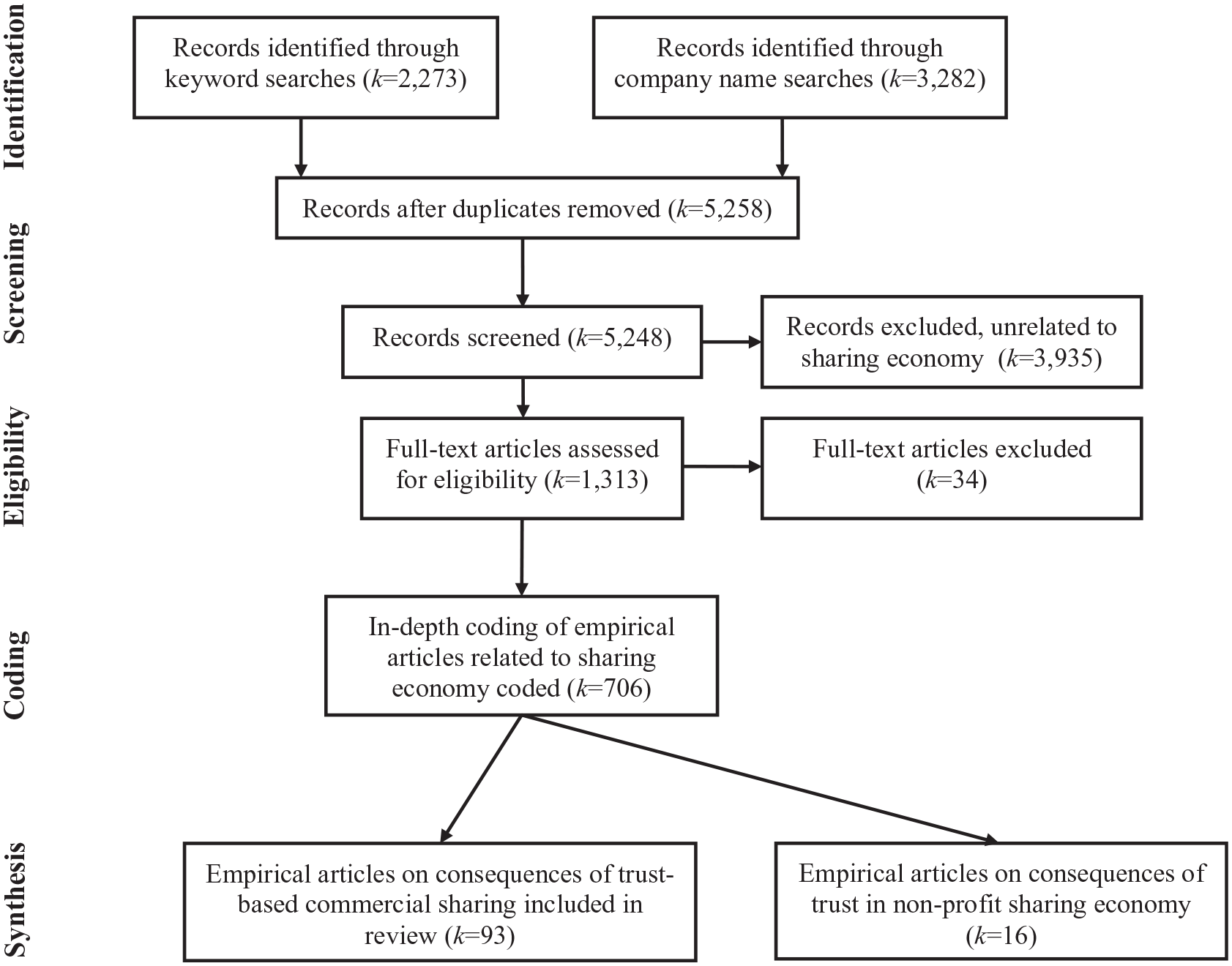
PRISMA Chart
Coding
The stepwise coding procedure entailed four independent coders (see full codebook in the online supplement). In short, the first coder, a research assistant, conducted the online search, extracting relevant papers from the initial corpus of studies. This step was done according to the prespecified criterion, namely, whether the paper deals with the sharing economy, defined as “peer-to-peer-based activity of obtaining, giving, or sharing the access to goods and services, coordinated through community-based online services” (Hamari et al., 2016). The title-screening procedure revealed 1,313 papers that relate to the sharing economy, 706 of which are empirical contributions that were subsequently subjected to a first round of coding. The focal point of our review is the consequences of trust-based commercial sharing—the participation in for-profit peer-to-peer sharing-economy activity. Therefore, we have submitted the 706 empirical contributions to a first round of coding assessing the two components of trust-based commercial sharing: (a) whether the papers mention trust and (b) whether the papers present empirical results on the consequences of sharing. This first round of coding yielded a sample of 96 studies.
After coordinating with the author team, a second coder, also a research assistant, conducted additional in-depth coding on the details of the studies, specifying the negative and positive consequences of participating in the sharing economy. It is important to note that some outcomes may be considered a positive consequence for some but a negative consequence for others. To maximize consistency in classifying these contributions, we adopted the perspective taken by the authors of each original study. In the last step, two of the authors (NK and IS) added additional information extracted from the empirical papers, calculated the effect sizes, and verified that those 96 studies indeed focus on the focal point of our review—the for-profit peer-to-peer sharing-economy activity. This final verification led to excluding three studies that did not focus on peer-to-peer activity, leading to a final sample of 93 studies in our review.
Results
We present our findings by clustering them into positive and negative consequences for participants and third parties. Table 1 summarizes the number of contributions appearing in our review for each of the categories, and next, we provide a narrative description of the main findings.
The Consequences of Trust-Based Commercial Sharing
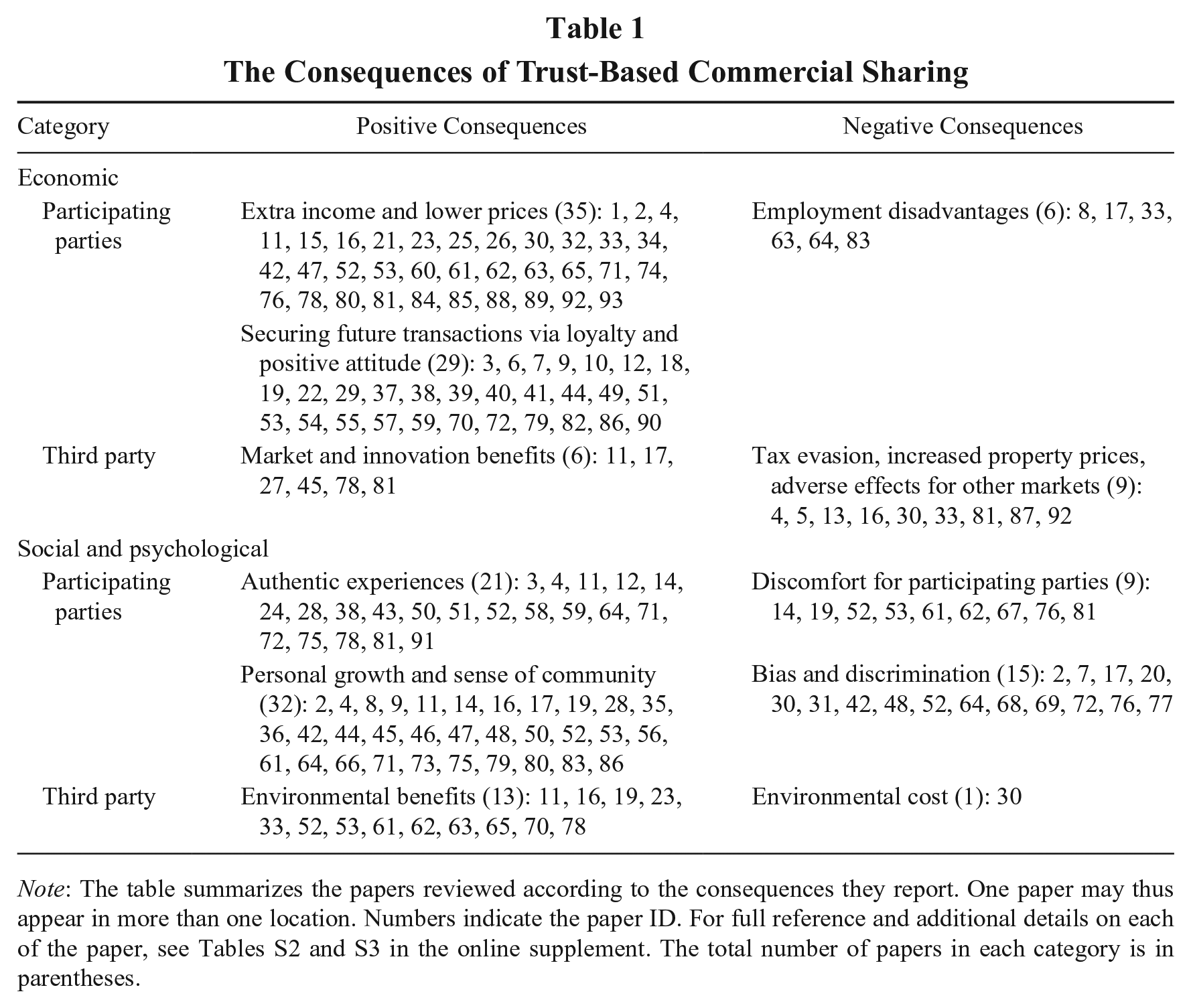
Note: The table summarizes the papers reviewed according to the consequences they report. One paper may thus appear in more than one location. Numbers indicate the paper ID. For full reference and additional details on each of the paper, see Tables S2 and S3 in the online supplement. The total number of papers in each category is in parentheses.
Positive Consequences
Economic Benefits for Participants
Extra income and lower prices
Both service providers and users stand to gain economically from trust-based commercial sharing (Cherry & Pidgeon, 2018; Mun, 2013; Richter, Kraus, Brem, Durst, & Giselbrecht, 2017). Evidence for sector-specific positive consequences for participating parties exists across a wide range of sharing platforms for various goods and services, such as crowdworking (Al-Ani & Stumpp, 2016), furniture sharing (Edbring, Lehner, & Mont, 2016), appliances sharing (Fremstad, 2016), meal sharing (Ter Huurne, Ronteltap, Guo, Corten, & Buskens, 2018), crowd-shipping (Rai, Verlinde, Merckx, & Macharis, 2017; but see also Punel, Ermagun, & Stathopoulos, 2018; Punel & Stathopoulos, 2017), and even insurances (Milanova & Maas, 2017). However, other studies reveal no employment benefits in the caregiving sector (Ticona & Mateescu, 2018).
In the car- and ride-sharing sector, providers and users benefit from trust-based commercial sharing. Drivers face lower entry barriers into the driving market and receive better pay while having more flexible working hours than they often do at traditional taxi companies (Kashyap & Bhatia, 2018; Vaclavik & Pithan, 2018). Users in turn profit from increased efficiency and affordability, in particular when using carpooling options, such as UberPool or Lyft Line (Sarriera, Álvarez, Blynn, Alesbury, Scully, & Zhao, 2017).
Extensive research has examined the house-/bed-sharing sector. Renting out spare rooms or couches via platforms such as Airbnb and Xiaozhu, a primary accommodation-sharing platform in China, generates new sources of income for house owners (Bernardi, 2018; Jordan & Moore, 2018). Hosts particularly benefit if trust is established via bilateral reviews (both sides review each other) because it leads to higher ratings and allows them to increase their prices (Proserpio, Xu, & Zervas, 2018). Hosts’ perceived trustworthiness leads to higher reservations of listings (Wu, Ma, & Xie, 2017). Users in turn can save money by making use of trust-based commercial sharing, such as staying in peer-to-peer accommodations, which provide cheaper alternatives to traditional options, for example, hotels (Apostolidis & Haeussler, 2018; Sthapit & Jiménez-Barreto, 2018; Toni, Renzi, & Mattia, 2016; Varma, Jukic, Pestek, Shultz, & Nestorov, 2016); in particular, shared rooms (vs. entire apartments) attract travelers who seek to save money (Lutz & Newlands, 2018). As another benefit, the prices for shared accommodation tend to be more stable (Gibbs, Guttentag, Gretzel, Yao, & Morton, 2018; Zervas, Proserpio, & Byers, 2017).
A main driver for increasing those economic profits is the establishment of trust. Hosts can charge higher prices if they have a trustworthy and attractive profile photo (Ert, Fleischer, & Magen, 2016) or if they disclose more information (Zloteanu, Harvey, Tuckett, & Livan, 2018), and guests with a trustworthy appearance are more likely to have their booking requests accepted (Karlsson, Kemperman, & Dolnicar, 2017). Similarity between hosts and guests in terms of age and education increases trust between them (Kwok & Xie, 2018). Besides personal characteristics, multiple studies have confirmed that signaling trust via positive ratings and reviews on the platform translates to higher revenues for hosts in Asia (Y. Wang, Xiang, Yang, & Ma, 2019; Xie, Mao, & Wu, 2019), Europe (Abrate & Viglia, 2019), and North America (Chen & Xie, 2017; Xie & Mao, 2017). As some authors argue, strong signals, such as being a “Superhost,” amplify this effect even further (Gunter, 2018).
Securing future transactions via loyalty and positive attitude
Besides the direct financial benefits that users and service providers obtain from taking part in trust-based sharing-economy activity, sharing also facilitates future economic transactions. Trust toward the sharing economy generally increases willingness to (re)use sharing-economy services (Hawlitschek, Teubner, & Gimpel, 2018; Smol, Avdiushchenko, Kulczycka, & Nowaczek, 2018), in particular when participating parties share the platform’s values (Na & Kang, 2018). A virtuous circle of trust can evolve, in which a validation of trust between peers galvanizes future transactions (Mun, 2013).
In the peer-to-peer accomodation sector, ample evidence suggests trust (signals) and successful transactions propel users to reuse shared accomodation (Alrawadieh & Alrawadieh, 2018; Bae & Koo, 2018; Birinci, Berezina, & Cobanoglu, 2018; Fagerstrøm, Pawar, Sigurdsson, Foxall, & Yani-de-Soriano, 2017; Lutz, Hoffmann, Bucher, & Fieseler, 2018; Malazizi, Alipour, & Olya, 2018; Muñoz-Leiva, Mayo-Muñoz, & De la Hoz-Correa, 2018; Tussyadiah & Pesonen, 2018; C. Wang & Jeong, 2018; but see also Möhlmann, 2015). Similar results have been obtained for collaborative traveling apps (Dickinson et al., 2017). Positive experiences and a confirmation of trust also improve people’s attitudes toward the platform itself (Mittendorf, 2018; C. Wang & Jeong, 2018; but see also S. Lee & Cho, 2015) and reduce switching intentions (Liang, Choi, & Joppe, 2018). As such, trust toward the host, the platform, and other users can feed off each other (Wu & Shen, 2018; S. Yang, Lee, Lee, & Koo, 2018). In general, positive experiences induce a feeling of loyalty toward the host and the platform (S. Lee & Kim, 2018; Priporas, Stylos, Vedanthachari, & Santiwatana, 2017) and even strengthen hosts’ attachment to fellow hosts (H. Lee, Yang, & Koo, 2019).
The empirical landscape of trust-based commercial sharing on future transactions in the transport-/ride-sharing sector is mixed. Whereas empirical findings suggest trust prompts the intention to (re)use such services (Bachmann, Hanimann, Artho, & Jonas, 2018; Barbu, Florea, Ogarcă, & Barbu, 2018; Ta, Esper, & Hofer, 2018; but see also Oyedele & Simpson, 2018) and lowers the perceived risks of participating (Z. Lee, Chan, Balaji, & Chong, 2018), other work has documented no effects of trust on (intended) future use (Barnes & Mattsson, 2017).
Economic Benefits for Third Parties
Market and innovation benefits
Third parties that do not take part in the sharing transaction can nonetheless gain economically from trust-based commercial sharing. Shared accommodation improves market outcomes by increasing competition among providers (Varma et al., 2016), sharing rides with peers instead of driving alone increases overall market efficiency (Cockayne, 2016), and the advent of such car-sharing platforms can, at least temporarily, increase new car sales (Guo, Xin, Barnes, & Li, 2018). Other studies show the participating parties also believe taking part in the sharing economy can contribute to the local community (Toni et al., 2016), whereas coworking can revitalize existing retail and commercial activities (Mariotti, Pacchi, & Di Vita, 2017).
Social and Psychological Benefits for Participants
Authentic experiences
Trust-based commercial sharing further provides social and psychological benefits (Mun, 2013; Rihova, Buhalis, Gouthro, & Moital, 2018), from fostering collaboration (Richardson, 2015) via increasing experienced convenience, such as saving time and effort when sharing appliances (Mun, 2013; see also Möhlmann, 2015), and fun when crowdworking (Al-Ani & Stumpp, 2016) to satisfaction with crowd-shipping deliveries (Ta et al., 2018).
Multiple studies in the peer-to-peer accommodation sector suggest showing trust by staying at a private person’s place instead of a hotel room increases guests’ satisfaction levels (Alrawadieh & Alrawadieh, 2018; Birinci et al., 2018; S. Lee & Kim, 2018; Priporas et al., 2017; see also Y. Yang, Tan, & Li, 2019), whereas a lack of trust conversely lowers the satisfaction levels (Mahadevan, 2018; Malazizi et al., 2018). Compared with a traditional accommodation option, staying in a peer-to-peer accommodation offers a personalized experience (Mody, Suess, & Lehto, 2017), one where tourists feel like locals (Apostolidis & Haeussler, 2018; Bernardi, 2018; Paulauskaite, Powell, Coca-Stefaniak, & Morrison, 2017; Varma et al., 2016) and can more easily make memorable experiences (Sthapit & Jiménez-Barreto, 2018; Toni et al., 2016), in particular when the hosts strive to make the guests feel at home (Camilleri & Neuhofer, 2017; Varma et al., 2016).
Similarly, within the car-sharing sector, trust-based commercial sharing leads to satisfaction (Barbu et al., 2018) and value co-creation, that is, an increased personalization of the experience that suits the users’ needs (Guyader, 2018). It also increases the available services, such as multihop ride sharing, thus increasing the number of available rides (Teubner & Flath, 2015), and users of carpooling enjoy its comfort and the reduced travel time (Sarriera et al., 2017). The use of digital channels common in the sharing economy further facilitates communication and connection with customers (Garrett, Straker, & Wrigley, 2017).
Personal growth and sense of community
Personal growth and getting to know, connect, and interact with strangers in a meaningful way mark some of the key benefits of taking part in the sharing economy. Taking part in trust-based commercial sharing can boost providers’ popularity (Mauri, Minazzi, Nieto-García, & Viglia, 2018), help them achieve their authentic self (Vaclavik & Pithan, 2018), and instill a sense of achievement and empowerment (Al-Ani & Stumpp, 2016; Tan, Tan, Lu, & Land, 2017), compared with those who do not take part in the sharing economy.
Further, sharing-economy platforms can have a social appeal for users (Tussyadiah & Pesonen, 2018) and providers (Newlands, Lutz, & Fieseler, 2018). Sharing-economy participants expand their social network value (Rihova et al., 2018) by making new contacts (Bernardi, 2018; Cherry & Pidgeon, 2018; Cockayne, 2016; Ladegaard, 2018; Mariotti et al., 2017; Milanova & Maas, 2017; Mun, 2013; Richardson, 2015; Sthapit & Jiménez-Barreto, 2018; Vaclavik & Pithan, 2018). Trust-based commercial sharing can further generate a sense of community (Edbring et al., 2016; Miller, Ward, Lee, D’Ambrosio, & Coughlin, 2018; Mody et al., 2017; Mun, 2013; Punel et al., 2018) and improve city connectedness (Teubner & Flath, 2015). Such social benefits are particularly pronounced when participating parties actively seek personal contact, such as when sharing a room rather than renting an entire apartment (Lutz & Newlands, 2018) or opting for carpooling instead of an individual ride (Sarriera et al., 2017).
Social and Psychological Benefits for Third Parties
Environmental benefits
One of the main appeals of the sharing economy is its positive environmental impact. Multiple studies across various platforms document the appeal of reducing resource use in general and lowering the carbon footprint in particular (Cherry & Pidgeon, 2018; Mun, 2013; Richter et al., 2017; Smol et al., 2018). Namely, a positive environmental impact is achieved in the ride-sharing sector (Kashyap & Bhatia, 2018; Punel et al., 2018; Punel & Stathopoulos, 2017; Rai et al., 2017; Sarriera et al., 2017), peer-to-peer tourism (Bernardi, 2018; Toni et al., 2016), and appliance sharing (Edbring et al., 2016; Fremstad, 2016).
Negative Consequences
Economic Costs for Participants
Employment disadvantages
Trust-based commercial sharing also has negative consequences. From an economic perspective, providers suffer from disadvantageous employment conditions. Drivers on ride-sharing platforms face severe pressure to meet incentive-based work schemes while not receiving pay for extra work when not driving their own car and lacking insurance (Kashyap & Bhatia, 2018). Providers often face heavy workloads (L. Wang, 2018), suffer from increased dependency on influential actors that the sharing economy brings about (Baek, Kim, Pahk, & Manzini, 2018), and report a lack of autonomy and a fear of receiving bad ratings from users (Cockayne, 2016). Overall, the characteristically blurry lines between employment and leisure in the sharing economy lead to vulnerabilities and uncertainties about social protection for providers (Rai et al., 2017) and can result in unregulated employment (Richardson, 2015).
Economic Costs for Third Parties
Tax evasion, increased property prices, and adverse effects for other markets
Shared accommodation can harm society when hosts do not pay taxes on the income they generate. Some research suggests participating parties are aware of such potential illegalities (Varma et al., 2016) and therefore engage in psychological processes to alleviate guilty feelings, such as by denying responsibility (Apostolidis & Haeussler, 2018). Peer-to-peer accommodation can also drive housing prices up (Cherry & Pidgeon, 2018; Jordan & Moore, 2018), which is a negative consequence from the perspective of those seeking to purchase a property.
Trust-based commercial sharing can harm other (traditional) markets, too, such as adverse effects of ride-sharing services on taxis and auto rickshaws (Kashyap & Bhatia, 2018). Similarly, peer-to-peer accommodation can incur costs for the traditional hotel sector (Apostolidis & Haeussler, 2018; Varma et al., 2016; see also Aznar, Sayeras, Galiana, & Rocafort, 2016). In particular, lower peer-to-peer accommodation prices and higher satisfaction levels slash into hotel sales (Blal, Singal, & Templin, 2018; Xie & Kwok, 2017), estimated to cost up to 8% to 10% in revenue losses (Zervas et al., 2017).
Social and Psychological Costs for Participants
Discomfort
Sharing experiences can cause discomfort among users and providers. Whereas guests in peer-to-peer accommodation platforms lament fewer and lower-quality services (Varma et al., 2016), particularly when the interaction with the host was unpleasant (Camilleri & Neuhofer, 2017), users of shared furniture and crowd-shipping complain about complicated use (Edbring et al., 2016; Punel et al., 2018; Punel & Stathopoulos, 2017), and crowd-shipping users worry about delivery conditions and lack of professionalism (Punel et al., 2018). In the car- and ride-sharing sector, carpooling users can endure being paired with unpleasant other passengers, remain uncertain about the length of the shared trip, and face less privacy than individual rides (Sarriera et al., 2017). Furthermore, such unpleasant experiences can perpetuate themselves: Users’ misbehavior, such as leaving a shared car in a dirty condition, can lead to similar misbehavior by successive users (Schaefers, Wittkowski, Benoit, & Ferraro, 2016).
Providers in turn face the discomfort of being exposed in the sharing economy. Their profiles tend to be more visible than the users’ profiles (Ticona & Mateescu, 2018), causing potential privacy and safety concerns (Mun, 2013).
Bias and discrimination
Several studies have critically examined the impact of online reputation and review systems on participating parties. They find providers fear bad and fake reviews (Al-Ani & Stumpp, 2016) and the corresponding exclusion from the platform (Cockayne, 2016). Other studies document systematic biases in these reviews, such as overgenerous ratings, which undermine trust (Bae & Koo, 2018). Such platform-mediated trust mechanisms in the sharing economy also bring about and perpetuate discrimination. Whether they are drivers on ride-sharing platforms (Tjaden, Schwemmer, & Khadjavi, 2018) or hosts on peer-to-peer accomodation platforms (Kakar, Voelz, Wu, & Franco, 2018), for identical services, minority-group providers (are forced to) charge lower prices than nonminorities. Other studies document general homophily tendencies, as crowdsourcing users provide more favorable ratings when drivers are of an ethnicity that matches their own (Ta et al., 2018).
Users also face discrimination. In the car-/ride-sharing sector, carpooling users face discrimination based on social class and ethnicity (Sarriera et al., 2017), whereas ethnic-minority passengers on ride-sharing platforms have lower acceptance rates and longer waiting times for replies (Simonovits, Shvets, & Taylor, 2018). Similarly, on peer-to-peer accomodation platforms, evidence exists of guest discrimination based on age, gender, race, and sexual orientation (Lutz & Newlands, 2018). A large field experiment in the United States, using a set of newly created Airbnb profiles, revealed that booking requests by guests with distinctly Black names were 16% less likely to be accepted than identical guests with names associated with White ethnicity (Edelman, Luca, & Svirsky, 2017).
Trust-based commercial sharing also reinforces (economic and social) inequalities in time banks, food swaps, maker spaces, open-access education platforms (Schor, Fitzmaurice, Carfagna, & Attwood-Charles, 2016), digital media (Cockayne, 2016), and care-work platforms (Ticona & Mateescu, 2018). It thereby contributes to corroding the social fabric of communities, such as when accommodation sharing undermines a sense of local community (Jordan & Moore, 2018), poses a threat to older adults’ independence (Miller et al., 2018), and leads to exclusion of those who are unwilling to provide personal information to prove their trustworthiness (Richardson, 2015).
Social and Psychological Costs for Third Parties
Environmental costs
Trust-based commercial sharing also negatively affects uninvolved third parties. These negative consequences consist of house-sharing platforms increasing traffic and congestion due to an influx of tourists (Jordan & Moore, 2018) for the residents. It further causes second-order environmental harm by increasing car sales following the introduction of car sharing, eventually leading to more traffic congestion and increased CO2 emissions (Guo et al., 2018). Hence, instead of reducing the number of rides, ride sharing might lead to more cars and traffic.
Discussion
The volume of trust-based commercial sharing activity is rapidly growing. Our preregistered systematic literature review provides an overview of the empirical knowledge into the consequences of trust-based commercial sharing, spanning across regions, sectors, and disciplines. Results indicate that although trust-based commercial sharing has various positive economic and social consequences, it also has non-negligible negative consequences for participants and third parties; see Table 1.
Next, we identify the common denominators at the root of the positive and the negative consequences. Our analysis suggests positive consequences stem from the infrastructural characteristics of the sharing economy (Sundararajan, 2016), whereas most negative consequences stem from ambiguities inherently associated with sharing-economy activities. Engaging with theories and current empirical insights from management and psychology, we accordingly introduce the transparency-based sharing framework. The framework outlines the benefits associated with increasing transparency about the consequences of sharing. Using the framework, we highlight the research avenues not yet explored and clarify the implications for management practice.
Common Denominators for Positive Consequences
Trust-based commercial sharing has positive economic and social/psychological consequences for participating parties. Positive economic consequences include (a) extra income and lower prices and (b) securing future transactions via loyalty and positive attitude. Positive social/psychological consequences include (c) authentic experiences and (d) personal growth and sense of community. Additionally, trust-based commercial sharing has positive economic consequences for third parties, in terms of market and innovation benefits, as well as positive social consequences, in terms of helping the environment.
A common denominator for the positive consequences is that they are enabled by technological facilitators of payment, insurance, and communication infrastructure (Sundararajan, 2016). The payment infrastructure of providing own in-app monetary transfer is financially advantageous for providers, allowing them to easily charge for (flexible) working hours (Kashyap & Bhatia, 2018), and for users, who save money compared to paying via traditional, nonsharing alternatives (Sarriera et al., 2017). The existing insurance infrastructure, such as basic coverage and refunds for damaged goods, has sufficed to reduce the risks of sharing valuable items and allowed ever more people to enter otherwise potentially risky transactions. Daring to share houses, rides, and other service enables participating parties to forge new contacts (Ladegaard, 2018), is often more convenient (Bernardi, 2018), and leads to more authentic experiences than traditional alternatives (Apostolidis & Haeussler, 2018; Paulauskaite et al., 2017). Finally, the unique direct-communication infrastructure, in the form of review and ratings systems, arguably plays the biggest role in the flourishing of trust-based commercial sharing. By receiving positive reviews and establishing a good reputation, providers are rewarded for working hard and offering high-quality services, whereas users can easily screen the market and select the most desirable alternative.
The positive consequences of trust-based commercial sharing also affect third parties, a less studied aspect, as Table 1 suggests. For example, trust-based commercial sharing can spur innovation, trigger economic revenue by invigorating adjacent markets, and even produce environmental benefits (Sarriera et al., 2017). As our review reveals, the introduction of ride sharing can boost short-term sales in the car industry, a positive effect for such adjacent market sectors (Guo et al., 2018). This observation is in line with findings documenting positive environmental effects as ride sharing reduces the overall distance covered per vehicle (Jacobson & King, 2009; but see Jin, Kong, Wu, & Sui, 2018). Together, those findings support the positive, green image that trust-based commercial sharing platforms often enjoy.
Common Denominators for Negative Consequences
Trust-based commercial sharing also carries negative economic and social/psychological consequences for participating parties. The negative economic consequence consists of employment disadvantages for the providers, whereas the negative social/psychological consequences include bias and discrimination. Additionally, trust-based commercial sharing has negative consequences for third parties—economically, in terms of tax evasion, increased property prices, and adverse effects for other markets, and from a social perspective, in terms of environmental costs.
A common denominator for the negative consequences arises out of the ambiguities associated with (a) the roles different parties take, (b) the terms of the transaction, and (c) who is (in)directly affected by the trade. Specifically, for service providers, the line between work and leisure becomes increasingly blurry, leading to precarious working conditions (Al-Ani & Stumpp, 2016; Cockayne, 2016). Drivers on ride-sharing platforms, for instance, often do not receive pay for extra hours (Kashyap & Bhatia, 2018). Further, ambiguities about one’s responsibilities often become apparent if the transaction goes astray, revealing the underspecified and vague contracts some platforms use. By setting some terms of the contract between users and providers, such as managing refunds in case of cancellation, platforms assume certain responsibilities. At the same time, platforms exclude themselves from being liable for transaction complexities, such as when the property is damaged or when inappropriate conduct takes place. Nontransparent information about which aspects are covered, and how the validity of claims is assessed, is a pressing challenge in trust-based commercial sharing (EU Commission, 2017).
Consider Airbnb’s recent “host guarantees” and “host protection insurance” policies (Airbnb, 2020b). Although the details about the responsibilities and coverages in a liability case are blurry, and Airbnb explicitly states it does not replace traditional coverages, participants often believe they are sufficiently insured (Ballestros, 2018). As our review shows, such ambiguities about responsibilities, aggravating the differentiation between “fake” and “real” assurances, can create discomfort ranging from lower service quality (Varma et al., 2016) and unpleasant interactions (Camilleri & Neuhofer, 2017) to misbehavior (Schaefers et al., 2016) or privacy concerns (Mun, 2013).
Also, the rating and review systems—the key trust enabler in the sharing economy—entail ambiguities and systematic bias. The facial picture and name serve as the first, most salient determinants for the initial establishment of trust-based commercial sharing. Our review shows that, contrary to the notion that reviews merely reward merit, ample evidence reveals systemic biases in the reviews, which in turn distort the predictive value of the reviews. Specifically, people with non-White names (Edelman et al., 2017; Simonovits et al., 2018) and other minorities (Ameri, Rogers, Schur, & Kruse, 2020) have to pay a price premium to be trusted in the sharing economy. Moreover, even after establishing a transaction, the review systems can produce biases in reviews, such as participants trying to game the system by pressuring their counterparts into inflated ratings (Dellarocas, 2010; Luca, 2017) and the extent to which ratings influence search results (EU Commission, 2017).
Underlying ambiguities have negative consequences for uninvolved third parties, such as creating false impressions about the positive environmental impact of sharing. Our review suggests house-sharing services can increase housing prices in the real estate market (Jordan & Moore, 2018), cause losses in tax revenues when professional providers act under the guise of being nonprofessionals (Apostolidis & Haeussler, 2018), and increase congestion in residential neighborhoods by an influx of tourists (Jordan & Moore, 2018). At the same time, we find participating parties often believe trust-based commercial sharing does create positive third-party effects (Toni et al., 2016). Such optimistic beliefs can propel participating parties—in particular, users—to (repeatedly) opt for a sharing-economy alternative and neglect the negative consequences that arise from doing so (Apostolidis & Haeussler, 2018).
Transparency-Based Sharing Framework
To increase responsible sharing—sharing while considering the various consequences of doing so—awareness of the negative consequences is key. Our review reveals participating in trust-based commercial sharing creates both positive and negative consequences for interacting as well as third parties. Intriguingly, whereas much of the literature is devoted to the positive consequences of sharing, less work focuses on the negative consequences. Nonetheless, emerging from our review, the common denominator for the negative consequences is the ambiguity about the consequences of engaging in a trust-based commercial sharing activity.
Given that the sharing economy often provides the most financially attractive alternative, it is especially challenging to make users consider its negative sides, the reason being people’s motivated reasoning (Grossman, 2014; Kunda, 1990)—the tendency to interpret reality in a self-serving way. Indeed, work in management and psychology reveals that people avoid information about the potential impact of their actions on others (Dana, Weber, & Kuang, 2007; Grossman & van der Weele, 2017), a phenomenon known as wilfull ignorance. Furthermore, compared with more transparent settings, ambiguity allows people to justify violating rules (Shalvi, Dana, Handgraaf, & De Dreu, 2011; Shalvi, Gino, Barkan, & Ayal, 2015), interpret available information in a self-serving way (Bénabou & Tirole, 2016; Epley & Gilovich, 2016; Shu, Gino, & Bazerman, 2011), and pay selective attention to available information (Bazerman, 2014; Chugh, Bazerman, & Banaji, 2005; Gino, Norton, & Weber, 2016).
In the context of trust-based commercial sharing, willful ignorance—the intentional avoidance of often uncomfortable information—may be especially pronounced when sharing-economy participants feel that by participating, they are doing good, a message advocated by many platforms. Trust-based commercial sharing platforms often advocate using their services as means to promote “sharing,” “trust,” and “community building.” The emphasis on positive valence and social concepts, such as being part of one community, fosters collective trust by increasing a sense of in-group membership among users and providers (Kramer, 2010). Emphasizing the positively valenced concept of trust, a strategy identified in our review, echoes research on eco-labeling—markers that indicate the eco-friendliness of food items—suggesting that signaling a green, environment-friendly image via these labels often increases trust (Sønderskov & Daugbjerg, 2011). As a consequence, such labels foster pro-environmental consumer behavior (Taufique, Vocino, & Polonsky, 2017), even though these labels are not always reliable (Daugbjerg, Smed, Andersen, & Schvartzman, 2014). Similarly, research on framing effects shows that highlighting specific information can have immense effects on information processing and consequential behavior (for a review, see Chong & Druckman, 2007). Thus framing trust-based commercial sharing in a positive way can potentially overshadow or distance negative consequences.
Consider the recent coronavirus (COVID-19) crisis that has disrupted all economic sectors. The trust-based commercial sharing platforms have quickly adapted to the situation offering potential solutions to keep businesses running. Airbnb has launched the #frontlinestay campaign facilitating hosts to offer their places to coronavirus responders and health workers (Airbnb, 2020a); Uber provided free deliveries for health care workers (Hawkins, 2020); food and grocery delivery drivers have been applauded as being the lifelines for the vulnerable parts of the society in need of staying isolated (Essif, 2020). At the same time, those platforms have been criticized for placing business over health and, by so doing, putting people at risk. Airbnb has received pushback for allowing the advertisement of rentals as “ideal places for self-isolation” (Criddle, 2020), putting a strain on local communities and hospitals (Watson, 2020); Uber has been criticized for failing to provide social security and health care protection for its workforce (Nova, 2020). Consequently, many sharing-economy workers, including the much-needed food and grocery delivery workers of Instacart, were forced to work while sick (Dickey, 2020) and with insufficient protection (Essif, 2020). The platforms do not demonstrate sufficient means to ensure the hygiene standards they promote (Watson, 2020), resulting in an increase in risks of infection for providers, users, and third parties.
The recent COVID-19 situation demonstrates the inherent complexity identified in our review. The combination of (a) ambiguities about roles and responsibilities, (b) the positive framing platforms use to promote sharing, and (c) the biased way in which people process information may lead participants to neglect the negative consequences associated with trust-based commercial sharing. Clearly, to encourage responsible sharing, people need to know the consequences of their actions. In Figure 2, we introduce a novel transparency-based sharing framework. Our framework is grounded in organizational research advocating that stimulating and maintaining trust between stakeholders and organizations requires transparency—the degree of visibility and accessibility of information (Zhu, 2002).
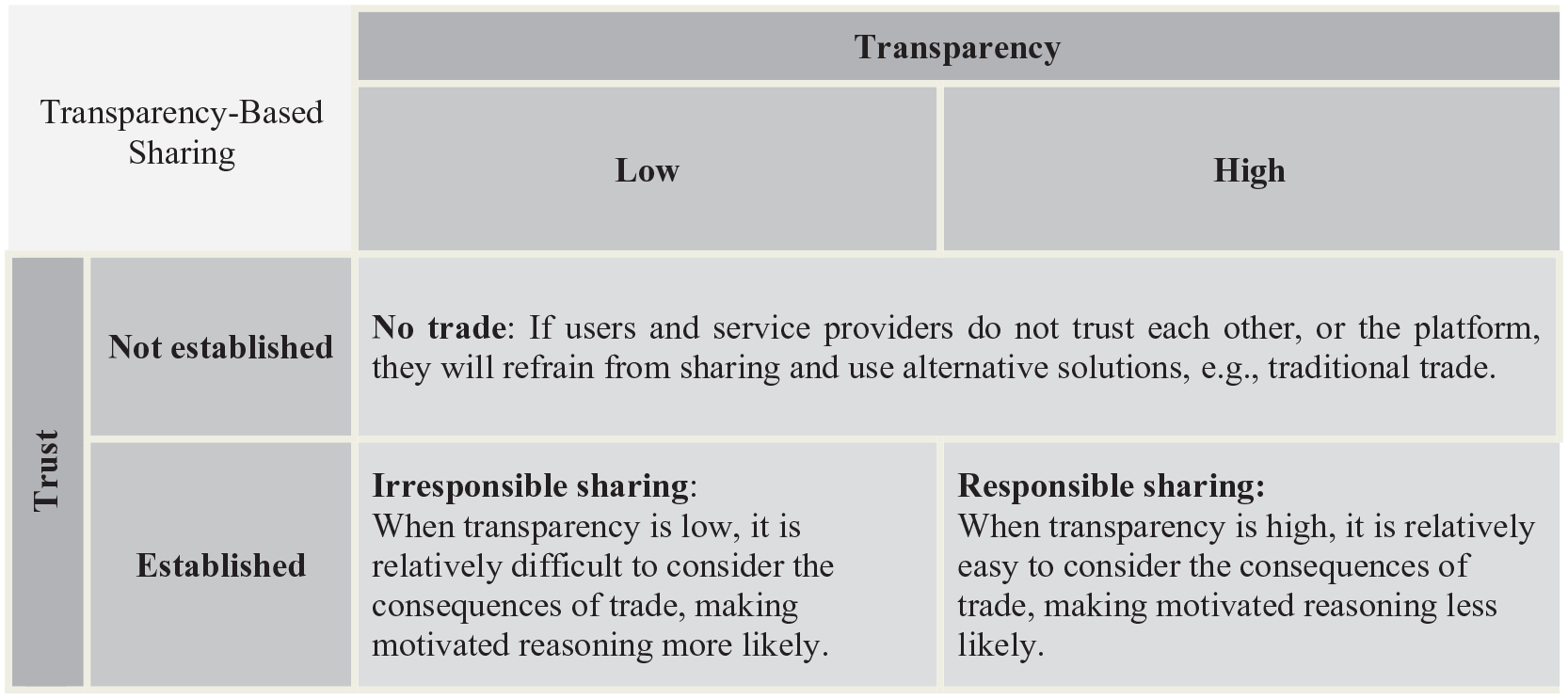
Transparency-Based Sharing Framework
Novelty and Scope of the Framework
Novelty
The framework is novel in three ways. First, it highlights the role of behavioral mechanisms in shaping awareness of the consequences of sharing, enabling responsible sharing. Understanding behavioral mechanisms squarely fits recent calls for using behavioral scientific insights in shaping policy by the World Bank (2015) and the Organisation for Economic Co-operation and Development (2017). Policy makers almost universally treat responsible sharing as a “good thing” and accordingly operate to incentivize consumers’ behavior according to normative benchmarks they consider appropriate (Pigors & Rockenbach, 2016). Viewed from the transparency-based sharing framework perspective, however, at least some of these attempts appear to be misaligned with their original goal, because they do not sufficiently consider the paradoxical nature of participants’ information-seeking tendencies and willful ignorance. Second, compared with prior work focusing on either the antecedents of sharing (Ter Huurne et al., 2017) or the impact on the participating parties (Gerwe & Silva, 2020), the transparency-based sharing framework is the first to look at both positive and negative outcomes, for participants as well as third parties. Third and finally, the transparency-based sharing framework gives a new role to transparency. Contrary to Schnackenberg and Tomlinson (2016), who look at transparency as an antecedent of trust, we look at transparency as a tool to attenuate the negative consequences of sharing. As such, the transparency-based sharing framework highlights transparency’s important role in facilitating responsible sharing.
Scope
The transparency-based sharing framework is most suitable to understand trust-based commercial sharing, not traditional economic trade. Although the adverse consequences highlighted in the transparency-based sharing framework apply to all traditional economic interactions, they are more likely to emerge in trust-based commercial sharing because of the unique role of the platform—serving as both an economically interested party and a regulator. To clarify the unique role of platforms, think of a traditional business-to-consumer interaction. In such traditional settings, consumer protection laws and other rules set by the government help foster trust between the counterparts and provide protection from exploitation and unwanted negative consequences. In these cases, some parts of the contract between consumers and businesses are preset by the law (e.g., the right of withdrawal within 14 days), and if something goes wrong, the counterparts expect the law to intervene and settle the issue. Similarly, commercial platforms set rules and important parts of the contract between participants (e.g., cancellation fees). However, platforms often deny responsibility for solving issues emerging among participants (EU Commission, 2017). This regulatory role taken by the platform is not present in traditional economic interactions (van Doorn, 2019). The role poses challenges, especially given the lack of official regulations and in combination with the for-profit nature of the commercial platform. Clear examples of how this tension can play out and generate negative outcomes that are unique to trust-based commercial sharing emerge from our results, for example, the ambiguity about whether drivers of food delivery companies are employees or freelancers (Kashyap & Bhatia, 2018), the opaque coverage of the insurance provided by platforms (Miller et al., 2018), or the emergence of discrimination in house- and bed-sharing platforms (Edelman et al., 2017).
The transparency-based sharing framework is not suitable for understanding nonprofit sharing platforms. Nonprofit platforms differ from commercial platforms because they do not seek to secure profits and are better able to select participants committed to “true sharing,” not only to minimizing costs (Sundararajan, 2016). In that regard, nonprofit sharing platforms are comparable to the principled negotiation approach that aims to identify and satisfy underlying basic needs of all parties to create mutually beneficial outcomes (Fisher, Ury, & Patton, 2011). Adopting such an approach, platforms such as Timebank or couch-surfing are less likely to generate negative consequences because they are closer to bartering than to monetary transactions. In a recent book, Gunia (2018) discusses how, compared with the standard monetary mindset we use in all economic transactions—which paints a “competitive, adversarial, fixed-pie view of the world” (Gunia, 2018: 16)—the use of a bartering mindset can help shift the perspective of economic transactions to a win-win situation. In pure barter economies, the counterparts have to consider multiple parties with their needs and their offerings and have to focus on mutually beneficial deals. Indeed, nonprofit sharing-economy platforms seem less likely to create negative consequences because, on the one hand, they are less likely to misrepresent what their goals are and, on the other hand, attract users who are genuinely interested in sharing and bartering and not just those interested in cutting costs.
Directions for Future Research
We identify and discuss three main avenues for future research on trust-based commercial sharing. The first avenue emphasizes the need to fill the gaps in knowledge about the existence of the negative consequences of trust-based commercial sharing for third parties, and people’s perceptions about those consequences. The second avenue highlights the need to increase our understanding of how basic behavioral mechanisms translate ambiguity into unawareness of the negative consequences of trust-based commercial sharing. The third avenue outlines the importance of policy-oriented research-testing interventions aimed at increasing responsible sharing.
Insights Into Negative Consequences for Third Parties
The first avenue for future research relates to the lack of knowledge on the impact of trust-based commercial sharing on third parties. Three considerations motivate the need to collect better data and evidence about the impact. First, the small number of papers studying the negative consequences for third parties identified in our review clashes with the growing number of politicians and activist groups warning about important societal consequences of commercial sharing. Such consequences include, for example, unfair competition due to sharing transactions eluding safety or health regulations (Henley, 2017); externalities on local communities, such as overuse of local resources, noise, and increased rents (New York Times, 2014); and tax evasion (Süddeutsche Zeitung, 2019). Second, some of the reasons that have been traditionally put forward to support sharing, such as the lower impact of ride sharing on the environment, still require additional evidence to determine if their effects are in fact positive. Although initially advocated as a possible solution to emerging environmental challenges, the actual environmental impact of ride sharing is a topic of much debate (Jin et al., 2018). Whereas some studies suggest the introduction of ride-sharing platforms reduces the overall distance covered per vehicle (Jacobson & King, 2009), others suggest it increases rides and CO2 emissions (Barrios, Hochberg, & Yi, 2020). To best inform people about the impact of trust-based commercial sharing compared with traditional economic interactions, accumulating clear evidence and transparently communicating it are needed.
Our review shows that research using objective empirical measures of the impact of sharing along with an assessment of people’s perceptions of such impact is lacking. The papers surveyed in the literature review use either empirical data, such as the impact of house sharing on hotel revenues (e.g., Zervas et al., 2017), or questionnaire data about respondents’ perceptions, such as the sense of belonging to a community (e.g., Punel et al., 2018). The joint use of quantitative approaches to estimate the consequences for third parties with the assessments of people’s perceptions seems like a fruitful avenue for future research. For example, actual traffic congestion rates and particulate matter (PM10) pollution levels could be used to estimate the impact of the entry of car-sharing platforms on the market and be paired with large surveys assessing people’s perceptions of such an impact. Knowledge about the gap between reality and perceptions is essential in order to unpack the environmental motivations of both users and platforms. With such knowledge, we can understand whether these motivations are grounded in incorrect beliefs and point to the most fruitful ways to increase awareness of the consequences.
Studying the Mechanisms Driving Negative Consequences
The transparency-based trust framework suggests that when trust is promoted but ambiguity about the consequences of sharing is high, participants’ motivated reasoning (e.g., willful ignorance, self-serving justifications) may lead them to share irresponsibly. To date, research providing behavioral insights into sharing decisions is sparse, and many knowledge gaps remain. For example, several research questions remain unanswered: What are the sharing economy settings most likely to promote ambiguity? Are users and providers equally susceptible to the positive rhetoric of the platforms? Do users and providers engage in motivated reasoning to the same extent? Are those questions answered differently across different sharing economy sectors? Answering these and related questions will help us understand how transparency can be better used to curb the negative consequences of sharing and its limits as a tool to increase responsible sharing.
Take for example the case of ignorance, which can be present on both participants’ and the platform’s sides. Participants may not be motivated to search for information about the inconvenient consequences of sharing as those can generate discomfort or even change their decision to share. In such case, the platform, having aligned incentives, would not necessarily be incentivized to increase transparency. However, even if transparency is increased, whether due to the platform or a regulatory decision, willful ignorance on the participants’ side may still occur; see Figure 2 bottom panels. It is thus vital for future research to map the exact circumstances in which transparency about the consequences of sharing reduces willful ignorance. Such a task becomes even more important as in some cases, willful ignorance can also emerge on the platform’s side. The platform may not store useful information regarding participants’ behavior, such as Uber not closely monitoring its drivers’ compliance with regulations about maximum working hours (Kruzman, 2017). Such ignorance allows the platform a level of plausible deniability in case of legal issues between users and providers and, in some cases, help the platform plausibly deny having information about participants’ use. Related questions remain open: To what extent do sharing economy participants and/or sharing platforms engage in willful ignorance?” Are there settings in which the incentive to avoid information by the platform and/or by the participants is not aligned? Can misalignment in incentives to avoid information be used to increase information transparency? Is ignorance strategically used by platforms to deny responsibility? Addressing those questions, which relate to interactions between the different parties, each holding different motivations, calls for new research with a high level of methodological sophistication, in particular, in terms of assessing the various motivations parties have and how those affect both information-search patterns and the use of various platforms.
Policy-Oriented Research on Responsible Sharing
One main point of emphasis for policy-oriented work is improving the rating and review systems, as manifold forms of biases exist that require further empirical scrutiny (Dellarocas, 2010; Luca, 2017). Our review suggests that in general, providers are more vulnerable than users to biased reviews (Cockayne, 2016). The trend toward online social ratings has redefined the meaning of being a customer, turning users into bosses for the respective service providers (Dzieza, 2015). Service providers fearing bad reviews might become susceptible to blackmail or extortive reviews (“I will review you negatively if you do not . . .”) or might actively game the review system themselves, for example, by encouraging fake reviews. Future research is needed to address how unjustified reviews can be appealed in a way that is fair and transparent for the providers. Also, how likely are users to comply with requests to provide fake or inflated reviews? Does moving beyond one general rating for the entire experience lead users to be less willing to contribute to the public good of reliable reviews? Could digital traces collected during transactions enable a verification of the reviews by tying reviews to objective criteria?
Another issue for future research to address pertains to distrust created in noisy review signals. Some scholars argue trust and distrust represent two different concepts that coexist in multidimensional relationships and that need to be present for well-functioning organizations (Lewicki, McAllister, & Bies, 1998). The idea is that having a certain level of distrust caused by negative experiences in one domain does not necessarily reduce trust in other domains in which one had positive experiences. A question that is still open concerns the exact signals that users rely on to determine whether to trust or distrust a given review score. Additional open questions include, for example, how distrust based on biased reviews on one platform influences users’ willingness to engage in trust-based commercial sharing on other platforms or how transparent reputation systems of fake reviews can reinstall trust.
Besides contributing to improvements of the review systems, evidence-based policy making requires more research assessing the effectiveness of different strategies to increase transparency. In particular, research examining the market forces that might induce more responsible sharing practices is lacking. Although only a fraction of participating parties may be affected by transparent information about the negative consequences, how large this share actually is remains unknown. Reform efforts would greatly benefit from research analyzing how many users would be willing to pay a price premium for sharing responsibly and how many providers would abstain from entering the gig workforce if they received transparent information. Market research estimating the price elasticity of supply and demand for trust-based commercial sharing provides relevant information to identify whether a market for more responsible sharing can exist. Also, how should regulators incentivize platforms to actively participate in increasing transparency and reduce harm for third parties? Further, what type of user is willing to pay extra for responsible sharing? And how can providers cater toward this group of users?
Implications for Management Practice
Trust-based commercial sharing has positive as well as negative consequences, and balancing the two is crucial to encourage responsible sharing. Policy makers, companies, and participants often consider the cheaper prices of trust-based commercial sharing or the flexible work opportunities it creates. Those opportunities are indeed valuable to many. At the same time, the use of trust-based commercial sharing is also associated with discrimination, weak to nonexisting employee rights, and burdening of residential communities. The transparency-based sharing framework we put forward is aimed at encouraging discussion, future research, and wide consideration of the delicate trade-off between facilitating versus restricting the new and valuable emerging market. Specifically, policy makers and managers seeking a deeper understanding of the delicate equilibrium between the motivations of all involved parties must consider the need to transparently discuss the negative consequences without demolishing trust or significantly reducing trade. Assuming (at least some) participants and platforms are motivated to share responsibly, a wisely crafted and transparent provision of inconvenient information would help build “good” forms of trust rather than trust leading to opportunistic behavior. By acknowledging the existence of a tension between the positive and the negative consequences of trust-based commercial sharing, we can facilitate responsible sharing.
For platforms seeking to promote responsible sharing, a pressing question is how transparency can be increased without reducing the platform’s economic activity—leading to challenging trade-offs. Namely, sharing-economy platforms having a stake in establishing and maintaining transactions between users and providers can lead to conflicts of interest. Consider the empirical evidence for the occurrence of racial biases in the booking process in the sharing economy (Edelman et al., 2017; Kakar et al., 2018). Our review indicates such biases stem to a large extent from participating parties gauging the trustworthiness of the counterpart based on profile pictures (Ert et al., 2016). Such facial trust cues are noisy and also contribute to the perpetuation of racial, gender, and religious biases. Recent research suggests that even informing people about the existence of such biases in facial perception does not lead to a reduction in biased choices (Jaeger, Todorov, Evans, & van Beest, 2020). Following recent advice based on empirical insights, platforms could deemphasize (Ert et al., 2016) or remove profile pictures or even names altogether (Edelman, 2016). Bear in mind that when opting for traditional options, like hotels, people do not take into account profile pictures for the booking process. Yet, implementing such a strategy in trust-based commercial sharing platforms increases the risk of losing revenue, as it undermines the establishment of trust, a key currency in the sharing economy. Hence, when providing information to users, sharing-economy platforms may face a trade-off between promoting racial equality and promoting trust.
Trade-offs also emerge when increasing transparency with providers. As the review highlights, precarious working conditions for gig workers stem in part from ambiguous information about the type of contract offered and role that service providers play (Ritov & Schurr, 2020). For example, increasing transparency could consist of informing drivers on ride-sharing platforms in advance about a potential “deactivation” when they fail to reach a review-score target or letting them know about the exact remuneration for offline working hours (Kashyap & Bhatia, 2018). Although such transparency enables providers to make a more informed decision to enter the contract, it also likely raises the low entry threshold by increasing bureaucratic demands. As a consequence, fewer drivers might join the gig workforce, which eventually leads to a loss in revenue for ride-sharing platforms. Thus, providing transparent information to providers can come with a cost for the sharing-economy platforms.
Conclusions
The trust-based commercial sharing platforms are growing rapidly in popularity, thriving from the internet’s ability to coordinate markets efficiently and leading strangers to trust each other. Those platforms have transformed many business transactions into semipersonal exchanges. The positive consequences of trust are ample, but the negative consequences should not be ignored. Our systematic review of all existing work on the consequences of trust-based commercial sharing suggests that to ensure service providers, users, and third parties all prosper and are protected, trust should be encouraged transparently. By advocating for transparency in the sharing economy, we hope our work will contribute to achieving responsible sharing.
Supplemental Material
JOM_SOM_R4 – Supplemental material for The Consequences of Participating in the Sharing Economy: A Transparency-Based Sharing Framework
Supplemental material, JOM_SOM_R4 for The Consequences of Participating in the Sharing Economy: A Transparency-Based Sharing Framework by Nils C. Köbis, Ivan Soraperra and Shaul Shalvi in Journal of Management
Footnotes
Acknowledgements
The research was financially supported by the European Research Council (ERC-CoG-865931) and a Dutch Research Council (NWO; Vi.Vidi.195.137). We thank Franziska Yasrebi and Marleen Troost for their help with coding.
Supplemental material for this article is available with the manuscript on the JOM website.

References
Supplementary Material
Please find the following supplemental material available below.
For Open Access articles published under a Creative Commons License, all supplemental material carries the same license as the article it is associated with.
For non-Open Access articles published, all supplemental material carries a non-exclusive license, and permission requests for re-use of supplemental material or any part of supplemental material shall be sent directly to the copyright owner as specified in the copyright notice associated with the article.
