




Abstract
Inventors are triply embedded. They are embedded in a network of knowledge components that they can reuse in future inventions. They are embedded in an inventor network, where internal embeddedness (the strength of relationships between focal inventors and their colleagues upon whose knowledge the team builds) and network centrality influence access to information. Finally, they are embedded in the firm, with its specific routines that favor external or internal knowledge search, what we call search orientation. Using a sample of 39,785 semiconductor patents, we study the pattern of knowledge reuse, or the recombination of technologically similar components, on invention impact. We propose that reuse of internal knowledge affects invention impact in a concave manner and posit that internal embeddedness steepens this relationship while network centrality leads to an inflection point shift. We examine whether these effects differ for subsamples of firms with inward- or outward-looking search orientation. We find that inward-looking firms’ optimal pattern of internal knowledge reuse does not differ markedly from that of outward-looking firms. We find that inward-looking firms are more susceptible to internal embeddedness and that centrality in the collaborative network flattens rather than shifts the relationship between reuse and impact. These findings elevate the theoretical discourse of embeddedness from the effects of network positions on innovation outcomes to similar network positions having asymmetric effects that vary with the firm’s search orientation. Our results contribute to an emergent area in innovation research on how inventor networks shape the inventive process and its outcomes.
The development, acquisition, management, and transfer of knowledge within and across firms has occupied scholars for decades (Appleyard, 1996; Grant, 1996; Kogut & Zander, 1992; Matusik, 2002; Polanyi, 1966, 2009). In general, knowledge evolves through recombinant processes and the exchange of ideas (Johnson, 2011; Nelson & Winter, 1982; Schumpeter, 1934), both within and beyond organizational boundaries, by individuals who are embedded in knowledge and collaborative networks that support the pooling of resources (Guan & Liu, 2016; Uzzi, 1996). During the recombinant process, inventors exploit their social networks in order to gather insights, validate information, and challenge their own vantage points. We focus on a subset of recombinations, namely, those that reuse technologically similar components, and hypothesize that internal knowledge reuse relates curvilinearly (inverted U shape) to invention impact. We examine how these concave relationships are influenced by network characteristics and a firm’s search orientation.
The relationship between the reuse of technologically similar components and invention impact is explained by two counteracting latent mechanisms. 1 Absorptive capacity increases with the degree of reuse because the prior use of components creates knowledge in which absorptive capacity is grounded (Zahra & George, 2002; Zou, Ertug, & George, 2018). At the same time, an increasing degree of reuse reduces the novelty creation potential, because teams that rehash similar component combinations exhibit less exploration, which negatively correlates with novelty and eventually with impact. Both absorptive capacity (which influences an invention’s usefulness) and novelty are required to create a patentable invention. Thus, we suggest that the concave shape is explained through the multiplicative effects of increasing team absorptive capacity and decreasing novelty creation as the degree of reuse increases (Gilsing, Nooteboom, Vanhaverbeke, Duysters, & van den Oord, 2008; Nooteboom, van Haverbeke, Duysters, Gilsing, & Van den Oord, 2007).
Recombinant processes, however, do not happen in a vacuum. Prior research has established that inventors are doubly embedded in knowledge networks and in networks of collaborative ties (Guan & Liu, 2016; C. Wang, Rodan, Fruin, & Xu, 2014). We investigate the moderating role of two dimensions of the collaborative tie network. Internal embeddedness is the quality of being ingrained in an intraorganizational network of social relationships that enable knowledge exchange through the routinization and stabilization of linkages among organizational members (Gulati, 1998; Uzzi, 1996). This specialized form of embeddedness captures the relative ease (in terms of tie strength) with which the focal team has access to colleagues with domain knowledge. We posit that as internal knowledge reuse increases, internal embeddedness will steepen the concave relation between reuse and impact. Next, we look at the moderating effects of a team’s network centrality, which we operationalize through the team members’ mean degree centrality in the industry collaboration network. We argue that network centrality will enhance a team’s potential for novelty creation thanks to increased access to information. This leads us to suggest that the moderating effect of network centrality will consist of an inflection point shift of the relationship between internal knowledge reuse and invention impact.
Finally, we add a third layer of embeddedness by recognizing inventor teams are also embedded within their own firms. Such firms, even within an industry, can be highly heterogeneous, and much-studied differentiators are the firm’s knowledge base and search behavior (Hoopes, Madsen, & Walker, 2003; March, 1991; H. Wang, Choi, Wan, & Dong, 2016). Search orientation is a characteristic of the firm’s knowledge base that reveals the firm’s historical tendency to search internally or externally, which could affect the effectiveness with which firms reuse knowledge. We split our sample into two separate groups of internally and externally oriented firms and ask whether the hypothesized effects would differ for either.
This research contributes to an emergent area in innovation research that examines the interplay of the knowledge network from which teams select and reuse components and the collaboration network in which they are embedded (Guan & Liu, 2016; C. Wang et al., 2014). Prior work finds that both networks are decoupled because collaborative patterns of researchers differ from co-occurrence patterns of components because an industry’s knowledge component combinations at least partially precede the current community of active researchers (C. Wang et al., 2014). By investigating interactions between knowledge reuse and collaborative networks at the level of the invention, our study advances our understanding of how knowledge and inventor networks are interlinked and jointly influence the impact of inventions.
Our findings shine new light on the “paradox of embeddedness,” which suggests that embeddedness may facilitate as well as hinder knowledge transfer (Asakawa, Park, Song, & Kim, 2017; Uzzi, 1997). While studies have shown that different types of embeddedness can influence knowledge-related outcomes in diverse ways (e.g., Asakawa et al., 2017), we find that the same type of embeddedness (network centrality) can have diverging consequences depending on the firm’s search orientation. Thus, we expand the notion that inventors are doubly embedded in networks of knowledge components and knowledge holders (C. Wang et al., 2014) to a third layer of embeddedness in the firm with its idiosyncratic search orientation. Given that we expose diverse moderating effects of network centrality on reuse, our findings suggest that purely structuralist network arguments are insufficient to explain innovation success. This opens avenues for research into the influence of network structure on actor behavior.
Theory Development
We follow Nelson and Winter (1982), who argued that the inventive process “consists to a substantial extent of a recombination of conceptual and physical materials that were previously in existence” (p. 130). The “conceptual materials” of interest are knowledge components that an inventor team uses as inspiration, or as source material, for a new invention. An invention is then the outcome of a process of recombination of a number of knowledge components. We define reuse as a subset of recombination, namely, the extent to which a current invention builds on similar knowledge domains as did its source materials. Source materials that refer to domains that are distinct from the focal invention’s domains are also used in the recombinant process, for inspiration, but are not reused. Figure 1 summarizes our hypotheses and guides our theoretical narrative.
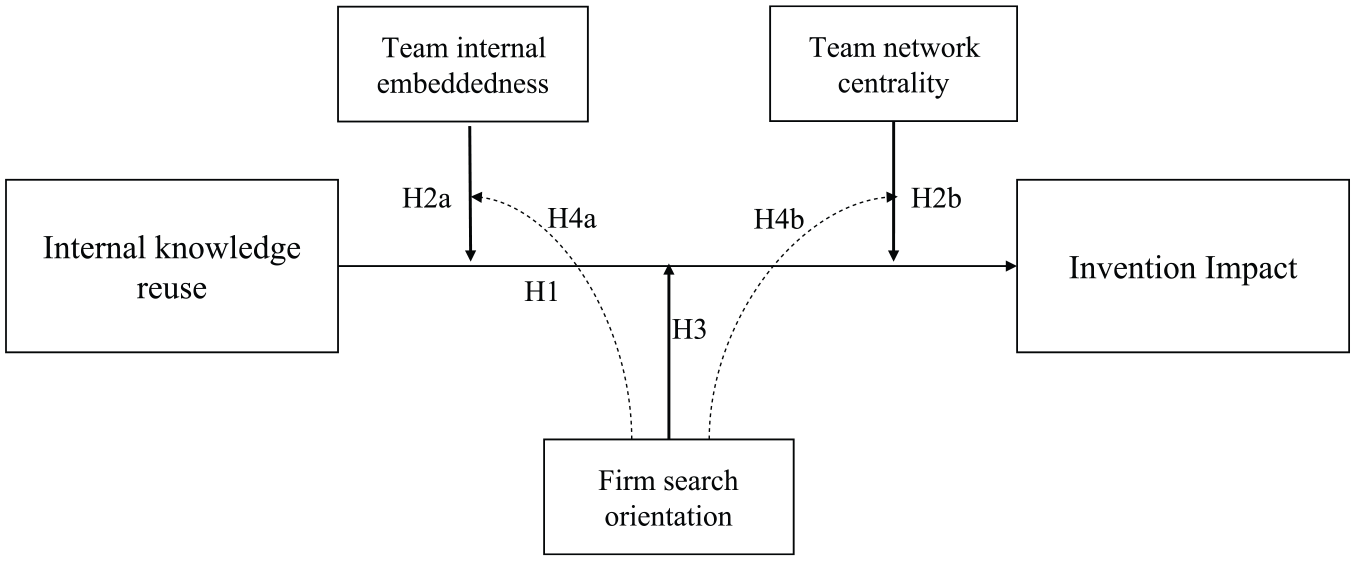
Model Overview and Hypotheses
Internal Knowledge Reuse and Invention Impact
Invention impact reflects the number of times a specific invention has been recombined in the creation of other inventions. Inventions that inspire many other inventors are influential, much like highly cited academic papers (Keijl, Gilsing, Knoben, & Duysters, 2016). We explain the effects of internal knowledge reuse on invention impact through a multiplicative combination of two mechanisms with opposing effects, leading to a concave (inverted U) relationship (Haans, Pieters, & He, 2016). 2 The two explanatory mechanisms are absorptive capacity, which correlates positively with reuse and enables teams to come up with useful inventions, and the potential for novelty creation, which correlates negatively with reuse and is evidently linked to novelty. Because both absorptive capacity and novelty creation are positively correlated to invention impact (Arts & Veugelers, 2014; Cohen & Levinthal, 1990; Kaplan & Vakili, 2015), these counterbalancing effects jointly create a concave relationship.
Reusing technological components enhances the usefulness of technologically related knowledge, improving a team’s domain-specific absorptive capacity and spurring innovation (L. Kim, 1998). Knowledge reuse is associated with fewer mistakes and higher quality (Argote & Miron-Spektor, 2011; Fleming, 2001), which leads to an improvement in the ability to value, assimilate, and apply the reused knowledge (Cohen & Levinthal, 1990). Moreover, reusing internal knowledge components builds component competence (Henderson & Cockburn, 1994) and is indicative of combinative capabilities that help firms generate inventions from existing knowledge (Kogut & Zander, 1992). This suggests that reusing internal knowledge drives incitive relation with absorptive capacity.
Three complementary arguments explain why increasing internal knowledge reuse also lowers the potential for novelty creation and thus invention impact. At the component level, high reuse suggests teams may face idiosyncratic constraints because there may objectively be less novelty to explore (Dosi, 1982), due to the creative potential of component combinations being largely exhausted (D.-J. Kim & Kogut, 1996) or because the inventive process exhibits little explorative search (March, 1991). At the team level, when a “new project is like a prior one” (Skilton & Dooley, 2010: 122), the likelihood that teams start following firm-specific, task-related mental models rises with reuse. As these mental models constrain what a team sees or does (D. H. Kim, 1993), they relate negatively to novelty creation and could reduce impact. At the knowledge base level, teams that reuse the firm’s existing knowledge necessarily start from a smaller base than teams that search the entire industry knowledge base. Because the technological search landscape is rugged (Fleming & Sorenson, 2004; Levinthal, 1997), starting from a smaller knowledge base (e.g., strong reuse) reduces the team’s possible vantage points from which to see new peaks, which will also reduce impact. These three arguments imply a negative relationship between reuse and impact through the novelty creation mechanism.
When combining these mechanisms, we see that at low reuse, the potential to do something novel is great but the capacity to do so is low, resulting in low overall impact. On the opposite side, when a team’s invention reuses only technologically similar components, absorptive capacity is high but the potential of doing something creative is reduced due to the tendency to create incremental innovations in familiar domains, leading to lower average impact (Singh & Fleming, 2010; Sørensen & Stuart, 2000). In the middle, when some components are reused while other ones are added, the team has the best chance of creating high impact. All parts of the curve are likely to exist: Teams may apply knowledge components to a technologically dissimilar (reuse = 0) or similar (reuse = 1) domain or anything in between. Moreover, firms may differ in their preferred, and even optimal, levels of reuse. Reuse should thus generally relate curvilinearly to invention impact.
Hypothesis 1: Internal knowledge reuse is curvilinearly (∩ shape) related to invention impact.
Embeddedness in Inventor Networks
The embeddedness perspective recognizes that economic action is contained within a social structure that constrains and facilitates action (Gulati, 1998; Uzzi, 1996). Connectivity within a collaborative network facilitates knowledge search and transfer and opens up knowledge-related opportunities (Carnabuci & Operti, 2013; Savino, Messeni Petruzzelli, & Albino, 2017), which explains why embeddedness is also referred to as an “opportunity structure” (Uzzi, 1996). We proffer that the effects of knowledge reuse are influenced by the inventor network within which inventor teams are embedded. Following Haans et al. (2016), we theorize the moderation of a curvilinear effect by explaining how the latent mechanisms that jointly shape invention impact (absorptive capacity and novelty creation) are influenced by the moderator.
Internal embeddedness
We define internal embeddedness as a team’s collaborative relationships that enable specialized knowledge exchange within the boundaries of the firm (Gulati, 1998; Uzzi, 1996). Like relational embeddedness, internal embeddedness reflects a history of prior interactions and the strength of collaborative ties among firm colleagues (Nahapiet & Ghoshal, 1998). Inventors can also access internal indirect ties relatively easily because firms facilitate knowledge exchange (Grant, 1996; Zander & Kogut, 1995). Through a combination of direct ties that enable resource and information provisioning and indirect ties that facilitate knowledge transfers, internal embeddedness can contribute to innovation output (e.g., Ahuja, 2000). We argue that internal embeddedness pivots the slope of the absorptive capacity effect upward while it pushes the slope of the novelty creation effect downward such that the net effect is a steepening of the ∩ shape.
Internal embeddedness increases absorptive capacity via facilitating the flow of relevant knowledge. “Knowledge is grounded in the experience and expertise of individuals” (Mabey & Zhao, 2017: 41; see also Gulati, 1998), and much of the knowledge underpinning inventions remains tacit (i.e., not explained by the knowledge components) because codification is hard (Cowan, David, & Foray, 2000; Gore & Gore, 1999). Internal embeddededness facilitates socialization and enhances the willingness to share information (Nonaka, 1994; Reagans & McEvily, 2003), which increases the probability that internally embedded teams can access their colleagues’ tacit knowledge. While such knowledge is often difficult to articulate, it can be shared through conversation and shared experiences with knoweldgeable colleagues (Zack, 1999). Because internally embedded teams have collabored with their colleagues before, they already share mututal knowledge, which facilitates knowledge exchange (Kotha, George, & Srikanth, 2013). This suggests that an internally embedded team that is reusing internal knowledge will have the chance and the capacity to exchange ideas with knowledgeable colleagues, thereby improving the team’s absorptive capacity.
Aside from its effect on absorptive capacity, internal embeddedness also influences a team’s ability to create novelty by reinforcing the mental barriers in the team, which will be stronger as reuse increases (C. Wang et al., 2014; Yayavaram & Ahuja, 2008). Mental models are shared through internal embeddedness, shape and steer perception and search (Gore & Gore, 1999), and can lead to rigidity and reduced creative capacity (Skilton & Dooley, 2010), among other ways by altering search behavior (Knudsen & Srikanth, 2014). This will be especially salient when internal knowledge reuse and internal embeddedness are both high, as the colleagues with which the team is connected are domain experts who are known to struggle with novelty (Schillebeeckx, Lin, & George, 2019). As team members internalize their colleagues’ cognitive barriers, their own creative thinking is hampered. Internal embeddedness may then increase knowledge insularity and trap teams “in a negative spiral of self-affirming, marginal innovations that become narrowed in scope” rather than generating more useful inventions (George, Kotha, & Zheng, 2008: 1451). Internal embeddedness will thus pivot the novelty creation mechanism downward. Combined with the upward pivot for absorptive capacity, the expected moderation effect is then a steepening of the concave relationship between internal knowledge reuse and invention impact.
Hypothesis 2a: Internal knowledge reuse’s curvilinear (∩-shape) relationship with invention impact will be steepened as internal embeddedness increases.
Network centrality
We make a related argument for the moderating effect on a team’s centrality in a network of collaborative ties. Network centrality boosts a team’s potential for novelty creation by enabling access to people with complementary domains of expertise that can be useful in the team’s ongoing recombinant process. Centrality in external networks or in the interunit network is known to positively influence invention-related outcomes (Tsai, 2001) because social network connectivity improves the quality of ideas (Björk & Magnusson, 2009). Being central is likely to be associated with having boundary-spanning ties that could serve as diverse information sources, and this will enhance the team’s potential for novelty creation. It is possible that this effect would strengthen as reuse increases simply because the central teams can reap larger benefits from their network as they are reusing internal knowledge and look outside for creative ideas. If this holds, we would expect steepening. However, it is perhaps more likely that the contribution network centrality makes to novelty creation is not contingent on whether the team is reusing internal knowledge or recombining other knowledge. This would imply a mere upward shift of the novelty creation mechanism, which is associated with a shift of the concave curve’s inflection point. We deem the latter more plausible; therefore, we propose the following:
Hypothesis 2b: The inflection point of internal knowledge reuse’s curvilinear (∩-shape) relationship with invention impact will move to the right as network centrality increases.
Search Orientation
The knowledge base of the firm, or “the set of information inputs, knowledge, and capabilities that inventors draw on when looking for innovative solutions” (Dosi, 1988: 1126), exposes a firm’s search orientation. A highly specific knowledge base exemplifies strong local search, whereas a broad knowledge base indicates more distant search tendencies. By looking at what H. Wang and Chen (2010: 146) term “backward-based firm specificity,” a firm’s search orientation reveals whether it has relied more or less on its internally developed knowledge than its industry peers. Given the importance of search in the inventive process, we investigate whether the processes, routines, and practices in place in a firm (to search chiefly inward or outward) could alter the aforementioned relationships.
To provide some insight into this question, we revisit our three prior hypotheses through the lens of a firm’s search orientation. Because of experiential learning’s positive effect on innovation (Argote & Miron-Spektor, 2011) and firms’ tendencies to develop and focus on core competences (Prahalad & Hamel, 1990), we expect that firms will strategically play to their idiosyncratic competences. If practice indeed makes perfect, inward-looking firms should be better at reusing internal knowledge than outward-looking firms, which are more used to relying on external knowledge. We would anticipate a higher optimum (inflection point) for inward-looking firms than for outward-looking firms:
Hypothesis 3: Ceteris paribus, teams in inward-looking firms will exhibit a higher level of optimum internal knowledge reuse than teams in outward-looking firms.
When investigating the moderation effect of internal embeddedness separately in inward-and outward-looking organizations, we also anticipate a difference. Inward-looking firms strongly support the interactions among their inventors in order to foster future collaborations and discoveries. In comparison to outward-looking firms, teams in inward-looking firms are more likely to work on inventions that build on their colleagues’ prior inventions so that the same level of internal embeddedness is more useful, simply because the quality of connections between inventors who tend to rely on their own firm’s knowledge base is likely to be better. These closer interactions will boost both absorptive capacity as well as exacerbate the negative effect on novelty creation, because when it comes to novelty creation, teams in inward-looking firms can be thought of as being embedded in a nonbenign environment (MacAulay, Steen, & Kastelle, 2017) that worsens the problems with rigid mental models. Therefore, we anticipate that the moderation effect of internal embeddedness will be stronger for inward-looking firms than for outward-looking firms.
Hypothesis 4a: Inward-looking firms are more sensitive to the effects of internal embeddedness than outward-looking firms.
Finally, we take a closer look at how search orientation may influence the moderation effect of network centrality. Hypothesis 2b abides by the structuralist perspective on networks, which suggests that particular network constellations have positive or negative consequences. While there may be disagreements about which constellations are more conducive to innovation-related outcomes (Burt, 2004; Coleman, 1988), the structuralist perspective leaves limited room for contingency arguments. Although Coleman (1988) recognized that any type of social capital could be at once useful for certain actions but harmful for other actions, he never said that structuralist network characteristics could be at once beneficial for certain actors while being harmful to others. The dominant belief is thus that “social capital increases the efficiency of action” (Nahapiet & Ghoshal, 1998: 245).
Yet, recent findings have started to question this noncontingent view on structural network effects. Guan, Zhang, and Yan (2015), for instance, found that the relationship between the intercity collaboration network structure and innovation is moderated by the structure of intercountry collaboration networks. Schillebeeckx et al. (2019) found that expert teams that occupy structural holes create less impactful inventions, thereby providing some counterweight to the established structuralist perspective on the benefits of structural holes (Burt, 1994; Guan & Liu, 2016; Paruchuri & Awate, 2017, C. Wang et al., 2014). Therefore, we explore if firm characteristics can alter how teams benefit from structurally similar network positions.
We theorize that for inward-looking firms, network centrality will not initiate the previously hypothesized inflection point shift but may instead flatten the concave curve. For Hypothesis 2b, we relied strictly on the novelty creation mechanism to explain the inflection point shift. When considering inward-looking firms, we anticipate effects on absorptive capacity as well as novelty creation. Regarding absorptive capacity, being central in an inward-looking firm is likely to be associated with a higher incidence of attention diffusion. High-status individuals are frequently called upon by colleagues and thus more likely to be distracted, are more likely to be complacent, and often need to help others, reducing cognitive bandwidth, which eventually could weigh on their own performance (Bothner, Kim, & Smith, 2012). We anticipate that this attention diffusion effect is weaker in outward-looking firms because colleagues are less likely to make significant demands on their central colleagues in such environments. These cognitive influences are associated with a downward intercept shift in absorptive capacity’s ability to drive impact.
For novelty creation, individuals in central positions are likely to be experts on the firm’s internal knowledge, which may decrease their tendency to explore new ideas, simply because their organizational standing has been acquired through the exploitation of internal knowledge (C. Wang et al., 2014). This is likely to be more salient in inward-looking firms that have historically developed more exploitative routines and practices than their outward-looking counterparts. Central inventors in inward-looking firms are likely to be well connected with their colleagues. This strongly embeds them in the firm’s ways of thinking and mental maps, which lowers their tendency to think differently.
Central actors in outward-looking firms are more likely to have obtained their position from being more broadly connected in the industry in general. Centrality in an inward-looking firm may also resemble an echo chamber in which the central members’ ideas are not challenged. Specifically, it is likely that the central inventor is connected to people who have an incentive to filter out information they think would not appeal to the central inventor. Thus, while the network structure of a central inventor team in an inward- and in an outward-looking firm may in theory be identical, we propose that the quality of the nodes (types of information they can share) and how they process and transmit information (filtering) are likely to be distinct. These three reasons are all linked to a decrease in novelty creation, such that the novelty creation mechanism should move downward. Together, this leads us to our final hypothesis:
Hypothesis 4b: For inward-looking firms, network centrality will flatten the concave relationship between internal knowledge reuse and invention impact.
Data and Methods
We investigate our hypotheses using patent data from the U.S. semiconductor industry. Because this industry relies heavily on research and development (R&D) and is known to have high invention and patenting rates since the 1980s, this industry is an appropriate context to test our hypotheses (Alcácer & Zhao, 2012; Mathews & Cho, 1999; Stuart, 2000). We limit ourselves to a single industry because vicarious learning through embeddedness differs across industries (Srinivasan, Haunschild, & Grewal, 2007), and we focus only on U.S. firms to control for institutional variation in patenting behavior (Cohen, Goto, Nagata, Nelson, & Walsh, 2002). While using patent data has known limitations, patent documents do provide “a reasonably complete description of the invention” (Griliches, 1998: 291) and offer the following benefits: (a) independent categorization into a technology structure called the International Patent Classification (IPC) system, (b) explicit incorporation of knowledge upon which the previous invention builds (prior art citations), and (c) identification of the focal inventors and, through prior art citations, the knowledge holders upon whose ideas they relied. These three characteristics of patent data make our hypotheses testable.
Our initial data set is built by merging the list of U.S. semiconductor firms provided by Hall and Ziedonis (2001) with all U.S. firms with Standard Industrial Classification code = 3674 (i.e., semiconductor industry) in Compustat and adding all firms listed in the ranking of semiconductor firms published by iSuppli Corporation. In doing so, we developed a list of 171 semiconductor firms with a Compustat record (Alnuaimi & George, 2016). Then, we compare our 171 firms to the 247,309 assignees that were granted patents by the U.S. Patent and Trademark Office (USPTO) between 1975 and 2008. Because of the variation in the naming of patent assignees (see Kogan, Papanikolaou, Seru, & Stoffman, 2012), we improve the matching of parent firm to assignee by (a) using the numerical identifiers provided by National Bureau of Economic Research patent projects and (b) using the Directory of American Firms Operating in Foreign Countries to isolate subsidiaries (Alnuaimi & George, 2016). Once we completed this matching exercise, we developed our sample of inventions.
Our focal sample consists of inventions made by semiconductor firms between 2000 and 2004. This window was characterized by significant inventive activity in the semiconductor industry, and its relative short time span has the advantage of keeping variations in the patenting process, which could affect our invention impact measure, small (e.g., Hall & Ziedonis, 2001). For each of the 39,785 firm patents in our 5-year window, we collect the cited prior art, its IPC classifications, and the names and affiliations of the cited inventors. This allows us to create detailed knowledge component and collaboration networks. Our component knowledge network connects the focal patent’s IPC classifications to the classifications of the prior art, and the inventor network allows us to connect citing inventors (the focal invention team) to the cited inventors.
Response
Invention impact
We extract a sliding 10-year window of forward citations from Google Patents. This gives every patent the same length of time to be cited, increasing comparability. Many studies have shown that forward citations are related to economic importance of inventions, patent quality, and patent value (Agarwal, Ganco, & Ziedonis, 2009; Albert, Avery, Narin, & McAllister, 1991; Harhoff, Narin, Scherer, & Vopel, 1999). For robustness, we add a measure for a 10-year window excluding self-citations.
Predictors
Internal knowledge reuse is the redeployment of technologically similar components in the process of invention. Inventing teams reuse internal knowledge, which is proxied by prior art citations. Besides firm self-citations, we also consider team member self-citations as internal knowledge, even if a team member developed those inventions when they were working for a different company. Like Gruber, Harhoff, and Hoisl (2013), we understand the technological classifications of the cited prior art as proxies for knowledge components. We believe these classifications serve as proxies for the underlying knowledge domains with which inventors are more or less familiar. Although we know that some prior art citations are added by USPTO officials (Giuri et al., 2007), citations and their technological classifications remain useful to demarcate the knowledge upon which new inventions build, and this remains true even if the focal firm did not add the prior art citations itself. 3
We look at reuse as a continuum between 0% and 100% with 0% (100%) reflecting an invention with no (perfect) overlap between the classifications of its cited prior art and the focal patent’s classifications. Reuse thus increases as similarity between the classifications to which prior art is assigned and the classifications to which the focal patent is assigned goes up. This allows us to differentiate recombination (i.e., all the knowledge components that are inputs, i.e., cited, in the invention) from reuse (only the technological components that overlap with the components of the focal invention). To determine the similarity between the focal patent and a backward citation, we create binary vectors of length 129 (total number of classes in our sample) for each patent and each prior art citation. We then calculate the cosine similarity between the focal patent’s “class vector” and each prior art citation, after which we determine averages for internal knowledge reuse. The cosine similarity is a proximity measure in vector space and is preferred over the alternative Jaccard index from the perspective of graph theory (Leydesdorff, Kogler, & Yan, 2017). Internal knowledge reuse is then the average of the cosine similarity of the team members’ self-citations and the cosine similarity of the team members’ current firm citations.
While every backward citation provides evidence of recombination and influence, our operationalization for reuse is more granular. First, by linking the focal patent’s classifications to the classifications of the cited art, we create a proxy for the salience of a prior art citation in the recombination process: IPC classes are discretely attributed to a patent and it is therefore impossible to exactly know to what degree the focal team indeed relied on the knowledge captured in a specific patent document. Second, we see the technological landscape as rugged with unknown peaks and troughs (Baumann, Schmidt, & Stieglitz, 2019; Levinthal, 1997). In such a landscape, patents demarcate areas of legal exclusion, granted to the assignee. Under the assumption that the IPC categorization schema is meaningful and useful, in that patent officers categorize related inventions under the same class or subclass, a single IPC class (e.g., A01) represents a coherent area in the technological landscape. Then, prior art assigned to the same technology class(es) as a focal patent is more likely to closely relate to the focal patent (i.e., it is reused). By relying on prior art that is categorized in the same IPC classes, the focal patent is essentially more constrained by the prior art because its “area of exclusion” is closer to (and thus more strongly limited by) a patent with high technological similarity than by a patent with weak technological similarity. Our operationalization of reuse excludes those prior art citations that are sought and included but are assigned to entirely different IPC classes.
Internal embeddedness
Knowledge exchange is easier when inventors are proximate so that prior connections between focal inventors and the inventors of cited prior art serve as meaningful proxies for embeddedness. To measure our specialized form of internal embeddedness, we look at the direct and indirect ties between the focal team members and the members of all internal prior art citations, excluding team self-citations (Balland, Belso-Martínez, & Morrison, 2016). We weigh these collaborative ties so that each tie indicates how many patents two inventors collaborated on before the application date of the focal patent. This is consistent with Uzzi’s (1996) finding that embedded ties develop primarily from existing personal relations. It also acknowledges the notion that “the existence of common third-party ties around a focal bridge substantially changes the nature of the bridging relationship through which knowledge flows,” so that the sharing of a third-party tie is more likely to lead to successful innovation (Tortoriello & Krackhardt, 2010: 168). While much network research differentiates between direct and indirect ties, we subsume them in one measure because in our invention-specific micronetworks, their correlation is .87.
Figure 2 shows an example. Inventors T and D are directly connected through two prior collaborations, while R and A are indirectly connected through M and L. Let internal embeddedness be represented by Em(pf). We define a patent pair index for each <pf, pi>, where pi represents a prior art citation from within the firm (without overlapping inventors). Let Tf and Ti be sets of inventor team members of the focal and a cited patent, respectively. Em1(pf, pi) captures direct prior collaborators across the teams, while Em2(pf, pi) considers indirect connections among inventors. Em(pf) is defined as follows:

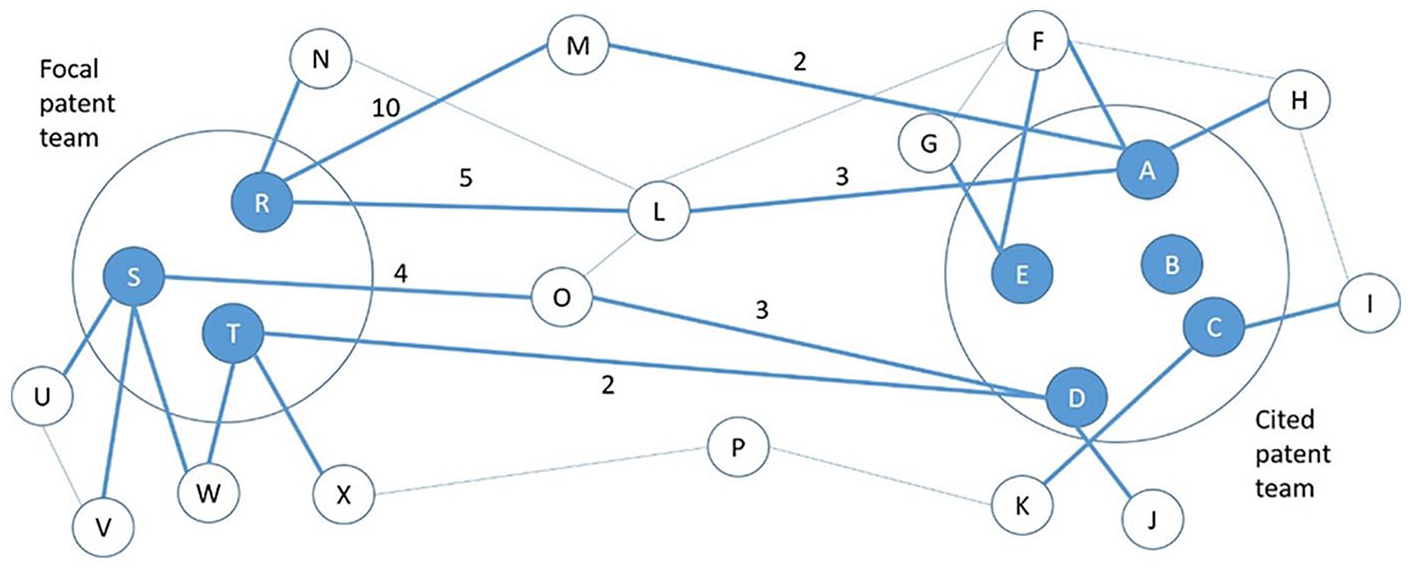
Example Inventor Network
To determine the values for Em1(pf, pi) and Em2(pf, pi), we need to define inventor pair variables Em1(ta, tb) and Em2(ta, tb) for each pair <ta, tb>, where ta is from the focal team Tf and tb is from a cited team Ti. The patent pair indexes Em1(pf, pi) and Em2(pf, pi) are calculated as averages over all inventor pair indexes. To calculate inventor pair indexes Em1(ta, tb) and Em2(ta, tb), we take into account both the number of paths connecting ta and tb and the strength of those paths. Em1(ta, tb) is calculated as the number of patents ta and tb worked on together before the application date of the focal patent. Em2(ta, tb) is calculated as follows:

In this formula, M is the number of indirect paths between inventors ta and tb, x1 and x2 are the weights (i.e., number of patents) of the first edge and second edge of each path. Figure 3 shows an example inventor collaboration network for a focal patent and a single prior art citation. Em2(R, A) is 0.5*(5 + 3) + 0.5*(10 + 2) = 10; the first part is for path “R-L-A” and the second part is for path “R-M-A.” Em2(S, D) is 0.5*4 + 0.5*3 = 3.5, based on path “S-O-D.” Em1(pf, pi) is 2/15 = 0.133, where 2 is the summation of weights of direct paths connecting any inventor pair of focal and cited patent and 15 is the number of possible inventor pairs (3 in the focal team times 5 in the cited team). Finally, Em(pf, pi) is then 2/3*2/15 + 1/3*(10 + 3.5) / 15 = 4 + 13.5/45 = 0.3. We winsorized this variable at mean plus three standard deviations to control excessive skewness.
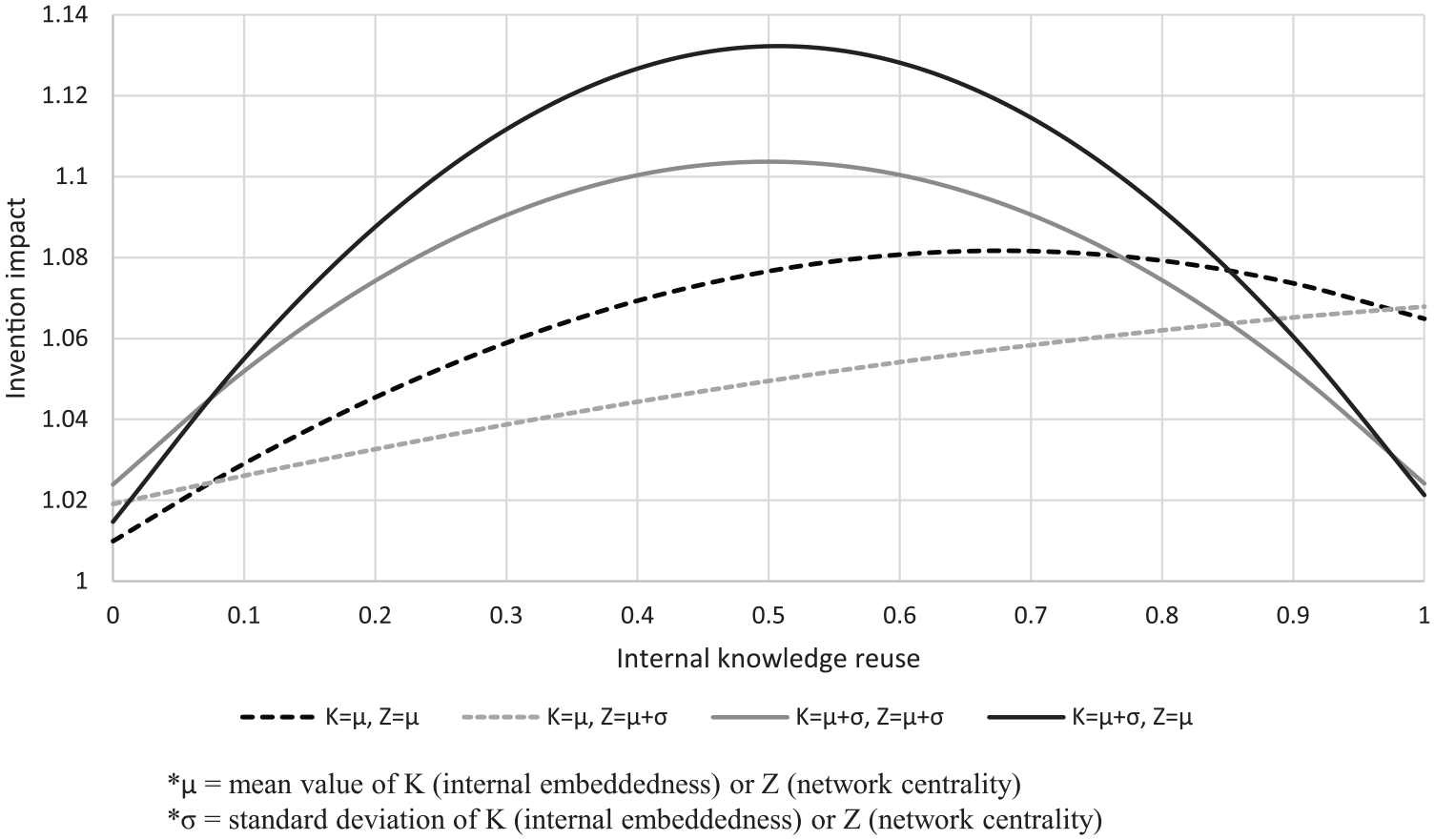
Moderating Effects of Internal Embeddedness (K) and Network Centrality (Z) on Invention Impact
Network centrality is operationalized as the team members’ average degree centrality in the annually expanding 1990 – (t – 1) collaboration network GS = <VS, ES>, where VS is a node set (each node represents an inventor) and ES is an edge set (formed when two inventors collaborated on an invention). Degree centrality is a useful measure for a situated knowledge construction process (like invention) and defined “as the number of ties incident upon a node” or “the number of paths of length one that emanate from a node” (Borgatti, 2005: 62). Following C. Wang et al. (2014), we then operationalize degree centrality of a team as the sum of the number of collaborators each team member has, divided by team size.
Search orientation is operationalized in the following steps. First, we determine for each invention in our sample the fraction of firm self-backward citations over the total number of prior art citations. Next, we aggregate and average those fractions per firm-year to give us an idea of how heavily a firm in any given year relies on self-citations. In the following step, we compare the firm-year average to the industry average and define an inward-looking firm as a firm that relied more on self-citations in a specific year than the industry average and an outward-looking firm in the opposite way. We then create a simple dummy for inward or outward looking, which facilitates the split sample approach used in our analysis. For example, Micron Technologies and Qualcomm are well-known firms that are consistently inward looking in our sample, while Texas Instruments and Intel are consistently outward looking.
Controls
We add controls at the level of the firm, the knowledge network, the team, and the patent. First, we create variables for external knowledge reuse in the same way as we created internal knowledge reuse and control for both the main and the quadratic effect. At the firm level, we control for size (assets) and productivity (number of patents applied for per year). We also use firm fixed effects to control for differences in patenting behavior between firms. In addition, we control for network measures studied by Guan and Liu (2016) and C. Wang et al. (2014), which are constructed in a way similar to the previous description. We determine the structural holes’ value and degree centrality of the patent’s knowledge elements in the 1990-to-1999 knowledge component network but include only the former to reduce multicollinearity. We also add a team’s average degree centrality in the knowledge component co-occurrence network.
At the level of the team, we control for team size (Singh & Fleming, 2010), team diversity, team similarity (omitted to reduce collinearity), and team mutual knowledge. We use the following steps to determine team diversity: First, we create a binary vector of length N with N ≤ Nmax = 129 (maximum number of IPC classes) for each team member based on their own historical patent portfolio’s subclass assignments. If the team member has patents assigned to 1 of the N classes, this vector element will be marked as 1; otherwise, 0. We call the number of classes in which a team has invented before N ≤ Nmax (N = 9 in Table 1). Next, we calculate how many team members have experience in each subclass Sc and divide this number by M, which equals the sum of all team members’ experience across all patent classes (M = 13 in Table 1). We then calculate a Herfindahl-Hirschman index (HHI) to capture the concentration of knowledge in specific subclasses (HHI =
Determination of Team Diversity
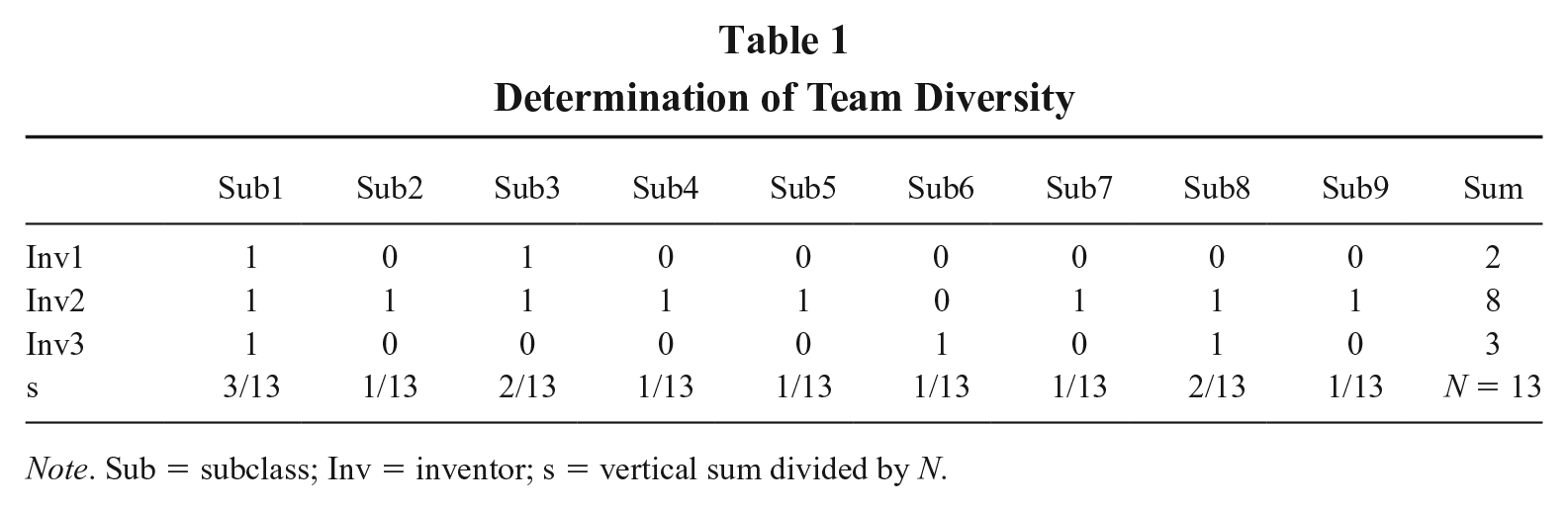
Note. Sub = subclass; Inv = inventor; s = vertical sum divided by N.

For clarity, consider Table 1, which provides a simple example of this measure for a team of three inventors that have a joint portfolio breadth M = 9. Inventor 1 (Inv1) has one prior patent that is assigned to Subclasses 1 and 3. Inventor 2 (Inv2) has 10 prior patents that are assigned to all subclasses except Subclass 6. Finally the third team member (Inv3) has four prior patents and all are assigned to Subclasses 1, 6, and 8. Note that we exclude the number of different patents each inventor has in a particular subclass and merely focus on the diversity. HHI is determined by 6*(1/13)2 + 2*(2/13)2 + 1*(1/13)2 = 0.136.
Team similarity is measured using the same inventor vectors as described earlier. Now, we average the pairwise cosine similarity value for each unique member pair in the team. Thus, for each team consisting of K members whose individual portfolio breadth is characterized by a vector Vk (k: 1 → K) of length M, the averaged cosine similarity measure is captured by the following equation derived from the Euclidian dot product formula applied to every unique pair in a team with K members divided by the number of unique pairs:

Team mutual knowledge is measured by the members’ collaboration strength in a collaboration network. The measurement is similar to embeddedness, but here we look only at the focal team, its prior direct ties to one another, and the indirect prior ties that broker the relationships of the team. At the patent level, we control for number of claims, self and non-self prior art citations, breadth (number of subclasses to which the patent is assigned), and time lag between application and grant date (Fleming, 2001). We add dummies for application and grant year and technological category effects that could influence the incidence of forward citations (Marco, 2007).
Results
Our response is a count variable, which calls for a nonlinear regression technique. We analyze our data in Stata using Poisson regression, which is preferred because it is more robust than the negative binomial (e.g., clustering of standard errors) and because the overdispersion of our dependent variable is moderate (µ = 9.84, σ = 14.49). In choosing to conduct within-firm fixed-effects or random-effects regressions, we need to control for firm-specific aspects that could influence knowledge transfer (Levin & Cross, 2004). Because some of our explanatory variables are possibly correlated with firm effects, a random-effects regression would be inconsistent. The Hausman (1978) test confirmed this suspicion; hence we deploy fixed effects (note that running negative binomial regressions would disable the use of real fixed effects). To check for collinearity, we ran an ordinary least squares (OLS) regression without indicator variables, quadratic terms, and interactions as they artificially inflate the variance inflation factors (Allison, 2012). We removed a few controls (knowledge stock, number of employees, team similarity) with variance inflation factors above 4 (Wooldridge, 2014). Including those variables in the regression did not affect our results. Table 2 presents descriptive statistics, including quadratic terms and interactions (Haans et al., 2016).
Descriptive Statistics and Correlation Matrix
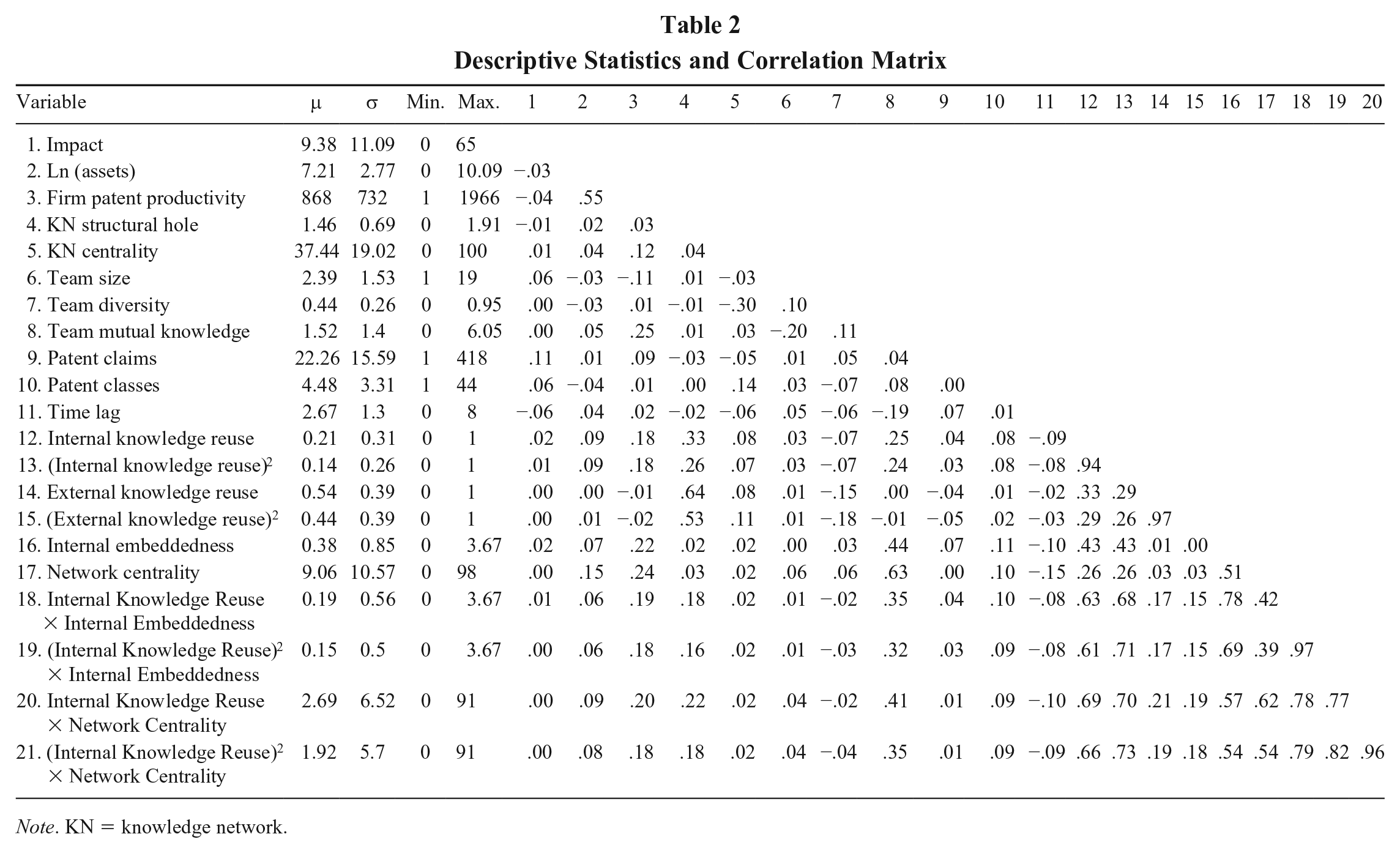
Note. KN = knowledge network.
Hypothesis 1 suggests a concave, inverted U-shaped relationship between knowledge reuse and invention impact. Model 1 in Table 3 suggests this cannot be rejected, as all coefficients are significant in the expected directions. To verify the ∩ shape, the simplest way is to rerun the models as OLS regression (with the natural logarithm of the number of forward citations + 1 as the response) and then run a U test and a Fieller test (Haans et al., 2016; Lind & Mehlum, 2010). 4 Running this test supports the hypothesized inverted U shape.
Internal and External Knowledge Reuse for Inward- and Outward-Looking Firms
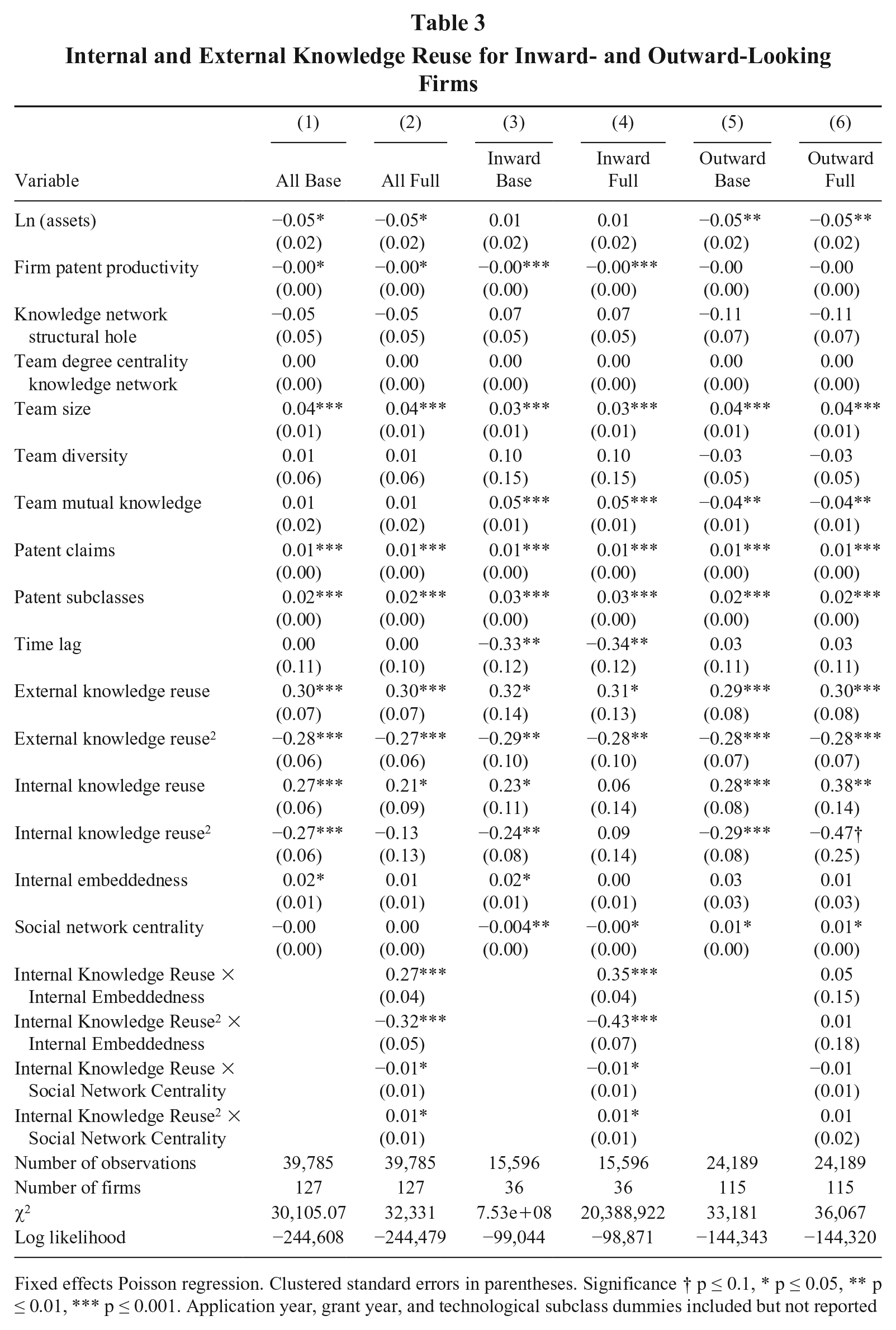
Fixed effects Poisson regression. Clustered standard errors in parentheses. Significance † p ≤ 0.1, * p ≤ 0.05, ** p ≤ 0.01, *** p ≤ 0.001. Application year, grant year, and technological subclass dummies included but not reported
Hypothesis 2a proposes that the curvilinear relationship between knowledge reuse and invention impact is moderated by internal embeddedness as depicted in Figure 2c. Model 2 depicts the results for the entire sample, and the significant interactions between internal knowledge reuse and internal embeddedness appear to be supportive of a steepening. Model 2 also shows significant interactions with network centrality, suggesting support for Hypothesis 2b, but it is not possible to confirm hypotheses from only the regression table due to the model’s nonlinearity. We therefore implement the following procedure that is largely described in Haans et al. (2016). Our regression is a Poisson model with two distinct moderators of a quadratic predictor, and this creates specific complexities. Let β0 represent all the controls, X is internal knowledge reuse, Y is the number of forward citations, and K and Z are the two moderators. The model can then be written as

To assess what actually happens with the concave relationship between internal knowledge reuse and invention impact, we need to determine the entire curve at different values of K and Z and look at the resulting effects. In addition, we need to determine the inflection point to verify whether or not it shifts as predicted in Hypothesis 2a. The inflection Xtp is derived by setting the derivative of Y equal to zero (dY/dX = 0). The resulting formula clearly shows that the inflection point (and consequentially the entire curve) depends on both K and Z.

Keeping all controls fixed, we determine the shape of the curve for four permutations of both moderators at mean values and mean plus one standard deviation. For each permutation, we calculate the inflection point and then graph the entire figure by allowing X to move from 0% reuse to 100% reuse. Figure 3 therefore depicts four curves. Let us start by looking at the black lines. The dotted black line gives the base scenario of both internal embeddedness (K) and network centrality (Z) at mean value. The solid black line shows what happens when K increases. Consistent with Hypothesis 2a, an increase in internal embeddedness will steepen the concave relationships between internal knowledge reuse and invention impact. We can derive the same insight from the gray lines. For high network centrality, an increase in internal embeddedness (solid gray line) leads to a steepening of the curve.
For Hypothesis 2b, the picture is less clear. We need to look at either the solid or the dotted lines to investigate the effect of a change in network centrality. Looking at the solid lines means we start from high internal embeddedness. The gray solid line is below the black one, suggesting a flattening of the curve. Calculations show that the inflection points for both solid lines are virtually identical (0.50 and 0.51), suggesting a negligible shift in the inflection point. When we look at the dotted lines (for mean internal embeddedness), however, a clearer image emerges. Again, there is some flattening, but the inflection point now jumps from 0.68 to 1.47 (beyond the actual values of internal reuse), which is consistent with our hypothesis. This suggests we find partial support for Hypothesis 2b. The real effect therefore depends on the value of internal embeddedness: The inflection point is shifting to the right as predicted, but the size of that shift is less meaningful for high values of internal embeddedness.
Models 3 to 6 compare the results, sampled on search orientation. Hypothesis 3 suggested that inward-looking firms would be better at internal knowledge reuse (higher apex). However, we find that the inflection points for both samples are virtually identical at Xtp = 0.48, suggesting that inward-looking firms are not better at reusing internal knowledge than their counterparts. Nonetheless, it is also clear that inward-looking firms have the optimum within reach as it is about half a standard deviation away from the mean (0.48 ≈ 0.31 + 1/2*0.35). For outward-looking firms, however, the optimum is about 1.44 standard deviations away from the mean (0.48 ≈ 0.14 + 1.44*0.25). Hypothesis 3 is not supported.
When comparing Models 4 and 6, it appears that inward-looking firms are indeed significantly more sensitive to the effects of internal embeddedness than outward-looking firms, for which the interaction effects are insignificant, while the betas in Model 4 are higher in absolute value than in Model 2. This provides some support for Hypothesis 4a, but given the nonlinearity of the model, even nonsignificant interaction terms are no guarantee of nonsignificant effects. To further investigate these results, we follow Haans et al. (2016) and determine the slopes at different distances (between 0 and 0.30 in increments of 0.05) from the inflection point for each sample. For ease of comparison, we keep network centrality at mean value and look at what happens with the slopes (derivatives of the concave relationship) as internal embeddedness moves from mean value to a high (mean + one standard deviation) value. Figure 4 shows that for outward-looking firms, an increase in internal embeddedness has virtually no effect on the slopes (and thus no steepening effect), while there is a clear steepening effect for inward-looking firms (the light gray line is significantly steeper than the dark gray line). This supports Hypothesis 4a.
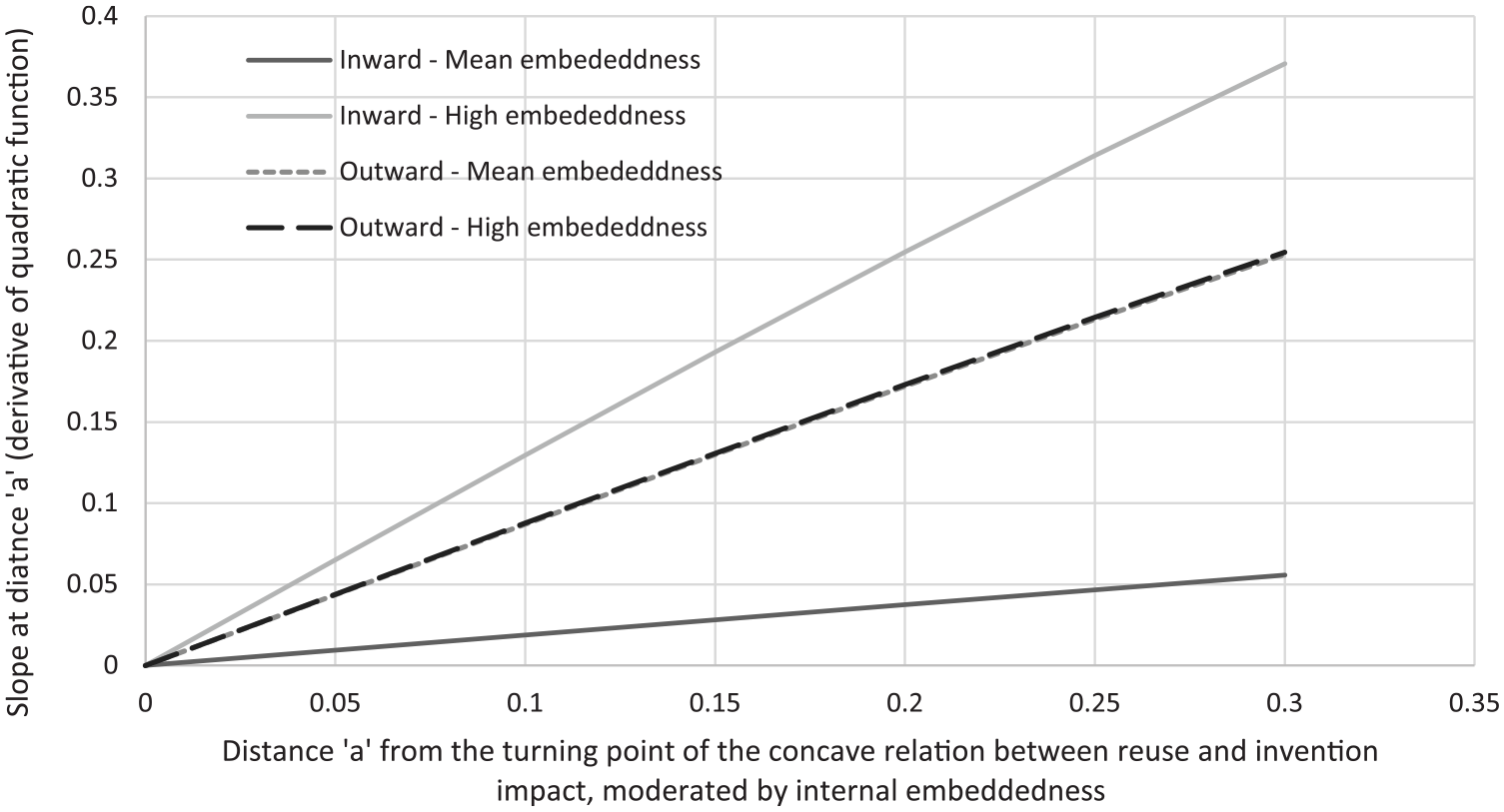
Comparison of Inward- and Outward-Looking Firms at Mean and High Internal Embeddedness
Finally, we investigate whether inward-looking firms experience a stronger flattening of the reuse–impact relationship when their teams are highly central. In our discussion of Hypothesis 2b, we found that for all firms, some flattening was indeed visible while the inflection point shifted to the right as hypothesized. Using the same visualization approach, this time holding internal embeddedness at its mean, we check the slopes at mean and high values of network centrality in both samples. Figure 5 shows the results and shows significantly flatter slopes for inward-looking firms (the solid lines) compared to the outward-looking firms. An increase in network centrality even leads to the slopes becoming negative, from which we can infer at least significant flattening and possibly even shape flip, something we did not expect. However, the flattening effect of a one-standard-deviation increase in centrality seems rather similar based on the graph such that we cannot rule out that Hypothesis 4b may be rejected.
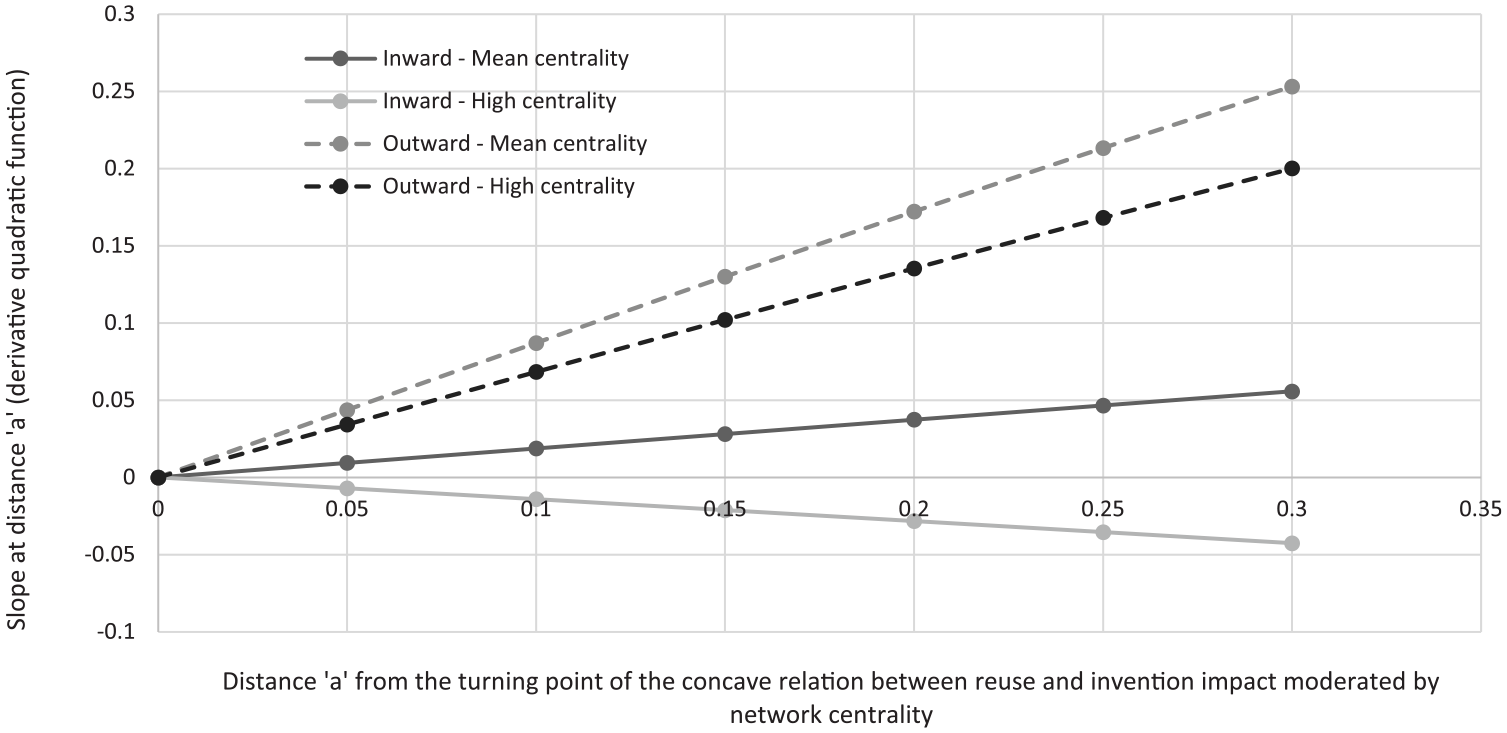
Comparison of Inward- and Outward-Looking Firms at Mean and High Network Centrality
We conduct a couple of additional tests to find more clarity regarding the likelihood of asymmetric effects in the two subsamples. A coarse approach can be based on the nested model comparison approach proposed by Clogg, Petkova, and Haritou (1995). These authors propose to create a Z value for different betas for nested models as follows:

In this formula, β1a and SEβ1a represent the coefficient and standard error of the full model, whereas β1b and SEβ1b represent the coefficients of the subsample. If our hypotheses are correct, we should observe differences in the Z values. Of course, we cannot directly compare the outward- and inward-looking firms with this approach because they are not nested, so we can only compare each subsample with the entire sample. Using this approach reveals significant differences in the Z values for the main effect, the interaction effects with internal embeddedness, and the independent effect of network centrality but not for the interaction effect between internal knowledge reuse and network centrality, suggesting the latter moderation may not be significantly different.
A second approach is to run the full regression but differentiate all moderation effects for inward- and outward-looking firms so that we can find separate coefficients to establish differential impact. These results are consistent with our findings and available upon request. Finally, a third approach is to run the full model and add all relevant interaction effects for either inward- or outward-looking firms so that the betas for these effects represent a difference between both types of firms. We can then run a likelihood ratio test (although this means we cannot cluster the error terms) and a Wald test on the coefficients of the added interaction effects, both of which are highly significant. These findings add support for our hypotheses, although the complexity of hypothesizing between samples makes it impossible to simply use a p value to determine statistical difference—a practice that is coming under increasing scrutiny (Amrhein, Greenland, & McShane, 2019; Wasserstein, Schirm, & Lazar, 2019).
Robustness and Limitations
To ensure that our results are not spurious or driven by how we split the sample, we conducted robustness checks. First, we ran the analysis again but determined search orientation this time based on the absolute number of self-citations rather than the fraction of firm self-citations. While this reduced the number of inward-looking observations to 10,318, the results held. We also excluded from the sample all the firms that were not consistently inward or outward looking over the focal 5-year period. The results did not change. Results also remained consistent when standard-normalizing network centrality for each subset of inward- or outward-looking firms. We also ran OLS regression on the log-transformed number of forward citations and ran two negative binomial regressions in Stata, one with quasi fixed effects (xtnbreg, fe) and one with robust standard errors (nbreg i.firm, robust), all of which gave substantively similar results (available from the authors).
We wanted to verify whether our findings would hold if we excluded self-citations from the impact variable. Given our interest in inward-looking firms, it is relevant to find out whether these inward-looking firms also achieve outside impact. With the exception of the interaction effect between internal knowledge reuse and network centrality, all results are consistent when excluding self-citations from the impact variable. As expected, for outward-looking firms, the results remain the same. Finally, there are some endogeneity concerns. In particular, it is possible that embeddedness drives reuse, as teams with strong connections to knowledgeable colleagues may be more likely to build on the prior inventions of those colleagues. To control for this, we regressed internal knowledge reuse on a variety of predictors that capture selection variables, including team similarity; team size; the number of team, firm, and external backward citations; the average number of inventors on those team, firm, and external prior art citations; time; technology class; and search orientation dummies (results available upon request). We also regress the quadratic term for internal knowledge reuse on the same predictors. This is required because the linear projection of the square is not the same as the square of the linear projection (Haans et al., 2016). The residuals of these two regressions capture variance in internal knowledge reuse that is not driven by selection. Using these residuals in our regression instead of the original variable gives us consistent results with the ones in Models 2, 4, and 6 in Table 3.
Finally, we attempt an instrumental variable approach. We use team mutual knowledge, team diversity (both insignificant in Model 2), and the average size of cited inventor teams in which team members or firm colleagues were involved as instruments for both internal knowledge reuse terms, after which the instrumented variables are replaced. In this generalized-method-of-moments regression, the F tests are above the critical value of 12; the Hansen-J statistic is rejected, suggesting the instruments are coherent; and the curvilinear effect of internal knowledge recombination is found with β1 = 0.73 (p ≤ .05) and β2 = ‒0.73 (p ≤ .10). This provides support that endogeneity may not be detrimental in our analysis (results available upon request). While these are imperfect solutions to endogeneity, they provide reasonable support for the validity of our findings.
Discussion and Implications
This study expands our understanding of how inventor teams recombine and reuse knowledge components to create impactful inventions and how this process is influenced by the team’s embeddedness in collaboration networks and the firm.
Doubly Embedded: Knowledge and Inventor Networks
Like C. Wang and colleagues (2014: 508), our study highlights the multilevel nature of inventors’ embeddedness in networks of both social relationships (internal embeddedness and network centrality) and knowledge components (reuse). To this, we add a third form of embeddedness by recognizing that teams are deeply embedded within their own firms and that firms with opposing search orientations (inward or outward looking) can derive divergent benefits from their position in the inventor network. By using a longitudinal, nondichotomous design and by focusing on the complementarities among the networks rather than their decoupled nature, we extend previous work by C. Wang and colleagues and posit that knowledge component reuse drives invention impact in an inverse U-shaped way.
We theorize the ∩ shape as a multiplicative combination of two latent mechanisms, thereby following best practices to ground the observed quadratic effects (Haans et al., 2016). We proffer that increasing knowledge reuse generally is associated with higher absorptive capacity, because reuse implies components have been tried and tested before, which reduces mistakes while it also enhances the usefulness of technologically related knowledge (Argote & Miron-Spektor, 2011; L. Kim, 1998). Reusing internal knowledge moreover evidences component competence and combinative capabilities (Henderson & Cockburn, 1994; Kogut & Zander, 1992). These arguments support a positive relationship between reuse and absorptive capacity, leading to higher impact.
Yet, increasing internal knowledge reuse is also associated with lower novelty creation, as there may be objectively less novelty to explore or because high reuse suggests a tendency to favor marginal over radical improvements (Dosi, 1982; March, 1991). Reusing such knowledge can also be hampered by rigid mental models and the relatively small knowledge base of the firm, which limits the team’s vantage points in the technological landscape (Fleming & Sorenson, 2004; D. H. Kim, 1993). These arguments support a negative relationship between reuse and novelty creation, leading to lower impact. Combined, these mechanisms result in an inverted U-shaped effect. While theorizing in terms of latent mechanisms takes up more journal space, we nevertheless do so because it enables better predictions and facilitates falsification at the level of the mechanism.
While we did not form explicit hypotheses about external knowledge reuse, in unreported regressions we found that most of our results hold there, as well. It is particularly interesting that inward- and outward-looking groups reuse on average the same amount of external knowledge and that the mean degree of actual external knowledge reuse is almost perfectly on the apex. This suggests both groups are close to optimal in their external knowledge reuse, but both fall short when it comes to internal knowledge reuse.
Next, we showed that access to colleagues who are domain experts, a specialized form of internal embeddedness, generally improves the team’s capacity to create high-impact inventions, which we attribute to improved information flow and content, which strengthens the team’s absorptive capacity. The effect of internal embeddedness on novelty creation is more complex. While internal embeddedness may give access to recent knowledge (Katila, 2002), it also exacerbates the mental barriers that reduce explorative search and increase insularity (George et al., 2008; Knudsen & Srikanth, 2014). The net result is a steepening of the concave relationship between reuse and invention impact. We found only partial evidence for our hypothesis that network centrality will shift the inflection point of the concave reuse–impact relationship to the right and explained that this is a consequence of the nonindependence of the two moderators in a nonlinear model. By demonstrating that there are contingencies between the two moderators that become clear only through an in-depth analysis of the inflection point, we contribute to more granular testing as well as theory formation.
Triply Embedded: Inward- and Outward-Looking Firms
Perhaps our most interesting insights are rooted in our separation of inward- and outward-looking firms. A key contribution is that findings for the average firm (by investigating the entire sample) can obfuscate fundamental differences in how teams create successful inventions. First, despite long-standing beliefs that firms favor local search, our data reveal that the majority of inventions does not rely sufficiently on internal knowledge. Although we find, to our surprise, that the optimum level of reuse for inward-looking firms is identical to that of outward-looking firms, we do find evidence that the two types of firms have asymmetric benefits to knowledge reuse when considering team collaborative ties.
Inward-looking firms are very sensitive to internal embeddedness, while outward-looking firms are not. This implies that the capacity to create high-impact inventions of teams in inward-looking firms is strongly influenced by the team’s connections with colleagues who are domain experts, while the same does not hold for firms with an outward-looking search orientation. For inward-looking firms, our empirical results could even imply that if internal knowledge reuse becomes high, R&D managers may benefit from reducing communication between the team and expert colleagues, to diminish the downsides of transferring mental maps and imposing search limits (i.e., the dark side of embeddedness) that may be experienced by engaging with knowledgeable colleagues. Such effect is absent for outward-looking firms.
Regarding centrality in the collaborative network, the findings are less clear and require further study. The first surprising finding is already that overall in this sample, centrality does not seem to have strong positive effects on invention impact, which goes against much prior work. More specifically, teams in inward-looking firms actually become less successful if their centrality increases. We postulate that teams can take up structurally equivalent positions in a collaborative network but that the quality and diversity of the nodes to whom they are connected differs. This provides a counterweight to structuralist network perspectives that argue structural network characteristics in and of themselves explain invention outcomes. On the contrary, we find that the same network position in terms of degree centrality may have diverging effects on the success of knowledge reuse, depending on the firm’s historical search orientation. Our explanation is that the same structural characteristics may imply either a distracting echo chamber or a rich pool of diverse and useful ideas, depending on the search orientation of the firm in which the node is embedded. Future work on the idiosyncratic properties of nodes (inventors, teams), firms (beyond search orientation), and their connections and structural network characteristics (beyond centrality) could shine further light on the results here.
Patterns of Knowledge Reuse
A puzzling implication of our study is that all teams, even those in inward-looking firms, do not reuse sufficient internal knowledge while they do use sufficient external knowledge. Empirically, we established an ∩-shaped relationship that peaks at a cosine similarity value of about 0.48 (for external knowledge reuse), while mean internal knowledge reuse is around 0.20 (0.31 for inward-looking firms and 0.14 for outward-looking firms). In our sample, 63.1% of the inventions do not reuse internal knowledge at all, and this effect is not primarily driven by small firms that lack internal knowledge to recombine. Firms like Broadcom, Texas Instruments, National Semiconductor, and Intel possess large knowledge stocks and reuse significantly less internal knowledge than the sample average, while Qualcomm, Advanced Micro Devices, and Micron Technologies reuse significantly more internal knowledge than average.
We do not find similar differences in external knowledge reuse. When comparing Micron Technologies and Intel, for instance, we find that the former searches significantly more in general (an average of 29.5 vs. 12.9 backward citations) and that over 25% of those citations are self-citations, while for Intel that percentage is only 13.5. While we explored how these differences can influence invention impact through network characteristics, future research could look deeper into how search orientation influences other determinants of the inventive process. Such research could investigate whether different firms are associated with different optimal search strategies and could consider the possibility that when it comes to recombination, reuse, and/or technologically local and distant search, teams with similar expertise may have different comfort zones in terms of exploration depending on their firm’s search routines, habits, and competencies.
One possible explanation may be that inward-looking firms favor personalization over knowledge codification (Hansen, Nohria, & Tierney, 1999). Such firms rely more heavily on person-to-person knowledge transfer, and thus for them, the influence of embeddedness would be expected to be more significant than for firms preferring codification strategies (Prencipe & Tell, 2001). Future research can investigate more deliberately whether specific firm characteristics, such as the search orientation, warrant separate analyses and theorizing, as they did in this case. Not only would this open up research avenues, but it would also make our findings relevant for managerial practice. The dominant “single sample approach” inevitably makes it hard to uncover whether theoretically convincing relationships hold for all or only for a, perhaps small, majority of cases.
In an unreported regression, we created a dummy variable for firms with an ambivalent search orientation (i.e., the 21 firms—good for 2,784 inventions—that were not consistently above or below the industry average over the 5-year period we investigated). We found that these ambidextrous firms on average created higher-impact inventions, supporting claims that ambidexterity is important for innovation (Gupta, Smith, & Shalley, 2006; March, 1991). These ambidextrous firms did not, however, benefit more or less from knowledge reuse than their nonambidextrous competitors. It would be interesting if other researchers could explore in more detail whether inward-looking, outward-looking, and ambidextrous firms develop networks of different type and quality and how they use those networks to boost performance.
Finally, we invite other researchers to investigate whether our findings hold at the level of the individual inventor. Prior literature that looked at the interplay of the knowledge component and the collaboration network has focused on the individual or the firm (e.g., Guan & Liu, 2016; Paruchuri & Awate, 2017; C. Wang et al., 2014). In this article, we have taken the invention as unit of analysis and focused on the team that creates that invention as a driver of its impact. It is possible that when looking at an inventor’s annual productivity and success, embeddedness in the firm and the collaborative network play different roles than at the invention-team level. This could be studied specifically for sole inventors or for teams from which members are randomly drawn for inclusion in the sample. We hope our study inspires researchers to explore how inventions and inventors are triply embedded in knowledge component networks, collaborative networks, and firm practices and how these jointly affect the invention process and its outcomes.
Conclusion
Our theory and findings contribute to explanations of knowledge recombination (Galunic & Rodan, 1998; Messeni Petruzzelli, & Savino, 2014), tacit knowledge and knowledge transfer (Ancori, Bureth, & Cohendet, 2000; Cowan et al., 2000), and embeddedness in social and knowledge component networks (Guan & Liu, 2016; Uzzi, 1996, 1997; C. Wang et al., 2014) within the broad literature on organizational learning and innovation (Cohen & Levinthal, 1990; Levitt & March, 1988). We find that internal knowledge reuse relates curvilinearly to invention impact, regardless of the firm’s search orientation. For inward-looking firms, this relationship is reinforced by a specialized form of internal embeddedness and slightly weakened by network centrality. Outward-looking firms, on the contrary, are less susceptible to these network effects, suggesting that outward-looking firms are less reliant on their network when reusing internal knowledge. Our study illuminates a previously unstudied aspect of the paradox of embeddedness by suggesting that the effects of embeddedness may depend on node attributes in such a way that the same structural network characteristic can have asymmetric effects. Finally, we show that teams are truly triply embedded in networks of knowledge components, inventor networks, and their own firm with its idiosyncratic search orientation and that these three forms of embeddedness are all important to understand how teams create high-impact inventions.
Footnotes
Acknowledgements
The authors thank our editor, Jorge Walter, and three anonymous reviewers for their constructive comments and developmental feedback on multiple versions of this manuscript. This research was funded by a Singapore Management University research grant from the Ministry of Education Academic Research Fund Tier 1. Gerard George gratefully acknowledges the financial support of the Lee Foundation for its generous sponsorship of the Lee Kong Chian Chair Professorship.
