



Abstract
We use human resources (HR) system strength theory to argue that transformational leadership leads to employee consensus on a unit’s high-performance work system (HPWS), that consensus helps align employee attitudes, and that a compression in attitudes facilitates strategy execution and unit-level outcomes. Empirical tests based on a 4-year linked employee–customer panel data set, involving 255 do-it-yourself stores, support our predictions. Transformational leadership is positively related to HPWS consensus. Consensus is negatively associated with unit-level job satisfaction dispersion, which in turn relates positively to unit-level customer satisfaction. Our study makes important contributions to the strategic HR and HR system strength literatures, highlighting the roles of leadership and employee consensus in strategy execution.
Keywords
Strategic human resources (HR) management research demonstrates that high-performance work systems (HPWSs; Posthuma, Campion, Masimova, & Campion, 2013) have positive effects on firm performance (Aryee, Walumbwa, Seidu, & Otaye, 2012; Becker & Gerhart, 1996; Combs, Liu, Hall, & Ketchen, 2006; Huselid, 1995; Jiang, Lepak, Hu, & Baer, 2012) through their impact on employee attitudes, behaviors, and performance (Appelbaum, Bailey, Berg, & Kalleberg, 2000). To better understand HPWSs, we investigate how leadership contributes to their realization. HPWS effects do not unfold by magic (Chadwick, Super, & Kwon, 2015); rather, managers design an HPWS, and leaders sell it to employees, who interpret and respond to it (Nishii, Lepak, & Schneider, 2008). Ironically, strategic HR scholarship looks at HPWSs but tends to neglect the role of managers and leaders (Chadwick et al., 2015), while strategy research highlights the role of managers (Helfat et al., 2007; Sirmon, Hitt, Ireland, & Gilbert, 2011) but also remains relatively silent about leadership (Ateş, Tarakci, Porck, van Knippenberg, & Groenen, in press).
We use the HR system strength theory of Bowen and Ostroff (2004; Ostroff & Bowen, 2016) as an overarching framework to amend the strategic HR and strategy literatures using transformational leadership thinking in an attempt to explain how leadership facilitates the HR and strategy process. 1 Managers and leaders are critical players in strategy execution (Ateş et al., in press; Chadwick et al., 2015) because they act as prime intermediaries to involve employees through the depth of the organization (Sirmon et al., 2011). On one hand, it is crucial that managers embrace the firm’s strategy and translate it into an aligned HPWS; on the other hand, it is key that leaders inspire employees to adopt the HPWS. Transformational leaders create awareness of the firm’s strategy and HPWS through high-quality exchanges with employees that enable them to see a clear picture of the firm’s HPWS and develop a consensus. According to HR system strength theory, employee consensus exists “when there is agreement among employees” or a “low variance in perceptions about the situation” (Bowen & Ostroff, 2004: 212, 207).
Leadership and employee consensus are relevant but underresearched topics in strategic HR scholarship. Firms design and use HPWSs to impact employee attitudes and behaviors in strategically intended ways (Becker & Huselid, 2006; Bowen & Ostroff, 2004). When employees share perceptions about their firm’s HPWS, perceptional and, in turn, behavioral variability is reduced. HPWS consensus indicates unified perceptions of desired behaviors and enhances conformity with strategic firm goals. Strategy scholars emphasize that strategic alignment is a crucial but intricate task (Tarakci, Ateş, Porck, van Knippenberg, Groenen, & Haas, 2014). Strategies must be formulated (a planning activity) and implemented (an executing activity); successful strategy implementation requires that employees engage in desired behaviors (Noble, 1999). However, implementation efforts often fail because while the formulators may be few, the implementors [sic] are typically many, functioning at different levels and in different units and places . . . each with their own values and interpretations. They are not robots, nor are the systems that control them airtight. The inevitable result is some slipping between formulation and implementation. (Mintzberg, 1990: 186)
HPWS consensus indicates that the formulation–implementation or intention–realization gap (Mintzberg & Waters, 1985) is narrowed, thus facilitating firm performance and creating potential for competitive advantage through managerial capabilities (Barney, 2001).
Further, from a behavioral perspective, sources of variability, such as HPWS consensus, “may operate as moderators on the HR practices to performance link” (Nishii & Wright, 2007: 5). HPWS consensus indicates that employees have a similar understanding of an HPWS. HR research that mirrors the intention–realization debate in strategy has shown that HR system effectiveness depends on both the intended HR system’s design and the employees’ perceptions and attributions regarding the system (Nishii et al., 2008). A good HR system is unnecessarily ineffective if it is neither communicated adequately nor understood in intended ways; conversely, the potentially negative effects of a poor HR system may be mitigated if the system is not understood accordingly. Both good and poor HR systems will have stronger effects when they are perceived and well understood, as indicated by employee consensus, in both the positive and the negative sense.
Along these lines, some conceptual studies have argued that consensus explains relevant unit-level outcomes (Chan, 1998; Ostroff & Fulmer, 2014), but empirical evidence for such effects is rare (Hewett, Shantz, Mundy, & Alfes, 2017). X. Li, Frenkel, and Sanders (2011) and Sanders, Dorenbosch, and Reuver (2008) provide some evidence that consensus on the HPWS impacts employee attitudes and behaviors. Furthermore, Y. Li, Wang, van Jaarsveld, Lee, and Ma (in press) offer some evidence that consensus (defined as homogeneity in employee experiences) amplifies the positive effects that high-involvement work systems can exert on firm-level innovation.
We contribute to this line of research in two ways. First, we argue that transformational leadership facilitates consensus building. HR system strength theory assumes that HR and line managers create employee consensus when they send consistent and strong messages regarding the HR system (Bowen & Ostroff, 2004). In complex firms, employee consensus results from consistent communications among top managers, HR professionals, line managers (i.e., leaders), and employees (Sirmon et al., 2011). We have used a much simpler setting here by drawing on data from a franchise system of 255 do-it-yourself (DIY) stores. Within the franchise system, the same general set of HR practices (i.e., HPWS) is applied in all its stores. However, store managers can assign smaller or greater weights to single practices and thus tailor the HPWS to their stores’ needs. Because the stores have about 80 employees on average, store managers serve as strategists (“formulators”) and also are involved in the strategy implementation process (leading the “implementers”). Because transformational leaders give consideration to and have high-quality exchanges with implementers (Bass, 1985; Bass, Avolio, Jung, & Berson, 2003), their employees form clearer expectations and are more likely to have consensual perceptions of the HPWS and strategic goals of the firm.
Second, we develop and test theory about how consensus contributes to relevant unit-level outcomes. 2 In this regard, our work extends the few recent studies that have delved more deeply into the relationship between employee consensus and unit-level outcomes (Y. Li et al., in press). Specifically, we assert that an HPWS has stronger positive effects on unit-level job satisfaction when employees reach consensus about it. We further posit that consensus on the HPWS results in lower within-store job satisfaction dispersion. Finally, we demonstrate that both unit-level job satisfaction and job satisfaction dispersion are significantly related to unit-level customer satisfaction—a strategically relevant outcome for the DIY stores that we study.
We used a 4-year linked employee–customer panel data set from 255 German DIY franchise stores to test our model. Across 4 years of observations, our data comprised more than 15,000 employee responses and more than 250,000 customer responses. We aggregated these individual-level data to the store level and, by using fixed-effects (FE) panel estimators, mitigated statistical issues, such as omitted variables and single-informant bias. In the next section, we present our theory and hypotheses. We then introduce the sample, data, and analytical strategies, and report and discuss the findings from our estimations. Finally, we detail the limitations, implications, and research avenues that emerge from this work.
Theory and Hypotheses
HPWSs
A central tenet of strategic HR scholarship is that HR practices affect employee attitudes, behaviors, and performance, which then translate into unit-level outcomes (Combs et al., 2006; Dyer & Reeves, 1995; Huselid, 1995; Jiang et al., 2012). HPWSs consist of complementary bundles of HR practices (Posthuma et al., 2013) and “reflect the multiple paths through which HRM policies will influence successful strategy implementation” (Becker & Huselid, 1998: 55). 3
HR practices that are often bundled to HPWSs include pay for performance, extensive training, selective recruitment, employee participation, and flexible work arrangements (Becker & Gerhart, 1996; Combs et al., 2006). However, this list is both inconclusive and misleading (Becker & Gerhart, 1996; Posthuma et al., 2013) because some practices may be performance enhancing in some contexts but not in others, and some practices may be complementary in certain conditions but not across contexts. Thus, we place emphasis on identifying HR practices that directly support the strategically relevant unit-level outcomes in our setting.
A conceptual starting point for thinking about the unit-level performance effects of an HPWS is the HPWS–employee attitudes–unit-level outcomes chain (Jiang et al., 2012). Within this chain, the HPWS has a direct impact on HR-proximal outcomes, such as employee attitudes and behaviors, which translate into HR-distal outcomes, such as customer attitudes and profits (Boselie, 2010; Dyer & Reeves, 1995; Guest, 1997; Kehoe & Wright, 2013). We use this chain as our base model (Figure 1) and then extend it on the basis of HR system strength theory.
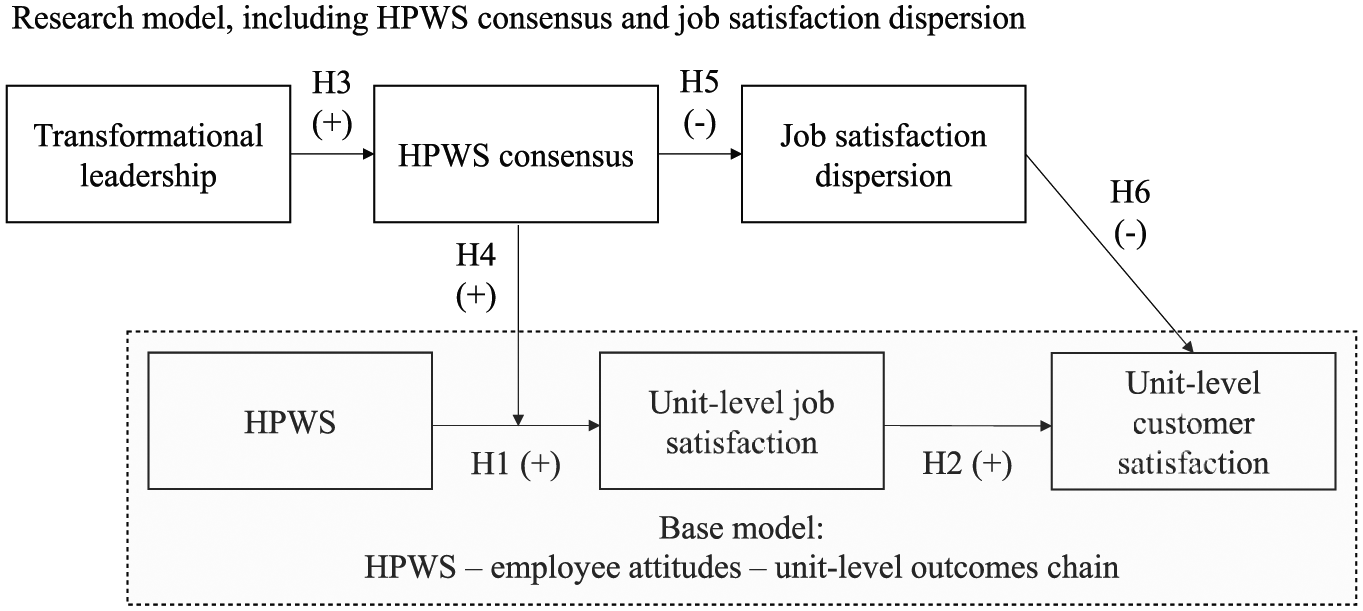
Theoretical Model
Base Model: HPWS‒Employee Attitudes‒Unit-Level Outcomes
Investments in an HPWS send a credible signal to employees that the firm values long-term employment relationships and mutual commitments (Blau, 1964; Emerson, 1976). Employees tend to reciprocate such signals with positive attitudes, behaviors, and performance (Piening, Baluch, & Salge, 2013). Along these lines, research has documented positive HPWS effects on job satisfaction. For example, Messersmith, Patel, Lepak, and Gould-Williams (2011) reported a positive relationship among local government authorities in Wales; Takeuchi, Chen, and Lepak (2009) found similar effects for a multi-industry sample of Japanese establishments; and Piening et al. (2013) reported consistent findings for hospitals in the English National Health Service. Thus, we posit that an HPWS has a positive impact on employee-level job satisfaction.
Employee-level job satisfaction is the behavioral origin of unit-level job satisfaction. A fundamental insight of multilevel theory (Klein & Kozlowski, 2000; Ployhart & Moliterno, 2011; Ployhart, Nyberg, Reilly, & Maltarich, 2014) relates to shared unit properties, which as “collective constructs represent the aggregate influence of individuals” (Kozlowski & Klein, 2000: 15). Shared unit properties are based on composition models of emergence, which assume that individual-level and unit-level constructs translate into each other in isomorphic ways (Chan, 1998). Shared unit properties are measured at the level of origin (i.e., the individual) and aggregated to the unit mean to describe the unit’s characteristics. To be recognized as a shared unit property, sufficient within-unit agreement is needed (Bliese, 2000; Kozlowski & Klein, 2000), but variation across units remains possible and likely. Thus, we contend that HPWSs have positive employee-level job satisfaction effects that aggregate to unit-level job satisfaction effects.
Hypothesis 1: HPWSs are positively associated with unit-level job satisfaction.
HPWSs have HR-proximal outcomes that translate into HR-distal outcomes (Dyer & Reeves, 1995; Kehoe & Wright, 2013). The strategically important unit-level outcome of our study is customer satisfaction, a straightforward performance indicator in DIY stores. DIY stores have similar product portfolios, whether within a single franchise system or across independent retailers. Because prices are also similar, competition is driven by temporary or special offers and by service quality, which is a strong differentiator in this market. Customer satisfaction is the most important and valid indicator of service quality, predicting repurchasing intentions, store revenues, and profitability (e.g., Anderson, Fornell, & Lehmann, 1994; Anderson, Fornell, & Rust, 1997; Heskett, Sasser, & Schlesinger, 1997; Szymanski & Henard, 2001).
In a service context, customer satisfaction is driven by face-to-face experiences (Lovelock & Wirtz, 2016). A person’s mood influences the mood of others in the same environment (Hatfield, Cacioppo, & Rapson, 1994), and because satisfied employees express more positive emotions than less satisfied employees (Judge, Bono, Thoresen, & Patton, 2001; Judge & Ilies, 2004), customers also express more positive affect and satisfaction (Barger & Grandey, 2006; Pugh, 2001). Moreover, satisfied employees tend to reciprocate positive firm investments by exhibiting discretionary and extrarole behaviors toward customers (Eisenberger, Armeli, Rexwinkel, Lynch, & Rhoades, 2001; Messersmith et al., 2011), which are important for customer satisfaction when service encounters are nonroutine and when appropriate employee behaviors cannot be enforced through labor contracts. The positive link between employee job satisfaction and customer satisfaction has received empirical support (e.g., Brown & Lam, 2008; Wangenheim, Evanschitzky, & Wunderlich, 2007).
Paralleling the previous discussion, we contend that the individual-level relationship will also hold at the unit level. Relative to the total distribution of all stores, stores with above-average job satisfaction levels have either more satisfied employees than stores below the mean or particularly strongly satisfied employees. In both situations, it is more likely that customers make positive experiences, in terms of either quantity (more experiences) or quality (stronger experiences), such that, on average, higher customer satisfaction levels result. Thus, we posit the following:
Hypothesis 2: Unit-level job satisfaction is positively associated with unit-level customer satisfaction.
Research Model: The Role of Transformational Leadership and Consensus
HR system strength theory and consensus
We are now prepared to enrich the base model with HR system strength theory (Bowen & Ostroff, 2004; Ostroff & Bowen, 2016). HR system strength theory has its intellectual roots in the concepts of situationism and situational strength (Meyer, Dalal, & Hermida, 2010; Mischel, 1968, 1977). Situational strength is defined as “implicit or explicit cues provided by external entities regarding the desirability of potential behaviors” (Meyer et al., 2010: 122). In an HR context, firms design HR systems (the cues) that support and develop employee abilities, motivations, and opportunities, which, in turn, support the firm’s strategic goals. A strong HR system constitutes a strong situation that serves as a “linking mechanism that builds shared, collective perceptions, attitudes, and behaviors among employees” (Bowen & Ostroff, 2004: 206). Implicitly, HR system strength theory assumes that situational strength applies to situations in which employees perceive HR systems positively, such that good and strong HR systems have the most positive employee-based outcomes. However, the situational strength concept is unbiased and does not exclusively pertain to positive situations. Rather, it is ignorant regarding the nature of the cues, so that negative cues (like a poor HPWS) also can create strong situations and convey clear messages about desired and undesired behaviors. 4
HR system strength theory assumes that strong HR systems are characterized by three meta-features: distinctiveness, consistency, and consensus. Research has either focused on HR system strength as a broad construct or studied one of the three meta-features; the latter approach carries the advantage that “differential effects of meta-features with different outcomes” (Hewett et al., 2017: 102) can be detected. Given our interest in transformational leadership, we concentrate on consensus; however, we acknowledge that a complete test of HR system strength theory would require a broader conceptualization of the theory.
HPWS consensus is measured as the degree of variation in employees’ perceptions regarding an HPWS (Ostroff & Fulmer, 2014). It is an important predictor of HR system effectiveness because individual-level variability is a potential moderator of the HR system‒unit-level performance link (Nishii & Wright, 2007). Thus, when employees differ in their perceptions about an HPWS, HPWS outcomes may vary from situations in which employees perceive the HPWS similarly (i.e., when consensus exists). Although the employee consensus concept is not new and is an important meta-feature of HR system strength theory, research that studies and supports it is scarce. X. Li et al. (2011) and Sanders et al. (2008) report that consensus on HPWS results in differential employee attitudes and behaviors, and Y. Li et al. (in press) demonstrate that consensus amplifies the positive effects of high involvement work systems on firm-level innovation. Moreover, some related research in strategy analyzes strategic consensus more broadly (e.g., Ateş et al., in press; Tarakci et al., 2014) but does not speak directly to HPWS consensus or HR-based strategy execution. However, we see an opportunity to combine and integrate these virtually unrelated streams of literature better.
HR system strength theory searches for mechanisms that make the set of HR “practices coherent, salient and distinctive, and visible and understandable, the result of which builds consensus among employees about the practices” (Ostroff & Bowen, 2016: 196). Scholars have suggested that consensus is determined by the social interaction and cohesion among employees (González-Romá, Peiró, & Tordera, 2002; Naumann & Bennett, 2000), work-unit characteristics (Colquitt, Noe, & Jackson, 2002), and leadership behaviors (Gonzáles-Romá & Peiró, 2014; Walumbwa, Wu, & Orwa, 2008). We focus on leadership and specifically on the critical role of transformational leadership in the strategy execution process (Bowen & Ostroff, 2004; Chadwick et al., 2015; Guest & Bos-Nehles, 2013; Sirmon et al., 2011).
Transformational leadership effect on consensus
A firm’s top managers set the strategic goals of the firm, and HR managers design the HR system for achieving these goals. A key assumption of HR system strength theory is that when the firm’s goals and values are clearly communicated throughout the firm, employee consensus results (Sosik, Gentry, & Chun, 2012; Stanton, Young, Bartram, & Leggat, 2010). In complex organizations, communications of strategic decisions and implementation efforts are delegated to functional experts (e.g., HR professionals) and line managers (Bos-Nehles, Riemsdijk, & Kees Looise, 2013) who reflect the firm’s top management (Hambrick & Mason, 1984). Our setting mirrors these assumptions but implies a leaner top management–employee cascade. In the franchise system that we observed, store managers are top managers who make strategic decisions, assign weights to the importance of HR practices, and tailor the HPWS to their stores’ needs, as well as leaders who communicate the weights and the meaning of the HPWS to their employees. Although the role of leadership is acknowledged in HR system strength theory, research is scarce on its role in consensus building and shared employee perceptions (Ateş et al., in press; Dionne, Sayama, Hao, & Bush, 2010).
To better illuminate the role of leadership, we refer to transformational leadership research. Transformational leadership has four higher-order attributes and behaviors, including idealized influence and inspirational motivation (which describe a leader’s charisma and provision of a vision and mission), intellectual stimulation, and individualized consideration (i.e., targeted development and coaching of employees; Avolio, Bass, & Jung, 1999; Barling, Weber, & Kelloway, 1996; Bass et al., 2003). Transformational leaders engage in high-quality exchanges with their employees, explaining the firm’s HPWS to give a clear picture to employees, who, in turn, are more likely to develop consensual perceptions of the HPWS (González-Romá et al., 2002; Kozlowski & Doherty, 1989; Luria, 2008; Zohar & Luria, 2010).
It is worth noting that in the franchise setting of our study, between-store variation in HPWS perceptions occurs either because store managers differ in their strategy formulation and leadership approaches or because different types of employees select (and are selected) into different stores. 5 Within-store variation occurs because different employees in the same store receive different HR treatments or because different employees in the same store perceive the same HR treatments differently. Employee consensus relates to sources of within-store variation, and we contend that transformational leadership creates employee consensus through two related, yet different, routes.
First, transformational leaders give individualized consideration to employees, which—on the surface—appears to speak against consensus building. However, individualized consideration, in essence, implies that each employee receives the treatment he or she needs or deserves, resulting in strong and consensual HPWS perceptions. For example, the stores in our sample provide customer orientation trainings to employees. Groups of employees are likely to know which group members need these trainings most; by providing them to those with the biggest needs, transformational leadership is likely to result in perceptions of fairness and equitable treatment, which are critical components of a strong HR system and precursors of employee consensus (Bowen & Ostroff, 2004). Second, transformational leaders are relentlessly communicating the firm’s mission (“What is our reason for existence?” “What do we do, and why do we do it?”) and vision (“How do we get there?”). By doing so, they create unambiguous and unanimous experiences that can be more easily shared among employees than perceptions that result from less consistent messages. Thus, transformational leadership creates a common ground on which employees can better understand how the firm’s HPWS contributes to its strategy process. Insight in this regard comes from General Electric’s former CEO, Jack Welch, who explained, Good business leaders create a vision, articulate the vision, passionately own the vision, and relentlessly drive it to completion. Above all else, though, good leaders are open. They go up, down, and around their organization to reach people. They don’t stick to the established channels. They’re informal. They’re straight with people. They make a religion out of being accessible. They never get bored telling their story. Real communication takes countless hours of eyeball to eyeball, back and forth. It means more listening than talking. It’s not pronouncements on a videotape, it’s not announcements in a newspaper. It is human beings coming to see and accept things through a constant interactive process aimed at consensus. (quoted in Tichy & Charan, 1989: 113)
In our study setting, transformational store leaders “articulate the vision, passionately own the vision, and relentlessly drive it to completion” and—in the absence of professional HR departments in these relatively small stores—serve as the functional experts who communicate the HPWS to their employees. For example, an HR practice used in the stores is information sharing. Store managers who exhibit transformational leadership are likely to personally engage in conversations with employees about the nature of customer satisfaction (i.e., our dependent variable), why it is strategically important, and why and how the firm uses HR practices and an HPWS to systematically support behaviors that facilitate it. These transformational leaders thereby contribute to a joint understanding of the firm’s strategic goals and to employee consensus on the HPWS in support of these goals. In sum, we hypothesize the following:
Hypothesis 3: Transformational leadership is positively associated with employee consensus on the HPWS.
Consensus effects
In HR system strength theory, employee consensus refers to the “shared perception of what the organization is like in terms of practices, policies, procedures, routines, and rewards” (Bowen & Ostroff, 2004: 205). Borrowing from this and related literature (Carr, Schmidt, Ford, & DeShon, 2003; Collins & Smith, 2006; Jiang, Chuang, & Chiao, 2015), we assume that HPWS consensus has two important effects on the functioning of the HPWS: It moderates the HPWS main effect and leads to a compression in employee attitudes and behaviors. We discuss the interaction or amplifying effect first.
HR system strength theory suggests that HPWSs are more effective when they send strong and unambiguous signals that can be easily decoded. In other words, an HPWS has a stronger effect on unit-level job satisfaction (as argued in Hypothesis 1) when there is employee consensus. When the HPWS is perceived positively and these perceptions are shared, then the positive HPWS effect on unit-level job satisfaction will be magnified. Likewise, when the HPWS is perceived negatively, the negative HPWS effect on unit-level job satisfaction will be stronger when the negative perceptions are shared among employees. HR system strength theory argues that consensus constitutes a strong situation (Meyer et al., 2010; Mischel, 1968, 1977). When HPWS perceptions are positive on average, consensus implies that many individuals, as in a social contagion process (Hatfield et al., 1994), develop positive attitudes at the same time, thus fostering a climate of trust and mutual concern (Takeuchi et al., 2009), with effects beyond those of the HPWS alone. Along the same line, consensus about a poor HPWS signals distrust and less concern for employees, resulting in a less positive climate and magnifying the negative effect of the poor HPWS on unit-level job satisfaction. In contrast, low consensus (i.e., perceptual variability) indicates a weak situation marked by differing interpretations of the HPWS, attenuating the HPWS effect on unit-level job satisfaction, whether positive or negative. We therefore hypothesize the following:
Hypothesis 4: The HPWS effect on unit-level job satisfaction is stronger (weaker) when employee consensus on the HPWS is strong (weak).
When employees perceive an HPWS unanimously, they are more likely to develop similar attitudes toward their work and employer. Thus, employee consensus on the HPWS should also reduce a unit’s job satisfaction dispersion. Like HPWS consensus, job satisfaction dispersion is a variability-based construct, but there are some important differences between consensus and job satisfaction dispersion. Consensus occurs when employees make sense of an HR system. It is, therefore, related to studies that analyze employee perceptions (e.g., Kehoe & Wright, 2013; Liao, Toya, Lepak, & Hong, 2009) or attributions regarding a firm’s HR system (Nishii et al., 2008; Sanders & Yang, 2016). It is also related to studies of organizational climate, defined as “shared perceptions of organizational policies, practices, and procedures” (Carr et al., 2003: 605). Job satisfaction dispersion, in contrast, mirrors the attitudinal response to the HPWS consensus-building process.
Job satisfaction dispersion is a potentially important predictor of unit-level performance because it recognizes that “individuals and groups may experience and respond differentially to HR systems within organizations” (Nishii & Wright, 2007: 5). In strong situations (i.e., when a strong HR system is in place), employees are likely to develop consensus on the HPWS, leading to reduced job satisfaction dispersion. In contrast, in a weak situation, employees exhibit little agreement about the situation, and individual predispositions toward job satisfaction (e.g., personality) and employer-independent, idiosyncratic factors (e.g., an employee’s work-family situation) gain relatively stronger weights than the working situation (Judge & Zapata, 2015) in shaping an individual’s job satisfaction, resulting in a larger variability in job satisfaction within the unit (Liao & Chuang, 2004). In sum, we posit the following:
Hypothesis 5: Employee consensus on the HPWS is negatively associated with a unit’s job satisfaction dispersion.
Finally, we posit that a unit’s job satisfaction dispersion will be negatively associated with the unit’s average customer satisfaction. Customer satisfaction is an important outcome metric in our study’s retail setting because satisfied customers purchase more per visit, have a higher repurchasing probability, and are more likely to recommend the firm through their relationship networks. When customers use services, they usually have multiple service encounters (Lovelock & Wirtz, 2016). A customer’s experiences may differ across encounters, either during a single visit with multiple employee encounters; over time, involving multiple encounters with the same employee; or as a combination of these options. When service experiences differ across encounters, customers will tend to find it difficult to develop a consistent view of the firm (Heider, 1946, 1958), and their experience will be dominated by uncertainty and discomfort, which, in turn, results in tension and negative affect (Miles, 2012). Negative affect directly translates into lower customer satisfaction. Moreover, the negative impact of poor service performance tends to be greater than the positive impact of excellent service performance (Cronin, 2003), such that two mediocre service experiences are likely to result in greater overall customer satisfaction than one very positive and one very negative service encounter. In sum, these arguments lead to the following:
Hypothesis 6: Job satisfaction dispersion is negatively associated with unit-level customer satisfaction.
Data and Measures
Data and Sample
The data for this study come from employees and customers of a German DIY retail franchise system and were collected and provided by a market research firm. They comprise four yearly data collections from 2000 to 2003. Employees completed an employee survey, with 7,087 participants in 2000, 7,545 in 2001, 10,664 in 2002, and 2,790 in 2003, for a total of 28,086 responses. Two to 4 weeks after completion of the employee survey, a customer survey was initiated. After their shopping experience, customers received a questionnaire that sought to evaluate their satisfaction with different aspects of the store and the service encounter. Customers completed the questionnaires in the stores and returned them to closed boxes positioned near the stores’ exits. The customer participation amounted to 83,673 responses in 2000, 144,965 in 2001, 130,351 in 2002, and 162,244 in 2003, for a total of 521,233 responses.
Because our theory concerns HPWS consensus and job satisfaction dispersion, which are unit-level constructs, we aggregated the individual-level employee and customer data to the store level. Because stores had an opportunity to opt out of the employee and/or customer surveys, we do not have matched employee–customer data for all stores in all four years of data collection (i.e., the store-level panel dataset is unbalanced). For the employee survey, we obtained data from 319 stores in 2000, 340 stores in 2001, 305 stores in 2002, and 101 stores in 2003, for a total of 1,065 store-year observations. 6 For the customer survey, 318 stores participated in 2000, 217 stores in 2001, 315 stores in 2002, and 317 stores in 2003, for a total of 1,167 store-year observations.
Notably, although the number of stores that participated in the customer surveys decreased between Years 1 and 2, the number of customer responses increased. This is explained by a change in the administration of the surveys. Customer responses were limited to 300 per store in Year 1, but the restriction was lifted in later years. Because we employ a store-level, FE panel model, we omit all stores that do not have unit-level linked employee–customer data for 2 or more years of data collection. 7 Furthermore, to ensure the reliability of the unit-level measures, we include only stores with at least five employee responses (Liao & Chuang, 2004). 8 Therefore, the final data set consists of 255 stores and 695 store-year observations (which equals 2.7 matched employee–customer observations per store). The final analyses are based on 15,059 employee responses and 260,037 customer responses (after the exclusion of entire stores and individuals with missing data). The average aggregated store-level data comprise 22 employee responses and 374 customer observations per store.
Analytical Strategy
To exploit the time structure of the panel data, we use unit-level panel regression models. A Hausman test indicates unobserved heterogeneity, which suggests the use of FE models. FE estimators use within-unit variation over time. When observations are demeaned across time, all unobserved (quasi) time-constant variables are eliminated from the model and controlled for. This has valuable advantages (Beck, Brüderl, & Woywode, 2008). For example, if an unobserved variable, such as a store’s overall management quality, affects both the store’s use of an HPWS and its performance, the HPWS effect would be upward biased in cross-sectional and random-effects analyses but not in FE models (Huselid & Becker, 1996), as long as the omitted variable, like management quality, is relatively time constant, as the evidence suggests (Bloom, Genakos, Sadun, & van Reenen, 2012; Syverson, 2011). Given that prior research on HPWS and unit-level performance might have suffered from omitted variables (Gerhart, 2007), we consider FE to be a major advantage. We further aggregate employee and customer responses to the unit (i.e., store) level to account for our theoretical model and to create reliable measures of HPWS that are not distorted by a single-informant bias (Gerhart, Wright, McMahan, & Snell, 2000). Because our data come from stores of a single franchise system with an overarching strategy and similar products and prices, the HR practices that enter into the HPWS can be interpreted clearly and are not distorted by unobserved variation in store strategies, industry, or competition other than those controlled for by the FE models.
Measures
HPWSs
HPWSs are “coordinated bundles of High Performance Work Practices” (Posthuma et al., 2013: 1185), but there is no general agreement about which specific HR practices form an HPWS (Becker & Gerhart, 1996; Paauwe, 2009; Posthuma et al., 2013). Rather, one should bundle context-adequate HR practices into an HPWS. To measure HPWS in the service context of our study, we consider four HR practices that both support successful employee–customer service interactions in relation to the strategic goals of the franchise system (i.e., customer satisfaction) and represent the low-skilled labor market settings of the franchise system: training, information sharing, participation, and employment security.
Most employees in the stores have low-skilled jobs. Examples of typical tasks are receiving incoming goods and stocking shelves, jobs that require only minimal recruitment efforts. HR practices, such as selective recruitment, are not considered high-performance work practices in this context because their marginal benefits are low relative to their marginal costs. In addition, in the German labor market, wages for low-skilled jobs are strongly structured by collective agreements between unions and employer associations, with relatively little room for individual-level incentives and negotiations. For this reason, individual pay for performance is not considered a high-performance work practice in this context. Yet, these workers are often in direct contact with the stores’ customers and thus have a potentially strong impact on customer satisfaction. From this perspective, training, information sharing, and participation in decision making are economically feasible, yet effective, HR practices for improving the customer service experience. Likewise, employment security is an efficient HR practice for managing both the employees’ job satisfaction and their willingness to provide discretionary effort toward customers (Sverke, Hellgren, & Näswall, 2002).
Respondents to the employee surveys indicated their agreement with statements about the HR practices of their stores on 5-point rating scales. Two items measure training (for example, “The following topics are regularly communicated and trained in our store: customer orientation” [individual-level correlation = .75, store-level correlation = .90]). Information sharing and participation in decision making are assessed with three items each (respective examples: “I am regularly informed about the customer satisfaction level of our store” [individual-level α = .69, store-level α = .81]; “In our store, employees have sufficient discretion and competence to react to customer requests rapidly and flexibly” [individual-level α = .77, store-level α = .90]). Finally, employment security is measured with a single item (“My job at [employer] is safe in the future”). All items are provided in Appendix A (see online supplement). Because the store-level measures are more reliable than the individual-level measures due to the data aggregation, the interitem correlations and alphas (i.e., the internal consistencies of the subscales) are also higher for the store-level measures.
We further apply a subscale aggregation procedure to create an HPWS index (Liao et al., 2009; Zacharatos, Barling, & Iverson, 2005), whose Cronbach’s alpha values are .76 for individual-level data and .83 for store-level data. We also calculate intraclass correlation coefficients (ICC) to assess whether the aggregation procedure, from the individual to the unit level, is appropriate (Bliese, 2000). The ICC(1), which reflects the proportion of variance explained by store membership, is .24 and thus higher than the recommended cutoff value of .05. The ICC(2) is .87, which is higher than the cutoff value of .70, indicating that there is sufficient within-unit stability.
Job satisfaction
To measure job satisfaction, we use a global single item and a 5-point response scale (“In total, how satisfied are you with [employer] as an employee?”). Although the use of a single item might threaten the reliability of the measure, research indicates that single-item measures of job satisfaction perform well compared to more complex measures and may even account for incremental variance in outcomes like job performance or turnover intentions (Wanous, Reichers, & Hudy, 1997). The aggregation from the individual to the unit level also mitigates reliability concerns (Wanous & Hudy, 2001). The aggregated store-level mean, calculated from an average of 22 responses per store, is sufficiently reliable (ICC[2] = .79), and the ICC(1) is .15, considerably higher than in prior studies (e.g., Piening et al., 2013).
Customer satisfaction
We measure customer satisfaction with three items on a 5-point response scale. These items have shown validity in service and retail contexts in prior studies (e.g., Gómez, McLaughlin, & Wittink, 2004). More specifically, the items are “Employees behave friendly toward me,” “I am satisfied with the expert advice that I received,” and “I can find a competent service employee quickly.” We highlight the strong conceptual relationship between the HPWS items and these customer satisfaction items, which increases the nomological clarity of the model. The customer satisfaction scale is sufficiently reliable (individual-level α = .78, store-level α = .94). The ICC analyses reveal a somewhat lower but still sufficient between-store variation (ICC[1] = .08), and a strong group mean reliability (ICC[2] = .97).
Consensus on HPWS and job satisfaction dispersion
We use the standard deviation as our measure of HPWS consensus and job satisfaction dispersion. The standard deviation has more statistical power than alternative dispersion measures, and its interpretation is easier (Roberson, Sturman, & Simons, 2007; Sanders et al., 2008; Schneider, Salvaggio, & Subirats, 2002). For HPWS consensus, we multiply the standard deviation by −1, such that higher values represent greater consensus. For job satisfaction dispersion, we use the original standard deviation metric, so that higher values represent greater dispersion.
Transformational leadership
Transformational leadership is measured as the degree to which store managers live the firm’s vision and mission, act as role models, and personally appreciate their employees’ behaviors and performance (Avolio et al., 1999). Three items from the employee survey are used (e.g., “The store manager lives the firm’s goals” [individual-level α = .84, store-level α = .94]). The ICC(1) is .24 and the ICC(2) is .87.
Construct validity
We conduct a confirmatory factor analysis to validate the measurement model that uses employee-based responses. A three-factor model with HPWS perceptions (as a second-order construct), transformational leadership, and job satisfaction has an acceptable fit to the data (χ2 = 699.72, p = .00; comparative fit index = .93; Tucker-Lewis index = .91; standardized root mean residual = .046; root mean squared error of approximation = .12). It fits the data significantly better than either a one-factor model (∆χ2 = 911.04, p < .01) or a three-factor model with HPWS perceptions as a simple (compared to a second-order) construct (∆χ2 = 446.68, p < .01). 9
Control variables
We control for time effects by employing a dummy variable for each year of data collection. The logic is that macroscopic developments or firm policy changes could have influenced the variables and distorted the results. Moreover, time dummies have favorable properties regarding the error structures in panel models (Certo & Semadeni, 2006). We also use an indirect measure of market competition, which counts the extent to which customers have experiences with other DIY stores in the same geographical region. Experienced customers are more difficult to satisfy; further, stronger regional competition gives employees more outside employment options, which tends to correlate with job satisfaction levels (Lee, Gerhart, Weller, & Trevor, 2008; March & Simon, 1958). Because we apply FE estimators, all (quasi) time-stable characteristics of the stores, such as size, location, or management quality, are controlled for.
Analysis and Results
Table 1 displays the means, standard deviations, and correlations of the aggregated store-level variables. Transformational leadership (M = 3.94, SD = .50), HPWS (M = 3.81, SD = .37), and unit-level customer satisfaction (M = 3.89, SD = .24) all score high on the 5-point rating scales, whereas the unit-level job satisfaction mean is somewhat lower (M = 3.41, SD = .35). The average HPWS consensus is −.58 (SD = .14), and the average job satisfaction dispersion is .73 (SD = .17). We note the statistically significant correlations between HPWS and HPWS consensus (r = .40) and between unit-level job satisfaction and job satisfaction dispersion (r = −.11). With truncated scales like the 5-point rating scales we use, the mean and the dispersion of a unit-level construct must be dependent. This dependency constitutes range restriction that may lower the statistical power of a model and lead to underestimations of relationships (Cole, Bedeian, Hirschfeld, & Vogel, 2011; Lindell & Brandt, 2000), leading to conservative estimates or increased risk of type II error in the regressions. Moreover, multicollinearity issues may arise. We discuss this in more detail below and also suggest a robustness check.
Means, Standard Deviations, and Correlations for Aggregated Variables
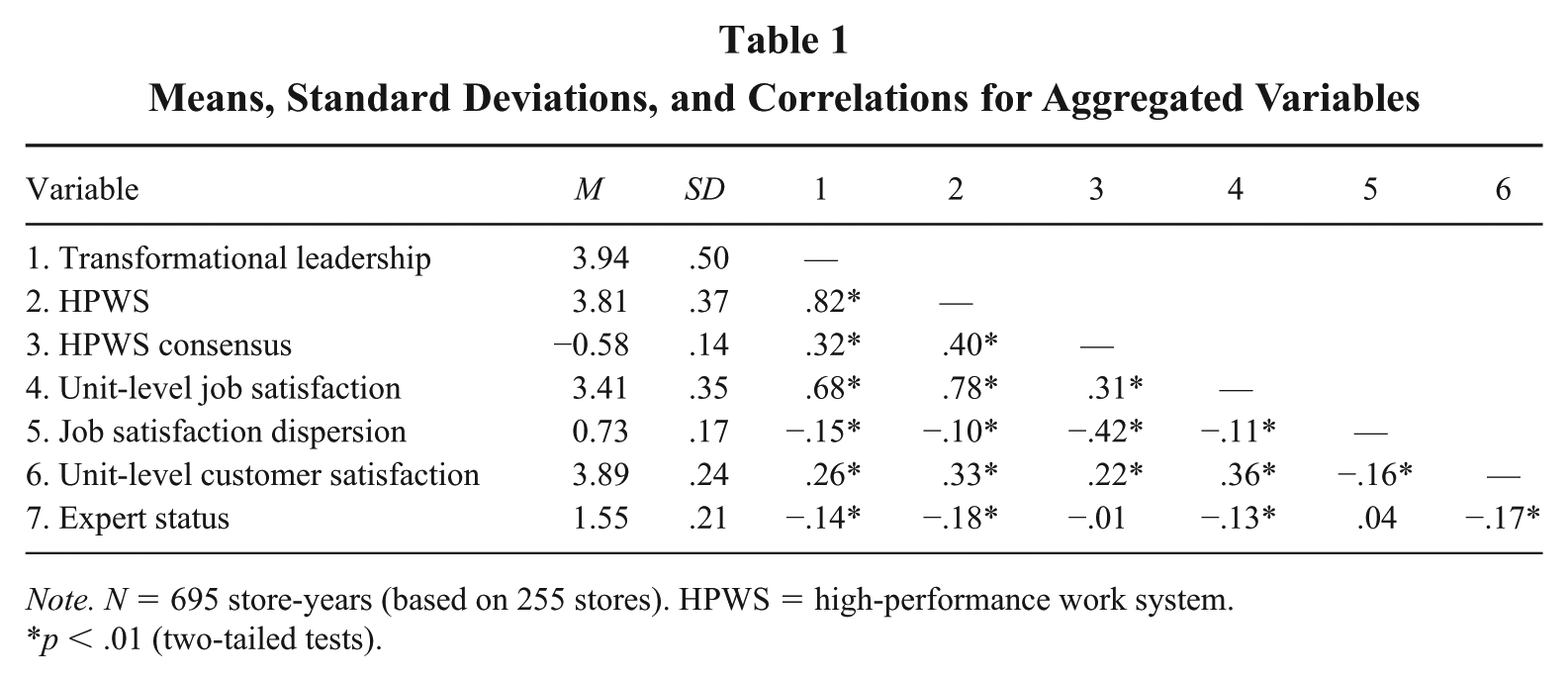
Note. N = 695 store-years (based on 255 stores). HPWS = high-performance work system.
p < .01 (two-tailed tests).
As outlined above, we use FE models for all multivariate analyses. Because a Breusch-Pagan test indicates that heteroskedasticity may be an issue in some but not all of the models, we estimate robust standard errors for the affected models and normal standard errors for the remaining models (see the notes to the tables). To reduce any nonessential correlation and to ease the interpretation of the estimates, we mean-center the variables before entering them in an interaction term (Aiken & West, 1993; Dalal & Zickar, 2012).
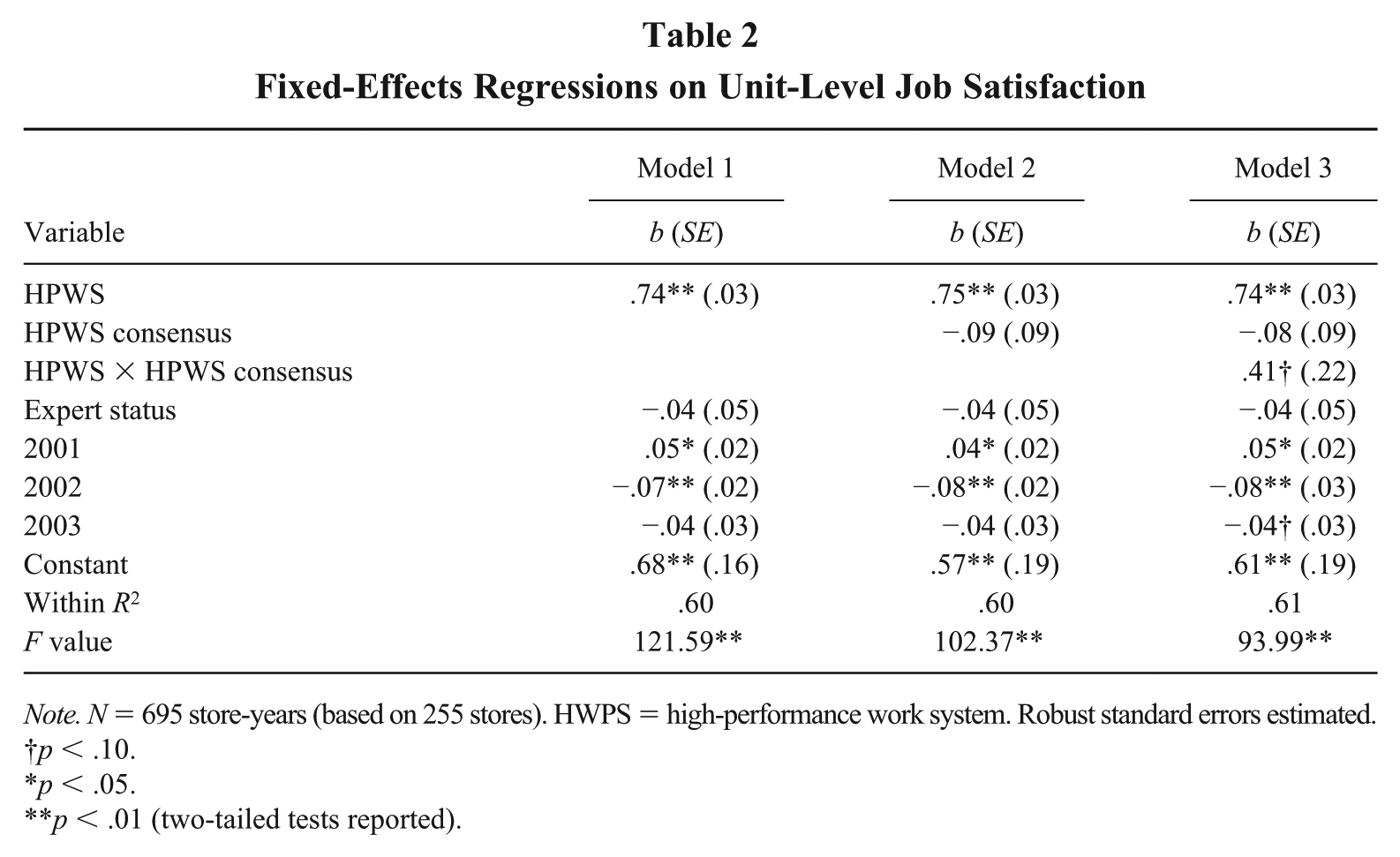
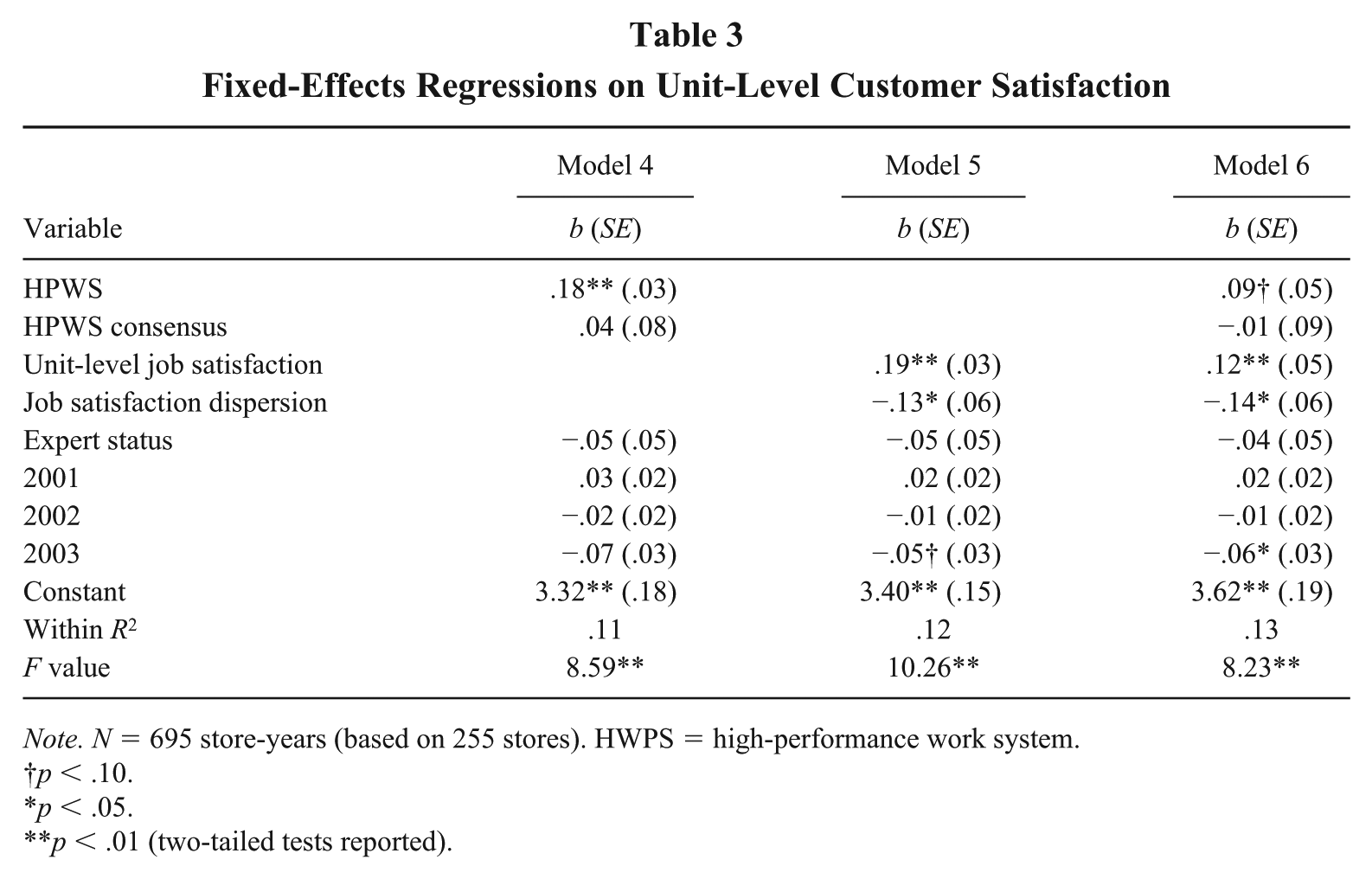
Hypotheses 1 and 2, which reflect the base model (see Figure 1), are tested with a series of regression models that we present in Tables 2 and 3. In support of Hypothesis 1, HPWSs are positively related to unit-level job satisfaction (Table 2, Model 2: b = .75, p < .01). Model 5 in Table 3 shows that, in line with Hypothesis 2, unit-level job satisfaction is positively associated with unit-level customer satisfaction (b = .19, p < .01).
Fixed-Effects Regressions on Unit-Level Job Satisfaction
Note. N = 695 store-years (based on 255 stores). HWPS = high-performance work system. Robust standard errors estimated.
p < .10.
p < .05.
p < .01 (two-tailed tests reported).
Fixed-Effects Regressions on Unit-Level Customer Satisfaction
Note. N = 695 store-years (based on 255 stores). HWPS = high-performance work system.
p < .10.
p < .05.
p < .01 (two-tailed tests reported).
Model specifications (Table 3, Models 4 to 6) indicate that the HPWS association with unit-level customer satisfaction is partially mediated by unit-level job satisfaction. As Model 4 indicates, HPWSs have a significant total effect on unit-level customer satisfaction (b = .18, p < .01). In a joint model (Model 6), the HPWS effect decreases to .09 (p < .10), whereas the unit-level job satisfaction effect is still significant (b = .12, p < .01). The indirect HPWS effect on unit-level customer satisfaction, mediated by unit-level job satisfaction, accounts for 51% of the total HPWS effect and is significant according to a Sobel-Goodman test (p < .01). Moreover, these effects are robust to the inclusion of HPWS consensus and job satisfaction dispersion.
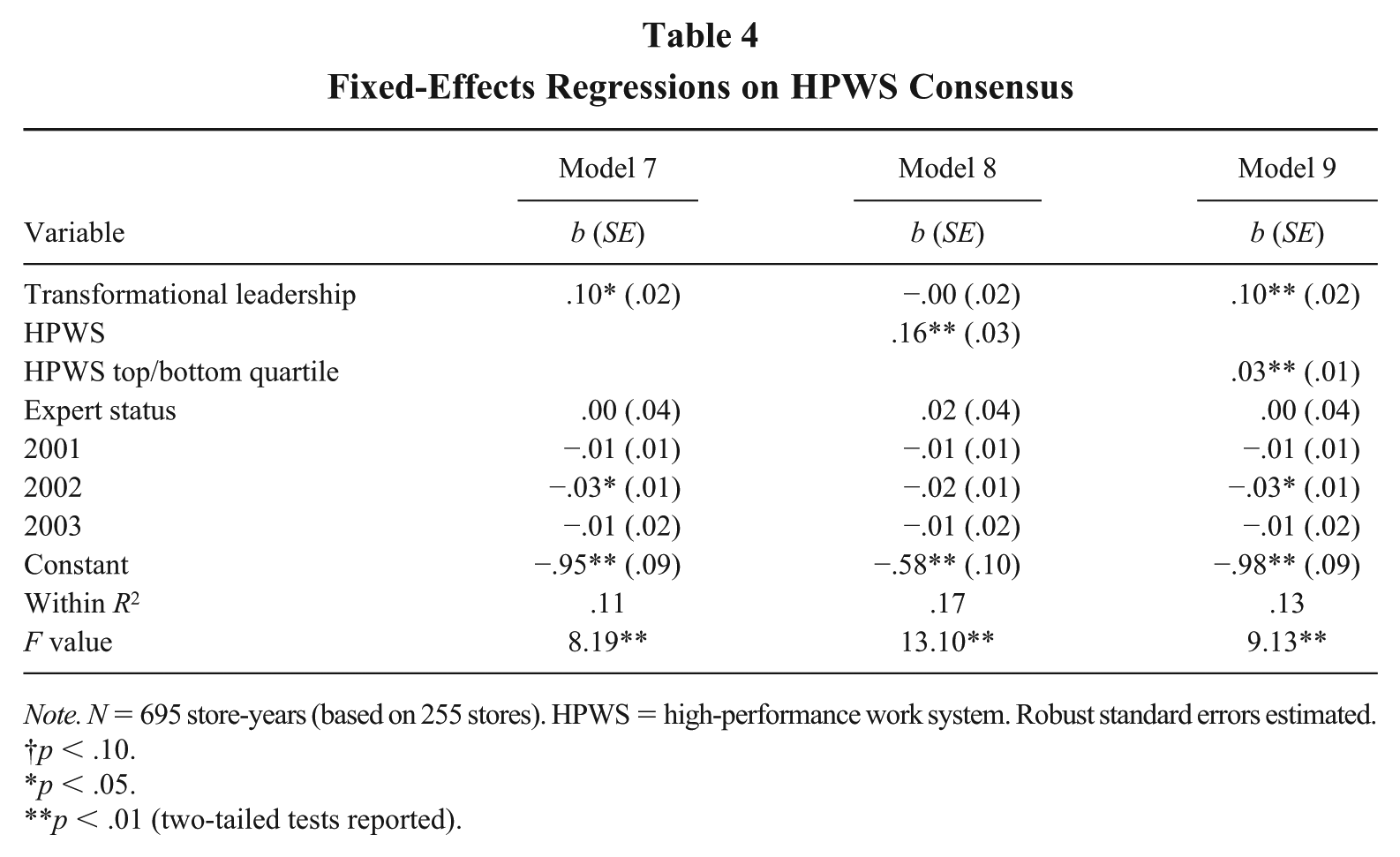
In Hypothesis 3, we assume that transformational leadership is positively related to HPWS consensus. This relationship is supported, as shown in Model 7 in Table 4 (b = .10, p < .01). As mentioned earlier, the correlation (r = .40) between HPWSs and HPWS consensus requires attention, though. Given that the association is mechanical to a degree, one would like to control for HWPS level when regressing HPWS consensus on transformational leadership. However, given the correlational patterns of our data, this strategy is not without further difficulties. Transformational leadership, HPWS, and unit-level job satisfaction are all relatively highly correlated; HPWS and transformational leadership especially are strongly correlated (r = .82). When they are simultaneously included in a regression, the correlations are problematic because overcontrolling and/or spurious relationships may be observed. One reason for such issues is statistical multicollinearity. Another reason is the conceptual relatedness of the constructs. By using confirmatory factor analysis, we have shown that the measures exhibit sufficient discriminant validity. However, some HR practices, like information sharing, may still depend on transformational leadership to be effective, so that they are often observed in combination. As a consequence, when we predict HPWS consensus by transformational leadership and omit the HPWS measure, a spurious leadership effect may be observed because the leadership measure may partly approximate the omitted HPWS effect. However, including HPWS results in overcontrolling because of the strong correlation between HPWS and transformational leadership in combination with the mechanical correlation between HPWS and HPWS consensus. As a result, it is likely that in this situation, the mechanically related HPWS effect overrules the conceptually plausible leadership effect. We show this artifact in Model 8 in Table 4.
Fixed-Effects Regressions on HPWS Consensus
Note. N = 695 store-years (based on 255 stores). HPWS = high-performance work system. Robust standard errors estimated.
p < .10.
p < .05.
p < .01 (two-tailed tests reported).
Based on these considerations, we suggest a simple but effective solution. The relationship between HPWS and HPWS consensus stems from the fact that, given truncated scales and limited distributions, any mean close to the scale endpoints goes along with reduced variation. However, this effect works in both directions, to both the left and right end tails of the HPWS distribution, and is thus not linear. We can employ this nonlinear property and create a dummy variable that collapses the top and bottom quartiles of the HPWS distribution into one category and compares it with the medium two quartiles. This dummy controls for the mechanical correlation between HPWS and HPWS consensus but avoids multicollinearity and overcontrolling because the nonlinear transformation reduces the correlation between the HPWS dummy and transformational leadership. Appendix C reports the correlations of this dummy variable with the other variables in the model (see online supplement). Model 9 in Table 4 presents the results of this robustness check. The transformational leadership effect is retained at the same level as in Model 7 in Table 4 and is still significant (b = .10, p < .01). Moreover, the top/bottom quartile dummy is positive and significant, as one would expect. We interpret this as supportive evidence for our model and assumptions. 10
In Hypothesis 4, we expect a positive interaction effect of HPWS and HPWS consensus on unit-level job satisfaction. The interaction is only marginally significant, as shown in Model 3 in Table 2 (b = .41, p < .10). 11 Based on the stepwise inclusion of HPWS consensus into the models (Table 2, Models 1 to 3), we observe that the main effect of HPWS consensus on unit-level job satisfaction is insignificant and that the inclusion of the interaction effect improves the model R-squared statistic only marginally (from .60 to .61). However, HPWS consensus impacts unit-level customer satisfaction through two routes, unit-level job satisfaction and job satisfaction dispersion, of which, as we explain below, the job satisfaction dispersion effect is much stronger.
Given that dispersion constructs have generally low statistical power (Roberson et al., 2007) and that the FE estimates are conservative, the marginally significant interaction of HPWS and HPWS consensus is still noteworthy. The interaction plot (Figure 2) reveals a “deadly combination” that occurs when a poor HPWS is perceived with a strong consensus. Given that unit-level job satisfaction has an overall low standard deviation of 0.35, the interaction is meaningful. The HPWS effect on unit-level job satisfaction (from one standard deviation below the mean to one standard deviation above the mean) is approximately 0.25 standard deviations larger when the HPWS consensus is strong as compared to when it is low.
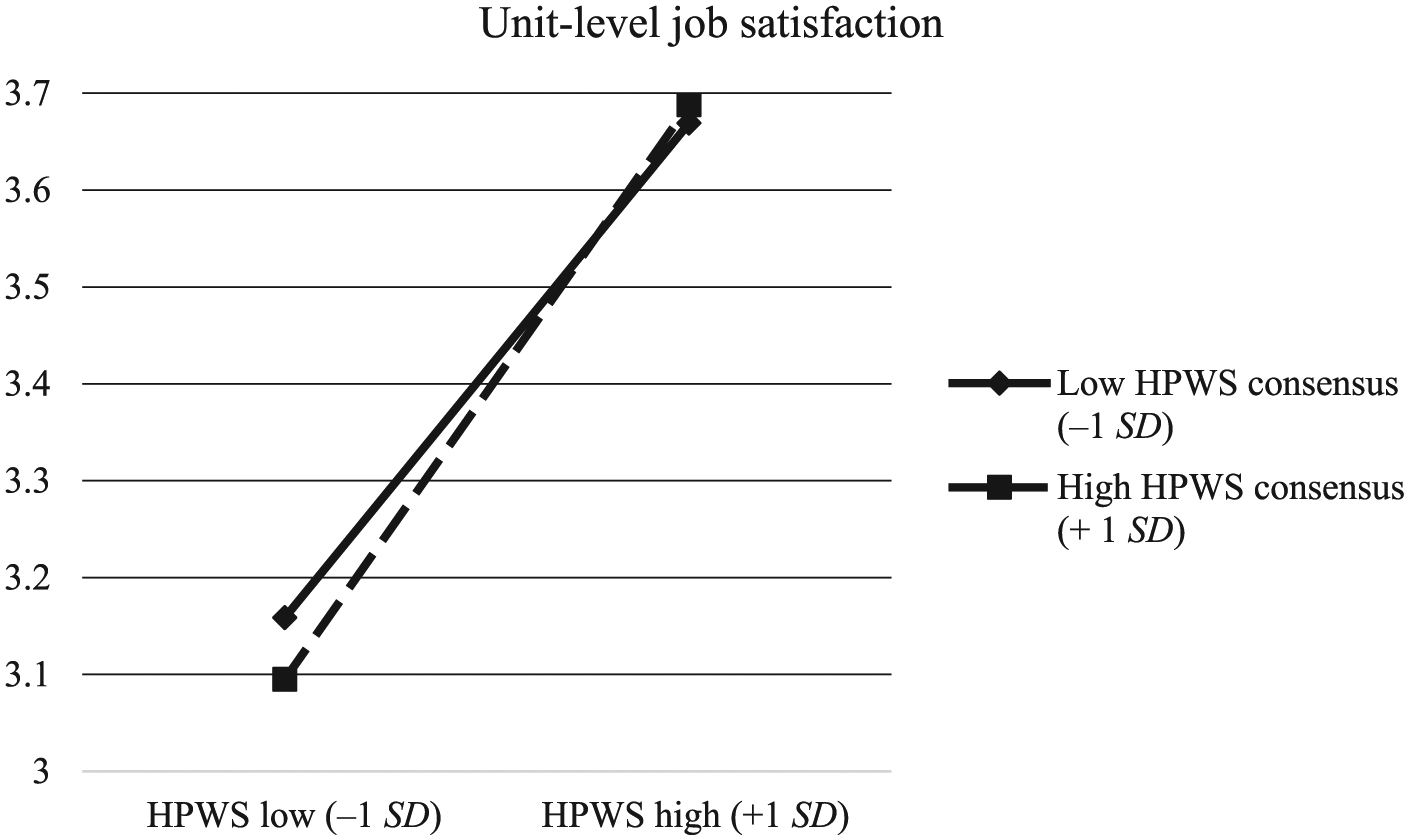
Interaction Between High-Performance Work System (HPWS) and HPWS Consensus
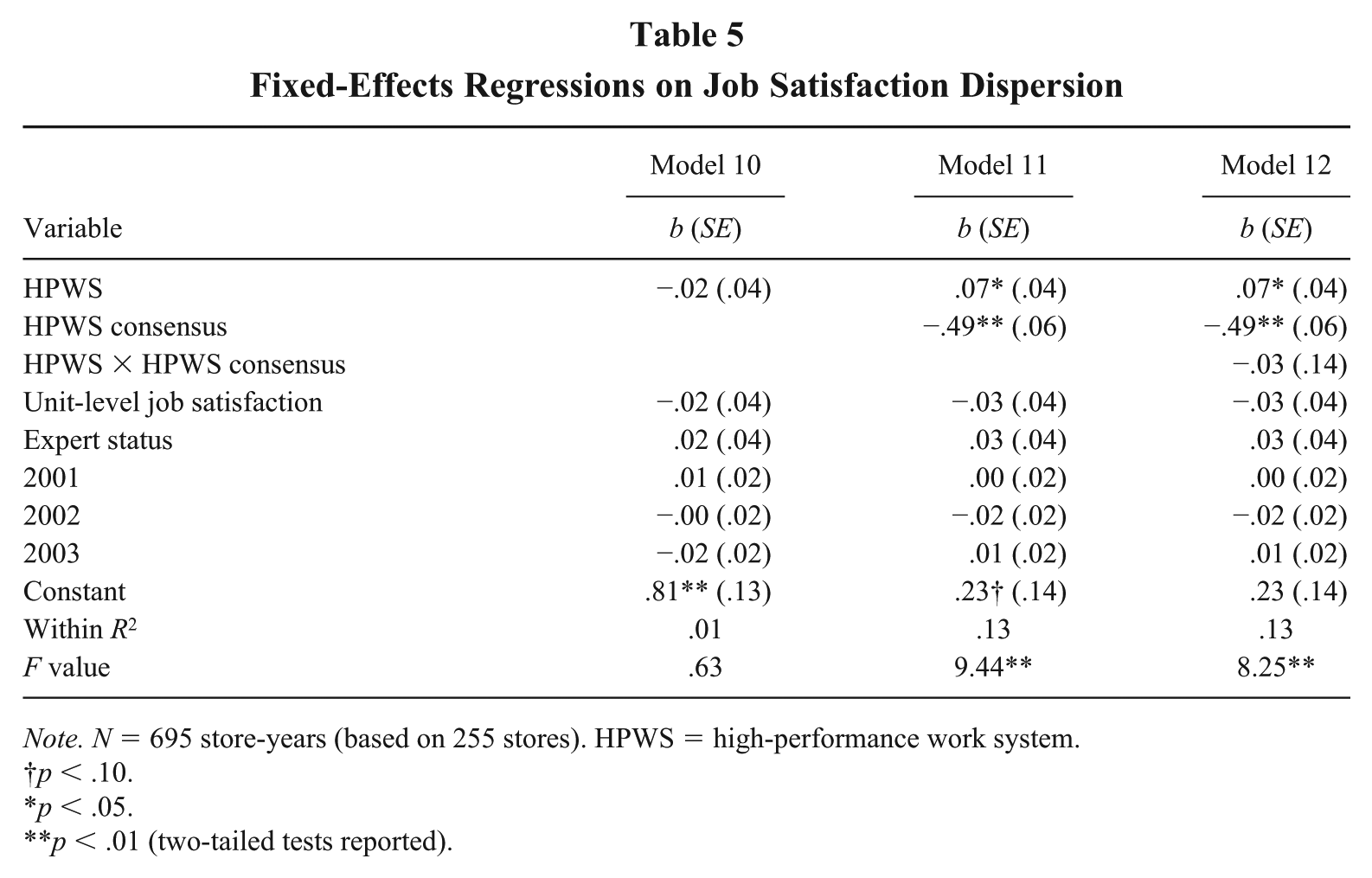
In Hypothesis 5, we predict that HPWS consensus has a negative effect on job satisfaction dispersion. As Model 11 in Table 5 shows, we find support for this relationship (b = −.49, p < .01). As indicated by the strong improvement of the model R-squared statistic from Model 10 to Model 11 as shown in Table 5 (from .01 to .13), HPWS consensus is the driving force of job satisfaction dispersion. We also test for the nonhypothesized but potential effects of HPWS and the interaction of HPWS and HPWS consensus on job satisfaction dispersion (Model 10 for the simple main effect; Model 12 for the joint effects). While HPWS has a positive, conditional main effect on job satisfaction dispersion (b = .07, p < .05), the interaction is insignificant (b = −.03, p > .10).
Fixed-Effects Regressions on Job Satisfaction Dispersion
Note. N = 695 store-years (based on 255 stores). HPWS = high-performance work system.
p < .10.
p < .05.
p < .01 (two-tailed tests reported).
Finally, in support of Hypothesis 6, job satisfaction dispersion has a negative relationship with unit-level customer satisfaction (Table 3, Model 5). A one-unit increase in job satisfaction dispersion goes along with a −.13 decrease in unit-level customer satisfaction (p < .05). As in the HPWS case, we estimate the mediated chain of effects from HPWS consensus to unit-level customer satisfaction. The total HPWS consensus effect on unit-level customer satisfaction is insignificant (b = .04, p > .10), but a Sobel-Goodman test indicates a significant indirect effect (b = .07, p < .05), which operates through job satisfaction dispersion. 12 Thus, HPWS consensus relates negatively to job satisfaction dispersion, which, in turn, relates negatively to unit-level customer satisfaction, such that the combined effect is positive, as we expected.
Discussion
We explore an important antecedent of HPWS consensus (transformational leadership) as well as HPWS consensus effects on HR-proximal (unit-level job satisfaction) and HR-distal (unit-level customer satisfaction) outcomes. By aggregating employee and customer data to the store level, using multiple observations per unit (22 employees and 374 customers per unit on average), and exploiting the panel structure of the data, we are able to capitalize on the strengths of a longitudinal, multi-informant design and examine aspects of an implemented HPWS in detail.
We find that transformational leadership is positively related to HPWS consensus, although the role of HPWS consensus as a predictor variable is complex. First, a closer inspection of the HPWS and HPWS consensus interaction reveals that, in our sample, only the top 15th percentile of the observed stores (in terms of the HPWS) benefit from HPWS consensus, whereas there is no or a negative HPWS consensus effect for the remaining 85% of the stores (Figure 2). Thus, creating similar views of a poor HPWS may seriously backfire. Second, HPWS consensus has a strongly negative effect on job satisfaction dispersion, which, in turn, negatively relates to unit-level customer satisfaction. We interpret this finding in light of the firm’s strategy execution process: With a strong HPWS consensus, employees understand the strategies and HPWS of their stores better and develop similar attitudes that lead to strategic alignment. These results have noteworthy implications for theory and practice.
Implications
For both theory and practice, the role of leadership in creating employee consensus deserves more attention. HR system strength theory emphasizes that HR “practices can be viewed as communications from the employer to employee” (Bowen & Ostroff, 2004: 207) and that these communications occur between members of the top management team, HR professionals, and leaders throughout the firm’s hierarchy. Through communications and leadership behaviors, managers and leaders facilitate consensus building among employees. Specifically, our data support the role of transformational leadership in consensus building. By communicating the organization’s mission and vision and by approaching employees individually, store managers contribute to the effectiveness of their stores by creating employee consensus.
Our results echo recent theorizing about resource orchestration (Chadwick et al., 2015; Sirmon et al., 2011; Sirmon, Hitt, & Ireland, 2007) as a dynamic firm capability (Kor & Mesko, 2013). Essentially, resource orchestration argues that “the key to the management of resources is the resource of management” (Mahoney, 1995: 92). Managers need to orchestrate complex sets of resources, including HR and HR systems, to respond to internal and external firm dynamics and to create value. Resource orchestration entails many components and stages, but “to optimize value creation, they must be synchronized” (Sirmon et al., 2007: 287): Resources must be structured, bundled, and leveraged to contribute value to customers and stakeholders, and employee consensus indicates successful synchronization efforts. For example, the DIY stores in our sample frequently use special offers to attract customers and create customer satisfaction and value. To leverage the potential from special offers, well-informed and well-trained employees are needed to direct customers to these products and to ably and willingly explain the differences between reduced and regular products when customers compare prices.
These suggestions echo research by Brymer and Sirmon (2018), who, on the basis of resource orchestration logic, argue that the bundling of HR according to certain criteria (like service area or region) has positive effects on unit-level outcomes. Transformational leadership may be interpreted as the strategic attempt to create similar employee perceptions, attitudes, and behaviors (i.e., HPWS consensus) and thus bundles of orchestrated resources. In a second study, Chadwick et al. (2015) found that CEO emphasis on strategic HR predicts the use of commitment-based HR systems, which, in turn, have a positive impact on firm performance. Framing employee consensus through a resource orchestration, strategic alignment, and synchronization lens may finally contribute to our understanding of the human capital resource emergence process (Ployhart & Moliterno, 2011; Ployhart et al., 2014). Although empirical studies have sought to understand this process better (e.g., Reilly, Nyberg, Maltarich, & Weller, 2014), we still have limited insights regarding the emergence of the human capital resource, how it manifests, and what its consequences are. Consensus may be one of the missing pieces that helps us to better embrace the emergent properties of collectives of individuals in similar situations. For example, Ployhart and Moliterno (2011: 135) speak of emergence enabling states that consist “of the unit’s behavioral processes, cognitive mechanisms, and affective psychological states. . . . Simply put, emergence enabling states describe how unit members act, think, and feel.” HPWS consensus embraces attitudes and behaviors and relates to all three dimensions. Transformational leaders who live and explain their firm’s vision and mission may create emergence-enabling states in which employees act, think, and feel in similar ways that contribute to the firm’s strategic goals. Consensus may thus also indicate a better or more valuable human capital resource.
Generally, research has demonstrated the economic value of “good management” practices to firm performance (Bloom et al., 2012) but has highlighted that leadership also needs to be considered (Waldman, Sully de Luque, & Wang, 2012). Additional work is needed to explore the dynamics through which top management decisions diffuse and ripple through the organization. Employee consensus is a critical outcome of such resource orchestration and synchronization efforts, but to inform practice about how it works, we require more knowledge about the mediated chain from managerial decision making to employee-based outcomes. Open questions are, among others, Which unit-level outcomes benefit from employee consensus (e.g., customer satisfaction), and which outcomes may be impaired by too much consensus (e.g., innovation)? Which roles do HR systems, the HR function, leaders, and employees have in the resource orchestration process? Which leadership behaviors are complementary to HR systems, and which are substitutes (Chuang, Jackson, & Jiang, 2016)? When are leaders reflections of the top management, and when do they follow their own agendas? We encourage research that approaches these and related questions.
A second implication of our work relates to the use of dispersion measures for HR research (Nishii & Wright, 2007). In the service setting of our study, job satisfaction dispersion relates negatively and in economically significant ways to unit-level customer satisfaction—an important store-level outcome and industry metric. Further, HPWS consensus relates strongly and negatively to job satisfaction dispersion. Thus, an HPWS and its HR-proximal outcomes should be evaluated in terms of both level and dispersion effects. This responds to Nishii and Wright (2007: 5), who note that “we have hitherto failed to explicitly recognize the many ways in which individuals and groups may experience and respond differentially to HR systems within organizations.” According to these authors, the term “HR systems adoption” is a shortcut for two or even more processes: the processes through which HR systems are enacted and the perceptions of HR practices by heterogeneous individuals within firms. Transformational leadership speaks to the enactment path and describes how an HPWS consensus emerges; HPWS consensus approximates the perceptional differences path. However, future research should attempt to better explain how heterogeneous individuals with potentially different perceptions of the same HR system can be managed to create more uniform perceptions and to reliably execute the strategy of the firm.
Our findings are further interesting for HR professionals in firms with primarily low-skilled jobs (e.g., Pieper, Trevor, Weller, & Duchon, in press). Strategic HR researchers have argued that HPWSs are primarily beneficial for knowledge workers or a highly skilled human capital resource, because low-skilled workers have fewer opportunities to contribute to strategic objectives (e.g., Becker & Huselid, 2006). However, our results indicate that HPWSs have favorable unit-level outcomes in low-skill settings as well. In some settings, a narrow but well-aligned set of relatively inexpensive HR practices might be more instrumental for achieving strategic goals than a standard set of HR practices that is poorly aligned. We have outlined that traditional HR practices of an HPWS, such as selective recruitment or individual pay for performance, are either difficult to realize because of institutional constraints or show little promise for value creation in our study’s setting. Yet, as we have shown, a coherent set of mostly informal practices, in conjunction with leadership attributes, has positive effects and supports the execution and achievement of the store’s strategy. Ironically, this may indicate that more contextualized research (i.e., research that takes into account external fit) is needed to understand the “complexity of internal fit” (Kepes & Delery, 2010: 388; italics added) in HR systems.
Limitations and Future Research
We address some limitations, leading to questions for future research. First, we focus on some aspects of transformational leadership but do not measure all aspects; moreover, we neglect other leadership behaviors. While there is sufficient theoretical rationale for the relationships that we study, alternative leadership behaviors may have similar effects on HPWS consensus. For example, transactional leaders may also facilitate consensus by providing rewards, or visionary leaders may inspire employees in a similar way to transformational leaders (Ateş et al., 2020). Future research should better explore alternative leadership behaviors and their effects on HPWS consensus and should utilize full-fledged leadership scales to measure leadership better.
Second, we recognize the role of transformational leadership in HPWS consensus but do not study alternative mechanisms that would also facilitate consensus building. Besides the roles played by managers and leaders, Bowen and Ostroff (2004) mention alternative paths to consensus. For example, HR researchers recognize the role of organization design (i.e., external fit) in HR and HPWS functioning (Weller, Nyberg, Hymer, & Ebert, in press), with a focus on design parameters, such as centralization and formalization (Mintzberg, 1979; Van de Ven, 1976). When HR systems are centrally managed (e.g., through a strong and strategically anchored HR function; Ulrich, 1997) and executed throughout the organization with the help of uniform, formalized processes (e.g., based on digital tools and processes), there is a greater chance for employee consensus than in situations where strategic decisions are made in the field units and strategy execution is an informal process. Considering organization design is also important for better embracing the role of leadership. In some situations, leadership and organization design may be substitutes—either a strong leader or process may suffice to execute the firm’s strategy. In some situations, however, leadership and organization design are complements, such that successful strategy execution hinges on specific leadership behaviors embedded in a specific organization design. A related case may occur in our data. The high correlation of transformational leadership and HPWS (r = .82) may indicate that certain aspects of an HPWS (e.g., information sharing) may require transformational leadership behaviors to be efficient, so that employees cannot easily differentiate between these complementary inputs to the strategy execution process. We encourage research that tries to better understand these complex relationships and disentangle them.
A third limitation of our study is that in addition to consensus, HR system strength theory assumes that strong HR systems are also characterized by distinctiveness and consistency. As such, our model relates to parts of HR system strength theory but is far from a complete test of it. We motivate researchers to invest in a more complete test of the theory.
Fourth, we rely on unit-level job satisfaction as a mediating variable but do not consider other potential mediators, such as unit-level commitment, involvement, or the human capital resource’s collective abilities, motivation, and opportunities (which may, in turn, impact attitudes, such as job satisfaction). Our finding that 51% of the HPWS effect on unit-level customer satisfaction is mediated through unit-level job satisfaction indicates that unit-level attitudes are an important construct in the low-skilled service setting of our study, but alternative measures (e.g., abilities, motivations, opportunities; Jiang et al., 2012) could further inform subsequent studies.
Fifth, we cannot rule out endogeneity completely. The FE models allow us to eliminate (quasi) time-constant unobserved heterogeneity, but other types of endogeneity (e.g., simultaneity) might still cause estimation issues. If unit-level customer satisfaction were systematically higher in some stores than in others, for unobserved and truly exogenous reasons, it could result in more positive service encounters, which, in turn, could increase average employee job satisfaction in these stores. However, it is difficult to think of such a confound that is not determined by region (e.g., differences in competition or wealth) or time (e.g., business cycles), which are picked up by either the FE estimator, time dummies, or additional controls. Moreover, we sought to minimize concerns by using a design in which the employee surveys are conducted some weeks before the customer surveys, so that temporal precedence between the independent and dependent variables is established (Wright, Gardner, Moynihan, & Allen, 2005). Further, the marketing literature also regards customer satisfaction as a primarily endogenous variable, which is caused by, among other factors, employee satisfaction (Wangenheim et al., 2007).
Sixth, the HPWS consensus and job satisfaction dispersion effects on unit-level customer satisfaction might depend on the DIY store, service context of our study, thus lacking external validity. We assumed repeated customer interactions with the same or different employees of the same stores. In other contexts, such as manufacturing, where employees do not have face-to-face interactions with customers, customer satisfaction is probably unaffected by job satisfaction dispersion, unless it materializes in product quality variations or similar outcomes.
Finally, we were not able to fully control the data collection procedure, so we cannot report response rates more accurately than we did, nor could we use longer and better validated scales for the constructs of interest. We believe that our measures have sufficient psychometric properties and that the data have merits, but we acknowledge these difficulties as a limitation of our work.
Conclusion
In summary, this study suggests a positive effect of transformational leadership on HPWS consensus, which has positive effects on HR-proximal and HR-distal outcomes. HPWS consensus, like job satisfaction dispersion, is a variability-based construct. Researchers have repeatedly noted that more theory and empirical research should consider sources of within-firm variability to better elucidate the effects of HPWS on employee perceptions and behaviors, and more distal outcome metrics, such as customer satisfaction. Our study has moved into this direction, and we encourage future research to extend on it.
Supplemental Material
JOM817605_SM – Supplemental material for Transformational Leadership, High-Performance Work System Consensus, and Customer Satisfaction
Supplemental material, JOM817605_SM for Transformational Leadership, High-Performance Work System Consensus, and Customer Satisfaction by Ingo Weller, Julian Süß, Heiner Evanschitzky and Florian von Wangenheim in Journal of Management
Footnotes
Acknowledgements
The authors would like to acknowledge helpful comments from seminar participants at IE University’s Business School (Madrid) and from the editor and two anonymous reviewers.
Supplemental material for this article is with the manuscript on the JOM website.
Notes
References
Supplementary Material
Please find the following supplemental material available below.
For Open Access articles published under a Creative Commons License, all supplemental material carries the same license as the article it is associated with.
For non-Open Access articles published, all supplemental material carries a non-exclusive license, and permission requests for re-use of supplemental material or any part of supplemental material shall be sent directly to the copyright owner as specified in the copyright notice associated with the article.
