




Abstract
Despite the importance of leader vision communication to effective leadership, little is known about what prompts leaders to communicate a vision in the first place. Drawing from construal level theory, we examined the within-person relationship of leader construal level in the morning with vision communication during that workday. Leadership self-identity, or the extent to which “being a leader” is central to one’s self-concept, was specified as a cross-level moderator of the daily construal level–vision communication relationship. We tested our predictions using an experience sampling design across 15 consecutive workdays. In total, we obtained a total of 394 matched morning and afternoon surveys from 44 mid- to high-level managers. Results revealed that a high-level construal level in the morning was positively associated with vision communication during the day but only when leadership self-identity is high (vs. low). We discuss the theoretical implications of our findings, in particular with regard to the emerging field of visionary leadership as well as the emerging literature that uses construal level theory to explain leadership phenomena.
Keywords
A cursory inspection of the literature on what makes for effective leadership leads one to conclude that vision communication lies at the core of effective leadership (Berson, Waldman, & Pearce, 2016; House & Shamir, 1993; Stam, Lord, van Knippenberg, & Wisse, 2014; van Knippenberg & Sitkin, 2013; van Knippenberg & Stam, 2014). Indeed, vision communication—or the articulation of an abstract, future-oriented direction for the collective that appeals to desirable values and outcomes (van Knippenberg & Stam, 2014)—is associated with general indicators of leadership effectiveness and performance (cf. Stam et al., 2014) and is endorsed as contributing to outstanding leadership by laypersons across different cultures (Den Hartog, House, Hanges, Ruiz-Quintanilla, & Dorfman, 1999). Not surprisingly, CEOs rate vision communication among the topics of highest importance to them (London Business School, 2008). What is surprising, however, is that vision communication remains as mysterious as it is deemed essential. Inspired by this dissonance, scholars have recently begun to unravel part of the mystery behind effective vision communication (Stam et al., 2014).
Thus far, empirical research on vision communication has explored such elements as the use of rhetorical techniques (e.g., Mio, Riggio, Levin, & Reese, 2005; Naidoo & Lord, 2008), the focus or content of visions (Stam, van Knippenberg, & Wisse, 2010a, 2010b), and the emotional expression of leaders during vision communication (Venus, Stam, & van Knippenberg, 2013). More recent research has started to develop theoretical frameworks depicting how visions are shaped in collaboration with followers (Berson et al., 2016) as well as how visions translate into follower pursuits (Stam et al., 2014). Although there is clear progress in the current state of the science of vision communication, less is known about what actually predicts leader vision communication. That is, what triggers leaders to engage in vision communication in the first place? In light of the view that good theory captures the processes through which a phenomenon comes about (van Knippenberg, 2011), identifying the antecedents of vision communication should be just as critical for advancing the science behind vision communication as identifying what makes for effective vision communication. We therefore break new ground in the present study by exploring theoretically derived antecedents of leader vision communication.
Drawing on construal level theory (Trope & Liberman, 2010)—which posits that the way that one construes a specific action or entity (i.e., a higher future-oriented construal in terms of values and end-states vs. a lower present-oriented construal in terms of details and specifics) has implications for subsequent behavior—we expect a positive association between construal level and vision communication. In keeping with the tenet of construal level theory that construal level is a dynamic phenomenon that fluctuates over time (Trope & Liberman, 2010) and with recent evidence that leaders’ motivation and behavior also vary on a daily basis (e.g., Johnson, Venus, Lanaj, Mao, & Chang, 2012; Lanaj, Johnson, & Lee, 2016; Qin, Huang, Johnson, Ju, & Hu, in press), we argue that it is of theoretical importance to use a nuanced within-person design, to capture the temporal dynamics of our focal variables. Specifically, we propose that leaders will engage in more daily vision communication on days when they experience high construal level. Moreover, we expect that the extent to which daily high construal translates into daily vision communication depends on leaders’ motivation for and positive attitude toward engaging in vision communication in the first place. Evidence has shown that individuals differ in their leadership identity, or the extent to which they actually define themselves as leaders and are motivated to express this identity (Day & Sin, 2011; Hiller, 2005). For leaders who identify strongly with their leader role, high daily construal should be more predictive of daily vision communication because doing so is aligned with one’s sense of self as a leader, which includes the desire to exhibit effective leader behaviors such as vision communication (Day, Harrison, & Halpin, 2009). We therefore examine leadership self-identity as a chronic between-person moderator of the within-person relation of daily construal level with daily vision communication.
The current study makes several contributions to the leadership literature. First, exploring daily construal level as a predictor of daily vision communication is important because it enhances our limited understanding of visionary leadership (e.g., Stam et al., 2014). As a corollary, our study answers calls to focus on specific leader behaviors, a focus that is argued to be more useful and actionable than styles and multidimensional conceptualizations of leadership behaviors (van Knippenberg & Sitkin, 2013). Second, by recognizing the potential of construal level for understanding vision communication, we contribute to emerging work suggesting that construal level theory is relevant for leadership phenomena (Berson & Halevy, 2014; Berson, Halevy, Shamir, & Erez, 2015; Popper, 2013). Finally, we extend the emerging within-person perspective on leader behavior, which has only recently begun to examine within-person antecedents (e.g., mood, attentional resources) and the interplay of dynamic within-person and static between-person antecedents (e.g., Barnes, Lucianetti, Bhave, & Christian, 2015).
Theoretical Background
Leadership and Vision Communication
Vision communication is heralded as the sine qua non of outstanding leadership (House & Shamir, 1993; Stam et al., 2014) and is defined as the articulation of a future-oriented direction of the collective that appeals to desirable values and outcomes (Berson et al., 2016; House & Shamir, 1993; Stam et al., 2014). Unlike typical goals, visions are abstract, higher-level goals that incorporate strategic components (Conger & Kanungo, 1998) and reflect uncertain and open-ended outcomes (e.g., innovation, risky opportunities) that need not necessarily be achievable (Stam et al., 2014; van Knippenberg & Stam, 2014). Visions are valuable because they provide followers with a sense of identity and purpose (Carton, Murphy, & Clark, 2014; Shamir, House, & Arthur, 1993), and they elicit positive attitudes and increased performance (Kirkpatrick & Locke, 1996; Stam et al., 2010a, 2010b; Venus et al., 2013). Despite the positive status that vision communication seems to enjoy, it is unfortunately not easy to answer the question of what drives leaders to engage in vision communication behavior, a state of affairs that is probably best summarized by Stam et al. (2014: 1172), who in their review of the literature qualified vision communication as holding “the dubious honor of being both one of the most crucial and mysterious aspects of leadership.” It is clearly not an overstatement, therefore, to argue that more research is needed in the field of vision communication.
Fortunately, recent years have witnessed attempts to demystify what makes for effective vision communication. While previous research focused on the rhetorical techniques used for vision communication (for overviews, see Stam et al., 2014; van Knippenberg & Stam, 2014), more recently scholars have begun to illuminate when and for whom vision communication affect follower performance (Stam et al., 2010a, 2010b; Venus et al., 2013), how vision content gets shared and shaped by followers (Berson et al., 2015), and how vision communication translates into vision pursuit (Stam et al., 2014). Even so, what is missing so far from these streams of research is an illumination of the antecedents of leader vision communication. This is unfortunate because a complex phenomenon such as vision communication cannot be fully understood without an understanding of all elements, including the antecedents that contribute to the phenomenon. We therefore break ground in the present study by exploring leader daily construal level as a possible within-person antecedent of daily vision communication behavior of the leader.
Leader Construal Level and Vision Communication
Construal level theory explains how we transcend ourselves from the present to imagine the future, see things from another person’s perspective, and consider hypothetical realities by forming abstract mental representations of psychologically distant objects (Trope & Liberman, 2010). Low-level construals of actions, events, and objects are concrete, unstructured, and contextualized representations that include subordinate features, whereas high-level construals are abstract, schematic, and decontextualized representations that include only superordinate, central, and core features. Low-level construals direct attention to concrete details and the “how” of situations, lower-level goals, the proximal future, and outcomes that are certain and local. In contrast, high-level construals direct attention to the big picture and the “why” of situations, to enduring and meaningful goals and values that are tied to people’s self-concepts, to the distant future, and to outcomes that are uncertain, abstract, and nonlocal. As an example, a high-level construal of performing one’s job might include “learning a new skill,” whereas a low-level construal might be “filling in a TPS report” (Rosen, Koopman, Gabriel, & Johnson, 2016).
Importantly, construal level influences people’s cognitive and behavioral reactions via its relations with temporal and perceptual scope. Consequently, construal level theory has proven useful for explaining organizational phenomena (for an overview, see Wiesenfeld, Reyt, Brockner, & Trope, 2017), such as decision making (Trope & Liberman, 2010), negotiation (Wening, Keith, & Abele, 2015), virtual team behavior (Wilson, Crisp, & Mortensen, 2013), organizational learning (Reyt & Wiesenfeld, 2015), and employee incivility (Rosen et al., 2016). Interestingly, construal level has been applied to leadership contexts as well. For instance, Popper (2013) used construal level theory to explain how leader perceptions are a function of psychological distance, and Berson et al. (2015) proposed that follower motivation is a function of the match between the construal level of leader message attributes and situational attributes. In terms of empirical research, van Houwelingen, van Dijke, and De Cremer (2015) showed that construal level influences leaders’ decision to discipline followers after transgression of moral norms. Demonstrating the importance of a match between the situation and leader communication in terms of construal level, van Houwelingen, Stam, and Giessner (2017) found that leader appeals to desirability (feasibility) were more effective when the spatial distance between leaders and followers was high (low). These developments suggest that construal level holds promise for explaining leadership phenomena, and we suspect that leader vision communication is a promising candidate given the parallels between visions and high-level construal in terms of temporal perspective and abstraction.
Having a high daily construal level may motivate leaders to exhibit vision communication on that same day for a few reasons. First, a leader is more likely to communicate a vision under a high-level construal because of its focus on superordinate and long-term end states that reflect desirable values and outcomes (Stam et al., 2014). For example, a team leader may be in charge of the development of a new virtual reality device. On a day when the leader experiences high-level construal, she or he may communicate a vision statement to her or his followers, which references a long-term goal and the general function of the device. On that day, a team leader may further stress the meaning and purpose of the device, such as how it fits into the values of the company and how it will bring about profound changes in the lives of its future customers. The reason is that a high construal drives the leader to focus on the abstract and intrinsic meaning of the product. In contrast, when the leader experiences a low construal on another day, he or she will be more likely to focus on short-term goals and specific details of the device (e.g., its cost and hardware specifications) rather than the abstract and long-term vision. The reason is that low construal primes the leader to have pragmatic, instrumental considerations focused on the feasibility of the means used to reach end states (Kivetz & Tyler, 2007; Liberman & Trope, 1998).
Second, vision is more likely to be communicated during days when the leader experiences a high-level construal because it increases the leader’s perceptual scope as well as context-dependent information processing (i.e., seeing stimuli as interdependent entities linked by a broader context; Liberman & Förster, 2009). Visions are future-oriented images of the collective; therefore, they emphasize higher-level goals and outcomes that appeal to the group rather than select individuals. On a day when a leader experiences a high-level construal, that person is more likely to focus on collective goals and interests via context-dependent information processing, which is associated with a focus on similarity (Förster, 2009) and with collective self-construal (e.g., Kühnen & Oyserman, 2002). Indeed, high-level construals prime people to see themselves as being similar to others, even for those who belong to different social groups (Levy, Freitas, & Salovey, 2002), and to show increased group identification and group-consistent behavior (McCrea, Wieber, & Myers, 2012). For the reasons stated so far, we expect that leader daily high-level construal will predict daily vision communication.
Hypothesis 1: Within leaders, construal level will be positively related to the frequency of vision communication.
Moderating Role of Leadership Self-Identity
While a higher (vs. lower) daily construal level is expected to foster more frequent daily vision communication, variation in vision communication is best understood by examining the interplay of within-leader states and between-leader traits (Dinh & Lord, 2012). A cue to engage in vision communication may not be acted on by every leader, and it stands to reason that having a higher daily construal level should prompt a leader to engage in vision communication, especially to the extent that doing so is considered meaningful to this leader. We argue that this meaningfulness depends on a key trait—namely, leadership self-identity. Leadership self-identity refers to the extent that people actually define themselves as leaders and are motivated to express this identity (Day & Sin, 2011; Hiller, 2005). Thus, we explore how the relation of daily construal level with daily vision communication is moderated by leadership self-identity. By focusing on leadership self-identity, we extend recent research that positions self-definitions as critical antecedents of leader behavior. While attention has broadened the focus from leader identity levels (individual vs. collective; e.g., Johnson et al., 2012; Rus, van Knippenberg, & Wisse, 2010a, 2010b) to include other types of self-definitions (e.g., team identification; Giessner, van Knippenberg, van Ginkel, & Sleebos, 2013), the role of leadership self-identity has yet to be integrated with this work.
There are at least two reasons why the positive relation of daily construal levels with daily vision communication is expected to be pronounced for leaders with strong (vs. weak) leadership self-identities. First, although having a high-level construal makes the elements or “ingredients” that constitute visionary communication (e.g., desirable end states, collective values, future orientation) more accessible in the working memory of leaders, these cognitive elements have the potential to prompt a variety of behaviors (e.g., more cooperative and ethical behavior, greater creativity and innovation, less incivility; see Wiesenfeld et al., 2017), many of which fall outside the domain of leadership. The value of having a strong (vs. weak) leadership self-identity is that it channels the expression of high-level construals into leadership-related endeavors and behaviors. That is, having a strong leadership self-identity motivates leaders to seek out opportunities to exercise competencies associated with effective leadership by engaging in endeavors and behaviors (e.g., vision communication) that are central to the identity (Day et al., 2009; Day & Harrison, 2007). In this way, a high-level construal can be loosely thought of as providing the raw ingredients for vision communication, whereas a strong leadership self-identity motivates the use of these ingredients for vision communication (and possibly other leadership endeavors). Put differently, whereas a high-level construal provides leaders with the appropriate attentional focus or mind-set to communicate a vision, leaders will be more likely to act on cues and opportunities to actually vocalize this mind-set (i.e., engage in more vision communication) when they have a strong leadership self-identity. In contrast, when leadership self-identity is weak, cues and opportunities to exhibit leadership behaviors triggered by a high-level construal will be less relevant and meaningful, thereby lessening the occurrence of vision communication.
Second, high-level construals cause individuals to make decisions and behave in accordance with self-referenced values and attitudes (Eyal, Sagristano, Trope, Liberman, & Chaiken 2009; Freitas, Langsam, Clark, & Moeller, 2008). Therefore, on a day when a leader experiences high construal, that individual will be more likely to engage behaviors that are self-consistent and self-expressive. When the leader holds a strong leadership self-identity, she or he will desire to be an effective leader and will value actions that move her or him closer to achieving that ideal goal (Hiller, 2005). This leader will tend to see vision communication as self-consistent or self-expressive because such communication is perceived as prototypical of effective leadership (van Knippenberg & Stam, 2014). However, when leadership self-identity is low, the leader will display other types of self-expressive behaviors (and not necessarily leadership related), in line with the most central component in that leader’s identity. For example, if the leader has a strong moral self-identity, a high-level construal during a given day may motivate him or her to exhibit more corporate social responsibility endeavors rather than vision communication. We therefore predict the following:
Hypothesis 2: The within-leader relation of construal level with vision communication will be moderated by leadership self-identity such that this positive relation will be stronger when leadership self-identity is strong (vs. weak).
Method
Participants and Procedure
The sample consisted of mid- to high-level managerial employees who were enrolled in an executive-style weekend MBA program. A total of 44 participants completed an initial onetime questionnaire during the first wave and then two or more sets of daily surveys during the second wave. We initially contacted 63 managers about participating in this study; thus, our response rate was around 70%. The demographics of the final sample were as follows: 64% were male; the majority were either Caucasian (58%), African American (26%), or Asian (14%); the average age was 41.0 years (SD = 7.5); the average tenure in a managerial role was 12.9 years (SD = 7.4); and the average number of subordinates who directly reported to the leaders was 10.2 (SD = 5.9).
Data were collected in two waves. We assessed chronic leadership self-identity at one time during the first wave, followed by morning and afternoon surveys that were administered daily for 15 consecutive workdays during the second wave, beginning 1 week after the first wave. We sent links to the online morning survey around 6
Measures
In instances where a short daily measure of a focal construct was not available, we followed the recommendations of Beal (2015) and Uy, Foo, and Aguinis (2010) to shorten previously validated scales to protect the time of our sample of mid- to high-level managers, encourage high response rates, and lessen participant fatigue. This approach is commonly used in daily experience sampling studies (e.g., Gabriel, Diefendorff, Chandler, Moran, & Gregarus, 2014; Scott, Garza, Conlon, & Kim, 2014) and, specifically, daily experience sampling studies involving leader behaviors (e.g., Johnson et al., 2012; Johnson, Lanaj, & Barnes, 2014; Lanaj et al., 2016). Coefficient alphas were averaged across the days of data collection.
Leadership self-identity
We measured chronic leadership self-identity on the onetime survey using 3 items (α = .83) developed by Hiller (2005). These items were designed to capture the extent to which respondents consider being a leader to be self-descriptive. The items are “I am a leader,” “I see myself as a leader,” and “I prefer being seen by others as a leader.” Participants responded to these items based on how they generally think about themselves, using a 5-point scale (1 = strongly disagree, 5 = strongly agree). Hiller provided evidence of the discriminant validity of this construct in relation to other potentially overlapping individual difference constructs, including leader prototypicality, individualistic and collectivistic self-identities, core self-evaluations, self-monitoring, and self-confidence.
Daily construal level
We looked for a brief measure of construal level that is face valid for a managerial audience and short enough to be administered daily. The most common measure is Vallacher and Wegner’s (1989) behavior identification form, which consists of 25 statements of specific actions with a forced-choice response format. For each statement (e.g., “Climbing a tree”), participants select the option that best represents what the action means to them, with one response reflecting a high-level construal (“Getting a good view”) and the other, a low-level construal (“Holding onto branches”). However, this measure was not deemed practical for our purposes, because it is too long to administer daily and because it references behaviors that are somewhat irrelevant for work (e.g., the item “Toothbrushing” with the options “Preventing tooth decay” and “Moving a brush around”), possibly leading to perceptions of poor face validity from our sample of employees. We therefore developed 3 context-independent items (average α = .73; daily range α = .38–.83) that directly assess key elements of construal level (e.g., abstractness and meaning; Trope & Liberman, 2010). The items are “At this moment I am focused on the big picture rather than on details,” “At this moment I am focused on the general meaning or overall effect of my work,” and “At this moment I care more about central characteristics of my actions rather than specifics.” Participants responded to these items on the basis of how they currently felt at the beginning of the workday, using a 5-point scale (1 = strongly disagree, 5 = strongly agree).
Because we developed the construal level items for the purposes of this study, we conducted two pilot studies to assess the validity of this measure. First, we administered our construal level items (α = .75) and Vallacher and Wegner’s (1989) behavior identification form (α = .87) to a sample of 112 individuals enrolled in an MBA program (52% male, average age = 24.1 years). Participants’ scores on the two measures were highly correlated (r = .74, p < .01), which speaks favorably about the convergent validity of our short scale.
Second, because our items are intended to capture individuals’ current or state construal level, we primed construal level in a separate sample of 95 MBA students (56% male, average age = 23.4 years) and then administered our 3-item measure (α = .79). To manipulate construal level, we used an established procedure developed by Liberman, Trope, McCrea, and Sherman (2007) that involves participants reporting why or how people would perform six different activities (e.g., “opening a bank account” and “learning to play the piano”). It is well established that thinking about why (how) an activity is done primes a high (low) construal level (Trope & Liberman, 2010). The activities were presented to participants one at a time, and after reading each activity, they answered a question. In the high construal level condition (n = 32), participants answered why a person would do the activity (e.g., “Why would someone open a bank account?”), whereas in the low construal level condition (n = 33), they answered how a person would do the activity (e.g., “How would someone open a bank account?”). After reading and responding to all six activities, participants completed our 3-item construal level measure. We also included a control condition (n = 30) in which participants completed only the 3-item measure. Participants were randomly assigned into the conditions. Results of a one-way analysis of variance indicated that construal level scores varied across the three conditions, F(2, 92) = 29.74, p < .01. Specifically, construal level scores in the high construal condition (M = 4.13, SD = 0.76) were higher than those in the low construal condition (M = 2.55, SD = 0.81), t(63) = 8.10, p < .01, and in the control condition (M = 3.09, SD = 0.94), t(60) = 4.80, p < .01. Construal level scores in the control condition were similarly higher than those in the low construal condition, t(61) = 2.44, p < .01. Taken together, these pilot results provide encouraging support for the validity of our short measure of state construal level.
Daily vision communication
We measured daily vision communication at the end of the workday using 3 items (average α = .88; daily range α = .68–.92) that were adapted from existing scales (Conger, Kanungo, Menon, & Mathur, 1997; Podsakoff, MacKenzie, Moorman, & Fetter, 1990; Rafferty & Griffin, 2004). These items represent the core elements of vision communication—namely, the communication of a future-oriented direction that appeals to desirable outcomes and higher-level goals (e.g., Berson et al., 2015; Conger & Kanungo, 1998; Stam et al., 2014; van Knippenberg & Stam, 2014). The items are “Today I spoke about the direction our organization is heading towards,” “I talked about future opportunities today,” and “I spoke about strategic and organizational goals today.” Participants responded to these items using a 6-point frequency scale (1 = did not exhibit this behavior today, 6 = five or more times today).
Although we believe that managers are in the best position to report their own daily vision communication behavior (e.g., a given subordinate may not witness all instances of vision communication), there are limitations with collecting self-reports. For example, managers may report their intentions to exhibit vision communication rather than actual vision communication behavior. Moreover, managers’ perception or interpretation of their behavior may change as a function of construal level, even though the behavior in fact does not change (e.g., managers interpret goal-setting behavior as vision communication when they have a high construal but not a low construal). To verify that managers’ reports of vision communication are associated with their observable behavior, we conducted a pilot study in which a manager and a subordinate rated the manager’s vision communication behavior during one day. Manager and subordinate reports were collected at the end of the workday. We administered our daily vision communication items to a sample of 83 matched dyads of manager (63% male, average age = 32.7 years) and subordinate (42% male, average age = 25.2 years) who were recruited via snowball sampling through university students. Results revealed that manager and subordinate reports of the manager’s vision communication on that day were positively and significantly correlated (r = .68, p < .01), which gives us some confidence that manager reports of their own daily vision communication are reasonable (albeit not perfect) proxies of their actual behavior. These findings are also consistent with other empirical evidence showing that daily reports of leader behavior by managers and subordinates show reasonable convergence and that conclusions do not substantively change when daily leader behavior models are tested with manager reports vis-à-vis subordinate reports (see Lin, Ma, & Johnson, 2016).
Results
Because of the nested structure of our data, we conducted multilevel analyses using the multilevel package in R (Bliese, 2013). The Level 1 variables are daily construal level and vision communication, and leadership self-identity is the Level 2 variable. Based on Hofmann, Griffin, and Gavin’s (2000) recommendations, the Level 1 predictors (construal level, vision communication) were person mean centered, and the Level 2 variable (leadership self-identity) was grand mean centered. To verify that the two within-person level variables (construal level and vision communication) are distinct, we performed a set of confirmatory factory analyses to compare a correlated two-factor model with a model in which the correlation between construal level and vision communication was set to .71. We constrained the correlation to be .71 rather than 1.00 because the former is a more conservative and appropriate test of discriminant validity, which specifies that construal level and vision communication share at least 50% of their variance (as opposed to the unrealistically high 100% of their variance; see MacKenzie, Podsakoff, & Podsakoff, 2011). Results revealed that the fit of the 2-factor model was good (χ2 = 24.10, comparative fit index = .98, standardized root mean square residual = .03, root mean square error of approximation = .07) and significantly better (Δχ2 = 28.06, df = 1, p < .01) than the constrained model (χ2 = 52.16, comparative fit index = .95, standardized root mean square residual = .13, root mean square error of approximation = .11).
The descriptive statistics of the focal variables are as follows: vision, M = 2.61, SD = 1.28; construal level, M = 3.49, SD = 0.64; and leadership self-identity, M = 4.22, SD = 0.63. The Level 1 correlation between leader construal level in the morning and vision communication during the workday was .34 (p < .05). Consistent with our view that construal level and vision communication fluctuate from one day to the next, there were meaningful proportions of within-person variance in each: 34% of the total variance in construal level and 47% of the total variance in vision communication were at the within-person (daily) level.
Hypothesis 1 predicted that higher construal levels at the beginning of the workday would predict greater daily vision communication by managers. Counter to expectations, this direct relation was not statistically significant (γ = .17, t = 1.38, p = .17). However, the effect was in the predicted direction, and low power may be responsible for the effect not reaching significance at the conventional .05 level. We do not want to qualify these results, therefore, as indicative of no direct effect. It is also possible that the relation of construal level with vision communication is contingent on managers’ leadership self-identity. Hypothesis 2 predicted that the daily within-person relation of morning construal level with vision communication during the workday would be moderated by leadership self-identity such that high construal level would have stronger positive association with vision communication when leadership self-identity is strong (vs. weak). Before examining this cross-level interaction, though, we tested whether the variance of slopes actually varied across managers (Aguinis, Gottfredson, & Culpepper, 2013; Bliese, 2013). The variance in slopes across persons was .25, and a likelihood ratio test indicated that the model with a random slope provided a significantly better fit than a model without a random slope, thus indicating significant slope variation (L.Ratio = 11.87, df = 2, p < .01). Importantly, the cross-level moderating effect of leadership self-identity was significant (γ = .49, t = 2.21, p < .05). Simple slope tests (Aiken & West, 1991) indicated that the relation of construal level with vision communication was positive and significant when leadership self-identity was high (γ = .53, t = 2.57, p < .01), whereas this relation was negative in sign and nonsignificant when leadership self-identity was low (γ = −.09, t = −0.47, p = .64). Hypothesis 2 was therefore supported (see Figure 1). The full model explained 9% of the variance in daily vision communication. Additional analyses revealed that leadership self-identity explained 29% of the variance in the random slope at Level 1.
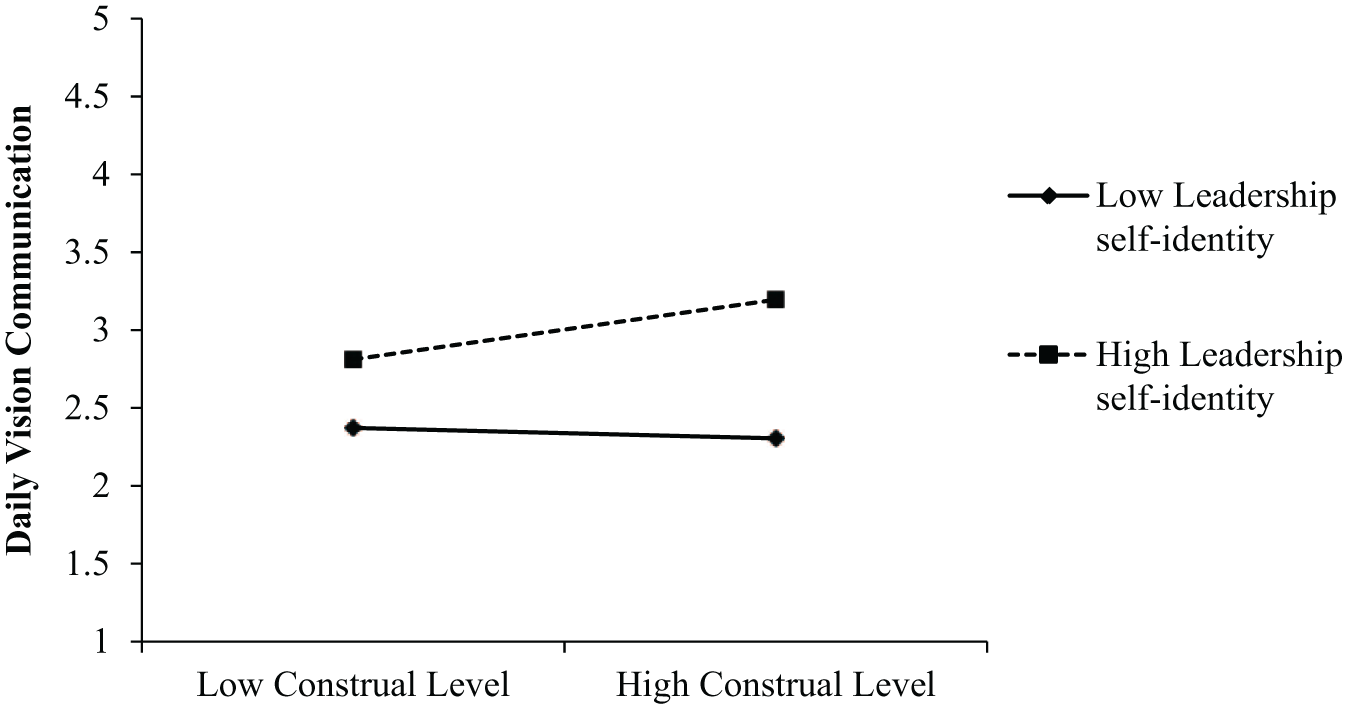
Cross-Level Interaction Between Leader Morning Construal Level and Leadership Self-Identity on Daily Vision Communication
As a final step, we further explored the causal direction in our results by conducting a supplementary analysis. Although we showed that construal level at the beginning of the workday predicted subsequent vision communication behaviors throughout that day, for a more conservative test we controlled for construal level and vision communication from the prior day. This enables us to demonstrate whether change in construal level predicts a change in vision communication, which helps us to better tease apart the causal direction of relationships among these variables (Johnson et al., 2014). After adding these control variables from the prior day, we observed that our results remained the same such that the cross-level interaction of change in construal level with leader identity predicted change in vision communication (γ = .48, t = 2.16, p < .05). The nature of the interaction was comparable to what is illustrated in Figure 1. The results of this supplementary analysis speak to the robustness of our findings and the theorized direction of the relationship between construal level and vision communication.
Discussion
Although vision communication is viewed as a key element of effective leadership with beneficial consequences for followers (Berson et al., 2015; House & Shamir, 1993; Stam et al., 2014; van Knippenberg & Stam, 2014; Venus et al., 2013), little is known about the antecedents that facilitate vision communication by leaders. Drawing from construal level theory (Trope & Liberman, 2010), we posited that holding a high-level construal would trigger greater leader engagement in daily vision communication because high-level construals focus people on abstract, future-oriented, and desirable end states, which are central to vision communication. Thus, a high-level construal equips leaders with the proper information-processing elements or ingredients for communicating visions. This does not, however, ensure that leaders are sufficiently motivated to engage in vision communication. Rather, construal level is more likely to prompt vision communication for individuals who define themselves as leaders and therefore are motivated to channel their information processing into behaviors that exemplify leadership. In line with this idea, we found that a high-level construal in the morning was associated with greater vision communication during the day, particularly when the description of “being a leader” is central to a manager’s self-identity.
Theoretical Implications
Our research contributes to the leadership literature in several key ways. Perhaps the most significant contribution of this research is to the visionary leadership literature (Berson et al., 2015; Stam et al., 2014; van Knippenberg & Stam, 2014). Although scholars have begun to illuminate how and when vision communication affects follower performance (e.g., Stam et al., 2010a, 2010b; Venus et al., 2013) and how vision content gets shared and shaped by followers (Berson et al., 2015), little is known about what prompts leaders to communicate a vision in the first place. By showing that the frequency of daily vision communication is affected by the interplay of daily construal level and leadership self-identity, our study provides a first step in unraveling the antecedents of vision communication. Specifically, we found that having a high construal level is a necessary ingredient for daily vision communication. High construal level enables leaders to focus on long-term collective goals representing idealistic values and meaningful purposes, which are the “raw” ingredients of visions. However, actually transforming these ingredients into visions requires leaders to be sufficiently motivated to exhibit leader-like behavior. Thus, we found that a high construal level predicted daily vision communication especially when leadership self-identity was high. This finding corroborates the critical role of leadership self-identity and that defining oneself as a leader is a critical first step for managers to act in leader-like ways. It appears that a high construal level lays the cognitive basis for the formation of leaders’ visions, whereas leadership self-identity acts as the catalyst for actual implementation of vision communication.
Second, by relying on construal level theory to explore the antecedents of vision communication, we add to the emerging but scarce literature that has started to apply the insights of construal level theory to the study of leadership (Berson et al., 2015; Berson & Halevy, 2014; Popper, 2013; van Houwelingen et al., 2015). In line with these studies, our results echo a similar message that insights from construal level theory can indeed be used to enhance our understanding of leadership phenomena. Specifically, we find that holding a high-level construal helps explain why leaders engage in one of the core elements of effective leadership—namely, vision communication. Unlike previous research, we make a unique contribution by examining leader construal level as a within-person phenomenon, which is consistent with how construal level is conceptualized in the literature (Trope & Liberman, 2010). Construal level is a dynamic phenomenon that ebbs and flows from one day to the next; thus, it really ought to be tracked at multiple points over time (e.g., daily). Failure to do so results in a disconnect between theory (construal level as a dynamic phenomenon) and methods (onetime static assessment of construal level). We encourage researchers to continue to explore the implications of construal level for leadership processes, which may uncover other direct effects (e.g., construal level may predict other leader behaviors, such as contingent reward or empowering behavior), moderated effects (e.g., construal level may moderate whether negative affect or mental fatigue lead to abusive leader behavior; cf. Rosen et al., 2016), or even mediated effects (e.g., leader language and behavior may have indirect effects on follower outcomes by altering follower construal level).
Third, our research contributes to the leadership literature more broadly by showing that leader vision communication varies substantially on a daily basis. In fact, we observed that approximately half of the observed variance in vision communication (47%) is at the within-person level. This study adds to recent evidence that demonstrated significant within-person variance in leader behaviors (Barnes et al., 2015; Johnson et al., 2012; Lanaj et al., 2016). Our results suggest that adopting a within-leader approach for studying leader behaviors is a needed approach for advancing knowledge within the leadership literature. Similarly, research is needed to identify the transient antecedents that contribute to within-person variance in leader behaviors and the consequences of such within-person fluctuations.
Practical Implications
Leader vision communication is crucial for organizations to adapt, survive, and thrive in today’s dynamic business environment (Collins & Porras, 1996). Our study suggests that to promote vision communication behavior, organizations need to take into account managers’ construal level as well as their leadership self-identity simultaneously. Fortunately, it appears possible that both these person-level antecedents can be shaped by features and experiences within the organizational context.
With respect to construal level, there is a preponderance of evidence that it is malleable (e.g., Berson & Halevy, 2014; Fujita, Trope, Liberman, & Levin-Sagi, 2006; Reyt & Wiesenfeld, 2015). For example, laboratory experiments have primed a high-level construal by having participants think about events or objects in terms of high psychological distance (e.g., in the distant future or in far-off physical distance), desirability (vs. feasibility), higher-order values (vs. concrete actions), or the ends underlying behavior (“why”) instead of the means (“how”; Trope & Liberman, 2010). Organizations can therefore adopt similar strategies to prime a high construal level in managers during times when vision communication is needed. For example, ways to prime a high-level construal in managers might include emphasizing the core values and purposes of the organization, encouraging long-term planning and outlook, highlighting the meaning and impact of company outputs (e.g., products and services) on distal stakeholders outside the company (e.g., customers), and urging managers to think about why they do things (vs. how) and to frame actions based on desirability (vs. feasibility). Adopting one or more of these approaches will help managers better understand the abstract meaning and superordinate characteristics of their daily work, thus cultivating a higher construal level (Trope & Liberman, 2010). For this reason, future research is needed to develop and test interventions intended to prime a high construal level at work, which not only is important for increasing vision communication but has other benefits as well, such as reducing deviant behavior (Rosen et al., 2016) and increasing exploratory learning (Reyt & Wiesenfeld, 2015).
As our results suggest, though, increasing vision communication is not as simple as priming a high-level construal. Rather, managers must self-identify as leaders to realize the benefits of a high construal. Thus, organizations must also take steps to increase the salience of managers’ leadership self-identity. Fortunately, existing research provides some insight on how this might be accomplished. For example, individual difference variables, such as core self-evaluation, self-monitoring, previous experience in leadership roles, and motivation to lead, are all positively associated with leadership self-identity (Hiller, 2005). Organizations could therefore select people into managerial roles partly on the basis of one or more of these individual differences. Moreover, organizations could also offer training and mentoring programs for extant or potential leaders to further strengthen their identification with leadership roles and responsibilities.
Limitations and Future Directions
Our findings should be interpreted in light of a few limitations. First, all the variables were self-reported by the leaders, which may raise the concern of common method variance and perceptual biases (Podsakoff et al., 2003). However, we minimized this concern by setting temporal intervals between the measurements of the focal predictor and outcome variables (construal level was measured at the beginning of the workday and vision communication at the end). Furthermore, the Level 1 predictor was also person mean centered for data analysis, thus removing the possibility that between-person differences in response tendencies influenced the results (Bryk & Raudenbush, 2002). Last, common method variance is unlikely to produce spurious interactions (Siemsen, Roth, & Oliveira, 2010); thus, we are confident in the veracity of the moderating effect of leadership self-identity. Also note that results from a pilot study revealed that manager and subordinate reports of the manager’s daily vision communication behavior were positively correlated. Although this significant correlation provides some degree of confidence in our findings, the assessment of leadership behaviors via self-reports remains a potential limitation of the current study (see Atwater & Yammarino, 1992).
Second, we adopted a general measure of vision commutation to assess the extent to which a leader describes a desirable and future-oriented direction for the organization. We are confident in the content validity of this measure, given that we deliberately selected items from different measures that were not confounded with their effects (van Knippenberg & Sitkin, 2013). Even so, research is lacking with regard to the development and validation of well-operationalized vision measures. Our measure could be seen as a modest first step forward in this regard, but more efforts to build valid vision measures are certainly needed to benefit the growing body of research on visionary leadership.
Another related limitation is that we did not focus on the specific content of the vision. Exploring vision content in more detail may allow us to assess whether visions actually focus on aspects that are more characteristics of a high-level construal (e.g., desirability, abstract features, and values; Trope & Liberman, 2010). To date, vision content can vary on the basis of its regulatory focus. Specifically, Stam et al. (2010a, 2010b) and Venus et al. (2013) distinguished between visions focusing on reaching desirable end states (i.e., promotion appeals) and those focusing on avoiding undesirable situations (i.e., prevention appeals). In addition to construal level, it is possible that other leader states and traits, such as leader regulatory focus, may play a role by influencing the content of the language and visions that leaders communicate (cf. Johnson et al., 2017). Thus, exploring vision content in terms of abstract versus concrete construal levels as well as other characteristics (e.g., promotion vs. prevention) provides another fruitful direction for future research.
Fourth, our study focused on a presumed consequence of high-level construal—namely, vision communication. This is not to say, however, that a low-level construal is not important or useful for leadership phenomena. According to construal level theory, individuals with lower construal tend to focus more on the specific and concrete details of an action and pay more attention to how an action is to be performed. As such, leaders with a low construal may be more likely to enact goal-focused types of behavior that involve clarifying specific responsibilities and setting concrete objectives for followers (Colbert & Witt, 2009). Such concrete and short-term directive behaviors resemble a task-focused or initiating structure leadership style (Fleishman, 1973). Future research could explore when and why low-level construal may affect leadership behavior. In so doing, future research may also explore whether specific circumstances or activities prime a certain construal level in leaders. To clarify, in our study, the adoption of a high construal level in the morning by leaders may be reflective of particular events (e.g., planning activities) that triggered the corresponding construal level. It would be interesting for future research to explore what daily stimuli trigger a high (vs. low) construal level in leaders.
Fifth, the current study focused on chronic leadership self-identity as a moderator to explore the interplay of within- and between-person levels. However, while leadership self-identity is typically seen as relatively stable, it can fluctuate over weeks or months as a function of (dis)engagement in leadership activities (Miscenko, Guenter, & Day, 2017). This raises the possibility that leadership self-identity may also fluctuate on shorter daily cycles, and if so, it would be interesting to explore whether higher daily construal levels generate more daily vision communication to the extent that leaders experience a strong (vs. weak) daily leadership self-identity. Examining leadership self-identity as a moderator at the daily level may not only help us to explain more variance in daily vision communication but also stimulate research on the antecedents of activating a strong (vs. weak) daily leadership self-identity.
Sixth, another potential limitation involves an untested assumption of our research—namely, that daily vision communication is always desirable. This assumption is based on prior research on charismatic and vision research (e.g., Carton, in press; Venus et al., 2013), which generally finds that leader vision communication is beneficial for followers and work units. It is possible, however, that vision communication may come at a cost. For example, on days when leaders express vision, followers may be reminded of the importance of pursuing more distal goals (e.g., investing in high-quality relationships with clients by reaching out to them and enquiring about their future needs) while forsaking more proximal goals (e.g., fixing a budget problem that is due in a few days). In the long run, such effects may hurt the group performance. Thus, leaders may need to balance visioning with pursuit of contextual goals. Furthermore, it is important to recognize that the effect of visioning may be contingent on the psychological distance that exists between followers and leaders (Berson et al., 2015). Recall that van Houwelingen and colleagues (2017) recently demonstrated that desirability appeals, which are seen as characteristic of visions (van Knippenberg & Stam, 2014), were more effective when leader-follower spatial distance was high. This speaks to the importance of integrating antecedents and consequences of visionary leadership in future studies.
A final limitation of our study is the selective sample of mid- to high-level managers. These leaders scored relatively high on the leadership self-identity measure (M = 4.19, SD = 0.61) and may be the cause of range restriction in our sample. Range restriction potentially lowers the ability to detect a moderation effect (Aguinis, 1995). Given our significant findings involving leadership self-identity, this issue did not appear to be problematic and may in fact have underestimated the strength of our interaction effect. This not only highlights the need for future researchers to study broader samples but also testifies to the importance of integrating the role of leader self-identity in research studying the antecedents of leadership behaviors.
Conclusion
Vision communication has been regarded as a crucial component of effective leadership and warrants more attention in the literature (e.g., Stam et al., 2014). Our study builds on the emerging and promising attempts to demystify visionary leadership by investigating key antecedents of leader daily vision communication. We found that leader construal level plays an important role here, especially in interplay with whether leaders define themselves according to the leadership role. This research provides a novel perspective to understand what contributes to within-person fluctuations in leader vision communication, and it identifies some needed directions for future research to advance our knowledge on this important leadership behavior.
Footnotes
Acknowledgements
We thank Fang Pi and Lo Tran Lian for their administrative support and help with data collection.
Data collection was financed in part by the Bruce E. MacDonald Faculty Excellence Fund Research Grant, awarded to Russell E. Johnson by the Broad College of Business at Michigan State University.