




Abstract
A great deal of research has been devoted to understanding the organizational returns of employee referral programs, particularly with respect to outcomes involving those hired through the referral process. Yet, no work has addressed whether the presence of a referral hire (i.e., the referred candidate who is hired and working in the firm) is related to behavioral outcomes for the referrer. Drawing on the social enrichment perspective, we theorize how referral hire presence (RHP), which is the time during which the referrer’s and the referral hire’s employment spells overlap, impacts referrer behavior. Using data from 265 referrers in a U.S. call center, we found that RHP was negatively related to referrer voluntary turnover and positively related to referrer job performance. Further, results from a supplemental experimental study supported our social enrichment rationale for the field study relationships, as the construct was associated with both RHP and additional attitudes known to be proximal predictors of turnover and performance. We also explore boundary conditions for the RHP effect in the call center data, revealing a nuanced mix of moderators of RHP effects. Overall, our findings provide the first evidence for the role of social enrichment, possible modifications to the well-established social enrichment perspective in the workplace, and evidence that understanding the impact of referral hiring necessitates careful consideration of the behavioral consequences for the referrer.
Referral hiring, or the practice of using recommendations of a current employee (referrer) to identify and hire a new employee (referral hire), has been estimated to account for 30% to 50% of an organization’s filling of its job openings (Fernandez, Castilla, & Moore, 2000; Granovetter 1995). Research has also revealed that referral hires stay longer (Decker & Cornelius, 1979; Weller, Holtom, Matiaske, & Mellewigt, 2009) and perform better (Blau, 1990; Castilla, 2005; Hill, 1970) than employees hired through other recruitment channels (e.g., newspaper ads, employment agencies). Burks, Cowgill, Hoffman, and Housman (2015) also found that referred workers yield profits 21% to 39% higher than nonreferred workers.
There are many avenues through which referral hiring makes good business sense. Employees can act as cost- and time-effective recruiters because they are often equipped to screen the labor market and refer candidates to the firm (Pallais & Sands, 2016). They can also smooth information asymmetries in the hiring process and share with job seekers information about the job (e.g., hours and wages) and company (e.g., working climate and culture) while also providing the company with data on candidates’ human capital and person–organization fit. Finally, the referrer’s role extends to post-hire phases, such as socialization (Weller, Michalik, & Mühlbauer, 2013), thereby influencing the referral hire’s experience in the firm. Referrers can, for example, act as mentors, providing referral hires with career advice and informal training (Castilla, 2005; Fernandez et al., 2000).
The referral literature, to date, has focused on firm-relevant outcomes that originate from referral hires (e.g., longer tenure and higher performance). This has left open the compelling question of whether there also are important individual- and firm-level consequences for referrers. The few studies that have attended to referrers focus on referrer attributes and behavior (e.g., expertise, job performance, and turnover) that may affect referral hire outcomes (e.g., job offers, job performance, and turnover), generally finding that referrer characteristics influence such outcomes (Castilla, 2005; Fernandez et al., 2000; Pieper, 2015; Van Hoye & Lievens 2009; Yakubovich & Lup 2006). A few studies have also examined the motivations and incentives for referring (e.g., Beaman & Magruder, 2012; Bloemer, 2010; Marin, 2012; Pieper, Greenwald, & Schlachter, in press; Shinnar, Young, & Meana, 2004; Smith, 2005; Van Hoye, 2013). Yet, the literature remains silent as to the impact of referring on important behavioral outcomes for referrers. We aim to address this gap through two studies—a nonexperimental field study and an experimental scenario study—of two crucial referrer behaviors: job performance and voluntary turnover.
We use the social enrichment perspective (Castilla, 2005; Fernandez et al., 2000) to theorize how referral hire presence (RHP), which is the time during which the referrer’s and the referral hire’s employment spells overlap, impacts referrer behavior. In the field study, our data set allows us to precisely reconstruct RHP periods and the timing of RHP effects. Our approach is consistent with the social enrichment argument that is grounded in the positive effects from the presence of social ties. We contend that because employees selectively refer individuals from their social networks to jobs in their firm (Smith, 2005), the hiring of a friend or acquaintance can enrich the work environment by making it more enjoyable (Castilla, 2005; Fernandez et al., 2000). We argue that this social enrichment results in enhanced referrer job performance and reduced referrer quitting, presumably via known precursors of these behaviors (e.g., job satisfaction, job engagement, job embeddedness). We further extend the social enrichment perspective by testing two boundary conditions that may moderate social enrichment due to RHP. We identify exposure (i.e., job similarity of the referrer–referral hire dyad) and loss aversion (i.e., the impact of the referral hire leaving relative to the impact of the referral hire joining the firm) as conditions under which RHP, via enhanced social enrichment, more strongly influence referrer outcomes. Employing a detailed data set consisting of 2 years of weekly, objective performance and turnover observations from 2,039 employees in a U.S. call center, we find a pattern of results that is largely consistent with our theory (see Table 1 for a summary of predictions).
Summary Table of Hypotheses and Methods
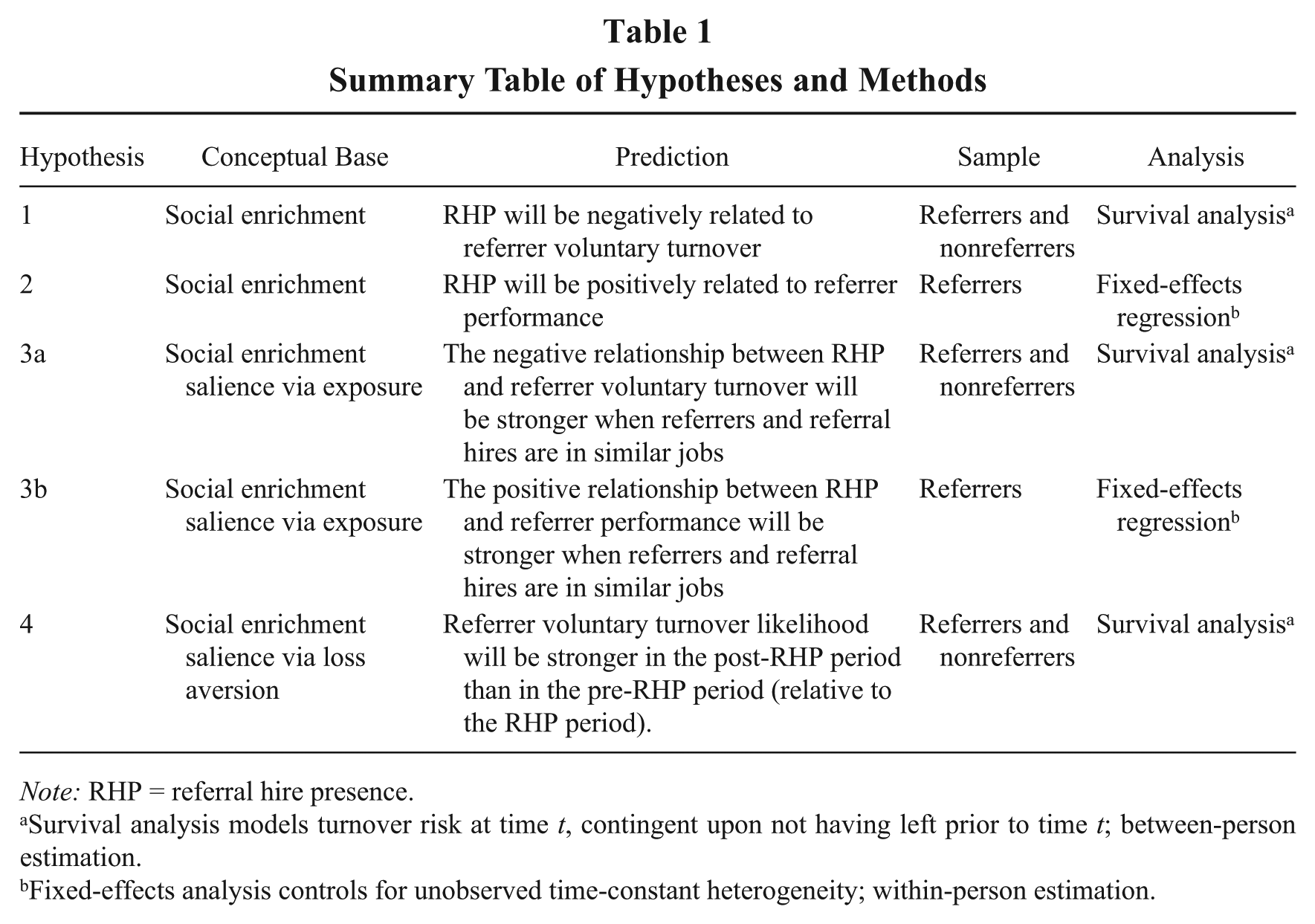
Note: RHP = referral hire presence.
Survival analysis models turnover risk at time t, contingent upon not having left prior to time t; between-person estimation.
Fixed-effects analysis controls for unobserved time-constant heterogeneity; within-person estimation.
The social enrichment mechanism, however, has yet to be empirically assessed as a mediating explanation. Because we were unable to measure this mediator in our field study, we conducted a supplemental experimental scenario study to provide the first evidence of this mechanism. The results support our field study’s predictions and provide compelling evidence that RHP directly leads to social enrichment and that this enrichment is related to several known predictors of turnover and job performance (see Figure 1 for the conceptual model).
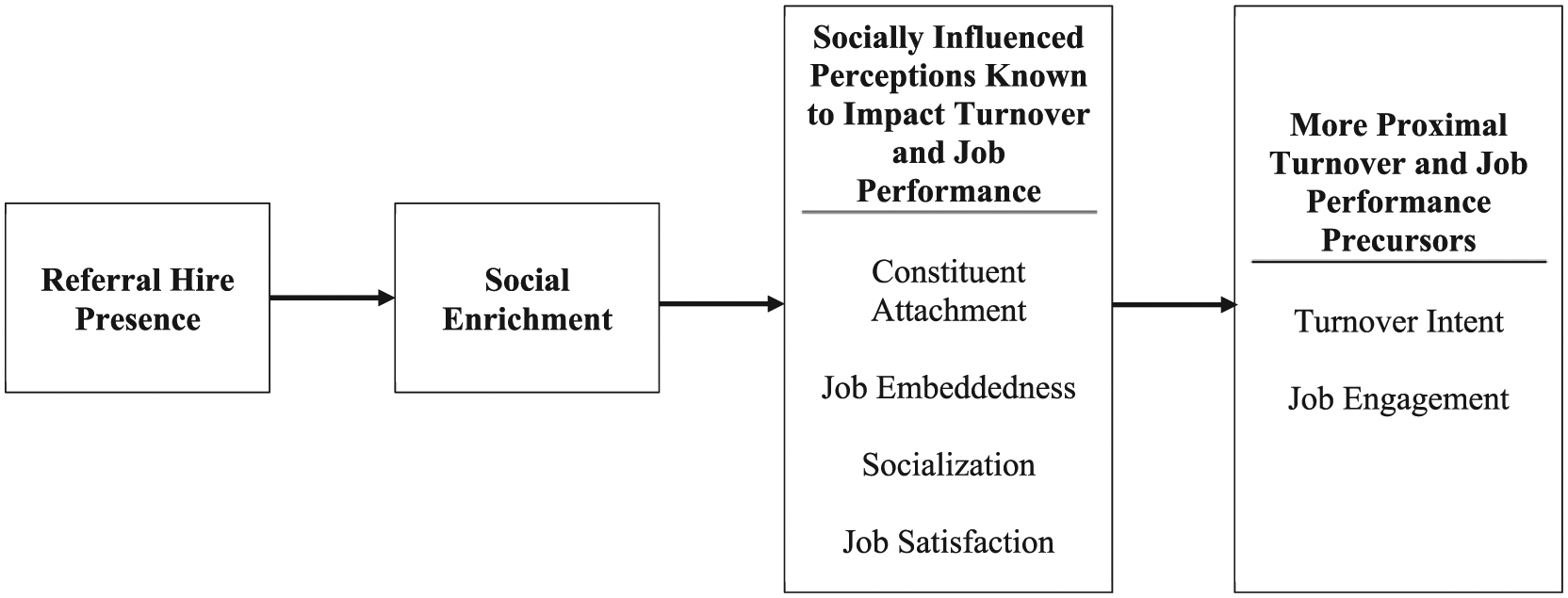
Potential Causal Flow Explanation for Social Enrichment’s Role in Referral Hire Presence Effects on Referrer Behaviors
Our work makes several important contributions. First, we extend the literature by developing a more complete framework of referral hiring effects. Moving beyond prior work, we conceptualize that the social tie implicit in the referrer–referral hire dyad socially enriches the workplace and influences referral hires and referrers alike. We also demonstrate that referral hiring is complex, with nuanced effects for the hiring firm. Second, to understand these nuances better, we extend theory on social enrichment by examining boundary conditions (i.e., exposure and loss aversion) that may enhance the social enrichment brought on through referral hiring. Third, our work is the first to measure social enrichment and to empirically test its role in the causal chain stretching from RHP to behavioral outcomes. Most important, our experimental scenario study yields unprecedented support for the social enrichment explanation central both to our work and to the influential prior work on referral hire effects (e.g., Castilla, 2005; Fernandez et al., 2000; Pieper, 2015). Finally, our findings yield implications relevant to practitioners and scholars. Scholars can build on our work to better identify the mediation at work from social enrichment to critical behaviors and understand the boundary conditions that affect the salience of social enrichment. The results of our study further suggest managerial strategies that leverage the presence of a social tie to increase performance and retention.
Theory and Hypotheses
Baseline Influence of RHP
Referral hiring involves more than bringing coworkers into the workplace. It brings in “particular” coworkers—individuals known to insiders and likely to be strong social ties (Granovetter, 1973). It also means hiring those believed to be well suited to the company’s task and social environment. Referrers see the performance of their referral hires as a reflection of themselves in the eyes of their employer and coworkers, and these reputational concerns, in turn, lead referrers to be highly selective in choosing whom to refer (Smith, 2005). Given this targeted selection, we argue, based on the social enrichment perspective (Fernandez et al., 2000), that RHP enriches the social component of a referrer’s work environment; this component should then influence attitudes and perceptions that, in turn, contribute to job performance and turnover behavior. While our goal here is not to fully document the array of possible mediators that connect RHP to key referrer behaviors, we do argue that social enrichment is an immediate consequence of RHP, and this social benefit then feeds into various performance and turnover precursors. Our field study, which uses data from a call center, establishes the RHP link with referrer performance and turnover, and our experimental scenario study provides evidence as to the RHP–social enrichment relationship and its role as a predictor of a range of perceptual precursors that lead to job performance and turnover.
Accordingly, our study is firmly grounded in the notion that people make the place (Schneider, 1987). That is, coworkers define the workplace’s social environment to such an extent that they influence meaningful employee outcomes. For example, the presence of a friend or acquaintance can make the workplace more enjoyable (Sias & Cahill, 1998), increase workplace engagement (Ellingwood, 2001), and positively affect worker productivity (Bandiera, Barankay, & Rasul, 2010). Meta-analytic evidence also speaks to coworker influence, as Humphrey, Nahrgang, and Morgeson (2007) found that social characteristics at work (e.g., feedback and social support) explain incremental variance in organizational commitment, job satisfaction, turnover intentions, and performance, and Chiaburu and Harrison (2008) reported that coworker actions (i.e., support and antagonism) predict perceptual, attitudinal, and behavioral outcomes for colleagues.
Given that coworkers can provide a socially enriched environment that affects the focal employee’s work outcomes, it is important to understand why RHP may contribute to a socially enriched environment. It is known that an individual’s social network is characterized by few strong, or close, ties and many weak, or distant, ties (Burt, 1992), and that this is also true among social networks in the workplace (Sias & Cahill, 1998). Referral hires, who are selectively referred and known individuals, are likely to be strong social ties (e.g., Granovetter, 1973), as research has demonstrated that referring strong ties is a reoccurring pattern in many job contexts, including the low-wage/low-skill job context studied here (e.g., Granovetter, 1973; Marin, 2012; Rees & Shultz, 1970). Strong ties should facilitate social enrichment, as they are instrumental in providing emotional support, interdependence, and reciprocal services (Granovetter, 1973; Sias & Cahill, 1998). That is, the strong ties brought into the workplace through referral hiring will likely lead to strong positive coworker effects.
Voluntary turnover likelihood
We contend that because of social enrichment due to RHP, referrers will be more motivated, satisfied, and embedded in the organization, which leads to positive behavioral outcomes. Research grounded in social enrichment logic has demonstrated that the referrer–referral relationship is entwined with referral hires’ turnover (Castilla, 2005; Fernandez et al., 2000; Pieper, 2015). We extend this notion to referrer turnover, as referral hires should also serve, through social enrichment, as “ties that bind” (Mossholder, Settoon, & Henagan, 2005: 616), which embed employees into a denser web of relations and make them “less susceptible to forces that could dislodge them from their organizations” (Mossholder et al., 2005: 608). Embedding effects (Mitchell, Holtom, Lee, Sablynski, & Erez, 2001) have received support from a growing set of studies that investigate how employees’ social relations influence their decisions to leave (Feeley, Hwang, & Barnett, 2008; Mossholder et al., 2005; Moynihan & Pandey, 2008). For example, Mossholder et al. (2005) found that medical center employees with greater network centrality (i.e., the number of direct and indirect social ties an individual has) were significantly less likely to leave than less central employees. The authors’ interpretation was that “leaving such exchange relationships [in one’s organization] may entail a psychic loss, making withdrawal personally costly to the individual” (Mossholder et al., 2005: 608). Thus, social relations may provide advantages in terms of reduced turnover for firms.
For the reasons noted above, RHP should reduce a referrer’s desire to leave, a construct referred to as “desirability of movement” in the turnover literature. Further, because low-wage/low-skill jobs typically have low entry barriers (Holzer, 1996), employees in them may have many external alternatives—logic consistent with the turnover literature’s “ease-of-movement” construct. Indeed, there is evidence that workers in these jobs shift frequently from one job to the next (Brown, Haltiwanger, & Lane, 2006). Not only are desirability and ease of movement fundamental predictors of turnover (March & Simon, 1958), but the positive effect of desirability of movement on quit behavior is stronger when ease of movement is high (T. H. Lee, Gerhart, Weller, & Trevor, 2008; Trevor, 2001). Thus, the low-wage/low-skill context strengthens our expectation that RHP (presumably via social enrichment and its impact on embeddedness and satisfaction) will be associated with reduced turnover among referrers.
Hypothesis 1: RHP will be negatively related to referrer voluntary turnover.
Performance
A socially enriched environment due to RHP may also be associated with improved performance. Social relations provide information, support, companionship, and a friendly work environment—factors reliably linked with positive employee attitudes, behaviors, and productivity (Chiaburu & Harrison, 2008; Ellingwood, 2001; Humphrey et al., 2007; E. W. Morrison, 2002; Riordan & Griffeth, 1995). Thus, referrers’ job performance may improve as a result of a richer social context.
The low-wage/low-skill job context may also enhance the importance of RHP to referrer performance. Because management tightly controls work in these settings (Deery, Iverson, & Walsh, 2010) and workers often face poor working conditions (e.g., insecure employment, low pay, and little autonomy), employees have little discretion in structuring their daily tasks; thus, the job itself is not very rewarding. This is relevant in call centers, given the sophisticated technical control systems that determine employees’ pace and work intensity (Batt & Moynihan, 2002). Referring, however, may afford employees with a means to enrich their workplaces. Referrers can shape the human resources of their organizations and, consequently, alter relational configurations in a manner that is meaningful for them. Helping facilitate the socialization of their referral hires is another example in which referrers can exercise agency in enriching their daily routine; and, most important, socializing new hires has been associated with positive job attitudes and increased motivation/effort in the socializing agent (Feldman, 1994; Sutton & Louis, 1987).
In sum, we predict a positive effect of RHP on job performance, as RHP yields the social enrichment that contributes to improved employee attitudes and socialization tendencies that facilitate enhanced performance. In support of this link, research has shown that employee attitudes, such as organizational commitment and job satisfaction, have important consequences for individual behaviors, including job performance (e.g., Harrison, Newman, & Roth, 2006; Judge, Thoresen, Bono, & Patton, 2001).
Hypothesis 2: RHP will be positively related to referrer performance.
Boundary Conditions Influencing the Salience of RHP
A socially enriched work environment is nearly universally accepted as a favorable aspect of organizational culture (R. Morrison & Nolan, 2007). The social enrichment perspective, however, particularly as it relates to referral hiring, is silent as to conditions in which the social enrichment from RHP may be more meaningful, or salient, for referrers. We examine referrer–referral hire exposure (i.e., job similarity) and referrers’ loss aversion (i.e., the impact of the referral hire leaving [post-RHP] relative to the impact of the referral hire joining the firm [pre-RHP]) as two such boundary conditions.
Exposure, RHP, and referrer outcomes
Structural characteristics of the social network can challenge one’s accessibility or exposure to social ties (Lin, 2001). One workplace factor that may affect exposure is job similarity, defined here as the degree of congruence (in job content and proximity) between the referrer’s and referral hire’s job. Those with similar jobs (e.g., working in the same department) or those working proximal to each other are exposed to a shared work environment with similar tasks, management practices, and leadership. Through greater exposure, referrers and referral hires develop a collective understanding of their working situations, which enhances the extent to which they view each other as referent others at work. Referrer–referral hire exposure, based on job similarity, should also enhance the salience of the social enrichment due to RHP as well as increase the likelihood that the referrer will play a key role in the referral hire’s socialization. Given our contention that such social enrichment will heighten referrer retention and yield greater referrer performance, we conclude that referrer–referral hire job similarity will moderate the effect of RHP on referrer turnover and performance.
Hypothesis 3a: The negative relationship between RHP and referrer voluntary turnover will be stronger when referrers and referral hires are in similar jobs.
Hypothesis 3b: The positive relationship between RHP and referrer performance will be stronger when referrers and referral hires are in similar jobs.
Loss aversion, RHP, and referrer outcomes
Research has provided evidence of interdependent referrer and referral hire behavior (Castilla, 2005; Fernandez et al., 2000; Pieper, 2015), such that the departure of the referrer has implications on the performance and likelihood of leaving for the referral hire. In addition, studies have reported that coworker turnover affects remaining employees’ job attitudes (e.g., Brockner & Kim, 1993; Krackhardt & Porter, 1985) and that coworker embeddedness and job search behaviors explain incremental variance in the turnover decisions of their peers (Felps, Mitchell, Herman, Lee, Holtom, & Harman, 2009). It is likely then that the turnover of a referral hire may be an important predictor of referrer outcomes because the referrer loses an important social tie in the firm.
Referrers can experience both positive events (social enrichment gains) and negative events (social enrichment losses) because of referring. Because people are typically loss averse in that they prefer avoiding losses to acquiring gains (Kahneman & Tversky, 1984), we argue that the social enrichment loss from a referral hire quitting will be more salient, or matter more, than having gained the presence of a referral hire. In support of this notion, a plethora of research provides evidence of negative events having greater influence than positive events (Baumeister, Bratslavsky, Finkenauer, & Vohs, 2001; Taylor, 1991) because the former elicit stronger physiological, cognitive, and behavioral reactions.
Additionally, the endowment effect, or the tendency for people who own a good to value it more than people who do not (Thaler, 1980), has been attributed to loss aversion. In this framework, ownership (or even psychological ownership; Reb & Connolly, 2007) is said to increase the perceived value of the good, and therefore, when faced with the potential loss of the good (i.e., the social tie in our context), people are more affected. Referrers endowed with the presence of a referral hire may place value on having that person with them at work (i.e., Hypotheses 1 and 2). Because individuals are loss averse, if a social tie (referral hire) quits, this negative event may produce a shock that prompts a referrer to reconsider his or her fit with the organization (T. W. Lee & Mitchell, 1994). Because of this loss and because negative events are more powerful than positive events, referrers may feel less obligated toward the organization once the referral hire has left than they did prior to the referral hire’s presence. In other words, referrers have a certain turnover risk before their referral hire enters the firm (i.e., pre-RHP). Then, during the referral hire’s presence, this risk should be reduced for referrers relative to nonreferrers. If the referral hire leaves, however, loss aversion and the endowment effect suggest that the referrer’s post-RHP turnover risk should increase to higher levels than before the RHP.
Hypothesis 4: Referrer voluntary turnover likelihood will be stronger in the post-RHP period than in the pre-RHP period.
In terms of how referrers’ post-RHP job performance and pre-RHP job performance compare, relevant logic suggests competing explanations. On the one hand, referrers, particularly those choosing to stay, likely would invest more effort and exhibit greater performance to compensate for the loss of reputation that the resignation of their referral hires may have caused. Reputation is a social resource valued by society (Lin, 2001), and if the referral hire quits, the referrer’s reputation may be negatively affected, for example, by his or her inability to properly prescreen the applicant. Thus, the referrer’s post-RHP performance may be higher than his or her pre-RHP performance. Alternatively, if the “shock” of the referral hire’s turnover (Lee & Mitchell, 1994) and the reduced social enrichment in the post-RHP workplace (Fernandez et al., 2000) cause referrers to consider quitting, the lost social tie may yield a decline in referrers’ effort and performance, perhaps even to below pre-RHP levels. Sturman and Trevor’s (2001) finding that prospective leavers exhibit declining performance during the time before separation supports this logic. Given these competing arguments, we do not offer an a priori prediction on the influence of referral hire turnover on referrer performance, but we explore the potential effect post hoc.
Method
Research Setting
Our field study’s data come from a large data set also described in Pieper (2015) (see Appendix A in the online supplement for a data transparency table). Longitudinal data were collected from a U.S. call center that offers inbound (customer-initiated), with a few outbound (employee-initiated), services across multiple channels (telephone, online chat, and e-mail). The call center provides customized, high-quality services and solutions to clients in a variety of industries (e.g., telecommunications, travel, publishing, and health care). The company compiled weekly performance data for entry-level employees in its core role of customer service representative (CSR) from January 1, 2008, to December 31, 2009—the 2-year observation window in our study. The unit of analysis was the person-week. The company granted access to employment information (e.g., hire/termination, pay, and position data) and employee referral data tracked during the study window, but it restricted access to data related to Title VII (e.g., age and race). Responding to customer call inquiries about products/services is the core function of the CSR job, making CSRs the key occupational and revenue-generating group within the firm. Employees undergo client-customized training for a median of 4 weeks (range = 2 to 10 weeks); this is followed by a median of 4 weeks (range = 1 to 4 weeks) of on-the-job training.
The call center services approximately nine clients at a time. During our study’s observation window, the call center served 12 clients and 28 different client programs. Teams consisting of 10 to 30 employees are assigned to clients and their associated programs. Client programs entail services that may differ by the client’s customers (e.g., a health insurance client having specific programs targeted toward certain policy holders) and/or services (e.g., specific programs for billing issue resolution or technical support). While all employees respond to customer inquiries, positions differ depending on the assigned client and client program. Although the work is mostly independent, the call center organizes its workforce into teams to create a collective identity and physically situates employees in the call center by client, client program, and team. Team performance, however, is neither tracked nor rewarded.
While call center work is individualized, structured, and routine, several factors suggest that social interaction is common and important. Inbound calls are the primary type in the call center studied here, meaning that employees can have idle time waiting for the next call, during which they can intermingle. Moreover, coworker support for help addressing customer issues and navigating the complex call center technologies is critical, given the high employee-to-supervisor ratio (Deery et al., 2010). Further, the potential for social interaction in this environment (which is sometimes difficult but doable) is more likely to be exploited when there are strong social ties; such ties not only are likely with referral hires but also are more likely to yield emotional support and interdependence (Granovetter, 1973; Sias & Cahill, 1998).
Sample
The sample included employees hired in the years 2007 to 2009 and whose employment overlapped with this study’s 2-year observation window (N = 2,152). The company provided records of referrers and their referral hires for the years 2007 to 2009, allowing us to match dyads and develop a data set oriented around RHP. We restricted our analysis to employees hired in 2007 or later, so that we could track their complete history of referral hires. This allows us to fully account for all referral hires present for a referrer during our observation window, as relevant information (i.e., employment dates of referral hires) for longer-tenured employees was unavailable. For example, if a longer-tenured employee referred a new hire prior to 2007 that was still employed during our observation window, we would have been unable to account for RHP for this employee, as our data do not go back that far.
We received access to information about those referred candidates that were hired (as opposed to the entire population of recommended candidates, which would also include referred candidates who never applied and referred candidates denied employment). Thus, we define referrers upon the hiring of their referral. An incumbent who refers but whose referred candidate is not hired is not counted as a referrer. Out of the population of 2,152 employees, 285 referrers (13%) had at least one referral hire present at some point during the 2-year observation window. Because of missing data on study variables, the final sample was 2,039 employees, including 265 referrers (13%); this data set was used for the turnover models.
Job performance is not tracked during the new-hire training period, so if a new hire in training refers and has a referral hire present during this period, we would not have performance information for these referrers as long as they are in training. A handful of referrers also quit during their training. These two aspects resulted in 74 fewer referrer cases (i.e., Nindividuals = 191) for the performance models than for the turnover models.
Dependent Variables
Voluntary turnover
Company records included voluntary turnover, which captured the supervisor’s assessment of whether the employee did or did not voluntarily quit. We assigned a value of 1 in the week when an employee left voluntarily and 0 in the weeks the employee was present with the organization. The voluntary turnover rate was 51% in the full sample—a rate consistent with the call center industry (Batt, Doellgast, Kwon, & Agrawal, 2005). As is customary in survival analysis (e.g., Morita, Lee, & Mowday, 1993; Nyberg, 2010; Trevor, 2001), employees terminated by the organization (9% in the full sample) or who had not quit by the end of the observation period were treated as right censored.
Performance
We measured performance as the average number of calls an employee could handle per hour in a given week. We calculated it based on average handle time (AHT). AHT is the average duration, in seconds, of one call, and it is measured from the start to finish of a call, including hold, talk, and postwork time necessary to address the caller’s issue. AHT is the most important indicator of employee performance in call centers (Liu & Batt, 2010) and a prime factor in determining staffing levels. Consistent with prior research (i.e., Castilla, 2005; Pieper, 2015), we converted AHT to calls per hour to provide a measure in which higher values represent better performance; we divided 3,600 (i.e., the number of seconds in an hour) by AHT (measured in seconds). For example, an AHT of 600 s (10 min) converts to six calls per hour.
We used Cook’s D influence statistic to identify multivariate outliers in our performance model. Using a threshold of a D value greater than 4/n, where n equals the number of person-week observations (Cook, 1977), we excluded 23 person-week observations that distort the results. These entailed extreme values of calls per hour based on few calls handled in a week (e.g., an employee had a reported calls per hour of 900 in a week, based on handling a single call).
Independent Variables
Appendix B, Table 1, in the online supplement displays person-week observation examples to aid in understanding the structure of our data and variables.
RHP
We coded RHP as 1 in weeks in which a referral hire was present during the referrer’s employment spell and 0 if no referral hire was present. For example, if the referrer was hired on January 1st and this employee’s referred candidate was hired on March 1st and did not quit during our study window, RHP was coded as 0 up until the week of March 1st and 1 thereafter.
Referrer–referral hire job similarity
Referrer–referral hire job similarity was based on whether a dyad worked for the same client program at the start of the referral hire’s employment. Job similarity occurred with 24% of referrers. Because job content varies by client program and the workforce is physically situated accordingly, interaction is most likely among CSRs in the same client program. Thus, a referral hire servicing a travel firm’s billing program would be less likely to seek advice from his or her referrer working on an insurance firm’s benefits program. A finer distinction would be pairs on the same team, but there were only two instances in our data.
Because job similarity is conditional on RHP (i.e., it cannot be identified without a referral hire being present), we split the RHP condition into job-similar RHP and job-dissimilar RHP dummy variables. Job-similar RHP was coded 1 if the dyad worked on the same client program and 0 otherwise. Job-dissimilar RHP was coded 1 if the dyad worked on different client programs and 0 otherwise. The reference category for both dummy variables jointly is no RHP.
If more than one referral hire was present in a week and at least one worked in the same client program, we coded job-similar RHP as 1 and job-dissimilar RHP as 0. Further, because job similarity is conditional on RHP, we cannot estimate an interaction term (RHP by job similarity) for collinearity reasons—the job similarity variable and interaction term of RHP and job similarity would be the same, and one would be omitted from the model. However, adding the job-similar and job-dissimilar RHP dummies (relative to the no-RHP condition) to the regressions and performing a Wald test of coefficient equality is sufficient for testing this interaction. The approach compares the effects of RHP in similar and dissimilar jobs to the no-RHP condition.
Loss aversion (pre-RHP vs. post-RHP)
We separated the no-RHP condition into the time before a referral hire joined the firm (pre-RHP) and the time after all referral hires had terminated (post-RHP). We coded pre-RHP as 1 for the weeks prior to the presence of any referral hire (which in our study is the time before the first referral is hired) and 0 otherwise. We coded post-RHP as 1 for the weeks following the end of employment for the referrer’s referral hires (i.e., all referral hires had left the company and were no longer present during the referrer’s employment spell); this variable was coded as 0 otherwise. Eight cases existed in which a referral hire terminated and then several weeks later the referrer had another referral hire employed. One could argue that the post-RHP in this case could also be considered pre-RHP. Therefore, to clearly distinguish between pre-RHP and post-RHP, we truncated the data for this analysis to end in the week prior to the subsequent referral hire’s joining the organization. This led to slightly fewer person-week observations for these models (see Tables 5 and 6, Model 7 in each). Entering the two dummies (pre-RHP and post-RHP) into our regressions, while excluding the RHP variable, and performing a Wald test of coefficient equality are sufficient for testing the difference between gaining and losing RHP.
Covariates
Analyses controlled for several variables known to correlate with voluntary turnover and performance. We controlled for employees’ team, gender, pay rate, hours per week, and source through which they were recruited. Dummy variables indicating an employee’s team were included to control for variation in managerial practices across supervisors and client differences. We used a dummy variable to control for an employee’s gender (i.e., male). Because pay influences performance and voluntary turnover (Gerhart & Rynes, 2003), we controlled for pay rate, a time-varying measure of an employee’s hourly wage rate. We controlled for hours per week worked to account for scheduling differences related to “peak” call-volume times experienced by the call center. This covariate may also account for higher levels of emotional labor that can lower performance, lead to burnout, and increase turnover (Cordes & Dougherty, 1993). Given that referred employees stay longer than hires from alternative recruitment sources (Pieper, 2015; Rynes, 1991; Rynes & Cable, 2003; Zottoli & Wanous, 2000), we accounted for the source through which the employee was recruited. Recruitment source was coded as 1 if the employee was referred to the firm and 0 if the employee was recruited through a different recruitment source (e.g., newspaper ad).
We also controlled for the period following a workforce change due to a new client and the employee referral bonus plan in effect. In June 2009, the company began servicing a large client and hired roughly 3 times as many employees per month as was usual to increase capacity. To account for productivity losses and the company’s potentially relaxing its hiring standards to fill openings for this new client, we included a time-varying dummy variable where new client was coded 1 for the time following the change and 0 otherwise.
During the observation window, the company changed its referral bonus plan. Prior to September 2008, referrers received $100 if the referral hire remained 45 days and another $100 if the referral hire remained 90 days. The bonus plan switched to a payout of $15 per every biweekly paycheck once the referral hire remained past 60 days. To control for the differential incentive effects of the two plans, a time-varying dummy variable was included where $15 bonus plan was coded as 1 for the time of September 2008 and later, and 0 for the time before, when the $100 plan was in effect.
From the variables described above, gender and recruitment source are not estimated in the performance models because we employed fixed-effects (FE) estimation (see below), which controls for any time-constant information by design. In the performance models, we also controlled for employees’ tenure (in weeks) with the company because of its influence on performance (Ng & Feldman, 2010). A linear tenure control may be inadequate in the call center setting, where performance improves in the first few months and then levels off (e.g., Batt, 1999, states that employees in the CSR job reach proficiency in 6 months to a year). To approximate nonlinear effects, we thus added tenure squared. Call volume was measured as the number of calls the employee handled each week and was included as a measure of external pressure (which might suppress average handle time).
Analytical Strategies
Voluntary turnover likelihood
We used survival analysis to estimate the time-specific probability of voluntary turnover. We drew on the full data set of 2,039 employees, including 265 referrers and 1,774 nonreferrers because survival analysis uses between-individual variation, which, in our case, requires turnover variation in the referrer group (which can have a RHP) and in the nonreferrer group (which cannot have a RHP). Note that there is no variation in turnover for referrers in the pre-RHP condition because referrers cannot quit and thereafter experience RHP. Therefore, our models examine whether turnover risk, among all employees who are at risk of leaving the firm, is lower for times of RHP relative to no RHP.
Survival models, relative to a traditional binary dependent-variable approach, like logit regression, are well suited to deal with temporal information (i.e., tenure) and account for right-censored data (e.g., cases that do not experience a voluntary turnover event, such as employees who leave involuntarily or who remain at the end of the observation window). Thus, rather than being excluded entirely, an employee terminated by the firm was included as a stayer up until the termination date, when the employee then drops out of the analysis. Including such cases increases the accuracy of the estimation (e.g., Morita et al., 1993; Nyberg, 2010; Trevor, 2001).
We estimated Cox proportional hazards models (Cox, 1972). The Cox model is semiparametric—it does not require specification of the form of the baseline hazard function in advance (i.e., no distributional assumptions are imposed). 1 To conduct the analyses with time-varying covariates, we configured the data set into spells. Spells result from creating a new observation for an individual when a time-varying variable changes, possibly each week in this study. Because our sample includes employees hired in 2007 who were employed at the start of our observation window (the year 2008), we adjusted these cases’ tenure duration to their correct length of service (i.e., we accounted for left truncation). Finally, we used the Efron method to deal with tied turnover and censored events.
Referrer performance
We analyzed pooled cross-sectional time-series data (i.e., panel data) from 191 referrers with available performance data. Because the Hausman specification test suggested the presence of unobserved heterogeneity in our main effect model (Hypothesis 2; χ2 = 46.90, df = 7, p < .001), we used FE estimation (Greene, 2003; Hausman, 1978). It has the advantage that all time-constant information is effectively eliminated. Thus, potential biases from omitted performance-relevant information can be controlled for, resulting in unbiased and consistent estimates. The FE estimator exclusively exploits the within-individual variation over time; thus, within-individual variation must be present. Because nonreferrers have no variation in RHP over time, we exclusively used the referrer data for the performance analyses. Our models examine the extent to which referrer performance increases/declines after a change in RHP. We used STATA’s areg command to estimate the FE models, which produces the same parameter estimates as xtreg, fe but includes the variance explained by absorbed dummies in the calculation of R2, whereas xtreg, fe does not.
Results
Table 2 reports the means and standard deviations for the full sample and split by referrers and nonreferrers. Tables 3 and 4 report correlations (at the person-week level) for the turnover and performance analyses (Appendix B, Tables 2 and 3, report the aggregate-level correlations). Employees in the full sample were 34% male, had an average tenure of 31 weeks, were paid roughly $8.62 an hour, and worked 36.75 hours per week. Of the 265 referrers (13% of employees), 64 referrers (24%) worked on the same client program with a referral hire (i.e., job similarity), 113 (43%) were referred to their job, and 103 (39%) had at least one referral hire terminate. The mean number of referral hires present was 1.28, with 51 of the 265 referrers experiencing at least one additional referral hire being hired.
Descriptive Statistics
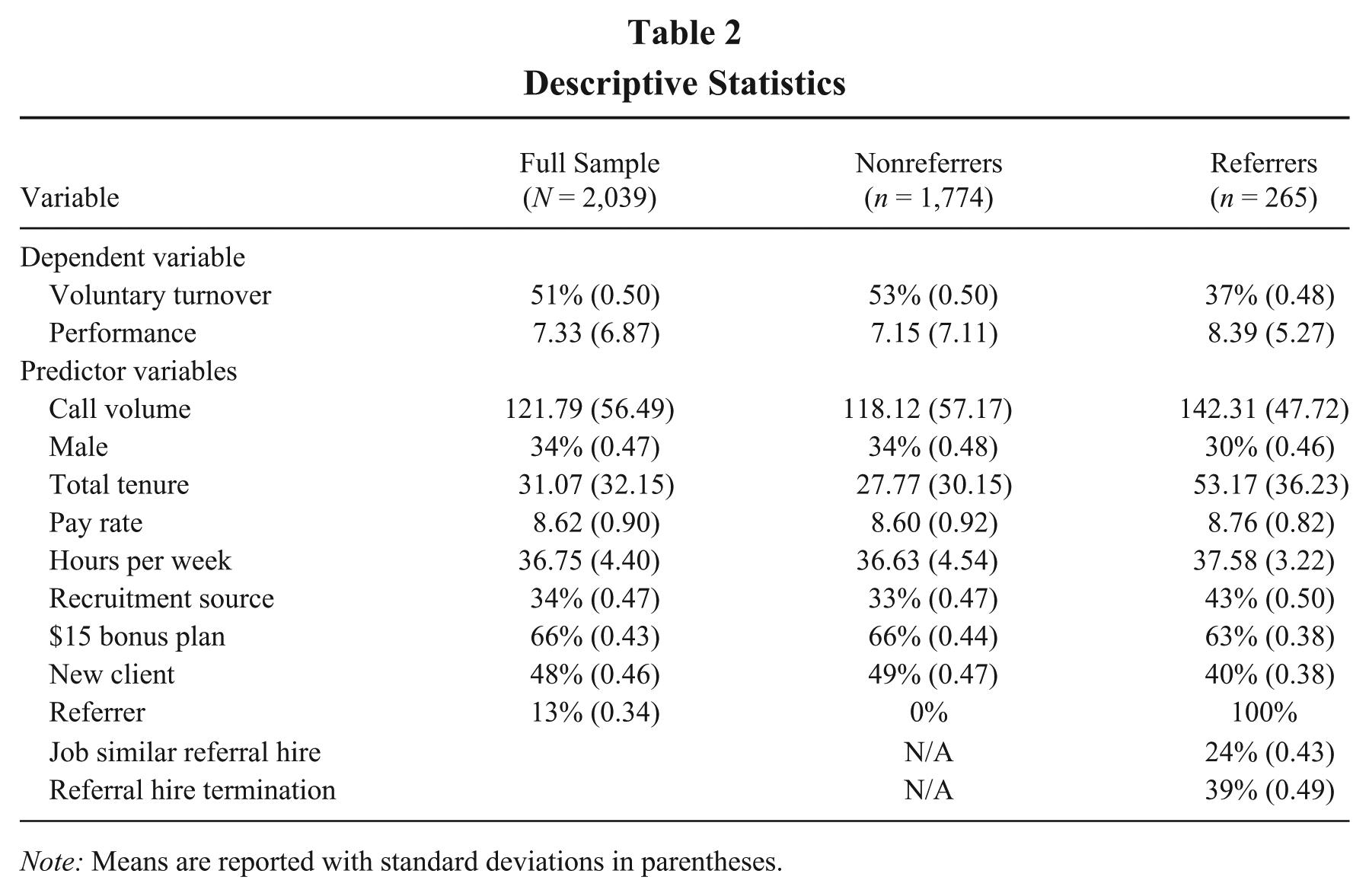
Note: Means are reported with standard deviations in parentheses.
Correlations for Analysis of Voluntary Turnover
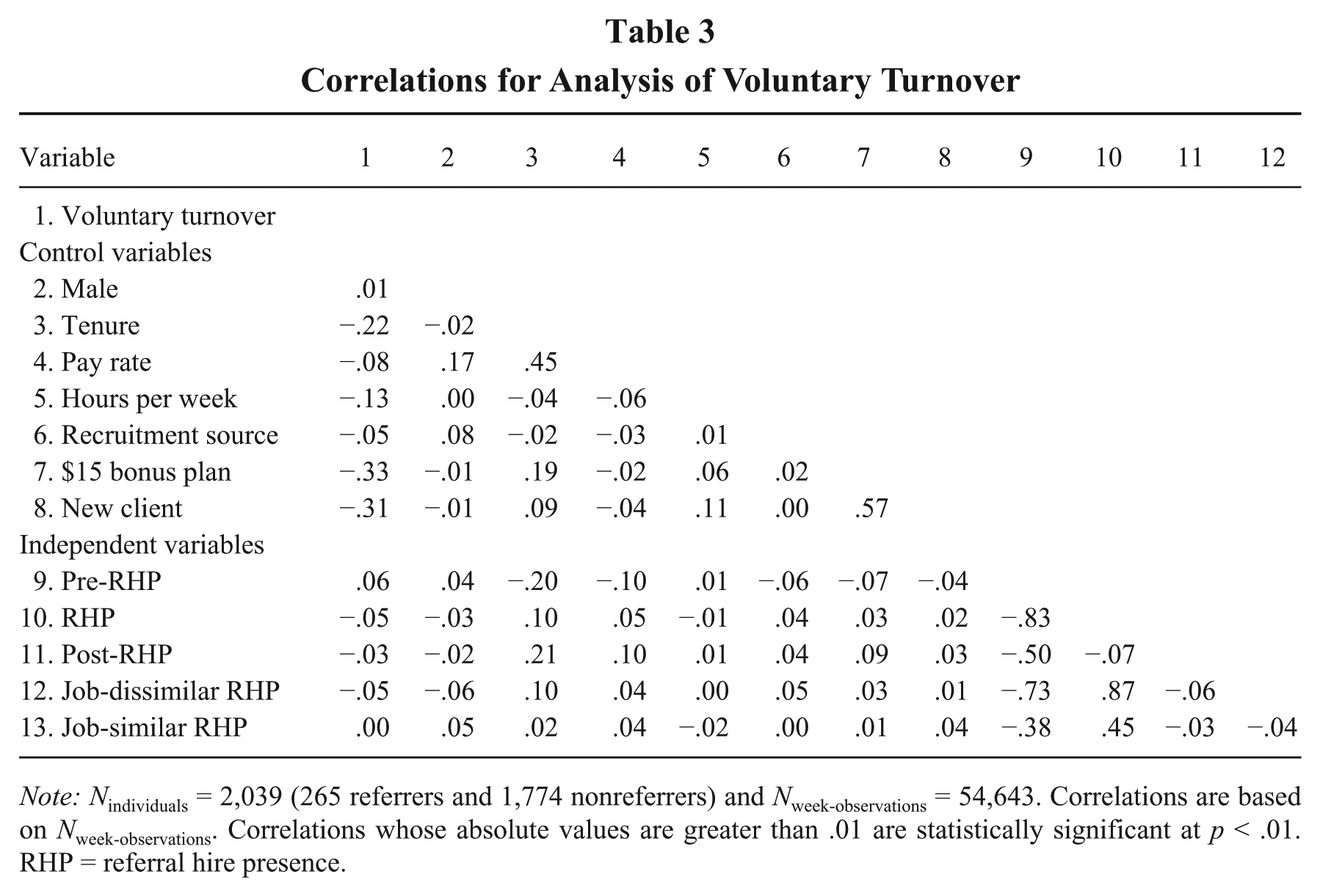
Note: Nindividuals = 2,039 (265 referrers and 1,774 nonreferrers) and Nweek-observations = 54,643. Correlations are based on Nweek-observations. Correlations whose absolute values are greater than .01 are statistically significant at p < .01. RHP = referral hire presence.
Correlations for Analysis of Performance
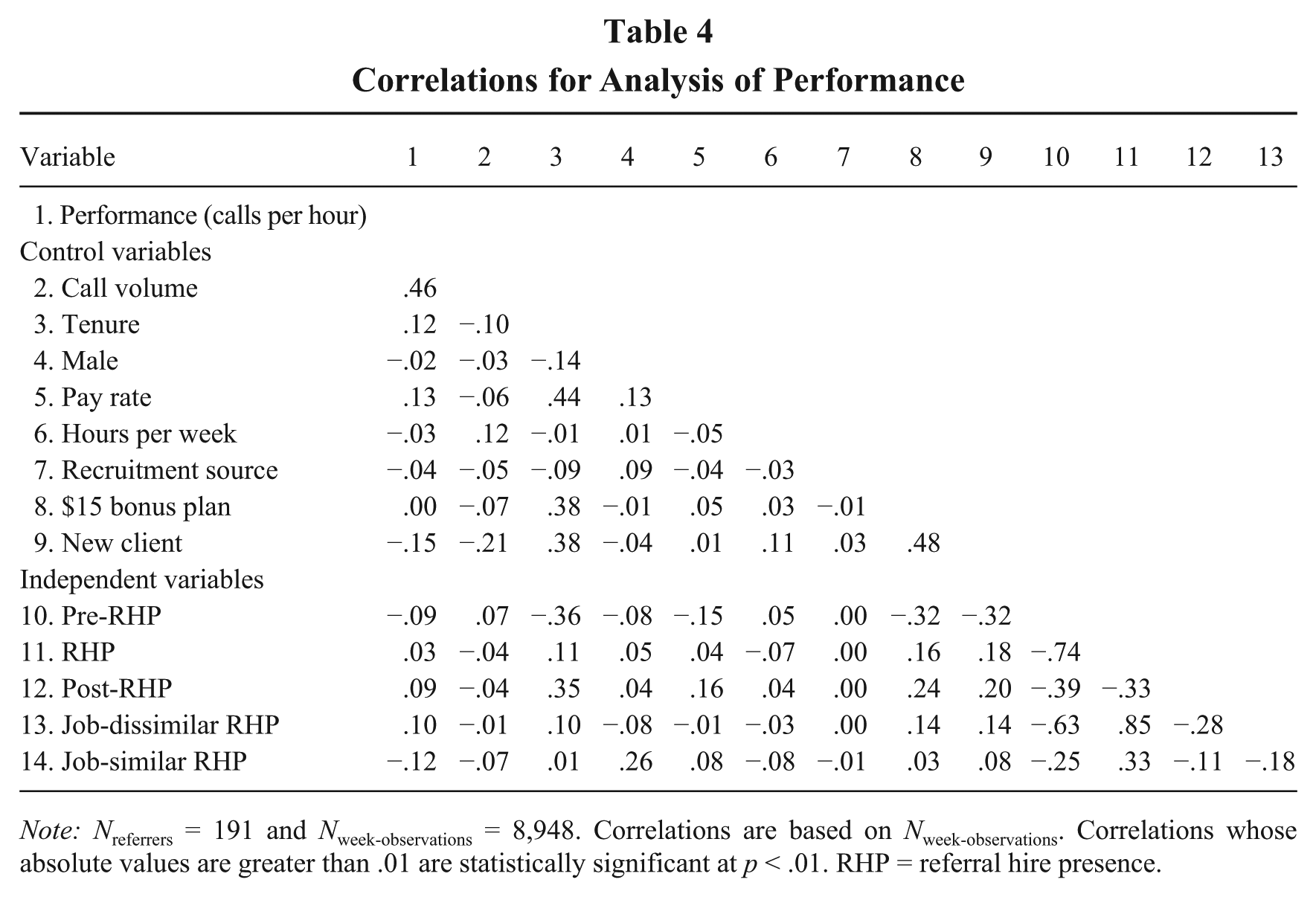
Note: Nreferrers = 191 and Nweek-observations = 8,948. Correlations are based on Nweek-observations. Correlations whose absolute values are greater than .01 are statistically significant at p < .01. RHP = referral hire presence.
We predicted that RHP would be negatively related to referrer voluntary turnover (Hypothesis 1) and positively related to referrer performance (Hypothesis 2). Table 5 and Table 6 display the results. In support of Hypothesis 1, the RHP coefficient was significantly and negatively related to voluntary turnover likelihood (b = −.32, p < .05; Model 2 of Table 5). The −.32 coefficient suggests that, among all employees at risk of leaving, employees with a referral hire present were 27% ([exponent(−.32) – 1] * 100) less likely to leave than those without a referral hire present. Hypothesis 2 was also supported; the .43 RHP coefficient was significantly and positively related to referrer performance (Model 2 of Table 6). Referrers’ calls per hour was 0.43 calls per hour higher when a referral hire was present. This translates into handling 17.2 more calls per week (assuming a 40-hr workweek), or an increase of 5.1% for the mean performing referrer (0.43 divided by mean performance of 8.39 in Table 2). While the 0.2% incremental variance in referrer performance explained by RHP may seem trivial, considerable firm savings (e.g., staffing efficiency) are likely when the effect is multiplied across weeks and employees. 2
Proportional Hazards (Cox) Regression Analyses of Voluntary Turnover
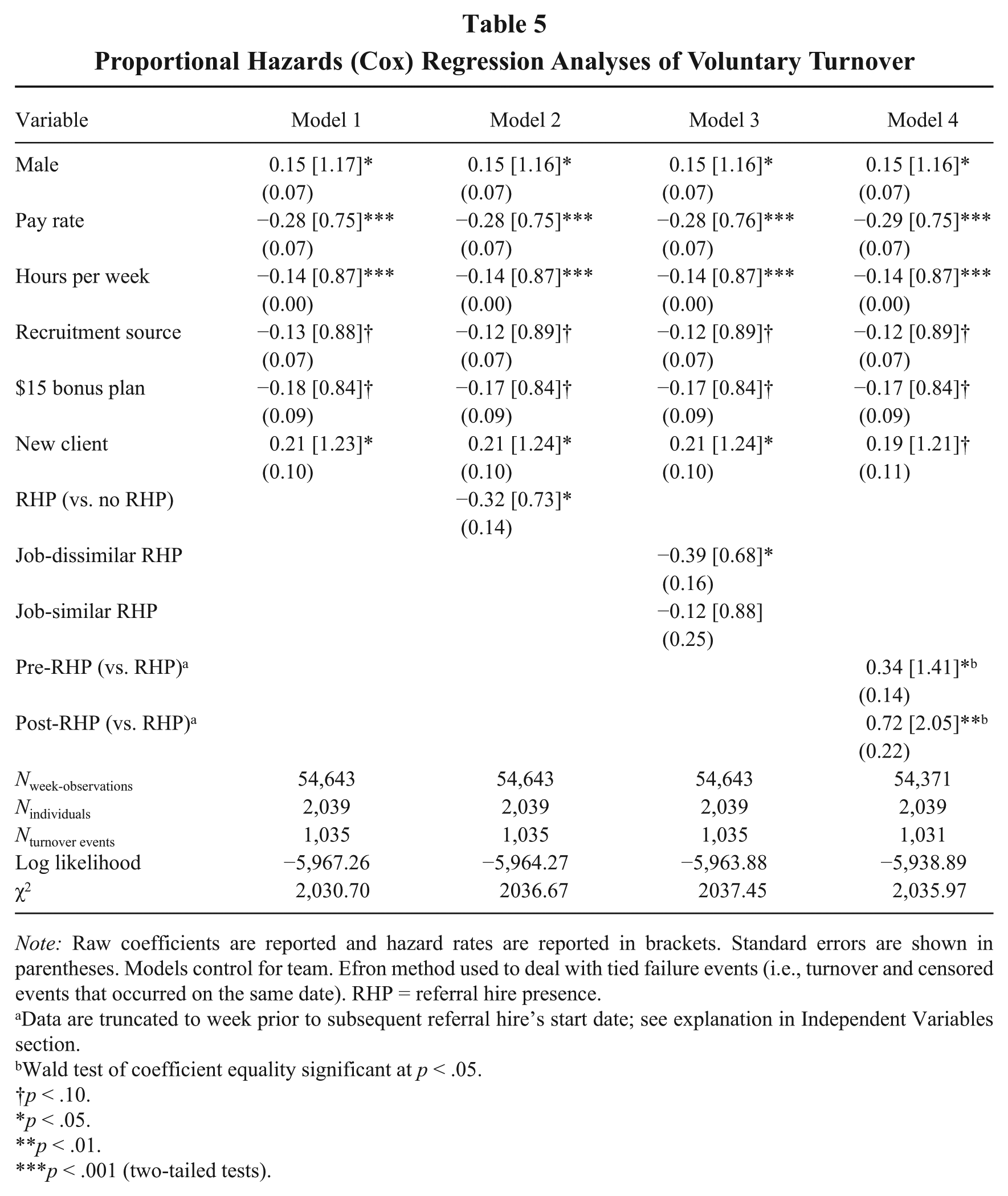
Note: Raw coefficients are reported and hazard rates are reported in brackets. Standard errors are shown in parentheses. Models control for team. Efron method used to deal with tied failure events (i.e., turnover and censored events that occurred on the same date). RHP = referral hire presence.
Data are truncated to week prior to subsequent referral hire’s start date; see explanation in Independent Variables section.
Wald test of coefficient equality significant at p < .05.
p < .10.
p < .05.
p < .01.
p < .001 (two-tailed tests).
Fixed-Effects Regression of Performance
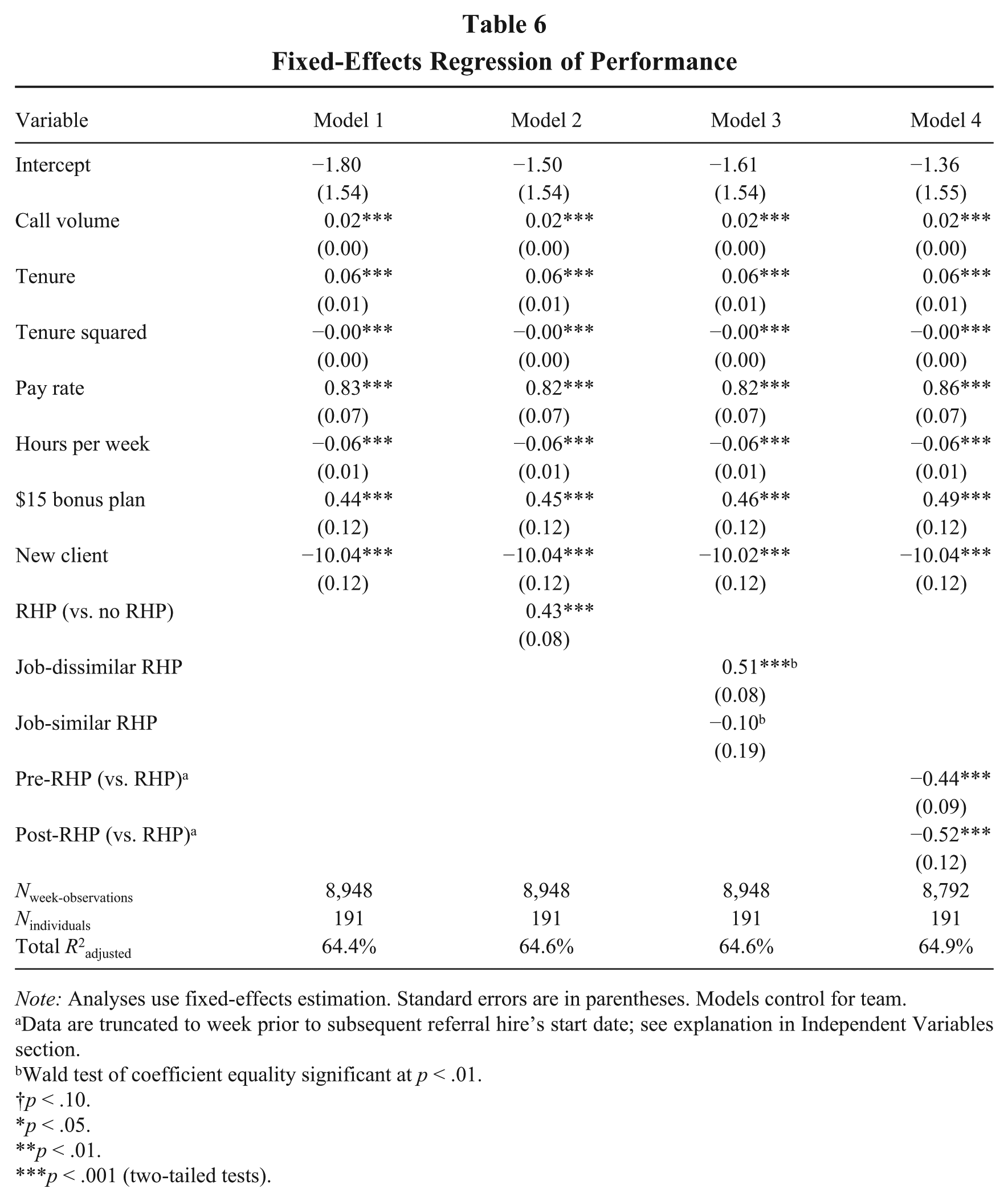
Note: Analyses use fixed-effects estimation. Standard errors are in parentheses. Models control for team.
Data are truncated to week prior to subsequent referral hire’s start date; see explanation in Independent Variables section.
Wald test of coefficient equality significant at p < .01.
p < .10.
p < .05.
p < .01.
p < .001 (two-tailed tests).
In Hypotheses 3a and 3b, we hypothesized that exposure, measured as referrer–referral hire job similarity, moderates the RHP effect. As described above, we entered the job-similar and job-dissimilar RHP dummies into our turnover and performance regression models and excluded the RHP variable. Thus, the no-RHP condition served as the omitted reference category. Because our prediction focused on the difference between job-similar RHP and job-dissimilar RHP, we performed a Wald test of coefficient equality between their coefficients. The turnover models did not support Hypothesis 3a (Wald test χ2 = 0.81, p > .05). In the performance model (Model 3 of Table 6), the 0.61 deviation between the job-similar and job-dissimilar RHP coefficients was significant but opposite of our prediction (Wald test χ2 = 9.58, p < .01), lending no support to Hypothesis 3b. 3 Because both job similarity conditions could occur when multiple referral hires were present, we checked the robustness of our results by truncating the data for when a second, third, or fourth referral hire joined the firm and examining the effect of job similarity for the first referral hire only. The results were like those reported above.
Hypothesis 4 predicted that, due to loss aversion, the RHP effect on referrers’ turnover likelihood would be stronger in the post-RHP period as compared to the pre-RHP period. In support of this prediction, the difference between the pre-RHP and post-RHP coefficients was significant (Wald test χ2 = 4.08, p < .05; Model 4 in Table 5). The 0.37 difference translates into a 31% higher turnover likelihood post-RHP (relative to pre-RHP) and indicates the retention effect from gaining RHP is weaker than the attrition effect from losing (all) one’s referral hires. We also explored post hoc whether referrers’ performance would be lower post-RHP than pre-RHP and found no significant difference (Wald test χ2 = 0.58, p > .05; Model 4 in Table 6).
Supplemental Study
The hypotheses tested above were motivated by the expectation that referring, and the subsequent RHP, yields social enrichment, which ultimately influences referrer behaviors. Like all prior research using the social enrichment framework (e.g., Castilla, 2005; Fernandez et al., 2000; Pieper, 2015), our field study did not contain a direct measure of this construct. We thus extend this area of work by directly examining this explanatory mechanism in a supplemental study. While documenting the exact nature of the causal chain from RHP to turnover/job performance behaviors is beyond the scope of our supplemental study, we do provide the first empirical evidence that RHP directly leads to social enrichment and that this enrichment is related to several known predictors of turnover and job performance (i.e., constituent attachment, job embeddedness, socialization, job satisfaction, and ultimately, turnover intent and job engagement). The general framework we investigate here is summarized in Figure 1.
We used the experimental scenario study (ESS) approach (e.g., Aguinis & Bradley, 2014; Atzmüller & Steiner, 2010; Auspurg & Hinz, 2015). In the ESS approach, respondents evaluate hypothetical decision scenarios, which are “carefully constructed description[s] of a person, object, or situation, representing a systematic combination of characteristics” (Atzmüller & Steiner, 2010: 128). Like in factorial experiments, the goal is to estimate causal effects from the exogenous manipulation of the scenarios (i.e., treatments).
Here, we provide brief descriptions of the scenarios and variables, data and sampling strategy, and results. More details are accessible via the online supplement. In the ESS decision scenarios, respondents were told to envision that they worked for a U.S.-based call center dealing with mostly inbound calls. To increase their external validity, we aimed at creating valid, representative, and strong treatment manipulations (Highhouse, 2009) and described the firm context in terms like the original field data’s attributes. We also included a picture of a call center setting to increase the realism of the study (among three selections, a sample of undergraduate students had rated it as best representing a call center). We employed three manipulations: Participants were told that they worked in groups of 15 coworkers on average and had (1) no or two coworkers that they considered to be friends within their working group; their manager had just announced that (2) a new hire, an acquaintance that they had referred, or a close friend that they had referred would be joining the company; and the hire (3) would be or would not be in their working group. The first treatment (number of existing friends) was meant to establish a baseline level of social ties, providing us with an alternative means to examine whether a general (as opposed to RHP-driven) socially enriched environment led to turnover- and performance-relevant outcomes. The second (referral hiring) and third (job similarity or proximity) approximated key variables from the field study. Overall, 12 scenarios were possible (2 × 3 × 2 manipulations; see Appendix C in the online supplement), and we used one randomly drawn scenario per respondent to keep the burden of participation as low as possible.
Respondents read the scenario and then, relating to it, responded to items measuring social enrichment, constituent attachment, job embeddedness, socialization, job engagement, and turnover intention (see Appendix D in the online supplement). Participants responded to all items using a 5-point scale (1 = strongly disagree; 5 = strongly agree). We created a seven-item scale of social enrichment, with four items adapted from enrichment-related items in Carlson, Kacmar, Wayne, and Grzywacz (2006) and Kirchmeyer (1992) and three items that we developed. A sample item is “The hire would give me support in my work life.” We included constituent attachment (two items from Ellingson, Tews, & Dachner, 2016), which is the degree to which employees feel attached to individuals in a workplace (Maertz & Griffeth, 2004), due to its conceptual proximity to social enrichment and its demonstrated link to turnover (Ellingson et al., 2016). We also included job embeddedness (two items from Crossley, Bennett, Jex, & Burnfield, 2007) and socialization (three items from Jones, 1986) because of their expected conceptual proximity to social enrichment and their ties to job performance and turnover. Additionally, we included job engagement (two items from Rich, Lepine, & Crawford, 2010) and turnover intention (a single item from Kelloway, Gottlieb, & Barham, 1999) to provide perceptual measures that are reliable predictors of our field study’s dependent variables (i.e., job engagement has been shown to be a performance precursor [Rich et al., 2010], while turnover intention is a predictor of leaving [Tett & Meyer, 1993]). We also asked about respondents’ demographics (age, gender, and actual referral hiring experience) and inquired about their familiarity with a call center. Because the ESS approach measures attitudes and intentions, and not observed behaviors, a direct comparison between the field study and the supplemental study is limited with respect to the dependent variables. A confirmatory factor analysis testing for the validity of our measurement model is reported in Appendix E of the online supplement.
We utilized two subject pools to conduct the ESS. One consisted of 251 undergraduate business students from a midwestern U.S. university who completed a paper-and-pencil version of the questionnaire during class and were not compensated for participating. The second pool consisted of 653 employed individuals who participated in an online survey. For this subject pool, we contracted with Qualtrics (www.qualtrics.com) to recruit participants from its Internet freelancing platform (an “eLancing” environment; Aguinis & Lawal, 2012). ELancing provides “access to large samples of working individuals at relatively low cost” (Aguinis & Bradley, 2014: 363). Recent management research has used such a sampling strategy as a reliable data source (e.g., Courtright, Gardner, Smith, McCormick, & Colbert, 2016; DeCelles, DeRue, Margolis, & Ceranic, 2012; Long, Bendersky, & Morrill, 2011). The use of both a student sample and an employee sample helps increase the external validity of the ESS study, allows for a solid pretest (based on the student sample), and increases the overall sample size.
We included several quality controls to ensure the integrity of our data. We embedded an attention filter in the survey (“This is an attention filter. Please select ‘agree’ for this statement.”), and we excluded 17 students and 121 employees who failed it. We also included a manipulation check for each of the three treatments to assess whether participants had read and understood the scenarios (Appendix C in the online supplement) and excluded 65 students and 203 employees who failed at least one of these three checks. The final sample was 498 participants (169 students and 329 employees). There is considerable face validity associated with our exclusion decisions, as it is reasonable to exclude careless and low-effort responders. Not surprisingly, analyses of those who failed the screens yielded questionable and partly counterintuitive results.
Because analyses with the two samples reached comparable results, we pooled them in the reported estimations. For transparency and comparison reasons, we report the results by sample in the online supplement (Appendices F and G). Table 7 displays the regressions of social enrichment, as well as several other constructs that we cited as additional explanations for RHP effects, on our three treatment manipulations. In support of our theory, Model 1 reveals that social enrichment was significantly greater for the referred-acquaintance (b = 0.64, p > .001) and referred-close-friend (b = 0.93, p < .001) conditions than for the new-hire-only (nonreferral) condition. The results of a pairwise comparison of the coefficients further indicated that social enrichment was significantly greater for the referred-close-friend condition than for the referred-acquaintance condition (t = 4.01, p < .001), indicating that social enrichment is greater for stronger social ties. The two referral conditions were also positively and significantly related to constituent attachment (Model 2), job embeddedness (Model 3), and socialization (Model 4). The results from the ESS strongly support our contention and field study assumption that RHP yields an enriched social environment as well as an array of perceptions that we envision as partially a function of social enrichment and known to be linked to turnover and performance.
Supplemental Analysis: Pooled Ordinary Least Squares Regression Results for Experimental Study
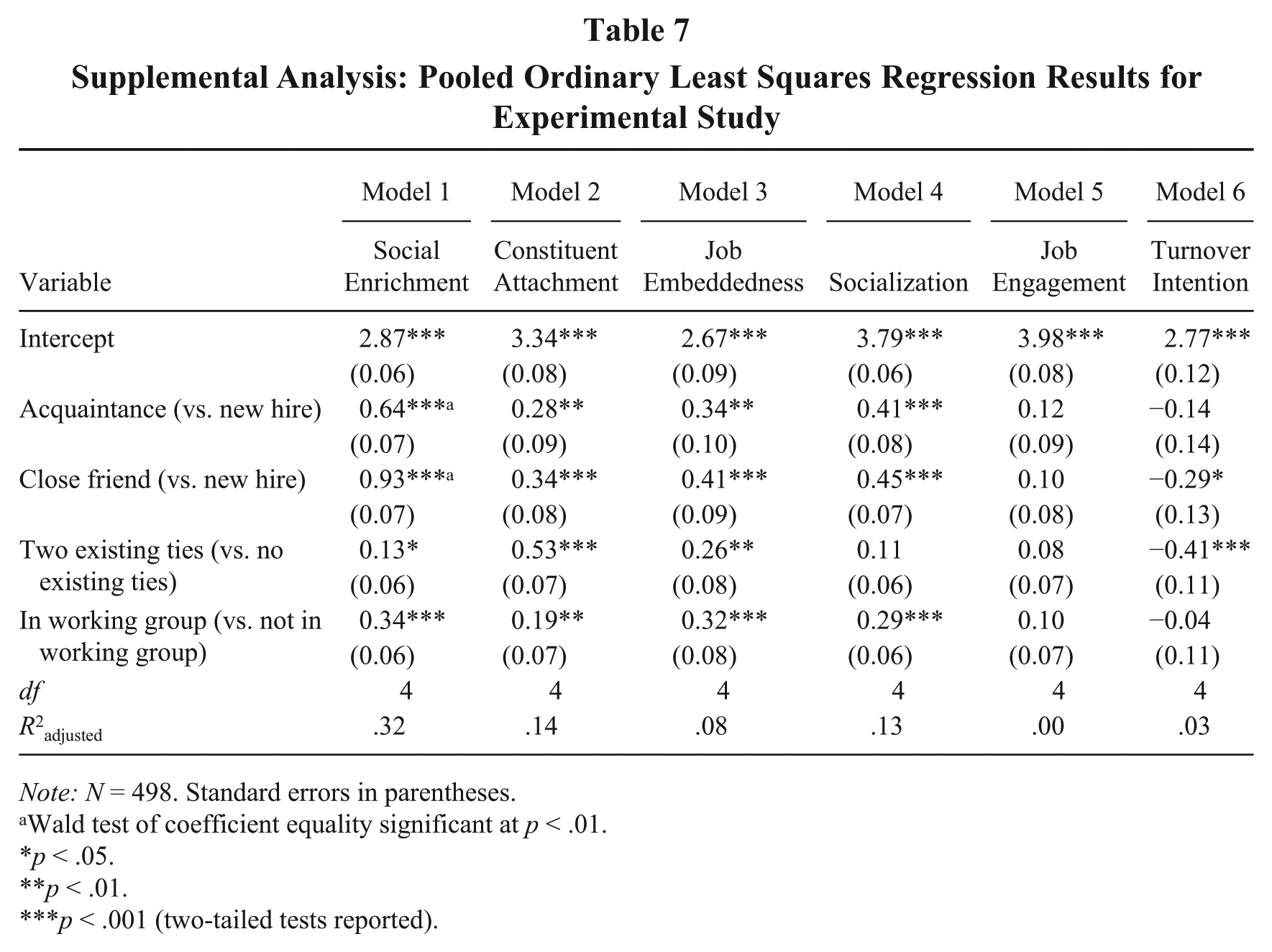
Note: N = 498. Standard errors in parentheses.
Wald test of coefficient equality significant at p < .01.
p < .05.
p < .01.
p < .001 (two-tailed tests reported).
Model 5 in Table 7 reveals that referring did not yield effects on job engagement (the most proximal measure to job performance in the field study). However, this is not particularly surprising because we asked subjects to project what their engagement would be in a hypothetical job. Such imagined job engagement is likely difficult to estimate. Similarly, envisioning one’s turnover intent in the future for a hypothetical job is a noise-laden undertaking. Yet, Model 6 of Table 7 suggests considerable support for the importance of social ties and referral hiring to referrer turnover. In terms of the general impact of social ties, the two existing ties treatment (operationalized in the ESS as two close friends) was associated with significantly lower turnover intent (b = −0.41, p < .001). Regarding the specific referral context, the hiring of a referred close friend was significantly related to a reduction in referrer’s turnover intent (b = −0.29, p < .05), consistent with our field study finding. Further, in analyses not shown here, adding any of the proposed explanations for how referral hiring can reduce turnover probability (i.e., social enrichment, constituent attachment, job embeddedness, and socialization) results in a reduction of the magnitude of that coefficient and a loss of statistical significance, which suggests the mediation we were unable to measure in our field study.
While the supplemental study evidence to this point clearly indicates that referral hiring yields social enrichment, associated perceptions, and turnover intent, we conducted additional analyses to strengthen the support for the suggested causal ordering in Figure 1’s conceptual framework. First, we examined whether social enrichment predicted job engagement and turnover intent. Table 8’s Models 1 and 6 reveal statistically significant effects, as expected. We next added the perceptual variables (constituent attachment, job embeddedness, and socialization). As seen in Table 8, social enrichment’s positive effect on job engagement (Models 2-5) and negative effect on turnover intent (Models 7-10) largely or wholly diminish (by 32% to 100%) when adding the constructs that we expected to partially mediate its impact on more proximal determinants of job performance and turnover. These results support our contention that the social enrichment arising from RHP yields responses that ultimately contribute to job performance and turnover.
Supplemental Analysis: Pooled Ordinary Least Squares Regression Results for Experimental Study With Mediators Included
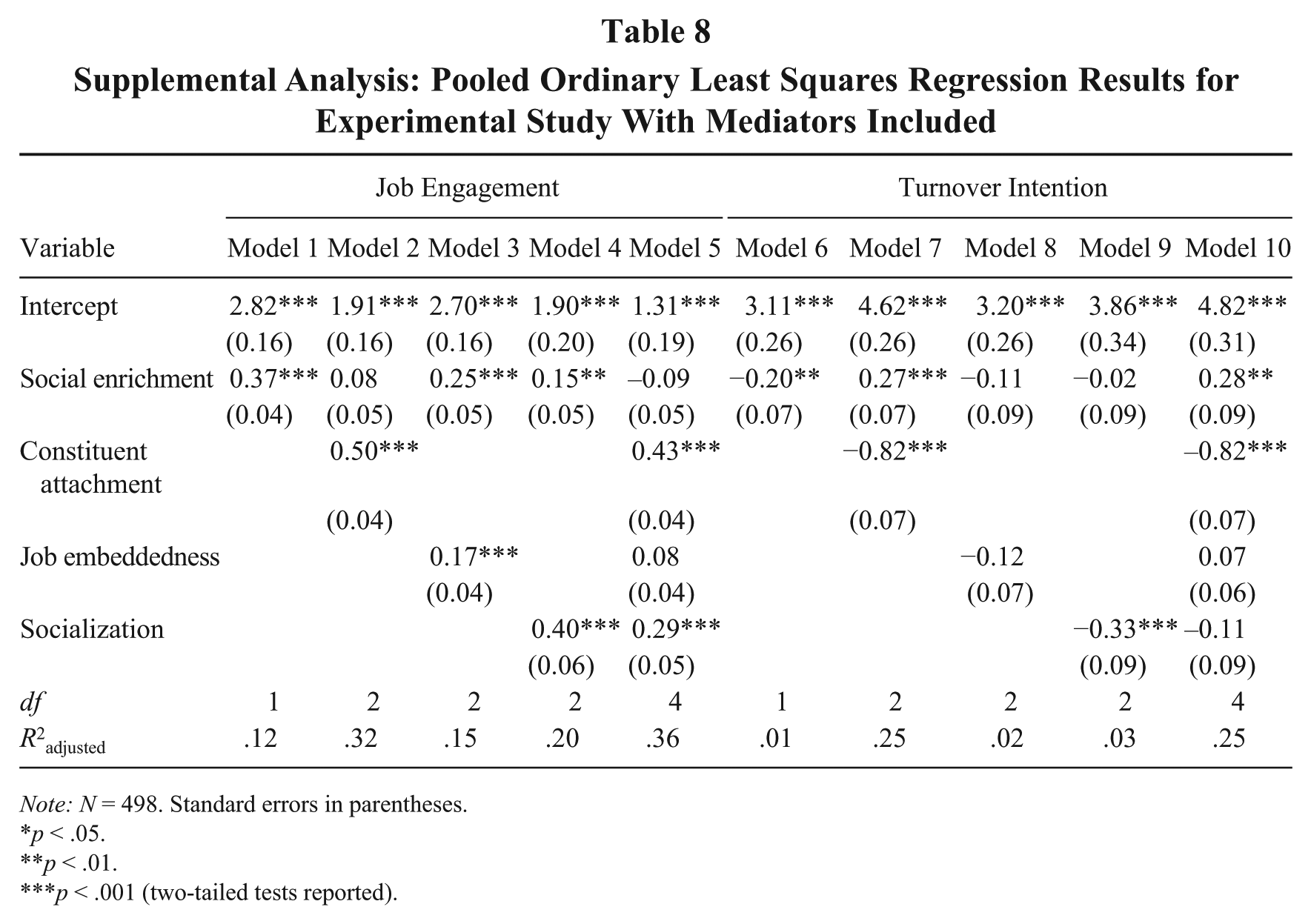
Note: N = 498. Standard errors in parentheses.
p < .05.
p < .01.
p < .001 (two-tailed tests reported).
Additional analyses of the ESS data provide further support for our framework. First, we note that social enrichment, constituent attachment, and job embeddedness (RHP reactions leading up to engagement and turnover intention) were significantly predicted by our two-existing-ties manipulation (see Table 7’s Models 1-3). Like the referral hiring results, this is consistent with our field study’s assumption that social ties promote performance- and turnover-relevant responses. Moreover, these three variables were all significantly higher when the hire was going to be in the same working group, consistent with our argument that greater exposure to the referral hire (job similarity in the field study) would enhance the social context.
Finally, while the ESS approach can provide high internal validity, questions concerning its external validity are common. Thus, we additionally surveyed the Qualtrics respondents about their current working situation (e.g., tenure, salary, job level, and full-time status), referral hiring experience, and several job-related perceptions (job satisfaction, job embeddedness, turnover intention, job engagement, constituent attachment, and social enrichment). We also measured their conscientiousness and extraversion to control for personality variables that relate to both performance and likelihood of referring. With controls in place, regression analysis revealed that social enrichment, job embeddedness, constituent attachment, and job satisfaction were significantly higher for referrers (individuals who had referred someone to a job at their current employer) than for nonreferrers (see Appendix H in the online supplement for the results). We also found that social enrichment predicted reduced turnover intention and enhanced job engagement when entered in the regressions predicting these outcomes. Adding the variables likely mediating the social enrichment effect on job performance and turnover (i.e., constituent attachment, job embeddedness, and job satisfaction) revealed reduced social enrichment coefficients (by 42% to 100%), consistent with mediating effects.
Overall, the survey analysis was consistent with the ESS results. Most important, both support our theorizing that RHP enriches the social environment, which in turn contributes to known precursors of turnover and job performance. As such, the supplemental study is consistent with, and helps to illuminate explanations for, our field study findings that RHP contributes to referrer turnover and job performance.
Discussion
We examined the relationship between RHP and referrer voluntary turnover likelihood and job performance. Drawing on the social enrichment perspective (Fernandez et al., 2000), we explained how RHP can influence the social context in a referrer’s work life to produce a richer workplace that results in improved referrer performance and retention. We also identified and tested two boundary conditions that influence the salience of the social enrichment due to RHP to explain when it likely has a greater influence on these outcomes—exposure (i.e., referrer–referral hire job similarity) and loss aversion (i.e., the impact of the referral hire’s leaving relative to the impact of the referral hire’s joining the firm). Finally, we conducted a supplemental ESS to illuminate the social enrichment construct and its mediating role in referral effects. Although this construct permeates referral hire theorizing, no prior research had measured it; our doing so allowed us to progress beyond asserting that social enrichment explains referral effects.
Our field study empirically demonstrates the relationship between RHP and referrers’ behaviors. Employees with a referral hire present were 27% less likely to leave than employees without a referral hire present, and their performance improved by 0.43 calls per hour (a performance increase of 5.1%) when a referral hire was present. These effects speak to the importance of referring and the critical nature of social enrichment. Given the high incidence of referral hiring, and the well-accepted positions that (aggregate) employee performance and turnover are critical drivers of firm performance, our results indicate that referral hiring is even more impactful than had been thought. By extending the literature’s focus from behavioral reactions of referral hires to a broader emphasis including referrers, we have identified a second pathway in which referral hiring is integral to human capital effects on the firm.
The tests of the boundary conditions presented some nuances. First, and opposite of our prediction, job similarity (exposure) between referrers and their referral hires, when compared to job dissimilarity, was associated with lower referrer job performance. It appears that the social benefits attributable to job similarity might be more complex than theory predicts. Importantly, there are plausible reasons why the social enrichment provided by RHP may entail costs that are greater with a job-similar referral hire. As stated earlier, referrers may attend to their referral hire’s socialization. Miller and Jablin (1991) observe that organizational entry is the most critical time for employees and that new employees will more deliberately seek information. Existing ties can facilitate socialization, such that referral hires learn from their referrers, adjust, and improve their performance. The downside is that with the same intensity with which referral hires seek information, referrers may need to invest in the relationship. As such, gains for referral hires may be accompanied by costs for referrers. Based on establishment-level data from Switzerland, Mühlemann and Strupler Leiser (2015: 2) estimated that a new hire “disrupts the production process of other workers in the firm for informal instruction activities by 100 working hours (2.5 work weeks).” In sum, investing in the informal training of newcomers can lead to lower performance of incumbents (Feldman, 1994; Mühlemann & Strupler Leiser, 2015). This may be particularly true for referrers and even more so under heightened exposure. Our analyses suggest that these costs for referrers in similar jobs to their referral hires may essentially offset the referrer performance gains gleaned from RHP. However, somebody must bear these costs, so any reduction in exposure-based performance benefits for the referrer may also be offset by gains for a colleague who did not need to train the newcomer. From the firm’s perspective, the referrer may be the optimal person, given that interaction and learning are likely to occur more smoothly in the referrer–referral dyad than in another peer relationship. Thus, the referrer’s socialization and training costs are likely lower than other informal training arrangements.
Our expectation about the role of loss aversion was supported. Our results demonstrate that having lost a referral hire put the referrer at greater turnover risk than what was present prior to experiencing the RHP (alternatively, RHP loss hurt referrer retention more than RHP gain helped it). This is consistent with the general loss aversion literature’s conclusion that losses matter more than gains. It is also consistent with research on the endowment effect, which stipulates that people place more value on things they own (here, RHP means that the referrer “has” the social tie, and referral hire turnover means the tie has been lost). Our work also builds on Fernandez et al. (2000) and Pieper (2015), who found that referral hires were more likely to leave if their referrer left. This parallel speaks to the importance of recognizing that the social enrichment effects brought on by referral hiring extend to both referrers and referral hires.
Finally, in our ESS study, we supported, for the first time, the role of social enrichment in the causal chain from RHP to referrer behaviors. Support was evident for referring directly leading to greater social enrichment and for this social enrichment feeding into precursors of job performance and turnover (job satisfaction, constituent attachment, job embeddedness, socialization). Finally, we find evidence consistent with mediation effects.
Theoretical Implications
Our study offers several contributions to theory. First, it provides insights to a novel and important question: Is referral hiring associated with important behavioral outcomes for referrers? We conceptualize and provide evidence that referring socially enriches one’s workplace, which in turn influences performance and turnover. Our study is an important departure from prior work focusing solely on the behavioral outcomes of referral hires, as it demonstrates an additional avenue by which organizations are impacted by referral hiring.
Second, the results of our boundary condition tests indicate that referral hiring presents nuances in terms of the behavioral referrer benefits. We find that when the referrer’s exposure to a referral hire (job similarity) is greater, referrer performance may suffer relative to lower exposure (job dissimilarity). Pieper (2015) also found that referral hire performance was lower under heightened exposure to the referrer. These like findings suggest that some aspect of the increased shared time jeopardizes the performance gains otherwise enjoyed by the referrer and referral hire. One potential explanation would be that while strong ties enrich the social environment in ways that benefit both parties, high exposure between pairs may be too much of a good thing, perhaps yielding higher costs than those that inevitably occur with a new hire (i.e., training and socialization). Hence, the positive effects of social enrichment may, under high exposure, be reduced or even eliminated by referring costs. More holistic analyses are necessary, however, to estimate the full dyadic and systemic effects.
Our findings also reveal that referrers are at greater risk of leaving when they have “lost” their referral hire, supporting the loss aversion notion and the endowment effect that extends to “owning” the presence of a social tie. In analyses not shown here, we explored whether a referrer was more likely to leave under job-similar versus job-dissimilar RHP conditions. We found that referrers’ likelihood of leaving after their referral hire terminated did not depend on job similarity. The boundary conditions investigated here thus suggest that referral hiring is a more complex phenomenon than the social enrichment argument and prior research have indicated.
Overall, our findings suggest that the social enrichment argument may benefit from the inclusion of contextual factors influencing the salience of social enrichment due to RHP. Our study yields unprecedented support for the social enrichment argument and suggests a general framework for considering mediators that better explain how social enrichment can influence turnover and performance, and likewise partially supports our predictions regarding social enrichment salience, as represented by exposure and loss aversion. Scholars can extend our work through a deeper focus on the mediators operating from RHP to behavioral outcomes and boundary conditions affecting the salience of RHP. Our focus on the salience of social enrichment is new, and much work is needed to uncover additional factors that can make the presence of a referral hire more meaningful (e.g., organizational culture).
Practical Implications
Our results suggest that referral hiring has positive referrer outcomes that potentially translate to the firm level. Referrers perform better and stay longer when their referral hires are present. The presence aspect is crucial. We do not attempt to argue that referrers are materially different than nonreferrers but, rather, argue that the presence of a referral hire changes the workplace’s social landscape in ways that ultimately manifest in referrer retention and enhanced job performance. Given our results, coupled with the well-established behavioral benefits for the referral hire, referral hiring appears to be an extraordinary value proposition for the firm because performance and retention gains emerge for both members of the referral dyad. As such, prioritizing incentive and other programs to encourage such hiring would seem to promise considerable return on investment.
Our study also can help managers understand how to leverage the hiring of an employee’s referral to improve performance and retention. For example, managers need to be aware of and work to prevent the potential downsides associated with RHP. We found that the performance increase was less under greater exposure (job similarity). Managers may need to be cautious when placing referrers and referral hires in the same job (or in proximity to each other). The downside of this is, of course, that the potential of any referring effort is undermined once social ties are deliberately restricted. It may be that striving for moderate, rather than high or low, exposure between referrers and referral hires is a better strategy, although we were unable to test this in our data. Providing an outlet to socialize (e.g., the same break schedule) also may help offset the liability. We also found a snowball effect of turnover (Krackhardt & Porter, 1986), as referral hire turnover prompted referrer turnover. Consequently, if the referral hire terminates, managers should follow up with referrers to encourage them to stay.
Limitations and Future Research
This study includes several limitations. First, we conceptualized and demonstrated the role of social enrichment in the causal chain of our theory; however, there may be other mechanisms that explain RHP effects. For example, referring may enable referrers to make positive attributions about the meaning of their work (Gersick, Bartunek, & Dutton, 2000) or legitimize a referrer’s work, which in turn leads to a positive work identity that influences job attitudes (e.g., Riordan & Griffeth, 1995; Ryan & Deci, 2001). Also, the monetary benefits of a referral bonus might explain the RHP effect on referrer turnover. While we isolated the social enrichment mechanism and provided evidence of mediation in our ESS study, we did not empirically test the full mediation model. We call on future research to more comprehensively study the likely mediators of referral hiring effects on referrer behaviors.
Second, the analyses in the main study did not account for employee demographics (age, education, and race). Given the use of FE estimation in the performance models, the potential bias from such time-constant unobserved variables is limited to the voluntary turnover case (i.e., Cox models). Although an FE estimator for the Cox model is available (Davis, Trevor, & Feng, 2015; Weller et al., 2013), it requires data from multiple jobs per individual and variation in the reasons for terminations. In analyses not shown here, the results of a turnover model with a control for an employee’s predicted likelihood of referring (which proxies for unobserved individual characteristics that determine whether one becomes a successful referrer or not) remained substantially unaltered. Because the inclusion of such proxies has advantages (mitigation of omitted variable bias) and disadvantages (underestimation of referrers’ likelihood and overestimation of nonreferrers’ likelihood), we retained our original models. Future studies should collect referring data across employees’ multiple employment spells.
In the turnover models, the absence of data on unsuccessful referrers (referrers whose referral was not hired) may be a concern to the degree that unsuccessful referrers have lower attachment to the workplace. The modeling approach described above—controlling for referring likelihood—helps address this issue for our turnover models, and the FE specification in our performance models alleviates this concern. Further, because candidates referred by high performers are more likely to be hired (Yakubovich & Lup, 2006), our performance models may be underestimated because of a possible overrepresentation of high performers (a special case of a range restriction). Future research on unsuccessful referrers is thus warranted.
Fourth, and opening new research avenues, RHP ought to be more salient for referrers that have no other existing referral-related ties. We found in analyses not shown here that the presence of additional referral hires positively affected referrer performance up to a point at which time it became detrimental, which supports social network research indicating that maintaining networks has costs (Granovetter, 1973). For turnover likelihood, however, results indicated that each additional referral hire reduces referrer turnover likelihood by 24%, but no attenuation was evident. Another boundary condition to explore involves examining the nature of the referrer–referral hire relationship (e.g., tie strength; Granovetter, 1973). Although we could not assess this with our field data, the results of our supplemental study provide some initial insight—social enrichment was greater when the referral hire was a close friend than when the hire was an acquaintance. This may mean that tie strength, by influencing the degree of social enrichment, ultimately affects the levels of turnover likelihood reduction and job performance gains that we observed here.
Our operationalization of referrer–referral hire job similarity, as a measure of exposure, is another potential limitation. Importantly, conversations with management at the call center indicated that referrer–referral hire exposure most likely occurs when the pair works on the same client program. That said, there are certainly alternative approaches to exposure (and, presumably, social enrichment salience)—see note 3 for one example. Assessing more nuanced features of the job (physical distance or perceptual measures of interaction) may provide measurement alternatives to exposure and explain why our different exposure proxies (job similarity and having completed training) produced competing findings.
Finally, our findings may be limited to low-wage/low-skill job contexts. The high degree of turnover in such contexts (and in our field study) likely provides ample opportunities to refer. Referring in firms with lower levels of attrition may provide a setting where fewer but more meaningful referrals are made. Future research should examine the effects of RHP on referrer outcomes in alternative job settings. Scholars might also test the generalizability of referring effects in a “chain” of referrers (Pieper, 2015), where Employee A refers Employee B, who refers Employee C. A particularly interesting question to explore entails whether and how turnover contagion (Felps et al., 2009) spreads through the chain.
Conclusion
While extant research provides compelling evidence for referral hires’ behavioral outcomes, our research offers the first evidence that referring affects critical behavioral outcomes for referrers. Our work identifies referrer retention and job performance gains as additional benefits of referral hiring and provides a boundary condition analysis suggesting nuances of these benefits. Further, our ESS study provides the only empirical evidence to date that referring enhances the social enrichment construct at the heart of referral hire discourse. As such, this study delivers insights into the behavioral outcomes for referrers and lends empirical support to the widely held social enrichment assumptions about how the benefits of referral hiring emerge.
Footnotes
Acknowledgements
This article was accepted under the editorship of Patrick M. Wright. We would like to thank our action editor, David G. Allen, and two anonymous reviewers for their insightful suggestions and guidance throughout the revision process.
Supplemental material for this article is available with the manuscript on the JOM website.
Notes
References
Supplementary Material
Please find the following supplemental material available below.
For Open Access articles published under a Creative Commons License, all supplemental material carries the same license as the article it is associated with.
For non-Open Access articles published, all supplemental material carries a non-exclusive license, and permission requests for re-use of supplemental material or any part of supplemental material shall be sent directly to the copyright owner as specified in the copyright notice associated with the article.
