




Abstract
We examine the impact of beauty on the academic career success of tenure-track accounting professors at top business schools in America and show that beauty plays a significant role. Specifically, after controlling for gender, ethnicity, publication history, work experience, and quality of alma mater, more attractive professors obtain better first school placements post-PhD and are granted tenure in a shorter period of time. These findings are broadly consistent with behavioral theory which predicts that facial attractiveness irrationally affects the perception of performance characteristics. Interestingly, there is no incremental benefit of attractiveness for the career progression from associate to full professor. This finding is consistent with the notion that the role played by beauty in promotion diminishes when the individual’s ability and competency become apparent over time.
Introduction
A rapidly increasing body of literature in economics and sociology documents that beauty generates positive evaluations and impressions. In comparison with the less attractive, individuals with good looks are better liked and receive more favorable treatment in hiring, performance ratings, and promotion decisions (Dipboye et al., 1977; Landy & Sigall, 1974). Studies in the fields of economics and management have explored the effect of beauty on business success and document an association with favorable traits of firms’ top management (e.g., CEOs), such as confidence (Mobius & Roensblat, 2006) and happiness (Hamermesh & Abrevaya, 2013), which in turn contribute to higher shareholder values. This widespread preference for physical attractiveness is commonly known as the “beauty premium” (Hamermesh & Biddle, 1994), and its potency is such that even those who associate with beautiful persons gain in perceived stature (Sigall & Landy, 1973).
The beauty premium exists in many social contexts and across a wide variety of professions, leading us to question whether it is caused by discriminatory or perceived valuable skills. On one hand, physical attractiveness affects people’s perceptions of intellectual competence and general mental health (Eagly et al., 1991; Feingold, 1992; Langlois et al., 2000; Hosoda et al., 2003). Beautiful individuals are considered more socially competent (Dion et al., 1972; Eagly et al., 1991; Miller, 1970). On the other hand, the literature also shows the link between beauty and positive life outcomes to be largely discriminatory and driven by the favorable treatment from others (Dion et al., 1972; Hamermesh & Biddle, 1994; Mobius & Rosenblat, 2006). Given the mixed evidence, what drives the beauty premium remains a controversial issue.
It is this debate that motivates us to re-examine the question in a new, previously unstudied, setting. Specifically, we explore whether and how the beauty premium exists in academic career progression. Using a sample of 714 photos and CVs of accounting faculty members from 93 university websites, including the Businessweek Top 50 2015 MBA Schools, we first examine the association between beauty and the school ranking of a PhD candidate’s first job placement. Second, we examine the association between beauty and the time to obtain tenure. Finally, we examine the association between beauty and the time to full professorship. We measure beauty using raw attractiveness scores from Amazon MTurk workers that are demeaned to minimize bias from “nice” or “harsh” judges and normalized to facilitate the interpretation of regression coefficients. To adjust for the potential relationship between facial attractiveness and age, gender, and ethnicity, our final measure of beauty is calculated as the residual value of subtracting the expected beauty score (determined from a regression of normalized beauty score on gender, age, and ethnicity control variables) from the actual beauty score. Our beauty results are insensitive to the use of the residual or the actual beauty scores.
We select accounting professors in U.S. research institutions for this study for several reasons. First, all PhD accounting programs in the United States have a very clear mission of placing students to academic institutions. For this reason, each school only admits a few PhD students per year (i.e., usually between 2 and 4) and upon graduation, almost all accounting PhDs are placed at postsecondary educational institutions. This placement strategy differs markedly from PhD programs in science, engineering, and economics, where many graduates find jobs in industry, and mitigates the self-selection concern that the physical appearance of industry orientated PhD graduates differs systematically from those who remain in academia. Second, accounting is a well-structured discipline in business schools. Since teaching performance and research productivity are relatively easy to measure, the quality and quantity of research can be controlled more effectively.
We find a strong positive impact of perceived attractiveness on the school ranking of a PhD candidate’s first job placement. More attractive PhD candidates are placed to more highly ranked schools. With respect to tenure, we find a negative association between beauty and time to tenure when tenure is achieved at a professor’s first school or at a professor’s second school placement when there is a voluntary early departure from the first school. These findings provide empirical evidence to support the assertion that the benefits of beauty are discriminatory. When tenure is achieved at a professor’s second or subsequent school placement and leaving the first school is a forced decision, we find that the time to tenure is not affected by their perceived attractiveness. Similarly, we find that the time to full professorship is not affected by beauty. These findings are consistent with the notion that sufficient time has passed for these individuals to demonstrate their ability. Physical attractiveness no longer induces a behavioral bias.
Although not the primary focus of our study, we also explore the influence of gender and ethnicity on career progression in academia. We do not find any evidence of gender discrimination. Specifically, the quality of first job placement is similar for males and females as is the number of years to full professorship. Although the number of years to obtain tenure is longer for females by approximately 8 months, this is likely due in large part to maternity leaves. With respect to ethnicity, we find some evidence of discrimination. Specifically, Asian scholars are placed at lower quality schools and obtain tenure in a longer period of time when tenure is achieved at professor’s second or subsequent school placement and leaving the first school was a forced decision. Although African ethnic minorities obtain initial job placements of similar quality to their cultural counterparts, they obtain tenure in a significantly longer period of time.
Our study contributes to economics and psychology literature in several ways. First, through studying the direct impact of attractiveness on career success in academia, we address the question whether the beauty premium is due to behavioral bias or perceived valuable skills. No published study to date has explored the impact of physical attractiveness on initial job placement and career progression in tenure-track research positions. We are the first to show that when job candidates are seeking their first position as an assistant professor, hiring committees and tenure and promotion committees rely on attractiveness as a proxy for expected future potential. We are also among the first researchers to explore the differential impact of beauty over the course of a person’s career. Early in one’s academic career, the beauty premium is “alive and well.” However, as their career progresses, the beauty premium disappears and is not a determinant of the promotion from associate to full rank professor. The market does not seem to correct for the pattern over time, as the same pattern observed for those professors obtaining tenure and full professorship in the 1980s and 1990s continues to be seen for those professors being promoted more recently in the 2000s and 2010s. This finding is despite the fact that a number of academic and practitioner reports have brought this bias to the world’s attention in the past two decades.
Second, we take advantage of the progress in technology to improve the methodology adopted in the literature. Only a handful of large-scale surveys have collected independent evaluations of physical attractiveness (Sala et al., 2013). Most rely on a single attractiveness rating from a rater. We add a new level of rigor to the literature, gaining more objective attractiveness ratings using photographs and having them rated, on average, by 25 unrelated individuals. This treatment is expected to reduce measurement noise significantly.
Third, our findings have practical implications. This article suggests that making the decision processes of recruitment, tenure, and promotion more transparent and objective is important. Recruiting and promotion committees would benefit if they are aware of the natural tendency to overweight facial attractiveness, discriminate against both Asian and African minorities and seek ways to correct these biases. Aspiring PhD candidates should also note that while they may have little ability to change their attractiveness and gender and no ability to change their ethnicity, it may have a significant influence on their career progression.
Background
Broadly speaking, there are two general perspectives on the observed relationship between attractiveness and success. These perspectives are (a) neoclassical—attractive individuals are “better” than their less attractive peers (i.e., smarter and socially competent) and (b) behavioral—attractive individuals are no “better” than others and succeed due to discrimination on the part of society (Graham et al., 2017).
As an example of support for the first perspective, the empirical findings of Kanazawa and Kovar (2004) led them to reason that beautiful people are more intelligent due to four assertions: (a) more intelligent men are more likely to attain higher status, (b) higher status men are more likely to mate with more beautiful women, (c) intelligence is heritable, and (d) beauty is heritable. Large nationally representative samples from both the United Kingdom and the United States supply Kanazawa (2011) with additional evidence that attractiveness and general intelligence are positively associated. Mocan and Tekin (2010) find that unattractive individuals have a higher proclivity for committing a crime. The authors suggest that beauty may positively impact human capital formation since attractive individuals participate in more activities that build their confidence and leadership skills. These skills, in turn, can lead to increased success in the labor market. Conversely, for unattractive individuals, lack of human capital formation can lead to an increased likelihood of school suspension and a lower grade point average. Further support can be found in Feingold’s (1992) meta-analysis of the literature, where social skills, freedom from social anxiety, opposite-sex popularity, and sexual experience are correlated with independent ratings of physical attractiveness. More recently, in an experimental labor market, where employers determine the wages of workers performing a maze-solving task, Mobius and Rosenblat (2006) find that 15% to 20% of the beauty premium is transmitted through higher self-confidence.
In terms of the second perspective, Dion (1973) finds that preschoolers discriminate differences in facial attractiveness, showing a distinct preference for attractive over unattractive children as potential friends. In another study by Clifford and Walster (1973), randomly selected fifth grade teachers evaluate a child’s potential based only on the child’s report cards and his or her photograph. The results confirm the researchers’ expectation that physical attractiveness affects teachers’ judgments in rating children’s social potential and intelligence.
In a work setting, Ruffle and Shtudiner (2015) investigate the role of physical attractiveness in the hiring process. They send over 5,000 CVs, in pairs, to approximately 2,600 advertised job openings. For each pair, one CV is without a photo, whereas the other one includes a picture of either an attractive or a plain-looking individual. Employer callbacks to attractive men are significantly higher than to plain-looking men and to men with no photos.
Overall, the findings in the literature provide consistent evidence that many benefits afforded to attractive individuals are discriminatory in nature, supporting the second perspective primarily and the first perspective to a lesser degree. Our brains seem genetically predisposed to subconsciously form an attractiveness stereotype, associating beauty with positive attributes.
Quality of the First Job Placement
First, we analyze the association between facial attractiveness and the quality of a PhD candidate’s first job placement.
Humans are fundamentally social beings. We try to preserve the integrity of our social group and status when selecting new group members. Consider the impact of our evolutionary past on the inner workings of the brain, where many social interactions were brief and provided limited information. Not surprisingly, then, we often rely on first impressions to select new group members (Bar et al., 2006; Todorov et al., 2005; Willis & Todorov, 2006). As to academic job placement, a large part of the interview experience is “visual,” much like that of a presidential candidate performing on television, and this is where attractive individuals excel. In their experimental setting using undergraduate students and local townspeople, Mulford et al. (1998) find that attractive individuals are advantaged in two ways; first, they have greater opportunity for social exchange; and second, these exchange opportunities are with others who have a higher propensity to cooperate once the interaction is consummated.
In addition, most newly minted PhDs do not yet have a top tier publication and much of their work has been under the supervision of, or co-authored with, others. In other words, a candidate’s true intellectual and social competencies may not be readily apparent at the time of graduation. As such, typical signals, such as the supervisor’s recommendation letter and the list of publications/working papers, could be very noisy proxies of one’s research ability and may drive hiring committees, consciously or unconsciously, to factor in attractiveness as a proxy for ability, resulting in more attractive candidates being placed at higher quality schools.
To confirm if this is the case, we regress:
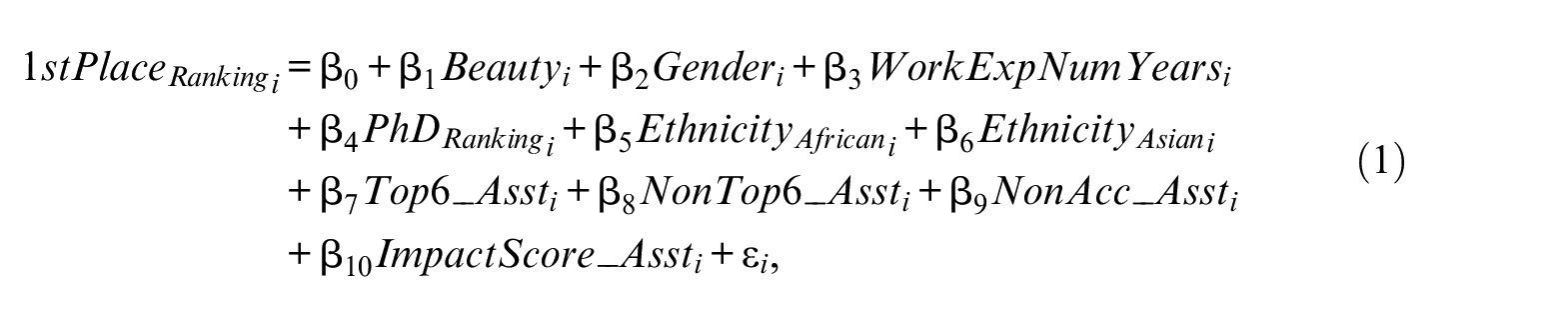
where the dependent variable is the school ranking measure 1stPlace_Ranking. Beauty is the measure of facial attractiveness of each professor’s picture. Since our empirical tests are designed to capture the relationship between attractiveness and career success, we control for characteristics likely to be correlated with (a) time to tenure and (b) quality of first school placement in our multivariate tests. Our control variables include gender, ethnicity, prior nonacademic work experience, quality of prior institutions, and number/quality of publications. Definitions of all variables are provided in Online Appendix A.
Time to Obtain Tenure
Second, we examine if facial attractiveness is associated with the time to obtain tenure.
Most schools allow assistant professors a period of 5 to 7 years to obtain tenure. Ideally, candidates should be evaluated based on merit, such as their research and teaching ability, and their contribution to the profession. Given that publication in a top tier accounting journal can easily take 3 to 4 years, from initial draft to final submission and publication, the tenure clock is rather short. Following the argument in the previous section, whether one’s “true” research/teaching ability can be revealed within such a short time period remains an empirical question. In addition, most schools do not have a “rigid” written rule regarding the number of “A” publications required for tenure. This allows tenure and promotion committees a certain flexibility in their final decision. In light of the logic presented above, other qualitative considerations likely play a role in the tenure promotion decision. Moreover, as noted above, there is strong empirical evidence to support the assertion that the benefits of beauty are discriminatory in nature. As such, the benefits of beauty may still persist. To confirm if this is the case, we regress:
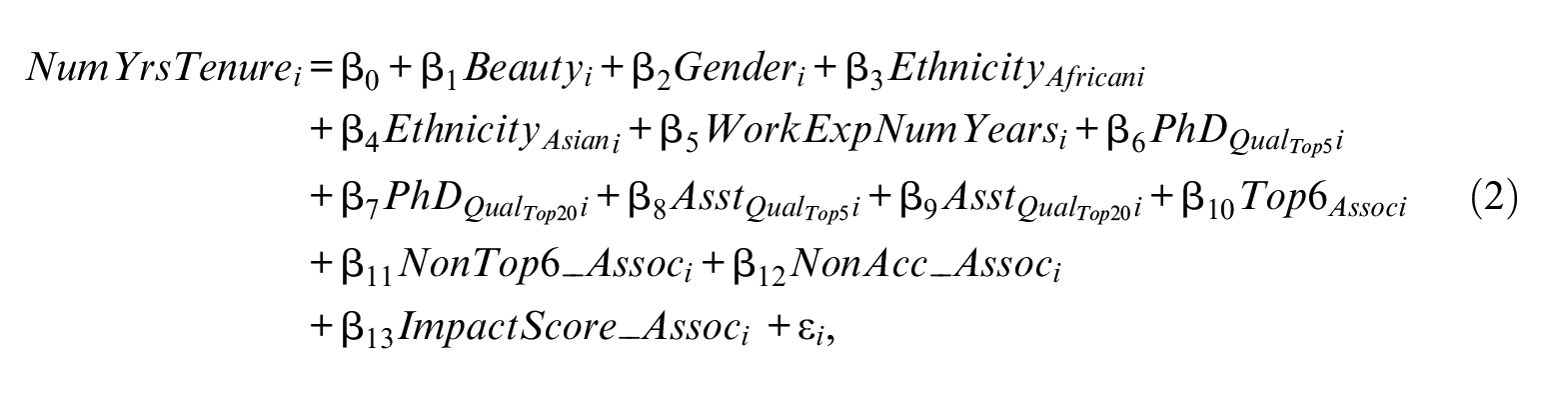
where NumYrsTenure is the number of years between first placement after graduation and promotion to tenured professor. Definitions of all control variables are provided in Online Appendix A.
When examining the association between beauty and time to tenure, we consider three scenarios: (a) when tenure is achieved at a professor’s first school placement, (b) when tenure is achieved at a professor’s second school placement when there is a voluntary early departure from the first school, and (c) when tenure is achieved at a professor’s second or subsequent school placement and leaving the first school is a forced decision. We separately assess professors who are tenured at the second or subsequent schools because these professors have been working for several years and as such, competing schools may exploit the uncertainty of the tenure process and lure them away with promises of a quick tenure decision. For such a voluntary leave, facial attractiveness is expected to be negatively associated with the time to tenure. On the other hand, it is possible that these professors fail to receive tenure at their first schools and are forced to leave. Restarting a tenure clock gives schools more time to evaluate their talent. Under this scenario, facial attractiveness is not necessarily associated with the time to tenure.
Time to Full Professorship
Next, we study if facial attractiveness is associated with the time to obtain full professorship.
In a setting using elementary school children, Lerner et al. (1990) find that physical attractiveness had its maximum influence on teachers’ judgments about students’ academic competence at the beginning of the school year, when the teachers had less personal behavioral information about the students. 1 As such, it may be that teachers were most likely to rely on stereotype associations between physical attractiveness and competence at this time. In addition, findings by Fiske and Taylor (1991) support the notion that the beauty effect is stronger when a direct measure of competence is absent than when it is present. Once a professor has already obtained tenure (i.e., on average, 10 years after first beginning PhD studies), much is known about the individual’s past productivity and his or her prospects of future productivity, that is, quality and quantity of working papers. In light of such strong competency indicators, no reliance need be placed on beauty as an imperfect proxy.
Moreover, as argued by Cook and Mobbs (2016) in their study on executive appearance and CEO selection, facial attractiveness of CEO candidates may only be an important distinguishing characteristic when candidates have similar skills which causes firms to seek additional selection criteria. By the time a professor has tenure, the pool of peers is sufficiently diversified in terms of publication history, working papers in the pipeline, and research interests.
As such, we expect that the beauty premium no longer exists in the period from tenure to full professorship.
To confirm if this is the case, we regress:
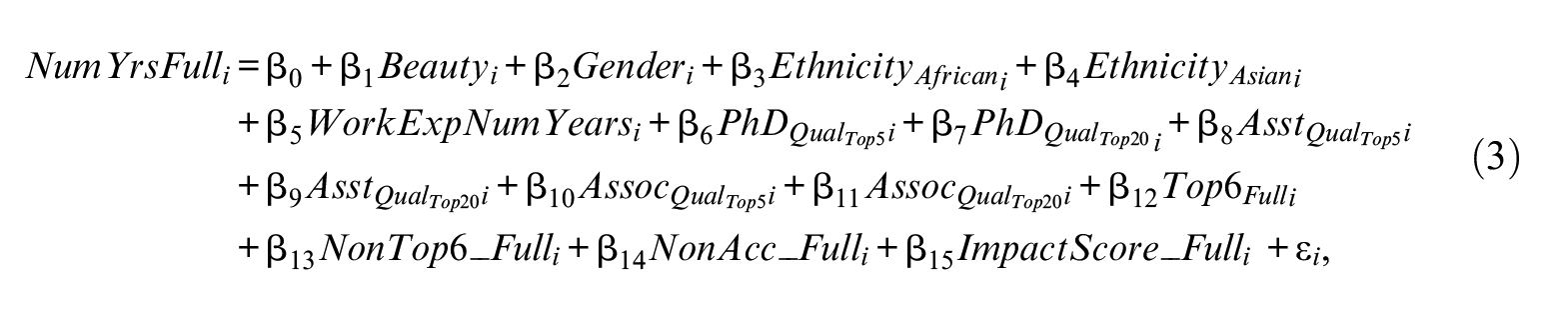
where NumYrsFull is the number of years between associate to full professor.
Test Results and Discussion
To conduct the empirical analysis, we obtain a list of schools featured in the Businessweek Top 50 MBA schools in the United States for the year 2015 (Online Appendix B). 2 We supplement this list with accounting faculty from additional lower tier U.S. schools, bringing our complete sample to 93 business schools. The publication history for each professor (as of June 2015) is pulled from two independent sources: (a) the professor’s CV and (b) manual collection of publication information for each of the top six accounting journals over the past 40 years. We obtain ethnicity information using a combination of visual photo inspection and background search of the surname. Assuming most individuals earn their undergraduate degree at age 22, we estimate professor age using the year the professor graduated from undergraduate studies.
Raw attractiveness scores are obtained from Amazon Mechanical Turk (MTurk), a crowdsourcing internet marketplace that enables individuals and employers (known as Requesters) to coordinate the use of human intelligence to perform tasks. For each photo, the MTurk workers rate the attractiveness on two dimensions: (1) quantitative—on a scale of 0 (very unattractive) to 100 (very attractive); and (2) qualitative—as (a) below average, (b) average, (c) attractive, or (d) very attractive. 3
Each photo is rated, on average, 25 times by MTurk workers. The use of a composite rating is consistent with the work of Hamermesh and Parker (2005) and Karl and Sicinski (2015), who noted that the estimated coefficients on Beauty are smaller when based on evaluations of a single rater rather than a composite measure. Composite measures are more reliable because they are based on aggregations of correlated responses.
The raw quantitative scores for each professor photo are then converted into a single attractiveness measure. First, the judge’s mean rating across all photographs that he or she coded is used to minimize bias from “nice” or “harsh” judges. Specifically, we subtract the mean quantitative score given by a rater from each quantitative score received from the same rater. This adjustment is required to account for the fact that each rater may have different benchmarks for beauty, which would add noise to the measure. Next, the average of the mean-adjusted scores is taken. Finally, the variable is normalized (between 0 and 100) to facilitate the interpretation of regression coefficients. We refer to this variable as the normalized quantitative facial attractiveness score (Quant Score). Given that accounting professors attract little if any attention in social media, it is highly unlikely raters would know the identity of individuals they are rating and as such we are unconcerned that familiarity will bias the results. 4
Previous research shows there to be minimal cross-cultural variation in people’s perceptions of which facial characteristics are considered attractive (e.g., Langlois et al., 2000; Perrett et al., 1994). Nonetheless, to adjust for the potential correlation of facial attractiveness with age, gender and ethnicity, we first regress the above-mentioned Quant Score on an individual professor’s age, gender and ethnicity, as follows:

Based on these coefficients, we calculate the expected value of Quant Score for each individual professor in our sample. Our final measure of the quantitative facial attractiveness score, Beauty, is then calculated as the residual value of subtracting the expected Quant Score from the actual Quant Score. 5
Table 1 presents the summary statistics for beauty measures. Panel A reports the summary statistics for the normalized mean-adjusted quantitative scores from MTurk raters. Panel B reports the summary statistics of the mean-adjusted quantitative scores by gender, ethnicity group, and age. On average, female professors receive higher scores than male professors. Non-Asian/African professors and younger professors also tend to be rated higher.
Summary Statistics for Beauty Measures.
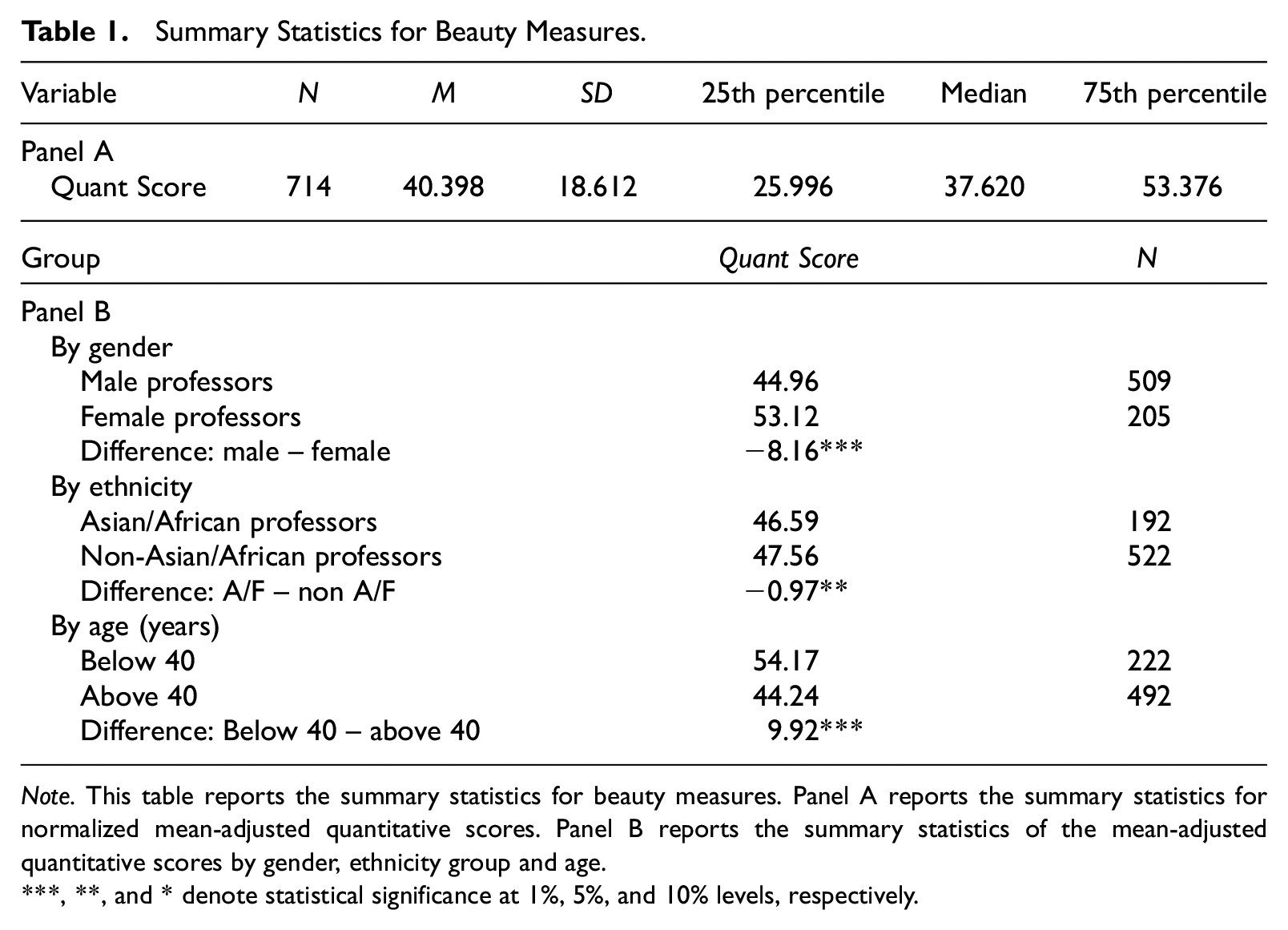
Note. This table reports the summary statistics for beauty measures. Panel A reports the summary statistics for normalized mean-adjusted quantitative scores. Panel B reports the summary statistics of the mean-adjusted quantitative scores by gender, ethnicity group and age.
, **, and * denote statistical significance at 1%, 5%, and 10% levels, respectively.
The Effect of Facial Attractiveness on Quality of First School Placement
Online Appendix D presents the ordinary least squares (OLS) regression results of Equation (4). The results show that the coefficient on Gender is significantly negative with a value of −6.215 and a t-stat of −7.78, indicating that, on average, male professors receive lower facial attractiveness score ratings. Similarly, the coefficient on Ln_Age is also significantly negative with a value of −22.388, suggesting that raters assign lower scores to older professors.
Table 2 reports the regression results of the quality of first job placement. The results show that the coefficient on Beauty is significantly negative (with a value of −0.358 and a t-value of −3.03), 6 indicating that more attractive candidates tend to place at better quality universities when they graduate from their PhD program. In terms of economic significance, the interquartile change of Beauty of 19.821 (= 9.735 − [−10.086]) is translated to a school ranking of 7.10 (= [−0.358] * 19.821) places higher. Given the average ranking of the first school placement is 41.218, this is equivalent to an average of 17.22% [= 7.10/41.218] higher increase in school ranking placement. The ranking of the first placement is also influenced by the quality of the candidate’s PhD program, as indicated by the significantly negative coefficient on PhD_Qual_Top5 (with a value of −30.947 and a t-value of −11.99) and PhD_Qual_Top20 (with a value of −18.534 and a t-value of −6.44). In addition, the significantly negative coefficient on Top6_Asst (with a value of −7.000 and a t-value of −3.90) indicates that candidates who have publications in the top 6 accounting journals tend to have better placement when they graduate.
The Relation Between Beauty and Quality of First Placement as Assistant Professor.
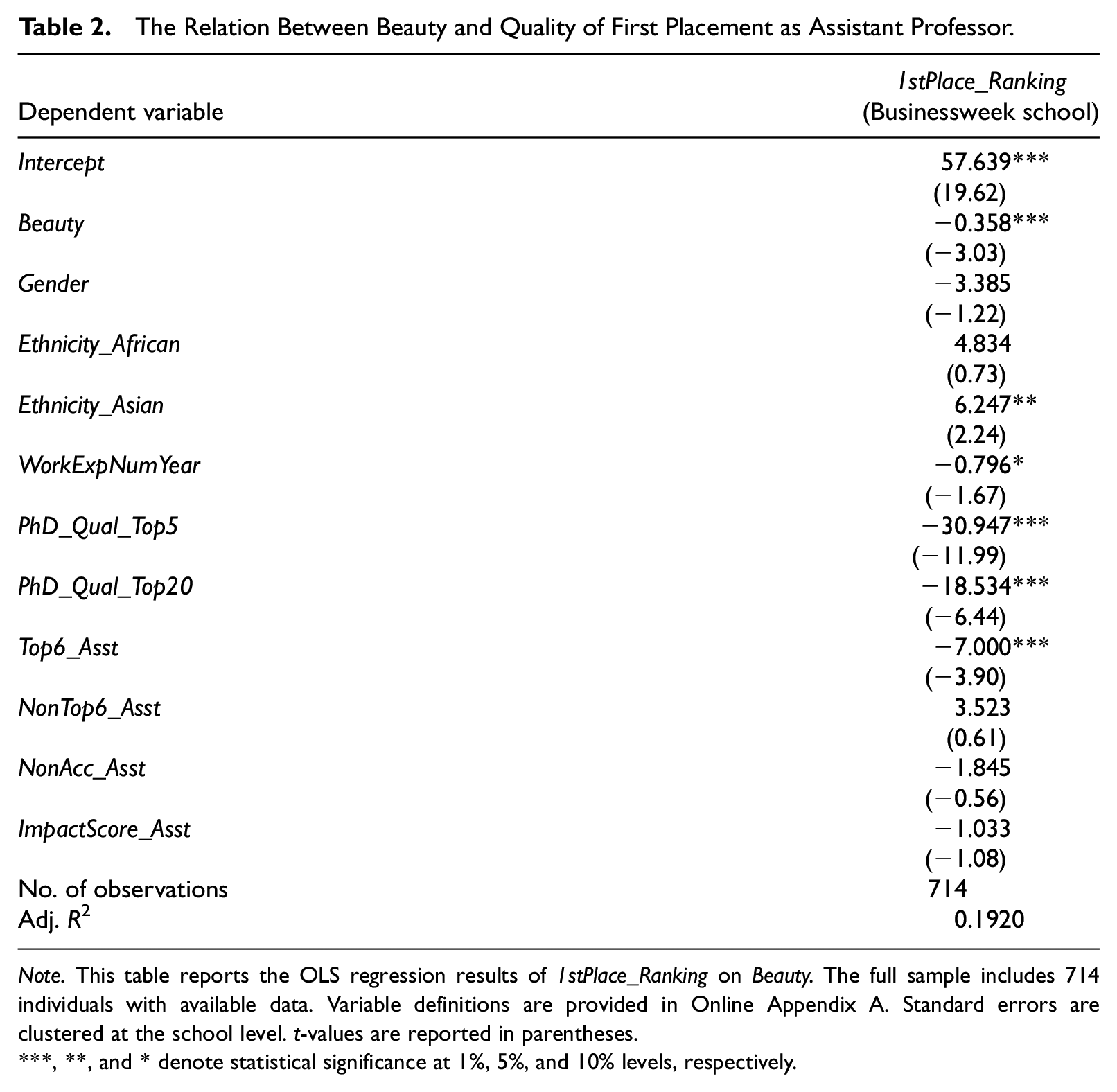
Note. This table reports the OLS regression results of 1stPlace_Ranking on Beauty. The full sample includes 714 individuals with available data. Variable definitions are provided in Online Appendix A. Standard errors are clustered at the school level. t-values are reported in parentheses.
, **, and * denote statistical significance at 1%, 5%, and 10% levels, respectively.
The Effect of Facial Attractiveness on Requisite Time to Attain Tenure
Table 3, Column 1, reports the results for those who obtain tenure at their first school placement. The results show the coefficient on Beauty to be significantly negative (with a value of −0.028 and a t-stat of −2.99), indicating more attractive candidates obtain tenure at their first school placement in a shorter time period. In terms of economic significance, the interquartile change of Beauty of 19.821 (= 9.735 − [−10.086]) is translated to a −0.55 (= [−0.028] * 19.821) decrease in number of years to obtain tenure. Given the average number of years to tenure is 6.456, this is equivalent to an average of 8.5% [= 0.55/6.456] shorter time in obtaining tenure. Professors from better-quality universities tend to receive tenure faster, as indicated by the significantly negative coefficient (−0.909 with a t-stat of −2.61) on Asst_Qual_Top5. 7
The Relation Between Beauty and Number of Years to Obtain Tenure.
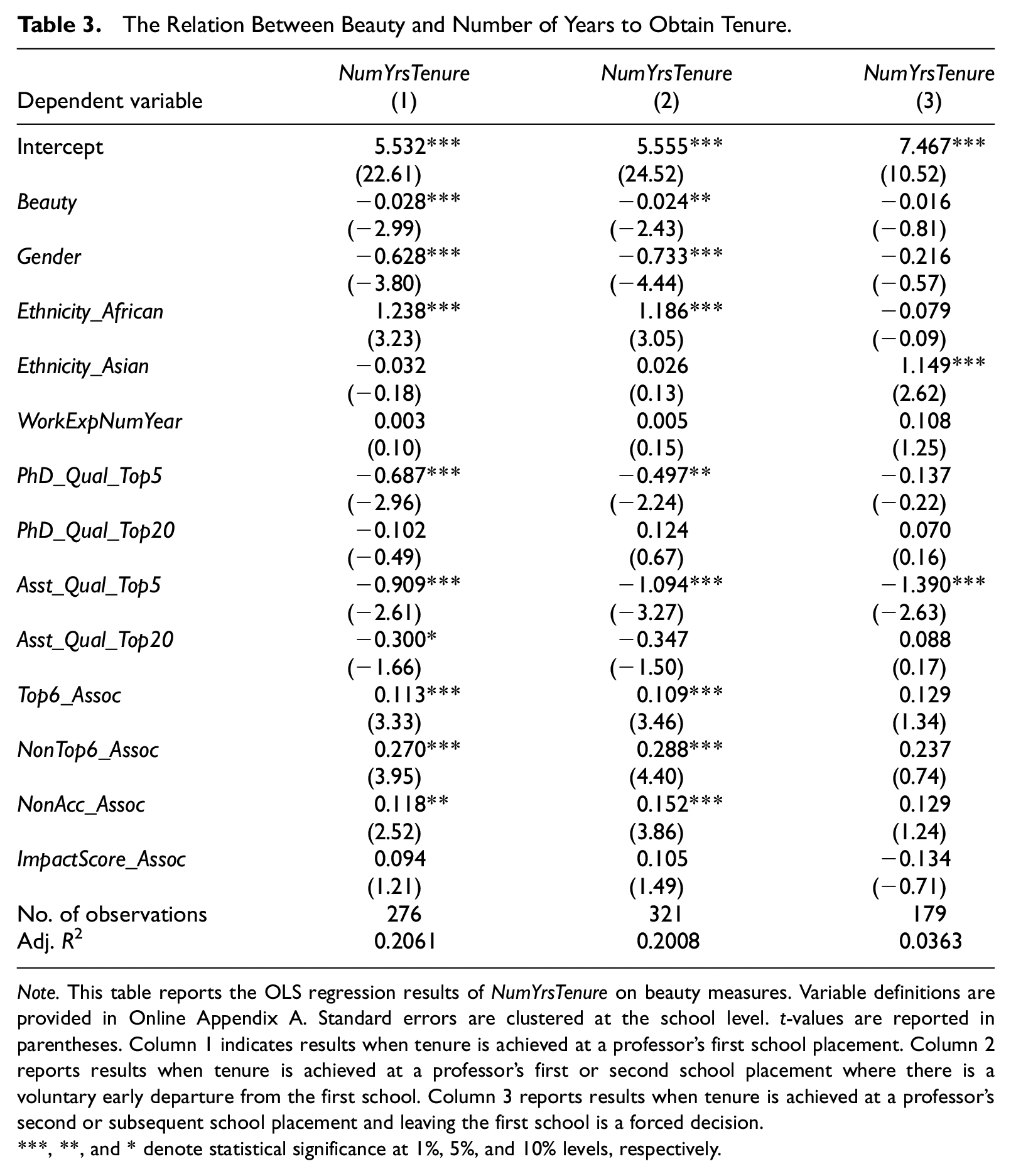
Note. This table reports the OLS regression results of NumYrsTenure on beauty measures. Variable definitions are provided in Online Appendix A. Standard errors are clustered at the school level. t-values are reported in parentheses. Column 1 indicates results when tenure is achieved at a professor’s first school placement. Column 2 reports results when tenure is achieved at a professor’s first or second school placement where there is a voluntary early departure from the first school. Column 3 reports results when tenure is achieved at a professor’s second or subsequent school placement and leaving the first school is a forced decision.
, **, and * denote statistical significance at 1%, 5%, and 10% levels, respectively.
Some professors voluntarily leave their first placement universities, perhaps to move to a better academic environment or for personal reasons. Table 3, Column 2, reports the results when tenure is achieved at a professor’s first school or at a professor’s second school placement when there is an early voluntary departure from the first school. The move is classified as an early voluntary departure if the number of years at the first school is less than or equal to three. Otherwise, it is treated as a forced departure. With the early voluntary departure cases included in the analysis, the sample size increases from 276 to 321. The results in Panel B are similar to that in Panel A. The coefficient on Beauty is significantly negative, indicating a shorter time period for attractive candidates to obtain tenure.
Table 3, Column 3, reports the regression results when tenure is achieved at a professor’s second or subsequent school placement and leaving the first school is a forced decision. Similar to above, we classify the move as a forced departure if the number of years before leaving the first school exceeds three. Consistent with our conjecture, the results show the coefficient on Beauty to be insignificant in all model specifications, indicating that time to tenure is not associated with professor’s facial attractiveness when tenure is achieved at a professor’s second or subsequent school placement. 8
The Effect of Facial Attractiveness on Requisite Time to Become Full Professor
Table 4 reports the regression results of the association between facial attractiveness measure (Beauty) and number of years to obtain full professorship from the time one first obtains tenure. The results show that the coefficient on Beauty to be insignificant, indicating time to obtain full professorship is not associated with the professor’s facial attractiveness. 9
The Relation Between Beauty and Number of Years to Obtain Full Professorship.
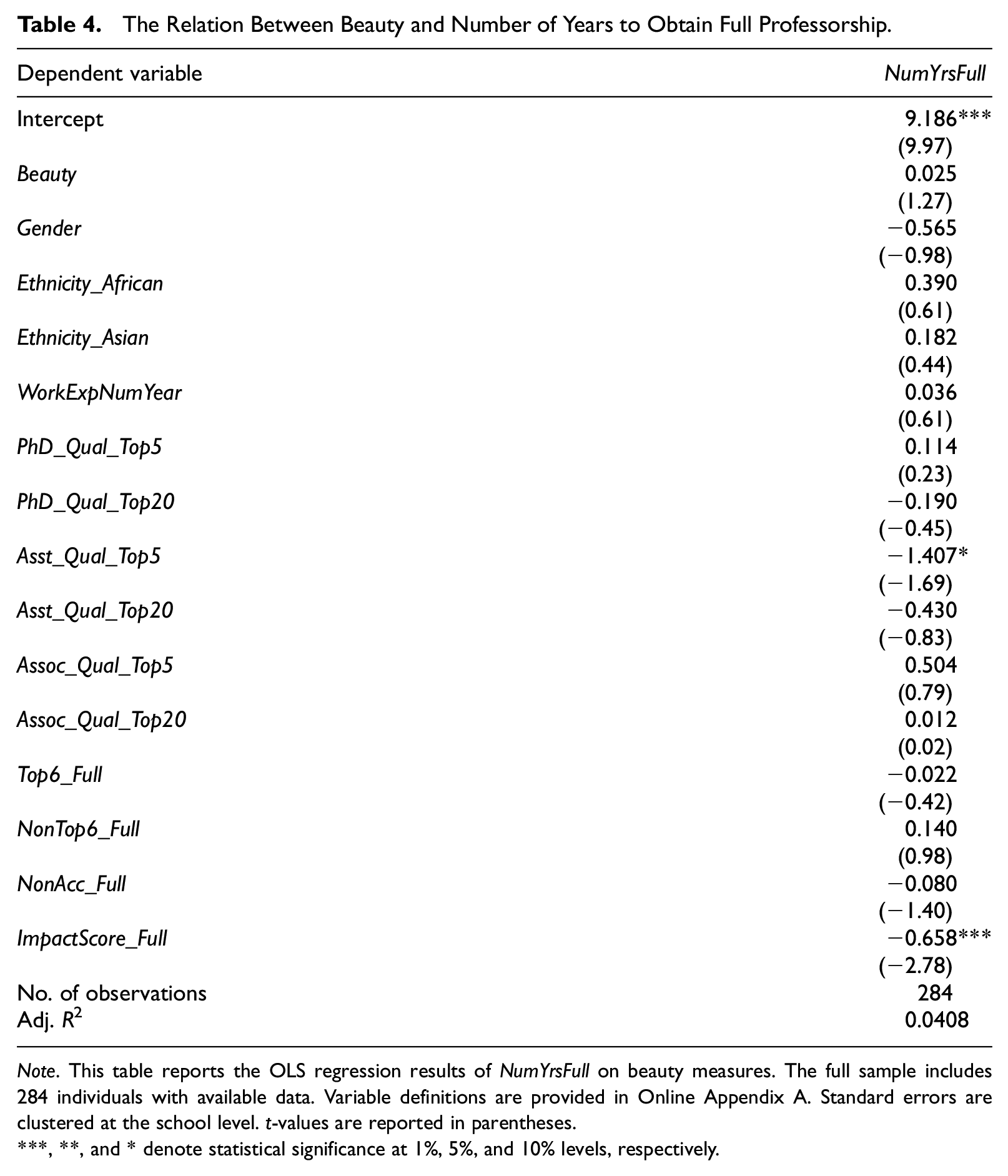
Note. This table reports the OLS regression results of NumYrsFull on beauty measures. The full sample includes 284 individuals with available data. Variable definitions are provided in Online Appendix A. Standard errors are clustered at the school level. t-values are reported in parentheses.
, **, and * denote statistical significance at 1%, 5%, and 10% levels, respectively.
In summary, our findings suggest the behavior of hiring committees and tenure and promotion committees changes with the facial attractiveness of the candidate. At the time of graduation from PhD studies, many hiring committees “thin slice” on attractiveness as a proxy for quality, resulting in more attractive candidates being placed at higher quality schools. This relationship continues to be observed in individuals obtaining tenure at their first school placement or their second school placement where the move from their first school is voluntary. Physical attractiveness is no longer a behavioral bias when the move from the first school is forced and for the period from associate to full professorship.
Other Facial Feature Measures
We control for two additional facial feature measures: perceived competency (Competency) and perceived trustworthiness (Trustworthiness) and examine how they affect career outcomes. These measures have been popularized by recent papers, such as Dilger et al. (2015), who find that research performance is influenced by perceived trustworthiness, and Graham et al. (2017), who find that competent looks are reflected in CEO compensation. For this test, we ask MTurk participants to re-assess the photos and evaluate them based on perceived competency and trustworthiness. Both perceived competency and perceived trustworthiness are calculated using the same methodology as Beauty described above.
After controlling for both perceived competency (Competency) and perceived trustworthiness (Trustworthiness), the results (un-tabulated) provide some evidence supporting the argument in the prior literature that facial features impact academic career outcomes. Specifically, when perceived competency and trustworthiness are included in regression models individually, the coefficients are significantly associated with the quality of the first job placement, with higher perceived measures leading to better job placements. However, when the analyses are re-run for time to tenure, the coefficients are not significant. For both quality of first job placement and time to tenure, perceived competency and trustworthiness do not subsume the effect of facial attractiveness. More specifically, perceived competency and trustworthiness are all insignificant in regression analyses which also include Beauty. These findings are consistent with an “irrational” reliance on Beauty.
Male Versus Female Analysis
Gender discrimination continues in hidden and often subtle ways in American society (Kuhn & Shen, 2013), despite the Civil Rights Act of 1964 and subsequent legislation. The literature finds that American firms provide their male employees with more promotion opportunities and pay them more (Altonji & Blank, 1999; Goldin & Rouse, 2000). In the context of financial advisors, Egan et al. (2017) find that female American advisors are more likely to lose their jobs than their male counterparts.
In our regression analyses (Tables 2–4), where we include a gender dummy variable as a control, we do not find any convincing evidence of gender discrimination. Specifically, the quality of first job placement is similar for males and females, as is the number of years to full professorship. Although the number of years to obtain tenure is longer for females by approximately 8 months, this is likely due in large part to maternity leaves. We also conduct subsample analyses for the male and female subgroups. The results (provided in the online appendix) reveal that facial attractiveness matters for both male and female subgroups and the difference between the coefficients on Beauty for the two subgroups is not statistically significant. When interacting Beauty with Gender and including the interaction term in the regression models, the coefficient on the interaction term Beauty×Gender is insignificant for all our hypotheses. The results suggest that the effect of facial attractiveness on academic career does not differ between men and women.
Ethnicity Analysis
The negative impacts of ethnicity discrimination on employment outcomes are clear. Berdahi and Moore (2006), using data from five organizations, find that women experienced more sexual harassment than men, minorities experienced more ethnic harassment than Whites, and minority women experienced more harassment overall than majority men, minority men, and majority women. Avery et al. (2008), using results from a national survey of 763 full-time U.S. employees, find that perceived race-based discrimination at work was more prevalent among Black and Hispanic than White employees. Heath and Cheung (2006), exploring ethnic penalties in the labor market, find that ethnic disadvantages experienced by minority groups cannot be expected to resolve of their own accord. Finally, Woo (2000), exploring the impact of glass ceilings on Asian Americans, find that Asian Americans are significantly underrepresented in senior management positions across corporate America due to a number of factors, including little or no access to informal networks and “different” standards for performance evaluation, relative to their White colleagues, and biased rating and testing systems.
In our regression analyses (Tables 2–4), where we include African ethnicity and Asian ethnicity dummy variables as controls, we find some evidence of discrimination. Specifically, Asian scholars are placed at lower quality schools and obtain tenure in a longer period of time when tenure is achieved at professor’s second or subsequent school placement and leaving the first school was a forced decision. Although African ethnic minorities obtain initial job placements of similar quality to their cultural counterparts, they take a significantly longer period of time to obtain tenure.
Conclusion
Asking human subjects to rate the attractiveness of tenure-track accounting professors and controlling for characteristics such as publication history, nonacademic work experience, and quality of alma mater, we show that beauty has significant impact on a professor’s career success. Specifically, attractiveness is associated with better first school placements post-PhD and the attainment of a quicker route to tenure. Interestingly, however, there is no association between attractiveness and time to tenure for those professors who obtain tenure at their second or subsequent school placement (and leaving the first school is a forced decision) and for individuals when making the transition from the role of associate professor to that of full professor.
Our evidence shows that the so called “beauty premium” exists in rigorous and objective evaluation processes (such as rookie recruiting and tenure promotion), where one should be judged by his or her merits alone. In other words, more attractive individuals are treated more favorably than less-attractive persons. While one might expect that recruiting and tenure committees are conscientious and well-experienced at assessing candidates, it appears that committee members consist of individuals with personal biases. As such, this article suggests that making the decision processes of recruitment, tenure, and promotion more transparent and objective is important. Recruitment and promotion committees would benefit from being made aware of the natural tendency to overweight facial attractiveness and seek to find a way to correct this bias. We should also be cautious about overreliance on objectively measureable criteria such as the number of publications, without paying attention to other less objective criteria such as paper quality and the contribution made by each co-author. 10
With respect to the influence of gender and ethnicity on career progression, we find no strong evidence for gender discrimination but do find support for ethnicity discrimination for individuals of both Asian and African descent. As already suggested above for beauty, recruitment and promotion committees should be made aware of the tendency to discriminate against ethnic minorities and find ways to proactively address and correct this bias. It is encouraging to hear that many U.S. and Canadian schools have already taken steps to address these inequalities through workforce diversity training and new recruitment and retention strategies.
Finally, the beauty measure in our paper mainly focuses on facial attractiveness. While the majority of research in this area has focused exclusively on facial beauty, a few papers explore the relative importance of facial expressions, body and voices to the overall physical attractiveness. 11 These papers find that facial attractiveness, body attractiveness, voices and facial expressions independently contribute to overall human physical attractiveness. To what extent pure facial beauty as opposed to more subtle factors such as empathy and sense of humor contribute to perceptions of beauty is a consideration for future research. As such, future research could extend the beauty research beyond facial attractiveness to include such characteristics as body attractiveness, voice, and facial expressions in a single model.
Supplemental Material
sj-docx-1-jaf-10.1177_0148558X221115115 – Supplemental material for Beauty and Accounting Academic Career
Supplemental material, sj-docx-1-jaf-10.1177_0148558X221115115 for Beauty and Accounting Academic Career by Yanju Liu, Hai Lu and Kevin Veenstra in Journal of Accounting, Auditing & Finance
Footnotes
Acknowledgements
We gratefully acknowledge helpful comments from workshop participants at Tsinghua University, Singapore Management University, conference delegates at the European Accounting Association and Canadian Academic Accounting Association annual meetings, and two anonymous reviewers. All errors are our own.
Declaration of Conflicting Interests
The author(s) declared no potential conflicts of interest with respect to the research, authorship, and/or publication of this article.
Funding
The author(s) disclosed receipt of the following financial support for the research, authorship, and/or publication of this article: This article was supported by the CPA/DeGroote Centre for Promotion of Accounting Education and Research at McMaster University.

Supplemental Material
Supplemental material for this article is available online.
Notes
Author Biographies
References
Supplementary Material
Please find the following supplemental material available below.
For Open Access articles published under a Creative Commons License, all supplemental material carries the same license as the article it is associated with.
For non-Open Access articles published, all supplemental material carries a non-exclusive license, and permission requests for re-use of supplemental material or any part of supplemental material shall be sent directly to the copyright owner as specified in the copyright notice associated with the article.
