



Abstract
With the hazard brought by highly energetic gamma radiation, it is necessary to increase the effectiveness of the gamma shields by considering their internal geometry or the arrangement of the materials within the shield. The study primarily analysed the effectiveness of the gamma shield based on its geometry to suggest a different configuration for radiation protection. The two geometries are horizontal and vertical embedded lead sheets inside the concrete slab. A total of 10,000 particles were simulated to traverse different set-ups of gamma shields using a Monte Carlo simulation programmed in the MATLAB desktop software. In the simulation, a random walk method was used within the shield to determine the scattering of photons. The results show that the concrete slab containing horizontal lead sheets compared with the concrete slab containing vertical lead sheets produced a difference of 0.06–1.01% in the number of transmitted photons and a difference of 1.15–3.85% in the average transmitted energies. Between the two configurations, the horizontal geometry of the embedded lead sheets is more effective in attenuating gamma scattering.
INTRODUCTION
Gamma rays are high-energy electromagnetic radiation, which can penetrate human tissue (Erramli and El Asri, 2019). Once they penetrate through an individual's body, ionisations occur and damage the tissue. Radiation shielding is necessary to minimise exposure and provide protection against penetrating particles. The effectiveness of the gamma shields should be increased by considering their internal geometry or the arrangement of the materials within the shield. In this study, the two geometries are horizontal and vertical embedded lead sheets inside the concrete slab.
In a radiation installation, the most common material used for shielding is concrete (Gencel et al., 2011). However, supplementary additives play a significant role in modifying the radiation shield properties (Gencel et al., 2011; Amir, 2018). Several studies examine concrete composed of other materials, including natural rocks, natural perlite mineral, boron carbide, haematite, and lead as additive contents in the material (Gencel et al., 2011; Rezaei-Ochbelagh and Azimkhani, 2012; Agar et al., 2019; Bantan et al., 2020). Particularly, integrating additives with properties such as high density and gamma attenuation into the concrete's composition yields a more effective shielding performance against gamma radiation since gamma ray attenuation capability is improved (Gencel et al., 2011; Agar et al., 2019). As such, the current study has decided on using concrete as the primary slab and adding lead for gamma shielding.
Moreover, this study employed Monte Carlo methods since these utilise random sampling processes to give an approximation to deterministic quantities (Johansen, 2010). Given the experimental possibility limitations, simulation is one of the approaches that can predict the performance of a given system because of its efficiency, convenience, ease of access, verification, and safety which is important in radiation physics. With this, a two-dimensional random walk Monte Carlo simulation was created.
Problem statement
Due to the limited studies about the optimal geometry of lead and concrete for gamma shielding, the study primarily aimed to analyse the effectiveness of the gamma shield based on its geometry.
Specifically, the study had the following objectives:
Obtain a Monte Carlo simulation of a gamma ray transmission through a gamma shield using MATLAB application. Compare the number of reflected, absorbed, and transmitted photons in the gamma shield among the different set-ups. Determine the effectiveness of the configuration of the gamma radiation shield through the average of the transmitted energy.
Scope and limitations
The study focuses on the analysis of the geometry inside the gamma shield. Other types of radiation besides gamma rays are beyond the scope of this study. The study also concentrates on the gamma ray photons that undergo the Compton scattering effect.
Currently, the study is visualised in two dimensions. The limitations of the study include the fixed distance of the radiation source from the slab and the limited angle from which the particle is emitted. In the simulation proper, the energy of the source photons is limited to gamma ray energies above 100 keV. Similarly, the energy inside the shield also has a lower boundary of 1 keV where the particle stops upon attaining this limit. In addition, the simulation of the study is also conceptualised to include 10,000 particles due to the limitations in execution time.
METHODS
Simulation set-up
In MATLAB® desktop software, a Monte Carlo simulation was created to traverse 10,000 particles in different gamma shield set-ups. The gamma shield shown in Fig. 1, which was located 0.7 m away from the source, had a height of 2.8 m and a thickness of 0.3 m. This was similar among the gamma shield set-ups. Furthermore, the shield contained 0.005-m-thick embedded sheets of lead with a separation distance of 0.5 m between parallel plates.
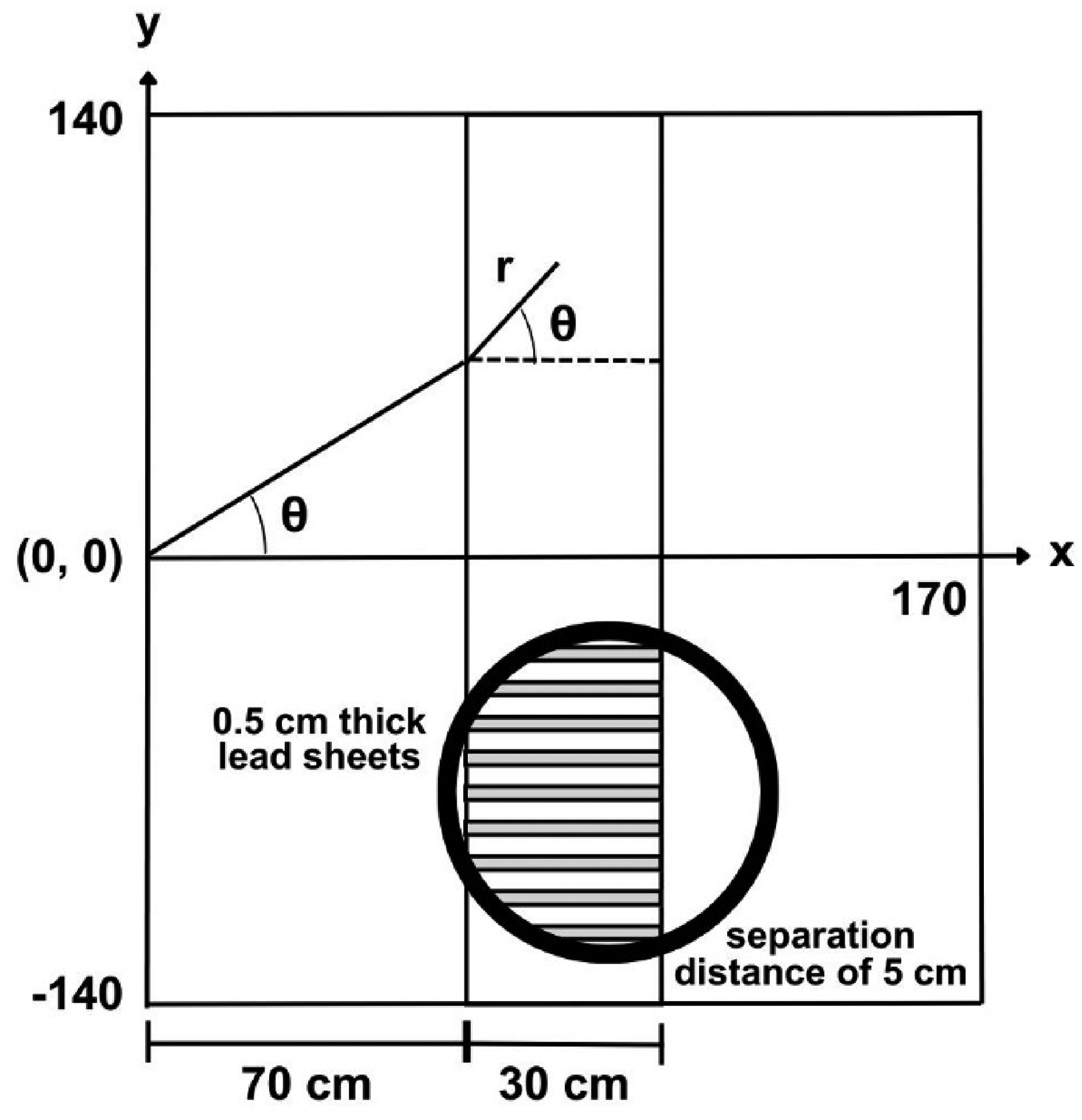
Visualisation of the simulation in two-dimensional space.
As shown in Fig. 1, a particle was emitted with a random initial energy and direction from a point source onto the shield. For the direction, a random number was generated solely for its incident angle, which was limited by the Gaussian distribution with a mean of 0° and a standard deviation relative to the height of the shield and its distance from the source. Since the study focused on the Compton scattering phenomenon, the source photons comprised initial energies randomly generated between 0.511 and 1.022 MeV with a Gaussian distribution that had a mean of 0.7665 MeV and a standard deviation of 0.2555 MeV.
Motion of the particle
A random walk method was used to determine the scattering of photons within the shield, wherein the step length r and step angle θ specified its position in two-dimensional space. In this study, the step angle was randomly chosen from a Gaussian distribution with a mean of 0° and a standard deviation of b · 180°. The parameter b for the step angle was introduced wherein it served as how wide or narrow the photon beam inside the shield. The impact of this parameter on the gamma shielding set-ups was also investigated by varying its value, including b = 0.1, 0.05, and 0.025, since small-angle scattering was considered. The remaining scattered photon energy was determined by the Compton scattering formula, where the step angle was involved. The mean free path was also calculated based on the energy of the scattered photon.
The step length was then generated since it was determined by the mean free path. More importantly, this was randomly selected using a Rayleigh distribution to have positive values.
Another random walk occurred whenever the photon struck the coordinates of the lead sheets, which had the same process as the concrete but with different values for the mean free path. Accordingly, the random walk process persisted in the corresponding component of the shield.
Analysis of the simulation results
After the simulation, the particle was considered as reflected if it was found on the left side of the shield, whereas it was regarded as transmitted when detected on the right side of the shield. On the other hand, the particle was absorbed by the material when it was inside the shield with a reduced energy below 1 keV. The average energies were also recorded.
To investigate the effectiveness of the two configurations of the gamma radiation shield, the results of every set-up were compared. The mean results of the number of transmitted photons and average energies were analysed for both geometries with varying spread of the beam inside the shield.
RESULTS AND DISCUSSION
The simulations in Fig. 2 were representations of the scattering of photons for the specified scattered beams. Since the study focused on scattering within the shield, most photons penetrated the shield. Hence, the simulations do not exactly depict the reality in which the photons would already be attenuated in the given slab thickness.

Sample scattering gamma ray propagation for (1) horizontal and (2) vertical geometry.
For the broad scattered beam, Fig. 2 shows that there was almost no difference in the simulation. However, relatively more particles passed through the concrete slab with horizontal lead sheets compared to the concrete slab with vertical lead sheets, as seen in Table 1. There was a percent difference of 1.01% in the number of transmitted photons between them. On the other hand, the average energies of transmitted photons on the concrete slab with vertical lead sheets were higher compared to the other geometry with a percent difference of 3.85% in the average energy of transmitted photons obtained between these geometries.
Results for broad scattered beam propagation (b = 0.1).
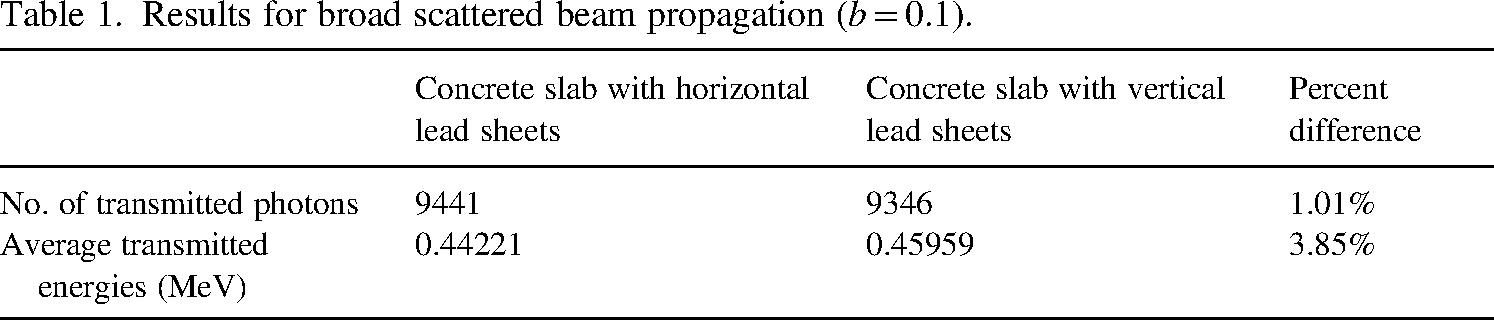
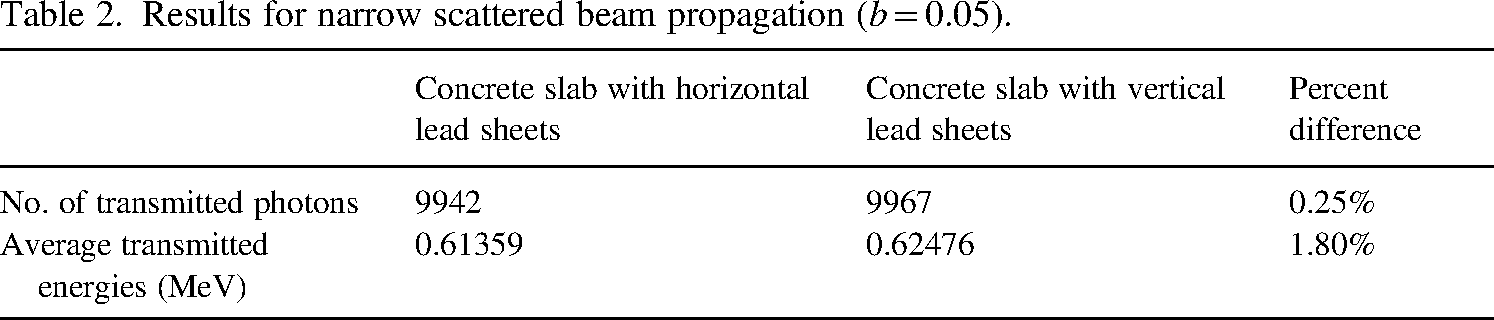
For the last two beams, based on Tables 2 and 3, the shield containing horizontal lead sheets yielded fewer transmitted photons than the shield with vertical sheets. It could be observed that this contrasted with the previous result in the broad scattered beam propagation. Consistently, the concrete slab with horizontal lead sheets produced relatively lower average transmitted energies compared with the vertical geometry. It is crucial to note that this observation was consistent among all the parameters.
Results for narrow scattered beam propagation (b = 0.05).
Results for beam propagation similar to the incident beam (b = 0.025).
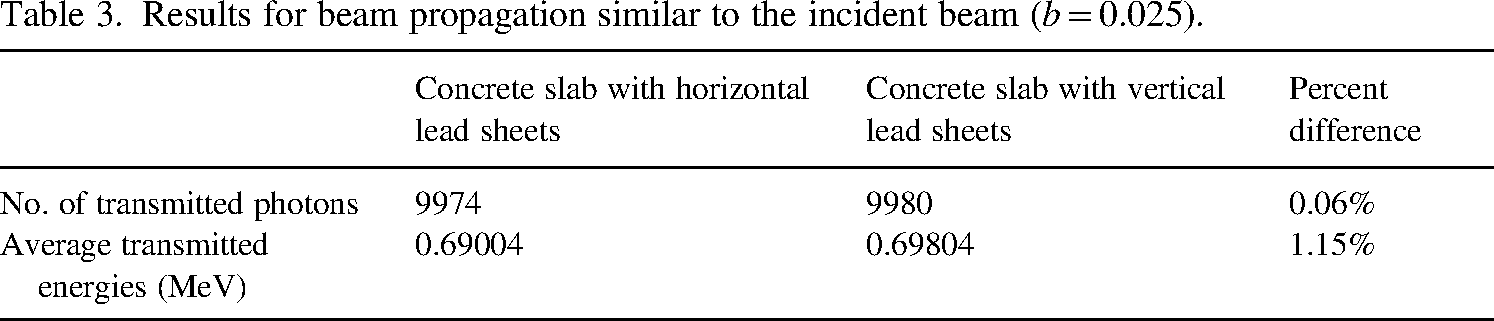
Generally, the concrete slab containing horizontally embedded lead sheets was better in terms of the number of transmitted photons and the average transmitted energies.
Based on the results, the number of transmitted particles is lessened by embedding lead sheets where the characteristics of both geometries were closer to concrete than lead. The concrete slab containing horizontal lead sheets compared with the concrete slab containing vertical lead sheets produced a difference of 0.06–1.01% in the number of transmitted photons and a difference of 1.15–3.85% in the average transmitted energies. Thus, the geometry of the horizontally embedded lead sheets had better results and was more effective in attenuating gamma scattering.
Footnotes
CONFLICTS OF INTEREST
The author(s) declare no conflicts of interest.
FUNDING
Partial financial support was provided by University of the Philippines Manila for conference registration.