




Abstract
After the accident at Fukushima Daiichi nuclear power plant on 11 March 2011, radioactive materials were released into the atmosphere resulting in environmental contamination. Following the implementation of environmental decontamination efforts, the Radiation Dose Registration Centre of the Radiation Effects Association established the radiation dose registration system for decontamination and related workers to consolidate and prevent the loss of radiation records. This article presents statistics on the radiation doses of decontamination and related workers using official records. Since approximately 10 years have passed since the accident in Fukushima, the types of work conducted in the affected restricted areas have changed over time. Therefore, changes in radiation dose for each type of work and comparisons with nuclear workers are presented.
1. INTRODUCTION
After the accident at Fukushima Daiichi nuclear power plant on 11 March 2011, the Government of Japan promulgated the ‘Ordinance on the Prevention of Ionizing Radiation Hazard at Work to Decontaminate Soil and Wastes Contaminated by Radioactive Materials Resulting from the Great East Japan Earthquake and Related Works’ (the Ordinance) on 22 December 2011 (Ordinance, 2011). Enforcement of the Ordinance began on 1 January 2012. The Government of Japan also enacted the ‘Guideline on the Prevention of Radiation Hazard of Workers Engaged in Decontamination and Related Works’ (the Guideline) on 22 December 2011, the same day as it promulgated the Ordinance (MHLW, 2011).
Following the establishment of this regulatory framework, environmental decontamination was initiated in two affected areas: the special decontamination area (SDA) and the intensive contamination survey area (ICSA). The SDA corresponded to places with substantial environmental contamination of radioactive materials, and the Government of Japan was responsible for decontamination. The ICSA corresponded to places with an ambient dose rate exceeding 0.23 μSv h−1, and the governor of the local government or the mayor of the local municipality was responsible for decontamination.
This article presents statistics on the radiation doses of decontamination and related workers using official records.
2. RADIATION DOSE REGISTRATION SYSTEM FOR DECONTAMINATION AND RELATED WORKS
2.1. Establishment of the radiation dose registration system
After decontamination and related works began in the areas affected by the accident at Fukushima Daiichi nuclear power plant, concerns were expressed regarding implementation of these decontamination works following enforcement of the Ordinance. Specifically, employers’ lack of means to verify each worker’s past radiation dose if workers did not report their past radiation dose accurately themselves was highlighted as a concern. Furthermore, the possibility that radiation dose records could be scattered or lost after contractors terminated their business if these records were not properly organised and registered was flagged as a concern.
The Radiation Dose Registration Centre (RADREC) of the Radiation Effects Association has been operating a centralised radiation dose registration system for nuclear workers since 1977 (Asano and Ito, 2019). This system uses a database and radiation passbook which records past dose and health examination results for each worker. In order to address concerns with contamination of sites following the Fukushima accident, a radiation dose registration system for decontamination and related workers was initiated in November 2013, referencing the preceding nuclear worker system. In March 2015, RADREC started operating a database system for the dose records of decontamination and related workers.
In conjunction with the use of a radiation passbook, the RADREC database allows primary contractors to record radiation dose and verify the past dose of each worker.
2.2. Registration categories
The radiation dose registration system comprises two categories for contractors joining the registration system, depending on their work content and area.
Category I represents decontamination work which occurs inside the SDA, as well as the handling of specified waste. Category I requires contractors to use the radiation passbook, record radiation dose quarterly, and register radiation dose and health records after completing their work. Enquiries about workers’ past dose records must be addressed. These requirements assume that related work takes place at higher radiation dose rates, and they are similar to the corresponding requirements for workers in radiation-controlled areas in nuclear facilities.
Category II represents work which occurs in the ICSA. Contractors under Category II only need to register radiation dose and health records after completing their work, because radiation dose rates in the ICSA are lower than the corresponding rates in the SDA.
2.3. Registering records with the database
Designated institutions can issue radiation passbooks to Category I workers. When these passbooks are issued, a central registration number (personal ID) is obtained. Radiation passbooks and personal IDs are commonly used in both decontamination and nuclear facilities in order to manage radiation dose for both types of project.
Contractors joining the registration system can access the RADREC database and register the title of their work project and their quarterly radiation dose. They can also enquire about workers’ past dose records. If a decontamination worker has performed nuclear work, the radiation dose they have incurred at nuclear facilities can be verified using the RADREC database, which cross-references the decontamination and nuclear databases.
3. RADIATION DOSE STATISTICS FOR DECONTAMINATION AND RELATED WORKERS
3.1. Changes in the radiation dose to workers
As of 1 November 2020, approximately 120 primary contractors for 750 recovery projects joined the RADREC registration framework, and registered project titles for decontamination and related work or the handling of specified waste. The database includes the radiation dose records of approximately 100,000 workers.
Using the database’s periodically registered records, radiation dose statistics are provided in Fig. 1. Even if subcontracted workers participated in multiple projects in a given year, their radiation dose records are aggregated in the database using each worker’s central registration number.
Changes in radiation dose to decontamination workers.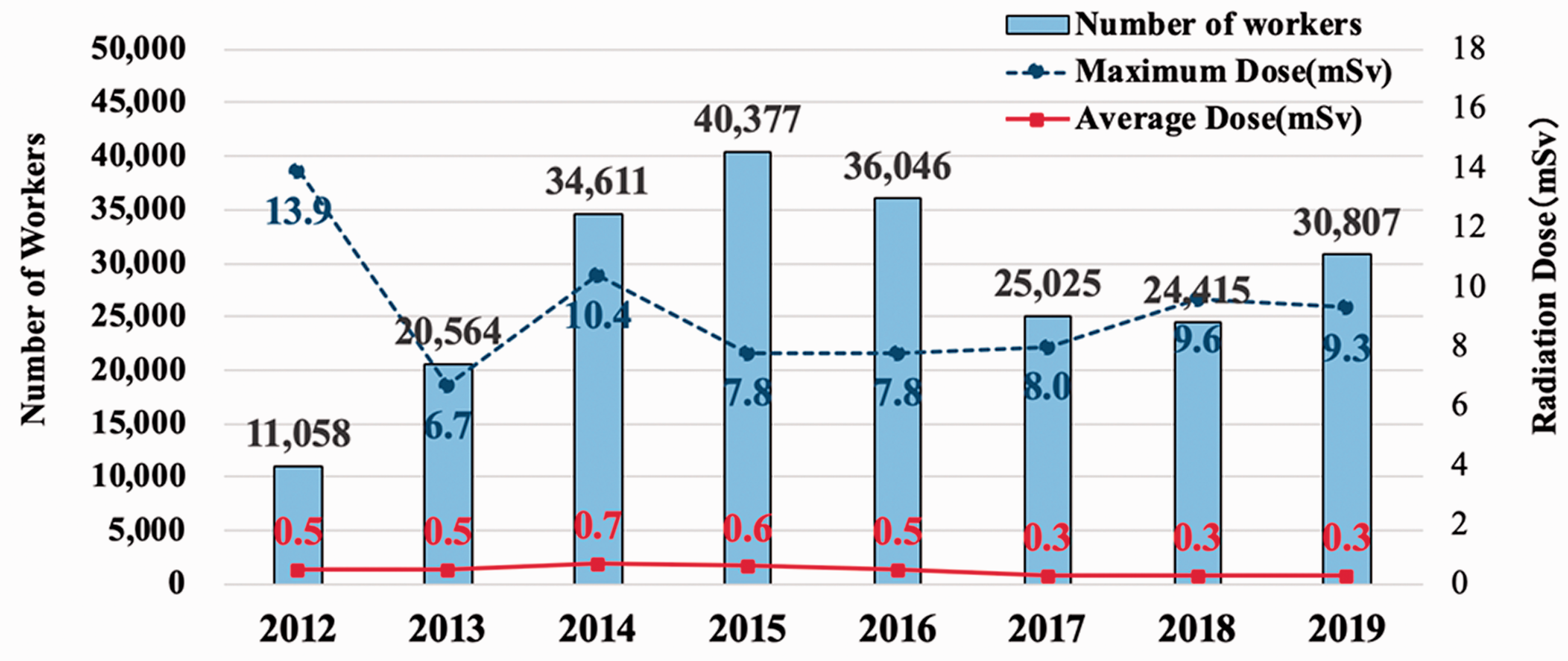
The number of decontamination workers increased from 2012 to 2015, and then decreased from 2015 to 2018 because operations across the whole decontamination area had terminated by March 2017.
The highest recorded dose ranged from 6.7 to 13.9 mSv year−1, but no workers received an annual dose >20 mSv. The average dose ranged from 0.3 to 0.7 mSv year−1. In 2019, more than 90% of workers were exposed to <1 mSv year−1.
3.2. Changing types of work in the special decontamination area
In the early stages after the accident at Fukushima Daiichi nuclear power plant, decontamination works began in the SDA and ICSA. However, 10 years have passed since the accident, and decontamination works in the whole area had terminated by March 2017. Since then, the types of recovery work and activities have changed at these sites. Construction and operation of the Interim Storage Facility and construction of the Specified Reconstruction and Revitalisation Base have become substantial. The works related to the Specified Reconstruction and Revitalisation Base particularly involve activities in the higher-dose-rate ‘difficult-to-return zone’, where decontamination and related works have not yet been implemented (MOE, 2020). This section discusses radiation dose by type of work since the accident.
3.2.1. Work type categories
To clarify the work in progress in the SDA, work types are divided into the following five categories, based on the titles of the work projects registered in the RADREC database.
‘Decontamination’: whole-area decontamination, land restoration at temporary storage sites, and demolition of houses in the SDA. ‘Waste disposal’: handling of specified waste of <100,000 Bq kg−1, minimising waste volumes, and incineration facilities. ‘Interim storage’: construction of soil separation and storage facilities, transportation of soil and waste from temporary storage facilities to the Interim Storage Facility, and processing and storage of soil and waste. ‘Reconstruction/revitalisation’: construction of a Specified Reconstruction and Revitalisation Base, demolition of houses, and decontamination in six municipalities (Futaba, Okuma, Namie, Tomioka, Iitate, and Katsurao). ‘Others’: radiation monitoring and management support for construction, consultants, and road construction.
3.2.2. Worker numbers for each type of work
Changes in the number of workers for each work type are provided in Fig. 2. Workers engaged in multiple projects are counted for each project; therefore, total worker numbers do not correspond to the data presented in Fig. 1.
Worker numbers for each type of work.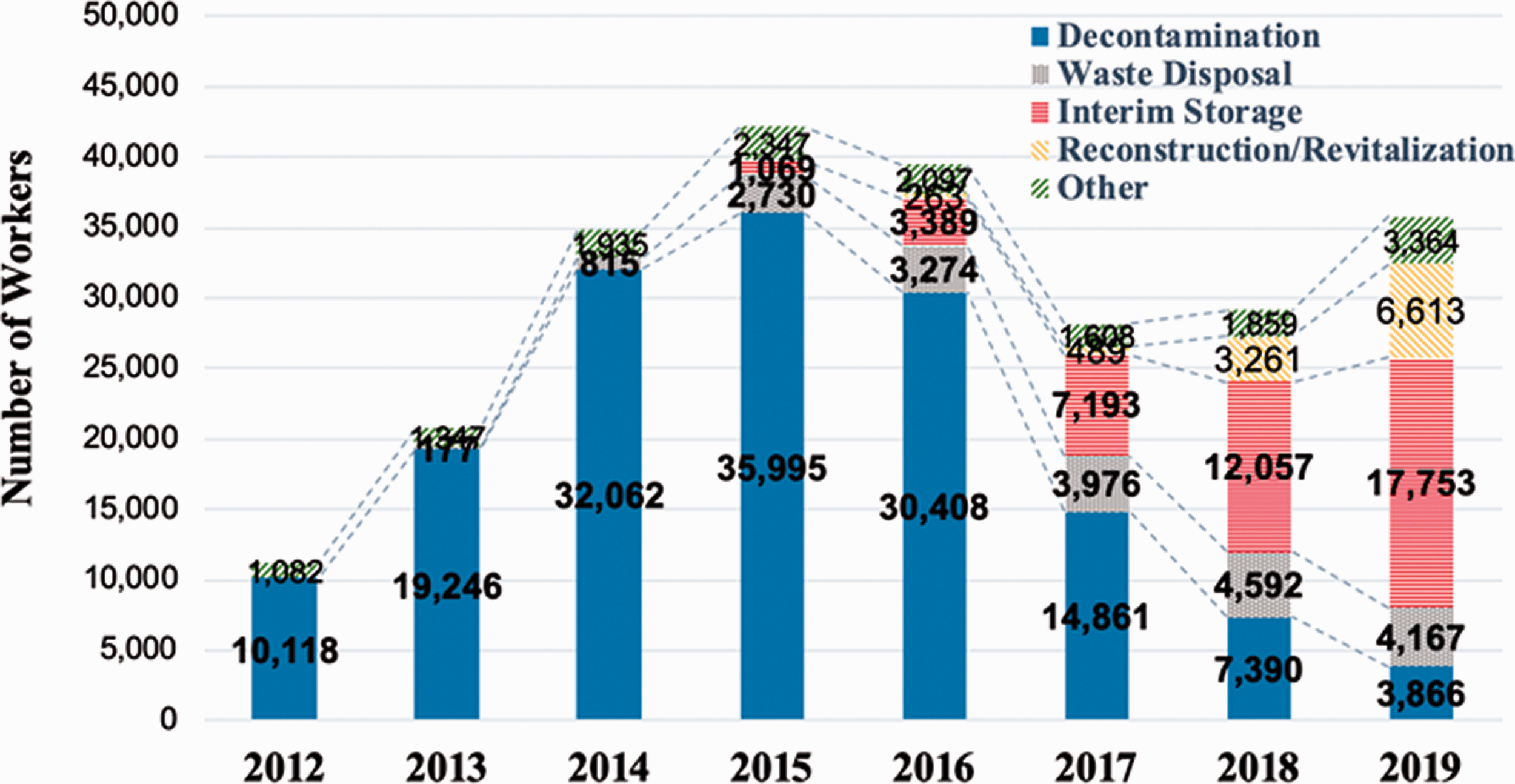
Decontamination workers were dominant from 2012 to 2016. The number of workers at the Interim Storage Facility accounted for approximately 2% of all workers in 2015, and accounted for approximately half of all workers in 2019.
3.2.3. Average dose for each type of work
Average doses for each type of work are provided in Fig. 3. The average dose for decontamination of the whole area from 2012 to 2016 ranged between 0.5 and 0.7 mSv year−1. After termination of decontamination works in the whole area, average dose decreased to 0.1 mSv year−1 in 2019. Average dose at the Interim Storage Facility was 0.3–0.5 mSv year−1. Before operation of the Interim Storage Facility, workers had been exposed to higher doses because of decontamination efforts and the demolition of housing prior to land development at the scheduled site.
Average dose for each type of work.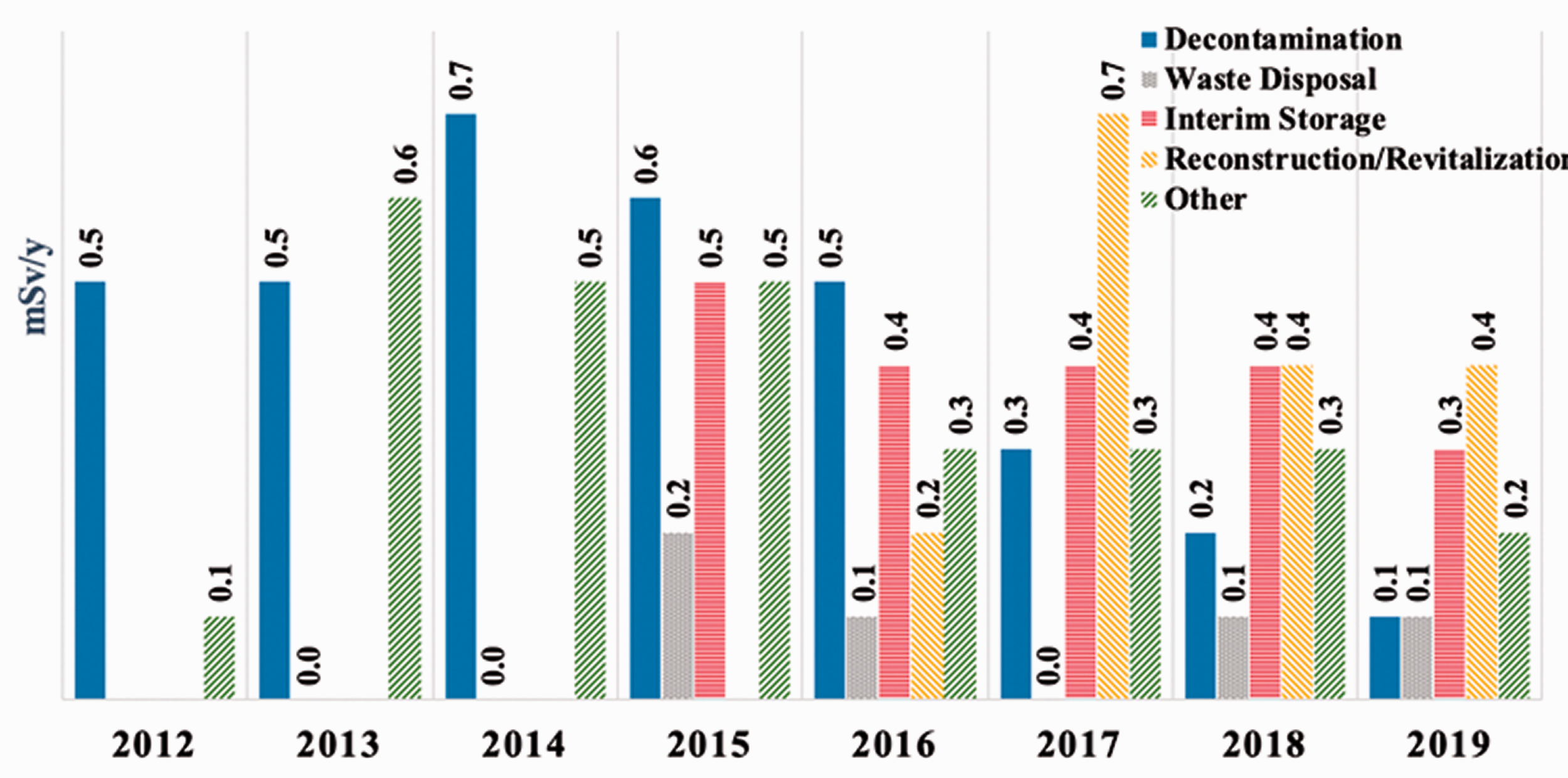
The average dose at the Specified Reconstruction and Revitalisation Base was 0.7 mSv year−1 in 2017 because projects were implemented in the ‘difficult-to-return zone’, where contamination remained significant.
The average dose pertaining to waste handling was lower because this work includes handling waste of <100,000 Bq kg−1 and is mainly implemented outside the SDA.
3.2.4. Maximum dose for each type of work
Maximum doses for each type of work are provided in Fig. 4. The maximum dose for decontamination workers was 13.9 mSv year−1 in 2012, which included radiation doses resulting from the Pilot Project of Japan Atomic Energy Agency, of which some work was implemented in the ‘difficult-to-return zone’.
Maximum dose for each type of work.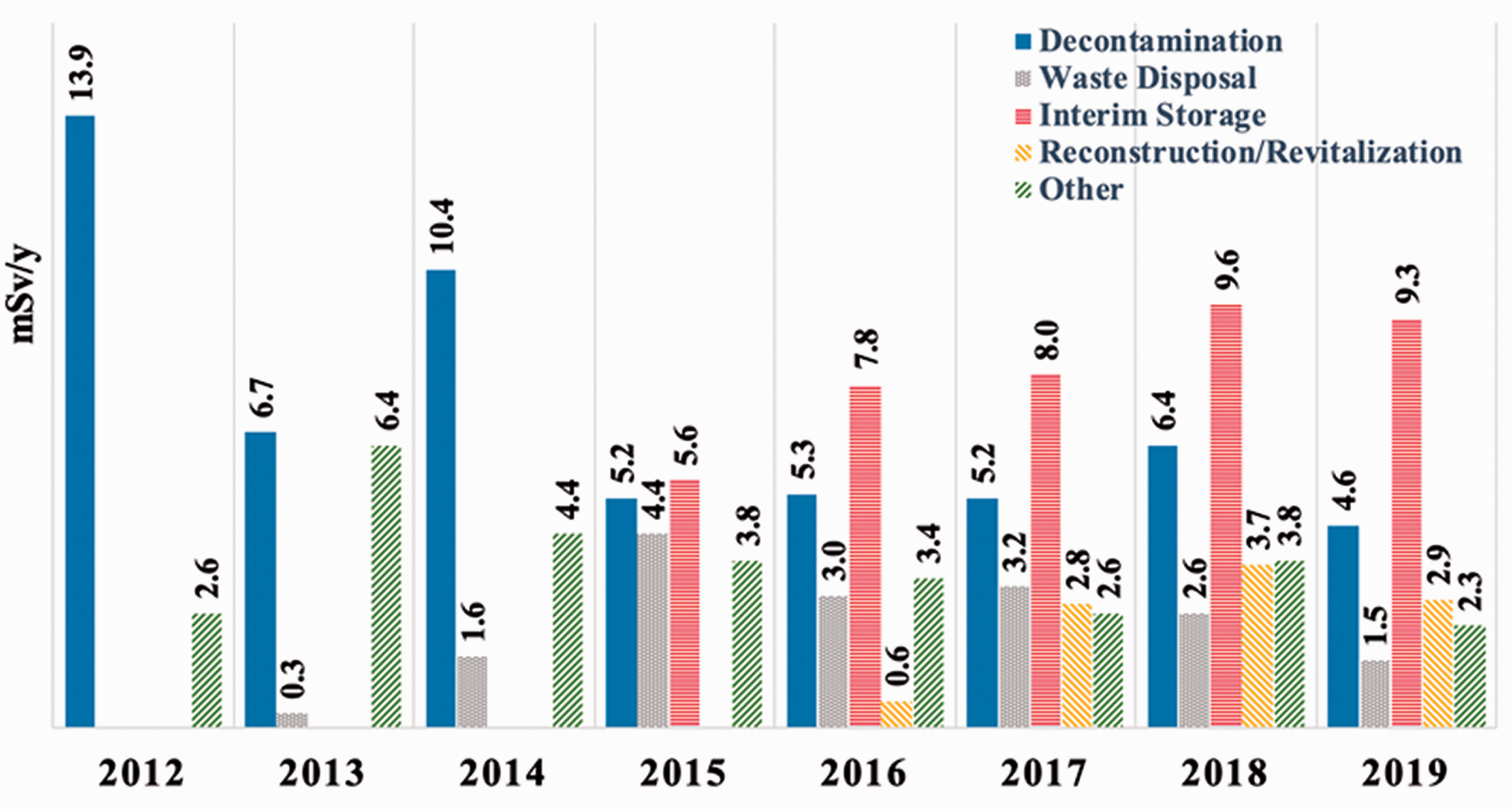
The maximum dose between 2012 and 2014 was due to decontamination work. Since 2015, maximum doses occurred during work at the Interim Storage Facility, especially amongst project managers, who tended to remain longer at each site. No workers received an annual dose >20 mSv.
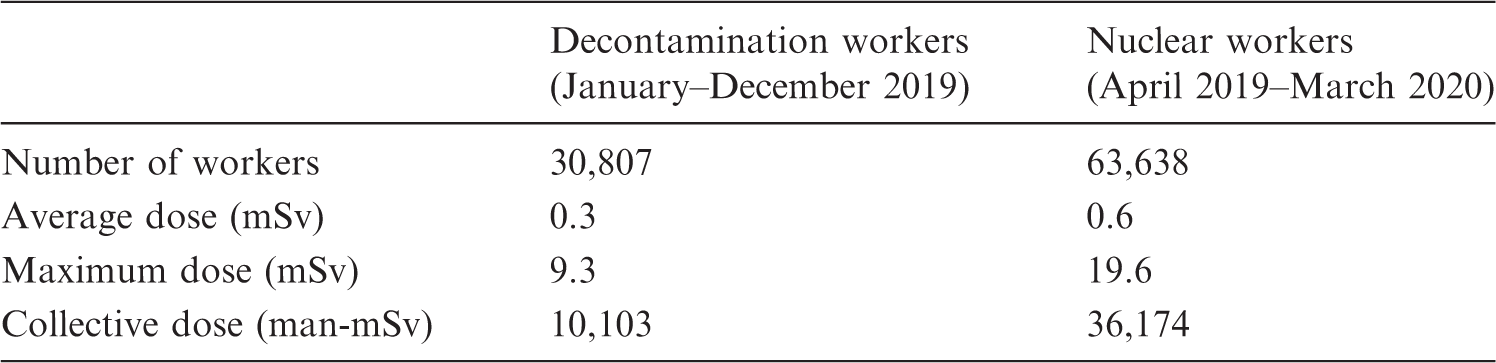
3.3. Comparing radiation doses between decontamination workers and nuclear workers
Comparing radiation doses between decontamination workers and nuclear workers.
4. Conclusions
The radiation dose registry system for decontamination and related workers has been operating successfully. Statistical comparisons with nuclear workers are also available.
Although decontamination efforts in the whole area had terminated by the end of 2017, construction and operation of the Interim Storage Facility and construction of the Specified Reconstruction and Revitalisation Base remain in progress. Since approximately 10 years have passed since the accident at Fukushima Daiichi nuclear power plant, the types of work in the affected areas have changed over time. Considerations of radiation protection measures are important, depending on recovery phase.
After the nuclear accident, the recovery process within the affected restricted area may continue to change over the long term. The preparation of careful and prudent radiation protection measures is required throughout the recovery process.