




Abstract
This paper does not necessarily reflect the views of the International Commission on Radiological Protection.
Keywords
1. FUNDAMENTAL QUESTION
In November 2011, the International Commission on Radiological Protection (ICRP) initiated a forum on the rehabilitation of living conditions after the accident at Fukushima Daiichi nuclear power plant. It developed into a series of meetings – the ICRP Dialogue – in which a variety of concerned parties shared experiences and exchanged views to address challenges in affected communities (Lochard et al., 2019). One question was asked frequently at the meetings: ‘what is at stake?’
For experts in radiological protection, this question may sound somewhat strange. It was obvious that the source of the problem was radioactive contamination. Various protective measures were taken against it, including detailed radiation monitoring, a decontamination programme to reduce the level of radiation in the living environment, and activities related to communication about radiation risk (Shimura et al., 2015). Nevertheless, the same question was asked repeatedly. This reality prompts us to rethink our view about the situation faced by the people of Fukushima.
In the case of a nuclear emergency, residents living near the site could be exposed to high doses of radiation. Preventing/mitigating adverse radiation effects is the main focus of the emergency response (IAEA, 2015). Immediate actions such as evacuation are taken depending on the situation. Following the immediate response, restrictions may be imposed on people’s lives to prevent inadvertent exposure, but these restrictive measures are accepted in the interests of safety. In this way, safety, especially radiation safety, is emphasised in the emergency response. However, even if society as a whole agrees on this scheme, the implications of safety are probably different between experts and the public.
Nuclear/radiation experts play a central role in planning and implementing the emergency response. For these experts, ensuring safety is a top priority, and they do their best to keep radiation doses reasonably low. On the other hand, for the public, being safe is an implicit assumption to have a normal life. In ordinary times, they take it for granted to be safe and do not pay particular attention to their safety. If they need to change their way of life for the sake of safety, this will have a huge impact.
After the accident at Fukushima Daiichi nuclear power plant, life changed for people living in the affected areas. Changes in the living environment brought various difficulties, such as health concerns, family issues, stigmatisation, and community severance. All these problems stemmed from consideration of radiation safety. There is no doubt that the root cause was radioactive contamination, but people’s lives were hugely disrupted by focusing on radiation exposure and protective measures against it. Under such circumstances, people were at a loss about what to do. Many issues came together and they lost their perspective. That is why the same question was asked repeatedly: ‘what is at stake?’
2. WHAT ‘RECOVERY’ MEANS
If this view is correct, what is recovery for the affected people? To answer this question, we need to know what issues arise after a nuclear accident. In the case of the accident at Fukushima Daiichi nuclear power plant, people from affected areas have suffered from various problems, including changes in their living environment, concerns about their children's health, and difficulties related to nursing care for the elderly. In addition to these personal and family issues, people who were ordered to relocate experienced division of their community and loss of connection with others. Some of them were depressed and lost motivation for life. Broadly speaking, what was common and easy to achieve in normal times suddenly became something special and difficult to achieve.
In a post-accident situation, new problems arise, and existing problems accelerate or reignite. For example, sales of farm produce from Fukushima reduced after the accident, and farmers have suffered from harmful rumours ever since. This is a new problem brought about by the accident. At the same time, the accident appears to have accelerated an existing problem – a decrease in the farming population in the area. From this perspective, it is not difficult to imagine various pending issues erupting all of a sudden in the wake of an accident. However, no two are the same. What matters will vary between communities, families, and individuals. As such, specific measures for recovery need to be considered on a case-by-case basis.
Having said that, there will be common features. These may resemble what we are currently experiencing in the midst of the coronavirus disease 2019 pandemic. Our daily lives have changed considerably since the beginning of the pandemic. It is not just a matter of public health, but striking a balance between infection control measures and social activities.
The situation following a nuclear accident may be basically the same. The core of the problem is disturbance of the balance of life. Life consists of many activities and materials necessary for each activity. We keep balance between them almost unconsciously as it is routine practice. However, when affected by an external force that is strong enough to disturb the balance, we get upset and struggle to find a new point of equilibrium.
If that is the case, recovery needs to restore the balance of disrupted life at all levels in the affected area. This is not as easy as it sounds. Just imagine you are a farmer, ordered to relocate, and have nothing to do in a small makeshift house. In this case, it is not just restoring the balance, but starting life all over again. That is why recovery takes time, and why elderly people tend to be left behind. There will be no true recovery without resolving inner struggles, and we cannot specify an end date for this reason.
3. FACILITATING RECOVERY
3.1. Transdisciplinary approach
The question is, how will society be able to facilitate recovery? Nuclear accidents and subsequent responses disrupt life in many ways. A wide range of measures will be necessary and, as already stated, specific measures for recovery need to be considered on a case-by-case basis. On the other hand, addressing the respective issues separately may not be effective. An issue-by-issue approach will lead to a sort of sectionalism, and all problems are linked to one another in each individual, family, and community. It is desirable to involve various stakeholders and utilise their knowledge and skills to address the difficult situation as a whole.
On this point, radiological protection is a multi-disciplinary field that involves a range of disciplines, such as epidemiology, physics, engineering, economics, and sociology, to assess and control radiation exposure (Fig. 1a). Still, we have to admit that related experts were not necessarily helpful to the people of Fukushima. This may be because individual experts stayed within the domain of their own specialties, and the scope was too limited to address the complex nature of the post-accident situation. What is required is a transdisciplinary approach that eliminates barriers among disciplines. Rather than subdividing problems to fit in the existing framework, available knowledge and skills of stakeholders should be mobilised to tackle the difficult situation (Fig. 1b).
Comparison of a multi-disciplinary approach (a) and a transdisciplinary approach (b).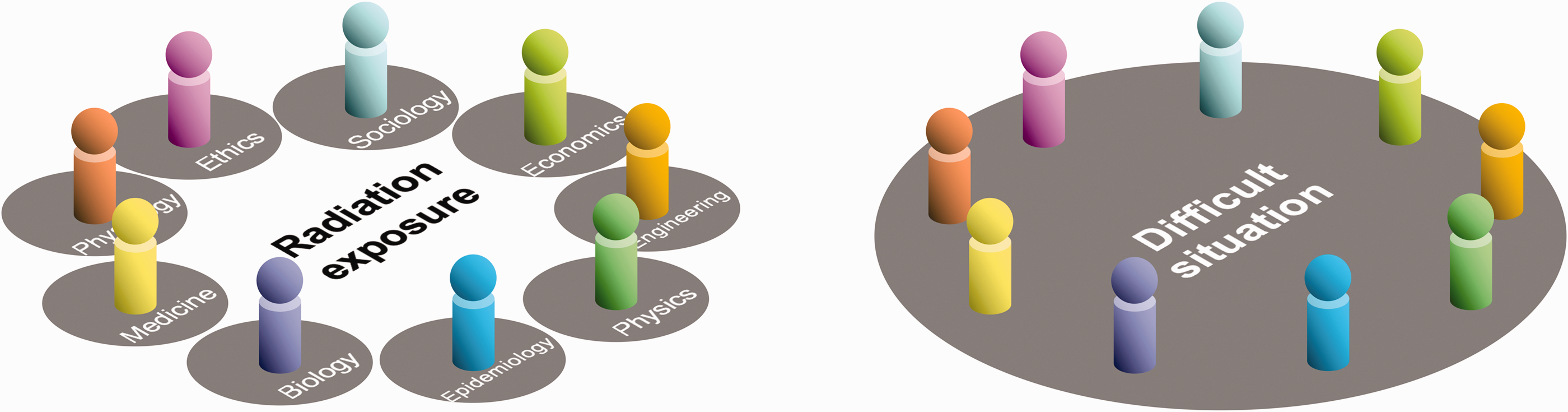
The so-called ‘co-expertise process’ may be regarded as a simple form of the transdisciplinary approach. It is a process of co-operation between experts, professionals, and local stakeholders that aims to share local knowledge and scientific expertise for the purpose of assessing and better understanding the radiological situation, developing protective actions, and improving living and working conditions (ICRP, 2020). It should be emphasised that people are not recipients of support, but actively involve themselves as stakeholders on an equal footing. Active involvement is key because it may help people get a better grip on the situation and adjust their way of living on their own. In fact, true recovery is nothing less than regaining control of one’s life, and it can only be achieved by an individual’s own will. Our question should be how to better support those people who are struggling.
3.2. Three-layered help model
Living in a country which is prone to natural disasters, the Japanese often refer to the three-layered help model in the context of disaster preparedness. The three layers are public help, mutual help, and self-help, and correspond to efforts at the levels of society, community, and individual (Fig. 2). This model could be useful to find a direction of systematic support for recovery after a nuclear accident.
Concept of three-layered help model. Public help is efforts at society level. Mutual help and self-help are efforts at community level and individual level, respectively.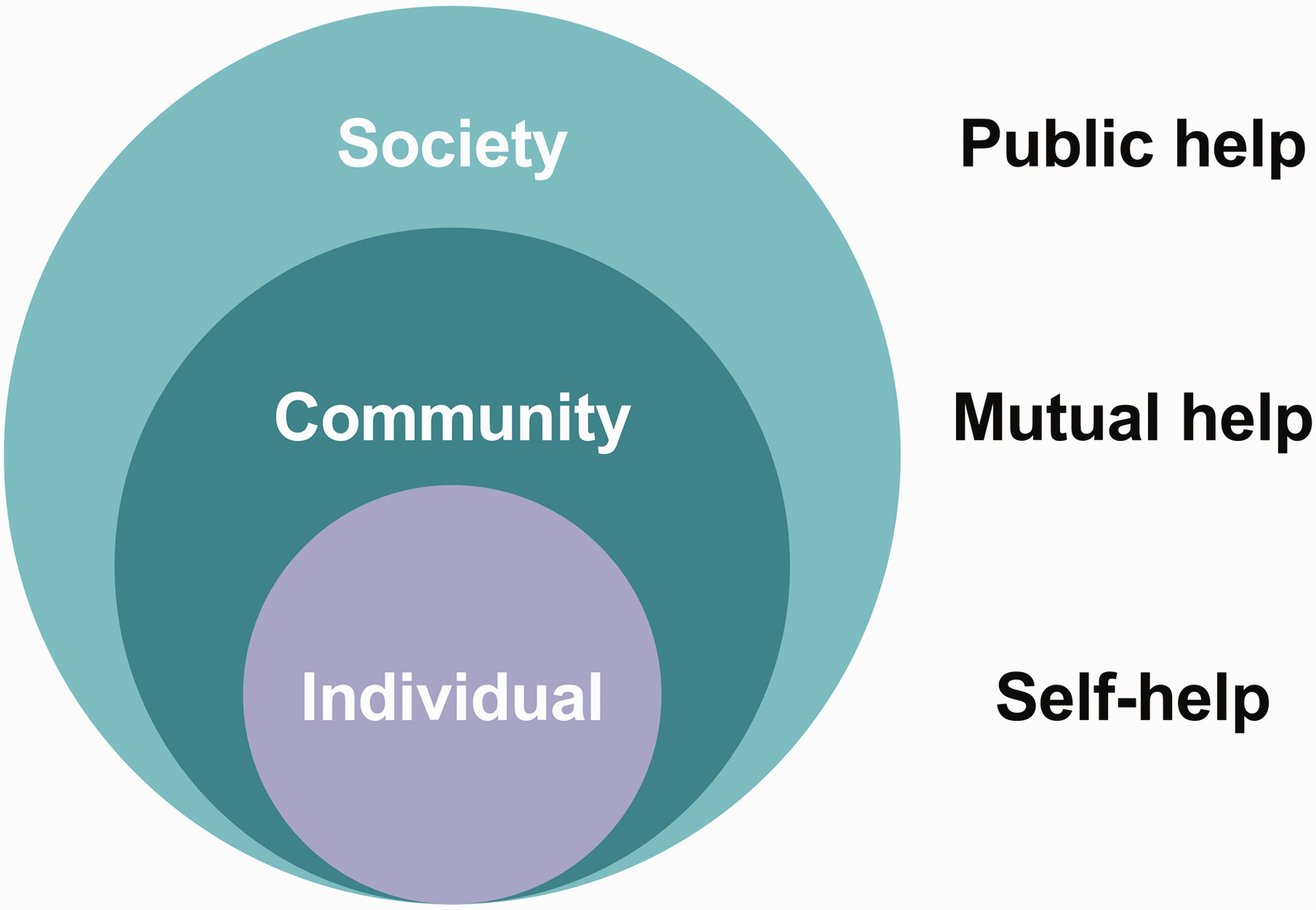
Public help is necessary to prepare the environment for recovery. Typically, public help is programmes directed by the government or relevant authorities, such as large-area radiation monitoring and the development of necessary infrastructures.
As described above, ultimate recovery, in the sense of regaining control of each individual’s life, rests with self-help. However, at the same time, it is important to remember that self-help does not mean surviving on one’s own. The passage of time is different from person to person, particularly after a significant event such as a nuclear accident. Some people can adapt to the new normal fairly quickly, while others do not. Any individual should not be abandoned on the pretext of self-help.
In this regard, mutual help is important to keep individuals from being isolated. It provides eyes to watch over those who need longer to recover. Mutual help also has more active function. In a community whose members live in the same environment and have a similar lifestyle, people are likely to share common problems. If their efforts to address these problems develop into some form of collaborative activity, it will provide a platform for co-expertise. In any case, mutual help is a vital component in ensuring the flexibility and sustainability of efforts for recovery. Considering its importance, supporting communities behind the scenes should be positioned as part of public help.
4. CONCLUSIONS
Recovery after a nuclear accident means nothing other than restoration of the balance of life which has been disturbed by the accident and protective measures against radiation exposure. In some cases, it is almost like starting life over, which is a difficult challenge and may take a long time. Public help plays a role in improving the environment needed for recovery, but ultimately, recovery rests with self-help, in the sense of each individual regaining control of their life. Mutual help plays a crucial part in the process of recovery, and due consideration should be given to how society can support communities over the long term.