




Abstract
This paper does not necessarily reflect the views of the International Commission on Radiological Protection.
1. INTRODUCTION
The rehabilitation of living and working conditions in affected areas after a nuclear accident is characterised by a double challenge: to provide adequate protection for the people and the environment; and to maintain and support the dynamic of socio-economic activities. Feedback from Chernobyl and Fukushima has shown the importance of direct involvement of affected people and local communities through adoption of the co-expertise process fostering cooperation between local residents and experts. In addition, it highlighted the need to adopt governance mechanisms respecting ethical and social values. After indicating the main lessons and challenges associated with the living conditions for residents following a nuclear accident, this article highlights the key features of the co-expertise process and the governance mechanisms for supporting socio-economic activities during the recovery process.
2. LESSONS FROM EXPERIENCE
After a nuclear accident, people are very confused and do not know where to turn. They no longer trust the authorities and experts, and gradually lose control of their daily life. There is a threat to their dignity. Although people expect to return to the previous situation as soon as possible, lessons from the post-accident management of the accidents in Chernobyl and Fukushima accidents show that this is not possible. Total removal of radioactivity from contaminated areas is not feasible; whatever efforts are made, there is always residual contamination, especially in forests. In addition, many human and societal consequences are irreversible and the destabilisation of communities leads to ruptures and complex dilemmas. The socio-economic dynamics in the affected areas face new constraints. The demography of local communities is modified considerably as a consequence of the evacuations (voluntary or compulsory), with a tendency for young people to leave. Local production from agriculture and fishing, and also from industry as well as leisure and tourist activities, suffer from a degraded image. Finally, the use of the environment is severely restricted due to residual contamination.
In such a context, radiological protection, although essential to protect people (those who have stayed and those who return or settle for the first time), is not able to ensure socio-economic development. Experience has shown that the implementation of radiological standards is not sufficient to restore people's confidence in the recovery process, and that without the active involvement of all stakeholders, it is difficult to create a favourable dynamic.
A major stake in the recovery process is, therefore, on one hand, to put radiological protection at the service of improving living and working conditions in the affected areas and on the other hand to promote socio-economic development taking into account the radiological context. In this perspective, the aim is to contribute to the protection of people and the environment, and to maintain vigilance for ensuring a sustainable future for the local population.
Experience that followed the accidents in Chernobyl and Fukushima accidents has shown that the driving force behind the recovery process lies in respecting the individual choices of those affected and the contribution of local communities, while keeping in mind that none of the stakeholders and none of the decision-making levels (local, regional, national) alone can solve the challenges facing the affected regions.
3. The Co-Expertise Process
The process of co-expertise – short for cooperation between experts and stakeholders – applied to post-nuclear accident situations emerged in the late 1990s as part of the ETHOS project implemented in villages in Belarus affected by the Chernobyl accident (Lochard, 2013). Based on the direct involvement of affected people to characterise their personal radiological situation and that of their community, the objective of the project was to reduce the exposure of the villagers and to improve their quality of life with support from experts and authorities. The co-expertise process has been refined through its implementation in communities affected by the Fukushima accident (Takamura et al., 2018; Lochard et al., 2020; Yasutaka et al., 2020).
Fig. 1 presents the main steps of the co-expertise process, as well as its methodological foundations. Dialogue, measurements, and local projects are the three pillars of this process (ICRP, 2020).
The co-expertise process in radiological protection.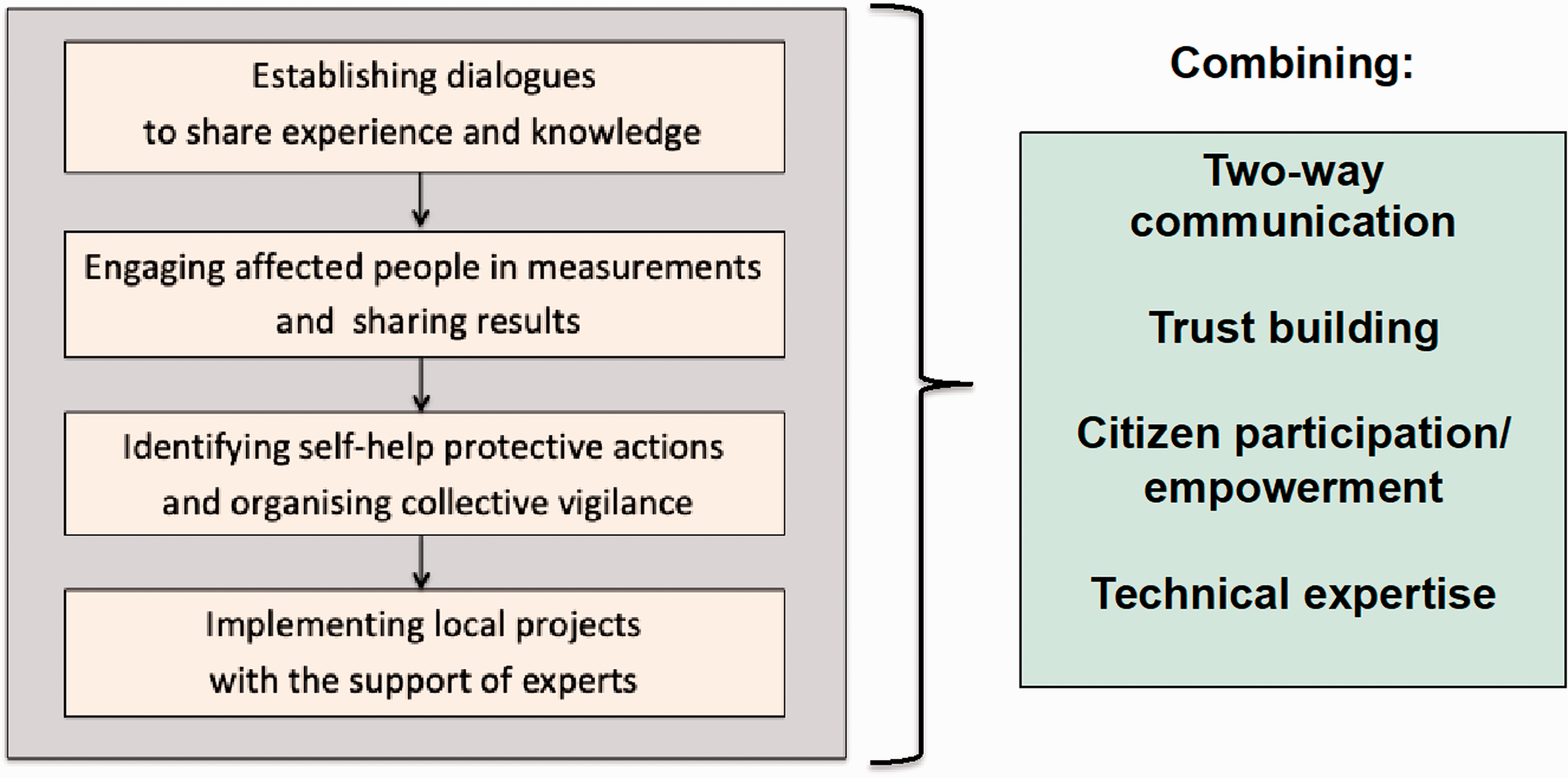
3.1. The role of dialogue
Dialogue enables those concerned to ask questions to experts by to share their concerns, challenges, and expectations with them; and to gradually familiarise themselves with the basic concepts of radiological protection. At the same time, it allows experts to take ownership of the radiological, societal, environmental and economic factors characterising the local situation. Beyond allowing expression of the plurality of points of view, it is an effective way to question ready-made representations, false ideas, incantatory speeches, and unrealistic positions, and also to identify the values shared by local communities. Listening and empathy are the qualities required for the experts involved.
3.2. The role of measurements
Measuring ambient radioactivity and human exposure is a way of making the invisible and frightening radioactivity visible, to gradually give everyone the keys to understand where, when, and how she/he is exposed and thus to understand the reality of the radiological situation. Whether it is those who have decided to stay, those who wish to return, or those who wish to visit or to settle in the affected areas, all need to understand the reality they are facing, or will face, in order to make informed decisions. Experience has shown that sharing the results of measurements to discuss and compare individual situations is a powerful way to identify possible individual or collective actions to improve the protection of those affected.
3.3. The role of local projects
Beyond their practical objectives (protecting individuals and the community, improving living and working conditions, etc.), local projects are a way for affected persons to recovery the sense of personal fulfilment that were stopped after the accident and look again positively at the future. To implement these local projects effectively, cooperation with the competent authorities, public and private organisations, experts, and professionals is essential. Support for local projects requires the establishment of appropriate decision-making mechanisms to ensure the legitimacy, transparency, and equity of their implementation.
4. The Governance Of Socio-Economic Activities
The rehabilitation of decent and sustainable living and working conditions in affected areas must necessarily be based on a ‘long-term vision of their development’ co-negotiated between all the stakeholders: national, regional, and local authorities; experts, scientists, professionals, and, of course, the people directly affected by the accident (Baudé et al., 2016). The challenge is to articulate the redeployment of social and economic activities damaged by the accident, the emergence of new and innovative activities in line with the local context, and support for local projects led by individuals and/or local communities, which must also aim to constantly improve the radiological situation.
The technical and administrative management of economic development is essential and must be carried out in accordance with the ethical values structuring radiological protection (ICRP, 2018):
Beneficence and non-maleficence – the primary objective of radiological protection is to contribute to the protection of people and the environment, and to ensure their ‘well-being’. In the context of a post-accident situation, the emphasis is also placed on the quality of living together. Prudence – due to scientific uncertainties and public concerns, there is a duty to promote health surveillance and to ensure vigilance against potential effects that may occur in the future. Justice – support for all those affected by the accident must be organised, and it is necessary to ensure a fair balance in the allocation of human and financial resources devoted to these support actions. Dignity – the empowerment of the people and communities concerned is essential to ensure a sustainable recovery process, and is crucial to enable them to regain their autonomy.
The decision-making process concerning economic and social development, such as decisions relating to the implementation of protective actions, should be open to all stakeholders (inclusiveness), with honesty and openness (transparency), and with all the explanations concerning their justification (accountability). This implies a specific approach to expertise in which scientists, experts, and professionals not only make decisions but put themselves at the service of local stakeholders in order to facilitate the development of their capacity to assess and manage their own situation and that of affected areas (Schneider et al., 2019). It also involves monitoring and evaluating local projects with all stakeholders (co-assessment of the situation and issues) in order to adapt strategies and policies as the recovery process evolves.
Past experience has shown that the communities involved in co-expertise experiences are eager to develop local projects in the fields of radiological protection, social activities, economic development, education, memory, and culture. In the process of recovery, memory not only plays a role in commemoration but also serves as a living reminder to raise awareness, maintain vigilance, transmit experience, and thus contribute to build the future.
Capitalising on the accumulated experience and making it accessible to all affected people, as well as sharing it internationally, is a moral duty. In this perspective, the involvement of the education system (schools and universities) is an essential means of sharing the experience with the next generation.
5. CONCLUSIONS
Management of the recovery process must be linked to the ‘long-term vision of the territory’, taking into account the health, social, environmental, economic, cultural, and memorial dimensions. The objective is to restore individual well-being and the quality of community life in affected areas where people are allowed to reside. This implies the development of a sustainable socio-economic framework articulating the redeployment of infrastructures and socio-economic activities including innovative projects, the support of local projects initiated by individuals and local communities, and the dissemination and transmission of the experience gained in managing the situation. Some experiences of communities affected by the Chernobyl and Fukushima accidents have shown that, to be successful, the recovery process must rely on governance mechanisms securing an open dialogue between all stakeholders in which experts are at the service of the affected people. It also requires the empowerment of individuals and local communities to decide together the values and principles for a common future. This cannot be achieved without the support of the authorities and without respect for individual autonomy.