




Abstract
The radiation environment in space is a complex mixture of particles of solar and galactic origin with a broad range of energies. In astronaut dose estimation, three sources must be considered: galactic cosmic radiation, trapped particles, and solar energetic particles (SEPs). The astronaut dose due to SEP exposure during a space mission is more difficult to estimate than the other components because the occurrence of a large solar particle event cannot be predicted by the current space weather research. Thus, several models have been proposed to estimate the worst-case scenario and/or the probability of the integral SEP fluence during a particular space mission, considering the confidence level, solar activity, and duration of the mission. In addition, recent investigations of the cosmogenic nuclide concentrations in tree rings and ice cores have revealed that the sun can cause solar particle events much larger than the largest event recorded in the modern solar observations. If such an extreme event occurs during a mission to deep space, astronauts may suffer from radiation doses in excess of the threshold value for some tissue reactions (0.5 Gy) and their career limit (0.6–1.2 Sv). This article reviews the recent progress made in space weather research that is useful for cosmic radiation dosimetry.
1. INTRODUCTION
The estimation of cosmic radiation doses is indispensable in the design of manned space missions, such as long-term stays at the International Space Station (ISS) and future expeditions to the moon and Mars (Durante and Cucinotta, 2011). Three radiation sources must be considered in the estimation: galactic cosmic radiation (GCR), trapped particles (TPs), and solar energetic particles (SEPs). GCR enters the heliosphere continuously from all directions and is modulated by the interplanetary magnetic field produced by the charged particles emitted by the sun, the so-called ‘solar wind’. Thus, its flux near the Earth is anticorrelated with the solar activity. SEPs are emitted from the surface of the sun by coronal mass ejections over the course of hours or days. TPs are trapped in the Earth’s magnetic field as a result of the interaction of GCR and SEPs with the Earth’s magnetic field and the atmosphere. In addition to these sources, solar wind and solar storm protons, as well as auroral and trapped electrons, exist in space; these make a very minor contribution to the total astronaut dose because their energies are too low to penetrate the spacecraft shielding. A synoptic view of the integral particle fluence rate of each cosmic radiation source is shown in Fig. 1, and their features are summarised in Publication 123 (ICRP, 2013).
Synoptic view of integral particle fluence rate of each cosmic radiation source (Wilson, 1978).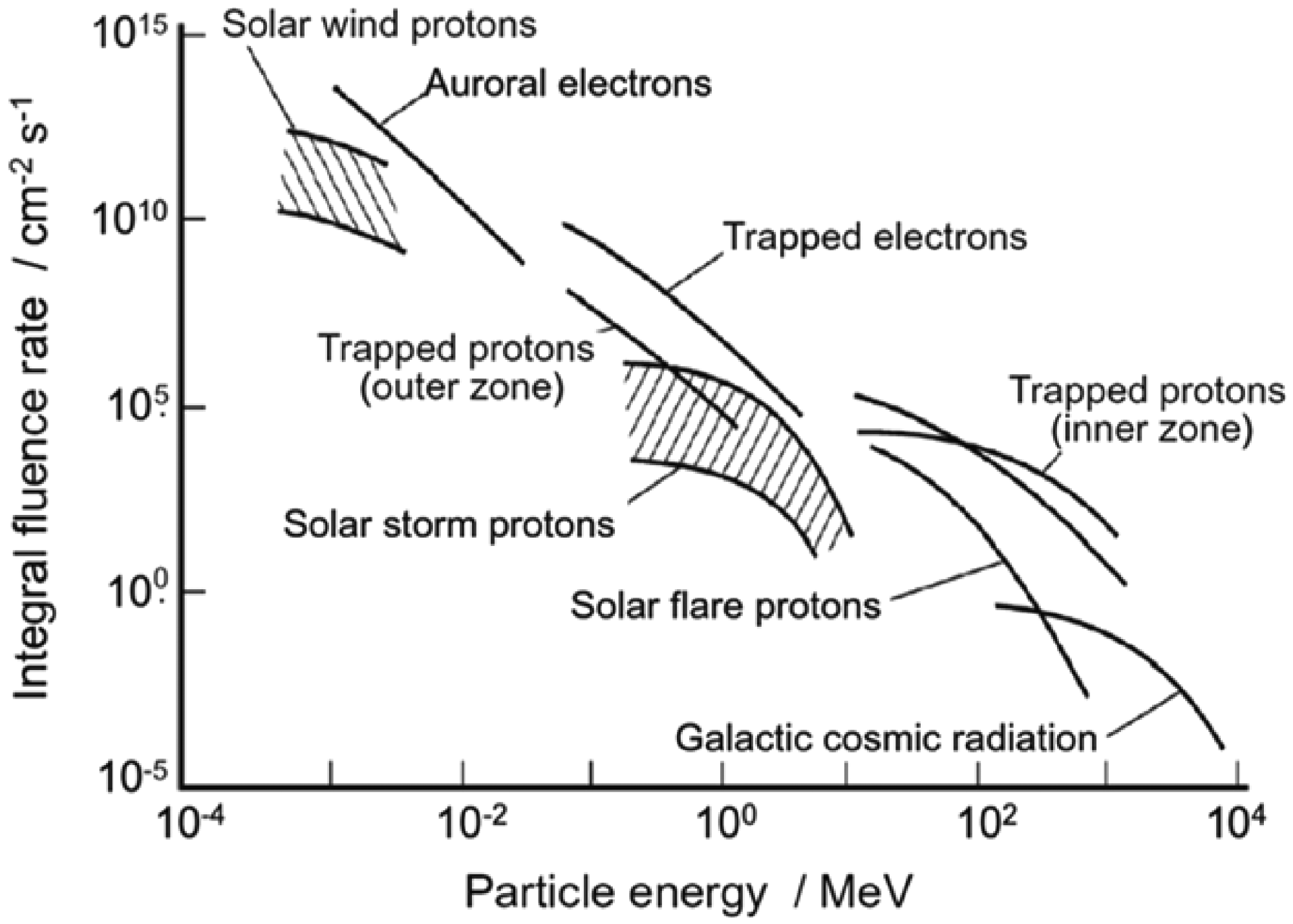
The fluxes of GCR and TPs are relatively stable and predictable compared with those of SEPs, and the procedures for calculating GCR (Nymmik et al., 1995; Matthiä et al., 2013; O'Neill et al., 2014; Slaba and Blattnig, 2014) and TP (Ginet et al., 2013) fluxes are fairly well established. Therefore, the radiation doses due to GCR and TP exposure for various scenarios, such as inside the ISS and on the surfaces of the moon and Mars, can be evaluated with a certain degree of precision (e.g. Matthiä et al., 2016; Sato et al., 2018b).
In contrast, SEP fluence during a space mission is unpredictable because it may increase suddenly if a large solar particle event (SPE) occurs. Therefore, space weather research plays a very important role in ensuring astronaut radiation safety, particularly when it comes to issuing alerts and estimating the worst-case SEP exposures. The occurrence of a large SPE is also regarded as a serious hazard to air crews and flight passengers. Thus, the International Civil Aviation Organization (ICAO) has recently decided to use the radiation dose as mandatory information to operate their centre. This article summarises the recent progress made in space weather research that is useful for cosmic radiation dosimetry.
2. RECENT PROGRESS IN SPACE WEATHER RESEARCH
2.1. SPE detection and alerts
The occurrence of an SPE is related to various physical processes yet to be fully understood, such as solar flares, coronal mass ejections, coronal and interplanetary shock waves, and particle acceleration and transport mechanisms. Therefore, it is very difficult to predict SPEs based on solar observation, and differentiate them from other space weather hazards, such as magnetospheric substorms. Consequently, it is important to detect the arrival of SEPs around the Earth and issue an alert immediately. The detection of relativistic electrons at satellites can be utilised as a pre-alert of an SPE because they can arrive at the Earth prior to SEPs (Posner, 2007).
There are two main methods for issuing an SPE alert: one is based on the high-energy proton detectors mounted on geostationary operational environmental satellites (GOESs), and the other is based on the neutron monitors on the surface of the Earth. These datasets are publicly available from the Space Weather Prediction Center of the US National Oceanic and Atmospheric Administration (ftp://ftp.swpc.noaa.gov/pub/lists/particle/) and the Neutron Monitor Database (http://www.nmdb.eu/), respectively. The former can detect SPEs directly by measuring proton fluxes >1 MeV, while the latter detects SPEs indirectly by measuring the secondary neutrons generated through the nuclear interactions induced by SEPs in the atmosphere. SPEs with a significant increase in neutron monitor count rates are rarely observed in comparison with those with an increase in the GOES proton fluxes, because most SPEs do not emit high-energy protons (E > 450 MeV) that can create neutrons reaching the surface of the Earth. These events are called ‘ground-level enhancements’ (GLEs), and only 72 GLEs have been recorded over eight decades of observation. The profiles of each GLE are summarised in Asvestari et al. (2017).
Fig. 2 shows the GOES proton and x-ray fluxes, and the count rates of the Oulu neutron monitor for 6–11 September 2017. It is evident from Fig. 2A that several solar flares occurred that week, but only the last flare was associated with a large SPE, indicating that the SEP fluxes cannot be estimated solely from the solar flare class, as discussed by Takahashi et al. (2016). The large SPE observed on 10 September 2017 resulted in GLE72, as shown in Fig. 2B, but the neutron monitor count rates only increased by a few percent above the background level. This is because the SEP spectrum during this event was so soft that most protons and their secondary neutrons could not penetrate deep into the atmosphere. In addition, a decrease in the neutron monitor count rates, the so-called ‘Forbush decrease’, was observed on 8–9 September 2017, which occurred due to the magnetic field of the strong solar wind that could sweep GCR away from the Earth. Thus, the occurrence of a large solar flare does not always result in an increase in radiation dose on the Earth.
(A) Geostationary operational environmental satellite proton and x-ray fluxes, and (B) count rates of the Oulu neutron monitor for 6–11 September 2017.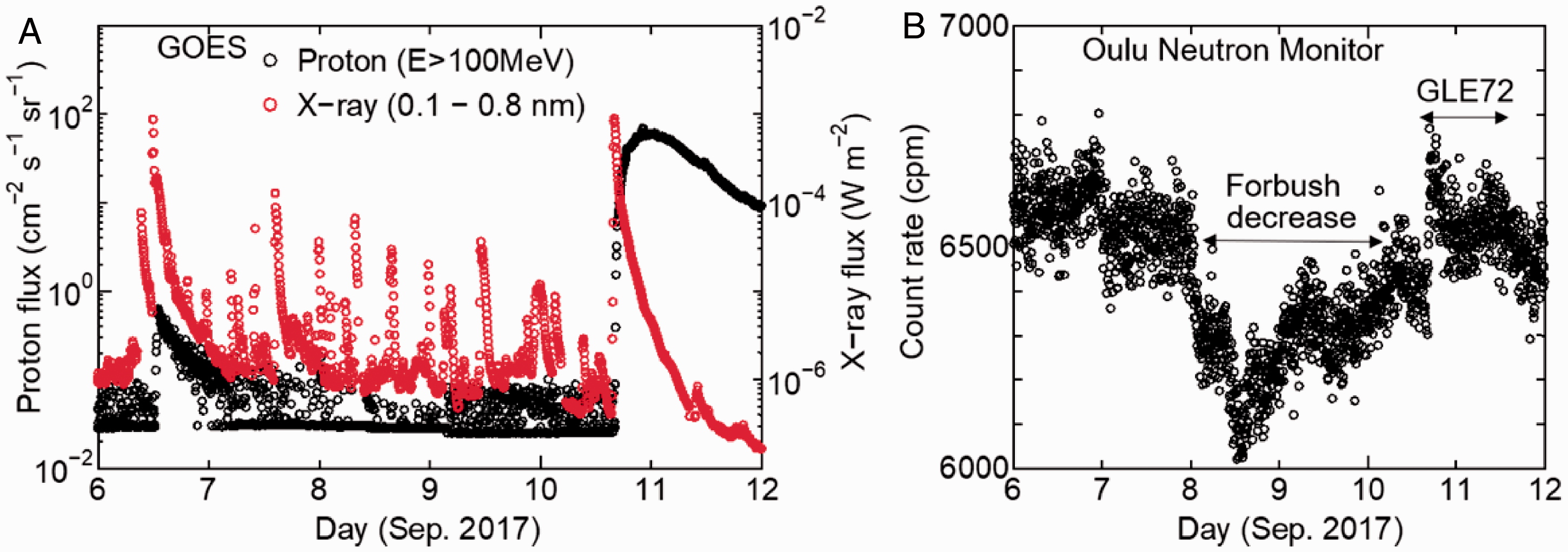
Using real-time data of the GOES proton fluxes and/or neutron monitor count rates, several systems have been developed to issue an SEP exposure alert at flight altitudes, such as AVIDOS (Latocha et al., 2009), NAIRAS (Mertens et al., 2010), SiGLE (Lantos et al., 2003), and WASAVIES (Kataoka et al., 2018; Sato et al., 2018a). As an example, Fig. 3 shows the worldwide dose rate map at 12-km altitude during the GLE69 peak (6:55 UT, 20 January 2005) drawn by WASAVIES. When a GLE occurs, the radiation dose data calculated by these systems are provided to ICAO and used as the mandatory information to operate their centre.
Worldwide dose rate map at 12-km altitude during the GLE69 peak (6:55 UT, 20 January 2005) drawn by WASAVIES (https://wasavies.nict.go.jp/).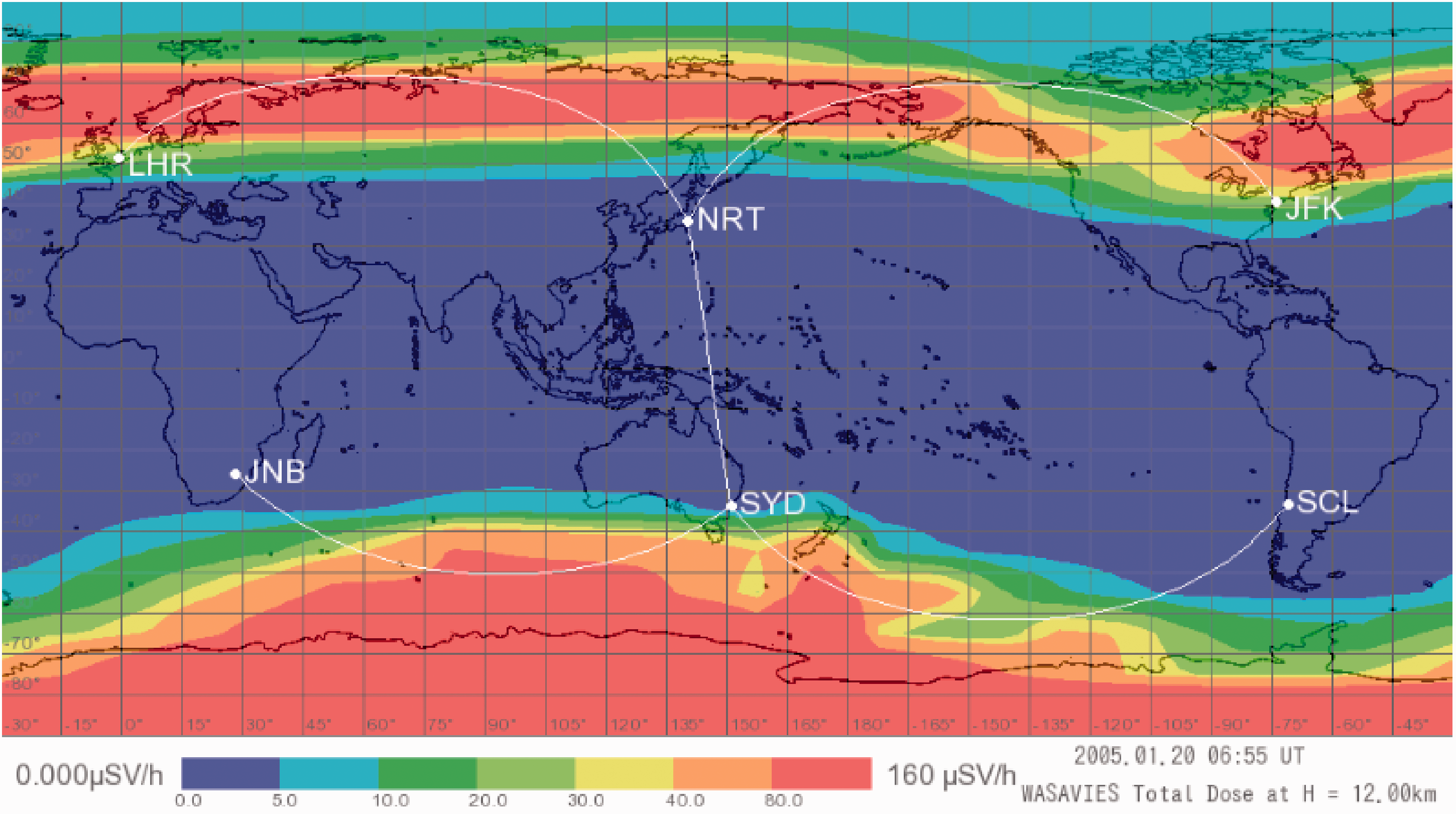
2.2. Worst-case scenario estimation
The worst-case scenario of SEP exposure is generally considered in the design of a space mission. Several models have been proposed to reconstruct the SEP fluence during a historically large SPE. Their results are summarised in web-based tools, such as the On-Line Tool for the Assessment of Radiation in Space developed by the National Aeronautics and Space Administration (Singleterry et al., 2010) and the Space Environment Information System developed by the European Space Agency (Heynderickx et al., 2004). These tools also have functions for considering the influences of magnetosphere and spacecraft shielding on SEP fluence; therefore, they are widely used in the design of space missions to estimate the worst-case scenario of SEP exposure. In addition, Tylka and Dietrich (2009) recently proposed a new model for representing SEP fluence with a double power law function of rigidity, the so-called ‘Band function’ (Band et al., 1993), and evaluated the parameters used in the function for many GLEs. Fig. 4 shows some examples of SEP fluences for historically large GLEs calculated by the Band function (Durante and Cucinotta, 2011). It is known that GLE5, which occurred in February 1956, is the largest event observed since the neutron monitors went live in the 1940s, and its spectrum was much harder in comparison with those of the other events.
Examples of solar energetic particle fluences for historically large ground-level enhancements calculated by the Band function.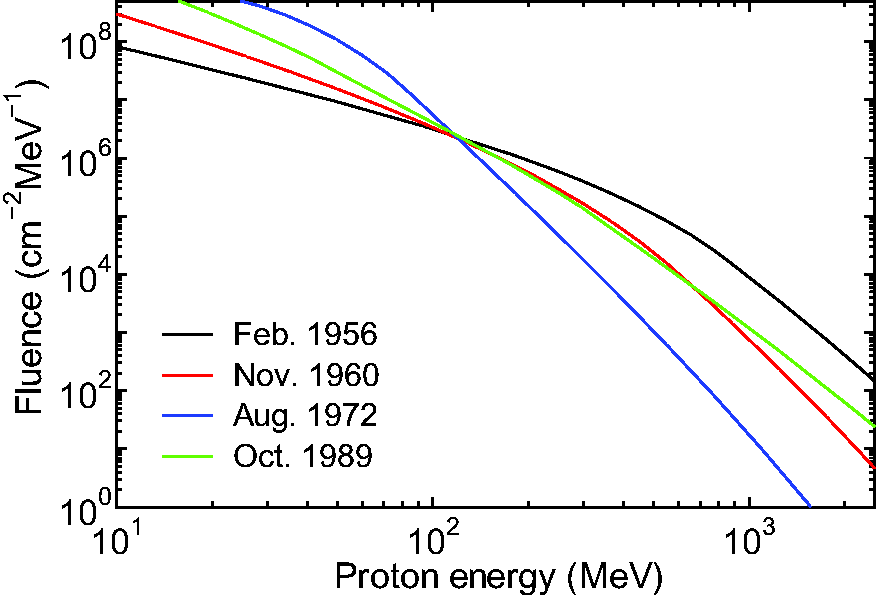
In addition, several probabilistic models were proposed to predict the integral SEP fluence accumulated during a mission at a certain level of confidence. For example, Feynman et al. (2002) developed the Jet Propulsion Laboratory Model based on Monte Carlo simulation, and Kim et al. (2009) proposed the use of the integral fluence of SEPs >100 MeV to estimate the percentiles of dose to blood-forming organs during a particular mission. Jiggens et al. (2012) developed SEP environment modelling, which is based on ‘virtual timelines’ rather than traditional Monte Carlo approaches; and Raukunen et al. (2018) systematically investigated the distributions and relationships of the spectral fit parameters of the Band function for GLEs occurring in solar cycles 19–24. These probabilistic models enable a more sophisticated mission design, considering the confidence level, solar activity, and duration of the mission, rather than simply assuming the worst-case scenario.
Note that most models for estimating the worst-case scenario and/or the probability of the integral SEP fluence during a mission were developed based on the modern solar observation data obtained using neutron monitors and/or satellites. However, the sun can cause solar flares much larger than the largest flare recorded in the modern solar observations, such as the Carrington event, which occurred in 1859. Fortunately, the SEP spectrum generated by the Carrington event is estimated to have been softer than those for historically large GLEs (Townsend et al., 2006). Instead, recent investigations on the cosmogenic nuclide concentrations in tree rings and ice cores have revealed that extremely large SPEs with hard SEP spectra occurred in AD 774/5 and 993/4 (Miyake et al., 2012, 2013, 2015). The total SEP fluences during these events were estimated to be 119–141 and 51–68 times higher than those during GLE69, which is the largest event to have occurred to date in the 21st century (Mekhaldi et al., 2015). If a male astronaut had stayed in an ISS-type spacecraft in deep space during GLE69, his red bone marrow dose and dose equivalent would have been approximately 5 mGy and 8 mSv, respectively, as estimated by the WASAVIES simulation (Sato et al., 2019). Therefore, astronauts may suffer from radiation doses in excess of the threshold value for some tissue reactions (i.e. >0.5 Gy) (ICRP, 2012), as well as their career limit (i.e. >0.6–1.2 Sv) (McKenna-Lawlor, 2014), if a once-in-a-millennium-class SPE occurs during their mission to deep space. Consequently, real-time monitoring of radiation doses is indispensable during missions to deep space to take adequate actions during an SPE, such as sheltering astronauts in well-shielded locations in their spacecraft (Mertens et al., 2018; Townsend et al., 2018).
3. CONCLUSIONS
Recent progress in space weather research has enabled more sophisticated design of space missions with respect to SEP exposure, taking the confidence level, solar activity, and duration of the mission into account. It has also been revealed that the sun can cause much larger SPEs than the largest event recorded in the modern solar observations. If such an extreme event occurs during a mission to deep space, the dose and dose equivalent for astronauts may exceed the threshold values for some tissue reactions and their career limit, respectively. The strategy of radiological protection against such low-probability and high-risk events must be discussed in the future.
Footnotes
ACKNOWLEDGEMENTS
The author is grateful to the members of ICRP Task Group 115 on Risk and Dose Assessment for Radiological Protection of Astronauts and Dr N. Hamada at the Central Research Institute of Electric Power Industry, Japan for their advice on writing this manuscript. The author also wishes to thank the Sodankyla Geophysical Observatory of the University of Oulu, Finland for furnishing neutron monitor data.