




Abstract
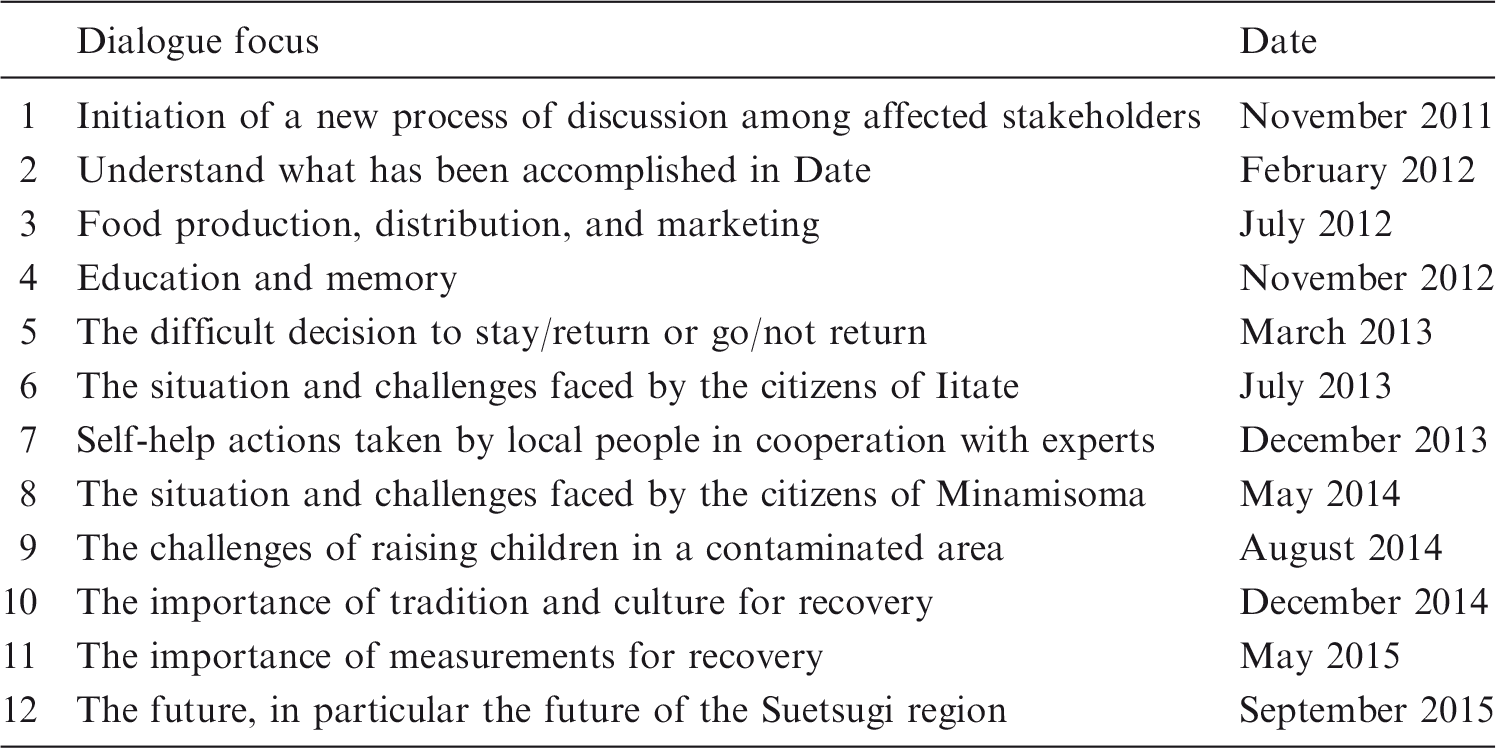
Between September 2011 and August 2015, the International Commission on Radiological Protection (ICRP) organised a series of 12 stakeholder dialogue workshops with residents of Fukushima Prefecture. Discussions focused on recovery, addressing topics such as protection of children, management of contaminated food, monitoring, and self-help measures. The OECD Nuclear Energy Agency (NEA) supported, and the Committee on Radiation Protection and Public Health (CRPPH) Secretariat attended, all 12 meetings to listen directly to the concerns of affected individuals and draw lessons for CRPPH. To summarise the dialogue results, ICRP organised a final meeting in Date, Japan with the support of NEA and other organisations. The lessons from and utility of the dialogue meetings were praised by dialogue participants and sponsors, and ICRP agreed that some form of dialogue would continue, although with ICRP participation and support rather than leadership. This paper summarises the internationally relevant lessons learned by CRPPH from this important process.
1. INTRODUCTION
The significance and complexity of post-accident recovery have emerged increasingly over the months and years since the accident at Fukushima Daiichi nuclear power plant. These recovery issues have strong culture-specific aspects, yet also have a certain universality. Based on its previous work on stakeholder involvement in radiological protection decision making, the Nuclear Energy Agency’s (NEA) Committee on Radiation Protection and Public Health (CRPPH) began to support a series of dialogue symposia organised by the International Commission on Radiological Protection (ICRP) starting in November 2011. After participating in 12 such symposia, the last being held in September 2015, CRPPH developed this article to assess the lessons of international relevance based on the experience of the people of Fukushima.
2. BACKGROUND
For some time, CRPPH has been interested in the processes of radiological protection decision making, in stakeholder involvement in such processes, and in the role of the radiological protection expert. This focus began approximately 5 years after the Chernobyl accident, as its radiological impacts on NEA member countries became more apparent, and has since been incorporated into the Committee’s work programme in several different manifestations. CRPPH’s work in this area has been extensive and pioneering for the radiological protection community. Through the CRPPH Villigen workshops, work on post-Chernobyl recovery, and focus on understanding how science and social values support and drive radiological protection decisions, CRPPH has built an evolving understanding of the roles of stakeholders and radiological protection experts in decision-making processes. This understanding can be characterised simplistically as follows:
Villigen workshops (NEA, 1998, 2001, 2003)
– Integrate radiological protection aspects into societal decisions, rather than integrating societal values into radiological protection decisions. – Chernobyl work from 1987 to 2011 (NEA, 2011a)
– The radiological protection expert should be at the service of stakeholders. Science and values workshops in 2008, 2009, 2012, and 2015 (NEA, 2011b)
– Decisions are informed by science, but are driven by social values.
List of the topics and dates of the 12 stakeholder dialogue symposia.
3. LESSONS LEARNED
Post-accident situations can be very difficult in terms of stakeholder interactions, because affected populations will generally be angry, will probably be overwhelmed with the complexity of the situation, and will generally have lost trust in any governmental and ‘accident source’ experts. However, as described above, the dialogues built trust relatively quickly, which fostered the expression of open and heart-felt opinions by stakeholders.
The dialogues resulted in many lessons and suggestions. Much of this was in the context of Japanese culture, yet much of this experience is very relevant beyond Japanese culture and the specifics of the Fukushima accident. The experience gained from the ICRP dialogues has all been in the context of post-accident recovery, although much of this experience is applicable to almost any stakeholder dialogue situation. The following aspects are key examples of what has been learned to assist other NEA member countries to be better prepared so as to recover more efficiently from a nuclear or radiological event.
The lessons and observations presented here represent those of CRPPH over the past 25 years, and more specifically, those drawn from post-accident recovery in Fukushima. The overall conclusions from these two elements, while coming from a patchwork of very different circumstances in many different cultures and countries, are felt to be relatively universal. The following simplified global recovery lessons thus represent the broad aspects that will be extremely important to address should another large-scale nuclear accident occur:
the radiological protection focus of stakeholder involvement in a post-accident recovery situation should be on long-term technical support; trust is a necessary and central component of successful stakeholder involvement, successful being understood as providing information and support so that stakeholders can make informed decisions and so that they feel that their concerns have been addressed; as a result of stakeholder involvement, individuals can develop a positive vision of their future, which will help them to make an informed choice to stay or to go; individual decisions whether to stay or to go, are all valid and it is essential that this be clearly expressed; and the level of support needed to achieve the goals listed here can be very resource intensive.
More generally, CRPPH has been through a learning process over the past 25 years with respect to radiological protection decisions. It has taken time to recognise the role of the radiological protection specialist in decision processes, and that the skills needed for embarking on stakeholder interactions are not ‘normally’ addressed in radiological protection education programmes. Considering that the ‘most effective’ stakeholder interactions are undertaken by radiological protection experts trained in public interactions rather than by communications experts trained in radiological protection, it will be important to review and most probably revise university and on-the-job training approaches for radiological protection experts to include stakeholder interaction training.
4. Conclusions
Years of CRPPH experience in the field of radiological protection, particularly following the Chernobyl and Fukushima Daiichi nuclear power plant accidents, have strongly suggested that the role of the radiological protection expert in post-accident recovery situations is principally one of support to affected stakeholders, both in terms of ‘affected stakeholders’ and ‘stakeholders’ in the broader sense of the term. Trust is required to achieve effective support, and this trust will depend on pre-accident engagement and post-accident responsiveness, clarity, and transparency in addressing stakeholder concerns. The resources needed for this will be significant, and processes for such engagement will need to be established pre-accident. In implementing protective measures during an emergency situation, it will be important to communicate recovery processes to affected populations (e.g. how decisions to end protective measures will be made and how stakeholders will be involved). Thus, while recovery from an accident will present unique challenges, flexible and resilient processes for ‘moving forward together’ will be central pillars to restoring individual’s lives and society’s structure in the framework of post-accident conditions.