




Abstract
All soils and rocks contain naturally occurring radioactive material (NORM). Many ores and raw materials contain relatively high levels of natural radionuclides, and processing such materials can further increase the concentrations of natural radionuclides, sometimes referred to as ‘technologically enhanced naturally occurring radioactive material’ (TENORM). Examples of NORM minerals include uranium ores, monazite (a source of rare earth minerals), and phosphate rock used to produce phosphate fertiliser. Such activities have the potential to result in above background radiation exposure to workers and the public. The objective of this paper is to review the sources and exposure from NORM in North American industries, and provide a perspective on the potential radiological hazards to workers and the environment. Proper consideration of NORM issues is important and needs to be integrated in the assessment of these projects. Concerns over radioactivity and radiation amongst non-governmental organisations and the local public have resulted in the cancellation of NORM mining and mineral extraction projects, as well as inhibition of the safe use of by-product materials from various NORM industries. This paper also briefly comments on the current regulatory framework for NORM (TENORM) in Canada and the USA, as well as the potential implications of the recent activities of the International Commission on Radiological Protection for NORM industries.
1. Introduction
People have always been exposed to natural background radiation; radioactivity from radionuclides found naturally in soils and rocks; radioactivity in food, water, and air; and radiation from space. While the levels of radiation and radioactivity vary widely from place to place, by perhaps a factor of 10 or so, there is nowhere on earth that is not radioactive. According to the United Nations Scientific Committee on the Effects of Atomic Radiation (UNSCEAR), the nominal per caput annual dose from all natural sources of radiation is approximately 2.4 mSv with a range of (approximately) 1–13 mSv year−1 (UNSCEAR, 2000).
1.1. What is NORM?
Most naturally occurring radioactive material (NORM) contains radionuclides from the so-called long-lived ‘primordial’ decay chains, resulting from the decay of U-238, U-235, Th-232, and other long-lived radionuclides, such as K-40. All soils and rocks are naturally radioactive, and hence all ores are also radioactive. This is illustrated in Fig. 1 which shows the nominal range of radioactivity in soils and a variety of ores.
Uranium and thorium in soils and ores (Wymer, 2008). UNSCEAR, United Nations Scientific Committee on the Effects of Atomic Radiation.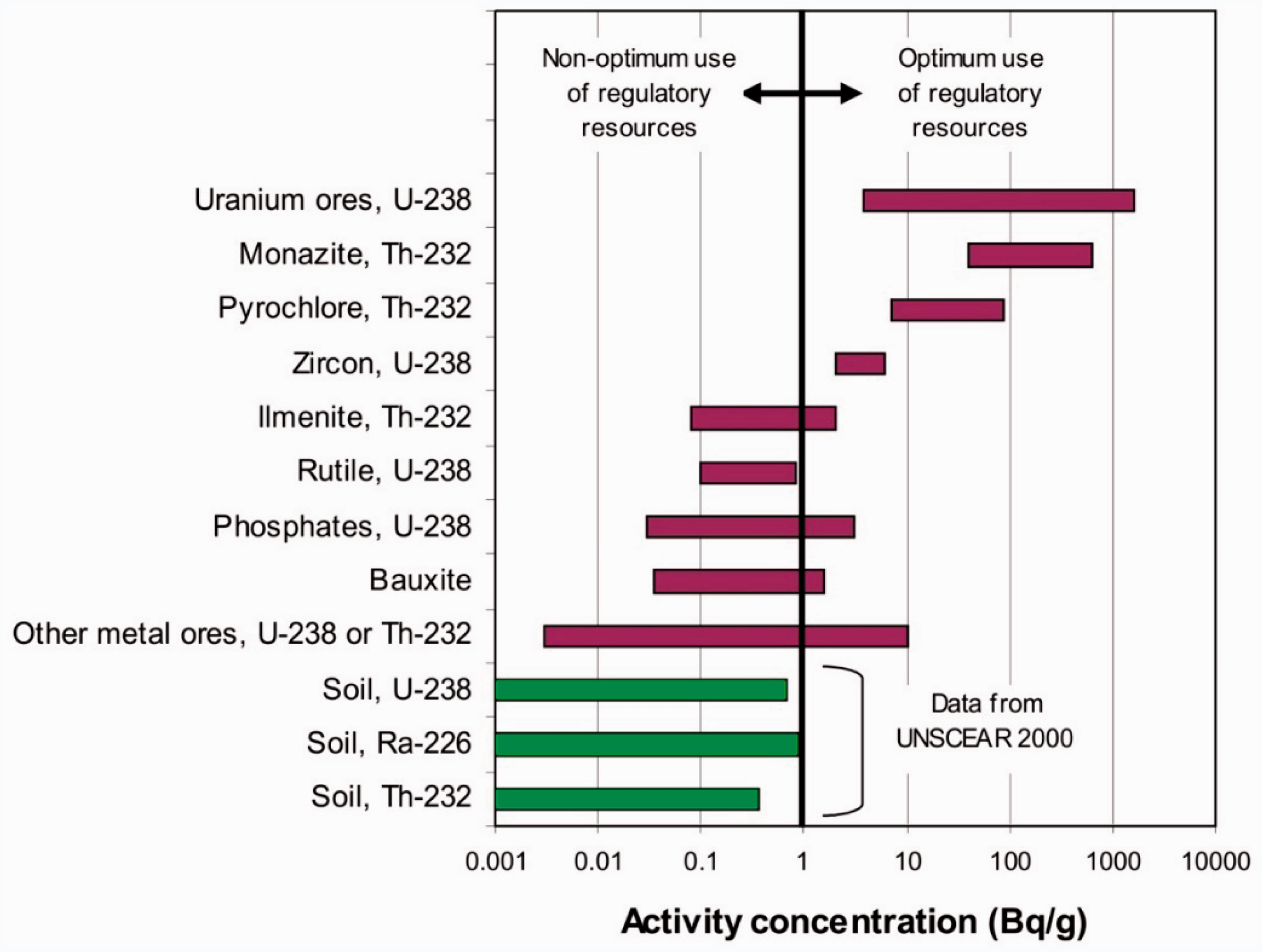
Examples of radioactivity levels in naturally occurring radioactive material.
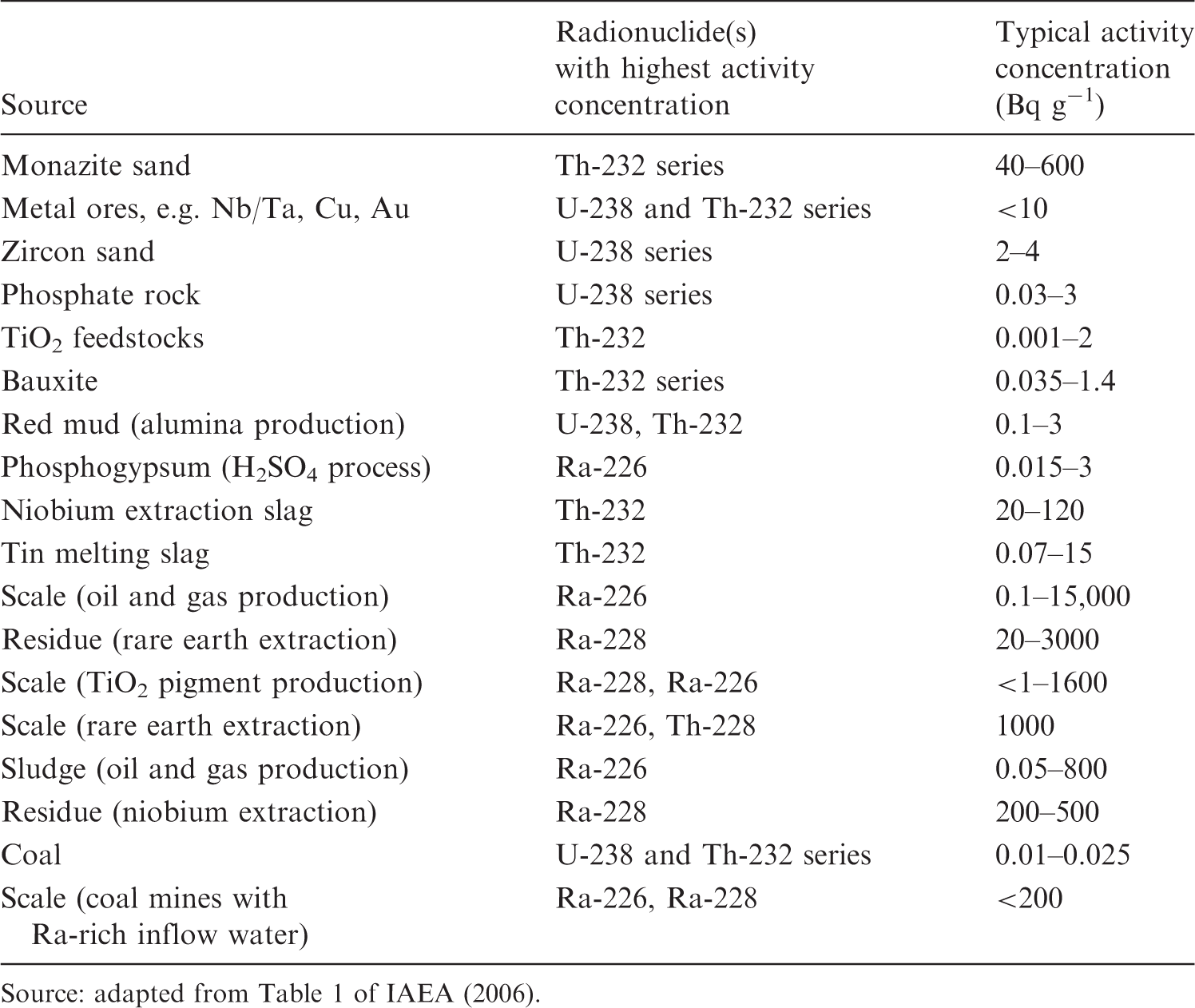
Source: adapted from Table 1 of IAEA (2006).
Fortunately, in most cases, radionuclide concentrations in NORM do not pose any material risk to the environment or humans. However, when NORM is concentrated due to human activities such as oil and gas, water treatment waste, and coal combustion, it is important to consider such enhancement of the radioactivity in the products, by-products, residues, or wastes arising from these industrial processes (IAEA, 2006).
The radionuclides of interest for NORM are from the uranium and thorium natural decay series. As suggested above, NORM is found in mining and mineral processing, as well as in many industrial waste streams including overburden, mine spoils and tailings from uranium mining, metal mining and processing wastes, rare earth mining and extraction, oil and gas production (including fracking), and the production of phosphate fertilisers. Each of these NORM sources is discussed briefly below.
2. Examples of NORM industries
2.1. Uranium mining
According to the World Nuclear Association (WNA, 2013), uranium was produced in some 20 countries in 2012 through one or more of the three main methods, i.e. underground mining, open pit mining, and in-situ leaching (ISL) (sometimes referred to as ‘in-situ recovery’). Conventional mines, either underground or open pit, have a mill where the ore is crushed, ground up, and then leached 1 to dissolve the uranium and separate it from the host ore. At the mill of a conventional mine or the treatment plant of an ISL operation, the uranium which is now in solution is separated by ion exchange before being precipitated, dried, and packed. This product, uranium oxide concentrate, is also referred to as ‘yellowcake’ and ‘mixed uranium oxides’ (U3O8). In addition, uranium can be recovered as a by-product from phosphate fertiliser production, and from mining of other minerals including copper and gold where the ores contain economic quantities of uranium. In such situations, the treatment process to recover uranium may be more complex.
During uranium mining and processing, workers may be exposed externally to gamma rays emitted from the ores, process materials, products, and tailings, and internally through inhalation of aerosol particles (inhalable dust) containing long-lived alpha activity, including radon progeny. Environmental exposures vary by region, type of mine, and processing, but include releases of dust and radon to the air; releases of uranium, radium, and other radionuclides to the surface water; and potential effects on groundwater. For modern mines and processing plants, most workers receive radiation doses well below the radiation protection guidance developed by the International Commission on Radiological Protection (ICRP). Annex B of UNSCEAR (2008) provides considerable information on current levels of radiation seen by workers and the public arising from uranium recovery operations. Available information indicates that average doses to workers involved with mining and processing uranium in Canada and worldwide are less than 2–3 mSv year−1 (Health Canada, 2008; UNSCEAR, 2008).
2.2. Metal mining and processing industries
All natural materials contain some level of uranium and thorium. Thus, it is plausible that the mining and processing of ores other than uranium may also need to consider NORM, the potential concentration of uranium or thorium during processing, and the associated radiological exposures. Examples of metal mining and processing activities involving NORM include the mining and processing of gold, aluminium, iron, zinc, copper, nickel, silver, and more (e.g. NCRP, 1993; NRC, 1999; IAEA, 2003a, 2006; EPA, 2008; UNSCEAR, 2008).
The mining and mineral processing industry is the largest producer of NORM wastes, and legacy issues associated with tailings and mine spoils arising from past uranium and other mining is a significant issue in Canada and the USA. To illustrate, according to the US Environmental Protection Agency (EPA), there are a few billion tonnes of waste, with varying concentrations of NORM, that potentially require consideration during reclamation with requirements for long-term stewardship (EPA, 2008).
2.3. Rare earth elements
All rare earth element (REE) ore deposits contain minor levels of thorium and uranium, and hence are considered as NORM. The name suggests that these elements are rare, but in fact they are relatively abundant in the earth’s crust. The reason why they are considered rare is because of their geochemical properties. REEs are not found in a concentrated form, which makes them economically difficult to obtain. As the concentrations of REEs are low, greater amounts have to be mined and then purified, which increases the potential risk to workers, the general public, and the environment (IAEA, 2011; EPA, 2012).
The mining and processing strategies for REE concentrate production are resource and location specific. It is important to understand that the hydrometallurgic REE concentrate specifications typically stipulate very low levels of radioactivity, and essentially all of the radioactivity will remain in the mineral concentration rejects (tailings) and the metallurgic residues. In some cases, the radionuclide concentrations of REE can be much higher than the normal range of background levels and radiological issues. External gamma radiation exposure, for example, will be proportionately high with concentration, and may require consideration in the workplace and for managing tailings and wastes. To illustrate, Pillai (2007) reported measured gamma fields ranging from a few µGy h−1 to a few 100 µGy h−1 in a REE processing plant in India. Similar levels would be expected in North American facilities.
In some cases, it may be possible that the concentration of uranium or thorium in process intermediates, tailings, or process wastes could exceed 0.05% by weight, and hence would (in the USA) require a licence from the US Nuclear Regulatory Commission (NRC).
2.4. Phosphate
Phosphate fertiliser is used throughout the world in agriculture to help sustain food production. Phosphate rock, which contains low concentrations of NORM (primarily uranium series radionuclides), is mined and then processed to produce phosphate fertilisers.
Phosphate rock is mined using various mining techniques, and phosphate ore is separated from the rest of the ore. This separation process produces two types of waste: phosphatic clay tailings, which contain approximately 50% of the radioactivity that was present originally; and sand tailings, which contain approximately 10% of the radioactivity that was present originally. The rest of the radioactivity is carried by the phosphate rock. During the production of phosphoric acid (wet process) and the production of elemental phosphorus (thermal process), the main by-products are phosphogypsum and phosphate slag, respectively. During the wet process, phosphogypsum retains approximately 80% of Ra-226, which is the primary radionuclide of interest (IAEA, 2013).
With the majority of the phosphogypsum in the USA centralised in Florida, the state established the Florida Institute of Phosphate Research (FIPR) to study phosphate issues that affect Florida (Birky, 2002). Studies by FIPR and others have confirmed the low risk arising from the use of by-product phosphogypsum as an agricultural soil amendment and fertiliser, as a road base, and as daily landfill cover (Birky, 2002).
There is increasing interest in using the by-product as a resource. According to Hilton (2006), phosphogypsum is growing at more than 100 million tonnes year−1, and the total worldwide phosphogypsum will double within 30 or so years. The land-based stacks, such as those in central Florida, are often in prime, highly sensitive, increasingly populated areas. FIPR also initiated a global effort, working with the International Atomic Energy Agency (IAEA), referred to as ‘Stack Free’ to achieve eventual equilibrium between production and consumption of phosphogypsum across the full life cycle of a producing facility, with the aim of considering phosphogypsum as a resource rather than a waste (Birky, 2002; Hilton, 2006).
2.5. Oil and gas
Approximately 64% of gas-producing equipment and 57% of oil-producing equipment contains levels of radioactivity at or near background levels (EPA, 2010). Uranium and thorium isotopes are largely immobile during oil and gas extractions, but Ra-226, Ra-224, Ra-228, and Pb-210 are slightly more soluble, and may become mobilised in the fluid phases of the formation of oil and gas reservoirs that co-exist with saline water (water that has salts dissolved in it). The concentration of salts in the saline water varies depending on the length of time that the water is in contact with the rocks. Brines, which are a solution of salt in water, are brought to the surface along with the oil and gas, where they are separated and disposed. The brines, typically referred to as ‘produced water’, potentially contain radium from both the uranium and thorium decay chains (EPA, 1999; Zielinski and Otton, 1999; IAEA, 2003b; Gazineu et al., 2004; EPA, 2010).
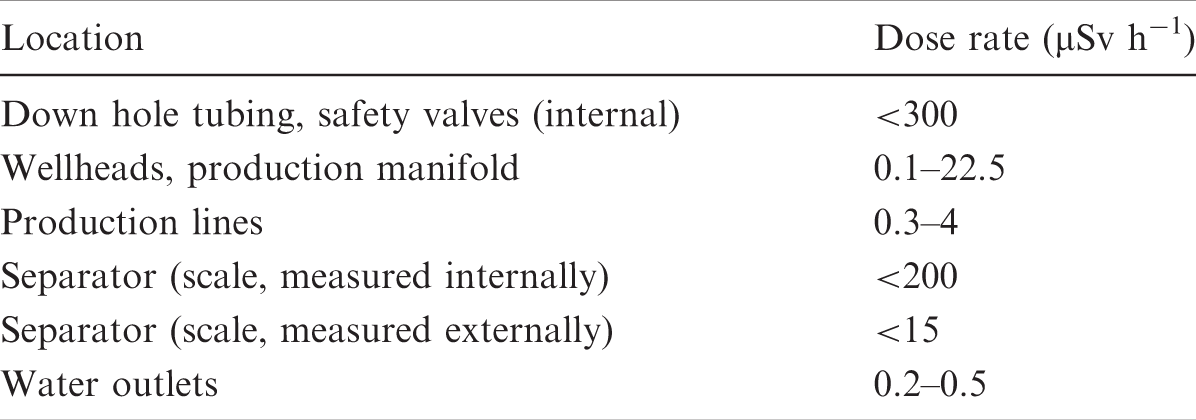
External gamma dose rates observed near oil-producing and -processing equipment (IAEA, 2013).
2.6. Fracking
Fracking is a technique to introduce fluids under high pressure into a natural-gas-containing rock formation to fracture the rock and prop open the fractures. This allows natural gas to flow more freely from the formation into wells where it is collected.
Fracking produces very large quantities of wastewater, which contain some level of NORM. Wastewater from fracking can be categorised as flowback or produced water. Flowback is essentially fracturing fluid injected into a gas well that returns to the surface when the drilling pressure is released. Water returning to the surface before the gas extraction process begins is considered under this category. Produced water refers to the wastewater emerging after the production has begun, much of which is salty water contained within the shale formation. The characteristics of the produced water depend on the geological conditions (Hammer and Van Briesen, 2012; EPA, 2014a, 2014b). Although the shales being fracked may only contain a small amount of radioactivity, radium is more soluble in the drilling fluid, which mainly contains water, in conditions found underground. As such, when wastewater is brought back up to the surface, it will potentially contain elevated levels of radium. Moreover, drilling fluids can be partially recycled, and with each re-use, radium continues to concentrate. Concentrations of NORM radionuclides in produced water can be fairly high, with concentrations reported from a few Bq l−1 to more than 1000 Bq l−1 (Warner et al., 2013; EPA, 2014).
Flowback water can mainly be managed by minimising use of produced water, recycling and re-using the water, or transporting the water off site for treatment and eventual release into ground or surface water. Land farming of produced water has the potential to create future liability, as any radionuclides in the produced water would accumulate in the soils where land farming is employed.
EPA began research under its ‘Plan to Study the Potential Impacts of Hydraulic Fracturing on Drinking Water Resources’ to ensure that natural gas extraction does not present undue hazards to the health of the public. The environmental scope of the project includes the full lifespan of water in fracturing. A progress report was released in 2012 (EPA, 2012).
3. REgulatION
3.1. Canada
The Canadian Nuclear Safety Commission (CNSC) is the federal agency that licenses and regulates nuclear facilities and materials. However, NORM is exempt from the CNSC’s jurisdiction (except for import, export, and transport).
Policies surrounding uranium mining/milling and nuclear power generation are varied across Canada, and each province has the authority to prohibit these operations through legislation. The presence of NORM in the process materials and wastes requires that potential radiation exposures and material management be addressed. Such requirements are noted specifically within the provincial or territorial mines acts, and/or applicable provincial workplace safety regulations.
To support provincial agencies, the Federal Provincial Territorial Radiation Protection Committee introduced guidelines that apply to situations where NORM is in its natural state, and to cases in which the concentration of NORM has been increased by processing. The Canadian Guidelines for the Management of NORM state: The basic principle of the Guidelines is that persons exposed to NORM should be subject to the same radiation exposure standards that apply to persons exposed to CNSC-regulated radioactive materials. No distinction is made regarding the origin of the radiation, or whether it is NORM in its natural state or NORM whose concentration of radioactive material has been increased by processing (technologically enhanced NORM or TENORM). (Health Canada, 2000)
The incorporation of NORM guidelines to provincial mining and occupational acts is at the discretion of the provinces, although the NORM guidelines serve as the default for most provinces.
3.2. USA
Simmons (2009) provided a comprehensive review of the legal aspects of NORM and TENORM (‘NORM’) in the USA. Much of the following discussion is adapted from Simmons, who noted that NORM in the form of natural uranium and/or thorium is licensable source material when the concentration of uranium or thorium exceeds 0.05% by weight, and a specific licence is needed to mine or process such materials. He also commented that TENORM is currently not defined in any federal regulations of the USA, but that some states have promulgated TENORM regulations with TENORM defined broadly as ‘naturally occurring radioactive materials whose radionuclide concentration has become increased by human activity’.
According to Simmons (2009), the application of regulations for NORM in the USA is not well understood. The ultimate regulation for radioactive source materials is based on the Atomic Energy Act (AEA), which has pre-emption on all other regulations that deal with health and safety for uranium and thorium source materials. Under the AEA, NRC has responsibility for ‘source material’, and the NRC’s Part 40 regulations excluded all forms of uranium and thorium below a concentration of 0.05%. In 1961, the definition of source material was revised and only ore below 0.05% concentration was excluded from the source material definition. Chemical mixtures, compounds, solutions, or alloys below this concentration level are exempted as ‘unimportant quantities’ of source material. Some mineral extraction processes are licensed specifically by NRC because the concentration of materials exceeds 0.05% by weight in some part of the process.
Apart from the licence requirement noted above, and the transport of NORM that is subject to US Department of Transportation regulations (essentially the IAEA regulations), NORM is, in practice, subject primarily to state regulation control regulations. State NORM regulations are typically based on the guidelines suggested by the Conference of Radiation Control Program Directors (CRCPD). CRCPD is a US organisation of state radiation regulators formed to assist in the formulation of consistent radiation protection regulations. As part of their Suggested State Regulations for the Control of Radiation, CRCPD issued Part N on the regulation and control of TENORM (CRPCD, 2004). CRCPD does not have any legal authority over the regulation of radioactive material, including NORM; therefore, application of the CRCPD guidance is discretionary.
3.3. International
Both Canada and the USA follow the guidance developed by IAEA for the safe transport of radioactive material (IAEA, 1996, 2000, 2005).
One further aspect requires a comment. To implement its system of radiological protection, ICRP has established a dose conversion convention for radon to allow doses from exposure to radon to be added to doses from other sources of radiation exposure (IAEA, 2005). ICRP now recommends a doubling of its nominal risk coefficient for radon-induced lung cancer, based on its review of uranium miner epidemiology 2 (ICRP, 2010).
In addition, ICRP proposed that radon should be treated in the same way as other radionuclides in its system of radiological protection (i.e. using ICRP’s biokinetic dose models), and provided ‘nominal’ dose coefficients calculated using its biokinetic dose models and ‘nominal’ parameter values (ICRP, 2010). The use of dose conversion factors based on biokinetic models is very sensitive to model inputs, notably for radon decay product activity, size, and distribution of alpha particles. Unfortunately, mine environments vary widely from place to place and with time, and dosimetrically relevant parameters, notably activity size distribution, are currently very limited. The effect of this change on mine design and operations is not fully understood at present, but will certainly present challenges for the foreseeable future.
4. Conclusions
Uranium and thorium are ubiquitous in soil, rocks, and ores. Thus, mining and many industrial processes will have NORM as an integral part of their activities. NORM industries considered in this paper are uranium mining, metal mining and processing industries, REE mining and processing, phosphate fertiliser, oil and gas production, and fracking. Exposures and types of radionuclides will vary between industries, but the most prominent NORM radionuclides arise from the uranium decay series and thorium decay series. The levels of uranium and thorium series radionuclides associated with NORM industries vary quite widely; even for industries where the initial concentrations of radionuclides in the ores or feeds are fairly low, there is potential for concentration of the radionuclides at various locations in process streams or wastes. Thus, the presence of NORM and consideration of the potential types and levels of radiation exposure should be an integral part of health and safety planning.
The national nuclear regulators in Canada and the USA do not regulate activities with uranium and thorium below 0.05% by weight. However, in both Canada and the USA, guidance for radiation protection from NORM is available and, broadly speaking, is followed by the provinces and states. Both countries follow the guidance for transport of radioactive materials developed by IAEA.
The work of ICRP is important as radiation protection guidance is typically based on their generic guidance. Thus, it is important to follow the work of ICRP and provide comments to ICRP on proposed new guidance as it is developed. IAEA also provides guidance for many NORM industries on the practical application of radiation protection principles.
Footnotes
1
Depending on the mineralogy of the ore, various processes including either sulphuric acid or alkaline (carbonate) leach are employed to liberate the uranium from the host ore. The method used to recover uranium has implications for protection of both workers and the environment.
2
 also noted that the risk of lung cancer from radon for smokers is substantially greater than that for non-smokers. This is an important observation, as current radon risk projection models are all relative risk models, and risk estimation is strongly influenced by the prevalence of smoking in the reference population.