




Abstract
Since publication of the 2007 Recommendations (ICRP Publication 103), the International Commission on Radiological Protection has focused on preparing a series of publications dedicated to different types of existing exposure situations, such as radon exposure, cosmic exposure in aviation, and exposure to naturally occurring radioactive material (NORM). The publication related to NORM will present the main types of corresponding activities, and describe the characteristics of NORM exposure. It will also develop a conceptual framework for the practical application of the Commission’s system to NORM exposure. In particular, the publication will explain why NORM activities are generally considered to be existing exposure situations, and when some of them should be managed as planned exposure situations. It will indicate when the workers should be considered as occupationally exposed. It will also provide recommendations regarding application of the three principles of radiological protection. The need to consider the justification of the re-use or recycling of residues carefully will be highlighted. Guidance will be provided for selection of the reference level, and for implementation of the optimisation process through a graded approach including both prevention and mitigation of exposures. Flexibility will be recommended for the application of dose limits, notably when the situation is managed as a planned exposure situation.
1. Introduction
At its meeting in Berlin, Germany in October 2007, the Main Commission of the International Commission on Radiological Protection (ICRP) approved the development by Committee 4 of a new report related to application of the Commission’s recommendations on radiological protection of workers, the public, and the environment to exposures resulting from industrial processes using naturally occurring radioactive material (NORM). Task Group 76 was created, the aim of which is to develop recommendations to cover the broad range of activities associated with the processing, production or use, and disposal of materials with enhanced levels of NORM. The report will also clarify the issues concerning the type of exposure situations, the categories of exposure, and the basic principles to be applied for the management of NORM. Task Group 76 is continuing its work, and its membership was revised in 2013.
2. Characteristics of Norm Exposure
NORM is ubiquitous and present in almost all materials on earth. Human activities have the potential to either increase or decrease radiation exposures to NORM. The primary source is not controllable or is only partially controllable. However, the source may be modified unintentionally or intentionally.
NORM exposure occurs as a result of industrial processes or work activities. These activities may increase both occupational and public exposures. A wide range of processes or activities may be concerned. The main types of NORM industries are:
mining and mineral processing industries; coal, oil, and gas production; some metal production industries (thorium, niobium, zircon, titanium, etc.); phosphate industry and production of some building materials; and water treatment.
This list is not intended to be exhaustive or exclusive, but rather representative of the situations that pose an exposure situation of concern.
Typical NORM industries process a wide range of raw materials and activity concentrations, producing a variety of products and wastes. These industries may or may not be of concern, depending on the activity concentrations in the raw materials handled, the processes adopted, the uses to which final products are put, the re-use and recycling of residues, and the disposal of wastes. Exposures may occur during various stages of production or from the use of products, residues, and waste. In many cases, there is a lack of awareness of the presence of radioactive material in these products.
Concentrations may be enhanced in products, by-products, or waste generated by some mineral processing industries. In general, exposures from these industries involve small doses to large numbers of people, and the resulting population doses can be greater than those from artificially produced radionuclides.
Exposure of workers is often adventitious as it is not normally considered to be part of the job in which they are engaged. There is often a lack of awareness about radiation protection culture in the industry. In these industries, risk reduction strategies depend on changing personal behaviour, and need a long-term perspective when implemented.
Due to the large variations in activity concentration in NORM industries, and the uses, as well as a wide range of industrial practices, to which these materials are put, it is not possible to adopt a simple generic approach for their safe management.
3. Exposure Situations and Categories of Exposure
The Commission’s system of radiological protection is described in Publication 103 (ICRP, 2007). According to Paragraph 44, it ‘applies to all radiation exposures from any source, regardless of its size and origin’. In particular, according to Paragraph 45, ‘the Commission’s Recommendations cover exposures to both natural and man-made sources. The Recommendations can apply in their entirety only to situations in which either the source of exposure or the pathways leading to the doses received by individuals can be controlled by some reasonable means. Sources in such situations are called controllable sources.’
3.1. Exposure situations
An exposure situation is the process that includes a natural or man-made radiation source and the transfer of radiation through various pathways leading to the exposure of individuals. The recommendations in Publication 103 (ICRP, 2007) organise radiological protection according to three types of exposure situation: planned exposure situations, emergency exposure situations, and existing exposure situations. Planned exposure situations are situations resulting from the deliberate introduction and operation of sources. Exposures can be anticipated and fully controlled. Emergency exposure situations result from the loss of control of the source, and urgent action is necessary in order to avoid or reduce undesirable consequences. They also include exposures resulting from a malicious act or from any other unexpected situation. Existing exposure situations are situations where the source already exists when a decision to control the related exposure is taken. They include naturally occurring exposures as well as exposures from past events and accidents, in addition to practices. Characterisation of exposure is a prerequisite to control.
NORM exposure situations have the characteristics of existing exposure situations as NORM are ubiquitous and present in almost all materials on earth. NORM is mentioned as an example of existing exposure situations in Paragraph 284 of Publication 103 (ICRP, 2007). The source is natural and already exists when a decision on control has to be taken. NORM industries create or alter pathways with the potential to either increase or decrease radiation exposures from these materials. When such alterations arise without modifying the source, or when the source is modified unintentionally, the exposure situation is an existing exposure situation. However, when the source is removed and modified intentionally, the exposure situation becomes a planned exposure situation (see Fig. 1). When the primary source is not (or only partially) controllable, the modification of the source is controllable. NORM industries are not likely to give rise to an emergency exposure situation, although high concentrations of NORM in a place may require the prompt implementation of protective actions.
Types of naturally occurring radioactive material exposure situations according to the state of the source.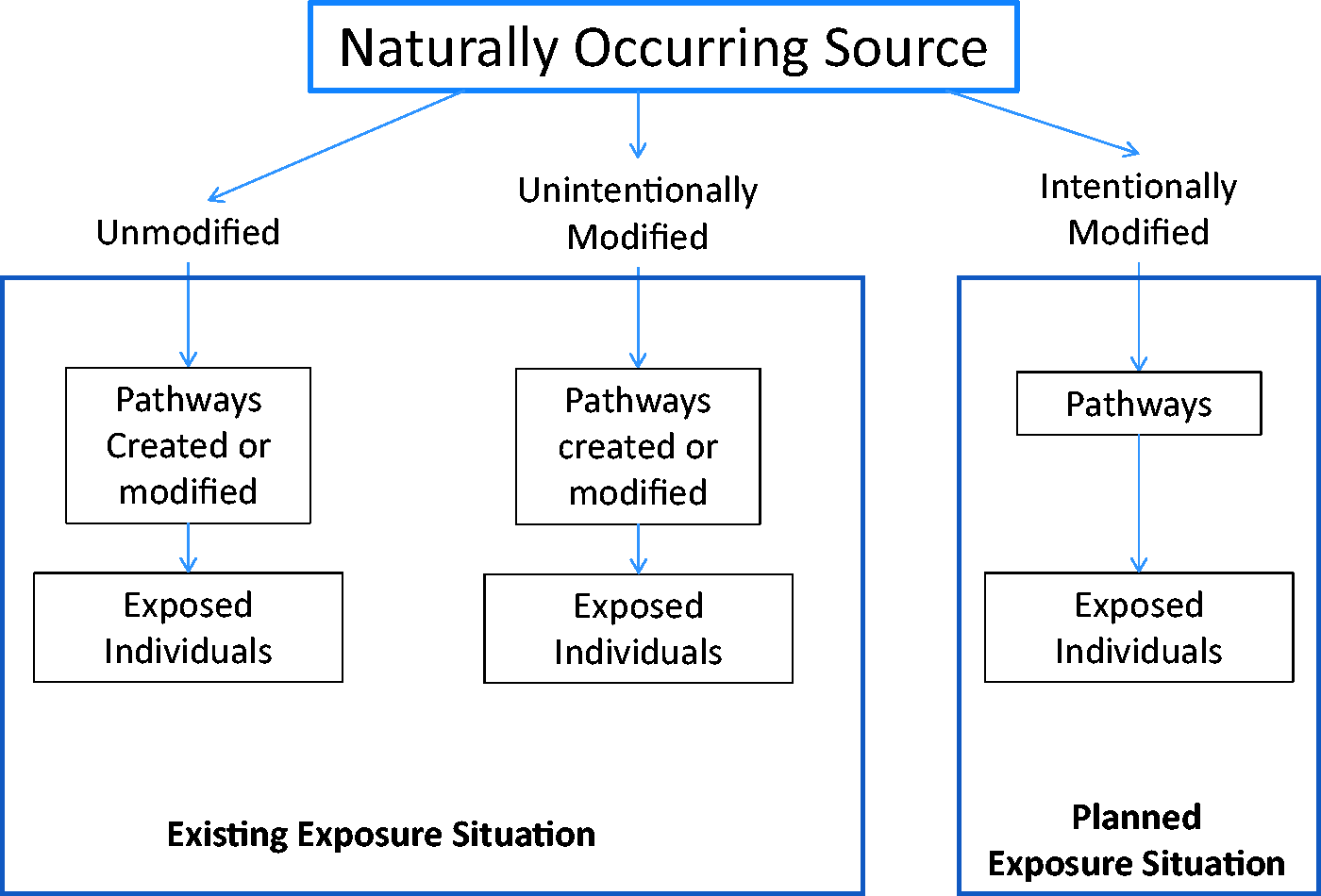
3.2. Categories of exposure
The Commission distinguishes between three categories of exposure: medical exposures of patients, occupational exposures, and public exposures. Medical exposures of patients occur in diagnostic, interventional, and therapeutic procedures. NORM industries do not lead to medical exposures.
Occupational exposure is radiation exposure of workers incurred as a result of their work. However, because of the ubiquity of radiation, the direct application of this definition to radiation would mean that all workers should be subject to a regime of radiological protection. The Commission therefore limits its use of ‘occupational exposures’ to radiation exposures incurred at work as a result of situations that can reasonably be regarded as being the responsibility of the operating management (ICRP, 2007). The Commission also considers that workers who are not regarded as being occupationally exposed to radiation are usually treated in the same way as members of the public.
In the case of NORM industries, if the source has been modified intentionally and introduced deliberately, the exposure at work is considered to be occupational exposure, because it is clear that the exposure can be regarded as the responsibility of the operating management. The exposure situation is then managed by controlling the source, the pathways, and individual exposures. If the source has not been modified, the exposure at work is considered to be adventitious, the workers are treated in the same way as members of the public, and the exposure situation is managed by controlling the pathways. In a case where the source has been modified unintentionally, the exposure at work may also be seen as adventitious, and is consequently not usually regarded as the responsibility of the operating management. However, if the protection of a worker needs the application of individual requirements, such as training, individual monitoring, and health surveillance, the exposure should be considered as occupational exposure, and the exposure situation should be managed by controlling both the pathways and individual exposures. Whatever the case, the health and safety of workers continue to be the responsibility of their employer.
Public exposure is exposure that is neither medical nor occupational.
4. Application of the Principles
4.1. Justification
In the ICRP system of protection, the principle of justification is one of the two source-related fundamental principles (ICRP, 2007, Para. 203). In application of this principle, any decision that alters the radiation exposure situation should do more good than harm. This means that by introducing a new radiation source, reducing existing exposure, or reducing the risk of potential exposure, one should achieve sufficient individual or societal benefit to offset the detriment it causes.
In the case of NORM exposure, the intentional modification of a source should be justified like the deliberate introduction of a source. When the source has not been modified, or has been modified unintentionally, the strategies of protection should be justified. In all cases, particular attention should be paid to justification of the re-use or recycling of residues. Among the considerations to take into account are the level of exposure, the fact that the re-use or recycling should not give rise to exposure of concern (e.g. some building materials which may become the main source of radon exposure in some countries), and ethical considerations such as the dissemination of radiation in consumer products.
4.2. Optimisation of protection
The Commission considers that the principle of optimisation has a key role in NORM industries. The first step is to characterise the relevant exposure situation in terms of the nature of the exposure, the benefits from the exposure situation to individuals and society, as well as other societal criteria, and the practicability of preventing or reducing the exposures. Assessment of these attributes should enable the selection of an appropriate range for the constraint or the reference level.
The management of NORM should be subjected to a graded approach consistent with the optimisation principle. Optimisation requires that the likelihood of incurring exposures, the number of people exposed, and the magnitude of the exposures should all be kept as low as reasonably achievable, taking into account economic and societal factors. The level of protection should maximise the margin of benefit over harm, and should be the best possible under the prevailing circumstances.
The optimisation principle is particularly important for the management of NORM residues as doses to the public can be comparable to those from background radiation, and may exceed the public dose limit for planned exposure situations.
An endpoint for optimisation must not be set in advance, as the optimised level of protection will depend on the situation and past experience with the management of similar situations. The result of an assessment may be that action to reduce exposures is not warranted, depending on the controllability of the source of exposure, and the prevailing economic, societal, and cultural circumstances. However, the concept of exemption, which is a regulatory concept, should not drive the protection strategy.
The Commission recommends that all industries involved in the production and handling of NORM should develop a protection strategy through a NORM management plan. The essential elements of a management plan to be considered in any operation involving materials containing NORM include:
identification of potential sources of exposure to workers and members of the public; identification of potential impacts on the environment; identification of exposures to workers and members of the public (determine who is exposed, where, when, and how); selection of the relevant dose restrictions (reference levels or dose constraints); selection of the best protective option in the prevailing circumstances, including prevention and mitigation measures; and management of environmental impacts of wastes, residues, and discharges. a description of all processes where doses to workers or the public may arise; a plan to manage radiation exposures; a radioactive waste management plan; an assessment of the current or projected use of material that may be recycled; an assessment of the potential impact of manufactured items containing NORM; responsibilities of the operator/employer and of the employees; any relevant occupational health and safety issues; any relevant environmental protection issues; ways to involve stakeholders; appropriate monitoring and review programmes; demonstration of compliance with relevant radiological protection criteria; and periodic review of the status of the operation in relation to continuing controls.
The NORM management plan should cover all aspects of the management of radiation exposures and radioactive waste, and should include:
Appropriate prevention and mitigation procedures should be chosen for each situation, as appropriate. A monitoring programme should be implemented to check the adequacy and efficiency of control measures, and data collected should be used to justify continuation of the present control measures, or to indicate a need to change them.
4.3. Dose restrictions
4.3.1. Reference levels and dose constraints
Reference levels and dose constraints are very similar concepts for the planning of optimisation. The reference level represents, in emergency and existing controllable exposure situations, the level below which the ambition is to reduce all doses from a source to a level that is as low as reasonably achievable, economic and societal factors being taken into account. The reference level is also the level above which it is judged, from a planning standpoint, to be inappropriate to allow exposures to occur. A dose constraint is a prospective and source-related restriction on the individual dose from a source in a planned exposure situation, which serves as an upper bound on the predicted dose in the optimisation of protection for that source. It is a level of dose above which it is unlikely that protection is optimised for a given source of exposure, and therefore action must almost always be taken.
According to Publication 103 (ICRP, 2007), the chosen value for a reference level or a dose constraint depends upon the prevailing circumstances of the exposure situation under consideration. In order to provide guidance for selecting appropriate values, the Commission has defined a dose scale (ICRP, 2007, Table 5) reflecting the fact that, within a continuum of risk (linear non-threshold assumption), the risk that may be acceptable depends on the exposure circumstances. This scale is divided into three bands reflecting the more or less important need for action, which is dependent on the characteristics of the exposure situation: controllability of the source; individual or societal benefit from the situation; and requirements with regard to information, training, and dosimetric or medical surveillance. Numerically speaking, the three bands are <1 mSv, 1–20 mSv, and 20–100 mSv (in acute or annual doses).
As far as NORM exposure is concerned, reference levels for public exposure, including the exposure of workers treated as members of the public, should be typically selected, within a graded approach, in the lower range of the second band, between 1 and 20 mSv, set on an annual basis. A specific graded approach may be implemented in workplaces in order to allow the management of workers as occupationally exposed in case, despite all reasonable efforts, the doses cannot be maintained consistently below the selected reference level. For workers considered as occupationally exposed in an existing exposure situation, the relevant dose restriction should be selected in the band between 1 and 20 mSv year−1. In case of a planned exposure situation, the dose constraint should be selected in the first band, <1 mSv year−1, for public exposure, and in the second band, between 1 and 20 mSv year−1, for occupational exposure.
In practice, derived reference levels should be determined in measurable quantities (dose rate, activity, or activity concentration) for the operational implementation of the optimisation process.
The optimisation process is implemented for NORM exposure through the management plan. When implementing optimisation, the distinction should be made between prevention aiming to maintain the expected exposure (added dose) to a level that is as low as reasonably achievable under the prevailing circumstances, and mitigation aiming to reduce the residual dose to a level that is as low as reasonably achievable (see Fig. 2).
Implementation of the optimisation principle. ALARA, as low as reasonably achievable.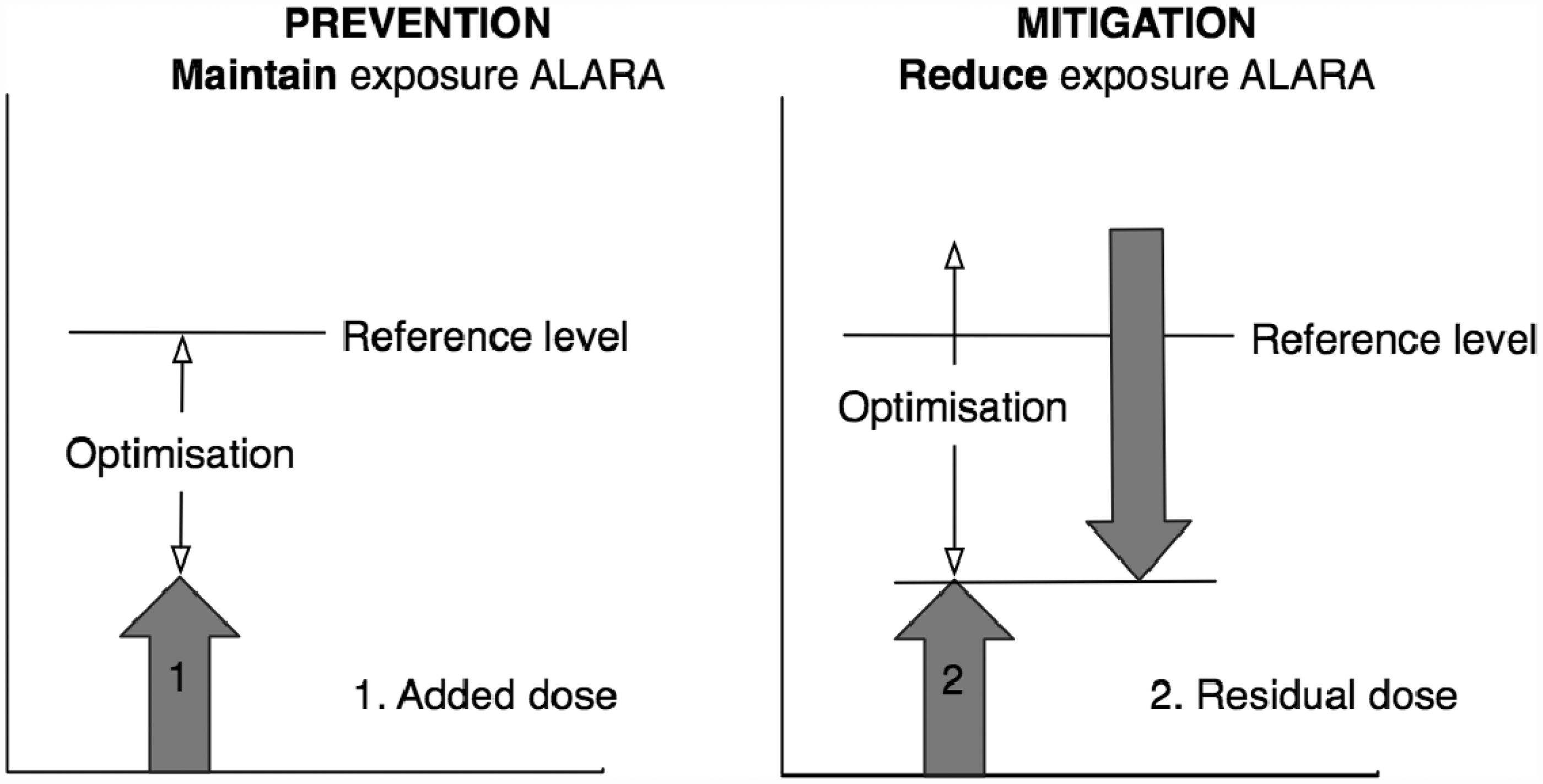
4.3.2. Application of dose limits
According to Publication 103 (ICRP, 2007, Para. 203), the principle of application of dose limits is the third fundamental principle of the ICRP system. It is individual related and only applies for planned exposure situations. The total dose to any individual from regulated sources in planned exposure situations other than medical exposure of patients should not exceed the appropriate limits recommended by the Commission. Dose limits apply to NORM exposure in planned exposure situations. The dose limit recommended by the Commission for occupational exposure is expressed as an effective dose of 20 mSv year−1, averaged over defined 5-year periods (100 mSv in 5 years), with the further provision that the effective dose should not exceed 50 mSv in any single year (ICRP, 2007, Para. 244).
5. Conclusions
The purpose of the report of Task Group 76 is to provide guidance on application of the Commission’s system of radiological protection to NORM exposure. As such exposure occurs as a result of industrial processes, one could assume that it can be managed in the same way as exposure occurring in the nuclear industry. This is true in some cases, when the source has been removed and modified intentionally. In this case, the exposure situation is a planned exposure situation and can be managed as such. However, in most cases, the source, whether unmodified or modified unintentionally, is not controllable or is only partially controllable. The corresponding exposure situations are existing exposure situations and should be managed as such. As for radon exposure, NORM exposure of workers may be adventitious, in which case the workers should be treated as members of the public. The wide range of industrial processes, activity concentrations in materials, and distribution of individual exposures is another challenge to address. Regardless of the NORM exposure situation, it is managed mainly on the basis of the optimisation process. The corresponding protection strategy, implemented through a management plan, should be based on an ambitious, realistic, and graded approach. Further reflection is needed by Task Group 76 to determine appropriate recommendations for NORM exposure.