




Abstract
In 2010, the US National Council on Radiation Protection and Measurements (NCRP) established a scientific committee (SC5-1) to prepare a comprehensive report on the framework and approach for optimising decision making in late-phase recovery from nuclear or radiological incidents that lead to wide-area contamination. The NCRP report builds on recommendations from the International Commission on Radiological Protection’s (ICRP) Publication 111 which specifically addresses the protection of people living in long-term contaminated areas. Based on this approach, the report addresses all relevant dimensions: health, environment, economic, psychological, cultural, ethical, and political. NCRP, like ICRP, considers optimisation to be the best approach to decision making for balancing these multiple risk factors in situations involving wide-area contamination where the conventional clean-up approach may encounter some serious constraints. The NCRP report describes optimisation as an iterative process that can be broken down into a series of steps, all of which involve deliberations with stakeholders as a necessary element for a community-focused recovery effort. The steps, elaborated on in the report, range from defining the situation to a series of actions involving assessing impacts, evaluating options, developing a strategy, and demonstrating its successful implementation. In conclusion, the NCRP report makes a series of recommendations aimed at enhancing and strengthening late-phase recovery following a major nuclear or radiological incident.
Keywords
1. Introduction
In the USA, efforts on emergency preparedness have focused primarily on triaging the initial response to the event; the more complex, long-term issues relating to recovery have not been fully explored. It is clear from the accidents at the nuclear power plants in Chernobyl and Fukushima that the radiological impact can affect wide areas and last for years, making planning for recovery particularly important. Similar challenges would have to be faced following the use of radioactive or nuclear material in terrorist events such as those resulting from a radiological dispersal device (RDD) or improvised nuclear device (IND). Some guidance has been published (Federal Emergency Management Agency, 2008) for the protection of public health in the response to an RDD or IND, but no specific radiological criteria have been prescribed for long-term recovery; instead a site-specific optimisation process has been recommended, the details of which require further development.
1.1. Widespread radiological contamination and related issues
Late-phase recovery is concerned with a range of issues arising from the spread of long-lived radionuclides over a wide area. The scale of the recovery effort required can provide a significant challenge to society as witnessed in the aftermath of the accident at Fukushima Daiichi nuclear power station in 2011. An important consideration for restoring affected communities is mitigating the impact of the radiological contamination. In doing so, however, decisions have to be made regarding issues such as radiation monitoring, health surveillance, future land uses, priorities for remediation and time scales for implementation, clean-up criteria, decontamination technologies, human and financial resources, waste management, and appropriate and effective communication strategies, taking into account sociopolitical factors, cultural perspectives, human health and public welfare needs, and ecological risks.
1.2. Background
The US Department of Homeland Security has supported NCRP (2010–2013) in establishing a scientific committee (SC5-1) to prepare a comprehensive report that defines, in more detail, the process and procedures for optimising late-phase recovery from a wide range of radiological incidents that lead to wide-area contamination. The principle of optimisation has been embedded in radiation protection for many decades, and remains a tenet to support remediation actions to address late-phase recovery issues (ICRP, 2009). It has been the task of SC5-1 to elaborate guidance on optimisation that would be applicable to late-phase recovery for wide-area contamination resulting from either a nuclear emergency or terrorist attack. It requires a very different strategy from conventional clean-up, where the primary focus is on reducing radiation risk. In particular, due to resource limitations, far broader considerations apply and decisions will inevitably involve trade-offs and entail complex deliberations with stakeholders. As major incidents involving nuclear or radiological sources have been rare, one important aspect of SC5-1’s work has been to evaluate past incidents (e.g. those involving nuclear facilities, atomic testing or military-related activities, clandestine acts, and planning exercises) for their relevance with respect to the role of optimisation. The NCRP report (NCRP, 2014) has undergone an extensive peer review process.
2. Key elements of late-phase recovery
Whilst it is not possible to be too prescriptive about the time frame for phases of response and recovery, the National Disaster Recovery Framework (NDRF) (Federal Emergency Management Agency, 2011a) identifies four periods: preparedness (ongoing); short term (days); intermediate (weeks to months); and long term (months to years). Whilst late-phase recovery takes place predominantly in the long term, it has its roots in the short term and continues into the intermediate phase. For example, some prompt actions taken to decontaminate buildings or land during the intermediate phase may influence waste management strategies in the late phase. Late-phase recovery is primarily concerned with rehabilitation, remediation, and recovery (i.e. permanent housing solutions, decontamination strategies, rebuilding infrastructure and businesses, and following up health care). Key elements facilitating the success of late-phase recovery are resilience, involvement of the whole community, stakeholder engagement, and effective risk communication.
2.1. Resilience
For a severely impacted community, the objective of the long-term recovery is to create normal and acceptable living conditions in the most expedient manner, with a goal to re-establish and sustain the local economic viability. Resilience requires adequate resources to sustain the functionality and vitality of the community. It also requires a community that is readily adaptable under adverse situations. With proper preparedness, such as by strengthening the support infrastructure and better public awareness and training, a community can substantially improve its overall resilience prior to an incident.
2.2. Whole community
In recent years, there has been growing concern in the USA about the adequacy of community preparedness for major disruptions caused by disasters or terrorist acts. Recognising the limitations of the Government’s role and its effectiveness in responding to such an event, the Federal Emergency Management Agency began to develop a concept that involves the ‘whole community’ (Federal Emergency Management Agency, 2011b) in preparedness for such situations. The concept applies throughout all phases of an incident, although it is particularly important in the late-phase recovery effort as there will be considerably diverse and complex issues that will involve a broad base of stakeholders. Advancing such a concept also necessitates related actions by the Government and responsible authorities to develop and adapt appropriate policies to facilitate and implement the approach. Such policies may include the creation and support of a self-help programme as a means to engage and empower citizens in recovering from an incident.
2.3. Stakeholders
Large accidents, such as those witnessed in Chernobyl and Fukushima, have shown that recovery from a severe event is not likely to return the affected communities to pre-accident conditions. Rather, a ‘new normality’ would be created in the longer term in which stakeholders may find it acceptable to continue to live and/or work in contaminated areas. Thus, the important issues including choice of decontamination methods, clean-up criteria, waste disposal sites, and future land use would require extensive interactions with the local community and other stakeholders to reach a consensus. NDRF provides guidance to promote effective recovery by clarifying the roles and responsibilities for stakeholders both pre- and post-emergency. The International Radiation Protection Association (IRPA, 2008) has also published guiding principles for radiation protection professionals in stakeholder involvement. These aim to promote the participation of all relevant parties in the process of reaching decisions involving radiological protection, which may impact on the well-being and quality of life of workers and members of the public, and on the environment. These principles can be applied at each step of the recovery process.
2.4. Risk communication
Numerous studies have highlighted the importance of effective risk communication in enabling people to make informed choices following disasters, including nuclear and radiological incidents (Becker, 2007; Covello, 2011). Effective communication requires accurate information that can be disseminated in a timely manner in order to enhance the response effort and mitigate potential psychological and social impacts, including discrimination. It is thus important to address such issues in the pre-event planning stage, recognising that the later phases of recovery will necessitate a more sophisticated approach towards communication to address the complex decisions that have to be made and the uncertainties involved. The information needs of stakeholders will be great, and it is therefore important that all available communication methods are used to disseminate and share information. There will be a need to use traditional media outlets (television, radio, online news), supplemented by full use of other delivery channels such as social media. Effective risk communication can help people to find peace and be connected, hopeful, adaptable, and cooperative, instead of feeling unsafe, anxious, isolated, pessimistic, inflexible, uncooperative, helpless, dependent, fatalistic, and victimised.
2.5. Latest guidance from ICRP
ICRP (2009) provides guidance for the protection of people living in long-term contaminated areas resulting from either a nuclear accident or a radiation emergency. This elaborates on the 2007 Recommendations (ICRP, 2007) which advocate a system of protection based on the type of exposure situation (planned, emergency, or existing) to which the fundamental principles of justification and optimisation apply. Late-phase recovery is considered by the Commission as an existing exposure situation to which reference levels of dose can be applied to assist the optimisation process for both planning and response. ICRP (2009) suggests that the reference level should be selected in the lower part of the 1–20 mSv year−1 band, recognising that national authorities may take into account the prevailing circumstances and the timing of the overall rehabilitation programme. ICRP (2009) acknowledges that living in long-term contaminated areas is a complex situation that cannot be managed by radiological protection considerations alone, and must address all relevant dimensions such as health, environment, economic, social, psychological, cultural, ethical, and political. Furthermore, ICRP highlights practical aspects for implementing protection strategies, and emphasises the need to involve the affected population and local professionals directly in the management of the situation. The work carried out by NCRP SC5-1 further elaborates on the latest guidance from ICRP by providing a step-by-step framework for optimisation.
3. Process of optimisation
Optimisation is a multifaceted approach that is the best method for balancing multiple risk factors. It can be depicted as an iterative seven-step process that involves stakeholders at each step (Fig. 1). The multitude of issues cannot be resolved by a top-down government-driven approach; instead, the recovery effort must be community based, with the government playing a supporting role to support initiatives and facilitate actions.
Optimisation process for late-phase recovery.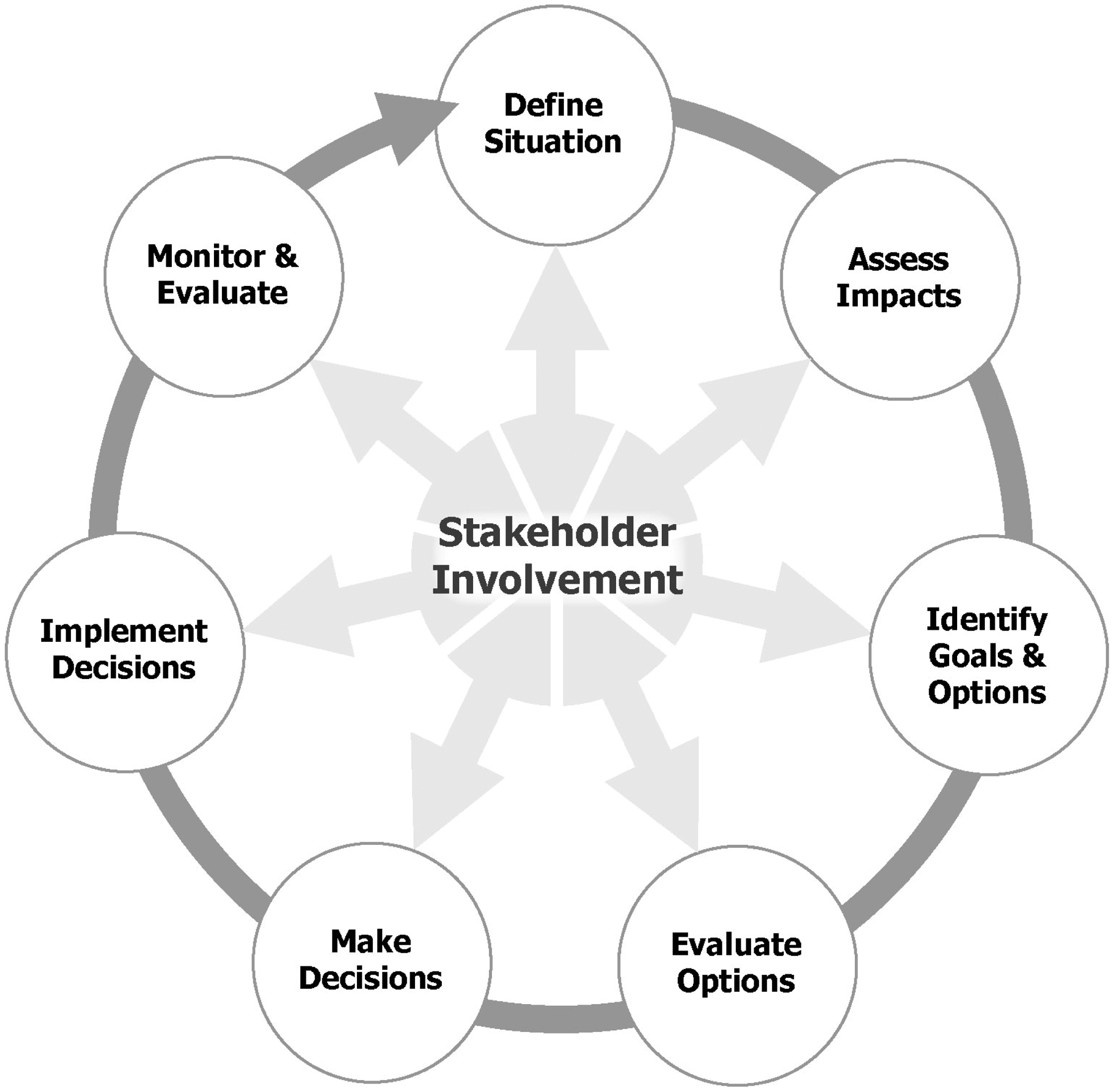
3.1. Define situation
Establishing an accurate and detailed characterisation of the contamination and presenting it in an understandable manner is an important element to defining the situation. This includes determining the radionuclide composition of the deposit, its mobility, spatial variability, and location of hotspots. This process relies on monitoring and surveillance of buildings, pavements, infrastructure, parks, surface waters, soils, produce, livestock, and commodities. Other important aspects of defining the situation include establishing land use, population size, its distribution and composition, habits, and activities.
3.2. Assess impacts
Environmental monitoring data coupled with assessment models may be used to calculate projected doses to adults and children living in the affected area, taking their habits into account. The situation can be complex due to the involvement of multiple radionuclides, multiple surfaces and media, and multiple exposure pathways. When assessing impacts, focus should be on doses from the various exposure scenarios, not activity concentrations on (or in) various media. This is because the time and effort required for removing contamination beyond certain levels from everywhere does not automatically lead to a reduction in doses, and can generate unnecessarily large amounts of waste. The assessments must be realistic and take into account prevailing environmental conditions and the potential for elevated background radiation coming, for example, from direct shine from adjacent sites or contaminated objects such as trees. Local knowledge can play a critical role in the impact assessment process.
3.3. Identify goals and options
For a radiation emergency, the primary goal of the entire recovery process will be to develop an agreed strategy for returning areas affected by the emergency to a state as close as possible to that existing before the release of radioactivity, and the population to a lifestyle where the accident is no longer a dominant influence. It is important that the public participate fully in establishing the goals for recovery, be they based on radiological, economic, environmental, or other criteria. When setting radiological goals, it is important to establish how the level of radiological risk (dose) will be equated with measurable levels of radioactivity in the environment. Other goals of recovery may include targets for restoring businesses or for minimising waste generation.
There are many options available for managing recovery. Options may include controlling access, modifying individual behaviours, intervening in food production systems and drinking water supplies, or by decontaminating inhabited areas. Identification and selection of these options will depend on the goals of recovery; some options will be very effective at reducing doses but generate large volumes of waste for which no disposal route is available, and other options may be less effective but provide reassurance to the population. In meeting different recovery goals, it may be necessary to reconcile options to optimise the overall recovery strategy.
3.4. Evaluate options
Evaluation of options involves scrutinising their key attributes to decide whether the agreed goals for recovery can be met. This should be carried out at the local level and in conjunction with stakeholders. Key attributes include: effectiveness, feasibility, capacity, time scales of implementation, constraints (legal, societal, and environmental), waste generation, doses to implementers, costs, societal impact, and acceptability to stakeholders. To assist in comparison between options and for selecting and combining options, datasheets such as those published in the UK Recovery Handbooks for Radiation Incidents (HPA, 2009) can be used to record information systematically on key attributes of each recovery option. Various techniques, such as cost benefit and multi-attribute analysis, are available to assist the evaluation of options that should take place in conjunction with stakeholders.
3.5. Decision making
Unlike emergency situations, where prompt response towards triaging the incident is an over-riding consideration, more time can be expended in the late phase to develop comprehensive and effective schemes for involving stakeholders in decision making. No matter how valid the recovery strategy, or how well the science has been conducted, if it is not accepted by the stakeholders, it will fail. Considerations should include issues that are specific to local and regional needs, including cultural and ethnic sensitivities, applicability of existing policies and legislation, and requirements for the development and trialling of appropriate decontamination technologies. The discussions should involve the citizens of the affected communities.
3.6. Implementation
Once decisions have been reached regarding the recovery strategy, implementation must be accompanied by documentation on the basis and rationale for the decisions (including prioritisation for recovery options), and there must be communication of the decision to stakeholders, including the programme of implementation, the technologies that will be used, criteria by which their success will be evaluated, and the relevant time scales. The entire decision process and resulting recovery plan must maintain transparency throughout. It is important that the recovery plan is sufficiently flexible to allow adjustments and improvements to be made during implementation. Sometimes, technologies are new or under development and have to be trialled on a small scale before consideration and approval is given for their wider application.
3.7. Monitor and evaluate
A long-term monitoring programme is a key element to evaluating the success of the recovery strategy. It is recommended that various measurable milestones for recovery are established and agreed with input from the community; these may include short- to medium-term targets for projected dose; restoration of utilities, transport infrastructure, local businesses, agricultural production, and tourism; and the transfer of waste to safe storage for managed disposal. These targets provide a means of monitoring and evaluating progress, and may assist in deciding when specific recovery activities can be scaled down. In addition to long-term monitoring of residual contamination in the environment, other public health objectives (e.g. referrals), economic indicators (e.g. employment statistics, numbers of hotel rooms filled), or environmental targets (volumes of waste) may be evaluated.
3.8. Challenges to optimisation
ICRP, NCRP, and other international organisations suggest that late-phase recovery from wide-area contamination is best managed through an iterative optimisation process whereby radiological criteria represent one of many factors that have to be taken into account when making decisions. Consequently, there are no pre-set clean-up goals, and the return to a new normality is guided by the priorities set by local communities who are actively involved in the entire process. This is in marked contrast to the current clean-up approach carried out under statutory regulatory provisions that focuses on radiological risk, precautionary decision making, and clean-up goals close to background. Although thorough and generally effective in many remediation situations, it requires a lengthy process and may take several decades to decontaminate a site (GAO, 2012). Such a protracted time frame is not conducive to a community’s expedient recovery to decent living conditions. Whilst some may oppose the concept of optimisation, it should be seen as a logical and practicable way forward for managing wide-area contamination, which will ensure balanced and timely recovery in a region affected by a serious nuclear or radiological event.
4. Recommendations
Eight recommendations to enhance and strengthen late-phase recovery from radiological or nuclear incidents for wide-area contamination have been proposed by NCRP; they suggest well-balanced consideration of factors for circumstances that go well beyond those experienced in conventional clean-ups. The recommendations are summarised below.
Develop a national strategy promoting community resilience. Integrate late-phase recovery into planning and ensure it is exercised. Embrace the optimisation paradigm for managing non-conventional wide-area contamination. Ensure that stakeholder engagement and empowerment underpin the optimisation process. Develop a communication plan as an integral part of the preparedness strategy. Develop adaptive and responsive policies including those for waste management. Conduct research and development to address the impact of wide-area contamination specifically. Establish a mechanism to integrate lessons learned from past incidents.
The recommendations are considered to be applicable to all types of nuclear or radiological incidents, be they associated with nuclear accidents or malevolent acts. Central to the recommendations is the need to further develop approaches and methods that can be implemented on an incident and site-specific basis. Such activities are vital to the preparedness for any future events.
5. Conclusions
Given the potentially large magnitude of impacts caused by a nuclear or radiological incident, it has been recognised that the traditional, statutory approach to long-term recovery, and specifically to the remediation and clean-up of contaminated areas, may not be feasible due to the magnitude of issues involved. NCRP has proposed a framework for optimisation that provides a balanced approach to addressing complex issues typical of late-phase recovery in a nuclear or radiological incident that may involve wide-area contamination. The framework, which builds on the guidance published by ICRP, is underpinned by stakeholder involvement, and balances the protection of human health against the available resources, business and economic targets, waste management, and societal needs.