



Abstract
The Nuclear Energy Agency organised its third workshop on ‘Science and values in radiological protection’ in November 2012 in Tokyo. One of the issues addressed, non-cancer effects, had also been addressed in the first two science and values workshops (Helsinki, Finland, 2008; Vaux-de-Cernay, France, 2009), but presented several new elements of relevance to International Commission on Radiological Protection discussions of the evolution of the system of radiological protection. Radiological protection science, both epidemiological and biological, now suggests that stroke and heart disease may well be caused by radiation exposure at doses of the order of 0.5 Gy or less. Further, it is possible that such detriments may be caused by either chronic or acute exposures. While significant uncertainties remain, the need to consider non-cancer detriment in risk assessment and in the development of protection strategies is now a significant scientific and ethical question. This paper will present the results of the Nuclear Energy Agency science and values workshop discussion of non-cancer risks, and of the questions and possible future directions raised during the workshop.
1. Introduction
Radiological protection was founded on, and continues to be, a combination of science and value judgements. As described by Lauriston S. Taylor, 1 radiological protection is ‘… not only a matter for science. It is a problem of philosophy, and morality, and the utmost wisdom’ (Taylor, 1957). In the development of radiological protection policy and its practical application, there is always a need for radiological protection policy makers, practitioners, and other stakeholders to better understand the evolving interactions between science and values. At the same time, there is a need for radiological protection scientists to better understand the broad processes of radiological protection decision-making and to better interact with these processes, particularly by providing input from their research. Rolf M. Sievert, the Swedish physicist who laid the foundations of modern radiation physics, clearly expressed the dynamic link between policy, research, and application: ‘The establishment of maximum permissible radiation levels is a non-scientific task, which must be based primarily on scientific knowledge and judgment’ (Sievert, 1958).
Achieving a mutual understanding among radiological protection policy makers, practitioners, researchers, industry, and non-governmental organisations is expected to facilitate the prioritisation of research and the framing of decision-making in the future, and to improve the quality and robustness of radiological protection.
The Committee on Radiation Protection and Public Health (CRPPH), a standing technical committee of the Organisation for Economic Co-operation and Development (OECD)/Nuclear Energy Agency (NEA), has long been aware of the need to develop a shared understanding of emerging challenges for radiological protection among scientific and regulatory communities, and other concerned stakeholders. The CRPPH expert group on the implications of radiological protection science published a report in 2007 on ‘Scientific issues and emerging challenges for radiological protection’ (OECD/NEA, 2007a). This report represents a broad summary of key scientific challenges that could arise from on-going research on radiological protection. Additionally, the CRPPH expert group on the collective opinion published its report on ‘Radiation protection in today’s world – towards sustainability’ (OECD/NEA, 2007b). The report identifies key emerging challenges to the radiological protection system in order to assist decision makers at all levels to better address these within their relevant contexts.
In follow-up to these activities and in response to the existing need to foster mutual understanding among all stakeholders concerned, the CRPPH initiated a longer-term process of reflection on scientific and societal issues that might challenge radiological protection in the coming decade. The first step in this process was a workshop organised in collaboration with the Radiation and Nuclear Safety Authority of Finland to address some of these issues. This workshop, entitled ‘Science and values in radiological protection’, took place from 15 to 17 January 2008 in Helsinki, Finland (OECD/NEA, 2011). At this workshop, more than 60 scientists, researchers, representatives of regulatory authorities, and political decision makers from 22 countries (including countries that are not members of the OECD) met to discuss new trends in radiological protection.
A second workshop in the series was then organised in collaboration with France’s IRSN (Institut de radioprotection et de sûreté nucléaire) and sponsored by the French Ministry of Ecology, Energy, Sustainable Development, and Land-use Planning. This second science and values workshop took place from 30 November to 2 December 2009 in Vaux-de-Cernay, France (OECD/NEA, 2011). More than 70 participants from 19 countries (European countries, Argentina, Canada, Chinese Taipei, Japan, Korea, and the USA) attended this workshop.
As a result of these two meetings, the CRPPH recognised that mutual understanding of scientific evidence and radiological protection values and practice is important both for obtaining optimal protection and for identifying the gaps in knowledge that are most relevant for radiological protection. Most of the participants at both science and values workshops agreed that while there is no immediate need to change the current principles, extended dialogue among all concerned stakeholders is necessary in order to facilitate the integration of challenging scientific phenomena into existing regulatory frameworks. This type of exchange forum between regulators and scientists was welcomed, and could serve as a model way of moving forward.
As such, and in view of the significant social concerns following the Fukushima accident, the CRPPH agreed to hold a third science and values workshop in Japan, co-organised by the Japanese Nuclear Regulation Authority, the Japanese Ministry of Education, Culture, Sports, Science, and Technology, and the Japanese National Institute of Radiological Sciences (OECD/NEA, 2013). In this workshop, 134 participants from 16 countries came together to share their experiences, knowledge, and issues, and to provide recommendations to further enhance radiological protection. The workshop benefitted from the active and devoted participation of a spectrum of stakeholders, including local Fukushima Prefecture residents and leaders, journalists, physicians, and radiological protection professionals.
Breakout session topics addressed in each science and values workshop.
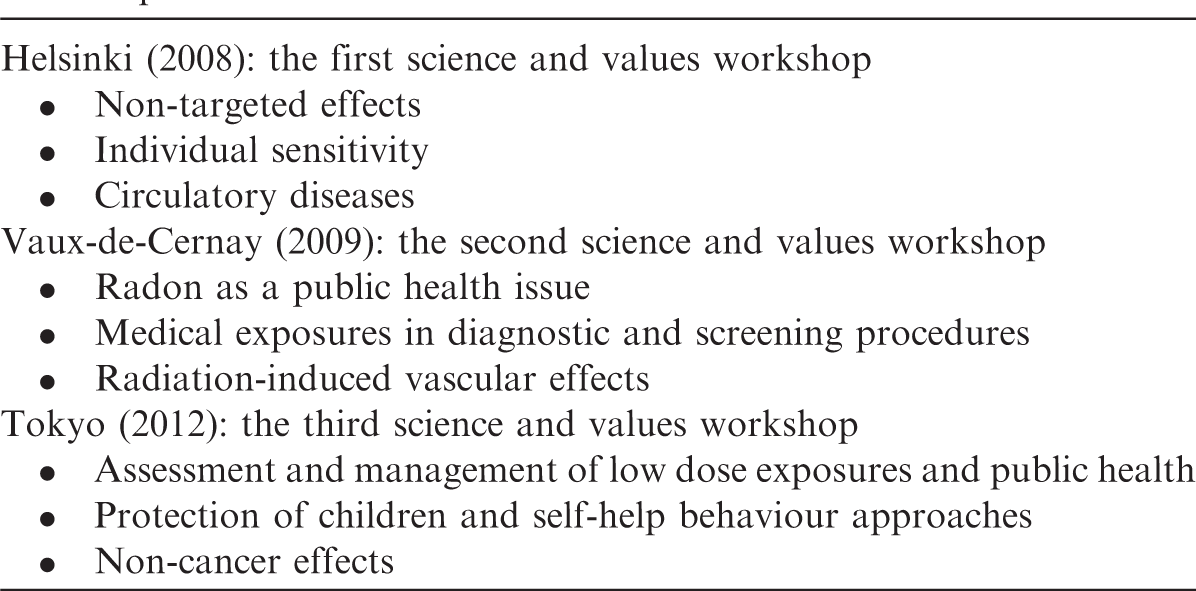
In all three workshops, the topic of non-cancer effects was addressed, although with an evolving name. In the first science and values workshop it was called ‘circulatory diseases’, in the second science and values workshop, it was called ‘radiation-induced vascular effects’, and in the third science and values workshop, it was called ‘non-cancer effects’. In spite of the changing title used for this topic, there is a clear line of evolution of scientific understanding and of values consideration in this topic. These workshops are summarised in two NEA publications (OECD/NEA, 2012, 2013).
2. Workshop results
The three workshops showed similar results with respect to non-cancer diseases. There was broad agreement on the existence of clear epidemiological evidence of radiation-induced non-cancer effects above 0.5 Gy, and that the evidence is inconclusive at lower doses. It was also recognised that radiation-induced non-cancer effects are not specifically addressed by the system, at present, but may have significant impacts on the assessment of morbidity and mortality. However, from 2008 to 2013, there was significant advancement of scientific understanding in the areas of epidemiology and radiation biology, which was reflected in the evolution of the workshop findings and conclusions over this period.
2.1. The Helsinki workshop
The first science and values workshop concluded that if available Japanese risk estimates and the assumption of a linear non-threshold imply potential changes in radiological protection principles in relation to non-cancer effects, there may be a significant need for revision of protection criteria. The radiological protection system is risk-informed, not risk-based, and the main emphasis is on individual dose restrictions. As an indication, including non-cancer effects in risk estimates may suggest that current dose limits be lowered by 30–50%. It was noted that application of the precautionary principle in judging whether or not to modify existing radiological protection criteria should include not only assessment of the change in detriment, but also assessment of the costs and other consequences that such a change would cause. The breakout session recognised that any potential change should be made in the light of evolving science and rigorous value judgements.
2.2. The Vaux-de-Cernay workshop
The second science and values workshop took these conclusions a step further, proposing that, given the strengthening evidence base from epidemiological studies and research on mechanisms, the policy implications of radiation-induced vascular effects should be given much more serious consideration – or, if previously considered, these policy implications should be fully and appropriately acted upon.
Further studies (on both mechanisms and epidemiology) were being undertaken on the potential link between radiation exposure and vascular disease, particularly for exposure to chronic and low exposures. More information was emerging and circulating, thereby increasing professional awareness of this issue. Critical reviews were being made of the existing data and literature, and investigations were being made of plausible biological mechanisms. Regulators were increasingly becoming aware of the challenges raised by this new knowledge, and were reflecting on its potential implications for the current protection system.
Notwithstanding the above, questions were raised as to whether enough was being done, and sufficiently quickly given the apparent and increasing strength of the epidemiological evidence (particularly for chronic exposures where increased risks have been observed for accumulated exposures in the range of 0.1–0.5 Gy). Some felt that under the circumstances, a more proactive response was needed from the radiation protection community; others argued for a more measured approach, pending the development of a stronger evidence base and, in particular, the establishment of a causal relationship, or plausible mechanism, for the induction of vascular diseases following chronic or low dose exposures. It was widely recognised by participants that value judgements would inevitably have a major role to play in the development of an evidence-based policy.
Pending further developments (particularly clarification of, or progress on, the various issues listed above), a number of actions were identified that could, in the interim, mitigate the impact of radiation-induced vascular disease (assuming its occurrence following exposure to low and/or chronic doses were to be confirmed). These included the following:
2
giving even more emphasis to optimisation; adopting dose constraints for organs (e.g. in the Radiation Protection and Safety of Radiation Sources: International Basic Safety Standards; General Safety Requirements Part 3); and giving greater attention to doses accumulated over a lifetime.
The evidence base for the induction of vascular diseases from exposure to high acute doses of radiation was then well established, and was already influencing clinical practice (e.g. in radiotherapy of the breast). This knowledge and changing clinical practice do, however, need to be disseminated more widely. It is necessary to foster greater awareness in medical personnel of the importance of minimising the exposure of the heart when it is in the vicinity of the organ of tissue being irradiated during radiotherapy.
2.3. The Tokyo workshop
The third science and values workshop proposed that new epidemiological evidence (here, the reference is to new studies of the Mayak populations) suggests that chronic exposure at levels as low as 500 mSv may cause a small excess risk of stroke and heart disease. A cautious attitude is needed in the interpretation of epidemiological studies because of confounding factors (smoking and drinking habits, etc.). There are many models in the literature that have been tested in order to derive a dose incidence function. According to some experts, the most appropriate model may be a logistic curve, but this has not been used thus far for radiation protection purposes.
Current biological understanding of radiation effects provides mechanisms that might apply at different dose ranges. A better understanding of these mechanisms is still needed, and it would be helpful in deriving the most appropriate dose response function.
Based on current knowledge, it seems relevant to address the issue of non-cancer effects within the system of radiation protection. The system, as provided by ICRP, will, of course, not change immediately; time is needed for a shared reflection to clarify the issue. Additionally, it seems that the system is robust enough that major conceptual changes are not expected.
In order to ensure that ethical values are fully applied, the issue of the detriment due to deterministic effects must be clarified. This must be achieved in close co-operation with experts from the radiation protection community and from all fields. Breakout session participants recommended that ICRP should set up a task group devoted to assessment of the detriment associated with tissue reactions (deterministic effects) produced by radiation exposures.
As there are still uncertainties regarding epidemiology as well as radiobiology, it was recommended that research efforts should be maintained in order to improve knowledge and decrease uncertainties.
Based on scientific studies, at the time of the third science and values workshop, there appeared to be more information on non-cancer effects than was available on cancer effects in 1966. A delicate remaining question, if non-cancer effects are to be considered in the radiation protection system, is the issue of imputation. What are we going to say in 10 years to a Fukushima worker who develops a cardiovascular disease? What about people who are chronically exposed in contaminated territories? Therefore, the workshop recommended the re-evaluation of the consequences of the new scientific findings for non-cancer effects in the radiation protection system provided by ICRP.
A final recommendation was made for ICRP to use common language when undertaking this re-evaluation.
3. Conclusion and recommendations
The three science and values workshops represent a significant evolution of thinking with regard to how the radiological protection framework addresses non-cancer effects.
3.1. Moral challenge
Publication 9 (ICRP, 1966) justified its use of protective measures by stating:
The mechanism of the induction by radiation of leukaemia and other types of malignancy is not known. Such induction has so far been clearly established after doses of more than 100 rads [1 gray], but it is unknown whether a threshold dose exists below which no malignancy is produced. […] As the existence of a threshold dose is unknown, it has been assumed that even the smallest doses involve a proportionately small risk of induction of malignancies. […] The Commission is aware that the assumptions of no threshold and of complete additivity of all doses may be incorrect, but is satisfied that they are unlikely to lead to the underestimation of risks.
3.2. What are we doing now?
As part of addressing this moral challenge, there are many on-going aspects of study, including:
reinforcing scientific studies on non-cancer effects; increasing professional awareness of non-cancer effects, particularly in the medical area, where patients can receive significant doses approaching or exceeding 0.5 Gy; critically reviewing existing data/literature; strengthening the evidence database from epidemiological studies, and continuing research on non-cancer disease mechanisms; challenging the features of the current radiological protection system in light of evolving science and value judgements; and investigating the policy implications that the inclusion of radiation-induced non-cancer disease in the system of radiological protection may have on regulation and application.
3.3. Remaining value questions
As part of the resolution of the moral dilemma posed by radiation-induced non-cancer effects, there are many value questions that will need to be addressed, and the responses to which will help set the direction for the resolution of the moral dilemma. For example:
How much additional risk is suggested by new studies? What are the implications of the additional detriment due to these effects? Is evidence sufficient to require further precaution in the radiological protection system for workers and for the general public, and in this context, how important is consistency given the precedent of cancer risk regulation? If radiation-induced non-cancer effects are to be taken into the system, how should this be accomplished in terms of the existing system and overall risk management?
3.4. Recommendations
In partial response to these questions, the science and values workshops have developed a few recommendations to assist in clarifying the situation.
The ‘detriment’ of an effect is defined as the total harm to health experienced by an exposed group and its descendants as a result of the group’s exposure to a radiation source (ICRP, 2007). In order to ensure that ethical values fully apply, there is a need to clarify the issue of the detriment due to deterministic effects. This must be achieved in close cooperation with experts from the radiation protection community and from all fields. As such, it is recommended that ICRP should create a task group on the detriment associated with deterministic effects. The time is approaching to review and report on this issue. In support of these efforts, there is a need for a synthesis of available knowledge, particularly radiobiology inputs, and for this, more assistance from the United Nations Scientific Committee on the Effects of Atomic Radiation would be helpful. There is a need to maintain research efforts in order to provide more reliable answers (e.g. decrease uncertainties) in terms of improved understanding of mechanisms, and of improved understanding of risks through epidemiological studies.
In terms of strengthening protection efforts now, before decisions on how to account for non-cancer effects are made, it is also recommended that more ways are found to spread the message of ICRP recommendations in the context of the wider range of safety issues in daily life, to appropriately apply the principle of the optimisation of protection.
Footnotes
1
Radiation physicist and pioneer in the field of radiation safety, founding member of both the International Commission on Radiation Units and Measurements and the International Commission on Radiological Protection (ICRP).
2
Also see the conclusions of the Article 31 group of experts following a European Union scientific seminar on ‘Emerging evidence for radiation induced circulatory diseases’ (EC, 2008). The group of experts, referred to under Article 31 of the European Atomic Energy Community treaty, provides the European Commission with an opinion on basic standards for health and safety.