




Abstract
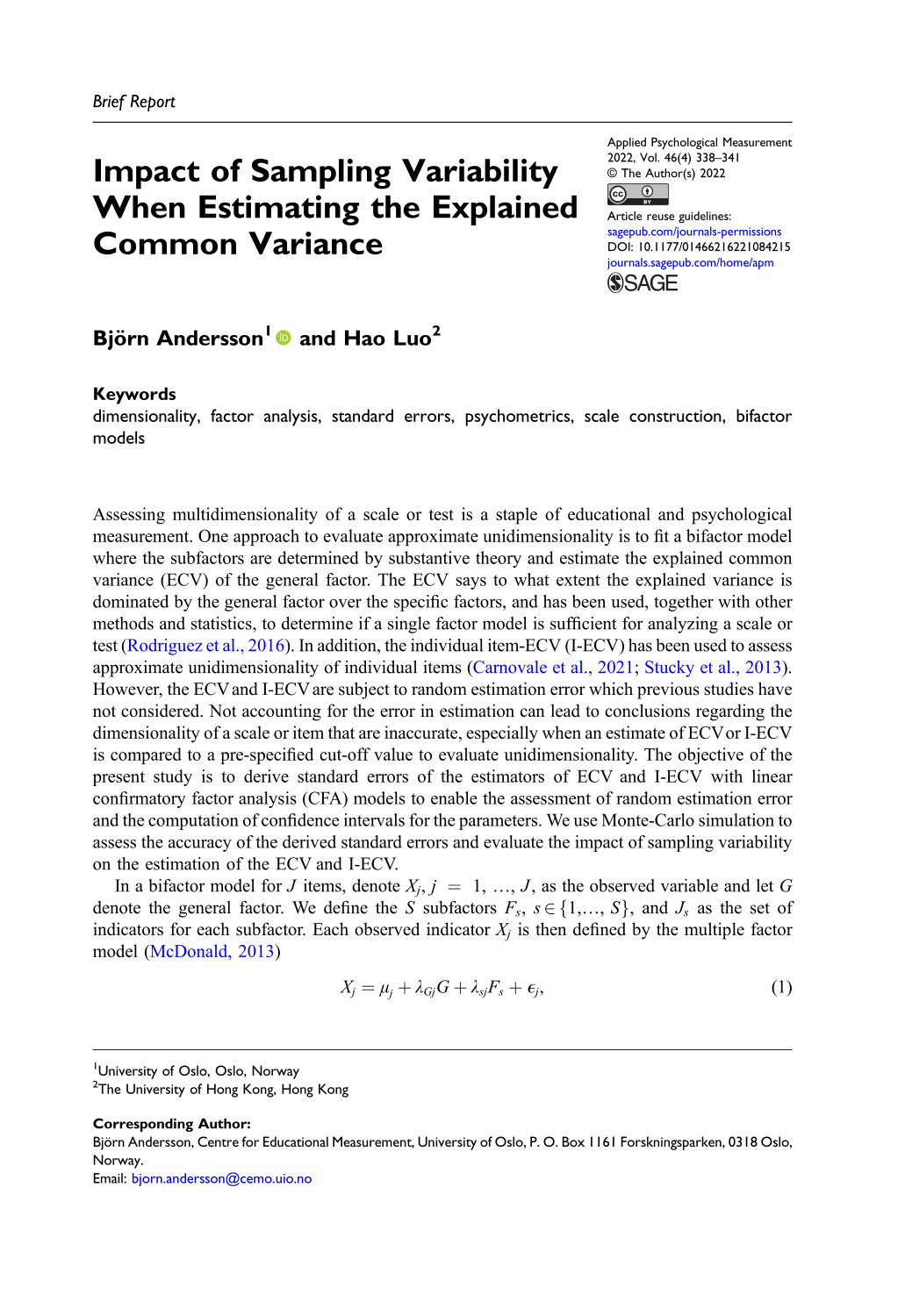
Assessing multidimensionality of a scale or test is a staple of educational and psychological measurement. One approach to evaluate approximate unidimensionality is to fit a bifactor model where the subfactors are determined by substantive theory and estimate the explained common variance (ECV) of the general factor. The ECV says to what extent the explained variance is dominated by the general factor over the specific factors, and has been used, together with other methods and statistics, to determine if a single factor model is sufficient for analyzing a scale or test (Rodriguez et al., 2016). In addition, the individual item-ECV (I-ECV) has been used to assess approximate unidimensionality of individual items (Carnovale et al., 2021; Stucky et al., 2013). However, the ECV and I-ECV are subject to random estimation error which previous studies have not considered. Not accounting for the error in estimation can lead to conclusions regarding the dimensionality of a scale or item that are inaccurate, especially when an estimate of ECV or I-ECV is compared to a pre-specified cut-off value to evaluate unidimensionality. The objective of the present study is to derive standard errors of the estimators of ECV and I-ECV with linear confirmatory factor analysis (CFA) models to enable the assessment of random estimation error and the computation of confidence intervals for the parameters. We use Monte-Carlo simulation to assess the accuracy of the derived standard errors and evaluate the impact of sampling variability on the estimation of the ECV and I-ECV.
In a bifactor model for

The explained common variance for CFA models is equal to (Rodriguez et al., 2016)

In the literature, it has been suggested that ECV values higher than 0.7 to 0.8 indicate sufficient unidimensionality of the scales to adopt a unidimensional model (Rodriguez et al., 2016). To further evaluate the unidimensionality of a specific item score, another statistic, the explained common variance of an item (

The ECV and


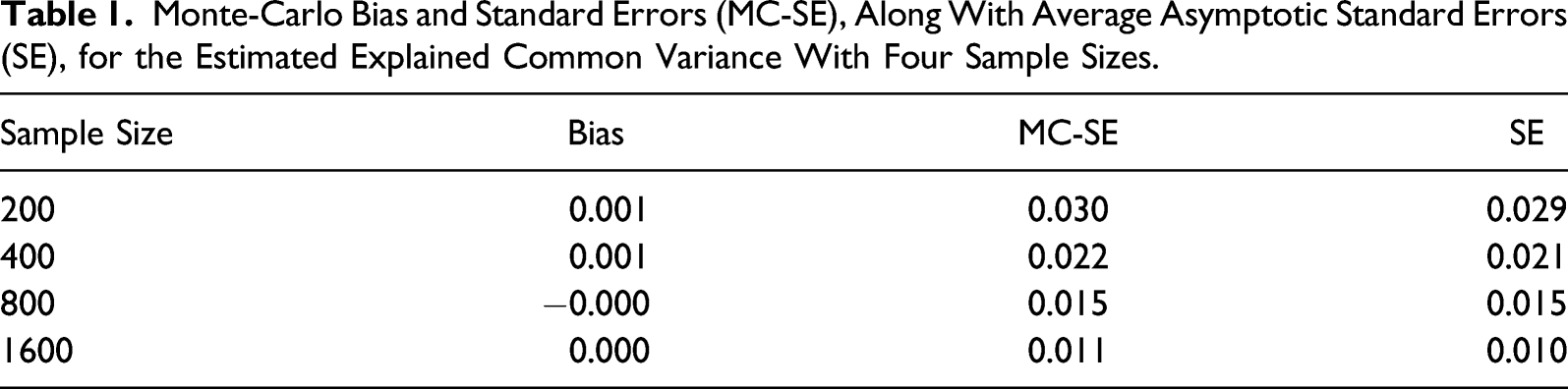
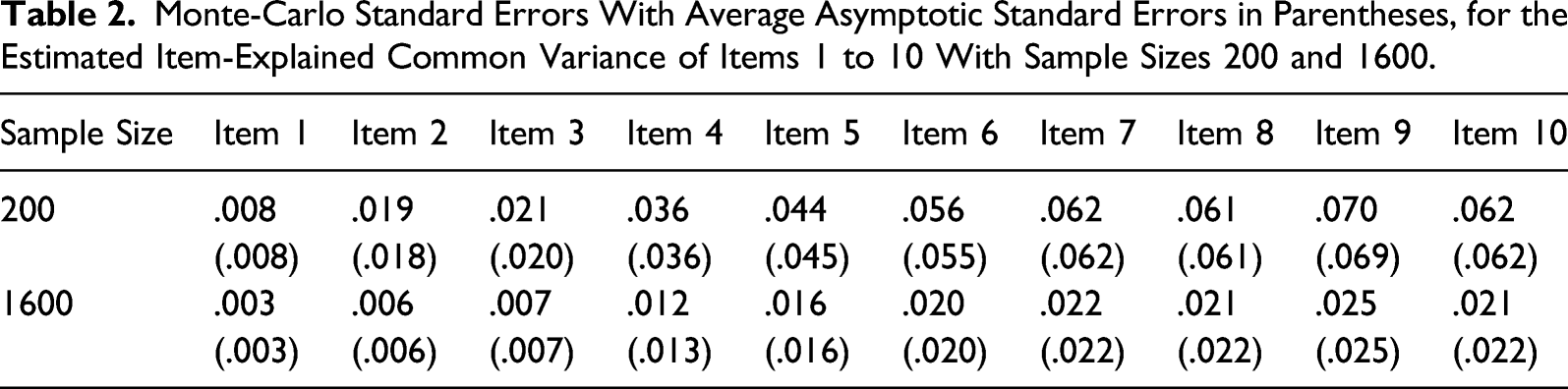
To assess the accuracy of the standard errors and illustrate the impact of estimation error for ECV and
Monte-Carlo Bias and Standard Errors (MC-SE), Along With Average Asymptotic Standard Errors (SE), for the Estimated Explained Common Variance With Four Sample Sizes.
Monte-Carlo Standard Errors With Average Asymptotic Standard Errors in Parentheses, for the Estimated Item-Explained Common Variance of Items 1 to 10 With Sample Sizes 200 and 1600.
Assessing approximate unidimensionality is commonly done as part of scale development in education and psychology and useful statistics like the ECV help in evaluating unidimensionality. However, this process should be complemented with an assessment of the random error associated with the statistics used. Just like the reporting of reliability coefficients should include standard errors or confidence intervals (Fan & Thompson, 2001), we argue that measures like the ECV and I-ECV should be reported together with an indication of the amount of random error. In this study, we presented a simple solution to assess estimation error for linear factor models and implemented the approach in R for use by interested researchers. Future studies can include the specific results for other statistics commonly used with bifactor models, such as the omega-total and omega-hierarchical coefficients.
Supplemental Material
sj-pdf-1-apm-10.1177_01466216221084215 - Supplemental Material - Impact of Sampling Variability When Estimating the Explained Common Variance
Supplemental Material, sj-pdf-1-apm-10.1177_01466216221084215 for Impact of Sampling Variability When Estimating the Explained Common Variance by Björn Andersson and Hao Luo in Applied Psychological Measurement
Footnotes
Declaration of Conflicting Interests
The author(s) declared no potential conflicts of interest with respect to the research, authorship, and/or publication of this article.
Funding
The author(s) received no financial support for the research, authorship, and/or publication of this article.

Supplemental Material
Supplemental material for this article is available online.
References
Supplementary Material
Please find the following supplemental material available below.
For Open Access articles published under a Creative Commons License, all supplemental material carries the same license as the article it is associated with.
For non-Open Access articles published, all supplemental material carries a non-exclusive license, and permission requests for re-use of supplemental material or any part of supplemental material shall be sent directly to the copyright owner as specified in the copyright notice associated with the article.
