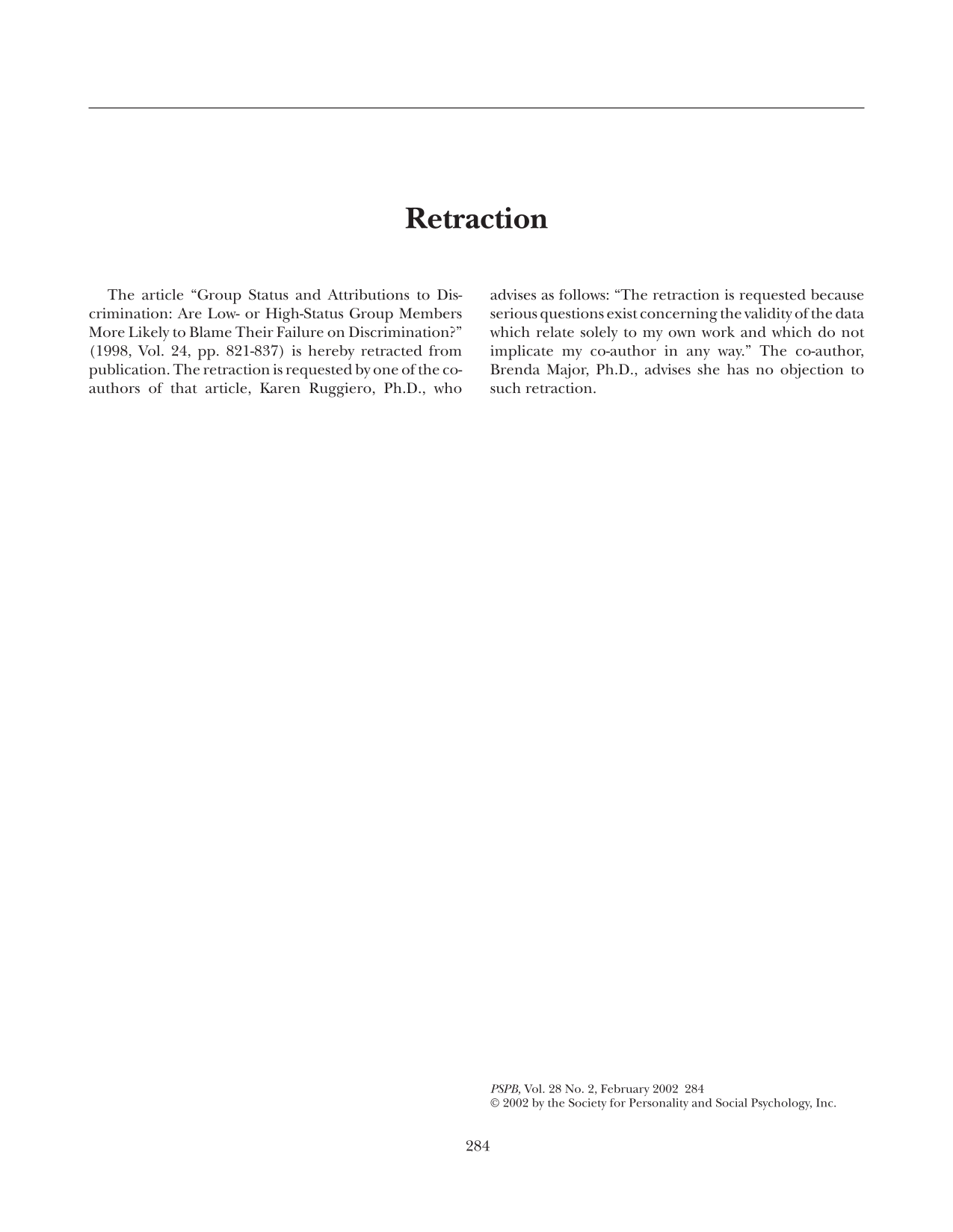
Retracted: Group Status and Attributions to Discrimination: Are Low- or High-Status Group Members More Likely to Blame their Failure on Discrimination?
Restricted accessResearch articleFirst published online August, 1998
Retracted: Group Status and Attributions to Discrimination: Are Low- or High-Status Group Members More Likely to Blame their Failure on Discrimination?
Alicke, M. D. (1985). Global self-evaluation as determined by
desirability and controllability of trait adjectives.
Journal of Personality and Social Psychology,
49, 1621-1630.
2.
Alicke, M. D. , Klotz, M. L., Breitenbecher, D. L., Yurak, T.J., & Vredenburg, D. S. (1995). Personal contact, individuation, and the
better- than-average effect. Journal of Personality and
Social Psychology, 68,
804-825.
3.
Aronson, E. , Brewer, M., & Carlsmith,J. M. (1985). Experimentation in social
psychology. In G. Lindzey & E. Aronson (Eds.), Handbook of social Psychology (2nd
ed., Vol. 1, pp. 441-486).
New York: Random
House.
4.
Baron, R. M. , & Kenny, D. A. (1986). The moderator-mediator variable
distinction in social psychological research: Conceptual, strategic, and
statistical considerations. Journal of Personality and
Social Psychology, 51,
1173-1182.
5.
Berger,J. , Fisek, M. H., Norman, R. Z., & Zelditch, M.Jr. (1977). Status characteristics and social interaction:
An expectation-states approach. New York:
Elsevier North-Holland.
6.
Bettencourt, B. A. , & Miller, N. (1996). Gender differences in aggression as a
function of provocation: A meta-analysis. Psychological
Bulletin, 119,
422-447.
7.
Brown,J. D. (1993). Coping with stress: The beneficial role
of positive illusions. In A. P. Turnbull,J. M. Patterson, S. K. Behr, D. L. Murphy, J. G. Marquis, & M.J. Blue-Banning (Eds.), Cognitive coping, families, and disability (pp.
123-133). Baltimore:
Brooks.
8.
Burger,J. M. , & Burns, L. (1988). The illusion of unique invulnerability
and the use of effective contraception. Personality and
Social Psychology Bulletin, 14,
264-270.
9.
Chodorow, N. (1978). The reproduction of mothering: Psychoanalysis
and the sociology of gender. Berkeley:
SAGE Publications.
10.
Conway, M. , Pizzamiglio, M. T., & Mount, L. (1996). Status, communality, and agency:
Implications for stereotypes of gender and other groups.
Journal of Personality and Social Psychology,
71, 25-38.
11.
Crocker, J. , & Major, B. (1989). Social stigma and self-esteem: The
self-protective properties of stigma. Psychological
Review, 96,
608-630.
12.
Crocker,J. , Voelkl, K., Testa, M., & Major, B. (1991). Social stigma: The affective consequences
of attributional ambiguity. Journal of Personality and
Social Psychology, 60,
218-228.
13.
Deaux, K. (1984). From individual differences to social
categories: Analysis of a decade's research on gender.
American Psychologist, 39,
105-116.
14.
Frieze, I. H. , Whitley, B. E., Hanusa, B. H., & McHugh, M. C. (1982). Assessing the theoretical models for sex
differences in causal attributions for success and failure.
Sex Rolk8, 333-343.
15.
Harris, D. M. , & Guten, S. (1979). Health-protective behavior: An
exploratory study. Journal of Health and Social
Behavior, 20,
17-29.
16.
Josephs, R. A. , Markus, H. R., & Tafarodi, R. W. (1992). Gender and self-esteem.
Journal of Personality and Social Psychology,
63, 391-402.
17.
Kirscht,J. F. , Haefner, D. P., Kegeles, S. S., & Rosenstock, I. M. (1966). A national study of health
beliefs. Journal of Health and Human Behavior,
7, 248-254.
18.
Lenski, G. E. (1966). Power and privilege: A theory of social stratif
cation. New York:
McGraw-Hill.
19.
Lerner, M. J. , & Somers, D. G. (1992). Employees' reactions to an anticipated
plant closure: The influence of positive illusions. In L. Montada, S. H. Filipp, & M.J. Lerner (Eds.), Life crises and experiences of loss in adulthood
(pp. 229-253). Hillsdale,
NJ: Lawrence
Erlbaum.
20.
Maccoby, E. E. , & Jacklin, C. N. (1974). The psychology of sex differences.
Stanford, CAStanford University Press.
21.
Major, B. , Barr, L., Zubek, J., & Babey, S. (in press). Gender and self-esteem: A
meta-analysis. In W. B. Swann,J. H. Langlois, & L. A. Gilbert (Eds.), Sexism and stereotypes in modern society.
Washington, DC: American
Psychological Association.
22.
Major, B. , & Crocker, J. (1993). Social stigma: The affective consequences
of attributional ambiguity. In D. M. Mackie & D. L. Hamilton (Eds.), Affect, cognition, and stereotyping: Interactive processes in
intergroup perception (pp. 345-370).
New York: Academic
Press.
23.
Markus, H. R. , & Oyserman, D. (1989). Gender and thought: The role of the
self-concept. In M. Crawford & M. Gentry (Eds.), Gender and thought: Psychological perspectives (pp.
100-127). New York:
Springer-Verlag.
24.
Mayer, K. B. , & Buckley,W. (1970). Class and society (3rd
ed.). New York: Random
House.
25.
Miller, G. B. (1986). Toward a new psychology of women
(2nd ed.). Boston:
Beacon.
26.
Nicholls, J. G. (1975). Causal attributions and other
achievement-related cognitions: Effects of task outcome, attainment value and
sex. Journal of Personality and Social
Psychology, 31,
379-389.
27.
Parsons, J. E. , Ruble, D. N., Hodges, K. L., & Small, A. W. (1976). Cognitive developmental factors in
emerging sex differences in achievement-related expectancies.
Journal of Social Issues, 32,
47-61.
28.
Perloff, L. S. (1983). Perceptions of vulnerability to
victimization. Journal of Social Issues,
39, 41-61.
29.
Perloff, L. S. , & Farbisz, R. (1985, May). Perceptions of uniqueness and illusions of
invulnerability to divorce. Paper presented at the
annual Midwestern Psychological Association meeting,
Chicago.
30.
Perloff, L. S. , & Fetzer, B. K. (1986). Self-other judgments and perceived
vulnerability to victimization. Journal of Personality and
Social Psychology, 50,
502-510.
31.
Ridgeway, C. (1991). The social construction of status value:
Gender and other nominal characteristics. Social
Forces, 70,
367-386.
32.
Roberts, T. (1991). Gender and the influence of evaluations
and self-assessments in achievement settings.
Psychological Bulletin, 109,
297-308.
33.
Roberts, T. , & Nolen-Hoeksema, S. (1989). Sex differences in reaction to evaluative
feedback. Sex Roles, 1,
147-159.
34.
Ross, M. , Lepper, M. R., & Hubbard, M. (1975). Perseverance in self-perception and other
perception: Biased attributional processes in the debriefing
paradigm. Journal of Personality and Social
Psychology, 32,
880-892.
35.
Ruggiero, K. M. , & Taylor, D. M. (1995). Coping with discrimination: How minority
group members perceive the discrimination that confronts them.
Journal of Personality and Social Psychology,
68, 826-838.
36.
Ruggiero, K. M. , & Taylor, D. M. (1997). Why minority group members perceive or do
not perceive the discrimination that confronts them: The role of self-esteem and
perceived control. Journal of Personality and Social
Psychology, 72,
373-389.
37.
Ruggiero, K. M. , Schmader, T., Taylor, D. M., & Steele,J. (1998). W4hen discrimination is minimized: The role of
perceived control Manuscript submitted for publication.
38.
Shils, E. (1975). Center and periphery: Essays in
macrosociology. Chicago:
University of Chicago Press.
39.
Skaalvik, E. M. (1986). Sex differences in global self-esteem: A
research review. Scandinavian Journal of Educational
Research, 30,
167-179.
40.
Taylor, S. E. (1989). Positive illusions: Creative self-deception and
the healthy mind. New York:
Basic Books.
41.
Taylor, S. E. , & Brown, J. D. (1988). Illusion and well-being: A social
psychological perspective on mental health. Psychological
Bulletin, 103,
193-210.
42.
Taylor, S. E. , Kemeny, M. E., Aspinwall, L. G., Schneider, S. G., Rodriguez, R., & Herbert, M. (1992). Optimism, coping, psychological distress,
and high risk sexual behavior among men at risk for acquired immunodeficiency
syndrome (AIDS)-Journal of Personality and Social Psychology, 63,
460-473.
43.
Tyler, T. R. , & Lind, E. A. (1992). A relational model of authority in
groups. Advances in Experimental Social
Psychology, 25,
115-191.
44.
Weinstein, N. D. (1980). Unrealistic optimism about future life
events. Journal of Personality and Social
Psychology, 39,
806-820.
45.
Weinstein, N. D. (1982). Unrealistic optimism about susceptibility
to health problems. Journal of Behavioral
Medicine, 5,
441-460.
46.
Weinstein, N. D. (1984). Why it won't happen to me: Perceptions of
risk factors and susceptibility. Health
Psychology, 3,
431-457.
47.
Winer, B. F. (1971). Statistical principles in experimental
design (2nd ed.). New
York:
McGraw-Hill.
48.
Wylie, R. (1979). The serf-concept (Vol. 2).
Lincoln: University of Nebraska
Press.