




Abstract
The quest for authenticity is a potent existential striving. Commonly defined as knowing and living in accordance with one’s perceived “true self,” we propose that authenticity may also be inferred from ambient feelings of fluency, or the subjective feeling of ease that corresponds to one’s immediate experience, mental processing, or physical action. We report four studies (N = 1,465) supporting this idea. Study 1 shows that fluency during a recent activity predicts subjective authenticity beyond other relevant variables. Study 2 demonstrates that participants’ recalled fluent experiences also felt authentic. In Study 3, generating self-defining attributes under cognitive load reduced fluency and, subsequently, subjective authenticity. Finally, preregistered Study 4 manipulated fluency during a non-self-relevant task. Participants in the fluent condition reported greater subjective authenticity than those in the disfluent condition. We discuss how a phenomenological approach to subjective authenticity can integrate and complement recent theorizing about the nature of authenticity.
Introduction
Contemporary empirical research has defined authenticity as knowing and behaving in a way that is consistent with the true self (Kernis & Goldman, 2006; Wood et al., 2008). This conceptual leap, from the true self to authenticity has skipped over one important question; the question of how exactly someone comes to know the true self in the first place. How does one know that she is truly an academic at her core, and not a sailor or puppeteer? Authenticity is supposed to be predicated on this self-knowledge, and yet, despite people exhibiting variability in perceived access to their true selves (Schlegel et al., 2011) and sensing that the true-self is distinct from the regular self (Strohminger et al., 2017), the process by which people come to know who they really are is not well known.
Complicating matters further is that a defining feature of the perceived true self is that it exists independent of one’s outward behavior (Schlegel et al., 2011; Trilling, 2009). If one cannot consistently rely on their own behavior as a valid indicator of their true selves, on what foundation is the true self-concept built? A pessimistic response is that there is no foundation at all; that the self is merely tossed into the flux of existence with nothing to grasp (thrownness/Geworfenheit; Heidegger, 1927/1962), giving the experience of selfhood a quality of self-alienation (Seeman, 1959). A more optimistic view is that, despite this experience of thrownness, we have developed cognitive strategies for giving the self a form where none really exists. For instance, common metaphors for the true self borrow the concreteness of physical entities (Landau et al., 2011) and routine experiences of discovery and creation (Bench et al., 2015; Schlegel et al., 2012) to give the self some comprehensible structure. The experience of authenticity from a traditional standpoint, is a top-down process—a person starts with a concept of what the true self is (using metaphors and narratives, for instance), and then reasons about what personal experiences are authentic or not. This top-down approach is captured in the State Authenticity as Fit to Environment (SAFE) model (Schmader & Sedikides, 2018), which posits that perceived alignment between personal characteristics (e.g., identities, values, or goals) and environmental features elicit state authenticity. Implicit in this model is the assumption that self-knowledge enables individuals to interpret environmental fit, which in turn elicits authenticity.
Given that one’s concepts and categories are, to a large degree, determined by forces outside of one’s control (e.g., culture; Markus & Kitayama, 2010), this approach to authenticity is inherently problematic if one remains committed to the definition of the true self as independent of external influence. Considering the known limits to humans’ self-reflection and introspection abilities (Nisbett et al., 2001), it seems rather difficult—if not impossible—that one could separate those features of the self that are truly theirs, from those that are culturally ingrained, situationally activated, and so on (Baumeister, 2019).
For these reasons, some have concluded that the true self is most probably a myth (Baumeister, 1999). And yet, “people recognize authenticity when they experience it” (Schmader & Sedikides, 2018, p. 3). What is it exactly that people experience when they feel authentic? In the current research, we suggest that authenticity is a state that partially depends on momentary feelings of fluency—the subjective feeling of ease with which a perceptual, cognitive, or behavioral process is carried out. Thus, we take the view that authenticity is (at least in part) a bottom-up phenomenological process. We further suggest that this process may help explain how people come to identify features of their avowed true selves.
Fluency and Authenticity
Traditional views of authenticity take an ontological approach, portraying the true self as a knowable entity that, once discovered, can guide behavior (Kernis & Goldman, 2006; Wood et al., 2008). In contrast to this perspective, more recent research has approached authenticity from a phenomenological point of view by defining it as a state or experience that is more-or-less in constant flux (Sedikides et al., 2017). In support of this view, one experience sampling study showed that within-participant variability in feelings of authenticity was greater than between-participant variability (Lenton et al., 2016). Moreover, it has been shown that people on either extreme of the trait authenticity continuum have experienced both feelings of authenticity and inauthenticity in their daily lives (Lenton, Bruder, et al., 2013), suggesting that feelings of authenticity vary widely across situations. This is the first step toward a phenomenology of authenticity, but what features of the situation are responsible for this feeling?
We propose that fluency is one key answer to this question. Fluency is the subjective feeling of ease when carrying out perceptual, cognitive, and behavioral tasks. Feelings of fluency can arise independently of any existing self-knowledge (Hicks et al., 2026; see also Vess, 2019 for a treatment of owning one’s phenomenological experience). That is, the experience of fluency may serve as an experiential cue for people’s inferences about who they are, their values and goals, and their relationships, and thus can be the source of authentic feelings. We focus particularly on related feelings of familiarity, truth, and pleasantness as properties of fluent experiences that suggest fluency should make experiences feel authentic.
Familiarity
Experiences that are fluent often feel familiar. For instance, words that are written in an easy-to-read font are judged as more familiar than those in harder-to-read fonts (Reber & Schwarz, 1999). Non-words that follow a regular form are judged as more familiar than those that do not follow a regular form (Whittlesea & Williams, 1998). Words feel more familiar if they have been primed by a semantically related word previously, and events that are easy to imagine feel more likely to occur than those that are difficult to imagine (Whittlesea, 1993).
We suspect that these feelings of familiarity can make a situation feel authentic and even shape the true self-concept. The features of the self that are seen as defining who one “truly” is are likely those selected from fluent experiences. For example, believing one is truly an actor likely stems from repeated fluency—and thus feeling of familiarity—when processing acting-related information. This fluency could come from the ease of movement while performing, easily processed media portrayals, or daydreams about acting in the absence of mental effort. Fluency gives certain self-features a feeling of familiarity, granting them the privilege of being called the true self.
From this view, even new, random, or contradictory experiences and cognitions can feel authentic, to the extent that incidental experiences feel fluent. For instance, a sudden thought about becoming an actor may feel fluent to the extent that such thoughts were primed by a commercial on television. The fluency of that thought can create the illusion that one has always wanted to act (an illusion of familiarity), and consequently, that becoming an actor is an authentic pursuit. This process can occur even if being an actor is not a part of one’s current self-concept.
Truth
Experiences that are fluent often feel true. For instance, statements that are presented in easy-to-read fonts are rated as more true (Reber & Schwarz, 1999), short proverbs are judged to be more true when they rhyme (McGlone & Tofighbakhsh, 2000), and repeated or previously seen statements are judged to be more true (Dechêne et al., 2009). On this view, people will tend to privilege fluent attributes, cognitions, and experiences as being true of themselves. Returning to the previous example, the subjective fluency accompanying a spontaneous (but previously primed) thought about becoming an actor may serve as a cue that one was made to become an actor—that being an actor is one’s true nature—and consequently, that becoming an actor is an authentic pursuit. This process can occur even if being an actor is not a part of one’s current or avowed true self-concept.
Pleasantness
Experiences that are fluent feel good. Broadly speaking, hedonic or aesthetic responses to stimuli are grounded in the processing fluency of the stimuli themselves. For instance, pictures are experienced more pleasantly to the extent that they are processed fluently (Reber et al., 2004). Viewing pictures that have been primed with similar visual contours leads to smiling (Winkielman & Cacioppo, 2001). Products and brands are liked more when they are primed by related concepts (Lee & Labroo, 2004). Prototypical images (faces and random dots) are processed more fluently and subsequently judged to be more attractive (Winkielman et al., 2006).
The link between authenticity and pleasantness has similarly been established in multiple studies. For example, positive mood inductions causally impact authenticity judgments (Lenton, Slabu, et al., 2013). Self-enhancing feedback, which feels good, has also been strongly linked to authenticity judgments (Guenther et al., 2023) as has imagining engaging in socially desirable behaviors (Garrison et al., 2023; Jongman-Sereno & Leary, 2016). Likability also serves as a cue to the authenticity of others (Rivera et al., 2025), further reinforcing the idea that people believe things that are pleasant are more likely to be authentic. Thus, fluency-induced pleasantness may serve as an indicator of authentic feelings because feeling good typically feels authentic. Consider one more example of the aspiring actor. The subjective fluency accompanying a spontaneous thought about becoming an actor may make the goal of becoming an actor feel good, and consequently, that becoming an actor is an authentic pursuit.
In sum, authenticity is often conceptualized as accessing and expressing the true self. In contrast, our perspective is that the true self is not something people always have immediate and direct access to, and as such, authenticity must be partially inferred from momentary feelings. When an experience is fluent, it can feel familiar, true, and good, and so people assume that it is reflective of who they really are inside.
The Present Research
In the present research, we examine the relationship between perceived fluency and subjective authenticity. Study 1 examined the positive link between naturally occurring feelings of fluency and subjective authenticity in a recent experience. Study 2 tested whether recalled experiences of fluency are also perceived as authentic. Study 3 tests whether manipulated fluency while generating self-defining attributes influences subjective authenticity. Finally, preregistered Study 4 examines whether experienced fluency completing a creative task influences feelings of authenticity during the task, regardless of creative self-identification. All data and materials can be found in our OSF file. 1
Study 1: Fluency and Authenticity in Daily Life
Study 1 used a one-shot experience-sampling paradigm to assess participants’ experience of fluency and authenticity in their recent actions. Prior research has shown that authenticity varies greatly from situation to situation (Lenton et al., 2016). Could feelings of fluency explain variation in subjective authenticity during even routine daily action? In Study 1, participants reported their most recent activity and its perceived fluency. We expected momentary fluency to predict subjective authenticity, over and above other known predictors of authenticity such as importance of the activity (Lenton, Bruder, et al., 2013), affect (Lenton, Slabu, et al., 2013), and intrinsic and extrinsic motivation (Van den Bosch & Taris, 2018).
Participants
Because this was an exploratory study with uncertain effect sizes, we aimed to recruit 400 participants to maximize statistical power within our resources. In 2017, we recruited 402 participants through Amazon Mechanical Turk (MTurk), each compensated $0.50. A G*Power (Faul et al., 2007) sensitivity analysis determined that our study was adequately powered to detect small-to-medium and larger effects (f² = 0.03). Due to a programming error, demographic data were not collected; however, typical MTurk samples at the time were predominately White, mostly women, and averaged 25 to 34 years old (Moss, n.d.). 2 This study was not preregistered.
Procedure
Participants were first told that this online study was about personality and personal experiences. They were asked to reflect on the most recent activity they engaged in within the past 10 min and to provide a short description of that activity in a text box before completing the measures listed below.
Measures
Activity
Participants first described an activity and indicated whether the activity was related to work, leisure, or “other,” and responded to two items assessing the activity’s personal importance on a 5-point scale (importance: 1 = “not at all” to 5 = “extremely”; M = 3.56, SD = 1.11). Participants reported activities were generally evenly distributed between work (31%), leisure (38%), and other (31%).
Fluency
Participants responded to seven items generated by the research team about how “fluent and natural” the activity felt (e.g., “I felt at ease while doing that activity”) on a 7-point scale (1 = “strongly disagree” to 7 = “strongly agree”; M = 5.75, SD = 0.82, α = .75). 3
Authenticity
Participants completed the Authenticity Scale by Wood et al. (2008) considering how they felt “right now.” Subscales of authentic living (e.g., “I think it is better to be yourself than to be popular”; M = 5.77, SD = 0.82, α = .80) and self-alienation (reverse scored; e.g., “I don’t really know how I feel inside”; M = 2.34, SD = 1.28, α = .91) were averaged together to create the main authenticity score (M = 5.71, SD = 0.93, α = .88).
Motivation
Participants indicated why they performed the activity, rating four items for intrinsic motivation (e.g., “Because I think that the activity is interesting”; M = 4.12, SD = 1.77, α = .90) and four items for extrinsic motivation (e.g., “Because I am supposed to do it”; M = 4.33, SD = 2.04, α = .92) on a 7-point scale (1 = “very little or not at all” to 7 = “very much”).
Affect
Current affect was assessed with nine items on a 7-point scale (1 = “very little or not at all” to 7 = “a great deal”), including six negative emotions (i.e., uncomfortable, uneasy, bothered, angry, disgusted, annoyed; M = 1.50, SD = 0.95, α = .92) and three positive emotions (i.e., happy, good, energetic; M = 4.70, SD = 1.53, α = .88),
Results
Bivariate correlations (see Table 1) indicated that perceived fluency was significantly positively associated with subjective authenticity, such that those who rated the task as feeling more fluent also reported experiencing greater authenticity in the moment. We conducted a multiple linear regression analysis with Jamovi to examine whether perceived fluency during the task was associated with subjective authenticity, controlling for the other known predictors of authenticity we measured. As shown in Table 2, perceived fluency was a significant positive predictor of subjective authenticity while controlling for motivation, task importance, and positive and negative affect. This suggests that fluency is a robust predictor of subjective authenticity.
Bivariate Correlations of Study 1 Variables.
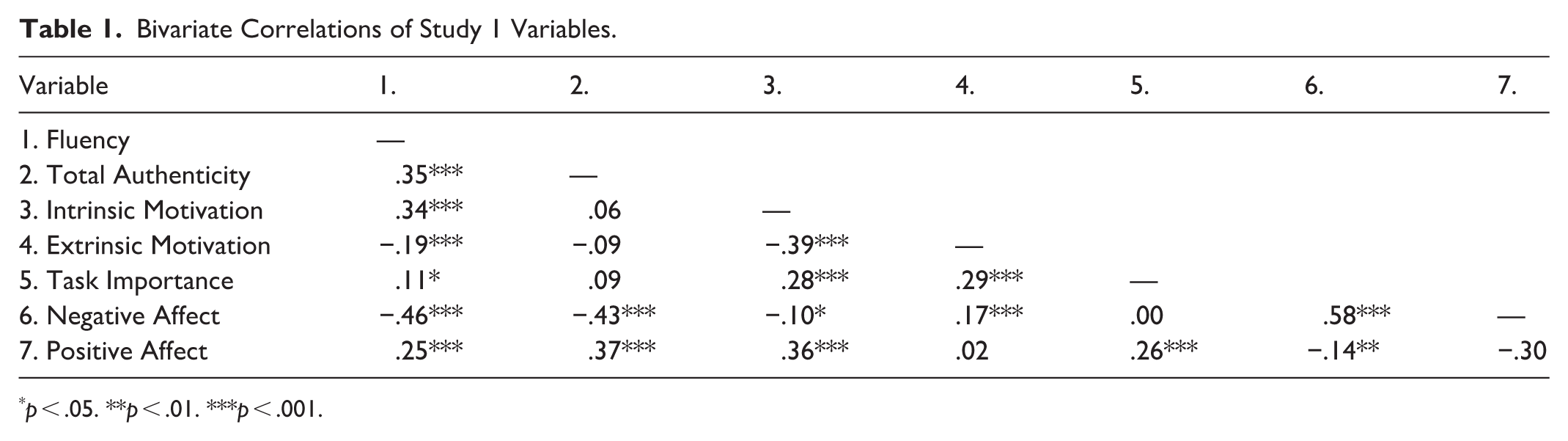
p < .05. **p < .01. ***p < .001.
Regression of Task Fluency Predicting Subjective Authenticity Controlling for Potential Confounds.
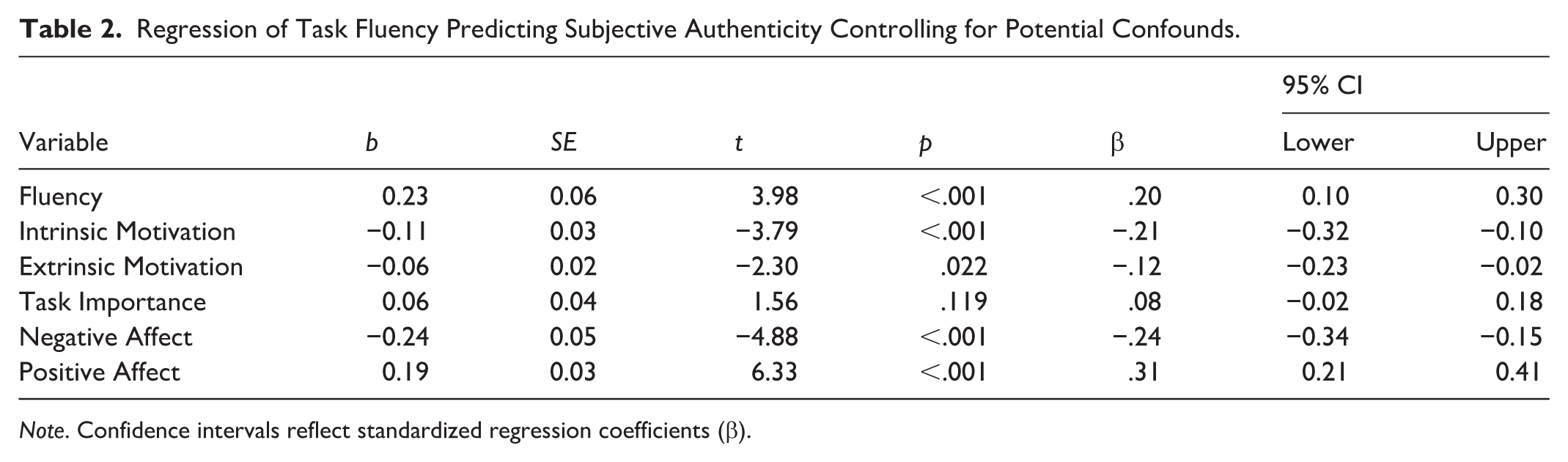
Note. Confidence intervals reflect standardized regression coefficients (β).
Discussion
The ease with which participants completed a daily activity, whether work, play, or something else, was the strongest predictor of momentary authentic feelings, even when accounting for other situational, affective, and motivational factors which would be expected to predict authenticity. These findings support the notion that feelings of fluency serve as a cue to what kinds of activities represent the true self, and provide preliminary evidence for such a link.
Study 2: Recalling Fluent Experiences
Study 1 provides initial evidence for a link between momentary fluency and authenticity in daily life. Study 2 builds on Study 1 by instructing participants to recall a recent experience that was either ordinary (control), fluent, or disfluent, and to rate its subjective authenticity. We expected fluent experiences to be rated as more authentic. We also examined whether fluency effects emerged beyond perceived fit, given the clear relationship between fit and authenticity established by the SAFE model (Aday et al., 2024; Schmader & Sedikides, 2018). This helped us begin to address the question of whether fluency predicts subjective authenticity independent of self-relevance.
Participants
We aimed for a sample size larger than that needed to detect a conventionally medium sized effect with 80% power (one-way ANOVA with three groups, required n = 159, α = .05, f² = 0.25). The final sample, collected in 2019, consisted of 202 American MTurk workers who earned $0.70 in compensation (see Table 3 for demographic information). A sensitivity analysis indicated that the study was adequately powered to detect medium-sized effects or larger (f² = 0.22). This study was not preregistered.
Study 2 Participant Demographics.
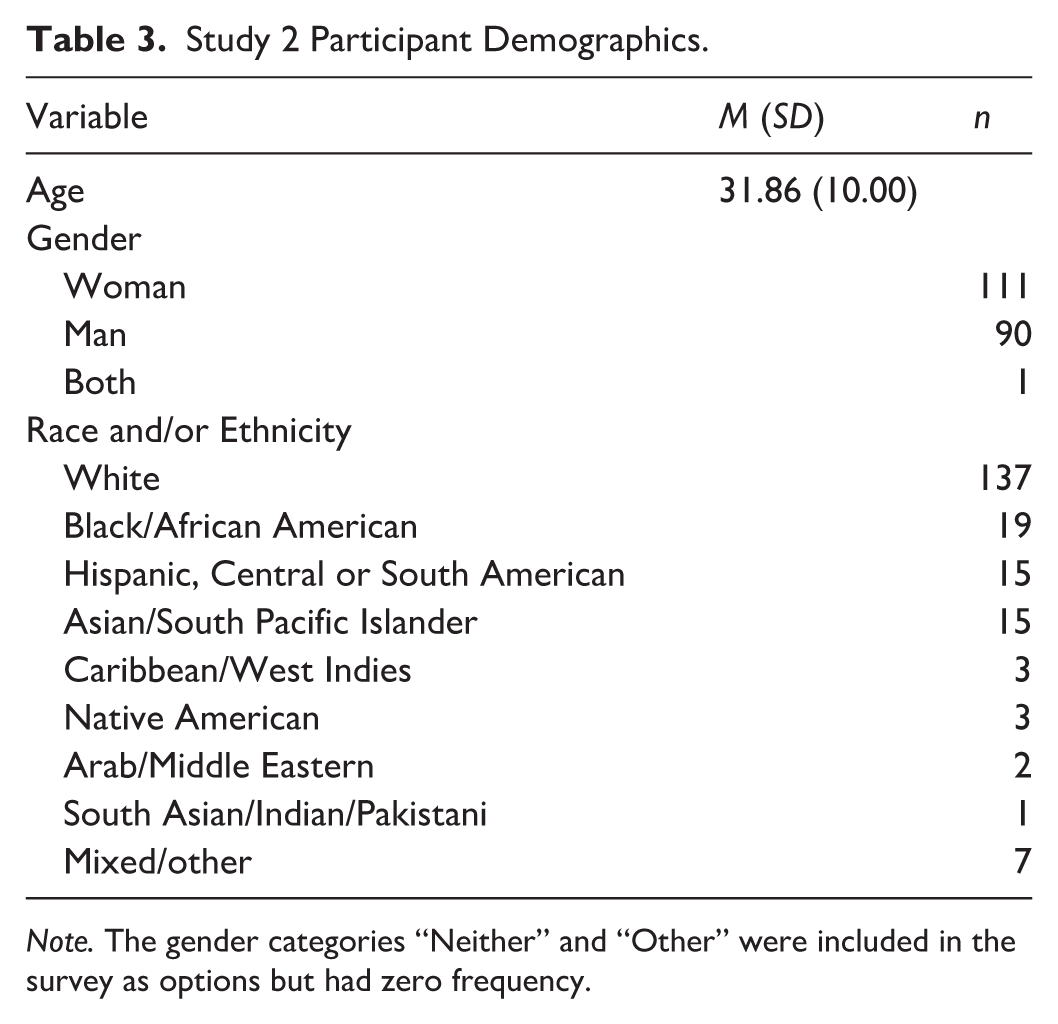
Note. The gender categories “Neither” and “Other” were included in the survey as options but had zero frequency.
Procedure
Participants provided consent and were told that the study concerned how people experience daily life. They were randomly assigned to one of three between-subject conditions: Fluent Event (n = 66), Disfluent Event (n = 68), or Control (n = 68). Fluent and disfluent event participants were asked to recall a recent experience that felt either easy and natural or not easy and natural, respectively. Control participants recalled an ordinary daily experience. All participants were then instructed to write about their experience in detail by typing into a text box. Following the writing task, participants were asked to consider the event they had just described and to indicate their experience of fluency, fit, and authenticity during the event.
Measures
Fluency was measured with the same seven items from Study 1 (M = 3.31, SD = 1.18, α = .89). Authenticity was assessed with five items: four slightly adapted items from the self-alienation subscale used in Study 1 (Wood et al., 2008; e.g., “During that experience, I felt in touch with the real me”) and one additional face-valid item (i.e., “During that experience, I felt authentic”). All items were rated on a 5-point Likert scale with higher scores indicating greater subjective authenticity during the event (M = 3.73, SD = 0.92, α = .79). Fit was assessed with one item for each of the three types of fit in the SAFE model (Schmader & Sedikides, 2018) on 5-point Likert scales: Self-Concept Fit (i.e., “How much does the experience fit with your personal identity and self-concept?”; M = 3.35, SD = 1.31), Goal Fit (“How much does the experience fit with your values and goals?”; M = 3.33, SD = 1.33), Social Fit (“How much does the experience fit with your social relationships?”; M = 3.01, SD = 1.26).
Results
We hypothesized that experienced fluency and authenticity would be higher in the Fluent Event condition than in the Disfluent Event and Control conditions. Two one-way ANOVAs tested the omnibus effects for each outcome separately, followed by Tukey post-hoc comparisons. Before analyzing mean differences, we collapsed across conditions and examined the overall correlation between fluency and authenticity, which was strong and positive, r(200) = .71, p < .001.
Attesting to the effectiveness of the manipulation, the effect of condition was significant for experienced fluency, F(2, 199) = 136.18, p < .001, ω2 = .57. Fluency was higher in the Fluent Event condition (M = 4.17, SD = 0.77) compared to the Control condition (M = 3.70, SD = 0.93), and the Disfluent Event condition (M = 2.08, SD = 0.57; see Table 4). Fluency was also significantly lower in the Disfluent Event condition compared to the Control condition. Subjective authenticity differed significantly by condition, F(2, 199) = 35.48, p < .001, ω2 = .25. Authenticity was significantly higher in the Fluent Event condition (M = 4.18, SD = 0.78) compared to the Disfluent Event condition (M = 3.09, SD = 0.86), but not significantly higher than the Control condition (M = 3.94, SD = 0.75; see Table 5). Authenticity was also lower in the Disfluent Event condition compared to the Control condition.
Post-Hoc Comparisons of Fluency Across Conditions.
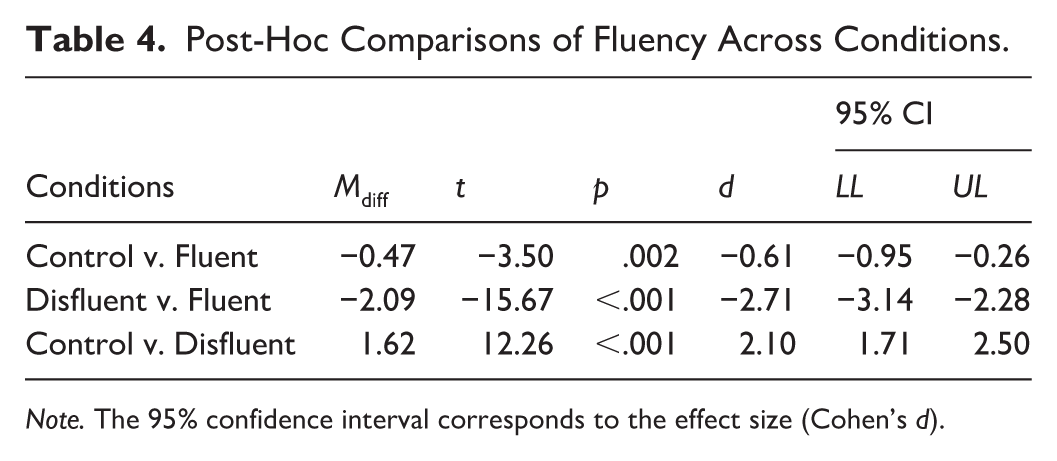
Note. The 95% confidence interval corresponds to the effect size (Cohen’s d).
Post-Hoc Comparisons of Authenticity Across Conditions.
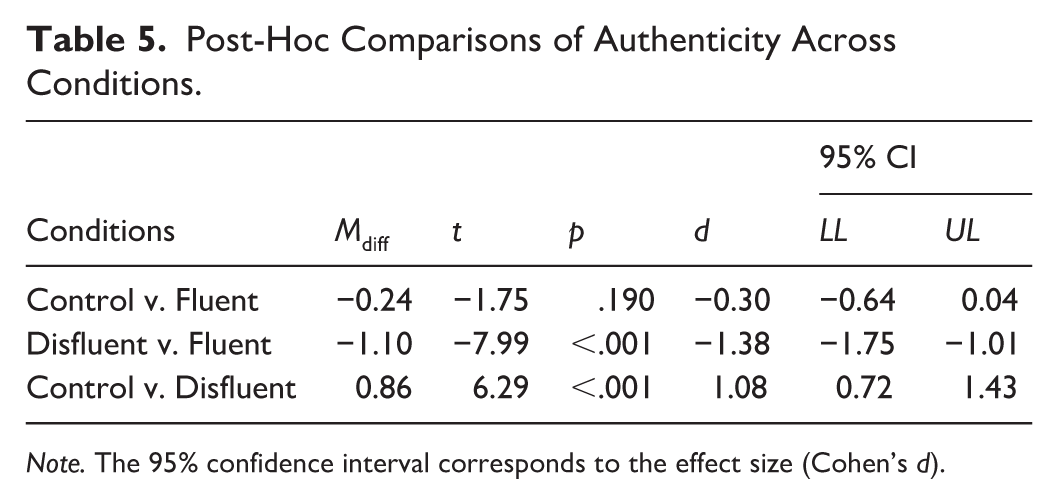
Note. The 95% confidence interval corresponds to the effect size (Cohen’s d).
This effect of condition on subjective authenticity remained significant even after controlling for self-concept fit, goal fit, and social fit in an ANCOVA, F(2, 196) = 17.68, p < .001, ω2 = .13. There was no significant difference in subjective authenticity between the Fluent Event condition (adjusted M = 3.98, SE = 0.09) and Control condition (adjusted M = 3.95, SE = 0.09), ptukey = .967. However, participants in the Disfluent Event condition (adjusted M = 3.28, SD = 0.09) reported significantly lower subjective authenticity compared to those in the Fluent Event condition, Mdiff = −0.70, t(196) = −5.14, ptukey < .001, and the Control condition, Mdiff = 0.67, t(196) = 5.27, ptukey < .001.
Discussion
Fluent (vs. disfluent) experiences also tend to feel more authentic. As expected, participants reported greater experienced fluency in the Fluent Event condition than in both the Disfluent Event and Control conditions, supporting the effectiveness of our manipulation. Participants also reported significantly higher subjective authenticity in the Fluent Event condition compared to the Disfluent Event condition, though not significantly more than the Control condition. This aligns with the idea that disfluency is particularly noticeable and thus has a stronger influence on the experience of authenticity than fluency (Aday & Schmader, 2019). Another possible explanation for this pattern is that the control condition was not entirely neutral. That is, recalling everyday, ordinary experiences (as in the Control condition) may elicit relatively high levels of authenticity, potentially limiting the differences between the Control and Fluent conditions. Another potential limitation of this study is that our manipulation may have introduced demand characteristics if participants held lay-theories equating “ease” or “naturalness” with subjective authenticity. Studies 3 and 4 sought to limit the impact of such effects by manipulating experiences of fluency indirectly rather than asking participants to recall events.
Taken together, Studies 1 and 2 provide partial support for our overarching hypothesis that experienced fluency serves as a cue to subjective authenticity and can do so independent of the self-relevance of the behavior or situation. However, a major limitation of both studies is that they rely on participants’ recollections of their experiences. Although the link between experienced fluency and subjective authenticity appears robust across the first two studies, it remains unclear whether momentary feelings of fluency causally influence perceptions of authenticity. Study 3 addresses this limitation by manipulating cognitive fluency and assessing subjective authenticity during the task.
Study 3: Incidental Fluency and Subjective Authenticity (Self-Attributes)
Study 3 tested a causal link between experienced fluency and subjective authenticity. We manipulated feelings of cognitive fluency within subjects during two self-knowledge generation tasks. Participants were asked to generate attributes that describe them; once without any cognitive constraints (i.e., fluent) and once while under cognitive load (i.e., disfluent). The order of these tasks was counterbalanced so that half of participants moved from fluency to disfluency, while the other half moved from disfluency to fluency. We predicted that generating self-attributes under cognitive load would result in reduced feelings of authenticity compared to generating self-attributes without added load. While the task was focused on generating self-relevant attributes, the content of the task is not so critical to our predictions. It is the subjective experience of fluency in any task, that we suspect, may impact subjective authenticity. That said, having access to the attributes, values, beliefs, and feelings that comprise one’s true self is said to be a necessary component of authenticity (Kernis & Goldman, 2006; Wood et al., 2008). As such, we expect the fluency of this task may be particularly potent in predicting the subjective experience of authenticity.
Participants
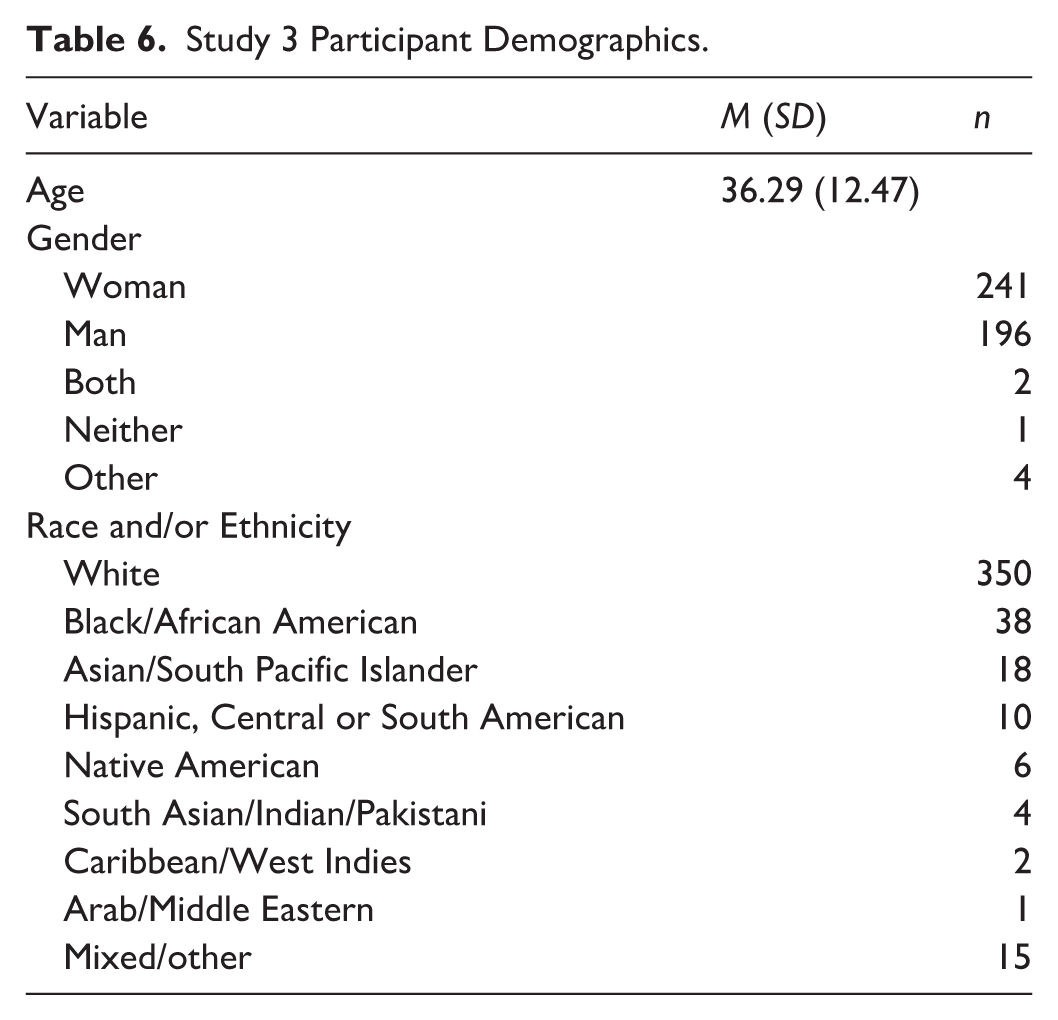
A sample of 200 participants was determined to provide 80% power to detect a relatively small difference across conditions (i.e., paired-samples t-test, dz = .20, α = .05, two-tailed). We intentionally over-recruited to increase the precision of our effect size estimates and concluded with a final sample of N = 444 American Prolific Academic workers who participated online for $1.00 (see Table 6 for demographic information) in 2019. A sensitivity analysis indicated that the study was adequately powered to detect small-sized effects or larger (d = 0.13).
Study 3 Participant Demographics.
Procedure
Participants were told the study examined the relationship between self-knowledge and memory. In a within-subjects design, they completed both Fluent and Disfluent attribute generation tasks. In each condition, participants generated five self-descriptive attributes (10 total), typing each attribute on a separate page. In the Disfluent condition, a seven-digit number was shown for 4 seconds before each attribute generation page. Participants had to hold a number in memory while generating each self-attribute. On the next page, they typed the number into a text box before receiving a new number. Holding a number in memory while attempting to generate self-attributes was expected to increase cognitive load and feelings of disfluency. Task order was counterbalanced across participants.
Measures
After each attribute generation task, participants completed the same measure of authenticity used in Study 2 (Fluent Task α = .88; Disfluent Task α = .89). To assess task fluency, they also completed three items evaluating the sense of ease of generating self-attributes: “It was easy to come up with attributes that describe me,” “Self-attributes came to mind fluently,” and “Coming up with attributes that describe me was difficult” (reverse coded). Responses were rated on a five-point scale (1 = “Strongly disagree” to 5 = “Strongly agree”), with high internal reliability for this scale at both times (Fluent Task α = .92; Disfluent Task α = .88). After completing these measures, participants were shown all ten attributes that they had generated previously and were asked to indicate how well each one describes them (1 = “Does not describe me”; 5 = “Describes me extremely well”; Fluent Task α = .78; Disfluent Task α = .75). Finally, participants completed demographics and read a debriefing statement.
Results
We conducted two paired-samples t-tests in R. First, we tested whether fluency ratings were higher in the Fluency condition compared to the Disfluency condition (i.e., no-load vs. load conditions). The effect of the condition on reported fluency was statistically significant, such that participants reported higher fluency in the Fluent condition (M = 3.42, SD = 1.19) compared to the Disfluent condition (M = 3.23, SD = 1.15), t(443) = 3.46, 95% CI [0.08, 0.30], p < .001. Despite the small effect size, d = 0.17 [0.07, 0.26], the manipulation yielded a statistically significant difference in perceived fluency. The effect of condition was also statistically significant in terms of subjective authenticity, such that participants reported higher authenticity in the Fluent condition (M = 3.94, SD = 0.85) compared to the Disfluent condition (M = 3.89, SD = 0.87), t(443) = 2.06 [0.00, 0.09], p = .041. However, the effect size was small, d = 0.05 [0.00, 0.10], indicating only a very small difference in subjective authenticity between conditions.
A mediation analysis, using the mediation package (Tingley et al., 2014) in R, tested whether experienced fluency mediated the effect of condition (Fluent vs. Disfluent) on subjective authenticity. The average causal mediation effect 4 was significant, b = 0.07, 95% CI [0.01, 0.13], p = .015, indicating that experienced fluency mediates the relationship between condition and subjective authenticity. The average direct effect of condition on authenticity, controlling for fluency, was not significant, b = −0.03 [−0.12, 0.07], p = .592, suggesting that the effect of condition on subjective authenticity operates primarily through its influence on experienced fluency.
One alternate explanation for the findings is that the manipulation may have affected the participant’s sense of who they are. Indeed, cognitive ease manipulations that ask participants to generate few compared to many attributes have been used to manipulate perceived true-self-knowledge in the past (Schlegel et al., 2011). In order to test whether the fluency manipulation influenced the extent to which recalled attributes were representative of the self, we also tested for the effect of condition on attribute ratings. Another paired-samples t-test revealed, unexpectedly, that participants rated their self-generated attributes as less descriptive of the self in the Fluent condition (M = 4.24, SD = 0.66) compared to Disfluent condition (M = 4.40, SD = 0.53), t(442) = −5.53, 95% CI [−0.21, −0.10], p < .001. This is the opposite direction of the effect that we would have expected if there was going to be one at all. Though, it is worth noting that this is a small effect, d = −0.26 [−0.36, −0.17].
Collapsing across conditions, attribute ratings were positively correlated with both authenticity, r(442) = .49, 95% CI [0.42, 0.56], p < .001, and felt fluency, r(442) = .35 [0.26, 0.43], p < .001, thus it is unlikely that the positive effect of the Fluency condition on subjective authenticity would be due to these differences in attribute ratings. Indeed, a mixed-effects ANCOVA controlling for attribute ratings showed a significant effect of condition on subjective authenticity, b = 0.06 [0.01, 0.10], t(412) = 2.52, p = .012, indicating that subjective authenticity was higher in the Fluent condition (M = 3.94, SE = 0.04) compared to the Disfluent condition (M = 3.89, SE = 0.04) after accounting for the self-attribute rating differences. Ratings were also positively associated with authenticity in this model, b = 0.08 [0.01, 0.15], t(621) = 2.44, p = .015.
Discussion
The findings from this study suggest that when a self-descriptor generation task is made more difficult by incidental features of the situation (e.g., cognitive load) feelings of authenticity are reduced. Although, it should be noted that the effect sizes for condition differences on both fluency and authenticity were relatively small. Nonetheless, the findings suggest that when the stream of consciousness associated with processing the self and one’s immediate experience is interrupted, such as when one is required to memorize long number strings while attempting to generate self-attributes, subjective authenticity takes a hit (see also Vess, 2019). While we might expect fluency during this task to be particularly important to authenticity because of its self-relevance, it is important to note our theorizing does not require the task to be self-relevant (see Study 4).
Despite finding the expected effect of fluency on authenticity ratings, we found the opposite effect on how descriptive participants believed the attributes they generated were of themselves. Attributes that were generated under disfluent conditions were rated by participants as more descriptive of themselves compared to fluent conditions. While this effect was unexpected, we see at least one possible post-hoc explanation for this finding. Perhaps being under cognitive load led people to generate the most chronically accessible aspects of their self-concept. Such attributes should feel very descriptive of the self. On this view, the fluency of the task may be serving as a cue to authenticity, whereas the chronic accessibility of the generated attributes is driving the descriptiveness judgments. This view is speculative but is supported by the fact that descriptiveness ratings were collected at the very end of the study after participants had completed both manipulations and associated dependent variables. Indeed, the attributes that participants generated in both conditions were piped back into the same rating matrix. At this point in the study, any effect of disfluency during the attribution generation task may have worn off, leaving the more chronic accessibility of the attributes generated as a more relevant cue to their descriptiveness than the fluency of the task per se.
This study manipulated fluency using a cognitive load paradigm; thus, it is limited to conclusions based on changes to cognitive or processing fluency. However, we suggest that changes to other kinds of fluency should also translate into changes in subjective authenticity. We argue that even nonspecific, fringe feelings of fluency can be interpreted as a signal that one’s immediate experiences are authentic (or not). Study 4 aims to address this.
Study 4: Incidental Fluency and Subjective Authenticity (Creative Task)
Whereas Study 3 manipulated fluency by having participants generate self-relevant information, Study 4 sought to manipulate fluency in a task not directly related to the self. Specifically, we examined whether disruptions to fluency when completing a creative task could influence feelings of authenticity during the task, regardless of how much one self-identified as creative. This study was preregistered. 5 We used a between-subjects design and hypothesized a main effect of fluency, such that participants in a neutral condition would report greater subjective authenticity compared to those in a disfluent condition. We did not expect to find a main effect of pre-task creative identification on subjective authenticity, though we did think it was possible that there would be an interaction between pre-task creative identity and condition. While we were less confident about the possibility of an interaction compared to a main effect of condition, it seemed possible that the effect of the fluency manipulation might be stronger for people who identify as highly creative. Specifically, we suspected that a disfluent task might be particularly threatening to authenticity if it is in a domain that fits the self-concept.
A secondary goal of Study 4 was to examine if the fluency manipulation might also impact a post-task measure of creative identity. This is consistent with our theorizing that degree of fluency in a task might be part of how people come to decide who they are. Third, though this was not in our preregistration, we later realized that we included a measure of self-esteem in Study 4, which would allow us to examine whether any observed fluency effects could not be explained by self-esteem (i.e., global evaluations of self-worth). This seemed important given that the fluency manipulation might impact self-esteem (see Williams et al., 2020, for related discussion) and there is a strong link between self-esteem and authenticity (Davis et al., 2014).
Participants
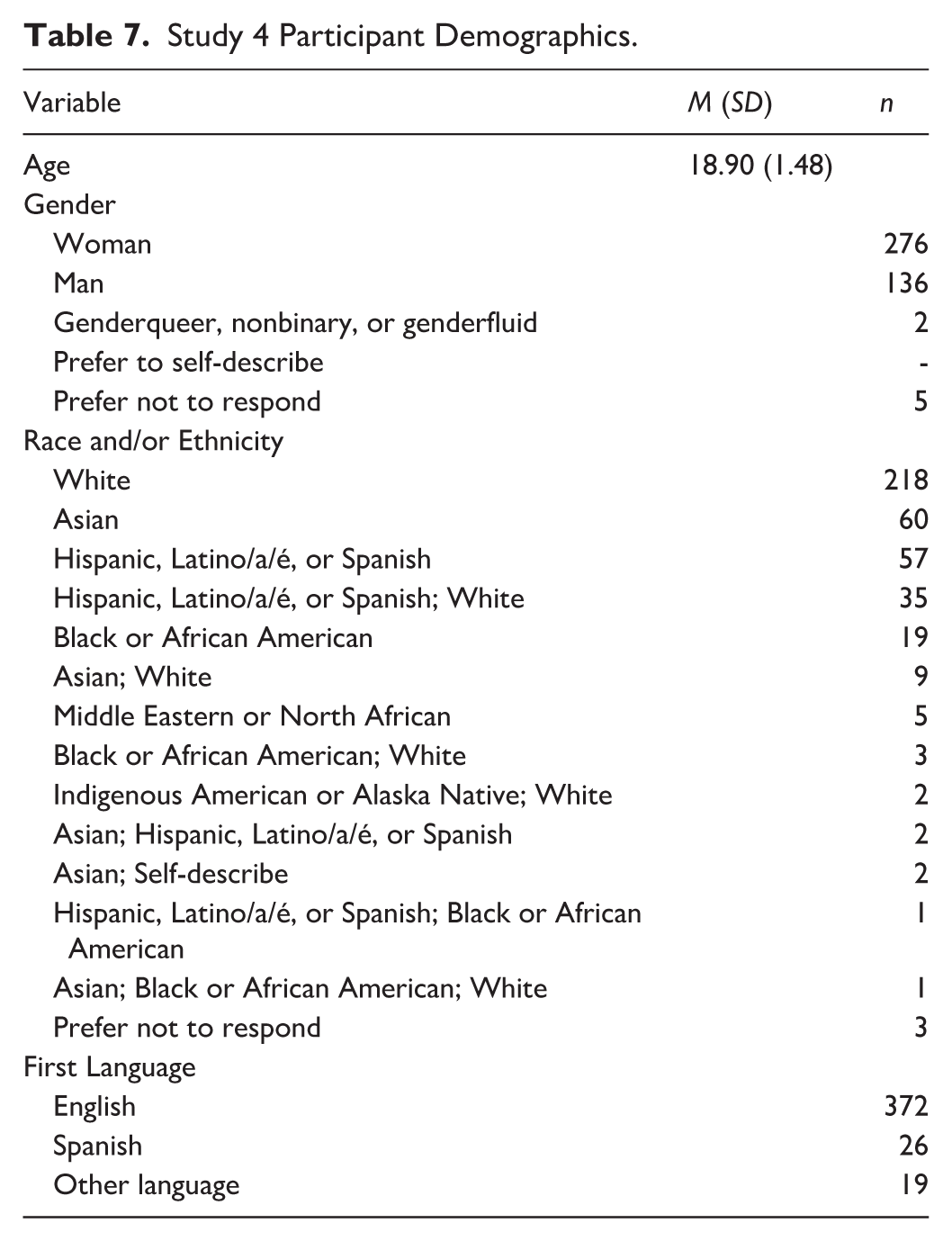
Due to uncertainty regarding the effectiveness of our manipulation and the expected effect sizes, we aimed to maximize statistical power within the constraints of our lab resources. We recruited 423 participants from Texas A&M University who received course credit for their participation during the Fall 2024 and Spring 2025 semesters. Five responses were excluded because participants indicated their data were invalid on an integrity check item, and one was excluded for being under 18 years of age. This left us with 417 participants (see Table 7 for demographic information). A sensitivity analysis indicated that the study was adequately powered to detect small effects or larger (d = 0.27; for a model with three predictors, f² = 0.03).
Study 4 Participant Demographics.
Procedure
This in-person study was conducted using computers located within private cubicles. Participants were informed that they would be completing a “common and trusted” measure of creativity known as the Remote Associates Test (RAT; Mednick, 1968). They first completed a baseline measure of creative self-identification before being randomly assigned to either a normal RAT condition (i.e., control) or disfluent RAT condition. The disfluent RAT condition included red herrings known to increase the task difficulty (Beda & Smith, 2018), whereas the control condition contained the same RAT items without the red herrings. Each condition comprised 10 RAT items. Following the task, participants completed the questionnaires listed below.
Measures
To assess both pre- and post-task creative self-identification, we used the Short Scale of Creative Self (Karwowski et al., 2018). Participants rated 11 items (e.g., “I think I am a creative person”) on a 5-point Likert scale (1 = “Definitely not” while 5 = “Definitely yes”). The scale displayed excellent internal reliability at both times (αpre = .87; αpost = .90).We used the same measure of fluency as in Studies 1 and 2 (M = 2.74, SD = 0.79, α = .80). Subjective authenticity was assessed with two complementary yet separate measures. First, participants completed the Real Self Overlap Scale (Lenton, Slabu, et al., 2013), which presents seven pairs of circles with varying degrees of overlap. One circle represents the “me during task,” and the other represents the participant’s perception of their “real” or true self. Participants selected the pair that best reflected how they felt (M = 3.98, SD = 1.69). Next, participants responded to three items (e.g., “I felt authentic in the way I acted during the last 20 minutes”) adapted from Fleeson and Wilt (2010). These items were rated on a 7-point Likert scale (1 = “Strongly agree”; 7 = “Strongly disagree”) and demonstrated high internal reliability (M = 5.01, SD = 1.39, α = .92). We combined these two measures to create our main subjective authenticity variable for analyses (M = 4.75, SD = 1.32, α = .87). We used the 10-item Rosenberg Self-Esteem scale (Rosenberg, 1979) to assess global self-esteem. Items (e.g., “On the whole, I am satisfied with myself”) were rated on a 4-point Likert scale (1 = “Strongly disagree”; 4 = “Strongly agree”; M = 3.02, SD = 0.55, α = .89).
Results
Pre-Registered Analyses
We conducted an independent-samples t-test in Jamovi to test the effect of our manipulation on perceived task fluency. Participants in the disfluent condition (n = 202; M = 2.45, SD = 0.69) reported significantly less fluency than those in the control condition (n = 211; M = 3.01, SD = 0.79), Mdiff = 0.56, t(411) = 7.64, p < .001, d = 0.75, 95% CI [0.55, 0.95]. These results indicate that our manipulation was effective. To test whether subjective authenticity differed between conditions, we conducted an independent-samples t-test. Participants in the disfluent condition (n = 203; M = 4.56, SD = 1.37) reported significantly lower subjective authenticity than those in the control condition (n = 214; M = 4.93, SD = 1.24), Mdiff = 0.38, t(415) = 2.94, p = .003, d = 0.29 [0.09, 0.48].
Although we did not expect to find a main effect of pre-task creative identification on subjective authenticity, a linear regression revealed that pre-task creative identification did, in fact, predict subjective authenticity, b = 0.36, 95% CI [0.17, 0.55], p < .001, even when controlling for condition, b = −0.40 [−0.65, −0.15], p = .002. Probing further for the possibility of an interaction between pre-task creative identification and condition revealed no significant interaction (p = .452). This suggests that the positive association between pre-task creative identification was consistent across both the control and disfluent condition.
We also preregistered a secondary goal to examine post-task creative identification between conditions. To explore the potential link between fluency and self-concept, we conducted a 2 (Time: Pre-task vs. Post-task) × 2 (Condition: Control vs. Disfluent) mixed ANOVA to test the effect of condition on creative identity. Time was a within-subjects factor, and condition was a between-subjects factor. There were no significant differences in pre-task creative identity between the two groups (p = .437); however, there was a significant difference in creative identity pre- and post-task overall, F(1,405) = 103.91, p < .001, η2 p = .20. This indicates that participants’ creative identity decreased from pre-task identity (M = 3.73, SD = 0.62) to post-task (M = 3.57, SD = 0.73) overall, Mdiff = 0.17, t(405) = 10.19, p < .001. This effect was qualified by a significant interaction of time and condition, F(1,405) = 13.32, p < .001, η2 p = .03, though the effect size was small. Tukey post-hoc comparisons revealed that while both groups showed decreases in creative identity, the decrease was larger in the disfluent condition (adjusted Mpre = 3.74, SEpre = 0.05; Mpost = 3.51, SEpost = 0.05; Mdiff = 0.23, t(405) = 9.68, p < .001) than the control condition (adjusted Mpre = 3.73, SEpre = 0.04; Mpost = 3.62, SEpost = 0.05; Mdiff = 0.11, t(405) = 4.68, p < .001; see Figure 1). It should be noted that, across conditions, participants reported generally high levels of creative identification both pre- and post-RAT, as evidenced by mean scores exceeding the mid-point of the 5-point scale.
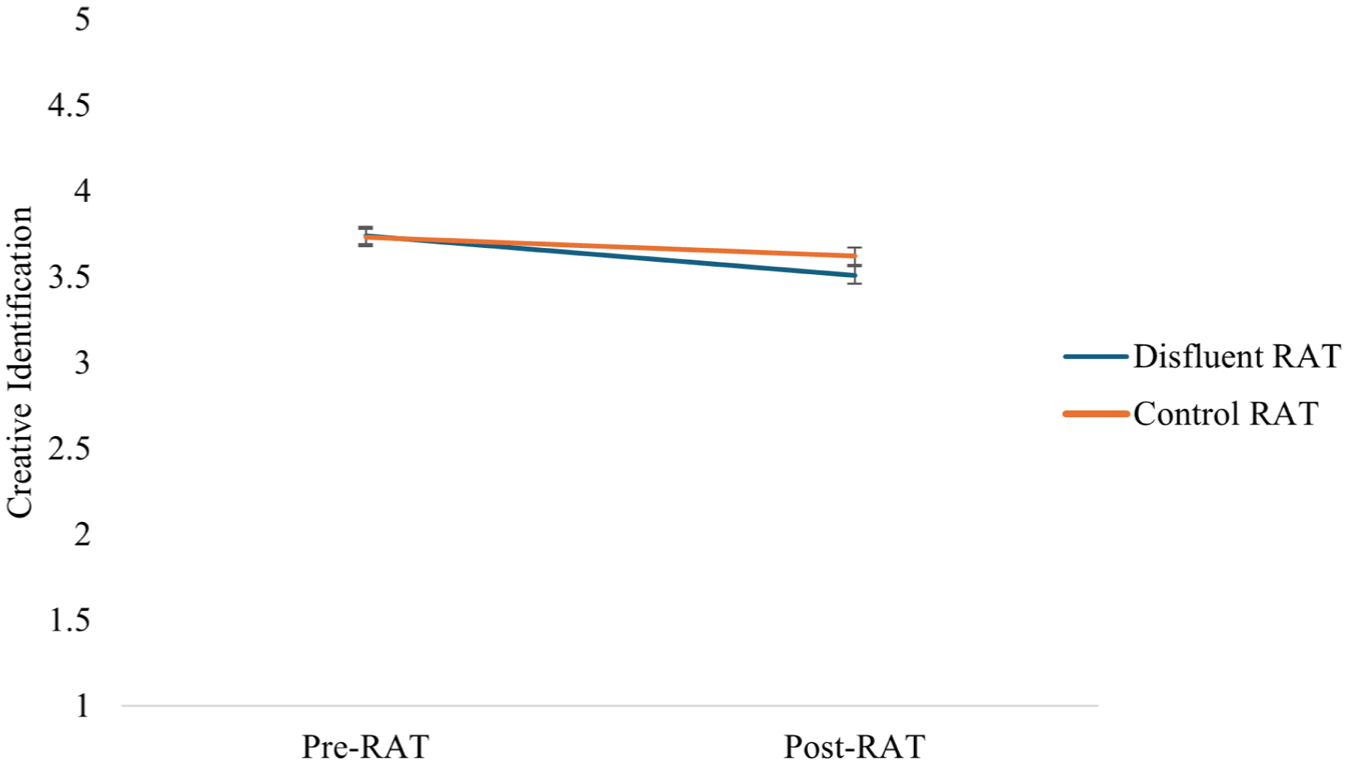
Line graph of the interaction between time and condition on creative identification.
Nonpreregistered Analyses
To rule out self-esteem as an explanatory variable, we conducted an ANCOVA testing the main effect of condition on subjective authenticity while controlling for self-esteem. The effect remained significant, F(1,407) = 7.68, p = .006, ω2 = .02. 6 A Tukey post-hoc test confirmed that participants in the disfluent condition (adjusted M = 4.57, SE = 0.09) reported less subjective authenticity than those control condition (adjusted M = 4.92, SE = 0.09), Mdiff = 0.35, t(407) = 2.77, p = .006, d = 0.27, 95% CI [0.08, 0.47]. In terms of the main effect of pre-task creative identification on subjective authenticity, a linear regression revealed that pre-task creative identification remained a significant predictor of subjective authenticity, b = 0.28 [0.09, 0.48], p = .004, even when controlling for condition, b = −0.37 [−0.62, −0.12], p = .004, and self-esteem, b = 0.39 [0.16, 0.62], p < .001. The interaction between pre-task creative identification and condition remained nonsignificant even after controlling for self-esteem (p = .628).
Discussion
Study 4 examined whether task-related fluency could cue feelings of authenticity, even when the task was not explicitly self-relevant. As predicted in our preregistration, participants who completed the disfluent task reported lower subjective authenticity than those in the control condition, even after accounting for self-identification with the task (i.e., creative identity) and self-esteem. Notably, although we did not anticipate it, pre-task creative identification predicted subjective authenticity, which underscored the importance of statistically controlling for it; however, it did not significantly interact with condition. This means that the positive association between pre-task creative identity was consistent across both conditions. Additionally, we found evidence that disruptions to fluency can impact one’s own self-perceptions. Specifically, participants in the disfluent condition showed a markedly greater decline in creative self-identification relative to both their pre-task levels and those in the control condition, suggesting that disfluency may undermine one’s self-concept in domains related to the task, though the effect size was small.
General Discussion
It is probably not the case that there are a set of traits or features that definitively define a person’s true self. And if there were, it is unlikely that people have the introspective capabilities to access those features (Nisbett & Wilson, 1977). Yet, people still seem to have a sense of who they really are and when they feel like they are being authentic (Hicks et al., 2026). In the current research, we aimed to explain this feeling of authenticity from a fluency perspective. Across four studies, we found that self-evaluations of authenticity are reliably associated with feelings of fluency, whether experienced in everyday life (Study 1), recalled upon in memory (Study 2), or when subtly manipulated in the laboratory (Studies 3 & 4). Thus, these studies suggest that fluency may be an important contributor to feelings of authenticity. Though, it is worth noting, as Aday and Schmader (2019) discuss, individuals are typically, though not always, unaware of fluency when it is present (which is likely the default state), but are keenly aware of disfluency. This asymmetry mirrors many other ideas in psychology such as “bad is stronger than good” (Baumeister et al., 2001).
While fluency is an important component of the SAFE model of authenticity (Schmader & Sedikides, 2018), it is framed as an outcome of high congruence between one’s self-concept and the external environment. This reflects a top-down approach asking, “Does my identity fit within this context?” The answer to this question shapes one’s perceived fluency, and, in turn, their sense of state authenticity. In contrast, the current studies suggest that feelings of fluency can contribute to state authenticity even when one’s self-concept is only minimally relevant, or entirely irrelevant, to the experience. As such, our bottom-up approach suggests that fluency serves a broader and more flexible function as a cue to authenticity.
The current research helps clarify how people come to know their “true self.” For example, in Study 1, momentary feelings of fluency during everyday activities contributed to participants’ greater sense of knowing and aligning with their true self. Although mundane routines like brushing teeth are hardly “the original force toward individual growth and fulfillment” that Horney (1950) speaks of when defining authenticity, such activities can still feel authentic when they elicit fluency. Thus, our approach expands the bounds for what can be considered authentic.
Traditional and modern accounts often characterize authenticity as morally good (Strohminger et al., 2017), yet our theorizing leaves room for someone to at least feel authentic when they engage in less than desirable behavior. In fact, our theorizing could reasonably predict that even maladaptive or morally questionable habits, behaviors, and thoughts could feel authentic to the extent that they are experienced as fluent. Indeed, research on Dark Triad traits (i.e., psychopathy, narcissism, and Machiavellianism) suggests that people high in these traits are less likely to view moral traits as central to their identity (Maffly-Kipp et al., 2023), suggesting that authenticity for them may reflect fluency rather than moral virtue.
This view embraces a fully subjective approach to authenticity in which judgments of authenticity rely on certain cues that may or may not be particularly self-relevant (Hicks et al., 2026). Identifying the cues that people use to judge their own authenticity helps guide future research on how immorality, lapses in self-control, and negative habit formation may feel authentic. For example, it is known that self-control requires ignoring immediate impulses that promise hedonic fulfillment (Hofmann et al., 2009), but if those impulses are also conflated with feelings of fluency that signal authenticity (e.g., when holding a cigarette feels familiar and natural), ignoring that cue may be extremely difficult. Further, over time, these bottom-up feelings of fluency may feed into the formation of default concepts, goals, and values. Thus, interventions that aim to increase self-control or kick bad habits may find success when considering fluency-induced authenticity as a driving mechanism.
Finally, bottom-up processes may interact with personality to shape authenticity. Consider an introvert at a party of extroverts. From a top-down view (SAFE model), the mismatch produces feelings of inauthenticity, and from the bottom-up, awkward interactions reinforce that feeling. Yet if those interactions feel unexpectedly fluent, the self-identified introvert may update their self-concept, perceiving themself as more authentically extroverted. In this way, fluency can inform self-knowledge by aligning self-evaluations with phenomenological experiences.
Limitations and Future Directions
First, it is important to acknowledge that our samples were drawn from WEIRD cultural contexts and the findings cannot be generalized beyond adults from these populations (Henrich et al., 2010). Most participants were online recruits in their 30s (Studies 1–3), with predominantly White samples across all studies. Broader generalization requires further empirical evidence from demographically diverse samples. Future research should examine demographic and ecological influences on authenticity. For instance, individuals may experience less authenticity to the extent that they are afforded fewer fluent experiences due to disability, lower socio-economic status, or who might experience chronically low fit to the environment, such as those with marginalized identities. Additionally, our findings do not speak to potential boundary conditions arising from cultural contexts. For example, in some cultural settings, values and expectations may strongly encourage individuals to practice certain abilities (e.g., music, dance, math) until they reach a high level of fluency. This raises an important question: Does such externally driven fluency foster a sense of authenticity, or might it instead feel inauthentic? Although our studies cannot directly address this issue, future research that includes more diverse cultural contexts would be well-positioned to do so.
Second, because authenticity varies across situations (Lenton et al., 2016), our lab- and online-based studies are limited in scope. Each relied on a single assessment of fluency and authenticity, whereas experience-sampling or daily dairy methods could provide more valuable insights regarding fluctuations over time and across various contexts. Relatedly, the design of the current studies does not provide clear evidence as to the potential mechanisms driving the relationships between fluency and authenticity. As noted in the introduction, fluent experiences are known to feel familiar, true, and good, but the current work cannot speak to whether one of these features is more important than the other in explaining the relationship between fluency and authenticity. While we suspect it is a combination of all of these, this is a direction for future empirical work.
Lastly, Study 4 attempts to demonstrate how fluency in a domain not explicitly related to the self can still be associated with the experience of authenticity; however, we acknowledge that this rests on the bold assumption that any experience could be entirely irrelevant to the self. By virtue of being consciously aware of an experience’s perceived fluency, one may already be incorporating it into their self-related processing, blurring the line between what is “self-relevant” and what is “non-self-relevant.” We do not view this as a weakness of the manuscript’s core argument; rather, it serves as a clarification of our methodological approach in Study 4. In fact, it may highlight how fluency functions as a cue for identifying which domains are meaningful to the self during the process of self-discovery. Future research could explore this phenomenon in critical development periods, such as adolescence and emerging adulthood, to garner a better understanding of how fluency informs perceived self-knowledge.
Conclusion
At some point, most people grapple with the question of how they truly know who they are. While this process is rarely as straightforward as one might hope, given the vastness and complexity of the self, our evidence suggests that one cue people rely on is perceived fluency. This subjective sense of ease across various experiences can serve as a powerful cue to subjective authenticity, perhaps even in moments that are mundane, morally ambiguous, or seemingly unrelated to one’s identity. By shifting the lens from a top-down, identity-driven framework and incorporating a more flexible, bottom-up approach, we broaden the scope of what can be experienced as authentic.
Footnotes

Ethical Considerations
This research was approved by the University of Cologne’s, University of Florida’s, and Texas A&M University’s Institutional Review Boards.
Funding
The authors received no financial support for the research, authorship, and/or publication of this article.
Declaration of Conflicting Interests
The authors declared no potential conflicts of interest with respect to the research, authorship, and/or publication of this article.