




Abstract
Moral appeals—persuasive messages aimed at invoking moral obligations—are widely used across various contexts. However, evidence about their effectiveness in changing behaviors remains mixed, and little is known about the conditions that influence it. To address this, we conducted a meta-analysis with 67 papers (k = 399) to assess the overall impact of moral appeals on behavioral intentions and behaviors, and to test various moderators of this effect. Drawing on various theories, we proposed that both morality enhancers and hindrances can influence their effectiveness and investigated three groups of moderators (Moral Content, Social Aspects, Autonomy Restraints). Results showed that, overall, moral appeals had a small, positive effect (d = 0.22). Furthermore, Moral Content (negative framing) and Social Aspects (the presence of social norms) enhanced appeal effectiveness, while Autonomy Restraints (the use of assertive language) undermined it. Our findings provide important theoretical and practical insights into moral appeals.
Introduction
To encourage people to behave in ways that are good for society, authorities often use appeals that highlight the moral aspects of an issue, thereby persuading their audiences to behave desirably out of moral obligations (Schmitt, 1964). For example, health officials encourage vaccinations among employees “to protect vulnerable patients” (Mulder & Lokate, 2022), and governments frame tax compliance as “essential for the public good” (Blumenthal et al., 2001) or as “an act of social responsibility and patriotism” (McGraw & Scholtz, 1991). Compared to legal enforcement, moral appeals are cost-effective (Schmitt, 1964) and quick to implement, proving useful in crises like COVID-19. Unlike coercive mandates, they can also preserve autonomy and foster intrinsic motivation for lasting behavioral change (Deci & Ryan, 1985; Martela et al., 2021).
Nonetheless, it is not entirely clear how effective moral appeals are in changing behavior. While there are studies showing moral appeals promote prosocial behavior in economic games (Brañas-Garza, 2007; Tsikas, 2023) and work effectively in real-world contexts focused on increasing vaccination (Mulder & Lokate, 2022) and environmental responsibility (Hockett & Hall, 2007), other studies report null or negative effects. For instance, moral appeals seem to fail in improving people’s compliance with public rules (Apesteguia et al., 2013) and can even trigger reactance in affirmative consent policies (Tinkler et al., 2018). Results also vary across studies that target the same behavioral change domain. For example, findings for the use of moral appeals to increase tax compliance are mixed (Castro & Scartascini, 2015; Koumpias & Martínez-Vázquez, 2019; Torgler, 2013). To resolve these inconsistencies, we conducted a meta-analysis to assess their overall effect on people’s decisions to change their behavior and test when moral appeals are most persuasive.
Our meta-analysis focuses explicitly on the impact of moral appeals on behaviors while also considering behavioral intentions, as they are recognized as strong predictors of behaviors (Montano & Kasprzyk, 2015; Webb & Sheeran, 2006). Our first goal is to test whether moral appeals influence people’s behavior and what the overall effect size is, emphasizing general patterns rather than domain-specific outcomes. To reach this goal and gain a better understanding of potential mechanisms underlying their impact, we developed an integrative framework (see Figure 1), proposing that two opposing dynamics have a role in determining whether moral appeals affect people’s behavior. Based on (models derived from) the four-step moral decision-making model (Butterfield et al., 2000; Moore & Gino, 2015; Rest, 1986), the concepts of bounded ethicality (Bazerman & Sezer, 2016; Chugh & Kern, 2016), and moral identity theory (Aquino & Reed, 2002), this framework presents morality enhancers—such as appeals to moral self-image or moral reputation—that likely increase the effectiveness of moral appeals. Conversely, informed by moral disengagement theory (Bandura, 2011) and psychological reactance theory (Brehm & Brehm, 2013), the framework also presents morality hindrances, involving moral and autonomy threats, that should hinder the impact of moral appeals.
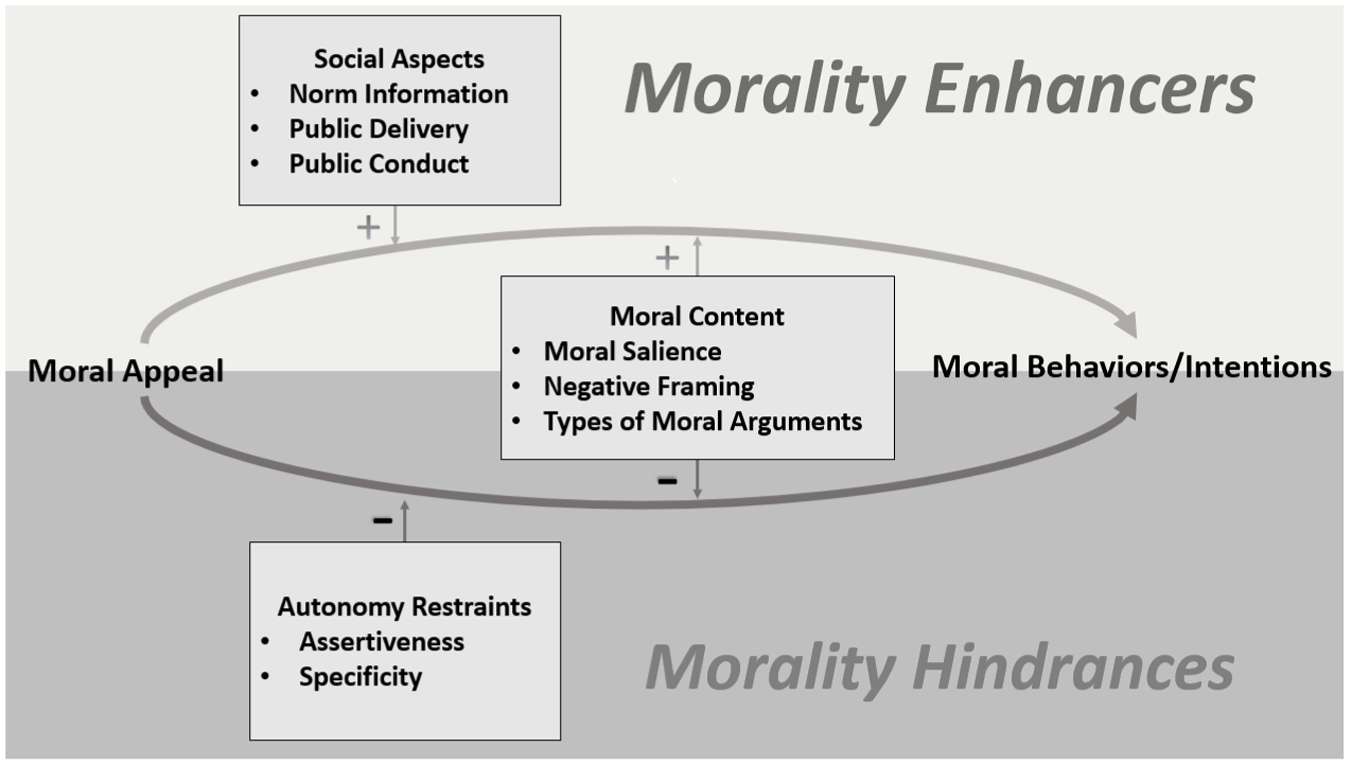
Theoretical model with the enhancers and morality hindrances of moral appeals and three groups of moderators.
Our second goal is to identify when moral appeals are most effective. As part of our integrative framework, we categorize moderators into three groups based on one of the two above dynamic(s) they are most likely to influence: (a) the Moral Content of an appeal (moral salience, negative framing, moral arguments), which can affect both enhancers and hindrances, (b) Social Aspects informing an appeal (norm information, public delivery, and conduct), which should mainly influence moral enhancers (i.e., by eliciting moral reputational concerns), and (c) the Autonomy Restraints signaled by an appeal (assertiveness, specificity), which we propose to mainly shape moral hindrances (i.e., through eliciting autonomy threats).
With this meta-analysis, we offer three significant contributions to the field. First, we clarify inconsistencies in the existing literature on moral appeals by systematically reviewing the research through our theoretical framework. This provides a comprehensive understanding of their effectiveness in influencing people’s behavior and offers practical guidance on their use. Our framework highlights that opposing psychological dynamics can underlie the effects of moral appeals, potentially offsetting or canceling out each other’s influence.
Second, much prior research on moral appeals primarily focused on their main effects, with limited systematic exploration of possible moderators (but see Dal Bó & Dal Bó, 2014; White, MacDonnell & Dahl, et al., 2011). Our framework explores moderators that relate both to an appeal’s moral content and the context in which it is used. By moving beyond simple main effects, our framework provides a nuanced understanding of how different factors impact the effectiveness of moral appeals, paving the way for applying them in more targeted ways.
Finally, by integrating insights from different theories, this meta-analysis advances our understanding of the processes through which moral appeals exert behavioral effects. For example, we show how key constructs such as moral awareness, moral identity, moral disengagement, and psychological reactance can be conceptually organized as operating through one of the two underlying dynamics we propose determine appeal effectiveness. Although a direct empirical comparison of the dynamics of these underlying processes is not possible in a meta-analysis, and thus only provides suggestive evidence of these underlying processes, articulating them systematically can clarify how seemingly disparate constructs can reflect a common underlying process. As such, our study represents an important step toward a more generative theory of how moral appeals work.
In the following sections, we first briefly introduce the concept of moral appeals before presenting our integrated theoretical framework. Then, based on this framework, we predict how our moderators shape the effects of moral appeals.
Moral Appeals as Persuasive Tools
What Are Moral Appeals?
Moral appeals combine two key aspects: the moral content of the message that aims to invoke moral norms or values (Luttrell et al., 2019; Schmitt, 1964), and the intent to influence behavior. The study of Dal Bó and Dal Bó (2014), gives a nice example of a moral appeal used in a decision-making game where participants have to allocate resources amongst themselves and others. The appeal to participants stated: “An action of yours is moral if it treats others the way you would like others to treat you. If you were to act accordingly, you would allocate 10 [resources] to the joint account.” The “moral content” here invokes a moral norm (i.e., treating others as you would like to be treated). At the same time, the “appeal” aspect attempts to influence the participant’s behavior, encouraging them to allocate resources in a specific way. To capture both aspects, we define moral appeals as “persuasive messages aimed at invoking a moral obligation among the audience for them to behave desirably.”
Our definition distinguishes moral appeals from social norm appeals, which rely on conformity (e.g., Blumenthal et al., 2001), and from moral labeling, which classifies situations as moral without intending to persuade behavior change (Capraro & Rand, 2018; Mieth et al., 2021). Additionally, moral appeals are unidirectional, with the audience playing a passive role. Therefore, activities that involve active cognitive engagement (e.g., moral priming, Aquino et al., 2009) or participatory interaction (e.g., ethical courses, Schwitzgebel et al., 2020) are not considered moral appeals.
An Integrated Framework of Moral Appeals
We propose that the impact of moral appeals is shaped by two opposing dynamics: the morality enhancers and hindrances. Below, we theorize how these two dynamics, when combined, influence the effectiveness of moral appeals and how their interplay shapes this impact.
The Morality Enhancers
According to Rest’s classical four-step model of moral decision-making and subsequent work (Butterfield et al., 2000; Chugh & Kern, 2016; Jones, 1991; Moore & Gino, 2015; Rest, 1986; Schwartz, 2016), moral awareness is the first step toward ethical behavior, as recognizing the moral relevance of an action likely initiates the moral decision-making process. Research on bounded ethicality shows that people often act unethically without realizing it (Bazerman & Sezer, 2016). Moral appeals are therefore expected to be effective because they make people aware of the moral relevance of their behavior, either by describing behaviors in moral terms (Dal Bó & Dal Bó, 2014) or providing moral arguments (Hockett & Hall, 2007).
However, awareness alone does not guarantee moral action; motivation is also required, particularly for sustained behavior change (Rest, 1986). Building on moral identity theory (Aquino & Reed, 2002), the efficacy of moral appeals should also be driven by individuals’ desire to be moral, both in their own eyes (moral self-image) and in the eyes of others (moral reputation). First, being morally good is integral to one’s identity (Hardy & Carlo, 2011), and people strive for consistency with their ethical selves (Blasi, 1980; Brown, 2000). Ethical dissonance occurs when the desire to maintain a moral self-image conflicts with the temptation to act unethically (Barkan et al., 2015; Harmon-Jones & Mills, 2019). By highlighting the moral implications of actions, moral appeals make individuals aware that certain behaviors could threaten their self-image, thereby motivating alignment with ethical standards (Barkan et al., 2015).
In addition to self-image, most people care about their moral image in others’ eyes (though see Blair, 2007; Carlson, 2013, for exceptions such as psychopathy and narcissism) and are strongly motivated by such social motives to uphold their moral reputation (Aquino & Reed, 2002; Gneezy et al., 2018; Kajackaite & Gneezy, 2017). Concern for one’s social image drives moral behavior (Vonasch et al., 2018) because moral deviance can lead to harmful social consequences such as ostracism, social rejection (Kurzban & Leary, 2001), sanctions (e.g., Van Kleef et al., 2015), and diminished self-esteem (Leary, 1999), while signaling morality can confer social benefits such as signaling trustworthiness (Grant & Mayer, 2009), gaining respect from others (Aquino & Reed, 2002), and being perceived as a principled or legitimate actor (Tyler & Blader, 2003). Moral appeals, although not communicating a social norm directly, can implicitly communicate what is considered moral by others. This can imply a social consensus, thereby shaping expectations and influencing moral decision-making (Cialdini et al., 1991; Dal Bó & Dal Bó, 2014; Jones, 1991). Together, appeals can work effectively because people want to maintain a positive moral self-image and moral reputation. For this, they need to align their actions with ethical standards.
The Morality Hindrances
Besides morality enhancers, moral appeals may also have undesired effects due to two perceived threats tied to their core elements (i.e., their moral content and persuasive intent). These elements can trigger moral and autonomy threats, undermining an appeal’s effectiveness.
The moral awareness induced by moral appeals may inadvertently be accompanied by moral threats. By highlighting the moral implications of behavior, individuals become aware of their own potential moral shortcomings that may threaten their self-image. While the drive for a moral self-image can enhance moral behavior, people can also be sensitive to criticism of their moral standing (Minson & Monin, 2012), leading them to disengage from the requested moral behavior. For example, vegans’ morally driven commitments can provoke derogation from meat-eaters (“do-gooder derogation”; Minson & Monin, 2012; Monin & Norton, 2003). Similarly, moralizing messages can be perceived as accusations of moral failure, eliciting defensive reactions such as source derogation or message rejection (Leach & Dhont, 2003). Individuals may also employ moral disengagement strategies—shifting responsibility, using euphemisms, or minimizing consequences—to protect their moral image (Bandura, 2011; Moore, 2015; Newman et al., 2020).
Closely related, autonomy threats can emerge when moral appeals are perceived as constraining one’s freedom to choose how to behave. Psychological reactance theory suggests that perceived threats to autonomy elicit resistance through counterarguing, anger, or boomerang effects, in which individuals deliberately act contrary to persuasive attempts (Brehm & Brehm, 2013; Quick & Stephenson, 2007; Dillard & Shen, 2005; Burgoon et al., 2002). In line with this, research shows that normative appeals such as “a large majority of people recycle/think that everyone should recycle” can evoke reactance in terms of experienced freedom threat and counterarguing the appropriateness of this norm (Kavvouris et al., 2020). Together, moral and autonomy threats can lead individuals to reject, ignore, or oppose moral appeals as a way of defending both their moral self-perception and autonomy.
The Effectiveness of Moral Appeals
The first goal of this meta-analysis is to reveal the overall effect of moral appeals. Given the competing dynamics and the empirical mixed findings in previous literature, however, we make no directional prediction regarding their direct impact on people’s behavior (or behavioral intentions). In the next section, we argue for boundary conditions that will strengthen or weaken this direct effect, depending on whether an appeal likely activates morality-enhancers or -hindrances, or both simultaneously.
Boundary Conditions for Effective Moral Appeals
The impact of moral appeals can be shaped by various contextual factors or appeal forms, as suggested by mixed empirical results about their effects. To better understand when moral appeals are most effective, the second goal of this research is to identify key moderators that influence their effectiveness.
Three Groups of Moderators
We categorized our moderators based on the two opposing dynamics in our framework and their theoretical underpinnings. The first set of moderators (Moral Content) likely moderate both morality enhancers and morality hindrances due to their effect on moral awareness. The moderators of the second category (Social Aspects) are likely to primarily influence moral reputation and can therefore be regarded as moderators of morality enhancers. The moderators of the third category (Autonomy Restraints) are likely moderating morality hindrances as they function as autonomy threats. By examining these moderators, we aim to construct a comprehensive model and offer insights into the complex dynamics of moral appeals’ impact on behavior (see Figure 1).
Moral Content: Moderators Affecting Both Morality Enhancers and Hindrances
Since moral appeals are reasoned to influence behavior by increasing moral awareness, any factor that enhances the recognition of an issue’s moral implications should impact their effectiveness. As recognition is primarily a cognitive process, we draw upon literature from moral cognition and persuasive communication (e.g., Jones, 1991; Janoff-Bulman et al., 2009; Wheeler & Laham, 2016) to identify content moderators, which enabled us to identify three-key content-related factors tied to moral awareness: (a) moral salience, (b) framing (negative vs. positive), and (c) the type(s) of arguments (deontological and/or consequentialist).
Moral Salience
The extent to which a moral appeal increases moral awareness varies depending on how clearly the message highlights the moral aspects of the behavior. That is, the extent to which a situation presents itself as a moral issue (moral salience; Jones, 1991). Moral salience is stronger when messages use explicit moral language (e.g., “An action of yours is moral if it maximizes the sum of everyone’s payoffs”; Dal Bó & Dal Bó, 2014) or provide multiple compelling arguments that assert the moral nature of behaviors (e.g., Balafoutas & Rezaei, 2022; Bos et al., 2020). Conversely, moral salience is weaker when references to moral values are vague or limited, with few arguments connecting morality to the behavior (e.g., “. . .substantial energy conservation will be required for the society in ‘critical peak-demand hours,’ in which electricity supply will be very limited relative to demand,” Ito et al., 2018). When moral salience is high (low), individuals are more (less) likely to recognize moral dimensions, resulting in corresponding changes in moral awareness.
Negative Framing
Whether the behavioral outcomes are expressed in terms of gains (i.e., positive framing; e.g., “Think about what will be gained in our community if we keep recycling,” White, MacDonnell & Dahl, et al., 2011; See also Chen et al., 2019), or losses (i.e., negative framing; e.g., “Think about what will be lost in our community if we don’t keep recycling,” White, MacDonnell & Dahl, et al., 2011) also influences how likely the message can elicit moral awareness. Notably, we argue that negative framings are likely to trigger moral awareness. Negative (vs. positive) framing likely evokes the “do not harm” moral principle (Leliveld et al., 2008, 2009), due to its focus on negativity and occasional direct references to harm. This linkage to harm boosts moral awareness as harm is one of the core moral concerns (Graham et al., 2013; Schein & Gray, 2018). Additionally, negativity bias makes negative information more impactful than positive, as losses are prioritized over gains (Baumeister et al., 2001; Cacioppo & Berntson, 1994; Kahneman et al., 1991). Thus, negative framings should more likely trigger moral awareness than neutral or positive framings.
Types of Moral Arguments
Based on ethics literature (Alexander & Moore, 2007; Bartels & Medin, 2007; Sinnott-Armstrong, 2015; Uhlmann et al., 2009), two types of reasons for moral behaviors can be distinguished: deontological appeals emphasizing rules, values, and obligations (Alexander & Moore, 2007; “Please get vaccinated to fulfill your duty as a nurse.”), and consequential appeals emphasizing action outcomes (Sinnott-Armstrong, 2015; “Please get vaccinated to reduce the infection risks of vulnerable patients”). We argue that moral awareness can be influenced by framing messages in these two terms. Deontological appeals resonate with innate values of right and wrong (i.e., moral conviction, Skitka et al., 2005), which likely promote strong intentions for people to act in line with this moral standard and be resistant to external influence (Skitka et al., 2009). Conversely, consequentialist appeals frame issues around weighing losses and gains. Unlike absolute moral convictions, consequentialist arguments allow for compromise and avoid judging one’s intrinsic moral character, reducing pressure to choose between right and wrong. While both types can elicit moral awareness, this flexibility means consequentialist appeals tend to activate it less strongly than deontological ones.
In conclusion, the three factors related to the moral content of an appeal—moral salience, negative framing, and the type of moral arguments—likely influence how strongly moral awareness is activated. However, given that moral awareness can simultaneously activate enhancers (i.e., moral self-image) and hindrances (i.e., moral threats) dynamics, it is hard to predict when and how moral content factors will moderate moral appeals’ effect. We therefore test the moderating effects of these factors in a more exploratory way rather than proposing directional hypotheses.
Social Aspects: Moderators Affecting Morality Enhancers
Social motives, such as adhering to social norms and maintaining a good reputation, strongly influence behavior (Cialdini et al., 1991). Specifically, past research shows that contexts that directly enhance perceived social norms and reputational salience make people comply more often with the request. Moral appeals on their own can also induce desired behaviors by implicitly conveying social consensus, but may be more successful in contexts with more salient social norms. This would activate the enhancer mechanism of moral reputation in our framework. Building upon literature about social context effects (Andreoni & Bernheim, 2009; Cialdini et al., 1991; Lapinski & Rimal, 2005), we identified two such contexts: the presence of social norm-related information in moral appeals themselves (i.e., norm information), and external factors beyond the content of messages that exert social pressure for compliance, namely whether the moral appeal is delivered publicly or not (i.e., public delivery) and whether the targeted behavior is publicly observable or not (i.e., public conduct). Specifically, norm information signals shared expectations (Cialdini et al., 1991), while public delivery and conduct increase reputational visibility (Andreoni & Bernheim, 2009) and social accountability (Lapinski & Rimal, 2005).
Norm Information
Norm information often explicitly communicates social norms by providing examples of others’ behaviors (e.g., “Your neighbors’ average (median) consumption June to October 2006: 35,000 gallons. You consumed more water than 72% of your Cobb County neighbors,” Ferraro & Price, 2013) or by referencing established norms (e.g., “The Chinese nation has always had the tradition of helping those in need”; Chen et al., 2019). By strengthening social motives, norm information could enhance the power of moral appeals in two ways. First, norm information explicitly highlights how others behave or think, clarifying the social consensus on moral norms. By enhancing the moral reputation enhancers dynamic, and leveraging the pressure of social conformity, adding norm information alongside moral appeals increases the likelihood of behavioral conformity. Second, for moral appeals delivered by those in power, norm information also enhances the perceived legitimacy of the message. Legitimacy, as the acceptance of authority, not only promotes the perceived duty to comply but also implies that institutions act in alignment with public moral values, thus fostering citizens’ law-abiding behaviors and cooperation (Jackson et al., 2012; Tyler, 2006; Tyler & Hou, 2002). By incorporating norm information consistent with the appeals, institutions highlight that their request reflects public opinion, therefore strengthening perceived legitimacy and enhancing the persuasive power of moral appeals.
Public Delivery and Conduct
Public settings may also strengthen the moral reputation morality enhancers as publicity amplifies the presence of social norms and others’ judgment (Andreoni & Bernheim, 2009). Hence, moral appeals delivered in public settings (e.g., on signposts in public transport) are expected to make individuals more sensitive to their moral reputation than private appeals (e.g., e-mail), thus encouraging greater conformity to the appeals. For the same reasons, moral appeals promoting publicly visible behaviors (e.g., feeding animals in a park) will be more effective than those targeting private behaviors (e.g., paying taxes). Additionally, the presence of an audience often amplifies the sense of behavioral accountability (Leary, 2019), thereby heightening individuals’ awareness of the moral consequences of their behaviors. Conversely, without observers, individuals may feel less accountable and less mindful of moral implications.
Taken together, public (vs. private) settings increase both reputational concerns and moral self-image concerns, leading to the following prediction:
Autonomy Restraints: Moderators Affecting Morality Hindrances
Moderators in our final third category are most likely to influence the effectiveness of moral appeals by affecting perceived autonomy threats. Autonomy threats are mainly triggered when people experience a reduced freedom to choose (Brehm & Brehm, 2013; Quick & Stephenson, 2007). Past research suggests two important factors influencing this experienced constraint: (a) how assertively framed the moral appeals were (Assertiveness; Staunton et al., 2022; Miller et al., 2007), and (b) how specific the desired behaviors were described (Specificity; Ball & Goodboy, 2014; Mulder et al., 2020). Assertiveness employs commanding and directive language, which reduces perceived freedom, and specificity increases prescriptiveness by limiting behavioral options. As both factors influence autonomy threat—a process underlying the morality hindrances of moral appeals—we expect these factors to moderate their effectiveness. This makes these two factors theoretically closely relevant to autonomy threats, which drive the morality hindrances in our framework (Brehm & Brehm, 2013; Quick & Stephenson, 2007).
Assertiveness
One of the most studied factors contributing to reactance is assertive language (Miller et al., 2007; Staunton et al., 2022). Assertive messages are often characterized by intense and dogmatic language, exerting pressure on receivers for compliance. Typically, assertive persuasions use imperative words (e.g., “Ought,” “Must”), leaving limited room for negotiation and clearly conveying the sender’s persuasive intention (Miller et al., 2007). Hence, assertive language poses significant threats to an individual’s need for autonomy and self-determination as it is often seen as forceful and controlling (Jenkins & Dragojevic, 2013). We hence hypothesized that:
Specificity
The specificity of recommended behaviors in moral appeals—referring to how detailed and narrowly defined the suggested action is—can also influence how controlling the message feels. Highly specific appeals often prescribe exactly what the audience should do (e.g., “Finish all the food on your plate to avoid waste,” Dolnicar et al., 2020), leaving little room for alternative actions. In contrast, general appeals express values or goals more broadly (e.g., “Respect nature and its resources”; Chang, 2022), allowing recipients more freedom to determine how to act on the message. By prescribing a single, fixed course of action, specific messages can limit the audience’s sense of agency and make the appeal feel externally imposed rather than a personally endorsed choice. Consequently, they are more likely to increase feelings of coercion, potentially undermining moral appeals.
Secondary Moderators of Interest and Controls
Beyond the primary moderators central to our theorizing about moral appeals, we examined several secondary factors. These variables are less directly linked to the morality-enhancing or morality-inhibiting mechanisms but may affect overall persuasiveness and were therefore treated as message-related controls. For moral content, we included message length, argument elaboration, and monetary versus non-monetary outcomes, which primarily influence attention, cognitive effort, or motivation rather than systematically engaging moral principles (Jones, 1991; Janoff-Bulman et al., 2009; Petty & Cacioppo, 1986; Singhapakdi et al., 2013; Wheeler & Laham, 2016). Similarly, message source (e.g., researchers, government, organizations) may affect credibility or perceived authority (Pornpitakpan, 2004), but is less directly tied to the core mechanisms of moral reputation and social pressure emphasized in our model. Finally, following prior meta-analyses (Hunter & Schmidt, 2004; Lipsey & Wilson, 2001), we included several design- and publication-related characteristics (e.g., study year, journal field, repeated exposure, measurement timing) as controls to account for systematic methodological variation in effect sizes (Ebbinghaus, 1913/1964; Rosenthal, 1979). These secondary moderators were included to assess robustness and rule out alternative explanations rather than for theoretical reasons related to moral appeals, though full results are reported for completeness (see Tables 3 and 4).
Method
Transparency and Openness
We adhered to the PRISMA 2020 guidelines for systematic reviews (Figure 2, Page et al., 2021). All data and R syntax are available on the Open Science Framework at https://osf.io/xrj69/?view_only=2d405902eb21438fb8b31cd52e2c67a8. This study’s design and its analysis were not preregistered.
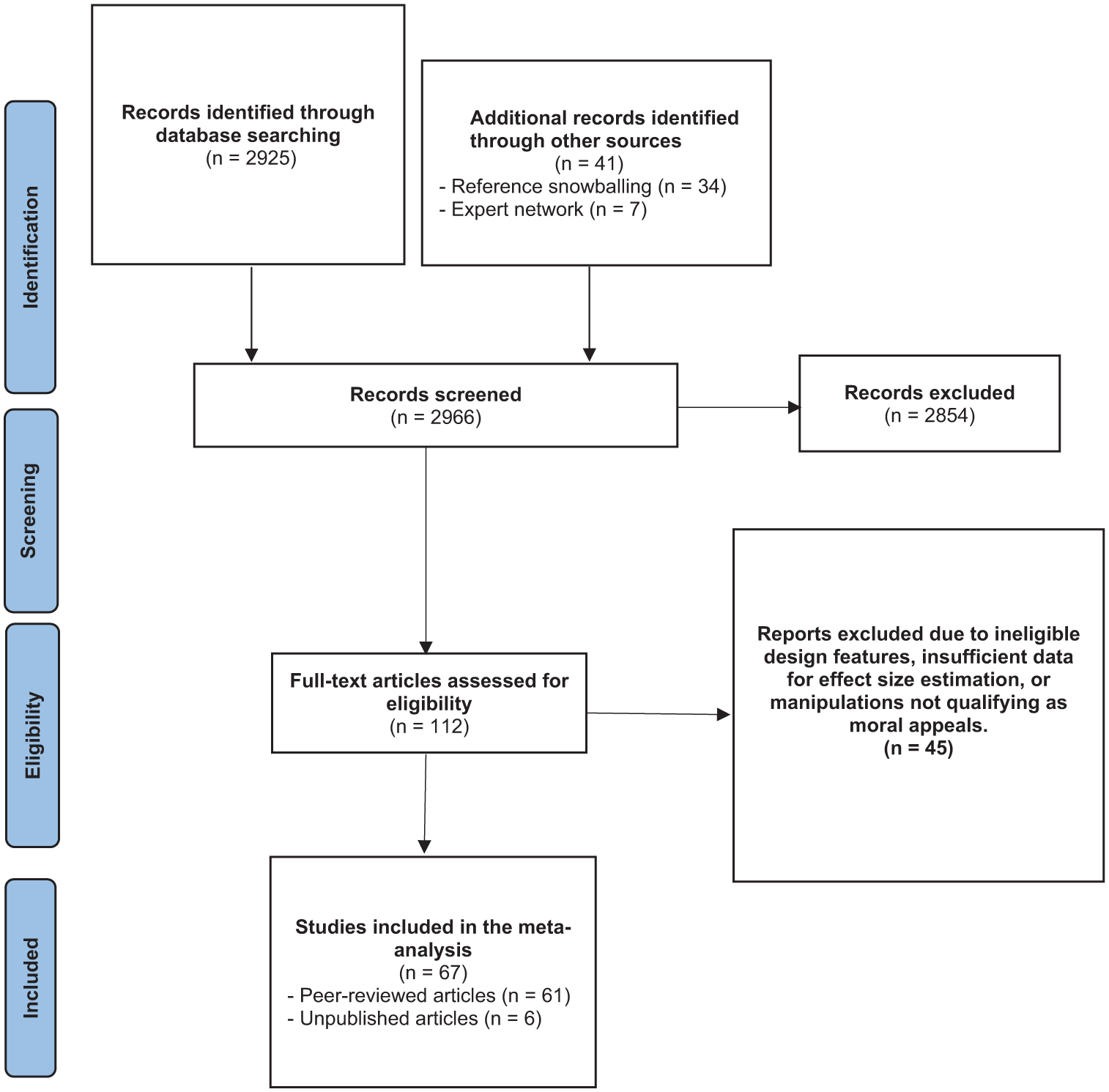
Preferred Reporting Items for Systematic Reviews and Meta-Analyses diagram of the flow of reports and studies into the meta-analysis.
Literature Search
Relevant studies for this meta-analysis were identified in Web of Science, EBSCOhost, Google Scholar, and SSRN by using the following keywords 1 : moral appeal*, moral suasion, moral persuasion, normative appeal*, moral message, moralized persuasion, message fram* along with moral or ethical, and moral reframing. We also used snowball sampling by reviewing the reference lists of identified articles to include additional relevant studies. To reduce publication bias, we launched a call for unpublished data in January 2025.
For inclusion in this meta-analysis, studies had to meet the following inclusion criteria: First, eligible studies should describe one or more experiments containing at least one treatment group that exposed participants to a moral appeal that is experimentally manipulated and held constant across participants. Papers without standard manipulation (e.g., use personalized moral messages; Kalla et al., 2022 ) fall outside the scope of our research, as such personalization prevents the clear identification and comparison of a single, standardized moral-appeal manipulation. Second, they should include a comparison between the moral appeal treatment group and a valid control group without moral appeal, which could be a group that received no message, or one exposed to a message not designed to induce moral obligations. Third, the dependent variable measured should be either intentions and/or behaviors. Lastly, participants should be adults (age 18 or above). Studies were excluded if they did not report appropriate statistics (either in the literature or corresponding supplemental materials) necessary to calculate the effect size (e.g., F ratios, means and SDs, frequencies, or exact p values).
The final sample consists of 67 papers, 2 reporting on 77 studies and 401 effect sizes. The papers in this meta-analysis include 61 peer-reviewed articles, 2 preprints (Dutta-Powell et al., 2023; Garrett et al., 2023), and 2 working papers (Bailey et al., 2023; Kusztal et al., 2023), 1 thesis (Vitro, 2023), and 1 conference paper (Nicoletti & Delehanty, 2017), all published between 1982 and December 2024 (M = 2015, SD = 9).
Coding of Moderators
A coding manual was developed with descriptions of each variable and was used to code all relevant studies we identified accordingly (see Appendix A).
To ensure the reliability of the coding process, two coders first independently coded 11 papers across 3 rounds. Following each round, any discrepancies in coding were discussed and resolved collectively, resulting in subsequent updates to the codebook. The independent coding phase concluded once the inter-rater reliability achieved a satisfactory level. Specifically, all variables of interest demonstrated an intra-class correlation coefficient (ICC) exceeding 0.80, which can be considered as good according to Koo and Li (2016). Following the resolution of disagreements through discussion, the rest of the papers were distributed among the coders for them to code the papers separately.
Theoretical Moderators
We classify the moderators into three categories: (a) Moral Content, (b) Social Aspects, and (c) Autonomy Restraints. 3
The first category of Moral Content includes moral salience, negative framing, and the use of moral arguments. Moral salience represents how likely participants would interpret the issue at hand as morally relevant after being exposed to moral appeals, which was evaluated subjectively on a 5-point scale (−2 = low(salience), 2 = high (salience); ICC = 0.815). Negative Framing represents whether the appeal highlights positive or negative consequences if people undertake (or refrain from) the advocated actions with a 5-point scale (−2 = positive (framing), 2 = negative (framing); ICC = 0.871). Lastly, the use of moral arguments entailed the type of moral arguments that were used in the message. These could be either consequentialist arguments, deontological arguments, or both based on the moral arguments the message has used.
For the second category of Social Aspects, we dichotomously coded whether or not the message indicates that other people behave in line or have norms that are in line with moral appeals (norm information), whether the appeal was made in a situation where people receive the moral appeals privately or publicly (delivery: public vs. private), whether the behavior endorsed in the moral appeal is intended to be carried out in private or public settings (conduct: public vs. private vs. unknown). For conduct, in some instances, it was unclear or unknown whether others would observe participants’ behavior or not (e.g., payment with an honest box in a public place; Pruckner & Sausgruber, 2013). We coded for “unknown” in such cases.
Two continuous variables were coded for the third category Autonomy Restraints. Assertiveness captures the degree of assertiveness of the message with a 3-point scale (−1 = non-assertive, 0 = neither assertive nor non-assertive, 1 = assertive; ICC = 0.824). Specifically, we coded for “assertive” when the message use imperative forms (e.g., “should,” “must”) and “non-assertive” when the message use polite words (e.g., “please,” “may”).“Neither assertive nor non-assertive” indicates that no specific request is made to the audience for them to behave in a certain way (yet still with persuasive intentions), but only an explanation is given about the consequences of the behavior or a reference to values is made (e.g., “do what you think is morally right”; Bilancini et al., 2020). We also coded a message as “Neither assertive nor non-assertive” if a specific request is made without non-assertive and assertive language (e.g., “Cherish the earth; treasure its food”; Chang, 2022). Specificity encoded whether the messages were specific in that they clearly describe which behaviors are expected of people, or were more general in that they used more comprehensible guidelines (i.e., general messages) with a 5-point scale (−2 = low [specificity], 2 = high [specificity]; ICC = 0.958).
Meta-Analytic Procedures
For this meta-analysis, we used Cohen’s d as the measure of effect size, which is calculated as the difference between two means divided by the pooled standard deviation. When means and standard deviations were not directly reported, we calculated Cohen’s d from t-score, F-score, chi-square values, or rates of desired behavioral changes (Lipsey & Wilson, 2001).
For model estimations, we relied on metafor (Viechtbauer, 2010) and meta (Schwarzer et al., 2015) R packages. Prior to all formal analysis, we checked for outliers in the effects of moral appeals, that is, values deviating by more than four standard deviations 4 from the mean effect size (Auer & Papies 2020; Bijmolt et al., 2005; Peng et al., 2023). Based on this criterion, we identified and removed two outliers (d = 1.83, Dutta-Powell et al., 2023; d = 1.66, Ferraro et al., 2011), which leaves us 399 effect sizes in total.
After that, we first computed and tested the average moral appeal main effect generalizing across all studies that compare the effect of moral appeals on behaviors and intentions as compared to the control group. A core assumption of meta-analysis is the independence between effect sizes. However, when a study reports more than one effect size contributing to the same meta-analytic effect size (e.g., if a study used different scales to measure the same outcome, or compared multiple interventions to one single control group), dependency introduced by those designs can bias meta-analytic estimates (Borenstein et al., 2009). To deal with statistical dependencies, the current study used a three-level multilevel meta-analytic method with the metafor R package, with effect sizes (Level 1) nested within studies (Level 2), and between-study heterogeneity modeled at Level 3 (Viechtbauer, 2010). A multilevel meta-analysis allows for increased power and greater accuracy when pooling information together for estimation of the overall effect size, as compared to other methods such as averaging effect sizes within a study, only including one effect size per study, or ignoring the statistical dependencies (Bijmolt & Pieters, 2001).
Before conducting subgroup analysis and meta-regression, we used several strategies to deal with missing data in the dataset. We did not use listwise deletion, as that would substantially reduce k and statistical power. For missing data in Age (62.84% missing), Gender (53.37% missing), and Length (15.71% missing), we replaced them with the respective mean values (Meanage = 35.74; MeanGender = 0.49; MeanLength = 254). Sometimes, the papers did not provide us with the original materials of the moral appeals, resulting in the absence of key variables. Consequently, message-related moderators, including Assertiveness (12.72% missing), Framing (11.72% missing), Specificity (13.96% missing), Elaboration (14.21% missing), and Moral Salience (13.96% missing), which were scored with the Likert scale, had missing data. In such cases, we substituted missing data with the central score of the scale (i.e., zero). 5
After this, we used three-level mixed-effects models for each categorical theoretical and control moderator. Specifically, we conduct subgroup analyses for this data set by including each categorical moderator separately and obtain estimates for the impact of only that moderator and the corresponding 95% CIs. Our last step was to conduct meta-regressions using three-level mixed-effects models to examine the impact of all moderators and control variables simultaneously. Before conducting the meta-regressions, we checked for multicollinearity by calculating the generalized variance inflation factor [GVIF]1/(2*df), which is used when there are dummy regressors from categorical variables; it is comparable to the square root of the variance inflation factor (SQRT[VIF]) for 1 degree of freedom (df = 1; Fox & Monette, 1992). In an iterative procedure (Schmidt & Bijmolt, 2020), we excluded the moderator with the highest GVIF1/(2*df) and re-estimated the model repeatedly, until all moderators had a GVIF1/(2*df) < 2. This cut-off value of 2 is comparable to a VIF cut-off value of 4, which could be regarded as acceptable (Hair et al., 2019, p. 316) and has been applied in other disciplines (e.g., Schmidt & Bijmolt, 2020). Accordingly, we excluded two moderators in the following order: type of experiments (GVIF1/(2*df)= 3.36), trust appeal (GVIF1/(2*df)= 2.66), authority mentioned in the content (GVIF1/(2*df)= 2.19), and DV domains (GVIF1/(2*df)= 2.04). 6
Publication Bias
We used various ways to control and examine the existence of publication bias. First, we included non-peer-reviewed literature (ntotal = 6; ktotal = 29) in our dataset. Second, the set of observed effect sizes contains substantial proportions of positive and negative as well as significant and non-significant effects. Third, we applied the trim-and-fill method (Duval & Tweedie, 2000), which imputed zero studies on the left side, again indicating no publication bias. Given critiques of trim-and-fill regarding its assumptions and limited accuracy (Carter et al., 2019; Simonsohn et al., 2014), we interpreted its results cautiously and in conjunction with other complementary approaches. To complement this, we examined the distribution of effect sizes using a funnel plot and conducted Egger’s test (Egger et al., 1997). Egger’s test in a mixed-effects meta-regression model was non-significant (p = .53), indicating no evidence of publication bias. We conducted Precision Effect Test (PET) analyses (Stanley & Doucouliagos, 2014) to assess small-study effects. The PET slope was not significant (b = 0.45, SE = 0.37, z = 1.22, p = .22), indicating no evidence of small-study bias, while the PET intercept remained significant (b = 0.17, SE = 0.06, z = 2.86, p = .004) and residual heterogeneity being substantial, QE(397)= 83,241.24, p < .001. Following recommended practice, we estimated a PEESE model (Stanley & Doucouliagos, 2014). The PEESE intercept was also significant (b = 0.19, SE = 0.04, z = 4.71, p < .001), and the SE² term was not (p = .14), with residual heterogeneity remaining high, QE (397)= 83,912.28, p < .001. Although PET–PEESE can be less reliable with very few or very small studies (Stanley, 2017), our dataset avoids these limitations. Despite the high heterogeneity, both PET and PEESE still remained significant, supporting the robustness of the underlying effect.
Results
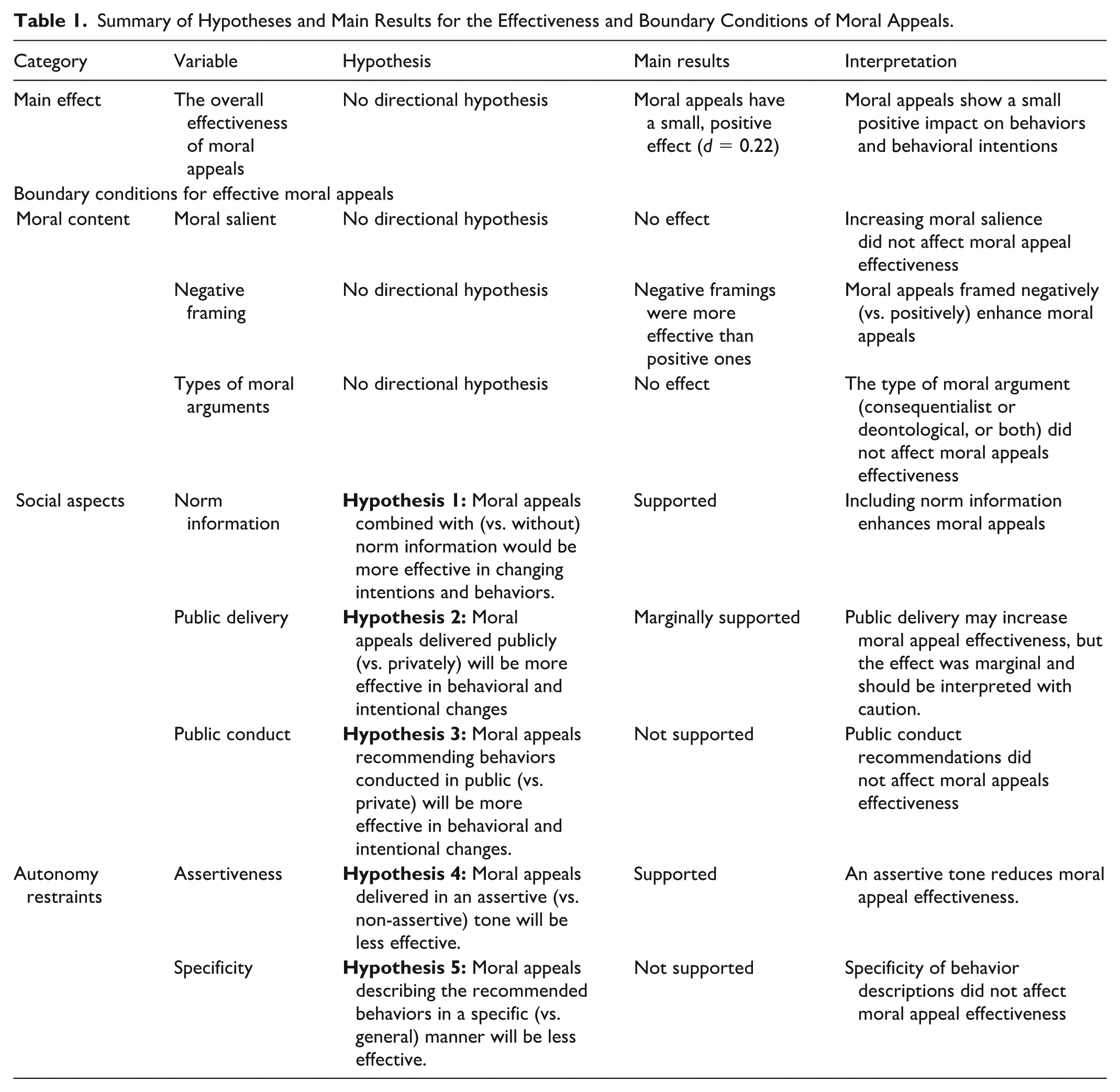
For ease of interpretation, Table 1 provides a summary of all hypotheses, a brief overview of the results, and concise interpretations. All supplementary analyses and robustness checks are reported in Appendixes C and D.
Summary of Hypotheses and Main Results for the Effectiveness and Boundary Conditions of Moral Appeals.
Overall Effect Size
We first examined the overall effect of moral appeals on behavior and behavioral intentions (all combined). Our results showed that moral appeals have a small effect size, d = 0.22, 95% CI [0.16, 0.29], p < .001 (see Table 2). We also compared our three-level model with a two-level, simple random-effects model that constrained Level 3 heterogeneity to zero. The results showed that the three-level model provided a significantly better fit compared to the two-level model (χ21 = 139.84; p < .001). Hence, moral appeals have a small and positive effect on outcomes. That is, relative to participants in comparison groups, participants exposed to moral appeals showed behavior or had behavioral intentions that were more in line with the position advocated by the appeals.
Overall Average Effect Sizes, Heterogeneity, and Publication Bias.

Note. k = number of included effect sizes; d = standardized mean difference; CI = confidence interval; ***p < .001.
The test of homogeneity was statistically significant, Q (398) = 83,967.29, p < .001, indicating the effect sizes were heterogeneous. Moreover, the estimated variance components were τ2Level 2 = .04 and τ2Level 3 = .07. Further analysis showed that I2Level 3 = 64.14 % of the total variation can be attributed to between-cluster, and I2Level 2 = 35.42% to within-cluster heterogeneity, which suggests substantial between- and within-study heterogeneity, supporting the presence of moderators.
Moderator Tests
The results of the subgroup analysis can be found in Table 3, and the results of the meta-regression with all the moderators that met the multicollinearity standard are in Table 4. Subgroup analysis showed that moral appeals are effective at most levels of different moderators. However, as subgroup analysis can only analyze one variable at a time and cannot analyze continuous variables sufficiently, we primarily rely on the results of meta-regression analysis in Table 4 when interpreting the moderating effects. Meta-regression can assess how various moderators contribute to heterogeneity simultaneously and accommodate both categorical and continuous variables, providing a more comprehensive test of the moderating effects.
Subgroup Analysis for Categorical Moderators.
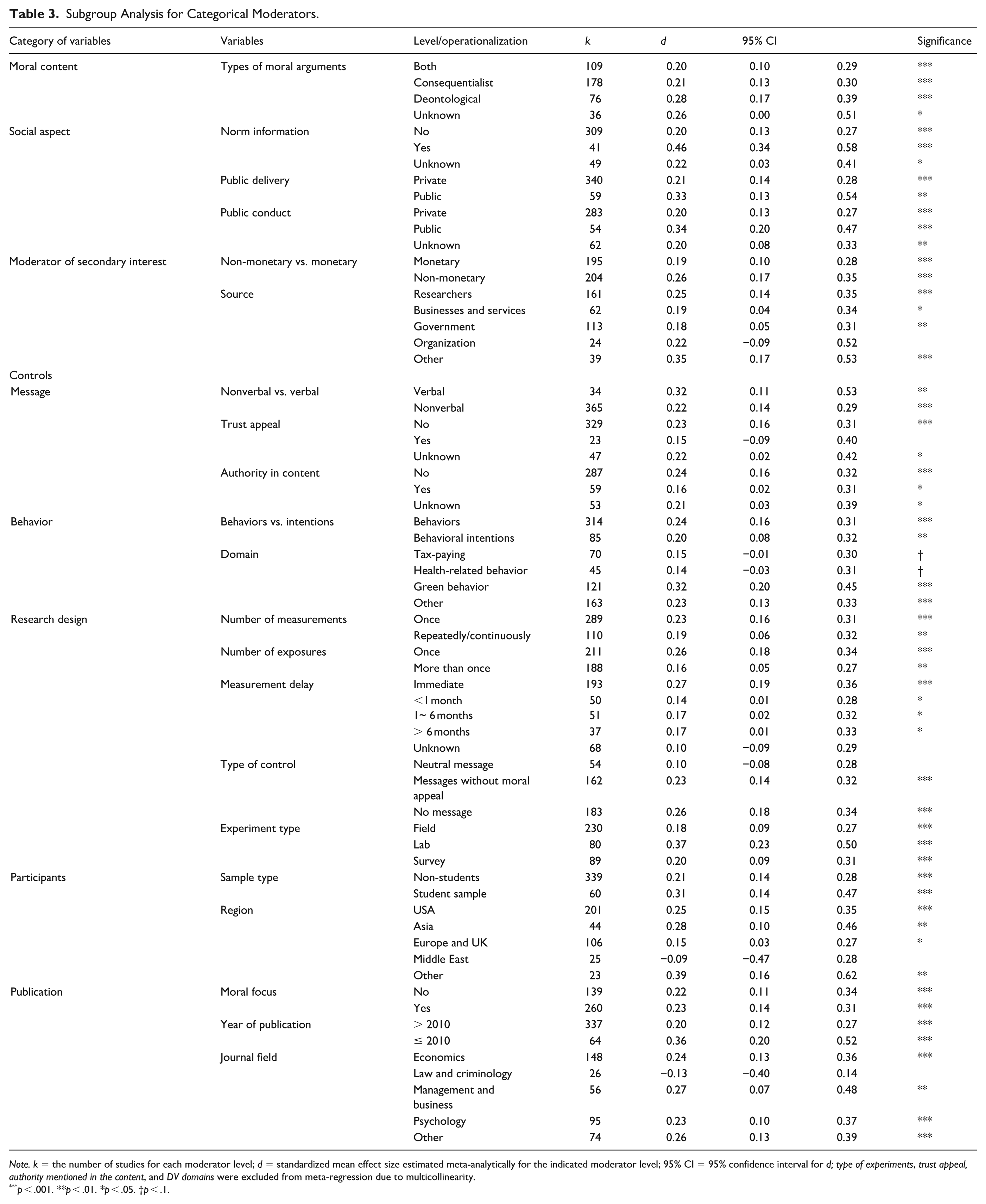
Note. k = the number of studies for each moderator level; d = standardized mean effect size estimated meta-analytically for the indicated moderator level; 95% CI = 95% confidence interval for d; type of experiments, trust appeal, authority mentioned in the content, and DV domains were excluded from meta-regression due to multicollinearity.
p < .001. **p < .01. *p < .05. †p < .1.
Meta-Regression.
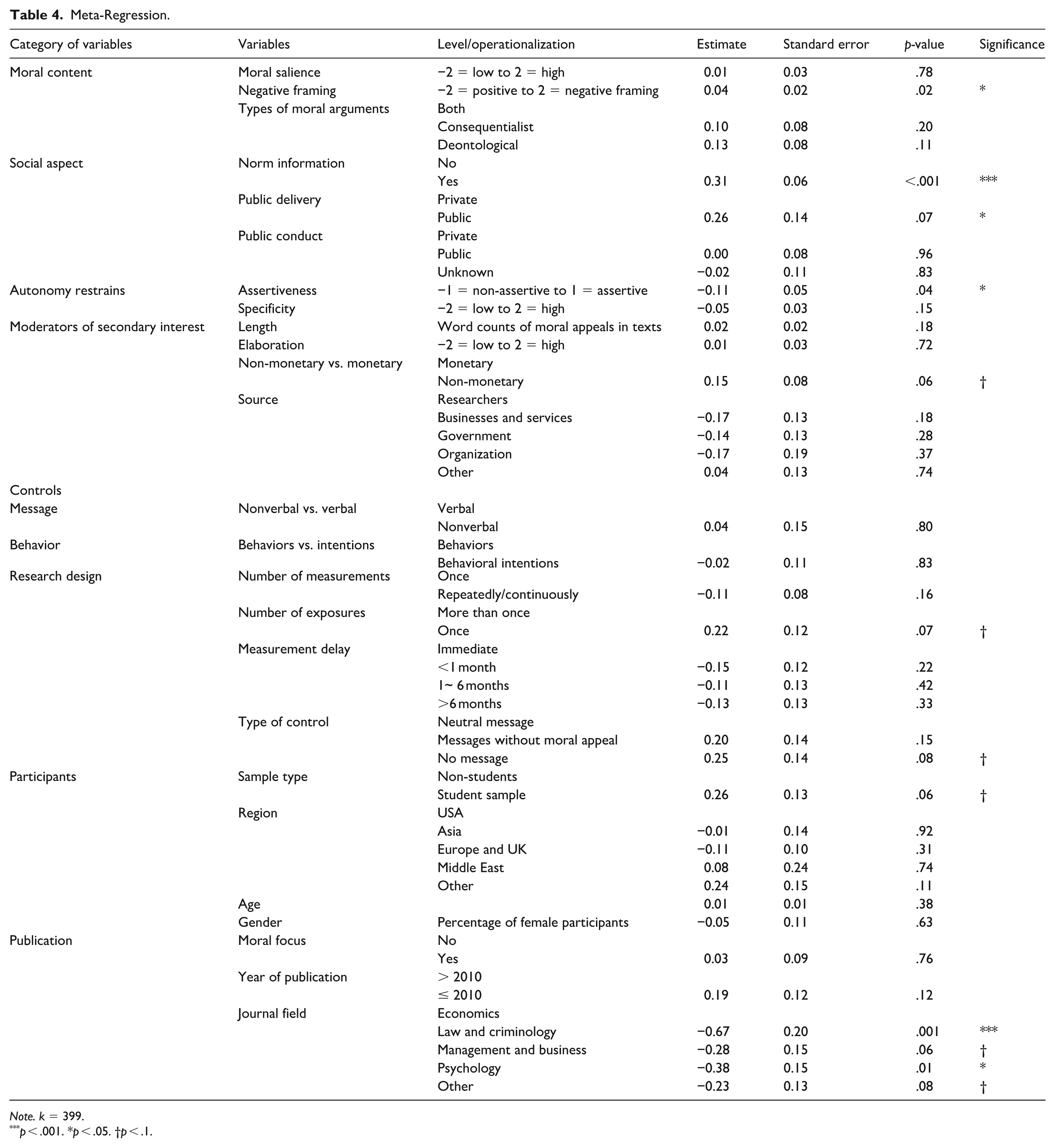
Note. k = 399.
p < .001. *p < .05. †p < .1.
Moral Content
Moral salience had no significant influence on moral appeals (b = 0.01, SE = 0.03, p = .78). Framing did exert an influence (b = 0.04, SE = 0.02, p = .02) in that negative framings were more effective than positive ones. Regarding types of moral arguments, moral appeals using consequentialist (d = 0.21; 95% CI [0.13, 0.30]; b = 0.10, SE = 0.08, p = .20), deontological (d = 0.28; [0.17, 0.39]; b = 0.13, SE = 0.08, p = .11), and both framings (d = 0.20; 95% CI [0.10, 0.29]) are equally effective.
Social Aspects
Moral appeals combined with norm information (d = 0.46; 95% CI [0.34, 0.58]) are significantly more effective than those without (d = 0.20; [0.13, 0.27]), b = 0.31, SE = 0.06, p < .001, supporting our Hypothesis 1. Furthermore, results suggest that the effects of moral appeals delivered in public (d = 0.33; [0.13, 0.54]) appear to be larger than in private (d = 0.21; [0.14, 0.28]), b = 0.26, SE = 0.14, p = .07. This finding should be interpreted with caution due to its marginal significance. Regarding behavioral conduct, the effect of moral appeals is equally effective when the outcome behaviors are intended to be conducted in public (d = 0.34; [0.20, 0.47]; b = 0.00, SE = 0.08, p = .96), private (d = 0.20; [0.13, 0.27]), and the ambiguous settings (d = 0.20; [0.08, 0.33]; b = −0.02, SE = 0.11, p = .83), failing to support Hypothesis 3.
Autonomy Restraints
Concerning moderators related to Autonomy Restraints, the more assertive the message is, the weaker the effect of moral appeals (b = −0.11, SE = 0.05, p = .04), in line with our theorizing and provides support for Hypothesis 4. Contrary to Hypothesis 5, how specific the behaviors described in the message did not influence the effect of moral appeals (b = −0.05, SE = 0.03, p = .15).
General Discussion
This meta-analysis aims to address inconsistent findings on the main effect of moral appeals, test moral appeals’ overall influence, and identify when they are most effective by examining various moderators. In our integrated framework, we reasoned that moral appeals increase moral awareness, but that this could evoke either morality enhancers (movements towards behaviors in line with the moral appeal spurred by the desire to strive for a moral self-image and moral reputation) or morality hindrances (counter-movements spurred by defensive reactions to moral self-threats or autonomy threats). We further reasoned that the Moral Content of the appeal, Social Aspects surrounding the communication of the appeal, and aspects related to Autonomy Constraints would influence the effect of moral appeals through one or both dynamics.
Our main result is that moral appeals are successful in influencing intentions and behaviors across conditions, with a small, positive effect size, suggesting that, overall, morality enhancers are generally dominant over morality hindrances. Furthermore, there was not one level of any moderator that we tested for which moral appeals significantly backfired to produce worse outcomes relative to the comparison groups. Instead, we were able to identify various moderators that can enhance their effectiveness to make moral appeals work better.
When Moral Appeals Work Better
Of the three groups of moderators (i.e., Moral Content, Social Aspects, and Autonomy Restraints), our results emphasized Social Aspects as key to enhancing moral appeals, while also providing preliminary evidence that Autonomy Restraints weaken them. Moral Content tended to produce null effects.
For Social Aspects, consistent with our expectations, moral appeals that explicitly incorporate social norm information were generally more effective. Public delivery of the message showed a small, marginally significant increase in effectiveness, whereas whether the behavior itself was public or private did not appear to matter. Given the modest size of the public-delivery effect, these interpretations should be viewed as preliminary. However, they do suggest that moral appeals are more effectively strengthened by highlighting group norms, rather than merely emphasizing the visibility of individual actions. This pattern suggests that moral appeal may contribute to a “social tipping point.” By making norms salient in public contexts, it can help reach critical thresholds needed to facilitate broader behavioral change in a social domain (Judge et al., 2024).
Regarding Autonomy Restraints, our results align with the idea that forceful wording can threaten autonomy and dampen the persuasive impact of an appeal. Furthermore, contrary to our hypothesis, specific instructions had no effect. We had argued that specific language would be experienced as more controlling and evoke more reactance. What could explain this null effect is that specific instructions also have the advantage of being clearer (Ball & Goodboy, 2014; Miller et al., 2007), making them easier to follow as concrete guidelines than more general instructions (Mulder et al., 2020). This finding aligns with the theory of planned behavior (Ajzen, 2002), which posits that perceived control over one’s behavior (i.e., knowing what to do and how) can facilitate action. So, this benefit of specific instructions in a moral appeal may offset their potential to trigger reactance.
For Moral Content, we made no directional hypothesis, as we reasoned that moral salience, negative framing, or the type of argument could affect moral awareness by simultaneously triggering morality-enhancing (moral self-image) or hindering (moral threat) processes and, thus, result in null effects. Consistent with this, the meta-analysis found no moderating effect of moral salience, nor did deontological appeals (referring to rules, values, and obligations) differ in effectiveness from consequentialist appeals (referring to outcomes). This could suggest that moral salience and the type of appeals may activate competing psychological processes, thereby cancelling out any overall effect. However, the absence of a moderation of any moral content factor may also be explained in alternative ways. For example, highlighting moral aspects may not meaningfully shift participants’ perceptions or actions (Haidt, 2001; Van Bavel et al., 2012). Additionally, deontological and consequentialist appeals may both be effective in distinct ways; deontological appeals may engage emotional responses, while consequentialist appeals may elicit cognitive deliberation (Conway & Gawronski, 2013). Finally, methodological factors could also play a role. For example, the way morality was salient differed across studies, which could have introduced noise and further attenuated observable effects (Shadish et al., 2002). Moreover, the lack of a moderating effect could have been due to limited variation introduced through data imputation (Little & Rubin, 2019). Indeed, our multiple-imputation robustness analyses identified deontological framing as a significant moderator, whereas this effect did not emerge under mean imputation, suggesting that deontological (relative to consequentialist) framing may exert an effect under certain analytic assumptions.
One Moral Content factor that did enhance the effectiveness of moral appeals was negative framing, suggesting moral appeals focusing on the negative aspects of undesired behavior were more persuasive than those emphasizing the positive aspects of desired behavior. Drawing on the “bad is stronger than good” principle (Baumeister et al., 2001), we reasoned that negative framing would enhance moral awareness. Our results suggest that this contributes more to the enhancers’ dynamic of moral self-image than to the hindrances’ dynamic of moral threat. This may be because people are more motivated to maintain a self-image of not being immoral than to be seen as actively moral (see Trafimow & Trafimow, 1999, on perfect vs. imperfect duty violations). This may help them overcome the moral threat elicited by the appeal and instead boost their motivation to restore their moral self-image, thereby increasing their likelihood of compliance.
Theoretical and Practical Implications
This meta-analysis offers several contributions. First, we clarify the concept of moral appeals by emphasizing that moral appeals consist of two primary components: moral content and persuasive intent, thereby differentiating moral appeals from related constructs such as moral priming (Aquino et al., 2009) and moral labeling (e.g., Mieth et al., 2021). This conceptual clarification provides a clearer foundation for future research and application.
Second, this is the first meta-analysis to systematically assess the overall effectiveness of moral appeals. We find that moral appeals have a small but reliable positive effect on behavior and behavioral intentions and, importantly, do not backfire on average. This challenges common concerns that moralizing messages alienate recipients (Driessen, 2022). Although modest, such effects can be meaningful when scaled across populations or accumulated over time (Cohen, 1992; Funder & Ozer, 2019). Moral appeals operate at the individual level (Chater & Loewenstein, 2023), yet repeated exposure can aggregate into substantial organizational, political, or societal impact. At the same time, the modest effect size suggests that moral persuasion is not universally powerful. Our findings further refine this understanding by identifying moderators that indicate when moral appeals are more or less effective. For instance, subgroup analyses showed that when combined with norm information, moral appeals produced a medium-sized effect (d = 0.46), and when delivered publicly, they produced a small-to-medium effect (d = 0.33). Together, these findings suggest that moral appeals should be viewed as one ingredient in a broader behavior-change toolkit rather than a standalone intervention for producing large short-term changes.
Third, we systematically examine moderators of moral appeals—an area previously underexplored. Despite constraints in available coding, our results show that moral appeals are most effective when combined with social cues (e.g., norm information), negatively framed, and delivered without assertive language, with tentative evidence that public delivery further enhances effectiveness. These findings indicate that the effectiveness of moral appeals is context-dependent. Notably, social aspects emerged as the strongest moderator, suggesting that moral appeals work best when they signal shared support beyond the sender. Substantial residual heterogeneity further indicates that additional moderators that were beyond the scope of this meta-analysis remain important targets for future research.
Beyond its theoretical contributions, this study has several practical implications. Moral appeals can be used with relative confidence, as they are unlikely to backfire and can positively influence behavior. However, given their small average effect, they should not be viewed as a standalone solution; other strategies, such as monetary incentives, may be more effective (Wang et al., 2021). Instead, moral appeals may be best understood as one ingredient in a broader package of behavior-change strategies. Second, how moral appeals are delivered matters: practitioners can get more out of moral appeals when they align them with perceived social norms, use negative framing, and avoid overly assertive language that may trigger autonomy threats. And, with some caution, our findings suggest that moral appeals may work better if they are delivered publicly.
Strengths, Limitations, and Future Directions
A key strength of this study is its methodological approach. By meta-analyzing a wide range of field and laboratory experiments across diverse domains (e.g., environmental behavior, health, tax compliance), we enhance the reliability and generalizability of our conclusions. Importantly, we found no difference in the effectiveness of moral appeals on behavioral intentions versus actual behaviors, suggesting that moral appeals influence both intended and enacted behavior. As a result, studies using intention measures may still offer valid insights into real-world behavior change—an encouraging finding given the widespread use of intentions in persuasion research.
Despite its merits, this study has several limitations. First, our analysis was limited to the moderators of our focus, which left others unexplored. Some were not considered due to insufficient data, such as those related to the audience (e.g., personality traits) and the sender (e.g., perceived trustworthiness). For example, the meta personality factor Stability—a combination of agreeableness, conscientiousness, and emotional stability (DeYoung et al., 2002)—may influence responses to moral appeals as it has been linked to greater compliance and lower reactance (e.g., Seemann et al., 2005). Individuals high in stability may be more receptive to moral persuasion. Furthermore, there may be factors, apart from the ones we coded and tested, that relate to our three categories of moderators (moral content, social aspects, and autonomy restraints) and may also moderate the effect of moral appeals. An example of this is the extent to which an appeal to ingroup values is made (related to social aspects), which is expected to contribute to the effect of a moral appeal. Last, although coded in our meta-analysis, domain type could not be tested as a moderator. Our dataset spanned multiple domains (e.g., tax compliance, health, environmental behavior), but this factor could not be included in the meta-regression models due to multicollinearity. Future research should therefore examine how domains impact moral appeals. When doing this, particular attention could be given to differences between polarized (e.g., climate policy) versus less polarized contexts (e.g., tax compliance) as moralization may amplify identity threat and intergroup conflict in polarized domains but function more normatively in less polarized settings (D’Amore et al., 2024).
A second limitation is that, although robustness checks using multiple imputation largely corroborated the main conclusions of the meta-analysis, some moderators were less stable to this robustness check. Assertiveness was no longer significant under multiple imputation, likely because this approach introduces additional variance by accounting for uncertainty in the imputed values, which can attenuate effects that are marginal or sensitive to study characteristics (Sterne et al., 2009; White, Royston & Wood, et al., 2011) and should therefore be interpreted with caution. In addition, deontological framing emerged as a significant moderator in the robustness check, suggesting that rule-based reasoning may play a larger role in moral appeal effectiveness than indicated by the primary models.
Another limitation is that our meta-analytic approach did not allow us to directly test the underlying mechanisms of moral awareness, moral self-image, and moral threat dynamics. Our theoretical model primarily served as an organizing framework for generating hypotheses about the effects of moral appeals and their moderators, rather than for testing mediation. Consequently, the present findings provide suggestive rather than definitive evidence regarding underlying causal processes, and alternative explanations—such as the theory of planned behavior (Ajzen, 2002), and process dissociation accounts (Conway & Gawronski, 2013)—may also contribute to the observed effects. Although available data did not allow us to empirically adjudicate between alternative explanations, our model can guide future research to test when moral appeals affirm moral self-image versus elicit threat or reactance—for example, in contexts where social norms conflict with moral imperatives (e.g., vegetarianism vs. meat-eating; Monin & Norton, 2003) versus contexts aligned with shared values (e.g., reducing food waste; Dolnicar et al., 2020).
A further limitation of this meta-analysis is its exclusive focus on behavioral intentions and actual behaviors, without examining attitudinal outcomes. This focus reflects our primary goal of assessing whether moral appeals translate into action-oriented change, as well as conceptual and methodological considerations. Conceptually, our model emphasizes moral awareness rather than attitudinal change as a trigger for behavior, consistent with evidence that moral attitudes do not reliably translate into action, particularly at the collective level (Ajzen, 1991; Sheeran, 2002; Bolderdijk & Cornelissen, 2022). Moral appeals may also influence behavior without (first) changing attitudes, as suggested by theories such as nudging (Thaler & Sunstein, 2009), self-perception theory (Bem, 1967), and the elaboration likelihood model (Petty & Cacioppo, 1986). Methodologically, attitude measures are operationalized heterogeneously across moral appeal studies (e.g., as moral concern, beliefs about responsibility, or subjective evaluations of messages). Because general attitudes toward policies, people, institutions, and events correlate with broad rather than specific behaviors (Ajzen et al., 2018), combining diverse measures would inflate heterogeneity and reduce precision. Nevertheless, future research integrating both attitudinal and behavioral outcomes could clarify when and how moral appeals shift attitudes and whether such changes mediate subsequent behavior.
One last limitation concerns our reliance on the conventional significance threshold of .05 and the reporting of effects approaching this threshold. While this approach maintains comparability with prior work (Turner & Rains, 2021; Witte & Allen, 2000), we acknowledge that testing multiple moderators in our sample increases the chance of false positives (Streiner & Norman, 2011). However, all moderator analyses were pre-specified and theory-driven, which should mitigate this concern. Furthermore, stricter corrections would substantially increase Type II error given the limited number of studies for some moderators (Borenstein et al., 2009; Rothman, 1990). Nevertheless, marginal effects, especially the distinction between public versus private delivery, should be interpreted with caution and warrant replication under stricter correction procedures.
Conclusions
This meta-analysis provides the most comprehensive evaluation of moral appeals to date, revealing their small but positive overall effect on intentions and behaviors across domains. Our moderator analyses indicate that moral appeals are more effective when they incorporate social cues, such as norm information, when negatively framed, and avoid assertive language. It also tentatively suggests that appeals may benefit from public delivery. Our results also highlight the need for further research on the role of moral awareness in shaping moral appeals, particularly the interplay between the competing psychological dynamics it may trigger. We believe our analysis offers a comprehensive overview of the existing literature and provides valuable insights and promising directions for future research on moral appeals.
Supplemental Material
sj-docx-1-psp-10.1177_01461672261437934 – Supplemental material for The Behavioral Impact of Moral Appeals: An Integrated Framework and Meta-Analysis
Supplemental material, sj-docx-1-psp-10.1177_01461672261437934 for The Behavioral Impact of Moral Appeals: An Integrated Framework and Meta-Analysis by Sylvia Y. Xu, Laetitia B. Mulder, Floor A. Rink, Tammo H. A. Bijmolt and Marijke C. Leliveld in Personality and Social Psychology Bulletin
Footnotes
Author Note
An earlier version of this manuscript was accepted at the 2025 Academy of Management Annual Meeting. The corresponding abstract can be found in the Academy of Management Proceedings (Vol. 2025).

Funding
The authors received no financial support for the research, authorship, and/or publication of this article.
Declaration of Conflicting Interests
The authors declared no potential conflicts of interest with respect to the research, authorship, and/or publication of this article.
Data Availability Statement
Supplemental Material
Supplemental material is available online with this article.
Notes
References
Supplementary Material
Please find the following supplemental material available below.
For Open Access articles published under a Creative Commons License, all supplemental material carries the same license as the article it is associated with.
For non-Open Access articles published, all supplemental material carries a non-exclusive license, and permission requests for re-use of supplemental material or any part of supplemental material shall be sent directly to the copyright owner as specified in the copyright notice associated with the article.
