




Abstract
Across three experimental studies using hypothetical scenarios, we investigated under what circumstances, and to what effect, women and men devalue women’s orgasm. In Studies 1 and 2, women reported their orgasm value in response to a hypothetical scenario that varied their imagined orgasm history and current orgasm frequency with a new partner (low vs. high). In Study 2, orgasm value was compared to a baseline, pre-manipulation measure of orgasm value. In both studies, we found that women devalued orgasm only when they imagined they had a history of infrequent orgasms and were not orgasming with their current partner. When current orgasm frequency was low, women who valued orgasm less (or devalued orgasm) imagined better sexual and relationship outcomes than women who valued orgasm more. Men (Study 3) valued a hypothetical female partner’s orgasm less under the same circumstances and reported similar impacts of women’s orgasm absence on their own and perceived partner’s imagined sexual and relationship outcomes.
Introduction
Do women care less than men do about experiencing orgasm? While there may be a cultural assumption that women do not care about orgasm for their own sexual satisfaction as much as men do (Vandal, 2018), the empirical research on this topic is mixed. Some research suggests heterosexual women place less importance on orgasm for their sexual satisfaction than heterosexual men and report a significantly lower desired orgasm frequency (Mark et al., 2014; Salisbury & Fisher, 2014; Wetzel et al., 2022). Women may be more likely than men to value relational and emotional aspects of a sexual encounter over physical pleasure and often enter sexual encounters to meet the needs of their partner rather than their own (Blumenstock, 2021; Mark et al., 2014; Regan & Berscheid, 1996). Women sometimes dismiss their own sexual pleasure in pursuit of the pleasure and satisfaction of their partner (Armstrong et al., 2012; McClelland, 2010, 2011). Women may be less likely than men to rank orgasm as one of their primary goals or motivators for sex or to spontaneously indicate that orgasm is important for their sexual satisfaction (e.g., McClelland, 2011; Meston & Buss, 2007; Salisbury & Fisher, 2014).
However, other research suggests women tend to value orgasm highly (e.g., Dickman et al., 2024; Wetzel, Sanchez, & Cole, 2024). Orgasm is a consistent predictor of sexual satisfaction for women within mixed-sex couples and has implications for many sexual and relationship outcomes (e.g., Dienberg et al., 2023; Leonhardt et al., 2018; Wetzel et al., 2022). Samples that directly compare measures of orgasm importance, value, or desire between men and women find a small or non-existent gender difference (e.g., Wetzel et al., 2022; Wetzel, Sanchez, & Cole, 2024).
Research has also found that women’s threshold for a sexually satisfying experience is based on the absence of pain or degradation rather than the presence of pleasure or orgasm (McClelland, 2010). Women likely shape their conceptualization of sexual satisfaction based on their gendered experience of sexuality, especially given that individuals interpret their sexual experiences in accordance with expectations for their social group (McClelland, 2010). Women are socialized into, and often enact, a less agentic sexual gender role compared to men’s (Sanchez et al., 2006, 2012). Men’s and women’s sexual outcomes cannot be easily compared when men’s sexual socialization is different from women’s, creating an inherently different sexual experience for women compared to men (Conley & Klein, 2022). Thus, it is important to consider various factors (e.g., motivational, interpersonal, sociocultural) that may influence the value women place on orgasm across contexts. A primary aim of the present work is to reconcile mixed findings in the literature by exploring whether and under what circumstances women reduce their orgasm value.
Devaluing Orgasm
If women do, in fact, value orgasm less than men in certain circumstances, it is important to consider the sociocultural reasons why this difference may exist and the psychological processes that underlie this effect. Women experience substantially fewer orgasms than men during partnered sex (i.e., the “orgasm gap”; Dienberg et al., 2023; Döring & Mohseni, 2022; Frederick et al., 2018; Mahar et al., 2020; McElroy & Perry, 2024), and research consistently finds that orgasm frequency shapes orgasm expectations, which, in turn, shape orgasm desire and pursuit (Blumenstock, 2021; Wetzel et al., 2022; Wetzel, Sanchez, & Cole, 2024; Wetzel et al., 2025). Thus, women may come to value orgasm less than men precisely because they are less likely to experience it.
Devaluing refers to an attitudinal shift: placing less importance, or value, on a particular outcome or goal domain. Indeed, research suggests that when people underperform in a certain domain compared to others, they often respond by devaluing that goal domain (Tesser, 1988; Tesser & Campbell, 1980; Tesser & Paulhus, 1983). According to the self-threat literature, when people experience threats to the self, either in comparison to others (e.g., other women have orgasms and I do not) or via perceived underperformance (e.g., I don’t have orgasms as often as I should), they devalue that domain, or reduce the importance of that domain, in order to preserve a positive sense of self (e.g., orgasm is not important to me). For example, in one study, participants described a fictitious personality trait as less important to them after they received feedback that they scored lower on that trait than another person (Tesser & Paulhus, 1983). Devaluing the outcome domain deflects the threat to the self, preserving self-esteem (Tesser, 1988; Tesser & Campbell, 1980; Tesser & Paulhus, 1983). Moreover, research suggests people also deflect threats to their romantic relationships by devaluing (e.g., downplaying the attractiveness of alternative partners; Cole et al., 2016; Lydon et al., 1999). In the case of orgasm, women who perceive themselves, or their relationships, as “underperforming” in the orgasm domain may devalue the importance of orgasm as a result. If women’s low orgasm frequency was considered a self-threat, the cause of orgasm absence would likely be attributed to women themselves. If women’s low orgasm frequency was considered a relationship threat, the cause of orgasm absence would likely be attributed to their partner (e.g., lack of knowledge, skill, or effort) or to the relationship (e.g., incompatibility or insufficient communication).
According to the multiple discrepancies theory (Michalos, 1985), a person’s satisfaction in any domain is a result of the discrepancy between what that person has and what they desire, what they expect, and what they perceive relevant others have. In applying this theory to orgasm or sexual satisfaction, women are likely more satisfied when they reduce the discrepancy between their existing orgasm frequency and the orgasm frequency that they desire and expect. Research has illustrated that women do shift their desire for, expectation for, and pursuit of orgasm depending on their orgasm history as well as the context of the current sexual situation (Gusakova et al., 2020; Wetzel, Sanchez, & Cole, 2024; Wetzel et al., 2022). In general, goal pursuit research finds that people adapt by adjusting—or disengaging entirely from—their goals when they become unattainable or unfeasible (Svensson et al., 2023; Wrosch et al., 2003, 2007). Similarly, women disengage from the pursuit of an orgasm goal when it is not perceived to be feasible (Wetzel, Sanchez, & Cole, 2024). To maintain their satisfaction in these instances (e.g., orgasm is not feasible with a particular partner or in a particular context), we suspect that women reduce the importance they place on orgasm, as well as their expectations for orgasm (Michalos, 1985; Wetzel et al., 2022). Devaluing orgasm refers to a reduction in orgasm value, while disengagement from an orgasm goal would be a potential consequence of devaluing that outcome (Dickman et al., 2024).
Although devaluation can be an adaptive attitudinal shift as part of a self-regulatory process, the orgasm gap persists as a sociocultural and interpersonal gender equity issue, and thus, many women have to decide how to contend with orgasm absence, while men typically do not (Dienberg et al., 2023; Mahar et al., 2020). Thus, devaluing orgasm may contribute to a cycle of orgasm inequality as women adjust to orgasm absence, reducing their expectations and effort as a result (Dickman et al., 2024; Wetzel et al., 2022; Wetzel, Sanchez, & Cole, 2024). However, when women do have orgasms, they report greater sexual satisfaction and relational outcomes, as well as general psychological well-being (Leonhardt et al., 2018; Davison et al., 2009; Litzinger & Gordon, 2005; Sprecher, 2002). Thus, women’s potential devaluation of orgasm should be understood as both a psychological process to protect the self and one’s relationship, as well as a byproduct of a larger gender and sexual equity issue that negatively impacts women’s sexual and romantic relationships.
Current Project
When orgasm frequency is consistently low for a given woman across partners (i.e., self-threat; Tesser, 1988), or in a given relationship (i.e., relationship threat; Lydon et al., 1999), we expect women to reduce the value that they place on orgasm. In other words, we expect women to devalue orgasm when they are not experiencing it. In randomized experimental studies, we used hypothetical sexual scenarios to assess women’s (and men’s) anticipated value of women’s orgasm based on two key features: women’s orgasm history and their orgasm frequency with a current partner. This project is the first to use experimental methods to establish causal links between these variables and to expand devaluation theory directly into the sexuality domain. Throughout this manuscript, we operationalize “devaluing” as either a between-subjects difference in orgasm value by condition or a within-subjects reduction in orgasm value.
In the current project, we sought to address three primary research questions:
(1)Do women and men devalue women’s orgasm? If so, under what conditions do they devalue women’s orgasm?
(2)Across conditions, how strongly do women and men attribute women’s orgasm frequency to themselves versus their partner?
(3)Does devaluing orgasm provide a buffer against negative imagined sexual and relationship outcomes when orgasm frequency is low?
Across studies, we assessed the impact of assigned orgasm history and current orgasm frequency condition on the value of women’s orgasm, sexual satisfaction, sexual desire, and relationship commitment. We used causal attributions to determine how women’s orgasm frequency was attributed to women versus their partners.
Hypotheses
No studies in this manuscript were pre-registered. The first study in this project was largely exploratory due to the lack of existing research on this topic. We predicted that women who imagined they experienced a low orgasm frequency historically and/or with a current partner would report lower orgasm value, as well as lower imagined sexual desire, sexual satisfaction, and relationship commitment, compared to those who imagined they experienced a high orgasm frequency. The goal of Study 2 was to replicate the results from Study 1 and expand on them by including within-subjects change in orgasm value from a baseline measure of orgasm value. In Study 2, we predicted that orgasm value would decrease from baseline under the same conditions established in Study 1. If devaluing orgasm is protective against relationship threat, we expected that there would be a negative relationship between orgasm value and imagined sexual and relationship outcomes for the low current orgasm frequency condition specifically (i.e., when orgasm is absent, imagined outcomes should be worse as orgasm value increases). These moderation analyses were exploratory. Further expanding on Study 1, Study 3 tested whether heterosexual and bisexual men valued a hypothetical female partner’s orgasm less under the same conditions, and whether a hypothetical woman’s orgasm frequency would similarly impact men’s own and perceived partner’s imagined sexual and relationship outcomes.
Study 1
Method
Sample and Procedure
For Studies 1 and 2, we recruited online adult samples of cisgender women living in the United States who had been sexually active in the past year. We used the Prolific recruitment platform. Based on a power analysis conducted in G*Power for a 2 × 2 between-subjects ANOVA with 90% power to detect a small effect size of f = 0.2 at α = .05, a minimum analytic sample of 265 participants would be required for all studies in the current project. For Study 1, to account for participant exclusion, we recruited 299 eligible participants who completed the full study before halting data collection. After recruitment was complete, 27 participants were removed for failing an attention check related to the experimental manipulation. Another participant was removed for failing more than one additional attention check. Our final sample consisted of 271 cisgender women of any sexual orientation. However, most women (90.4%) in our sample were partnered with men. See Table 1 for full participant demographics for all studies in the current project. We report all manipulations and exclusions.
Demographic Information for Each Sample.
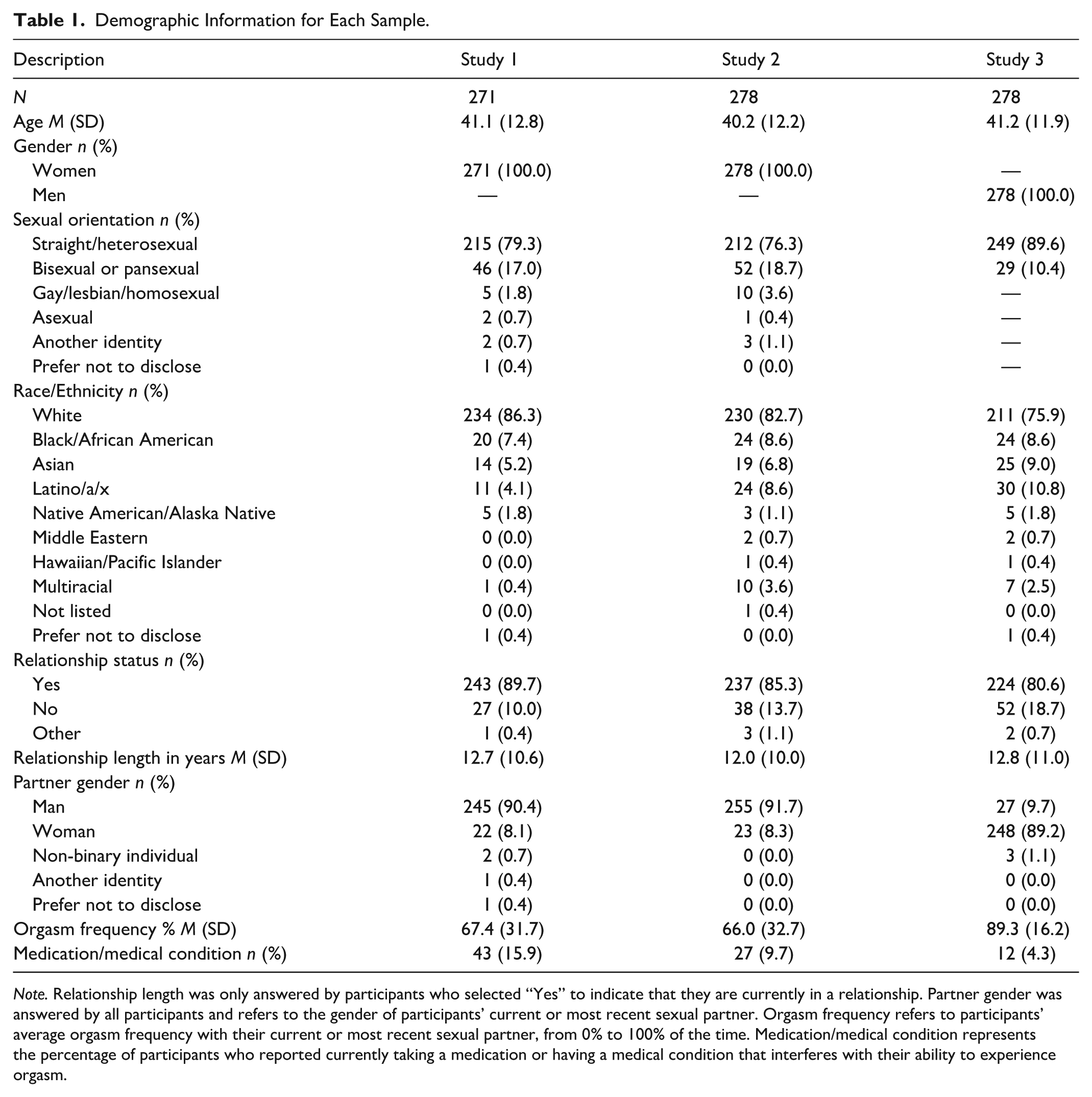
Note. Relationship length was only answered by participants who selected “Yes” to indicate that they are currently in a relationship. Partner gender was answered by all participants and refers to the gender of participants’ current or most recent sexual partner. Orgasm frequency refers to participants’ average orgasm frequency with their current or most recent sexual partner, from 0% to 100% of the time. Medication/medical condition represents the percentage of participants who reported currently taking a medication or having a medical condition that interferes with their ability to experience orgasm.
After indicating consent, participants were asked to imagine themselves in a hypothetical sexual scenario and completed various measures. Some additional measures were administered but are not included in the current manuscript for conciseness. See https://osf.io/wdg67/ for full materials for all studies in the current project. After completing demographic questions, participants were debriefed and compensated.
Measures
Hypothetical Scenario
Regardless of their current relationship status or past sexual experiences, participants were asked to imagine themselves in the context of a hypothetical sexual scenario. Participants were randomly assigned to a condition in which orgasm history and orgasm frequency with a current partner were either low or high (2 × 2 design). For example, the Low History × Low Current condition read:
The scenarios differed based only on the sentences presented in bold text. In the high orgasm history conditions, the first two sentences instead read: “Imagine that you normally have a high orgasm frequency across sexual partners. In other words, you have typically experienced orgasm very often in the past.” In the high current orgasm frequency conditions, the last sentence instead read: “and you have experienced orgasm with this person during almost all of your sexual encounters.” Two attention check questions ensured that participants correctly identified their assigned condition; the final sample consisted only of participants who correctly answered these attention check questions. Four participants were removed in the High History × Low Current condition (final n = 68), 10 were removed in the High History × High Current condition (n = 66), 8 were removed in Low History × High Current (n = 67), and 5 were removed in Low History × Low Current (n = 70).
Orgasm Value
Participants indicated how much they would value orgasm with the partner in the scenario using a standard orgasm importance item (“Orgasm would be important to my sexual satisfaction with this partner”; Wetzel, Sanchez, & Cole, 2024), and an adapted value subscale (Major & Schmader, 1998; three items; e.g., “I would care a great deal about experiencing orgasm with this partner”). These four items, answered on a scale from 1 (strongly disagree) to 7 (strongly agree), were averaged into one composite measure, with higher scores indicating greater orgasm value. For all scales in the current project, we created a weighted average for reliability scores by condition (α = .88). To measure devaluation, we compare between-subjects orgasm value across conditions.
Causal Attributions
To gauge causal attributions for participants’ current orgasm frequency, we asked participants, “To what extent would you say the following factors are the cause of your [high/low] orgasm frequency with your hypothetical partner in the scenario.” Participants responded on a scale from 1 (not at all) to 5 (extremely) for “your hypothetical partner” and “yourself.”
Imagined Sexual and Relationship Outcomes
Participants reported their desire for future sexual encounters with their hypothetical partner using an established scale (adapted from Blumenstock, 2021) which consisted of eight items on seven-point scales (e.g., “My future sexual desire for this partner would be strong”; α = .88). These items were averaged, and higher scores indicated greater imagined sexual desire for their hypothetical partner. Participants also reported their anticipated sexual satisfaction (Hudson et al., 1981; as used by Babin, 2013) by responding to twelve items (e.g., “I think that my sex life with this partner would be wonderful”; α = .95) on a scale from 1 (strongly disagree) to 7 (strongly agree). Higher scores indicated greater sexual satisfaction. Finally, we administered a measure of relationship commitment (adapted from Johnson & Rusbult, 1989), for which participants responded to five items (α = .82; e.g., “In general, to what extent would you be satisfied with your current relationship with your romantic partner?”) on a scale from 1 (not at all) to 5 (extremely). These measures were presented in randomized order.
Analytic Strategy
Using 2 (Orgasm History: High vs. Low) × 2 (Current Orgasm Frequency: High vs. Low) ANOVAs, we tested for differences by experimental condition for all outcome measures. The pattern of all ANOVA results was consistent when controlling for participants’ orgasm frequency in their real lives (see Supplement Document). We then tested whether orgasm frequency condition moderated the relationship between orgasm value and imagined sexual and relationship outcomes using PROCESS Model 1 (Hayes, 2022).
Results
Orgasm Value
There was a significant main effect of orgasm history, F(1,267) = 13.51, p < .001, ηp2 = .05, and a significant main effect of current orgasm frequency, F(1,267) = 15.49, p < .001, ηp2 = .06, on women’s orgasm value. Importantly, there was a significant interaction (Table 2). Women valued their orgasm the least when they had a history of infrequent orgasms and were having infrequent orgasms with their current partner, relative to all other conditions (Figure 1). See Table 2 for all significant interaction effects for all studies.
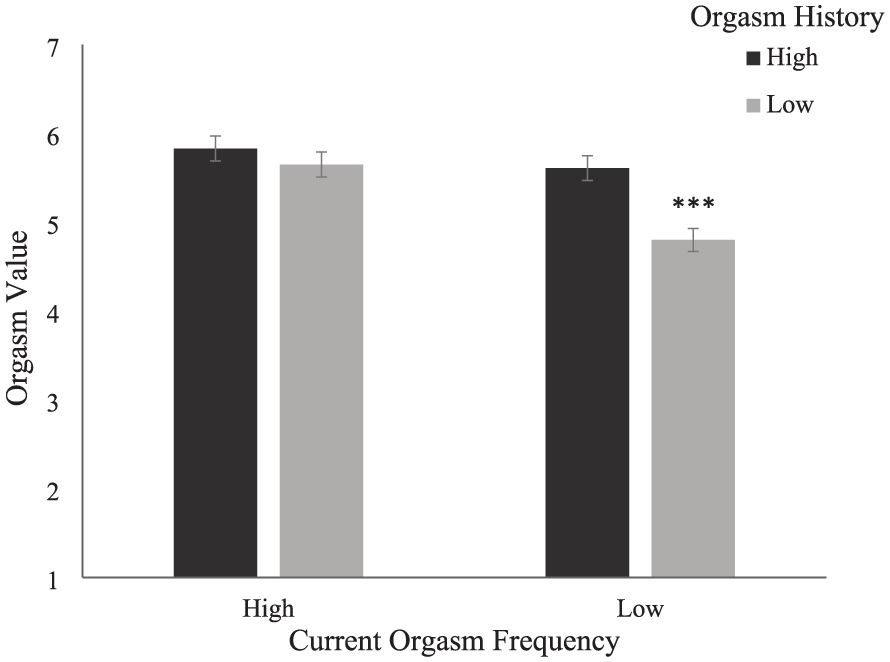
Orgasm value by condition (Study 1).
Interaction Effects and Pairwise Comparisons by Condition for Studies 1 to 3.
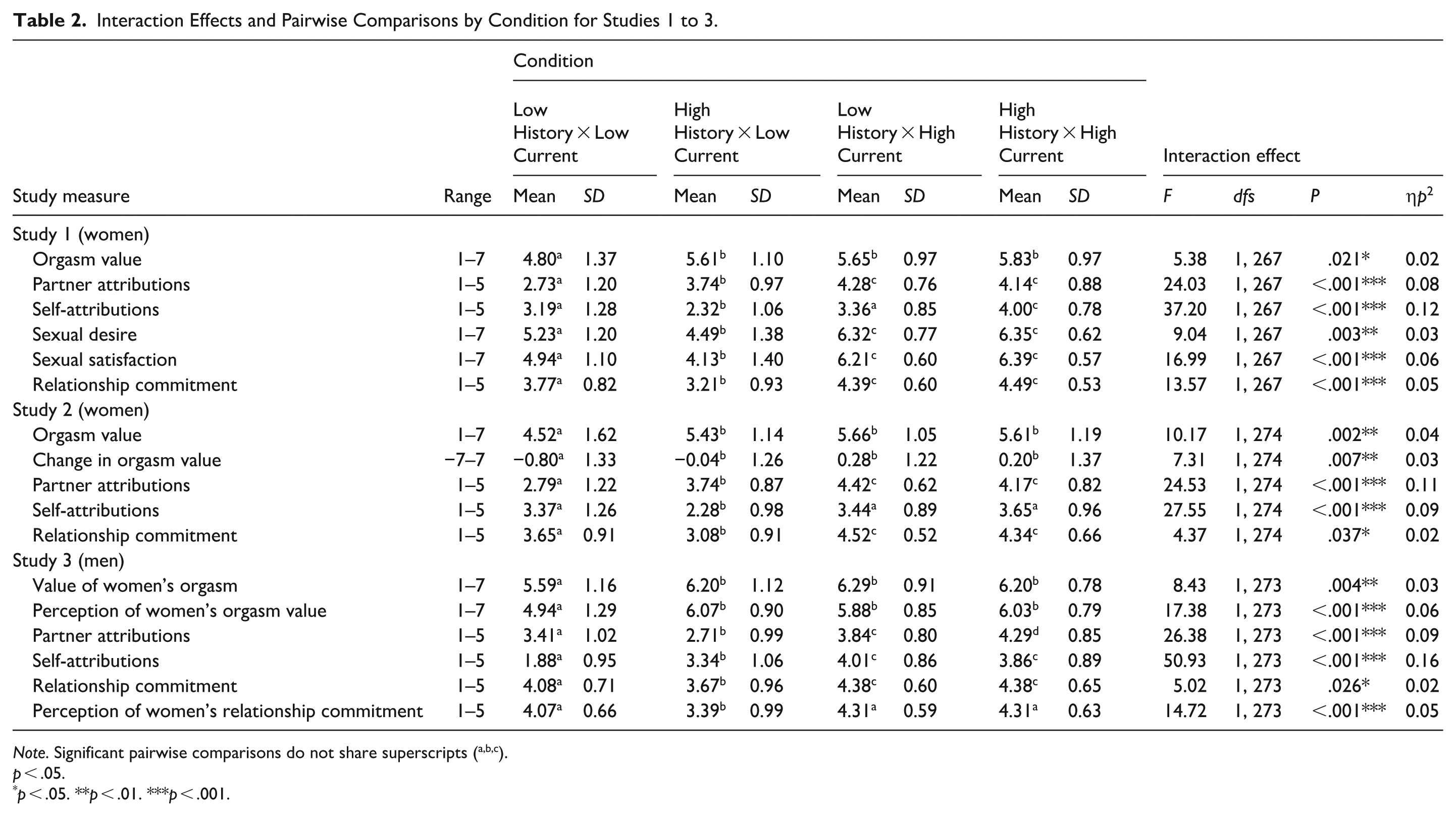
Note. Significant pairwise comparisons do not share superscripts (a,b,c).
p < .05.
p < .05. **p < .01. ***p < .001.
Causal Attributions for Current Orgasm Frequency
To test whether participants’ attributions for orgasm absence reflected self-threat (i.e., attribution to self) or relationship threat (i.e., attribution to partner), we compared the causal attributions women made for their assigned current orgasm frequency.
Partner Attributions
There was a significant main effect of orgasm history, F(1,267) = 13.33, p < .001, ηp2 = .05, and current orgasm frequency, F(1,267) = 69.05, p < .001, ηp2 = .21 on women’s attributions of their orgasm frequency to their partner. There was a significant interaction (Table 2). Women attributed their orgasm frequency to their partner the least when they were told they rarely experienced orgasm across a history of partners, as well as with their current partner. Thus, this condition may instead represent a threat to the self.
Self-Attributions
There was a significant main effect of current orgasm frequency, F(1,267) = 56.22, p < .001, ηp2 = .17, but no main effect of orgasm history, p = .372, on women’s attributions of their orgasm frequency to themselves. There was a significant interaction, such that women attributed their orgasm frequency to themselves the least when they had orgasms often in the past but not in their current relationship, suggesting that this condition may instead represent a relationship threat (Table 2).
Imagined Sexual and Relationship Outcomes
Sexual Desire
There was a significant main effect of orgasm history, F(1,267) = 8.03, p = .005, ηp2 = .03, and current orgasm frequency, F(1,267) = 136.00, p < .001, ηp2 = .34, on sexual desire for the hypothetical partner. This effect was qualified by a significant interaction (Table 2), such that women who imagined not orgasming in their current relationship reported they would have lower sexual desire for their partner, and this effect was especially strong when they imagined they had frequent orgasms with partners in the past (Figure 2).
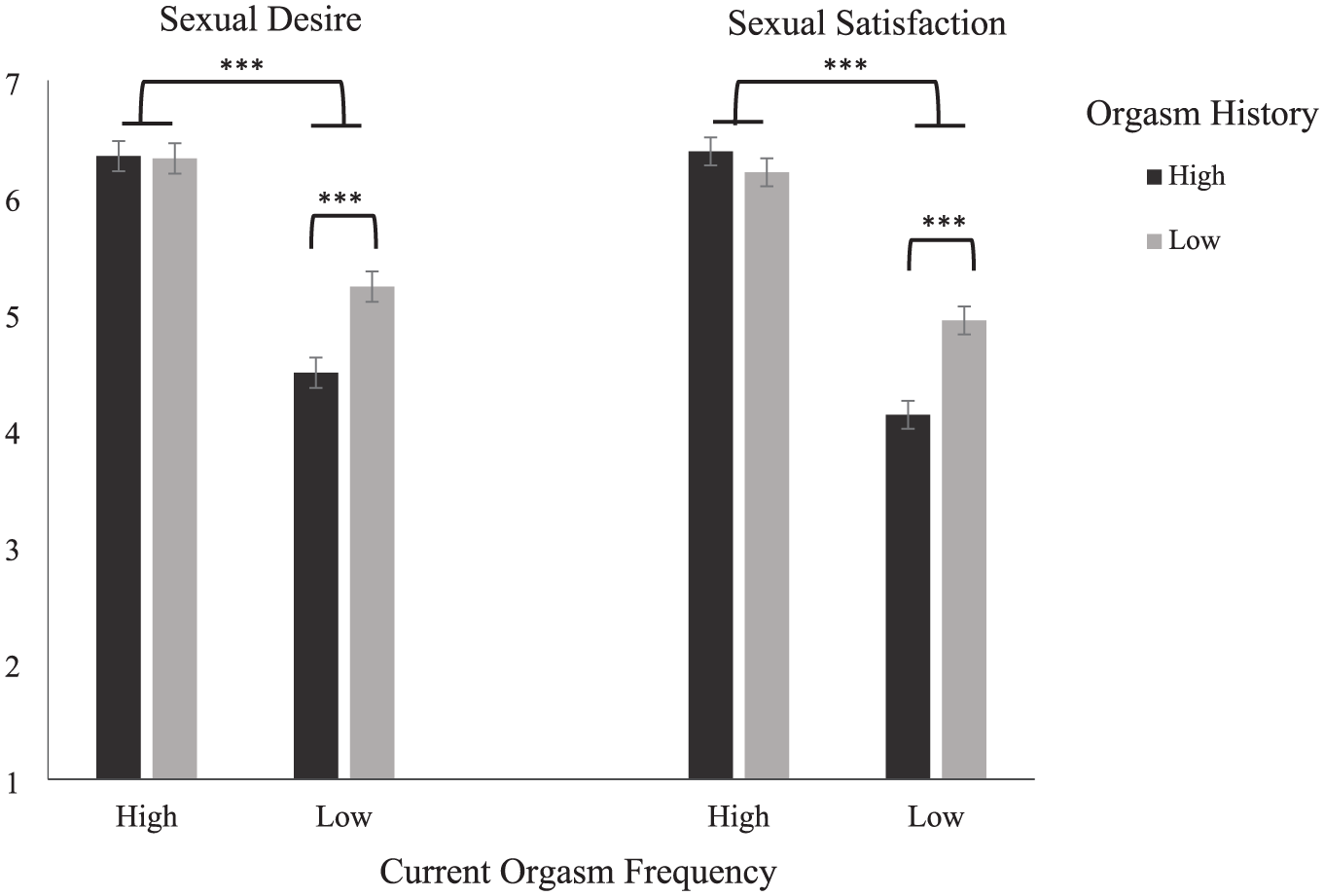
Sexual desire and sexual satisfaction by condition (Study 1).
Sexual Satisfaction
There was also a significant main effect of orgasm history, F(1,267) = 7.02, p = .009, ηp2 = .03, and current orgasm frequency, F(1,267) = 217.30, p < .001, ηp2 = .45, on sexual satisfaction. Importantly, there was a significant interaction (Table 2). Women who imagined not orgasming in their current relationship reported they would have lower sexual satisfaction, and especially so when they imagined they had frequent orgasms in the past (Figure 2).
Relationship Commitment
For relationship commitment, there was a significant main effect of orgasm history, F(1,267) = 6.28, p = .013, ηp2 = .02, and current orgasm frequency, F(1,267) = 111.74, p < .001, ηp2 = .30. There was a significant interaction (Table 2); women who imagined not orgasming in their current relationship reported they would have lower relationship commitment, especially when they imagined they had frequent orgasms in the past.
What Is the Relationship Between Orgasm Value and Imagined Sexual and Relationship Outcomes?
Next, we investigated whether placing less value on orgasm protected against negative imagined sexual and relationship outcomes when current orgasm frequency was low (i.e., when there was a threat to the self and/or relationship) by conducting a series of moderation analyses using PROCESS Model 1 (Hayes, 2022), in which we investigated the relationships between orgasm value and imagined sexual/relationship outcomes at both levels of current orgasm frequency: high versus low. We report 95% confidence intervals.
Sexual Desire
There was a main effect of orgasm value on sexual desire, b = −0.58, 95% CI [−0.91, −0.26], SE = 0.17, t(267) = −3.51, p < .001, such that greater orgasm value was associated with lower sexual desire, and no main effect of current orgasm frequency condition, b = −1.15, [−2.45, 0.14], SE = 0.66, t(267) = −1.75, p = .081. Importantly, the relationship between orgasm value and sexual desire was moderated by current orgasm frequency condition, as evidenced by a significant interaction between orgasm value and current orgasm frequency condition, b = 0.47, [0.24, 0.70], SE = 0.12, t(267) = 4.03, p < .001. When current orgasm frequency was high, greater orgasm value was associated with greater sexual desire for women’s hypothetical partner, b = 0.35, [0.17, 0.54], SE = 0.09, t(267) = 3.78, p < .001. However, when orgasm frequency was low, women’s orgasm value was not related to their sexual desire, b = −0.11, [−0.25, 0.02], SE = 0.07, t(267) = −1.66, p = .097.
Sexual Satisfaction
There was a main effect of orgasm value on sexual satisfaction, b = −0.65, 95% CI [−0.96, −0.34], SE = 0.16, t(267) = −4.13, p < .001, such that greater orgasm value was associated with lower sexual satisfaction, and no main effect of orgasm frequency condition, b = −0.82, [−2.06, 0.41], SE = 0.63, t(267) = −1.31, p = .192. As predicted, the relationship between women’s orgasm value and sexual satisfaction was moderated by orgasm frequency, as evidenced by a significant interaction, b = 0.47, [0.25, 0.69], SE = 0.11, t(267) = 4.21, p < .001 (Figure 3). As women valued orgasm more, they experienced lower sexual satisfaction when orgasm frequency was low, b = −0.19, [−0.31, −0.06], SE = 0.07, t(267) = −2.86, p = .005, and greater sexual satisfaction when orgasm frequency was high, b = 0.28, [0.10, 0.46], SE = 0.09, t(267) = 3.13, p = .002.
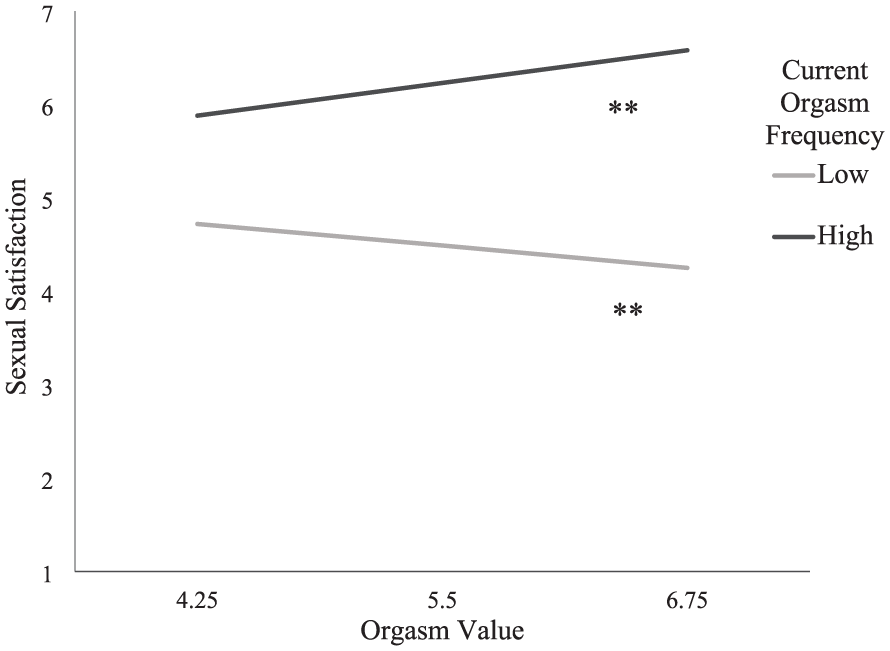
Moderation of the relationship between orgasm value and sexual satisfaction by current orgasm frequency (Study 1).
Relationship Commitment
Finally, there was a main effect of orgasm value on relationship commitment, b = −0.59, 95% CI [−0.82, −0.36], SE = 0.12, t(267) = −5.08, p < .001, such that greater orgasm value was associated with lower relationship commitment, and no main effect of orgasm frequency condition, b = −0.88, [−1.79, 0.02], SE = 0.46, t(267) = −1.92, p = .056. However, the relationship between women’s orgasm value and relationship commitment was moderated by orgasm frequency condition, b = 0.34, [0.18, 0.50], SE = 0.08, t(267) = 4.21, p < .001. The more women valued orgasm, the less committed they felt to their hypothetical partner when experiencing orgasm infrequently, b = −0.25, [−0.34, −0.15], SE = 0.05, t(267) = −5.16, p < .001. There was no relationship between orgasm value and relationship commitment for women who imagined experiencing orgasm often, b = 0.10, [−0.03, 0.22], SE = 0.07, t(267) = 1.46, p = .147.
Study 1 Discussion
In Study 1, we found that women reported lower orgasm value, sexual desire, sexual satisfaction, and relationship commitment when they were not experiencing orgasm in a hypothetical relationship, compared to when they were told they experienced orgasm often. However, these relationships depended on hypothetical orgasm history. Women’s orgasm value was lower only when told their orgasm history was also low, while women’s imagined sexual and relationship outcomes were especially low when told their orgasm history was high.
We theorize that women experience a threat to the self when they experience a low orgasm frequency consistently across partners. Women may devalue orgasm in this condition to preserve self-image, adjusting the importance they place on orgasm to maintain their satisfaction with and interest in sex (Michalos, 1985; Tesser, 1988). This theory is supported by our attribution findings: women attributed their current orgasm frequency to their hypothetical partner the least in this condition.
There were particularly strong negative effects of orgasm absence on imagined sexual and relationship outcomes when women were told they experienced orgasm often in the past, but not with their current partner, which may instead reflect a threat to the relationship. This theory is again supported by our attribution findings: women attributed their orgasm frequency to themselves the least in this condition. If orgasm has been experienced often with previous partners but isn’t experienced in the current relationship, women’s evaluation of the relationship may be threatened, resulting in especially low sexual desire, sexual satisfaction, and relationship commitment with that partner.
When women value orgasm less, however, they report less negative impacts of orgasm absence on their imagined sexual and relationship outcomes. In our moderation results, when told they weren’t experiencing orgasm, greater orgasm value was associated with lower sexual satisfaction and relationship commitment. When told they were experiencing orgasm often, greater orgasm value was associated with higher sexual satisfaction and sexual desire. Valuing orgasm more may enhance the evaluation of the relationship when orgasm frequency is high, while valuing orgasm less may protect the relationship when orgasm frequency is low. However, these analyses are correlational. We investigate this possibility further in Study 2.
Study 2
While Study 1 showed that orgasm value differed experimentally based on orgasm history and current orgasm frequency, we wanted to assess devaluing within-subjects (i.e., a change in value). The purpose of Study 2 was to replicate the results of Study 1, including a measure of baseline orgasm value to show change in orgasm value as a result of experimental condition.
Method
Sample and Procedure
We first recruited women for a short, initial survey, and 446 eligible participants completed the full survey. We recruited 308 eligible participants from this initial sample 1 week later to complete the second survey. After excluding participants who failed the attention check related to the manipulation (n = 29) or more than one additional attention check (n = 1), our final sample consisted of 278 women who completed both parts of the study (see Table 1 for demographics).
In the initial survey, participants completed screening questions, reported their baseline orgasm value, and completed demographics. One week later, in the second survey, participants were randomly assigned to a condition, read the hypothetical scenario, and responded to the measures below. Participants’ two surveys were linked via their unique Prolific ID.
Measures
Baseline Orgasm Value
In the initial survey, participants read the following baseline scenario with no orgasm information: “Imagine that you have a new partner who you’ve been dating for a few months. You’re very excited about the relationship and feel a strong connection.” Participants were asked the extent to which they agreed with the orgasm value measure used in Study 1, on the same scale (e.g., “I would care a great deal about experiencing orgasm with this partner”; α = .95). For the results presented, we utilized this measure for baseline orgasm value.
Participants were also asked to indicate the extent to which they agree with the same four items about themselves in general (e.g., “I care a great deal about experiencing orgasm”; α = .94) and about women in general (e.g., “Women care a great deal about experiencing orgasm”; α = .86). The general pattern of results was consistent for orgasm value across all three baseline measures (see Supplement Document), so we utilized one measure for conciseness.
Hypothetical Scenario
In the second survey, participants were given the same instructions as in Study 1 and were randomly assigned to one of the same four conditions. The hypothetical sexual scenarios were exactly the same as in Study 1, and the same attention check questions were included. Sixteen participants were removed in the Low History × Low Current condition (final n = 63), four in the Low History × High Current condition (n = 72), six in High History × High Current (n = 71), and three in High History × Low Current (n = 72).
Orgasm Value
Participants were asked how much they would value orgasm with their hypothetical partner in the scenario (e.g., “I would care a great deal about experiencing orgasm with this partner”) with the same four-item measure used in Study 1 (α = .91). We compared this measure of orgasm value (post-test) to participants’ baseline orgasm value (pre-test). Devaluation was conceptualized as a decrease in orgasm value from pre-test to post-test.
Causal Attributions
Participants responded to the same causal attribution items as in Study 1.
Imagined Sexual and Relationship Outcomes
Participants reported their imagined sexual desire (α = .88), sexual satisfaction (α = .96), and relationship commitment (α = .83) with their hypothetical partner using the same measures as Study 1.
Analytic Strategy
We first utilized a repeated-measures ANOVA to determine whether there was an effect of orgasm history and current orgasm frequency condition on participants’ within-subjects change in orgasm value (pre- and post-manipulation). Then, we created an orgasm value difference score by subtracting women’s baseline value from their value in response to experimental condition, such that negative scores would indicate a decrease in value from baseline (i.e., devaluing) and positive scores would indicate an increase in value. We utilized the difference score so that we could visualize the magnitude of participants’ change in orgasm value (Rogosa & Willett, 1983; Thomas & Zumbo, 2012). We conducted 2 (Orgasm History: High vs. Low) × 2 (Current Orgasm Frequency: High vs. Low) ANOVAs on all dependent variables, including the change in orgasm value (i.e., devaluing), and we conducted the same moderation analyses as in Study 1 using PROCESS Model 1 (Hayes, 2022).
Results
Orgasm Value
There was a significant main effect of orgasm history, F(1,274) = 8.28, p = .004, ηp2 = .03, and a significant main effect of current orgasm frequency, F(1,274) = 19.14, p < .001, ηp2 = .07, on orgasm value in response to the scenario. Importantly, as predicted, there was a significant interaction (see Table 2); women valued orgasm less when orgasm frequency was consistently low across partners compared to all other conditions, ps < .001, directly replicating the results of Study 1.
To assess change in value, we first used a repeated-measures ANOVA to determine whether there was an effect of orgasm history and current orgasm frequency condition on participants’ within-subjects change in orgasm value (pre- and post-manipulation). There was a significant three-way interaction between within-subjects orgasm value, orgasm history condition, and current orgasm frequency condition, F(1,274) = 7.31, p = .007, ηp2 = .03. That is, the within-subjects change in orgasm value depended on both conditions. After establishing the effect of both conditions on the within-subjects outcome, we then utilized a difference score so that we could visualize the magnitude of participants’ change in orgasm value (Rogosa & Willett, 1983; Thomas & Zumbo, 2012).
When looking at the change in orgasm value from baseline using a difference score, there was a main effect of orgasm history, F(1,274) = 4.77, p = .030, ηp2 = .02, and a main effect of current orgasm frequency, F(1, 274) = 18.36, p < .001, ηp2 = .06, on women’s change in orgasm value. There was also a significant interaction (Table 2). Orgasm value decreased post-manipuation only when women imagined that they experienced orgasm rarely in the past and rarely with their current partner; using the sample average, women devalued orgasm in this condition only (Figure 4).
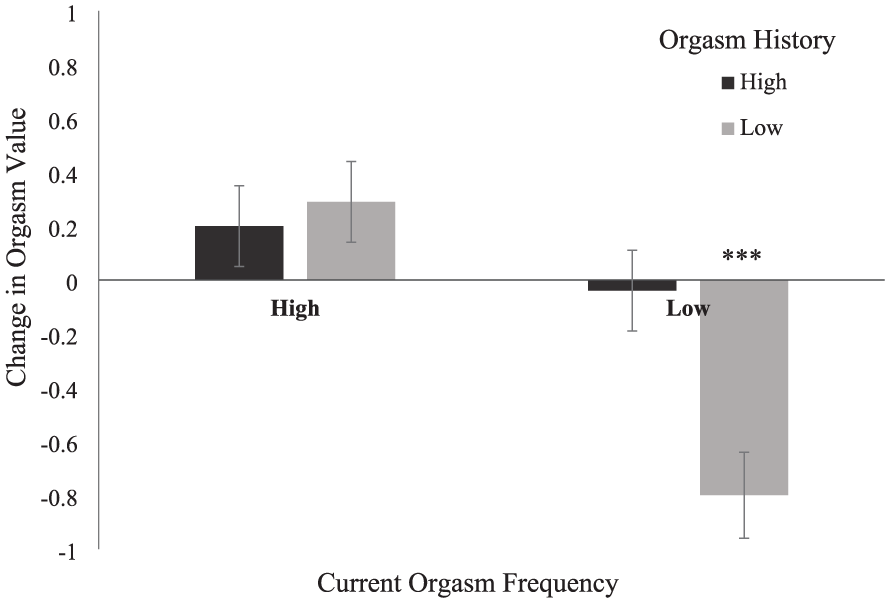
Change in orgasm value by condition (pre- to post-manipulation) compared to women’s baseline (Study 2).
Descriptively, in the Low × Low condition, 68.3% of women devalued orgasm, 15.9% of women did not change their orgasm value, and 15.9% of women increased their orgasm value (see Table 3 for other conditions).
Descriptive Results for Women’s Change in Orgasm Value (Study 2).
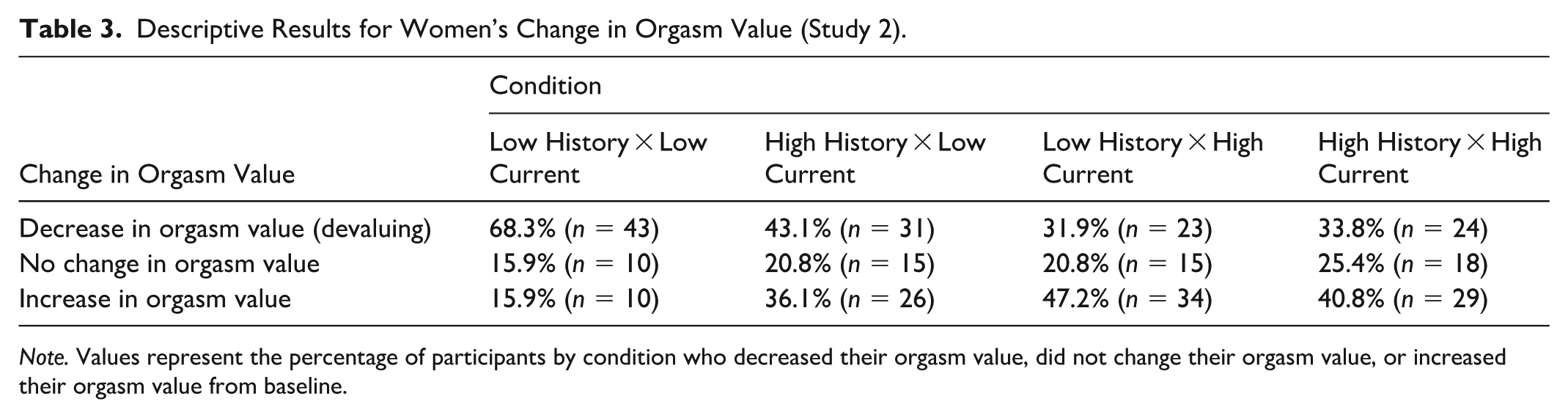
Note. Values represent the percentage of participants by condition who decreased their orgasm value, did not change their orgasm value, or increased their orgasm value from baseline.
Causal Attributions for Orgasm Frequency
Partner Attributions
There was a significant main effect of orgasm history, F(1,274) = 11.03, p = .001, ηp2 = .04, and of current orgasm frequency, F(1,274) = 96.54, p < .001, ηp2 = .26, on women’s attributions of their current orgasm frequency to their hypothetical partner. Importantly, there was also a significant interaction (Table 2). Women attributed their orgasm frequency to their partner the least when their orgasm frequency was consistently low across partners and in the current relationship, as in Study 1.
Self-Attributions
There was a significant main effect of orgasm history, F(1,274) = 12.92, p < .001, ηp2 = .05, and of current orgasm frequency, F(1,274) = 34.74, p < .001, ηp2 = .11, on women’s attributions of their current orgasm frequency to themselves. There was a significant interaction (Table 2); women attributed their orgasm to themselves the least when told they had experienced orgasm often in the past but not with their current partner, compared to all other conditions, ps < .001, replicating the results of Study 1.
Imagined Sexual and Relationship Outcomes
Sexual Desire
There was a significant main effect of orgasm history, F(1,274) = 11.08, p < .001, ηp2 = .04, such that women reported greater sexual desire for their hypothetical partner when their orgasm history was low (M = 5.77, SD = 1.30) than when their orgasm history was high (M = 5.27, SD = 1.47). There was a main effect of current orgasm frequency, F(1, 274) = 180.91, p < .001, ηp2 = .40, such that women reported greater desire when their current orgasm frequency was high (M = 6.39, SD = 0.66) than when it was low (M = 4.59, SD = 1.45). The interaction was not significant, F(1, 274) = 1.12, p = .290, ηp2 = .00.
Sexual Satisfaction
There was a significant main effect of orgasm history, F(1,274) = 15.15, p < .001, ηp2 = .05, and current orgasm frequency, F(1,274) = 285.40, p < .001, ηp2 = .51, on sexual satisfaction. There was no interaction, F(1,274) = 3.60, p = .059, ηp2 = .01. Imagined sexual satisfaction was higher when orgasm history was low (M = 5.61, SD = 1.32) than when it was high (M = 5.07, SD = 1.55). Sexual satisfaction was higher when current orgasm frequency was high (M = 6.34, SD = 0.63) than when it was low (M = 4.27, SD = 1.34). Importantly, sexual satisfaction and desire were both lowest when women imagined they experienced orgasm often in the past but not in their current relationship, as in Study 1, though these patterns were driven by two main effects rather than an interaction.
Relationship Commitment
There was a significant main effect of orgasm history, F(1,274) = 17.06, p < .001, ηp2 = .06, and of current orgasm frequency, F(1,274) = 133.57, p < .001, ηp2 = .33, on imagined relationship commitment. Importantly, there was a significant interaction (Table 2). These results replicated the findings from Study 1; women reported especially low relationship commitment when they imagined they experienced orgasm often in the past but not with their current partner (Figure 5).
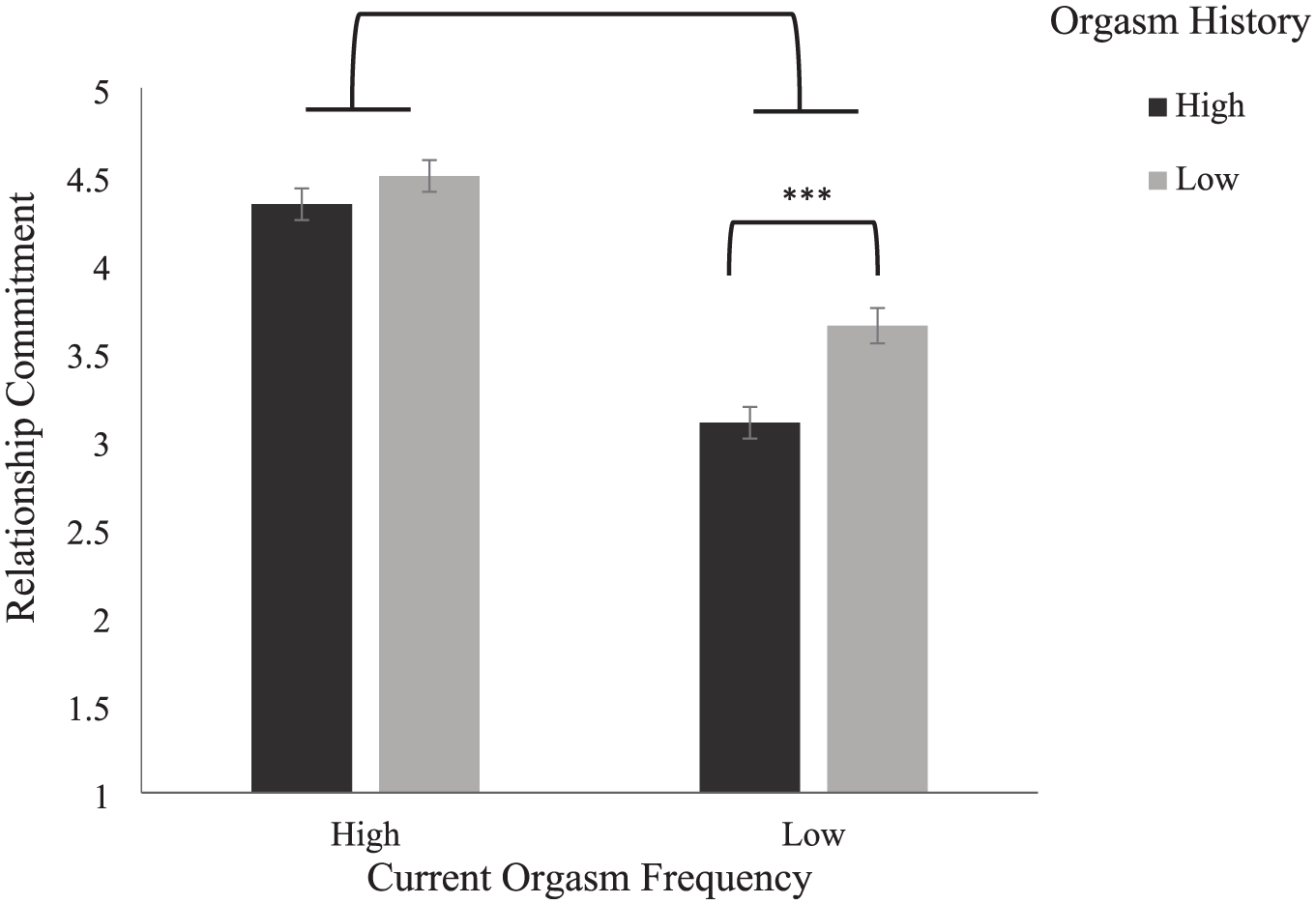
Relationship commitment by condition (Study 2).
What Is the Relationship Between Devaluing Orgasm and Imagined Sexual and Relationship Outcomes?
We tested the same moderation models as in Study 1 and found that the relationship between orgasm value and all imagined sexual and relationship outcomes depended on current orgasm frequency. Replicating and confirming the exploratory moderation results of Study 1, we found that there was a negative relationship between orgasm value and imagined sexual and relationship outcomes when orgasm frequency was low, ps < .05. There was also a positive relationship between orgasm value and imagined sexual and relationship outcomes when orgasm frequency was high, ps < .05 (see Supplement Document).
In order to determine whether devaluing orgasm serves as a protective factor against negative outcomes, we conducted an additional series of moderations, in which we tested the relationship between change in orgasm value (difference score) and imagined sexual and relationship outcomes at both levels of current orgasm frequency (high and low), using PROCESS Model 1 (Hayes, 2022), thus expanding on the findings from Study 1.
Sexual Desire
For sexual desire, the main effect of the change in orgasm value was significant, b = −0.65, 95% CI [−0.96, −0.34], SE = 0.16, t(274) = −4.16, p < .001, such that a decrease in orgasm value was associated with greater sexual desire. The main effect of the current orgasm frequency condition was also significant, b = 1.89, [1.62, 2.15], SE = 0.13, t(274) = 14.08, p < .001, such that high orgasm frequency predicted greater sexual desire. The relationship between value change and sexual desire was moderated by current orgasm frequency, as evidenced by a significant interaction, b = 0.36, [0.17, 0.56], SE = 0.10, t(274) = 3.63, p < .001. When current orgasm frequency was low, a decrease in value post-manipulation (i.e., devaluing) was associated with greater desire, b = −0.29, [−0.43, −0.15], SE = 0.07, t(274) = −4.15, p < .001, but there was no relationship when orgasm frequency was high, b = 0.07, [−0.07, 0.21], SE = 0.07, t(274) = 1.01, p = .313 (Figure 6).
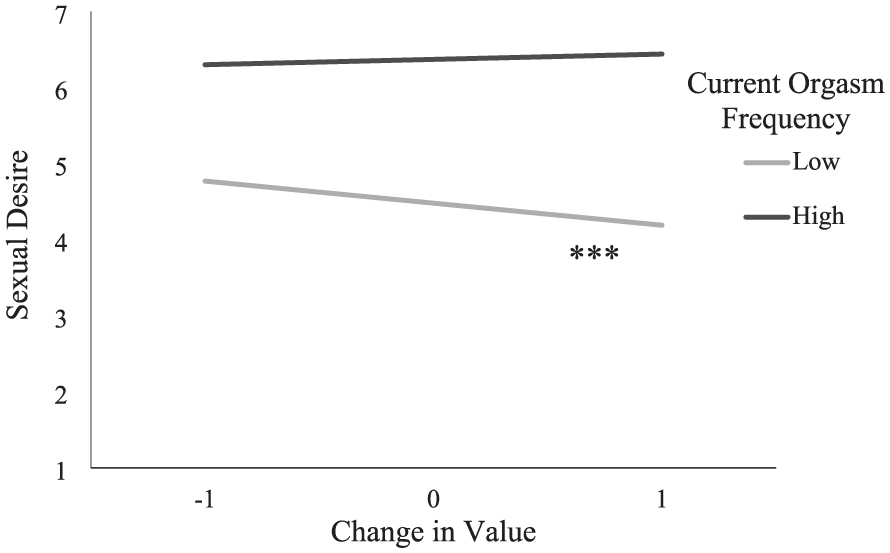
Moderation of the relationship between change in orgasm value and sexual desire by current orgasm frequency (Study 2).
Sexual Satisfaction
Similarly, for sexual satisfaction, the main effect of the change in orgasm value was significant, b = −0.57, 95% CI [−0.85, −0.28], SE = 0.15, t(274) = −3.90, p < .001, such that a decrease in orgasm value was associated with greater sexual satisfaction. The main effect of orgasm frequency condition was also significant, b = 2.16, [1.91, 2.40], SE = 0.12, t(274) = 17.28, p < .001, such that high orgasm frequency predicted greater sexual satisfaction. The relationship between value change and sexual satisfaction again depended on current orgasm frequency, b = 0.31, [0.13,0.49], SE = 0.09, t(274) = 3.33, p = .001. When current orgasm frequency was low, a decrease in value was associated with greater sexual satisfaction, b = −0.26, [−0.39, −0.13], SE = 0.06, t(274) = −3.99, p < .001, but there was no relationship when current orgasm frequency was high, b = 0.04, [−0.08, 0.17], SE = 0.07, t(274) = 0.74, p = .458 (Figure 7).
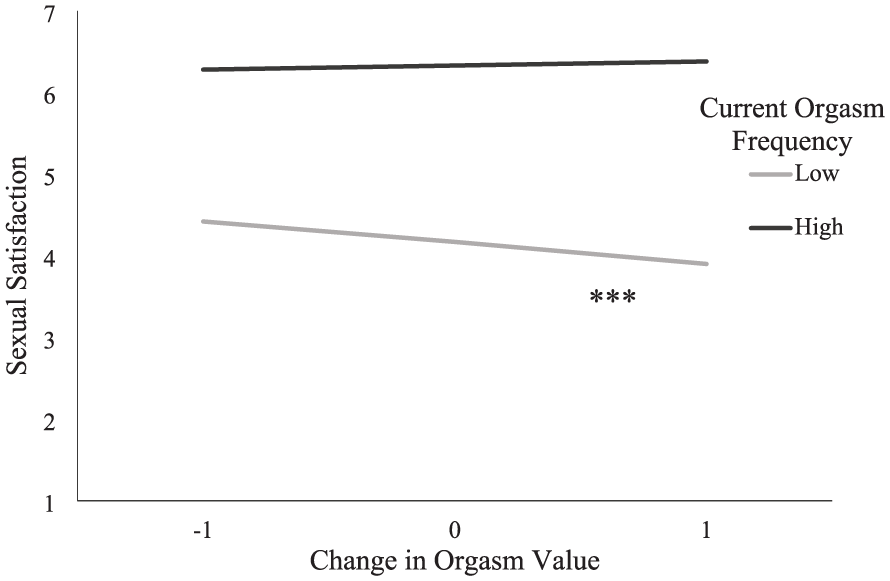
Moderation of the relationship between change in orgasm value and sexual satisfaction by current orgasm frequency (Study 2).
Relationship Commitment
Finally, for relationship commitment, the main effect of the change in orgasm value was significant, b = −0.49, 95% CI [−0.71, −0.27], SE = 0.11, t(274) = −4.44, p < .001, such that a decrease in orgasm value was associated with greater relationship commitment. The main effect of orgasm frequency condition was also significant, b = 1.14, [0.94, 1.32], SE = 0.09, t(274) = 12.00, p < .001, such that high orgasm frequency predicted greater relationship commitment. The relationship between the change in orgasm value and relationship commitment depended on current orgasm frequency, b = 0.29, [0.15, 0.43], SE = 0.07, t(274) = 4.16, p < .001. When current orgasm frequency was low, women who decreased their orgasm value reported greater relationship commitment, b = −0.20, [−0.30, −0.10], SE = 0.05, t(274) = −4.03, p < .001, but there was no relationship when current orgasm frequency was high, b = 0.09, [−0.01, 0.19], SE = 0.05, t(274) = 1.87, p = .063 (Figure 8).
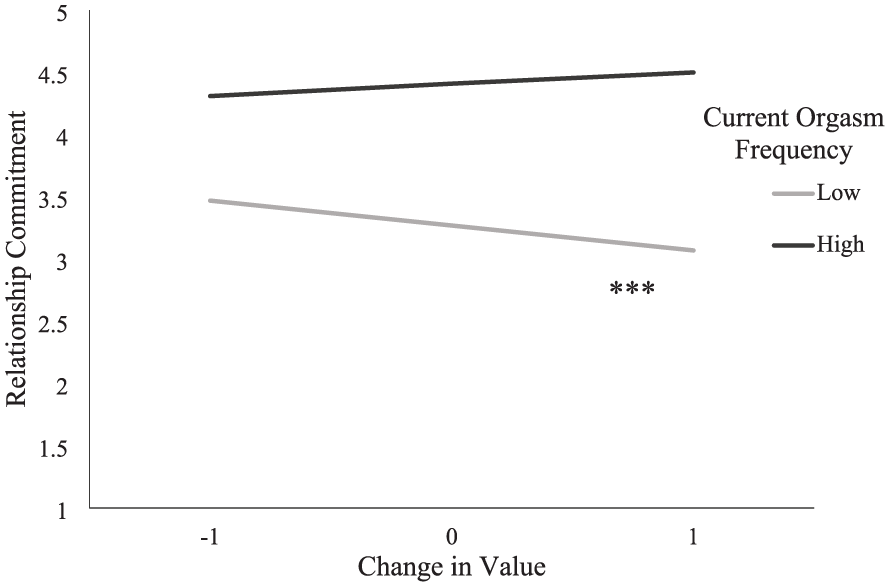
Moderation of the relationship between change in orgasm value and relationship commitment by current orgasm frequency (Study 2).
Expanding on Study 1, these results demonstrate that, when orgasm was absent, women who devalued orgasm experienced more positive imagined outcomes than women who did not devalue orgasm.
Study 2 Discussion
In Study 2, we found that women devalued orgasm post-manipulation, compared to their baseline orgasm value, when told their orgasm history and current orgasm frequency were both low. Our attribution findings continue to provide support for the theory that a consistently low orgasm frequency across partners represents a self-threat for women, in which devaluation is most likely to occur.
In Study 2, we also replicated evidence that orgasm absence has negative consequences for the relationship, and that some of these effects are particularly strong when women have experienced orgasm often in the past, with previous partners. Our attribution findings suggest that experiencing orgasm often in the past but not with a current partner represents a relationship threat, in which the negative evaluation of the relationship can be particularly extreme.
Devaluing orgasm may protect against these negative impacts of orgasm absense, as evidenced again by our moderation analyses. Devaluing orgasm was consistently associated with more positive imagined sexual and relationship outcomes when orgasm was absent. Thus, orgasm frequency plays a role in shaping how orgasm value will impact a relationship, and devaluing orgasm may be a strategy women call upon in order to mitigate relationship threat. However, women still anticipated experiencing greater sexual desire, sexual satisfaction, and relationship commitment when their hypothetical orgasm frequency was high, regardless of their orgasm value.
Study 3
The purpose of Study 3 was to expand the current findings to include men partnered with women. We used the same experimental design and investigated the same research questions, but this time we investigated men’s evaluations of orgasm value, causal attributions, and their own and their perceived partner’s imagined sexual/relationship outcomes.
Method
Sample and Procedure
We recruited an online Prolific sample of adult cisgender men who were heterosexual or bisexual, living in the United States, and sexually active in the past year. We only included heterosexual and bisexual men because we wanted to examine men’s perceptions within a mixed-gender context, and we utilized the sexual orientation pre-screening options available on Prolific. The full study was completed by 296 eligible participants. We removed 13 participants for failing an attention check related to the manipulation, and four participants were removed for failing more than one additional attention check. One participant was removed because he messaged the researchers on Prolific to indicate that he responded to the measures incorrectly. Thus, our final sample consisted of 278 men (see Table 1).
Similar to the previous studies, men were asked to imagine themselves in a hypothetical sexual scenario, then completed measures in response. After completing demographics, participants were debriefed and compensated.
Measures
Hypothetical Scenario
Given the same instructions as Studies 1 and 2, men were asked to imagine themselves in the context of a sexual scenario which differed based on participants’ hypothetical partner’s orgasm history and current orgasm frequency while in a relationship with the participant. For example, the Low Orgasm History × Low Current Orgasm Frequency condition read: “Imagine that you have a new partner, a woman who you’ve been dating for a few months.
The scenarios differed based only on the sentences presented in bold text. In the high orgasm history conditions, the first two bold sentences instead read: “Now imagine that your partner normally has a high orgasm frequency across sexual partners. In other words, she has typically experienced orgasm very often in the past.” In the high current orgasm frequency conditions, the last sentence instead read: “and she has experienced orgasm with you during almost all of your sexual encounters.” Two attention check questions again ensured that participants correctly identified their condition. Four participants were removed in the Low History × Low Current condition (final n = 69), four in the High History × High Current (final n = 70), three in Low History × High Current (final n = 68), and two in High History × Low Current (final n = 71).
Orgasm Value
Participants were asked about their orgasm value using the same four items, regarding how much they would value their own orgasm with their hypothetical partner (α = .80; e.g., “My own orgasm would be important to my sexual satisfaction with this partner”), how much they would value their partner’s orgasm (α = .87; “My partner’s orgasm would be important to my sexual satisfaction with her”), and how much they perceived their partner would value her own orgasm (α = .83; “My partner’s orgasm would be important to her sexual satisfaction with me”). These three value measures were presented in random order. To measure devaluation, we compared men’s between-subjects orgasm value across conditions.
Causal Attributions
Participants responded to the same causal attribution items as in Studies 1 and 2.
Imagined Sexual and Relationship Outcomes
Adapting the same measures as Studies 1 and 2, men reported their sexual desire for future encounters (e.g., “My future sexual desire for this partner would be strong”; α = .87) and their perception of their partner’s sexual desire (e.g., “My partner’s future sexual desire for me would be strong”; α = .88). Participants also reported their anticipated sexual satisfaction. Because this measure captures a joint perspective (e.g., “I think that my sex life with this partner would be wonderful”; “I feel that this partner would be sexually pleased with me”; α = .96), we only administered this measure once. Finally, we assessed participants’ relationship commitment (e.g., “In general, to what extent would you be satisfied with your current relationship with your romantic partner?”; α = .83) and perceived partner’s relationship commitment (e.g., “In general, to what extent do you think your romantic partner is satisfied with your current relationship?”; α = .83).
Analytic Strategy
We conducted 2 (Orgasm History: High vs. Low) × 2 (Current Orgasm: High vs. Low) ANOVAs on all dependent variables, including men’s own and perceived partner’s perspectives.
Results
Orgasm Value
Men’s own orgasm value did not differ based on their female partner’s orgasm history, F(1,273) = 0.60, p = .440, ηp2 = .00, her current orgasm frequency, F(1,273) = 0.76, p = .384, ηp2 = .00, and there was no interaction, F(1,273) = 1.12, p = .292, ηp2 = .00. However, men’s value of their partner’s orgasm did depend on that woman’s orgasm history, F(1,273) = 4.51, p = .035, ηp2 = .02, and current orgasm frequency, F(1,273) = 8.26, p = .004, ηp2 = .03. Importantly, there was a significant interaction (see Table 2). Men’s value of women’s orgasm followed the same pattern as women’s reports, in which his value of her orgasm was lower only when her orgasm was consistently low across partners, ps < .001 (Figure 9).
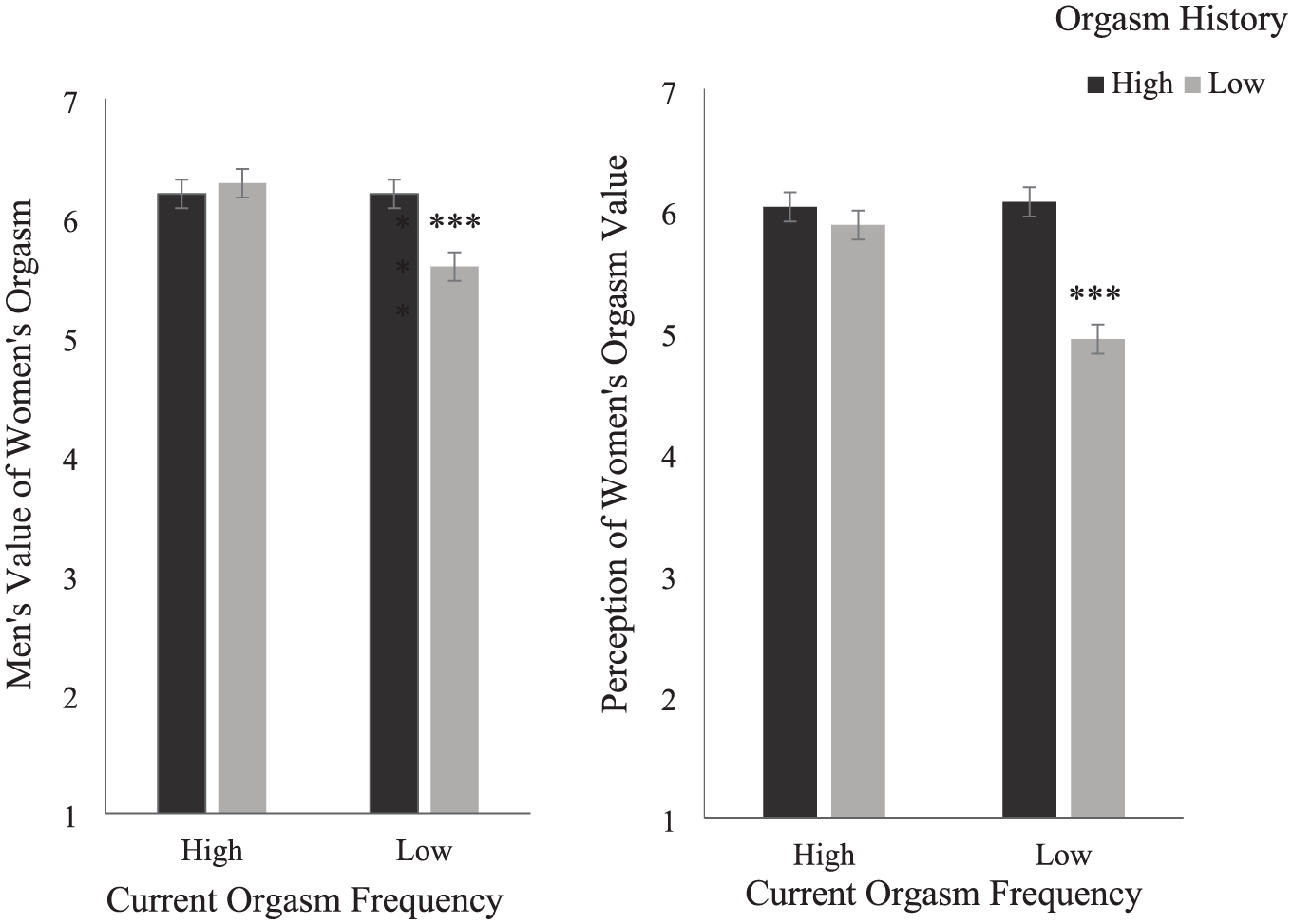
Men’s value of their female partner’s orgasm, and perceptions of her orgasm value, based on condition (Study 3).
The same was true for men’s perception of their partner’s own orgasm value; there was a main effect of women’s orgasm history, F(1,273) = 29.32, p < .001, ηp2 = .10, current orgasm frequency, F(1,273) = 14.47, p < .001, ηp2 = .05, and a significant interaction (Table 2). Men accurately perceived that a female partner would value her orgasm less when her orgasm frequency was consistently low across partners as well, compared to all other conditions, ps < .001 (Figure 9).
Causal Attributions for Current Orgasm Frequency
Partner Attributions
There was a significant main effect of women’s current orgasm frequency, F(1,273) = 81.64, p < .001, ηp2 = .23, on men’s attributions of women’s orgasm frequency to her. There was no main effect of orgasm history, F(1,273) = 1.21, p = .272, ηp2 = .00, but there was a significant interaction (Table 2). Similar to women’s own attributions, men’s attribution to their female partner was lowest when she had experienced orgasm often in the past but not in their current relationship.
Self-Attributions
There was a significant main effect of current orgasm frequency, F(1,273) = 136.38, p < .001, ηp2 = .33, and orgasm history, F(1,273) = 33.01, p < .001, ηp2 = .11, on men’s attributions of their partner’s orgasm frequency to themselves. There was also a significant interaction (Table 2). Similar to women’s attributions, men’s attribution to themselves was lowest when their female partner experienced a consistently low orgasm frequency with them and across a history of partners.
Imagined Sexual and Relationship Outcomes
Sexual Desire
There was an effect of women’s current orgasm frequency on men’s own sexual desire, F(1,273) = 15.59, p < .001, ηp2 = .05, such that men reported greater sexual desire for their partner when her orgasm frequency was high (M = 6.34, SD = 0.72) than when it was low (M = 5.89, SD = 1.13). There was no main effect of women’s orgasm history, F(1,273) = 2.04, p = .155, ηp2 = .01, and no interaction, F(1,273) = 0.05, p = .819, ηp2 = .00.
Similarly, there was an effect of women’s current orgasm frequency on men’s perception of her sexual desire, F(1, 273) = 53.27, p < .001, ηp2 = .16. Men whose partner’s orgasm frequency was high (M = 6.15, SD = 0.69) perceived their partner to have greater sexual desire for future encounters than men whose partner’s orgasm frequency was low (M = 5.29, SD = 1.22). Men also perceived their partner to have greater sexual desire when her orgasm history was low (M = 5.86, SD = 0.93) versus high (M = 5.59, SD = 1.19), F(1,273) = 5.27, p = .022, ηp2 = .02. There was no interaction, however, F(1, 273) = 0.67, p = .414, ηp2 = .00.
Sexual Satisfaction
On the single measure of sexual satisfaction, men reported greater overall sexual satisfaction when women’s current orgasm frequency was high (M = 6.35, SD = 0.64) than when it was low (M = 5.26, SD = 1.26), F(1,273) = 81.17, p < .001, ηp2 = .23. There was no main effect of orgasm history, F(1,273) = 0.63, p = .430, ηp2 = .00, and no interaction, F(1,273) = 0.21, p = .649, ηp2 = .00.
Relationship Commitment
There was a main effect of women’s orgasm history, F(1,273) = 5.28, p = .022, ηp2 = .02, and women’s current orgasm frequency, F(1,273) = 31.36, p < .001, ηp2 = .10, as well as a significant interaction, on men’s own relationship commitment (Table 2). Men reported greater relationship commitment when women’s orgasm frequency was high than when it was low. Men’s relationship commitment was especially low when their female partner experienced orgasm often in the past but not in their current relationship.
Men’s perception of their partner’s relationship commitment was similarly impacted by her orgasm history, F(1,273) = 14.99, p < .001, ηp2 = .05, and current orgasm frequency, F(1,273) = 42.83, p < .001, ηp2 = .14. There was a significant interaction (Table 2). Again, men estimated that women’s relationship commitment would be lowest when she experienced orgasm often in the past but not in the current relationship, mirroring women’s actual reports.
Study 3 Discussion
In Study 3, we found that men valued a hypothetical female partner’s orgasm less when she did not experience orgasm in the past or in the current relationship, as compared to all other conditions. Thus, men adjusted their value of their partner’s orgasm, and expected women to value orgasm, in the same pattern that women themselves reported. Men’s causal attributions matched women’s as well; they attributed women’s orgasm frequency to themselves the least when their female partner did not experience orgasm across a history of partners, supporting the idea that this may be perceived as a stable attribute of the female partner (the condition in which women’s orgasm is most likely to be devalued). Men may disengage in these circumstances from a goal that is not seen as feasible (Wrosch et al., 2003, 2007).
Women’s orgasm absence in the current relationship had negative consequences for men’s imagined sexual and relationship outcomes, highlighting that women’s orgasm frequency also impacts men’s outcomes in relationships. Additionally, men understood the consequences that orgasm absence would have on their partners. In particular, men reported a particularly large decrease in relationship commitment when women experienced orgasm often in the past but not in the current relationship. Orgasm frequency in this condition was attributed least to the female partner, supporting the idea that this condition may serve as a relationship threat. Men seem to disengage from the relationship similarly to women when receiving this potentially threatening information.
General Discussion
Across three studies using hypothetical sexual scenarios, women, and men partnered with women, valued women’s orgasm less when women had infrequent orgasms consistently across partners, including a current partner, compared to all other conditions. In Study 2, we also found evidence for women devaluing orgasm, or actually decreasing their orgasm value from baseline, in this condition. This finding is consistent with a wealth of research that finds people commonly devalue outcomes in which they perceive that they, or their romantic relationships, perform poorly (Lydon et al., 1999; Tesser, 1998). Moreover, people disengage from goals that are perceived to be unfeasible or unattainable, across domains (Wetzel, Sanchez, & Cole, 2024; Wrosch et al., 2003, 2007). In the current studies, we provide empirical evidence for the devaluation of women’s orgasm in the face of consistent orgasm absence. Our research also suggests men and women are in sync with this tendency; both men and women report lower value of women’s orgasm under the same conditions.
When considering why consistently low orgasm frequency across partners would result in orgasm devaluation, we can call upon decades of theory and research in the self-literature. Our causal attribution results across all three studies illustrate that women’s orgasm frequency is attributed to the male partner the least under these conditions. Thus, consistently low orgasm frequency across partners may reflect a self-threat for women, where low orgasm frequency is perceived as a stable, internal attribute. The self-threat literature suggests that perceived underperformance leads to devaluing the importance of that outcome, to reduce potential damage to one’s self-concept (Tesser, 1988; Tesser & Campbell, 1980; Tesser & Paulhus, 1983). This research applies this seminal framework to orgasm for the first time; women who perceive themselves as underperforming in the orgasm domain (i.e., consistently low orgasm frequency across partners) may devalue orgasm as a result. Considering orgasm absence as a stable attribute may also reflect orgasm as an unattainable goal for women and their partners (Wetzel, Sanchez, & Cole, 2024; Wrosch et al., 2003, 2007).
In this case, adjusting one’s orgasm value (i.e., devaluing) could be adaptive to maintain satisfaction. According to the multiple discrepancies theory (Michalos, 1985), a person’s satisfaction with their orgasm frequency would be a result of the discrepancy between their current orgasm frequency and the orgasm frequency that they desire, expect, and perceive relevant others to have. Thus, women should be more satisfied when they reduce the discrepancy between their current orgasm frequency and the orgasm frequency that they desire and expect. Previous research has established that women pursue orgasm less when they value and expect orgasm less (Dickman et al., 2024; Gusakova et al., 2020; Wetzel, Sanchez, & Cole, 2024; Wetzel et al., 2022). Women also tend to desire and expect orgasm less often when they experience it less often (Wetzel et al., 2022). Thus, while emotionally adaptive, devaluation likely perpetuates a cycle of low orgasm frequency (Gusakova et al., 2020; Wetzel, Sanchez, & Cole, 2024; Wetzel et al., 2022).
Sexual and Relationship Outcomes
Across three studies, we find that both women and men imagine negative sexual and relationship outcomes when women’s orgasm frequency is low, and these negative anticipated effects can be most extreme when told that women experienced orgasm often with previous partners. In particular, across all three studies, relationship commitment was especially low when women experienced orgasm often in the past but not in the current relationship. Both men and women attributed women’s orgasm absence to the woman herself the least under these conditions. Thus, if these conditions signal a relationship threat (e.g., incompatibility), people may withdraw their commitment to the relationship as a result.
Importantly, these studies showcase potential downstream negative effects of women’s orgasm absence on sexual and relationship outcomes, in line with previous research (Dienberg et al., 2023; Frederick et al., 2017; Haavio-Mannila & Kontula, 1997; Sprecher & Cate, 2004). While the association between orgasm and sexual desire, sexual satisfaction, and relationship satisfaction for women has been well-established (see Dienberg et al., 2023), the current research provides evidence of causation within a hypothetical context: both men and women reported less imagined sexual desire, sexual satisfaction, and relationship commitment when told women’s orgasm frequency was low.
What Is the Relationship Between Devaluing Orgasm and Sexual and Relationship Outcomes?
We suspected that devaluing orgasm serves as a protective strategy to mitigate the negative impact of orgasm absence on sexual and relationship outcomes. When orgasm is less important to a given woman, fluctuations in her orgasm frequency should be associated with smaller changes to her sexual satisfaction, sexual desire, or relationship commitment. In Study 1, moderation analyses revealed initial evidence for this pattern; women who valued orgasm more imagined greater desire and sexual satisfaction when orgasm frequency was high, and imagined lower sexual satisfaction and relationship commitment when orgasm frequency was low. In Study 2, as women devalued orgasm more, they reported more positive outcomes when orgasm was absent. Thus, women may devalue orgasm to retain better outcomes in the face of orgasm absence. However, in our research, orgasm absence retained persistent negative impacts on all of women’s imagined sexual and romantic outcomes (e.g., Dienberg et al., 2023; Haning et al., 2007; Wetzel et al., 2022), regardless of orgasm history or orgasm value. In other words, devaluing orgasm did not eliminate the negative impacts of orgasm absence on sexual satisfaction, sexual desire, or relationship commitment; it only reduced their magnitude.
Implications
In sum, we find that a consistently low orgasm frequency across a history of partners provides the circumstances in which women’s orgasm is devalued. We suspect that this condition represents a threat to the self (or in men’s case, a threat to the female partner) rather than to the relationship. In this situation, orgasm may be perceived as an unattainable goal and its absence as a stable attribute of the woman herself. If a woman consistently does not experience orgasm across partners, devaluing orgasm may help her maintain desire and satisfaction. Meanwhile, experiencing orgasm often in with past partners but not in the current relationship instead may signal an issue with the relationship, which was associated with more extreme negative relationship outcomes—especially low relationship commitment with this partner. However, if women have a strong motivation to protect the relationship, they may devalue orgasm in these circumstances as well. Future research should investigate this possibility.
Devaluation is a natural, adaptive strategy when faced with unfavorable outcomes in a particular domain (Lydon et al., 1999; Schmader et al., 2001; Tesser, 1988). The findings of the current research support a potential adaptive benefit of devaluing orgasm, to protect one’s sense of self, one’s relationship, or to motivate disengagement from a goal that is not feasible. However, women are faced with low orgasm frequency much more often than men (Frederick et al., 2018; Mahar et al., 2020; McElroy & Perry, 2024; Wetzel et al., 2022). Aside from potential cases of clinical dysfunction, we argue that the low orgasm frequency that women often experience is not inevitable (Mahar et al., 2020). Many women do not receive sufficient clitoral stimulation during partnered sex to facilitate a consistent orgasm frequency, yet experience consistently high rates of orgasm during masturbation (Mahar et al., 2020; McElroy & Perry, 2024). Sociocultural sexual scripts focus on clitoral stimulation as brief foreplay and prioritize vaginal intercourse as the primary sex act (Simon & Gagnon, 1986; Mahar et al., 2020). Vaginal intercourse is associated with the lowest orgasm frequency for women, but with a consistently high orgasm frequency for men (Frederick et al., 2018). Research has also identified an orgasm pursuit gap, in which men’s orgasm is typically prioritized and pursued over women’s orgasm (Klein & Conley, 2022; Wolfer & Carmichael, 2025).
Men tend to have a consistently high orgasm frequency across contexts while women’s orgasm frequency is highly context-dependent (Mahar et al., 2020; McElroy & Perry, 2024; Wetzel & Sanchez, 2022; Wetzel, Sanchez, & Cole, 2024). If sociocultural sexual scripts prioritize a sex act in which men are likely to experience orgasm, and women are unlikely to experience orgasm, then many women must make decisions about how to contend with a low orgasm frequency, while men do not. When women contend with orgasm absence by devaluing orgasm, they reduce their orgasm expectations and orgasm pursuit as a result, making orgasm even less likely in the future (Blumenstock, 2021; Gusakova et al., 2020; Wetzel et al., 2022; Wetzel, Sanchez, & Cole, 2024). Thus, devaluing women’s orgasm likely perpetuates the orgasm gap over time, with consequences for women’s well-being (Dienberg et al., 2023).
Sexual scripts can be adjusted at an individual or interpersonal level (Simon & Gagnon, 1986; Wiederman, 2005). Research shows that women’s orgasm frequency can be increased with sufficient clitoral stimulation, collaborative pursuit of her orgasm from both partners, and sexual communication, to name a few examples (Dickman et al., 2024; Frederick et al., 2018; Jones et al., 2018; Wetzel, Sanchez, & Cole, 2024; Wetzel et al., 2025; Willis et al., 2018; Wolfer & Carmichael, 2025). Women often relegate their sexual satisfaction to a lower threshold than men (i.e., the absence of pain rather than the presence of orgasm; McClelland, 2010). Thus, women and their partners may want to engage further in the pursuit of women’s orgasm, rather than to devalue and disengage, when faced with low orgasm frequency.
However, we do not mean to suggest that orgasm is or should be prioritized as the most important goal in sexual encounters (Chadwick et al., 2019). Pressure for orgasm can make orgasm less pleasurable, and orgasm coercion from one’s partner can lead to negative psychological and relationship outcomes (Chadwick & van Anders, 2022a; Chadwick et al., 2019). Broadly speaking, performance pressure can be a double-edged sword that either creates threat or encourages motivation, with associated implications for behavior (Mitchell et al., 2019). Expectations for achievement from external sources, which create performance pressure, can impair performance (Baumeister et al., 1985). Thus, pressure for orgasm will not only make orgasm less likely but has been shown to have harmful consequences (Chadwick & van Anders, 2022a, 2022b). Our research similarly suggests that reducing orgasm value has a beneficial effect on those who are not experiencing orgasm, by mitigating negative imagined sexual and relationship outcomes.
Thus, there is a theoretical tension present in this work. The authors understand women’s devaluation of orgasm as (a) a protective and potentially beneficial psychological process that (b) operates within a larger sociocultural landscape in which women’s pleasure and orgasm is de-prioritized (Klein & Conley, 2022). To address this tension, we emphasize (a) women’s agency in making the sexual decisions that are right for them and (b) the importance of prioritizing women’s pleasure holistically within sociocultural and interpersonal sexual scripts, regardless of orgasm.
Thus, couples may choose to focus on women’s pleasure holistically, without performance pressure on the orgasm goal, in order to facilitate better sexual outcomes for women over time. This strategy would include prioritizing sex acts beyond intercourse alone (Willis et al., 2018); couples can adjust their interpersonal sexual scripts to spend more time and attention on the clitoral sex acts which are most pleasurable for the female partner, and most likely to result in her orgasm (McElroy & Perry, 2024; Wetzel et al., 2025; Wiederman, 2005, 2015). Research finds that, for the majority of women, these sex acts are vaginal intercourse with simultaneous clitoral stimulation, receiving oral sex, receiving manual stimulation of the clitoris, and/or vibrator use (Wetzel et al., 2025).
Limitations and Future Directions
The current project should be interpreted in the context of limitations. First, all samples were recruited from the Prolific online recruitment platform, which is not representative of the United States population. All samples were majority-White, which means that these results do not necessarily generalize to or represent all racial/ethnic groups. However, the orgasm gap does persist across racial/ethnic groups (Wetzel, Sanchez, et al., 2024).
The studies included in this project were not pre-registered, which is a limitation given the experimental nature of these studies and the complexity of the analyses. However, we utilized an exploratory and confirmatory design, in which we followed a similar design in Study 2 to confirm exploratory results from Study 1. We have been transparent about exploratory analyses, and all data and materials are available with open access. Additionally, moderation analyses are correlational, so we cannot establish causation or directionality in regards to the relationship between orgasm value and imagined outcomes.
The hypothetical nature of the study design used throughout this manuscript is another significant limitation. These scenarios do not capture the complexity of real-world relationships or the many, potentially competing, motivations at play in any given sexual situation. There was very little relational context in the hypothetical scenario, potentially leading to increased susceptibility to the information given (e.g., orgasm frequency). This lack of context could have led to affective detachment or demand effects for participants (see Mummolo & Peterson, 2019). Additionally, most of our participants were in existing relationships, and it may have been difficult to imagine a new, hypothetical partner. However, women's actual orgasm frequency was not a significant covariate for the effect of condition on imagined outcomes (see Supplemental Document: Study 1), suggesting that women were able to successfully engage in the hypothetical exercise. Using vignettes allowed us the experimental control necessary to isolate variables and establish causal effects. As the very first study establishing this effect, we felt it was important to demonstrate proof of concept, retain high levels of experimental control, and establish causality before attempting to measure the process in women’s real, complicated lives. We suspect that women with a strong motivation to protect their relationship may devalue orgasm in the face of low orgasm frequency, even when orgasm history is high. Correlational research could investigate the association between women’s actual orgasm frequency and orgasm value across partners. Future experimental research could manipulate the strength of the participant’s motivation to protect the relationship (e.g., commitment to the partner or strength of the relationship in other domains) to determine whether orgasm is devalued under various circumstances.
Future research should also investigate these processes with real couples, and longitudinally, to determine how devaluation impacts couples over time. Devaluing orgasm may protect against decreases in sexual satisfaction in the short-term but over time, devaluing orgasm may no longer buffer against negative outcomes or could lead to resentment. Moreover, future research could explore the extent to which devaluation is a conscious or deliberate strategy employed to maintain positive relationship outcomes, or whether, like many attitudinal or self-serving processes, devaluation occurs largely outside of one’s awareness.
Conclusion
In response to hypothetical scenarios, the current research finds that women, and men partnered with women, devalue women’s orgasm when orgasm frequency is consistently low across partners. Women and men experience negative impacts of women’s orgasm absence on their imagined sexual and relationship outcomes, and especially so when orgasm was experienced often with previous partners. Devaluing orgasm may protect women’s relationships when contending with orgasm absence; when orgasm frequency was low, women who devalued orgasm had more positive imagined sexual and relationship outcomes compared to women who did not. This work is the first to apply the well-established concept of goal or outcome devaluation (e.g., Ghassemi et al., 2017; Tesser, 1988) to the sexuality domain and provide empirical evidence for the conditions under which the devaluation of women’s orgasm occurs. While potentially adaptive for warding off threats to the self and relationship, or adjusting to unfeasible goals, the devaluation of women’s orgasm likely perpetuates the orgasm gap over time as women and their partners contend with orgasm absence.
Supplemental Material
sj-docx-1-psp-10.1177_01461672261417538 – Supplemental material for Devaluing Women’s Orgasm: An Experimental Investigation of Whether, When, and to What Effect Women and Men Reduce the Importance of Women’s Orgasm
Supplemental material, sj-docx-1-psp-10.1177_01461672261417538 for Devaluing Women’s Orgasm: An Experimental Investigation of Whether, When, and to What Effect Women and Men Reduce the Importance of Women’s Orgasm by Grace Marie Wetzel, Hayley Svensson, Shana Cole and Diana T Sanchez in Personality and Social Psychology Bulletin
Footnotes
Acknowledgements
The first author of this manuscript was supported by the National Science Foundation’s Graduate Research Fellowship.

Ethical Considerations
This research was approved by the Institutional Review Board at Rutgers University.
Consent to Participate
Informed consent was obtained from all participants included in the study. Consent was presented and obtained electronically; signed documentation of consent was waived.
Funding
The authors received no financial support for the research, authorship, and/or publication of this article.
Declaration of Conflicting Interests
The authors declared no potential conflicts of interest with respect to the research, authorship, and/or publication of this article.
Data Availability Statement
Supplemental Material
Supplemental material is available online with this article.
References
Supplementary Material
Please find the following supplemental material available below.
For Open Access articles published under a Creative Commons License, all supplemental material carries the same license as the article it is associated with.
For non-Open Access articles published, all supplemental material carries a non-exclusive license, and permission requests for re-use of supplemental material or any part of supplemental material shall be sent directly to the copyright owner as specified in the copyright notice associated with the article.
