




Abstract
Interpersonal transgressions are inevitable and pose threats to social bonds and well-being. For victims, holding a grudge is a common response. Recent qualitative work suggests that hurt and anger are central to grudges, yet their relation has not been tested quantitatively. Previous research has focused on the independent effects of hurt and anger, often overlooking their interaction. We predicted that the interaction between hurt and anger contributes to grudge holding. Across three nonexperimental studies and one experimental study (Studies 1–4), we examined how these emotions relate to grudge holding and tested a mechanism in Studies 3 and 4. Results consistently showed that individuals who felt high hurt and anger reported stronger grudges than those who felt only one emotion strongly. Perceiving the transgressor as immoral explained this interaction. This research advances our understanding of grudge holding by examining the interaction between these emotions and empirically testing the underlying theory.
Introduction
Developing lasting relationships is a fundamental human need essential for survival and reproductive success (Baumeister & Leary, 1995). However, achieving this goal becomes challenging when interpersonal transgressions, where one individual harms another, occur. The effects of these transgressions are often negative for both transgressors and victims, but the impact is often worse for the victims because they typically have no control over the negative event (i.e., becoming a victim). Nevertheless, victims can play an active role in negotiating and resolving conflicts through their post-transgression responses (PTRs).
McCullough et al. (2013) argue that two victim PTRs, revenge and forgiveness, were favored by natural selection because they helped to successfully resolve ongoing social problems, such as interpersonal conflicts, that jeopardized individuals’ evolutionary fitness. Revenge aims to impose costs on the transgressor, potentially deterring future transgressions, whereas forgiveness bestows benefits on the transgressor, potentially preserving valuable relationships with them. Despite the potential benefit of revenge in deterring harm, the costs associated with its role in the possible escalation of conflict and damage to relationships often outweigh its benefits (Schumann & Ross, 2010). Forgiveness, which is prosocial in its intended use, also has a downside, potentially facilitating ongoing transgressions because wrongdoers face no consequences (Exline & Baumeister, 2000; McCullough, 2008; McNulty, 2011). What then is the option for victims when revenge and forgiveness are too costly for them? One option is to hold a grudge against the transgressor, a unique PTR that differs from seeking revenge or forgiving by providing self-protective, emotionally charged vigilance against future transgressions (Kowalski et al., 2023; Struthers et al., 2019; van Monsjou et al., 2022). A grudge primarily serves as a psychological strategy for self-protection, but it may also impose relational costs on the transgressor via avoidance without directly escalating the conflict. Despite its use during the social motivation process, grudge holding research is still in its nascent stage and researchers’ understanding of the grudge holding process and the factors that influence it is unclear. Recently, van Monsjou et al.’s (2023) qualitative work defined a grudge as a persistent negative feeling that diminishes over time but is easily summoned when needed. Research shows that common emotions uniquely associated with grudge holding include feeling hurt and angry (Lemay et al., 2012; Kowalski et al., 2023; van Monsjou et al., 2023), suggesting that hurt feelings and anger may play important roles in the process of grudge holding. However, the interaction between hurt and anger and its association with grudge holding has not been quantitatively tested. To bridge this gap, we conducted three nonexperimental studies and one experimental study to investigate the relation between hurt feelings, anger, and grudge holding. We specifically tested how hurt and anger interact to predict grudges. Another goal of this research was to explore why hurt and anger interact to affect grudge holding. Given that the targets of grudges are perceived as “bad” by victims of interpersonal transgressions (Kowalski et al., 2023; van Monsjou et al., 2023), we also examined the mediating role of victims’ moral judgment of the transgressor in explaining the relation between hurt, anger, and grudge holding. Specifically, we propose that hurt and anger may lead to harsher moral evaluations, which in turn fuel grudges against transgressors. This research aims to advance the theoretical understanding of the role of emotions and moral judgments in grudge holding.
Holding a Grudge
van Monsjou et al.’s (2023) definition implies that grudge holding is not merely a static emotional reaction but a dynamic process involving dormant yet reactivatable affect. This process differs from general negative psychological states such as unforgiveness, which is a broader catch all term incorporating negative emotions, vengeful rumination, grudge holding, and the opposite of forgiveness (Boon et al., 2025; Stackhouse et al., 2018; vanOyen Witvliet et al., 2001). To capture the construct of grudge holding empirically, van Monsjou et al. (2022) developed the Grudge Aspect Measure (GAM), which includes three subscales: disdain, emotional persistence, and perceived longevity, each reflecting key aspects of grudge holding. Importantly, grudge holding is distinct from independent feelings of hurt and anger. Instead, we propose that a grudge stems from an interaction between feelings of hurt and anger, and reflects a sustained emotional and cognitive perspective, marked by altered attitudes toward the transgressor (disdain), lingering negative affect (emotional persistence), and expectations that the harm will not be easily resolved (perceived longevity). Grudges can fade in conscious awareness but are easily reactivated by potential or actual threats. Taken together, these subscales capture grudge holding as a long-term psychological orientation toward a transgressor.
Although limited scholarly attention has been paid to grudges, some research shows that they are associated with negative health-related issues, prolonged interpersonal conflict, and relationship dissolution (Kowalski et al., 2023; vanOyen Witvliet et al., 2001). Other research suggests that grudges function as an evolved psychological mechanism helping victims to self-protect and maintain vigilance against ongoing relationship threats from transgressors (Li et al., 2025; Struthers et al., 2019). Given the functional value of grudges, and the associated costs of revenge and forgiveness, it is likely that natural selection would have favored grudge holding as a unique evolved psychological mechanism to negotiate relationships following interpersonal transgressions, where vengeance could escalate conflict via counter revenge and forgiveness could prolong conflict via a lack of consequences. Building on the above conceptualization and function, the present research examined how hurt feelings and anger interact to predict grudge holding.
Hurt Feelings, Anger, and Grudge Holding
Individuals’ experiences of hurt feelings can arise from a range of trivial negative events, such as forgotten birthdays and being teased, to more severe events, such as harsh criticism, betrayal, and abandonment by loved ones (Feeney, 2005; Leary & Springer, 2001). Hurt feelings are associated with other negative feelings such as devaluation (Leary et al., 1998), vulnerability, dependence (Lemay et al., 2012), and social pain (Eisenberger, 2011; MacDonald & Leary, 2005), reflecting both the value of, and potential threat to, the relationship (Feeney, 2005). Given that hurt feelings emphasize relationship value and threat, both victims and transgressors are likely to preserve relationships motivated by hurt feelings by engaging in constructive remedial PTRs such as forgiving and apologizing, respectively (Bachman & Guerrero, 2006; Leary & Springer, 2001; Lemay et al., 2012; Murray et al., 2006; Sanford, 2007).
In addition to activating hurt feelings, interpersonal transgressions can also trigger anger (Kowalski et al., 2023; Sell, 2011), which has its own unique aspects. Anger is associated with victims’ loss of control and power, transgressors’ intent to harm, and lack of value for the victim and relationship (Weiner, 1993). In turn, both victims and transgressors are likely to further injure, or dissolve relationships motivated by anger by engaging in destructive PTRs such as seeking revenge and engaging in nonapologetic responses, respectively (Guilfoyle et al., 2022; Lemay et al., 2012; Kuppens et al., 2003; Roseman et al., 1994; Weiner, 1993).
Given the distinct functions and social consequences of hurt feelings and anger on the social motivation process, an important question arises: What are the consequences when hurt feelings and anger co-occur? Previous research has examined these emotions independently. Hurt feelings can potentially lead to constructive responses and have the potential to preserve relationships, whereas anger often brings destructive responses, escalates conflicts, and potentially destroys relationships (Lemay et al., 2012; Sanford, 2007). When hurt and anger co-occur following an interpersonal transgression, the implications are more complex because of their opposing constructive and destructive consequences. For instance, consider a scenario where an employee feels hurt because their manager criticized their work in front of colleagues, leading to feelings of devaluation and vulnerability. At the same time, the employee feels anger toward the manager for the humiliation that was controllable by the manager. It is the tension between these two emotional states, hurt signaling vulnerability and anger signaling injustice, that gives rise to a distinct motivational pattern. The interaction of hurt and anger may not lead to straightforward constructive or destructive responses when forgiveness feels undeserved and revenge is risky, given the manager has greater power than the employee. Instead, the employee might opt for a unique PTR, a grudge, to self-protect by maintaining vigilance against ongoing transgressions from their manager (Struthers et al., 2019).
Building on this, van Monsjou et al. (2023) suggest that the dynamic interplay between the two may result in the unique psychological experience of holding a grudge. When the vulnerabilities and dependence inherent in hurt feelings clash with the power and control inherent in anger, individuals may find themselves in a conflicted state with no clear resolution. In such cases, neither repair nor confrontation seems feasible. Instead, we propose that hurt and anger may interact, resulting in grudge holding which functions to protect victims against ongoing transgressions (Struthers et al., 2019).
What Explains the Relation Between Hurt, Anger, and Grudges?
Based on Sell’s (2011) recalibration theory of anger and Weiner’s (1993, 2006) attribution theory of emotion and social conduct, we propose that perceived immorality serves as a key mechanism through which the interaction of hurt and anger relates to grudge holding. Specifically, anger, especially when paired with hurt, can intensify the search for causal explanations, leading victims to attribute blame and reassess the transgressor’s character (Dorado et al., 2023; Goldberg et al., 1999). Hurt reflects relational dependence and vulnerability and may amplify the perceived meaning of the offense, reinforcing the conclusion that the transgressor acted immorally. These moral evaluations, judgments about the transgressor’s blameworthiness, intent, and character (Weiner, 2006), justify maintaining negative emotions and motivate sustained vigilance.
Importantly, although both moral evaluations and grudge holding may involve negative views of the transgressor, they reflect distinct processes. Moral evaluation is cognitive and judgment-oriented, whereas grudge holding involves sustained negative affect, as well as a desire to withdraw from or avoid the transgressor, which can persist even after moral blame has diminished. Because immoral character is often viewed as stable and predictive of future transgressions (Goodwin et al., 2014; Pizarro & Tannenbaum, 2012), it may prolong the responses to remain vigilant, motivating grudge holding. Indeed, victims who hold grudges are likely to perceive the transgressor as morally inferior (Kowalski et al., 2023; van Monsjou et al., 2023). Thus, in the current research, we included measures of participants’ moral evaluations of the transgressor to explore its mediating role in explaining why hurt and anger interact to predict grudge holding.
Overview of the Research
To test the relation between hurt feelings, anger, and grudge holding, we conducted four studies. Our first goal was to test whether hurt feelings and anger interact to predict grudges (Studies 1–4). We expected both emotions to be important contributors to grudge holding, such that the link between one emotion and grudge would be stronger when the other emotion was higher. Although hurt and anger frequently co-occur following interpersonal transgressions, the nature of their relation remains theoretically underdeveloped. In the present research, we do not assume a fixed causal ordering between these emotions. Instead, we tested how the interaction of hurt and anger may contribute to grudge holding. Our second goal was to explore the mechanism explaining this relation (Studies 3 and 4), specifically whether it could be explained by perceiving the transgressor as immoral. Studies 1 through 3 were nonexperimental. In Studies 1 and 2, we collected data from community samples and focused on romantic relationships. In Studies 3 and 4, we collected data from undergraduate students and considered a broad range of relationship types to determine if the findings in Studies 1 and 2 (i.e. romantic relationships) could be generalized to other types of relationships. Last, Study 4 used an experimental design to begin to test whether the relation between the interaction of hurt and anger and grudge holding is causal in nature. Studies 1 to 3 are exploratory and were not preregistered. Study 4 was preregistered. All study materials, data, codebooks, analysis codes, and supplemental materials are available on Open Science Framework at osf.io/g2hfd.
Study 1
The primary aim of the current study was to examine whether victims’ hurt feelings and anger interact to affect their grudge holding. We expected a positive association between hurt and grudge holding when victims of transgressions also feel anger about the transgression. In Study 1, we used a nonexperimental design to test this association.
Method
Participants
Our initial sample consisted of 252 adults (126 couples) from the community who were currently in a romantic relationship. The original sample size was determined by the number of students enrolled in undergraduate psychology courses who were asked to distribute a URL to adults currently in a romantic relationship. A 2-week deadline was given to participants, and the data collection stopped when this deadline was reached. Participants who had substantial missing data, straight line responding, or demonstrated a distracted response pattern (i.e., those who answered three or more items incorrectly out of five attention checks), as determined by responses on the Conscientious Responders Scale (CRS; Marjanovic et al., 2014), were excluded. The final sample (N = 242) consisted of 122 women and 118 men (2 participants identified as nonbinary or preferred not to disclose). Participants ranged from 19 to 70 years of age (M = 36.06, SD = 15.46). A sensitivity power analysis with α = .05, and three predictor variables, indicated that our sample size had 80% power to detect a medium effect size, f2 = 0.05. The sample was diverse in terms of ethnicity: 33.5% White, 15.7% South Asian, 13.2% Black, 12.4% East Asian, 8.3% Middle Eastern, 8.3% South East Asian, 3.7% Other, 3.3% Latin American, and 1.7% South American.
Transgression Recall and Measures
Recalled Transgression
Participants were asked to recall and write about a recent unresolved conflict that occurred between themselves and their romantic partner. See Supplemental Materials for the full text of the transgression recall prompt.
Victims’ Hurt Feelings and Anger
Hurt feelings and anger were each assessed with a single item (To what extent do you feel hurt by this event?; To what extent do you feel angry about this event?). Items were presented in random order and measured with a 7-point scale from 1 (Not at all) to 7 (Very much so).
Grudge
The GAM (van Monsjou et al., 2022) was used to measure victims’ grudges against the offending partner. The GAM is an 18-item scale consisting of three subscales assessing disdain (e.g., If I could cut this person out of my life, I would; 8 items), which reflects the desire to end the relationship with the transgressor, emotional persistence (e.g., Being reminded of what happened makes it hard to get over; 5 items), representing the persistence of negative emotions, and perceived longevity (e.g., I can’t see myself letting go of this anytime soon; 5 items), which represents the victim’s perceptions that they will struggle to move on in the near future. This measure uses a 7-point scale that ranges from 1 (Strongly disagree) to 7 (Strongly agree). Responses to these three subscales were combined to create a composite measure that capture the overall victims’ grudge holding.
Conscientious Responders Scale
To identify distracted response patterns, the CRS (Marjanovic et al., 2014) was used. The CRS includes five items that instruct the participant on how to respond. For example, to answer this question, please choose option number four. Based on the recommendations of Marjanovic et al. (2014), participants who failed to respond correctly to three or more of the five items were excluded from the study. In addition to distracted responders, participants were excluded if they had substantial missing data.
Procedure
Students from advanced undergraduate courses were provided with a virtual flyer containing a URL to the online survey. They were asked to distribute the virtual flyer and URL to two individual adults who were currently in exclusive romantic relationships for at least 6 months. After agreeing to participate in the study, participants completed a series of items addressing demographic information. Participants were then asked to recall and write about an unresolved conflict with their romantic partner. After the transgression recall task, participants completed event items regarding details of the transgression, items for hurt feelings and anger, and the GAM. At the end of the online survey, all participants were provided with a debrief form and were redirected to a separate survey where they were given the opportunity to enter their email address into a draw for one of three $100 gift cards.
Results
Preliminary Analyses
Item scores for the GAM were averaged based on inter-item correlations and adequate levels of internal consistency to create the variable—grudge (M = 1.95, SD = 1.07, α = .94). In addition, hurt feelings and anger were distributed around the midpoint of the 7-point scale, hurt feelings (M = 4.44, SD = 1.952) and anger (M = 4.12, SD = 2.011). Zero-order correlations for key study variables can be found in Table 1.
Zero-order Correlations for Key Variables Study 1.
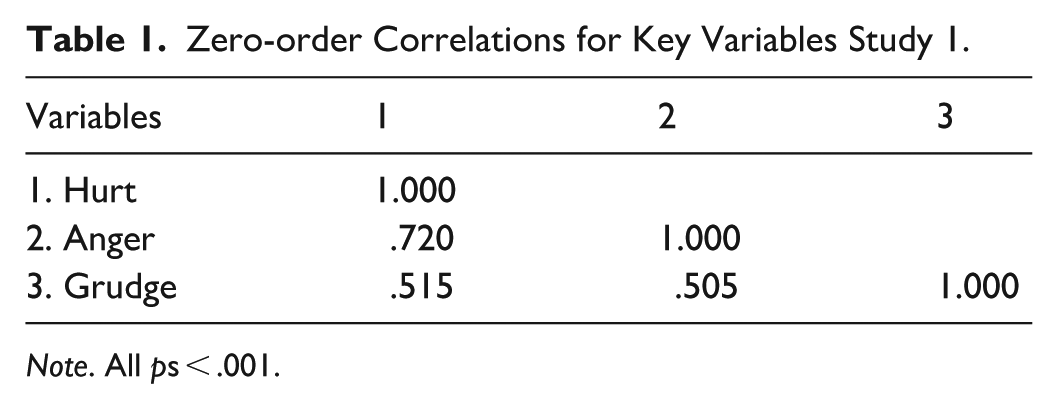
Note. All ps < .001.
Primary Analyses
We used multilevel modeling with individuals nested within couples to account for the nonindependence in the data (Kenny et al., 2006). The intercepts were free to vary randomly, and the slopes were treated as fixed effects. A nonsignificant association between hurt and grudge holding was found, b = −0.036, SE = 0.068, t = −0.527, p = .599, 95% CI [−0.171, 0.101]. Similarly, a nonsignificant relation between anger and grudge holding was found, b = −0.115, SE = 0.081, t = −1.419, p = .157, [−0.276, 0.048]. However, there was a significant interaction between hurt and anger on grudge holding, b = 0.058, SE = 0.015, t = 3.828, p < .001, [0.027, 0.088].
To probe this interaction, we tested the simple slopes for hurt feelings at low (−1 SD) and high (+1 SD) levels of anger (see Figure 1). When anger was low (−1 SD), there was no significant association between hurt and grudge, b = 0.086, SE = 0.047, t = 1.843, p = .067, 95% CI [−0.005, 0.178]. Conversely, when anger was high (+1 SD), the association between hurt and grudge was significant and positive, b = 0.319, SE = 0.057, t = 5.604, p < .001, [0.207, 0.430]. We also tested the simple slopes for anger when hurt was low (−1 SD) and high (+1 SD). For victims experiencing low levels of hurt, there was no significant association between their anger and grudges, b = 0.029, SE = 0.052, t = 0.548, p = .584, [−0.074, 0.131]. However, for victims experiencing high levels of hurt, a positive association was found between anger and grudge holding, b = 0.254, SE = 0.048, t = 5.278, p < .001, [0.160, 0.349]. Overall, this interaction pattern is consistent with the theorized relations among hurt, anger, and grudge holding.
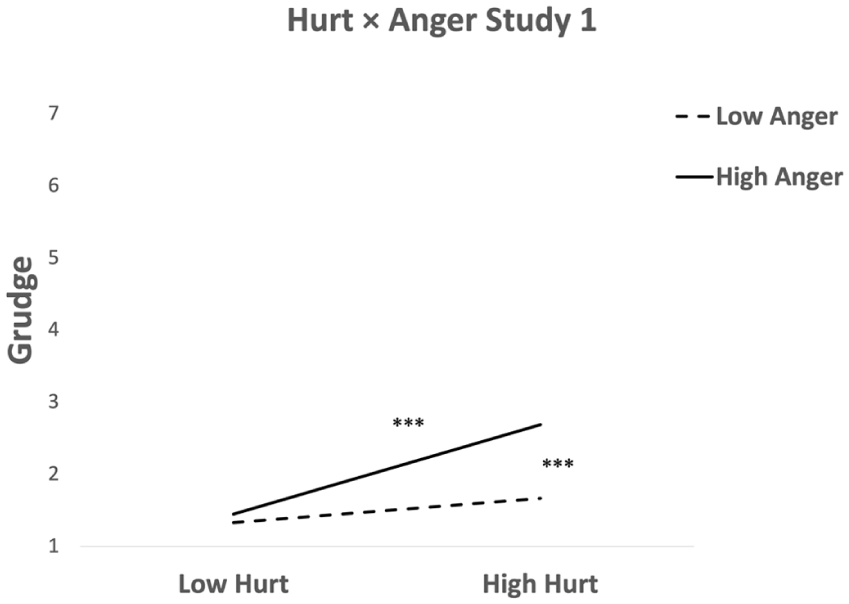
Hurt feelings × anger on grudge holding study 1.
Study 2
The primary goal of Study 2 was to replicate Study 1 using an independent and larger sample size. Consistent with Study 1, we expected that victim hurt and anger would interact to predict grudge holding against transgressors. Similarly, we specifically predicted a positive relation between hurt and grudge holding when victims of an interpersonal transgression also feel angry about the transgression.
Method
Participants
Undergraduate students enrolled in psychology courses were asked to distribute the URLs with the study materials to two independent adults (i.e., two adults who do not know each other) currently in romantic relationships. Consistent with Study 1, participants were given a 2-week deadline, and data collection stopped once this deadline was reached. There were 880 participants who completed the study materials, but we excluded those with substantial missing data, a straight line response pattern (n = 125), and those who failed the attention checks (i.e., answered three or more of the five items incorrectly), as determined by responses on the CRS (Marjanovic et al., 2014; n = 61), resulting in a final sample of 694 participants. A sensitivity power analysis indicated 80% power to detect a small effect size, f2 = 0.01 with α = .05 and N = 694. The final sample included 474 women, 209 men, 11 participants who identified as nonbinary or preferred not to disclose. Participants’ ages range from 18 to 82 years old (M = 24.74, SD = 11.04). This sample was ethnically diverse: 34.7% White, 18.3% South Asian, 12% Middle Eastern, 11.5% Black, 8.2% South East Asian, 5.3% East Asian, 4% Other, 3.2% Latin American, 2% South American, 0.6% Indigenous, and 0.1% Polynesian.
Transgression Recall and Measures
Recalled Transgression
Participants were asked to recall an unresolved transgression that had been committed against them by their partner, using the same stimulus in Study 1.
Hurt and Anger
Participants rated their hurt feelings and anger on a 7-point scale. Items were the same as Study 1.
Grudge
The GAM scale (van Monsjou et al., 2022) in Study 1 was used in Study 2 again to assess participants’ grudges against their partner.
Conscientious Responders Scale
The material was the same as Study 1. Distracted responses were identified based on recommendations of Marjanovic et al. (2014).
Procedure
Participants were given a URL link to access to the online survey. After they consented to participate, they were instructed to complete the study materials in the sequence described in the material section above. In addition, participants completed the Conscientious Response Scale used in Study 1. At the end of the survey, they received the debriefing of the study and were redirected to a separate survey where they had the opportunity to enter their email address into a draw for a $100 gift card to a major retailer.
Results and Discussion
Preliminary Analyses
The items for the GAM were averaged based on inter-item correlations and acceptable levels of internal consistency to create the variable grudge total (M = 2.25, SD = 1.33, α = .96). In addition, the hurt and anger measures were distributed around the midpoint of the 7-point scale, hurt (M = 4.45, SD = 1.91) and anger (M = 3.99, SD = 1.93). See Table 2 for correlations between the study variables.
Zero-order Correlations for Key Variables Study 2.
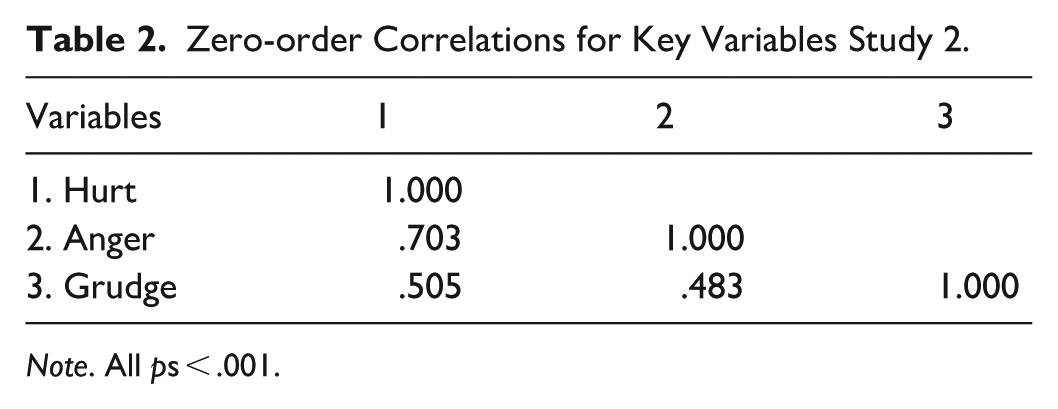
Note. All ps < .001.
Primary Analyses
Hayes’s (2012) PROCESS analysis (Models 1) was used to test the association between hurt and anger and grudge holding. The association between hurt and grudge holding was nonsignificant, b = 0.010, SE = 0.052, t = 0.186, p = .853, 95% CI [−0.092, 0.111], and the association between anger and grudge holding was negative and significant, b = −0.124, SE = 0.063, t = −1.980, p = .048, [−0.247, −0.001]. Most germane to our hypothesis, hurt and anger interacted to predict grudge holding, b = 0.064, SE = 0.012, t = 5.478, p < .001, [0.041, 0.087], consistent with Study 1.
To probe the interaction, we then tested the simple slopes for hurt at low levels (−1 SD) and high levels (+1 SD) of anger (See Figure 2). When anger was low, there was a significant positive relation between hurt and grudge, b = 0.142, SE = 0.036, t = 3.996, p < .001, 95% CI [0.072, 0.212]. When anger was high, the positive relation between hurt and grudge became stronger, b = 0.389, SE = 0.043, t = 9.113, p < .001, [0.305, 0.473]. We also tested the simple slopes for anger at different levels of hurt (−1, +1 SD). For victims low in hurt, the relation between anger and grudge was nonsignificant, b = 0.040, SE = 0.040, t = 1.005, p = .315, [−0.038, 0.118]; however, for victims high in hurt, the relation between anger and grudge was significant and positive, b = 0.283, SE = 0.037, t = 7.637, p < .001, [0.210, 0.356], as predicted.
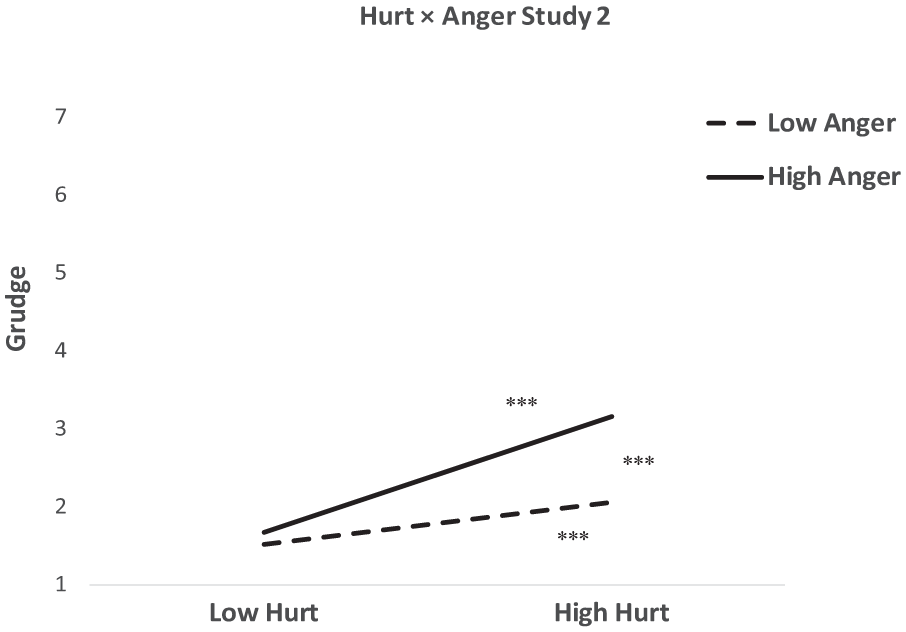
Hurt feelings × anger on grudge holding study 2.
Overall, the results of Studies 1 and 2 support our hypotheses that hurt feelings and anger interact to predict grudge holding, particularly a positive association between hurt and grudge holding was found when victims were also angry. The absence of a significant independent association between hurt feelings and grudge holding (Studies 1 and 2) and anger and grudge holding (Study 1), and a significant association between the interaction of hurt and anger and grudge holding (Studies 1 and 2) suggests that both are important in the formation of grudges during the grudge holding process.
Study 3
In Studies 1 and 2, we focused on romantic relationships; however, van Monsjou et al. (2023) and Kowalski et al. (2023) found that grudges were related to a broad range of prior relationships including friends, coworkers, roommates, family, and romantic partners. Study 3 extended the findings to other types of interpersonal relationships. Additionally, we sought to explore the underlying dimensions of hurt and anger by including multiple items to assess these emotions. We also investigated whether the moderated relation between hurt, anger, and grudge could be explained by perceptions of the transgressor’s immorality. To explore this mediated moderation, we used Hayes’ (2012) PROCESS analysis (Models 1 and 8) to test the mediating role of transgressor immorality.
Method
Participants
We recruited a sample of undergraduate students from a Canadian university. Data collection began mid-semester and ended when the university research pool closed at the end of the semester. Initially, 511 participants completed the study materials. However, we excluded those with substantial missing data and a straight line response pattern (n = 15), as well as those who had failed three or more CRS items (Marjanovic et al., 2014) (n = 33), resulting in a final sample of 463 participants. A sensitivity power analysis based on α = .05, 80% power, four predictor variables, and N = 463, indicated that we had sufficient power to detect a small effect size, f2 = 0.02. This sample comprised 382 women, 73 men, and 8 participants who identified as non-binary or preferred not to disclose their gender. Participants ranged in age from 17 to 70 years (M = 19.73, SD = 4.92). This sample was ethnically diverse: 24.8% South Asian, 23.1% White, 13% Middle Eastern, 10.8% Black, 9.5% South-East Asian, 6.9% East Asian, 6.9% Other, 3.5% Latin American, 1.1% South American. Participants reported diverse relationships with the transgressor: 42.9% friend, 17.7% immediate family member, 13.4% romantic partner, 6.1% relative, 4.8% stranger, 4.1% Other, 3.9% coworker, 3.7% acquaintance, 1.7% significant other, 1.7% boss.
Transgression Recall and Measures
Recalled Transgression
Participants were asked to recall an unresolved transgression from any relationship within the past 6 months, extending the recall period from Studies 1 and 2, which was 2 weeks. See Supplemental Materials for the full text of the transgression recall prompt.
Hurt and Anger
Based on the theorizing of Lemay et al. (2012) and Feeney (2005), we developed multiple items to assess hurt and anger. Five items were used to measure hurt feelings (e.g., To what extent do you feel hurt by this person regarding this event?) and five items were used to assess anger (e.g., To what extent do you feel angry at this person for this event?). Items were presented in random order. Responses were rated on 7-point scale from 1 (Not at all) to 7 (Very much so). These items demonstrate acceptable reliability and were combined to create composite variables of hurt (α = .84) and anger (α = .79).
Perception of Immorality
Three items that capture Weiner’s (2006) theorizing about moral evaluation were used to assess participants’ perception of the transgressor’s immorality regarding the event (After this event, I see this person as a bad person; This person hurt me on purpose rather than unintentionally; This person deserves to be blamed for hurting me; α = .81). Responses were rated on 7-point scale from 1 (Strongly disagree) to 7 (Strongly agree).
Grudge
The GAM scale (van Monsjou et al., 2022) in Studies 1 and 2 was used to assess participants’ degree of grudge holding toward a transgressor.
Conscientious Responders Scale
The material was the same as Studies 1 and 2. Distracted responses were identified based on Marjanovic et al.’s (2014) recommendations.
Procedure
The study was conducted online. A URL to the study materials was posted on the university Undergraduate Research Participation Pool website. University undergraduate students signed up for the study and accessed the materials via the provided URL. After consenting to participate, participants were instructed to complete the study materials in the order described in the material section. Upon completion, participants received a debriefing and were granted credits toward their introductory psychology course.
Results
Preliminary Analysis
We averaged items based on their correlations and internal consistency levels for each scale: hurt (M = 5.26, SD = 1.29, α = .84), anger (M = 5.01, SD = 1.34, α = .79), immoral character (M = 3.85, SD = 1.77, α = .81), and grudge total (M = 3.80, SD = 1.54, α = .94). See Table 3 for correlations between the study variables. 1
Zero-order Correlations for Key Variables Study 3.
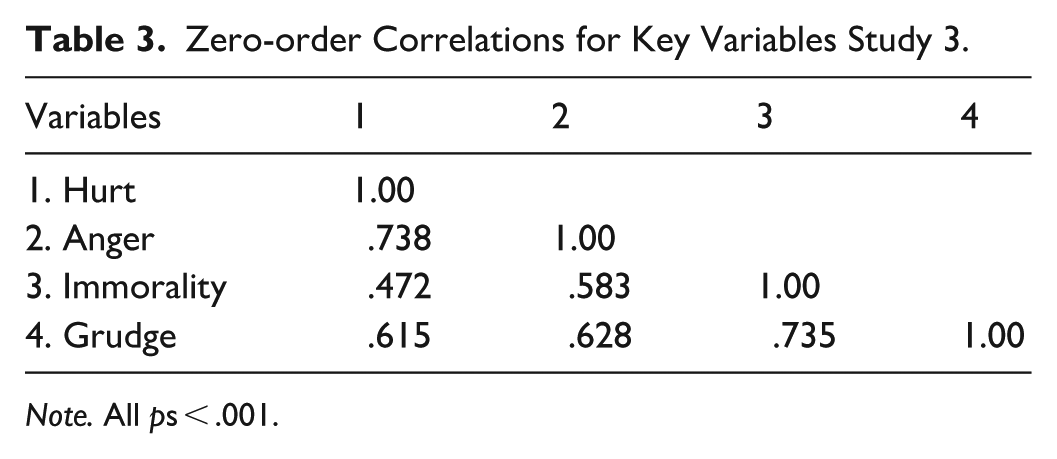
Note. All ps < .001.
Primary Analyses
To test our hypothesis that hurt and anger would interact to predict grudge, we used Hayes’s (2012) PROCESS analysis (Model 1). The analysis revealed neither hurt (b = −0.020, SE = 0.137, t = −0.147, p = .883, 95% CI [−0.289, 0.249]) nor anger (b = −0.044, SE = 0.154, t = −0.288, p = .774, [−0.346, 0.258]) was significantly associated with grudge holding. However, as predicted, the interaction between hurt and anger was significant, b = 0.093, SE = 0.027, t = 3.393, p = .001, [0.039, 0.147]. Simple slope tests showed that when anger was low (−1 SD), the relation between hurt and grudge was positive and significant, b = 0.320, SE = 0.065, t = 4.956, p < .001, [0.193, 0.447]. This relation strengthened when anger was high (+1 SD), b = 0.570, SE = 0.079, t = 7.179, p < .001, [0.414, 0.726], supporting our hypothesis regarding the moderating role of anger (see Figure 3). Similarly, at low levels (−1 SD) of hurt, anger was significantly related to grudge, b = 0.325, SE = 0.067, t = 4.831, p < .001, [0.193, 0.457], and this relation was stronger at high levels (+1 SD) of hurt, b = 0.564, SE = 0.069, t = 8.154, p < .001, [0.428, 0.700].
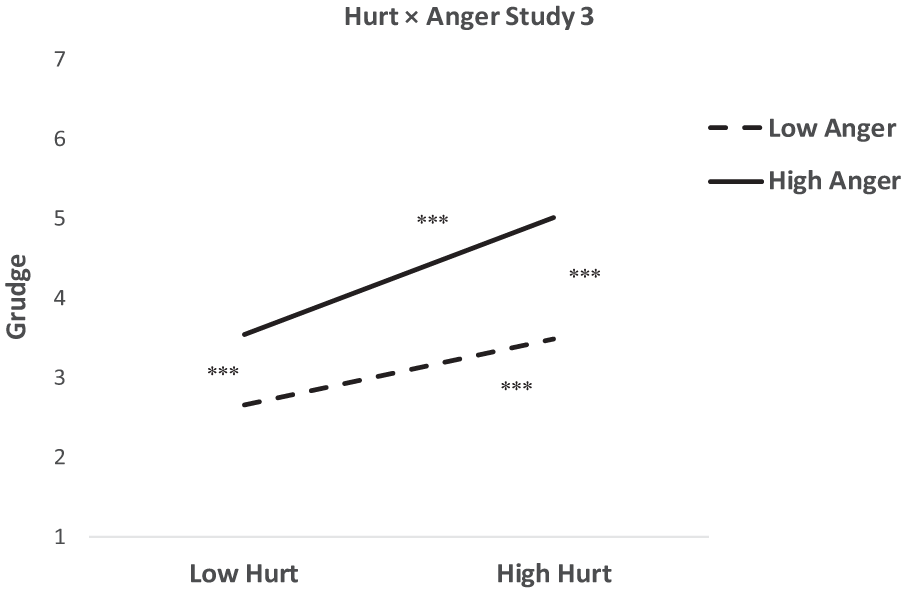
Hurt feelings × anger on grudge holding study 3.
Before testing for moderated mediation in which victims’ perception of transgressors’ immorality mediates the association between the interaction of hurt and anger on grudge, we ran PROCESS Model 1 to examine the moderated relation between hurt and anger on victims’ perception of transgressors’ immorality. The results showed no significant relation between hurt and immorality, b = −0.254, SE = 0.172, t = −1.477, p = .141, 95% CI [−0.592, 0.084], or between anger and immorality, b = 0.240, SE = 0.193, t = 1.246, p = .214, [−0.139, 0.619]. However, hurt and anger interacted to predict immorality, b = 0.085, SE = 0.034, t = 2.456, p = .014, [0.017, 0.152]. When anger was low, the relation between hurt and immorality was nonsignificant, b = 0.056, SE = 0.081, t = 0.687, p = .492, [−0.104, 0.215], but it was stronger when anger was high, b = 0.283, SE = 0.100, t = 2.835, p = .005, [0.087, 0.479] (see Figure 4). We also tested the moderating role of hurt on the association between anger and immorality; the positive relation between anger and immorality was stronger when hurt was high, b = 0.794, SE = 0.087, t = 9.131, p < .001, [0.623, 0.965], compared to when it was low, b = 0.576, SE = 0.084, t = 6.821, p < .001, [0.410, 0.742].
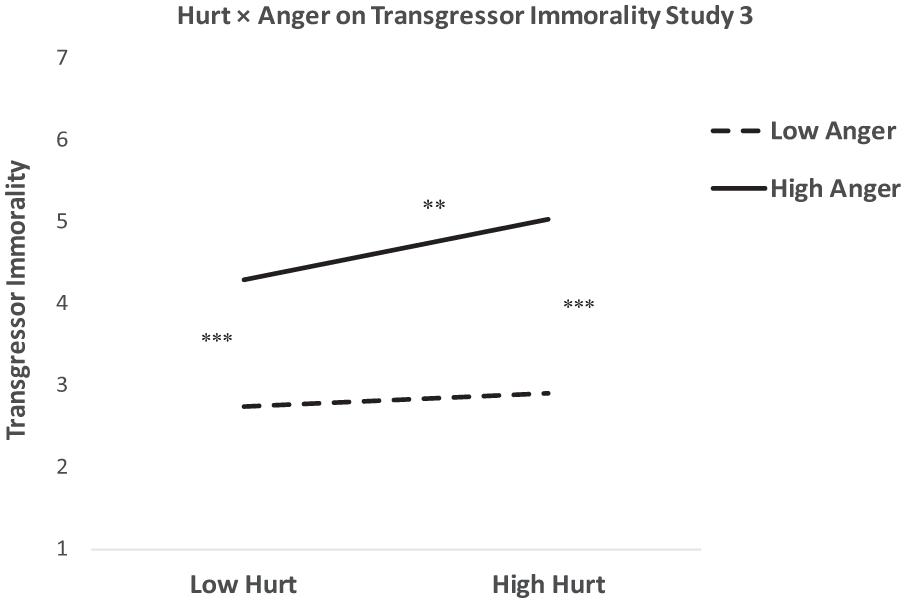
Hurt feelings × anger on transgressor immorality study 3.
For our moderated mediation model (PROCESS Model 8), we tested whether the perception of the transgressor’s immorality mediated the moderated relation between hurt and grudge. See Figure 5 for the model tested. The analysis revealed a significant indirect effect for immorality, Effect = 0.039, SE = 0.015, 95% bootstrap CI [0.011, 0.070]. This result indicates that the significant interaction between hurt and anger on grudge holding was mediated by victims’ perceptions of the transgressor’s immorality.
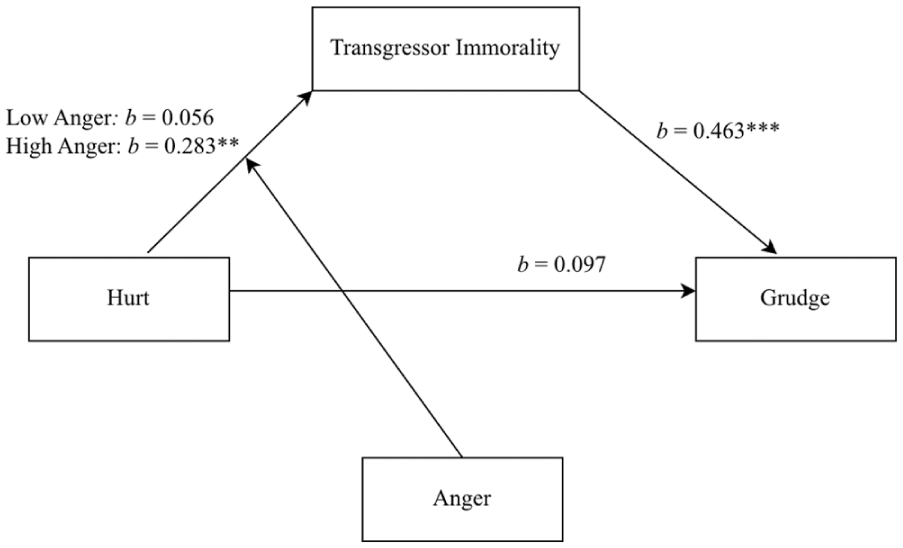
Moderated mediation model for study 3.
Study 4
The primary goal of Study 4 was to replicate the findings from Studies 1 to 3 using an experimental design. Study 4 was preregistered (https://aspredicted.org/5w6x-nv6j.pdf). The preregistration specified the study design, hypotheses, manipulations of hurt and anger, sample size, exclusion criteria, and analyses. Any exploratory analyses not included in the preregistration are noted below in the Results.
We aimed to test the causal relation between hurt, anger, and grudge by manipulating hurt (absence/low, presence/high) and anger (absence/low, presence/high). Although hurt and anger were positively correlated in our studies, prior work suggests they are conceptually distinct in both function and outcomes (Lemay et al., 2012). This distinction is further supported by the authors’ unpublished qualitative data currently under review, in which participants described hurt and anger as phenomenologically different emotional experiences following transgressions (Li et al., 2025). To disentangle hurt and anger, Study 4 used an experimental design in which participants were randomly assigned to one of four conditions: recalling a transgression with a person whom they had prior experience that made them feel: hurt only (without anger), angry only (without hurt), both hurt and angry, or neither hurt nor angry. We hypothesized that participants who experienced both hurt and anger would engage in grudge holding because they would be more likely to perceive the transgressor as immoral, unworthy of reconciliation, and excluded from the moral community (Struthers et al., 2017). Alternatively, we also theorized that the interaction between hurt and anger on grudge holding could be explained by victims’ welfare trade-off ratio (WTR) toward the transgressor (Struthers et al., 2025). Hurt and anger may not only shape victims’ moral evaluations of the transgressor; these negative emotions may also interact to reduce victims’ willingness to prioritize the transgressor’s welfare relative to their own, rendering the transgressor unworthy of further investment (Tooby et al. 2008). A low WTR toward the transgressor would, in turn, motivate victims to maintain psychological distance by holding a grudge. To test these mediators, we measured victims’ perceptions of the transgressor’s moral and immoral character and their WTR toward the transgressor, examining whether the interaction effect of hurt and anger on grudge could be explained by these factors using Hayes’s (2012) PROCESS (Model 8).
Method
Participants
A sample of undergraduate students from a university participant pool was used. Data collection ended when the university research pool closed at the end of the semester. An a priori power analysis was conducted using G*Power 3.1 (Faul et al., 2007) to determine the size of sample needed to detect a small to moderate effect (ƒ = 0.15), α = .05 across four groups. Our preregistration specified a target sample size of N = 475 to achieve 90% power. In anticipation of exclusions associated with those with a random response pattern as indicated by failing three or more items on the Conscientious Response Scale (Marjanovic et al., 2012; n = 39), participants who did not complete the experimental recollections correctly (e.g., participants in a present/high hurt condition reporting “1” (not at all) on the hurt manipulation check) (n = 43), and those with incomplete responding (i.e., substantial missing data, straight line response pattern; n = 35), we oversampled by approximately 100 participants, total N = 555 (Stosic et al., 2024). After exclusions, the final sample consisted of 438 participants and included 349 females, 83 males, 5 individuals who identified as nonbinary, and 1 who preferred not to say. The sample was culturally diverse: 23.6% South Asian, 11.9% Black, 14.7% Middle Eastern, 19.5% White, 11.7% South East Asian, 6.4% East Asian, 5.5% Latin American, 1.1% South American, and 5.7% other. Although our sample size was slightly below our preregistered target, it still exceeds the minimum sample size of 351 required to detect the same effect with 80% power (approximately 88 participants per condition) and is therefore adequate for our primary analysis.
Transgression Recall, Measures, and Manipulation of Hurt and Anger
Recalled Transgression and Manipulation
Participants were randomly assigned to one of four conditions to recall a transgression, varying by hurt (absence/low, presence/high) and anger (absence/low, presence/high). The instruction of Hurt and Anger condition were as follows:
Present/High Hurt and Absent/Low Anger Condition
Please take a moment to think about a time in the recent past when an unresolved negative event between you and another person, where the other person committed a transgression by harming you (psychologically, emotionally, physically, etc.). It is important that you recall a transgression in which you felt hurt (sad) but not angry (not mad).
Present/High Anger and Absent/Low Hurt Condition
Please take a moment to think about a time in the recent past when an unresolved negative event occurred between you and another person, where the other person committed a transgression by harming you (psychologically, emotionally, physically, etc.). It is important that you recall a transgression in which you felt angry (mad) but not hurt (not sad).
Present/High Hurt and Present/High Anger Condition
Please take a moment to think about a time in the recent past when an unresolved negative event occurred between you and another person, where the other person committed a transgression by harming you (psychologically, emotionally, physically, etc.). It is important that you recall a transgression in which you felt both hurt (sad) and angry (mad).
Absent/Low Hurt and Absent/Low Anger Condition
Please take a moment to think about a time in the recent past when an unresolved negative event occurred between you and another person, where the other person committed a transgression by harming you (psychologically, emotionally, physically, etc.). It is important that you recall a transgression in which you felt neither hurt (not sad) nor angry (not mad).
Participants were further instructed to think about the most memorable unresolved negative event where they felt the specified emotions, if they could not recall a relevant event occurred in the recent past. The transgressor could be a friend, family member, romantic partner, coworker, or acquaintance. The negative event could have resulted from something the other person did or failed to do. Participants were asked to describe what happened, their actions, and how it made them feel hurt but not angry, angry but not hurt, both hurt and angry, or neither hurt nor angry. Each condition included an emoji representation of the instructed emotions (see Supplemental Materials).
Manipulation Checks
After recalling the transgression, participants rated their emotional states, indicating how much they felt hurt and anger because of the event from 1 (Not at all) to 7 (Very much so). Participants in hurt conditions were expected to report higher levels of hurt, and those in the anger conditions were expected to report higher levels of anger.
Event Negativity
Participants also completed two items assessing the negativity of the recalled transgression: “How negative was this event?” and “How much does this event have a negative impact on you?” (1 = Not at all, 7 = Very much so).
Moral and Immoral Character
Participants rated the transgressor’s moral character on a 7-point scale (1 = Not at all and 7 = Very much so) using 21 adapted items from Tappin and McKay (2017; e.g., Honest, Trustworthy) and White et al. (2020; e.g., Selfish, Compassionate).
Welfare Trade-off Ratio
Participants completed items adapted from Struthers et al. 2025, including four items assessing relative concern for the transgressor (e.g., I am more concerned about the other person than myself), four items on rumination (e.g., I find myself replaying the negative event with the other person in my mind.), and four items on worry (e.g., I worry that I will hurt the other person in the future). All items were rated on a 7-point scale (1 = Not at all and 7 = Very much so).
Grudge
The GAM scale (van Monsjou et al., 2022) in the previous three studies was used again to assess participants grudges against the transgressor.
Other PTRs
To keep the study at a manageable length for participants, we included a single item to assess each additional PTR: revenge, avoidance, and forgiveness. Revenge and avoidance were measured using one item each from the Transgression-Related Interpersonal Motivations Inventory (TRIM-12; McCullough et al., 1998): “I will make the other person pay.” and “I’m avoiding the other person.” Forgiveness was assessed using a single item from the TRIM-Benevolence subscale (McCullough & Hoyt, 2002): “I want us to bury the hatchet and move forward with our relationship.”
Conscientious Responders Scale
The material was the same as the previous three studies. Distracted responses were identified based on Marjanovic et al.’s (2014) recommendations.
Procedure
Participants accessed the study materials via a link on the university undergraduate research participation pool website. After providing consent, participants were randomly assigned to one of the four hurt (absence/low, presence/high) by anger (absence/low, presence/high) conditions and completed the study materials online. They responded to manipulation checks and other questions about the transgression. Participants then received a debriefing and were granted credits toward their introductory psychology course.
Results
Preliminary Analysis
The 21 items assessing participants’ evaluation of transgressors’ moral character were subjected to an exploratory factor analysis with Varimax rotation. The Kaiser-Meyer-Olkin measure (KMO = 0.96) and Bartlett’s test of sphericity (χ²(210) = 6557.18, p < .001) indicated that the set of items was adequately related for factor analysis. The communalities were all above 0.3, indicating that each item shared some common variance with other items. We utilized a factor loading cut-off point of 0.50 and followed Kaiser’s criterion of eigenvalues greater than 1, which led to a two-factor solution (see Table 4). We labeled these factors as immoral character (immoral, bad, manipulative, deceptive, rude, insincere, selfish, disloyal, disagreeable, irresponsible, prejudice) and moral character (kind, respectful, cooperative, good, fair, compassionate, principled, trustworthy, honest, easygoing). This solution accounted for 63.57% of the total variance.
Rotated Factor Loadings for Morality and Immorality Study 4.
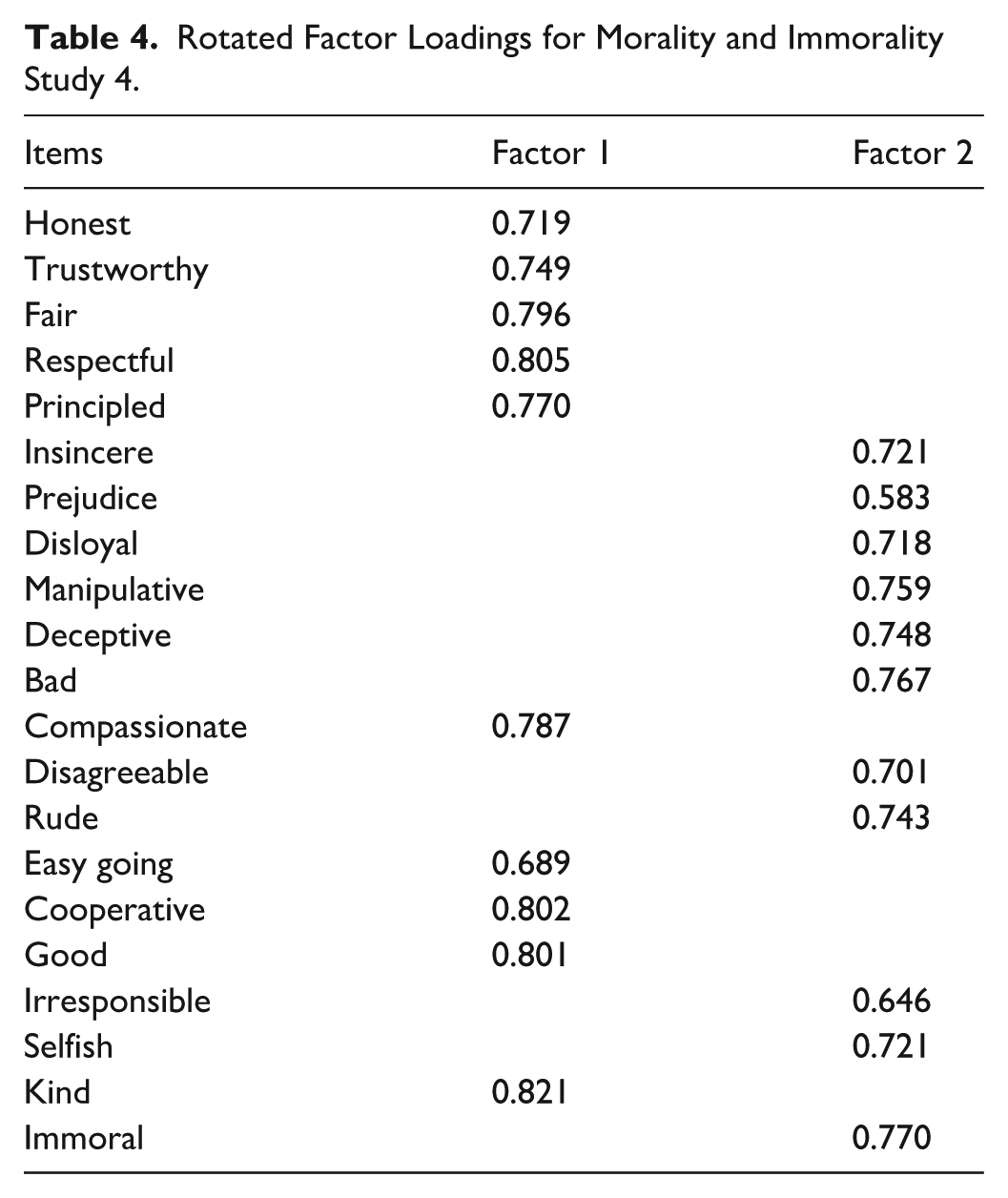
We then created composite dependent variables for our primary analyses: transgressor moral character (M = 3.08, SD = 1.50, α = .95), transgressor immoral character (M = 3.81, SD = 1.57, α = .93), WTR (M = 3.23, SD = 0.92, α = .74), and grudge (M = 3.80, SD = 1.54, α = .94). We also examined three single-item measures assessing revenge (M = 1.60, SD = 1.27), avoidance (M = 3.44, SD = 2.27), and forgiveness (M = 3.93, SD = 2.10). See Table 5 for correlations between the study variables.
Zero-order Correlations for Key Dependent Variables Study 4.
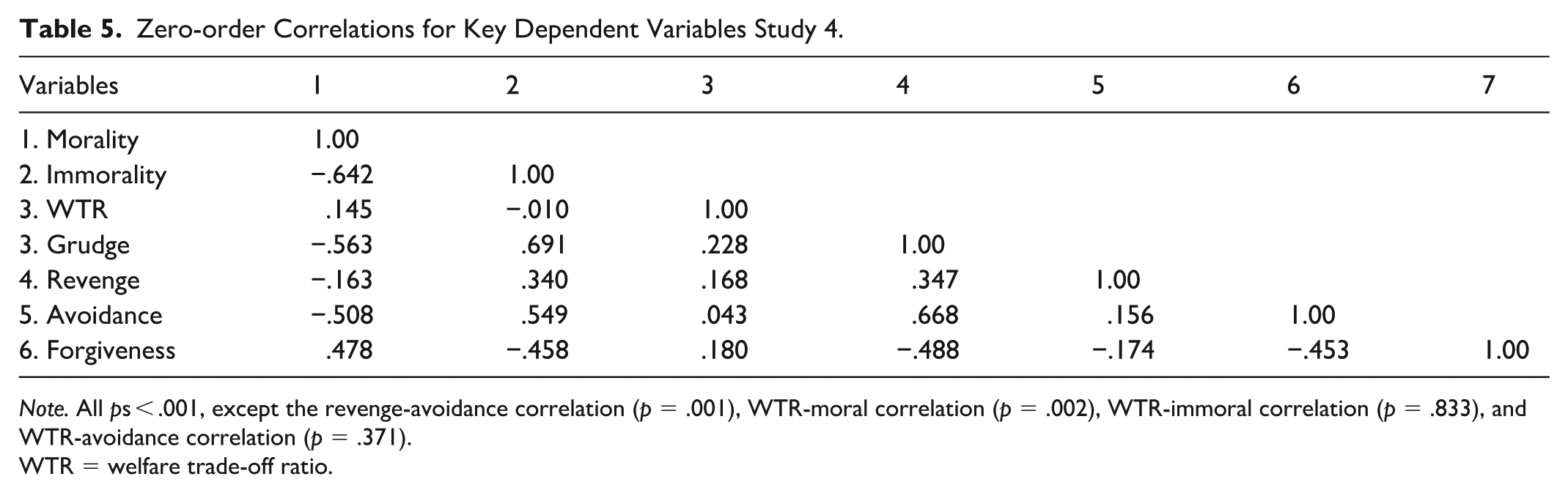
Note. All ps < .001, except the revenge-avoidance correlation (p = .001), WTR-moral correlation (p = .002), WTR-immoral correlation (p = .833), and WTR-avoidance correlation (p = .371).
WTR = welfare trade-off ratio.
Manipulation Checks and Event Negativity
To evaluate the effectiveness of the hurt and anger manipulation, we conducted separate 2 (hurt: absence/low, presence/high) × 2 (anger: absence/low, presence/high) factorial ANOVAs on the manipulation check measures. For the hurt manipulation check, the analysis revealed a significant main effect of hurt, F(1, 434) = 52.71, p < .001, η p 2 = .108, such that participants in the present/high hurt conditions reported higher hurt than those in the absent/low hurt conditions. The main effect of anger, F(1, 434) = 2.743, p = .098, and the interaction, F(1, 434) = 0.255, p = .614, were nonsignificant. For the anger manipulation check, there was a significant main effect of anger, F(1, 434) = 94.504, p < .001, η p 2 = .179, with participants in the present/high anger condition reporting greater anger than those in the absent/low anger conditions. The main effect of hurt, F(1, 434) = 1.248, p = .265, and the interaction, F(1, 434) = 0.868, p = .352, were nonsignificant. These support the successful manipulation of hurt and anger. See Table 6 for full descriptive statistics. Although the manipulation worked as intended, participants instructed to recall hurt but not anger still reported some anger, and those asked to recall anger but not hurt still reported some hurt. Thus, these conditions are better understood as reflecting relatively lower levels of each emotion rather than a complete absence.
Descriptive Statistics for Manipulation Checks and Perceived Negativity by Condition.
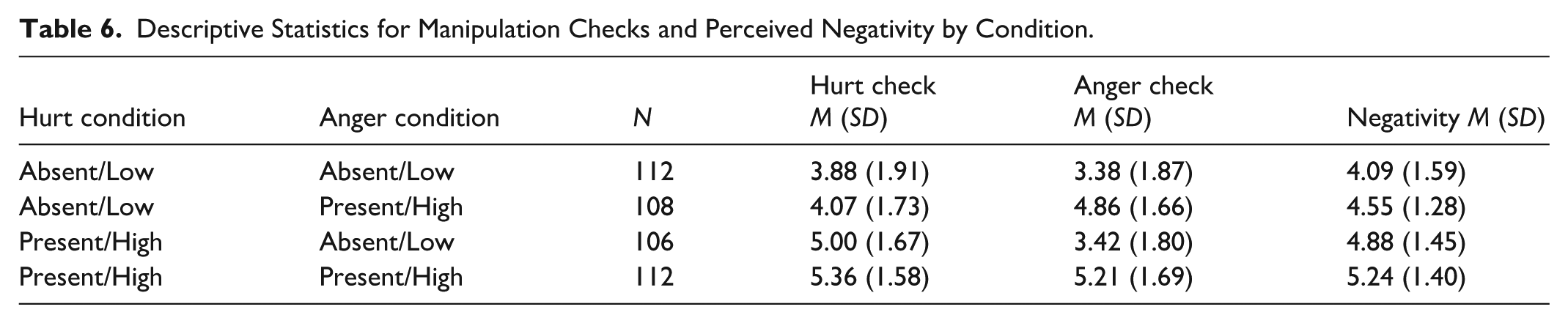
We assessed the mean level of event negativity perceived by our participants to ensure participants had a similar level of perceived negativity across the recalled events. Based on the average of the two items assessing event negativity (r = .57) we found a moderate level of overall perceived negativity (M = 4.69, SD = 1.49). Next, we tested the interaction of hurt and anger on perceived negativity using a 2 × 2 between groups ANOVA. Although the interaction between hurt and anger was nonsignificant, F(1, 434) = 0.116, p = .733, the analysis revealed a significant main effect of hurt, F(1, 434) = 28.940, p < .001, η p 2 = .063, and a significant main effect of anger, F(1, 434) = 8.979, p = .003, η p 2 = .020.
Grudge Holding
We conducted a 2 (hurt: absence/low, presence/high) × 2 (anger: absence/low, presence/high) between groups ANOVA on grudge holding. This analysis revealed a significant main effect of hurt, F(1, 434) = 6.460, p = .011, η p 2 = .015, and a significant main effect of anger, F(1, 434) = 17.714, p < .001, η p 2 = .039, but their interaction effect was nonsignificant, F(1, 434) = 2.092, p = .149.
Although not originally preregistered, because event negativity was associated with hurt and anger, we conducted a follow up analysis to explore our moderation hypothesis with perceived event negativity being included as a covariate. A 2 × 2 ANCOVA on grudge holding (controlling for event negativity) revealed no main effect of hurt, F(1, 433) = 0.440, p = .508, but a significant main effect of anger, F(1, 433) = 9.014, p = .003, η p 2 = .020. Importantly, the hurt × anger interaction was significant, F(1, 433) = 4.033, p = .045, η p 2 = .009.
To probe this interaction, we conducted simple effects tests on the estimated marginal means (see Figure 6). When anger was absent/low, grudge holding did not significantly differ between the absent/low hurt group and the present/high hurt group, mean difference = −0.296, SE = 0.159, F(1, 433) = 3.480, p = .063, 95% CI for the mean difference [−0.608, 0.016]. No significant difference was found between the hurt groups when anger was present/high, mean difference = 0.146, SE = 0.157, F(1, 433) = 0.855, p = .356, [−0.164, 0.455]. We then tested the simple effects for anger when hurt was absent/low and present/high. When hurt was absent/low, grudge holding did not significantly differ between levels of anger, mean difference = 0.113, SE = 0.156, F(1, 433) = 0.521, p = .471, [−0.194, 0.419], but when hurt was present/high, participants in the present/high anger condition reported significantly more grudge holding than those in the absent/low anger condition, mean difference = 0.554, SE = 0.156, F(1, 433) = 12.55, p < .001, [0.247, 0.862].
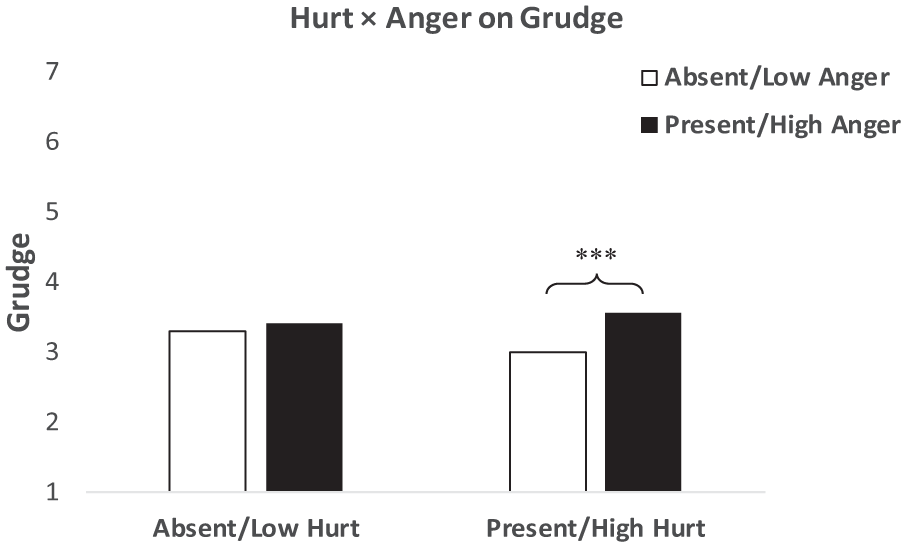
Hurt feeling × anger on grudge holding study 4.
Potential Mediators
To examine whether the perception of the transgressor’s morality and immorality mediated the effect of hurt × anger interaction on grudge, we first conducted separate 2 (hurt: absence/low, presence/high) × 2 (anger: absence/low, presence/high) factorial ANOVAs on perceived transgressor morality and immorality. Hurt and anger did not interact to affect perceiving transgressors as moral, F(1, 434) = 1.314, p = .252, but they did interact to predict perceiving transgressors as immoral, F(1, 434) = 3.920, p = .048, η p 2 = .009, consistent with our prediction and Study 3 (see Figure 7). We conducted simple effects tests on the estimated marginal means. When anger was absent/low, perceived immorality did not differ significantly between the absent/low hurt group and the present/high hurt group, mean difference = −0.082, SE = 0.204, F(1, 434) = 0.163, p = .687, 95% CI [−0.483, 0.318]. In contrast, when anger was present/high, participants in the present/high hurt condition perceived the transgressor as significantly more immoral than those in the absent/low hurt condition, mean difference = 0.487, SE = 0.203, F(1, 434) = 5.766, p = .017, [0.088, 0.886]. Additionally, the simple effects of anger varied across levels of hurt. When hurt was absent/low, participants in the present/high anger condition reported greater perceived immorality than those in the absent/low anger condition, mean difference = 0.558, SE = 0.203, F(1, 434) = 7.558, p = .006, [0.159, 0.956], and this difference became larger when hurt was present/high, mean difference = 1.127, SE = 0.204, F(1, 434) = 30.576, p < .001, [0.726, 1.528]. We also conducted a 2 × 2 ANOVA on WTR and found that the interaction was nonsignificant, F(1, 434) = 0.001, p = .969.
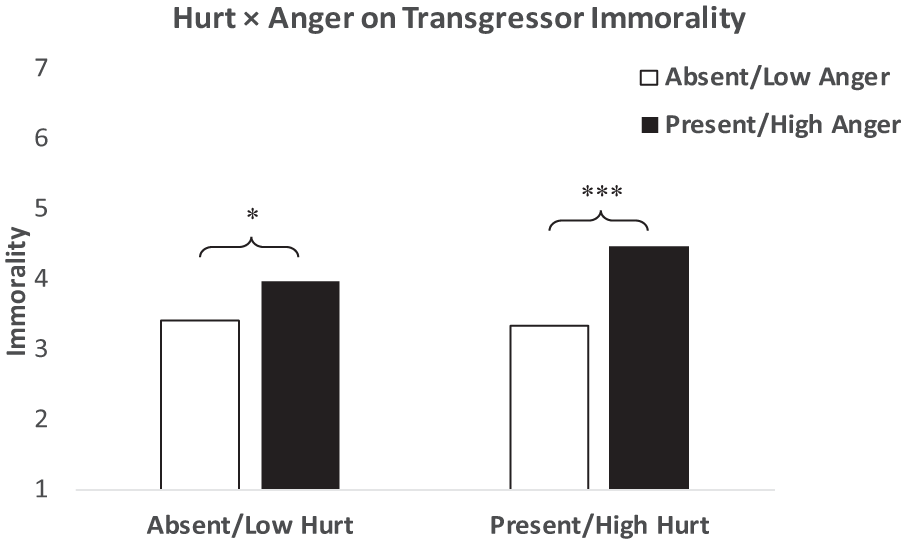
Hurt feeling × anger on transgressor immorality study 4.
Among the proposed mediators (morality, immorality, and WTR), only perceived transgressor immorality was affected by the hurt × anger interaction. Accordingly, we tested a moderated mediation model using PROCESS Model 8 to examine whether the interaction between hurt and anger on grudge holding could be explained by perceptions of the transgressor’s immorality. Because earlier analyses indicated that hurt did not significantly predict grudge holding at either the absent/low or the present/high anger conditions, whereas anger significantly predicted grudge holding when hurt was present/high, we treated anger as the focal independent variable and hurt as the moderator variable in this model (see Figure 8). The index of moderated mediation was significant, Effect = 0.357, SE = 0.181, 95% bootstrap CI [0.007, 0.717]. The conditional indirect effect for transgressor immorality between anger and grudge was significant when hurt was absent/low, Effect = 0.350, SE = 0.128, [0.104, 0.603], and it became stronger when hurt was present/high, Effect = 0.708, SE = 0.130, [0.451, 0.963]. 2 Thus, anger contributes to stronger grudge holding via heightened perceptions of the transgressor’s immorality, especially under conditions of high hurt.
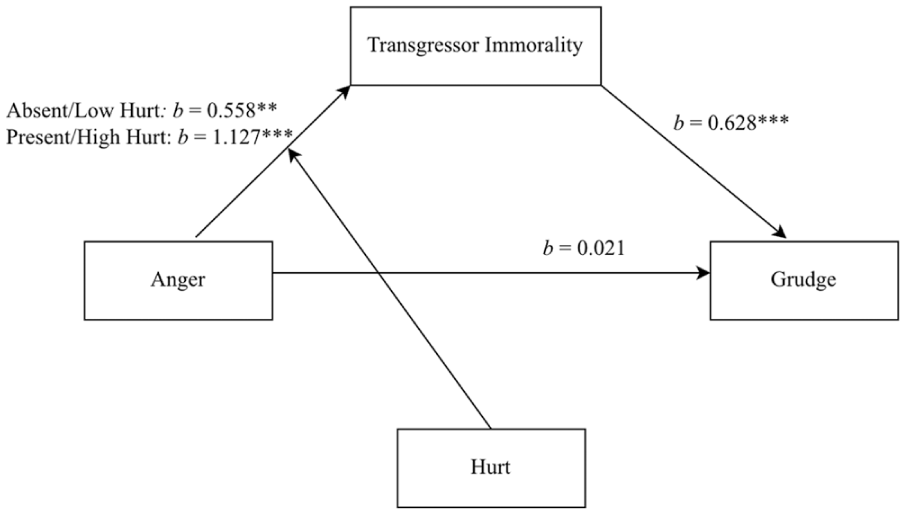
Moderated mediation model for study 4.
Other PTRs
We also tested the interaction effects of hurt and anger on other PTRs, using 2 (hurt: absence/low, presence/high) × 2 (anger: absence/low, presence/high) factorial ANOVAs. The interaction between hurt and anger was nonsignificant on revenge, F(1, 434) = 0.019, p = .892, avoidance, F(1, 434) = 1.362, p = .244, and forgiveness, F(1, 434) = 0.167, p = .683. Although the main effects of hurt were nonsignificant on these outcomes (revenge: F(1, 434) = 0.725, p = .395; avoidance: F(1, 434) = 0.151, p = .698; forgiveness: F(1, 434) = 0.002, p = .961), there was a significant main effect of anger on revenge, F(1, 434) = 7.334, p = .007, η p 2 = .017, avoidance, F(1, 434) = 17.836, p < .001, η p 2 = .039, and forgiveness, F(1, 434) = 4.589, p = .033, η p 2 = .010. 3
General Discussion
In this research, we examined the interaction between hurt feelings and anger in predicting victim’s grudge holding and the mediating role of perceptions of the transgressor’s moral character in this process. Previous research has highlighted the unique social motivational consequences of hurt and anger on victims and transgressors (Feeney, 2005; Leary & Springer, 2001; Lemay et al., 2012). Hurt feelings are associated with victims’ vulnerabilities, dependence, and commitment to the relationship, leading to constructive responses by both victims and transgressors aimed at preserving the relationship (Lemay et al., 2012). In contrast, anger is associated with a sense of power and attempts to control and change the transgressor’s behavior, leading to destructive responses by both victims and transgressors. Although informative, no studies have examined their interactive role on the social motivation process, and as a result, researchers still do not understand how they interact to affect the social motivation process following interpersonal transgressions. Given that grudges are defined as a sustained feeling of hurt and anger, we tested whether hurt and anger would interact to affect grudge holding. As well, because these emotions can trigger blaming thoughts and lead to a reassessment of the transgressor’s morality, and victims who hold grudges are likely to perceive their transgressors as someone possessing low morality, we tested the explanatory role of victims’ perception of a transgressor’s immorality on the association between the interaction of hurt and anger and grudge holding.
We conducted four studies using different methods (nonexperimental, experimental), samples (nonstudent adults, undergraduate students), relationship types (romantic, diverse relationships), and operationalizations of variables including hurt feelings and anger (single and multiple items). These studies supported our hypothesis that hurt feelings and anger interact to predict grudge holding. In Study 4 where we manipulated hurt feelings and anger, a nonsignificant interaction was found when conducting our preregistered analysis; however, given the significant association between hurt/anger and event negativity, we decided to run a follow up analysis controlling for event negativity. Results supported our moderation hypothesis on grudge holding. For the other PTRs, revenge, avoidance, and forgiveness, a nonsignificant hurt by anger interaction was found regardless of whether event negativity was included as a covariate. These findings suggest that grudge holding is not simply equivalent to wanting revenge, distancing oneself, or withholding forgiveness. Rather, it reflects a distinct response pattern.
Studies 1 and 2 focused on romantic relationships and were conducted on community samples, whereas Studies 3 and 4 focused on diverse relationships with undergraduate student samples. Interestingly, the overall level of grudge holding appeared to be lower in Studies 1 and 2 compared to Studies 3 and 4, which may suggest that grudge holding is less likely and less functional in the context of romantic relationships. Romantic partnerships typically involve high interdependence, and thus, harboring a grudge may be maladaptive to relationship maintenance and success. Future work could investigate how relationship norms and goals shape grudge holding and when they may serve or hinder relationship preservation.
Furthermore, we found that the moderated relation between hurt feelings and anger was mediated by perceptions of the transgressor’s immorality in Studies 3 and 4. This is consistent with previous qualitative work (van Monsjou et al., 2023), where individuals holding grudges reported viewing the transgressor as a “bad” person since the event. When individuals feel hurt in a valued relationship and subsequently feel anger toward the offending person, it may fundamentally alter their perception of the transgressor. In Study 4, we incorporated specific moral character items from existing scales (Tappin & McKay, 2017; White et al., 2020) and found that character items related to transgressors’ immorality, but not morality, were predicted by the interaction of hurt and anger and mediated the interaction effect on grudge holding. The effect on immorality rather than morality suggests that not seeing someone as a good and moral person does not necessarily mean seeing them as a “bad” and immoral person. People may react more strongly to immoral than to moral behavior due to a negativity bias, which is a tendency to assign greater weight to negative information (Baumeister et al., 2001). From an evolutionary perspective, misjudging someone’s immorality can be more costly than misjudging their morality. If a person mistakenly trusts and forms a relationship with someone who is actually harmful, it can lead to significant negative consequences concerning an individual’s evolutionary fitness. This aligns with the idea that holding a grudge serves a self-protection function because it helps individuals remain vigilant and cautious about potential threats to their wellbeing. We also examined WTR as an alternative mechanism, but it did not account for the relation between the hurt and anger interaction and grudge holding.
Implications, Limitation, and Future Research
This research offers significant theoretical implications for the study of hurt feelings and anger, particularly in the context of interpersonal conflict. It enhances our understanding of how these two emotions interact to influence grudge holding. Although hurt feelings and anger are distinct, investigating their combined psychological effects is crucial to a more complete understanding of the social motivation process following interpersonal transgressions. This research advances the theory of grudge holding by demonstrating that the interaction of both emotions is a key predictor of grudge, with their impact explained by perceptions of the transgressor’s immorality. Overall, this work contributes to the literature on social motivation and provides insights into how, when, and why individuals harbor grudges.
Despite its benefits, this research has several limitations. In Study 4, the use of a recall priming task may have limited experimental control over transgression characteristics such as offense severity, which we did not directly measure. Instead, we included a measure of event negativity, which conceptually overlaps with severity (e.g., Fehr et al., 2010; McCullough et al., 2003). Because more severe interpersonal events are typically rated as more negative, including event negativity as a covariate allowed us to partially account for variation in perceived severity across recalled events. Nonetheless, the absence of a direct measure of severity remains a limitation of this study. Relatedly, discrepancy in statistical significance related to including event negativity as a covariate raises the possibility of lower internal validity associated with the recall-based procedure used in Study 4. Although adding this covariate did not alter the moderated mediation results for perceived immorality, future studies using more controlled transgression paradigms would strengthen the internal validity of that procedure. Additionally, there remains a lack of clear conceptualization of hurt feelings and anger in the context of interpersonal transgression. It is not well understood which aspects of these emotions are most relevant to grudge holding or how they unfold over time. Future research exploring which emotion arises first or if they occur simultaneously could be beneficial in better understanding the interplay between these two emotions. Given the implications of grudges for the maintenance of valuable relationships, a better understanding of the temporal process of grudge holding may provide insights into how to circumvent or influence their development. One promising direction for future research is the use of daily diary or experience sampling methods to investigate the temporal sequence of hurt and anger. By collecting data on individuals’ emotional experiences in real-time or on a daily basis, researchers can gain insights into how these emotions evolve and interact over time in the context of grudge holding. This approach would provide a more nuanced understanding of the dynamic interplay between hurt and anger and how they contribute to the development and maintenance of grudges. Finally, qualitative research methods, such as interviews with individuals who hold grudges, could also provide valuable insights. This approach could help clarify the concepts of hurt and anger, their sequence in grudge holding, and explore other potential mechanisms that explain the relation between these emotions and grudge holding.
Conclusion
This research advances our understanding of the interplay between hurt feelings and anger in the context of interpersonal transgressions. Our findings demonstrate that when these two distinct emotions co-occur, they predict grudge holding, with perceptions of the transgressor’s immorality playing a mediating role. This highlights the complex emotional and cognitive dimensions of grudge holding and provides a more comprehensive theoretical model concerning the social motivation process following interpersonal transgressions. From a theoretical perspective, this research contributes to the literature on social motivation, offering insights into how, when, and why individuals harbor grudges. Practically, by addressing both hurt and anger and their interactive effects, practitioners can develop more effective strategies for helping individuals manage interpersonal conflicts. Overall, this research emphasizes the importance of considering the interactional impact of hurt feelings and anger in understanding grudge holding, paving the way for future investigations into the multifaceted nature of this experience.
Supplemental Material
sj-docx-1-psp-10.1177_01461672251414770 – Supplemental material for Understanding Grudges: The Interplay Between Hurt Feelings and Anger
Supplemental material, sj-docx-1-psp-10.1177_01461672251414770 for Understanding Grudges: The Interplay Between Hurt Feelings and Anger by Jingyuan Sophie Li, C. Ward Struthers, Jewy Ferrer, Ola AlMakadma, Kai Wen Zhou and Dmytro O. Rebrov in Personality and Social Psychology Bulletin
Footnotes

Ethical Considerations
The studies reported in this article received ethical approval from the Research Ethics Committee at the authors’ university.
Funding
The authors received no financial support for the research, authorship, and/or publication of this article.
Declaration of Conflicting Interests
The authors declared no potential conflicts of interest with respect to the research, authorship, and/or publication of this article.
Data Availability Statement
Supplemental Material
Supplemental material is available online with this article.
Notes
References
Supplementary Material
Please find the following supplemental material available below.
For Open Access articles published under a Creative Commons License, all supplemental material carries the same license as the article it is associated with.
For non-Open Access articles published, all supplemental material carries a non-exclusive license, and permission requests for re-use of supplemental material or any part of supplemental material shall be sent directly to the copyright owner as specified in the copyright notice associated with the article.
