




Abstract
People who perceive they lack power inhibit their needs and goals, sometimes aggress to restore power, and experience poorer well-being. However, people may underestimate how much power they have to meet their needs. Guided by error management principles, we tested whether people systematically underestimate their power in relationships. Across four samples of friendships, same-gender couples, and woman–man couples (N = 1,304 dyads), we used Truth and Bias models to assess discrepancies between people’s own perceived power and the power they had as reported by their friends/partners. We found robust evidence that people underestimated their power. Moreover, higher self-protection motives (e.g., attachment anxiety) and specific power motives (e.g., desire for power) predicted greater underestimation bias whereas higher pro-relationship motives (commitment) predicted lower underestimation bias. These results illustrate that self-protection, pro-relationship, and power motives bias perceptions of power, advancing our understanding of why and how these predictors shape power-related behaviors and relationship outcomes.
Introduction
Power – the perceived ability to influence others – is central to understanding how people experience and navigate their relationships (Anderson et al., 2012; Simpson et al., 2015). People who feel able to influence their partner to achieve desired outcomes can confidently express and pursue their own needs and goals (Overall et al., 2023). By contrast, people who perceive they lack power show behavioral inhibition and are less likely to successfully pursue their needs and goals (Keltner et al., 2003; Overall et al., 2023). Low power is characterized by anxiety and threat (Keltner et al., 2003; Willardt & Schmid, 2024), leading to inhibited expression of thoughts and feelings, lower relationship satisfaction, and poorer well-being (Kifer et al., 2013; Körner & Altmann, 2025; Körner & Schütz, 2025; Overall et al., 2023). Low power can also motivate harmful behaviors, such as aggression or manipulation to try to restore power (Overall & Hammond, 2025).
Despite extensive evidence for the important implications of low perceived power, little is known about whether people’s perceptions of power accurately reflect how much they can influence their relationship partners. Indeed, the behavioral inhibition, aggression, and poor well-being that arises from low power may arise because people actually lack influence in their relationship and/or because they inaccurately perceive they lack influence. In four dyadic studies of friendships, same-gender couples, and woman–man couples, we tested whether people are biased in their perceived ability to influence their partner expecting that people may generally underestimate their relationship power. We also tested whether people who are higher in self-protection motives, lower in pro-relationship motives, and higher in power motives were more likely to underestimate their power.
Bias in Perceptions of Relationship Power
Relationship power involves how much an actor has the ability to influence their relationship partner (Anderson et al., 2012). Thus, a key benchmark for assessing bias in actors’ perceptions of their power is how much their partner reports they are influenced by actors. This approach aligns with most work assessing bias in relationship-related perceptions, which considers whether actors’ perceptions match that reported by their partner (Fletcher & Kerr, 2010), including power (Cross et al., 2019). To illustrate, we asked actors to rate how much influence they had over their partners (actor’s power) and asked their partners to report on how much they were actually influenced by actors (the benchmark to assess bias). We then used contemporary approaches to model directional bias (West & Kenny, 2011) to assess the mean-level discrepancy between actor’s perceived influence over their partner (i.e., perceived power) and the partner’s reports of how much they are actually influenced by actors (i.e., actors’ actual power). Actors’ perceiving lower power compared to partners’ reports would reveal that actors typically underestimate their relationship power (an underestimation bias) whereas actors’ perceiving higher power compared to partners’ reports would reveal that actors’ typically overestimate their relationship power (an overestimation bias).
Our predictions for directional bias are based on error management theory (Haselton & Buss, 2000), which is a key theory for explaining biased perceptions in close relationships (Fletcher & Kerr, 2010). Error management theory proposes that people’s social evaluations are adaptively biased toward minimizing more costly errors. We illustrate with a central evaluation critical to maintaining relationships – partners’ regard. Actors who overestimate the positivity of their partner’s regard will likely fail to engage in efforts to maintain relationships, risking partner dissatisfaction and rejection (Overall et al., 2012). By contrast, underestimating partner’s regard is likely to be less costly because it will often prompt actors to try to repair partner’s regard and maintain relationships. Accordingly, actors tend to underestimate their partner’s regard and other similar evaluations, such as their partner’s love, satisfaction, and commitment (Fletcher & Kerr, 2010; LaBuda & Gere, 2023).
Applying error management theory principles to perceived power also led us to expect that, on average, people will underestimate the influence they have over their partners (i.e., power). Overestimating (vs. underestimating) power could lead to more costly mistakes. Actors believing they have more influence than they do likely risk actors failing to engage the strategies needed to meet core needs and goals, leaving actors open to potential exploitation, imbalanced rewards, and unfulfilled needs in relationships. Underestimating power, on the other hand, might lead to more cooperative strategies than needed. This is likely to be relatively less costly in terms of need fulfillment in interdependent relationships that require meeting both people’s needs and may have more benefits in terms of maintaining relationships. We thus propose that actors’ may typically underestimate their power, and provide the first systematic test of average biases in perceived power in four studies that assess different types of close relationships.
Predictors of Bias in Perceptions of Relationship Power
Applying error management principles (Haselton & Buss, 2000), we propose that underestimating (vs. overestimating) power is more likely because such judgments may ensure people enact strategies to meet core needs and goals, thereby avoiding potential exploitation, imbalanced rewards, and unfulfilled relationship needs. However, greater sensitivity to relationship costs and unfulfilled needs (self-protection motives), focus on prioritizing one’s own needs and goals (pro-relationship motives), or focus on achieving influence and attaining one’s own goals (power motives) should increase or decrease underestimation bias in perceptions of relationship power. Guided by theoretical frameworks that emphasize insecurities versus commitment create self-protection versus pro-relationship motives when managing risks in relationships (Murray et al., 2006) and pro-relationship versus power motives modify responses to power (Körner et al., 2025; Overall & Hammond, 2025), we identified several variables that captured these three motives (see Table 1).
Potential Predictors of Bias in Perceptions of Relationship Power.
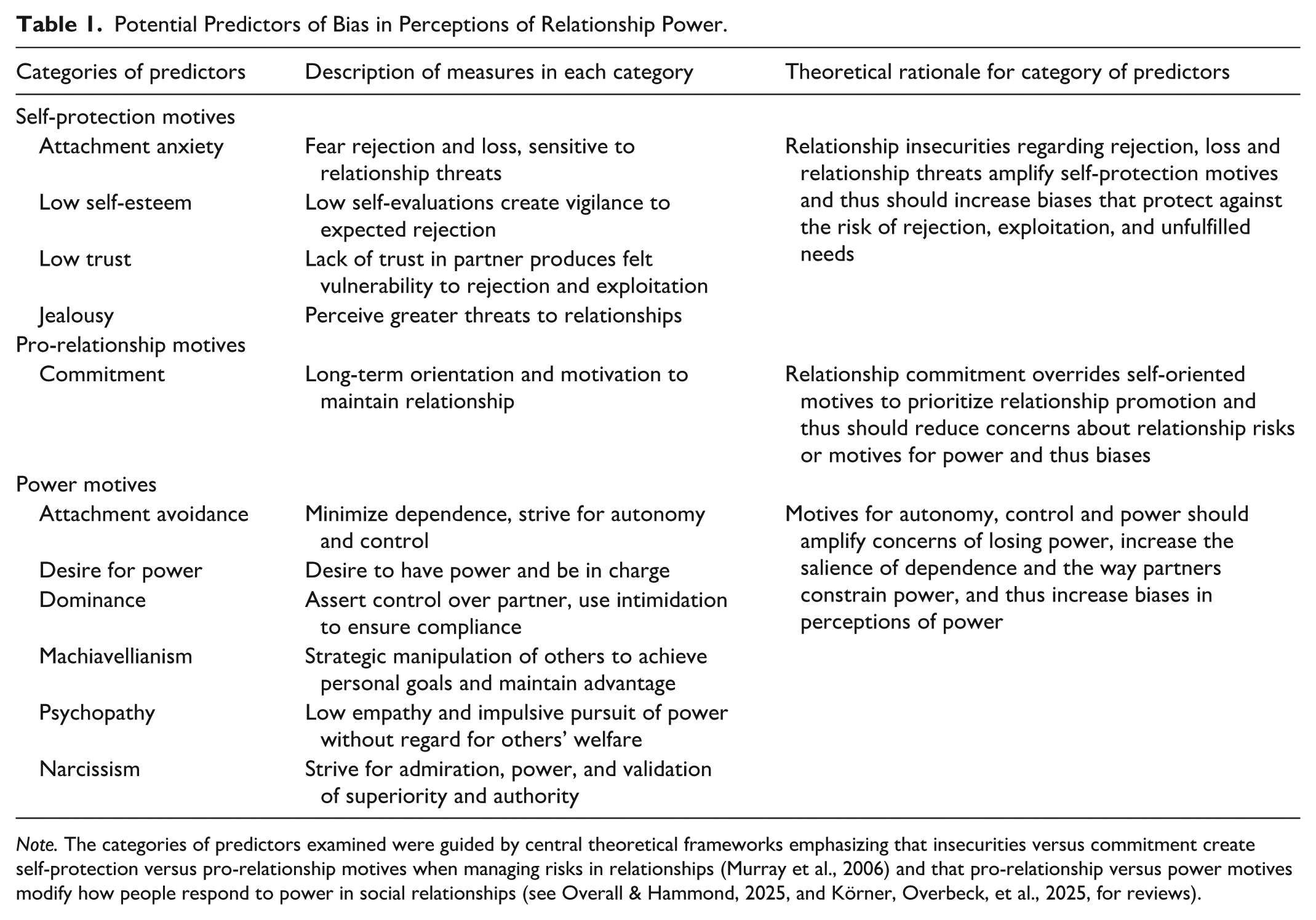
Note. The categories of predictors examined were guided by central theoretical frameworks emphasizing that insecurities versus commitment create self-protection versus pro-relationship motives when managing risks in relationships (Murray et al., 2006) and that pro-relationship versus power motives modify how people respond to power in social relationships (see Overall & Hammond, 2025, and Körner, Overbeck, et al., 2025, for reviews).
Self-Protection Motives
A consistent theme in core relationship theories is that insecurities regarding rejection, loss, and relationship threats amplify self-protection motives to protect against rejection (Mikulincer & Shaver, 2003; Murray et al., 2006). For example, individuals high in attachment anxiety and low in self-esteem are especially vigilant to signs of relational threat, rejection, or loss of influence and thus tend to construe neutral behaviors as disinterest or rejection (Dykas & Cassidy, 2011; Murray et al., 2006; Rodriguez et al., 2019). Similarly, individuals low in trust are sensitive to signs of detachment and are concerned about protecting against hurt and exploitation (Wieselquist et al., 1999). Individuals high in jealousy also tend to perceive relationship threats as more common and are particularly concerned with relationship loss (Pfeiffer & Wong, 1989; White & Mullen, 1989). Such heightened sensitivity to rejection, loss, and relationship threats make individuals high in self-protection motives feel they lack power over desired outcomes (also Körner, Overall, et al., 2025), and are thus more likely to perceive themselves as having less power than they actually do. Thus, we hypothesized individuals higher versus lower in self-protection motives would show stronger underestimation of their power (see Table 1).
Pro-Relationship Motives
The same relationship theories emphasize that commitment to relationships overrides self-protection concerns to prioritize promoting positive relationship outcomes in risky situations (Murray et al., 2006; Rusbult et al., 1998). Commitment reflects a long-term orientation and motivation to maintain the relationship (Rusbult et al., 1998). Rather than focusing on asserting influence for personal gain, committed individuals prioritize the health and longevity of their relationship (Wieselquist et al., 1999). This orientation leads them to adopt constructive influence strategies that resolve problems and sustain relationships, such as collaborative problem-solving, accommodation, and open self-disclosure (Sprecher & Hendrick, 2004; Stanley et al., 2010), rather than monitoring or being focused on their own power. Thus, we hypothesize individuals higher versus lower in pro-relationship motives will show lower underestimation of their power.
Power Motives
The power literature also recognizes that motives are critical to responses to power, including that pro-relationship motives generate more constructive responses whereas power motives produce more destructive responses to threats to power (see Overall & Hammond, 2025, and Körner, Overbeck, et al., 2025, for reviews). In particular, motives for autonomy, control, and power should amplify concerns of losing power, increasing reactivity to dependence, and associated power constraints in relationships. One key relationship predictor that captures motives for autonomy and reactivity to dependence is attachment avoidance. Compared to the vigilance to rejection and loss associated with attachment anxiety, people high in attachment avoidance strive to minimize dependence and maintain autonomy, resulting in greater distance and withdrawal (Mikulincer & Shaver, 2003; Simpson et al., 1996) in order to limit their partner from reducing their power and control (Körner, Overall, et al., 2025; Overall, 2019). In the power literature, these motives are typically captured by stronger desires to have power and attempts to assert control over or dominate partners (Murphy et al., 2022; Körner, Overbeck, et al., 2025), along with dark triad traits Machiavellianism, psychopathy, and narcissism, which also reflect motives to pursue or prioritize one’s own power (Verona et al., 2023; Zeigler-Hill et al., 2024; see Table 1).
Critically, motives for control and power clash with the reality of interdependence in close relationships, where mutual influence and compromise are necessary, and partners inevitably influence the attainment of needs and goals. Individuals with stronger power motives, such as people high in attachment avoidance, interpret their partner’s influence as more controlling or manipulative, amplifying concerns of power loss and desires to retain control (Körner, Overall, et al., 2025; Overall, 2019). Additionally, inevitable constraints to power will be particularly salient to power-motivated individuals, amplifying feelings of low power (Cross et al., 2019; Körner, Overall, et al., 2025). Providing preliminary evidence, people who are concerned about losing power perceive they have less influence in their relationship than their partners report (Cross et al., 2019). Consequently, we hypothesized that individuals higher compared to lower in power motives would show stronger underestimation of their power.
Current Research
In the current research, we test whether people are biased in their perceptions of relationship power, proposing that people may be more likely to underestimate their power in close relationships. In Study 1, we drew on four dyadic samples in which participants had completed the most established measure of relationship power (Anderson et al., 2012) to assess how much actors perceived they had the ability to influence their friend or romantic partner. Friends and romantic partners also reported on how much they were actually influenced by actors, which was used as the benchmark to assess whether actors’ perceptions of their own power were biased (along with other indices of accuracy described below). In Study 2, we drew on three of the dyadic samples that included measures related to self-protection, pro-relationship, and power motives (see Table 1) to test whether these motives predict underestimation of power. Assessing a range of related variables enabled us to examine core factors that may influence biased perceptions, which have implications for the negative outcomes that arise when people perceive low power in their relationships.
Transparency and Openness
We present the studies and samples in the order in which the data were analyzed. The aims and analyses in Study 1 focused on assessing average levels of directional bias and were preregistered separately for each of the four samples (https://aspredicted.org/g9qc-g7g3.pdf, https://aspredicted.org/jg6b-4typ.pdf, https://aspredicted.org/8gbz-sdjg.pdf, https://aspredicted.org/7rdb-cw3d.pdf). Study 2 extends the analyses reported in Study 1 by testing predictors of bias and was preregistered for the samples combined (https://osf.io/cr894/). Data, materials, and syntax are available online (https://osf.io/d2vba/). We report all preregistered measures and exclusions across samples.
Study 1
Study 1 aimed to identify whether actors’ perceptions of how much influence they had in their relationship (power) were biased using their friends’ or partners’ reports of how much actors’ actually influenced them as the benchmark. To assess bias, we applied the Truth & Bias model (West & Kenny, 2011), which distinguishes between different components of bias and accuracy: directional bias, tracking accuracy, and assumed similarity. Directional bias refers to the degree to which people underestimate or overestimate their level of power compared to the level of power reported by their friend or partner, which was the main focus of our predictions. Appropriately calculating directional bias, however, requires also modeling tracking accuracy and assumed similarity (West & Kenny, 2011).
Tracking accuracy refers to the relative association between partners’ reports of actors’ power and actors’ perceptions of power. People may underestimate (or overestimate) power while still accurately tracking relative levels (Fletcher & Kerr, 2010; West & Kenny, 2011). For example, actors who possess higher relationship power may accurately perceive they have higher power compared to other actors who have lower power, but nonetheless still underestimate the overall level of power they have in their relationship. Consistent with most judgments in relationships (Fletcher & Kerr, 2010; LaBuda & Gere, 2023), we expected significant tracking accuracy. Although this has not been tested for relationship power, prior studies in zero or low acquaintance contexts suggest that actors accurately track their relative status or power (Anderson et al., 2008; Körner, Overbeck, et al., 2024).
Assumed similarity involves individuals believing that their friends or partners have the same level of power in the relationship as they have themselves, indexed by the relative association between actors’ reports of their partners’ power and actors’ perceptions of their own power. Mirroring most judgments in relationships (Fletcher & Kerr, 2010; LaBuda & Gere, 2023), medium-to-high positive associations occur between actors’ reports of their partners’ power and perceptions of their own power in romantic relationships (Cross et al., 2019; Overall et al., 2023). Thus, we also expected significant assumed similarity.
We tested bias in perceptions of power by applying Truth and Bias models (West & Kenny, 2011) to four samples that have not been previously used to examine bias and accuracy of perceptions of power. Sample 1 involved friendship dyads – a context largely ignored by power research (Körner & Altmann, 2025). Although error management principles have been principally applied to mating or romantic relationships, friendships also require managing competing needs, goals, and motives that should produce similar biases (Haselton & Galperin, 2013). In particular, actors should be cautious in their judgments of how much they can influence friends or coalition partners to maximize cooperation and avoid exploitation. Overestimating power in friendships will fail to motivate strategies needed to avoid exploitation and thus be more costly than underestimating power, which may motivate greater cooperation than needed but help sustain relationships with ongoing social partners. Thus, people may underestimate their power in friendships just as we expect they will in romantic relationships.
Samples 2 to 4 tested the predicted underestimation bias in romantic relationships. Sample 2 involved same-gender couples, which represents another underrepresented relationship context in power research (Kim et al., 2019). Sample 3 involved woman–man couples from Germany, and Sample 4 involved woman–man couples from New Zealand (NZ). In these last two samples of distinguishable dyads, we tested for gender differences given the meaning and consequences of power may differ across women and men, especially in heterosexual relationships (Connell, 2013). Testing our predictions in friendships, same-gender couples, and woman–man couples provides a broad test of whether biased perceptions of power generalize across different relationship contexts.
Method
See Table 2 for demographics of each sample.
Sample Characteristics Across Studies.
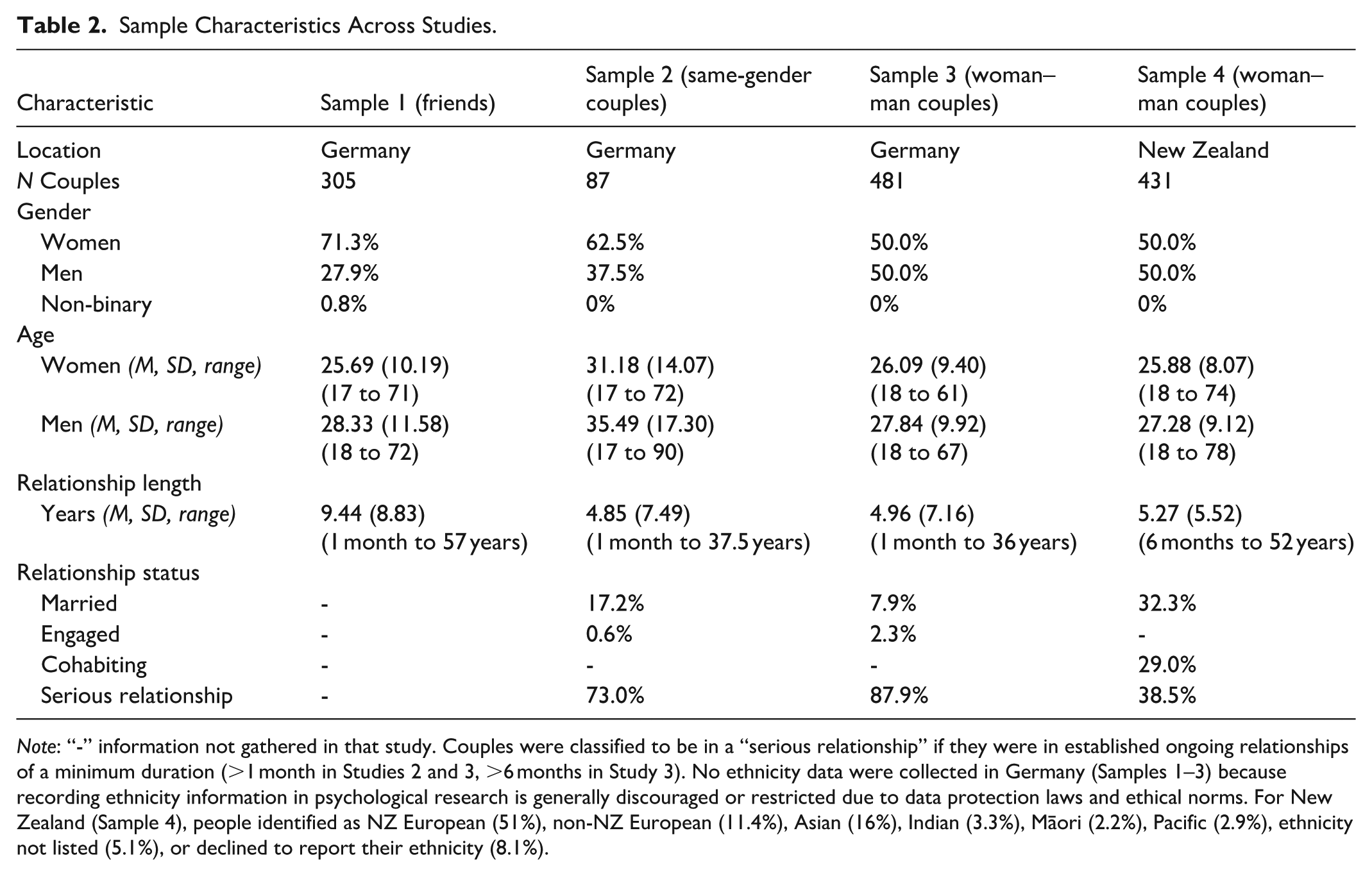
Note: “-” information not gathered in that study. Couples were classified to be in a “serious relationship” if they were in established ongoing relationships of a minimum duration (>1 month in Studies 2 and 3, >6 months in Study 3). No ethnicity data were collected in Germany (Samples 1–3) because recording ethnicity information in psychological research is generally discouraged or restricted due to data protection laws and ethical norms. For New Zealand (Sample 4), people identified as NZ European (51%), non-NZ European (11.4%), Asian (16%), Indian (3.3%), Māori (2.2%), Pacific (2.9%), ethnicity not listed (5.1%), or declined to report their ethnicity (8.1%).
Sample 1: Participants and Procedure
Data were drawn from two studies involving friendship dyads (Körner & Altmann, 2025) who independently completed an online survey, including the power measures relevant to the current study. Participants were recruited via word-of-mouth advertising and email lists in Southern Germany. Exclusion criteria were: younger than 17 years, and/or less than 1 month in the present friendship. The final sample comprised 305 friendship dyads.
Sample 2: Participants and Procedure
We drew on data from four dyadic samples (Körner & Schütz, 2026; Körner, Schütz, et al., 2025) in which couple members completed an online survey independently of their partner, including the power measures for the current study. Recruitment strategy and location were the same as for Sample 1. Exclusion criteria were: younger than 17 years, and/or less than 1 month in the present relationship. We only included same-gender couples from these samples and collapsed the data across the samples to generate a large integrative same-gender couple sample to maximize power. The resulting dataset included 87 same-gender couples.
Sample 3: Participants and Procedure
This sample was partly drawn from dyadic samples described in Sample 2 and partly drawn from independent dyadic samples (Körner, Schütz et al., 2025) but focused on woman–man couples. Recruitment strategy, location, and procedure were similar to Sample 2. Exclusion criteria were the same as Sample 2. The resulting dataset included 481 woman–man couples.
Sample 4: Participants and Procedure
We drew on data from four dyadic samples in which couples completed the same power measures (see Overall et al., 2023; Studies 1–4). Couples were recruited via electronic and noticeboard advertisements posted around a large city-based university and associated organizations (health centers, childcare facilities) in NZ. Exclusion criteria were: younger than 18 years, and/or relationship length <6 months. The final dataset included 431 woman–man couples.
Power Analyses
We assessed achieved power to detect a small directional bias (intercept = 0.10), treating the intercept as a one-sample t test (α = .05) in G*Power. We had high power in Samples 1 (0.95), 3 (women 0.99/men virtually perfect), and 4 (women 0.89/men 0.90) to detect this effect with the corresponding sample size. In Sample 2, we had low power (0.38). However, directional bias in Sample 2 was nearly double the starting value, and we achieved high power (0.89) for the size of directional bias in this sample (0.19; see Table 4).
Next, we assessed achieved power for typical small-to-medium effect sizes for tracking accuracy and assumed similarity given the observed correlations of variables across partners (α = .05; Ackerman et al., 2020; for details see Online Supplemental Material). We had high power in Samples 1 (0.97), 3 (0.997), and 4 (0.995) to detect small effects for tracking accuracy β = .15 and virtually perfect power in Samples 1, 3, and 4 to detect small-medium effects for assumed similarity of β = .20 (we used a lower effect size for tracking accuracy because these are usually smaller than assumed similarity; LaBuda & Gere, 2023). In Sample 2, we had low power to detect the specified effects for tracking accuracy (0.53) and assumed similarity (0.77), but the effect sizes in Sample 2 were higher than these starting values. We achieved virtually perfect statistical power using the effect sizes from Table 4.
Samples 1–4: Measures
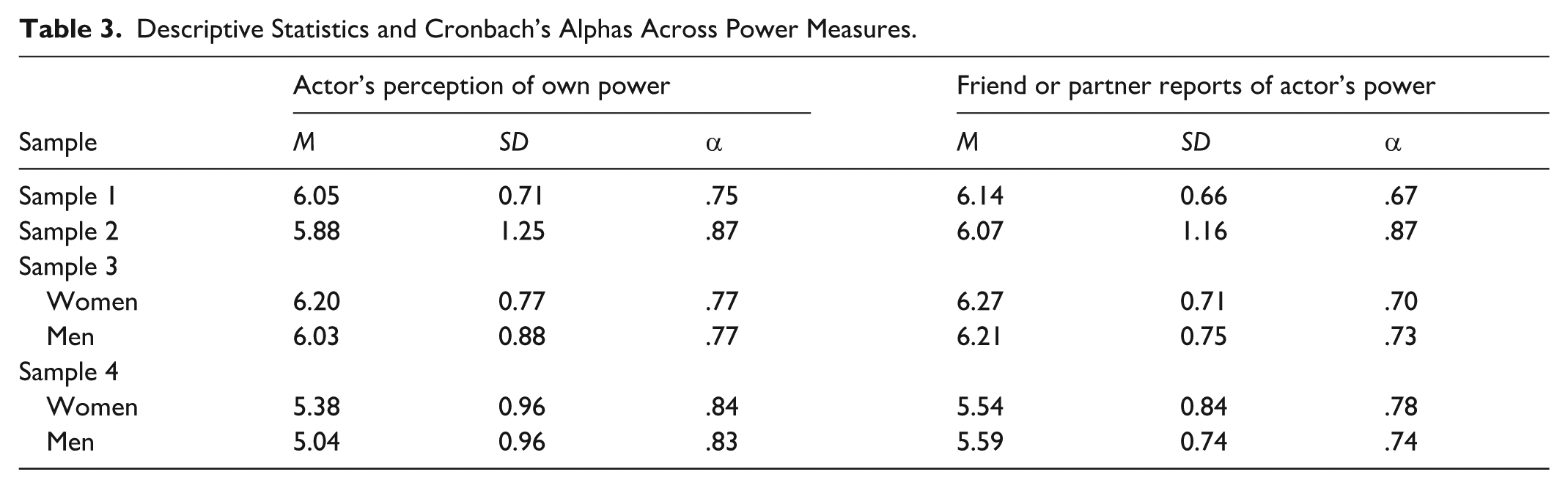
See Table 3 for descriptives and reliabilities.
Descriptive Statistics and Cronbach’s Alphas Across Power Measures.
Actors’ Perceptions of Own Power
Participants completed the Personal Sense of Power Scale (Anderson et al., 2012) with reference to their friendship (“In my friendship”) or romantic relationship (“In my relationship with my partner. . .”). This 8-item scale assesses actors’ influence over their partner’s behavior or opinions (e.g., “My ideas and opinions are often ignored by my [friend]/[partner]”), ability to make decisions (e.g., “If I want to, I get to make the decisions”), and satisfy actors’ goals and desires (e.g., “Even when I try, I am not able to get my way,” reverse-coded; 1 = strongly disagree, 7 = strongly agree).
Friend or Partner Report of Actors’ Power
Participants completed an adapted version of the Personal Sense of Power Scale (Overall et al., 2023) which reported on how much their friend or partner had power in their relationship – that is, how much their friend and partner actually had influence over them (e.g., “My [friend’s]/[partner’s] ideas and opinions are often ignored by me” reverse-coded, “If my [friend]/[partner] wants to, they get to make the decisions,” “Even when my [friend]/[partner] tries, they are not able to get their way,” reverse-coded; 1 = strongly disagree, 7 = strongly agree).
Samples 1–4: Analytic Strategy
To aid comprehension, we use the terms “partner” and “partner report,” but these can be replaced with “friend” or “friend report” for the friendship sample. We used the Truth & Bias model (West & Kenny, 2011) to test for bias in perceptions of power (see Figure 1). Actors’ perceptions of their own power were regressed on partners’ reports of actors’ power (the benchmark used to assess bias and accuracy in actors’ perceived power) as well as actors’ reports of their partner’s power (to account for assumed similarity in perceived power). All variables were grand-mean centered on the partners’ reports of actor’s power – the benchmark so that the intercept indexes directional bias (West & Kenny, 2011; also see Cross et al., 2019). A significant negative intercept indicates that actors underestimate their relationship power, whereas a significant positive intercept would indicate that actors overestimate their power. The link between actors’ perceptions of their own power and partners’ reports of actors’ power represents tracking accuracy; the degree to which actors whose partners report they have more power perceive they have more power compared to actors whose partners report they have less power (Figure 1, dashed paths). The link between actors’ reports of partners’ power and actors’ perceptions of their own power reflects assumed similarity in perceived power (Figure 1, continuous paths). We conducted these models in Mplus 8 using Maximum Likelihood estimation, and report bootstrapped 95% Confidence Intervals (k = 5,000 samples) for all coefficients.
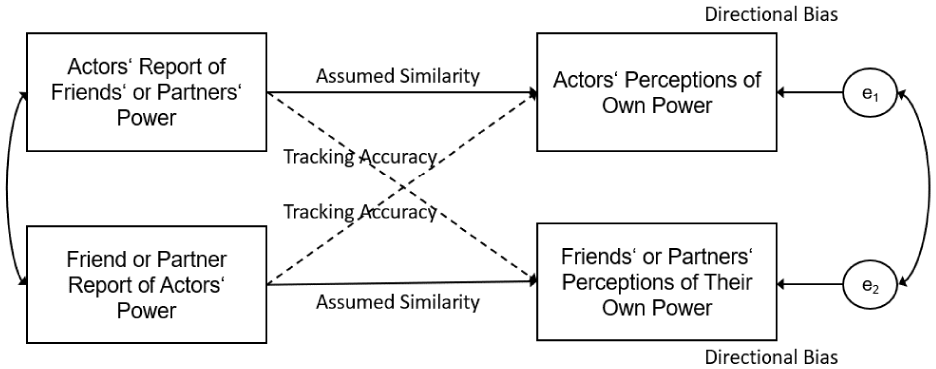
Model specification for the truth and bias model.
Analyses for indistinguishable dyads were conducted for Samples 1 to 2; because friends and same-gender partners are indistinguishable, we accounted for the arbitrariness in the assignment of friends or same-gender partners by setting all corresponding paths, means, intercepts, and (residual) variances equal across partners (Olsen & Kenny, 2006).
Analyses for distinguishable dyads were conducted for Samples 3 to 4; because woman–man couples are distinguishable by gender, we compared the fit of a saturated model (all effects freely estimated) against a path constrained model in which tracking accuracy and assumed similarity coefficients were constrained to be equal across women and men. A nonsignificant (p < .20) Likelihood Ratio Test indicates the absence of gender differences (Kenny & Ledermann, 2010). As the path constrained model was favored (see Online Supplemental Material), we set the means, intercepts, and (residual) variances equal across partners in a next step and compared the fit of this fully constrained model with the path constrained model using Likelihood Ratio tests. The path constrained model was favored in both samples, so we did not constrain the means, intercepts, and (residual) variance to be equal across partners.
Results
The results are shown in Table 4. In friendships and same-gender relationships assessed in Samples 1 and 2, people underestimated their power compared to the friend or partner reports of actor’s power (see Directional Bias for each sample in Table 4). This underestimation bias also was found in the woman–man couples assessed in Samples 3 and 4, but was stronger for men than women (women’s bias was weaker in Sample 3 and non-significant in Sample 4). Thus, in woman–man couples, men were more likely than women to underestimate their power compared to their partners’ reports of their power. Moreover, men’s underestimation bias was significantly weaker in friendships than in romantic relationships with women (German sample: Z = 2.36, p = .018; NZ sample: Z = 8.19, p < .001). However, underestimation bias was not significantly weaker in friendships when compared to bias in same-gender relationships (Z = 1.34, p = .180) or women’s bias in woman–man relationships (German sample: Z = 1.74, p = .082; NZ sample: Z = −1.24, p = .215).
Study 1: Results of Truth and Bias Analyses.
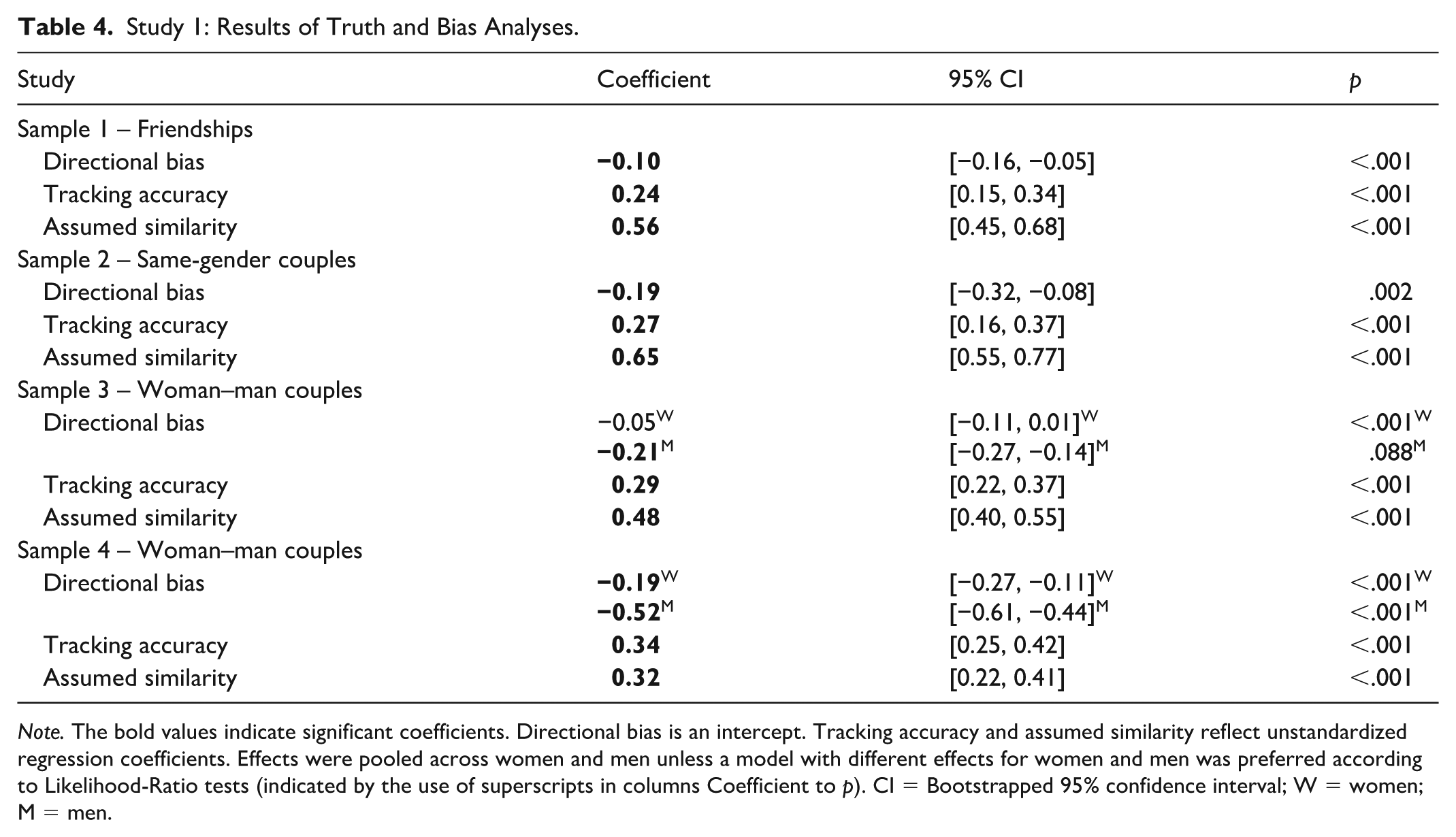
Note. The bold values indicate significant coefficients. Directional bias is an intercept. Tracking accuracy and assumed similarity reflect unstandardized regression coefficients. Effects were pooled across women and men unless a model with different effects for women and men was preferred according to Likelihood-Ratio tests (indicated by the use of superscripts in columns Coefficient to p). CI = Bootstrapped 95% confidence interval; W = women; M = men.
Alongside the robust evidence of underestimation bias, significant tracking accuracy of similar size emerged across all four samples (see Table 4). As expected, actors who had relatively higher versus lower power compared to other actors accurately tracked that they had greater versus lower power despite, on average, perceiving lower levels of power than reported by their friend or partner. Additionally, assumed similarity was significant across samples (see Table 4), showing an additional bias: people who reported their friend or partner as having power in their relationship were much more likely to perceive they had power.
Discussion
As expected, across all samples, people underestimated the power they had in their relationship. Additionally, men showed significantly greater underestimation bias in woman–man relationships compared to women’s underestimation bias and compared to underestimation bias in friendships and same-gender relationships. Prior studies have shown that men can react with more threat to low power in intimate relationships, likely because social expectations associated with traditional masculinity are tied to the possession and demonstration of power (Overall et al., 2016). Thus, men are more likely to be vigilant toward and more strongly react to lower power, particularly within woman–man relationships (Overall & Hammond, 2025; Overall et al., 2016).
Despite underestimation bias, people also illustrated tracking accuracy as is typical with other relationship judgments (Fletcher & Kerr, 2010; LaBuda & Gere, 2023) and evident for perceived power and status in unacquainted contexts (Körner, Overbeck, et al., 2024). Also, as is typical in relationship judgments (LaBuda & Gere, 2023), people showed high assumed similarity; people who reported their friends and romantic partners to be higher in power also perceived they had higher power. Nonetheless, despite accurately tracking their relative power compared to others, and perceiving similar levels of power with their partner, people tended to underestimate the power they had as reported by their friend or partner.
Study 2
Study 2 aimed to identify predictors of actors’ underestimation bias. Guided by central theoretical frameworks emphasizing that insecurities versus commitment create self-protection versus pro-relationship motives when managing risks in relationships (Murray et al., 2006) and that pro-relationship versus power motives modify how people respond to power (see Overall & Hammond, 2025, and Körner, Overbeck et al., 2025, for reviews), we identified predictor variables available in our samples that relate to self-protection, pro-relationship, and power motives (see Table 1). Greater self-protection motives should increase biases that protect against the risk of rejection and unfulfilled needs and thus increase underestimation of power. Similarly, greater power motives should amplify the salience of dependence and the way partners constrain power, and thus increase the degree to which actors’ underestimate their power. By contrast, pro-relationship motives should weaken concerns about relationship risks and thus the degree to which actors underestimate their power. Our primary focus was examining how these variables predicted underestimation bias, but for completeness, we also explored whether each variable predicted levels of tracking accuracy and assumed similarity.
Method
Participants and Procedure
We used Samples 1 (friendship dyads), 3 (German woman–man couples), and 4 (NZ woman–man couples) because these had reasonable sample sizes and included additional measures to enable testing predictors of bias and accuracy. The sample sizes varied across different analyses in Samples 1 and 3 because not all measures were included in the subsamples that were merged for the integrative datasets. Thus, data from 248 friendship dyads were analyzed when examining trust, commitment, and desire for power (see “Measures”). Data from 431 NZ woman–man couples were analyzed for attachment and commitment. Data from 287 German woman–man couples were analyzed for attachment, jealousy, and self-esteem. Data from 481 woman–man couples were analyzed for desire for power, and data from 162 German woman–man couples were analyzed for dominance and dark triad traits.
Measures
Power measures were described in Study 1 (see Table 3). Table S1 (Online Supplemental Material) displays correlations between the power motive variables and power measures. Consistent with our classification of variables as power motives, attachment avoidance, dominance, and the dark triad traits were strongly positively correlated with actors’ desire for power, but weakly to strongly negatively associated with actors’ perception of their own power. Confirmatory factor analyses also supported these distinctions (see Online Supplemental Material). See Table 5 for descriptives and reliabilities of all predictor variables.
Descriptive Statistics and Cronbach’s Alphas Across Predictor Variables.
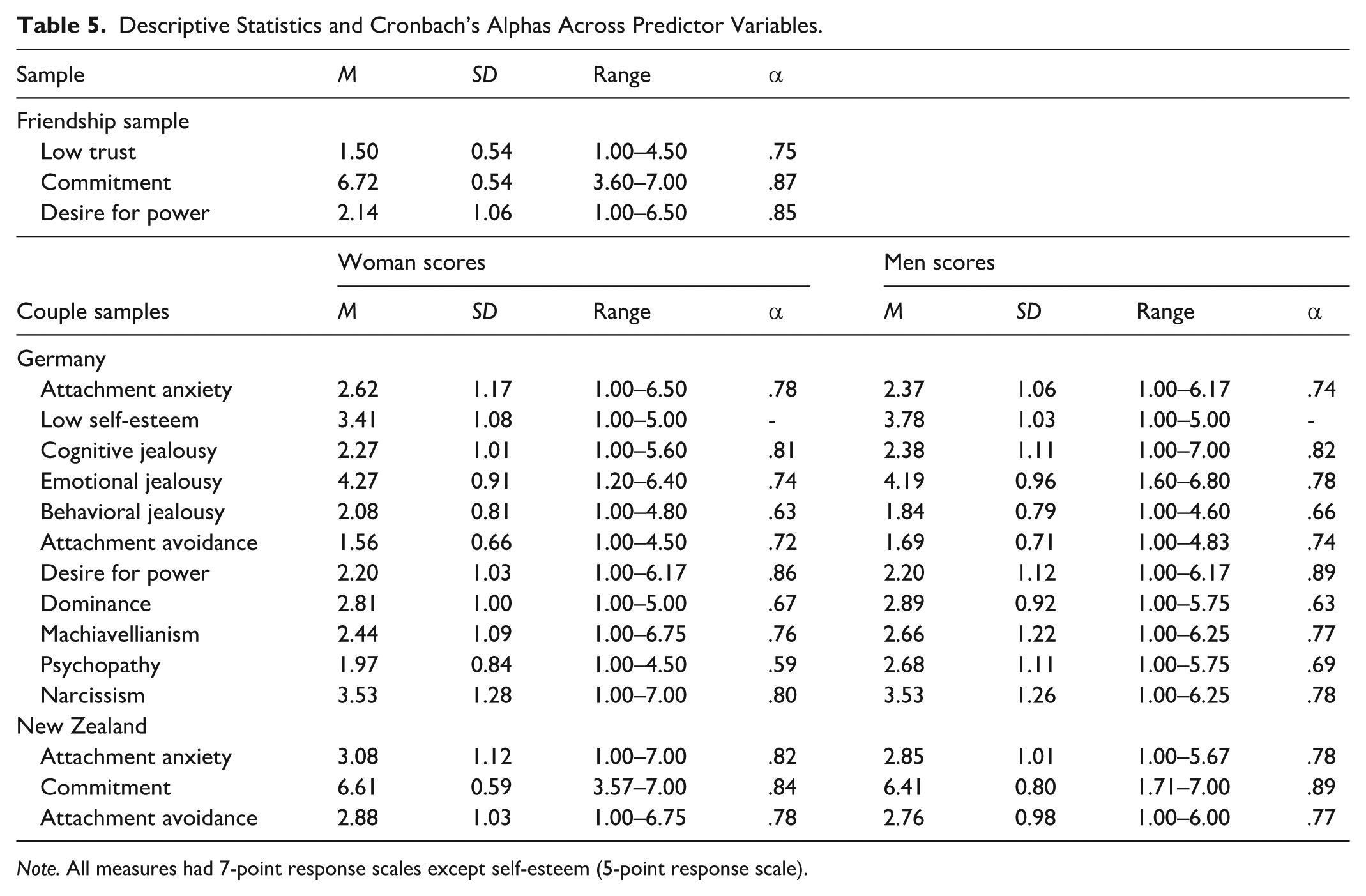
Note. All measures had 7-point response scales except self-esteem (5-point response scale).
Measures in Friendship Sample
Self-Protection Motive: Trust
Participants completed the 10-item Interpersonal Trust Scale (Buck & Bierhoff, 2012) to report on their friend’s reliability and trustworthiness (e.g., “I can expect my friend to tell me the truth,” “If my friend promised to do me a favor, they would keep it,” 1 = strongly disagree, 7 = strongly agree). Scale scores were reverse-coded so that higher values reflect lower trust.
Pro-Relationship Motive: Commitment
Participants rated six items from the Investment Model Scale (Rusbult et al., 1998) adapted to friendships (e.g., “I want our friendship to last for a very long time,” “I am committed to maintaining our friendship,” 1 = strongly disagree, 7 = strongly agree).
Power Motive: Desire for Power
Participants completed six items from the desired power subscale of the Feeling Power and Desiring Power Scales (Murphy et al., 2022) adapted to friendships (e.g., “I would enjoy having authority over my friend,” “I like to tell my friend what they should do,” 1 = strongly disagree, 7 = strongly agree).
Measures in Woman–Man Samples
Attachment and commitment were assessed in the NZ sample. Attachment and all other scales were assessed in the German sample.
Self-Protection Motive: Attachment Anxiety | Power Motive: Attachment Avoidance
In the German sample, participants completed the Experience in Close Relationships Scale (Wei et al., 2007). Six items assessed attachment anxiety (e.g., “I need a lot of reassurance that I am loved by my partner,” 1 = strongly disagree, 7 = strongly agree) and six items assessed attachment avoidance (e.g., “I try to avoid getting too close to my partner”). In the NZ sample, participants completed the Adult Attachment Questionnaire (Simpson et al., 1996) with reference to their romantic relationships in general. Nine items assessed attachment anxiety (e.g., “I often worry that my romantic partners don’t really love me”; 1 = strongly disagree, 7 = strongly agree) and eight items assessed attachment avoidance (e.g., “I’m not very comfortable having to depend on romantic partners”).
Self-Protection Motive: Self-Esteem
Participants completed the Single-Item Self-Esteem Scale (Robins et al., 2001, “I have high self-esteem,” 1 = strongly disagree, 5 = strongly agree), which was reverse-coded so that higher values reflect lower self-esteem.
Self-Protection Motive: Jealousy
Participants completed a short version of the Multidimensional Jealousy Scale (Diotaiuti et al., 2022; Pfeiffer & Wong, 1989; for German validation see Brauer & Proyer, 2024), which consists of three five-item subscales: cognitive (instruction: “How often do you have the following thoughts about your partner,” e.g., “I am worried that someone may be chasing after my partner”), emotional (instruction: “How would you emotionally react to the following situations?,” e.g., “My partner hugs and kisses someone else”), and behavioral (instruction: “How often do you engage in the following behaviors?,” e.g., “I question my partner about his or her telephone calls”) jealousy. Scale responses ranged from 1 (never/I’m very pleased/never) to 7 (always/I’m very upset/always).
Pro-Relationship Motive: Commitment
Participants rated seven items from the Investment Model Scale (Rusbult et al., 1998) assessing their commitment (e.g., “I am committed to maintaining our relationship”; 1 = strongly disagree, 7 = strongly agree).
Power Motive: Desire for Power
Participants completed the same desired power scale as in the friendship sample adapted to romantic relationships.
Power Motive: Dominance
Participants completed three items on relationship-specific dominance (“Sometimes I intimidate my partner,” “I dominate our partnership,” “My partner avoids arguments with me because he/she knows that I will get my way anyway,” 1 = strongly disagree, 7 = strongly agree; Körner, Murphy, et al., 2024).
Power Motive: Dark Triad
Participants rated the Dirty Dozen (Jonason & Webster, 2010). Machiavellianism (e.g., “I tend to exploit others toward my own end”), psychopathy (e.g., “I tend to be callous or insensitive”), and narcissism (e.g., “I tend to want other to admire me,” 1 = strongly disagree, 7 = strongly agree) were each assessed with four items.
Analytic Strategy
Applying the Truth & Bias model (West & Kenny, 2011), we regressed actors’ perceptions of their own power on (a) partner’s reports of the actor’s power (the benchmark used to assess accuracy and bias in actors’ perceptions of their power), (b) actors’ reports of their partner’s power (to account for assumed similarity in perceived power), (c) actor’s self-protection, pro-relationship, or power motive variables (testing whether these variables predict directional bias), as well as the interactions between (d) motive variables and partner’s reports of the actor’s power (testing whether motive variables predict tracking accuracy) and (e) motive variables and actors’ reports of their partner’s power (testing whether motive variables predict assumed similarity; see Figure 2 for an example). A separate model was computed for each predictor (e.g., trust, commitment, desire for power).
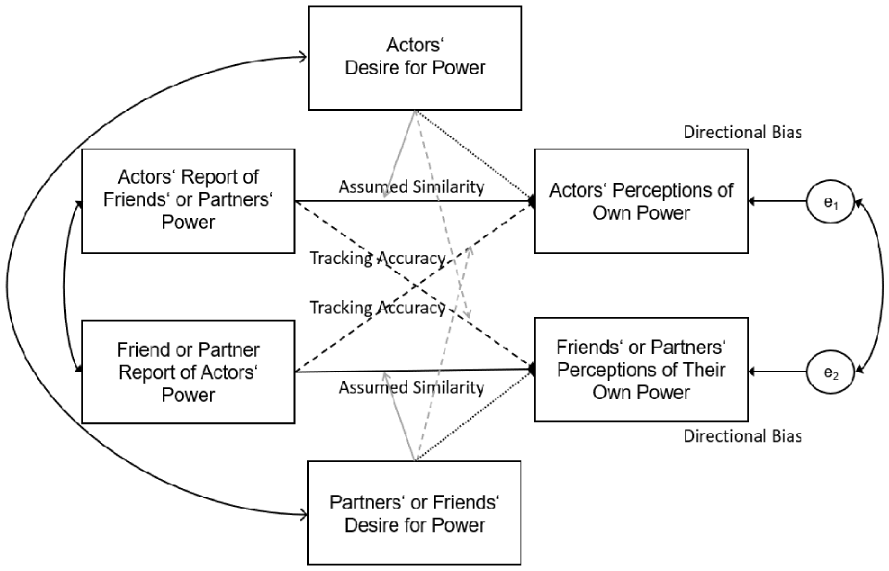
Model of truth and bias analyses using desire for power as an example of predictor.
As described in Study 1, all power variables (actors’ perceptions of their own power and partners’ reports of actor’s power) were grand-mean centered on the partners’ reports of actor’s power. The predictor variables were also grand-mean centered (including before computing interaction terms). As before, a significant negative intercept would indicate that actors, on average, were underestimating their power in the relationship. To test our hypothesized effects of the predictor variables on directional bias, we report the intercept at low (−1 SD) and high (+1 SD) levels of each predictor. In an exploratory fashion, we also report simple slope analyses for any significant interaction effects testing the effect of the predictor variables on tracking accuracy and assumed similarity.
We used the model fit restrictions that demonstrated superior fit based on likelihood ratio tests in the models in Study 1 that only assessed bias and accuracy without additional predictors or interaction terms. As friends are indistinguishable, we set all paths, means, intercepts, and (residual) variances equal across both friends in a dyad. In the couple samples, we set all paths equal across woman and men, but we did not constrain the means, intercepts, and (residual) variances (see Study 1). We used models in Mplus 8 using Maximum Likelihood estimation, and report bootstrapped 95% confidence intervals (k = 5,000 samples) for regression coefficients.
Results
Friendship Sample
The results for the friendship sample are presented in Table 6. As predicted, higher self-protection motives (i.e., lower trust) predicted people more strongly underestimating their power. Table 7 presents levels of directional bias at low versus high levels of self-protection motives. People with lower trust (high self-protection motives) showed significant underestimation of their power, whereas people with higher trust (low self-protection motives) did not. Against predictions, pro-relationship (commitment) and power motives (desire for power) did not significantly predict directional bias (Table 6). We present the conditional effects in Table 7 for completeness; despite non-significant differences, the pattern supported that greater pro-relationship motives reduced underestimation bias and greater power motives predicted significant underestimation bias.
Study 2 – Friendship Sample: Results of Truth and Bias Analyses Estimating Predictors of Directional Bias, Tracking Accuracy, and Assumed Similarity.
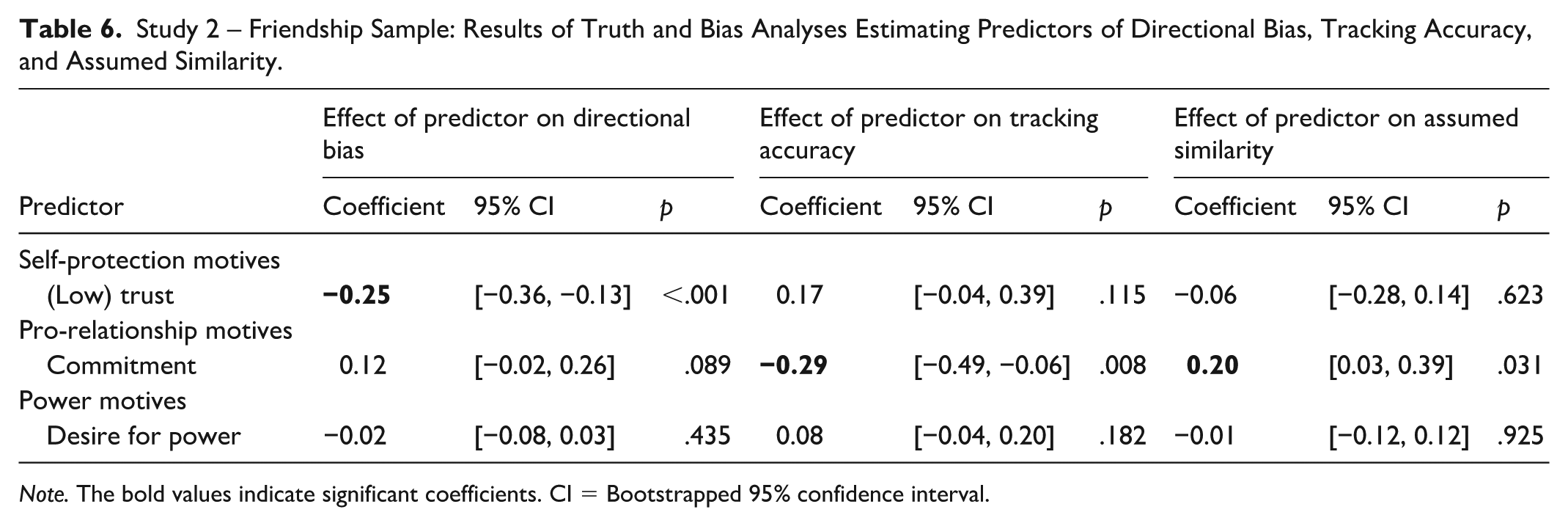
Note. The bold values indicate significant coefficients. CI = Bootstrapped 95% confidence interval.
Study 2 – Friendship Sample: Results of Truth and Bias Analyses Estimating Predictors of Directional Bias (Conditional Effects).
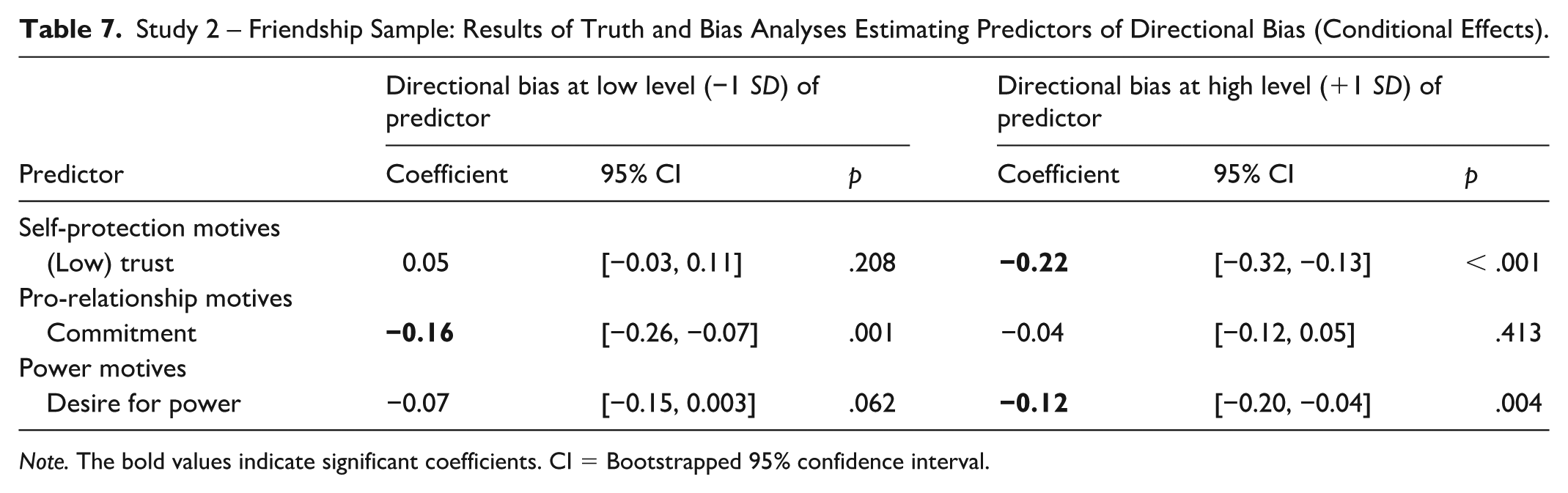
Note. The bold values indicate significant coefficients. CI = Bootstrapped 95% confidence interval.
Woman–Man Samples
The results for the woman–man samples are shown in Table 8. As expected, higher self-protection motives significantly predicted levels of directional bias for five of six variables: attachment anxiety in both samples, low self-esteem, and cognitive and emotional jealousy, but not behavioral jealousy. Table 9 presents the levels of directional bias at low versus high levels of self-protection motives for women and men. People with high self-protection motives showed significant underestimation bias, with two exceptions (men’s low self-esteem and women’s emotional jealousy). By contrast, people with low self-protection motives showed mostly no bias, or significantly overestimated their power in a few cases. The overall pattern, however, supports that greater self-protection motives amplify underestimation bias.
Study 2 – Woman–Man Couples: Results of Truth and Bias Analyses Estimating Relationship-Related Predictors of Directional Bias, Tracking Accuracy, and Assumed Similarity.
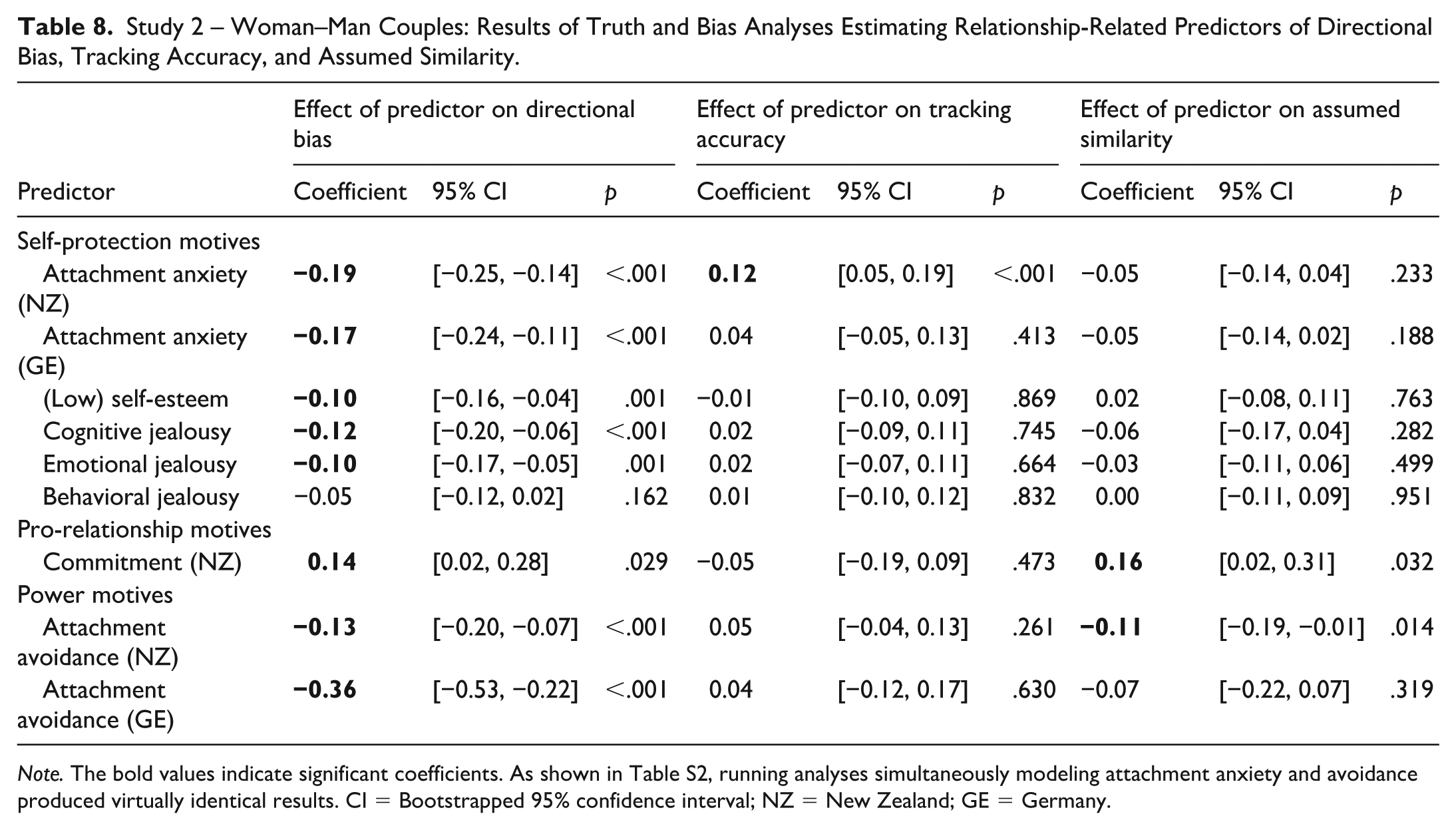
Note. The bold values indicate significant coefficients. As shown in Table S2, running analyses simultaneously modeling attachment anxiety and avoidance produced virtually identical results. CI = Bootstrapped 95% confidence interval; NZ = New Zealand; GE = Germany.
Study 2 – Woman–Man Couples: Results of Truth and Bias Analyses Estimating Relationship-Related Predictors of Directional Bias (Conditional Effects).
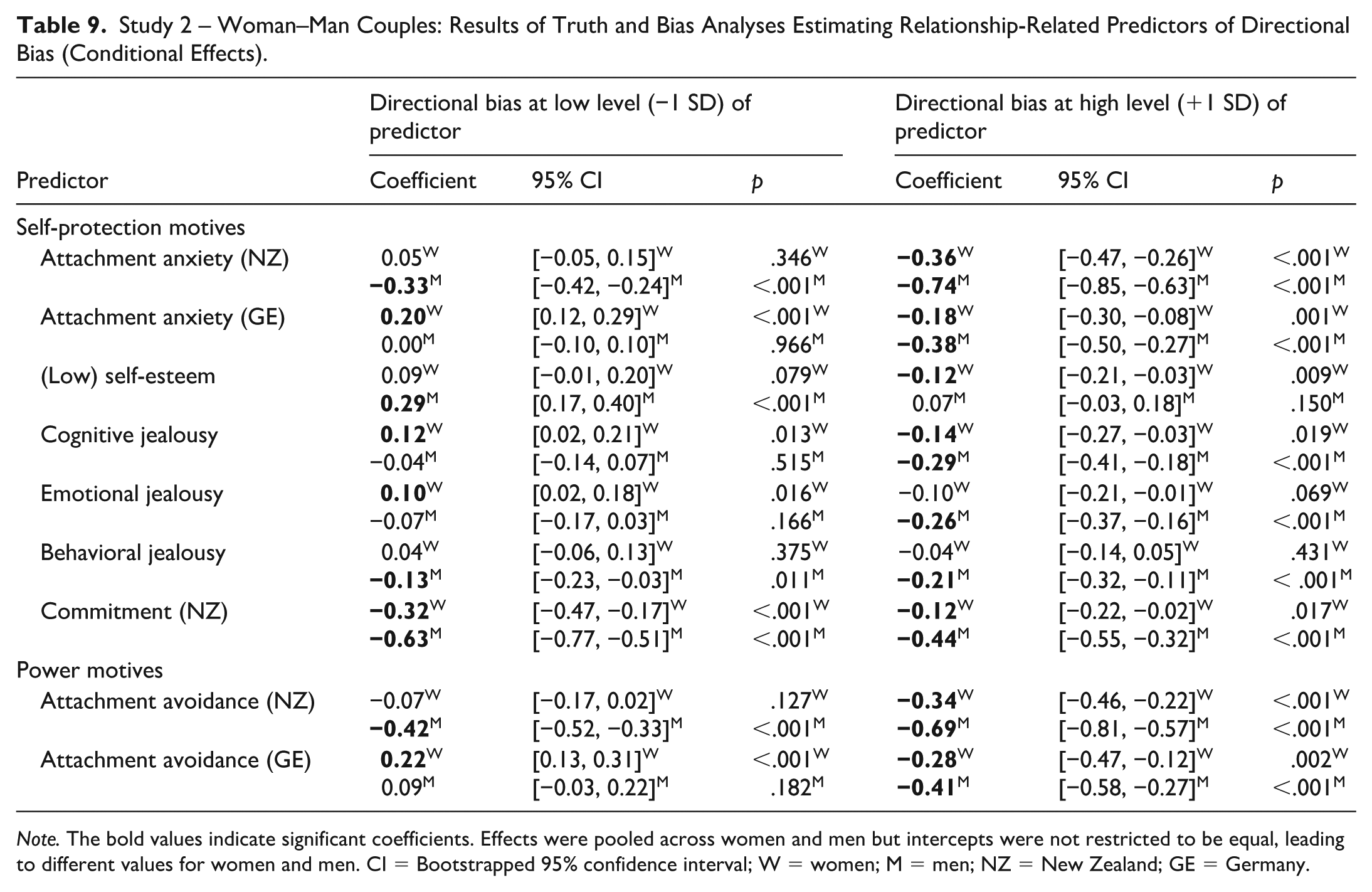
Note. The bold values indicate significant coefficients. Effects were pooled across women and men but intercepts were not restricted to be equal, leading to different values for women and men. CI = Bootstrapped 95% confidence interval; W = women; M = men; NZ = New Zealand; GE = Germany.
Higher pro-relationship motives (i.e., commitment) significantly predicted directional bias (Table 8). Both people high and low in commitment showed a significant underestimation bias but this bias was weaker at high levels of commitment (Table 9).
Our first analysis of power motives focused on attachment avoidance, which was assessed in both woman–man samples and captures desires for autonomy and control within relationships. As expected, attachment avoidance was significantly negatively associated with directional bias in both samples (Table 8). People high in attachment avoidance showed a significant underestimation of their own power compared to partner reports (Table 9).
Our second analysis of power motives focused on variables only assessed in one sample. As shown in Table 10, both greater desire for power and psychopathy significantly negatively predicted directional bias. People scoring higher in desire for power and psychopathy significantly underestimated their power, whereas people scoring lower on desire for power typically did not (Table 11). Dominance, Machiavellianism, and narcissism did not significantly predict directional bias (Table 10), with significant underestimation shown at high and low levels of these variables (with few exceptions; Table 11).
Study 2 – Woman–Man Couples: Results of Truth and Bias Analyses Estimating Broader Power Motives as Predictors of Directional Bias, Tracking Accuracy, and Assumed Similarity.
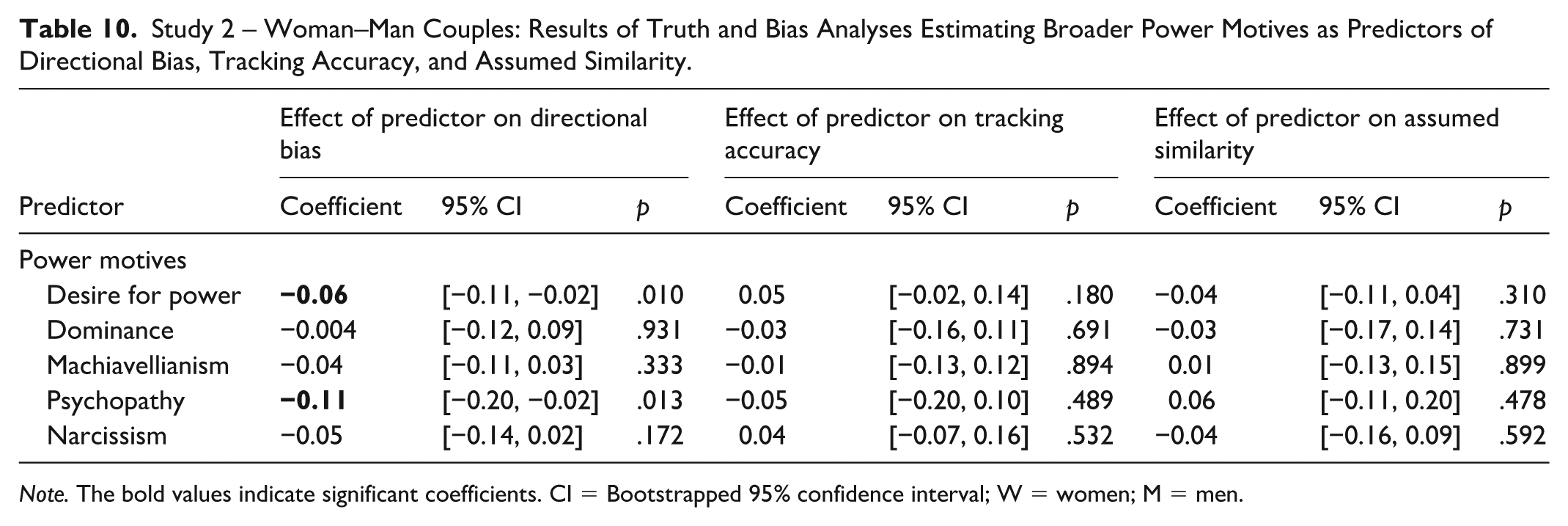
Note. The bold values indicate significant coefficients. CI = Bootstrapped 95% confidence interval; W = women; M = men.
Study 2 – Woman–Man Couples: Results of Truth and Bias Analyses Estimating Broader Power Motives as Predictors of Directional Bias (Conditional Effects).
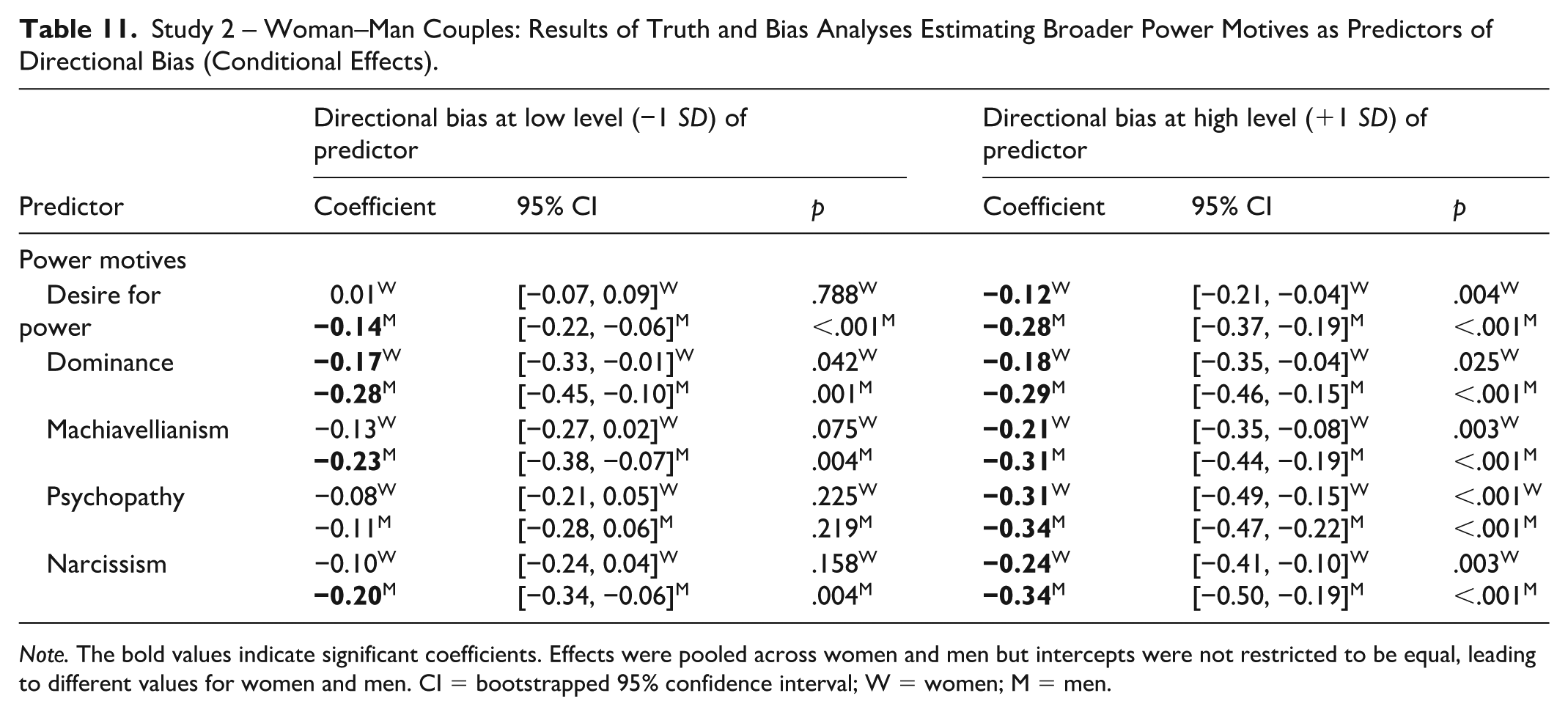
Note. The bold values indicate significant coefficients. Effects were pooled across women and men but intercepts were not restricted to be equal, leading to different values for women and men. CI = bootstrapped 95% confidence interval; W = women; M = men.
Exploratory Analyses
Across analyses, self-protection, pro-relationship, and power motives significantly predicted tracking accuracy in only 2 of 17 analyses and assumed similarity in only 3 of 17 analyses. Commitment showed the most consistent effects. First, in both the friendship and woman–man couple samples, commitment predicted levels of assumed similarity (Tables 6 and 8). Assumed similarity was weaker for people low (b = 0.41, p < .001, friendship; b = 0.18, p = .014, woman–man couples) compared to high (b = 0.63, p < .001; b = 0.42, p < .001, woman–man couples) in commitment. In the friendship sample, commitment also negatively predicted tracking accuracy (Table 6). Tracking accuracy was stronger for people low (b = 0.39, p < .001) compared to high (b = 0.08, p = .212) in commitment. Two further significant effects were found in the NZ woman–man sample (Table 8): Attachment anxiety significantly positively predicted tracking accuracy. Tracking accuracy was weaker for people low (b = 0.15, p = .002) compared to high (b = 0.41, p < .001) in anxiety. Attachment avoidance significantly negatively predicted assumed similarity. Assumed similarity was stronger for people low (b = 0.41, p < .001) compared to high (b = 0.18, p = .010) in avoidance.
Discussion
Overall, across friendship and couple samples, self-protection motives were associated with people more strongly underestimating their relationship power. Individuals high in attachment anxiety fear rejection and loss (Mikulincer & Shaver, 2003), people with low self-esteem doubt their value to others (Murray et al., 2006; Robins et al., 2001), and those prone to jealousy or have difficulty trusting others are also vigilant to relational threats (Pfeiffer & Wong, 1989). These sensitivities to relationship threats, and concerns about acceptance and unfulfilled needs, likely contribute to actors underestimating how much they can influence their partner (i.e., have power) to get what they need and desire in relationships (see Table 1). Thus, psychological dynamics rooted in fear, vulnerability, and dependence are likely why self-protection motives shape biased perceptions of power.
Greater pro-relationship motives (i.e., commitment) reduced actors’ underestimation of their power in couple relationships, but this pattern did not reach significance in friendships (p = .089). People who are more committed are less focused on prioritizing their own needs and goals, and more able to put aside their own desires to sustain their relationships. Thus, they should be less concerned about how much they can influence partners, and more oriented toward working together with their partner, reducing concerns and thus underestimation of their relationship power (see Table 1).
We also found evidence that people higher in power motives were more likely to underestimate their power, although the strongest effects emerged for attachment avoidance, desire for power, and psychopathy. People high in attachment avoidance prioritize control and autonomy in relationships, strive to limit their partner’s influence, and interpret their partner’s need for support or negative emotions as controlling or manipulative (Overall, 2019; Overall et al., 2015; Simpson et al., 2002). These concerns about sustaining control and power are likely why people high in attachment avoidance underestimated their power in both couple samples. Desiring more power also predicted greater underestimation bias in couples, but this effect was weaker in friendships. Together, these results support that people who prioritize control and desire power are likely overly reactive to inevitable constraints to relationship power, making them feel that they have less power than they actually do (also see Cross et al., 2019).
In one couple sample, we also tested broader individual differences related to power motives (see Table 1). Only psychopathy, and not dominance, Machiavellianism or narcissism, significantly predicted greater underestimation bias. Perhaps Machiavellianism and narcissism do not closely capture relationship-specific concerns and expectations that shape perceptions of power. Yet, psychopathy significantly predicted greater underestimation bias. Individuals high in psychopathy mistrust others and assume hostile intent (Patrick, 2018), which may lead them to perceive others as less able to influence. Psychopathy also reflects shallow affect and detachment (Patrick, 2018), which may impair the ability to successfully navigate close relationships, leading to lower perceived power.
Exploratory analyses examining whether self-protection, pro-relationship, and power motives predicted tracking accuracy and assumed similarity revealed only 5 of 34 effects were significant. The only effect that replicated in two samples involved pro-relationship motives: More committed people showed higher assumed similarity in friendships and woman–man couples. Combined with their weaker underestimation bias, these results suggest that people who value and prioritize maintaining relationships are less inclined to underestimate their power and instead perceive greater mutuality of power between themselves and their friend or partner. Overall, however, self-protection motives and power motives consistently predicted biased perceptions of power and did not reliably predict tracking accuracy or assumed similarity.
General Discussion
The present studies provide the first systematic analysis of the veracity of perceptions of power within close relationships and key relationship- and power-related variables that should shape bias in perceived power. As predicted, in dyadic samples of friends, same-gender couples, and woman–man couples, people underestimated the power they had in their relationships. However, the degree of this underestimation bias significantly varied across gender and a range of variables capturing self-protection, pro-relationship, and power motives. First, men showed greater underestimation bias in woman–man relationships compared to both women’s underestimation bias and men’s underestimation bias in friendships, consistent with gendered social expectations promoting greater concerns about holding and protecting power for men. Second, for both women and men, greater self-protection motives (greater attachment anxiety and jealousy, lower trust and self-esteem) and power motives (greater attachment avoidance, desire for power, psychopathology) amplified underestimation of power, whereas greater pro-relationship motives (greater commitment) reduced the tendency to underestimate power. These results offer the first detailed examination of bias in perceptions of power within different types of close relationships, indicate that biased perceptions of power help explain when and why self-, relationship-, and power-oriented motives produce destructive behaviors, and highlight new avenues for interventions and future research.
Theoretical Advances and Implications
People’s underestimation of their own power aligns with our expectations based on error management principles emphasizing that biases emerge in the direction that would likely minimize more costly errors (Haselton & Buss, 2000). Overestimating one’s power may prevent individuals from using strategies necessary to meet their needs, leaving them vulnerable to unmet needs and goals and potential exploitation. In contrast, underestimating power may lead to greater attempts to cooperate and influence partners when needed, which may incur less costs in terms of need fulfillment and sustaining close, interdependent relationships. If this theorizing is correct, individuals who believe they are at particular risk of not getting their needs met (self-protection motives) or who are particularly concerned about exploitation and prioritize power (power motives) should be most driven to avoid the costs that could emerge from overestimating power. Our results support these theoretical assumptions: individuals high in self-protection and power motives showed stronger underestimation bias than individuals low in self-protection and power motives.
Biases in perceptions of power have critical implications, given that perceived power determines behavior and relationship outcomes. For example, perceived power more strongly predicts relationship outcomes than objective sources of power (e.g., education, income; Körner & Schütz, 2021). This is because, as emphasized by most power theories, the behavioral and evaluative consequences of power stem from people’s perceived ability to influence rather than people’s actual influence or resources (Anderson et al., 2012; Keltner et al., 2003; Simpson et al., 2015). Although underestimating power may prevent the costs that could emerge from overestimating power (exploitation, failing to enact influence strategies), too much underestimation (as shown by people higher in self-protection or power motives) will have negative consequences, including greater inhibition, aggression, and poorer well-being (Keltner et al., 2003; Kifer et al., 2013; Körner & Schütz, 2021, 2025; Overall & Hammond, 2025). Thus, some of the negative correlates and consequences of low power may be mitigated by helping people see they have more relationship power than they think.
By showing that people high in self-protection and power motives are most likely to underestimate their power, the current findings also highlight that many of the responses associated with these variables likely reflect ways of managing a perceived lack of power. For example, people high in relationship insecurities and ensuing self-protection motives (see Table 1) are more likely to inhibit their negative thoughts and feelings (Righetti et al., 2015; Thomson et al., 2018) likely because their rejection fears and low trust make them feel they lack power and control in their relationships (Overall, 2019). Similarly, insecure people with high self-protection motives engage in excessive reassurance seeking and manipulation (e.g., guilt induction) to get their partner to address their needs (Overall et al., 2014; Shaver et al., 2005), likely because they feel unable to influence their partner in more constructive and effective ways (Overall, 2019). Thus, biased perceptions of power are likely central to these established outcomes, offering new avenues to integrate and advance why and how self-protection motives and perceived power shape relationships.
The behavioral responses of individuals high in power motives, such as those high in attachment avoidance, desire for power, and psychopathy, are also likely due to the biased perceptions of power shown in the current studies. People high in attachment avoidance, for example, commonly disengage and withdraw from their partners as a way of protecting their autonomy and control (Körner, Overall, et al., 2025; Overall, 2019). The current findings indicate that this power-protecting behavior is likely to stem from underestimating the influence they actually have in their relationships. Similarly, people higher in desire for power and psychopathy are likely to be more aggressive (Cross et al., 2019; Hyatt et al., 2019; Verona et al., 2023). However, rather than reflecting the possession of power, aggression is a common way people low in power try to restore or fight for power (Overall et al., 2016). Thus, biased perception of low power is likely a key explanatory variable of many risk factors of aggression: people who are motivated to attain and protect their power are likely to feel their influence is more constrained, prompting aggressive attempts to exert or regain power (also see Overall & Hammond, 2025).
Average levels, but not predictors, of directional bias also varied by gender: men were more likely to underestimate their power than women in woman–man relationships and men and women in friendships. Men’s greater underestimation bias may reflect traditional expectations that men should possess and demonstrate power, which makes men particularly vigilant and responsive to threats to power (Bosson & Vandello, 2011). Although these masculinity-related motives are relevant across relational contexts, our findings suggest that they are likely especially salient in heterosexual romantic relationships. In woman–man relationships, strong dependence on women may be particularly threatening to expectations that men should possess and demonstrate power (Overall & Hammond, 2025). For example, men who view women as competing for men’s power are more likely to underestimate the power they have in their relationship and, in turn, behave aggressively toward their partner (Cross et al., 2019). These results emphasize the importance of considering how gendered expectations shape perceived power, and again highlight that biased perceptions likely play a central role in explaining why key variables (i.e., gender and power-relevant motives) relate to destructive behavior in close relationships.
Finally, these findings and implications offer important practical insights. Recognizing that people high in self-protection and power motives systematically underestimate their power may help tailor interventions to reduce destructive relationship behavior (Jenks et al., 2024). In particular, effective interventions could help people realize they have more influence in their relationships than they believe as well as develop more constructive strategies to get their needs fulfilled. Reducing biased perceptions of power, and providing more effective avenues to manage needs in relationships, should reduce the myriad of destructive responses (e.g., inhibition, manipulation, withdrawal, aggression) that can arise from low power and enhance well-being for individuals and their partners or friends.
Strengths, Caveats, and Future Research Directions
The current studies had many strengths. The presence and predictors of underestimation bias largely replicated across four samples incorporating 1,304 dyads in different types of close relationships (friendships, same-gender couples, woman–man couples), across two countries (Germany, NZ). The studies also offered a detailed account of bias in perceived power by examining thirteen predictors targeting broader categories (self-protection motives, pro-relationship motives, power motives) that align with theoretical processes relevant to error management principles. The findings, and our evaluation above, also highlight valuable directions for future research, including examining how biased perceptions of power link insecurities and motives to a range of important power-relevant behaviors.
Future research could further detail the factors that shape bias in perceived power. We illustrated bias in people’s general perceptions of power using a widely-used measure that has been applied across a range of relationship contexts (Anderson et al., 2012; Körner, Overbeck, et al., 2025). General assessments of power play an important role in guiding behavior across situations. For example, although power can vary across specific domains (e.g., finances, relationship issues, sex in romantic relationships), reports of general relationship power highly correlate with reports of domain-specific power and as strongly predict behavior within specific domains (Farrell et al., 2015). It is possible, however, that levels of bias might vary across domains, potentially being stronger in domains of greater relational and personal consequence. Self-protection or power motives also may have stronger amplifying effects in domains or contexts that threaten people’s relationships or power.
Future research should examine these contextual effects, which will advance understanding of the predictors of bias. The results were consistent across self-protection motives, but were mixed for variables we proposed involved power motives. One of the strongest predictors in the power motives category was attachment avoidance, which involves strong desires to minimize dependence and sustain control in intimate relationships (see Table 1). However, attachment avoidance may capture a blend of motives given it is a form of attachment insecurity and that minimizing dependence involves limiting commitment and investment in relationships (i.e., low pro-relationship motives; Mikulincer & Shaver, 2003). Nonetheless, desire for power and psychopathy also predicted greater underestimation bias supporting the theorized role of power motives. Perhaps traits that did not significantly predict bias (e.g., narcissism, Machiavellianism) are not tightly linked to concerns about losing power in close relationships, or such concerns are counterbalanced by self-oriented illusions that they have or can yield control. Other individual differences, more focused on relational power (e.g., Authoritarianism, hostile sexism), may more closely capture motives for autonomy, control, and power in relationships. Finally, it also is possible that self-protection motives played a stronger role than power motives because needs and motives within interdependent contexts are intricately linked to sustaining relationships. In other contexts that involve less desire to sustain closeness, power motives may be more relevant. Indeed, our conclusions are restricted to close relationships and cannot be generalized to more hierarchical, work-based relationships or relationships within different cultural contexts.
Future research should investigate whether people also show underestimation of their power at work, particularly given the widely studied consequences of power in this context (Fast & Overbeck, 2022). Unlike highly interdependent couples and friends, the degree and direction of bias may vary depending on power-relevant roles. People in low-power positions (subordinates, employees) may need to track their relative influence more than people in high-power positions (managers, employers) and thus be more prone to bias. On the other hand, high-power positions may amplify vigilance by increasing the costs of overestimating power (e.g., missing defection, lack of influence, being undermined). These potential processes and biases will also be shaped by important motives (e.g., dominance, prestige; Fast & Overbeck, 2022), and as emphasized by our discussion, biased perceptions likely help explain why these motives shape different responses within work-based relationships.
Finally, future studies should examine the role of culture. The way power is experienced and responded to likely varies in collectivistic compared to individualistic cultures as represented by our samples (Torelli et al., 2020). For example, modesty, deference, and relational harmony are emphasized more in collectivistic cultures, which may mean people are more likely to downplay their influence and underestimate their power, and/or pro-relationship motives may be even more influential than power motives. Moreover, although we examined biases in different relationship contexts, replicating the results within additional same-gender samples that are larger, more representative, and include predictor measures of bias would test the generalizability of the findings in Study 2 and strengthen our conclusions.
Conclusion
Perceptions of power are systematically biased. Across friendships and romantic relationships, people tended to underestimate the influence they had on their friends and partners. This underestimation bias was stronger for people with higher self-protection motives or power motives, and weaker for those higher in pro-relationship motives. These findings enrich understanding of how power is perceived in close interpersonal contexts. The results also indicate that biased perceptions of power may explain various destructive behaviors that arise from self-protection and power motives, and suggest that the negative implications of low power may be overcome by helping people to see the influence people do have over their friends and partners.
Supplemental Material
sj-docx-1-psp-10.1177_01461672251409849 – Supplemental material for Bias in Perceptions of Power in Close Relationships: The Role of Self-Protection, Pro-Relationship, and Power Motives
Supplemental material, sj-docx-1-psp-10.1177_01461672251409849 for Bias in Perceptions of Power in Close Relationships: The Role of Self-Protection, Pro-Relationship, and Power Motives by Robert Körner and Nickola C. Overall in Personality and Social Psychology Bulletin
Footnotes
Ethical Considerations
All procedures performed in studies involving human participants were in accordance with the ethical standards of the national research committee and with the 1964 Helsinki declaration and its later amendments or comparable ethical standards. This article does not contain any studies with animals performed by any of the authors.
Consent to Participate
Informed consent was obtained from all participants who were included in the study.
Funding
The authors received no financial support for the research, authorship, and/or publication of this article.
Declaration of Conflicting Interests
The authors declared no potential conflicts of interest with respect to the research, authorship, and/or publication of this article.
Data Availability Statement
The studies were preregistered (https://aspredicted.org/g9qc-g7g3.pdf, https://aspredicted.org/jg6b-4typ.pdf, https://aspredicted.org/8gbz-sdjg.pdf, https://aspredicted.org/7rdb-cw3d.pdf, https://osf.io/cr894). Data, materials, and syntax are available online ( ).
).
Supplemental Material
Supplemental material is available online with this article.
References
Supplementary Material
Please find the following supplemental material available below.
For Open Access articles published under a Creative Commons License, all supplemental material carries the same license as the article it is associated with.
For non-Open Access articles published, all supplemental material carries a non-exclusive license, and permission requests for re-use of supplemental material or any part of supplemental material shall be sent directly to the copyright owner as specified in the copyright notice associated with the article.
