




Abstract
How do people whose beliefs conflict with the scientific consensus respond to two-sided messages that communicate both the belief-challenging consensus and isolated belief-affirming findings? Across three experiments (Ntotal = 1,124), we gave homeopathy supporters belief-challenging and belief-affirming information in varying orders. In Studies 1 and 2, we measured perceived trustworthiness of homeopathy-related science between both pieces of information. Compared with participants who received belief-challenging information first, participants who received belief-affirming information first reported higher trust in homeopathy-related science after the first information and were more likely to report believing that homeopathy is not effective after both pieces of information. Study 3 showed that the order effect on reported belief in the effectiveness of homeopathy did not occur without the interim measurement of perceived trustworthiness. This pattern is consistent with a consistency effect due to the interim measurement. Overall, two-sided messages did not outperform one-sided messages regarding changes in reported beliefs.
Introduction
In many domains of contested science, a clear scientific consensus exists. For instance, scientific evidence clearly shows that human-caused climate change is happening (Calvin et al., 2023), that COVID-19 vaccines are safe and effective (Soheili et al., 2023), and that homeopathy is no more effective than placebo treatments (NHMRC, 2015). Nonetheless, significant proportions of the public deny human-caused climate change (Gounaridis & Newell, 2024), doubt the safety and efficacy of vaccinations (Steinert et al., 2022), and/or rely on homeopathic treatments (IfD Allensbach, 2023; Mukerji & Ernst, 2022).
Even though the scientific consensus is clear in these domains, individual studies with deviating results are regularly published. For example, studies that claim to find evidence in favor of the effectiveness of homeopathy are easy to find (Maisel-Lotan et al., 2019; Oberbaum et al., 2001). Such studies are frequently put forward by homeopathy supporters to justify continued reliance on homeopathy. They also pose a challenge to scientists and others interested in communicating the evidence base in a transparent manner: If one presents the scientific consensus one-sidedly, opponents will be quick to put forward these deviating studies – and one runs the risk of appearing like one tried to conceal them. However, if one acknowledges the existence of such deviating studies, the consensus may appear less convincing, particularly to people motivated to dismiss it.
This raises the question of how scientific consensus on the one hand, and individual deviating studies on the other, can be communicated to skeptic audiences in a way that facilitates belief revision. We investigate this question in the context of homeopathy. Specifically, we suggest that the order in which belief-affirming (here: individual studies that support the effectiveness of homeopathy) and belief-challenging information (here: the scientific consensus showing that homeopathy is no more effective than placebo) are presented can influence self-reported belief revision in line with the scientific consensus.
Insights From Research on Two-Sided Persuasive Messages
Two-sided messages are a classical topic in the persuasion literature (Crowley & Hoyer, 1994; Eisend, 2006; Rosnow, 1968). One-sided messages present only arguments in favor of the advocated position, whereas two-sided messages also present some arguments in favor of the opposing side. Early research on this topic argued that, on the one hand, presenting opposing arguments might be detrimental to persuasion because these arguments might raise doubt in the audience’s mind. On the other hand, presenting both sides of an argument is fairer, and the audience might already be (or later become) aware of the opposing arguments anyway (Hovland et al., 1949). In the context of the U.S. war against Japan, Hovland et al. (1949) observed that one-sided messages were more convincing to participants who already agreed with the advocated position. Yet participants initially opposed to the advocated position were more convinced by a two-sided message.
Later research from advertising contexts confirmed that two-sided ads have a number of beneficial effects compared to their one-sided counterparts: They result in greater perceived novelty, greater perceived source credibility, less negative cognitive responses, more positive brand attitudes, and greater purchase intentions (Ein-Gar et al., 2012; Eisend, 2006).
An important factor moderating the effectiveness of two-sided (vs. one-sided) messages is whether they are refutational or not – that is, whether the opposing arguments are explicitly refuted or merely mentioned without being addressed. Specifically, refutational two-sided messages are typically more effective than one-sided ones, whereas non-refutational two-sided messages are sometimes less effective than their one-sided counterparts (Allen, 1991; Allen et al., 1990; O’Keefe, 1999). Refutation appears to be particularly important if the opposing arguments in a two-sided message concern attributes that are perceived as important (Crowley & Hoyer, 1994). In addition, two-sided (vs. one-sided) messages appear to be particularly beneficial when the trustworthiness of the communicator is questionable (Hovland et al., 1953).
Recently, Xu and Petty (2022, 2024a, 2024b) published a series of studies on two-sided messages aimed at influencing morally-based or otherwise strongly-held attitudes. They argued that two-sided messages that acknowledge the recipient’s position are more effective than one-sided ones at increasing openness to opposing views, particularly among people with strong attitudes. Notably, these effects were not observed for attitude change, but only for self-reported openness to opposing views, which the authors conceive as an important precursor to attitude change. Nonetheless, the long line of research on two-sided messages suggests that acknowledging individual studies that deviate from scientific consensus need not be detrimental to persuasion and can sometimes even be beneficial compared to a one-sided presentation of the scientific consensus.
Order Effects in Two-Sided Persuasive Messages
One question that naturally arises in the context of two-sided messages concerns potential order effects: Should the arguments in favor of the advocated position (in our case, the scientific consensus) be placed in front or after the arguments acknowledging the opposing side (in our case, the individual deviating studies)? Research on such message order effects dates back at least as far as Lund (1925), who postulated a “law of primacy in persuasion”: He observed that arguments that were encountered first had a greater impact on participants’ final position than arguments that were presented later in the communication. Relatedly, Asch (1946) found that the first piece of information presented in a sequence was particularly influential: A person described as intelligent – tall – mean was perceived more positively than a person described as mean – tall – intelligent.
Subsequent research challenged the idea that primacy effects are the only type of order effect in persuasion. Instead, recency effects were also frequently observed (Hovland, 1957). In the following decades, researchers identified several factors that facilitate the emergence of recency rather than primacy effects, among them a greater temporal distance between the messages (Miller & Campbell, 1959), the extent of message elaboration (Haugtvedt & Wegener, 1994), and, most relevant for the current purposes, the mode in which the messages are processed (Hogarth & Einhorn, 1992).
Hogarth and Einhorn (1992) propose an anchor-and-adjustment model aimed at predicting under which conditions primacy versus recency effects occur. They propose that the impact of a piece of information depends on the “anchor” that precedes it: the more room for change in the direction of the information, the greater the impact of this information. Applied to our setup, belief-challenging information should have a greater impact if it is preceded by belief-affirming information because this belief-affirming information should strengthen participants’ belief in the effectiveness of homeopathy. This results in an anchor with more room for change in the direction of the belief-challenging information (i.e., a strengthened belief in the effectiveness of homeopathy).
Hogarth and Einhorn further differentiate two ways in which a two-sided message may be processed: step-by-step, whereby participants update their belief after each successive piece of information, or in an end-of-sequence mode, whereby a single judgment is formed once all information has been presented. When a two-sided message is processed step-by-step and belief-affirming information is presented first, the model predicts a recency effect. This is because the initial affirming evidence shifts the participants’ position (their anchor) “upward,” in line with the affirming evidence. When belief-challenging evidence is presented next, this evidence is preceded by a higher anchor (e.g., a stronger belief in the effectiveness of homeopathy) and thereby, there is more room for change in the direction of the belief-challenging information compared to when this information is presented first. This combination of step-by-step processing and ordering produces the predicted recency effect.
A few contemporary studies have examined order effects in two-sided messages. One such study has found evidence consistent with a recency effect: Wang and Huang (2024) found that a belief-challenging information about in-person classes during the pandemic was more effective at generating message-consistent belief change when a message affirming participants’ views was delivered first, compared to the reversed sequence where the message challenging participants’ views was presented first. Related results were obtained in an advertising context by Igou and Bless (2003, 2007).
However, other research has found evidence for an order effect in the reversed direction: In particular, Xu and Petty (2024a) noted that the benefit of two-sided (vs. one-sided) messages increased when the acknowledgment of the recipient’s position (the argument against the advocated position) was placed at the end (vs. at the front) of the message.
In summary, prior research has shown that both primacy and recency effects occur in two-sided persuasive messages. A number of moderators that influence such order effects have already been identified (i.e., temporal delay, message elaboration, processing mode). Here, we propose an additional factor that can be expected to influence order effects in such contexts: people’s motivation to behave consistently.
Combining Order and Consistency Effects in Two-Sided Messages
When people notice an inconsistency between two or more cognitive elements (e.g., beliefs, attitudes, behaviors), they experience discomfort and strive to resolve the inconsistency (Festinger, 1962; Gawronski & Brannon, 2019). A well-established approach in psychological science involves strategically inducing such inconsistencies to facilitate attitude and behavior change (for a review, see McGrath, 2017). Here, we suggest that consistency effects might interact with the order in which belief-affirming and belief-challenging information are presented.
Similar lines of reasoning can be found in early research on two-sided persuasive messages. Specifically, Hovland et al. (1957) argued: “Social psychological factors of commitment could be said to interact with the problem of order of presentation, since there may be a tendency in many primacy-recency situations to respond with a committing type of action after hearing only one side of an issue” (p. 8).
Imagine a homeopathy supporter who is initially presented an information about individual studies in favor of homeopathy’s effectiveness. This person will likely feel a pleasant sense of affirmation and hold relatively favorable views of homeopathy-related science in that instance (Kunda, 1990; Lord et al., 1979; Nauroth et al., 2015). If asked at that moment to evaluate the trustworthiness of homeopathy-related science, they would likely provide a positive evaluation. Now imagine that same person being confronted with the belief-challenging scientific consensus in the next step: Having just declared that homeopathy-related science is relatively trustworthy, they now face the fact that this domain of science actually disconfirms their belief in homeopathy’s effectiveness. Although the individual may be motivated to dismiss this consensus in order to preserve their belief in the effectiveness of homeopathy, doing so would be inconsistent with their earlier expression of trust in homeopathy-related science. One evident way to maintain consistency would be to revise their response regarding the effectiveness of homeopathy.
Had the same information been presented in the reversed order (starting out with the belief-challenging scientific consensus), no consistency effects favoring self-reported belief revision would emerge. In fact, a homeopathy supporter being confronted first with the scientific consensus may find it relatively easy to dismiss this belief-challenging information by declaring homeopathy-related science as untrustworthy (see, e.g., Gershman, 2019; Munro, 2010 for discussions on ad-hoc reasoning in the face of disconfirmation).
This idea is related to the hypocrisy paradigm, which has been applied to induce behavior change across a variety of contexts (for a review, see Stone & Fernandez, 2008). In this paradigm, participants are first asked to publicly advocate for a target behavior (e.g., a healthy diet). Subsequently, they are prompted to think about instances where they “failed to practice what they preached.” The realization that one has behaved inconsistently with the behavior promoted earlier elicits discomfort and motivates behavior change in line with the advocated behavior. Analogously, we expect that an initial expression of trust toward homeopathy-related science should prompt consistency motives that facilitate self-reported belief revision in line with the scientific consensus.
The Present Research
There are many science domains where unequivocal scientific consensus exists, yet individual deviating studies are usually also available. In such situations, communicators may want to acknowledge the existence of these deviating studies while still encouraging belief revision in line with the scientific consensus. How can this be achieved most effectively? Drawing on research on two-sided messages, order effects, and cognitive consistency, we suggest that presenting belief-affirming information before the belief-challenging consensus facilitates self-reported belief revision when strategically combined with consistency effects. Specifically, homeopathy supporters who receive belief-affirming information first should express greater trust in homeopathy-related science after the first information compared to those who receive the belief-challenging consensus first. This early expression of trust should prompt a motivation to behave consistently when the belief-challenging scientific consensus is encountered next. In combination, this sequence should result in more frequent cases of self-reported belief revision than the reversed order.
This idea is inspired by the long line of research using consistency effects to motivate attitude and behavior change (Stone & Fernandez, 2008). It is also consistent with the sequential belief-updating model proposed by Hogarth and Einhorn (1992): By asking participants to express their attitudes toward science in between both pieces of information, we encourage a step-by-step processing mode. This should favor a recency effect that increases the impact of the information presented last – in case where the belief-affirming studies are presented first, the scientific consensus.
Across three experiments, we presented homeopathy supporters with two pieces of information in different orders. These pieces of information varied in terms of (a) whether they were belief-affirming versus -challenging and (b) whether they referred to individual studies versus the scientific consensus. We paired these qualities in order to avoid deceiving participants about the actual state of the evidence about homeopathy: The belief-affirming information referred to individual studies, whereas the belief-challenging information referred to the scientific consensus. In addition, we measured perceived trustworthiness of homeopathy-related science (and additional attitudes toward science) after both pieces of information. Studies 1 and 2 compared these two conditions (belief-affirming-studies-first and belief-challenging-consensus-first) with each other and a no-information control group. Study 3 conducted a preregistered replication, explored message order effects in the absence of the interim measurement of perceived trustworthiness (the consistency manipulation), and compared the two-sided messages with a one-sided message presenting only the scientific consensus. All data, materials, and analysis code are available on OSF: https://osf.io/z7y4x.
Studies 1 and 2
Method
Participants
Study 1
Participants were 286 Prolific users who reported to believe in the effectiveness of homeopathy at baseline (120 female, 159 male, 5 diverse, 2 missing values). Participants were eligible for the survey if they resided in Germany and spoke German fluently. The mean age was 29.04 years (SD = 8.66). The sample was highly educated: n = 137 had a university degree, n = 114 a high school degree (“Abitur”), n = 29 a higher secondary degree (“Realschule”), n = 3 a lower secondary degree (“Hauptschule”), n = 1 had no degree, and n = 2 did not report their highest level of education.
Study 2
Participants were recruited by the Loopster Panel. We included participants who indicated to believe in the effectiveness of homeopathy at baseline and passed an attention check (“This is a test item.” Please indicate “strongly agree”). We also excluded the data of n = 3 participants who stated that they did not participate seriously at the end of the survey. The final sample consisted of N = 322 participants (185 female, 137 male). The mean age was 53.19 years old (SD = 15.08). In terms of education, n = 92 had a university degree, n = 63 a high school degree (“Abitur”), n = 130 a higher secondary degree (“Realschule”), and n = 37 a lower secondary degree (“Hauptschule”).
Procedure
Studies 1 and 2 followed the same procedure. After a short introduction to placebo effects, participants reported their baseline beliefs about the effectiveness of homeopathy beyond placebo. We included only those participants who stated to believe in the effectiveness of homeopathy at baseline into our analyses. In Study 1, participants who stated not to believe in the effectiveness of homeopathy were directed to a different survey; participants who responded “don’t know” were retained for exploratory purposes (see Supplemental Material). In Study 2, participants who stated not to believe in the effectiveness of homeopathy or responded “don’t know” were filtered out.
Next, participants were randomly assigned to one of three conditions: belief-affirming-studies-first, belief-challenging-consensus-first, and control (see Figure 1 for an overview). In the belief-affirming-studies-first condition, participants first read about some individual studies finding evidence in favor of homeopathy before reading about the scientific consensus regarding homeopathy: Namely that, when considering the available evidence in its entirety, it becomes clear that homeopathy is no more effective than placebo (see Appendix for full texts; participants were only able to proceed after passing a short comprehension check for each text). Following each informational text, they rated the trustworthiness of homeopathy-related science, the suitability of the scientific method to investigate homeopathy, and the trustworthiness of science in general (in Study 2: additionally, the perceived competence and honesty of scientists researching homeopathy). This was thought to induce the expected consistency effects: Having just read belief-affirming scientific evidence in favor of homeopathy, participants in the belief-affirming-studies-first condition were expected to initially express more favorable attitudes toward homeopathy-related science. A motivation to behave consistently when the belief-challenging scientific consensus was encountered next should facilitate belief revision. The belief-challenging-consensus-first condition followed the same procedure in the reversed order. Instead of the informational texts, participants in the control group answered unrelated filler items about gender discrimination and meritocracy principles.
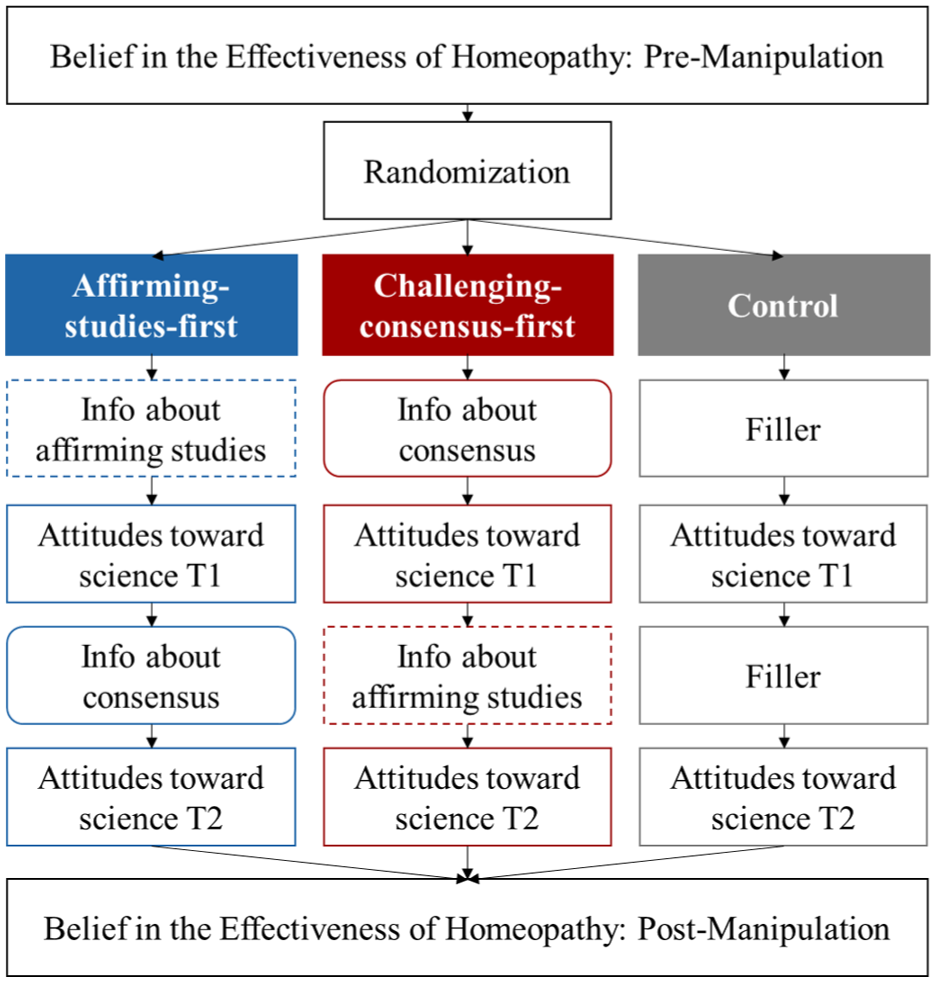
Overview of experimental design in studies 1 and 2.
Measures
Belief in the Effectiveness of Homeopathy
In both studies, participants chose one of three statements that best represented their opinion about homeopathy pre- and post-manipulation (self-developed measure): (a) That homeopathy is effective beyond the placebo effect for mild to moderate diseases (e.g., cold, flu, migraine), (b) that homeopathy is not effective beyond the placebo effect for mild to moderate diseases, or (c) that they had no idea whether homeopathy is effective beyond the placebo for such diseases. The main outcome of interest is this categorical self-reported belief post-manipulation.
Perceived Trustworthiness of Homeopathy-Related Science
The main purpose of these measures was to induce the expected consistency effects. After both pieces of information, participants evaluated the trustworthiness of homeopathy-related science with regard to several adjective pairs (on 7-point scales, self-developed). In Study 1, these were: unreliable – reliable and untrustworthy – trustworthy (rT1 = .75, rT2 = .80). In Study 2, an additional adjective pair was included: questionable – convincing (αT1 = .95, αT2 = .95). Other attitude toward science measures were also assessed after both pieces of information, namely the perceived trustworthiness of science in general and the perceived unsuitability of the scientific method to investigate homeopathy (both studies) and the perceived competence and honesty of scientists researching homeopathy (Study 2 only). We focus on the perceived trustworthiness of homeopathy-related science here because we deem this measure most relevant for the question at hand: How participants evaluate the trustworthiness of homeopathy-related science in its entirety should be most relevant for whether they are convinced by the scientific consensus or not. The remaining measures were included for exploratory purposes and to strengthen the consistency manipulation by having participants reflect more extensively on their attitudes toward science. Details on the remaining measures are provided in the Supplemental Material.
Results
We conducted all analyses using R (R Core Team, 2023) in RStudio (Posit Team, 2025). We relied mostly on the tidyverse collection of R packages (Wickham et al., 2019), psych (Revelle, 2007), nnet (Venables & Ripley, 2002), and the marginaleffects package (Arel-Bundock et al., 2024).
Perceived Trustworthiness of Homeopathy-Related Science
We begin by briefly describing patterns of responses to the repeated measures of perceived trustworthiness of homeopathy-related science (see Supplemental Material for further details). Recall that the main purpose of this measure was to induce consistency effects that were thought to facilitate self-reported belief revision in the belief-affirming-studies-first condition. In both studies, perceived trustworthiness was highest in the belief-affirming-studies-first condition following the first information (in this case, the belief-affirming single studies in favor of homeopathy): M (SD)Study 1 = 5.35 (1.12), M (SD)Study 2 = 5.63 (1.17). Importantly, after the first information, perceived trustworthiness scores in the belief-affirming-studies-first were significantly higher than in the belief-challenging-consensus-first condition (M [SD]Study 1 = 4.81 [1.37], M [SD]Study 2 = 4.81 [1.60]) in both studies in two-sided Welch’s t-tests: Study 1: t (173.44) = 2.87, p = .005; Study 2: t (182.79) = 4.21, p < .001. This indicates that our experimental procedure successfully induced participants in this condition to initially express relatively high trust toward homeopathy-related science.
Following the second piece of information, perceived trustworthiness scores in the belief-affirming-studies-first condition (Study 1: M [SD] = 4.93 [1.53]; Study 2: M [SD] = 5.07 [1.40]) were no longer significantly different from the belief-challenging-consensus-first condition (Study 1: M [SD] = 4.87 (1.22), t (171.47) = 0.29, p = .769; Study 2: M [SD] = 5.19 [1.33], t (205.98) = −0.67, p = .506). This indicates that not everyone in the belief-affirming-studies-first condition remained consistent in their evaluation of homeopathy-related science following the presentation of the belief-challenging consensus – at least some participants appear to have adjusted their initial trustworthiness evaluation downward. A graphical exploration of the data suggested that those participants in the belief-affirming-studies-first condition who revised their self-reported belief regarding the effectiveness of homeopathy (i.e., responded “disbelief” post-manipulation) were more likely to remain stable in their evaluation of trustworthiness, whereas those who did not revise their belief in the effectiveness of homeopathy later “downgraded” the trustworthiness of homeopathy-related science (see Supplemental Material for details).
Reported Belief in the Effectiveness of Homeopathy
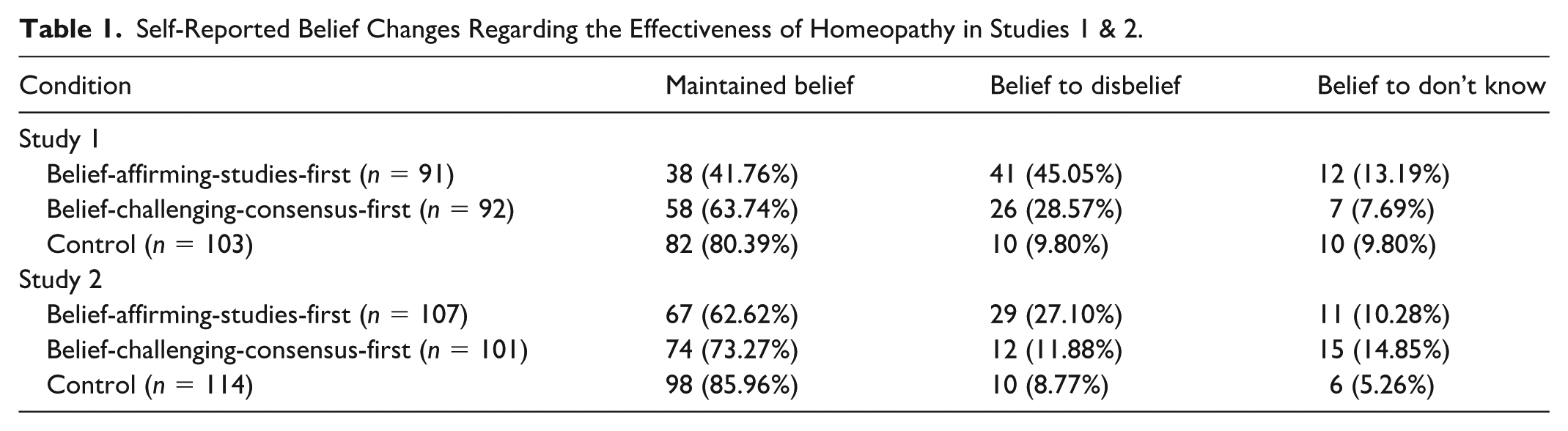
Table 1 shows observed frequencies of “belief,” “disbelief,” and “don’t know” responses regarding the effectiveness of homeopathy post-manipulation. It can be seen that the belief-affirming-studies-first condition resulted in the most frequent cases of self-reported belief revision, followed by the belief-challenging-consensus-first condition. To analyze differences in these observed frequencies between conditions, we first fit a multinomial regression model using condition (control, belief-affirming-studies-first, belief-challenging-consensus-first) as a predictor. On the basis of this model, we then calculated differences in predicted probabilities for each response category (belief, disbelief, don’t know) using the marginaleffects package (Arel-Bundock et al., 2024). We focus on differences in these predicted probabilities because they can be interpreted more intuitively than differences in log-odds or odds ratios.
Self-Reported Belief Changes Regarding the Effectiveness of Homeopathy in Studies 1 & 2.
Study 1
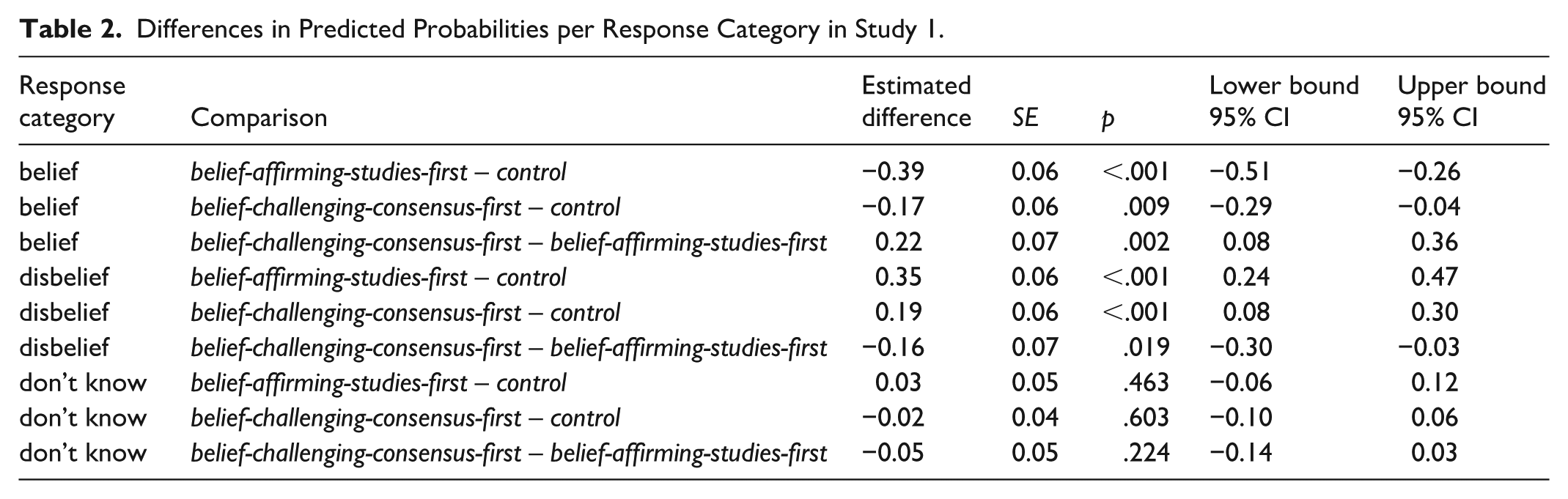
Figure 2 (top) displays predicted probabilities per response category for all conditions in Study 1. Compared to the control condition, participants in the belief-affirming-studies-first condition had a 39% lower probability of responding “belief” post-manipulation and a 35% higher probability of responding “disbelief” (see Table 2). Compared to the control condition, participants in the belief-challenging-consensus-first condition had a 16% lower probability of responding “belief” and a 19% higher probability of responding “disbelief.” Comparing both experimental conditions directly revealed that participants in the belief-affirming-studies-first condition had a 22% lower probability of responding “belief” than participants in the belief-challenging-consensus-first condition and a 16% higher probability of responding “disbelief.” The predicted probabilities for the “don’t know” category did not significantly differ between conditions (note that this response category has relatively small cell counts and should be interpreted with caution).
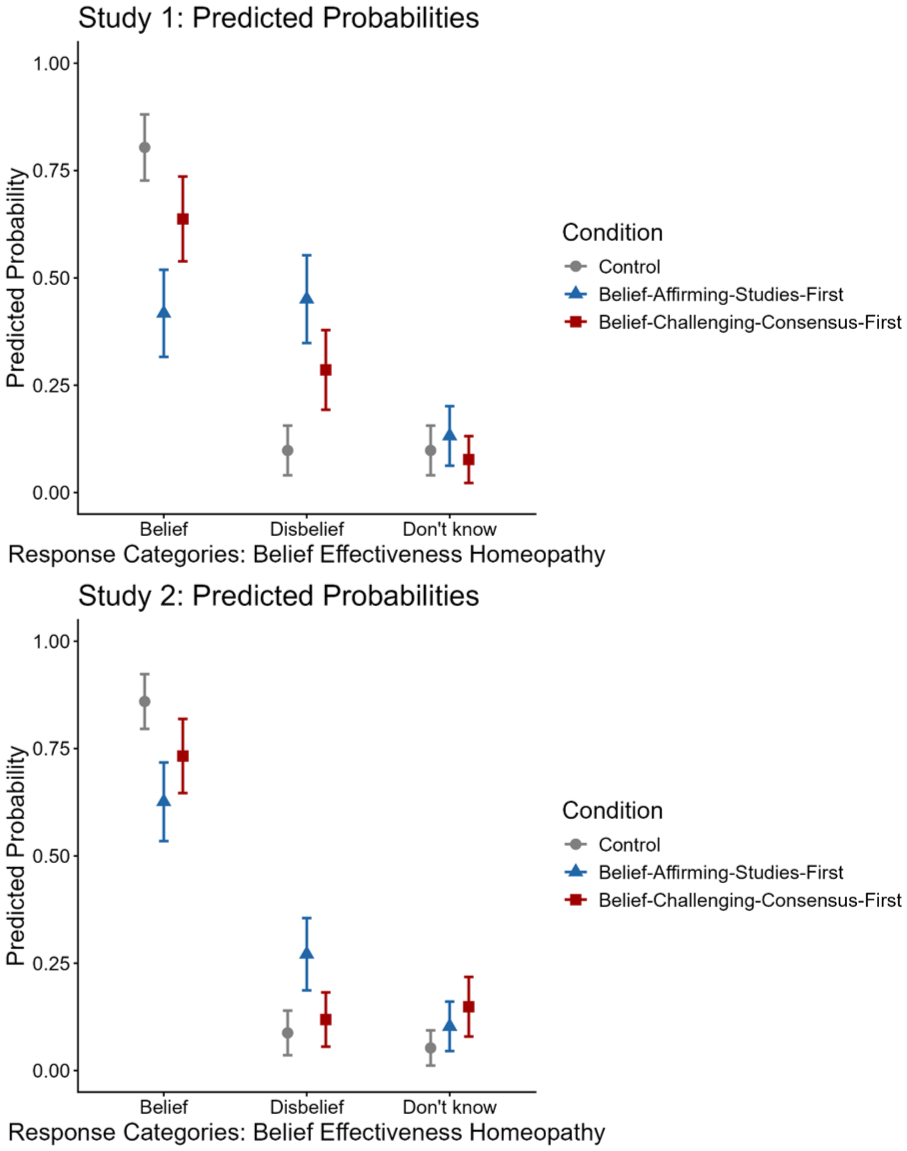
Predicted probabilities per response category (post-manipulation) in studies 1 and 2.
Differences in Predicted Probabilities per Response Category in Study 1.
Study 2
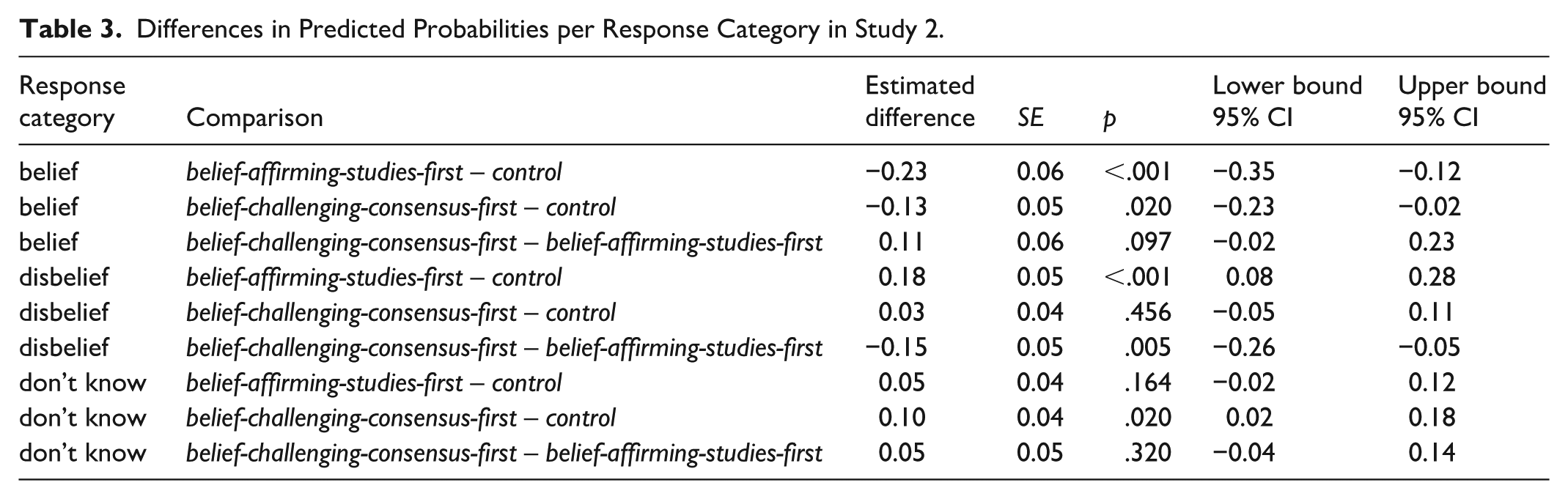
Figure 2 (bottom) displays predicted probabilities per response category for all conditions in Study 2. Compared to the control condition, the predicted probability of responding “belief” was 23% lower in the belief-affirming-studies-first condition; the predicted probability of responding “disbelief” was 18% higher (see Table 3 for details). Compared to the control condition, the predicted probability of responding “belief” was 13% lower in the belief-challenging-consensus-first condition; the probability of responding “disbelief” was not significantly different from the control group. Comparing both experimental conditions directly revealed that the predicted probability of responding “disbelief” was 15% higher in the belief-affirming-studies-first condition compared to the belief-challenging-consensus-first condition; the predicted probability of responding “belief” was not significantly different in this study. The predicted probability of responding “don’t know” was 10% higher in the belief-challenging-consensus-first condition compared to the control condition; otherwise, predicted probabilities for the “don’t know” category did not significantly differ between conditions.
Differences in Predicted Probabilities per Response Category in Study 2.
Discussion
When both belief-affirming and -challenging information are presented, starting out with the affirming information appears superior to the reversed order: This sequence of presentation significantly increased the probability that participants changed their response about the effectiveness of homeopathy from “belief” to “disbelief” compared to a condition that presented the same information in the reversed order. This finding differs from recent results obtained by Xu and Petty (2024a), which had suggested that presenting belief-affirming information last should be superior in two-sided messages.
We had suggested that presenting affirming information first should be particularly effective if strategically combined with consistency effects – that is, if participants are instructed to express their attitudes toward the trustworthiness of science in between both pieces of information. However, so far, we have not tested whether the superiority of presenting belief-affirming information at the beginning really depends on the induction of consistency effects: It may be that the same order effect emerges in the absence of any consistency manipulation. It is also not yet clear whether the difference between the belief-affirming-studies-first and the belief-challenging-consensus-first conditions arises because the former enhances effectiveness compared to other interventions, or because the latter reduces it. We explore these questions in Study 3.
Study 3
The main goal of Study 3 was to conduct a preregistered replication of the order effect observed in Studies 1 and 2 (https://aspredicted.org/wcxt-68s5.pdf). In addition, we aimed to explore whether order effects would also emerge in the absence of the experimental induction of consistency. It may be that it is not (only) consistency that drives the superiority of the belief-affirming-studies-first condition, but rather a general sense of feeling affirmed through the initial message (similar to self-affirmation effects, e.g., Cohen & Sherman, 2014). In this case, the belief-affirming-studies-first condition should also be superior to the reversed order in the absence of the consistency manipulation. If Xu and Petty (2024a)’s findings regarding self-reported openness to opposing views generalize, it might even be that the order effect reverses in the absence of the consistency manipulation.
Lastly, we include an additional condition presenting only the scientific consensus for exploratory purposes. This allows us to explore whether the two-sided messages acknowledging the deviating studies are more, less, or equally effective compared to a one-sided consensus message. Previous research had suggested that two-sided messages are superior compared to one-sided messages in changing strongly held beliefs (Hussein & Tormala, 2021; Xu & Petty, 2022, 2024b). However, the two-sided messages communicate more uncertainty and could also make the evidence base seem less clear.
Method
Participants
Data were collected by the Loopster Panel (participants from Study 2 were not allowed to participate). N = 519 completed the survey, three were excluded because they stated that they did not participate seriously, leaving n = 516 participants (326 female, 188 male, 2 diverse). The mean reported age was 48.08 (SD = 15.66). In terms of education, n = 151 reported a university degree, n = 125 a high school degree (“Abitur”), n = 190 a higher secondary degree (“Realschule”), n = 49 a lower secondary degree (“Hauptschule”) and n = 1 no degree.
Procedure and Measures
Participants reported their baseline beliefs about the effectiveness of homeopathy. Those participants who stated to believe in the effectiveness of homeopathy were able to participate (all others were debriefed and thanked) and randomized into five conditions: four conditions varying whether (a) affirming information was presented first versus second and (b) whether consistency effects were induced versus not induced, plus an additional condition that only presented the scientific consensus (see Figure 3 for an overview). We used the same measures as in Study 2. Cronbach’s alpha for the perceived trustworthiness of homeopathy-related science measures was αT1 = .95 and αT2 = .97.
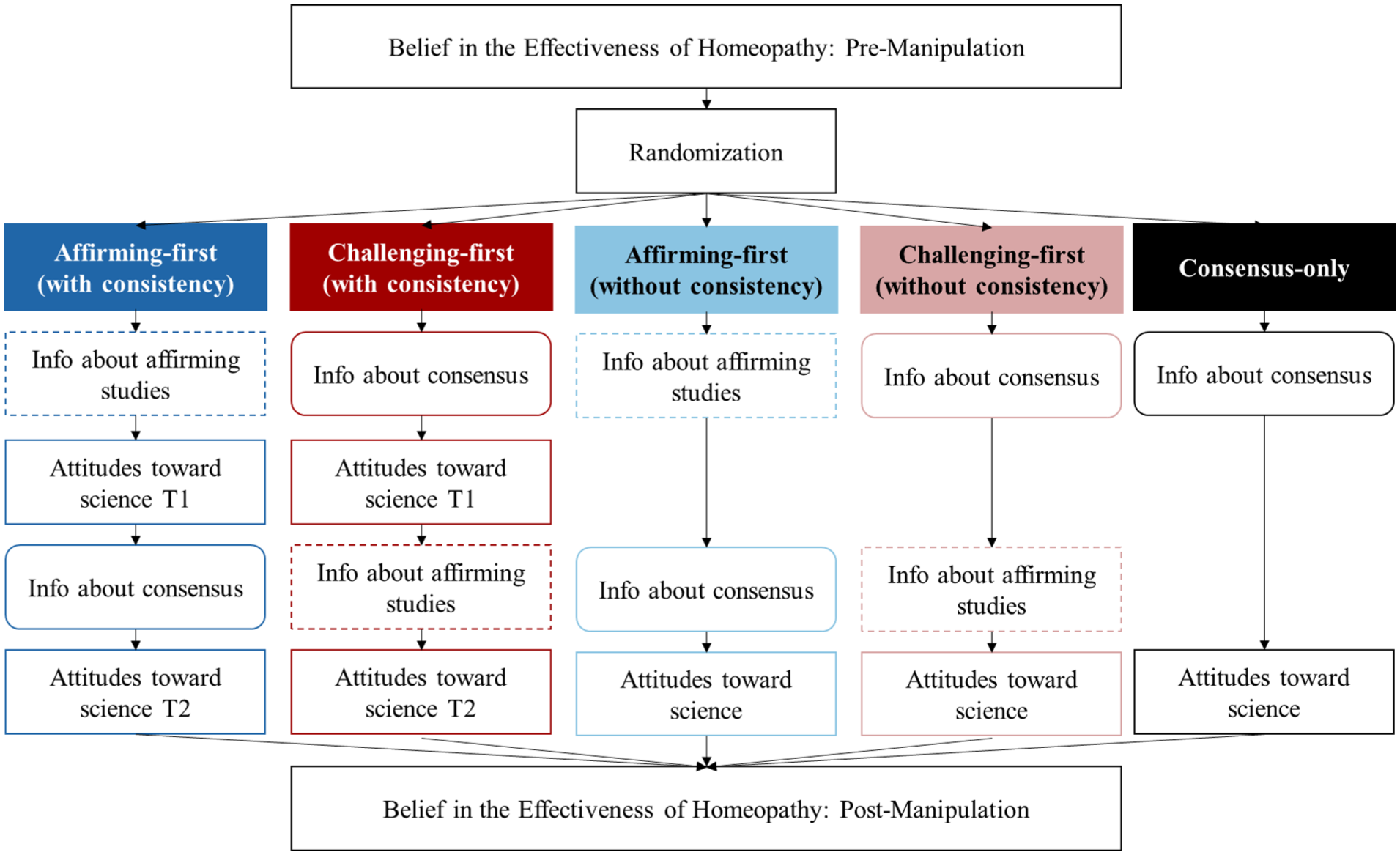
Overview of experimental design in study 3.
Results
Perceived Trustworthiness of Homeopathy-Related Science
As in Studies 1 and 2, participants in the belief-affirming-studies-first (with consistency) condition evaluated the trustworthiness of homeopathy-related science relatively positively after the first information and, on average, adjusted their evaluation downward following the second information. This pattern was reversed for the belief-challenging-consensus-first (with consistency) condition (see Supplemental Material for details). As before, participants in the belief-affirming-studies-first (with consistency) condition evaluated the trustworthiness of homeopathy-related science significantly more positively after the first information (M [SD] = 5.61 [1.16]) than participants in the belief-challenging-consensus-first (with consistency) condition (M [SD] = 5.01 [1.47], t (190.14) = 3.22, p = .001). This difference was no longer significant after the second piece of information (belief-affirming-studies-first (with consistency) condition: M (SD) = 5.17 (1.51), belief-challenging-consensus-first (with consistency): M (SD) = 5.34 (1.35), t (202.91) = −0.86, p = .391). Again, participants in the belief-affirming-studies-first (with consistency) condition who revised their belief about the effectiveness of homeopathy remained more stable in their evaluation of trustworthiness, whereas those who did not change their belief “downgraded” the trustworthiness of homeopathy-related science (see Supplemental Material for details).
Reported Belief in the Effectiveness of Homeopathy
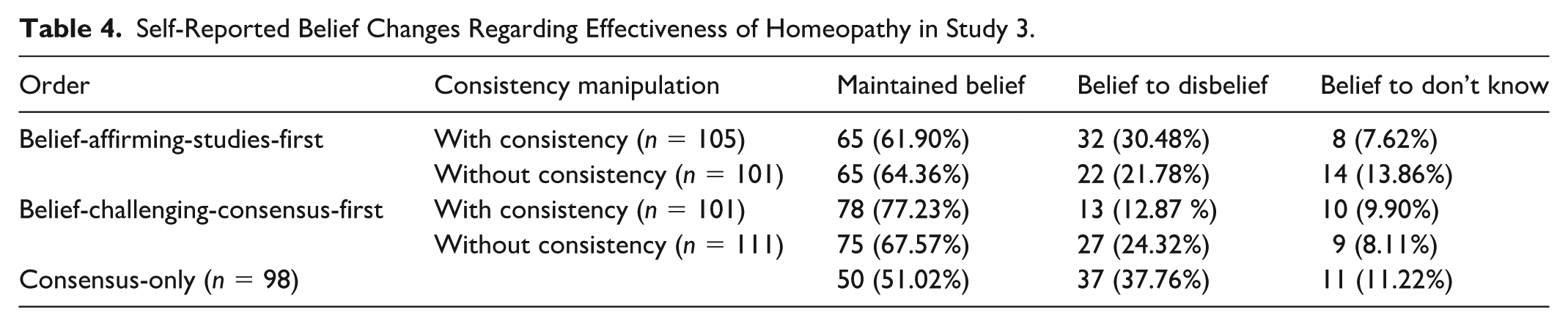
Table 4 demonstrates observed frequencies of “belief,” “disbelief,” and “don’t know” responses regarding the effectiveness of homeopathy across all five conditions. On a purely descriptive level, the consensus-only condition resulted in the most frequent cases of self-reported belief revision, followed by the belief-affirming-studies-first (with consistency) condition. The belief-challenging-consensus-first (with consistency) condition appears to have been the least effective overall.
Self-Reported Belief Changes Regarding Effectiveness of Homeopathy in Study 3.
We had preregistered to analyze changes from “belief” to “disbelief” and changes of any kind (a combination of changes from “belief” to “disbelief” and “belief” to “don’t know”) in two separate logistic regressions. However, these analyses can be conducted more concisely using a multinomial regression and the analytic framework of the “marginaleffects” package described above. We report all analyses as preregistered in the Supplemental Material (the preregistered hypothesis was supported).
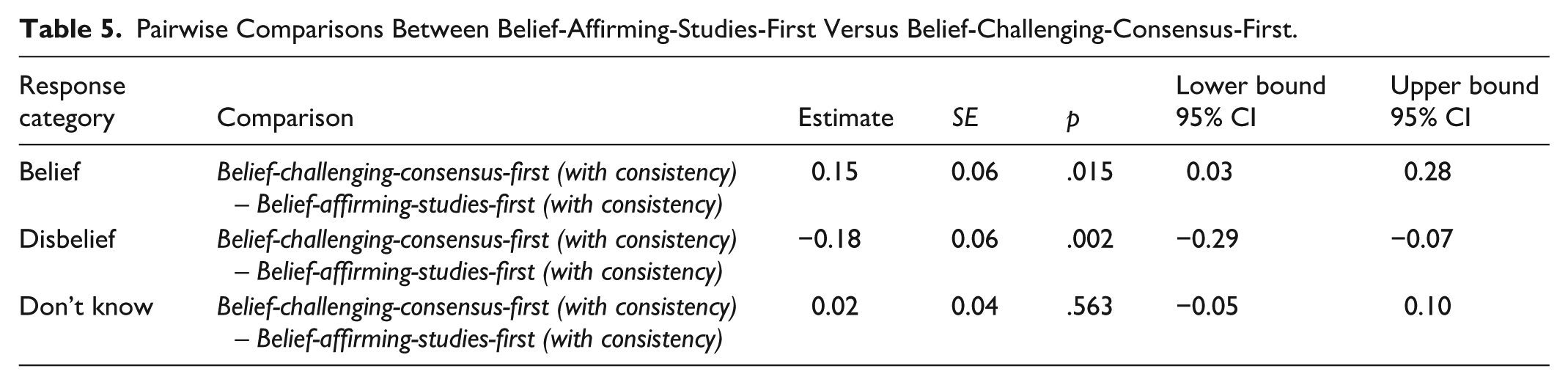
Our main hypothesis concerns the direct comparison of the belief-affirming-studies-first and the belief-challenging-consensus-first when consistency is induced. As expected, the belief-affirming-studies-first (with consistency) condition reduced the probability of responding “belief” by 15% and increased the probability of responding “disbelief” by 18% compared to the belief-challenging-consensus-first (with consistency) condition (see Table 5). Both of these comparisons were statistically significant. Thus, we replicated the superiority of presenting affirming information first (vs. second) in a situation where consistency motives were induced.
Pairwise Comparisons Between Belief-Affirming-Studies-First Versus Belief-Challenging-Consensus-First.
Exploratory Analyses
We conducted additional analyses (not preregistered) to compare response patterns across all five conditions and examine whether the presence of the consistency manipulation moderates the effect of presenting belief-affirming information first.
Pairwise Comparisons Across All Conditions
Figure 4 displays predicted probabilities per response categories for all five conditions in Study 3. Pairwise comparisons of these predicted probabilities revealed several noteworthy findings (see Table S3 in the Supplemental Material): First, the belief-affirming-studies-first (with consistency) condition was the only two-sided condition that was not significantly less effective than the one-sided consensus only condition. All other two-sided conditions either significantly increased the probability of responding “belief,” decreased the probability of responding “disbelief,” or both compared to the consensus-only condition. Second, the two-sided message conditions without the consistency manipulation did not significantly differ from each other in terms of predicted probabilities per response category.
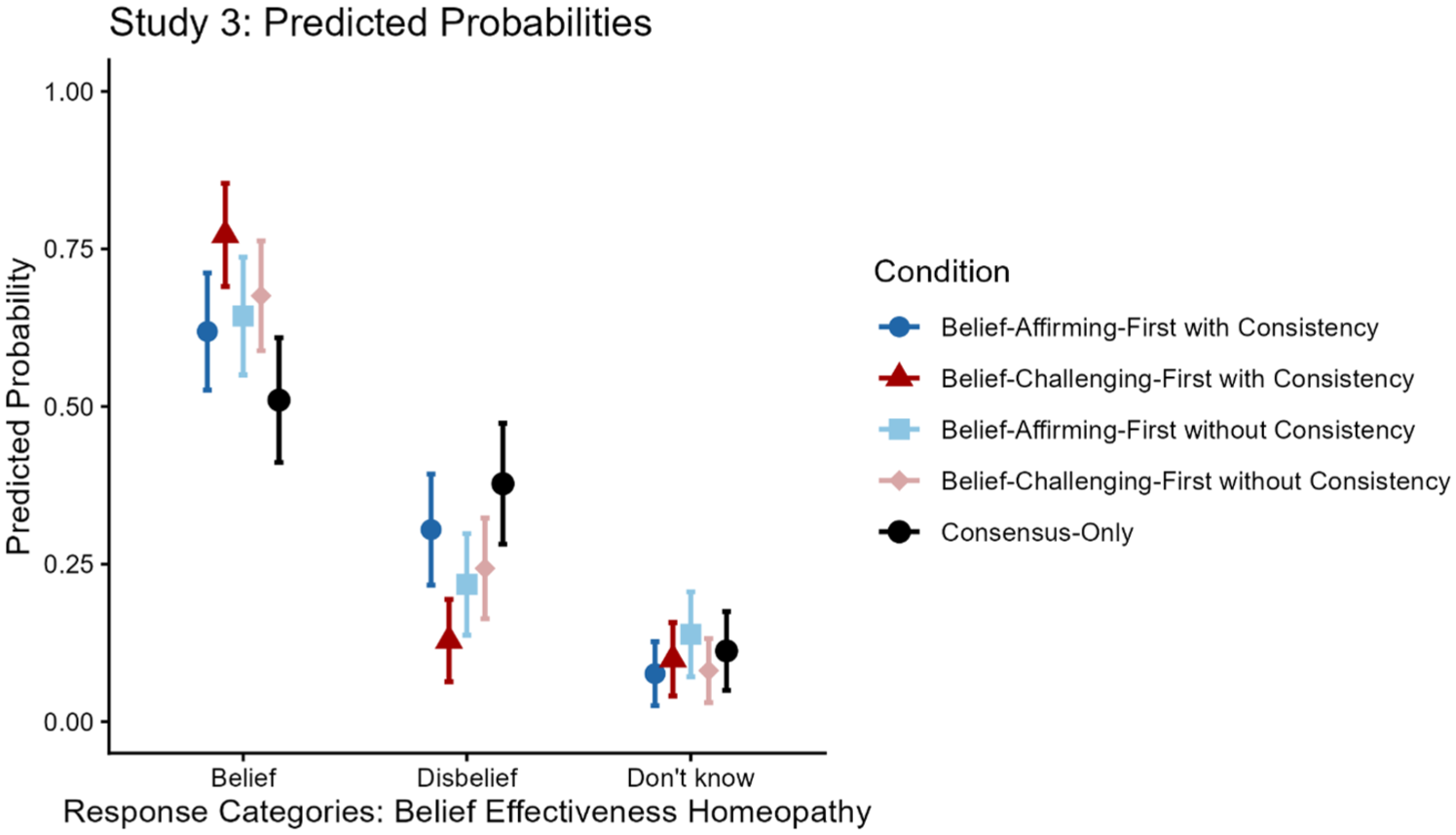
Predicted probabilities per response category (post-manipulation) in study 3.
Moderating Role of Consistency Effects
We further explored whether the experimental induction of consistency effects moderated the effect of communicating affirming information first (vs. second). For that purpose, we conducted a multinomial regression including two binary predictors (order: affirming information first vs. second; consistency: yes vs. no) and their interaction as predictors. Results revealed a positive and statistically significant interaction between presenting affirming information first and inducing consistency effects: If consistency effects were induced, the effect of presenting affirming information first on responding “disbelief” (vs. “belief”) was significantly greater compared to when consistency was not induced (B = 1.14, SE = .50, p = .021). This interaction term was not significant for the “don’t know” (vs. “belief”) response category.
A moderation analysis in terms of differences in predicted probabilities further confirmed that the effect of presenting affirming information first differed depending on whether consistency effects were induced vs. not induced. Presenting affirming information first in the absence of the consistency manipulation reduced the probability of responding “disbelief” by 3%, whereas presenting affirming information first when consistency effects were induced increased the probability of responding “disbelief” by 18%. This difference was statistically significant (estimated difference = −0.20, SE = 0.08, p = .012, 95% CI [−0.36, 0.04]), providing further support for the moderating role of consistency motives when it comes to self-reported belief revision (i.e., the “disbelief” response category).
Discussion
Study 3 provides several key insights. First, our preregistered hypothesis was supported: The belief-affirming-studies-first (with consistency) condition was significantly more effective than its counterpart presenting the consensus first. As long as participants were asked to rate the trustworthiness of science in between both pieces of information, presenting affirming studies first was clearly superior to the reversed order.
Exploratory analyses revealed that this order effect did not emerge in the absence of the consistency manipulation. In fact, whether consistency effects were experimentally induced (or not) moderated the effect of presenting affirming information first (vs. second): Presenting affirming information first increased the probability of responding “disbelief” only if consistency effects were induced. This suggests that presenting affirming information first is not generally superior to the reversed order, but only in combination with a consistency manipulation that instructs participants to evaluate and express their attitudes toward science following the initial affirming information.
Comparing the two-sided messages to the consensus-only condition revealed that it is also not generally the case that two-sided messages are superior to one-sided ones. To some extent, this seems unsurprising, since the two-sided messages provided explicit evidence for the effectiveness of homeopathy. However, this result differs from several previous findings in the persuasion literature, which had suggested that two-sided messages should be more persuasive than one-sided ones (Hussein & Tormala, 2021; Xu & Petty, 2022, 2024b).
Importantly, the belief-affirming-studies-first (with consistency) condition was the only two-sided message condition that was not significantly worse than the consensus-only condition. All other two-sided message conditions significantly reduced the likelihood of changing one’s reported belief in the effectiveness of homeopathy compared to the consensus-only condition. The favorable consistency effects produced in this condition likely compensated for the otherwise detrimental effect of communicating the evidence in favor of homeopathy. Note that this nonsignificant result does not allow us to conclude that both conditions are equally effective, which would require a formal equivalence test (Lakens, 2017; Liekefett et al., 2024). Nonetheless, these findings suggest that presenting affirming studies first and subsequently eliciting favorable consistency effects may be a way to acknowledge opposing studies without significant loss of persuasive power.
Lastly, the order effect between the belief-affirming-studies-first (with consistency) condition and the belief-challenging-consensus-first (with consistency) condition appears to be driven not only by the beneficial effects of the former but also by the particular ineffectiveness of the latter (this condition was less effective than all others). In the belief-challenging-consensus-first (with consistency) condition, participants initially expressed more negative attitudes toward homeopathy-related science’s trustworthiness, which likely hindered belief revision from the outset. If the goal is to generate belief change in line with the consensus, then this particular sequence should be avoided.
General Discussion
This research examined how people whose beliefs conflict with scientific consensus respond to messages presenting both the scientific consensus and individual deviating studies. Across three experiments, we presented homeopathy supporters with belief-affirming individual studies and the belief-challenging scientific consensus regarding homeopathy in different orders while measuring the perceived trustworthiness of homeopathy-related science in between. Results of the three experiments consistently showed that presenting belief-affirming information first increased the likelihood of self-reported belief revision compared to the reversed order. Study 3 showed that this order effect occurred only if attitudes toward science were measured in between both pieces of information, in line with the idea of consistency effects as an explanation: In the belief-affirming-studies-first condition, participants initially expressed relatively positive attitudes toward homeopathy-related science. This commitment to the trustworthiness of homeopathy-related science may have made it more difficult to dismiss the belief-challenging scientific consensus later, since such a dismissal would be inconsistent with their earlier expression of trust.
The finding that no order effects emerged in the absence of the interim measurement of perceived trustworthiness of homeopathy-related science is also consistent with the sequential belief-updating model postulated by Hogarth and Einhorn (1992): The authors had argued that recency effects should emerge if mixed evidence is processed in a step-by-step manner. An end-of-sequence response mode, in contrast, should favor primacy effects. It could be argued that, beyond the weakening of consistency motives, removing the interim measurement also removed one force toward step-by-step processing, thereby reducing recency tendencies.
However, this finding differs from previous research which found that presenting opposing evidence first is more effective than the reversed order regardless of any consistency manipulation (Igou & Bless, 2003, 2007; Wang & Huang, 2024). This may be due to several differences in study design: Igou and Bless (2003, 2007) studied positive and negative information about products that participants had no prior beliefs about. It is unclear to what extent this is comparable to information that affirms vs. challenges prior beliefs. Wang and Huang (2024) studied two-sided messages of either narrative or non-narrative form. It may be that the specific combination of a narrative affirming with a non-narrative disconfirming message results in order effects even in the absence of consistency motives.
Our findings also differ from Xu and Petty (2024a): In their studies, presenting affirming information last was most effective at generating openness to opposing views. Notably, the outcome in their studies was not belief or attitude change, but whether participants reported greater openness toward the opposing side on several Likert scale items. Some items of this openness measure capture a rather general positive or negative evaluation of the message that need not reflect a greater likelihood of actual attitude change. In addition, a closer look at their affirming-information-first condition reveals that at the time where the affirming information was presented, participants were already aware what the actual point of the message was going to be: The message started out with “Before explaining why wearing face masks is important, I would like to acknowledge the fact that. . .” [emphasis added]). This announcement likely took some wind out of the sails of the initial affirming message.
In any case, our results disconfirm the idea that it is generally “better to present it [the acknowledgment of the recipient’s side] at the end rather than the beginning of the two-sided message” (Xu & Petty, 2024a, p. 13). If attitudes toward the trustworthiness of the information source are explicitly assessed in between, the opposite appears to be the case. In the absence of such evaluations, order may not matter that much after all – at least in the case of the specific two-sided messages investigated here.
Our results also speak against the idea that two-sided messages are generally more effective than one-sided ones. There was only one version of the two-sided messages that was not significantly less effective than the one-sided communication of the scientific consensus: The belief-affirming-studies-first condition that included the consistency manipulation (Study 3). All other two-sided messages resulted in significantly fewer cases of self-reported belief revision. Previous research had suggested that two-sided messages are particularly beneficial when they explicitly refute the presented opposing arguments (Allen, 1991; Allen et al., 1990; O’Keefe, 1999). To some extent, this may explain why our two-sided messages were not superior to the one-sided version: In our case, the individual studies in favor of homeopathy were only refuted indirectly by invoking the broader scientific consensus. It may be that the effectiveness of our two-sided messages could be enhanced by including a more explicit refutation of these individual studies (e.g., by highlighting that individual deviating studies do not undermine the overall scientific consensus).
The lacking superiority of our two-sided messages may also be the result of the specific kind of two-sided messages studied here. Research has shown that even small amounts of scientific dissent (i.e., small proportions of dissenting scientists) are sufficient to cast doubt on scientific consensus: As soon as participants learned that there is some disagreement among scientists (however small), their belief in the respective claim decreased (Aklin & Urpelainen, 2014). A similar effect might have unfolded in our two-sided message conditions: The small number of individual studies in favor of homeopathy might have been sufficient to make the consensus seem less convincing – particularly because these individual studies confirmed participants’ prior belief and, most likely, said what they wanted to hear.
Lastly, the effectiveness of two- vs. one-sided messages might also be influenced by source characteristics. In our case, both pieces of information stemmed from the same source, namely homeopathy-related science. Early research on message sidedness had indicated that two-sided messages are particularly beneficial in contexts where the communicator is of questionable trustworthiness (Hovland et al., 1953). It may be that sources that are perceived as less trustworthy profit more from two-sided messaging.
Nonetheless, our results indicate that “undermining your case to enhance your impact” (Hussein & Tormala, 2021) may not work by default in the context of belief-affirming and -challenging scientific evidence. However, it is possible to communicate both belief-affirming and -challenging evidence without significant detriments to persuasive power: Namely when belief-affirming information is presented first, and commitment to the trustworthiness of the information source is generated afterwards. We discuss the potential benefits of this strategy in an applied setting below.
Theoretical and Practical Implications
By combining order and consistency effects in the study of belief revision, this research contributes to both the persuasion and cognitive consistency literatures (Aubert-Teillaud et al., 2023; Brannon & Gawronski, 2018; Harmon-Jones, 2019). Our findings help resolve some of the inconsistent results regarding order effects in two-sided messages by showing that these are sensitive to what happens in between and around the communication. Specifically, they can be brought about by explicitly thematizing the trustworthiness of the information source (in this case, homeopathy-related science).
In our study, the consensus-only condition did not differ significantly from the belief-affirming-studies-first (with consistency) condition in terms of effectiveness (while being significantly more effective than all other two-sided conditions). Nonetheless, we suggest that the belief-affirming-studies-first condition may be preferrable to the consensus-only condition in practical applications for two reasons: First, it communicates the full picture of the evidence base and is thus more honest. Second, communicating the consensus only may work well in a controlled study where the experimenter determines what happens next – but in real-life discussions, presenting the consensus only might not remain unchallenged. Imagine you are engaged in a discussion with a homeopathy supporter and present the scientific consensus one-sidedly. This may quickly result in a situation comparable to our belief-challenging-consensus-first condition, whereby the belief-challenging scientific consensus is countered by individual studies in favor of homeopathy. To avoid this situation (which, according to our data, would be an unfavorable strategy), it might be better to initially affirm that there are some studies in favor of homeopathy and try to produce favorable consistency effects afterwards.
Study 3 revealed that the superiority of presenting affirming information first depended on the interim measurement of attitudes toward homeopathy-related science. This finding has interesting implications for communication in an applied setting. While it is, of course, not possible to conduct such a measurement during a conversation, there may be rhetorical techniques with similar effects. For instance, the moderator in a discussion may present the individual studies in favor of homeopathy to a homeopathy supporter and subsequently ask them about their attitudes toward homeopathy-related science. This may tempt the homeopathy supporter to express a favorable view in public. To some extent, this may then “force” the discussion partner to either remain consistent with their earlier expression of trust or at least justify why they might evaluate homeopathy-related science as trustworthy only in case of the confirming results (which might be difficult to do).
Limitations and Future Research
All studies were conducted in the context of homeopathy. This is because belief in homeopathy is among the most widespread beliefs that conflict with scientific consensus in Germany, which facilitated sample acquisition. In addition, it is a domain that has received relatively little attention in psychological research so far (for exceptions, see Aßmann & Betsch, 2023; Liekefett & Becker, 2025). Future research should test whether our findings generalize to other science domains and to persuasive messages in general.
We investigated a particular kind of two-sided message that paired two features: whether the information was belief-affirming versus -challenging and whether it was consensual versus referred to individual studies. In addition, both pieces of information came from the same information source (homeopathy-related science), which is most likely necessary for our consistency manipulation to work. However, this limits the generalizability to two-sided messages in general, which frequently refer to issues that participants have no prior beliefs about or present pro- and contra-arguments from different sources. Thus, the lacking superiority of two-sided versus one-sided messages should be considered in light of the specific form of messages investigated here.
In Study 3, we systematically manipulated whether attitudes toward homeopathy-related science were measured in between both pieces of information. We observed that significant order effects emerged only if this was the case. However, it remains unclear what exactly is required for these order effects to emerge: Is it necessary for participants to publicly declare their attitudes toward science, or would it suffice to make such questions salient in their minds? Future research should strive to identify the mechanism behind this effect more clearly and determine how this mechanism can be successfully implemented outside of a survey, for example in a dyadic discussion.
We excluded participants who stated not to believe in the effectiveness of homeopathy at baseline in all studies (and those who were unsure in Studies 2 and 3). Thus, we cannot exclude the possibility of potential backfire effects among people whose beliefs were already aligned with the scientific consensus: It may be that the information about individual studies in favor of homeopathy created doubt among these participants, especially if they had never heard of such studies before (see also Hovland et al., 1949). To provide some initial evidence pertaining to this question, we analyzed the data of participants who were initially unsure about the effectiveness of homeopathy in Study 1. Results showed that for these participants, the belief-affirming-studies-first condition was clearly superior: It increased chances of self-reported belief revision without any negative side effects. The belief-challenging-consensus-first condition, in contrast, slightly increased chances of responding “belief” post-manipulation compared to the no-information control group. However, this analysis should be treated with caution due to small cell counts (for details, see Supplemental Material). Future research should examine the question of potential side effects among people whose beliefs are already aligned with scientific consensus more systematically.
Lastly, we do not know whether participants changed their internal beliefs about the effectiveness of homeopathy or merely their outward response (which is why we prefer to speak of “self-reported belief revision”). This problem is not unique to our research. Nonetheless, even if it were the case that participants only changed their outward response, this could still be a meaningful outcome: If people proclaimed to no longer believe in homeopathy (despite continuing to believe in it), they might at least influence others in this direction.
Conclusion
Despite clear scientific consensus that homeopathy is no more effective than placebo, studies that deviate from this consensus also exist. We investigated how people whose prior beliefs conflict with scientific consensus respond to messages presenting both the scientific consensus and individual deviating studies. Our findings suggest that when both belief-challenging (here, the scientific consensus) and -affirming (here, individual deviating studies) are presented, it is better to start out with the information that affirms the recipient’s belief before presenting the belief-challenging consensus. Compared to the reversed order, this sequence provides the opportunity to elicit commitment to the trustworthiness of the information source. This might generate consistency effects that motivate participants to align their position with the scientific consensus. Contrary to prior research, we find no evidence for order effects in two-sided messages in the absence of a consistency manipulation and no evidence for a general superiority of two-sided over one-sided messages.
Supplemental Material
sj-docx-1-psp-10.1177_01461672251409438 – Supplemental material for Combining Order and Consistency Effects in Two-Sided Messages on the Non-Effectiveness of Homeopathy
Supplemental material, sj-docx-1-psp-10.1177_01461672251409438 for Combining Order and Consistency Effects in Two-Sided Messages on the Non-Effectiveness of Homeopathy by Luisa Liekefett and Julia C. Becker in Personality and Social Psychology Bulletin
Footnotes
Appendix
Acknowledgements
We would like to thank Simone Sebben, Namkje Koudenburg, and several anonymous reviewers for valuable comments and suggestions.

Funding
The authors received no financial support for the research, authorship, and/or publication of this article.
Declaration of Conflicting Interests
The authors declared no potential conflicts of interest with respect to the research, authorship, and/or publication of this article.
Data Availability Statement
Supplemental Material
Supplemental material is available online with this article.
References
Supplementary Material
Please find the following supplemental material available below.
For Open Access articles published under a Creative Commons License, all supplemental material carries the same license as the article it is associated with.
For non-Open Access articles published, all supplemental material carries a non-exclusive license, and permission requests for re-use of supplemental material or any part of supplemental material shall be sent directly to the copyright owner as specified in the copyright notice associated with the article.
