




Abstract
Across five studies, we reveal consistent cultural differences in how humor is perceived, created and appreciated: compared to Americans, Chinese individuals were more likely to produce, appreciate, and associate humor with more profound meaning. Study 1 (N = 298) used a free association paradigm and found a stronger tendency among Chinese than American participants to associate humor with meaningfulness. Study 2 (N = 222) showed that humor generated by Chinese participants contained more depth and meaning than that of American participants. Study 3 (N = 200) compared short humorous videos from Chinese (Douyin) and American (TikTok) social media platforms and found that videos on Douyin contained more meaning than those on TikTok. Finally, Study 4 (N = 611) used a cultural sampling method to examine how participants’ cultural background and origin of humor influence people’s liking of meaningful humor. The results indicated that Chinese participants liked meaningful humor more than nonmeaningful humor to a greater extent than American participants. Study 5 (N = 500) extended these findings to a more naturalistic context. The research highlights a new dimension of humor (meaningfulness) that has never been studied before and contributes significantly to the literature on culture and humor.
Introduction
Humor, as a unique form of social play that evokes laughter and amusement, is often associated with positive emotions and interpersonal interactions (Martin & Ford, 2018). Beyond provoking laughter, humor may also carry profound meaning, prompting reflections, conveying philosophical insights, and encouraging people to look beneath the surface. This dimension of humor that emphasizes meaning over mere entertainment is particularly valued in Chinese culture, where humor is often expected to be wise, reflective, and socially appropriate. Despite its cultural significance, meaning-oriented humor has received limited attention in the psychological literature. To address this gap, the present research investigates the meaningfulness of humor in a cross-cultural context, comparing Chinese and American perspectives, with particular attention to the role of meaning in shaping humor preferences and practices.
Humor Across Cultures
Conceptualization
Although humor is commonly linked to laughter and amusement across cultures, Western conceptualizations tend to emphasize this entertaining and affective dimension. Scholars often conceptualize humor as anything perceived as funny that triggers laughter, encompassing both the mental processes involved in creating and understanding such amusing stimuli, as well as the mirthful emotional responses they provoke (Martin & Ford, 2018). Overall, humor can refer to a stimulus (e.g., a joke), a psychological state (e.g., amusement), or the act of creating something funny (e.g., telling a joke), all of which are closely associated with laughter and amusement (Warren et al., 2018).
In contrast, Chinese understanding of humor reflects a more meaning-oriented perspective. The term “humor (you mo)” was only introduced in modern times by the linguist and philosopher Yutang Lin, who emphasized its intellectual depth and reflective qualities over crude, sarcastic, or slapstick entertainment (Lin, 1974). This emphasis on meaning has found resonance in the Modern Chinese Dictionary (Seventh Edition), which defines humor as being “both funny and profound in meaning.” Japan’s Encyclopedia Britannica similarly describes humor as a thoughtful form of laughter that reflects one’s life perspective (Wang, 2004). Thus, in East Asian cultures such as China and Japan, humor is often expected to evoke deeper thoughts, suggesting a stronger cultural association between humor and meaning.
Views on Humor
Building on these conceptual differences, Western cultures tend to view humor as a broadly positive trait. Since the time of Plato and Aristotle, humor has been associated with virtue and desirability (Jiang et al., 2019). Contemporary research continues to support this view, with humor often considered a desirable personality characteristic, linked to emotional stability, adaptability, and social competence. People are often reluctant to admit a lack of humor (Cann & Matson, 2014), because humor is commonly viewed as a marker of being well-adjusted, easygoing, and capable of handling stress without anger (Martin & Ford, 2018), as well as a signal of virtue (Cao et al., 2023; Ruch & Heintz, 2016).
In contrast, East Asian (such as Chinese) views on humor are often more ambivalent (Yue, 2011). While humor is acknowledged as important in everyday life (Yue et al., 2006), it is held to higher standards and often viewed as a specialized skill rather than a common personality trait (Jiang et al., 2019). For example, when asked to nominate humorous individuals, Chinese students are more likely to nominate well-known figures such as comedians, whereas Canadian students tend to nominate family members or friends (Hiranandani & Yue, 2014). Traditionally, Chinese humor is expected to be insightful, morally appropriate, and socially meaningful (Lin, 1974), which may explain why individuals are reluctant to display humor in everyday interactions (Yue, 2010). Moreover, humor is also less common in formal or serious Chinese settings, where it may be perceived as immature (Liao, 2001) or inappropriate (Cao et al., 2025). As a result, humor that carries meaning or serves a social purpose (e.g., reinforcing cultural values) is more likely to be accepted and appreciated among Chinese people.
Behavioral Patterns
Cultural differences also manifest in behavioral patterns, which reveal underlying beliefs about humor’s purpose. East Asians (Abe, 1994; Nevo et al., 2001) are less likely than American students to use humor as a coping strategy, reflecting an expectation that humor should serve a constructive or meaningful role rather than simply provide emotional relief. Humor styles also align with these expectations: Chinese university students score significantly lower than Canadian students on maladaptive humor styles such as aggressive and self-defeating humor (Chen & Martin, 2007). Aggressive humor risks damaging relationships, while self-defeating humor, which involves making oneself the target of jokes, threatens face and dignity. Both are at odds with humor’s role as respectful and insightful social art (Chen & Martin, 2007). These cultural tendencies underscore that humor is not merely a tool for amusement but is expected to uphold social norms and cultural values.
Cross-cultural differences also emerge in humor content preferences, further illustrating the link between humor and meaning. American students favor jokes with sexual and aggressive content, whereas Chinese students prefer harmless jokes (i.e., jokes that lack aggressive, sexual, or socially sensitive elements; Nevo et al., 2001), or jokes with wise and conservative content (Castell & Goldstein, 1976). Furthermore, in tight cultures such as China, where social norms are more strictly enforced and deviance is punished (Gelfand et al., 2011), the range of acceptable humor is narrower, and spontaneous or playful humor may be discouraged if it risks offending others or disrupting social harmony (Cao et al., 2025). Instead, humor is more likely to be valued when it conveys insight or reinforces cultural ideals, reflecting a broader expectation that humor should be purposeful and socially meaningful.
Meaningfulness in Humor
Despite extensive research on humor, meaningfulness remains an understudied dimension, particularly in cross-cultural contexts. In Western psychology, humor is often operationalized around laughter and amusement. Many studies even use humor and laughter interchangeably when examining the effects of humor on people’s mental and physical well-being (Bennett & Lengacher, 2008; Martin, 2001; Ruch et al., 2019). This approach tends to frame humor primarily as a form of entertainment or a coping mechanism, with its value largely determined by the emotional responses (positive or negative) it elicits. In contrast, Chinese culture offers a more layered understanding of humor, where humor is not necessarily synonymous with laughter (Wang, 2004). Rather, it is often understood as a social art with purposeful functions, such as educating people and promoting social harmony. Yutang Lin once described humor as a spring breeze that brings comfort to others (Lin, 1974), highlighting its role in fostering meaningfulness and harmony rather than simple amusement. This perspective is captured in the concept of the seriocomic, a style that integrates comic elements with seriousness to convey deeper meaning (Cao & Hou, 2023; Cao, et al., in press; Lin, 1974). In China, humor is often expected to “educate through entertainment” (寓教于乐), reinforcing moral values or offering philosophical insight. Such meaning-oriented humor reflects broader cultural expectations around communication, where humor is valued not only for its emotional impact but also for its intellectual and social significance.
The Cultural Origins of Meaningfulness in Humor
The meaningfulness of humor in Chinese culture is deeply rooted in its philosophical traditions, shaped by two major influences: Taoist spontaneity and Confucian discipline. They interact to define humor’s cultural legitimacy in China, shaping how it is understood, practiced, and valued.
Taoism, with its emphasis on naturalness, transcendence and detachment, infuses Chinese humor with existential and philosophical depth. Zhuangzi, a central Taoist thinker, exemplifies this through stories like the “butterfly dream.” In the dream, Zhuangzi is a butterfly enjoying a carefree and delightful life. Upon awaking, he wonders whether he is Zhuangzi who dreamed he was a butterfly, or a butterfly who is dreaming he is Zhuangzi. Using gentle irony and paradox to challenge reality and illusion, Zhuangzi invites reflection rather than laughter, presenting humor as a means of exploring life’s uncertainties (Lin, 1974). Similarly, Laozi, the founder of Taoism, used paradoxical wit—as reflected in sayings such as “the greatest wisdom looks foolish”—to convey deeper truths, establishing humor as a medium for philosophical insight (Lin, 1974).
On the other hand, Confucianism imposed constraints on humor by emphasizing moral education, social ethics, and hierarchical order (Fei, 1992; Li, 2003). For example, the Confucian virtue of Ren (仁), which emphasizes moral integrity, seriousness, and formality, discourages humor that might undermine respect and social hierarchy. Research indicates that individuals with a stronger moral orientation tend to exhibit a more restrained sense of humor (Yam et al., 2019), and leaders who use humor may risk encouraging behaviors that challenge established norms (Yam et al., 2018). Yet, Confucianism does not reject humor entirely. It permits humor when it serves moral or educational purposes, guiding behavior and reinforcing social values (Xu, 2011). Traditional Chinese comedic forms such as Xiangsheng (crosstalk) and comedic skits often convey moral lessons about respect, honesty, and social responsibilities (Moser, 2017), making humor a regulated art that supports collective ethics rather than individual amusement.
These philosophical foundations help explain why Chinese humor tends to be harmless, implicit or indirect (e.g., embedded in metaphors), and purpose-driven. Its acceptance depends on its ability to convey meaning without challenging norms or causing offense. Humor that is overly critical or confrontational (—common in Western satire) is considered inappropriate and is not regarded as humor at all in China (Lin, 1974), as its aggressiveness undermines interpersonal harmony and overshadows the cultural value it seeks to convey (Yue et al., 2014). In contrast, in Western cultures such as the United States, humor is often viewed as a form of personal expression and entertainment (Lu, 2023; Martin & Ford, 2018). While meaningful humor exists in the West, particularly in satire and social critique, it is not the dominant mode. Instead, humor tends to emphasize spontaneity, individuality, and emotional expression.
Thus, how humor is defined, valued, and practiced differ across Chinese and Western cultures. In Western cultures, people may appreciate both purely entertaining and meaningful humor, but entertainment often takes precedence over meaning. By contrast, in Chinese culture, meaningful humor occupies a more central position, with entertainment typically serving only as a byproduct. This difference reflects broader cultural orientations: Chinese culture prioritizes humor that conveys educational, moral, or philosophical significance, whereas Western cultures emphasize humor as a tool for self-expression and entertainment.
The Present Research
The present research focuses on the meaningfulness embedded in humor once people identify something as humorous and compares how such meaningfulness manifests in Chinese versus Western cultural contexts. In this research, the meaningfulness of humor refers to the extent to which humorous content carries educational, moral, or philosophical value beyond mere entertainment. It includes humor that provokes reflection, conveys cultural ideals, or offers critical insights into life and society, such as fables, metaphors, and philosophical jokes. We hypothesized that compared to Americans, Chinese participants would be more likely to associate humor with meaningfulness and to both produce and appreciate humor with profound meaning. We conducted five studies to test such hypotheses. Specifically, Study 1 used a free association paradigm to explore whether Chinese participants would generate more meaningful associations for humor than American participants. Study 2 tested whether humor produced by Chinese participants would have more profound meaning than that produced by American participants. Study 3 investigated whether the findings can be generalized to everyday behaviors by comparing humor content on social media in China and the United States. Studies 4 and 5 examined how meaning in humor would influence emotional and evaluative responses, through cultural sampling and examining comedy movie reviews, respectively.
Transparency and Openness
Following Journal Article Reporting Standards (Kazak, 2018), we report how we determined our sample size, all data exclusions (if any), and all measures in the study. We pre-registered all the studies except Study 2, which had been conducted earlier. Data were analyzed using R 4.5.0. Data, material (if any), and analysis scripts are available at https://osf.io/b8uec/?view_only=321a22a931e945a6813f00240b65f9cf
Study 1
Using a free association paradigm following Ji et al. (2021), we asked participants to generate free associations for humor and to rate the meaningfulness of those associations. We expected Chinese participants to generate more meaningful associations than American participants. This study was preregistered at https://aspredicted.org/vjs8-hk5s.pdf
Method
Participants
An a priori power analysis using G*Power Version 3.1 (Faul et al., 2009) estimated that a minimum total sample size of N = 200 was required to detect a small to medium effect size (f = 0.20), power = 0.80, and α = .05, in a one-way analysis of variance (ANOVA) involving two groups. We recruited 150 Chinese students via Credamo and 150 American students via Prolific. One Chinese participant and two American participants produced only numbers or letters instead of words or phrases, and were thus removed, leaving 149 Chinese (65 men, 84 women, Mage = 22.41 years, SDage = 2.18) and 148 Americans (57 men, 86 women, and 5 with another identity, Mage = 24.40 years, SDage = 3.54) in the final analysis.
Material and Procedure
In a free association task, participants were first asked to write down as many words and phrases (associations) that came to their mind while thinking about humor, with a minimum of 1 and a maximum of 20. Participants then rated each association they generated on a 7-point scale (1 = not at all, 7 = extremely) to indicate how much each association conveyed profound meaning or philosophical thought. These ratings were averaged for each participant to represent the overall (perceived) meaningfulness of their associations.
To validate the self-ratings, we recruited 140 Chinese from Credamo and 210 American university students from Prolific, who did not take part in the association task, to serve as independent raters. 1 Chinese participants had generated 700 unique associations, and American participants had generated 1,078. Each association was rated by 10 independent raters from their own cultural group using the same 7-point scale as in self-ratings. A mean rating across raters was then computed for each association. 2 The inter-rater reliability was assessed using the average-measures intraclass correlation coefficient (ICC). For the Chinese raters, the ICC(k = 140) was .69, 95% CI [0.65, 0.72]. For the U.S. raters, the ICC(k = 210) was .71, 95% CI [0.69, 0.74]. These results suggest that the mean ratings across raters were reliable.
Results
Self-Ratings
A one-way ANOVA showed that Chinese participants (M = 5.04, SD = 0.86) generated more meaningful associations than American participants (M = 4.23, SD = 1.16), F(1, 295) = 46.61, p < .001, partial η2 = .14. 3
In addition, the proportion of associations rated as 1 (i.e., not meaningful at all) relative to each participant’s total number of associations was calculated to represent the ratio of nonmeaningful associations. A one-way ANOVA showed that the ratio of nonmeaningful associations was significantly higher among American participants (M = 0.08, SD = 0.16) than among Chinese participants (M = 0.02, SD = 0.07), F(1, 295) = 18.04, p < .001, partial η2 = .06.
Rater-Ratings
Further, A linear model was conducted with raters’ ratings as the dependent variable, culture (0 = United States, 1 = China) as fixed effects, and a random intercept for participants to account for individual-level variation. The results revealed a significant main effect of culture, b = 0.50, SE = 0.04, t(231) = 11.52, p < .001, 95% CI [0.42, 0.59], indicating that Chinese participants’ association (M = 4.11, SD = 0.84) were rated as more meaningful than those by American participants (M = 3.61, SD = 0.84).
To further examine cultural differences in meaningfulness, we analyzed how often each unique association was rated as not meaningful at all (i.e., received a rating of 1) by external raters. In the Chinese sample, 700 associations were each rated by 10 raters, yielding 7,000 total ratings. Of these, 492 were rated as 1 (7.03%). In the American sample, 1,078 associations were also each rated by 10 raters, resulting in 10,780 total ratings, with 2,807 rated as 1 (26.04%). A chi-square test with Yates’ continuity correction revealed that the proportion of 1 rating was significantly lower among Chinese associations than among American associations, χ²(1, N = 17,780) = 1013.70, p < .001. Thus, both self-ratings and other ratings showed consistent results: Chinese participants generated more meaningful associations of humor than their American counterparts.
Study 2
Study 1 showed that Chinese participants were more likely than American participants to associate humor with meaningfulness. Do Chinese participants also produce humor with greater meaningfulness than Americans? Study 2 examined this issue.
Method
Participants
According to G*Power (Faul et al., 2009), assuming power = 0.80, at least 200 participants are required for a 2 × 2 mixed design to identify a small interaction effect (f = 0.10). We recruited 120 Chinese university students from Credamo and 120 American university students from Prolific. Eleven Chinese and seven American participants failed the attention check 4 and consequently were excluded, leaving a final sample of 222 participants, including 109 Chinese (41 men, 68 women, Mage = 22.72 years, SDage = 2.05) and 113 Americans (63 men, 48 women, and 2 with another identity, Mage = 23.52 years, SDage = 3.54).
Material and Procedure
Two cartoons from CARTOONSTOCK featuring dialogues between two people were selected as materials (See Supplementary Material). In each cartoon, one character asked a question, and participants were instructed to take on the role of the other character and respond to the question in the most humorous way possible. Each participant generated two humorous responses.
A separate group of raters (80 Chinese university students from Credamo and 80 American university students from Prolific) then rated how funny responses from their own cultural group were (1 = not at all, 7 = extremely). 5 The mean rating of the two humorous responses was used to indicate funniness of each participant’s humor production (Cronbach’s α = .71 for Chinese raters and 0.68 for American raters, respectively). Likewise, another 80 Chinese and 80 American university students rated the meaningfulness of each response (1 = not at all, 7 = extremely). 6 The mean rating of the two humorous responses was used to indicate meaningfulness of each participant’s humor production (Cronbach’s α = .75 for Chinese participants and 0.73 for American participants, respectively).
Results
A 2 (culture: China vs. America; between-participant) × 2 (humor rating: funniness vs. meaning, within-participant) mixed ANOVA showed a significant interaction effect of culture by humor production, F(1, 220) = 105.37, p < .001, partial η2 = .32. Specifically, as seen in Figure 1, Chinese participants (M = 3.58, SD = 0.70) generated less funny response than American participants (M = 3.90, SD = 0.64), F(1, 220) = 12.76, p < .001, partial η2 = .06, but more meaningful response (M = 4.13, SD = 0.72) than American participants (M = 3.37, SD = 0.78), F(1, 220) = 56.27, p < .001, partial η2 = .20. Thus, compared to Americans, Chinese participants did not only associate humor with more meaningfulness (as shown in Study 1) but also generated more meaningful humor.
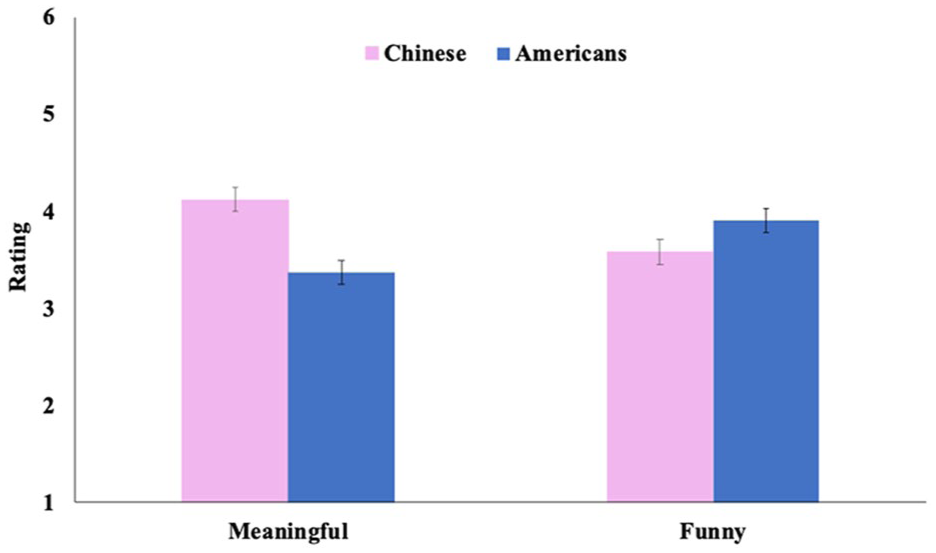
Cultural differences in funniness and meaningfulness of humor production (Study 2).
Study 3
Study 3 examined cross-cultural differencs in the meaningfulness of humor production in a more realistic context. We selected Douyin and TikTok, the leading short videos platforms in China and the United States, respectively, to compare differences in the meaning of humorous content posted by users in the two countries. This study was preregistered at https://aspredicted.org/r6n7-tn3f.pdf
Method
Material and Procedure
According to G*Power (Faul et al., 2009), assuming power = 0.80, at least 200 humorous videos are required for a 2 × 2 mixed design to identify a small interaction effect (f = 0.10). We used the keywords “Chinese humor” and “American humor” to search for humorous videos on Douyin and TikTok, respectively, and collected the top 100 short videos (<= 3 min in length) ranked by overall relevance to humor and popularity from each platform as the humorous materials. To select American videos on TikTok, we only included TikTok videos uploaded in English and by users based in the United States. The latter was determined based on user profiles, video language (e.g., accent), cultural cues (e.g., background settings), and location tags (e.g., location references). Similar criteria were used to select Chinese videos on Douyin.
One hundred Chinese students (36 men, 64 women, Mage = 21.85, SDage = 1.98) from Credamo and 100 Americans (34 men, 64 women, 2 with another identity, Mage = 23.96 years, SDage = 3.08) student raters from Prolific then watched the selected short videos from their own culture and rated the degree of perceived profound meaningfulness for each post (1 = not at all, 7 = very much) and how funny each short video was (1 = not funny, 7 = very funny). 7
Results
We first compared the average length of selected videos from Douyin and TikTok and found no significant difference between Douyin (M = 33.38 s, SD = 26.06) and TikTok videos (M = 34.78 s, SD = 25.82), t(198) = 0.38, p = .703.
We then averaged the meaningfulness (Cronbach’s α = .86 for Chinese videos and 0.96 for American videos) and funniness ratings (Cronbach’s α = .93 for Chinese videos and 0.90 for American videos), respectively, for each video.
Next, we conducted a 2 (cultural origin of the videos: between-participant) × 2 (type of rating: funny vs. meaningful, within-participant) mixed ANOVA. There was a significant interaction effect of cultural origin by type of rating, F(1, 198) = 76.56, p < .001, partial η2 = .28. As seen in Figure 2, Chinese short videos (M = 3.94, SD = 0.66) were rated significantly higher on meaningfulness than American short videos (M = 3.09, SD = 1.46), F(1, 198) = 28.62, p < .001, partial η2 = .13, although American videos (M = 4.98, SD = 0.96) were considered funnier than Chinese videos (M 4.59, SD = 1.07), F(1, 198) = 7.68, p = .006, partial η2 = .04.
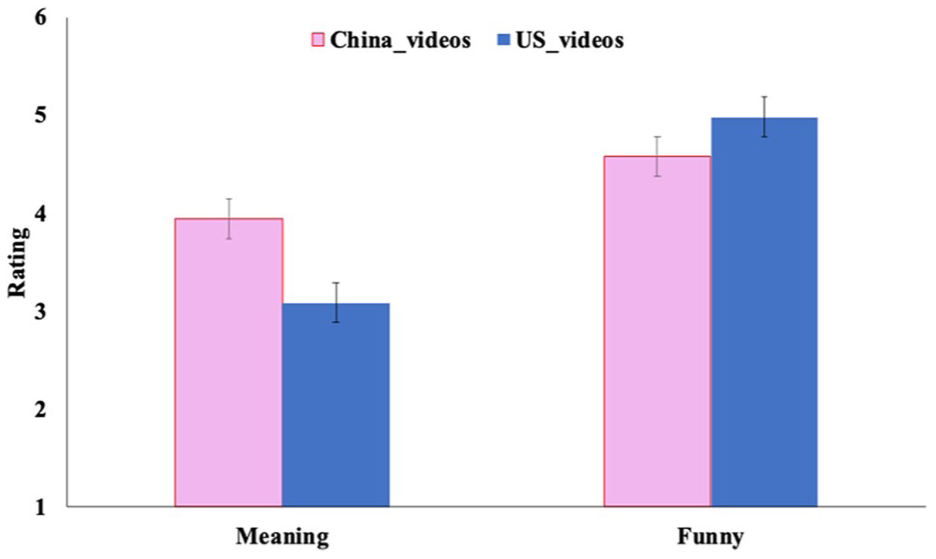
Differences between Chinese and American videos regarding how meaningful and funny they were (Study 3).
Study 4
Studies 2 and 3 indicated that compared to American participants, Chinese participants generated more meaningful humorous content, though such content might be rated as less funny. How would meaningful humor affect people’s emotional and evaluative responses, particularly regarding humor appreciation (i.e., liking)? 8 To address this question, Study 4 explored whether Chinese participants would like meaningful humor more than Americans. Given the differences in sense of humor between Eastern and Western cultures (Cao & Hou, 2023; Jiang et al., 2019), Study 4 used a cultural sampling method to explore how the cultural background of participants and the origin of humor influence people’s liking of meaningful humor. This study was preregistered at https://aspredicted.org/m3zd-5dhr.pdf.
Method
Participants
Sample 1 included 159 Chinese students (101 women and 58 men, Mage = 22.72, SD = 4.51) from Credamo and 152 American students (74 women, 70 men, and 8 other, Mage = 26.25, SD = 6.42) from Prolific. Sample 2 included 150 Chinese students (105 women and 45 men, Mage = 22.49, SD = 2.08) recruited via Credamo and 150 American students (83 women, 59 men and 8 with another identity, Mage = 23.67, SD = 3.30) recruited via Prolific. 9 All participants passed the attention check.
Material and Procedure
First, we asked participants from China and the United States in Sample 1 to provide the most representative humorous story from their own culture. Upon completion, we collected 159 Chinese stories and 152 American stories. Among the stories reported by participants in both countries, we selected 20 stories (10 American and 10 Chinese) with the highest frequencies while taking their translatability into consideration.
These 20 stories, translated as needed, were then rated by a group of 120 Chinese and 120 American student raters 10 on three aspects: (a) To what extent do you comprehend the humor in this story? (1 = Not at all, 7 = Completely); (b) How funny is the story? (1 = Not at all funny, 7 = Very funny); (c) Does the story convey some meaning, deeper thought, or philosophical reflections (Yes, No, or Not Sure). To make the rating task more manageable, each rater rated 5 stories, and each story was rated by 30 Chinese and 30 American raters.
We then narrowed these 20 stories sequentially in three steps: (a) Identifying stories with no cultural difference in comprehensibility; (b) Identifying stories that showed no cultural difference in funniness; (c) Identifying stories that conveyed profound meaning or not. After completing the above steps, we selected eight stories that met the criteria: two meaningful stories and two nonmeaningful stories from each culture (See Supplementary Material).
Finally, with Sample 2, we conducted a formal experiment where participants were asked to rate the eight stories, presented in a counterbalanced order. After reading each story, participants indicated how much they liked the story (1 = Not at all, 7 = Extremely). 11 After completing the first round of ratings for all eight stories, the stories were presented again for a second round, during which participants rated how meaningful each story was (1 = Not at all, 7 = Very much), as a manipulation check. 12
Results
Manipulation Check
For Chinese and American stories, respectively, a 2 (participant culture) × 2 (meaningfulness of humor: within-participant) mixed ANOVA revealed that, regardless of participant culture or origins of stories, meaningful stories were rated as more meaningful than nonmeaningful stories, Fs(1, 298) > 188, ps < .001, partial η2s > .38. 13 This indicates that our manipulation of meaningful and nonmeaningful stories in the two cultures was successful.
Humor Appreciation
We computed the average liking for the two stories in the same category and submitted it to a 2 (participant culture: between-participant) × 2 (meaningfulness of humor: within-participant) × 2 (humor origin: within-participant) mixed ANOVA. All the main effects were significant, ps <= .037. Most importantly, the interaction effect of culture by meaning of humor was significant, F(1, 298) = 12.28, p < .001, partial η2 = .04. As expected, Chinese participants liked meaningful stories (M = 4.67, SD = .84) much better than nonmeaningful stories (M = 4.35, SD = .96), F(1, 298) = 19.27, p < .001, partial η2 = .06, whereas Americans showed no preference (Mmeaningful = 4.14, SD = 1.21; Mnonmeaningful = 4.22, SD = 1.30), F(1, 298) < 1, p = .351. Furthermore, this pattern was stronger for American than Chinese stories, as shown in a significant 3-way interaction effect (Figure 3), F(1, 298) = 5.44, p = .020, partial η2 = .02.
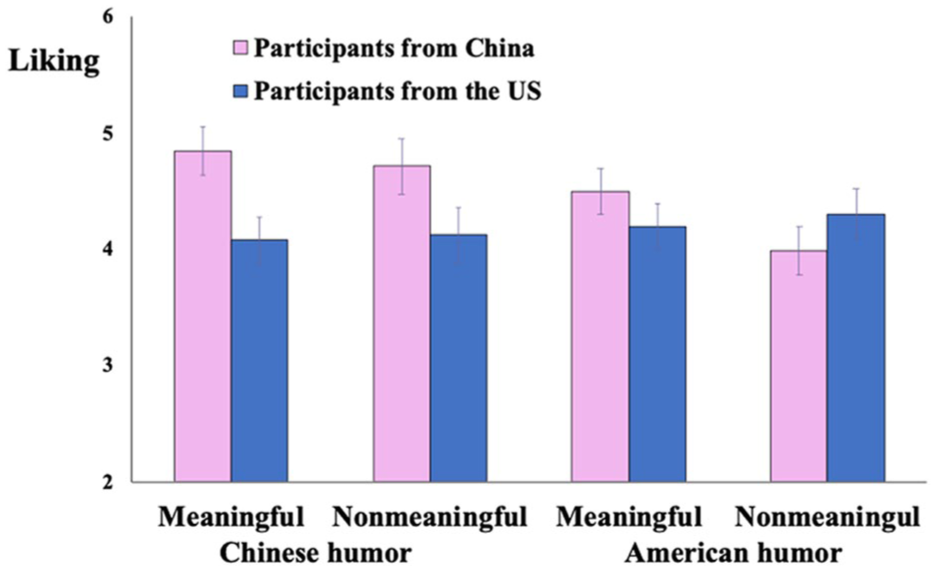
The effect of the culture, humor origin and meaningfulness on humor liking (Study 4).
Study 5
Study 4 demonstrated cultural differences in individuals’ appreciation of meaningful humor. Building on this, Study 5 explored the consequences of meaningful humor in more naturalistic contexts, examining whether Chinese participants would be more likely than American participants to like comedy movies that conveyed deeper meanings. This study’s design was preregistered; see https://aspredicted.org/njn8-8zmj.pdf
Method
Material and Procedure
We selected 10 Chinese comedy movies from China’ s Douban 14 and 10 American comedy movies from America’s Rotten Tomatoes websites (five from 2023 and five from 2024; see Supplementary Material). For each movie, we collected the first 50 user reviews based on their posting order, along with the same users’ overall evaluation or liking scores for the movies directly obtained from the respective websites. 15
Based on findings that contemporary large language models are capable of rating psychological constructs with human-level accuracy (Rathje et al., 2024), we used DeepSeek-V3 16 to evaluate the reviews to determine whether they conveyed “meaning”. Specifically, a trained DeepSeek model classified all the movie reviews into three categories: Explicitly stating that the movie conveyed meaning (labeled as 1); Explicitly stating that the movie lacked meaning (labeled as −1); No mention of meaning (labeled as 0).
Results
A linear mixed-effects model was conducted with liking ratings as the dependent variable, culture (1 = China, 2 = United States) and meaning (coded as 1 = meaning, 0 = no mention of meaning, −1 = no meaning) as fixed effects, and a random intercept for movie to account for movie-level variation. The results revealed a significant main effect of meaning, b = 1.84, SE = 0.14, p < .001, 95% CI [1.57, 2.11], indicating that movies conveying deeper meanings received higher liking ratings overall. The main effect of culture was not significant, b = 0.18, SE = 0.19, p = .333. Importantly, the interaction between culture and meaning was significant, b = 0.34, SE = 0.14, p = .018, 95% CI [0.07, 0.61]. Simple slope analyses (Figure 4) showed that, the positive association between meaningfulness and liking of the movies was stronger among Chinese viewers (b = 2.18, SE = 0.19, p < .001) than American viewers (b = 1.51, SE = 0.21, p < .001).17,18 Thus, meaningful comedies appealed to both Chinese and American reviewers, but meaningfulness might play a more important role in determining liking among Chinese than among Americans.
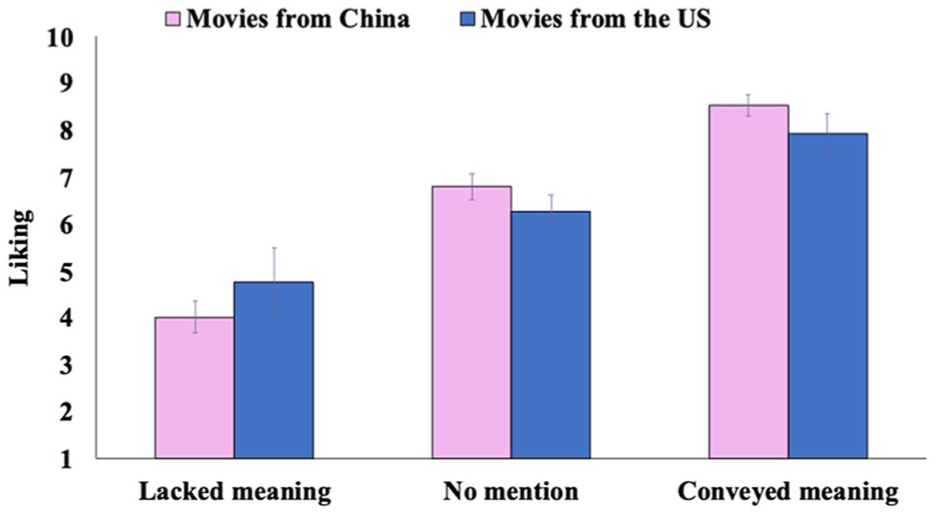
The effects of culture and meaning on movie liking (Study 5).
General Discussion
We found that Chinese participants associated humor with stronger meaningfulness than American participants (Study 1), and that such cultural differences were also manifested in humor production and appreciation. Specifically, humor produced by Chinese individuals tended to be more meaningful than that produced by Americans, both in controlled settings (Study 2) and in naturalistic social media settings (Study 3). Moreover, regardless of the humor origins, Chinese participants liked meaningful humor more than nonmeaningful humor, whereas American participants showed no preference (Study 4). Extending these findings, the research further found that the presence or absence of meaning in comedy movies had a bigger impact on the Chinese (than American) audience’s overall liking of movies (Study 5).
Implication
The present research is the first to systematically explore meaningfulness in humor across cultures, broadening our understanding of humor’s psychological functions across cultures. While previous studies primarily focused on how culture influences humor-related cognition, emotional expression, and behavior (Jiang et al., 2019; Lu, 2023), our findings provide deeper insights into why Eastern and Western cultures prefer different types of humor. Specifically, we show that humor production and appreciation in Chinese culture are closely tied to a meaning-seeking tendency, where humor is expected not only to entertain but also to convey educational, moral, or philosophical value. This tendency aligns with prior evidence showing that Chinese individuals are more inclined to search for and perceive meaning (Ding et al., 2024; Pressman & Bonanno, 2007), even in ambiguous contexts (Lin et al., 2022).
Our findings further demonstrate how the perception of meaning shapes affective responses to humor. Specifically, we consistently found that meaningful humor elicited stronger liking among Chinese participants than among Americans. This cultural difference highlights an important psychological function of humor: for Chinese individuals, the perception of meaning serves as an emotional amplifier, making humor more appreciated and socially acceptable when it carries implicit or explicit messages aligning with shared values. In contrast, American participants showed a more affectively neutral response to perceived meaning in humor, suggesting that amusement alone may be a sufficient condition for humor appreciation in the United States. As a result, this research provides a novel lens through which to understand cultural variation in emotional response patterns, not just in terms of what people laugh at, but why they feel good about it.
The present findings offer critical insights into the cross-cultural understanding of humor appreciation. In our studies, we measured humor appreciation through liking (i.e., how much participants liked the humorous stimuli). While some researchers (e.g., Ruch & Heintz, 2019) have used this approach, the broader literature has predominantly measured humor appreciation in terms of perceived funniness (i.e., how funny a humorous stimulus is perceived to be (e.g., Cao et al., 2021; Moran et al., 2014). Indeed, these two constructs are often treated as interchangeable, likely reflecting an implicit assumption, particularly in Western contexts, that people like what they find funny. Our findings challenge this assumption by revealing a distinctive cultural pattern: Chinese participants may appreciate a joke not primarily for its comedic value, but for its depth, meaning, or philosophical insight. Conversely, they may not appreciate a highly entertaining joke as much if it lacks substance or meaning. This distinction underscores the importance of differentiating between funniness and liking in humor research. By highlighting this distinction, our research offers a unique perspective to understand, conceptualize, and operationalize humor appreciation. It underscores the importance of adopting more culturally sensitive approaches in humor research and suggests new directions for investigating how humor operates and functions across cultures.
The present research has important practical implications. In Chinese culture, where meaning and meaning seeking are highly valued, humor can be a powerful vehicle for conveying important messages and perspectives. In contrast, American audiences often prefer light-hearted, purely entertaining humor that fosters a relaxed and enjoyable atmosphere. Understanding these cultural preferences is crucial for professionals engaged in cross-cultural interactions, such as business negotiators, diplomats, educators, and marketing teams. For example, in international business settings, humor that lacks deeper meaning may leave Chinese partners feeling disconnected or misunderstood. Diplomats who adjust their communication styles to meet cultural expectations can build stronger rapport and mutual understanding. Similarly, marketers can enhance the effectiveness of their campaigns by incorporating culturally relevant humor, such as adding meaningful humor elements to advertisements for the Chinese market. Social media platforms may benefit from the knowledge by optimizing recommendations and engagement based on audience preferences. Film production companies, comedians, and content creators can adjust their performance styles to better engage diverse audiences. Moreover, by incorporating culturally relevant and appropriate humor, educators can create more engaging and effective learning environments that resonate with diverse student populations.
Limitations and Future Directions
This research has some limitations. In Study 3, participants’ evaluations of each video provide direct evidence of humor-specific preferences and thus support our main conclusions. The observed cultural differences, however, may not be exclusive to humor. They could reflect a broader tendency among Chinese people, compared to Americans, to value meaningful content more generally. Future research could further examine whether this cultural preference for meaningfulness applies consistently across both humorous and non-humorous content, helping to clarify whether the observed effect is humor-specific or part of a wider cultural orientation toward meaning.
Although we carefully selected representative humorous stories from Chinese and American cultures through cultural sampling in Study 4, the limited number and types of stories may not fully capture the diversity of each culture’s humor. For instance, Chinese meaningful humor often draws on ancient fables, and American humor tends to focus on political satire. Such respective genres may evoke different cultural responses (Jiang et al., 2019). Future research may address this limitation by including a larger and more diverse set of humorous materials across various formats (e.g., stand-up routines, viral videos, everyday conversations), which would allow for a more comprehensive assessment of cultural variation in humor production and appreciation.
While the present research focuses on cultural differences, individual differences such as personality traits, emotional states, and cognitive styles may significantly influence both the appreciation and production of humor. Future research could explore how individual differences moderate people’s appreciation and creation of meaningful and nonmeaningful humor across different cultural contexts.
Future research may also explore how socioeconomic status or education levels influence humor across cultures. Chinese humor often involves a high level of artistic form and deep meaning, as it draws heavily on traditional cultural elements like historical references, fables, and legendary figures. This complexity raises the standards for both appreciating and creating humor, making it more dependent on cultural literacy. As a result, many Chinese people may feel that they have a lower sense of humor—not because they lack it, but because full appreciation of humor often requires extensive cultural knowledge. In contrast, American humor tends to be more direct, grounded in contemporary topics such as politics and everyday life, and generally more accessible. Cultural tightness-looseness may have contributed to these differences in humor topics and forms (Cao et al., 2025): tight cultures (e.g., China) maintain strict social norms and constrain acceptable forms of humor, whereas loose cultures (e.g., United States) tend to be more permissive and open to a broader range of humor expression. Consequently, humor may vary in accessibility and participation across cultural and socioeconomic lines. Our samples included mainly university-educated participants, although social media contributors and movie reviewers were more diverse. Future research may explore whether the patterns observed in this research generalize to broader populations with diverse educational backgrounds. For example, would individuals with less access to formal education or cultural resources in China also prefer meaningful humor, or might they respond more positively to primarily entertaining humor?
Future research may investigate the psychological functions of humor across cultures, particularly regarding how meaningful humor operates in different cultural contexts. For instance, does meaningful humor foster emotional bonding, enhance group cohesion, or communicate shared values more in some cultural contexts than others? We speculate that meaningful humor might fit tight cultures better than loose cultures, as it provides a socially acceptable way to reflect on life, reinforce collective ideals, and express sensitive issues indirectly. In such contexts, humor may function not only as a tool for expression but also as a subtle mechanism of social regulation. In contrast, loose cultures may place greater emphasis on entertainment and self-expressive functions of humor, with less attention to its collective or philosophical significance. Studying these differences will provide valuable insights into how humor not only entertains but also serves as a culturally shaped vehicle for connection, reflection, and meaning making.
In conclusion, humor is not universally understood, appreciated, or created in the same way. It serves as a cultural mirror, reflecting cultural values, priorities, and worldviews. While American humor emphasizes laughter and amusement, Chinese humor often seeks depth and meaning. Ultimately, humor does more than entertain—it reveals the soul of a culture, offering insights into how different societies make sense of the world.
Supplemental Material
sj-docx-1-psp-10.1177_01461672251405520 – Supplemental material for Beyond Laughter: How Culture Shapes the Meaning and Preference of Humor
Supplemental material, sj-docx-1-psp-10.1177_01461672251405520 for Beyond Laughter: How Culture Shapes the Meaning and Preference of Humor by Yi Cao, Yijiang Wang, Yubo Hou and Li-Jun Ji in Personality and Social Psychology Bulletin
Footnotes
Acknowledgements
We thank Kaiwen Tee for her help with an early version of the paper.

Author Contributions
Yi Cao and Li-Jun Ji: Conceptualization, Methodology, Project administration, Validation, Visualization, Writing—review and editing.
Yi Cao and Yijiang Wang: Data curation, Investigation
Yi Cao, Li-Jun Ji, and Yijiang Wang: Formal analysis
Yubo Hou, Yi Cao, and Li-Jun Ji: Funding acquisition, Supervision, Resources
Yi Cao: Software, Writing—original draft
All authors approved the final version of the manuscript for submission.
Funding
The authors disclosed receipt of the following financial support for the research, authorship, and/or publication of this article: This research received ethical approval from Peking University, and was supported by a grant from the National Natural Science Foundation of China (32271125) to Yubo Hou, and a grant from the China Postdoctoral Science Foundation (2024M760043) to Yi Cao, and a grant from the Social Sciences and Humanities Research Council of Canada (SSHRCC 435-2025-1116) to Ji.
Declaration of Conflicting Interests
The authors declared no potential conflicts of interest with respect to the research, authorship, and/or publication of this article.
Supplemental Material
Supplemental material is available online with this article.
Notes
References
Supplementary Material
Please find the following supplemental material available below.
For Open Access articles published under a Creative Commons License, all supplemental material carries the same license as the article it is associated with.
For non-Open Access articles published, all supplemental material carries a non-exclusive license, and permission requests for re-use of supplemental material or any part of supplemental material shall be sent directly to the copyright owner as specified in the copyright notice associated with the article.
