




Abstract
How does one attain meaning? Though pivotal to well-being, this question has been explored mainly within symbolic and philosophical domains, with little focus on its cognitive processes. We present a theoretical integration of meaning and attention, followed by five studies investigating their relationship in lab experiments and everyday life (total N = 1,654). Experimental findings indicate that meaning increased attention (Studies 1 and 3), and attention increased meaning, but only when meaning could be found in a stimulus (Studies 2a, 2b, and 3). An experience-sampling study further reveals a positive meaning–attention association at dispositional, situational, and cross-levels (Study 4). Across varied daily activities, participants reported greater meaning when they paid more attention. These studies also explored the interplay of meaning and attention with boredom, negative emotions, and subjective well-being. Together, our results suggest that paying attention during everyday activities can, in some instances, enhance the experience of meaning.
What would make you perceive this research as meaningful? The meaningfulness you ascribe to this article may depend on whether it makes sense, offers new insights, or serves your reading objective. After all, coherence, significance, and purpose are three core components of meaning (Heintzelman & King, 2014; Steger, 2012). But how exactly do you come to these evaluations? There ought to be cognitive processes via which meaning is constructed or perceived. Delineating these processes sheds light on how people find meaning in their daily lives, crucial for overall well-being (Li et al., 2021). Here, we propose paying attention is a key process through which one constructs and perceives meaning in situations. In turn, meaning captures and sustains attention. We argue that meaning and attention—thus far mostly studied in isolation—are intertwined. This research synthesized theories on meaning and attention, and investigated their relationship in experimental and everyday contexts.
Meaning
Well-being is categorized into two closely related types—hedonic (or subjective) well-being refers to life satisfaction and positive and negative affect and eudaimonic well-being refers to self-realization and perceived meaning in life (Ryan & Deci, 2001). Life meaning is thus a key dimension of well-being, predicting better mental health (Li et al., 2021). Meaninglessness is distressing as humans have a fundamental need for meaning (Heine et al., 2006).
What, then, is meaning? Meaning is defined as “relation” (Heine et al., 2006, p. 89), specifically, a “shared mental representation of possible relationships among things, events, and relationships” (Baumeister, 1991, p. 15). It is a feeling that offers information about the presence of reliable patterns and coherence within the surroundings (Heintzelman & King, 2014). Life is meaningful if it makes sense, has a purpose, and matters (Steger, 2012). There are diverse perspectives on how to enhance life meaning. For example, people can attain a sense of life meaning through constructing coherent life narratives (Rogers et al., 2023), keeping routines (Heintzelman & King, 2019), and engaging in prosocial behaviors (Klein, 2017).
Compared with the vast body of research on meaning in life, studies on how to enhance meaning in situations or moments (i.e., situational meaning) are scarce. Understanding the way to attain situational meaning is equally important because life meaning is constructed, at least in part, from meaning found in daily situations (Heintzelman & King, 2019; Van Tilburg & Igou, 2011b). However, research on this topic predominantly focuses on symbolic approaches to meaning regulation. According to the meaning maintenance model, meaning is “expected relations” (Heine et al., 2006). When these expected relations are violated, people will affirm alternative meaning frameworks to regain a sense of meaning, such as reinforcing social or cultural identities (Proulx et al., 2010; Van Tilburg & Igou, 2011a) and seeking reassurance in political ideologies (Maher et al., 2018; Van Tilburg & Igou, 2016) or moral beliefs (Randles et al., 2011). Practical approaches to attaining meaning, through exerting efforts, have been recently proposed (Campbell et al., 2025).
In other words, what is mostly known is how people gain situational meaning: (a) in the context of facing an expectation violation or a meaningless target, (b) through a symbolic approach, and (c) by turning toward alternative sources of meaning that are unrelated to the meaningless target. Less is known about how people perceive and construct meaning, and what shapes the perceived meaning of a target. Previous work has examined effort, identities, or beliefs as sources of meaning, or put differently, things that provide meaning. This research focused, however, on studying a cognitive pathway for the construction or perception of meaning. Investigating this is important as it sheds light on a direct approach to enhance situational meaning. Specifically, we propose attention to be that pathway.
How Attention and Meaning Relate?
Attention is a process of focusing cognitive resources on specific aspects of their environment while ignoring other aspects (American Psychological Association, n.d.). It is controlled by the dynamic interaction of top-down and bottom-up processes (Corbetta & Shulman, 2002). For top-down processes, people’s knowledge, expectation and goal shape attentional selection and prioritization (e.g., Le Pelley et al., 2016); for bottom-up processes, attention is drawn toward salient stimuli (e.g., Nothdurft, 2002). The ability to sustain attention for extended periods is critical for most daily tasks, like driving, communicating, and learning.
How attention relates to meaning has only been studied in two specific contexts: boredom and the workplace. Boredom is distinguished from other negative emotions by its combination of inattention and meaninglessness (Van Tilburg & Igou, 2017). While contemporary models treat these two facets as fundamental to understanding boredom, they differ in how they do so. The meaning and attention component (MAC) model of boredom (Westgate & Wilson, 2018) suggests that meaning and attention are not highly correlated; they independently predict boredom, forming different experiential profiles of boredom. In contrast, the boredom feedback model (Tam et al., 2021) posits that meaning and attention are interrelated in the experience of boredom. Supporting this, occupational research has consistently demonstrated a positive association between work meaningfulness and employee engagement (e.g., Kaur & Mittal, 2020; Soane et al., 2013; Vogel et al., 2020).
Theoretical Integration for Meaning and Attention
Yet, beyond the specific contexts of boredom and workplace, research on meaning and attention has largely progressed in parallel, and rarely cited each other. Here, we bridge these disparate lines of work. We integrate theoretical and empirical findings from both fields to propose their interconnectedness. We propose that attention facilitates the construction and perception of meaning. Meaning not only guides attentional allocation, but also makes stimuli salient, thereby capturing and sustaining attention.
First, people’s inclination to group similar perceptual objects aligns with their tendency to make meaning. Meaning research suggests that people are meaning-makers (Heine et al., 2006) and that meaning is a “web of connections” (Steger, 2012, p. 165). This parallels the findings in attention research that shows that the human visual system tends to group objects into an organized whole—a phenomenon termed perceptual grouping—by features, such as similarity, synchrony, and connectedness (see review by Wagemans et al., 2012). People spontaneously allocate attention to search for and group objects that exhibit coherence (e.g., Kerzel et al., 2012). Attention likely facilitates searching, grouping, and connecting objects, and in so doing may facilitate construction and perception of meaning.
Second, meaning offers mental representations that guide attention. Whereas meaning is a “shared mental representation of possible relationships among things, events, and relationships” (Baumeister, 1991, p. 15), attention is allocated to perceptual objects that are organized by a prior process (Kahneman & Henik, 2017). Information about objects learned in advance, such as a “perceptual set” or internal representations held in working memory, facilitates top-down attentional allocation (e.g., Griffin & Nobre, 2003). Based on these, meaning likely helps guide the allocation of attention.
Third, meaning renders stimuli salient and rewarding, which in turn captures and sustains attention. Cognitive research demonstrates that attention is automatically drawn to salient stimuli (Nothdurft, 2002), such as those exhibiting coherence (e.g., Zhao et al., 2013) or linked to monetary reward in previous tasks (e.g., Hickey et al., 2015). Attention can be sustained by rewards (Massar et al., 2016). From the meaning literature, meaningful things are characterized by high coherence, values, and significance (Steger, 2012); they are likely rewarding, thereby enhancing attention.
Fourth, neuropsychological evidence hints at the intertwining relationship between meaning and attention. Coherence, a cognitive aspect of meaning (Heintzelman & King, 2014), in stimuli is detected by two brain regions, the basal ganglia and orbitofrontal cortex (Lieberman, 2000; Volz et al., 2008). These two very regions are also involved in modulating attentional allocation (Hartikainen et al., 2012; Van Schouwenburg et al., 2015). This suggests a shared neural substrate for both detecting meaning and guiding attention.
Taken together, we theorize that paying attention is a process through which one constructs or perceives meaning, while meaning captures and sustains attention. Note that we do not claim attention to be the only or always necessary process for meaning perception. Previous research has shown that meaninglessness (Proulx & Heine, 2008; Van Tongeren & Green, 2010) or regularities in visual environment (Turk-Browne et al., 2005, 2009) can sometimes be detected without subjective awareness. We see the attention–meaning relationship as similar to tuning a radio: When the dial is turned just right, static noise fades and music comes through clearly. Similarly, paying attention helps people perceive a stimulus’s meaningfulness, or lack thereof, more clearly. Attention facilitates the construction and perception of meaning. Based on these theoretical propositions, we propose that meaning and attention are closely related, with a relationship that is positive, reciprocal, and causal.
Current Research
This research serves as the first step in investigating theorized meaning–attention relationship in lab experiments and everyday life. It focuses on sustained attention and situational, subjective experience of meaning as characterized by coherence, significance, and purpose. We hypothesized that meaning causally increases attention (Hypothesis 1a), attention causally enhances meaning (Hypothesis 1b), and that meaning and attention are positively associated (Hypothesis 1c). A series of experiments first tested whether meaning increases attention (Study 1), whether attention enhances meaning (Studies 2a and 2b), as well as the interactive effects of meaning and attention (Study 3). We developed novel paradigms for manipulating situational meaning and attention (see Pilot Studies 1-8 in the Supplement). Finally, we generalized the experimental findings to everyday contexts by examining the meaning–attention relationship at dispositional, situational, and across levels in an experience-sampling study (Study 4).
Across all studies, we investigated the relationships of meaning and attention with boredom, negative emotions, and subjective well-being as a secondary objective. This objective was motivated by the ongoing debates about how they relate with boredom (Igou et al., 2024), and the unclear causality and directionality of their associations with negative emotions and subjective well-being. Detailed results are provided in the Supplement.
Transparency and Openness
We pre-registered the study designs, sample sizes, exclusion criteria, hypotheses, procedures, measures, and analyses for all our experiments except Study 2b (https://aspredicted.org/BJJ_W7D; https://aspredicted.org/MX4_KNT; https://aspredicted.org/FTQ_MPB). The analysis plan for experience-sampling Study 4 was also pre-registered (https://osf.io/g7hdk/?view_only=bacbbfc054b04b67bd152ff04f8da19a). All data, codes, and surveys are available via the Open Science Framework (https://osf.io/a3u2c/?view_only=5e96975f721c407fbf1d38aa8d471bca). This research received approval from the ethics review boards of the University of Toronto (Studies 1-3), and the University of Hong Kong (Study 4).
Study 1: The Effect of Meaning on Attention
We propose that meaning captures and sustains attention. In other words, we expect that meaning causally increases attention (Hypothesis 1a). Study 1 was a between-participants experiment, where we manipulated participants’ feeling of meaning (high vs. low) and measured their attention. It was pre-registered at https://aspredicted.org/BJJ_W7D.
Method
Participants
Based on the estimated effect size from pilot data (d = 0.29; see Pilot Study 3 in the Supplement), we targeted a minimum sample of 376 participants (α = .05, power = 0.80). We recruited 420 U.S. nationals residing in the United States via Prolific, who received £1.50 for participating. After excluding those who did not complete the experiment (n = 15) and those who failed an attention check 1 (n = 3), we had a sample of 402 participants, 180 female and 214 male, eight other/not disclosed; age range = (19, 74), M = 42.5, SD = 12.9.
Meaning Manipulation
Previous experiments have manipulated meaning in various ways. Some have manipulated meaning through coherence by changing experimenters (Proulx & Heine, 2008), presenting coherent versus incoherent word triads (Heintzelman et al., 2013; Randles et al., 2011), or altering seasonal patterns in photographs (Heintzelman et al., 2013). Other studies have manipulated meaning through purpose, for example, by making donations according to participants’ task performance (Westgate & Wilson, 2018), or by framing tasks as either medically significant or meaningless (Chandler & Kapelner, 2013). Notably, no existing research has simultaneously targeted all three theorized meaning components—coherence, significance, and purpose—likely due to practical infeasibility.
These approaches have two limitations. First, none of the studies using coherence-based manipulations directly measured situational meaning, leaving it unclear whether meaning was successfully altered. Second, purpose-based manipulations may inadvertently influence participants’ motivation to exert effort, which is known to enhance sustained attention (Unsworth et al., 2022), thereby confounding our outcome variable. In addition, significance and purpose are highly subjective and context-dependent (Van Tilburg & Igou, 2013), making them difficult to manipulate consistently in controlled experiments. Also, providing participants with a purpose essentially gives them an anchor of attention, directly influencing the outcome variable we sought to investigate.
In light of these, we developed a novel paradigm to manipulate meaning through coherence rather than significance or purpose. We designed and constructed two 5-minute animated videos (for inducing high vs. low meaning), 2 featuring objects in motion accompanied by background audio. This approach was inspired by Heider and Simmel’s (1944) paradigm for assessing social attribution. Both videos showcase identical moving objects, but those in the high meaning video visually follow the Three Little Pigs narrative, while those in the low meaning video move arbitrarily. Both videos use the same audio segment; however, in the high meaning video, the audio remains coherent, while in the low meaning video, it is cut and rearranged to sound chaotic and nonsensical. Participants were merely instructed to watch either video. Figure 1 presents screenshots of the videos.
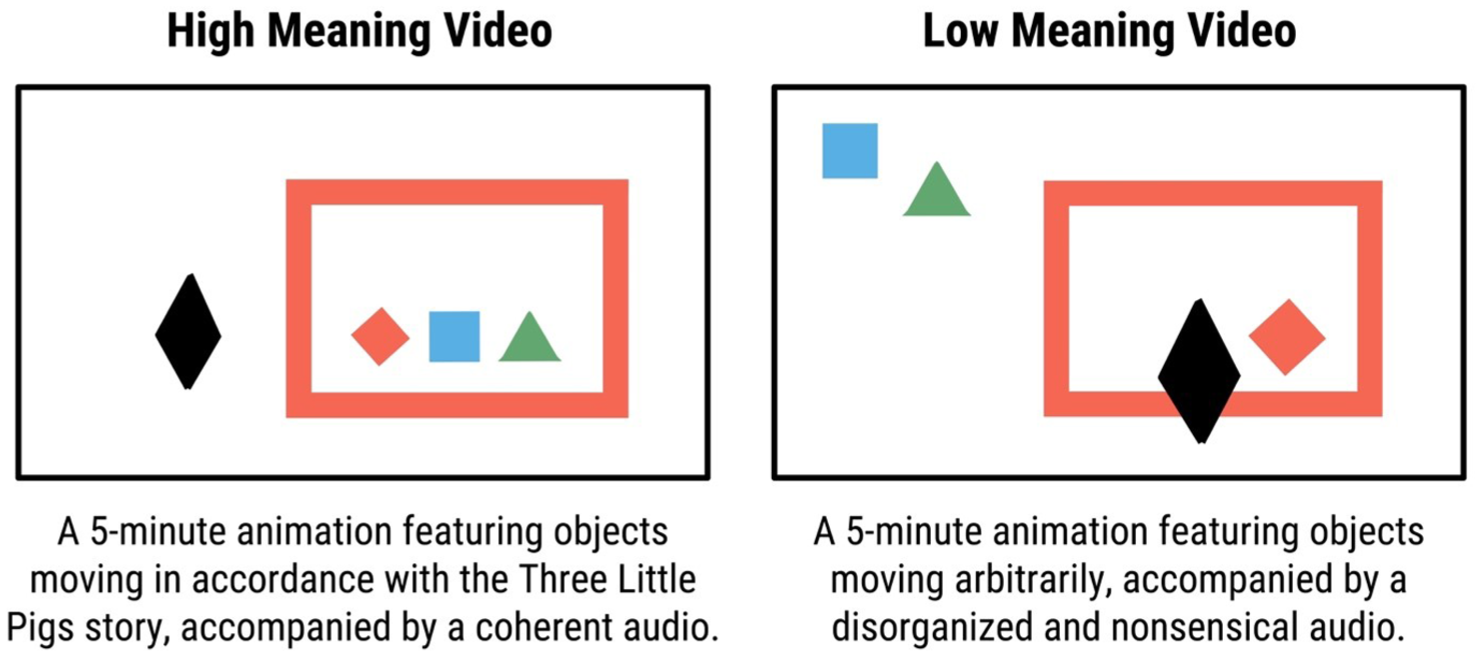
High and Low Meaning Videos in Study 1.
This paradigm allows us to maintain consistency in visual and auditory stimuli, while altering content’s coherence to manipulate situational meaning. It controls for participants’ motivation to exert effort, as they receive the same instruction and incentive to watch the video. We pilot tested the videos, and they successfully induced high and low levels of meaning (see Pilot Studies 1 and 3 in the Supplement). Importantly, although we only altered the coherence of the videos, our manipulation impacted all three theorized components of meaning—coherence, significance, and purpose—as our measure of meaning captures all these components (see Table 1). This suggests that we manipulated situational meaning as a whole, not just coherence.
Measures in Studies 1 to 4.
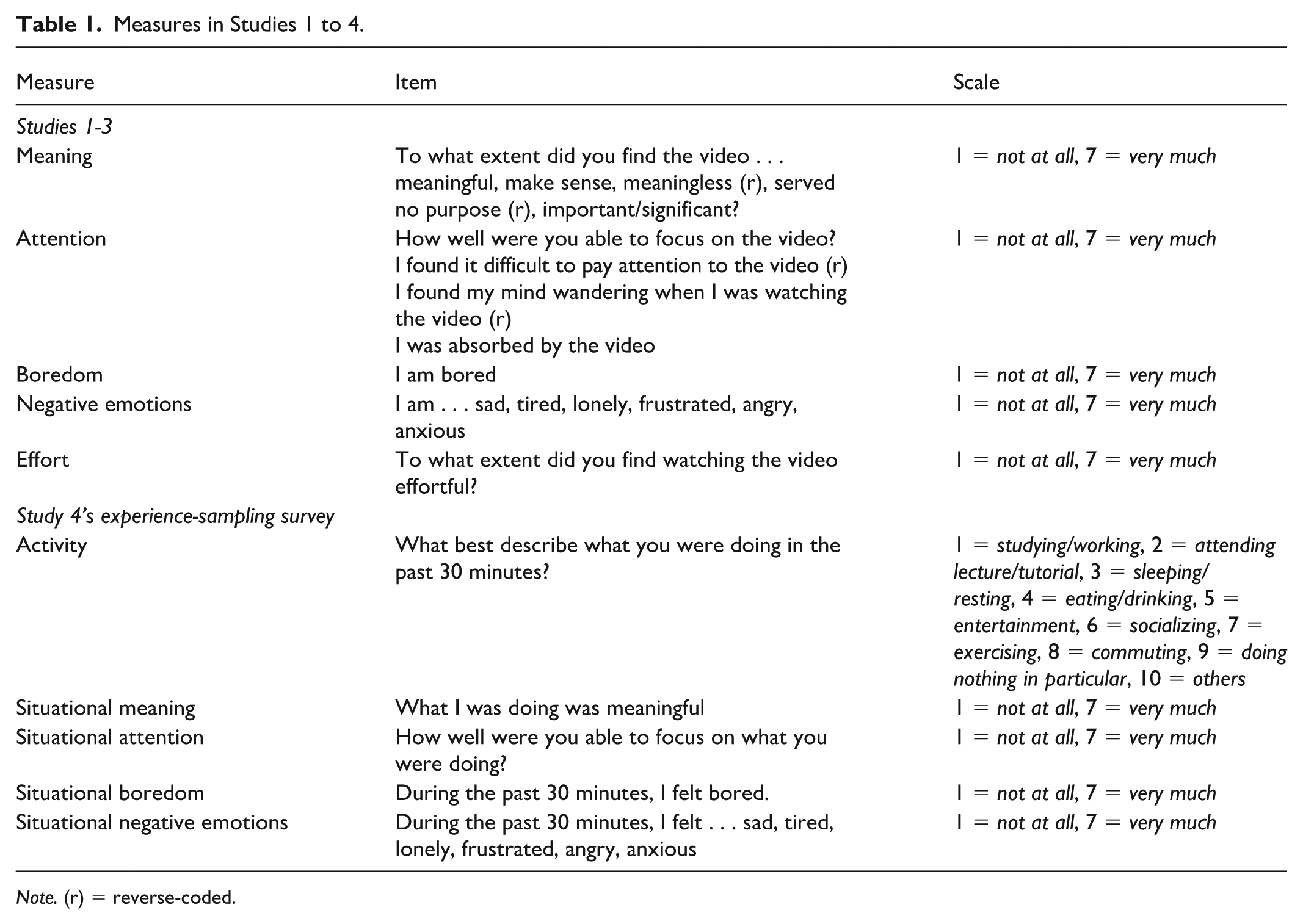
Note. (r) = reverse-coded.
Procedure and Measures
To disguise the study’s purpose, we informed participants that the study was about “visual stimulation and affective experiences.” After providing informed consent and demographics, participants reported their levels of boredom and negative emotions (α = .89). They were then randomly assigned to high or low meaning condition and watched the corresponding video (Figure 1). Next, they reported their levels of boredom and negative emotions (α = .86) again, as well as video meaningfulness (α = .93), attention to the video (α = .90), and effort. Table 1 presents all the measures. As pre-registered, we removed outlier responses that were 3 SD above or below the mean. This included three outliers for meaning in the low meaning condition; four for pre-test negative emotions in high meaning condition and four in low meaning condition; and five for post-test negative emotions in high meaning condition and one in low meaning condition.
Results and Discussion
To check whether our meaning manipulation was effective, we conducted an independent samples t-test to compare the levels of meaning between conditions. Meaning was significantly higher in the high meaning condition (M = 3.21, SD = 1.65), compared with the low meaning condition (M = 1.90, SD = 1.22), t(363.26) = 8.99, p < .001, d = 0.90; a large effect. It indicates a strong, successful manipulation of meaning.
From an independent samples t-test, participants in the high meaning condition (M = 4.72, SD = 1.59) reported higher attention than those in the low meaning condition (M = 3.95, SD = 1.63), t(400) = 4.81, p < .001, d = 0.48, 95% confidence interval (CI) = (0.28, 0.68) (Figure 2). Participants in the high meaning condition also reported lower levels of boredom, negative emotions, and effort than those in the low meaning condition (see Table S4).
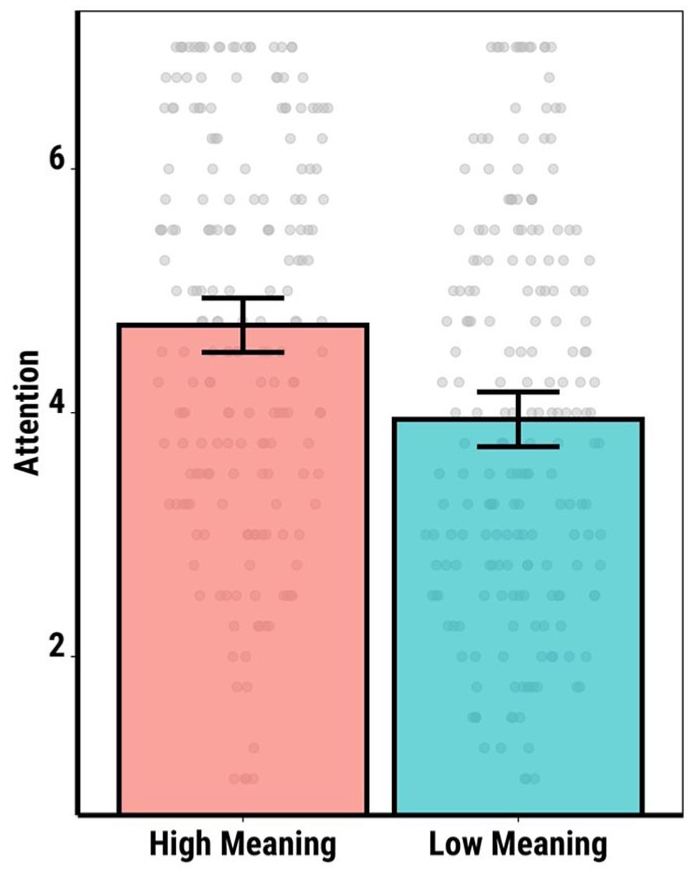
Mean Attention With 95% Confidence Intervals as a Function of Meaning Manipulation in Study 1.
Study 1 manipulated meaning and measured attention. Results show that meaning causally increased attention (Hypothesis 1a), while reducing boredom, negative emotions, and effort. Furthermore, we developed a novel paradigm that effectively manipulated situational meaning with a large effect.
Study 2a: The Effect of Attention on Meaning
Study 1 demonstrates that meaning enhanced attention. In Study 2a, we examined this relationship in the opposite direction—the effect of attention on meaning. We propose that paying attention is a process via which one constructs and perceives meaning. In other words, we expected that attention causally increases meaning (Hypothesis 1b). Study 2a was a between-participants experiment, where we manipulated participants’ attention (high vs. low) and measured their feeling of meaning. We pre-registered it at https://aspredicted.org/MX4_KNT.
Method
Participants
A power analysis indicated that obtaining a small effect size of d = 0.30 (α = .05, power = 0.80) required a minimum of 352 participants. We recruited 371 U.S. nationals residing in the United States via Prolific, who received £1.50 for participating. Excluding those who did not complete the experiment (n = 11) and those who failed an attention check (n = 2) resulted in a sample of 358 participants, 160 female and 190 male, eight other/not disclosed; age range = (19, 76), M = 41.9, SD = 12.6.
Attention Manipulation
Existing paradigms to manipulate attention are not suitable for our experiment because they influence constructs other than attention that are closely related to our outcome variable, meaning. Meaning is related to boredom (Van Tilburg & Igou, 2011a), effort (Campbell et al., 2025), and goal value (Van Tilburg & Igou, 2013). Unfortunately, existing attention manipulation paradigms, such as altering difficulty of attention tasks (Seli et al., 2016; Westgate & Wilson, 2018) or introducing distractions (McCaul et al., 1992; Zhang et al., 2020), likely vary levels of effort, goal value, and sensory input along with attention. Existing objective assessments for attention are also not suitable because they tend to be boring (Hunter & Eastwood, 2016) and effortful (Warm et al., 2008).
Our experiment had to control for variables other than attention that could vary meaning between conditions. Therefore, we sought to develop a novel attention manipulation paradigm that keeps effort, goal value, and sensory input as constant across conditions as reasonably possible. We also aimed to ensure that the task in one condition was not inherently more boring than that in another. We conducted a series of pilot tests to develop and refine our final manipulation for Study 2a (see Pilot Studies 2-8 in the Supplement for details).
In the selected paradigm, individuals in both high and low attention conditions watched the same 5-minute animation featuring objects moving in alignment with the Three Little Pigs narrative. Unlike the high and low meaning videos in Study 1, this video was accompanied by a lecture audio about beetroot—content entirely unrelated to the visual story. The difference between high and low attention conditions lay in the instructions given before viewing the video: those in the high attention condition are instructed to focus on the visual content while disregarding the audio, whereas those in the low attention condition are instructed to divert their attention to personal thoughts and reflect on their day and tasks while watching the video. Detailed instructions are presented in the Supplement (Tables S2 and S3).
This paradigm keeps effort, goal value, sensory input, and task boringness as constant as possible for both conditions, as people in both groups view the same video and receive similar instructions, with the only difference being on where they direct attention. It also provides people with content conducive to meaning-making.
Procedure and Measures
As in Study 1, we informed participants that the study was about “visual stimulation and affective experiences.” Participants first provided informed consent, demographics, and their levels of boredom and negative emotions (α = .87). They were then randomly assigned to either the high or low attention condition and watched the 5-minute animated video. Following the video, participants reported their levels of attention to the video (α = .86), video meaningfulness (α = .89), boredom, negative emotions (α = .87), and effort. The measures were identical across Studies 1 to 3 (Table 1). In this and the following Studies 2b and 3, participants also answered five multiple-choice questions concerning the video’s visual story as an objective measure of attention (e.g., “What is the color of the square?”; see Table S3). As pre-registered, we removed outlier responses that were 3 SD above or below the mean. This included one outlier for pre-test negative emotions in high attention condition and one in low attention condition; and five for post-test negative emotions in high attention condition and three in low attention condition.
Results and Discussion
To check whether our attention manipulation was effective, we ran independent samples t-tests to compare the self-report and objective levels of attention between conditions. Compared with those in the low attention condition (M = 4.32, SD = 1.56), participants in the high attention condition (M = 5.02, SD = 1.41) reported higher attention to the video, t(356) = 4.47, p < .001, though the effect (d = 0.47) was modest in size for a manipulation. They also provided a greater number of correct answers in response to multiple-choice questions regarding the video’s visual story (M = 3.42, SD = 1.34) than those in the low attention condition (M = 2.53, SD = 1.29), t(356) = 6.35, p < .001, d = 0.67.
Contrary to our hypothesized direction, an independent samples t-test indicated that participants in the high attention condition (M = 3.67, SD = 1.73) reported lower video meaningfulness than those in the low attention condition (M = 4.25, SD = 1.56), t(356) = –3.31, p = .001, d = –0.35, 95% CI = (–0.56, –0.14) (Figure 3). There was no significant difference in boredom, negative emotions, and effort between conditions (see Table S5).
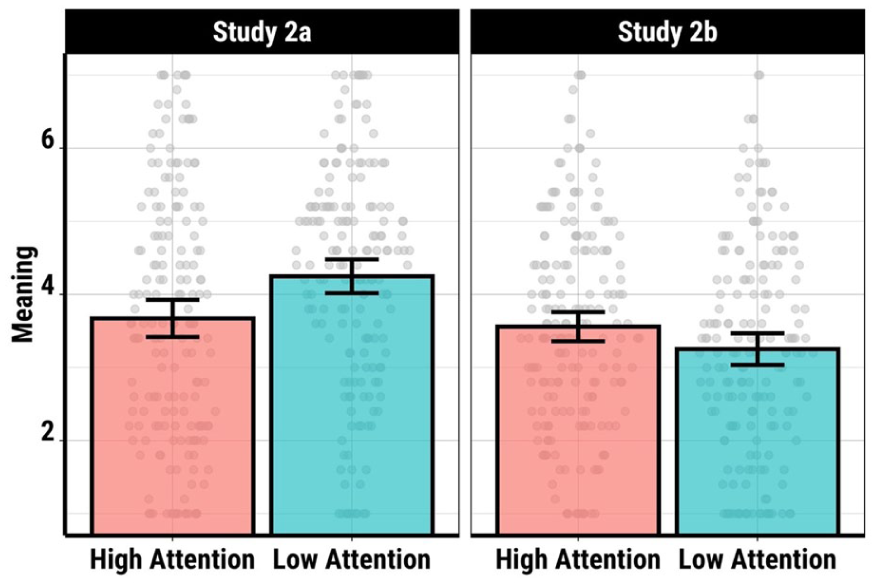
Mean Meaning With 95% Confidence Intervals as a Function of Attention Manipulation in Studies 2a and 2b
Study 2a manipulated attention and measured meaning. We expected attention to boost meaning (Hypothesis 1b); however, it diminished it. Past research indicates that work meaningfulness and engagement are positively correlated (e.g., Vogel et al., 2020). We also found positive meaning–attention correlations across Studies 1, 2a, and 2b (see Table S8). One possible explanation is that, while these studies reveal a general tendency for meaning and attention to be positively associated, the effect of attention on meaning may be contingent on target’s inherent meaningfulness. In this experiment, the video participants watched were incoherent, featuring the Three Little Pigs narrative accompanied by audio about beetroot. Participants who paid high attention might have processed it more deeply and hence found it more meaningless. Attention may only increase meaning when the stimulus affords meaning. To test this possibility, we ran Study 2b which manipulated participants’ attention toward a meaningful video.
Study 2b: The Effect of Attention on Meaning
Contrary to Hypothesis 1b, Study 2a indicates that attention reduced meaning. We speculated that attention might only increase meaning when the stimulus affords meaning to be extracted from it. Study 2b investigated this with a between-participants experimental design, where participants viewed the high meaning video from Study 1. It featured a manipulation of attention (high vs. low) and measured participants’ feeling of meaning. Since it largely resembled Study 2a, we did not make a separate pre-registration for the study. 3
Method
Participants
As in Study 2a, we targeted a minimum sample of 352 participants, which affords 80% power to obtain a small effect size of d = 0.30 (α = .05). A total of 570 students from the University of Toronto Scarborough participated for course credits. Excluding those who did not complete the experiment (n = 71), who failed either of the three attention check items (n = 102), as well as duplicate responses (n = 19) resulted in a sample of 378 participants, 240 female and 135 male, three other/not disclosed; age range = (17, 44), M = 18.8, SD = 1.94.
Procedure and Measures
The procedure in Study 2b was identical to that of Study 2a, with the only difference being the audio accompanying the video. In both studies, participants watched the same animation of the Three Little Pigs. However, in Study 2a, the animation was paired with an unrelated lecture audio about beetroot, whereas in Study 2b, it was accompanied by coherent audio (i.e., the high meaning video from Study 1). The attention manipulation remained the same across both studies. This study used the same measures as Studies 1-3 (Table 1), assessing attention to the video (α = .82), video meaningfulness (α = .83), boredom, effort, and negative emotions (pre-test α = .86, post-test α = .82). We removed two outlier responses for post-test negative emotions in high attention condition and one in low attention condition, that were 3 SD above or below the mean.
Results and Discussion
Our attention manipulation was successful, as evidenced by significant differences in self-report and objective levels of attention between conditions. Participants in the high attention condition (M = 4.57, SD = 1.41) reported higher attention to the video than those in the low attention condition (M = 4.07, SD = 1.38), t(376) = 3.41, p < .001, d = 0.35. They also provided a greater number of correct answers in response to multiple-choice questions regarding the video’s visual story (M = 4.07, SD = 1.11) than those in the low attention condition (M = 3.53, SD = 1.37), t(348.71) = 4.18, p < .001, d = 0.43.
Consistent with our hypothesized direction, an independent samples t-test indicated that participants in the high attention condition (M = 3.56, SD = 1.42) reported higher video meaningfulness than those in the low attention condition (M = 3.25, SD = 1.48), t(376) = 2.05, p = .041, d = 0.21, 95% CI = (0.009, 0.41) (Figure 3). There was no significant difference in boredom, negative emotions and effort between conditions (see Table S6).
Study 2b manipulated attention and measured meaning. Supporting our prediction, results show that attention causally enhanced meaning (Hypothesis 1b) when the stimulus was meaningful. Regarding the differences in results between Studies 2a and 2b, we speculate that the effect of attention on video meaningfulness depends on the video’s inherent meaning. In Study 2a, where the video was paired with lecture audio about beetroots, participants who focused on personal thoughts (low attention condition) likely processed the video less deeply, which made the mismatch between audio and visuals less salient to them. As a result, they perceived the video as more meaningful. In Study 2b, where the video was accompanied by coherent audio, participants who focused on personal thoughts (low attention condition) would be less able to process the narrative meaning of the video. Consequently, they provided more incorrect answers to multiple-choice questions regarding the video’s visual story and rated the video as less meaningful. Considering that the effect of attention on meaning appears to depend on the stimulus’s meaningfulness, we conducted Study 3 as a more robust test of this potential interactive effect.
Study 3: The Interactive Effect of Meaning and Attention
Study 2a reveals that attention decreased meaning, whereas Study 2b shows that attention increased meaning. Reviewing these findings, we hypothesized that there is an interaction between meaning and attention on people’s feeling of meaning. We predicted that attention increases meaning in high meaning condition, but not in low meaning condition. Study 3 tested this with a 2 (attention: high vs. low) × 2 (meaning: high vs. low) counterbalanced stimulus exposure experimental design. It was pre-registered at https://aspredicted.org/FTQ_MPB.
Method
Participants
We conducted a power analysis with 1,000 simulations using estimates obtained from pilot data (see Pilot Study 9 in the Supplement). With an alpha level of .05, power goes beyond 80% when the sample size is over 200. Therefore, we targeted to recruit a minimum sample of 200 participants. A total of 425 University of Toronto Scarborough’s students participated for course credit. Excluding those who did not complete the study (n = 33), those who failed either of the two attention check items (n = 57), and duplicate responses (n = 10) resulted in a sample of 325 participants, 222 female and 99 male, four other/not disclosed; age range = (17, 24), M = 18.7, SD = 1.25).
Procedure and Measures
This was a 2 (attention: high vs. low) × 2 (meaning: high vs. low) experiment with a counterbalanced stimulus exposure design (Westfall et al., 2014). Specifically, after providing informed consent, demographics, and reporting their pre-test emotions, they faced two of the four combinations of the attention manipulation and meaning manipulation: either they went through (a) the high attention high meaning condition and the low attention low meaning condition or (b) the high attention low meaning condition and low attention high meaning condition. The use of this counterbalanced design prevented participants from viewing the identical audio or visual stimulus twice, while partly benefiting from the efficiency of a within-participant structure. The order of the two assigned conditions was random.
As in Study 1, participants in the high meaning condition watched a 5-minute animation depicting the Three Little Pigs narrative with coherent audio, while those in the low meaning condition watched random object movements with incoherent audio. As in Studies 2a and 2b, participants in the high attention condition were instructed to focus on the visual content and ignore the audio, whereas those in the low attention condition were instructed to reflect on their day and upcoming tasks while watching.
After each condition, participants reported their levels of attention to the video (α = .87), video meaningfulness (α = .81), boredom, effort, and negative emotions (α = .83; Table 1). There was a filler task between the two conditions to prevent carryover effect. The filler task was a descriptor task (Schlegel et al., 2011), where participants spent a few minutes writing descriptors they believed best describe “breakfast,” “holiday,” and “country.” As pre-registered, we removed outlier responses that were 3 SD above or below the mean. This included: one outlier for meaning in low attention low meaning condition and one in high attention low meaning condition; two for negative emotions in high attention high meaning condition, one in low attention low meaning condition, and one in low attention high meaning condition.
Results
Means and standard deviations of the outcome variables for each condition are presented in Table S9.
Attention
We conducted a random-intercept multilevel model on attention, specifying the attention condition, the meaning condition and their interaction term as fixed effects, and participant as random intercept. It supported the predicted main effect of the attention condition (i.e., manipulation check), F(1, 323) = 46.1, p < .001, where attention was generally higher in the high attention condition (M = 4.24, SE = 0.082) than in the low attention condition (M = 3.57, SE = 0.082). Our attention manipulation was effective. Moreover, we found a main effect of the meaning condition (i.e., test of Hypothesis 1a), F(1, 323) = 30.9, p < .001, where attention was generally higher in the high meaning condition (M = 4.18, SE = 0.082) than in the low meaning condition (M = 3.63, SE = 0.082). This suggests that meaning increased attention (Hypothesis 1a), replicating Study 1’s results. The two-way interaction was not significant, F(1, 323) = 0.18, p = .673.
Meaning
We conducted a random-intercept multilevel model on meaning, specifying the attention condition, the meaning condition, and their interaction term as fixed effects, and participant as random intercept. It revealed a non-significant main effect of the attention condition (i.e., test of Hypothesis 1b), F(1, 318.17) = 1.22, p = .269, a significant main effect of the meaning condition (i.e., manipulation check), F(1, 318.17) = 99.5, p < .001, and a non-significant interaction, 4 F(1, 319.04) = 3.13, p = .078 (Figure 4).
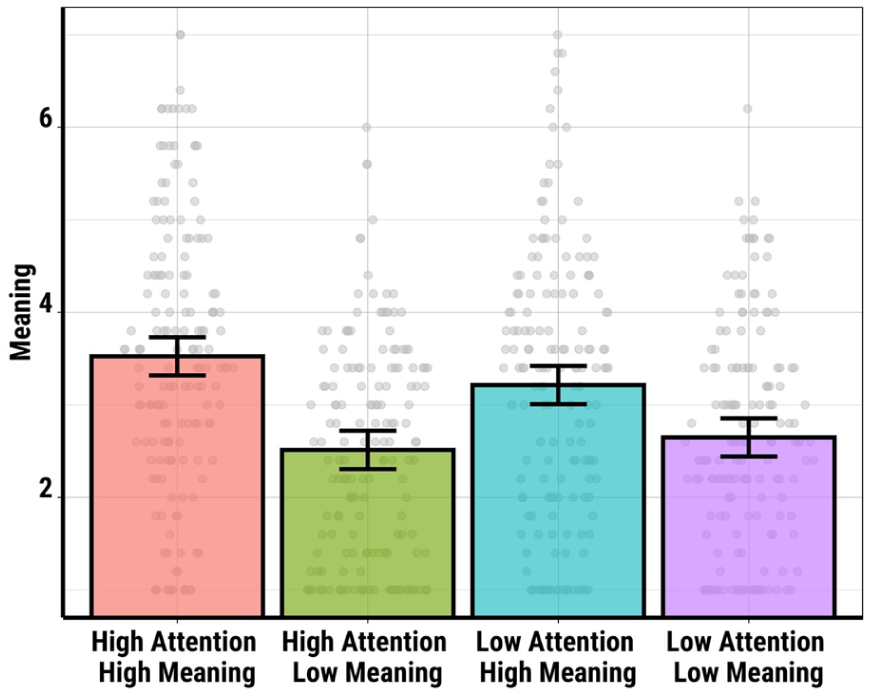
Estimated Marginal Means of Meaning With 95% Confidence Intervals as a Function of Attention and Meaning Manipulations in Study 3.
We followed up with simple effects analyses. The meaning condition had a significant effect on video meaningfulness in both the high attention, F(1, 540.74) = 46.3, p < .001, and low attention conditions, F(1, 540.73) = 14.5, p < .001, suggesting that our meaning manipulation was successful. Furthermore, aligned with our prediction, the attention condition had a significant effect on video meaningfulness in the high meaning condition, F(1, 539.86) = 4.36, p = .037, but not in low meaning condition, F(1, 541.61) = 0.82, p = .365. As shown in Figure 4, in the high meaning condition, participants in the high attention condition (M = 3.53, SE = 0.11) reported higher video meaningfulness than those in the low attention condition (M = 3.21, SE = 0.11). In the low meaning condition, there was no significant difference in video meaningfulness between the high attention (M = 2.51, SE = 0.11) and low attention (M = 2.65, SE = 0.11) conditions.
Boredom, Negative Emotions, and Effort
We present the results of random-intercept multilevel analyses for boredom, negative emotions, and effort in the Supplement. In brief, we observed significant main effects of meaning condition on boredom and negative emotions, with non-significant main effects of attention condition and non-significant interactions. There was no main or interaction effects on effort.
Discussion
Study 3 manipulated and measured both meaning and attention. Results indicate that meaning increased attention, which replicated Study 1’s findings. Although the meaning × attention interaction on meaning was not significant, we found that attention increased meaning in the high meaning condition but not in the low meaning condition. It partially supports our insights derived from Studies 2a and 2b’s findings, that the effect of attention on meaning varies depending on the stimulus’s meaningfulness. It appears that attention is involved in constructing meaning when encountering a meaningful stimulus; otherwise, its significance will be overlooked.
Study 4: Meaning and Attention in Everyday Life
Studies 1 to 3 tested the directionality and causality of the meaning–attention relationship in controlled experiments. What are the implications of these results in everyday life? Study 4 extended our experimental findings into real-world contexts by examining the interplay of meaning and attention not only at the situational level, but also at the dispositional level and across levels. It tested whether simple act of paying attention is linked to higher sense of meaning across diverse daily activities. In this 1-week experience-sampling study, we examined the meaning–attention relationships both between-persons (i.e., individual differences; how constructs vary from one person to another) and within-person (i.e., intraindividual fluctuations; how constructs vary from one occasion to another). We predicted that meaning and attention are positively associated (Hypothesis 1c). Data were gathered as part of a larger project; only measures relevant to this research are reported. We pre-registered the analysis plan at https://osf.io/g7hdk/?view_only=bacbbfc054b04b67bd152ff04f8da19a.
Method
Participants
We recruited 226 participants from the University of Hong Kong through a campus-wide email, offering HKD$100 (~U.S.$12.8) as compensation. Excluding duplicated responses in the baseline survey (n = 8) and participants who did not proceed to the experience-sampling component of the study (n = 27) resulted in a final sample of 191 participants, 138 female and 51 male, two other/not disclosed; age range = (18, 53), M = 23.1, SD = 4.47. The majority (97.9%) were undergraduate or postgraduate students.
Procedure and Measures
Figure 5 outlines the study procedure and measures.
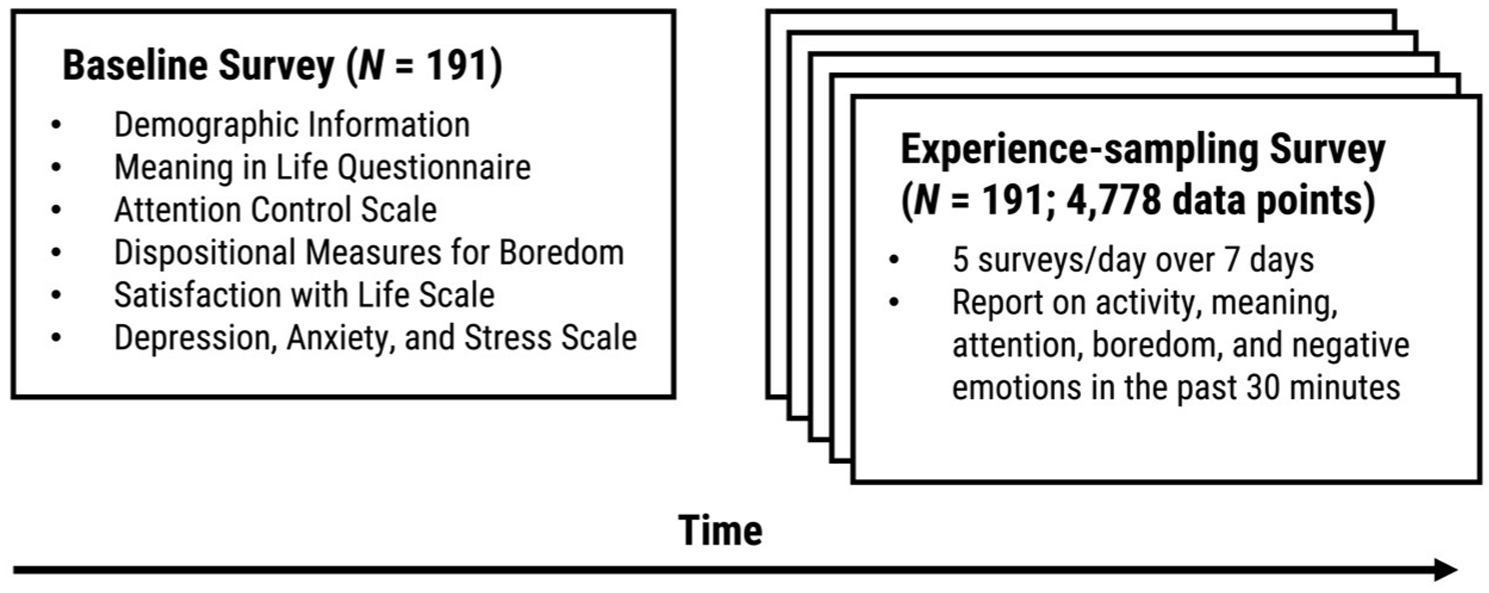
Flowchart of Study 4’s Procedure.
Baseline Survey
Participants first completed an online baseline survey. We measured life meaning using the five-item presence subscale of the Meaning in Life Questionnaire (Steger et al., 2006; e.g., “My life has a clear sense of purpose.”: 1 = absolutely untrue, 7 = absolutely true; α = .88), and attention control using the 20-item Attention Control Scale (Derryberry & Reed, 2002; e.g., “When concentrating, I can focus my attention so that I become unaware of what’s going on in the room around me.”: 1 = almost never, 4 = always; α = .77). We also administered dispositional measures for boredom and subjective well-being (see Supplement).
Experience-Sampling Survey
After completing the baseline survey, participants were directed to install the ExpiWell smartphone app for collecting experience-sampling data. Over the subsequent seven consecutive days, participants were prompted to complete a brief survey via the app five times a day. These surveys were dispatched randomly within five equal intervals spanning from 10 a.m. to 10 p.m. In each survey, participants selected one activity that best described what they were doing in the past 30 minutes, and reported their levels of situational meaning, attention, boredom, and negative emotions (Table 1). Finally, participants completed a post-study survey unrelated to this research and received their reward.
Analytic Approach
Multilevel linear models were applied for tests at situational levels and across levels, to account for the data structure with 4,778 data points (Level 1) nested within 191 participants (Level 2). For all the multilevel models outlined below, unless specified otherwise, we estimated random slopes models, assigning participants a random intercept (i.e., deviation from grand average) and assigning them a random slope (i.e., deviation from average within-person slope) on Level 1 predictor(s).
We person-mean centered all the situational predictors (variables assessed in experience-sampling surveys); they thus reflect how much a participant deviates from their usual at each time point. We mean centered all the dispositional predictors (variables assessed once in baseline survey); they thus indicate how much a participant differs from the average of all participants. In other words, we focused on the within-person variations at situational level, and on the between-person variations (i.e., individual differences) at dispositional level and across levels.
All analyses were conducted in R version 4.0.5 (R Core Team, 2021), using packages lme4 for computing multilevel linear models (Bates et al., 2015), lmerTest for retrieving p values (Kuznetsova et al., 2017), and r2mlm for calculating R2 effect sizes (Shaw et al., 2023).
Results
Descriptive statistics and zero-order correlations are reported in Table 2. In unconditional models, the intra-class correlation coefficients (ICCs) were .26 for situational meaning and .28 for situational attention. To test Hypothesis 1c, we examined the relationship between meaning and attention at dispositional, situational, and across levels.
Means, Standard Deviations, Correlations of Meaning, and Attention in Study 4 (N = 191).
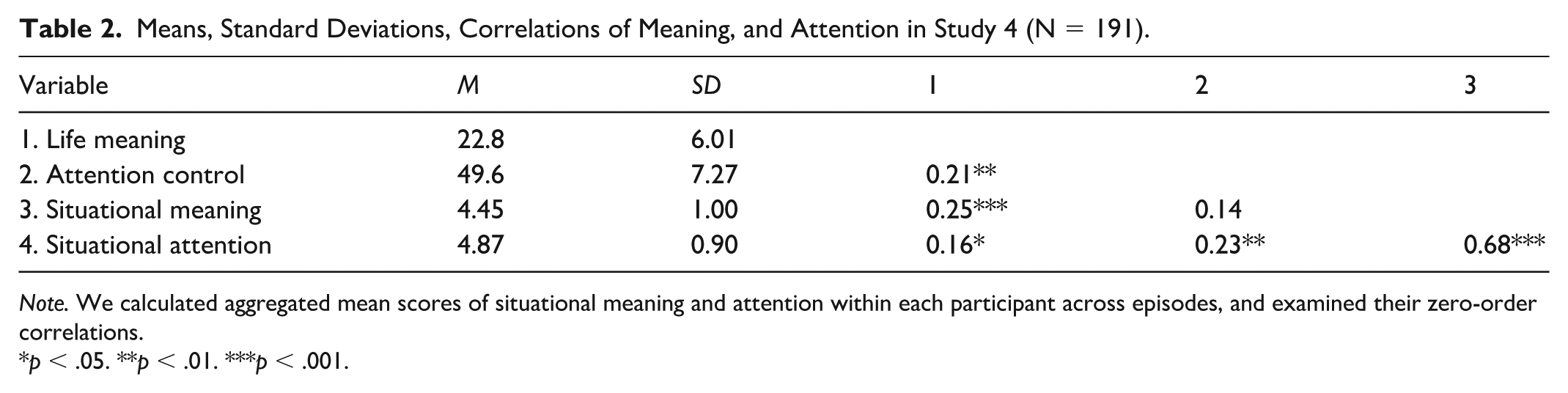
Note. We calculated aggregated mean scores of situational meaning and attention within each participant across episodes, and examined their zero-order correlations.
p < .05. **p < .01. ***p < .001.
Meaning and Attention at Dispositional Level
Zero-order correlations showed a positive association between life meaning and attention control, r = .21, p = .004. It indicates that participants who had better attention control tended to report greater life meaning. To examine between-person effects, we computed aggregated mean scores of situational meaning and situational attention for each participant across episodes. We found that, compared with other participants, those who reported greater situational attention in their daily lives (averaged across days) also experienced higher situational meaning on average, r = .68, p < .001.
Meaning and Attention at Situational Level
To examine within-person effects, we estimated a multilevel model where situational attention was predicted by situational meaning (person-mean centered). It revealed a positive association between situational meaning and situational attention, B = 0.38, SE = 0.021, p < .001, 95% CI = (0.33, 0.42), R2 = .13, indicating that meaning was higher at times of higher attention.
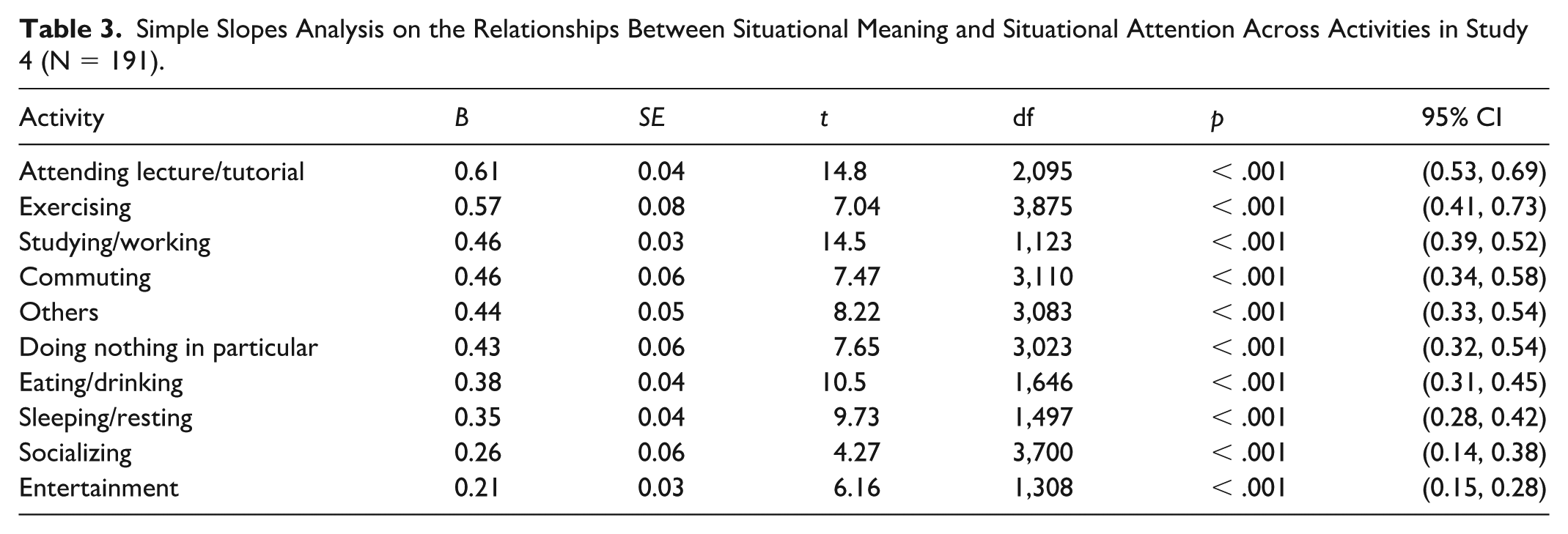
Furthermore, we examined how the meaning–attention relationship varied across different daily activities. We estimated a multilevel model with situational attention as the dependent variable, specifying activity, situational meaning (person-mean centered) and their interaction term as fixed predictors, participant as random intercept, and situational meaning as random slope. It showed a main effect of activity, F(9, 4,606) = 27.9, p < .001, a main effect of situational meaning, F(1, 293.6) = 396.5, p < .001, and a significant two-way interaction, F(1, 4,511) = 9.18, p < .001 (Figure 6). Decomposing the interaction with a simple slopes analysis, situational meaning was significantly positively associated with situational attention across all daily activities (Table 3), albeit the strength of association was stronger in some activities than in others (see Table S10). These results suggest that participants experienced higher meaning at times of higher attention, across all daily activities.
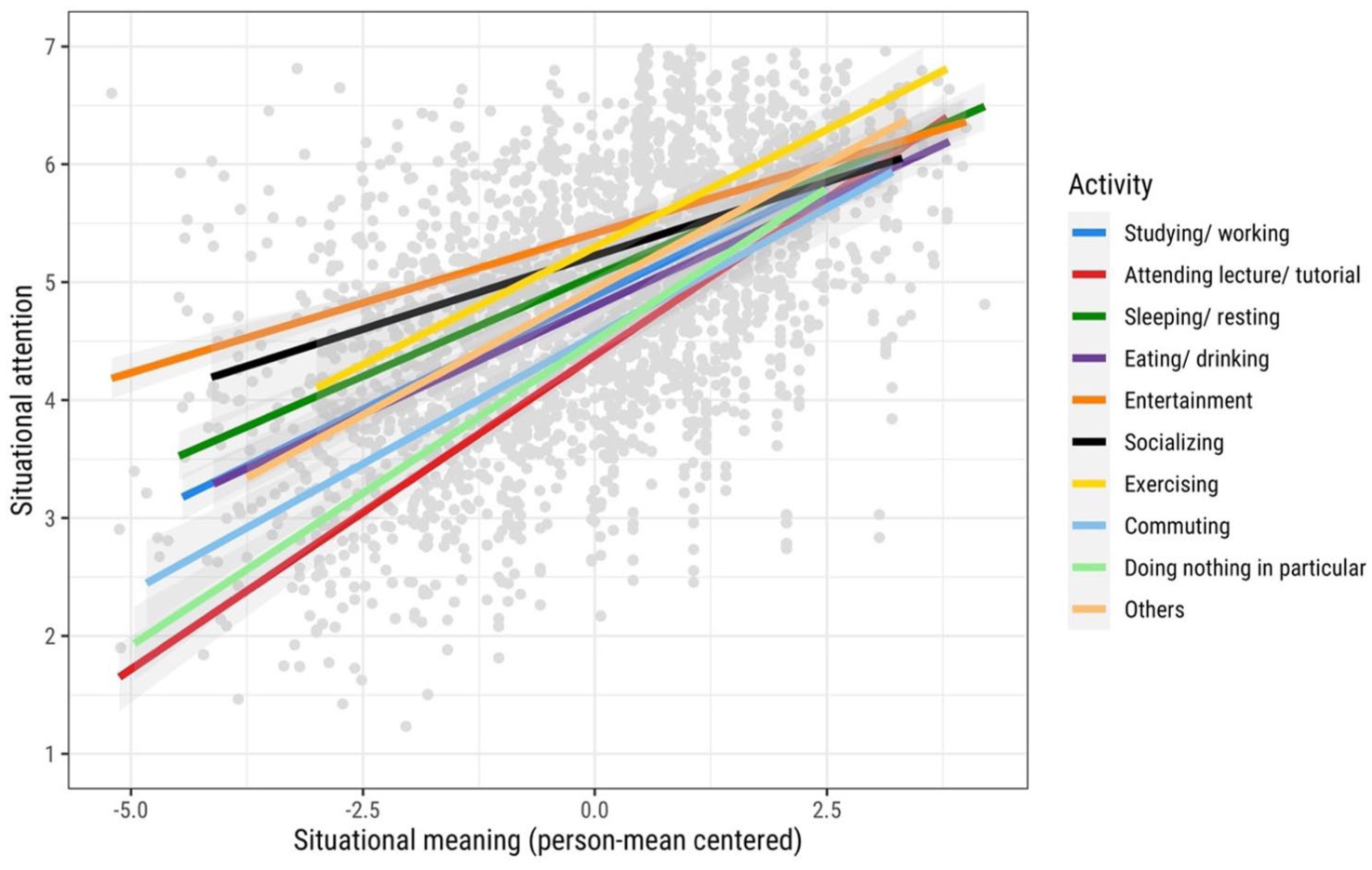
Simple Slopes Analysis on the Meaning–Attention Relationships Across Activities in Study 4.
Simple Slopes Analysis on the Relationships Between Situational Meaning and Situational Attention Across Activities in Study 4 (N = 191).
Meaning and Attention Across Levels
Next, we examined whether individual differences in life meaning and attention control predict situational meaning and attention. We first estimated random-intercept models, with participant specified as random intercept, testing whether life meaning (mean centered) predicted situational meaning, and whether attention control (mean centered) predicted situational attention. 5 We found that participants with higher life meaning experienced greater situational meaning, B = 0.040, SE = 0.011, p < .001, R2 = .019. Participants with higher attention control tended to report higher situational attention, B = 0.029, SE = 0.008, p < .001, R2 = .020.
We then estimated random-intercept models, with participant specified as random intercept, testing whether life meaning (mean centered) predicted situational attention, and whether attention control (mean centered) predicted situational meaning. Life meaning predicted higher situational attention, B = 0.022, SE = 0.010, p = .036, R2 = .007. Attention control predicted higher situational meaning, B = 0.021, SE = 0.010, p = .032, R2 = .008. These results suggest that, compared with other participants, those with higher life meaning had higher situational attention, while those with better attention control experienced higher situational meaning.
Boredom, Negative Emotions, and Subjective Well-Being
Regarding our secondary objective, we found that meaning and attention consistently predicted lower boredom, lower negative emotions, and better subjective well-being at dispositional, situational, and across levels (detailed in the Supplement).
Discussion
While Studies 1 to 3 establish causality and directionality of meaning–attention relationship, Study 4 highlights its significance in everyday life. Results support our hypothesis that meaning and attention are positively associated (Hypothesis 1c). Noteworthy is the strong within-person effect—when participants paid more attention, they reported a higher feeling of meaning. This was consistent across all daily activities. This positive association was replicated between persons at both dispositional and across levels.
General Discussion
The current research proposes a theoretical integration of two basic psychological processes—meaning and attention. Synthesizing their respective theoretical and empirical work, we propose that paying attention is a process via which one constructs and perceives meaning. Meaning, in turn, captures and sustains attention. Based on these theoretical propositions, we hypothesized the meaning–attention relationship to be positive, bi-directional, and causal. This hypothesis was then examined in lab experiments and everyday life.
Across five studies, we found that meaning and attention were indeed intertwined. Our experiments first demonstrate the directionality and causality of the meaning–attention relationship. We found that meaning causally increased attention (Studies 1 and 3), supporting our proposition that meaning captures and sustains attention. We further found that attention causally shaped meaning, but in different ways depending on the stimulus’s meaningfulness (Studies 2a, 2b, and 3). Specifically, attention enhanced meaning when the stimulus was meaningful, whereas it diminished or had no effect on meaning when the stimulus was meaningless. These findings suggest that attention, unlike other antecedents of meaning, such as beliefs, identities, ideologies, or effort (Campbell et al., 2025; Maher et al., 2018; Randles et al., 2011; Van Tilburg & Igou, 2011a), is not a source of meaning. The act of paying attention does not provide meaning in itself. Rather, these findings support our proposition that attention is a process through which one perceives and constructs meaning. In Study 2b and in Study 3’s high meaning condition, the video itself has meaning: it featured animated objects interacting in a way that formed a coherent storyline. This meaning could not be constructed in one’s mind before seeing the video—it emerged during viewing. Attention modulated the subjective experience of meaning, such that participants who paid more attention to it rated it as more meaningful.
We extended our experimental findings to real-world contexts in experience-sampling Study 4, underscoring the relevance of meaning–attention relationship in everyday life. We found that meaning and attention were positively associated at dispositional, situational, and across levels. When participants paid more attention during an activity, they reported a stronger sense of meaning—a within-person effect that was consistent across all daily activities. Across levels, higher life meaning predicted greater situational attention, whereas stronger attention control predicted greater situational meaning. Crucially, coupled with our experimental evidence on causality, these findings suggest that paying attention in daily activities can, in some cases, enhance overall sense of meaning. Greater situational meaning was associated with higher life meaning, a core aspect of well-being.
The well-being significance of meaning–attention relationship is further highlighted by our findings regarding the secondary objective. We investigated how meaning and attention are associated with boredom, negative emotions, and subjective well-being (detailed in the Supplement). Our experiments indicate that meaning reduced boredom and negative emotions (Studies 1 and 3). Attention did not affect boredom (Studies 2a, 2b, and 3) and negative emotions (Studies 2a and 3), but this might be attributed to our manipulation being moderate in effect. Also, participants were instructed to focus their attention either on the video or on their thoughts. Adequate attentional engagement might have been attained in both conditions (Tam et al., 2021), resulting in a non-significant difference in boredom. Directing attention toward one’s personal thoughts might have elicited negative emotions, depending on the content of those thoughts. In Study 4, both meaning and attention consistently predicted lower boredom, lower negative emotions, and better subjective well-being at dispositional, situational, and across levels. Participants experienced lower boredom and lower negative emotions at times of higher meaning or higher attention. These suggest that simple acts of paying attention or deriving meaning shape daily affective experiences and subjective well-being.
In terms of methodological contributions, we developed novel paradigms to manipulate situational meaning and attention, providing valuable tools for future research to explore their impacts. Our attention manipulation, despite moderate in effect (ds = 0.35-0.67), distinguishes itself from existing paradigms (e.g., Zhang et al., 2020) by varying attention while holding effort, boredom, and sensory input constant. Previous research featuring meaning manipulations either lacked measures of situational meaning (e.g., Randles et al., 2011) or potentially varied other factors like motivation to exert effort that could impact attention (e.g., Westgate & Wilson, 2018). Our coherence manipulation reliably altered situational meaning (Studies 1 and 3), with a large effect size (d = 0.90).
We only varied coherence in stimuli, but it altered participants’ sense of purpose and significance, considering that our meaning measure assessed all three components of meaning (i.e., purpose, significance, and coherence) with high reliability (α ranged .81-.93 in Studies 1-3). This supports the notion that the experience of meaning is unidimensional, that these three components share the same feeling state (Heintzelman & King, 2014). It also supports Heintzelman and King’s (2014) proposition: the feeling of meaning serves an important function of providing people information about whether there are reliable patterns in their surroundings. A key strength of our research, compared with previous studies on visual attention and coherence (e.g., Kerzel et al., 2012), is that we measured the subjective experience of meaning, thereby making a direct, explicit link between attention and meaning.
Implications
This research introduces a theoretical integration of meaning and attention, followed by empirical investigations. Previous studies on meaning have focused on its affective, motivational, or behavioral aspects (Byrka et al., 2021; Proulx & Heine, 2008, 2009; Van Tilburg & Igou, 2012), neglecting the cognitive dimension of this process. In parallel, despite the well-established literature on goals and attention (Dijksterhuis & Aarts, 2010), research on attention has overlooked its potential role in daily, subjective experiences of meaning. Thus far, the meaning–attention relationship has only been studied in boredom and occupational contexts. By examining it at a basic level, our research reveals the basic cognitive architecture of meaning, and the role of attention in meaning-making.
Our work provides evidence for a direct approach to enhancing meaning—paying attention. Life meaning is crucial to well-being, and it is shaped by instances of situational meaning in daily life. Previous studies on situational meaning have focused on identifying what provides meaning, or how to regain meaning through something unrelated to the meaningless target (e.g., Randles et al., 2011). We found that attention directly shapes the perceived meaning of a target. When participants were not paying attention, they either attributed greater meaning to meaningless stimulus or perceived meaningful stimulus as lacking meaning. It suggests that even when people encounter something that provides meaning, they may fail to perceive its meaning if they do not pay attention to it. This insight is particularly relevant in this technological age, where constant distractions from digital media are pervasive.
Our findings on the relationships between meaning, attention, boredom, negative emotions, and subjective well-being make several contributions to the literature. First, our experiments are among the few that have manipulated either meaning or attention to examine their effects on boredom, aside from one prior study (Westgate & Wilson, 2018). Second, our experience-sampling study is, to our knowledge, the first to investigate the boredom–attention relationship in everyday life. Third, our findings help clarify ongoing debates about the relationships between boredom, meaning, and attention (Igou et al., 2024). Finally, they address a gap in the literature concerning the unclear directionality and causality between meaning and attention in relation to negative emotions and subjective well-being.
Limitations and Future Directions
Given that our research is the initial empirical investigation of the theorized meaning–attention relationship, it has certain limitations. First, we primarily examined sustained attention and meaning as a subjective experience characterized by coherence, significance, and purpose. Future studies could explore how other types of attention—such as selective attention, spatial attention, visual search, divided attention, and involuntary attention—interact with other forms of meaninglessness, such as absurdity or expectation violation, or meaning in its non-subjective sense. Further research is also needed to identify potential moderators of this relationship, such as when attention shapes meaning and when it does not, as well as individual differences that may make some people more likely than others to experience meaning when paying attention.
Second, like many previous studies on meaning (e.g., Heintzelman et al., 2013; Randles et al., 2011), our meaning manipulation targeted the coherence component of meaning. Our manipulation reliably and strongly altered participants’ feeling of meaning in the pilot studies and Studies 1 and 3, as supported by a manipulation check that assessed all three components of meaning. This approach follows standard practice in experimental psychology, where manipulating one aspect of a broader construct is considered valid when it reliably alters the intended subjective experience. For example, boredom is often manipulated through repetitive tasks, and such studies are interpreted as manipulating boredom—not merely task repetitiveness—when supported by a manipulation check (e.g., Pfattheicher et al., 2021). As such, we consider our coherence-based manipulation a valid method of manipulating meaning and posit that our findings contribute to the understanding of meaning processes. Nonetheless, the meaning ratings for both the high and low meaning condition fell below the scale midpoint. It suggests that, although the manipulation strongly altered participants’ feeling of meaning, it did not induce a highly meaningful experience for those in the high meaning condition. Future research should aim to replicate our results using manipulations that target other components of meaning and explore whether the extent of difference in meaning might bring different effects.
Third, our measures have constraints. All data were self-reported, highlighting the need for objective assessments, such as eye-tracking, physiological measures, and brain scanning in future research. Study 4 used single-item measures to ensure the experience-sampling surveys remained concise and minimize disruption to participants’ daily lives. As a result, meaning was assessed with a single item rather than the five-item measure used in our experiments (Table 1). Similar single-item measures have been applied in prior experience-sampling studies to assess meaning in everyday life (e.g., Choi et al., 2017).
Fourth, to control for various potential confounds, we designed specific animated videos for the experiments. This limitation was partly offset by replicating our findings in experience-sampling Study 4. We encourage future research develop different stimuli to replicate our results. Furthermore, our attention manipulation was moderate in effect. While not optimal, our paradigm reliably induced high and low attention levels across Studies 2a, 2b, and 3, and outperformed various paradigms tested in our pilot data (see Pilot Studies 2-8 in the Supplement).
Fifth, we proposed that the difference in results between Studies 2a and 2b might be attributed to the differences in meaningfulness of the videos. Specifically, the video used in Study 2a featured mismatched visual and auditory content (i.e., a visual story of Three Little Pigs paired with a lecture audio on beetroots). It was less coherent and potentially less meaningful than the one used in Study 2b, which featured coherent visual and auditory content. Although participants in Study 2a appeared to rate the video as somewhat more meaningful than those in Study 2b, the two studies differed in population, context, and timing, making these ratings not directly comparable. To better understand this discrepancy, we conducted Study 3 and found that the effect of attention on meaning was contingent on the video’s meaningfulness. Despite the significant results from simple effects analyses, the interaction was not statistically significant. We recommend interpreting these findings with caution.
Moreover, while our experiments tested or manipulated attention, we excluded participants who failed attention checks. These checks served to identify participants who were inattentive to survey items, not the experimental stimuli. Excluding them was essential to maintain data quality, as their responses might not accurately reflect their experiences. Research indicates that incorporating careless responses can distort findings and undermine reliability and validity (Stosic et al., 2024).
Conclusion
Do you perceive this article as meaningful? If your attention during reading has led you to discern its coherence, significance, and purpose, chances are your answer is affirmative. The current research underscores paying attention as the process through which one constructs and perceives meaning. Across five studies, we examined the meaning–attention relationship in lab experiments and daily life. We found that meaning draws attention, while attention shapes feeling of meaning. Our findings not only bridge a theoretical gap between meaning and attention but also offer practical insights into enhancing them in everyday life.
Supplemental Material
sj-docx-1-psp-10.1177_01461672251383966 – Supplemental material for Meaning and Attention Intertwined: Experimental and Experience-Sampling Findings
Supplemental material, sj-docx-1-psp-10.1177_01461672251383966 for Meaning and Attention Intertwined: Experimental and Experience-Sampling Findings by Katy Y. Y. Tam, Wijnand A. P. van Tilburg, Christian S. Chan and Michael Inzlicht in Personality and Social Psychology Bulletin
Footnotes

Funding
The authors disclosed receipt of the following financial support for the research, authorship, and/or publication of this article: Study 4 was supported by General Research Fund, Research Grants Council, University Grants Committee of Hong Kong (RGC GRF Grant No. 17610619).
Declaration of Conflicting Interests
The authors declared no potential conflicts of interest with respect to the research, authorship, and/or publication of this article.
Data Availability Statement
Supplemental Material
Supplemental material is available online with this article.
Notes
References
Supplementary Material
Please find the following supplemental material available below.
For Open Access articles published under a Creative Commons License, all supplemental material carries the same license as the article it is associated with.
For non-Open Access articles published, all supplemental material carries a non-exclusive license, and permission requests for re-use of supplemental material or any part of supplemental material shall be sent directly to the copyright owner as specified in the copyright notice associated with the article.
