




Abstract

Turner-Zwinkels, F. M., van Noord, J., Kesberg, R., García-Sánchez, E., Brandt, M. J., Kuppens, T., Easterbrook, M. J., Smets, L., Gorska, P., Marchlewska, M., & Turner-Zwinkels, T. (2025). Affective polarization and political belief systems: The role of political identity, and the content and structure of political beliefs. Personality and Social Psychology Bulletin, 51(2): 222–238. https://doi.org/10.1177/01461672231183935
After publication, David Young discovered a coding error in Study 2. When investigating this error, we discovered a similar error in Study 1. Specifically, there was a misclassification in the party identifier coding used for computing belief similarity in Study 1 and Study 2. This led to incorrect classification of ingroup/outgroup status for a subset of participants (about 5.2% of cases in Study 1 and about 22.3% in Study 2). As a result, model estimates were inaccurately reported.
The authors re-verified all scripts, corrected the party identifier coding, and re-ran the analyses. In Study 2, we also re-specified the multilevel models to nest participants within the appropriate election contexts rather than by country. Updated scripts and manuscript (including corrected tables, figures, and appendices) are available via:
OSF updated manuscript link: https://osf.io/yg2w4/files/osfstorage
OSF updated scripts link: https://osf.io/xpb83/files/osfstorage
GitHub: https://github.com/TomasZwinkels/contstrucpol_postpubrevision
We gratefully acknowledge David Young for detecting the error in Study 2 and for his assistance in verifying the revised analyses.
Updated Abstract
We investigate the extent that political identity, political belief content (i.e., attitude stances), and political belief system structure (i.e., relations among attitudes) differences are associated with affective polarization (i.e., viewing ingroup partisans positively and outgroup partisans negatively) in two multinational, cross-sectional studies (Study 1 N = 4,246, Study 2 N = 30,053). First, we found a large, positive association between political identity and group liking—participants liked their ingroup substantially more than their outgroup. Second, political belief system content and structure was consistently associated with outgroup liking: Sharing similar belief system content with an outgroup was associated with more outgroup liking, and belief system structure similarity was associated with outgroup disliking (Study 1) and liking (Study 2). Belief system content and structure similarity were more weakly and inconsistently related to ingroup liking. Thus, affective polarization was greatest when belief system content similarity was low and structure similarity was high.
Overview of Changes in Results
These corrections lead to updates in sample size (Study 1 N = 4,246; Study 2 N = 30,053) and all model estimates. The Journal Editor confirmed that the changes to the article alter the results but do not change the conclusions. Indeed, our main conclusions regarding outgroup effects remain consistent with those originally reported: All adjusted coefficients for outgroup effects retain significance and the same directionality as reported in the original article (see Table 1). Specifically, participants continue to like outgroup partisans more when they share similar belief system content, and this effect remains positive, strong, and significant (as originally hypothesized) in Studies 1 and 2. Likewise, the effect of outgroup structure similarity in Study 1 remains significantly negative, while sharing a similar belief structure has a small positive association with outgroup liking in Study 2. Thus, we continue to conclude that differences in political belief content (and to a lesser extent structure) are important correlates of how positively people feel toward outgroup partisans.
List of Empirical Changes for Outgroup Effects Across Studies 1 and 2
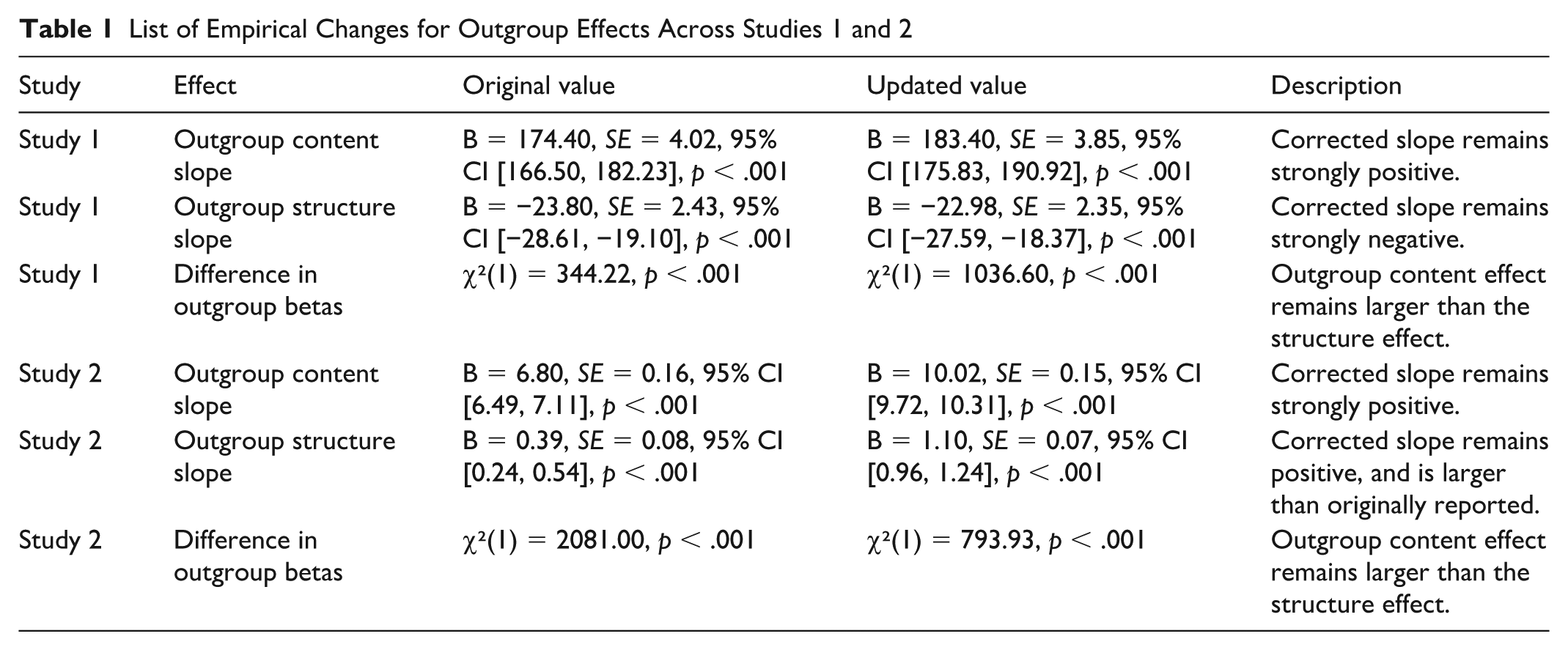
In contrast, the corrections alter the ingroup effects more notably (see Table 2). The most prominent change concerns the previously unexpected negative ingroup effect of belief system content similarity. In the original article, we reported that “sharing similar belief system content with the ingroup was associated with less ingroup liking.” This was a surprising finding, as it ran counter to our Hypothesis 1a (which predicted that greater belief similarity among ingroup members would increase ingroup liking). After correcting the coding error, this negative ingroup content effect has largely disappeared. In Study 1, the association between ingroup content similarity and ingroup liking is no longer negative or significant. Similarly in Study 2, the ingroup content effect shrank from a modest negative effect to a practically negligible one that is not statistically significant at conventional levels. In other words, with the corrected data, there is essentially no meaningful relationship (null effect) between belief system content similarity and ingroup affect. Thus, we now interpret the findings as offering only weak evidence against H1a, meaning we do not observe the hypothesized positive ingroup content effect, but neither do we observe a robust negative effect.
List of Empirical Changes for Ingroup Effects Across Studies 1 and 2
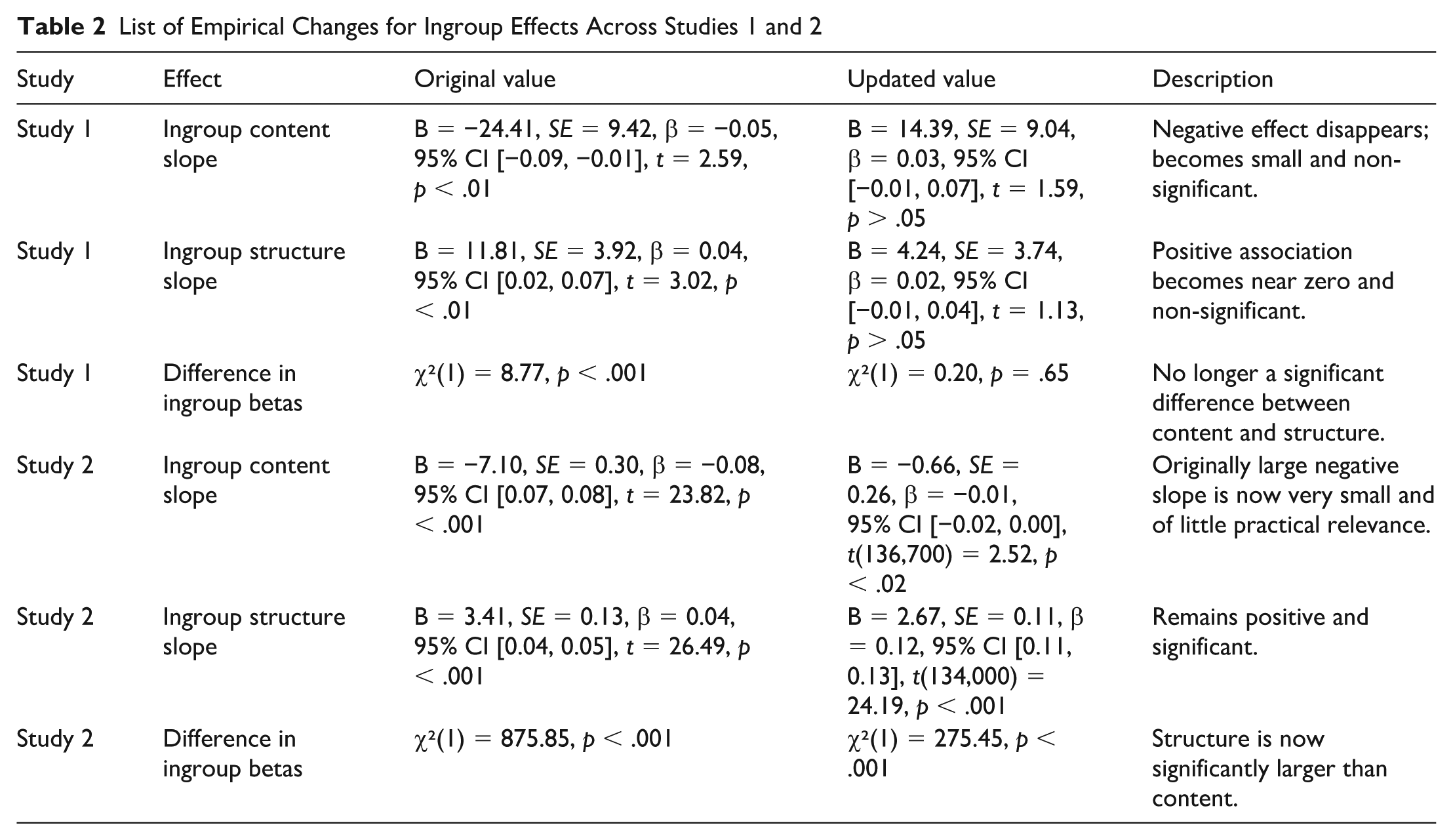
The ingroup effect of belief system structure similarity has also been revised (see Table 2). Originally, we found a small positive association between ingroup structure similarity and ingroup liking (supporting H1b) in both studies. After correction, this ingroup structure effect is weaker and less consistent across studies. In Study 1, belief system structure similarity is no longer significant. In Study 2, the belief system structure effect remains positive and statistically significant, with a slightly adjusted estimate. Thus, when considering both studies, we describe the relationship between ingroup belief system structure and ingroup liking as weak and inconsistent—present in a large cross-national sample (Study 2) but absent in Study 1. In line with this, we no longer find a difference between the size of ingroup content vs. structure effects in Study 1 (originally, structure similarity appeared to have a larger impact on ingroup liking than content similarity), but we do find that ingroup structure effects are larger than content effects in Study 2. In practical terms, the corrected analyses suggest that simply sharing an ingroup identity (being co-partisans) is the primary driver of positive feelings toward the ingroup, and variations in belief system content or structure among ingroup members do not, on the whole, strongly add to or detract from those positive feelings.
We sincerely apologize to readers for this error and appreciate the opportunity to correct the scholarly record.