




Abstract
Past research on intimate relationships suggests that exchange orientation—the tendency to expect direct reciprocation when providing a benefit—predicts lower relationship well-being. However, limited research has examined the long-term associations of this link or the effects of partner similarity in exchange orientation. The present research addressed this gap by employing a set of rigorous analyses on longitudinal data spanning 13 years from a national sample of romantic couples in Germany (N = 7,293 couples). Latent curve models with structured residuals (LCM-SR) revealed that romantic partners, on average, experienced a general decline in exchange orientation over the course of their relationship. Partners who showed slower declines in exchange orientation experienced steeper declines in relationship satisfaction. Within-person increases in exchange orientation predicted future decreases in relationship satisfaction. Dyadic response surface analyses (DRSA) indicated no evidence of similarity effects. Overall, these findings corroborate the adverse effects of exchange orientation on intimate relationships.
Keywords
Intimate relationships are typically conceived as communal in nature, where partners feel a sense of responsibility for one another’s welfare and provide benefits noncontingently based on their needs (Clark & Mills, 1979, 1993, 2012). However, people often fail to live up to this ideal, and research suggests that adherence to these ideals can vary depending on one’s exchange orientation (Murstein et al., 1977, 1987; Sprecher, 1998). Individuals higher in exchange orientation have a stronger inclination toward direct reciprocity, in which support provided is tied to a desire for repayment (Clark et al., 2010). In line with the notion that exchange norms are considered “decidedly not ideal” and may reflect “trouble” in romantic relationships (Clark & Mills, 2012, p.246), numerous studies have found that exchange orientation predicts lower relationship satisfaction across dating (Bippus et al., 2008; Sprecher, 1998), cohabiting (Milardo & Murstein, 1979; Jarvis et al., 2019), and marital relationships (Buunk & VanYperen, 1991; Clark et al., 2010; Murstein et al., 1977; Stafford, 2020; Stafford & Kuiper, 2022; Wang et al., 2022).
Notwithstanding such findings, there are several research gaps that warrant further investigation. First, past research demonstrating the adverse effects of exchange orientation on romantic relationships has mostly relied on between-person differences from cross-sectional data. Consequently, we have a limited understanding of the long-term associations between exchange orientation and relationship satisfaction let alone how peoples’ exchange orientation might change over the course of their relationship. Second, although some studies have utilized dyadic data to examine both actor and partner effects of exchange orientation on relationship well-being, no studies have examined the potential implications of the degree of similarity in exchange orientation between partners. These gaps remain critical for informing theory and practice on the nature of exchange orientation and how it shapes relationship outcomes. Hence, the present study aims to shed light on these questions by employing a set of rigorous analyses in a national longitudinal sample of couples from Germany.
Long-Term Associations Between Exchange Orientation and Relationship Satisfaction
Across more than three decades of research on exchange orientation, scholars have consistently—and explicitly—raised uncertainty surrounding the temporal direction of the link between exchange orientation and relationship satisfaction (Buunk & VanYperen, 1991; Jarvis et al., 2019; Murstein et al., 1987; Sprecher, 1998; Stafford & Kuiper, 2022). Specifically, studies have pointed out that “no claims about directionality or causality can be offered” (Stafford & Kuiper, 2022, p. 18) given there is “very little longitudinal research” on exchange orientation (Sprecher, 1998, p. 221). Based on such longstanding calls for clarity, we aim to address this gap by considering two critical aspects: (a) exploring long-term changes in exchange orientation and (b) investigating the temporal associations between these constructs at both between- and within-person levels.
Long-term Changes in Exchange Orientation
While empirical evidence remains limited, the prevailing assumption in the existing literature is that exchange orientation leads to lower relationship satisfaction rather than the reverse. One primary reason is that exchange orientation, also referred to as “E-personality” (Murstein et al., 1977), has traditionally been conceptualized as a chronic, stable, dispositional variable that is less susceptible to change itself but more likely to exert changes in other outcomes (e.g. Buunk et al., 1993; Stafford, 2020, VanYperen & Buunk, 1991). However, recent studies have raised an alternative perspective that peoples’ exchange orientation may indeed change and fluctuate across time and in different contexts. For instance, studies have suggested that an individual’s exchange orientation remains less stable across contexts but can differ across partners and relationships, thus being more context-specific than dispositional (Jarvis et al., 2019; Stafford, 2020). Moreover, scholars have found that people experience daily shifts in exchange orientation within the same relationship, suggesting exchange orientation should be considered as a type of relationship schema that is open to intrapersonal fluctuations (Li & Fung, 2019). In this vein, several studies discuss the possibility that a relationship might become more exchange oriented (e.g. Buunk & VanYperen, 1991; Stafford, 2020), although no work has directly tested the way that exchange orientation changes as relationships develop.
Consequently, one key aspect of examining the long-term associations between exchange orientation and relationship satisfaction involves exploring whether and how individuals’ exchange orientation toward a romantic partner might change and fluctuate over the course of their relationship. Understanding the average patterns of change in individuals’ exchange orientation can provide insight into whether it remains stable over time, suggesting a static construct, or whether it increases or diminishes as relationships progress, indicating long-term plasticity and malleability. Furthermore, examining individual variability in changes in exchange orientation enables us to explore how these differences might be associated with changes in other pertinent variables, such as relationship satisfaction.
Within-Person Associations Between Exchange Orientation and Relationship Satisfaction
Despite the conventional notion that exchange orientation precedes lower satisfaction, there are also conflicting perspectives that suggest a reverse directional effect. Some argue that when a relationship becomes exchange oriented, it might be a sign of a troubled relationship (Clark & Mills, 2012; Stafford, 2020), implying exchange orientation may emerge as a function of lower relationship well-being. As partial support for this perspective, a longitudinal study of married couples suggested that relationship distress and conflict pushed couples toward greater perceptions of unfairness in their relationships in the future (Grote & Clark, 2001). Similarly, Li and Fung (2019) showed that romantic partners were less likely to endorse communal norms on days of heightened stress, potentially due to reduced mental and physical resources to attend to their partner’s needs.
In this context, three studies to our knowledge have directly examined the temporal link between exchange orientation and relationship satisfaction. However, their findings remain inconsistent, likely due to their methodological limitation of employing only two time points. For instance, Buunk and VanYperen (1991) failed to find longitudinal associations between exchange orientation and relationship satisfaction in either direction over a one-year period. Meanwhile, Clark et al. (2010) found that individuals reporting higher exchange orientation at baseline reported lower relationship satisfaction 1 year later, although they did not explore whether satisfaction at baseline predicted future exchange orientation. Conversely, Sprecher (1998) found that individuals reporting higher commitment and love at baseline reported lower exchange orientation 1 year later, supporting the reverse directional effect.
As a potential explanation for these inconsistencies, the present study underscores the importance of distinguishing between-person differences and within-person changes as distinct sources of long-term variability in the two constructs—an approach that requires multiple measurements across a larger sample than prior studies. Specifically, between-person associations inform whether people who are more exchange-oriented than others are also more likely to become more satisfied with their relationships than others, or vice versa. In contrast, within-person associations capture whether, when a given person becomes more exchange-oriented than they normally are, they will become less satisfied with the relationship than they typically would be, or vice versa. While between-person associations reveal how individual differences in one construct are associated with corresponding differences in another, they provide limited insights into the interplay of changes within a given individual. Hence, to investigate the temporal directionality of changes in two constructs—such as whether improvements in one domain could lead to subsequent improvements in the other for a given individual—a stringent test of within-person associations is needed (Johnson et al., 2022; Park et al., 2023).
However, past longitudinal studies utilizing only two time points could not disentangle the between- and within-person sources of variance in the data, leading to a conflation of initial differences across individuals, shifts in relative rankings over time, and changes occurring within individuals. As a result, their results merge these between- and within-person effects into a single estimate that is challenging to interpret (Hamaker et al., 2015; Johnson et al., 2021) and may contribute to inconsistent findings (e.g. Berry & Willoughby, 2017; Mund & Nestler, 2019). Thus, the present study seeks to offer a more comprehensive investigation into the temporal link between exchange orientation and relationship satisfaction by appropriately disaggregating between- and within-person associations.
Partner Similarity in Exchange Orientation
Given that intimate relationships involve two interdependent partners whose attitudes collectively shape their interactions, understanding the link between exchange orientation and relationship satisfaction requires employing a dyadic perspective. Several past studies have employed dyadic analyses to examine both actor and partner effects of exchange orientation on relationship satisfaction (e.g. Clark et al., 2010; Murstein et al., 1977, Sprecher, 1998; Stafford, 2020; Stafford & Kuiper, 2022), no research to date has investigated whether dyadic similarity in exchange orientation might play a unique role in shaping couples’ relationship satisfaction above and beyond the independent effects of each partner’s exchange orientation.
Despite a lack of direct research on similarity effects, scholars have raised the possibility that relationship satisfaction may be higher when partners implicitly agree on the importance of direct reciprocation within the relationship (Murstein et al., 1977). For example, shared emphasis on direct reciprocity may enhance relationship functioning and mutual understanding by aligning partners’ expectations around exchange norms, helping them feel more “even” and satisfied in the relationship. Conversely, mismatches in exchange orientation may contribute to lower relationship satisfaction by creating conflicting expectations about reciprocity, which can manifest as feelings of neglect or perceived inequity for the more exchange-oriented partner and unwanted pressure or discomfort for the less exchange-oriented partner. However, given the inherently communal nature of intimate relationships, it is also possible that the joint effect of partners’ exchange orientation might follow an additive pattern—where “less is better”—rather than a similarity effect. In this case, relationship satisfaction may be highest when both partners are less exchange-oriented, regardless of the degree of similarity between them. Indeed, prior studies examining potential congruence effects in other domains often found that the main effects of each partner’s characteristics outweighed any similarity effects in predicting relationship outcomes (e.g. Kim et al., 2021; Weidmann et al., 2023).
To address these possibilities, the present study provides a stringent test of the similarity effects of exchange orientation on relationship satisfaction to expand our understanding of their dyadic associations. Leveraging intensive longitudinal data, we aim to examine potential similarity effects at both the between-person level—whether couples with more congruent exchange orientation on average across time experience higher relationship satisfaction—and within-person level—whether relationship satisfaction is higher at times when partners’ within-person fluctuations in exchange orientation are more aligned.
Overview of the Present Study
Overall, the present study aims to address three core research questions, encompassing the investigation of (a) average changes in romantic partners’ exchange orientation over time, (b) long-term associations between exchange orientation and relationship satisfaction, and (c) the association between partner similarity in exchange orientation and relationship satisfaction. Toward these aims, the current study employs two sets of analyses in a 13-year longitudinal dataset comprising a national sample of romantic couples from Germany (N = 7,293).
First, we employ the latent curve model with structural residuals (LCM-SR; Curran et al., 2014) to address the first two research questions: the average trajectories of individual changes in exchange orientation and the long-term associations between exchange orientation and relationship satisfaction. The main conceptual merit of LCM-SR is that it allows us to appropriately tease apart the between- and within-person sources of variance in the data to disaggregate long-term between-person associations (whether the rate of change in exchange orientation is associated with the rate of change in relationship satisfaction across individuals over time) and within-person associations (whether within-person fluctuations in exchange orientation predict subsequent within-person changes in relationship satisfaction and vice versa). These features demonstrate not only methodological rigor but also a critically important conceptual advance, allowing us to explore the temporal directionality of the link between exchange orientation and relationship satisfaction.
Second, we utilize dyadic response surface analysis (DRSA; Humberg et al., 2019) to provide a rigorous test of the similarity effects of exchange orientation on relationship satisfaction. The main conceptual merit of DRSA is that it retains every observation in the data to detect dyadic effects across all levels of the predictors and provides formal statistical tests on similarity effects. Hence, DRSA is a method specifically developed for testing dyadic similarity effects between partners while overcoming the drawbacks of past conventional methods (e.g. differences scores and intraclass correlation), which remove important information about each partner’s independent levels of the predictors to obscure the interpretation of their results (Edwards, 1994, 2002).
Methods
The research questions, details on samples and methods, and analytic plans were all preregistered on the Open Science Framework (preregistration and analysis code are available at https://osf.io/xezsf/).
Participants and Procedures
The data for this study came from the German Family Panel Study (pairfam). Pairfam is a multidisciplinary, longitudinal study that began in 2008 to research partnership and family dynamics in Germany. The study collects annual survey data from a nationwide random sample of individuals from three birth cohorts (1971–73, 1981–83, and 1991–93) and their partners, parents, and children. A restocking and refreshment sample was added with the 2001 to 2003 birth cohort in Wave 11. Participants completed annual computer-assisted personal interviews and received a small stipend as compensation for their time at each wave. Data can be accessed through a contract agreement with the German Family Panel research team, with further details available in their data manual (Brüderl et al., 2022) and concept paper (Huinink et al., 2011).
We filtered the data to include 7,293 mixed-gender couples from Waves 1, 3, 5, 7, 9, 11, and 13 when the exchange orientation measure was included in the interview. Of the total sample of couples who participated in all available waves, 98.82% identified as mixed-gender (n = 7,293) and 1.18% as same-gender (n = 87). Given that a small sample size limits separate analyses, our analyses only included mixed-gender couples to treat the sample as distinguishable dyads and directly test potential gender differences (Murstein et al., 1977; Sprecher, 1998). Across the entire sample, the average birth year was 1981.89 (SD = 8.63) for women and 1979.39 (SD = 9.33) for men. Approximately, 47.4% were married at baseline, and 78.01% identified as German natives with no migration background. Approximately 51.54% of women and 49.79% of men had post-secondary education at baseline. The median monthly household income was €2,600 (M = €2,913, SD = €1,909) at baseline.
For the first set of analyses examining long-term changes and associations using LCM-SR, we analyzed a subset of 3,677 couples who started participating in the study at Wave 1 to permit the tracking of participants’ reports over time. For the second set of analyses using DRSA, we analyzed the entire sample of couples who participated in any available waves to ensure maximum power in testing similarity effects while accounting for repeated measures. To ensure reliable estimates of within-person effects by disaggregating individuals’ average levels (between-person) and time-specific variations (within-person) over time, our primary analyses focused on a subset of 2,380 couples with data from a minimum of three time points across the available waves, while detailed analyses of the full sample are provided in the Supplemental Material. These sample sizes allowed sufficient power to detect small effect sizes in both LCM-SR and DRSA (see Supplemental Material for full detail).
Measures
Exchange Orientation
Exchange orientation was assessed using two items administered in Waves 1, 3, 5, 7, 9, 11, and 13: “When I do [partner] a favor, I expect something in return” and “If I give up something or give into [partner], I expect him/her to show appreciation” (1 = Not at all to 5 = Absolutely). The items were highly correlated across waves (r = .51); thus, we averaged them to compute a composite score. In addition, although past research on exchange orientation employed items related to expecting “recognition” or “acknowledgment” for a provided benefit (Murstein et al., 1987), we acknowledge that the second item concerning the anticipation of “appreciation” could be considered a weaker indicator of inclination toward direct reciprocity. Hence, as outlined in our preregistered analytic plan, we also conducted complementary analyses focusing exclusively on the first item (i.e. “When I do [partner] a favor, I expect something in return”) to ensure a comprehensive report.
Relationship Satisfaction
Relationship satisfaction was assessed at each wave using a single-item measure from the Relationship Assessment Scale (Hendrick et al., 1998): “All in all, how satisfied are you with your relationship?” (0 = very dissatisfied to 10 = very satisfied).
Analytic Plans
The current study employed two sets of analyses: we used LCM-SR to test long-term changes and associations of partners’ exchange orientation and relationship satisfaction and DRSA to test dyadic similarity effects in exchange orientation on relationship satisfaction. Detailed analytic plans for both analyses can be found in the Supplemental Material. In the results section, we offer concise introductions to the key aspects of each analysis, accompanied by the relevant findings. For LCM-SR, all analyses were conducted using Mplus (Muthén & Muthén, 1998–2017). For DRSA, the multilevel polynomial regression models were estimated using the mixed procedure in IBM SPSS statistics, and response surface parameters and plots were generated with the RSA package in R (Schönbrodt & Humberg, 2023). As indicated in our preregistration and the methods, we repeated all analyses using the composite and single-item score for the exchange orientation measure and reported both sets of results.
Deviation from Preregistration
While our analysis plans were preregistered on the OSF, our final approach to DRSA included a modification that deviated from the preregistration. Initially, the preregistered analysis plan aimed to test the similarity effects of partners’ exchange orientation while accounting for repeated measures, without clearly distinguishing between- and within-person effects. However, we revised our approach to disaggregate between- and within-person effects to examine potential congruence effects at two distinct levels. The complete results of the originally preregistered analyses are provided in the Supplemental Material.
Results
Part 1: Long-Term Changes and Associations Between Exchange Orientation and Relationship Satisfaction
Initial Growth Curve Fitting
We fitted a series of increasingly complex growth curve models (i.e. fixed intercept, random intercept, fixed linear slope, random linear slope, and latent basis models) to identify the best-fitting growth model for both partners’ exchange orientation and relationship satisfaction. Fixed intercept models assume that all individuals start at the same baseline level, while random intercept models allow individual variation around this baseline. Similarly, fixed slopes assume that all individuals follow the same trajectory over time, while random slopes permit individual differences in the rate or direction of change. In these models, intercept loadings were set to 1, and linear slope loadings represented the uniform passage of time across the seven biannual waves. To account for nonlinear patterns, latent basis models allow slope loadings to be freely estimated by the data, with the first and last time points fixed at 0 and 6, respectively, for model identification. Once estimated, these slope loadings were fixed for model comparisons and subsequent analyses.
Figure 1 presents the best-fitting growth curves for each construct (see Supplemental Material for detailed model comparisons). The random latent basis model provided the best fit for men’s and women’s relationship satisfaction, showing an overall decline followed by greater stabilization in later stages (men’s slope β = −.376, 95% CI [−0.463, −0.290], p < .001; women’s slope β = −.340, 95% CI [−0.429, −0.250], p < .001). For men’s exchange orientation, the random latent basis model fits best for both composite and single-item scores, capturing an overall decrease that stabilized by the end of the study for composite scores (slope β = −.316, 95% CI [−0.421, −0.210], p < .001) and nonsignificant declines for single-item scores (slope β = −.074, 95% CI [−0.171, 0.022], p = .131). For women’s exchange orientation, the random latent basis model fits best for the composite scores, while the random linear slope model fits best for the single-item scores. Women’s exchange orientation showed a general decline over the course of the relationship for both the composite scores (slope β = −.624, 95% CI [−0.791, −0.456], p < .001) and the single-item scores (slope β = −.301, 95% CI [−.428, −0.174], p < .001).1,2
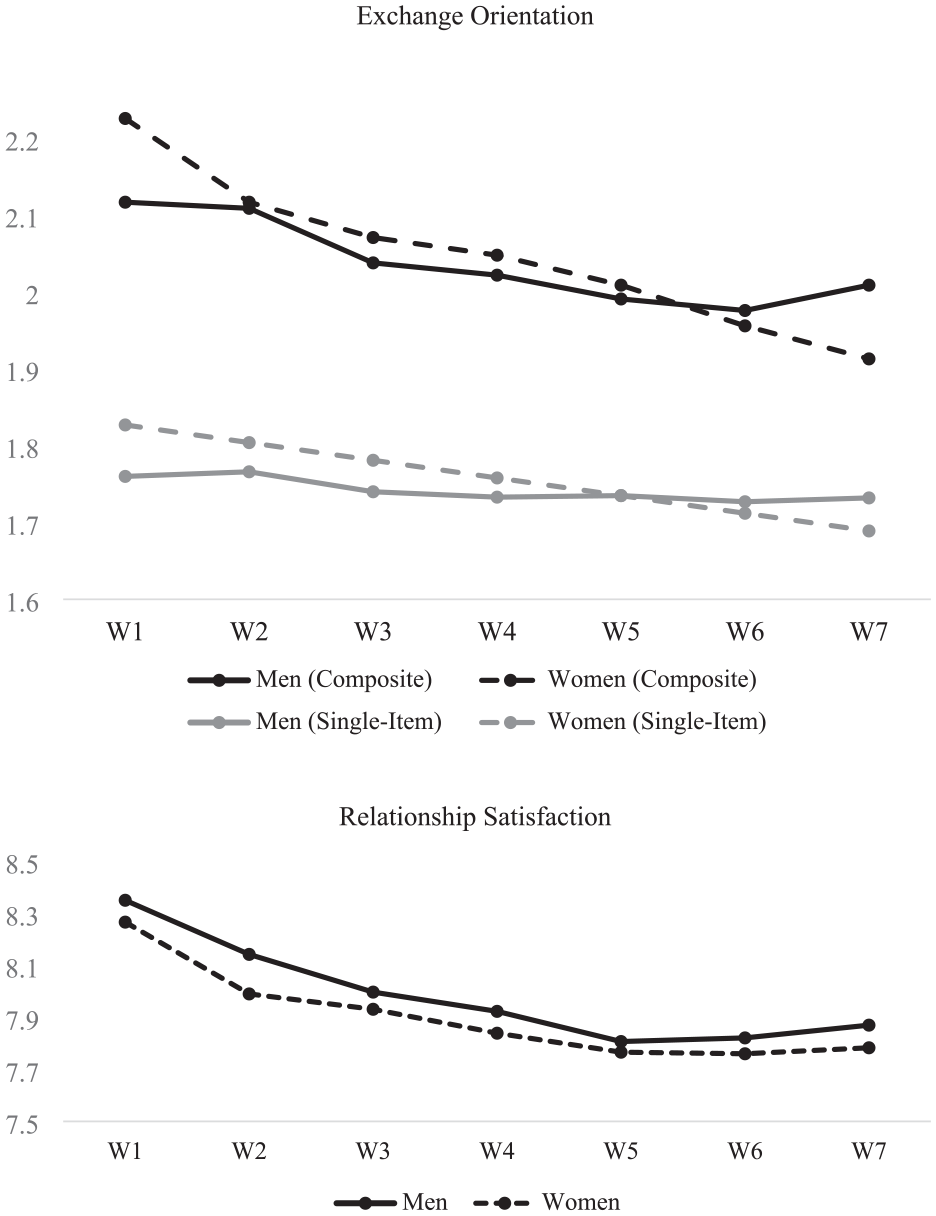
Trajectories of estimated means of exchange orientation from best-fitting growth curve models of men and women.
LCM-SR Model
To examine the long-term associations between exchange orientation and relationship satisfaction, the best-fitting growth curve models for both constructs were combined to compute the final LCM-SR model (see Supplemental Material for a complete analysis plan). A prototype bivariate analytic model is depicted in Figure 2 (note that the bivariate model is presented for demonstrative purposes, and our final model was multivariate, including dyadic reports of exchange orientation and relationship satisfaction across seven waves).

Prototype bivariate latent curve model with structured residuals (LCM-SR) depicting the longitudinal interrelation of exchange orientation and relationship satisfaction.
In brief, LCM-SR modeling partitions variance in the data into between-person components, captured in intercepts and slope variables, and within-person variation, captured in time-specific residuals. At the between-person level, the intercept terms capture between-person differences in the baseline levels of each construct and the slope terms reflect between-person differences in the average trajectories (i.e. rates) of individual change. Covariances among these growth parameters (intercepts and slopes) test the between-person cross-sectional (e.g. intercept-to-intercept) and longitudinal (e.g. intercept-to-slope and slope-to-slope) associations. At the within-person level, the construct residuals at each time point capture within-person deviations from one’s average trajectory. That is, these construct residuals correspond to the degree to which the individuals’ scores at each timepoint are higher or lower compared to their own average levels as predicted by the intercept and slope.
The within-person associations between exchange orientation and relationship satisfaction are examined through the directional paths and covariances between these construct residuals. All paths added to the time-specific residuals were set to equality across waves. In addition, we tested for gender differences by constraining paths to equality across partners and assessing model fit using chi-square difference testing. Given these constraints did not significantly reduce model fit across all cross-construct actor and partner effects (see Supplemental Material for details), indicating no significant gender differences, we reported results from the constrained model to enhance parsimony and statistical power.
Between-Person Associations
Table 1 presents the between-person associations of both partners’ exchange orientation and relationship satisfaction (dashed-dotted lines in Figure 2). The results showed significant covariances among the intercepts, indicating that individuals who were more exchange oriented (or had partners who were more exchange oriented) than others at baseline were also less satisfied with their relationship than others at baseline. In addition, we found significant slope-to-slope associations between one’s exchange orientation and relationship satisfaction, indicating long-term between-person associations: Individuals who showed slower declines in exchange orientation than others showed steeper declines in relationship satisfaction than others over the study. We did not find significant partner effects in the slope-to-slope associations. All results were consistent using the composite and single-item scores for the exchange orientation measure.
Summary of Cross-Construct Between-Person Associations Between Exchange Orientation and Relationship Satisfaction.

Note. Unstandardized estimates (b) and standardized estimates (β). The intercept term captures between-person differences in the baseline levels, and the slope term captures between-person differences in the average trajectories of individual change. The between-person paths were constrained to equality across genders. Significant effects are shown in bold for emphasis.
Within-Person Associations
Table 2 contains the within-person associations of both partners’ exchange orientation and relationship satisfaction. The results showed negative concurrent (i.e. within-time) associations between partners’ exchange orientation and relationship satisfaction (e.g. the dotted lines in Figure 2). Partners were less satisfied with their relationship than typical at times when they or their partners reported higher exchange orientation than usual. These associations were consistently observed using the composite and single-item scores for the exchange orientation measure.
Summary of Cross-Construct Within-Person Associations Between Exchange Orientation and Relationship Satisfaction.

Note. Unstandardized estimates (b) and standardized estimates (β). W−1 = preceding wave. The within-person paths were constrained to equality across waves and genders. Significant effects are shown in bold for emphasis.
Regarding time-lagged effects (e.g. the solid lines in Figure 2), we did not find significant within-person cross-lagged associations using the composite scores for the exchange orientation measure. However, the results revealed negative cross-lagged (actor) effects from exchange orientation to relationship satisfaction when using the single-item scores. When individuals reported higher exchange orientation than they typically did, they became less satisfied with their relationship in the future. In contrast, within-person changes in relationship satisfaction failed to predict future changes in exchange orientation. Application of equality constraints demonstrated that the time-lagged effects from exchange orientation to relationship satisfaction were significantly different from the reverse effects from relationship satisfaction to exchange orientation (Δχ2 [1] = 5.05, p = .025).
Part 2: Similarity Effects
We conducted multilevel polynomial regression and RSA to test the similarity effects of partners’ exchange orientation (see Supplemental Material for a complete analysis plan). For the multilevel polynomial regression, we added polynomial regression parameters to the actor-partner interdependence model (APIM; Kenny et al., 2006) while controlling for the linear passage of time. To disentangle between-person and within-person variance in the data, exchange orientation was modeled using both grand-mean centered aggregate and person-mean centered variables. The aggregate scores (i.e. average scores across all waves) capture between-person differences in average levels of exchange orientation across the study period, allowing us to test a potential similarity effect at the between-person level—whether relationship satisfaction is higher for couples who, on average across waves, have more congruent exchange orientations. The person-mean centered scores (i.e. scores at each time point minus the aggregate) reflect the degree to which the individual’s scores at each timepoint are higher or lower compared to their own average levels, allowing us to test a potential similarity effect at the within-person level—whether relationship satisfaction is higher at times when within-person fluctuations in partners’ exchange orientations are more congruent. Although orthogonal to each other, between-person and within-person effects were estimated in the same model.
Prior to interpreting the second-order terms (i.e. squared terms and interaction terms), we tested whether their inclusion significantly improved model fit using chi-square difference tests for both between-person and within-person effects. When significant improvements in model fit were observed, auxiliary RSA parameters (α1, α2, α3, α4, and α5) were computed from the estimated regression coefficients to evaluate the similarity hypothesis. In addition, given that chi-square difference testing showed no significant gender differences, we reported fixed effects pooled across men and women for parsimony. All analyses were repeated using the composite and single-item exchange orientation scores. Detailed model comparison results are provided in the Supplemental Material.
Overall, we found no evidence of similarity effects in exchange orientation. Table 3 presents the results of the regression coefficients and the response surface parameters for both between- and within-person effects, while Figure 3 shows the response surface plot based on the polynomial regression coefficients, depicting how different combinations of actor’s exchange orientation (on the x-axis) and partner’s exchange orientation (on the y-axis) relate to relationship satisfaction. For between-person effects, the results showed no evidence for a similarity effect; for example, the α4 parameter was not significantly negative, and the α3 parameter was significantly different from zero (Schönbrodt et al., 2018). Thus, the results did not support that couples who were more congruent in exchange orientation across waves reported higher satisfaction. Similarly, for within-person effects, the similarity hypothesis was rejected because the polynomial model did not show a significantly better fit than the base APIM model for the composite exchange orientation scores, while the auxiliary RSA parameters did not satisfy the conditions for similarity effects (e.g. α4 < 0, α3 = 0) for single-item scores. Hence, we did not find evidence that couples report higher satisfaction at times when their within-person changes in exchange orientation are more congruent.
Summary of Polynomial Regression Coefficients and Response Surface Parameters.

Note. α1 = linear slope of the line of congruence (b1 + b2); α2 = curvature of the line of congruence (b3 + b4 + b5); α3 = linear slope of the line of incongruence (b1 – b2); α4 = curvature of the line of incongruence (b3 – b4 + b5); α5 = position of the first principal axis (b3 – b5).
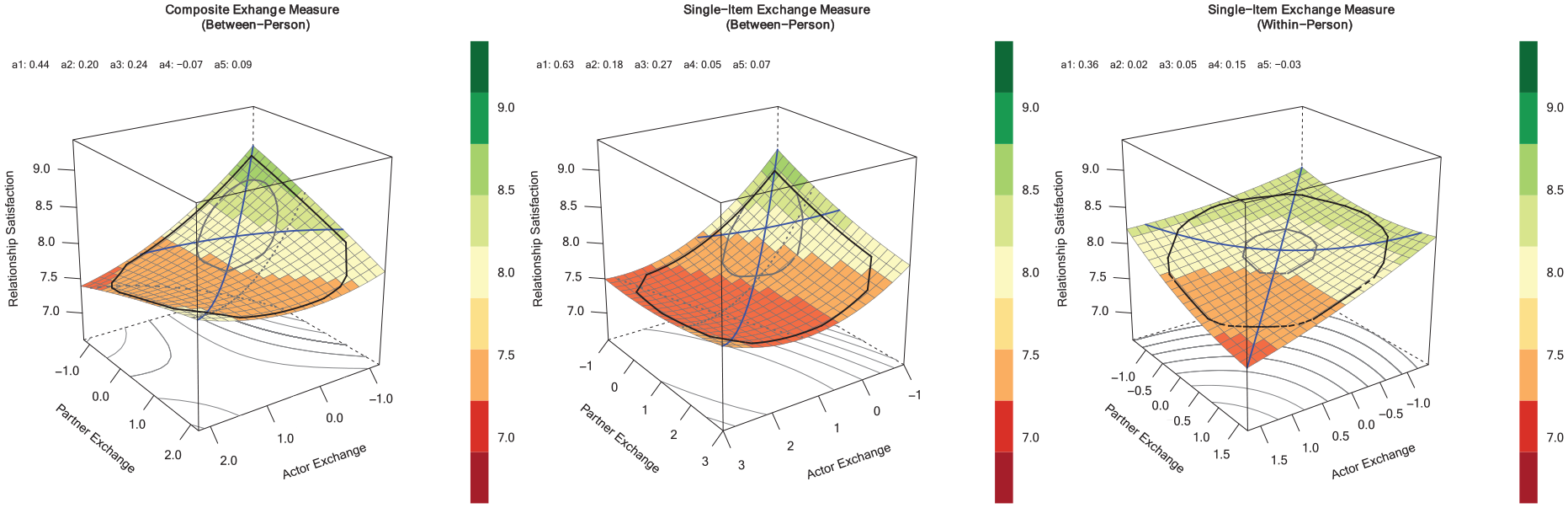
Response surface patterns of the dyadic polynomial regression models for between-person and within-person effects.
Discussion
Summary and Implications
In a large national sample of couples from Germany, the present study employed two sets of rigorous analyses to evaluate: (a) long-term changes in romantic partners’ exchange orientation, (b) temporal associations between exchange orientation and relationship satisfaction, and (c) the associations between partner similarity in exchange orientation and relationship satisfaction. First, we found that exchange orientation generally declined over the course of the relationship. Second, partners who experienced slower declines in exchange orientation showed steeper declines in relationship satisfaction than those who reported faster declines in exchange orientation. Importantly, we found that within-person increases in exchange orientation predicted future decreases in relationship satisfaction, rather than the other way around. Lastly, we found no evidence that partner similarity in exchange orientation predicts higher relationship satisfaction.
The current findings have significant theoretical and practical implications. First, earlier research has often theorized exchange orientation as a fixed dispositional construct (e.g. Buunk & VanYperen, 1991; Murstein et al., 1977; Stafford, 2020). However, the present study demonstrated that exchange orientation can fluctuate over time, highlighting its malleability and the potential for diverse patterns of plasticity across individuals and relationships (Li & Fung, 2019), suggesting it may be a potentially valuable yet underexplored target for interventions. Further, we found that romantic partners, on average, experienced a general decline in exchange orientation as their relationship developed, and those who showed a slower decline in exchange orientation were more likely to demonstrate greater declines in relationship satisfaction. These findings provide insight into the communal nature of intimate relationships, providing empirical support for the perspective that the exchange aspect of relationships is likely the strongest at the beginning stages, but as relationships develop increased closeness, partners might engage in less frequent recordkeeping. In fact, the current findings revealed that the associations between the trajectories of exchange orientation and relationship satisfaction were stronger than their baseline associations (Δχ [1] = 38.10, p < .001), highlighting the importance of examining how exchange orientation evolves over time rather than focusing solely on initial differences in its potential role in shaping relationship dynamics.
Second, we observed that within-person increases in exchange orientation generally co-occurred with corresponding decreases in relationship satisfaction within time, indicating a robust intrapersonal association between these changes. Further, our within-person cross-lagged effects suggest that an uptick in exchange orientation may signal a long-term drop in relationship satisfaction 2 years later, corroborating the adverse impact of exchange orientation on intimate relationships. Combined with the finding that peoples’ exchange orientation can change and fluctuate, one practical implication of our findings could be that couples should aim to avoid exchange norms in their relationships, moving away from expecting direct reciprocation. Rather, as research on communal strength (Clark & Mills, 2012) and responsiveness (Reis et al., 2004) indicates, partners should ideally strive to meet each other’s needs and desires with no strings attached. Although the norms toward direct reciprocation may be considered more equitable, our findings suggest such stringent expectations could undermine couples’ relationship happiness in the short- and long term.
Lastly, we found that dyadic similarity in exchange orientation was not related to relationship satisfaction, and both partners being equally exchange oriented did not provide any additional benefits. Instead, we mostly observed additive main effects, in which partners reported lower relationship satisfaction when either partner was higher on exchange orientation. Contrary to the notion that a similar propensity toward direct reciprocation may yield relationship benefits, our findings suggest that exchange orientation remains a risk factor for both partners with less regard for their similarity. In fact, the lack of similarity effects might be attributable to the difficulty individuals face in reasonably keeping track of everything their partners do for them in the highly interdependent context of a romantic relationship (see Visserman et al., 2019). Hence, an interesting avenue for future research could be to examine the interplay between peoples’ exchange orientation and their tendencies to underestimate their partners’ reciprocation or investment in the relationship.
Directions for Future Research
Based on the current findings, there are several directions for future research to help expand our understanding of the nature of exchange orientation in intimate relationships. First, while the present study examined peoples’ general tendencies toward direct reciprocation, researchers have noted the possibility that people’s exchange orientation may vary in importance across different aspects or domains of relationships (Stafford & Kuiper, 2022). For example, one might hold a stronger exchange view regarding the division of housework but endorse less of an exchange principle when it comes to providing emotional support. In fact, while global indices of exchange orientation do not capture these distinctions, recent studies have begun exploring exchange motives in specific relationship domains, such as sexuality (Raposo et al., 2021). Thus, a valuable avenue for future research would be to compare individuals’ exchange orientation across different relationship domains to investigate (a) whether people adopt distinct norms for different domains and (b) whether the propensity toward direct reciprocation is more harmful or beneficial in certain domains.
Relatedly, while the present study found no evidence that decreases in relationship satisfaction can lead to higher exchange orientation, it remains unclear why some individuals are higher in exchange orientation. We know little about the predictors of exchange orientation or under what circumstances exchange norms might become dominant. Thus, in addition to exploring the extent of domain-specificity in exchange orientation, investigating the contextual demands and constraints that might lead to increases or reductions in exchange orientation could inform a more nuanced understanding of conditions under which exchange orientation might be more deleterious or adaptive. In fact, although the present study employed rigorous longitudinal analyses to capture cross-lagged within-person associations, it must be noted that our findings from correlational data do not permit strong causal conclusions. While the autoregressive paths in our models, which describe the temporal continuity of how prior within-person fluctuations predict subsequent fluctuations, are expected to account for potential influences of time-invariant covariates, they do not fully eliminate the possibility of time-varying confounds (Mund et al., 2021). Furthermore, while the present study relied on biannual intervals for longitudinal analyses, it remains possible that the link between exchange orientation and relationship satisfaction is more bidirectional in shorter time frames, with one direction of effect lasting longer than the other over time. Although the optimal time lags for studying relationship development remain underexamined (Karney & Bradbury, 2020), future research using different time lags could help delineate the extent to which changes in exchange orientation might occur as a function of changes in other variables.
Another potential area for continued research is the consideration of different types of exchange orientations. Sprecher (1998) suggested that exchange orientation might be comprised of two components, namely underbenefiting and overbenefiting exchange orientation. The former describes concerns about receiving back from the partner after giving, while the latter involves the propensity toward discomfort when failing to repay after receiving. Previous research has shown that overbenefiting exchange orientation may not carry the same degree of impact on romantic relationships as underbenefiting exchange orientation (Bippus et al., 2008; Sprecher, 1998). In this context, the present study relied on items that specifically focused on partners’ expectations toward direct reciprocation from their partner, which aligns more closely underbenefiting exchange orientation and might explain the robust negative effects observed. Accordingly, additional research examining the long-term effects and dyadic matching effects with the distinction between underbenefiting and overbenefiting concerns could help extend our current findings.
Conclusion
In conclusion, this study advances our understanding of the role of exchange orientation in intimate relationships, offering insights into both theory and practice. Our findings revealed that exchange orientation can change and fluctuate within a relationship, generally declining over time. Notably, individuals who experienced slower declines in exchange orientation also showed steeper declines in relationship satisfaction, which suggests that a greater decrease in exchange orientation can be beneficial for maintaining a satisfying relationship. Moreover, this study provided within-person analyses of longitudinal reports, which suggested that exchange orientation may have a lasting impact on relationship satisfaction rather than the other way around. In addition, we found that partner similarity in exchange orientation did not have meaningful benefits for relationship satisfaction. Overall, these findings corroborate the detrimental effects of exchange orientation on romantic relationships, suggesting we should strive to move away from adopting a tit-for-tat mindset and focus on responding to our partners’ needs, ideally with no strings attached, to cultivate more satisfying relationships.
Supplemental Material
sj-docx-1-psp-10.1177_01461672251330700 – Supplemental material for “Pay Me Back”: Testing the Implications of Long-Term Changes and Partner Similarity in Exchange Orientation Within Intimate Relationships
Supplemental material, sj-docx-1-psp-10.1177_01461672251330700 for “Pay Me Back”: Testing the Implications of Long-Term Changes and Partner Similarity in Exchange Orientation Within Intimate Relationships by Haeyoung Gideon Park, Matthew D. Johnson, Amie M. Gordon and Emily A. Impett in Personality and Social Psychology Bulletin
Footnotes
Declaration of Conflicting Interests
The author(s) declared no potential conflicts of interest with respect to the research, authorship, and/or publication of this article.
Funding
The author(s) received no financial support for the research, authorship, and/or publication of this article.

Supplemental Material
Supplemental material is available online with this article.
Notes
References
Supplementary Material
Please find the following supplemental material available below.
For Open Access articles published under a Creative Commons License, all supplemental material carries the same license as the article it is associated with.
For non-Open Access articles published, all supplemental material carries a non-exclusive license, and permission requests for re-use of supplemental material or any part of supplemental material shall be sent directly to the copyright owner as specified in the copyright notice associated with the article.
