




Abstract
This study investigates the understudied aspect of the multi-faceted nature of religious identity and its implications for intergroup outcomes vital to (post-)conflict settings. Three studies were conducted in Northern Ireland to address this gap using a mixed-method approach. Study 1 involved 519 Catholic and Protestant participants who provided open-ended responses regarding religious identity construals as religious, cultural, or political. Qualitative content analysis yielded 17 items related to Catholic/Protestant identity construals. Study 2 included 276 participants who rated these 17 items, and factor analyses identified a subset of 14 items representing the three identity construals. Finally, Study 3 (N = 300) validated the newly-developed scale and examined how different combinations of religious, cultural, and political identities related to forgiveness, collective action, and allyship. The results indicate the reliable measurement of religious identity construals across the three dimensions and contribute to understanding religious identity and its implications for conflict and peace.
The religious identity of individuals is a key factor in many intergroup conflicts, such as the one between Catholics and Protestants in Northern Ireland. However, we argue that in conflict contexts, religious identity is not solely about religion itself; rather, it serves as a boundary marker between conflicting parties, underpinned by historical, religious, political, economic, and psychological factors (Cairns & Darby, 1998; Leach & Williams, 1999; Trew & Benson, 1996). For example, Catholic and Protestant affiliations in Northern Ireland are not merely indications of religiosity; they also represent social identity categories that encompass cultural, political, and historical differences, which extend beyond religious practices and even to non-practicing individuals (Hayes & McAllister, 2013; Mitchell, 2006).
Previous research has highlighted the significant role that social identity plays in conflict settings, with a range of studies examining this phenomenon (e.g., Cehajic et al., 2008; Hanke et al., 2013; Hewstone et al., 2006; Leonard et al., 2015; Noor et al., 2008; Uluğ et al., 2023). However, little research has been conducted on the diverse interpretations of key identities in such settings. Notable exceptions to this gap in research include the investigation by Acar et al. (2024) on religious, political, and cultural interpretations of a religious minority identity in Turkey (i.e., Alevi identity) and the research by Muldoon et al. (2007) on the content of national and religious identities in Northern Ireland (see also the work by McNicholl et al., 2019). To build on this latter tradition on the diverse interpretations of key identities, this study aims to examine the multi-faceted nature of religious identity in a post-conflict society and its implications for intergroup outcomes vital to conflict and peace research. To achieve this objective, Study 1 investigated how people in Northern Ireland understood, defined, and construed religious identity in the religious, cultural, or political sense—dimensions identified as particularly relevant by previous literature (Acar et al., 2024; PODEM, 2016) and the context-specific nature of religious identity in Northern Ireland (Dautel, 2012; McNicholl et al., 2019; Muldoon et al., 2007). Recognizing that no existing scale adequately captured these nuances, we developed and initially validated a new scale in Studies 2 and 3. Finally, in Study 3, we examined whether people with different constellations of religious, cultural, and political identities had different preferences for (a) collective action for one’s own group, (b) perceived allyship for the outgroup, and (c) forgiving the other group in post-conflict societies. Thus, we aimed to contribute to the controversy about different predictors of collective action versus forgiveness (Greenaway et al., 2011; Wright & Lubensky, 2013). Establishing these links is crucial because it can help shed light on how different interpretations of religious identity may impact intergroup dynamics, conflict resolution, and peace-building efforts.
Multi-Facets of Religious Group Identity: A Need for a Mixed-Method Approach
A person’s group identity plays a pivotal role in conflict settings. Social identity theory (SIT; Tajfel & Turner, 1979) is frequently used to examine the implications of aligning with one of the conflicting groups. Consequently, individuals who identify with a particular group often exhibit ingroup bias, manifesting as a tendency to view their group favorably in comparison to others. In ongoing or post-conflict situations, strong identification with one’s group not only reinforces ingroup bias but may also hinder the development of positive attitudes and behaviors toward the outgroup (Brown, 2000). SIT has been extensively researched, often using quantitative methods, to measure the strength of social identity and its links with peace-related outcomes, such as reconciliation and forgiveness (Baysu et al., 2018; Cehajic et al., 2008; Ferguson & McKeown, 2016; Uluğ et al., 2023).
People’s religious identity is one of the central social identities in many ethno-political conflicts (Neuberg et al., 2014), such as with Catholics and Protestants in Northern Ireland (Uluğ et al., 2023). While some argue that other social identities, such as national or ethnic identities, may wield comparable or greater influence than religious allegiance due to their perceived impermeability, certain conflicts, seemingly grounded in politics or ethnicity, reveal underlying religious tensions (Neuberg et al., 2014; Ysseldyk et al., 2010). In the former Yugoslavia, for example, ethnic groups were also differentiated in their religious beliefs: Most Serbs are Orthodox Christian, Croats are primarily Catholic, and Bosnians are primarily Muslim. There is a strong link between ethnic and religious identities in this context, just like with the conflict between Protestants and Catholics in Northern Ireland.
Recent research on group identity acknowledges that identification processes are multi-dimensional and dynamic, shifting over time and place (Ashmore et al., 2004), although empirical analyses of multiple facets of identities that include religion are rare (Ysseldyk et al., 2010). Employing a multi-faceted perspective on religious identity provides a more accurate evaluation of the precise elements of identity that are connected to conflict, as well as the potential for different dimensions of identity to correspond to distinct facets of intergroup conflict (Leach & Williams, 1999). For instance, Leach and Williams (1999) showed that different dimensions of religious identity (own vs. perceived others’ evaluation of one’s group) in Northern Ireland predicted different peace-related outcomes (e.g., different future scenarios regarding peace and conflict in Northern Ireland). However, this approach is insufficient in understanding the complexities of identification in conflict contexts, where identities can take on additional connotations, such as religious identities acquiring political or ethnic/national overtones, as seen in Northern Ireland (Muldoon et al., 2007).
An emerging line of research examines the content of religious identities in (post-)conflict settings, revealing their multi-faceted nature. For example, Dautel (2012) interviewed children in Northern Ireland to explore their perceptions of Protestantism and Catholicism. While their answers predominantly centered around religious beliefs (e.g., belief in God), variations emerged regarding the flexibility of group boundaries (e.g., whether one is born into or chooses a particular religion) and the intertwining of ethnic or national identity. Another example is from Turkey: Researchers conducted in-depth interviews with young Alevis and found that they have a tendency to define their Alevi identity—a religious minority identity in Turkey—along cultural, religious, and political lines (PODEM, 2016). The findings highlighted religious identities are more complex than they are studied in social psychology literature. Based on the findings of PODEM (2016), Acar et al. (2024) examined how Alevi identity in Turkey was associated with religious, political, and cultural dimensions, and how these different interpretations related to intergroup outcomes. However, the researchers utilized a quantitative approach to measure the intensity of religious identity across these different dimensions.
We argue for the necessity of employing mixed-method approaches to enhance the elucidation of the content and understandings underpinning social identity processes along with their implications for intergroup outcomes. In social psychology research, social identity is mostly studied with scales; however, the manner in which participants construe these identities is often overlooked. Studying the content of these identities qualitatively by specifically asking participants’ opinions of such identities provides fine-grained views and a plethora of information regarding social identities. For example, through qualitative methods, researchers can identify how people construct these identities, the meaning they attribute to such identities, and their content in ways not attainable through quantitative approaches.
Therefore, we began with a qualitative approach to analyze how people understood and construed their Protestant or Catholic identity across political, religious, and cultural dimensions with open-ended questions. This approach enabled us to analyze the actual content of these construals in Northern Ireland in Study 1. Subsequently, in Studies 2 and 3, we used this qualitative foundation to develop a more ecologically valid scale to quantitatively measure multi-faceted nature of religious identity across these three dimensions. We then used this new scale to distinguish participants with distinct constellations of identities via a latent profile analysis (LPA) in Study 3—a person-centered approach used to identify subgroups of individuals who share similar understandings or shared perceptions (Nylund-Gibson & Choi, 2018). Given the limited research on the topic, predicting the number or types of profiles that might emerge was challenging. Nonetheless, we expected that some participants might score high on all three dimensions while others might score relatively low across all dimensions. We also expected that along with high and low identifiers, some participants might score high on one dimension but not on others, such as predominantly cultural, religious, or political. Subsequently, we examined if people with different identity profiles showed differences in various intergroup outcomes.
Identity Profiles and Intergroup Outcomes
In advocating for a nuanced understanding of religious identity, especially within (post-)conflict contexts, a crucial question arises: Does conceptualizing religious identity in terms of its religious, cultural, or political dimensions help predict key intergroup outcomes essential to conflict and peace research? We specifically focused on forgiveness, collective action, and allyship as pivotal intergroup outcomes. Forgiveness research falls within the social cohesion approach, emphasizing reconciliation and harmony, while collective action and allyship align with the collective action perspective, prioritizing social justice. Wright and Lubensky (2013) shed light on this issue through their analysis of social psychological research in intergroup relations, revealing a notable theoretical paradox between prejudice reduction efforts emphasizing social harmony and the collective action perspective prioritizing social justice. Their work called for further integration of these traditionally separate literatures to advance understanding in the field. Therefore, in seeking to comprehend the implications of different identity profiles, we concentrated on these three outcomes.
Identity is very much central in the research on collective action (van Zomeren et al., 2008) as well as in forgiveness research in (post-)conflict contexts (Van Tongeren et al., 2014). Highlighting the aforementioned paradox (Wright & Lubensky, 2013), studies show that the more one identifies with their own group, the more likely they are to participate in collective action on behalf of their group (McGarty et al., 2009; van Zomeren et al., 2008) and less likely to forgive the outgroup for any perceived harm they have caused (Baysu & Duman, 2016; Noor et al., 2008). But this previous research does not explain how different profiles of religious identities can inform intergroup outcomes. To bridge this gap, we used two lines of research.
First, the social identity complexity theory (Roccas & Brewer, 2002) refers to how individuals perceive the interrelationships among their multiple group identities. High social identity complexity entails viewing one’s ingroups as mostly distinct yet overlapping, while low complexity involves seeing ingroups as mostly convergent. In cases of high perceived overlap, different ingroups may merge into a single convergent social identity. For example, Christian nationalists represent a convergent social identity arising from the perception of high overlap between Christian, American, and often White identities (Perry & Whitehead, 2015). When individuals perceive substantial overlap among their group memberships, they tend to exaggerate group homogeneity, erect strict boundaries, and perceive threats to their singular convergent social identity, often their primary identity. Studies indicate that low social-identity complexity correlates with increased intolerance of outgroups (Perry & Whitehead, 2015; Verkuyten & Martinovic, 2012). Applying this to identity profiles, we expected that individuals scoring higher on all three facets of religious identity would show less forgiveness and perceived allyship but stronger collective action on behalf of their group.
A second line of research focuses on politicized collective identity (Alberici & Milesi, 2016; Simon & Klandermans, 2001). When individuals recognize that their group is part of a system with unequal power distribution, their social identities can become politicized (e.g., feminist identity; Uysal et al., 2022). This often results in a greater willingness to participate in collective actions that benefit their group (Simon & Klandermans, 2001). This research suggests that embracing a political interpretation of Protestant/Catholic identities should correlate with greater engagement in collective action for their group’s interests and decreased support for the goals of the opposing group, implying reduced perceived allyship. A similar rationale could be applied to forgiveness: a more politically charged dimension of Protestant/Catholic identification might be associated with lower forgiveness. In addition, being religious, as in being a devout or practicing Catholic or Protestant, may not necessarily create a division. For example, Christians were found to be less biased toward Muslims when reminded that both religions belong to the Abrahamic religions (Kunst & Thomsen, 2015; see also the study by Baysu et al., 2018).
Taken together, both lines of research offer indirect evidence suggesting that individuals scoring high on all three dimensions and/or those with strong political orientations are likely to demonstrate reduced levels of forgiveness and perceived allyship, as well as increased engagement in collective action. Before providing an overview of the studies, we further explored the understanding of religious identities within the context of Northern Ireland.
Northern Ireland Context
In 1998, the Good Friday Agreement was signed, bringing an end to over four decades of violent conflict in Northern Ireland, which was known as “the Troubles.” This conflict was characterized by a complex interplay of religious, cultural, and political tensions between the main Protestant and Catholic communities (Mesev et al., 2009). While the key role of religious identities, including church affiliation, have been identified as perpetuating the conflict, these are strongly aligned with certain political and cultural dimensions (Mitchell, 2006).
In terms of the political dimension, Protestantism typically aligns with Unionism, while Catholicism is more closely associated with Nationalism. Unionist parties aim to maintain cultural and territorial ties with Britain, while Nationalist parties aspire to establish the United Republic of Ireland and identify with Irishness (McGlynn et al., 2014; Muldoon et al., 2007). Despite some progress toward political neutrality, McGlynn et al. (2014) argue that these ethno-political ideologies continue to shape a divide in the political system, reinforcing the social separation between Unionist and Nationalist groups (Hayes & McAllister, 2013). For example, people tend to vote for politicians who represent the interests of their ethno-cultural group in Northern Ireland (Hayes & McAllister, 2013). In terms of the cultural dimension, Protestant affiliation is linked to British identity and culture while Catholic identity is consistently associated with Irish identity and culture (Muldoon et al., 2007).
The differentiating factors between Protestants and Catholics ultimately lead to the development of distinct identities, with Protestant-British-Unionist identities (those who wish to see Northern Ireland remain part of the United Kingdom) being opposed to Catholic-Irish-Nationalist identities (those who advocate for the unification of the island of Ireland; see the studies by Cairns, 1994; Cassidy & Trew, 1998). Although some Protestants or Catholics do not identify with other cultural and political factors, their expressions of identity usually mirror the religious divide (McAuley & Tonge, 2007), and they rarely adopt the opposing group’s characteristics (e.g., a Unionist Catholic). The Northern Ireland context thus presents a unique opportunity to understand the multi-faceted nature of religious identity in (post)-conflict societies.
Overview of Current Studies
Despite the wealth of evidence that highlights the significant role of social identities in (post-)conflict settings (e.g., Cehajic et al., 2008; Hanke et al., 2013; Hewstone et al., 2006; Leonard et al., 2015; Noor et al., 2008; Uluğ et al., 2023), less is known about the content of key identities in such contexts. To address this gap, our study aimed to examine the multi-faceted nature of religious identity in a post-conflict society and its implications for intergroup outcomes in such a setting. Accordingly, we first aimed to use a qualitative approach to religious social identity (Study 1) to investigate how people in Northern Ireland understood and defined religious identity along the religious, cultural, or political dimensions. We then developed (Study 2) and validated (Study 3) a new scale to measure the various dimensions of Protestant/Catholic identities quantitatively. This was necessary because previous identity scales failed to fully capture the intricacies of how people interpret religious identity in (post-)conflict settings. Finally, using this new scale, we aimed to distinguish subgroups of participants with different constellations of religious, cultural, and political identities via an LPA. Due to the limited research on the topic, it was challenging to predict the number or types of profiles that might emerge. Nonetheless, we expected that some participants might score high on all three dimensions, while others might score relatively low across all dimensions, or substantially high on only one dimension. We examined if these profiles differed in intergroup variables such as collective action, perceived allyship, and forgiveness. Thus, we not only aimed to contribute to the debate on the different predictors of collective action versus forgiveness (e.g., see the study by Greenaway et al., 2011) but also extended this line of research by focusing on another crucial factor: perceived allyship in post-conflict societies. Even though allyship has been recently studied in social psychology and relatively calmer societies (e.g., Chen et al., 2023; Craig et al., 2020; Radke et al., 2020; Selvanathan et al., 2023; Williams et al., 2023), it has been long ignored in (post-)conflict societies (e.g., see the study by Uluğ et al., 2024). Overall, all three studies aimed to contribute to a nuanced understanding of multi-faceted nature of key identities in conflict contexts and its implications for intergroup outcomes.
These studies were approved by Queen’s University of Belfast and were not preregistered. The anonymized raw data syntax/code and output are publicly available via the Open Science Framework (OSF) webpage: https://osf.io/8v24w/?view_only=77735ac907054d02b7abc42f5e2538c4.
Study 1
Previous research with Alevis in Turkey showed that religious identities (may) exist along cultural, religious, and political lines (Acar et al., 2024; PODEM, 2016). Similarly, studies in the context of Northern Ireland have further supported the relevance of these dimensions (Dautel, 2012; McNicholl et al., 2019; Muldoon et al., 2007). Based on this research, we conducted Study 1 to qualitatively examine how people in Northern Ireland understood and defined religious identity along these three dimensions. Specifically, we asked Protestant- and Catholic-identified participants what it means for a Protestant or Catholic identity to be construed culturally, politically, or religiously. By analyzing their answers via qualitative content analysis, we sought to understand how people construed religious identity across these dimensions.
Method
Participants and Procedure
The study was conducted between 2019 and 2020. Data were collected from participants aged 18 years or older and raised in Northern Ireland. Initially, 571 participants were recruited. As we were interested in religious identity, we excluded those who did not identify as either group (n = 52); we had then 519 participants who self-identified (or were raised) as either Catholic (n = 259) or Protestant (n = 260). Excluding the missings (n = 146), we focused on 373 participants who responded to at least one of the open-ended questions about religious identity (49% Catholic, n = 184; 51% Protestant, n = 189; 41% males, 58% females, three preferred not to say, two identified other; age range: 18–81 years, M = 32.32, SD = 15.28). Participant demographics revealed a predominantly highly educated group (53% high school graduates, 43% having attained university education or higher, 4% lower than high school). Employment status varied, with 55% employed, 33% students, and a minority unemployed (6%) or in other categories (6%). On average, participants reported a moderate subjective socioeconomic status (SES; M = 5.98, SD = 1.48) on a scale ranging from 1 (worst off) to 10 (well-off).
We used both online (35%) and paper-pencil (65%) versions of the questionnaire. Participants were recruited via convenience sampling, which involved approaching family and friends and asking these individuals to forward questionnaires to others for both versions and posting on social media outlets for the online version. As part of a multi-study data-collection effort, we first asked some demographic questions to the participants. Later, they also responded to some items related to their mental health, family, and identity and intergroup experiences. After that, we asked our participants how people construe religious identity with three open-ended questions. However, the open-ended questions focused only on the ingroup. In other words, Catholics responded to three questions: “If a person you meet says, ‘Being Catholic is an important religious/cultural/political identity for me,’ what comes to mind about that person?” Protestants responded to three questions: “If a person you meet says, ‘Being Protestant is an important religious/cultural/political identity for me, what comes to mind about that person?” One of the reasons we used this approach was to gain insight into how people construe these identities without directly asking about their own religious identities. The aim was to help participants imagine an ingroup person and, thus, talk about even negative characteristics of the identity of this ingroup person. However, talking about negative associations would be quite unlikely if we asked about their own religious identity.
This study was not preregistered. We do not have informed consent to share these qualitative data publicly as they include direct quotations from participants. However, researchers who want access to these data should send an email to the corresponding author.
Results
We analyzed our data based on qualitative content analysis (Schreier, 2012). We treated each dimension of religious identification as a separate main category, and we also created a subcategory for each group (one for Catholics and one for Protestants). So, in total, we had three main categories and related two subcategories for each main category: (a) religious identity construals (1a for Catholics/1b for Protestants), (b) political identity construals (2a for Catholics/2b for Protestants), and (c) cultural identity construals (3a for Catholics/3b for Protestants). We examined participants’ responses in relation to the six subcategories and created sub-subcategories inductively (i.e., based on participants’ responses to the open-ended questions). Thus, we created the main categories and subcategories deductively (i.e., top-down way) based on the 2016 PODEM report (see also the study by Acar et al., 2024), whereas we created the sub-subcategories of these main categories inductively (i.e., bottom-up way) based on the responses of the participants to such open-ended questions. After that, we also calculated inter-rater reliability by selecting 10% of the overall data. Resulting inter-rater reliability scores that ranged from kappa = .76 to 1.00 for the various main categories of the coding frame can be considered almost perfect, with the exception of the main category Protestants’ Religious Identity Construals (i.e., 1b) that yielded a reliability score of kappa = .76, which is still substantial (Landis & Koch, 1977; see SOM.1 for inter-rater reliabilities). The qualitative data showed two important points: (a) religious identity can be construed in three different ways—religiously, culturally and politically—and participants across both religious groups could easily describe the content of those different construals, which shows these construals exist in the minds of participants; (b) the content of religious identities shows differences across Catholics and Protestants, yet share many similarities across both communities as well. All in all, there were more overlaps than differences across both communities in construing these religious identities religiously, politically, and culturally, which we explained below.
Main Category 1: Religious Identity Construals
Subcategory 1a: Catholics’ Religious Identity Construals
Catholic participants usually construed this identity with some religion-related terms such as someone religious/devout and who actively practices the faith, as seen in one participant’s words: “That person accepts, has faith in and believes the teachings of the Catholic Church and wishes this to be central to how they live their lives.” Others also mentioned Catholic upbringing, churchgoing, believing in God, and being proud of their religion as important parts of these construals. However, there were also some negative characterizations such as someone who lacks progressiveness and is backward, very traditional/single-minded, and bitter. For example, one participant associated people who see being Catholic as an important religious identity for them with being single-minded, as seen in the quote: “If they are a strict Catholic, they are probably pro-life and anti-gay marriage.” In addition, some other negative associations were made by some participants such as “weird,” “religious nut,” or “boring.” However, there were also some positive associations such as being good people, having good values, and living.
Subcategory 1b: Protestants’ Religious Identity Construals
Similar to Catholics, Protestant participants also mentioned some religion-related terms for Protestant religious identity including someone who attends church, actively practices religion, and believes in God. Again, similar to Catholics, some Protestant participants associated this identity with being brainwashed, bigoted, backward, close-minded, and uneducated. As for others, construing Protestant identity as a religious identity meant not accepting other religions or views but especially Catholics: “. . . they may be unaccepting of other religions” or “. . . and generally unaccepting of different views” or having sectarian views (e.g., “they would seem sectarian to me”). Some participants also mentioned that those who see Protestant identity as a religious identity could be loyalists (e.g., “they are probably a loyalist”), could be unionists (e.g., “if they are actually religious or if they just use ‘Protestant’ as a byword for Unionist”), or could give importance to their British identity (e.g., “they have strong beliefs toward the UK and may identify with being British”). Finally, there were also some instances of defining people who say Protestant identity is an important religious identity for them as good people.
Main Category 2: Political Identity Construals
Subcategory 2a: Catholics’ Political Identity Construals
Catholic participants mentioned different characteristics of political identity for them. For example, some participants argued that people who say that being Catholic is an important political identity for them are not actually Catholic; they are rather confused about what Catholic means. They also mix and confuse politics with religion. For example, one participant mentioned that those people could not separate church and state. Similarly, another participant argued that “they let religion dictate politics.” However, a few emphasized that religion and politics should not mix.
For others, political identity was associated with politically active people (e.g., left-wing, Republican, or supporting Sinn Fein), nationalists (e.g., Irish nationalist, supporting the reunification of Ireland, or voting for the national party), and possibly sectarians as well. For example, a participant argued that these people “[m]ay hold disdain for Protestants due to the Troubles.” Even though some participants mentioned positive characteristics such as being a good person (e.g., being smart and honest) or someone being affected by the troubles for people who define Catholic identity as a political identity, other construals were still quite negative such as being angry, bigoted, and narrow-minded. Some participants gave examples of being a bigot or narrow-minded related to being pro-life or “believe[ing] in things that hurt or hinder other minorities (LGBTQ).”
Subcategory 2b: Protestants’ Political Identity Construals
Participants also mentioned different characteristics of political identity for Protestants. Similar to Catholics, some participants associated political identity for Protestants with not differentiating between religion and political views, as well as with not understanding politics. For example, one participant said, “I think it is time to move on and separate religion and politics.” Others argued that people who say being Protestant is an important political identity for them do not practice religion (i.e., non-religious) and have extreme views. They are unionists, vote for Northern Irish (e.g., political parties such as DUP [Democratic Unionist Party] and UPP [Ulster Unionist Party]), loyalists, sectarians, or nationalists. For these people, a participant said, “I would immediately assume they were at least slightly sectarian and strongly aligned themselves with Britain.” Similarly, for another participant, a person who says that Protestant identity is an important political identity for them is “the kind of person who’d vote TUV [Traditional Unionist Voice] because the DUP aren’t extreme enough.” Therefore, it is not surprising that these people also want to stay in the United Kingdom and are against United Ireland.
Similar to Catholics’ political identity construals, this identity had both negative and positive characteristics. Negative construals included being short-sighted, backward, bigot, moron, stuck in the past, bitter, or having negative views toward Catholics/other views, whereas positive construals only included being intelligent and good.
Main Category 3: Cultural Identity Construals
Subcategory 3a: Catholics’ Cultural Identity Construals
Catholic participants mentioned different characteristics of cultural identity such as identifying more with the Irish cultural side than the Catholic side. Upbringing, family, history, and tradition are some of the examples that were mentioned as part of cultural identity. For example, according to one participant, people who define this identity as more like a cultural identity “identify more with the Irish cultural side and associate being Catholic as being an Irish thing, rather religious belief.”
As a result, these people are not religious even though they may share some Catholic practices, as seen in a participant’s words: “. . . they have a sense of belonging to the Catholic community, not necessarily religious.” The construals of this identity were associated with cultural events such as Irish music and dance, language and art, sports, or in general, having a strong sense of community. We should also note that some participants argued people who culturally construe Catholic identity may be Republican, nationalist (e.g., proud of being Irish), and “identify with the shared experiences of Catholics who have lived in the north of Ireland,” as seen in one participant’s own words.
Subcategory 3b: Protestants’ Cultural Identity Construals
Protestant participants mentioned different characteristics of cultural identity such as cultural traditions, including identifying with orange order and bonfires, loving the 12th and 13th of July, and being affiliated with band parades. Like Catholic participants, Protestant participants also mentioned people’s upbringing as part of the Protestant cultural community. Again, similar to the way cultural identity for Catholics was defined, Protestant participants associated this identity with being loyalist, sectarian, and unionist. Even though there were some other negative characterizations such as being boring, uneducated, bitter, short-sighted, bigot, and stuck in the past, this cultural identity was also associated with “good people” in some cases.
Discussion
Study 1 allowed us to understand the content of how Protestant and Catholic participants construe Protestant and Catholic identities in three different ways: as a (a) religious, (b) political, and (c) cultural identity. However, we did not come across any new main categories other than the three dimensions of religious identity we asked.
We observed some differences among religious identity’s political, religious, and cultural dimensions. When describing the religious aspect of religious identity, some religion-related terms (e.g., devout, churchgoing, believing in God) were mentioned more. In addition, being proud of religious identity was another important sub-subcategory that was mentioned under the religious aspect of religious identity. One of the important differences between Catholics and Protestants in defining the religious aspect of religious identity was that for Protestants, religious identity still had some political connotations. Similarly, being a loyalist, unionist, or British was mentioned by Protestants as part of the religious aspect of religious identity. However, that was not the case for Catholics as they mostly used religious terms to define this aspect of religious identity. When describing religious identity’s political aspect, terms either related to political ideologies or political actions were mentioned more often. In this subcategory, while some claimed that people who say that being Catholic is an important political identity for them are not indeed religious, others claimed these people are somewhat confusing politics with religion or cannot differentiate between religion and political views. Only among Catholics, being affected by the Troubles was mentioned for the political aspect of religious identity. Only among Protestants, negative views toward Catholics were mentioned for the political aspect. When describing the cultural aspect of religious identity, words associated with culture in general (e.g., history) and cultural traditions and events in particular (e.g., July 12) came to the fore. However, some participants still mentioned religion as an important part of cultural identity. More importantly, values and communities were unique to the cultural aspect of religious identity. We noticed that Protestant participants attributed more negativity to the cultural aspect of religious identity than their Catholic counterparts. However, some political terms were mentioned by both groups such as being Republican for Catholics and Loyalist for Protestants.
Those construals were quite diverse, yet they shared many similarities across both communities. For religious identity construals, both communities mentioned being actively religious, as well as some negative associations that come with the term such as being single-minded. For political identity construals, there was criticism against people who mix religion and politics across both communities. Sectarianism was also common among both Protestant and Catholic participants. For cultural identity construals, people’s upbringing in certain communities was mentioned among both communities. All in all, there were more overlaps than differences across both communities in construing these religious identities religiously, culturally, and politically.
Study 2
The aim of this study was to quantitatively measure different facets of religious identity identified in Study 1. Recognizing that no existing scale adequately captured these nuances—and to fulfill our primary objective of examining the multi-faceted nature of religious identity in a post-conflict society—we developed a new scale based on the findings of Study 1. Following Flake et al. (2017), our validation process involved a substantive phase in which we utilized the qualitative analysis of open-ended questions from Study 1 along with discussions with a local team of students to formulate the 17 items (based on the sub-subcategories we found in Study 1, see Table 1). We asked participants again what it meant for them to see Protestant or Catholic identity as religious, cultural, or political, but this time, we listed the 17 items and asked them to rate each of the items for each dimension of religious identity. This allowed us to examine quantitatively whether different items load clearly on different identity construals in an exploratory factor analysis, which is the first step to the structural phase of the validation process (Flake et al., 2017).
Frequencies and Percentages of Main Categories, Subcategories, and Sub-Subcategories With Respect to Religious, Cultural, and Political Identities Among Catholics and Protestants in Study 1.

Note. Similar sub-subcategories across communities are highlighted in bold; the connections between these sub-subcategories and the 17 items identified in Study 2 are italicized, and the item numbers from Table 2 are indicated in parentheses.
Method
Participants
The study was conducted between 2020 and 2021 among participants aged 18 years or older and raised in Northern Ireland. Out of 329 participants, we removed 22 participants who did not respond to the questionnaire beyond the first page of demographics and another 31 who identified as neither Catholic nor Protestant (i.e., other). We focused on 276 participants who self-identified (or were raised) as Protestant (n = 138) or Catholic (n = 138) (30% males, 70% females; age range: 18–69 years, M = 30.04, SD = 12.70). Participants were highly educated (54% high school graduates, 43% having attained university education or higher, 3% lower than high school), mostly employed (58%) or students (30%), with a minority unemployed (5%) or in other categories (7%). On average, participants reported a moderate subjective SES (M = 5.89, SD = 1.53). After giving their consent, participants responded to an online survey. They were recruited similarly as in Study 1, except that this study was completely online. The sample size was not determined by a sample size estimate based on power analysis. However, we still aimed to recruit at least 300 participants (n = 150 for each group) guided by the rule of thumb suggesting that 300 participants typically suffice for most factor analyses (MacCallum et al., 1999), as well as detecting small-to-medium effect sizes in regression (Faul et al., 2007).
Measures
Meanings of identity construals were measured with three questions as to what it means for participants to see Protestant/Catholic identity as religious, cultural, and political. Participants then responded to 17 items on a scale of 1 = strongly disagree to 7 = strongly agree separately for each identity construal: “Protestant/Catholic identity as religious/cultural/political means . . ..” (1. Attending church, 2. Being devout [i.e., structuring one’s life around religious beliefs], 3. Having a Catholic/Protestant background and upbringing, 4. Practicing one’s faith actively, 5. Being conservative [e.g., about LGBTI rights; abortion rights], 6. Seeing religion as a big part of one’s identity, 7. Having a strong sense of community [feeling unity with other Catholics/Protestants], 8. Participating in cultural events [e.g., St Patrick’s Day, Irish dance, language/e.g., parades & bands], 9. Identifying more with the Irish/British cultural side than the Catholic/Protestant side, 10. Mixing with people from the same community, 11. Being Nationalist [strong Irish identity]/Being Unionist [strong British Identity], 12. Being Republican/Loyalist, 13. Being politically active, 14. Having been affected by the Troubles, 15. Having sectarian views [i.e., unaccepting of the other community], 16. Voting based on religion/religious values, 17. Wanting reunification of Ireland [and being against British Politics]/Wanting to stay in the United Kingdom [and being against United Ireland]).
Importance of identity construals was measured with one item each based on the study by Acar et al. (2024): “Being Protestant/Catholic is an important religious/cultural/political identity for me.” Their responses ranged from 7-point response scales: 1 = strongly disagree to 7 = strongly agree.
Religious identification was measured with four items (Hogg & Hains, 1996): “How important is it to you to be a Catholic/Protestant?”; “How much do you feel a sense of belonging with other Catholics/Protestants?”; “How much are other Catholics/Protestants similar to you?”; and “How happy are you to be a Catholic/Protestant?” (α = .93). The responses ranged from 7-point response scales (1 = not at all to 7 = very much).
Results
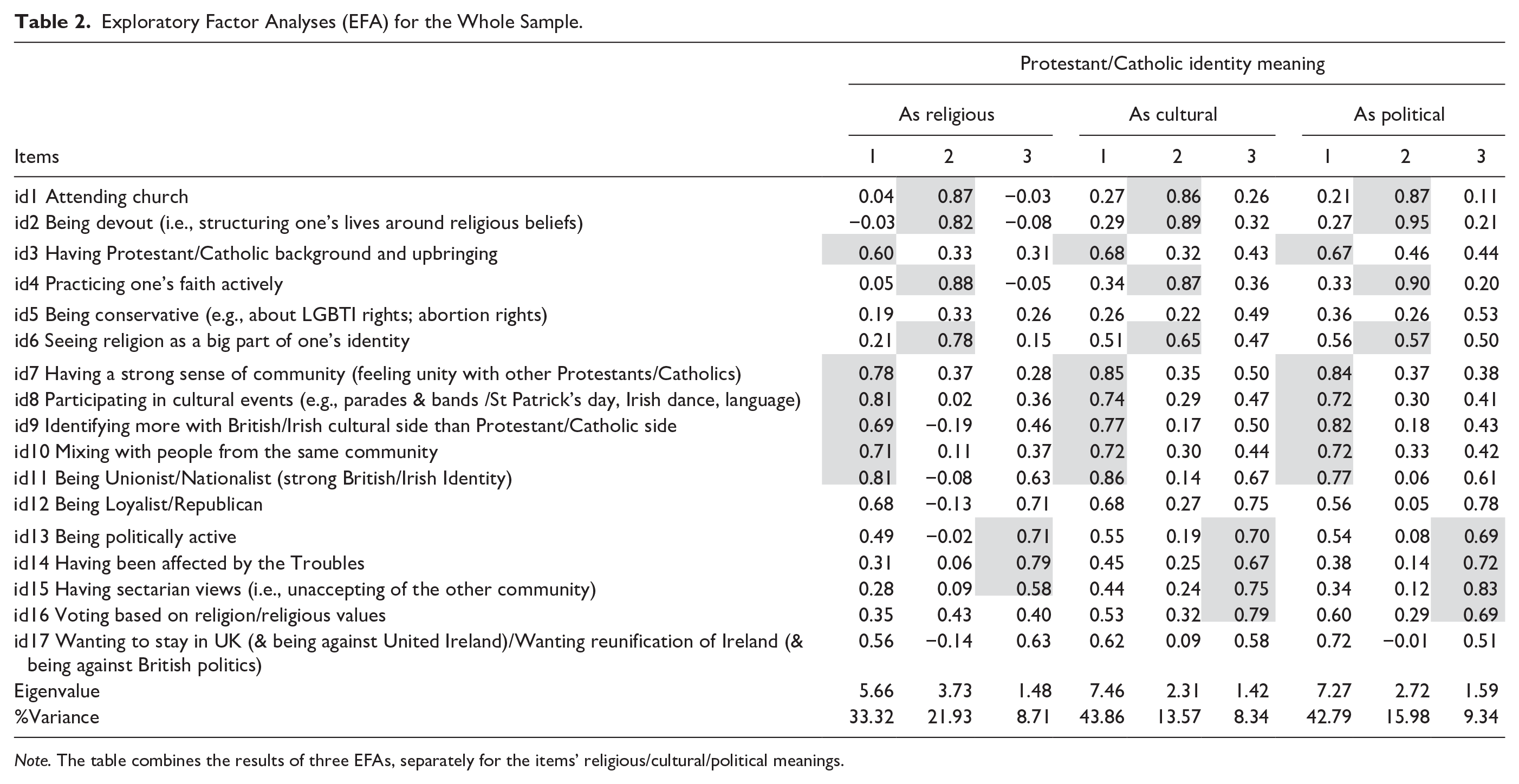
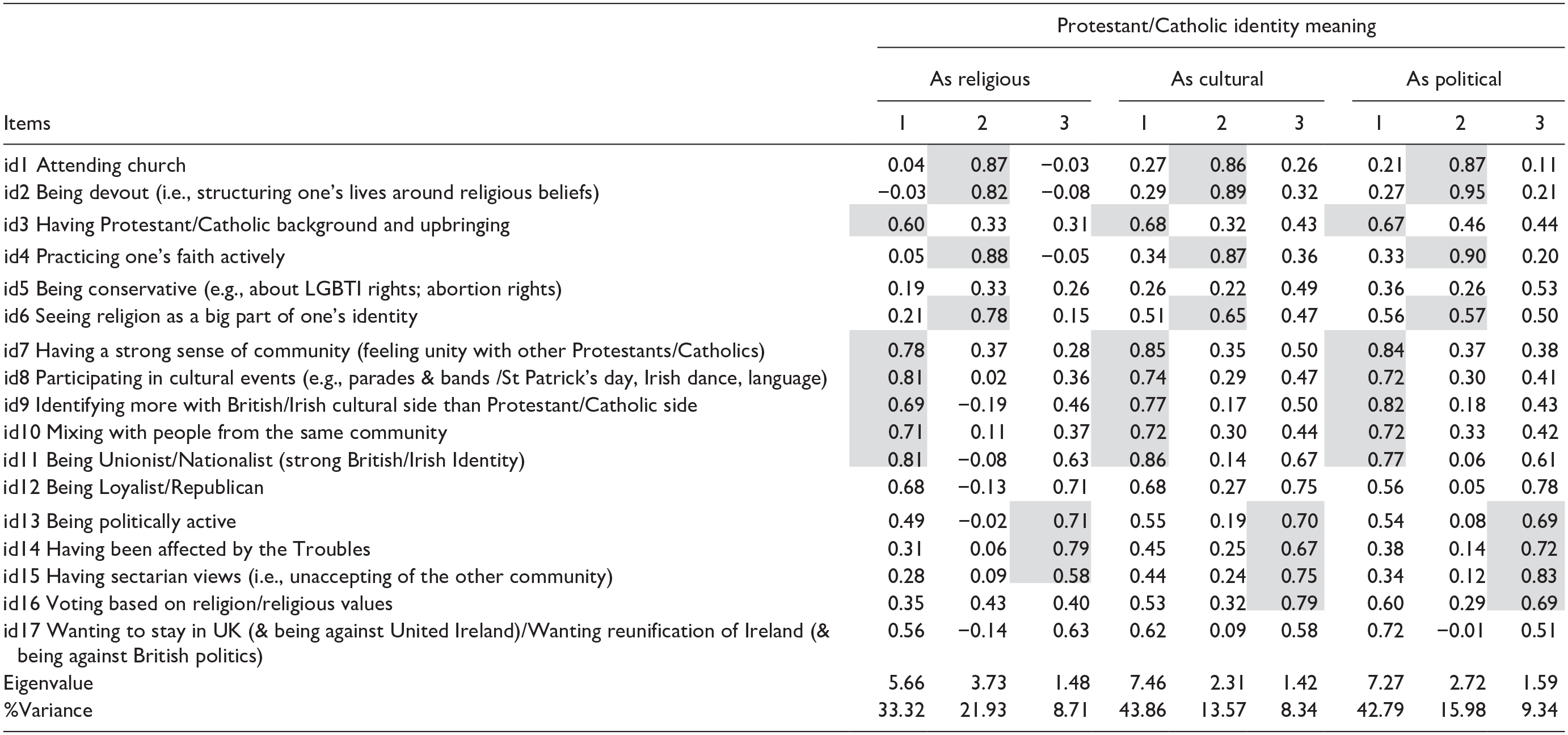
We ran three sets of factor analyses of the 17 items, referring to the items’ religious, cultural, or political meanings. We used principal axis factoring and oblimin rotation in SPSS. Kaiser-Meyer-Olkin (KMO) test values indicated sample adequacy for all three analyses (values between 0.8 and 1 indicate the sampling is adequate; KMO = .87, .88, and .87, respectively). Bartlett’s test of sphericity indicated the data were suitable for factor analysis for all three, chi2(136) = 1258.88, 1293.72, and 1281.98, all ps < .001. As seen in Table 2, all three analyses yielded three factors with eigenvalues over 1, explaining 64%–68% of the variance.
Exploratory Factor Analyses (EFA) for the Whole Sample.
Note. The table combines the results of three EFAs, separately for the items’ religious/cultural/political meanings.
In each analysis, the first factor was defined by six items we expected to find under cultural identity construal, the second factor by four items under religious identity construal, and the third factor by four items under political identity construal. Loadings over .60 on their respective factors were considered good. When the item did not load on their respective factor, and when there were cross-loadings (ratio of loadings being greater than 75%), the items were considered problematic (Costello & Osborne, 2005; Samuels, 2017; Tabachnick & Fidell, 2007). Accordingly, we decided to drop the three items: Item 5 did not load strongly on its respective factor (>.60), and Items 12 and 17 referred strongly to both cultural and political identities (>.60). We also ran the same analyses separately for Catholics and Protestants for exploratory purposes, which confirmed the results here (details can be found in SOM.2). We then computed three variables, cultural identity (the mean of six items referring to cultural identity; Items 3, 7, 8, 9, 10, 11; α = .89), religious identity (the mean of four items referring to religious identity; Items 1, 2, 4, 6; α = .90), and political identity (the mean of four items referring to political identity; Items 13, 14, 15, 16, α = .80).
We looked at the correlations between meanings of religious, cultural, and political identity construals with their self-importance for participants (Table 3). For both groups, religious identity meaning was significantly correlated with religious identity importance, but for Catholics, it was also associated with the importance of their cultural identity. Cultural identity meaning was associated with all three construals’ importance, but more so with cultural identity importance for Protestants and for political identity importance for Catholics. Political identity meaning was significantly associated with political identity importance among the Catholics but was not associated with the importance of any construals among the Protestants. In terms of the correlations with a typical (religious) identification scale, this scale was correlated with only cultural identity construal among Protestants, and both cultural and religious construals among Catholics.
Correlations Among Study Variables in Study 2.

Note. The correlations above the diagonal are for Protestants, and those below the diagonal are for Catholics. Different superscript letters indicate significant mean differences between groups by t-test. Ns range between 94 and 110 for each group.
p < .05, **p < .01, ***p < .001.
Discussion
Study 2 established the factor structure of the religious identity scale in terms of political, cultural, and religious dimensions. To define these construals, we used the items we found in the qualitative analysis in Study 1, and in this study, we validated quantitatively that these items indeed referred to their respective factors, allowing us to measure how participants themselves construed cultural, religious, and political identities.
We also found that the meanings of these construals were related to their self-ascribed importance and a typical religious identification scale. However, these associations varied in strength across Protestants and Catholics. This observation is intriguing, suggesting that when employing a conventional measure to assess the strength of religious identification, we may be gauging different aspects for Protestants and Catholics. For the former, it may encompass primarily cultural habits, whereas for the latter, it may encompass both cultural and religious practices. Notably, the political aspect did not correlate with the standard religious identification measure. These differences in meaning may consequently have implications for the associations between typical religious identity scales and intergroup outcomes.
While this study highlighted the value of employing a nuanced measure to assess various dimensions of religious identity, it was still an exploratory study. Thus, we needed to confirm the factor structure with a new sample (Flake et al., 2017). In addition, this study solely examined the meanings of these identity construals, which differ from their self-importance or identification. Furthermore, although this study aimed to correlate the new scale with existing measures of religious identification to discern similarities and differences, it was essential to ascertain whether this nuanced measure of religious identity dimensions effectively predicted intergroup outcomes. The third study sought to rectify these limitations.
Study 3
The aim of Study 3 was to study the implications of the multi-faceted nature of religious identity. In line with this objective, we proceeded to the second step of the structural phase of the validation process (Flake et al., 2017). Specifically, we aimed to validate the factor structure of this scale to ensure it reliably measures participants’ self-identification with religious, cultural, and political identity dimensions. This validation was essential not only for confirming the scale’s reliability and validity but also for accurately assessing how these identity dimensions relate to critical intergroup outcomes. Using this new scale, we then chose LPA, a person-centered approach, to distinguish participants with different constellations of religious, cultural, and political identities. Finally, we examined whether people in these profiles had different preferences for (a) collective action for their own group, (b) perceived allyship with the outgroup, and (c) forgiving the outgroup.
Method
Participants
The study was conducted between 2021 and 2022. Participants were 18 years or older, from Northern Ireland, and living in the United Kingdom or Ireland. Participants were recruited via a crowdsourcing platform, Prolific (89%), or as in the previous studies, via convenience sampling (11%). After giving their consent in line with the ethics approval, participants answered an online questionnaire. Out of the initial 578, 67 participants were excluded: Three participants failed both attention checks; one response was duplicate; 14 did not consent; 37 were either not living in the United Kingdom/Ireland or did not identify as from Northern Ireland; a further 12 participants were excluded due to missing details as they did not respond beyond the first page of the survey that involved demographics. Out of the remaining 511 valid responses, 354 self-identified (or were raised as) Protestant, 136 as Catholic, and 21 as other. In this study, we focused only on those who self-identified either as Catholic or Protestant (N = 490; 34% male; 66% female; age range: 18–72 years, M = 35.81, SD = 12.09). Participants were highly educated (38% high school graduates, 61% having attained university education or higher, 1% lower than high school), mostly employed (73%) or students (12%), with a minority unemployed (6%), or in other categories (9%). On average, participants reported a moderate SES (M = 5.90, SD = 1.51).
Although we did not have an exactly similar study to determine sample size, we relied on Study 2 (see also the study by Acar et al., 2024). We looked at the correlations between the importance of different religious identity construals and various intergroup outcomes, which ranged on average between r = .20 and .35. A priori power analysis for regression analysis with six predictors indicated that 329 participants were required to achieve a power of 80% for a small effect size (f2 = .04) at p < .05. Due to the difficulty of reaching Catholic participants, we continued data collection until we had a sizable group of Catholic participants. This study was not preregistered.
Measures
All items used 7-point response scales (1 = strongly disagree, 7 = strongly agree).
Religious identity construals were developed based on the previous study and further revised. As indicated by the additional analyses in SOM.2 in Study 2, two items needed revision. First, we simplified the item “Being Unionist/Nationalist (strong British/Irish Identity)” as “strong British/Irish Identity” to avoid double-barreled items, as participants may not necessarily equate unionist with British identity or nationalist with Irish identity. We also revised the “Voting based on religion/religious values” as two items “I/My family usually vote based on my/our community.” We opted for the word “community” rather than “religion/religious values” as the former is a more common reference to the two groups in Northern Ireland. In addition, we revised the items “Having sectarian views (i.e., unaccepting of the other community)” as two items “I find/my family find(s) the Catholic/Protestant community’s views unacceptable,” as people may be reluctant to self-identify as sectarian even if they think political identity means having sectarian views. With these revisions, we had four items measuring religious identity, six for cultural identity, and six for political identity (see reliabilities after factor analyses in the Results section).
In terms of intergroup outcomes, collective action was measured with five items (α = .92, e.g., “To protest the things that have been done to Protestants/Catholics . . .—I would sign a petition,” Acar et al., 2024). Perceived allyship was measured with three items (α = .88, e.g., “I see myself as an ally to Protestants/Catholics,” Uluğ & Uysal, 2023). Forgiveness was measured with four items (α = .92, e.g., “Protestants should move past their negative feelings toward Catholics for the harm their group inflicted in the past,” Wohl & Branscombe, 2005).
Results
Factor Analyses
We conducted a Confirmatory Factor Analysis (CFA) with 16 items using Mplus 8.3 (Muthén & Muthén, 1998–2017), the Maximum Likelihood estimator. This model did not have a good model fit, chi2(101) = 658.01; Comparative Fit Index (CFI) = .86, Root Mean Square Error of Approximation (RMSEA) = .11, Standardized Root Mean Square Residual (SRMR) = .08. After an inspection of modification indices, we allowed for three residual co-variances. Incorporating co-variances into the model to improve fit is a commonly employed strategy, suggesting the possibility of stronger correlations between specific pairs of items beyond what is explained by the latent factor alone (Kline, 2023). Accordingly, we estimated two co-variances within the political identity factor (ID4P with ID3P, both reflecting the perception of other community views as unacceptable; ID6P with ID4P, both reflecting familial opinion) and one within the cultural identity factor (ID6C with ID4C, both measuring identification with national identities), resulting in a significant improvement in model fit (chi2(3) = 337.74, p < .001), as well as an overall good model fit, chi2(98) = 320.26; CFI = .94, RMSEA = .07, SRMR = .06. Factor loadings before and after the modifications can be seen in SOM.3. Two political identity items (ID1P and ID2P) had low standardized loadings (<.30), and therefore, they were removed from the scale. While ID4P and ID4C also had low loading (.30), these were still considered acceptable and retained (Tabachnick & Fidell, 2007).
We then ran a CFA with 14 items and three factors. This model did not have a good model fit either, chi2(74) = 553.63; CFI = .87, RMSEA = 0.12, SRMR = .08. After an inspection of modification indices, we allowed for the same three residual co-variances as described earlier, resulting in a significant improvement in model fit (chi2(3) = 348.02, p < .001), as well as an overall good model fit, chi2(71) = 205.612; CFI = .96, RMSEA = .06, SRMR = .05. Factor loadings can be seen in Table 4 (see SOM.3 for factor loadings before modifications). Cultural identity was significantly correlated with political (r = .71) and religious identity latent factors (r = .49); and the latter two with one another (r = .30), all ps < .001.
CFA of Religious Identity Construals With 14 Items.

All factor loadings are significant at p < .001.
To further support the validity of the three-factor structure, we first compared the final revised model with 14 items to a similar one-factor model (where all 14 items were loaded on one factor) as well as all possible two-factor model solutions and confirmed that the three-factor solution provided the best model fit (SOM.4). We then tested the model invariance of this scale across Catholics and Protestants using the Multiple Indicators, Multiple Causes (MIMIC) model (i.e., a CFA with the grouping variable as a covariate), and interested readers can find the details in SOM.4 (separate group CFAs can be found in SOM.3).
The final scale (Table 4) consisted of four items for measuring religious identity construal (α for the whole group, Catholics, and Protestants, .96, .93, and .96, respectively, M = 2.53, SD = 1.89); six items for cultural identity (α for the whole group, Catholics, and Protestants, .78, .85, and .74, respectively; M = 4.47, SD = 1.31); and four items for political identity (α for the whole group, Catholics, and Protestants, .76, .81, and .75, respectively; M = 3.05, SD = 1.41).
LPA of Identity Construals and Intergroup Outcomes
We conducted an LPA of religious, cultural, and political dimensions of Catholic/Protestant identifications using Mplus 8.3 (Muthén & Muthén, 1998–2017). LPA is a statistical person-centered approach that allows for the recovery of hidden groups from observed data. This method assumes that individuals can be classified into various subpopulations with different profiles of personal and/or environmental attributes using probabilities (Nylund-Gibson & Choi, 2018; Oberski, 2016). Comparing two- to five-class solutions, we chose a four-class solution as it provided the best model fit (SOM.5). We also explored differences between Catholics and Protestants in profile endorsement, and the details can be found in SOM.6.
As seen in Figure 1, participants either scored relatively high on all dimensions (“high identifiers”, in comparison to the mean levels) or low on all dimensions (“low identifiers”). There were also two other groups that scored highly either on cultural and political (“cultural-political identifiers”) or on religious-cultural dimensions (“religious-cultural identifiers”). These last two groups did not differ in terms of endorsement of the cultural dimension; they differed in their endorsement of the religious dimension.
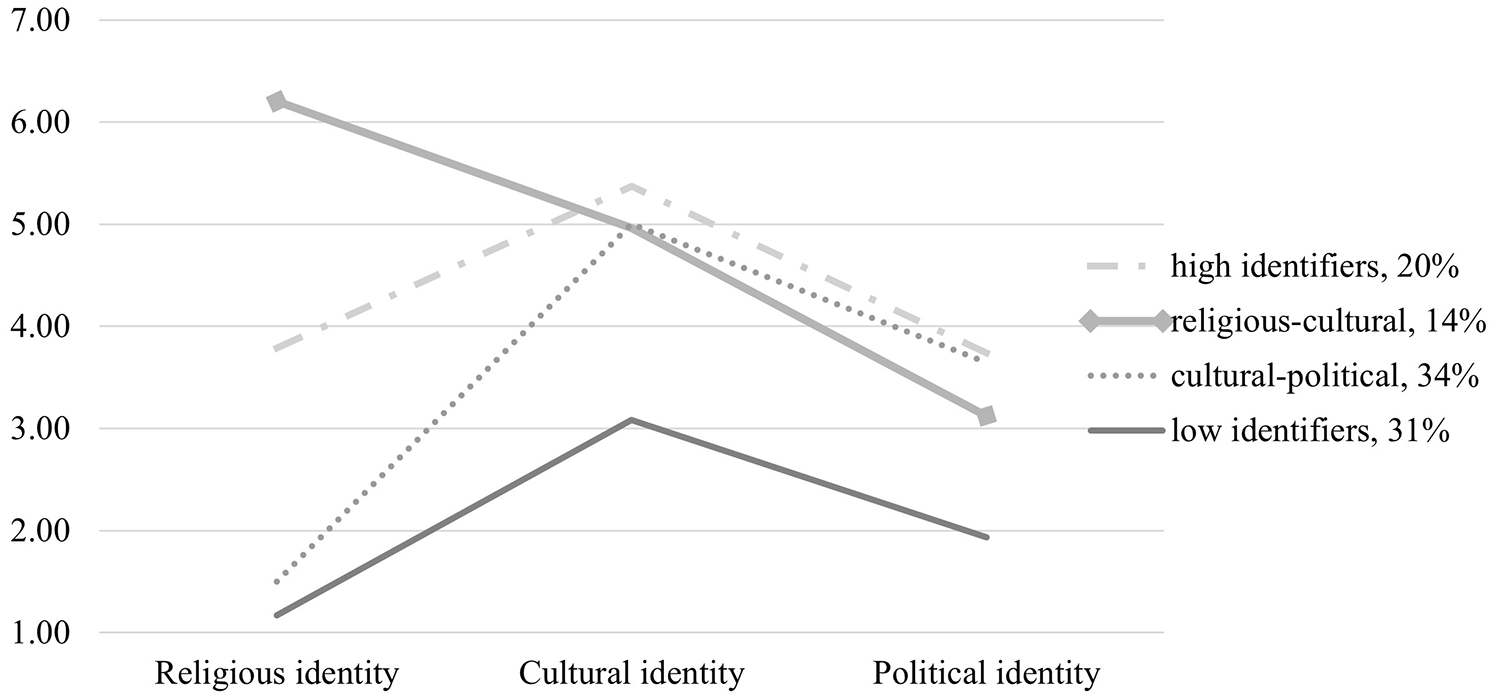
Latent Profile Analysis of Religious, Cultural, and Political Dimensions of Catholic/Protestant Identification.
Using the automatic three-step approach, we examined whether these groups differed in terms of intergroup variables by identifying these variables as auxiliary outcomes with the DU3STEP statement (Muthén & Muthén, 1998–2017). According to the equality tests of means across classes using the three-step procedure for the overall test, there were significant differences across groups in collective action chi2(3) = 24.20, p < .001; perceived allyship, chi2(3) = 10.25, p = .017; and forgiveness, chi2(3) = 14.03, p = .003. As shown in Table 5, most differences were between high and low identifiers. 1 High identifiers were more likely to endorse collective action and less likely to show perceived allyship and forgiveness for the outgroup than the remaining profiles. For correlations between the variables and their descriptives, please see SOM.7
Mean Differences in Intergroup Outcomes Across Four Religious Identity Profiles.

Different superscript letters within the same row indicate significant differences at p < .05.
As Supplemental Information, we also employed a variable-centered approach to analyze the associations between different dimensions of religious identity and intergroup outcomes using regression (please see SOM.8). The political identity dimension predicted lower perceived allyship and less forgiveness while the cultural identity dimension predicted more collective action.
Discussion
Study 3 further validated the factor structure of the religious identification scale across three dimensions. Using this new scale, we then distinguished four subgroups of participants who differed in the way they endorsed religious, cultural, and political dimensions of Protestant/Catholic identification via an LPA: (a) high identifiers that scored relatively high on all dimensions, (b) low identifiers that scored relatively low on all dimensions, (c) cultural-political identifiers that scored highly on cultural and political dimensions, and (d) religious-cultural identifiers that scored highly on religious-cultural dimensions. It was only the high identifier group, those that scored high on all dimensions, that were significantly more likely to endorse collective action and less likely to show perceived allyship and forgiveness for the other group. While we did not find a predominantly or solely political profile, both high identifiers and cultural-political profiles were relatively high on the political dimension. What differed most between these profiles was the extent to which they endorsed the religious dimension. Thus, in our sample, only a combination of the three dimensions yielded the most ingroup-oriented outcomes. This finding corroborates existing research arguing that the conflict in Northern Ireland is characterized by a complex interplay of religious, cultural, and political tensions between the Protestant and Catholic communities (Mesev et al., 2009).
General Discussion
The religious identity of individuals is a key factor in many intergroup conflicts, yet our own review of the literature suggests that little is known about how people construe religious identities in the first place. To address this gap, this study aimed to investigate multi-facets of religious identity and its implications for intergroup outcomes in a (post-)conflict setting using a mixed-method approach. Study 1 investigated how people in Northern Ireland understand, define, and construe religious identity in the religious, cultural, or political sense. We used a qualitative approach, and participants freely generated definitions of these construals by thinking about other people’s religious identities in Study 1. Results showed that people’s religious construals were very diverse, yet they shared many similarities across both communities. In other words, there were more overlaps than differences across both communities in construing these religious identities religiously, politically, and culturally, and we created different construals across three dimensions of religious identities.
Recognizing that no existing scale adequately captured these nuances, Study 2 developed and tested a new scale based on the qualitative content from Study 1. This scale consisted of 17 items to measure the various dimensions of religious identities of Protestant and Catholic participants. Participants rated each item to show what it meant for them to see Protestant or Catholic identity as a religious, cultural, or political identity. This allowed us to examine quantitatively whether different items load clearly on different identity construals. The findings of Study 2 further showed that the meanings of these construals were related to their self-ascribed importance, as well as to a typical measure of religious identification. However, associations varied in strength across Protestants and Catholics.
Study 3 extended the second study by validating the new scale we developed in Study 2 to measure the various dimensions of Protestant/Catholic identities. This validation was essential not only for confirming the scale’s reliability and validity but also for accurately assessing how these identity dimensions relate to critical intergroup outcomes. The results showed that this scale could differentiate people with varying degrees of religious, cultural, and political identities, as well as predict their attitudes toward collective action, perceived allyship, and forgiveness through an LPA. These profiles were (a) high identifiers that scored relatively high on all dimensions, (b) low identifiers that scored relatively low on all dimensions, (c) cultural-political identifiers that scored highly on cultural and political dimensions, and (d) religious-cultural identifiers that scored highly on religious-cultural dimensions. The results further showed that only the high identifier group—who scored high on all three dimensions of religious identity—was significantly more likely to endorse collective action for their own group and less likely to forgive and show perceived allyship for the other group.
Theoretical Contributions
The present research offers five major contributions to the literature on identity construals as well as their relationship to self-ascribed importance and intergroup-related outcomes. First, we conducted the first empirical study of how people qualitatively construe religious identities along religious, political, and cultural dimensions. There has been some qualitative research on religious identity (e.g., among children; Coles, 1991; Dautel, 2012) or varieties of religious experience (James, 1985), but none of this work has focused on how religious identity can be construed religiously, politically, and culturally and what those varieties of religious identity mean for people. Even though the literature has shown that social identity including religious identity plays a crucial role in conflict settings (e.g., Cehajic et al., 2008; Hanke et al., 2013; Hewstone et al., 2006; Leonard et al., 2015; Noor et al., 2008; Uluğ et al., 2023), little research has been conducted on the diverse interpretations of key identities in such settings. We built on previous work that was conducted with respect to interpretations of religious identities in Turkey (e.g., Acar et al., 2024; PODEM, 2016) and with respect to both religious and national identities in Northern Ireland (e.g., Dautel, 2012; McNicholl et al., 2019; Muldoon et al., 2007). However, we extended this line of work by showing there may be different construals (e.g., cultural interpretation) of these identities. We also complemented this line of work by demonstrating what the content of those identities looks like across both communities. Although the ways people construe religious identities are quite diverse, our findings also highlight that they share many similarities across both groups, which may also predict similar intergroup outcomes for both groups.
Second, we also developed a reliable religious identity scale. More importantly, our findings showed how participants construed cultural, religious, and political identities quantitatively and how these construals were related to their self-ascribed importance. In ethno-political conflict settings, some members of the victimized group may not appraise the victimhood as important or relevant to their identity (Jeong et al., 2023) and simply want to move on without categorizing themselves as victims (Leach, 2020; Vollhardt et al., 2021). So, they may not see their conflicting identities as personally central to them (i.e., personal centrality of collective victimhood; Vollhardt et al., 2016, 2021). For instance, in our analysis, cultural construals were higher than religious construals for most participants, except for those in the high identifier profile. So, one can argue that religious identity may not be relevant to them, or how they construe identities (e.g., culturally) may reduce their identification with that identity. Furthermore, the associations between these distinct construals and a standard religious identification scale differed between Protestants and Catholics. For Protestants, religious identification was primarily related to the cultural aspect of the religious identity, whereas for Catholics, it was related to both cultural and religious dimensions. Intriguingly, the political aspect exhibited no correlation with the standard religious identification measure. These findings imply that conventional measures of religious identification may capture varied aspects for each group. These disparities in interpretation may hold implications for the associations between typical religious identity scales and intergroup outcomes.
Third, the results highlighted how our multi-dimensional religious identity scale can be used to distinguish subgroups of individuals with different levels of identifications across these three dimensions using a person-centered approach, a less common method in social identity research. These profiles were in turn related to preferences for collective action, perceived allyship, and forgiveness in (post-)conflict societies. Specifically, the high identifier group was significantly more likely to endorse collective action for their own group and less likely to show perceived allyship and forgiveness for the outgroup. This finding aligns with a social identity complexity perspective (Roccas & Brewer, 2002). Individuals who endorse all three dimensions likely exhibit lower social identity complexity, perceiving their identity as more homogeneous and rigid. Consequently, they are more inclined to display ingroup-oriented attitudes. Verkuyten and Martinovic (2012) observed a similar pattern so that only those who scored high on religious and ethnic identity demonstrated more ingroup bias. However, their approach involved testing interactions rather than using a person-centered approach, making it unclear if such a profile would have emerged in their sample.
While our findings align with the social complexity perspective, contrary to expectations from the politicized collective identity literature (Simon & Klandermans, 2001), we did not identify a distinct political profile. Nevertheless, both high identifier and cultural-political profiles exhibited elevated scores in the political dimension (compared to its mean level). This finding suggests that the political dimension may still exert some influence in fostering less-positive outgroup attitudes. A supplementary analysis using a variable-centered approach provided partial support for this notion. Specifically, the political identity dimension was related to lower perceived allyship and reduced forgiveness toward the outgroup but had no significant effect on collective action. These findings indicate that the influence of political identity may be more nuanced than initially expected, emphasizing the need for further research to fully interpret these results. Future studies using a person-centered (or a variable-centered) approach, encompassing various dimensions or social identities, particularly in conflict settings, might shed light on the nuanced interplay between identity complexity and intergroup attitudes.
Fourth, our findings contribute to research integrating social cohesion and justice perspectives within intergroup relations research (Greenaway et al., 2011; Wright & Lubensky, 2013) by examining forgiveness and collective action and adding perceived allyship as relevant outcomes. Greenaway et al. (2011) showed that inclusive identities such as shared human identity might encourage members of victim groups to forgive the perpetrator group, but it may also reduce their collective action tendencies. Our findings replicate and extend this line of work by showing that it is also the high identifiers with religious identity in (post-)conflict settings that are more likely to endorse collective action for their own group, less likely to forgive the outgroup, and less likely to show perceived allyship with the outgroup. Thus, it can help shed light on how different interpretations of religious identity may impact intergroup dynamics and peace-building efforts.
Fifth, we developed and initially validated a new scale to assess various facets of religious identity in a post-conflict context since no such scale existed. Following the scale-validation guidelines outlined by Flake et al. (2017), our validation process involved several phases. In the substantive phase, we utilized qualitative analysis of open-ended questions and discussions with a local team of students to formulate scale items. Subsequently, in the structural phase, we performed exploratory, confirmatory, and multi-group factor analyses, alongside assessing reliability measures. Finally, in the external validation phase, we established correlations with similar measures to provide additional support for the validity of our scale. Moreover, we employed this measure to differentiate between various subgroups and to predict intergroup outcomes.
Despite previous research showing that different dimensions of religious identity in Northern Ireland predicted different peace-related outcomes (Leach & Williams, 1999), this approach did not take into account that identification processes are multi-dimensional and dynamic, shifting over time and place (Ashmore et al., 2004). Our multi-dimensional religious scale aligns with the characterization of the Northern Irish conflict, typically conceptualized as a conflict where a complex interplay of religious, cultural, and political tensions between the Protestant and Catholic communities plays a huge role (Mesev et al., 2009). Future studies should test its applicability in other (post-)conflict contexts.
Practical Contributions
Our studies have some practical contributions to social movements in general and allyship in particular. For example, the findings show how high identifiers (i.e., who scored high on all three dimensions of religious identity) may be more willing to take action on behalf of their own group yet less likely to do the same for the outgroup, which is crucial for allyship. As high identifiers are the ones who can be more mobilized, social movements that focus on improving the conditions of religious groups in societies should pay particular attention to how people construe religious identities. Similarly, social movements that aim to engage allies for their own religious groups should be aware of how being a high identifier may be a barrier to showing perceived allyship among those members.
The findings also have some practical contributions to conflict resolution and reconciliation. Our results highlight how being a high identifier on all three dimensions of religious identity predicts less willingness to forgive outgroup members. Even though religious identification may sometimes be a barrier to forgiveness in various conflict contexts (Cehajic et al., 2008; Hanke et al., 2013; Hewstone et al., 2006; Leonard et al., 2015; Noor et al., 2008) and sometimes not (Hewstone et al., 2006; Leonard et al., 2015; Philpot & Hornsey, 2011; Uluğ et al., 2021), being a high identifier on political, religious, and cultural dimensions of religious identity, as a convergent identity, can be a strong barrier to forgiveness due to the content of such identities. Thus, conflict resolution and reconciliation efforts that require forgiving outgroup members may be hindered by this type of identification. Such efforts should take into account the complex interplay of religious, cultural, and political tensions between conflicting communities.
Limitations and Future Directions
Our studies have a few limitations. First, participants responded to some items before they responded to the items we used in the current manuscript as part of a multi-study data-collection effort. For example, in Study 1, the open-ended questions came right after the participants answered some questions related to their mental health, family, as well as identity and intergroup experiences. Even though this approach allowed us to prepare our participants to think about their identities before presenting open-ended questions, responding to identity and intergroup experiences may have impacted the way they responded to the open-ended questions on identity construals. As participants provided a variety of viewpoints in their responses, we believe, to some extent, participants wrote whatever came to their minds. However, future studies should take the order of questions into account to prevent potential order effects on participants’ answers.
Second, while our studies were well powered (at least 276 participants in each study), we used snowball and/or convenience sampling. Convenience sampling, which involved recruiting family and friends and requesting them to distribute questionnaires or links, carries the risk of social desirability bias. To mitigate these concerns, participants were assured of questionnaire anonymity, and participation was voluntary, with no mandatory questions. This approach aimed to foster truthful responses and allowed us to target specific groups (Catholics vs. Protestants), enhancing participant engagement. In Study 3, we utilized Prolific to increase data quality in general (Douglas et al., 2023) although it remains a convenience sample. Overall, it is important to note that our samples are not representative; compared to the population in Northern Ireland, our samples were more educated and slightly younger. Consequently, caution is advised when generalizing findings. With larger and more diverse samples, particularly in terms of SES, age, and education, additional profiles may emerge. Future studies should consider collecting data from such samples to enhance generalizability.
Third, since our primary aim was to assess the multi-faceted nature of religious identity in a post-conflict society and no such scale existed, we developed and initially validated a new scale to achieve this goal. However, we acknowledge that the scale required modifications to attain acceptable fit indices—an acceptable and common practice to improve model fit—and that further validation in independent samples is necessary to confirm its reliability and validity. We position our scale as a proof of concept that provides a foundational step toward understanding how individuals construe their religious identity across cultural, religious, and political dimensions. Researchers in other conflict settings might find our approach valuable, particularly the use of both bottom-up and top-down methods; however, they should adapt the scale to their specific contexts, considering cultural, social, and political nuances. Previous studies have shown that conflict narratives in one conflict can be generalized to other conflict settings (e.g., Uluğ et al., 2021) or even to other post-conflict settings (e.g., Uluğ et al., 2023). One might also argue that the way people construe religious identities in such settings can show similarities (e.g., Alevis in Turkey vs. Catholics in Northern Ireland). However, future research should build upon our methodology by conducting additional validation studies to refine the scale and enhance its applicability in diverse contexts.
Fourth, although our decision to ask participants about specific categories of religious identity—namely, the cultural, religious, and political dimensions—was informed by prior literature and the context-specific nature of religious identity in Northern Ireland, it may have constrained the richness of the data by guiding participants’ responses into predefined categories. We aimed to balance top-down and bottom-up methods by encouraging participants to express their thoughts openly within these dimensions, capturing personal interpretations and nuances. However, we acknowledge that this approach may have limited the emergence of unanticipated themes or additional facets of religious identity. Future studies could adopt more open-ended approaches without predefined categories to explore a broader spectrum of how individuals conceptualize their identities in post-conflict societies, thereby providing a more comprehensive understanding of the complexities involved.
Fifth, we used correlational data in Studies 2 and 3 because correlational data helped to test the scale we developed to measure different identity construals in Study 2, validate the factor structure of this scale, and measure participants’ self-identification with religious, cultural, and political identity construals via this new scale in Study 3. However, this approach does not allow for causal inference, and we do not know whether identity construals shape people’s intergroup responses or the other way around. Therefore, future studies with an experimental approach could provide insights into this important topic. For example, one study may focus on how imagining different identity construals may shape people’s collective action tendencies for the ingroup and their tendency to forgive outgroup members.
Last, across all studies, we collected more data than we could use because we excluded participants who did not identify (or who said they were not raised) as either Catholic or Protestant. Thus, we could focus on participants who chose one of these identities in the study. However, this categorization itself may have excluded some participants who see and construe religious identity solely culturally (i.e., predominantly cultural identifiers). Therefore, future studies may employ a more inclusive approach for participants who may potentially construe identities in a more cultural way.
Conclusion
In the current contribution, we both qualitatively and quantitatively investigated the way religious identities were construed: (a) politically, (b) culturally, and (c) religiously. Using a combined bottom-up (exploring nuances and meanings) and top-down approach (using theoretically driven categories), we examined the content of these identities, developed a scale to measure it, as well as initially validated it while contributing to the discussion on collective action versus forgiveness controversy in the intergroup relations literature. Our findings highlight that religious identities are not singular and may be construed differently even by the same group members. Therefore, we believe that our multi-faceted approach to group identity provides a more accurate evaluation of the precise elements of identity that are connected to conflict characteristics. More importantly, our approach showed how different dimensions of group identity correspond to distinct facets of intergroup conflict. These construals may also change people’s attitudes not only toward their own group but also toward outgroup members. It is our hope that more research is conducted to unpack multi-dimensional and complex understandings of religious identity not only in conflict but also in post-conflict settings.
Footnotes
Authors’ Note
This research has not been disseminated elsewhere.

Declaration of Conflicting Interests
The author(s) declared no potential conflicts of interest with respect to the research, authorship, and/or publication of this article.
Funding
The author(s) received no financial support for the research, authorship, and/or publication of this article.
Supplemental Material
Supplemental material is available online with this article.