




Abstract
People tend to remember information from which they chose better than information assigned to them—a pattern known as the self-choice effect. The present studies tested the hypothesis that choosing for another person also improves memory. Studies 1a and 1b found that choosing for self and choosing for others both enhance memory compared with having no choice. Study 2 found that choosing for others boosts memory regardless of the closeness of the other. Study 3 found no memory benefit of making easy or difficult choices for others, contrary to predictions. And in Study 4 choosing for others enhanced memory only for chosen items. A mini meta-analysis combining all studies supported the conclusion that choosing for others enhances memory on a par with choosing for oneself. These results suggest that the effects of choice on memory signify something other than self-reference, which we presume to be substantially reduced when choosing for others.
Choice is a persistent part of human life and a perennial topic of interest among philosophers, psychologists, educators, and politicians. At a societal level, choice is a central facet of the political climate, popular culture, religiosity, and consumerism. On a more personal level, individuals make a variety of choices every day. Some choices are mundane (What show to watch?) whereas others are more significant (Which apartment to rent?). Sometimes it is required for a person to make choices on behalf of others, such as choosing what to feed a hungry toddler, delegating tasks at work, or making health decisions for elderly parents. Ultimately, choices have consequences. How do those consequences differ when choosing for others versus the self? The current investigation focused specifically on the consequences of choosing for memory.
Choice and Memory
Choice is a key element of executive functioning, which is one root of selfhood (Baumeister, 1998). The ability to make choices and control situations helps to turn a passive self into an active one. Although many behaviors are habitual or routine and hence do not require the self’s executive function, the act of choosing may be required whenever routines are interrupted, or novel situations arise. Choice dramatically expands the range of human behaviors.
The act of choosing has also been found to boost memory. A gathering stream of research concerns the self-choice effect, which refers to the pattern whereby choosing for oneself, as opposed to being assigned alternatives to remember, improves memory for the choice alternatives. Early evidence for the self-choice effect was reported by Kuhl and Kazén (1994), who had participants prepare to complete tasks from a list of self-chosen, boss-assigned, or unassigned office tasks. Participants subsequently remembered the tasks they had chosen to perform better than they remembered assigned or neutral (unassigned) tasks.
Numerous other studies have also found evidence for self-choice effects in memory (e.g., Stoll Benney & Henkel, 2006; Watanabe, 2001). For example, participants in one study watched 40 short video clips divided into two segments (Rotem-Turchinski et al., 2019). Between the segments, participants chose or were assigned one of two options pertaining to the upcoming video segment. As an example, in one instance the film’s protagonist asked for a book recommendation. In the active choice condition participants selected which genre of book they would recommend to the protagonist, whereas in the passive condition the genre of book was selected automatically. Later, participants recalled more details from videos that required their active choice.
In another study pairs of participants alternated at selecting pieces of paper with numbers on them (Cloutier & Macrae, 2008). The researcher designated a word to be associated with each number, and participants repeated those words aloud. In the self-choice condition, participants alternated at choosing among all 40 numbers. In the assigned condition, participants were pre-assigned 20 numbers to select. Results from a surprise memory test found better recognition and recall for words in the self-chosen condition. Choosing for oneself, as opposed to passively receiving information assigned by someone else, has thus been found to enhance memory in several prior experiments. This evidence has attested to the benefits to memory of involving the self at encoding via choice.
Self and Memory
The self is assumed to play a crucial role in making choice alternatives memorable. Perhaps the most seminal work on the link between self and memory concerns the self-reference effect. A series of studies by Rogers et al. (1977) found that participants recalled more words when they had been processed in relation to the self-concept (e.g., “Does this word describe me?”) compared with other encoding processes (e.g., structural processing, such as “Does this word contain the letter e?”). When people process information in relation to the self-concept, that information is remembered better. Engaging the self-concept during encoding benefits memory because the self-concept acts as a “glue” in information processing (Sui & Humphreys, 2015). Research has suggested that processing information in relation to the self usually happens quickly and automatically (Lieberman et al., 2004; Turk et al., 2008). Information related to self is highly familiar and well organized (Greenwald & Banaji, 1989), which helps to make it more memorable.
The self-choice effect differs from the self-reference effect in at least one distinctive way. The self-reference effect involves a relatively passive role for the self. Considering Baumeister’s (1998) organization of selfhood, the self-reference effect would implicate reflexive consciousness, which relies on memories, preferences, and self-perceptions. The self-choice effect also leans on self-perception and self-reference but extends beyond reflexive consciousness to require an agentic act of decision making. This agentic or volitional action entails the self’s executive function. In keeping with this line of reasoning, Kuhl and Kazén (1994) proposed that self-referential processing could not explain the self-choice effect because both chosen and assigned tasks become associated with the self, yet self-chosen tasks are remembered better. Kuhl and Kazén speculated that the volitional element of choice making must have contributed to the self-choice effect above and beyond the contributions of self-reference.
Across a series of experiments testing the role of executive control in the self-choice effect, Baldwin et al. (2022) found that choosing boosts recall by over one-half of a standard deviation compared with no choice. A subset of those studies tested the role of choice difficulty, under the assumption that more difficult choices entail more inner conflict, and hence more volitional deliberation, which should enhance memory. Indeed, both easy choices and difficult choices yielded a self-choice effect, but the effect was bigger for more difficult choices. A subset of Baldwin et al.’s studies also included ego depletion manipulations. Those manipulations were assumed to reduce the participant’s capacity for executive control, and the magnitude of the self-choice effect was reduced in the depletion conditions. Baldwin et al. concluded that the executive control involved in choosing better stamps information into memory.
Experiments testing the role of executive control are more common than experiments on the contributions of self-reference to the self-choice effect. Self-reference is simply assumed to play a central role, and with good reason. A person’s preferences and self-perceptions are almost certain to influence their choices, and processing information in relation to the self-concept is known to enhance memory (Rogers et al., 1977). Does reducing the contributions of self-reference when choosing also reduce memory for choice alternatives? To find out, we tested the memory consequences of choosing for others.
Choosing for Others
The process of choosing tends to vary as a function of whether the decision maker chooses for themselves or someone else (Polman, 2010). When choosing for others, a person does not only decide egocentrically (as they would for themselves); they may also consider the other person’s goals, what one “should’ do, or what would be best for the other person (Tunney & Ziegler, 2015). Those considerations may result in different choices for another compared with what one would choose for themselves. Differences in choice for self versus others have been observed in numerous contexts, including research in consumerism (e.g., Liu et al., 2019), health care (e.g., Zikmund-Fisher et al., 2006), economics (e.g., Mengarelli et al., 2014), and psychology (e.g., Polman & Vohs, 2016).
Such differences manifest not only in the choice itself, but also in how choice-related information is processed (Polman, 2010; Polman & Emich, 2011). Choosing for others has been characterized as a fundamentally different process than choosing for oneself (Polman & Wu, 2020). For example, participants in a cognitive dissonance study chose entrée items for a new restaurant (Hoshino-Browne et al., 2005). After ranking participants had to choose whether they wanted a coupon for the fifth-ranked or sixth-ranked entrée options (for self or friend). After a short time, participants reranked the entrées. Participants who chose for themselves spread the alternatives to a greater extent than those who chose for a friend. Thus, choosing for others did not induce the same kind of inner conflict or entail the same kind of dissonance-reducing justifications as choosing for oneselF (at least among individuals from more independent cultures).
Another way that choosing for oneself differs from choosing for others is in terms of how the choices are construed. Evidence suggests that people tend to focus more on the feasibility of the response alternatives when choosing for themselves but focus more on the desirability of the response alternatives when choosing for others (Lu et al., 2013; Polman & Emich, 2011). This pattern is thought to reflect differences in psychological distance: More abstract or high-level construal of alternatives when choosing for others versus more concrete or low-level construal of alternatives when choosing for oneself.
Moreover, with less psychological distance between self and other, decisions for others tend to be more like decisions for the selF (e.g., Ziegler & Tunney, 2012). For example, one study found that participants were more creative when choosing for others compared with themselves, but this difference was moderated by closeness of the other person (Polman & Emich, 2011). This pattern may indicate a psychological alignment between self and close others, consistent with the idea that close others share perspectives, resources, and characteristics with the self (Aron et al., 1991). However, when choosing for a distant other, the contributions of the self-concept are diminished. Indeed, evidence has found poorer memory for other-referential processing relative to self-referential processing (e.g., Keenan et al., 1992).
Given the different processes and distinct considerations involved in choosing for oneself versus somebody else, it is possible that the consequences for memory also differ. For example, choosing for others may boost memory to a lesser degree than choosing for oneself because choosing for others entails less self-referential processing. But insofar as choosing for another person entails a degree of response conflict and conflict resolution—processes that should engage the self’s executive function and encourage deliberation on the choice alternatives—then choosing for another person may also enhance memory, at least compared with having no choice at all. Such evidence may attest to the centrality—or lack thereof—of the self-concept for producing the choice effects in memory.
The Present Research
Extant research on the self-choice effect has focused on choosing for oneself. We conducted four experiments to test the novel hypothesis that choosing for somebody else also influences memory for choice alternatives. In this way, we hoped to elucidate the extent to which choosing for the self is crucial for the self-choice effect, or whether simply choosing is sufficient for boosting memory.
We predicted that choosing (for self or other) would enhance memory compared with no choice, because choice is a form of cognitive work involving response conflict, active deliberation, and conflict resolution—processes that should enhance memory (Baldwin et al., 2022). We assumed that those processes would be relevant also when choosing for others and would therefore boost memory, at least compared with having no choice at all.
We also predicted that memory would be better in self-choice compared with other-choice conditions, given the increased self-reference and personal importance involved when choosing for oneself. In one study, we also tested the hypothesis that the closeness of the other to the self matters, such that choosing for a close other boosts memory compared with choosing for a stranger, consistent with evidence that closeness moderates both choice-related and memory-related outcomes (e.g., Polman & Emich, 2011; Serbun et al., 2011).
Studies 1a and 1b
In Study 1a, we compared memory across choosing for others, choosing for self, and no choice conditions in a traditional laboratory setting. In Study 1b, we replicated the same conditions in an online setting. We expected choice (versus no choice) to enhance memory regardless of the target of the choice (self or other). However, given the robust evidence that self-related processing enhances memory (e.g., Rogers et al., 1977), we hypothesized that participants who chose for themselves would remember the choice alternatives best, followed by those who chose for others, with those in the no choice condition recalling the least.
Study 1a (Laboratory Experiment)
Method
Participants and Design
The data, materials, and code for analyses are available online for all studies (https://osf.io/xrkcz/). Three hundred fifty-three undergraduate students participated in exchange for credit toward a course requirement. Two outliers (more than 3 SDs away from the sample mean) on total recall (sample M = 6.59, SD = 3.16) and three outliers on the time between viewing or selecting words (sample M = 5.81 min, SD = 1.70 min) were not included in the analyses. (This duration could vary due to the pace at which participants completed the intervening questionnaires; see below.) The final sample for analysis included 348 students (219 women, 126 men, and three other-identifying genders). The sample’s average age was 18.74 (SD = 0.98). Participants were Caucasian/White (59.2%), Hispanic/Latino (21.6%) Asian (12.1%) or other races (7.1%).
Participants were randomly assigned among the self-choice (n = 117), choice-for-others (n = 115), or no choice (n = 116) conditions. Using G*Power, we determined that for a one-way analysis of variance (ANOVA), a sample this size would detect an effect size of
Materials and Procedure
Participants completed Study 1a in a private laboratory space at a public university. Participants were asked to assign words for a memory test to be administered in a future study; hence, participants were kept unaware that their memory would be tested. Participants in all conditions saw 20 pairs of words (40 words). In the choice conditions, participants selected a word from each pair to be included in a future experiment. In the self-choice condition participants selected the words they would like to see in a future study, whereas in the choice-for-others condition participants selected words for another participant to recall in a future study. Participants in the no choice condition saw the same word pairs (for 3 seconds) followed by an automatically refreshed webpage showing one of the words highlighted for a future participant’s memory test (for 2 seconds). Across all conditions the word pairs remained onscreen for 5 seconds to ensure all participants saw the words for the same duration.
After choosing (or seeing words assigned) among the 20 word pairs, participants reported demographic information and completed personality questionnaires. On average, it took participants about 6 minutes to complete the personality measures in between the encoding and retrieval phases of the experiment. After finishing the questionnaires, participants had 5 minutes to complete a surprise memory test for which they were prompted to try to remember any and all words from the word pairs (i.e., including both chosen/assigned words and unchosen/unassigned words). Participants then answered questions about their experiences during the study.
Personality Measures
Participants completed the following measures in the interval between the encoding (choice) phase and the surprise recall test: the Approach-Avoidance Temperament Questionnaire (AATQ; Elliot & Thrash, 2010), the Behavioral Inhibition System/Behavioral Activation System scales (BIS/BAS; Carver & White, 1994), the Need for Cognition questionnaire (NFC; Cacioppo et al., 1984) and the Trait Self-Control scale (TSC; Tangney et al., 2004). We did not generate specific hypotheses regarding the questionnaires but included them to serve as distractors between the encoding and (surprise) recall phases and to permit exploratory analyses (not reported here).
Post-Experiment Questionnaire
Participants rated how much choice they felt they had in the task (to serve as a manipulation check) as well as how much effort they put into the task. In addition, they were asked to rate how much they liked the words they (or the computer) selected as well as the ones they did not select. Participants also rated the difficulty they experienced in relation to the memory task. We also asked to what extent participants knew they would have to complete a memory test. Participants responded to all items using a scale from 1 = None/Not at All to 7 = Very Much. We report all manipulations, measures, and exclusions for all studies.
Results
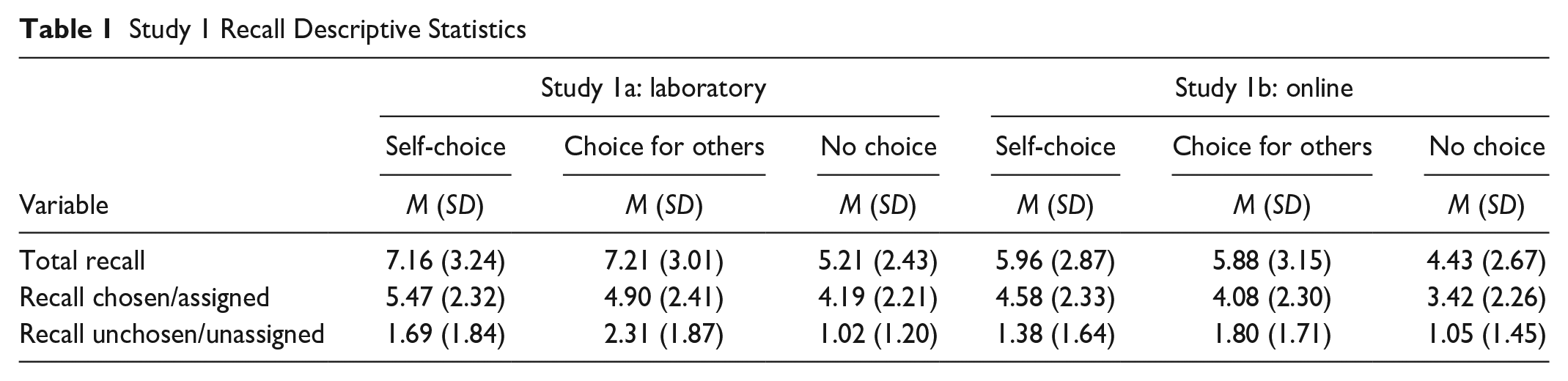
A one-way ANOVA on total recall of all choice alternatives returned a statistically significant difference among the groups, F(2, 345) = 17.80 p < .001,
At encoding, some words were chosen (or assigned) and others were unchosen (or unassigned). Another one-way ANOVA found differences among the groups on recall of chosen or assigned words, F(2, 345) = 8.94, p <.001,
A third one-way ANOVA found differences among the groups on memory for unchosen or unassigned word, F(2, 345) = 17.52, p < .001,
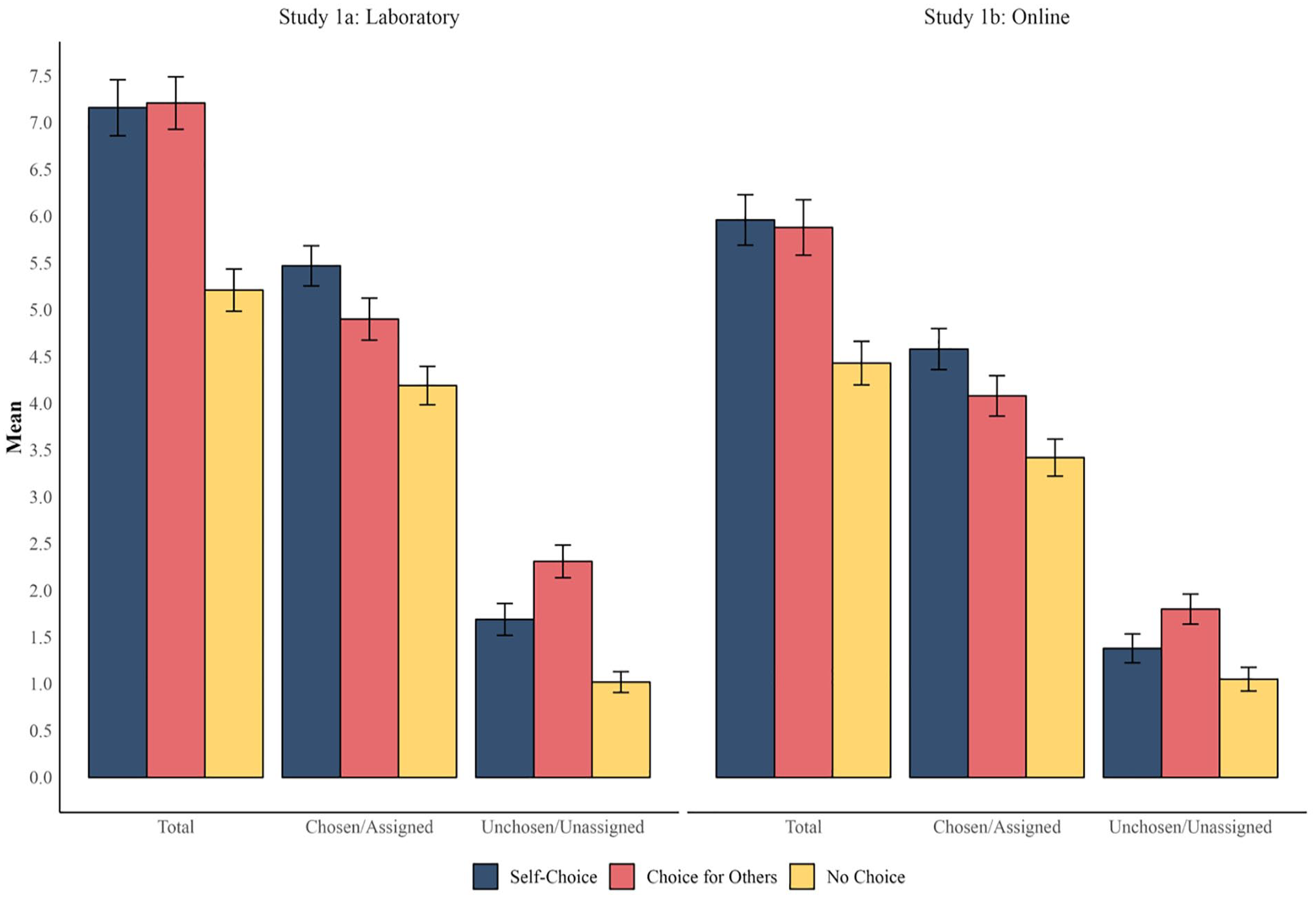
Study 1 Recall Results.
Study 1 Recall Descriptive Statistics
The primary manipulation check item from the post-experiment questionnaire pertained to feelings of choice. A one-way ANOVA found differences among groups on this item, F(2, 345) = 132.90, p < .001. As expected, participants felt like they had less choice in the no choice condition (M = 2.48, SD = 1.82) compared with the self-choice (M = 5.38, SD = 1.59) and other-choice conditions (M = 5.60, SD = 1.45), ps < .001, and the latter two groups did not differ, p = .546. Results for the other post-experiment questionnaire items are reported in the Supplemental Material for all studies.
Study 1b (Online Experiment)
Method
Participants and Design
Three hundred seventy-three undergraduate students participated in exchange for credit toward a course requirement. Nine outliers (more than 3 SDs away from the sample mean) on the time between viewing or selecting words (sample M = 6.83 min, SD = 3.45 min) and three outliers on total recall (sample M = 5.43, SD = 3.17) were not included in the analyses. Participants who did not complete the memory test were excluded (n = 3). One participant did not consent and thus did not complete the study. The final sample for analysis included 357 students (271 women, 81 men, and five other-identifying genders). The average age was 18.62 (SD = 1.18). Participants were Caucasian/White (60.5%), Hispanic/Latino (19.9%) Asian (14.9%) or other races (4.7%).
As in Study 1a, participants were randomly assigned among a self-choice condition (n = 113), choice-for-others condition (n = 113), or no choice condition (n = 131) and saw pairs of words of similar valence. Using G*Power, we determined that for a one-way ANOVA, a sample this size may detect an effect size of
Materials and Procedure
Participants completed Study 1b online via Qualtrics. Participants only saw difficult choice alternatives (i.e., word pairs of the same emotional valence). On average, it took participants roughly 6 minutes to complete the personality measures in between the encoding and retrieval phases of the experiment. All other material and procedures repeated Study 1a.
Results
A one-way ANOVA found differences among the groups in total recall of all the choice alternatives, F(2, 354) = 11.07, p < .001,
Groups also differed on recall of chosen or assigned words, F(2, 354) = 7.92, p < .001,
A third one-way ANOVA found group differences on memory for unchosen or unassigned word, F(2, 354) = 6.57, p = .002,
A one-way ANOVA found differences among groups on choice felt, F(2, 354) = 59.82, p < .001. Once again, participants felt they had less choice in the no choice condition (M = 2.95, SD = 1.92) compared with the self-choice (M = 5.21, SD = 1.80) and other-choice (M = 5.12, SD = 1.63) conditions, ps < .001, and the latter two groups did not differ p = .927.
Discussion
As proposed, Studies 1a and 1b found better recall among those who chose words (for themselves or for others), compared with those who had no choice. These results replicate prior evidence for the self-choice effect in memory and support the idea that choosing for others also improves memory compared with having no choice at all. This pattern held in both in-person and online settings and was evident even though participants did not know their memory for the choice alternatives would be tested.
Furthermore, in both Study 1a and Study 1b, participants recalled a similar number of words in the choice-for-others and self-choice conditions. These null differences may suggest choosing is more consequential than self-relevance for memory benefits. Overall, the results from Studies 1a and 1b suggest that the act of choosing—regardless of the target of the choice—is sufficient to enhance recall compared with having no choice.
Study 2
In Studies 1a and 1b, participants in the choice-for-others conditions chose for a purported future participant. We assume that choosing for a non-specific and psychologically distant other would have less of an effect on memory compared with choosing for a specific close other. Thus, in Study 2, we tested the effects on memory of choosing for a close other. We predicted that choosing for a close other would improve recall compared with choosing for a random other, given the greater overlap and connection of self to a close other. Furthermore, we again expected choosing for others to boost recall compared with having no choice at all. (Study 2 did not include a self-choice condition.)
Method
Participants and Design
Three hundred twenty-five undergraduate students participated in an online study in exchange for credit toward a course requirement. Five outliers (more than 3 SDs away from the sample mean) on the time between viewing or selecting words (sample M = 6.93 min, SD = 6.42) and three outliers on total recall (sample M = 5.77, SD = 3.57) were not included in the analyses. Participants who did not complete the memory test were also excluded (n = 11). The final sample included 306 participants (175 women, 130 men, and one other-identifying participant) with an average age of 19.12 years (SD = 1.13). Participants were Caucasian/White (55.2%), Hispanic/Latino (17.7%), Asian (16.0%), or other races (11.1%).
Participants were randomly assigned among the choice-for-close others condition (n = 105), choice-for-random others condition (n = 102), and the no choice condition (n = 99). Using G*Power we determined that for a one-way ANOVA, a sample this size may detect an effect size
Materials and Procedure
Participants in the choice-for-close others condition indicated the name of a close other to choose for and stated their relationship (e.g., romantic partner) to help ensure participants were thinking of a concrete person (names of selected others were removed from the dataset before analysis to ensure confidentiality). Participants in the choice-for-random others condition were led to believe they were choosing for an unspecified future participant. Participants in the no choice condition followed the procedures used Study 1a and 1b, such that words were highlighted for an unspecified future participant. Study 2 also included the same personality questionnaires and surprise memory test used in the previous studies. The post-experiment questionnaire matched the previous studies and added the Inclusion of Other in SelF (IOS) Scale (Aron et al., 1992). This scale uses overlapping circles representing self and another person to indicate perceived closeness. The scale ranges from 1 = no overlap between self and other to 7 = mostly overlap between self and other (circles primarily overlapped). On average it took participants about 7 min to complete the personality measures in between the encoding and recall phases of the experiment.
Results
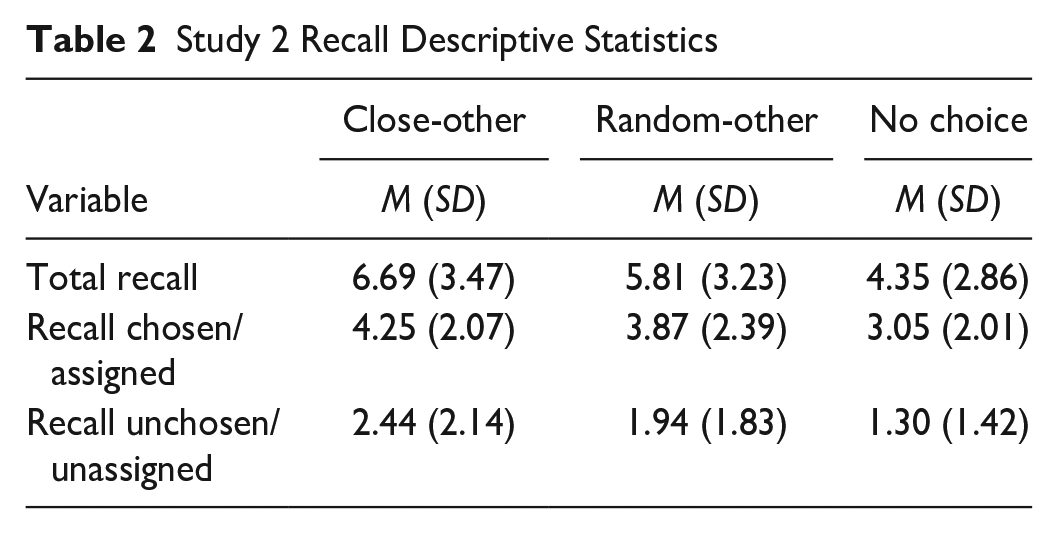
A one-way ANOVA found a main effect of experimental condition on total recall of the choice alternatives, F(2, 303) = 13.76, p < .001,
Groups also differed on recall of chosen or assigned words, F(2, 303) = 8.11, p < .001,
A third one-way ANOVA found group differences on memory for unchosen or unassigned word, F(2, 303) = 9.83, p < .001,
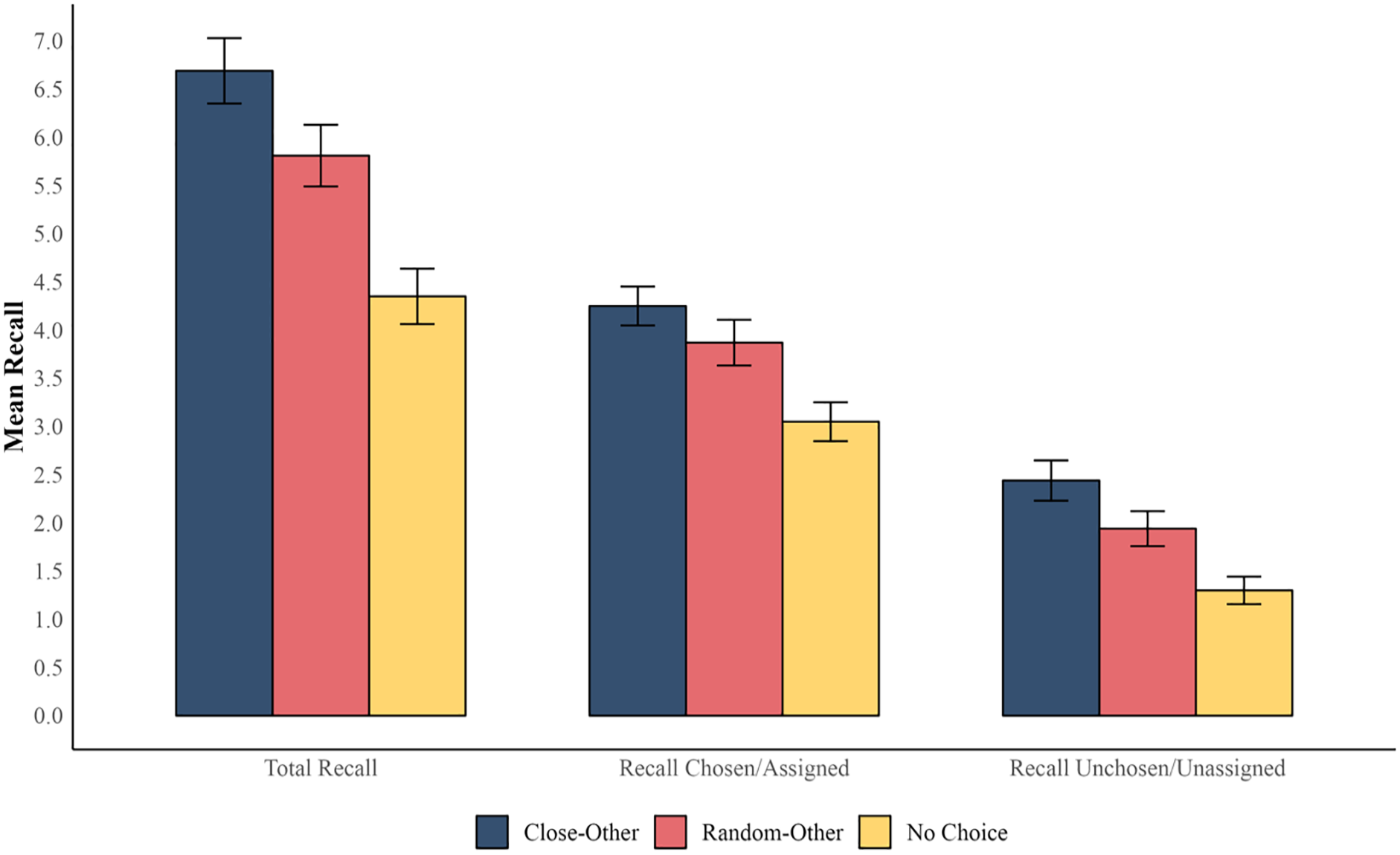
Study 2 Recall Results.
Study 2 Recall Descriptive Statistics
The primary manipulation check item pertained to feelings of choice. A one-way ANOVA found differences among groups on this item, F(2, 302) = 55.28, p < .001 As expected, participants felt less choice in the no choice condition (M = 2.89, SD = 1.71) compared with the choice-for-close others condition (M = 4.60, SD = 1.77), p < .001, and the choice-for-random others conditions (M = 5.36, SD = 1.60), p < .001; the latter two groups also differed, which was unexpected, such that participants reported more felt choice in the choice-for-random-others condition, p = .004.
An additional manipulation check item pertained to closeness to the other participant (i.e., the IOS Scale.) A one-way ANOVA found differences among groups, F(2, 302) = 156.20, p < .001 As expected, participants felt the closest to the other participant when they chose for a close-other (M = 5.51, SD = 1.47) compared with choosing or viewing items for a random-other, ps <.001. Closeness did not differ for participants between the no choice condition (M = 2.29, SD = 1.42) and choice-for-random others condition (M = 2.20 SD = 1.70), p = .919.
Discussion
Study 2 found better memory for choice alternatives among those who chose for close others or random others compared with those who had no choice. The recall difference after choosing for a close versus random other was in the predicted direction but not statistically significant. Hence, the predicted benefit of self-reference associated with choosing for a close other did not boost recall above and beyond the impact of choice more generally (i.e., choosing for a random other). Once again it appeared that choice alone, regardless of the target of the choice, was enough to boost recall.
Study 3
Previous research on the self-choice effect found better memory for more difficult choices (Baldwin et al., 2022). Does choice difficulty also matter when choosing for others? To find out, Study 3 again tested the extent to which memory is enhanced by choosing for others, and we also manipulated choice difficulty. Studies 1 and 2 only tested difficult choices, so in Study 3, we added an easy choice condition. The easy choice condition represented a particularly conservative test of the memory benefits of choosing for others, insofar as more difficult choices tend to be more memorable than easier choices. We hypothesized that participants making more difficult choices for others would recall more words compared with those making easy choices for others and to those having no choice at all.
Method
Participants and Design
Three hundred fifty-five undergraduate students participated in exchange for credit toward a course requirement. Participants who failed to complete the memory test were excluded (n = 8), as were outliers on total recall (n = 2; M = 4.67, SD = 2.89) and on the total amount of time between viewing or selecting words and the recall test (n = 9; sample M = 6.51 min, SD = 4.60 min). One participant did not consent. The final sample for analysis included 335 participants (156 men, 177 women, and two other-identifying genders) with an average age of 19.25 (SD = 1.06). Participants were Caucasian/White (58.8%), Hispanic or Latino (20.0%), Asian (10.8%) or other races (10.4%).
Study 3 used a between-subjects factorial design to test the impact of choice and choice difficulty, respectively, on memory. Participants were randomly assigned to a choice-for-others (n = 166) or no choice condition (n = 169). In addition, participants were randomly assigned to an easy choice condition (n = 169) or difficult choice condition (n = 166). Using G*Power, we determined that for a factorial ANOVA, a sample this size may detect an effect size of partial
Materials and Procedure
Participants completed the study online using Qualtrics. In the choice-for-others condition, participants selected one word from a series of word pairs for another participant to recall in a future study. Participants in the no choice condition saw the same word pairs before the webpage automatically refreshed with one of the words highlighted.
In the easy choice condition, participants chose (or saw assigned) words of opposite emotional valence (e.g., joy/death). In the difficult choice condition, participants chose (or saw assigned) words of the same valence (e.g., joy/life), as in the previous studies. Study 3 also included the same questionnaires used in the previous studies, followed by a surprise memory test. On average it took participants about 6 min to complete the personality measures separating the encoding and recall phases of the experiment.
Results
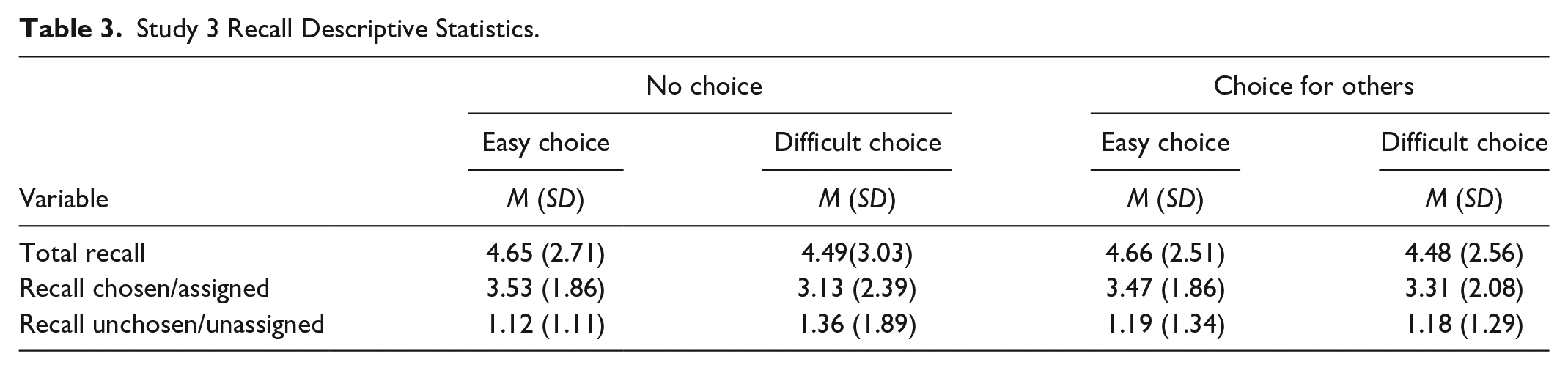
A factorial ANOVA tested the effects of choice and difficulty on total recall of choice alternatives. Contrary to predictions, we found no simple main effects of choice (p = .995, partial
We also found no simple main effects of choice (p = .809) or difficulty (p = .263), and no interaction between choice and difficulty, F(1, 331) = 0.25, p = .615, when recall of chosen or assigned words was the dependent measure. Similarly, we found no simple main effects of choice (p = .742) or difficulty (p = .480), and no interaction, F(1, 331) = 0.67, p = .412, on recall of unchosen or unselected words. Effect sizes for all these results were very small, partial
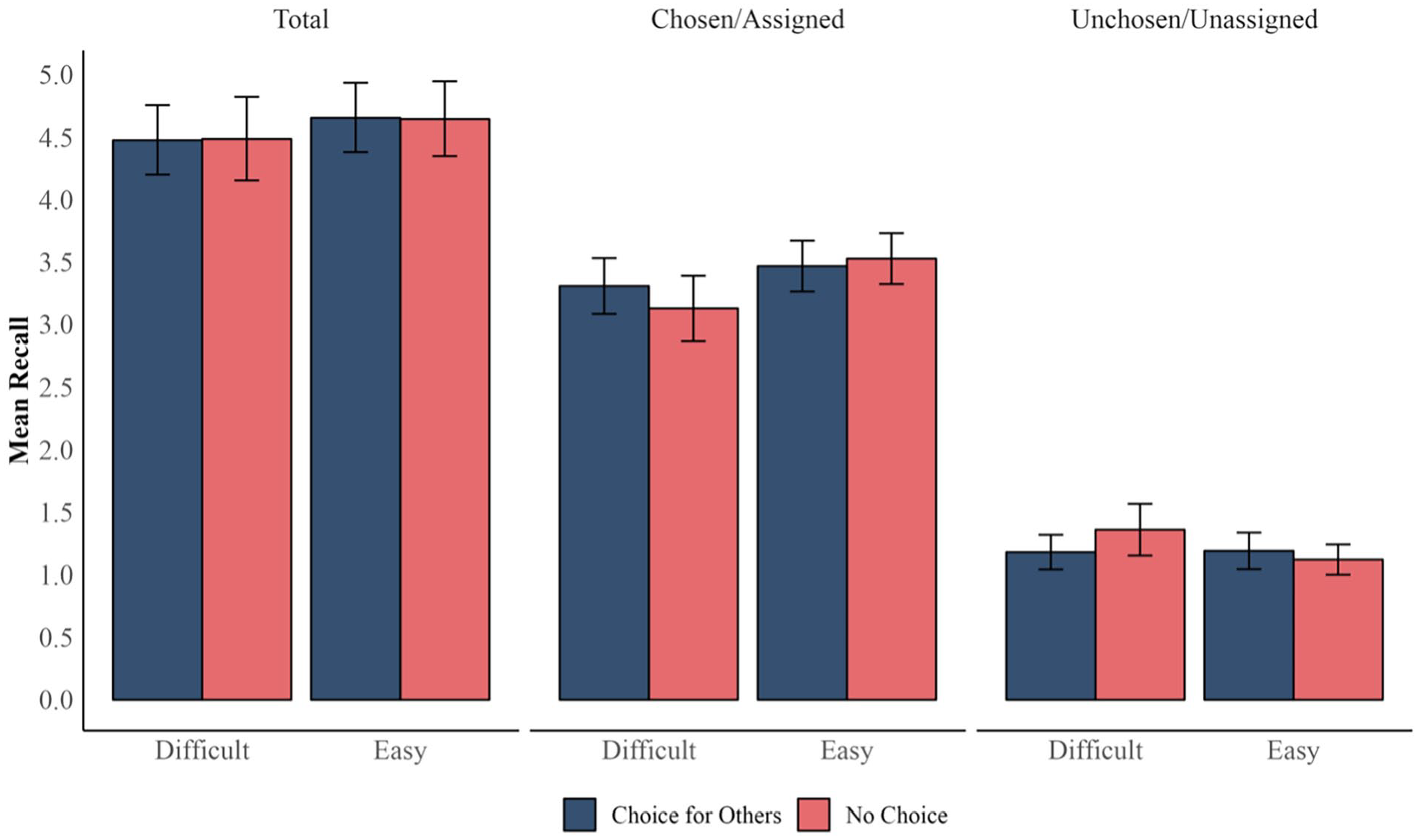
Study 3 Recall Results.
Study 3 Recall Descriptive Statistics.
Manipulation Check
We found a main effect of choice condition (p < .001) but not difficulty condition (p = .725) on felt choice. Overall participants reported the most felt choice in the choice conditions, suggesting a successful manipulation. The interaction between choice and difficulty on felt choice was non-significant, p = .054.
Discussion
In Study 3, memory was not reliably affected by choosing for others. This pattern was contrary to predictions and to the robust memory effects of choosing for others observed in the prior three experiments. Furthermore, we found no evidence that the difficulty of the choice mattered for memory. We manipulated choice difficulty by varying the similarity of the choice alternatives, because this manipulation has been found to moderate the memory benefits of choosing for the self in past research (Baldwin et al., 2022). But it did not appear to matter for the memorability of choices for others in the current study.
Study 4
We conducted a fourth study to test again the hypothesis that choosing for others improves memory for choice alternative compared with having no choice. We have found evidence to support the choice effect in three of the four studies so far (which represent all the studies we have conducted on the topic). To make the test a stringent one in Study 4, we had participants in the choice-for-others condition make only easy choices, which should produce weaker benefits to memory than harder choices (notwithstanding the results from Study 3; see Baldwin et al., 2022).
Method
Two hundred fifty-five undergraduate students participated in exchange for credit toward a course requirement. Participants who failed to complete the memory test were excluded (n = 10), as were two outliers (more than 3 SDs away from the sample mean) on total recall (sample M = 4.87, SD = 2.63) and one on the amount of time in between viewing the words and then recalling them (sample M = 7.00 minutes, SD = 6.05 minutes). 1 One participant did not consent. The sample for analysis included 244 participants (84 men, 160 women). The average age of the sample was 19.21 (SD = 1.25). Participants were Caucasian/White (62.7%), Hispanic/Latino (18.0%) Asian (11.9%) or other races (7.4%).
Study 4 used a between-subjects experimental design to test the impact of choosing for others on memory. Participants were randomly assigned between the choice-for-others condition (n = 118) and the no choice condition (n = 126). Using G*Power, we determined that for a t-test, a sample this size may detect an effect size of d = 0.36 at .80 power. All participants saw 20 pairs of words (40 words) of opposite valence (i.e., joy/death).
Results
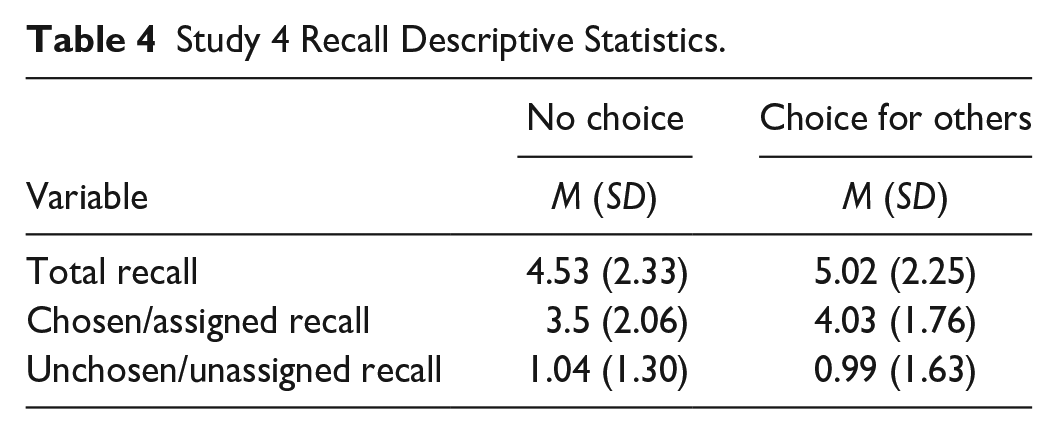
An independent-samples t-test compared the total number of words recalled in the choice-for-others condition and no choice conditions. We found no significant difference in total recall between the two conditions, t(242) = 1.65, p = .100, d = −0.21, 95% CI [−1.06, 0.93]
Another independent-samples t-test compared only the number of chosen/assigned words recalled. We found a difference in chosen/assigned recall for participants in the choice-for-others condition versus no choice conditions, t(242) = 2.14, p = .034, d = −0.27, 95% CI [−1.04, −0.04]
We also compared recall for unchosen/unassigned words across the two conditions. Participants in the choice-for-others condition recalled non-significantly fewer unchosen/unassigned words compared with participants in the no choice condition, t(242) = 0.213, p = .831, d = 0.02, 95% CI [−0.33, 0.411]. See Figure 4 and Table 4 for recall results.
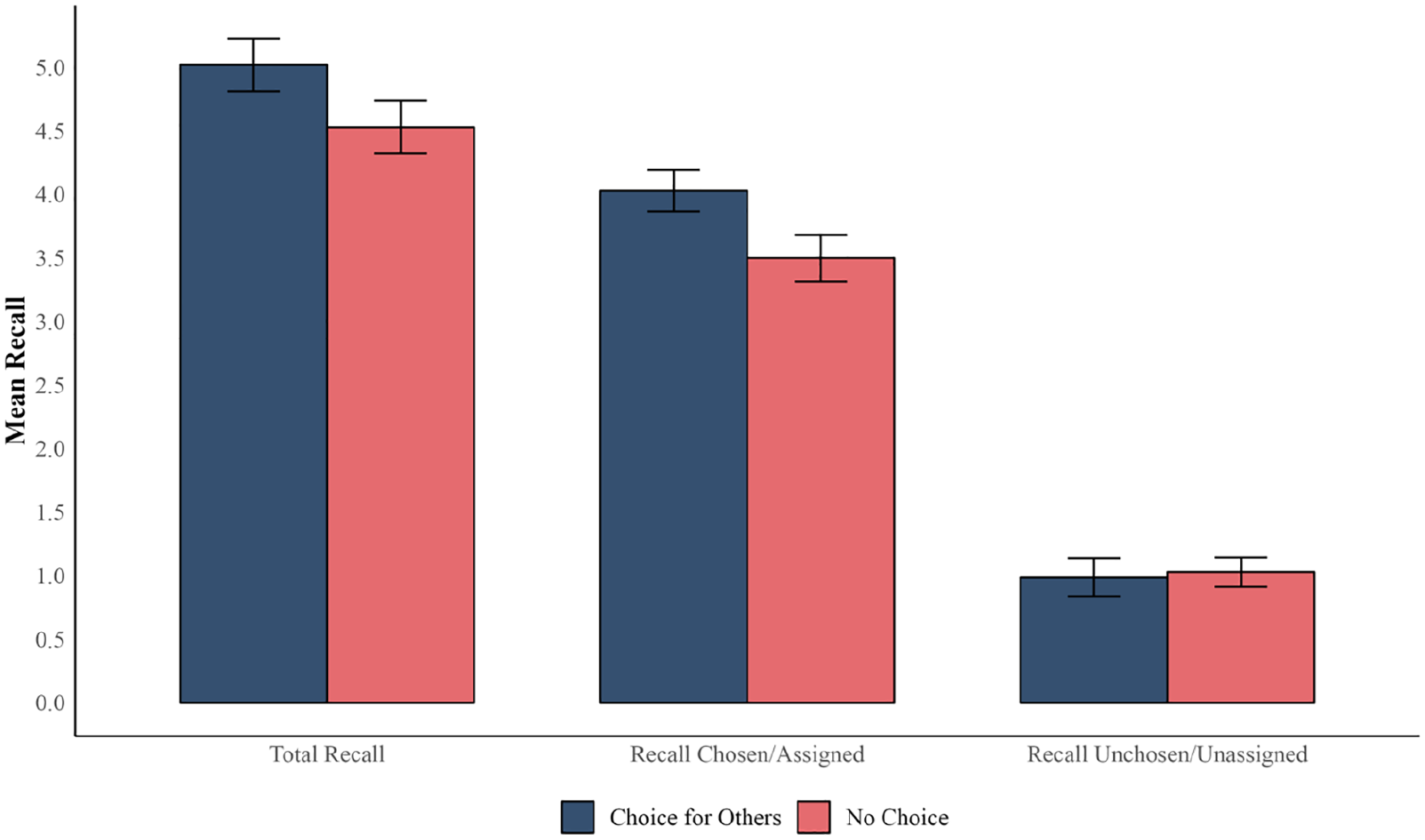
Study 4 Recall Results.
Study 4 Recall Descriptive Statistics.
Participants who chose for others (M = 6.05, SD = 1.30) felt more choice compared with participants for whom the computer made the choices, M = 2.22, SD = 1.47, t(242) = 21.46; p < .001. Again, this result suggested a successful choice manipulation.
Discussion
Study 4 found that choosing for others improved recall compared with not having choice, but only for chosen (versus assigned) alternatives. Total recall (i.e., including both chosen/assigned and unchosen/unassigned alternatives) did not differ between the two groups. This pattern only partially matched the results from prior studies. Self-choice typically enhances total recall (including both chosen and unchosen items) compared with no choice (see Studies 1a and 1b and Baldwin et al., 2022). Indeed, in most of the previous studies, choosing reliably enhanced memory for unchosen (versus unassigned) items, but that pattern did not hold in the current study. The results from Study 4 thus suggest a weaker or less robust effect of choosing for others on memory compared with the previous studies.
We hasten to add that, due to a miswording in a portion of the instructions, participants in Study 4 were explicitly asked to recall selected (i.e., chosen or assigned) words. That instruction contrasts with prior research, in which participants were asked to recall choice alternatives regardless of whether they had been chosen/assigned. Moreover, the choices in Study 4 always pitted words of opposite emotional valence (e.g., joy/death). Such pairs are thought to pose easy choices because participants overwhelmingly favor and choose the more positive word in each pair; easy choices typically yield a less robust self-choice effect compared with more difficult choices (see Baldwin et al., 2022). Those factors—expected in the case of easy choices, but unexpected in the case of the misworded instructions—may help to account for the weaker choice effects in Study 4.
Mini Meta-Analysis of the Current Studies
Due to uneven findings across studies, we combined them all to increase power and more conclusively estimate the effects of choice on memory using meta-analysis (following Goh et al., 2016) using unbiased ds (following Hedges, 1981; see Supplemental Material for formulas).
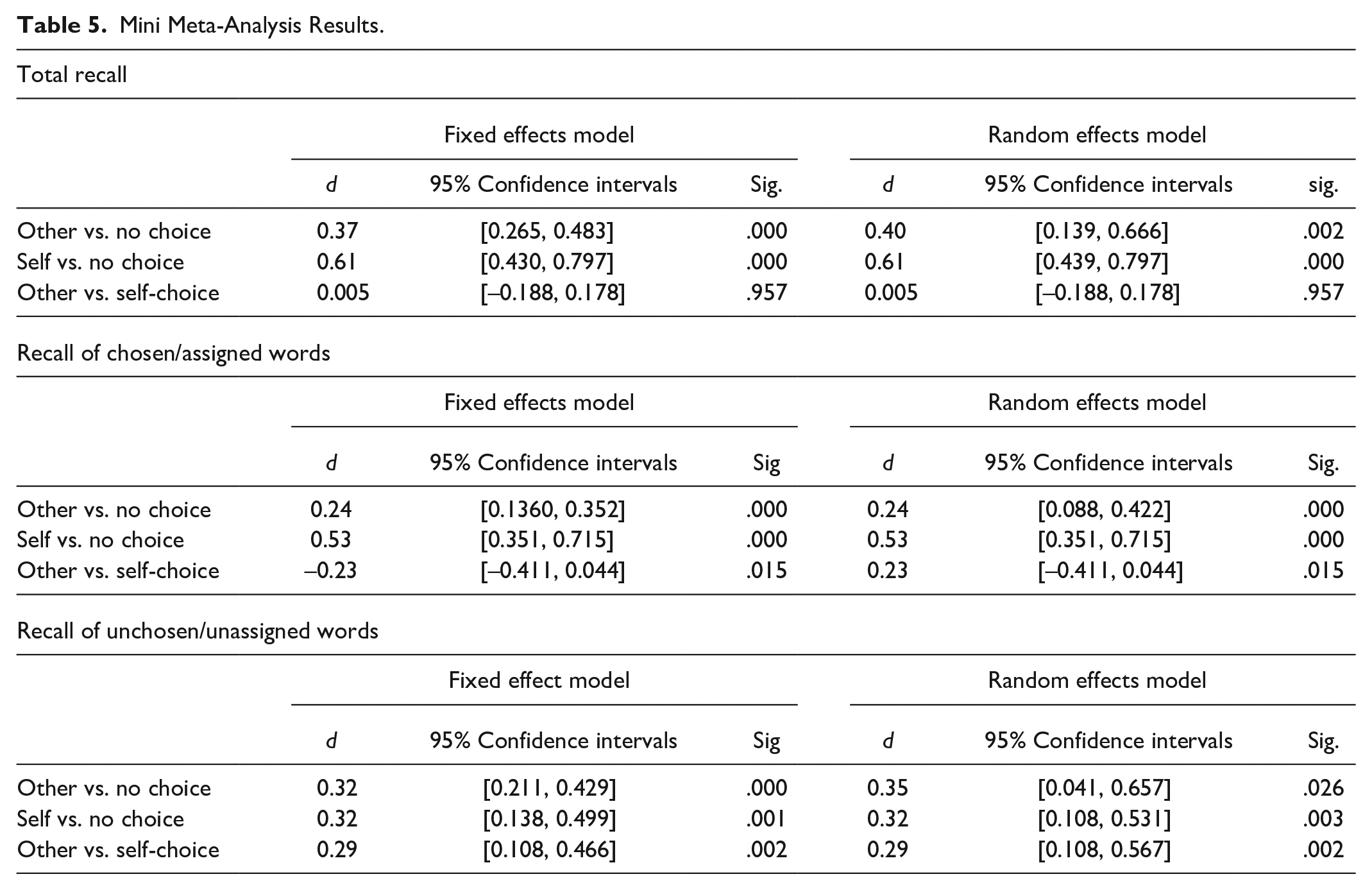
First, we tested the effect of choosing-for-others versus having no choice on total recall across all four studies (total N = 1360). 2 Using both a fixed effects model, d = 0.37, Z = 6.73, p < .001, and a random effects model with inverse variance weighting, d = 0.40, Z = 3.00, p = .003, we found a statistically significant difference between groups such that choosing for others increased total recall compared with having no choice.
Next, from the subset of studies that included a self-choice condition (i.e., Studies 1a and 1b), we compared the effect of self-choice against no choice on total recall (total N = 477). Again, using a fixed effects model, d = 0.61, Z = 6.55, p < .001, and a random effects model with inverse variance weighting, d = 0.61, Z = 6.55, p < .001, we found group differences, such that self-choice increased memory compared with having no choice. The observed magnitude of the self-choice effect matched almost exactly the effect size reported in a prior mini meta-analysis of 14 experiments (i.e., d = 0.62; Baldwin et al., 2022).
Finally, again using the relevant subset of studies (i.e., Studies 1a and 1b), we compared the effect of choosing for self versus choosing for others on total recall (total N = 458) and found a nonsignificant difference in both a fixed effects model, d = −0.005, Z = −0.054, p = .957, and a random effects model, d = −0.005, Z = −0.054, p = .957.
In addition to total recall, we also calculated meta-analytic models on chosen/assigned recall and unchosen/unassigned recall for each comparison group separately. See Table 5 and Figure 5 for results.
Mini Meta-Analysis Results.
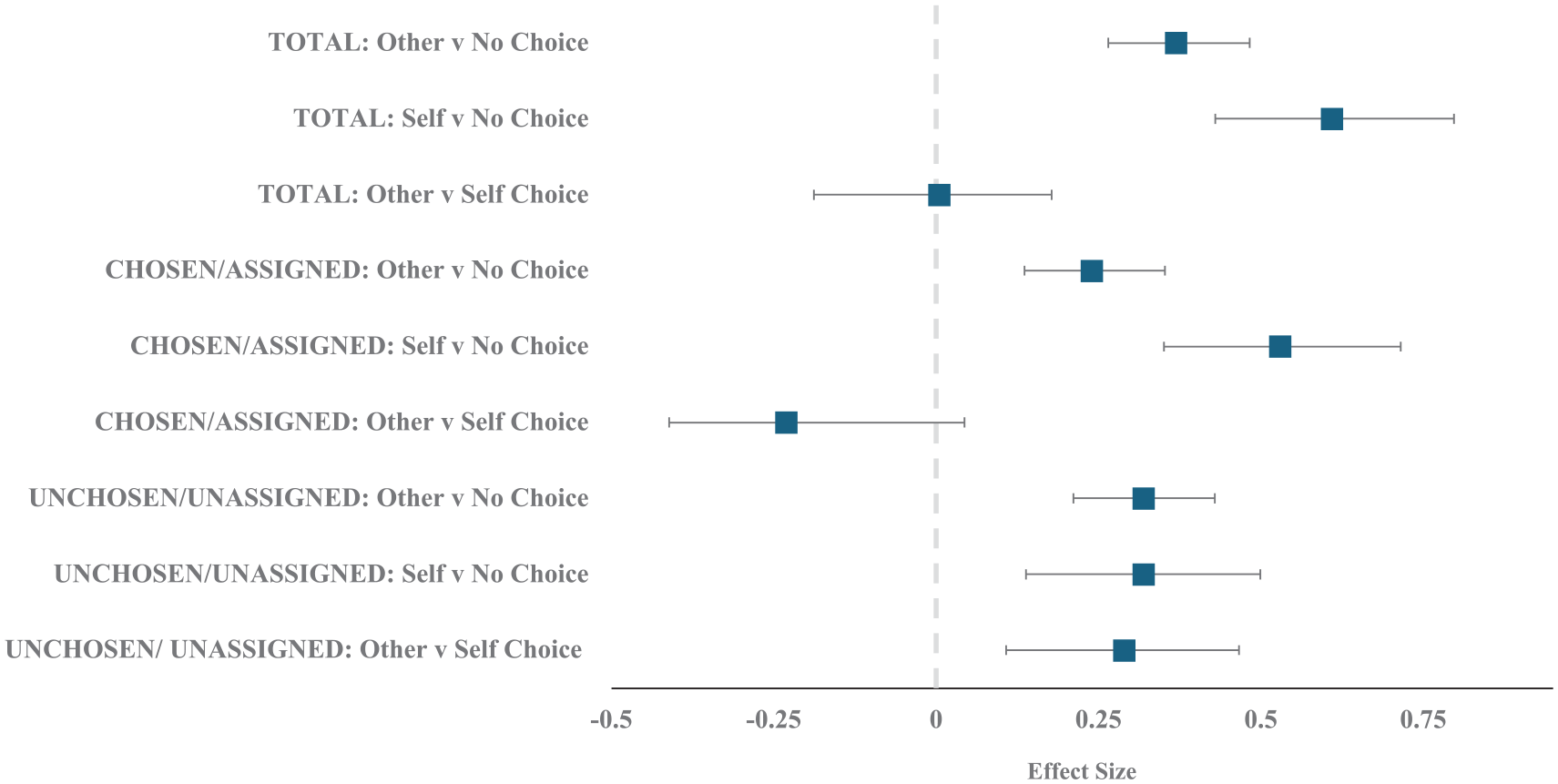
Forest Plot of Fixed Effects Mini-Meta Analyses Results.
General Discussion
Prior research found that choosing for oneself enhances memory for choice alternatives compared with being assigned items to recall. We sought to broaden work on the self-choice effect by testing the impact of making choices for other people. We proposed that the volition involved in making choices for others would improve memory over having no choice, but not as much as choosing for the self.
In four experiments, participants chose or saw words assigned for another participant to recall on a memory test. Participants then attempted a surprise memory test for the words. Studies 1a and 1b directly tested total recall after choosing for oneself, choosing for others, and having no choice. We found better total recall among participants in the two choice conditions compared with participants who had no choice, and this was true regardless of the target of the choices. Contrary to predictions, total recall did not differ between self-choice and choice-for-others.
In Study 2, we tested the extent to which closeness of the other to the self impacts memory. We reasoned that memory should be enhanced by making choices for close as compared with distant others, given the greater overlap between the self and a close other. But here again we found that choice improved memory over no choice, regardless of the closeness of the other.
Studies 3 and 4 found no significant differences in total recall between choice-for-others and no choice conditions. This pattern contrasts with evidence from the first two studies, which found enhanced recall when participants chose for others. However, the null results from Study 4 may have stemmed from an error in instructions given to participants; they were instructed to recall chosen items rather than all items, and indeed we found that they remembered chosen items better. Study 4 thus provided some evidence for an other-choice effect in memory.
A mini meta-analysis combining all four studies found a significant effect of choosing for others on memory compared with no choice. We also found a significant effect of self-choice compared with no choice (from Studies 1a and 1b). However, when comparing self-choice to other choice we found no significant difference.
Overall, these findings suggest that choice boosts memory, regardless of who the choice is for (self or others). These results attest to the powerful influence of choice on memory. Baldwin et al. (2022) proposed that the choices people make are exceptionally memorable events. The current findings extend that line of thought to suggest that even choices made for others are memorable.
How Crucial is the Self for the Self-Choice Effect?
We undertook this investigation to illuminate the role of the self in the self-choice effect. Inspired by Baumeister’s (1998) tripartite conceptualization of selfhood, we considered the influence of two core aspects: the self as reflexive consciousness and the self as executive decision maker. Reflexive consciousness is implicated in the processing of information in relation to the self-concept. When choosing, self-referenced processing would help to ensure compatibility between a person’s choices and their interests, preferences, or desires. The executive function of the self would be implicated in the process of deciding and finally committing to one alternative over the other.
We assumed that the influence of self-referenced processing would be reduced when choosing for others. Insofar as self-referenced processing is crucial for the self-choice effect, choices for others should be less memorable than choices for self. But we found that choosing improved memory (compared with no choice) for both self-choices and choices for others alike. Furthermore, choosing for a distant (i.e., random) other boosted memory similarly to choosing for a close other. It thus appeared that self-referenced processing was not instrumental to making choices memorable.
We hasten to acknowledge that the argument for equivalent memorability of self-choices and choices for others hinges on a null result (i.e., we found no statistically significant differences in recall between the self-choice and other-choice conditions). The frequentist statistics we used to analyze the current data cannot prove the null hypothesis, so this argument is necessarily tentative. It may be that self-choices are better remembered than choices for others in some circumstances; indeed, we had precisely predicted this pattern of results when we planned this program of research. We simply did not find much evidence for that prediction in these studies.
Relative to the self as reflexive consciousness, the self as executive decision maker seems more responsible for making choices memorable. Even when choosing for another person, the executive function of self may still be involved in the process; a choice still must be made. Here again it may be reasonable to assume that the level of engagement of the executive function would be somewhat reduced when choosing for another versus oneself, but apparently that reduction in engagement was not sufficient to diminish the memory effects of choosing. Some research has suggested that a person may be more engaged in the choice process when choosing for others compared with choosing for self, and that pattern could help explain the fact that self-choices were no more memorable than choices for others. For example, Liu et al. (2018) found that participants sought more information when choosing for others compared with choosing for themselves. Based on the current results we suggest that the memory benefits that flow from choosing reflect primarily the contributions of the executive function of the self; the reflexive self-consciousness aspect seems less crucial.
Limitations & Future Directions
We did not tell participants that their memories would be tested in these experiments. By using surprise memory tests, we hoped to prevent participants from using mnemonic strategies or otherwise intentionally trying to enhance memory at encoding or during the retention interval. At the end of each study, we asked participants to report whether they knew their memory would be tested. Results pertaining to this item are reported online. Briefly, participants in the no choice conditions often reported greater foreknowledge that their memory would be tested. In addition, in Studies 1a and 1b participants in the self-choice condition reported greater foreknowledge of a memory test compared with participants in the choice-for-others condition. Total recall results remained unchanged when including this variable as a statistical covariate. Nonetheless, it appears that asking participants to select words for a purported memory test is less believable when selecting for a future participant compared with simply viewing options for a future memory test for another participant. In future research it may be worthwhile to modify the choice paradigm to better mask the purpose of choosing to ensure that participants across conditions do not differentially anticipate having to take a memory test
Participants reported whether they knew memory would be tested only after they had completed a memory test, so those reports are subject to retrospective reporting biases and cannot be construed as an entirely accurate account of how well participants anticipated a memory test. The fact that participants in the conditions reporting the most foreknowledge tended to recall the least suggests that perhaps they did not, in fact, know a memory test was forthcoming. If they did, then viewing words under the expectation of a subsequent memory test did not boost memory as much as choosing for others without expecting to remember them.
Across all studies, participants chose between pairs of words to include on a memory test. Choosing words for a memory may not be reflective of the kinds of choices people make in daily life (for self or others), such as what to eat for dinner or where to go on vacation. As such, the external validity and generalizability of the current results remain to be seen. Furthermore, it is possible that the choice alternatives used in the current studies did not engage the self-concept sufficiently enough to ensure divergent effects of choosing for self versus others. Previous research has suggested that choosing for others (versus the self) may involve perspective taking, be driven by different motivations and goals, and invoke different affective states (e.g., Liu et al., 2019; Polman & Wu, 2020; Tunney & Ziegler, 2015). It could be that when choosing words for a memory test, the cognitive processes involved in choice, and perhaps the choice itself, do not differ for self versus others. In addition in Studies 1a and 1b, participants in the self-choice condition were not instructed that their choices would impact other participants, however, it could be that when deciding words for a memory test participants assumed those choices would be used for other participants as well. It is possible that these participants engaged cognitive processes more similar to choosing for others over self. Future studies should consider a variety of different choice alternatives, including those that more closely resemble the choices people routinely face in daily life or choices that more surely differ when choosing for self or others (e.g., product choice; Liu & Baskin, 2021).
Overall, regardless of study and condition, the recall totals we observed were lower than previous studies using free recall tests of choice memory. The mean recall percentages ranged from 10.8% to 17.9% in the current studies. For context, Cloutier and Macrae (2008) found free recall rates from 15% to 25%, Watanabe (2001) from 24% to 45%, and Watanabe and Soraci (2004) from 23% to 55%. The consistently lower mean recall rates in the current studies, at least in an informal comparison to relevant prior studies, may point toward methodological limitations that could have skewed the current results.
More specifically, due to COVID-19 we conducted most of these studies online, whereas past published research on the self-choice effect has been conducted almost exclusively in the laboratory. The online studies may have lacked sufficient control over outside factors that could disrupt item encoding and subsequent retrieval. For example, participants may have been distracted during the study (e.g., cell phone use and watching television), which may have impacted the results in a way that could be avoided in a laboratory setting. This possibility could have contributed to the relatively low mean recall rates and the null results in Studies 3 and 4. Recently, Ding et al. (2021) conducted online research on memory and found significant results on recognition of items. Prior to participation, Ding et al. had instructed their subjects to complete the study in a quiet environment. Prior to Study 1b we instructed participants to be in a quiet environment, however we did not verify their setting, and we did not include this instruction in Studies 2 through 4. Future research on choice memory may benefit from using in-person methods or more carefully controlled online tests.
Conclusion
Prior research found evidence for the self-choice effect—the pattern whereby choice alternatives are remembered better than assigned alternatives. The current research expanded those findings by testing whether choosing for self or merely choosing was sufficient to boost memory, by having participants choose for others. We found that choice boosts memory when choosing for self or other. In addition, we found that the closeness of the other made little difference for memory. These null differences question the role of the “self” in the self-choice.
Footnotes
Declaration of Conflicting Interests
The author(s) declared no potential conflicts of interest with respect to the research, authorship, and/or publication of this article.
Funding
The author(s) received no financial support for the research, authorship, and/or publication of this article.

Data Availability
Data and analysis scripts are available online: osf.io/xrkcz/