




Abstract
From job candidates to entrepreneurs, people often face an inherent tension between the need to share personal accomplishments and the need to avoid appearing arrogant. We propose that humorbragging—incorporating self-enhancing humor into self-promoting communications—can signal warmth and competence simultaneously, leading to instrumental benefits. Four studies explored humorbragging as a potential solution to the self-promotion paradox. Study 1 demonstrated that a humorbragging (vs. self-promoting) resume attracted more hiring interest from recruiters. Study 2 showed that perceived warmth and competence mediate the positive effect of humorbragging on hiring intentions. Study 3 found that humorbragging entrepreneurs achieved greater success securing funding compared to entrepreneurs who used other kinds of humor. Finally, Studies 4a to 4c established that the positive effect of humorbragging on hiring intentions is unique to self-enhancing humor. Overall, the current research establishes the instrumental benefits of humorbragging and explains why and when it functions as an effective impression management strategy.
The self-promotion paradox poses a significant challenge for job candidates, entrepreneurs, and other individuals who seek to present themselves as competent without alienating their audience (Bolino et al., 2016). It captures the inherent tension between the need to share information about personal accomplishments on one hand, and the need to avoid seeming arrogant on the other (Brooks et al., 2019; Ritzenhöfer et al., 2019; Scopelliti et al., 2015; Steinmetz, 2018). A job candidate who refrains from sharing information about their achievements (or alternatively, attributes them to fortunate circumstances) may be passed up for a coveted position because they seem to lack the necessary agency and competence to succeed in the job. However, a job candidate who claims credit for successes may come across as arrogant and boastful and may therefore be passed up for the same coveted position because they seem to lack in warmth and morality. Thus, the essence of the self-promotion paradox is that communicators seem to be damned if they do (self-promote) and damned if they don’t (self-promote).
The current paper proposes humorbragging as a potential tactic to address the self-promotion paradox. We define humorbragging as coupling self-enhancing humor with self-promotion, whereby the speaker engages in intentional self-promotion while simultaneously attempting to elicit amusement from the audience through the use of self-enhancing humor that is appropriate for the context. In the following sections, we first review research on self-focused impression management tactics. We then introduce humorbragging as an impression-management strategy, explain why and how humorbragging can benefit individuals who face the self-promotion paradox in evaluative contexts, and contrast humorbragging with other forms of humorous communicative acts. We then report findings from one field study, one archival study, and two experiments that tested our hypotheses.
Self-Focused Impression Management Tactics
Impression management tactics take numerous forms, such as ingratiation (Higgins et al., 2003), self-monitoring (Flynn et al., 2006), and bragging (Chaudhry & Loewenstein, 2019). Even within the conceptually tighter space of communication-based, self-focused impression management behaviors, many different tactics have been identified and studied. For example, researchers have distinguished between communications that focus on past achievements versus communications that focus on the potential for future achievements, finding a consistent preference for the latter among evaluators (Tormala et al., 2012).
One of the central factors that shape listeners’ reactions to self-focused impression management tactics is the extent to which communications are self-effacing (i.e., modest) versus self-enhancing (i.e., boastful; Rudman, 1998; Schlenker & Leary, 1982). While people intuitively recognize the need to qualify their self-promoting communications to make them more palatable to listeners, people tend to be inaccurate when predicting how others would react to their self-promotion (Scopelliti et al., 2015; Sezer et al., 2018; Steinmetz, 2018). These perspective-taking failures often lead individuals to use suboptimal strategies that backfire (Sezer et al., 2018).
One reason for this miscalibration is self-promoter’s tendency to prioritize competence over warmth in evaluative contexts. Competence and warmth are two critical dimensions of person perception (Fiske et al., 2002). Individuals are often judged as higher or lower in competence and warmth based on their communication strategy (Chaudhry & Loewenstein, 2019). During evaluative situations, such as job interviews, people often overemphasize the need to project competence over appearing warm (Scopelliti et al., 2015, 2017; Wojciszke & Abele, 2008). The audience, however, generally prefers those who are high in sociality and warmth when assessing those with whom they may be interdependent (Cottrell et al., 2007). Furthermore, unlike perceived competence, the preference for sociality and warmth is not task-specific and can be particularly pronounced when people choose their direct report (Wojciszke & Abele, 2008).
Different communication strategies can have opposite effects on perceptions of warmth and competence (Swencionis et al., 2017; Swencionis & Fiske, 2016). Indeed, individuals often downplay their own warmth to come across as more competent and downplay competence to come across as warmer (Holoien & Fiske, 2013). For example, Swencionis and Fiske (2016) have shown that, when interacting with a person in a lower-ranked position, individuals downplay their own competence to appear warmer, whereas when interacting with a person in a higher-ranked position, individuals downplay their own warmth to appear more competent. This line of research reflects a common belief that the tradeoff between warmth and competence is often unavoidable (Fiske et al., 2002).
The evidence concerning warmth-competence tradeoffs motivated researchers to identify strategies that would allow individuals to appear both warm and competent. For instance, people have been advised to emphasize their efforts over their natural talents when explaining their success (Wojciszke & Abele, 2008) or to have an intermediary share or convey a self-promoting message on their behalf (Scopelliti et al., 2017). Researchers have also cautioned against the counterproductive use of compensatory strategies, such as the tendency to reduce the abrasiveness of self-promotion by masking it with complaint or humility (Grant et al., 2018; Sezer et al., 2018). These recommendations are rooted in the assumption that impression management necessarily involves tradeoffs between competence and warmth (Swencionis et al., 2017).
The current research presents a different approach to addressing the self-promotion paradox in evaluative contexts, such as job interviews and entrepreneurial pitches. We argue that imbuing self-promotion with appropriate self-enhancing humor can bolster perceptions of warmth and competence simultaneously, thereby circumventing the seemingly unavoidable tradeoff between warmth and competence. We contribute to the self-presentation literature by addressing a principal open question in the literature on impression management: “How can individuals appear competent and likable” at the same time? (Bolino et al., 2016, p. 385). We propose that in contexts that call for people to promote themselves, such as in job interviews and entrepreneurial pitches to investors, appropriately used humor may be one way to resolve this long-standing paradox in impression management.
Imbuing Self-Promotion With Humor
At first glance, humor seems to be an unlikely remedy to the self-promotion paradox within an evaluative recruiting context for three complementary reasons. First, using humor in a high-stakes situation in which one is being evaluated—such as a job interview —is risky (Bitterly et al., 2017). Being humorous risks signaling excessive confidence. In addition, listeners may find the communicator’s humor inappropriate. Second, humor undermines the perceived truthfulness of communicated messages (Bitterly & Schweitzer, 2019). Finally, using humor may communicate to listeners that the speaker is making light of a serious situation. Indeed, research on humorous complaining shows that using humor when describing a transgression can make listeners treat the transgression less seriously (McGraw et al., 2015). Thus, at first sight, humor seems unsuited as a means to manage the self-promotion paradox.
We propose, however, that coupling self-promotion with self-enhancing humor that is appropriate to the context can provide instrumental benefits to communicators facing the self-promotion paradox. More specifically, humor can focus on different targets (the self vs. others) and can be used as a means to enhance or demote its target. These two dimensions form a conceptual framework for categorizing four broad types of humor people can utilize in a communicative act (Table 1). Although a speaker who is trying to be humorous can use humor that falls in any of the four categories outlined in Table 1, we propose that humorous bragging, situated in the top left cell of Table 1, is uniquely suited to benefit communicators who seek to navigate the self-promotion paradox in evaluative contexts.
Categorization of Types of Humor as a Function of Target and Direction.
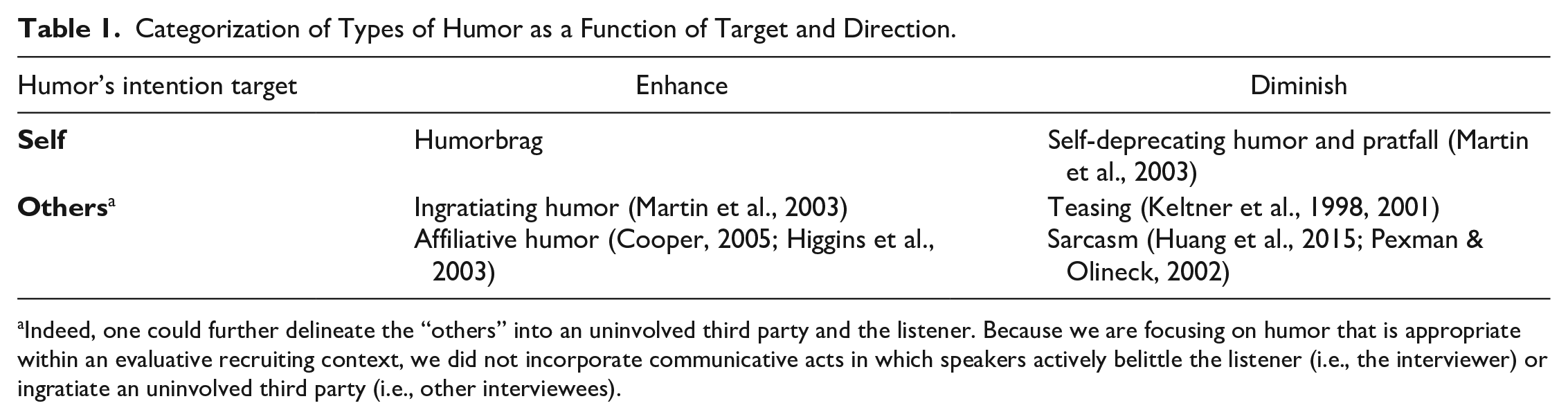
Indeed, one could further delineate the “others” into an uninvolved third party and the listener. Because we are focusing on humor that is appropriate within an evaluative recruiting context, we did not incorporate communicative acts in which speakers actively belittle the listener (i.e., the interviewer) or ingratiate an uninvolved third party (i.e., other interviewees).
We define humorbragging as the act of combining self-promotion with self-enhancing humor. Self-enhancing humor is a type of humor that involves making jokes or funny remarks that draw attention to one’s own positive qualities, achievements, or abilities. It is often used as a social tool to subtly boost one’s image or standing in the eyes of others while also entertaining them. Unlike a sense of humor, which is likely to be relatively stable across situations, humorbragging is an intentional communicative strategy that individuals can deploy selectively to impress others who evaluate them. In the sections below, we explain why and how self-enhancing humor can support effective self-promotion and what distinguishes humorbragging from generally being a humorous speaker.
Humorbragging Signals Warmth and Competence
Building on the benign violation theory of humor (McGraw et al., 2015; McGraw & Warren, 2010), we propose that humorbragging in evaluative employment contexts—including in high-stakes situations such as job interviews and pitching to investors—works because benign violations of norms effectively increase perceived warmth and signal the speaker’s competence simultaneously.
Focusing on the benign nature of the humorous communicative act, we propose that humorbragging signals to listeners that the situation is agreeable and pleasant and that the speaker is capable of amusing and entertaining in addition to being serious and industrious. Jointly, these processes have led researchers to claim that “being humorous offers vast interpersonal benefits” (McGraw et al., 2015, p. 1154). Research on psychological situations shows that, although some kinds of humor (e.g., inappropriate jokes) may provoke negative affect, people tend to experience situations that are humorous as positive and warm (Parrigon et al., 2017). Thus, humor can diffuse the tension that often accompanies high-stakes impression-management situations (McGraw et al., 2015) and promote perceived warmth and interpersonal liking (Bitterly & Schweitzer, 2019; Wood et al., 2011).
Focusing next on the norm violation aspect of the humorous communicative act, we propose that violating listeners’ expectations signals high levels of agency and competence. Indeed, prior research found a positive association between skillful use of humor and IQ (Greengross & Miller, 2011; Masten, 1986), as well as between perceived sense of humor and perceived intelligence, confidence, and effectiveness (Decker, 1987). Several lines of research explain this association and lend support to our theoretical assertion. For example, research by Van Kleef and his colleagues (2011, 2015) shows that observers tend to associate norm violation with power. Specifically, observing that an actor violates social norms signals that the actor is capable of exercising their will even in circumstances that typically constrain others’ actions. The existence of cognitive schemas linking unconventional behavior (Bellezza et al., 2014) and risk-taking behavior (Anderson & Galinsky, 2006) with status and power suggests that observers of unconventional and risky behavior are likely to infer that the actor feels confident and in control. Because reflected confidence often fuels perceptions of competence (Anderson & Kilduff, 2009; Kennedy et al., 2013), job candidates who promote themselves humorously are likely to be seen as competent.
Considerable research suggests that perceptions of warmth and competence shape observers’ social behavior (Cuddy et al., 2008; Fiske et al., 2007). Specifically, research shows that people seek to actively help warm others and wish to associate with competent others (Cuddy et al., 2008). Accordingly, evaluating targets as high in both warmth and competence will likely increase active helping and the desire to associate with them. This implies that in professional contexts, such as recruitment or investment decisions, evaluators are likely to be attracted to individuals who exhibit both warmth and competence. Consequently, job seekers perceived as high in warmth and competence are more likely to attain greater instrumental benefits, defined as tangible advantages that the jobseeker can obtain in the interview context, which may include increased hiring potential, improved job prospects, and enhanced reputation. Therefore, we predict:
Differentiating Humorbragging From Being Humourous
We further posit that not all humorous communication will lead to the proposed positive outcomes of humorbragging. Earlier, we proposed a conceptual framework for categorizing four broad types of humor people can utilize in a communicative act: humor can focus on different targets (self vs. others) and can be used as a means to enhance or diminish its target. We propose that self-enhancing humor yields the most favorable outcome compared with other forms of humorous communicative acts when used in self-promotive communications. More specifically, we argue that only when humor is communicated in a way consistent with the focus and direction of self-promotion (i.e., self-enhancing humor) will the humorbragging result in a favorable outcome.
Self-diminishing humor may increase warmth by making the speaker more endearing or humble but at the expense of being perceived as competent and confident (O’Donnell et al., 2016; Sezer, 2022). Other-directed humor (both enhancing and diminishing) may undercut the communicator’s goal of engaging in self-promotion, thereby reducing the effectiveness of humorbragging (Kacmar & Carlson, 1999; Kacmar et al., 1992). Taken together, we hypothesize:
Research Overview
We employed a multimethod approach and conducted four studies to test the effects of humorbragging on perceptions of warmth and competence, and through them, on instrumental benefits (e.g., being hired in an employment context or getting funded in an entrepreneurial context). Study 1, a resume audit study, examined whether humorbragging, as compared to self-promotion, would elicit more recruiter interest in the job seeker. Study 2 investigated warmth and competence as two underlying mechanisms for the positive effect of humorbragging on an employer’s hiring intentions. Studies 3 and 4 distinguished humorbraggers from humorous speakers. In Study 3, we analyzed the success of aspiring entrepreneurs’ pitches on the reality TV show Shark Tank as a function of the types of humor they used in their promotion pitches. We subsequently conducted Studies 4a through 4c to establish causality and demonstrate that humorbragging, but not other forms of humorous communicative acts, leads to instrumental benefits. Taken together, we utilized various communication mediums—including resumes, text transcripts of job interviews, and entrepreneurial pitches to real venture capitalists—to maximize the robustness and generalizability of our findings. The data and materials for the experiments (including the resumes used in Study 1) and the details of our exploratory studies are available here: https://osf.io/azjc2/.
Study 1: Humorbragging in Resumes
Study 1 tested whether humorbragging is an effective self-presentation strategy in a real-world setting. Specifically, we created and submitted two resumes to 345 companies seeking to fill a sales representative position. These resumes are comparable in terms of candidates’ education, experience, and technical skills. However, one of the applicants incorporated self-enhancing humor when introducing themselves in the Career Objectives section (humorbragging condition), while the other did not (self-promoting condition). We predicted that the candidate who uses humorbragging in their resume would be sought out by recruiters more than the candidate who does not use humorbragging.
Method
Materials
We created two resumes for two job applicants looking for sales representative positions. We embedded our key manipulation, humorbragging versus self-promoting communication, in the career objective section of the resumes (see Table 2). The career objective section serves as the optimal location for the manipulation for two reasons. First, it is the section that appears immediately below the contact information section. Therefore, it is the first opportunity for applicants to promote themselves in any given resume. Second, this section affords applicants greater freedom with regard to its content. The two resumes were identical in all other aspects: we matched the two applicants’ years of experience, career trajectory, and education. We also used gender and race-neutral names that were similarly common in the United States (Taylor Phillips and Emerson Bentley). 2 These materials were pretested to ascertain neutrality and equivalence. 3
Career Objective Statements Used in Study 1

In addition, we created a personal webpage for each applicant, which was hyperlinked in the resumes. Once loaded, each personal webpage contained only the applicant’s resume and nothing else. This webpage is embedded with software that tracks webpage traffic from unique visitors, thus providing an additional measurement of recruiter interest in the candidate.
Data Source
Using these resumes, we applied to actual jobs using a well-known job search platform that matches job applicants and employers. We targeted employers in Virginia who posted an ad for full-time, entry-level sales representatives within 14 days of our data collection period. We only applied to companies that did not require additional screening tests or information that went beyond what was in the resumes. A total of 345 companies fulfilled these requirements and received both applications on the same day. We predetermined a 14-day contact period, starting from the day we submitted the resumes, during which we kept track of recruiters’ expressions of interest in the applicants.
Recruiters’ Interest
Our dependent variable is recruiters’ interest in the candidate, which we operationalized as texts, voice mails, and emails (both through the applicant’s personal email address and the platform’s inbox) sent to applicants during the contact period. We aggregated the overall frequency of contacts across these forms of communication to create the Contact Frequency variable. We then combed through the data to create the Unique Companies variable, which focused on the number of unique companies that reached out to each applicant. To illustrate, a company that both called and emailed our applicant would be entered twice under Contact Frequency and only once under Unique Companies. Finally, we compared the number of unique visitors to each website. We kept the website visitors as a separate variable because the embedded software only provided an overall count without a means to match the visitor to a company. Therefore, we took the conservative route and treated that solely as additional information.
Results
Figure 1 provides a breakdown of the overall data. The humorbragging applicant’s website received 87 unique visitors, three times as many visitors as the self-promotion applicant’s website, which received 29 unique visitors. Going beyond visits to the applicants’ websites (e.g., a recruiter may email and/or call the candidate without accessing their website), examination of the traceable contact data showed that the humorbragging applicant received about 1.46 times more contacts (Contact Frequency = 400) than the self-promoting applicant (Contact Frequency = 274). On average, the humorbragging applicant received about 1.16 contacts from a company (SD = 1.83), significantly more than the self-promoting applicant (M = .79, SD = 1.44), t(344) = 6.21, p < .001. Note that it is possible for different recruiters from the same company to contact the same candidate. Therefore, it is important to consider the number of unique companies that contacted each candidate. The humorbragging applicant was sought out by a significantly larger number of unique companies (156 companies) as compared with the self-promoting applicant (125 companies; χ2 = 5.781, p = .016). 4 These results support Hypothesis 1.
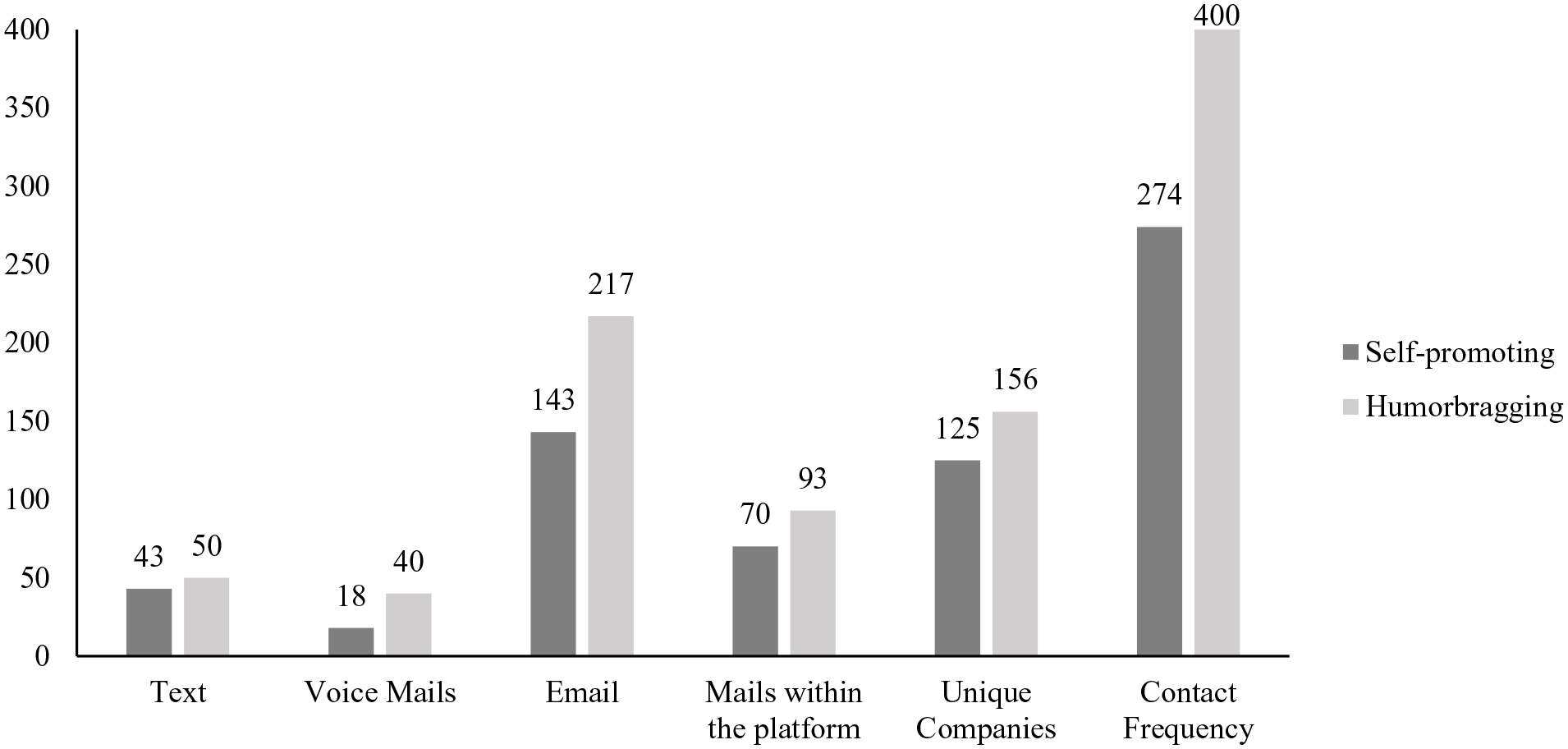
Number of contacts by sources within 14 days of data collection in Study 1.
Discussion
Study 1 serves as the first demonstration of humorbragging’s potential effectiveness as an impression management strategy in a job search context. This study provides causal evidence for the advantage of humorbragging over self-promotion and has high ecological validity as the participants in this audit study were actual recruiters working for companies looking to hire new employees. Further, we captured their interest using various contact methods, thereby emulating the actual job application process. The findings demonstrate that adding humorbragging in the career objectives section of the resume helps the applicant to be sought out more. Study 2 investigated the mechanisms underlying this effect.
Study 2—Humorbragging’s Effects on Warmth and Competence
Study 2 served two goals: to examine the proposed underlying mechanisms as well as to replicate the effect of humorbragging observed in Study 1. Specifically, we investigated whether humorbragging is an effective impression management strategy partly due to its positive impact on warmth and competence—the two fundamental dimensions of social perception (Cuddy et al., 2008). 5 We predicted that the humorbragging condition would increase the likelihood of the candidate being hired compared to the self-promotion condition (Hypothesis 1), replicating Study 1. We further predicted that warmth and competence operate as two mechanisms through which humorbragging promotes a candidate’s instrumental benefits in an evaluative workplace context (Hypotheses 2 and 3).
Method
Participants
We recruited 127 undergraduate students from a public East Coast University (Mage = 20.11, SD = 2.28; 68.5% female) to complete a 15-minute study in exchange for a snack. This sample size has 80% power to detect an effect size of f = .25 with α = .05.
Design and Procedure
Study 2 employed a single-factor, two-condition, between-participant design. Participants in both conditions were asked to imagine that they were a restauranteur looking to open their fourth restaurant. They then learned they were scheduled to interview several candidates for the assistant pastry chef position over the phone. One of their assistants produced a list of questions for them to be used during the phone interview, beginning with “Tell me about your proudest moment as a pastry chef.”
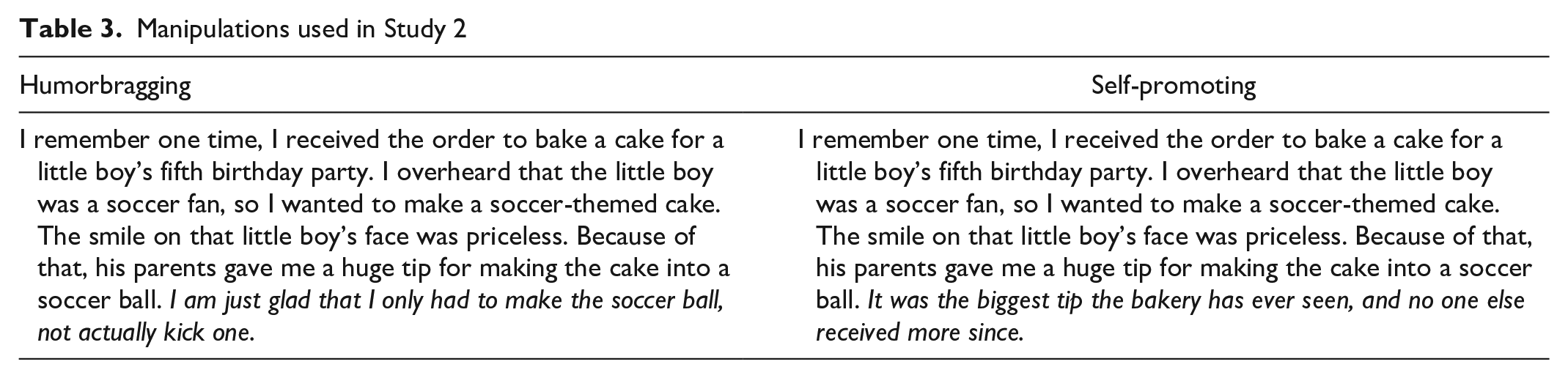
Participants were then randomly assigned to read the transcript of one of the interviews in which the candidate described a time they received an order to bake a cake for a little boy’s fifth birthday party. The candidate noted that they overheard the little boy was a soccer fan, so they wanted to make a soccer-themed cake. Both the boy and his parents were extremely pleased with the cake. Table 3 presents the transcripts with the manipulations italicized. 6
Manipulations used in Study 2
Measures
We assessed perceived warmth (warm, friendly, sociable, and easy-going) and competence (competent, intelligent, capable, and clever) using four items for each scale taken from previous research (Goodwin et al., 2014). Participants indicated how well each adjective described their impression of the candidate using a 5-point scale (1 = not well at all to 5 = very well) immediately after they read the candidate’s response. The order of the eight items was randomized for each participant. We aggregated responses to create the warmth (α = .91) and competence (α = .80) indices.
We also measured hiring intentions to capture the instrumental benefit using three items (How likely are you to hire this person? How positive do you feel about this person’s prospect at your restaurant? How successful do you think this person will be at your restaurant?). All items used 7-point scales (1 = very unlikely/negative/unsuccessful to 7 = very likely/positive/successful). We combined participants’ responses to form the hiring intentions index (α = .90).
Results
Lending support to Hypothesis 1, an analysis of variance (ANOVA) showed that participants were more interested in hiring the humorbragging candidate (M = 4.48, SD = 1.13) as compared with the self-promoting candidate (M = 3.98, SD = 1.20), F(1,125) = 5.72, p = .018, ηp2 = .04. A subsequent multivariate ANOVA (MANOVA) revealed significant differences between conditions in perceptions of warmth, F(2, 124) = 17.56, p < .001, ηp2 = .11, and competence, F(2, 124) = 7.37, p = .008, ηp2 = .05. Post-hoc analyses demonstrated that the humorbragging candidate was perceived to be significantly warmer than the self-promoting candidate (M = 4.21, SD = .70 vs. M = 3.58, SD = .97; t = 4.19, p < .001, 95% confidence interval (CI) [.333, .929], Cohen’s d = .75). The humorbragging candidate was also perceived to be significantly more competent than the self-promoting candidate (M = 3.64, SD = .76 vs. M = 3.28, SD = .70; t = 2.71, p = .008, 95% CI [.095, .610], Cohen’s d = .48). Together, these results support our prediction that humorbragging helps candidates to be seen as warmer and more competent than self-promoting.
We subsequently explored whether perceptions of warmth and competence mediated the positive relationship between humorbragging and hiring intentions by conducting a bootstrapping mediation analysis. We set the self-promoting condition as the reference group and conducted two mediation analyses, one with perceived warmth as the mediator and the other with perceived competence as the mediator through PROCESS model 4 with 5,000 bootstrap samples (Hayes, 2017). The results showed greater perceived warmth of humorbragging (as compared to self-promoting), b = .645, p < .001, 95% CI [.346, .944]. The results also showed greater perceived competence of humorbragging (as compared to self-promoting), b = .378, p = .005, 95% CI [.119, .636]. Both warmth and competence were associated with greater hiring intentions, warmth: b = .543, p < .001, 95% CI = [.359, .728], competence: b = .348, p < .001, 95% CI = [.535, .960]. More importantly, we found a significant indirect effect of humorbragging on hiring intention via warmth: indirect effect = .295, 95% CI = [.150, .460]. This finding supports Hypothesis 2 by showing that perceived warmth mediates the effect of humorbragging on instrumental benefits. We also found a significant indirect effect of humorbragging on hiring intention via competence: indirect effect = .238, 95% CI = [.074, .416]. This finding supports Hypothesis 3 by showing that perceived competence mediates the effect of humorbragging on instrumental benefits.
Discussion
Study 2 provides further support for the humorbragging effect. We replicated the effectiveness of humorbragging observed in Study 1. In addition, Study 2 extends Study 1 by showing that humorbragging boosts both perceived warmth and perceived competence and that perceptions of both warmth and competence mediate the effect of humorbragging on employers’ intentions to hire the candidate. Overall, Study 2 provides compelling evidence for the mechanisms that underlie the causal effect of humorbragging on instrumental benefits.
Taken together, Studies 1 and 2 demonstrated the positive effect of humorbragging in an evaluative setting. Specifically, we find consistent support that combining self-enhancing humor with self-promotion, compared to using self-promotion only, yields positive outcomes for the candidate. Studies 3 and 4 advanced our research by distinguishing humorbraggers from humorous speakers.
Study 3: Humorbragging in Entrepreneurs’ Pitches
Study 3 served two goals. First, we aimed to replicate and extend the generalizability of the humorbragging effect in another consequential and high-stakes real-world setting. Specifically, we predicted that aspiring entrepreneurs who humorbrag during their pitch to investors on primetime television (on the show Shark Tank) would be more likely to receive offers from a panel of venture capitalists than those who do not humorbrag.
Second, we examined humorbragging’s effectiveness not only relative to its absence but also relative to other humorous communications. More specifically, we predicted that the positive effect of humorbragging on instrumental benefits goes beyond the speaker attempting to be humorous. To do so, we investigated the impact of humorbragging as well as other forms of humor on entrepreneurs’ likelihood of receiving offers, including self- and other-diminishing humor. 7
Method
Data Source
Shark Tank is a reality TV show where, through a rigorous audition process, entrepreneurs are invited to present a one-hour pitch of their business venture in front of a panel of potential investors, colloquially referred to as “Sharks.” During the pitch, entrepreneurs present their ideas and respond to grueling questions from the sharks, with the ultimate hope of receiving a funding offer from them. The one-hour pitch is then edited to a 10-minute segment, which serves as the coding material of this study (see Smith & Viceisza, 2018 for more details on recruitment procedures).
There are several advantages to using Shark Tank episodes for examining the effect of humorbragging as a self-presentation strategy in business settings. First, entrepreneurs are highly motivated and expected to present themselves in the best light. Even if the “Sharks” choose not to invest in the company, the primetime exposure to a broad audience (including other potential investors, employees, and consumers) can impact entrepreneurs’ reputation and subsequent success. As such, successful self-presentation strategies during the pitch can be readily generalized to other settings. Second, because it is a reality TV show, the rules, and premise of the pitch process, along with the recurring investors, are all standardized from one entrepreneur to the next—providing a substantially more controlled environment than is typical of most field settings. Third, unlike case competitions, the entrepreneurs do not compete in a zero-sum tournament against each other for the ultimate prize. As such, the sharks are not constrained by the number of entrepreneurs they can fund. Consequently, their funding decisions largely reflect their impressions of the entrepreneur and the business opportunity. Finally, the entrepreneurs are from 13 distinct industries, ranging from education to health care to technology, thereby offering considerable generalizability across different contexts.
Scope of Data
We focused our coding efforts on pitches made by male entrepreneurs in the first four seasons of Shark Tank, which aired between 2009 and 2012. We focused on male entrepreneurs due to prior research demonstrating systemic gender bias against female entrepreneurs in investment settings (Brooks, Huang, Kearney, & Murray 2014). We did not code beyond Season 4 because, at the beginning of Season 5, the producer team changed the contestants’ requirements. 8 Our final sample included 154 pitches. Two research assistants blind to the hypotheses coded each pitch independently and then met to reconcile any differences they had. A third research assistant then spot-checked 25% of the coding to see if there were any disagreements. The final dataset had 100% agreement across the three research assistants. 9
Humorous Communications
We examined the different humorous communications used in the pitch, as defined by the conceptual framework in the introduction for categorizing various forms of humor. We coded for each pitch whether the entrepreneur(s) used humorbragging, defined as instances of self-focused humor meant to promote or elevate oneself in the eyes of others. We also coded for other humorous communications during the pitch, including self-diminishing humor, defined as instances of self-directed humor aimed to belittle the self as opposed to promoting the self, and other-diminishing humor, defined as instances of other-directed humor aimed to belittle others as opposed to promoting others. 10 For pitches with multiple entrepreneurs, we coded the pitch as containing humorbragging if one of the entrepreneurs engaged in that behavior.
Offer Received
Our criterion variable was whether the entrepreneur(s) received an offer from one or more of the sharks (0 = no and 1 = yes).
Control Variables
We also coded for five factors that could affect the entrepreneur’s chances of receiving an offer: season, episode, the number of presenters, the amount the entrepreneur was seeking, and the equity he offered to the investor(s) in the pitch.
Results
To control for the nested structure of the data, we conducted a series of multilevel logistic regression analyses (Table 4). Specifically, we ran a three-level model where each presentation was nested in episodes nested in seasons. For each episode, there were 1 to 4 presentations, with an average of 2.4 presentations per episode. Using a single-level logistic regression with episodes and seasons as categorical control variables resulted in an identical pattern of results to the one reported here. Entrepreneurs who used humorbragging were significantly more likely to receive an offer from one of the sharks than those who did not use humorbragging (odds ratio [OR] = 3.61, z = 1.91, p = .056, Model 2; OR = 5.16, z = 2.25, p = .024, Model 7), above and beyond our control variables, supporting Hypothesis 1. Unlike humorbragging, which utilizes self-enhancing humor, neither the use of self-diminishing nor other-diminishing humor was a significant predictor of receiving offers. This pattern of results lends support to Hypothesis 4.
Results From Multilevel Logistic Regression Models Predicting Funding Offer.
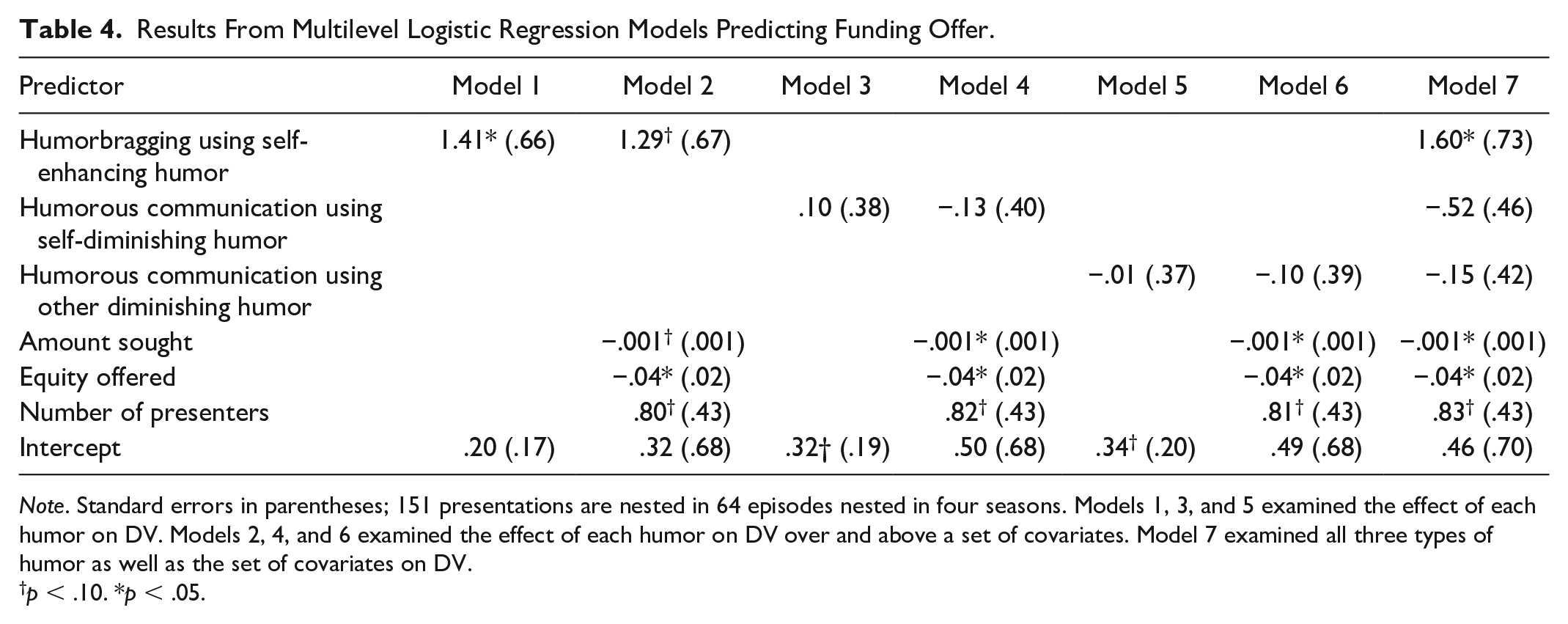
Note. Standard errors in parentheses; 151 presentations are nested in 64 episodes nested in four seasons. Models 1, 3, and 5 examined the effect of each humor on DV. Models 2, 4, and 6 examined the effect of each humor on DV over and above a set of covariates. Model 7 examined all three types of humor as well as the set of covariates on DV.
p < .10. *p < .05.
Discussion
Study 3 demonstrated that humorbragging is uniquely helpful in promoting instrumental benefits in an evaluative and high-stakes context. When self-promotion was coupled with other forms of humorous communicative acts, it did not significantly influence the likelihood of receiving an offer from investors. Only when self-promotion was coupled with self-enhancing humor, it positively predicted success in high-stakes pitches to investors. In addition, the presence of self-enhancing humor benefited the self-promoter over and above the presence of other humorous communication. These findings emerged across different industries, investment amounts, and controlling for various factors that may shape investors’ decisions. These results replicated the positive effects of humorbragging observed in the context of hiring decisions (in Studies 1 and 2) and highlighted the usefulness of this impression management strategy in another consequential evaluation context. More importantly, results from Study 3 refined our understanding of the humorbragging effect by differentiating it from other forms of humorous communicative acts.
Although the context of a primetime TV show provides an intriguing high-stakes context for testing the humorbragging effect, Study 3’s findings are limited for multiple reasons. First, Study 3’s findings are correlational and hence cannot rule out the effects of unobserved variables. Second, some pitches included more than one type of humor (the correlation between humor types ranged from .22 to .34), which dilutes the unique effect of humorbragging. Furthermore, Study 3’s context precluded the possibility of systematically investigating the causal effect of all four types of humor on investors’ decisions. Studies 4a to 4c used experimental designs to identify the unique causal effect of humorbragging on candidates’ instrumental benefits.
Studies 4a to 4c: Differentiating Humorbragging From Being Humorous
Study 4a had two goals. First, we set out to experimentally examine the positive effects of humorbragging while distinguishing this kind of humor from other forms of humorous communication, thereby providing causal evidence in line with the findings of Study 3. Second, Study 4a aimed to provide a more nuanced consideration of other-directed humor and investigated the effectiveness of both other-enhancing (i.e., ingratiating) and other-diminishing (i.e., sarcastic) humor. We expected humorbragging to produce the most favorable outcomes because it conveys a message consistent with self-promotion.
Method
Participants and Procedure
We recruited 400 participants from MTurk (Mage = 41.52, SD = 12.49; 50.5% female). The sample size has 80% power to detect an effect size of f = .17 with α = .05.
Design and Procedure
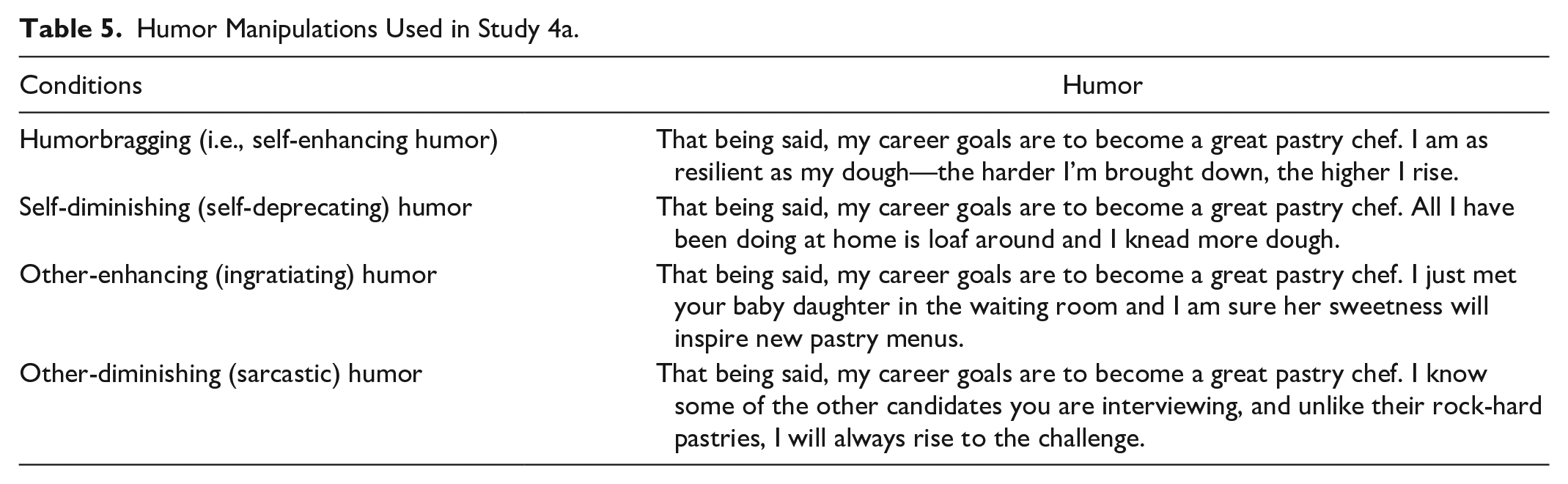
Study 4a employed a single-factor, between-participant design with four conditions. We used the same background story as in Study 2 but varied the type of humor in the candidate’s response. Specifically, the interviewer asked the question, “Tell me about your proudest moment as a pastry chef and what your career aspirations are.” After candidates bragged about their experience of getting the biggest tip (see self-promoting condition text in Table 2), they added humor to their responses about their career aspirations. Table 5 shows the humor used in each condition. 11 Then, we measured hiring intentions using the same three items as in Study 2 (α = .96).
Humor Manipulations Used in Study 4a.
Results
We first examined the effect of humorbragging by creating a dummy variable (1 = humorbragging, 0 = absence of humorbragging) and running an ANOVA of this binary variable on hiring intentions. Replicating the results from Study 3 and lending support to Hypothesis 1, we found a significant effect of humorbragging on hiring intentions, F(1,399) = 6.64, p = .010, ηp2 = .02. A subsequent ANOVA with post-hoc pairwise contrasts further revealed that humorbragging (M = 5.23, SD = 1.24) significantly increased hiring intentions compared to both other-directed humor (ingratiating M = 4.82, SD = 1.37, t = −2.19, p = .032, 95% CI [−.793, −.036], Cohen’s d = .32; sarcasm M = 4.79, SD = 1.45, t = −2.30, p = .020, 95% CI [−.823, −.071], Cohen’s d = .33) and marginally more favorable evaluation compared to self-diminishing humor (M = 4.88, SD = 1.34, t = −1.83, p = .069, 90% CI [−.668, −.034], Cohen’s d = .27). These three types of humor were not statistically different from one another, all p > .65, and overall, the model resulted in a marginally significant effect of experimental condition on hiring intentions, F(3,396) = 2.29, p = .078, ηp2 = .02.
To further establish that humorbragging was the active ingredient shaping Study 4a’s findings, we conducted two conceptual replications. The first replication study set to rule out a sense of resilience as a factor in increasing hiring intentions (Study 4b). The second replication study (Study 4c) had two goals. First, we set out to replicate that the degree of funniness was not a critical factor. Second, we extended the generalizability of the humorbragging effect to a different employment domain. The full material and results are available in the Supplemental Material.
Conceptual Replication Study 4b
To rule out the possibility that the effect observed in Study 4a was driven by highlighting resilience in the humorbragging condition, we conducted an independent study with a between-subject design (humorbrag vs. self-promote) with 198 Prolific participants (Mage = 38.37, SD = 14.20; 46.5% female). In both conditions, the candidate self-proclaimed resilience. 12 We used the same measure as in Study 2 to capture hiring intentions (α = .94). The findings replicated those of Study 4a—despite both conditions emphasizing resilience, humorbragging (M = 5.46, SD = 1.03) significantly increased hiring intentions compared to self-promotion (M = 5.17, SD = 1.23), t(196) = 1.73, p = .042.
Conceptual Replication Study 4c
Study 4c adopted the same between-subject design as Study 4a but was conducted with 431 Prolific participants (Mage = 42.55, SD = 14.43; 42.2% female). Participants are asked to imagine a scenario where they assume the role of a hiring manager at a tech company for a new programmer position. In all four conditions, they read the same self-promoting comment (“I dominated the coding challenge at my previous job and won first place. I knew I was the best, and my confidence paid off. This was an incredible achievement that solidified my passion for software development.”). Participants were then randomly assigned to read one of four humor manipulations, as shown in Table 6. Then, participants rated how funny the candidate’s response was, as well as the hiring intentions using the same three items as in Study 2 (α = .94; 1 = not at all to 7 = = very much).
Humor Manipulations Used in Study 4c.
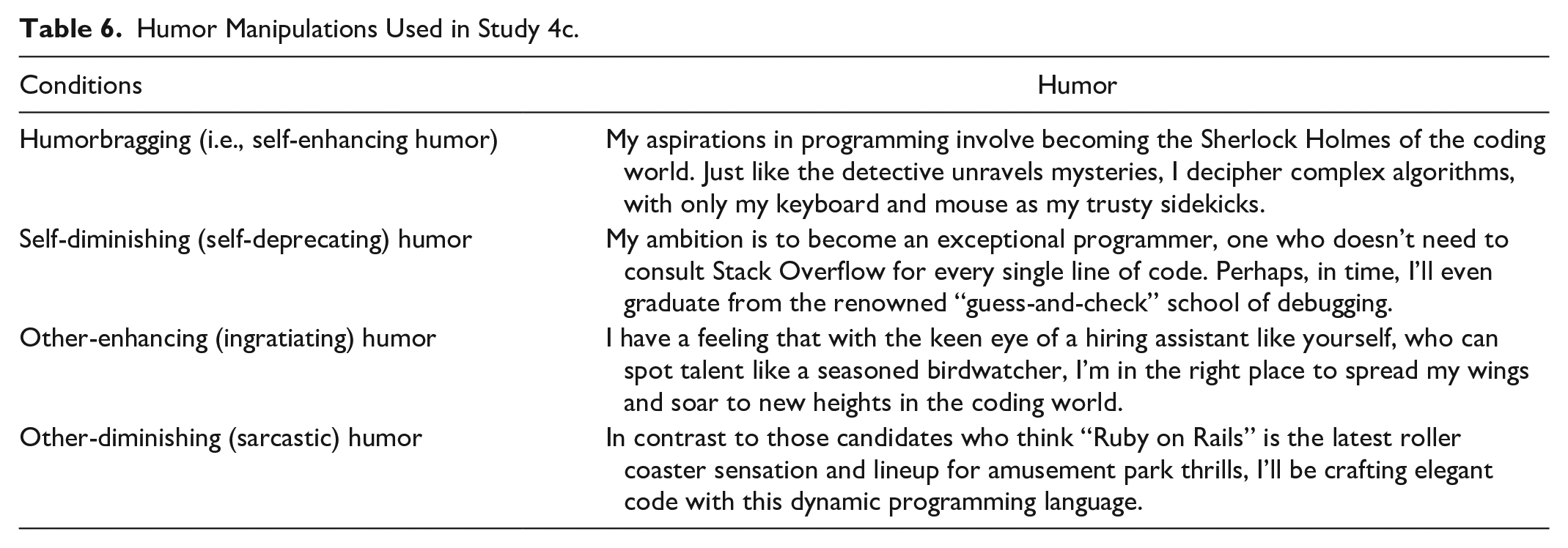
ANOVA revealed that there was not a significant effect of conditions on perceived funniness, F(3,427) = 1.97, p = .118. 13 Replicating results from Study 4a, ANOVA revealed a significant effect of humorbragging on hiring intention, F(3,427) = 4.18, p = .006. Post hoc pairwise contrasts further revealed that humorbragging (M = 5.20, SD = 1.34) significantly increased hiring intentions compared to both other-directed humor (other-enhancing M = 4.63, SD = 1.54, t = −3.04, p = .003, 95% CI [−.947, −.203], Cohen’s d = .39; other-diminishing M = 4.78, SD = 1.34, t = −2.22, p = .027, 95% CI [−.787, −.048], Cohen’s d = .31) and self-diminishing humor (M = 4.62, SD = 1.31, t = −3.08, p = .002, 95% CI [−.951, −.210], Cohen’s d = .44). These three types of humor were not statistically different from one another, all p > .39. The effect of humorbragging on hiring intention remained significant even after controlling for funniness, F(3,426) = 3.54, p = .015.
Discussion
Across Studies 3 and 4a, and conceptual replication studies 4b and 4c, results consistently demonstrated that self-promotion communicated in tandem with self-enhancing humor yields the most favorable instrumental benefit as compared with other forms of humorous communicative acts. Studies 4a through 4c replicated and extended Study 3’s findings by demonstrating the distinct causal effects of humorbragging using an experimental design.
General Discussion
Four studies that used different methodologies, samples, and experimental designs found consistent support for the positive consequences of humorbragging. Across two field studies and two experiments, we consistently find the power of adding self-enhancing humor to self-promotion in evaluative contexts. Importantly, we find that humorbragging boosts candidates’ perceived warmth and competence simultaneously. In addition, the findings point to an important distinction between humorbragging and other forms of humorous communicative acts. When the wrong type of humor is used (e.g., self-diminishing humor), it may backfire and hurt the intent for self-promotion. Together, these findings enhance our understanding of the dynamics of impression management and social perception.
Note that throughout our studies, we have been examining how to effectively promote oneself through the use of certain types of humor. Therefore, the results should be interpreted with caution, as all of our studies use self-promotion as the baseline. We are not suggesting that humorbragging is a universally effective solution. Rather, we argue that it is a better self-promotion strategy than self-promoting without the use of self-enhancing humor or with the use of other kinds of humor. We propose and empirically demonstrate that the positive effects of humorbragging are driven by increased perceptions of warmth and competence. Thus, on a practical level, our findings identify a potential path to navigating a common challenge that many individuals face whenever they need to present themselves in a favorable light, whether it’s in a job interview, a presentation to a client, or a social gathering in which they are being evaluated.
Theoretical and Practical Implications
Everyday communicative strategies involve a tradeoff between signaling competence and signaling warmth (Chaudhry & Loewenstein, 2019). This tradeoff manifests itself most vividly in high-stakes situations where individuals expect evaluations that could grant or deny access to valuable resources such as jobs or funds. To address the self-promotion paradox, we integrated research on humor as a benign violation of norms (Bitterly & Schweitzer, 2019; McGraw & Warren, 2010), impression management (Brooks et al., 2019; Sezer et al., 2018), and social perception (Fiske et al., 2002; Goodwin et al., 2014). In doing so, we discovered an effective combination of communicative acts, humorbragging, that enables communicators to signal warmth and competence simultaneously.
An important theoretical implication of our findings is that successfully navigating the self-promotion paradox may require complex communicative acts, amalgamating distinct components in specific ways. Communicators could do better by identifying compounds that integrate different elements (such as humor and bragging) rather than aiming for a compromise, middle-of-the-road solution that exists on a single dimension (such as trying to find a compromise between humility and arrogance).
Strengths, Limitations, and Future Directions
Extensive research has shown that women often face discrimination in the labor market (e.g., Phelan & Rudman, 2010; Rudman, 1998). Prior research on impression management either disregarded the role of gender (e.g., Kacmar & Carlson, 1999) or focused on strategies that women may use to mitigate gender bias (e.g., Kray et al., 2012). Our studies used gender-neutral names (in Experiments 1, 2, and 4), held gender constant (Study 3), and explicitly manipulated gender (see footnote 2), finding comparable positive effects of humorbragging regardless of candidates’ gender. Nonetheless, it is plausible that the effects of humorbragging depend on the interaction between the gender of the candidate and the masculinity versus femininity of the cultural context (Cheryan & Markus, 2020). For instance, a recent study by Miron-Spektor and colleagues (2022) found that high-status women benefited from using humor in their TED talks. Future research may explore whether and how different contexts moderate the positive effects of humorbragging.
One intriguing direction for future research lies in understanding the potential moderating role of context when it comes to humorbragging. While we define humorbragging as the strategic blending of self-enhancing humor with self-promotion, it remains crucial to pinpoint how this dynamic changes when the humor used is deemed inappropriate for a given context. The fine line between eliciting amusement and crossing the boundaries of appropriateness can significantly impact the perception of the speaker and their self-promotion efforts. For instance, professional and societal status may influence the perceived appropriateness of engaging in humorbragging. Romero and Cruthirds (2006) proposed that individuals with high-status positions may engage more in self-diminishing humor to be seen as more approachable, suggesting that specific impression management techniques may be more or less useful depending on one’s position in the hierarchy. Moreover, actors’ professional and societal status may shape the inferences that observers and evaluators draw from the use of this impression management strategy (i.e., the information value of this impression management strategy) as well as their reactions. To examine this possibility, we conducted an exploratory study to investigate whether the status of the position moderated the effect of humorbragging in the scenario we used 14 (see Supplemental Material). Our results demonstrated that the status of the candidate’s position did not influence the effect of humorbragging on hiring intentions in an interview context. Although this exploratory study did not indicate a significant interaction between the use of humorbragging and the status of the position on hiring intentions, we encourage future research to further explore how these complex dynamics affect the use of and the perception of humorbragging. Perceivers often infer competence from status (Fiske et al., 2002); hence, the use of humorbragging by high-status actors or by actors applying for high-status positions may exert its effects primarily by increasing communicators’ warmth rather than by further elevating perceived competence. Future research may examine this possibility directly.
Another area to explore is how culture shapes the consequences of humorbragging. Prior research showed that culture determines the appropriateness of particular impression management strategies (e.g., Lalwani et al., 2009). For instance, Mast et al. (2011) found that Canadian interviewers preferred hiring self-promoting applicants compared to Swiss interviewers who preferred modest applicants. Cultural differences may shape both the frequency with which individuals use specific impression management strategies and the manner in which these strategies are evaluated (Bye et al., 2011; Sandal et al., 2014). Relatedly, the type of industry in which candidates and evaluators are embedded may influence the effect of humorbragging as well. While the current set of studies used a variety of industries and occupations, ranging from sales representatives (Study 1) and chefs (Studies 2 and 4a) to company founders (Study 3) and programmers (Study 4c), these occupations and industries can be argued to enable individuals certain levels of freedom and creativity. Therefore, it is possible that using humorbragging when interviewing for more traditional and technical jobs, such as in manufacturing, may not be as effective. We encourage future research to further explore how different cultural, organizational, and occupational contexts shape the use and effectiveness of humorbragging.
Conclusion
Challenging the assumption that communicative acts invariably involve a tradeoff between warmth and competence, four studies provide consistent evidence that humorbragging can help job candidates and entrepreneurs navigate the self-promotion paradox successfully. Our findings show that humorbragging can effectively increase individuals’ chances of achieving the instrumental and relational goals they set for themselves. We hope that this research will inspire the exploration of additional “communicative compounds,” similar to humorous bragging, whereby individuals integrate different communicative elements successfully into a socially effective whole.
Supplemental Material
sj-docx-1-psp-10.1177_01461672231214462 – Supplemental material for The Humor Advantage: Humorous Bragging Benefits Job Candidates and Entrepreneurs
Supplemental material, sj-docx-1-psp-10.1177_01461672231214462 for The Humor Advantage: Humorous Bragging Benefits Job Candidates and Entrepreneurs by Jieun Pai, Eileen Y. Chou and Nir Halevy in Personality and Social Psychology Bulletin
Footnotes
Acknowledgements
The authors thank J. Keith Murnighan for his invaluable guidance.
Declaration of Conflicting Interests
The author(s) declared no potential conflicts of interest with respect to the research, authorship, and/or publication of this article.
Funding
The author(s) received no financial support for the research, authorship, and/or publication of this article.

Supplemental Material
Supplemental material is available online with this article.
Notes
References
Supplementary Material
Please find the following supplemental material available below.
For Open Access articles published under a Creative Commons License, all supplemental material carries the same license as the article it is associated with.
For non-Open Access articles published, all supplemental material carries a non-exclusive license, and permission requests for re-use of supplemental material or any part of supplemental material shall be sent directly to the copyright owner as specified in the copyright notice associated with the article.
