




Abstract
We investigate the extent that political identity, political belief content (i.e., attitude stances), and political belief system structure (i.e., relations among attitudes) differences are associated with affective polarization (i.e., viewing ingroup partisans positively and outgroup partisans negatively) in two multinational, cross-sectional studies (Study 1 N = 4,152, Study 2 N = 29,994). First, we found a large, positive association between political identity and group liking—participants liked their ingroup substantially more than their outgroup. Second, political belief system content and structure had opposite associations with group liking: Sharing similar belief system content with an outgroup was associated with more outgroup liking, but similarity with the ingroup was associated with less ingroup liking. The opposite pattern was found for political belief system structure. Thus, affective polarization was greatest when belief system content similarity was low and structure similarity was high.
Affective polarization (i.e., the tendency of people to view opposing partisans negatively and co-partisans positively; Iyengar & Westwood, 2015) has been well-documented in the United States (Iyengar et al., 2019). There is comparatively little affective polarization research in non-U.S. contexts, but research that exists documents similar trends of inter-party animosity in Europe (Gidron et al., 2019; Reiljan, 2020). Although affective polarization can have some positive consequences (e.g., higher voter turnout; Harteveld & Wagner, 2021), it is associated with negative societal consequences more often, including a decline of social trust (Whitt et al., 2021), increase in social segregation and sorting (McConnell et al., 2018), and partisan prejudice and discrimination (Gift & Gift, 2015). Because of this, the correlates and causes of affective polarization is an important topic, especially in under researched, non-U.S. contexts.
A key question about affective polarization is whether it is associated with differences in political identity or political beliefs (e.g., Dias & Lelkes, 2021). Some scholars argue that affective polarization is caused by political identities (e.g., Iyengar et al., 2012): People tend to dislike those who identify with a different partisan group than themselves. Others argue that affective polarization is driven by differences in political beliefs. Prior work that tested this belief–polarization association focused on the content of political beliefs by measuring differences in stances on political attitudes (e.g., are attitudes left-wing or right-wing). This work often finds that the more different peoples’ political attitudes are, the greater affective polarization (e.g., Dias & Lelkes, 2021). However, another way political beliefs might be associated with affective polarization is how attitudes are positioned in a wider political belief system (Converse, 2006; Gerring, 1997) that is the structure of political belief systems. Belief system structure is the way political attitudes are interrelated (e.g., strongly/weakly positively/negatively correlated), which captures the logic of the belief system or how people think about politics. Political belief systems can differ in both their content (e.g., strongly right-wing vs. strongly left-wing) and structure (e.g., consistently right/left-wing attitudes that are strongly related, vs. inconsistently left-wing and right-wing attitudes that are weakly related). We expect that just as having different political identities and political belief contents are associated with affective polarization, so too might having a different belief system structure. We test this possibility.
We investigate the extent that political identity, political belief content, and political belief system structure differences are associated with affective polarization in two multinational, cross-sectional studies; one conducted among European countries (Study 1) and one worldwide (i.e., Comparative Study of Election Systems, CSES; Study 2). Although affective polarization is endemic to many countries in Europe (Gidron et al., 2019; Reiljan, 2020), most psychological research on affective polarization was conducted in the United States. Our analyses give new insight into affective polarization around the world. We also make two further contributions. First, we test the relation between the structure of political beliefs and party (supporter) liking. The structure of political beliefs varies among voters (Baldassarri & Goldberg, 2014; van Noord et al., 2023) and is related to important democratic outcomes (e.g., satisfaction with democracy, Barbet, 2020; voting, van Noord et al., 2023). As such, it may be important to understand the relation between belief system structure and affective polarization. Second, we use a more comprehensive set of attitudes than prior research (e.g., Homola et al., 2022; Orr & Huber, 2020; Webster & Abramowitz, 2017), which typically focuses on a small set of attitudes. Using few attitudes may miss important attitudes for a given person/party, underestimating the importance of differences in attitudes for party liking.
Political Identity, Political Beliefs, and Affective Polarization
An identity-based account of affective polarization suggests that identifying with a group is sufficient to cause negative perceptions of opposing partisans (Iyengar et al., 2012). When people identify with a group, they are motivated to see it positively (Brewer, 1999; Tajfel & Turner, 1979), and see competitive outgroups negatively (Voci, 2006). The importance of political identity in people’s self-concepts (Van Bavel & Pereira, 2018) may explain why affective polarization has increased in the U.S. even though political beliefs of party supporters have not polarized (Iyengar et al., 2012; Mason, 2013). Indeed, affective polarization is more strongly associated with the strength of political identity than with political beliefs (Dias & Lelkes, 2021; Huddy et al., 2015; Mason, 2018). Furthermore, political identity predicts political beliefs longitudinally (Goren et al., 2009), and does so more strongly than vice versa (Goren, 2005).
A political belief-based account of affective polarization suggests that differences in political beliefs drive affective polarization. The idea is that the relation between affective polarization and political identity is confounded by political beliefs. The reason that political party supporters dislike each other more now than in the past is that the political beliefs of parties in polarized contexts are more strongly sorted (e.g., Republicans and Democrats; Baldassarri & Gelman, 2008; Dias & Lelkes, 2021). Political sorting means it is clearer to the public what attitudes parties disagree on, and it is the disagreement on political beliefs that drives affective polarization. Evidence supporting this perspective shows that describing voters or political candidates as ideologically “moderate” or “extreme” predicts more dislike in comparison to “weakly” ideological voters/candidates (Rogowski & Sutherland, 2016; Webster & Abramowitz, 2017) and does so more strongly than political identity (Homola et al., 2022; Lelkes, 2021; Orr & Huber, 2020).
A challenge for comparing the political identity and political beliefs perspectives is that the effects of identity and beliefs are difficult to separate empirically. People’s political beliefs are a defining part of their political identity—people usually choose the party they support based on their beliefs (Turner-Zwinkels et al., 2015), and often adopt political beliefs typically endorsed by their party (Groenendyk et al., 2020). Imperfect measurement of either political identity or political beliefs can conflate their effects. Indeed, most research that tries to separate political identity and political beliefs has not succeeded (see Dias & Lelkes, 2021). There are two additional shortcomings. First, few political beliefs are typically measured. This ignores the many attitudes that may be relevant in a country/party. This means that important beliefs and potential cumulative effects of disagreements on multiple beliefs will be missed. Second, the structure of the belief system (i.e., disagreements in the way people think politically) has not been studied. Together, the associations between affective polarization and political identity/beliefs estimated in the literature may be inaccurate. We use cross-sectional survey data from multiple countries with comprehensive measures of political attitudes, to estimate the association between political identity and political beliefs—both content and structure—and affective polarization.
Political Belief Systems and Affective Polarization
Political beliefs are not isolated but can be interrelated within a political belief system (Boutyline & Vaisey, 2017; Brandt & Sleegers, 2021; Converse, 2006; Gerring, 1997). Belief systems consist of multiple beliefs with some degree of interrelations among them. Acknowledging interrelations among beliefs draws attention to two important belief systems characteristics: their content and their structure. Belief system content refers to the positions that people take on their beliefs. If two belief systems differ in their content, then one may consist of left-wing attitudes (e.g., pro-choice) whereas another may consist of right-wing attitudes (e.g., anti-abortion).
Belief system structure is the pattern of relationships among the attitudes within the belief system. Different belief system structures exist. A tightly structured belief system is constrained and consistent ideologically (Baldassarri & Gelman, 2008; Converse, 2006), so attitudes are strongly related. Strongly left-wing and right-wing belief systems (e.g., Democrats and Republicans; Baldassarri & Goldberg, 2014) have the same ideological logic and tight structure despite having different beliefs. A weakly structured belief system has weakly related attitudes with no clear structuring logic. Belief systems can have alternative structures too (Gidron, 2020; Malka et al., 2019), but still have a strong-moderate correlation. For example, the structure in which the structure in which left-wing economic attitudes are negatively related to right-wing cultural attitudes, is more typical of right-wing populist supporters or people with lower levels of education (van Noord et al., 2023).
Belief System Content and Affective Polarization
Research in the belief-based account of affective polarization argues that affective polarization is driven by differences in political belief content and that these differences have important implications for intergroup relations (Homola et al., 2022; Lelkes, 2021; Orr & Huber, 2020; Rogowski & Sutherland, 2016; Webster & Abramowitz, 2017). Similarly, the ideological conflict hypothesis suggests that people are motivated to dislike groups with different belief system content than their own (Brandt & Crawford, 2020; Brandt et al., 2014), consistent with the similarity attraction effect (Byrne, 1971). Sharing attitudes and other similarities with a target is associated with more attraction (including liking; Montoya & Horton, 2013) and dissimilarity is associated with repulsion (Chen & Kenrick, 2002). Dissimilarity-Repulsion may be stronger for the ingroup, as we expect to be similar to them (Chen & Kenrick, 2002). Nevertheless, the observation across these studies is the same: People like others with similar political beliefs and/or dislike others with dissimilar beliefs.
However, some contradictory research suggests that similarity can be associated with dislike. First, people value dissimilarity or distinctiveness from outgroups. Social identity theory (Tajfel & Turner, 1979) argues that people need to perceive their ingroup as clearly delineated and distinct from their outgroups to have a positive identity (Brewer, 1991). Failure to satisfy this distinctiveness leads to threat (Jetten et al., 1997), and derogation of the outgroup (Branscombe et al., 1999). Consistent with this, the black sheep effect (e.g., Marques & Paez, 1994) shows that ingroup members who deviate from the ingroup identity toward the outgroup (i.e., blur ingroup and outgroup distinctiveness) are strongly derogated. Similarly, horizontal hostility research (White & Langer, 1999) shows that minority groups who are more similar to a majority outgroup are perceived more negatively than an outgroup who is equally similar to the ingroup, but more distinct from the outgroup. Together this research suggests that similarity in belief content between an individual and their political outgroup will be associated with more outgroup dislike and affective polarization.
Second, for ingroups, optimal distinctiveness theory (Brewer, 1991) argues that people are motivated by a need for (a balance between) similarity and distinctiveness. Membership in a group that is too large or inclusive can trigger a need for differentiation of the self from the ingroup (e.g., forming subgroups). This distinctiveness need could mean that belief similarity among the ingroup is associated with more disliking (also consistent with Tesser, 1988 self-evaluation theory). Nevertheless, given that people usually seek homogeneity and similarity among ingroup members (Simon & Pettigrew, 1990), we expect that similarity–dislike relation should only emerge when evaluating outgroup members, not ingroup members.
Belief System Structure and Affective Polarization
People’s belief system structure may be related to affective polarization. First, affective polarization and belief system structures are related at the country level. Gonthier and Guerra (2022) found that, in more polarized countries, political attitudes are more tightly correlated, suggesting a tightly structured belief system. Second, belief system structures differ within countries (e.g., the United States; Baldassarri & Goldberg, 2014; e.g., Europe; van Noord et al., 2022), and are associated with political outcomes (e.g., people with consistent ideological political beliefs usually have higher political knowledge and interest; Brandt, 2022; Fishman & Davis, 2022; Jennings, 1996; Lupton et al., 2015) that are also related to affective polarization (Suk et al., 2022). As such, we expect that both an individual’s belief system content and structure will be related to the extent they like or dislike partisans. Moreover, belief system content and structure could each have a different relation with affective polarization. For example, Brandt (2022) showed that political knowledge and engagement are related to belief system structure differently than the direction of ideological or partisan identification. Although belief system content and structure are related, they can each have a unique relation with political outcomes. We test if this is the case for affective polarization.
How should belief system structure and affective polarization be related? Direct evidence for the relation between individual’s belief system structure and affective polarization is lacking, but there is some indirect evidence. Prior research shows that generalized similarity is a strong driver of group liking (Byrne, 1969). As such, two people with similar belief system structures (e.g., two left-wing/right-wing ideologues or two populists with alternative belief system structures) may like each other, because they share the logic they use to understand politics. For example, mainstream left-wing and right-wing ideologues have the same belief system structure (Baldassarri & Golberg, 2014; van Noord et al., 2023) but can show heightened dislike of groups with a dissimilar belief system structure (e.g., populist right-wing; Harteveld et al., 2022; Harteveld, 2021). However, the opposite expectation is also plausible. People may dislike similarity in belief system structure with outgroups. Left-wing and right-wing ideologues with the same belief system structure sometimes dislike one another most strongly (Rogowski & Sutherland, 2016). Democrats and Republicans in the United States are an example of this. Nevertheless, the only anecdotal evidence supporting this structure similarity-dislike claim is from a two-party U.S. context, where alternative ideologies (e.g., populist parties) do not present a viable threat to mainstream parties. Thus, we will test both alternatives that similarity in belief system structure among individuals is liked and disliked.
Overview
We examine the relation between political belief systems (content and structure), political identity, and affective polarization both within Europe (Study 1) and worldwide (Study 2). We test how strongly differences between ingroup/outgroup belief system content and structure are associated with in/outgroup affect. In doing so, we aim to give fresh insight into affective polarization processes in non-U.S. contexts.
First, we test how similarity in belief system content and structure is associated with an individual’s ingroup liking. We expect that people value homogeneity in ingroup beliefs (Simon & Pettigrew, 1990), so similarity in belief system content (H1a) and structure (H1b) among ingroup members will be associated with greater ingroup liking. 1 Next, we test competing hypotheses about the relation between outgroup belief system similarity and outgroup liking: We test the expectation that similarity in belief system content (H2a) and structure (H2b) between the individual and outgroup will be associated with greater outgroup liking. We test H2 against the alternative hypothesis that content (H3a) and structure (H3b) similarity between the individual and outgroup will be associated with greater outgroup disliking.
We focus on affective polarization measured via a feeling thermometer directed toward “party supporters” in Study 1 and the party in Study 2. The feeling thermometer is the most widely applied measurement of affective polarization, capturing affect toward political groups (Druckman & Levendusky, 2019; Harteveld, 2021; Iyengar et al., 2012; Kekkonen et al., 2022). It is also a common measure of group attitudes in the social psychology literature more generally (Bergh & Brandt, 2022; Correll et al., 2010). The measure is strongly related to other affective polarization measures (e.g., trait-based items; Druckman & Levendusky, 2019; Lelkes & Westwood 2017) and has good construct validity (Gidron et al., 2022). Although our pre-registration also included predictions about the relation between belief system similarity and ingroup party identification we focus our investigation on affective polarization. Models involving party identification are reported in Supplemental Materials. We report all manipulations, measures, and exclusions in our studies.
Study 1
We first test our hypotheses in an eight-country cross-sectional survey. 2 This allows us to test our hypotheses across different political systems, including numerous multi-party systems.
Method
The sample consists of 9,688 respondents living in Belgium (n = 1,215), Denmark (n = 1,215), France (n = 1,201), Greece (n = 1,213), Hungary (n = 1,215), Netherlands (n = 1,202), Spain (n = 1,215), and the United Kingdom (n = 1,212). 3 This sample excludes respondents who failed more than one of the three attention checks. In line with the pre-registration, we selected participants with no more than two items missing from the 10 belief system items (n = 0), and who supported one of the four parties measured (per country) in affective polarization items (minimum supporters per party = 21, maximum supporters per party = 294, M = 122.12, SD = 75.87). Targeted parties consisted of one mainstream left-wing party, one mainstream right-wing party, one left-wing populist party, one right-wing populist party (names of the parties are available in the codebook). The motivation for party selection was to have both ideological variation (i.e., left-wing/right-wing) and belief system structure variation (mainstream parties vs. populist parties; Baldassarri & Goldberg, 2014; van Noord et al., 2023). In line with our pre-registration, we excluded the supporters of parties with fewer than n = 20 supporters. This condition was not met in the United Kingdom (UKIP supporters excluded, n = 14). Our final sample was 4152 participants (n = 2925 did not support any political party; n = 2603 supported a party that was not one of the four measured; n = 8 missing), aged 16–93 years (M = 50.60, SD = 15.88), ethnicity was mainly the majority ethnic group in each country (3,819 = majority ethnic group, 326 = minority ethnic group).
Measures
All measures, operationalizations, and sample information are pre-registered (see: https://osf.io/7ts86/?view_only=c4eb5443571f4e8aa21c27d21d0aa820). For complete information about items included in the survey see survey codebook (https://osf.io/u45r3/?view_only=4954265bd9ce4e60a208bdaadf46e0f0).
We measured affective polarization using the group liking feeling thermometer. Participants were asked “On a scale from 0 (coldest, least favorable) to 100 (warmest, most favorable), please indicate how you feel about each group. You would rate the group at the 50 mark if you don’t feel particularly warm or cold toward the group.” In each country, group liking was measured toward the supporters of four political parties (see Kekkonen et al., 2022; Knudsen, 2020; Renström et al., 2021 for similar operationalizations): A mainstream left-wing party, mainstream right-wing party, populist left-wing party, and populist right-wing party. There was one exception, among the French speaking-Belgium sample, there was no viable right-wing populist party.
The participants’ ingroup political identity was identified with the item “Which political party do you feel closest to?”
Political belief system items consisted of 10 political attitude items, each measured with a single item. We included three cultural attitudes (i.e., homosexuality, gender, and immigration) and three economic attitudes (i.e., income inequality, business, and social welfare). These items were selected as cultural and economic attitudes have been shown to capture important differences in belief systems (Achterberg & Houtman, 2009; Malka et al., 2019). In addition, we included three attitudes that represented newer points of conflict (i.e., political correctness, EU, and environment), and one ideology item. Ideology was measured with the item “In politics people sometimes talk of “left” and “right.” Where would you place yourself on a scale, where 0 means the left and 10 means the right?.” All belief system items were rescaled from 0 (i.e., left-wing) to 1 (i.e., right-wing).
Demographics of age, gender (man, woman; remaining options of non-binary, prefer not to say, other, were coded as missing), income (“To what extent do you feel that you are able to live a comfortable life with your current household income?” Anchored at 1 = very easy, 5 = very difficult), highest level of education completed (anchored at 1 = no formal education, 9 = Doctoral degree; for full answer option see codebook.) and ethnicity (“Do you belong to a minority ethnic group in [country]”; yes, no) were measured and used as controls in our analysis.
Variable Construction
Political belief system content similarity was constructed as an individual’s mean absolute difference between their 10 political belief system items with each individual group member’s political belief system items. This measurement captures the extent that two participants give the same or different level of response to the political belief system items (i.e., do participants agree or not). We calculate the absolute difference between all pairs of participants. For example, Participant A (with maximally right-wing responses to belief system items) and Participant B (with maximally left-wing responses to belief system items) would have a score of 1 showing that the content of their beliefs is maximally different. The mean of these values across the members of all ingroup or outgroup parties make the ingroup belief system content similarity and outgroup belief system content similarity (toward up to three different groups of political party supporters), respectively. These variables were recoded so that 0 equals maximal difference in attitude content and 1 equals perfectly identical attitude content.
Political belief system structure similarity was constructed using the mean absolute correlation between participants’ 10 political belief system items averaged across all different political parties. The idea is that it captures the extent to which two participants’ responses to political belief system items follow the same pattern (i.e., do participant responses follow a similar logic; Goldberg & Stein, 2018). First, this method takes the absolute correlation between all pairs of participants’ 10 political belief system items in the dataset. For example, if the dataset would contain 11 participants, each participant can be compared with 10 other participants (i.e., pp1:pp2, pp1:pp3 . . . pp1:pp11). We then calculate the absolute correlation between the 10 attitudes of each pair (e.g., if pp1 was maximally right-wing on all 10 attitudes, and pp2 was maximally left-wing on all 10 attitudes their absolute correlation would be r = 1.00; i.e., both participants respond using a perfectly constrained left-right ideological logic). The result is 10 absolute correlations per individual (i.e., 110 correlations across the whole dataset of 11 pps). For each participant, we average their absolute correlations with the supporters of each party measured (e.g., if 5 participants paired with pp1 were Labor supporters and 5 were Conservative, we would take the mean across the 5 Labor supporters, and separately across the 5 Conservative supporters). The result is one belief system structure similarity per political party for each individual: (a) belief system structure similarity scores with ingroup party supporters, (b) belief system structure similarity scores with up to three outgroup party supporters. Each value can range from 0 (i.e., maximally different structure) to 1 (i.e., identical structure).
Results
Exploratory Analyses
We tested if belief system content and structure similarity are different among ingroups and outgroups. Random intercept multilevel models (nesting observations within individuals) predicting (a) content and (b) structure similarity from the outgroup dummy (nested within individuals, with fixed effects for country and party dummies) show that there is significantly less similarity (content: B = −0.04, SE = <.001, β = −0.65, 95% CI = [−0.67, −0.62]; structure: B = −0.04, SE = .001, β = −0.34, 95% CI = [−0.36, −0.32]) among outgroups than ingroups. Ingroup partisans are much more similar in both content and structure of belief systems than outgroup partisans.
Next, we investigated the Pearson correlations between belief system similarity and group liking (see Figure 1). When individuals are rating their ingroup, this correlation is negative and small for content, r = −.13, 95% CI = [−.16, −.10]; t (4,143) = 8.37, p <.001, and smaller for structure, r = −.03, 95% CI = [−.06, −.00]; t (4,143) = 2.03, p =.04. When people rate their outgroups, average correlations across outgroups were positive and moderate for content, M r’s = .34, 95% CI = [.28, .39]; t’s (4,143) = 18.84–25.53, p <.001, and small for structure, M r’s = .12, 95% CI = [.01, .25]; t’s (4,143) = 2.62–14.94, p <.009. Given the moderate/strong correlation between belief system content and structure (r = 0.51, p < .001), we present models with structure and content separately alongside full models.
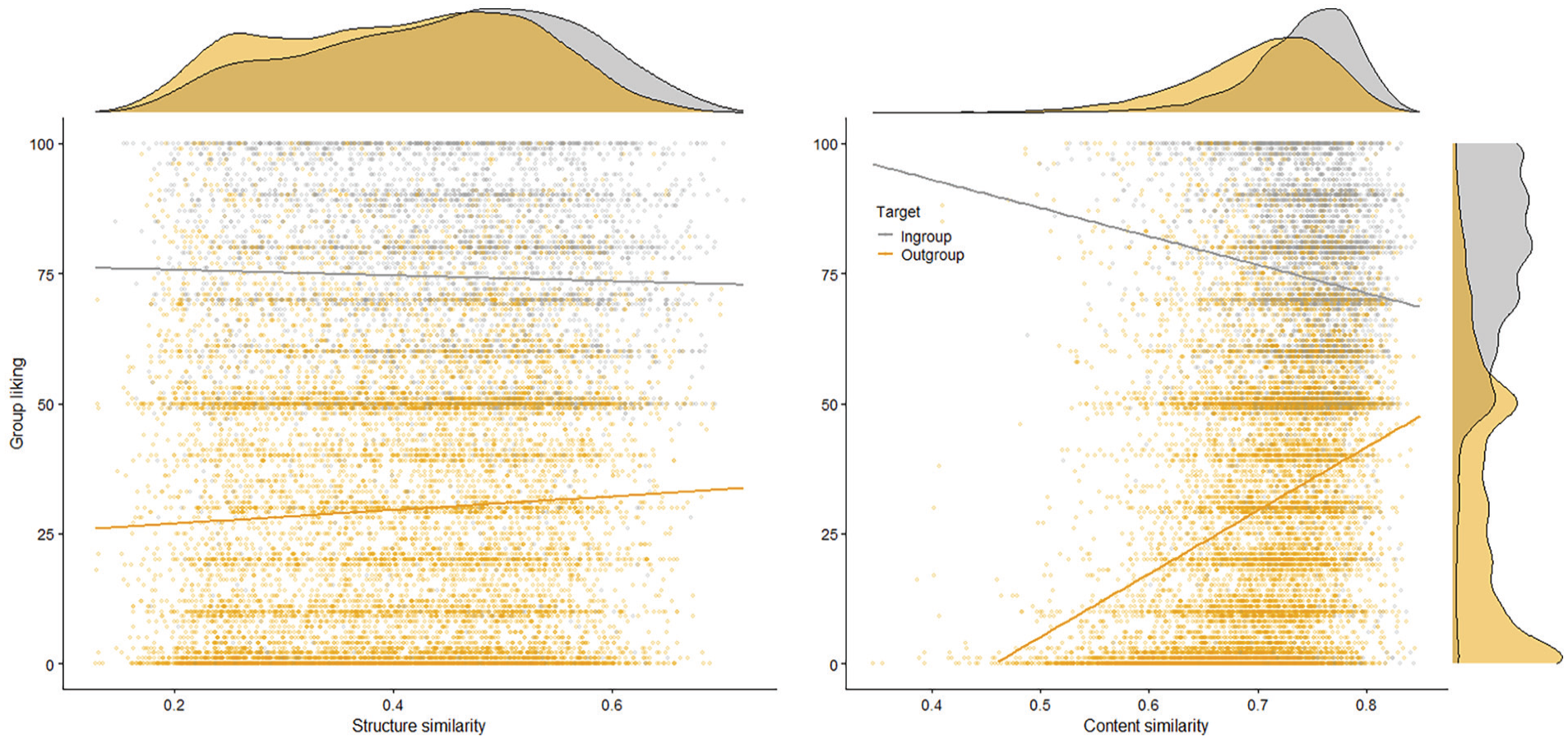
Scatterplot of the Relation Between Group Liking and Belief System Structure Similarity (Left Panel)/Content Similarity (Right Panel), and Density Plots of Each Variable, Study 1.
Pre-Registered Analyses
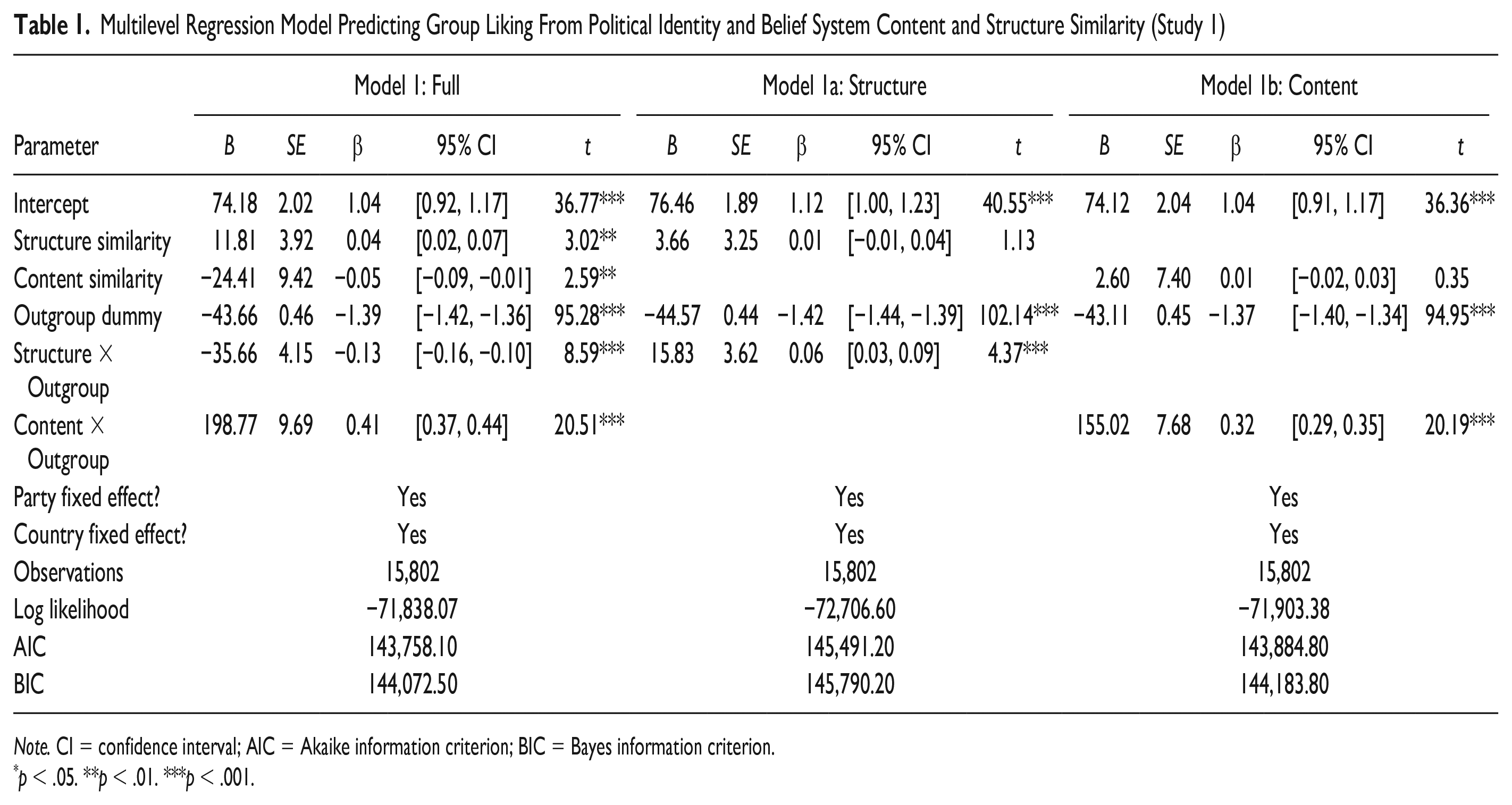
We estimated a random intercept multilevel model, nesting observations within individuals (see Table 1). To account for party and country differences, we included fixed effects dummies for every country and party. The outcome variable was group liking (i.e., measured toward four sets of party supporters, so data are stacked within individuals). Predictors were belief system content similarity and structure similarity (mean-centered), an outgroup dummy (coded 0 = ingroup, 1 = outgroup), and the interaction between the belief system similarity and outgroup dummy. We test (a) the extent that political beliefs are related to affective polarization via simple effects of content similarity and structure similarity for both the ingroup and outgroup; and (b) the extent that political identity is related to affective polarization via the outgroup dummy.
Multilevel Regression Model Predicting Group Liking From Political Identity and Belief System Content and Structure Similarity (Study 1)
Note. CI = confidence interval; AIC = Akaike information criterion; BIC = Bayes information criterion.
p < .05. **p < .01. ***p < .001.
Models including controls of gender (−1 = women, 1 = men), ethnicity (−1 = majority, 1 = minority), age (mean-centered), income (mean-centered), education (median-centered) are in Supplemental Materials. The controls did not notably change key model estimates. Because there is, theoretically, a quadratic relation between belief system content and structure similarity we also added a quadratic term to the model (not pre-registered), but this did not notably affect estimates so this model is in Supplemental Materials. A sensitivity analysis (not pre-registered; conducted in the package simr) using the logic or content variable with the smallest effect size detected in the relevant study revealed that assuming 80% power, it was possible to detect a minimum effect β > .04 in Study 1 and β > 0.015 in Study 2. This suggests that both studies are highly powered and capable of detecting the relevant effects. For the results of sensitivity analysis based on Monte Carlo simulations, see the online Supplemental Material.
First, we estimate the relation between political identity and affective polarization. We find identity-based affective polarization (i.e., the negative difference between ingroup liking and outgroup liking). The outgroup dummy has a strong negative association: on average Europeans like political outgroups approximately 44° less than their political ingroup. 4 This supports the political identity explanation of affective polarization.
Next, we investigated associations between political belief systems and affective polarization. Both content similarity and structure similarity are associated with the extent people like their ingroups and outgroups. Looking at the simple (main) effects of belief system similarity on its association with ingroup liking, we see evidence inconsistent with H1a, but consistent with H1b. There is a negative association between content similarity and ingroup liking (inconsistent with H1a), but a positive association between structure similarity and ingroup liking (supporting H1b). The more similar people are to the ingroup in terms of belief system content (i.e., whether they support or oppose similar policies), the less they like their ingroup. However, the more similar an individual is to their ingroup in terms of their belief system structure, the more they like the supporters of their ingroup. For liking the outgroup, this pattern is reversed. The interaction shows that the association between content similarity and group liking is significantly more positive for the outgroup than the ingroup, whereas the association between structure similarity and group liking is significantly more negative outgroup than the ingroup. Moreover, simple slopes in Figure 2 show that in line with H3a, the slope of content similarity on group liking for the outgroup is positive (B = 174.40, SE = 4.02, 95% CI = [166.50, 182.23], p <.001). In line with H3b the slope of structure similarity for the outgroup is negative (B = −23.8, SE = 2.43, 95% CI = [−28.61, −19.10], p <.001).
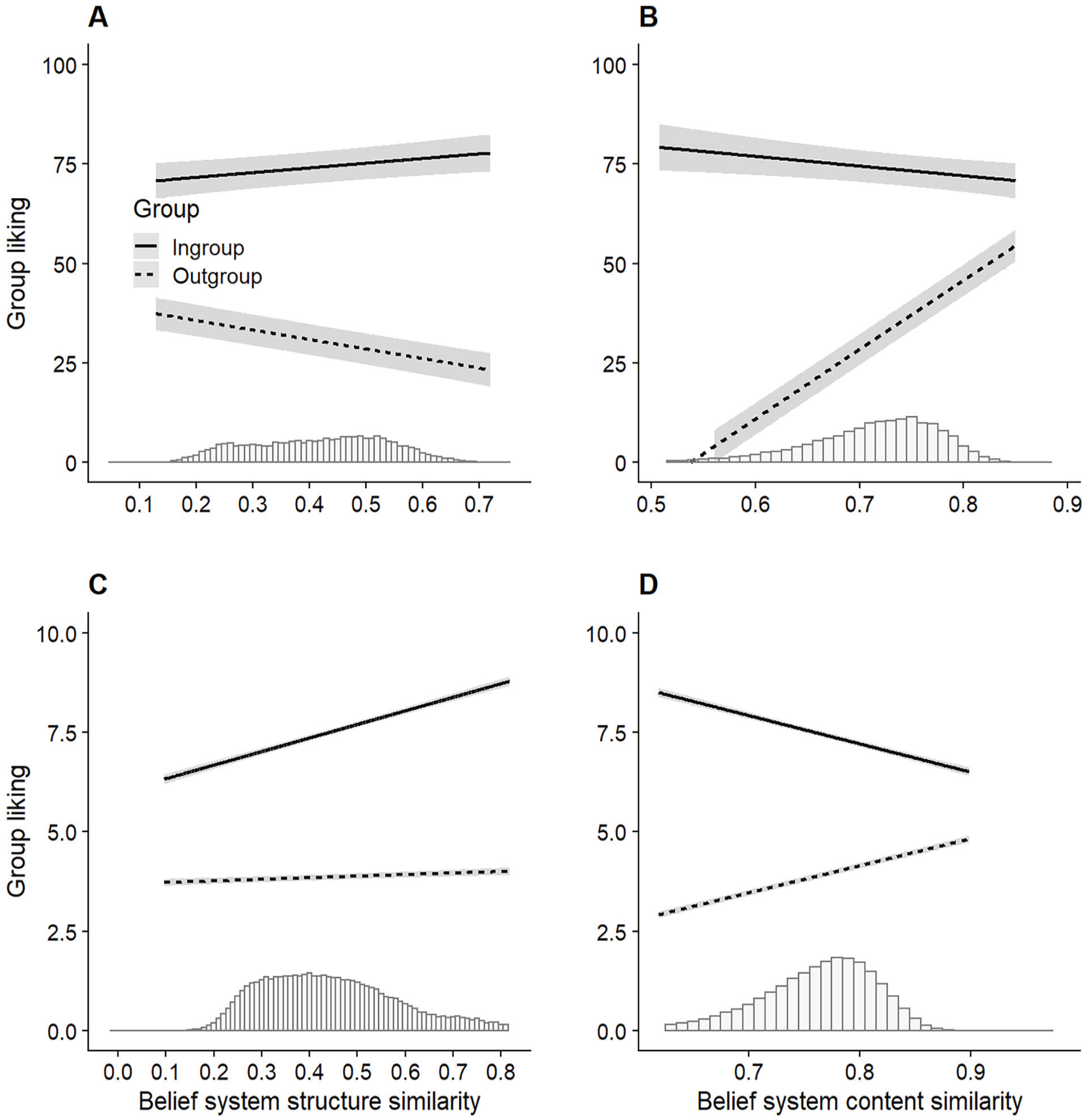
Average Marginal Effects Plot Showing the Average Change in Ingroup and Outgroup Liking Associated With Belief System Structure Similarity (A and C) and Belief System Content Similarity (B and D), Including 95% Confidence Intervals of Estimate.
Additional Analyses
A non-preregistered analysis showed that the standardized beta for content similarity was significantly larger than structure similarity for both the ingroup, χ2 (1) = 8.77, p <.001, and outgroup, χ2 (1) = 344.22, p <.001. Belief system content similarity is more strongly related to liking party supporters than is belief systems structure similarity. The standardized betas for the association between outgroup belief system similarity and outgroup liking are larger than between ingroup belief system similarity and ingroup liking, χ2 content (1) = 142.70, p <.001; χ2 structure (1) = 38.03, p <.001. Merely having the same ingroup categorization as another party supporter may be a more substantial predictor of the extent we like them, but, when it comes to outgroup liking, it may be particularly important how similar their belief systems are to ours.
We decomposed the (same) interaction effects focusing on the difference between ingroup slopes and outgroup slopes. This gives insight into when affective polarization (i.e., the difference between ingroup and outgroup liking) is higher or lower. Figure 3 shows the difference between ingroup and outgroup liking is lower at upper quartiles of content similarity (approximately −35°) than lower quartiles of content similarity (approximately −50°). In contrast, the difference between ingroup and outgroup liking is lower at lower quartiles of structure similarity (approximately −40°) than upper quartiles of structure similarity (approximately −47°). In other words, affective polarization is higher when content similarity is low and when structure similarity is high.
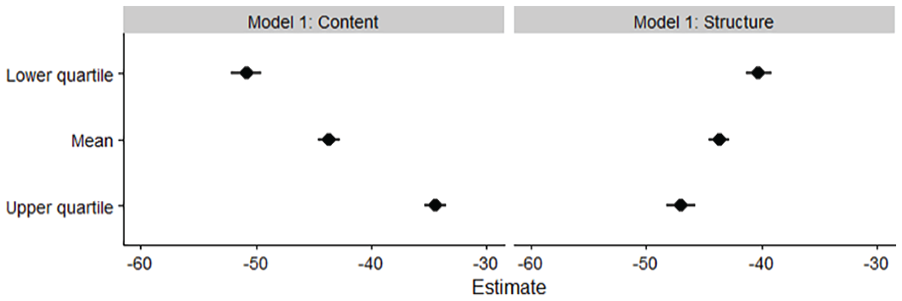
Simple Slopes of the Interaction Effect, Modeling Outgroup-Ingroup Differences in Group Liking and Their 95% Confidence Interval, at Lower Quartile Similarity (i.e., Low Similarity), Mean Similarity, and Upper Quartile Similarity (i.e., High Similarity) for Belief System Content Similarity (Left Panel) and Structure Similarity (Right Panel), Study 1.
Discussion
We tested how identity and belief system content and structure similarity was related to affective polarization in Europe. Most prior research focuses on U.S. parties, rather than partisans in Europe (see also Kekkonen et al., 2022; Knudsen, 2020). We found that affective polarization is prevalent across Europe, where individuals typically like their outgroup 44o (/100o) less than the ingroup. These levels are similar to those found in the United States. We also found that belief system content/structure similarity is associated with group liking for both the ingroup and outgroup, although belief system content similarity is a stronger correlate of affective polarization than is structure similarity. First, counter to H1a, the more similar we are to our ingroup in terms of content, the less we like them. Supporting H1b, people like the ingroup most when they are similar to their ingroup’s belief system structure. Second, belief system content similarity is positively related to outgroup liking (supporting H2a), whereas belief system structure similarity is negatively related to outgroup liking (supporting H3b). In short, both political identity and political beliefs (content and structure) are relevant for informing levels of affective polarization between political groups.
Study 2
Next, we sought to replicate Study 1 (a) with a different dataset including European countries, and (b) worldwide. For this, we used the Comparative Study of Election Systems (CSES). The CSES has political attitude and affective polarization (measured toward parties) data on 36 countries.
Method
Data and Sample
We used CSES data Module 4 (2011–2016) because it included both measures of political attitudes and affective polarization toward political parties. Following Study 1, and in line with Study 2 preregistration, we included all data with <2 missingness on belief system items, and >20 supporters of political parties that were included as targets in the measure of group liking. Our final sample was 29,994 participants from 36 countries worldwide (n = 90-3,177 per country), this included: Australia, Austria, Brazil, Bulgaria, Canada, Czech Republic, Finland, France, Germany, Great Britain, Greece, Hong Kong, Iceland, Israel, Japan, Latvia, Mexico, Montenegro, New Zealand, Norway, Peru, Philippines, Poland, Portugal, Korea, Romania, Serbia, Slovakia, Slovenia, South Africa, Sweden, Switzerland, Taiwan, Thailand, Turkey, and United States.
Measures
All measures, operationalizations, and sample information are preregistered (see: https://osf.io/j732x/?view_only=c5f3a8a3a8b8499ba7a2ed8d506cdbe0). We measured affective polarization using a group liking feeling thermometer:
I’d like to know what you think about each of our political parties. After I read the name of a political party, please rate it on a scale from 0 to 10, where 0 means you strongly dislike that party and 10 means that you strongly like that party.
Participants rated a maximum of nine parties. Answer options “haven’t heard of party,” “refused,” “don’t know,” or “missing” were coded as missing.
Political belief system items consisted of nine political attitudes, each measured with a single item. Ideology was measured as in Study 1. Eight further stances on political attitudes were measured—toward health, education, unemployment benefits, defense, pensions, business, policing, and welfare—using the following item: “Thinking about public expenditure on [issue], should there be much more than now, somewhat more than now, the same as now, somewhat less than now, or much less than now?” (1 = much more than now, 5 = much less than now; answers were coded as missing from the following responses, “refused,” “don’t know,” or “missing”). All belief system items were recoded/rescaled from 0 (i.e., left-wing) to 1 (i.e., right-wing). These nine attitudes were used to calculate political belief system content and structure similarity using the same method as Study 1.
Political identity (i.e., the ingroup) was identified using the item “which party do you feel closest to?.”
Controls were age, gender (coded −1 men, 1 women), education (median-centered), and household income.
Results
Exploratory Analyses
We tested if belief system content and structure similarity vary among ingroups and outgroups using two random intercept multilevel models (nested within individuals) predicting content and structure similarity from the outgroup dummy, with fixed effects for country and party. There was significantly less content (B = −0.02, SE = <.001, β = −0.10, 95% CI = [−0.11, −0.10], p < .001) and structure (B = −0.03, SE = <.001, β = −0.09, 95% CI = [−0.09, −0.08], p < .001) similarity among outgroups than ingroup. Ingroups were more similar in content and structure of belief systems than outgroups.
Next, we tested Pearson correlations between belief system similarity and group liking (see Figure 4). There was a small, negative correlation between ingroup liking and political content similarity, r = −.09, 95% CI = [−.07, −.10]; t (27,825) = 14.61, p <.001, but a small positive correlation with belief system structure similarity, r = .08, 95% CI = [.06, .09]; t (27,825) = 12.76, p <.001. The average correlation of outgroup liking across the outgroups with belief system content similarity was small and positive, M r’s = .17, 95% CI = [.03, .29]; t’s (894–17,827) = 3.97–32.82, p’s < .001, whereas the correlations between outgroup liking and structure similarity were null on average, M r’s = .05; 95% CI = [−.09, .34]; t’s (894–21,957) = −8.07, 20.98, p’s ≤ .001–.50. There was a small/moderate correlation between belief system content/structure similarity (r = .23, p < .001).
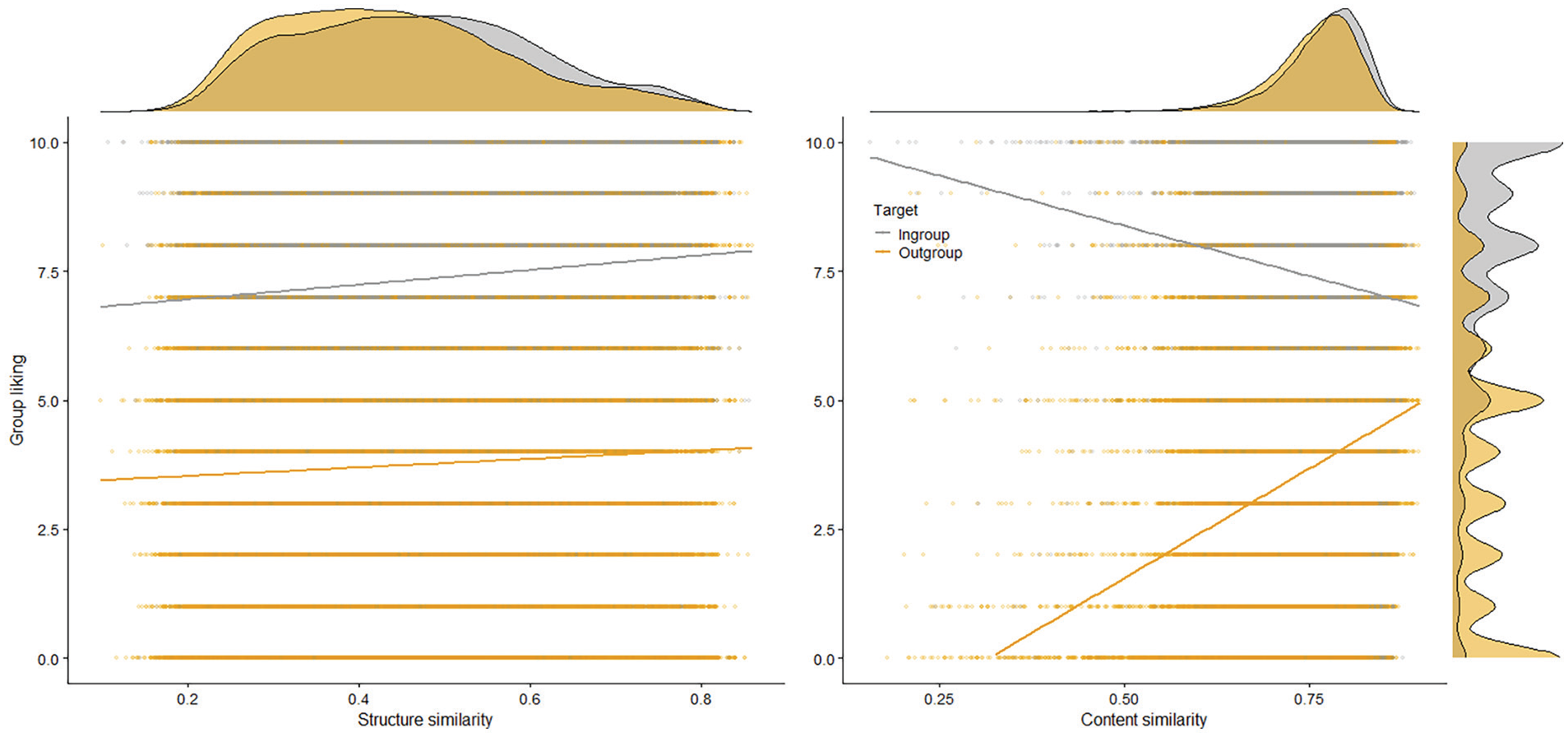
Scatterplot of the Relation Between Group Liking and Belief System Structure Similarity (Left Panel)/Content Similarity (Right Panel), and Density Plots of Each Variable, Study 2.
Pre-Registered Analysis
We estimated pre-registered models to test if affective polarization is associated with political belief system content and/or structure similarity. We use a multilevel random intercept model, nested within individuals, with fixed effects for party and country. The outcome variable is group liking, and the main predictors are belief system content and structure similarity, the outgroup dummy, and their interactions. Results for all countries are reported here. We also report analyses using only European countries, controls, and quadratic effects in the Supplemental Materials. Results were consistent.
Results presented in Table 2 show a strong tendency for affective polarization worldwide. First, looking at the relation between political identity and affective polarization via the outgroup dummy, we see that on average people like their political parties (7.5/10) and dislike their outgroup (3.9/10). On average people like outgroup parties 4 points less than the ingroup (similar in scale to Study 1). This shows a large relation between (not) sharing a political identity and the extent people like a political party.
Multilevel Regression Model Predicting Group Liking From Political Identity and Belief System Content and Structure Similarity (Study 2)
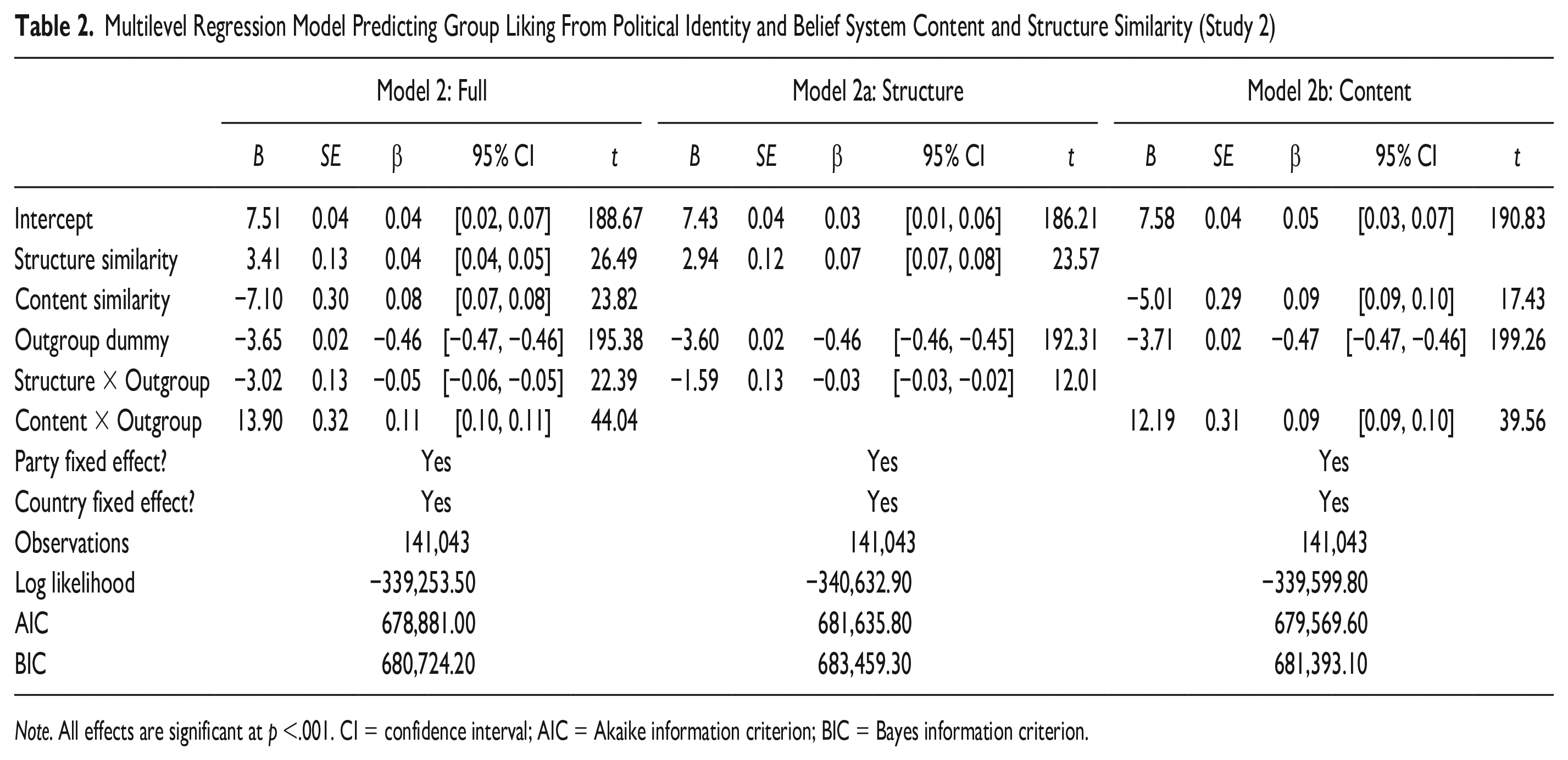
Note. All effects are significant at p <.001. CI = confidence interval; AIC = Akaike information criterion; BIC = Bayes information criterion.
Next, we look at the associations between political belief systems and affective polarization. Counter to H1a, people like their ingroup party less the more similar they are in content (p < .001). In support of H1b, people like their ingroup party more the more similar they are in structure (p < .001). We also find a positive interaction between group and content similarity, indicating that the slope of content similarity on group liking for the outgroup is significantly more positive than the ingroup slope. Indeed, the simple slope of content on outgroup liking is moderate and positive (B = 6.80, SE = 0.16, 95% CI = [6.49, 7.11] p <.001), consistent with H2a. Replicating Study 1, there is a negative interaction between group and structure similarity, indicating that the slope of structure similarity on group liking for the outgroup is significantly weaker than the ingroup slope. Simple slopes (see Figure 2, lower half) show that the slope of the outgroup itself is small, and slightly positive, indicating that more similarity in belief system structure is weakly associated with more liking (B = 0.39, SE = 0.08, 95% CI = [0.24, 0.54] p <.001), presenting support for H2b.
Additional Analyses
What does this mean for affective polarization? A non-preregistered analysis showed that the standardized beta for content similarity was significantly larger than the beta for structure similarity for both the ingroup, χ2 (1) = 875.85, p <.001, and outgroups, χ2 (1) = 2,081.00, p < .001. Similarity among content of belief systems is more strongly associated with party liking than is similarity in the structure of belief systems. Furthermore, decomposing the interaction to see the difference between ingroup and outgroup liking (slopes) at different levels of beliefs system similarity (see Figure 5) illustrates that affective polarization is smaller when content similarity among individuals is higher (approximately −3°) than when it is lower (approximately −4°). When people agree more on political attitudes, there is less difference between ingroup and outgroup liking. In contrast, affective polarization is larger when structure similarity is high among individuals (approximately −4°) than when it is low (approximately −3°). The more people share the logic they use to think about politics, the greater the difference between ingroup and outgroup liking.
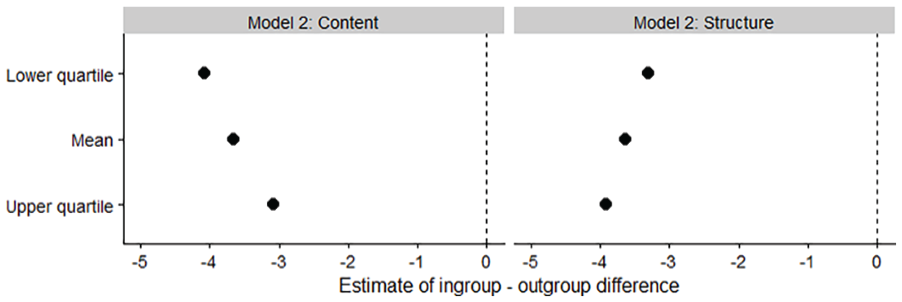
Simple Slopes of the Interaction Effect, Modeling the Estimated Difference Between Ingroup (ref) and Outgroup in Group Liking at Lower Quartile Similarity (i.e., Less Similarity), Mean Similarity, and Upper Quartile Similarity (i.e., High Similarity) According to Amount of Content (Left Panel) or Structure (Right Panel) Similarity, Demonstrating the Levels of Affective Polarization in Our Sample, Study 2.
Discussion
Results show that affective polarization is prevalent worldwide, where individuals typically like their outgroup 3.65o(/10o) less than the ingroup. Furthermore, the more similar belief system structure is to other party supporters, the more we like our ingroup (supporting H1b), and, to a lesser extent, the more similar belief system structure is to outgroup party supporters, the more we like the outgroup (supporting H2b). In contrast, the more similar our belief system content is to other party supporters, the less we like our ingroup (counter to H1a) and the more we like our outgroup (supporting H2a); however, this latter association was quite small with unclear practical relevance.
Results replicate across Studies 1 and 2, with the exception of the simple slope of structure similarity for the outgroup. Although both Studies 1 and 2 consistently had a significant difference between ingroup and outgroup slopes, the slope of structure similarity with the outgroup was small and negative in Study 1, but very small and positive in Study 2. We do not have a clear explanation for this deviation and it is possible that the differences are due to random variation between the studies. The difference may have been caused by different items or timing (i.e., 2022 vs. 2011−2016) between studies, but we think a more likely explanation is the different targets used across studies. For example, people often feel more negative about parties than party supporters (Druckman & Levendusky, 2019), perhaps they think differently about them too. People may care more about what politicians and parties think than how they think, as what they think is more directly linked to the concrete policies. Together, findings show that, political identity and political belief systems—both their content and structure—are all associated with group liking and affective polarization.
General Discussion
Both belief system content and structure similarity are associated with ingroup and outgroup liking of political party (supporters), and affective polarization (i.e., the difference between ingroup and outgroup liking) across two large, multinational and highly powered studies. These relations persist even when we control for the strong positive effect of sharing a political identity (i.e., being ingroup vs. outgroup). Counter to H1a, similarity in the belief system content among ingroup members is associated with liking the ingroup party (supporters) less. However, in line with H1b, similarity in the belief system structure among ingroup members is associated with liking the ingroup more. When it comes to the extent we like outgroups, similarity in the content of belief systems with the outgroup strongly increases outgroup liking (supporting H2a). All these relations were consistent across Studies 1 and 2, which is impressive given the use of a variety of different attitudes and samples from a wide variety of countries between our two studies. We also found that similarity in the structure of belief systems among outgroup members was related to the extent we like our outgroup, but the direction of the association differed between Studies 1 and 2: the slope was small and negative in Study 1, but (very) small and positive in Study 2. We do not have a clear explanation for this difference. Together, findings show that affective polarization is greatest when similarity in the structure of belief systems tends to be high and content similarity is typically low. As such, both political identity and political belief systems (content and structure) are relevant for group liking and affective polarization.
Optimal distinctiveness theory can explain many of the specific relations we found between belief system similarity and group liking. First, our findings of the association between belief system structure and group liking are largely consistent with optimal distinctiveness theory’s core premise that people like ingroup similarity (Studies 1 and 2) and outgroup dissimilarity (Study 1 only). Second, the unexpected negative relation between content similarity and ingroup liking (Studies 1 and 2): Given that political ingroups are typically large and inclusive, optimal distinctiveness theory could argue that people need more ingroup dissimilarity. As such, people should value the formation of subgroups within the ingroup to maintain greater individual distinctiveness. Third, the positive relation between content similarity and outgroup liking (Studies 1 and 2): This finding could highlight a need for more similarity with outgroups. In a context where people already dislike their outgroups, people may experience differences between ingroup-outgroup beliefs as quite large, so see value in greater similarity. In sum, optimal distinctiveness theory provides an explanation for why similarity in belief systems may be valued in some situations and disliked in others. However, it cannot provide a comprehensive explanation of why patterns in the relation between belief system similarity and group liking are asymmetric for content and structure. More research will be required to understand this.
Together, results show a pattern whereby affective polarization is typically higher when people have similar belief system structure but disagree on the content of beliefs. A historical example of this is the United States, where ideologues (i.e., strong Democrats or Republicans) who share the same belief system structure, disagree on content (i.e., attitude stances; Baldassarri & Goldberg, 2014), and dislike each other (Iyengar et al., 2012; Mason, 2013). We do not know of a theory that describes this pattern well. One reminiscent finding comes from work showing that men/women are more likely to use each other as a social comparison in gender equal (vs. unequal) countries where they share similar roles (Guimond et al., 2007). We speculate that groups that share belief system structure are most relevant for social comparison because they are part of a similar political conversation. As such, they may be more likely to experience the outgroup as an expectancy violation, as threating to their beliefs (regardless of the distance between beliefs) and to respond with affective polarization (Hernandez et al., 2021). Consistent with this idea, a historical increase in political sorting (people adopting similar consistently liberal/conservative belief system structure; Abramowitz & Saunders, 2008) preceded the U.S.’s cross-culturally unique rapid rise in affective polarization (Boxell et al., 2022; Gidron et al., 2019). So, our research comes together with others to suggest that political sorting may be an important part of polarization processes, aligning belief system structures and differences in belief content with political groups.
This research was the first to test the relation between belief system structure similarity and affective polarization. It joins with others to argue that belief systems are relevant and impactful for political behavior. They influence the way that individuals’ attitudes evolve (Turner-Zwinkels & Brandt, 2022), how they act politically (Brandt et al., 2019), and are also related to the way political groups feel about each other. Furthermore, this means that our research explains additional variance in affective polarization which would otherwise go unexplained. Nevertheless, we found a stronger relation between content similarity and group liking than between structure similarity and group liking. It may be that content similarity is easier for people to assess or seen as more diagnostic of a group than is belief system structure. This provides some legitimization of the preference that the psychological literature has for looking at relations involving the content of attitudes (e.g., Brandt & Crawford, 2020; Byrne, 1971; Webster & Abramowitz, 2017). If you are looking for the main political belief correlates of affective polarization, it is fair to focus on content above structure. But structure should not be ignored if a more complete explanation is desired.
Our results have practical implications for reducing affective polarization. In line with the political beliefs approach to affective polarization, a route to affective polarization reduction should be reducing the distance between groups’ beliefs. To some extent, interventions that correct misperceptions about outgroup beliefs take advantage of this idea (Lees & Cikara, 2020; Voelkel et al., 2023). Uniquely, our results suggest that interventions on the structure of belief systems may reduce affective polarization. For example, decoupling (e.g., economic and cultural) political beliefs or introducing new connections or associations between beliefs to change the structure of the belief system. However, it is unclear what changes in structure would be sufficient. From the two belief system (content and structure) variables, content explained the largest amount of variance in political party (supporters) liking, so interventions would be recommended to start there.
Limitations
Our study is one of few that investigates affective polarization beyond the United States. We tested our hypotheses across 41 different countries, in a variety of democracies on multiple continents with different party and electoral systems and histories with democracy. This is one of the most cross-nationally representative studies of affective polarization in the literature. This increases the odds that our research can make general claims about affective polarization in democracies, including democracies located in both western and non-western countries. Nevertheless, both western and democratic countries are overpopulated in our sample, so our findings may not apply to affective polarization in non-democratic and non-WEIRD (Western, Educated, Industrialized, Rich, Democratic) systems.
This research is subject to at least four limitations. First, as a correlational study, it cannot establish causal process. Future studies will be essential to establish causality. Ideally, an experiment would be conducted (e.g., 2 [Target: Ingroup vs. Outgroup] x 2 [Content Similar: No vs. Yes] x 2 [Structure Similar: No vs. Yes] mixed factorial design). However, belief system structure has not been manipulated before, so extensive pre-testing of experimental materials is required. Second, there is theoretically, a quadratic relation among the belief system content and structure variables which could complicate model interpretation. We did three things to circumvent this risk: (a) We checked variance inflation factors, which were below 9.5 (Study 1) and low at 5.8 (Study 2). (b) We reported models with content and structure similarity separately, with similar results. (c) We ran models including a quadratic effect of structure, with similar results. Thus, we think results are a reasonable approximation of the data. Third, our research used the feeling thermometer to measure affective polarization toward outgroup (supporters/parties) in general. Although this measure is strongly related to other affective polarization measures (Druckman & Levendusky, 2019) and has good construct validity (Gidron, Sheffer, & Mor, 2022), it focuses on a general, affective component of polarization. Findings (a) may not be relevant to behavioral expressions of bias or prejudice between political groups, which may be better captured by social distance measures (Druckman & Levendusky, 2019) and (b) may not map onto people’s behavior toward specific outgroup individuals, which is sometimes more lenient than it is toward groups or organizations (Kasper et al., 2023). Finally, we use single-item measures of attitudes, which may be less reliable than multi-item measures. However, single-item measures were necessary to use survey space efficiently and to tap into multiple different attitudes in the belief system. Using multiple issue positions is a strength of our study. Fortunately, our use of large, highly powered datasets allows us to cut through noise to find some robust relations. Nevertheless, it would be valuable for future research to use multiple items measures (Ansolabehere et al., 2008).
Conclusion
We tested the relation between political belief systems, political identity, and affective polarization. We tested a previously unexplored variable by investigating the relation between political belief system structure and group liking, in addition to political belief system content and group liking. In two large, multi-national datasets, we found that both political identity and political belief systems (content and structure) are relevant for affective polarization processes. Our findings show that affective polarization is greatest when similarity in the structure of belief systems is high and content similarity is low. This research shows the value of considering belief systems in psychological research, as both their content and structure are associated with how political groups feel about one another.
Supplemental Material
sj-docx-1-psp-10.1177_01461672231183935 – Supplemental material for Affective Polarization and Political Belief Systems: The Role of Political Identity and the Content and Structure of Political Beliefs
Supplemental material, sj-docx-1-psp-10.1177_01461672231183935 for Affective Polarization and Political Belief Systems: The Role of Political Identity and the Content and Structure of Political Beliefs by Felicity M. Turner-Zwinkels, Jochem van Noord, Rebekka Kesberg, Efrain García-Sánchez, Mark J. Brandt, Toon Kuppens, Matthew J. Easterbrook, Lien Smets, Paulina Gorska, Marta Marchlewska and Tomas Turner-Zwinkels in Personality and Social Psychology Bulletin
Supplemental Material
sj-docx-2-psp-10.1177_01461672231183935 – Supplemental material for Affective Polarization and Political Belief Systems: The Role of Political Identity and the Content and Structure of Political Beliefs
Supplemental material, sj-docx-2-psp-10.1177_01461672231183935 for Affective Polarization and Political Belief Systems: The Role of Political Identity and the Content and Structure of Political Beliefs by Felicity M. Turner-Zwinkels, Jochem van Noord, Rebekka Kesberg, Efrain García-Sánchez, Mark J. Brandt, Toon Kuppens, Matthew J. Easterbrook, Lien Smets, Paulina Gorska, Marta Marchlewska and Tomas Turner-Zwinkels in Personality and Social Psychology Bulletin
Supplemental Material
sj-docx-3-psp-10.1177_01461672231183935 – Supplemental material for Affective Polarization and Political Belief Systems: The Role of Political Identity and the Content and Structure of Political Beliefs
Supplemental material, sj-docx-3-psp-10.1177_01461672231183935 for Affective Polarization and Political Belief Systems: The Role of Political Identity and the Content and Structure of Political Beliefs by Felicity M. Turner-Zwinkels, Jochem van Noord, Rebekka Kesberg, Efrain García-Sánchez, Mark J. Brandt, Toon Kuppens, Matthew J. Easterbrook, Lien Smets, Paulina Gorska, Marta Marchlewska and Tomas Turner-Zwinkels in Personality and Social Psychology Bulletin
Supplemental Material
sj-docx-4-psp-10.1177_01461672231183935 – Supplemental material for Affective Polarization and Political Belief Systems: The Role of Political Identity and the Content and Structure of Political Beliefs
Supplemental material, sj-docx-4-psp-10.1177_01461672231183935 for Affective Polarization and Political Belief Systems: The Role of Political Identity and the Content and Structure of Political Beliefs by Felicity M. Turner-Zwinkels, Jochem van Noord, Rebekka Kesberg, Efrain García-Sánchez, Mark J. Brandt, Toon Kuppens, Matthew J. Easterbrook, Lien Smets, Paulina Gorska, Marta Marchlewska and Tomas Turner-Zwinkels in Personality and Social Psychology Bulletin
Supplemental Material
sj-docx-5-psp-10.1177_01461672231183935 – Supplemental material for Affective Polarization and Political Belief Systems: The Role of Political Identity and the Content and Structure of Political Beliefs
Supplemental material, sj-docx-5-psp-10.1177_01461672231183935 for Affective Polarization and Political Belief Systems: The Role of Political Identity and the Content and Structure of Political Beliefs by Felicity M. Turner-Zwinkels, Jochem van Noord, Rebekka Kesberg, Efrain García-Sánchez, Mark J. Brandt, Toon Kuppens, Matthew J. Easterbrook, Lien Smets, Paulina Gorska, Marta Marchlewska and Tomas Turner-Zwinkels in Personality and Social Psychology Bulletin
Supplemental Material
sj-docx-6-psp-10.1177_01461672231183935 – Supplemental material for Affective Polarization and Political Belief Systems: The Role of Political Identity and the Content and Structure of Political Beliefs
Supplemental material, sj-docx-6-psp-10.1177_01461672231183935 for Affective Polarization and Political Belief Systems: The Role of Political Identity and the Content and Structure of Political Beliefs by Felicity M. Turner-Zwinkels, Jochem van Noord, Rebekka Kesberg, Efrain García-Sánchez, Mark J. Brandt, Toon Kuppens, Matthew J. Easterbrook, Lien Smets, Paulina Gorska, Marta Marchlewska and Tomas Turner-Zwinkels in Personality and Social Psychology Bulletin
Supplemental Material
sj-docx-7-psp-10.1177_01461672231183935 – Supplemental material for Affective Polarization and Political Belief Systems: The Role of Political Identity and the Content and Structure of Political Beliefs
Supplemental material, sj-docx-7-psp-10.1177_01461672231183935 for Affective Polarization and Political Belief Systems: The Role of Political Identity and the Content and Structure of Political Beliefs by Felicity M. Turner-Zwinkels, Jochem van Noord, Rebekka Kesberg, Efrain García-Sánchez, Mark J. Brandt, Toon Kuppens, Matthew J. Easterbrook, Lien Smets, Paulina Gorska, Marta Marchlewska and Tomas Turner-Zwinkels in Personality and Social Psychology Bulletin
Footnotes
Declaration of Conflicting Interests
The author(s) declared no potential conflicts of interest with respect to the research, authorship, and/or publication of this article.
Funding
The author(s) disclosed receipt of the following financial support for the research, authorship, and/or publication of this article: This work is financially supported by the NORFACE Joint Research Programme on Democratic Governance in a Turbulent Age and co-funded by NWO, ESRC, AEI, NSC, FWO, and the European Commission through Horizon 2020 under grant agreement number 822166.
ORCID iDs

Supplemental Material
Supplemental material is available online with this article.
Notes
References
Supplementary Material
Please find the following supplemental material available below.
For Open Access articles published under a Creative Commons License, all supplemental material carries the same license as the article it is associated with.
For non-Open Access articles published, all supplemental material carries a non-exclusive license, and permission requests for re-use of supplemental material or any part of supplemental material shall be sent directly to the copyright owner as specified in the copyright notice associated with the article.
