




Abstract
People tend to evaluate themselves as better than they actually are. Such enhanced positive evaluation occurs not only for the self but also for close others. We extend the exploration of enhanced evaluation of close others to that of strangers. We predict that when individuals consider becoming friends with a stranger, their preference for a pleasant physical experience will drive an enhanced evaluation of that person. In two experiments, participants who considered friendship with a stranger evaluated the stranger as looking, sounding, and smelling better than how control participants evaluated them. The amount of time participants expected to spend with the stranger predicted their evaluation (Studies 1–2). In a large-scale third study, using various target stimuli, we found that when participants have an interest in a friendship but then are unable to physically spend time together, the enhanced-evaluation effect is weaker compared with when they could spend time together.
People are motivated to view themselves more positively than they are and thus self-enhance their traits and abilities (e.g., Dunning, 1999; Taylor & Brown, 1988). People tend to evaluate themselves as better than average (Alicke & Govorun, 2005), interpret traits self-servingly (Dunning et al., 1989), and associate themselves with positive words (Greenwald & Farnham, 2000). People’s self-enhancement extends to both personality and physical traits, as they quickly recognize more attractive versions of themselves and friends, but not strangers (Epley & Whitchurch, 2008). Self-enhancement is often regarded as a form of self-protection (Alicke & Sedikides, 2011), a means to achieve positive self-regard (Alicke & Sedikides, 2009; Heine & Hamamura, 2007), and a way to promote psychological–emotional well-being by protecting the individual from threats like criticism (Sedikides, 2021).
People not only self-enhance, but also enhance others who are close to them (Epley & Whitchurch, 2008), especially others who are perceived as an extension of one’s self (Brown, 2009), such as friends and family. For example, parents often have biased views of their children, perceiving them as cuter and smarter than others (Wenger & Fowers, 2008). People also evaluate their friends in more positive terms than others (Brown & Kobayashi, 2002), a finding that has been documented for different cultures (Kobayashi & Greenwald, 2003). Thus, research suggests that people tend to positively enhance how they view themselves and those close to them.
People often need to interact with others whom they have not previously met. In this research, we examine the question of whether and under which conditions people positively enhance their evaluations of strangers. We broaden the scope of investigation to explore evaluation of several physical aspects—namely, how a stranger looks, smells, and sounds. We suggest that the enhancement of strangers’ physical attributes takes place when people consider becoming friends and spending time with the person they just met.
Anticipating future interactions with strangers influences initial social dynamics, with people tending to like them more (Berscheid et al., 1976; Mirels & Mills, 1964). For example, in one study participants read a personality description of an unfamiliar target while either expecting or not expecting to have a discussion with the target. Participants who expected to interact with the target expressed a greater liking of the target compared with participants who did not expect to interact with the target (Darley & Berscheid, 1967). Furthermore, merely anticipating an interaction increased participants’ liking of the target both in a romantic context (e.g., dating; Berscheid et al., 1976) and in a non-romantic context of no-choice relationships (e.g., work relationships; Tyler & Sears, 1977). Outcome dependency also has been found to increase liking. When participants expected to interact with an unfamiliar target on whom their reward depends, their liking for the target increased (Neuberg & Fiske, 1987). Thus, the desire for positive interaction activates the motivation to experience the target as likable and pleasant to engage with (Klein & Kunda, 1992).
In the current research, we test whether this motivation also drives a positively biased evaluation of the target’s physical features. Furthermore, we propose a motivational account whereby when people expect to become friends with someone they just met and therefore anticipate spending time with that person, the desire to experience a physically pleasant interaction drives the enhanced evaluation of the person. The more time people expect to spend with someone they just met, the stronger the motivation to evaluate this stranger’s physical features positively.
We base our reasoning on the notion of motivated cognition, a process in which goals, needs, and motives shape individuals’ reasoning and thinking, leading to inaccurate representation that co-aligns with one’s desires (e.g., Kruglanski, 1996; Kunda, 1990). People’s desires and motivations may influence and shape the visual representations of their physical environment (Dunning & Balcetis, 2013). For example, desired locations may be evaluated as nearer than they are (Alter & Balcetis, 2011). Desired objects that can fulfill immediate goals are represented as closer compared with less desirable objects (Balcetis & Dunning, 2010). Beliefs and desires also influence people’s representations of others (e.g., Klein & Kunda, 1992; Plaks et al., 2005). For example, when participants desired a positive relationship with a potential task partner, they evaluated them in a manner complementary to their dominance orientation to maintain the positive relationship (Tiedens et al., 2007). Furthermore, different relationship motivations can bias the evaluation of others’ physical attributes. When participants experienced an ideological dissimilarity with another person, they evaluated that person as less attractive (Mallinas et al., 2018; Nicholson et al., 2016). Similarly, individuals in a romantic relationship are motivated to protect their relationship, and therefore, they evaluate attractive others posing a threat to the relationship as less physically attractive (Cole et al., 2016).
In this research, we focus on the evaluation of a stranger’s physical attributes. When individuals are interested in becoming friends with strangers, they expect to spend time with them. Spending physical time together is an important component of friendship. Individuals value a friendship relationship more when it includes face-to-face interactions, compared, for example, with online interactions (Griggs et al., 2021). Following the motivated-cognition rationale, we suggest that the motivation to experience a positive interaction that is pleasant on a physical level will influence individuals’ impressions of a stranger. Specifically, when individuals expect to interact and spend time with a stranger, their motivation for a pleasant experience biases their evaluation of the stranger as looking more beautiful, smelling nicer, and having a more pleasant voice. The more time people expect to spend together, the greater the bias of the physical aspects should be. Although nowadays many interactions are online, we focus on offline-physical interactions because such interactions are characterized by enhanced sensory aspects. The more sensory-intensive the experience, the more relevant the physical characteristics of the interaction with another person, thereby amplifying the biased evaluation of that person. Thus, while we may expect enhanced perception of some physical aspects in online interactions, the motivation for physical enhancement would be the greatest in offline interactions.
It could be argued that the desire for friendship and its effect on enhanced positive evaluation of physical aspects is attributed to a “halo effect” whereby evaluation of one attribute is generalized to other attributes (Nisbett & Wilson, 1977). In a classic demonstration of the halo effect, attractive individuals were judged to have better personal qualities than less attractive individuals (Dion et al., 1972; Eagly et al., 1991). A halo effect may work the other way around, with the increased liking of a stranger spilling over to influence the assessment of other attributes, such as physical attractiveness. Thus, it could be argued that liking a stranger and wanting to be friends and spend time with that person can create a halo effect that projects onto other attributes, such as how the stranger looks, and so on. However, we suggest that the enhanced-evaluation effect goes beyond a halo effect, as it reflects the motivation for a pleasant physical experience when spending time with others. Therefore, we propose a directional relationship between wanting to become friends and its impact of physical evaluation. Furthermore, we argue that the enhanced-evaluation effect is not driven merely by liking someone, but rather by the anticipation of spending time with the stranger. Because not all liking results in friendships and in spending time together (Hartup & Stevens, 1997), we focus our exploration on expected friendship (whether possible or not) and the extent of time expected to be spent together. We test whether the possibility of spending time together or not (regardless of liking) influences evaluation; and we test whether the length of time expected to be spent together influences evaluation. According to the halo-effect rationale, expected time duration should not impact the effect’s magnitude. Merely liking a person should be sufficient to project this positive view onto other attributes. However, according to our reasoning, the motivational driver (to have a pleasant physical experience) of the enhanced-evaluation effect means that the time spent together will influence the magnitude of the enhanced biased evaluation of the stranger.
Another line of reasoning that potentially explains the enhanced evaluation of strangers can pertain to people’ tendency to associate themselves with others, including strangers, who have pleasant physical features to elevate their self-worth. For example, beauty reflects a desirable and valued social quality that is associated with success (Eagly et al., 1991). People use proximity to others who are socially valued to self-enhance (Cialdini & De Nicholas, 1989). By associating with beautiful strangers, individuals may expect to experience some social gain. Indeed, people are rated more positively when presented with attractive friends (Kernis & Wheeler, 1981; Sigall & Landy, 1973). Thus, stranger-enhancing can be related to self-serving motivations: evaluating strangers associated with the self as more beautiful can be self-enhancing. This explanation may, in part, drive the positive enhancement of strangers, but it cannot fully explain it. If indeed the enhanced-evaluation effect is driven by self-enhancing motivations, any association with a likable stranger may be sufficient to activate the effect. Therefore, whether people can spend time together or not, or the amount of time they expect to spend together, should not influence the magnitude of the effect. However, we argue that the enhanced-evaluation effect is driven by the motivation for a pleasant physical experience, thus, the magnitude of the effect is directly tied not to whether one is merely associated with the desired stranger, but specifically to the possibility of physically interacting and the amount of time that can be spent together.
To conclude, in this research, we propose that people will evaluate strangers as having more pleasant physical attributes because of the desire for a pleasant physical experience. The physical experience of interacting with another person includes tangible visual, olfactory, and auditory characteristics. Thus, enhanced evaluation of a stranger is reflected in physical aspects like appearance, smell, and sound. We suggest that enhanced evaluation of a stranger occurs when there is interest in or possibility of having a relationship with the stranger. We further predict that the amount of time expected to be shared with the stranger will influence the extent of the enhanced physical evaluation. Finally, when individuals are interested in becoming friends but the chances for physical interaction are low, the effect is attenuated compared with when the chances for physical interaction are high.
The Present Research
In three studies, we test the hypothesis that interest in a friendship with an unfamiliar target will lead to enhanced physical evaluation of the target. In Study 1, we explore the effect in the context of physical beauty while controlling for participants’ gender. We include a no-interest in a friendship condition to show that although a no-interest condition should not lead to an enhanced physical evaluation, it also should not reduce physical evaluation. This demonstrates that the effect is driven by motivation for a relationship and is “deactivated” when there is no motivation for a relationship. In Study 2, we provide a preregistered replication of the effect: In addition to having participants assess beauty, we extend the effect to how the target smells and sounds. In Studies 1 and 2, we also test how the amount of expected time spent with target influences the enhanced-evaluation effect. In Study 3, using 10 target versions and a large sample (n = 3,998), we investigate whether the enhanced-evaluation effect will be attenuated when participants are initially interested in a relationship with the unfamiliar target, but then learn that physically spending time together is not possible. Throughout the studies, we used both men and women targets to show that the effect is not restricted to a specific gender.
For all studies, we report power analyses and data exclusions (if any). All sample sizes in this paper were predetermined before data collection. All stimuli used in this research can be found in the appendices of each study. All images used were properly licensed and purchased from “Adobe Stock Images.” De-identified data for all experiments can be accessed at https://osf.io/2kt6w/?view_only=d9d1b5e3f8ff4f1abe5de893f3d0006a. In all studies, participants completed a consent form before participation and were thanked, debriefed, and paid after participation.
Study 1
Study 1 served as a preliminary test of whether the expectation to become friends with an unfamiliar target would increase the extent to which the target is evaluated as physically beautiful. In addition, we tested whether the effect occurs for both men and women participants. Controlling for participants’ gender is important in this context given documented gender differences in responsiveness to appearance (Feingold, 1990). Finally, we aimed to test whether the effect is mediated by the amount of expected shared time with the stranger. Wanting to become friends and considering the extent of time one actually expects to spend with a friend are not necessarily the same. Therefore, it is important to test whether the duration of the time one expects to physically spend with the stranger predicts the physical evaluation of the stranger.
Participants in Study 1 were introduced to an unfamiliar target and asked to assume they were interested in becoming friends with the target (interest condition), were not (no-interest condition) or received no relationship instructions (control condition). We predicted that being interested in a friendship with an unfamiliar target would increase the extent to which the target is evaluated as beautiful. We included the no-interest condition to provide preliminary support for our proposed mechanism. Based on the motivated-cognition account, an expected interaction should positively alter physical evaluation because it allows optimism about a future pleasant sensory experience. If there is no expectation of interacting with the stranger, regardless of the reason (e.g., the friendship is not possible or is of no interest), then the motivational processes are not activated to influence cognition. It is important to note that the no-interest condition was not intended to activate negative attitudes toward the target, but rather to represent an overall impression that there is no foundation for friendship. Therefore, we did not expect participants in this condition to devalue the target or form negative evaluations; we did, however, expect that it would reduce the amount of time participants expected to spend with the target. Finally, we hypothesized that interest in a friendship would influence the time participants expect to spend with the target, and this should predict the physical evaluation.
Method
Participants
We collected data from 401 U.S. Prolific participants, who took part in this experiment for a payment of U.S.$0.80 (45.9% women; Mage = 32.11, SD = 8.89). The sample size was predetermined using G*Power software (Faul et al., 2007), allowing us to reach 80% power to detect any existing small to medium effect (ηp2 = .02; f = .15). All participants were included in the analysis.
Procedure and Measures
Participants in all conditions were asked to assume they regularly participate in a “Netflix club” in which they discuss Netflix shows with other club members. Participants were then introduced to Avery, a new member of the club. Avery’s description included details about her everyday life (e.g., “she works at an office downtown; during the weekends, she goes hiking”) followed by a photo. Participants were randomly assigned to one of three conditions. In the interest condition, participants were asked to assume that “Right from the start, you and Avery both liked and disliked the same things. You feel that the two of you will become very good friends.” Participants in the no-interest condition were told that “Right from the start, you and Avery liked and disliked different things. You feel that the two of you will never have shared interests and most likely you will not become friends.” Participants in the control condition were merely told that “Right from the start, Avery articulated nicely and in detail what she liked and disliked. You feel that she has a very specific taste in films and shows.” To enhance the manipulation, participants were asked to imagine and write about their interaction with Avery.
Next, we asked participants to rate the extent to which they felt close to Avery (M = 3.95, SD = 1.69) and the likelihood they would become friends with Avery (M = 4.27, SD = 1.81), and to choose the image that best describes their self/other overlap with Avery (using the self/other circles overlap scale; Aron et al., 1992; M = 3.22, SD = 1.76), which all served as manipulation checks. We then asked participants to indicate how much time they expect to spend with Avery, ranging from 1 = very little time to 7 = a lot of time (M = 4.18, SD = 1.71). Participants next reported the extent to which they think Avery is beautiful (M = 5.24, SD = 1.19), which served as the dependent measure of physical-appearance evaluation. To reduce possible demand characteristics, the beauty attribute was randomly presented along with several filler items, such as “musical” and “fastidious” (all variables were measured on a scale of 1–7; 1 = not at all, 7 = very much). Descriptive statistics and analyses for these variables are provided in Supplemental Table S1, Appendix 1.
Results
The descriptive statistics and correlations between all variables are provided in Supplemental Appendix 1, Tables S1 and S2.
Manipulation Checks
A one-way analysis of variance (ANOVA) on how close participants felt to the target showed a main effect, F(2, 398) = 55.73, p < .001, η2 = .22, 90% confidence interval (CI) [.16, .27]. Post hoc analysis revealed that participants in the interest condition (M = 4.87, SD = 1.35) felt closer to the target compared with participants in both the control condition (M = 4.06, SD = 1.54, Fisher’s least significant difference (LSD): p < .001; d = .55, 95% CI [.30, .79]) and the no-interest condition (M = 2.92, SD = 1.59, Fisher’s LSD: p < .001; d = 1.31, 95% CI [1.04, 1.58]). There was also a main effect on the likelihood to become friends with the target, F(2, 398) = 95.39, p < .001, η2 = .32, 90% CI [.26, .37]. Participants in the interest condition (M = 5.32, SD = 1.30) indicated a higher likelihood of becoming friends with the target compared with participants in both the control condition (M = 4.65, SD = 1.49, Fisher’s LSD: p < .001; d = .47, 95% CI [.23, .72]) and the no-interest condition (M = 2.85, SD = 1.67, Fisher’s LSD: p < .001; d = 1.64, 95% CI [1.36, 1.91]). In addition, there was a main effect on the self/other circles overlap, F(2, 398) = 56.13, p < .001, η2 = .22, 90% CI [.16, .27]. Participants in the interest condition (M = 4.17, SD = 1.66) indicated a higher self–other overlap compared with participants in both the control condition (M = 3.35, SD = 1.66, Fisher’s LSD: p < .001; d = .49, 95% CI [.25, .74]) and the no-interest condition (M = 2.14, SD = 1.34, Fisher’s LSD: p < .001; d = 1.34, 95% CI [1.07, 1.61]). Thus, our manipulation of inducing interest in a friendship was successful.
Looks Beautiful
A one-way ANOVA with participants’ rating of beauty as the dependent measure revealed a main effect, F(2, 398) = 9.76, p < .001, η2 = .04, 90% CI [.01, .08]. Participants in the interest condition (M = 5.59, SD = .90) evaluated the target as more beautiful compared with participants in both the control (M = 5.18, SD = 1.25, Fisher’s LSD: p = .01; d = .37, 95% CI [.13, .61]) and the no-interest conditions (M = 4.96, SD = 1.29, Fisher’s LSD: p < .001; d = .56, 95% CI [.31, .80]). Although beauty evaluations in the control condition were higher than those in the no-interest condition, this difference did not approach significance (Fisher’s LSD: p = .27; see Supplemental Figure S1 in Appendix 1).
To make sure the effect was consistent for both men and women participants, we repeated this analysis and included participants’ gender. We removed ten participants who specified their gender as “other.” Consistent with our hypotheses, a 3 (interest/no-interest/control) × 2 (participant’s gender: man/woman) ANOVA on beauty evaluation replicated the main effect: F(1, 387) = 9.10, p < .001, ηp2 = .04, 90% CI [.01, .08]. There was no effect of either gender, F(1, 387) = .18, p = .66, ηp2 < .001, indicating that beauty evaluation was similar among men and women participants. The interaction was not significant, F(1, 387) = .18, p = .96, ηp2 < .001; thus, the main effect was similar among men and women participants.
Amount of Expected Shared Time
A one-way ANOVA revealed a main effect on the amount of time participants expected to spend with the target, F(2, 398) = 89.73, p < .001, η2 = .31, 90% CI [.24, .36]. Participants in the interest condition (M = 5.21, SD = 1.28) expected to spend more time with the target compared with participants in both the control condition (M = 4.43, SD = 1.45, Fisher’s LSD: p < .001; d = .56, 95% CI [.32, .80]) and the no-interest condition (M = 2.89, SD = 1.52, Fisher’s LSD: p < .001; d = 1.64, 95% CI [1.35, 1.91]). The difference between the latter two groups was also significant, such that, participants in the control condition expected to spend more time with the target compared with those in the no-interest condition (Fisher’s LSD: p < .001; d = 1.03, 95% CI [.77, 1.28]).
Mediation Analysis
We tested the mediating role of the amount of expected shared time with the target on the relationship between the interest-in-friendship manipulation and the evaluation of the target as beautiful. We performed mediation analyses using R’s Lavaan package (version 0.6–7; Rosseel, 2012). In this model, the interest in a friendship and the no-interest conditions (compared with the control condition) served as the predictors, the amount of expected shared time served as the mediator, and the measure of beauty served as the dependent variable. As hypothesized, the amount of time participants expected to spend with the target positively mediated the effect in the comparison between the interest and control conditions: b = .29, SE = .07, p < .001, 95% CI [.16, .44]. We observed an indirect-only mediation effect in the second comparison, whereby the amount of expected shared time negatively mediated the relationship between the no-interest and control conditions: b = –.58, SE = .09, p < .001, 95% CI [–.78, –.41] (see Figure 1).
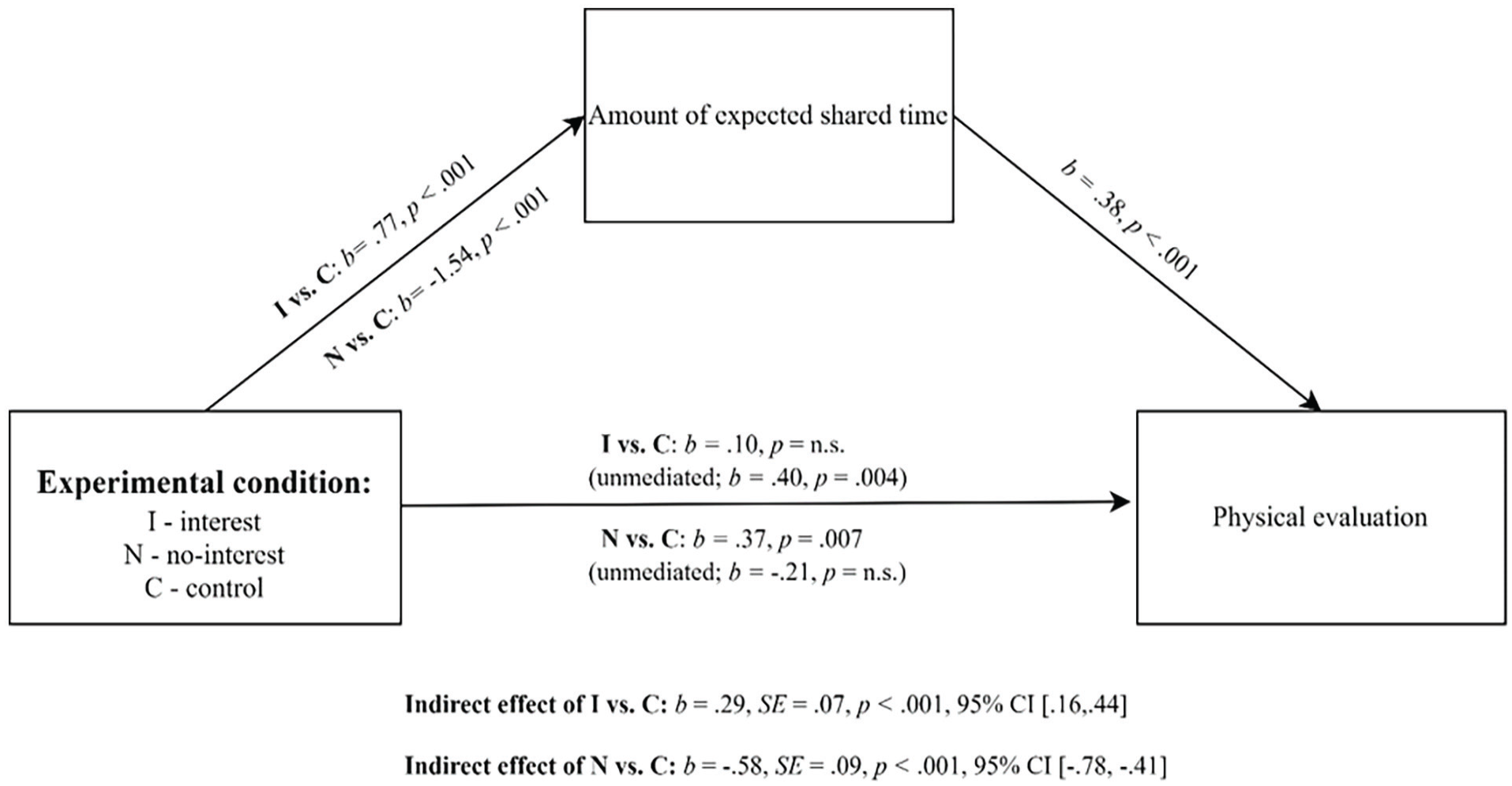
Mediation results for Study 1.
In a follow-up test, we conducted a mediation analysis that included the amount of expected shared time and two additional potential mediators: closeness and self–other overlap. We found that closeness was a significant mediator (b = .14, SE = .05, p = .009, 95% CI [.03, .24]), whereas self–other overlap was not (b = .06, SE = .04, p = .09, 95% CI [–.01, .14]). Importantly, amount of expected shared time was a significant mediator (b = .15, SE = .05, p = .008, 95% CI [.03, .25]) even when adding other potential processes (see Supplemental Table S3, Appendix 1).
Discussion
The results of Study 1 provide initial evidence for the hypothesis that interest in a friendship with a stranger enhances the evaluation of the stranger’s physical appearance. The effect is independent of the evaluator’s gender: both men and women participants evaluated the stranger as more beautiful when they were interested in a friendship. Study 1’s results also show that the amount of expected shared time with the stranger predicts beauty evaluations. Although beauty evaluations in the control condition were higher than those in the no-interest condition, this difference did not approach significance. We further observed that when participants were not interested in becoming friends, they assumed they would spend less time with the stranger compared with the control participants, which predicted lower physical evaluation. The indirect effect, therefore, suggests that the amount of expected shared time with the target played an important role in shaping participants’ evaluations and that when participants were not interested in forming a friendship with the target, their evaluations of the target’s beauty were predicted more strongly by their expectations for the amount of shared time with the target. It is possible that a “no-interest mindset” yields a weaker effect on physical evaluation than that of an “interest mindset” or that our “no-interest” manipulation was not as strong as our “interest” manipulation.
A limitation of this study is that it did not allow for a causality test of the mediation of expected shared time on the effect of friendship expectations and physical evaluation. We aim to overcome this limitation and provide causal evidence in Study 3. Another limitation of Study 1 is that the interest-in-friendship manipulation led participants to experience greater similarity and proximity, which could reflect a motivation to self-enhance. To rule out the notion of similarity, in Study 2, we refined the manipulation to induce less similarity, and in Study 3, we experimentally controlled for this by keeping conditions equal in terms of friendship desire, experienced similarity, and proximity.
Finally, this study does not rule out the possibility that the relation between friendship expectations and beauty evaluation is driven by a “halo effect.” We note that for some of the filler items, we find an effect for the experimental condition (e.g., musical), which may support the halo-effect account; however, we do not find such an effect for all the filler items (e.g., fastidious, sporty; see Supplemental Appendix 1, Table S1), arguing against this explanation. Therefore, it is possible that some of the filler items were perceived by participants differently than we expected. We discuss these findings in respect to the halo effect and alternative explanations in the “General Discussion” section.
Study 2
In Study 2, we aimed to replicate the effect of interest in friendship on physical evaluation and extend it to physical aspects other than looks, such as having a nice smell and a pleasant voice, which are notable features of the physical experience. Participants evaluated the target’s appearance based on an image and reported their imagined perceptions of smell and sound. No actual scent or auditory cues were provided. We further hypothesized that the amount of expected shared time with the stranger will predict these physical evaluations. Whereas, Study 1 tested this effect on a woman target, Study 2 tested the effect on a man target. Finally, as in Study 1, we checked for possible interaction with the participant’s gender. Study 2’s hypotheses and analysis plan were preregistered before data collection and can be accessed at https://aspredicted.org/MWJ_Z4R.
Method
Participants
We collected data from 401 U.S. Prolific participants, who took part in this experiment for a payment of U.S.$0.80. Following our preregistered exclusion criteria, we removed participants who reported severe difficulty in hearing/seeing/smelling. The reported analysis includes 390 participants (48.97% women; Mage = 35.09, SD = 10.45). The sample size was predetermined using R’s Pwr2ppl package (version 0.2.0; Aberson, 2019). This sample size allowed us to reach 80% > power to detect any existing small to medium mediation effect.
Procedure and Measures
We used the Netflix club cover story from Study 1. Following the introduction, participants were told the club had welcomed a new member, Jacob. Participants were randomly assigned to one of two relationship conditions. In the interest condition, they were asked to assume that “Right from the start, you liked Jacob’s comments, questions, and ideas. You feel that the two of you are going to become very good friends.” In the control condition, participants were told that “Right from the start, Jacob made comments, asked questions, and shared his ideas. However, you haven’t yet formed an opinion of him.” Next, we asked participants to rate the extent to which they felt close to Jacob (M = 3.45, SD = 1.52) and the likelihood they would become friends with Jacob (M = 4.72, SD = 1.45), and to choose the image that best describes their self–other overlap with Jacob (Aron et al., 1992; M = 2.92, SD = 1.63), which all served as manipulation checks. We then asked participants to indicate how much time they thought they would be spending with Jacob (M = 4.33, SD = 1.45), which served as the mediator. Finally, participants reported their physical evaluations of the target: how the target looks, smells, and sounds. Specifically, participants rated the extent to which they evaluated Jacob as beautiful (M = 4.89, SD = 1.24), as having a good smell (M = 4.56, SD = 1.21), and as having a pleasant voice (M = 4.71, SD = 1.17), which all served as the dependent measures. Given the high correlation between the dependent measures (α = .84), we averaged them into a single physical-evaluation score that we used in our planned analyses. See Supplemental Appendix 2 for multivariate analysis. All variables were measured on a scale of 1–7 (1 = not at all, 7 = very much).
Results
The descriptive statistics and correlation between all variables are reported in Supplemental Appendix 2, Tables S4 and S5.
Manipulation Checks
A series of three t-test analyses confirmed that participants in the interest condition felt closer to the target (M = 4.27, SD = 1.39), indicating a higher likelihood of becoming friends with the target (M = 5.58, SD = 1.25) and a higher self–other overlap (M = 3.92, SD = 1.57) compared with those in the control condition: feel close: M = 2.67, SD = 1.21; t(388) = 12.10, p < .001; d = 1.22, 95% CI [1.00, 1.44]; friendship likelihood: M = 3.89, SD = 1.11; t(388) = 14.04, p < .001; d = 1.42, 95% CI [1.19, 1.64]; self–other overlap: M = 1.96, SD = .99; t(388) = 14.78, p < .001; d = 1.49, 95% CI [1.27, 1.79]. Thus, our manipulation of inducing an interest in a friendship with the target was successful.
Physical Evaluation
As expected, participants in the interest condition evaluated the target higher on the general physical evaluation (M = 4.98, SD = .88) compared with control-condition participants (M = 4.48, SD = 1.15), t(388) = 4.72, p < .001; d = .47, 95% CI [.27, .68]. We note that the effect also holds when testing separately each sensory aspect (see p. 7, Supplemental Appendix 2).
To make sure the effect on physical evaluation was consistent for both men and women participants, we repeated this analysis including participants’ gender. In this analysis, we removed four participants who specified their gender as “other.” A 2 (interest/control) × 2 (participant’s gender: man/woman) ANOVA on the physical-evaluation attributes replicated the main effect for the manipulation: F(1, 382) = 24.33, p < .001, ηp2 = .06, 90% CI [.02, .10]. There was also an effect by participant’s gender: F(1, 382) = 5.24, p = .02, ηp2 = .014, 90% CI [.001, .038], such that, women participants (M = 4.84, SD = 1.08) indicated overall higher physical ratings compared with men participants (M = 4.61, SD = 1.02). The interaction between the experimental condition and participant’s gender was not significant: F(1, 382) = 2.95, p = .09, ηp2 < .01, meaning that while in general, women participants evaluated the target more positively, the main effect of relationship interest on physical evaluation was similar among men and women participants.
Amount of Expected Shared Time
A t-test analysis confirmed that participants in the interest condition (M = 4.89, SD = 1.34) expected to spend more time with the target compared with participants in the control condition (M = 3.79, SD = 1.35), t(388) = 7.98, p < .001; d = 0.8, 95% CI [0.60, 1.01].
Mediation Analysis
Next, we tested the predicted mediating role of the amount of expected shared time with the target on the effect of interest in a relationship and the general physical evaluation. We performed mediation analyses using R’s Lavaan package (version 0.6–7; Rosseel, 2012). In this model, the interest in a friendship (compared with the control condition) served as the independent variable, the amount of expected shared time with the target served as the mediator, and physical evaluation served as the dependent variable. As hypothesized, the amount of expected shared time mediated the effect of interest in a relationship on physical evaluation: b = .38, SE = .06, p < .001, 95% CI [.26, .50]; see Figure 2.
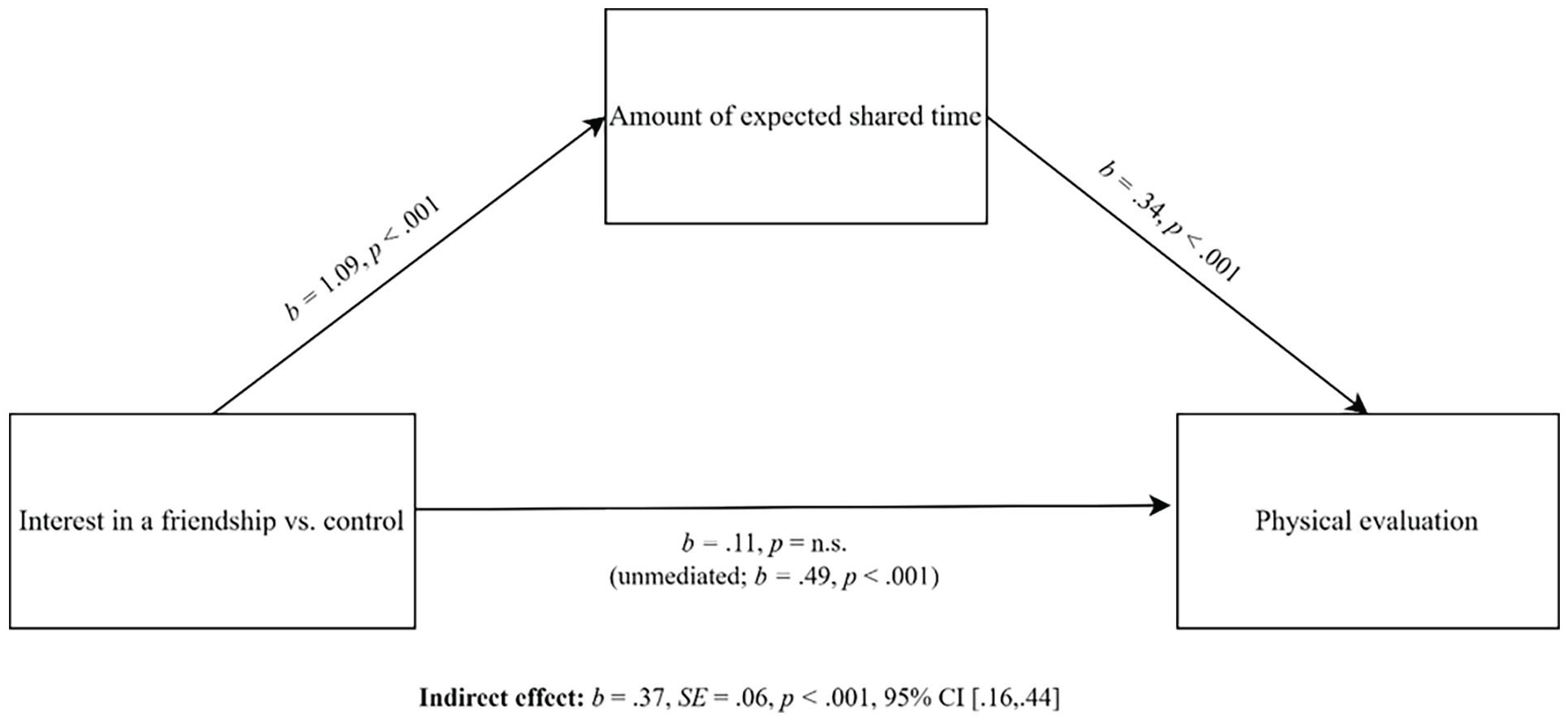
Mediation results for Study 3.
As in Study 1, we conducted a follow-up test with a mediation analysis that includes the time expectancy and two additional potential mediators: closeness and self–other overlap. We find that unlike Study 1, self–other overlap was significant (b = .19, SE = .08, p = .02, 95% CI [.02, .36]). Closeness, however, was not a significant mediator (b = .10, SE = .07, p = .15, 95% CI [−.03, .24]), while amount of expected shared time remained a significant mediator (b = .29, SE = .06, p < .001, 95% CI [.17, .40]; see Supplemental Table S6, Appendix 2).
Discussion
The results of Study 2 provide further evidence for the hypothesis that interest in a friendship with a stranger projects onto how the stranger’s physicality is evaluated. Participants evaluated the unfamiliar target as looking more beautiful, smelling better, and having a more pleasant voice when they were interested in becoming friends with the stranger. As in Study 1, we find that these effects are predicted by the amount of time participants expect to spend with the stranger. The follow-up mediation analyses showed that the amount of expected shared time was a significant mediator even when including other alternate mechanisms. In addition, while the amount of expected shared time consistently mediated the relationship between friendship expectation and physical evaluation in both Studies 1 and 2, the results for closeness and self–other overlap were not consistent across the two studies. We acknowledge that these findings do not provide causality evidence for expected time duration as the psychological process. Such evidence is provided in the next study.
Adding to the results of Study 1, which demonstrated the effect for a woman target, this study replicated the effect for a man target and again showed that the effect does not depend on participants’ gender. Study 2 also minimized the possibility that the manipulation increased similarity by avoiding mention that participants shared opinions with the targets. However, it is still possible that belonging to the same club increased similarity. Another limitation of Study 2 is that enhancement of the stranger’s evaluations served to justify the interest in a friendship—a notion aligned with most individuals’ general preference for engaging with others who are socially valued (Cialdini & De Nicholas, 1989). Finally, it could be argued that viewing a newly met stranger favorably creates a halo effect, and that the interest in becoming friends projects onto the physical evaluations of the stranger. In the next study, we aim to control for these alternative explanations. In Study 3, we keep the similarity dimension constant and test the enhanced physical-evaluation effect when all participants are interested in becoming friends with the stranger.
Study 3
The main goal of Study 3 was to examine whether the enhanced physical-evaluation effect occurs when friendship is initially desired but is not physically feasible. This design allows us to rule out several alternatives. By keeping the element of similarity and interest in a friendship constant, we can eliminate the notion that the effect emerges because participants experience similarity to the target and thus wish to self-enhance or try to justify their interest in a relationship. This design also allows us to rule out the explanation of a halo effect. According to this latter explanation, interest in a friendship projects a positive general evaluation of the target and enhances the evaluations of physical attributes. If a halo effect is in operation, then it should not matter whether the friendship is physically feasible; interest in the relationship by itself should lead to an enhanced evaluation of the target. Finally, in Study 3, we aim to increase the generalizability of our findings using ten different target versions of both men and women. As in Study 2, participants evaluated the target’s appearance from an image and reported imagined smell and sound, without actual scent or auditory cues.
As in Studies 1 and 2, we checked for a possible interaction with the participant’s gender. All participants were introduced to a stranger, either a woman or a man, with whom they would like to become friends. The relationship with the stranger was then described as either physically feasible or not feasible. We predicted that when the relationship is desired and feasible, there will be an increase in the enhanced evaluation of the stranger compared with when the relationship is desired but not feasible and participants do not expect to spend time with the target. Study 3’s hypotheses and analysis plan were preregistered before data collection and can be accessed at https://aspredicted.org/J85_VHW. Please refer to Supplemental Appendix 4 for a preliminary version of Study 3 (Study E1), which includes two target versions and a smaller sample size.
Method
Participants
We collected data from 3,997 U.S. Prolific participants, who took part in this experiment for a payment of U.S.$0.80. Following our preregistered exclusion criteria, we removed 33 participants who reported severe difficulty in hearing/seeing/smelling. The reported analysis includes 3,964 participants (49.09% women; Mage = 34.66, SD = 10.01; n ≈ 200 per target; see Supplemental Appendix 3, Table S7 for more details). The sample size was predetermined using G*Power software (Faul et al., 2007), allowing us to reach 80% power to detect an interaction effect (f = .10), between the experimental condition and target version; it also allowed us to reach 80% > power to detect any existing small main effect, per target. For descriptive statistics of each target’s sample, see Supplemental Appendix 3, Table S7.
Procedure and Measures
All participants were asked to assume they started working at a new firm and that on their first day they met another new employee—Avery (woman target)/Jacob (man target)—with whom they wanted to become friends. The target was randomized across ten target versions, five men and five women (see Supplemental Appendix 3). All participants were asked to assume that “You two have a short chat, and you have a feeling that the two of you could become good friends.” Participants were then randomly assigned to one of two friendship-feasibility conditions. In the high-feasibility condition, participants were asked to assume that “You and Avery/Jacob will be working at the same office branch and will probably see each other all the time.” In the low-feasibility condition, participants were told that “You and Avery/Jacob will be posted at different, very distant office branches, and will probably never see each other again.” We then asked participants to indicate the likelihood they will become friends with the target (M = 3.84, SD = 1.90), how similar the target is to them (M = 4.85, SD = 1.22), how much time they think they will be spending with the target (M = 4.22, SD = 1.75), and the extent to which they would like to become friends with the target (M = 5.62, SD = 1.17), all of which served as manipulation checks. The manipulation checks were presented in random order.
Next, participants indicated the extent to which they evaluated the target as looking beautiful (M = 4.93, SD = 1.36), smelling good (M = 4.76, SD = 1.23), and having a pleasant voice (M = 5.01, SD = 1.19)—which all served as the dependent measures of physical evaluation. To reduce possible demand characteristics, the physical attributes were randomly presented with several filler items: an artistic person, a good dancer, and sporty. All items were measured on a scale of 1–7 (1 = not at all, 7 = very much). For simplicity, we averaged the dependent measures (α = .81) to create a single a general physical-evaluation score. Finally, to address possible demand effects, we asked participants what they thought the purpose of the study was. We randomly sampled the open answers of 250 participants. We did not find any response that matched the study’s purpose.
Results
The correlations and the descriptive statistics of all variables are presented in Supplemental Appendix 3, Tables S8 and S9.
Manipulation Checks
A series of t-test analyses confirmed that participants in the high-feasibility condition indicated a greater likelihood of becoming friends with the target (M = 5.28, SD = 1.22) and expected to spend more time with the target (M = 5.29, SD = 1.12) compared with those in the low-feasibility condition: friendship likelihood: M = 2.37, SD = 1.24, t(3,962) = 74.08, p < .001; d = 2.35, 95% CI [2.27, 2.43]; amount of expected shared time: M = 3.13, SD = 1.60; t(3,962) = 49.09, p < .001; d = 1.56, 95% CI [1.48, 1.63]. Thus, our manipulation of inducing the feasibility of a friendship was successful.
As expected, we observed no differences between the conditions in similarity (high feasibility: M = 4.86, SD = 1.22; low feasibility: M = 4.85, SD = 1.22; t(3,962) = .20, p = .83; d < .001) or in the desire to become friends (high feasibility: M = 5.64, SD = 1.11; low feasibility: M = 5.59, SD = 1.22; t(3,962) = 1.14, p = .25; d = .03).
Physical Evaluation
A 2 (high/low feasibility) × 10 (target version) ANOVA on the general physical-evaluation measure revealed a main effect for friendship feasibility, F(1, 3,944) = 67.48, p < .001, ηp2 = .017, 90% CI [.01, .024], reflecting a higher physical-evaluation for the high-feasibility condition (M = 5.04, SD = 1.02) compared with the low-feasibility condition (M = 4.75, SD = 1.12). There was also a main effect for the target version, F(9, 3,944) = 13.83, p < .001, ηp2 = .03, 90% CI [.02, .037], such that, the overall physical evaluation for some targets was higher than for others. Finally, there was no interaction between friendship feasibility and target version, F(9, 3,944) = 1.71, p = .13, ηp2 < .01, such that, the main effect was consistent among the different targets (see Figure 3). We provide individual analyses for each target and measure (look, sound, and smell); see Table S7 for sample descriptive per target and Table S10 for the individual results. Overall, the pattern of the results was consistent among dependent measures and targets.
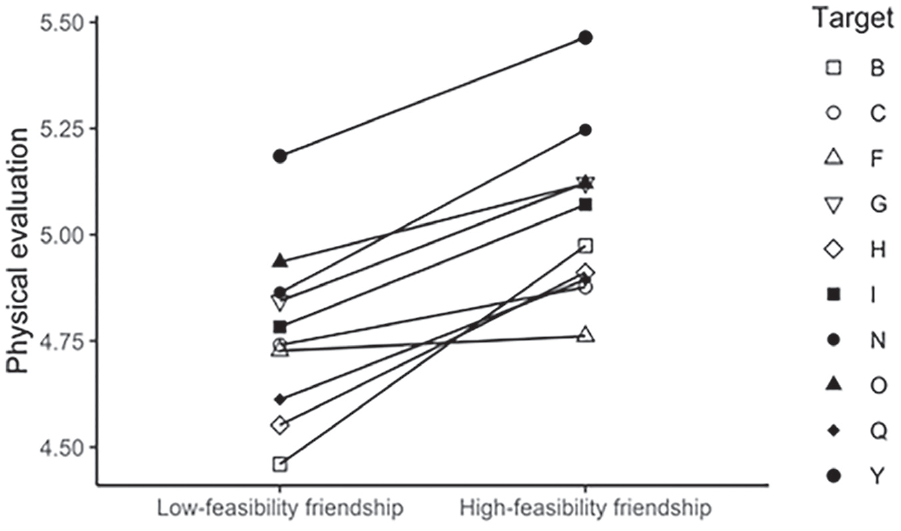
Mean ratings of physical evaluation (1–7 scale) by experimental condition and target (Study 3).
In line with our preregistered analysis plan, we conducted a secondary analysis including both target’s and participant’s gender. In this analysis, we removed 81 participants who specified their gender as “other.” A 2 (high/low feasibility) × 2 (target’s gender: man/woman) × 2 (participant’s gender: man/woman) ANOVA replicated the main effect for friendship feasibility, F(1, 3,875) = 70.15, p < .001, ηp2 = .018, 90% CI [.011, .025], reflecting a higher physical evaluation in the high-feasibility condition. There was also a main effect for participants’ gender, F(1, 3,875) = 71.26, p < .001, ηp2 = .018, 90% CI [.011, .02], reflecting higher physical-evaluation scores given by women participants compared with men participants. The main effect for the target’s gender was also significant, F(1, 3,875) = 30.12, p < .001, ηp2 = .008, 90% CI [.003, .012], such that, women targets were evaluated more highly on physical evaluation than men targets. The interaction between friendship feasibility and participants’ gender was also significant, F(1, 3,875) = 4.02, p = .04, ηp2 = .001, 90% CI [< .001, .003], such that, the effect of high-feasibility friendship on physical evaluation was more pronounced for women participants (p < .001) than men participants (p < .01). There was an interaction between the participant’s and target’s gender, F(1, 3,875) = 42.35, p < .001, ηp2 = .01, 90% CI [.001, .016], such that, women participants evaluated men and women targets similarly (p = .44), but men participants evaluated women targets more highly than men targets (p < .001). Finally, there was no interaction between friendship feasibility and the target’s gender, F(1, 3,875) = .9, p = .34, ηp2 < .001, nor was there a three-way interaction, F(1, 3,875) = 1.33, p = .23, ηp2 < .001. See Supplemental Appendix 3, Table S11, for all descriptive statistics.
Discussion
The results of Study 3 support the hypothesis that interest in a friendship with a stranger influences the evaluation of their physical attributes. Importantly, in support of the motivated-cognition account, Study 3 shows that interest in a friendship by itself does not enhance physical evaluation. In both the high- and low-friendship-feasibility conditions, participants expressed interest in becoming friends with the target based on their initial acquaintance. However, participants who were interested in a relationship but were told they would never see the target again rated the target lower on physical attributes compared with participants who expected to spend time with the target. We note that in addition to differences in physical evaluations, we find differences in the filler items (e.g., artistic, sporty, good dancer; see Supplemental Appendix 3, Table S9). We discuss possible explanations for these differences in the General Discussion section.
Of importance, we find that participants in both conditions evaluated the target as equally similar to themselves. Thus, similarity cannot explain the enhanced-evaluation effect. These results also cannot fully be explained as an attempt to self-enhance, justify interest in becoming friends or as a halo effect, given that in both conditions, there was an overall desire for friendship. Finally, we were able to replicate the effect across different targets, thus demonstrating its generalizability and adding to the external validity of our results.
General Discussion
In three studies, we consistently demonstrate that individuals enhance their physical evaluation of a stranger when they want to become friends and expect to physically spend time with the stranger. We show that the effect occurs for both men and women participants and targets. The effect was found for different physical attributes, including looks, smell, and sound.
This enhancement of strangers reflects a process of motivated cognition (Kunda, 1990). We find that the amount of expected shared time with the target is related to the positive evaluations of physical attributes. The more time participants expected to spend with the stranger, the more biased was their evaluation of the target as physically pleasant (Studies 1 and 2). Although these findings provide correlational data, we believe that it reflects individuals’ desire for a positive physical experience when spending time with others. Furthermore, we show that being able to spend time with the stranger is a crucial component beyond the wish to become friends. If the physical relationship is not feasible for whatever reason (e.g., physical distance), the mere desire for a friendship did not enhance the physical evaluation of the stranger compared with when the relationship was feasible (Study 3).
There could be different motives contributing to a biased representation of a stranger’s physical qualities. One argument is that this is a halo effect. While we do not argue against the possibility of a halo effect, our results suggest that the physical enhancement effect we find goes beyond a simple halo effect. In Study 1, we find an effect for some of the filler items (musical, fastidious) but not for all items (sporty, coffee lover), providing some evidence against the halo-effect account. While we did observe significant differences for the filler items measure in Study 3, it is worth noting that the effect sizes for the filler items were quite small (see Supplemental Table S9 in Appendix 3) compared with the effect size of the DV item. It could be that these significant differences were a result of the large sample size, rather than an actual effect of the halo bias. It is also possible that some of the filler items were associatively related to socially spending time with others and that relationship feasibility could have influenced other evaluations, such as the “sporty” measure, suggesting that these difference may be driven by other motivations rather than a halo effect
While we do not claim that there is no halo effect, we argue for a motivated-cognition process that goes beyond a halo effect. Evidence for this claim can be found mainly in Study 3, where stranger liking and the desire to become friends remained consistent across all conditions. The halo-effect explanation suggests no differences across conditions, but we find the enhanced-evaluation effect is attenuated when friendship is impossible. Other alternative explanations may be related to increased similarity between the evaluator and the stranger, which may prompt self-enhancing motivations or the motivation to justify interest in becoming friends with the stranger. While all these are plausible explanations, they cannot fully account for the results of Study 3, in which similarity and the desire to become friends were constant across the two conditions. To conclude, in our research, we attempted to highlight one specific motivated-cognition process that we believe relates the most to physical evaluation, but we acknowledge that social evaluation processes are complex in nature, and thus, there could be other factors and motivations that operate simultaneously and lead to biases in evaluation.
Our research has limitations and can be extended. First, we used expected shared time with a stranger as a proxy for pleasant physical interaction’s importance, but individual differences in sensory pleasure motivation (Eisenberger et al., 2010; Ruiz de Maya et al., 2016) could moderate this. The effect might be attenuated for those with low sensory pleasure motivation. Second, the focal question of this research concerns why people generate enhanced positive evaluations of liked strangers. Findings of past research on interpersonal devaluation may suggest that opposite effects take place for disliked strangers (e.g., Simpson et al., 1990). We found that when individuals have no interest in a friendship with the stranger, they do not reduce physical evaluation (Study 1). However, we note that the no-interest condition in Study 1 did not intend to induce any negative response toward the target. We suspect encountering a disliked stranger, causing aversion, may lead to negative physical evaluations.
An unresolved question is why people have strong preferences for pleasant physical experiences within the context of friendships. Past evolutionary research related to reproduction argued that individuals with attractive features are preferred because these features signal biological quality (e.g., Rhodes, 2006). However, later studies did not find relations between attractive features and actual health (Foo et al., 2017), implying that the roots of such preferences are elsewhere. Recently, Jones and colleagues (2021) argued that facial-attractiveness preference occurs because it is associated with a healthy lifestyle. However, it is questionable whether such associations can explain relationships other than those for the purpose of reproduction, such as friendships, and whether they can be extended beyond beauty to other attributes, such as smell and sound.
This research is the first to examine the physical enhancement of the qualities of strangers and to show that individuals’ physical evaluation of others not related to them is determined by their interest in becoming friends and the amount of time they expect to spend the stranger. Whereas previous studies have shown that participants tend to assess their future interaction partners as more likable because of the desire for positive interaction (expected spending time → liking a target), we show that the effect also has an opposite direction and a spillover effect (liking of a stranger → expected spending time → enhancing the physical attributes of the stranger). We provide evidence of the motivational process underlying this effect and show that this process is driven by the desire for a positive physical interaction with a stranger. Our findings shed light on the circumstances as well as the underlying process leading people to enhance their evaluation of strangers.
Supplemental Material
sj-docx-1-psp-10.1177_01461672231180150 – Supplemental material for Beautiful Strangers: Physical Evaluation of Strangers Is Influenced by Friendship Expectation
Supplemental material, sj-docx-1-psp-10.1177_01461672231180150 for Beautiful Strangers: Physical Evaluation of Strangers Is Influenced by Friendship Expectation by Natalia Kononov and Danit Ein-Gar in Personality and Social Psychology Bulletin
Footnotes
Declaration of Conflicting Interests
The author(s) declared no potential conflicts of interest with respect to the research, authorship, and/or publication of this article.
Funding
The author(s) disclosed receipt of the following financial support for the research, authorship, and/or publication of this article: This research was supported by the Jeremy Coller Foundation.

Supplemental Material
Supplemental material is available online with this article.
References
Supplementary Material
Please find the following supplemental material available below.
For Open Access articles published under a Creative Commons License, all supplemental material carries the same license as the article it is associated with.
For non-Open Access articles published, all supplemental material carries a non-exclusive license, and permission requests for re-use of supplemental material or any part of supplemental material shall be sent directly to the copyright owner as specified in the copyright notice associated with the article.
