




Abstract
Low-income, Latinx students navigate independent norms in U.S. educational systems and interdependent norms in their familial dynamics. Yet, their everyday interactions with important others (e.g., peers, parents, instructors) reveal more complexity in between these contexts, often communicating paradoxes of independence and interdependence. We conducted semi-structured interviews with 35 low-income, Latinx high school graduates before they entered college to examine how their daily interactions in home and school contexts facilitated dynamic and paradoxical engagement with interdependence and independence. Using constructivist grounded theory, we constructed five types of paradoxes. For example, strong practices of interdependence in their college-preparatory high school setting (e.g., extensive academic support) undermined students’ desires to be independent. These contradictions reflect an in-between space, referred to as nepantla, where students give voice to and make sense of past, present, and future understandings of how to be a self.
Keywords
I learned to make my mind large, as the universe is large, so that there is room for paradoxes.
Kingston, along with other women of color writers, beautifully captures the complexity in the everyday lives of People of Color who negotiate multiple social worlds. Part of the complexity lies in maneuvering paradoxes—contradictory messages, expectations, or values—in these multiple social worlds. A Latinx student from a low-income background, for example, navigates hyper-individualism in U.S. mainstream contexts and contrasting socialization of being interdependent with others in low-income communities of color (Anzaldúa, 1987/2012; Chang et al., 2020; Patton, 2016; Yosso, 2005). While the contrast is great, much nuance exists in between these contexts in terms of independence and interdependence (Covarrubias et al., 2019; Duncheon, 2020; Payne et al., 2021). Indeed, when navigating multiple contexts, individuals are offered cultural tools that evoke particular psychological tendencies and understandings of the self; these tools are known as cultural affordances (Adams & Markus, 2004; Kitayama et al., 2006). When those contexts have differing, and sometimes contrasting or paradoxical, cultural traditions and practices, this has potential to afford a more fluid understanding of the self (Adams, 2012). The current research explores this fluid sensemaking among a group of low-income Latinx high school graduates preparing to attend college as first-generation (FG) college students, or the first generation in their family to go to college.
Preparing for college as low-income FG Latinx students signals an upcoming transition between and among multiple worlds, from their home communities to the university space. This transitional space, referred to as nepantla, can be characterized by uncertainty and by the recognition that one is crossing from a present identity to a new one that is not fully formed (Anzaldúa, 1987/2012). Like anyone negotiating multiple worlds, low-income FG Latinx students can receive conflicting or opposing messages as they prepare to cross into new terrain. Exploring how students describe and make sense of these opposing messages reveals the ways in which students work to transform ambiguity and uncertainty into a new understanding of self (see Mestiza Consciousness, Anzaldúa, 1987/2012). This sensemaking does more than to balance or merge various understandings of self, but instead it represents a new consciousness that “challenges dualism and is flexible and tolerant of ambiguity” allowing space for new possibilities to occur (Keating, 2022, p. 181). Adding to scarce empirical work that captures engagement with both independence and interdependence (Bernal, 2001; Chang et al., 2020; Covarrubias et al., 2019; Duncheon, 2020; Payne et al., 2021), we conducted in-depth interviews with a group of low-income FG Latinx students in a nepantla state. Our aim was to document what paradoxes emerge from existing in this liminal space, as it has strong implications for institutional practice on how to support students to and through the college transition.
Cultural Affordances of Independence and Interdependence: The Multiple Worlds of Low-Income FG Latinx Students
U.S. systems of higher education are rooted in the cultural values and practices of middle-to-upper class white groups (Patton, 2016). Such rooting manifests as a setting that values norms of hyper-individualism, including being autonomous (Hamedani et al., 2013), self-expressive (Markus, 2017), free from constraint to pursue individual passions (Kusserow, 2012), and competitive and assertive to create opportunities for success (Kusserow, 1999). According to cultural mismatch theory, a privileging of independence undermines outcomes for students who value interdependence (Stephens et al., 2012; Stephens, Markus et al., 2014). This includes engaging in familial obligations, prioritizing the needs of close others, and seeing oneself as a part of a collective (Casanova et al., 2016; Cooper, 2011; Correa-Chávez et al., 2015; Garcia-Coll & Vasquez-Garcia, 1995; Rogoff, 2014; Sy & Romero, 2008; Tseng, 2004). Extending this work, home-school cultural value mismatch theory describes how such a mismatch creates tension for low-income FG Latinx students, leaving them to choose between competing values, like supporting family or focusing on individual work at school (Covarrubias, 2021; Covarrubias et al., 2019, 2021; Vasquez-Salgado et al., 2015, 2021). These frameworks are instrumental for legitimizing interdependence as an important way of being and for documenting the realities of navigating mismatching cultural worlds.
In addition to mismatches of independence and interdependence, scholars have also noted mismatches within socialization patterns of independence. For example, prevalent norms within U.S. schooling contexts, such as being self-expressive, would be considered soft independence (Kusserow, 2012; Lott, 2012). Soft independence acknowledges a self that is delicate, a being to be nourished by the many reliable and abundant opportunities in the social world (Calarco, 2014; Kusserow, 2012; Lareau, 2011). In contrast, hard independence affords a type of socialization in which students from working-class settings learn to be tough, to be self-reliant, and to be resilient. This mode of individualism acknowledges a self that is hard and protective in order to survive a social world of uncertainty and limited resources (Kusserow, 2012).
Because students (and families) have to negotiate soft independence in U.S. schooling (Lott, 2012), part of this negotiation includes drawing from cultural toolkits—socialization beliefs families draw from to teach their children how to maneuver U.S. mainstream spaces outside of the home (Calarco, 2014). A longitudinal study of families of children in grade school documented how middle-class parents socialized soft independence among their children when negotiating challenges at school, including asking for help or speaking up (Calarco, 2014). For working-class families, this socialization mirrored more self-reliant responses, including explicitly not asking for help. In this way, cultural toolkits can facilitate disparate outcomes in performance in schooling contexts, as there exists a mismatch between soft and hard forms of independence in school and at home (Calarco, 2014).
Growing research has started to examine how these classed experiences intersect with gender and race/ethnicity to inform these toolkits. Existing within multiple social worlds facilitates toolkits that are more complex, a shifting between interdependence and both hard and soft independence (Anzaldúa, 1987/2012; Bernal, 2001; Covarrubias et al., 2019; Denmark et al., 2014; Duncheon, 2020; Gonzalez-Ramos et al., 1998; Rondini, 2016). Duncheon (2020) documented, for example, how U.S. high school contexts that act as college preparatory programs for majority low-income, FG students of color work to balance these toolkits, often resulting in contradictory behaviors. Teachers prepared students for soft independent expectations of college but utilized hard independent strategies—like micro-managing or constraining behaviors—that undermined opportunities for students to actually learn soft independence (for a similar paradox see Weininger & Lareau, 2009).
Once in college, low-income, FG students of color experience similar balancing of these toolkits. Covarrubias et al. (2019) documented how low-income, FG Latinx and Asian students leveraged multiple cultural experiences rooted in both interdependence and soft and hard independence when navigating college. Students actively consider when to engage in soft independence, such as deciding when to ask for help in college settings (Chang et al., 2020; Payne et al., 2021). Students might draw from both interdependent (e.g., not wanting to be a burden on others, accessing social networks) and hard independent (e.g., wanting to be self-reliant) toolkits for making these decisions (Chang et al., 2020; Payne et al., 2021). Thus, students draw from toolkits that exist within a spectrum of independence and interdependence.
This kind of complexity is often thought of as a form of biculturalism, reflecting an integration of dominant norms of the host culture, the U.S. in this case, and of norms of the home culture, low-income FG Latinx in this case (Benet-Martínez & Haritatos, 2005; Nguyen & Benet-Martínez, 2007). But other scholars argue that rather than a balancing of two cultural realities, a third reality emerges. Anzaldúa’s (1987/2012) concept of Mestiza Consciousness, for example, describes a reality that engages with and enacts a lived experience with multiple, often contradictory, messages and expectations that uniquely constrain oneself when having to exist at the borderlands of more than one culture (p. 100). Anzaldúa acknowledged that People of Color—particularly women—develop an ability to navigate ambiguity and contradictions because they experience multiple social worlds defined by race/ethnicity, sexuality, gender, social class, language, and immigration status. The new consciousness that emerges is a fluid understanding of self that lives and breathes paradox.
Limited empirical studies have documented the varied ways that low-income, FG Latinx students experience paradoxes of independence and interdependence in both home and school contexts. The focus of the existing work is on students already in college (Bernal, 2001; Chang et al., 2020; Covarrubias et al., 2019). Focusing on the experiences of low-income FG Latinx students before they enter college offers a unique opportunity to capture students’ sensemaking of various messages as they occupy an in-transition nepantla state. That is, we can understand the messages and expectations these students engage with before being immersed into the hyper-individualistic culture of college. What is especially useful is a focus on these students as they attend a college-preparatory high school located in a low-income community, as this context can have competing socialization goals for students they serve (Duncheon, 2020). Specifically, using in-depth interviews, we explored how students’ daily interactions in home and school contexts afforded dynamic engagement with both interdependence and independence, with a focus on paradoxes, as they aspire for upward mobility in U.S. culture.
Method
School Sites and Participants
Students were recruited from two charter high schools in the Bay Area, referred to as College Pathways Preparatory (CPP). The majority of students in the high schools were Latinx (91.4%), FG (96%), and low-income as determined by eligibility for free and reduced lunch (82.4%). We partnered with school staff at both CPP locations to better understand the college transition and navigation experiences of their graduates. As a college preparatory school, the vast majority of students (95%) gain acceptance into higher education but CPP knows less about their experiences once there. Within this larger goal, we sought various research questions, including the current research aim: how students navigate independence and interdependence at home and in school.
For this project, the sample included 35 FG students at the end of their senior year of high school (M = 17.71, years, SD = 0.67). All students identified as Mexican American and/or Mexican-heritage, with one identifying as both Mexican and Filipino. There were 18 women, 15 men, and one student who identified as gender non-conforming; one student preferred to not disclose their gender identity.
We measured socioeconomic status (SES) in two ways. First, participants reported family household SES by selecting from five categories: 1 = working class, 2 = lower-middle class, 3 = middle class, 4 = upper-middle class, and 5 = upper class. There was also an “I don’t know” option, but no students selected this option. Participants reported an average family income reflecting lower-middle class (M = 1.94, SD = 0.87). Second, participants also reported subjective SES using the MacArthur Scale of Subjective Social Status (Adler et al., 2000). On a scale from 1 (lowest position) to 10 (highest position), participants indicated where they believed their social class standing was relative to “other people in the U.S.” On average, participants reflected a lower SES position (M = 3.71, SD = 1.32).
Procedure
To begin, the research team—the lead principal investigator (PI), graduate student researcher (GSR), and four undergraduate student researcher assistants—visited both CPP campuses to recruit participants. The team worked with school staff to host a “College Knowledge” informal panel at each site during an already-existing weekly college success class for all high school seniors. For an hour, the team shared their experiences navigating college as all people from low-income, FG Latinx backgrounds, and answered any questions senior students had about their experiences. After the panel, the team introduced the goals of the research and detailed the process for participating. The team shared parent letters in both English and Spanish, with attached parent consent and minor assent forms, for students to take home and review with their families. Students were asked to return completed consent/assent forms to teachers; only those who did so participated in the study.
Though the larger study included four waves of surveys, we focus on the subset of students who participated in semi-structured interviews during the summer after they graduated high school but before they began college. Interview data allowed us to investigate, with greater nuance, how students negotiated independence and interdependence in their daily lives. We chose a semi-structured, in-depth interview format to ensure some consistency across topics in the interviews and to also allow for natural flow of the conversation (Josselson, 2004). The interview protocol focused on various topics, such as school belonging, experiences at CPP, and family relationships. An initial draft of the protocol was shared with CPP staff to ensure inclusion of any relevant topics for their purposes. After revisions were made, the GSR piloted the protocol with her brother, who was also a Latinx FG high school student (not at CPP) transitioning to college. His feedback helped to clarify confusing questions and to adjust length of the protocol.
The PI and GSR began visiting the CPP campuses a month after the initial recruitment to conduct 11 individual interviews and 9 group interviews for a total of 35 students. The interviews took place in empty classrooms at CPP and ranged from 30 to 90 minutes. Students received $40 via online payment for participating. All interviews were audio-recorded using a physical recorder. The recordings were uploaded to an online transcription service, Temi, where the research team listened to and cleaned the transcripts. The university’s Institutional Review Board approved all procedures.
Methodology and Data Analysis
Our methodology was guided by phenomenology, as our goal was to learn about students’ subjective interpretations of their daily interactions (Creswell & Poth, 2016). Acknowledging this subjectivity, we adopted a constructivist grounded theory (CGT) approach to our analyses of data, such an approach allowed us to reflect on how our own positionalities and prior knowledge with the topic influenced our own sensemaking of the data (Charmaz, 2014; Smith & Luke, 2021). For example, as Mexican American women from low-income, FG backgrounds whose research expertise is centered on the college transition experience of students from similar backgrounds, we engaged in thoughtful reflexive work about how students were engaging with independence and interdependence. Part of our reflexivity included acknowledging how dynamic our sensemaking process was (Smith & Luke, 2021). For example, although we knew we wanted to focus on understanding messages of independence and interdependence, it took time, discussion, reflection on our own research and sensemaking processes, and engagement with multi-disciplinary literature to arrive at our observations of paradoxes (McNiff, 2013).
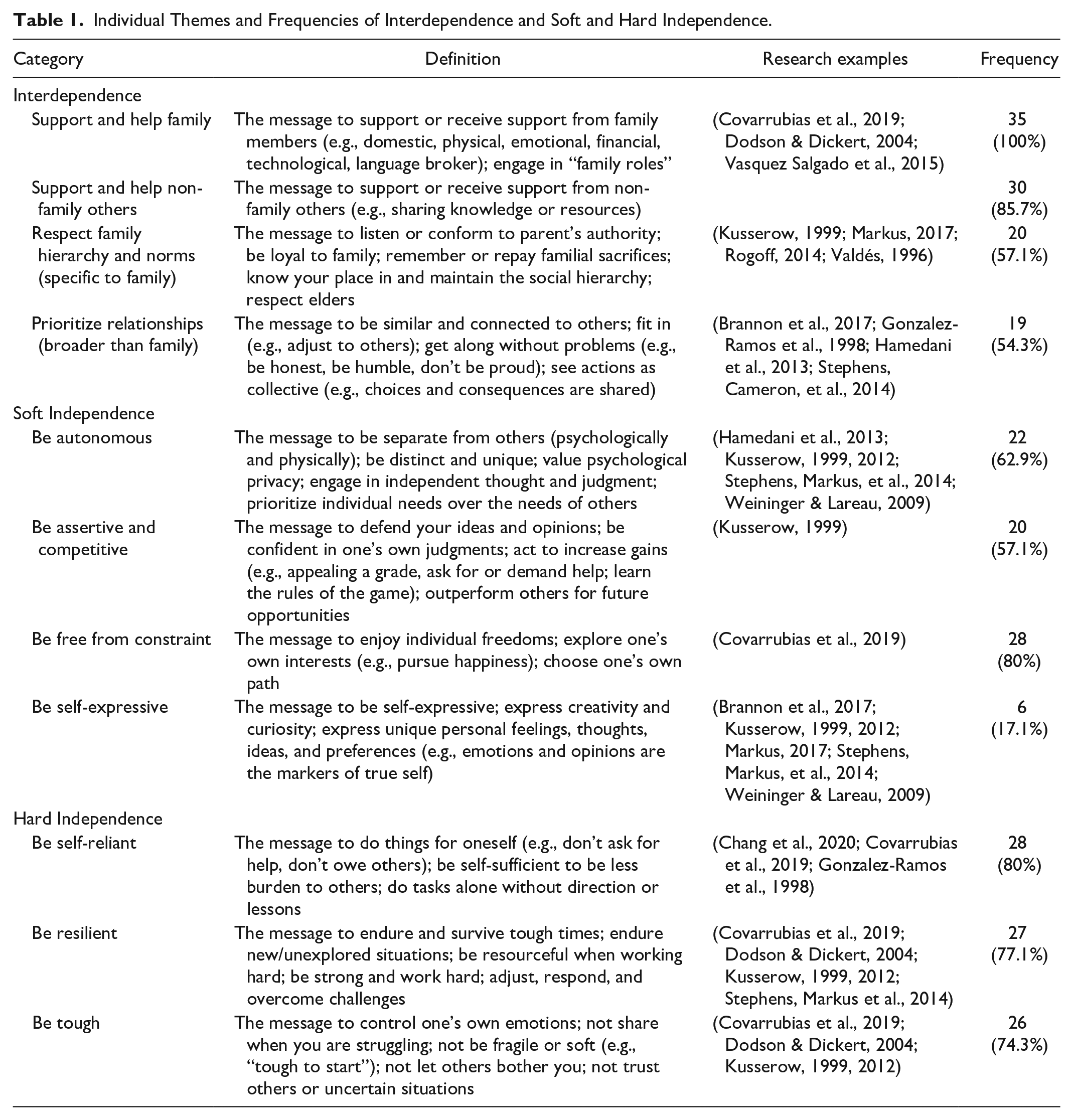
In the first phase of coding, the PI and GSR documented all pieces of data from the interview transcripts by paying attention to behaviors and incidents that participants described related to independence and interdependence (Sebastian, 2019). We did this by first pasting relevant excerpts into a shared Google Sheet file and discussing our interpretations of these excerpts. We took notes of our discussions on a separate shared Google Doc file, as a way to engage in constant comparison of the data and to construct our primary codes (Charmaz, 2014). At this stage, we revisited the literature, as it was clear that the excerpts reflected behaviors and experiences documented in research. We identified and re-read relevant papers that helped us to define instances of soft independence, hard independence, and interdependence for low-income, FG, and/or Latinx students (e.g., Brannon et al., 2017; Covarrubias et al., 2019; Dodson & Dickert, 2004; Gonzalez-Ramos et al., 1998; Hamedani et al., 2013; Kusserow, 1999, 2012; Markus, 2017; Rogoff, 2014; Stephens et al., 2012; Valdés, 1996; Vasquez-Salgado et al., 2015; Weininger & Lareau, 2009). We constructed a codebook, with names and definitions, reflecting four types of interdependent behaviors, four types of soft independent behaviors, and three types of hard independent behaviors (see Table 1).
Individual Themes and Frequencies of Interdependence and Soft and Hard Independence.
Part of our reflexive work and commitment to CGT was keeping an open mind to the data and revising our research aims (Smith & Luke, 2021; Timonen et al., 2018). In comparing our codes back to the data, we observed limitations in the codebook. The stand-alone codes felt stagnant, not fully capturing the dynamic ways students described engaging with independence and interdependence. Our memoing included observations for how students embodied contradictions in independence and interdependence because of their overlapping experiences of ethnicity, gender, and social class. This memoing captured our process for developing new understandings of the data, recognizing that knowledge creation is never static and that contradictions and a multiplicity of perspectives exist in the data (McNiff, 2013; Whitehead, 2017). In our reflexivity, we discussed Mestiza Consciousness as a concept for understanding these embodied contradictions.
This theorizing was not only resonant with our own experiences, but it also helped us to conceptualize the data in a different way (Smith & Luke, 2021). We started to note all the existing paradoxes and contradictions students described. We engaged in constant comparison again with the data and, in this stage of the coding process, we chose six themes that we felt were most significant for conceptualizing theory around paradoxes (Charmaz, 2014). Again, in our reflexive work, we discussed the limitations of our analyses (Smith & Luke, 2021). For example, Mestiza Consciousness recognizes the importance of sexuality in making sense of lived experiences. Thus, although the concept of Mestiza Consciousness was useful for testing our assumptions in the data, we recognize our limitations in fully capturing this reality for students since it was not a central question in the project and materials.
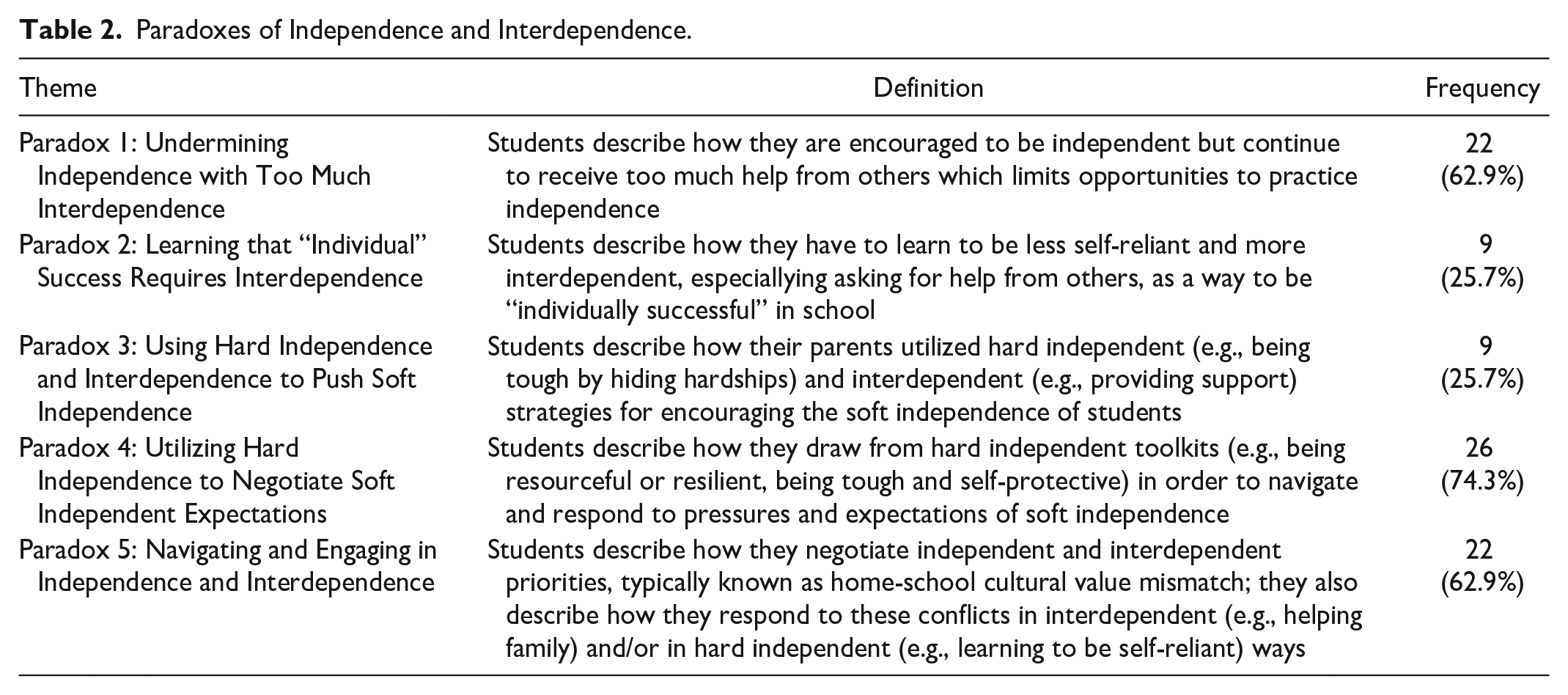
Once we had a working draft of the codebook reflecting the new themes, we engaged in focused coding and ongoing comparison of the data (Charmaz, 2014). Over the span of several months, we met weekly to discuss our reading and coding of interviews and to refine our themes to better reflect the data. Again, we acknowledged the messiness of this stage, as not all examples identified were straightforward (Smith & Luke, 2021). Part of our approach to the research question was coming to a collective understanding through our struggle to make sense of patterns and inconsistencies in the data (McNiff, 2013; Whitehead, 2017). For example, we noted overlap between two paradoxes and, after much discussion, we merged these into one. Our discussions helped us to reach consensus on codings that were discrepant. We continued to discuss and code all interviews until we arrived at our final codings with themes that represented the data well. 1 See Table 2 for theme names, definitions, and frequencies.
Paradoxes of Independence and Interdependence.
Trustworthiness
We engaged in investigator triangulation to enhance the trustworthiness of our work; specifically, we engaged the data as independent readers then met to discuss where our interpretations overlapped or diverged (Merriam, 1998). Our reflexive process was key to this step (Smith & Luke, 2021). For example, during our process of constant comparison of the data, we drew from our lived experiences as low-income, FG women of color navigating our own messages of independence and interdependence and from our knowledge of literature beyond psychology to make sense of relationships between individual codes. These experiences influenced our interpretations of the data, so we had to remain vigilant to the ways that we were making assumptions. Balancing our grounded approach with openness in the coding helped us to engage more deeply with the data. This was further informed by our reading of theory on nepantla and Mestiza Consciousness (Anzaldúa, 1987/2012; Keating, 2022) and of empirical work documenting how students negotiate both independence and interdependence (e.g., Bernal, 2001; Chang et al., 2020; Covarrubias et al., 2019; Payne et al., 2021). Engaging with the literature and in note-taking throughout the coding process helped us to make sense of our assumptions and limitations.
Results
Instances of Soft and Hard Independence and Interdependence
Before presenting the paradox themes, we summarized codings reflecting the number of students who reported engaging in or endorsing messages of soft and hard independence and interdependence. Though this is not the main focus of this paper, we present these results to provide a type of replication of past literature noting the nuanced ways in which low-income, FG students of color negotiate these different cultural norms and affordances of self (Chang et al., 2020; Covarrubias et al., 2019). Adding to literature, however, these themes more fully reflect different ways of engaging in independence and interdependence commonly documented in literature.
Table 1 summarizes the theme names, descriptions, and frequencies. A large number of students engaged in or with hard independence and interdependence. For hard independence, the majority reported all three sub-themes of Be Self-Reliant, Be Resilient, and Be Tough (frequencies across the sub-themes ranged from 74.3% to 80% and averaged to 77.1%). For interdependence, the majority reported all four themes (frequencies across the sub-themes ranged from 54.3% to 100% and averaged to 74.3%). It is important to note that every student in the sample reported the sub-theme of Support and Help Family.
Fewer students reported engaging in or with soft independence (frequencies across the sub-themes ranged from 17.1% to 80% and averaged to 54.3%). Though the average percentage is lower for soft independence than for hard independence, it is still substantial as reports of soft independence were present in more than half of the sample. For soft independence, the most reported sub-theme was Be Free From Constraint and the least reported was Be Self-expressive.
Summary of Paradoxes
Every student in the sample, with the exception of one, described contending with a paradox. This single student did, however, indicate separate themes of interdependence (Support and Help Family), and both hard (Be Resilient) and soft (Be Assertive and Competitive) independence; these instances simply did not seem to exist in contradiction. For the remaining group, the average number of paradoxes reported was between two and three, with the range being one to five paradoxes. Table 2 summarizes the theme names, descriptions, and frequencies.
Paradox 1: Undermining Independence With Too Much Interdependence
One of the most salient paradoxes reported by students was the realization that because they received too much help from close others (e.g., family, teachers) on certain tasks, there were limited opportunities to practice independence. Few students mentioned these interactions occurring at home. Rosa, for example, shared, “I feel like sometimes my family kind of holds me back . . . because they do kind of like baby me too, still to this age.” When asked to explain more, she noted how her parents treated her like a “mommy’s girl” or a “daddy’s girl,” giving her what she wanted. Though she recognized that she reinforced the behavior by throwing a “tantrum” if she did not get what she wanted, Rosa revealed her own ambivalence about this when she also wished that they “kind of wouldn’t do that no more.”
Students were more likely to share examples of these ambivalent feelings in the context of CPP. Here, participants similarly described the issue of teachers “holding your hand a lot” or being too “overprotective.” This phenomenon is likely influenced by the larger educational mission of CPP, as a school that aims to promote the educational success of majority low-income, FG Latinx students. Part of this mission is revealing the hidden steps for navigating the pathway to college for populations that might have less access to this critical information (Jack, 2016). Cecilia recognized this aim as rooted in values of interdependence:
[CPP] focuses on having to motivate and support . . . students and wanting them to succeed . . . [T]hey . . . see themselves in us because they want to see us succeed. Um, like a lot of [the staff] are also maybe first gen, so they do want to see, um, a lot bigger and better things for us.
CPP tried to balance scaffolding critical information with a desire for students to learn the skills for themselves in order to be more successful in college (Duncheon, 2020). However, Cecilia, like other participants, gave an explicit example of how the teachers often went too far in ways that undermined the chance for independent learning.
Specifically, one CPP campus had a policy known as reassessment, which allowed students to request a make-up or do-over on assignments they failed or missed. The goals behind reassessment were to prioritize mastery of a task rather than the performance outcome (e.g., grade) and to allow students who were managing multiple stressors some flexibility in completing work. And though students saw this policy as sometimes “helpful,” some participants noted how a commitment to helping students resulted in “so much rules” and “micromanaging” that undermined opportunities for practicing independence. Yesenia described how “if you don’t turn in something, the teachers will go out to find you” and offer an extension. She noted how you “don’t even have to ask for it, they’ll just give it to you.” She contrasted this with the anticipated reality of college where you have to be “independent” and “learn how to do things for yourself and by yourself.”
What made this experience confusing for students was the contradictory messages they received from teachers to be independent. Makaela noted how teachers consistently reminded students they “have to be independent” while also recognizing that teachers were “still holding your hand every step of the way.” Mayra and Esmeralda shared a similar sentiment of this paradox in messaging in their group conversation:
I think [CPP] did a lot of handholding. I don’t think it’s a bad thing per se, but it comes to a point where it’s like, we’re going to go into the real world and there’s not going to be someone running down the halls, like telling us, ‘Hey, like where are you going? You didn’t ask permission to go to the bathroom. .’. . But then there’s other times where it’s like, okay, you know what, if I go to college, what’s going to happen when I don’t know what to do, you know? So I do think being a student at [CPP] has its benefits. I really, I really do because they really do prepare us for college.
But there’s some parts that are, maybe feel like they’re holding your hands too much or. . .?
I feel like they held your hand too much. Yeah . . . So it’s like, they kind of hold your hand and then they kind of start pushing you towards independence. And they say, “Oh, act like adults,” but then they treat you like kids. So that’s weird at the same time.
You’re both shaking your head. Is that how somebody else has felt?
Yeah. A lot of it was weird . . . I do understand, like, obviously we are like our own people. We have to be independent at some point, but I guess they should have a little transitioning phase where it’s like, ‘Okay, this is going to happen now. And . . . that’s hand holding too but, it’s weird . . . Like, how are you going to guide us? And then all of a sudden, just like, let us go.
These participants recognized the difficulty in balancing interdependent support with independent learning. The schooling context here matters. CPP, as a college preparatory school, promotes and pushes soft independence, recognizing this value is linked to success in the United States (Duncheon, 2020; Stephens et al., 2012). Yet, CPP balances this goal with the reality of serving majority students from low-income, Latinx communities. This meant that they held interdependent values and goals of comunidad (community) as part of their school mission and displayed behaviors of hard independence—such as providing strict rules and less freedom to students—to not distract from the goal at hand: to gain college admission (Duncheon, 2020; Kusserow, 2012). It is this unique socio-cultural context of CPP that might have facilitated this paradox.
Paradox 2: Learning That “Individual” Success Requires Interdependence
Though too much interdependence (in the form of receiving help) can undermine independence, it is also the case that being too independent can be undermining. Participants often talked about feeling self-reliant—dealing with things on their own—even at the cost of getting important help. Because they learned to be self-reliant in their working-class homes, students were used to navigating issues on their own (Weininger & Lareau, 2009). Ana Maria shared this experience, “I deal with everything by myself.”
Self-reliance is common among FG students of color (Chang et al., 2020; Covarrubias et al., 2019; Payne et al., 2021) and serves students well when navigating uncertainty in low-income contexts (Kusserow, 2012). Recognizing this cultural toolkit, CPP explicitly named and emphasized the importance of reaching out to others to ask for help. That is, CPP taught them to scale this behavior back in U.S. middle-class schooling contexts. The paradox is that such schooling contexts are said to value this type of self-directed behavior by rewarding individual initiative (Stephens et al., 2012). Indeed, as noted earlier in the first paradox, Yesenia learned that college was a place to be “independent” and to “learn how to do things for yourself and by yourself.” But, in reality, one cannot do it alone. The most successful students, indeed, have learned to integrate help-seeking as a regular resource but this is part of a hidden curriculum, or implicit lessons about how to be successful (Jack, 2016; Laiduc & Covarrubias, 2022).
Learning and navigating this paradox then requires a specific type of code-switching or alternating between different selves (Elkins & Hanke, 2018). Students recognized this type of awareness and growth happening for them at CPP. Ana Maria expressed her gratitude for CPP, recognizing that they help you “really grow a lot” by allowing you to realize that help from others is critical. Viviana and Perla also grappled with this realization during their group interview:
I was a timid girl. Like I wouldn’t ask for help . . . And so CPP really did help me like manage to break out of my shell you know . . . I went to [college] orientation, they were like asking for help is gonna be a big benefit for you . . . So I think that’s one of the biggest skills that I’m glad I got during CPP.
Yeah. Ever since like, I’ve been like at CPP, I learned it’s really important to like build . . . relationships with your teacher that way you’re, like, you’re comfortable with asking them for help.
CPP strategically equipped them with the understanding that to manage academic and social hurdles in college requires a shift away from independence to interdependence. Without CPP making this part of the hidden curriculum visible, students might never have learned that “independence” and being individually successful really means relying on others for help.
Paradox 3: Using Hard Independence and Interdependence to Push Soft Independence
CPP is not unique in its goal to promote soft independence for students; indeed, parents actively pushed for soft independence. The main message parents conveyed to their children was that they wanted them to be free from constraint, to explore whatever made them happy. What made these messages of soft independence part of a paradox was that they stemmed from cultural toolkits rooted in hard independence and interdependence (Calarco, 2014). As the vast majority of participants in the sample had parents who migrated to the U.S. for better economic opportunities, parents often explicitly shared that they wanted their children to pursue lives where they could be more happy and less stressed. Different from pushing goals of interdependence, like asking children to pursue pathways that would bring stability for the entire family (though participants shared instances of this, too), this theme highlighted how parents’ difficult immigration histories influenced their desires for their children to pursue pathways that afforded their children more individual freedoms.
Parents pushed this aim by drawing from their toolkits as people from low-income, Latinx backgrounds. For example, as a sign of interdependence, they showed extreme support for their children’s freedom. Though both women and men reported this, gendered racialized norms facilitated more individual freedoms for Latino men (Ovink, 2014). Marco shared that the message he received from his parents was that all members of the family “are all different” and that he should “do what’s best for [him].” This support also meant providing space to focus on school tasks. Anthony, for example, recognized many times where his parents “needed help” but before asking for help they would check in to see if he had everything he needed to “write any essays” or “study for a test.” If he was busy, he was told explicitly: “‘No, you’re not going to work with me, as much as I may need you to help me. You’re not gonna go because you need to study.” This space for soft independence—to focus on one’s own individual goals and engage in autonomous tasks—was rooted in interdependent relationships.
Parents also utilized hard independence to push soft independence. One such strategy was for parents to not share hardships with their children to allow space for them to focus on their own tasks. This theme is similar to the Be Tough theme, a form of hard independence where students reported withholding stressors from their parents to not create undue burden (Covarrubias et al., 2019). Here, however, parents were the ones to employ this strategy. Ana Maria, whose parents were supportive of her individual pursuit of college, described how “they would try to hide everything that’s going bad, so [she doesn’t] stress about it while [she’s] gone.” Oscar gave a deeper reflection of his parents’ use of a similar strategy:
I do understand that what they’re trying to do is not make us worried, like, [telling us to] just worry about ourselves, our education . . . I think they’ve been looking out for us. Um, um, just trying to get us through, uh, a good education to help us lead a better life than they did basically coming from such a poor neighborhood in Mexico and coming here with basically nothing . . . And so I don’t really feel like it was a bad thing for them to hide it, but I wish they would’ve told me sooner so I could have helped out somehow.
Oscar beautifully captured the paradox. He noted the mixture of his parents pushing for his soft independence as stemming from values of interdependence (e.g., “looking out for us”) and from the use of strategies rooted in hard independence (e.g., hiding hardships from children).
At times, however, the hard independent responses, such as the Be Tough mind-set, created stress for students. Returning to Ana Maria, she further explained how confused she felt when her father engaged in a different form of being tough on her. Even though her father was proud of her for graduating and starting her individual journey to college, especially around others, she noted a different message when alone. She shared:
When it’s just me and him, like at home, and I’ll be on the computer, like doing actual things that have to be related with, um, like college. . . he’ll be like, “Ay huevona, ponte a trabajar” [Lazy, put yourself to work]. Or like, “why are you wasting your time on that?”
Ana Maria received both praise and criticism for engaging in soft independence: her father expressed pride that she pursued an individual goal of going to college but called her lazy for such behaviors. Thus, another facet of this paradox was that even though parents pushed soft independence, when students behaved consistently, the unfamiliarity of such behaviors could still prompt hard independent responses.
Paradox 4: Utilizing Hard Independence to Negotiate Soft Independent Expectations
In negotiating pressures to engage in soft independence, participants utilized their own hard independent toolkits to push back. As an expectation to be more competitive, Ale described how their father pushed them to seek out more prestigious schools for college:
When I said, ‘Oh, I’m choosing to go to college,’ his immediate reaction was ‘Okay, well you need to apply to Berkeley and Stanford and big name colleges. Um, he thinks that the name is what makes you. Um, and then I told him that I’m majoring in more of the liberal arts side and he said that he wouldn’t help me unless I did a STEM-based major . . .
Ale described feeling restricted by their father’s expectations for their future. Their response to the situation was “to take [themselves] out of that situation” entirely by cutting off communication. We labeled this response a form of hard independence because of its protective feature (Kusserow, 2012). Ale removed themselves as a way to protect themselves from the conflict and pressures to conform to their father’s expectations.
This protective response was also a strategy students used at school. Miley noted how college would afford her “more freedom” and that CPP helped to prepare students for this type of soft independence in her senior year by teaching her to take initiatives on certain tasks (e.g., calling colleges on their own). She described how a lot of this preparation happened in their senior seminar:
The new, um, thing that [CPP] did for us was that they would give us a whole class period just for the seniors. And we got to go more in depth [on] how college will be and what to expect . . . which I thought was good. But also it was overwhelming as well because we would also have independent time . . .
Miley later shared that it was “just so hard for [students at CPP] to get used to these new expectations in the seminar.” In response to her overwhelming feelings, Miley shared, “Um, sometimes I would just walk out of the class . . . Cause it was just overwhelming.”
This paradox captured how when faced with a pressure or expectation to engage in soft independence, students drew from hard independence. Although for Ale and Miley this meant withdrawing to protect themselves, for others the stress of such expectations resulted in learning something new or using their resources to navigate the stress. Esmeralda, for example, noted how in college she will have “more free time” but that with this time came “more responsibility.” For her, responding to shifts to soft independence meant learning how to buckle down and not “slack off.” Mayra also shared that her response was to “push through” and stay resilient.
Paradox 5: Navigating and Engaging in Independence and Interdependence
Though the first three paradoxes reflected instances in which students navigated messages or expectations of independence and interdependence, this paradox reflected two distinct forms not yet discussed. The first facet of this paradox is aligned with literature on home-school mismatch (Covarrubias et al., 2020; Vasquez-Salgado et al., 2015, 2021). The gendered elements of ethnicity made it so that more women experienced these home-school mismatches (Espinoza, 2010). When describing how she felt about the heavy role she played in supporting her family Rosa shared:
I mean, sometimes it’s good when I see . . . everyone smile and be happy, but I don’t know because everyone is happy except me at times, you know? Cause I’m the one that gets tired as well . . . I’ve always dreamt of having kids, but now with this, like, I kind of want to hold off on that for awhile because I’ve been focused on my family, like my parents and my sisters and my brother . . . I’m not having my own time. That’s why I enjoy getting my nails done because it’s the only hour that I get by myself . . .
Rosa recognized that her contributions to supporting her family are important to her and their well-being, but she acknowledged that this sometimes ran counter to her own individual well-being and interests. Tatiana shared a similar realization:
I tend to do a lot around the house . . . My parents relied on me a little too much . . . my mom was . . . like, “you have responsibilities at the house, wait and do everything else later.” . . . I do have other priorities . . . I need to fit other things into my schedule.
Whereas Rosa found pockets of alone time to manage the pressures of familial responsibilities and Tatiana maneuvered ways of fitting everything into her schedule, men shared a different approach. Representing another facet of this paradox, part of balancing these priorities for men included figuring out a way to support one’s family by engaging in hard independent behaviors. For example, Oscar chose to support his family by learning to be self-reliant. He shared:
I’ve been learning how to live outside of home . . . And I’ve been learning how to . . . take care of myself for the most part . . . I’ve been trying to grow up a little more independent. So I could actually not be too much of a burden on myself and not too much of a burden on them after I leave for college . . . So I feel like if I can learn how to be independent, I won’t have to be such a burden on everyone else.
For both Arturo and Marco, this translated into looking for work as a way to support family. Marco shared,
I wanted to work. Cause like I wanted, you know, buy myself clothes . . . I was also helping them . . . Since I was driving my dad’s truck, like, I would give him money for the gas or sometimes I would help him with truck payments . . .
For Otto, his hard independent response to supporting family came in the form of staying out of trouble. He shared, “I help my mom by getting out of trouble.”
General Discussion
The current study documented low-income, FG Latinx students’ sensemaking of messages of independence and interdependence in home and school interactions as they negotiated a in-between nepantla space. In this case, nepantla is characterized by an upcoming transition away from home and high school into a new terrain of university culture and values. Here is where students are able to reflect on all the expectations, impositions, and understandings of the social worlds they inhabit (Orozco-Mendoza, 2008). In nepantla, students bring awareness to different—often paradoxical and conflicting—messages and perspectives that transcend rigid norms and expectations of identities. This includes rigid ideas of cultural affordances of independence and interdependence.
Indeed, in the current work, part of our own reflexivity as researchers was learning to move beyond bounded categories of soft and hard independence and interdependence in our coding and sensemaking. Coding for stand-alone themes of soft and hard independence and interdependence enabled us to replicate past work aiming to document these various toolkits among samples of low-income, FG students of color (Bernal, 2001; Chang et al., 2020; Covarrubias et al., 2019; Duncheon, 2020; Payne et al., 2021). We found that though students engaged with messages of independence and interdependence, more students reported engaging with hard versus soft forms of independence. This aligns with work illustrating socialization affordances of hard independence within low-income environments (Covarrubias et al., 2019; Kusserow, 1999; Stephens, Cameron, et al., 2014). Still, because these students (and their families and high schools) negotiated soft independence in U.S. culture, the majority reported engaging with these messages, too. Yet, without considering the dynamic interplay between these stand-alone codes and the resulting paradoxes, we could not fully capture students’ experiences in nepantla. Both a reflexive (e.g., drawing from lived experience and prior knowledge, developing multiple possible interpretations of the data) and dialectical (e.g., adopting a lens toward contradictions to explain transformations) approach and perspective to the research process offered an opportunity to capture paradoxes within the data (McNiff, 2013; Whitehead, 2017).
The term paradox is important here. Biculturalism is the identification with and integration of two different cultures, with those high in integration reporting little conflict in both and those low in integration seeing these cultures as opposing (Nguyen & Benet-Martínez, 2007). For the latter group, it can be hard to hold space for both cultural realities at the same time. The in-between space, instead, can facilitate a third fluid understanding of the self where all elements—multiple marginalized and contradictory social realities—can exist at the same time, not having to choose one reality over the other. We were careful to not make claims about how students described their identities, whether they saw themselves as bicultural or as achieving a new third self. Instead, the paradoxes themselves reflect students’ sensemaking of the possible co-existence of all of their understandings of self as they negotiate nepantla. That is, our data do not tell us whether students have developed a new consciousness but rather our aim was to shed light on what messages come to mind for students as they occupy a liminal, nepantla space.
We found that this sample of low-income FG Latinx students described five paradoxes, including that (a) too much interdependence can undermine soft independence, (b) expectations of soft independence requires learning to be interdependent, (c) pushing soft independence can arise from hard independence and interdependence, (d) learning soft independence sometimes elicits hard independent responses, and (e) conflicts can emerge from balancing interdependent obligations and desires for independence. Some of these paradoxes have been documented separately in the literature for these groups and, as such, our work provides further evidence for these experiences. For example, consistent with other work (Duncheon, 2020), students described how CPP as a college preparatory program gave contradictory messages when they encouraged but undermined opportunities for practicing soft independence by micro-managing students’ behaviors. No work has documented all these facets together. But this is important as it demonstrates the variation of the different ways independence and interdependence co-exist for particular groups.
There are some new understandings. For example, home-school mismatch theory describes the specific tension that arises from having to prioritize family obligations with motivations for independence (Vasquez-Salgado et al., 2015, 2021). Students noted this paradox as well. However, we made two potentially new observations. First, we observed that students responded differently to the home-school mismatch. Women were more likely to find creative ways to balance these conflicting priorities. This included strategies like fitting everything into their schedules to ensure obligations were met or finding pockets of alone time to manage any stress to then be able to return to the obligations. Men, on the other hand, engaged in more hard independent strategies, namely learning to be more self-reliant. Self-reliance afforded men a way to contribute to family either by finding work or staying out of trouble so that they could alleviate any additional burden on family. Understanding the dynamic interplay of independence and interdependence revealed how racialized gendered norms likely afforded different response strategies to the same home-school mismatch tension experienced at home.
Second, we also observed a potential new form of home-school mismatch: how parents’ hard independent responses to soft independence can also create similar conflict. Students shared how parents pushed for soft independence, including being free from constraint. However, when students acted accordingly some were met with conflicting messages by parents to be tough, to work hard, and to not be lazy. This response is perhaps a form of cultural inertia, a resistance to beginning change especially directed to agents (i.e., students) demonstrating the change (Zárate et al., 2012). Students communicated feeling confused by these conflicting messages, like receiving both praise and criticism for engaging in soft independence, and also hurt when parents offered more strict or critical responses to their behaviors. Understanding this potential response helps to reveal the discomfort and uncertainty that can exist in the in-between space, where students are learning how to adapt to new behaviors.
Implications for Institutional Practice
Participants shared how they navigated multiple social worlds defined by ethnicity, social class, gender, and immigration status and how those worlds communicated paradoxes. The paradoxes reveal how students felt constrained, at times. Nepantla represents a state that is in transition, an important space to make sense of paradoxes and to transcend boundaries of what is possible. Institutional stakeholders, in recognizing this in-between space, can provide resources and opportunities for encouraging the emergence of a new consciousness, especially as students cross into uncertain terrain and look for ways of making sense of that terrain (see wise interventions as one sensemaking tool, Covarrubias & Laiduc, 2022; Walton & Cohen, 2007). In doing so, we more fully recognize the capital, lived knowledge, and tensions of our students that can beautifully inform the learning space (Rios-Aguilar et al., 2011). This can facilitate meaningful belonging for students as it allows students to come exactly as they are and it allows institutions to shift cultural norms about the “right” way of being.
Some of these institutional efforts are already taking place. For example, the fifth paradox we documented in this work reflects some elements of traditional forms of cultural mismatch and home-school mismatches: the psychological and academic consequences that arise when institutions privilege independence over interdependence, leaving students to choose from these priorities. Given our strong understanding of this paradox in the literature, there have been robust, empirically supported approaches to mitigating these experiences. For example, when institutions integrate more messages of interdependence within critical university structures, practices, and artifacts (e.g., like course assignments or welcome letters) this works to expand upon prevalent messages of independence in ways that boost outcomes for students who prioritize interdependence (Harackiewicz et al., 2016; Stephens et al., 2012). Showing compassion for the home-school mismatches students are managing is also effective for showing students they are cared for in school settings (Basch et al., 2022; Covarrubias et al., 2022).
What these efforts are doing is working toward recognizing that learning contexts, and the people within them, are complex. And part of the complexity includes utilizing multiple toolkits to maneuver different situations. For example, the third, fourth, and fifth paradoxes in this work revealed how both students and parents utilized hard independent and interdependent skills to negotiate norms of and expectations for soft independence. Bringing awareness to these various toolkits that students are leveraging can expand ideas about what is valuable for learning (Correa-Chávez et al., 2015; Rogoff, 2014). Indeed, complex tasks require a diverse toolkit, a shifting between independent and interdependent skills, among other things. A starting place for educators is to recognize the strengths of both skills for learning and to recognize the strength involved in being able to draw from both when needed. Such recognition can then serve as foundation for educators to create and design policies, programming, assignments, and activities that invite students to utilize these strengths in their learning and that intentionally tie such strengths to important reward structures, like performance in a class (see activation of capital framework, Rios-Aguilar et al., 2011). Such recognition and activation of students’ strengths can and should occur across diverse institutional spaces and efforts. For example, creating a campus orientation program that invites low-income, FG Latinx students and their families to have explicit conversations about these tensions and strengths, including how families can support both independence and interdependence, is one way to facilitate belonging to the university (Covarrubias et al., 2020).
Institutionalizing the message that being successful requires both independent efforts and interdependent ties importantly makes explicit what is often hidden. Indeed, the second paradox in this work revealed that, although universities value self-directed learning and motivation, it is a student’s ability to engage interdependent networks and to rely on others for help that facilitates success within the domain. Acknowledging that this contradiction exists is one step toward unmasking the hidden rules of what it takes to be successful and toward unraveling the false belief that success is solely about individual efforts (Gable, 2021; Jack, 2016; Laiduc & Covarrubias, 2022; Smith, 2013; Yosso, 2005). In debunking these myths, institutions are simultaneously working toward recognizing the value of diverse cultural strengths instead of leaving them to exist in contradiction of one another. Finding ways to institutionalize the value of these different forms of cultural strengths showcases to students that there are multiple pathways for being successful (Rios-Aguilar et al., 2011; Yosso, 2005). And, importantly, when institutions highlight multiple pathways for success, by having students share their college transition stories, this effort boosts resource-seeking and academic performance of minoritized students, namely FG students (see difference education interventions, Stephens, Hamedani et al., 2014; Townsend et al., 2019).
In addition to creating structures of support that undo conflicting or paradoxical messaging in the first place, it is also important to create spaces that simply acknowledge the stress, uncertainty, and confusion that can arise from navigating transitional spaces. In recognizing that students hold multitudes, especially during critical transition periods, stakeholders can provide better tools for reflecting on and converting some of the uncertainty into meaningful growth for students and for institutional practice. Some recent work hints at what happens when university faculty recognize the uncertainty and confusion that students navigate during a transition, in this case the switch to emergency remote learning brought on by the COVID-19 pandemic (Basch et al., 2022). During in-depth interviews, minoritized undergraduate students shared how their instructors became more aware of the home-school mismatches that they experienced and feelings of isolation related to remote learning. Faculty responded by integrating more interdependent activities (e.g., implementing group work and assignments) and more flexibility (e.g., adjusting deadlines, making material accessible online) into the course, and students commented that faculty felt more relatable as a result. An interesting caveat, and similar to the first paradox documented in this paper, is that students also reported that when faculty offered too much support in terms of flexibility this undermined individual accountability to learn. This reminds us that shifts in institutional practices also require a careful balance between independence and interdependence, especially as all members navigate uncertain transitions.
We provide some general examples of how educators can attend to the specific paradoxes documented in this research. We also want to convey the overall importance of recognizing that paradoxes exist at all and that they might manifest differently across different institutional contexts. Indeed, the nature of paradoxes might shift as the interplay between students’ different constellations of social identities and the social environments they encounter also shift. Thus, a broader awareness that paradoxes exist at all can provide more pathways for educators to attune to the different paradoxes that might arise in students’ lives and across diverse educational settings.
Limitations and Future Directions
We captured five paradoxes that reflect a starting point for where recognition can begin. In exploring these paradoxes, we focused on the intersections of ethnicity, social class, gender, and immigration history. Indeed, the theoretical origins of Mestiza Consciousness importantly centered the experiences of low-income, FG queer feminist women from immigrant backgrounds negotiating the physical and psychological borderlands of these multiple intersections. Our sample reflects these experiences in many ways, as all students were from low-income, FG Mexican American or Mexican-heritage backgrounds. However, paradoxes are necessarily informed by other lived experiences in social worlds not represented here.
For example, though we did not examine students’ experiences with sexual identity or language in the current work, these factors carry their own markers of inclusion or exclusion depending on the surrounding context, and might offer other contradictory experiences as a result about a person’s place and value. Relatedly, understanding how social class, gender, ethnicity, sexual identity, and language intersect with race and colonization history provides a more robust understanding of the lived experiences of Latinx students (Pérez Huber, 2010; Solórzano & Yosso, 2001). As one example, Afro-Latinx or Indigenous students, particularly those who are not of Mexican heritage, contend with intersectional invisibility, as they have not been historically represented in higher education research, programs, and admission (Kovats Sánchez, 2021; Mazzula & Sanchez, 2021; Purdie-Vaughns & Eibach, 2008; Vega et al., 2022). Future research should examine within-group heterogeneity, with an explicit focus on race and racialization, to understand how this informs particular paradoxes (see examples in Moraga & Anzaldúa, 2015). Anzaldúa’s theory of Borderlands offers a strong framework for these investigations, as the theory was meant to bridge and expand to new understandings beyond the experiences of those negotiating the physical and psychological spaces of the U.S. and Mexican border (Keating, 2022).
Such investigations can also employ various methods to better understand these paradoxes (e.g., ethnography, surveys, testimonio). Scholars, for example, have developed a borderlands scale, drawing from Anzaldúa’s framework, to understand these experiences among larger numbers of minoritized students in college (Langhout et al., 2017). A borderlands scale allows for the potential to explore the generalizability of these experiences and for more investigation of how students’ differing cultural contexts and realities afford different understandings of the self. Varied approaches with a focus on within-group heterogeneity allow for a richer exploration of the paradoxes encountered, how paradoxes get negotiated, and what facilitates—or prevents—the emergence of a new consciousness. To our knowledge, there is only one scholarly paper that applies the concept of Mestiza Consciousness to examine how Mexican American women undergraduates draw from their multiple toolkits to negotiate challenges within the university, like drawing from their biculturalism to develop different perspectives about an issue (Bernal, 2001; see also Garcia & Delgado Bernal, 2021). More empirical work in this area is needed to fully understand the experiences and negotiations of paradoxes for diverse groups, especially during critical transition periods.
Future research could utilize critical counter-storytelling—a method and methodology focused on challenging dominant narratives that cast minoritized groups as culturally deficient (Solórzano & Yosso, 2002)—to explore this negotiation process. Counter-stories take an intersectional, critical analysis of the social, cultural, and structural factors shaping students’ understandings of paradoxes, providing a more nuanced examination of how students might resist, integrate, or reimagine these messages in their own lives (Bernal, 2001; Covarrubias & Laiduc, 2022; Delgado & Stefancic, 2001; Muñoz & Maldonado, 2012). Documenting this negotiation process not only reveals something important about students’ sensemaking, but it also allows researchers to pinpoint effective pedagogical tools and structural supports that facilitate students’ identity growth, reconciliation, and acceptance (see the coatlicue state, Orozco-Mendoza, 2008). The process is critical for developing a consciousness that unlearns the harms of systems of oppression and that engages actively in creating just spaces.
Concluding Remarks
As low-income, FG Latinx students negotiated multiple social worlds (e.g., ethnicity, gender, social class, family’s immigration status), they responded to contradictory priorities. Documenting such contradictions and paradoxes builds a beginning awareness of the rich, diverse ways that students are negotiating the in-between space of independence and interdependence. That in-between space—although confusing, painful, and uncertain, at times—provides much possibility when respected and acknowledged. There is an openness where students can merge past, present, and future understandings of self, especially as those selves travel from one terrain to another.
That fluidity and transition affords richer understandings and sensemaking of what it means to be a self. Anzaldúa (1987/2012) writes of this messy process, noting that sensemaking requires a:
cross-over, kicking a hole out of the old boundaries of self and slipping under or over, dragging the old skin along, stumbling over it . . . It is a . . . screaming birth, one that fights her every inch of the way. It is only when she is on either side and the shell cracks open and the lid from her eyes lifts that she sees things in a different perspective . . . It is only then that her consciousness expands a tiny notch . . . (p. 71)
Marco, a student participant, captured this same feeling when describing his own experiences. When thinking about his future self in college, he remarked, “Like I want to be shaped like hardcore Mexican, but I always want to be open minded to new things.” Marco perfectly describes the desire to hold on to what is important, even if you might “stumble over it,” and to remain open to a burgeoning new consciousness where students strive to have many worlds and paradoxical understandings of self co-exist. There is much to learn from this openness as it provides powerful potential to reshape cultural ideas of what is valuable.
Footnotes
Acknowledgements
We want to thank members of the Cultural Psychology Research Group (University of Kansas) for their feedback and insights on this research work. We also want to show great appreciation to the CPP staff for their partnership and the student participants for sharing their stories with us.
Declaration of Conflicting Interests
The author(s) declared no potential conflicts of interest with respect to the research, authorship, and/or publication of this article.
Funding
The author(s) disclosed receipt of the following financial support for the research, authorship, and/or publication of this article: This research was funded by a Susan D. Dudley Early Career Research Grant sponsored through the Society for the Psychological Study of Social Issues.
