




Abstract
This article examines the relationship between the two fundamental attributes of the trustee: character and competence. Although the trust research predominantly adopts an additive perspective, our research emphasizes a moderation (i.e., multiplicative) relationship and the significance of their interaction. We find that competence is an important but not always reliable predictor of trust. First, the positive effect of competence is conditional on the trustee’s high character. Second, higher competence can have a lower marginal effect as character decreases. Furthermore, situational assurance weakens the effect of character on competence, which explains the additive joint effect found in previous research. Our modified trust game also makes a methodological contribution by examining the interaction between the various personal and situational sources of trust (as compared with the lone operationalization of character in the classic trust game). We discuss the shortcomings of the additive perspective and the implications of our method and findings.
Introduction
Trust reflects a willingness to accept vulnerability based on a positive expectation of others in return for a rewarding outcome (Rousseau et al., 1998). Similar to the research on social judgment and cognition (Bassellier et al., 2001; Cuddy et al., 2011), the trust literature distinguishes between the two fundamental attributes of the trustee, that is, character and competence, as crucial for trust to emerge (e.g., Barber, 1983; Colquitt et al., 2007; Das & Teng, 2001; Sitkin & Roth, 1993; Twyman et al., 2008). Competence concerns whether the trustees can deliver, regardless of whether they intend to do so, whereas character concerns whether the trustees intend to deliver what they can.
A long-standing belief holds that character or competence, each as an important source of trust, has a direct and independent role in the process of trust development (Mayer et al., 1995; McKnight et al., 1998; Serva et al., 2005). Together, they produce an additive joint effect on the trustor’s assessment of the trustee. With support from a meta-analysis of 132 independent samples (Colquitt et al., 2007), existing theories and findings suggest no interference between the trustor’s perceptions of the two attributes. Following this logic, the defect in one attribute can always be compensated for by the trustee via the improvement of the other.
Despite the pervasive view of an additive relationship, we take a moderation (i.e., multiplicative) perspective. We argue that the oversight of a moderation framework is rooted in the common situational assurances that often guarantee the minimal character or competence of the trustee. That is, the context of most correlational studies implies a positive presumption of other members of the same organization or society, which in turn drives a positive correlation between the perceiver’s assumptions of the other’s personal attributes (Colquitt et al., 2007). For instance, even before the presence of any evidence, common sense or professional standards could lead perceivers to believe that people will act and perform reasonably by adhering to these widely accepted norms and rules (Kramer & Lewicki, 2010).
In the current research, we separate personal characteristics from the situational assurance by examining an orthogonal configuration between character and competence in a series of controlled experiments. By explicitly examining how the trustor balances between the defects in each of these two attributes, our work consolidates the understanding of trust development by revealing the deliberation process of the trustor.
Also, we examine, if the moderation relationship exists, whether character or competence constitutes the foundational concern. Clarifying the role of each personal attribute, namely, the trustworthiness factors as the interpersonal antecedents of trust (Mayer et al., 1995), is also relevant to the discussion of person perceptions. In part, due to the commonly assumed positive correlation between these personal sources of trust in the trust research, competence is regarded as the primary contributor of trust (Colquitt et al., 2007). This challenges the pervasive view in social psychology that character cues normally outweigh competence in the social judgment (Fiske et al., 2007; Singh & Teoh, 2000). Understanding the boundary condition of these findings is crucial to unifying the two research streams on this topic.
To achieve these goals, we modified the classic trust game to be our key research instrument (Berg et al., 1995). Our design allows for the simultaneous manipulation of both the personal and situational information in the interaction. Accordingly, we are able to examine the joint and marginal effect of the various antecedents of trust on the trustor’s attitudinal and behavioral responses. Through four experiment studies, we found a moderating effect of the trustee’s character on competence. Competence alone is an important, but not always reliable, predictor of trust. Its positive and marginal effect is dependent on the level of high character. This nonlinear finding indicates a more complex relationship between the key attributes of the trustee than what the theories suggest (e.g., Butler, 1991; Schoorman et al., 2007).
Moreover, situational assurance (i.e., the rules or norms that appeal to the needs of the trustor) moderates the effect of character on competence. The moderation effect of character diminishes when a control mechanism alleviates the risk associated with the trustee’s misbehavior. The revelation of situational assurance as a boundary condition provides evidence for our explanation of why competence is found to be the primary and an independent source of trust in the prior research (Colquitt et al., 2007). This finding also suggests that situational assurance may substitute for high character in the decision-making process, thereby extending our understanding of how perceivers may infer the usefulness of the other’s competence without relying exclusively on the character signals (Fiske et al., 2007; Landy et al., 2016).
Character as an Antecedent of Trust
The relevance of character and competence for the assessment of the trustee is rooted in the distinction between the broad but fundamental dimensions of personal traits (Fiske et al., 2007; Judd et al., 2005; Oosterhof & Todorov, 2008; Rosenberg et al., 1968). The first judgment about character focuses on the information about someone’s intention, whether this person intends to benefit or harm others while fulfilling one’s own goal (Fiske et al., 2002; Rosenberg et al., 1968). A trustee of high character is more likely to support the trustor’s actions and goals (Ajzen & Madden, 1986), which in turn reduces the risk and uncertainty for the trustor (Lewicki & Bunker, 1995).
The discussion of character in the trust literature is further divided in relation to the two sub-concepts about morality: (a) whether someone’s behavior can be considered “good”; and (b) whether their behavior can be considered “right” (Abele & Wojciszke, 2007, 2014; Goodwin et al., 2014; Koch et al., 2021; Landy et al., 2016; Wojciszke et al., 1998). The consideration of “goodness” typically refers to benevolence (Colquitt et al., 2007). It emphasizes the will or choice of the trustee, i.e., whether the trustee is willing to endorse the trustor’s actions, without expecting an extrinsic reward in return (Dunn et al., 2012; Reeder et al., 1982). For instance, a principal investigator might support a lab assistant’s thesis which is beyond the lab schedule. Tomasello and Vaish (2013) describe the consideration of benevolence: other’s willingness to help, share, and reciprocate as the first step of cooperation.
The second morality subconcept, that is, the concern about the “rightness” of the other’s action, relates to the concept of integrity (Connelly et al., 2018; Simons et al., 2015). It refers to whether the behavior appears appropriate within the context of the interaction (Ellemers, 2017; Ellemers et al., 2019). For instance, the principal investigator may decide whether to lend the lab instruments to the lab assistant even though the rules may prohibit doing so.
The theoretical frameworks in trust research typically consider both the benevolence and integrity of the trustee to be equally relevant to the development of trust (Mayer et al., 1995; McKnight et al., 1998). However, empirical findings suggest that, first, the effect of high integrity can often confound with that of high benevolence (Jarvenpaa et al., 1998; Mayer & Gavin, 2005), and second, the consideration of benevolence tends to overrule that of integrity, especially when the two factors conflict (Levine & Schweitzer, 2015). For instance, although lying is generally considered immoral, prosocial lies (i.e., false accounts that signal caring for others) are deemed more ethical than the honest but egocentric choices. Hence, the intention to do “good” for others is crucial to determine the moral “rightness” of the person (Abele & Wojciszke, 2007; Goodwin et al., 2014; Landy et al., 2016; Wojciszke et al., 1998). When the element of benevolence is excluded from someone’s moral obligation toward others, their high integrity could be considered to be immoral and untrustworthy (Levine & Schweitzer, 2014; Meier et al., 2016).
Furthermore, in this article, we emphasize that helping others does not equate to denying one’s own interests. Instead, perceivers only need to feel reassured that the target person will complete the entrusted task, regardless of whether the person may also benefit from doing so (Levine & Schweitzer, 2015). Therefore, different from the prior work, in the current research we emphasize that the trustee can be a beneficiary of their own effort. The trustor simply requires the trustee to serve what the situation calls for, and satisfy the trustor’s needs, even if the trustee may also benefit as a result.
Competence as an Antecedent of Trust
Competence refers to the technical proficiency to act on one’s intention (Mayer et al., 1995; Sitkin & Roth, 1993). Greater competence is expected to translate into a higher technical reliability for the task, thereby developing greater trust in the trustee (Butler, 1991; Colquitt et al., 2007; Gabarro, 1990). Depending on the nature of task, the competence of the trustee might be required and expressed in more specific forms such as intelligence, physical strength, past experience, or even the possession of resource and social connections. In this research we treat the trustee’s whole skill set as a single facet in our discussion.
Prior meta-analytical research suggests that competence is the primary source of trust (Colquitt et al., 2007). However, it is worth noting the underlying contextual assumptions of these studies. For instance, social norms or company policies usually prohibit untrustworthy behaviors, whereas organization’s selection and recruitment process serves to screen out the least competent candidates. A consistent predicting power of competence based on a strong correlation between the perceptions of the trustee’s character and competence overlooks the scenarios wherein the character of the trustee cannot be easily assumed via the situational cues. For example, a competent but authoritarian leader is unlikely to receive a high level of trust from the followers, since the greater the competence of the leader the higher the follower’s concern of being exploited or punished (Awale et al., 2019; Fiske et al., 2002).
Character as a Moderator of Competence
People can face ambivalence in relation to the other’s character and competence. In dealing with the situation, the prior trust research tends to call for differentiating between character- and competence-related situations and focusing on the most vital attribute to one’s success (Krosgaard et al., 2002; Poppo et al., 2016; Rousseau et al., 1998). The job of a parking attendant requires less technical expertise as compared with that of a cardiac surgeon. Thus, at first glance, it may appear that the success of some tasks can depend exclusively on a single attribute. However, the need for the second attribute is never automatically addressed and then disregarded in any decisions. The perceiver often presumes the seemingly missing attribute by relying on the situational cues to satisfy the minimal demand of the task. That is, a parking attendant likely possesses the common aptitude for understanding the basic responsibilities of the work, whereas the character of a surgeon can be assumed from the fact that they are a medical professional. Despite the requirements for greater competence or character by different tasks, an intuitive or habitual assumption often exists prior to the assessment of the person (Kramer & Lewicki, 2010). Hence, whereas we recognize the contextual nature of many trust decisions, we argue that the fundamental concerns about the trustee’s both character and competence are always present and require attention of the trustor and the trust research.
Research findings from a range of social sciences, such as psychology, sociology, and economics are beginning to suggest an interactive relationship between the character and competence cues. Various reflections of character may interact with competence on general perception (Fiske et al., 2007; Landy et al., 2016), public opinion (Eichengreen et al., 2021; Sapienza & Zingales, 2013), job performance (Cerasoli et al., 2014), and partner selections (Casciaro & Lobo, 2008). Although there is mixed evidence about the validity of a moderation framework (Van Iddekinge et al., 2018), the above findings suggest the need to examine the dynamic between the two attributes in the discussion of trust, given its essential role in the social life.
From the perspective of social psychology, approach and avoidance theory provides the first theoretical framework to explain a moderation relationship between character and competence (Elliot, 2006; Lewin, 1935). This theory emphasizes a perceiver’s tendency to seek success and evade failure as the starting point of their decision-making (Carver, 2006). Only when perceivers feel that they are orienting toward a goal of positive valence (e.g., reward) do they actively approach and request more information about the other’s competence to verify the chance of benefiting from other’s subsequent action. In contrast, the prospect of a penalty or lack of reward precludes the need for interpreting other’s competence, and avoiding the interaction is the quicker and safer option.
High character provides a signal for the trustor to approach, instead of avoiding, the potential trustee. Experiments on selective trust show that female confederates, who are commonly stereotyped as warmer and more prosocial than men (Clément et al., 2014; Cuddy et al., 2008) gain more trust from children by providing accurate information about the child’s family (Q. Li et al., 2020). In contrast, attempts by male counterparts to signal high competence are typically ineffective. Similarly, research on perceiver’s information search and process find that the attention for the competence information decreases substantially after receiving information about the target’s unhelpful intention (De Bruin & Van Lange, 2000). These findings show that whereas the affirmation of the trustworthy character releases the added value of competence for building trust, its absence can render competence irrelevant.
These findings also receive indirect support from research on the sequence of attribute judgments. For instance, perceivers typically identify information about the other’s character faster than competence (Fiske et al., 2007). In a word-identification experiment by Ybarra et al. (2001), individuals across different age groups were more susceptible to the character- than competence-related information. That is, moral-social cues are more rapidly recognized than competence (Willis & Todorov, 2006). Therefore, the impression of low character can precede and consequently negate that of high competence. High competence becomes relevant only alongside high character.
Further to the valence of the character cues and their rapid recognition in the judgment process, a second theoretical perspective that supports the moderation relationship relates to the primacy of the character cues (Fiske et al., 2007; Singh & Teoh, 2000; Skowronski & Carlston, 1987). This view holds that human beings subconsciously interpret character and competence together, rather than as separate pieces of information (M. Li et al., 2021). The fRMI results show that the act of priming character-related information can sustain its associated neuronal responses in the medial prefrontal cortex when people proceed to read the competence-related information afterward. Even though perceivers may recognize the character cues first, they still interpret the information about competence alongside, instead of after, character (Cacioppo et al., 1997; Landy et al., 2016; Wojciszke et al., 1998).
Although such a concurrent influence of character and competence on the perceiver appears similar to their role as the direct and independent antecedents of trust (Mayer et al., 1995; McKnight et al., 1998), it is different from their configuration in the classic trust frameworks. Low character can trigger a reassessment of high competence. Research on recruitment decisions shows that a recruiter’s assumption about a job candidate’s motive can reverse the perceived usefulness of the candidate’s ability (Lee et al., 2015). Similarly, research in sociology finds that decreasing interpersonal affect toward co-workers can gradually diminish the reliance on their ability (Casciaro & Lobo, 2008). In many social interactions including trust, an immediate withdrawal from the relationship is not always a possible and realistic option. As a result, the trustor needs to carefully reassess, rather than dismiss, the value of the competence cues in response to the trustee’s low character. Hence, higher competence can have a weakened effect on trust when alongside the signal of low character.
Despite the two different underlying mechanisms, both perspectives suggest that low character can alter the expected positive effect of competence. The first view emphasizes a diagonal whereas the second view focuses on a gradual change. To the best of our knowledge, no prior trust research or theorizes examine the proposed moderation relationship:
Situational Assurance
Besides high character, situational assurance, such as control mechanisms (e.g., regulations, rules, and consensus), also enables one to believe others will behave trustworthily (Burger, 1987; Long & Sitkin, 2018). General models of dispositional inference (Borgida & Brekke, 1981) suggest that the expectation of someone’s given behavior (e.g., decision to tip) is often inferred from the base rate of that behavior among the others (e.g., tipping culture). Even if behaviors that respond to the direct instructions (e.g., from an authority or based on the public consensus), are more likely to be attributed to a situational than personal cause, the perceivers still view such compliances to be less selfish and equally helpful as someone’s free choice (Reeder et al., 2004). For instance, observing regular compliant behaviors can lead to misplaced trust in the character of an opportunistic trustee (Schweitzer et al., 2018).
Similarly, as in our discussion of doctors who are typically considered as warm-hearted and helpful, their association with the professional accreditation body can reduce the need for searching for their actual character toward each individual patient. By relying on such situational cues, the patients tend to focus on the doctor’s medical knowledge and skill at work. Therefore, situational assurances reduce the reliance on the character of the trustee as the source of the trustor’s deliberation process. Accordingly, limiting the trustee’s free choices in the interest of the trustor diminishes the moderating role of character, which helps to explain and replicate the additive relationship between the two personal attributes as found in the prior trust theories and research.
We conduct four experiments to test our hypotheses. Studies 1 to 3 examine Hypothesis 1, whether and how character moderates competence. Study 4 examines Hypothesis 2, situational assurance as the boundary condition of the above prediction.
Study 1
We modify the paradigm of the classic trust game (Berg et al., 1995). In the repeated version of the game, the sender starts by learning about the receiver’s decision of return in a prior game trial. The sender then has the opportunity to keep or pass some or all of their grant from the experimenter to the receiver. Any amount passing from the sender to the receiver is multiplied, and this larger pot enables the receiver to share some or all of the amount with the sender (i.e., decision of return).
Because the payoff of the sender and the receiver depends exclusively on whether their counterpart intends to share or retain their existing profit, the design of the classic trust game allows the receiver to demonstrate high character through the sharing of the profit and measures the sender’s trust in the character of the receiver through the sender’s initial gift to the receiver (Levine & Schweitzer, 2015; McCabe et al., 2003). To account for the attribution of competence, we add a competency task prior to the multiplication of the sender’s gift to the receiver. The receiver needs to succeed at the task to multiply any gift from the sender, whereas failing the task writes off the gift. In this way, the payoff of the sender also depends on the competence of the receiver. The sender will incur a loss either when the receiver decides to retain the profit (as in the original game) or fails the competency task in this game. Therefore, each study in the current research has a 2 (Competence: high vs. low) × 2 (Character: high vs. low) between-subjects design. We report all measures, manipulations, and exclusions in this article. No studies in this manuscript were preregistered.
Methods
The experiment materials, data, and syntax files for the studies presented in this paper is made accessible via the Open Science Framework at https://osf.io/s5kh3/?view_only=091968d803c94342864651dd8485b5e5
Participants
We conducted a power analysis in G*Power with four groups to determine that a minimum sample size of 128 was required to observe a medium effect size (f) of 0.25 in a between interaction test with one predicting and two response variables at 80% power (Faul et al., 2007). 328 (N = 82, 82, 81, 83) undergraduate students in an introductory organizational psychology module from an English-speaking country participated in this study as an in-class exercise.
Procedure
We illustrate the flow of this game in Figure 1. All participants were assigned to the role of the sender and start a hypothetical investment game with €10. No actual money was involved in this study. They were told to be randomly paired with another person from the lecture as the receiver, who was in fact a computer program (same as in the following studies).
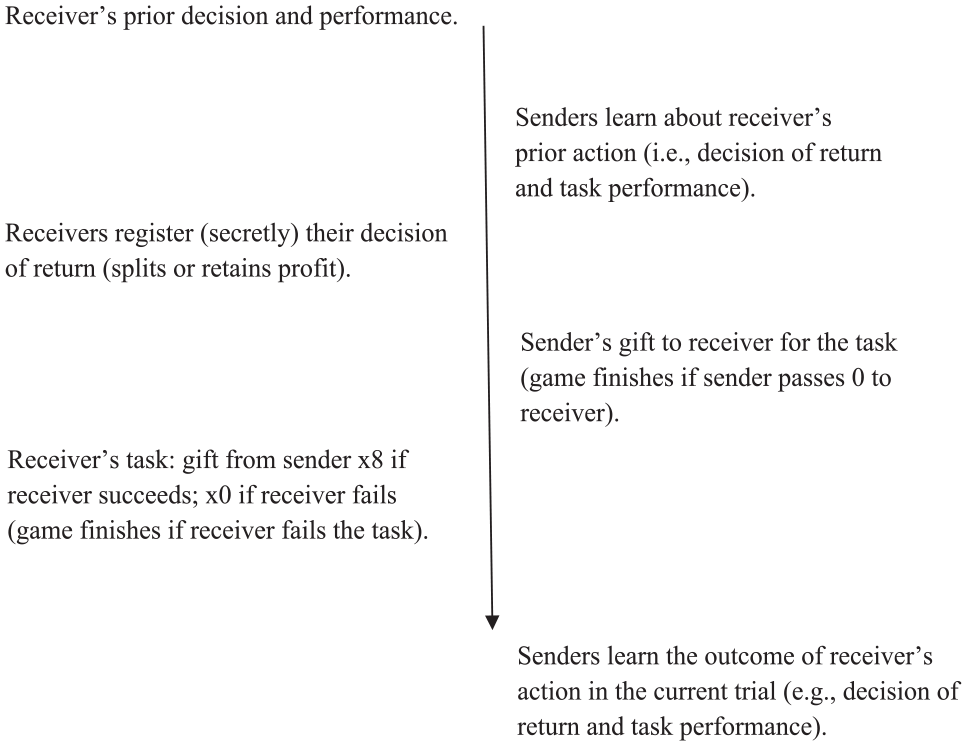
Flow of Modified Trust Game of Study 1.
In this game, the receivers start the game with nothing. The sender decides on how much money to pass to the receiver. If the receiver receives any money from the sender, the receiver needs to complete a competency task: a numerical psychometric puzzle (game will finish if the sender chooses to retain all the money). If the receiver successfully solves the puzzle (i.e., high competence), any amount from the sender will be multiplied by 8. If the receiver fails the task (i.e., low competence), any amount from the sender will be multiplied by 0 (game finishes if the receiver fails this task). We will explain below how the receiver’s prior puzzle performance is used to manipulate the competence level. The receiver’s actual performance in the current trial is only revealed at the end of the game.
Because the competence-related successes are more salient than the mistakes (Reeder & Coovert, 1986), rather than including a task that likely indicates continuous successes after the first success, such as spelling words in the receiver’s native language, we choose a variety of numerical psychometric tests to maintain the possibility of failing this task. In the instructions to the participants, we emphasize that the question is randomly chosen from 1,000 similar questions and provide an example.
At the beginning of the game, we ask the receiver to decide how much money to return to the sender if they later succeed at the psychometric task. The receivers have two choices: sharing half of the profit (i.e., high character) or nothing (i.e., low character). This early decision is made and kept in secret until the end of the game, meaning that the sender only learns the receiver’s actual decision of return alongside the receiver’s task performance, after the receiver’s completion of the competency task. The receiver then shares or retains their profit according to their initial decision. We will explain in the following text how the receiver’s prior choice was used to manipulate the character level.
There are two reasons for asking the receiver to secretly make their decision of return at the beginning of the game. First, an early decision prevents the receiver’s strategic move of faking high character. Without a predetermined decision, the receiver can pretend to split the profit after failing the puzzle. Second, an early decision eases the concern of reciprocation between the players. In the current game, neither the sender nor the receiver knows the actual choice of their counterpart when making their own decision in the ongoing trial, highlighting trust as essential for coping with risk and uncertainty in the situation.
After the sender learns the rules and procedure, to provide a clue about the receiver’s potential character and competence, each sender is presented with the receiver’s prior task performance and decision of return in a classic trust game. Prior to playing the current game, all the participants completed three psychometric questions after a previous lecture and a classic trust game in the role of the receiver in the first half of the current lecture. In summary, before the sender decides how much to invest, they learn about the receiver’s previous task performance and decision. In Table 1, we summarize the sender’s expected payoff (in parentheses) for each euro passing to the receiver in relation to the receiver’s decision of return and task performance and the amount of money passed to the receiver in each condition. The receiver’s low character (retaining the profit) or low competence (failing the task) incurs an equal loss to the sender.
Payoff for Every Euro to the Receiver (in Parentheses) and Amount Passed to the Receiver in Study 1.

Measure
The amount of money passed from the sender serves as the dependent variable.
Results
Analysis of variance (ANOVA) revealed a significant effect of the receiver’s character, F(1, 324) = 28.22, p < .001, ηp2 = 0.08, and its interaction with competence, F(1, 324) = 4.00, p = .046, ηp2 = 0.012, but not competence, F(1, 324) = 3.00, p = .084, ηp2 = 0.009, alone. The participants constantly invested more in the high character receiver regardless of their high (Meanhigh-character = 4.29, SD = 3.28 vs. Meanlow-character = 1.98, SD = 2.61; p < .001, 95% CI [1.43, 3.20]) or low (Meanhigh-character = 3.11, SD = 3.19 vs. Meanlow-character = 2.06, SD = 2.29; p = .019, 95% CI [0.17, 1.93]) competence. The receivers’ high competence resulted in more investment only to the receivers with high (p = .009, 95% CI [0.30, 2.07]) but not low (p = .85, 95% CI [−0.97, 0.80]; see Figure 2) character.
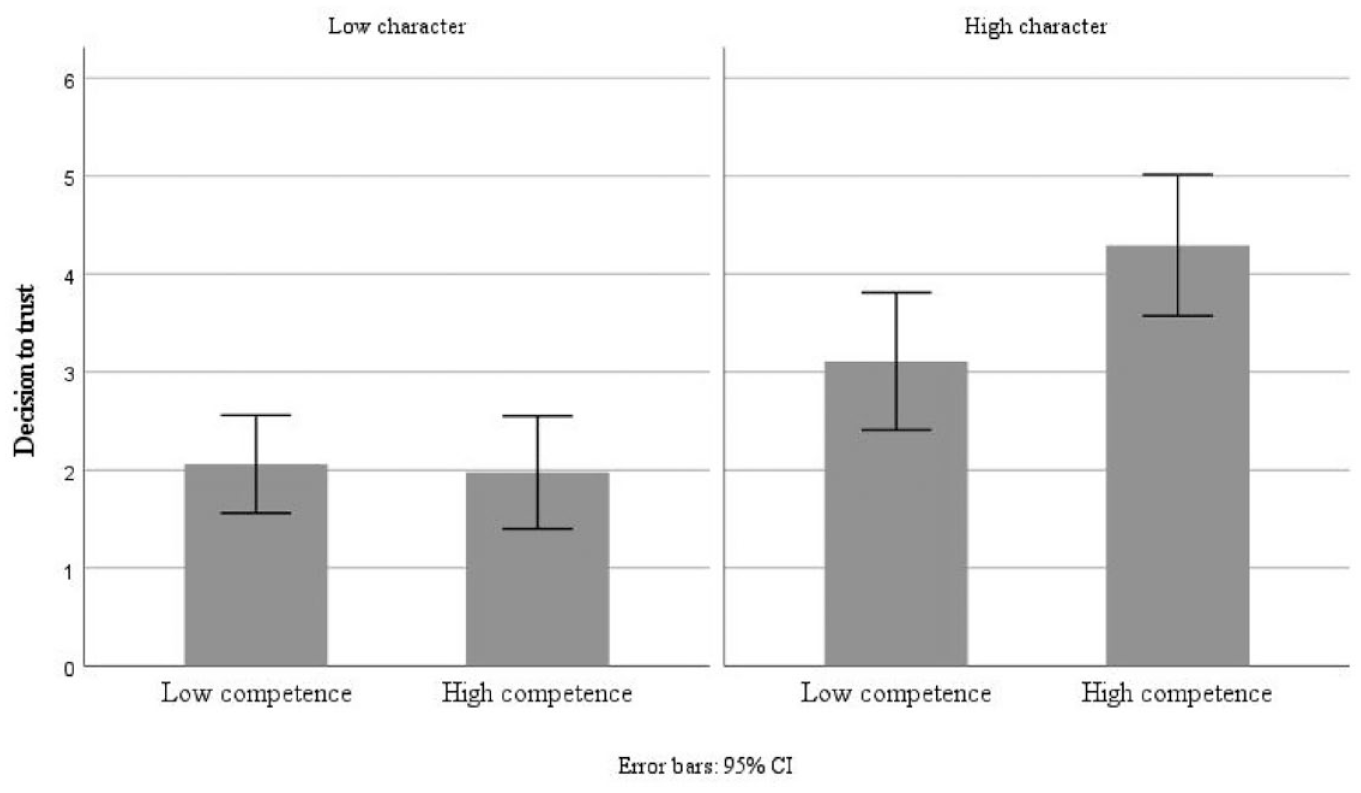
Participants’ Decision to Trust the Receiver in Study 1.
Discussion
High competence, expressed as the repeated technical successes, does not compensate for a lack of high character toward the trustor. The results of Study 1 suggest a moderated effect of competence by character. Low character effectively diminished the relevance of high competence. However, the question remains, whether the trustor’s indifference toward the trustee’s high competence alongside low character is rooted in the trustor’s dismissal or reassessment of the competence information.
Study 2
To examine the cause of the moderation, Study 2 includes the attitudinal measure of trust and the trustors’ perception of the two personal attributes. Furthermore, we balance the strength of the trustee’s character and competence signals by explicitly equalizing the chance of profit sharing and task success in the game. Instead of presenting the receiver’s one-off good intention but repeated successes, Study 2 includes an 80% or 20% chance that the receiver may share their profit and an 80% or 20% success rate at the competency task.
Methods
Participants
We conducted a power analysis in G*Power with four groups to determine that a minimum sample size of 98 was required to observe a medium effect size (f2) of 0.0625 in a between interaction test with two predicting and response variables at 80% power (Faul et al., 2007). The same sampling method is used in the following studies. We aimed to recruit 650 participants from Prolific. 648 participants (N = 161, 160, 164, 163) took part in this study (419 female, 223 male, six unspecified; mean age = 37; 524 White, seven Hispanic or Latino, 25 Black, 41 East or Southeast Asian, 27 South Asian, 16 other, eight unspecified; 99 finished High School; 143 College, 262 University; 114 Masters, 20 PhD, five other, five unspecified). Each participant was paid £1.2 to play this game once. They had a chance to win a £15 lottery upon the completion of the game.
Procedure
Study 2 has a similar procedure as Study 1. Except that each participant was given 10 lottery tickets to start the game. Each ticket represents an entry to a lottery draw of £15. More tickets increase their chance of winning.
At the beginning of the game, the senders are presented with the receiver’s competency performance and decision of return in a series of prior trials. The receivers have previously succeeded at four (i.e., high competence) or one (i.e., low competence) out of the five trials that they played previously. Similarly, the receivers have shared the profit in four (i.e., high character) or one (i.e., low character) of their five prior trials. Same as in Study 1, the receiver then make their decision of return and tackle the competency task if the sender passes any tickets to the receiver. Then, the receiver succeeds at the current trial only if they also have succeeded in four of the five prior trials and shares the profit if they have done so in the prior four trials.
Toward the end, those senders who choose to pass their tickets to the receiver are asked to make a hypothetical decision of how many lottery tickets they would pass if they were to play this game again with the same receiver. We summarize the sender’s expected payoff (in parentheses) and the number of tickets passed to the receiver in Table 2.
Payoff for Every Lottery Ticket to the Receiver (in Parentheses) and the Number of Tickets Passed to the Receiver in Study 2.

Measure
The participants reported their perception of the receiver’s competence (a = 0.96), character (a = 0.91), and their intention to trust the receiver (a = 0.66) before making the ticket decision (Mayer & Davis, 1999; see Appendix).
Results
We present the mean values, standard deviation, and the correlation matrix in Table 3. The participants reported a higher perception of the receiver’s competence when the receiver succeeded at 80% of the prior task, Meanhigh-competence = 5.25, SD = 0.80 vs. Meanlow-competence = 3.14, SD = 1.28; t(543) = 25.12; p < .001, 95% CI [1.94, 2.27], d = 1.97, and a higher perception of character when the receiver chose to split the profit in 80% of the prior games, Meanhigh-character = 3.74, SD = 1.16 vs. Meanlow-character = 2.70, SD = 1.20; t(646) = 11.25; p < .001, 95% CI [0.86, 1.22], d = 0.88.
Descriptive Statistics and Correlations for Measures in Study 2.
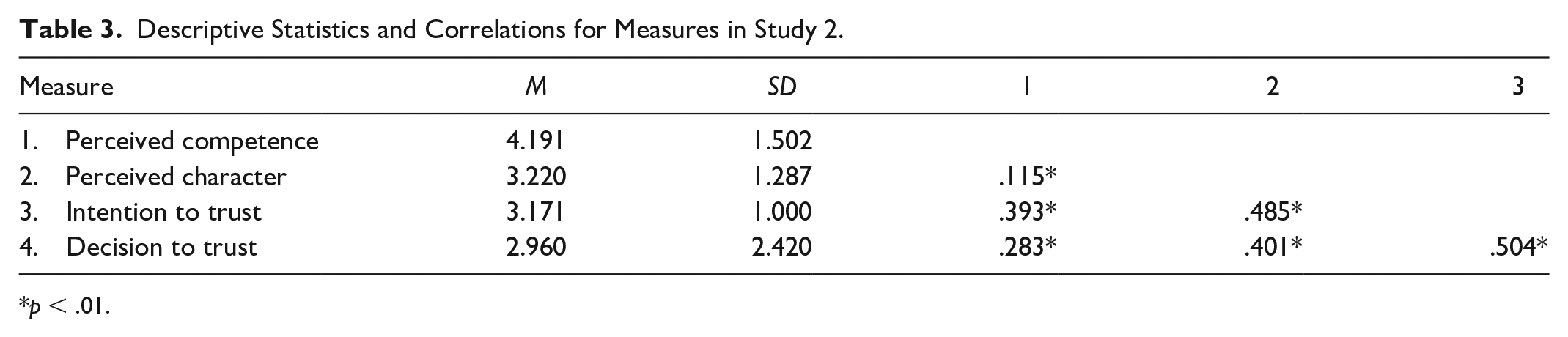
p < .01.
Multivariate analysis of variance (MANOVA) revealed a significant effect of the receiver’s character, F(2, 643) = 29.20, p < .001, ηp2 = 0.083, competence, F(2, 643) = 13.13, p < .001, ηp2 = 0.039, and the interaction, F(2, 643) = 5.74, p = .003, ηp2 = 0.018).
Intention to Trust
We found a significant effect of the receiver’s character, F(1, 644) = 50.55, p < .001, ηp2 = 0.073, competence, F(1, 644) = 26.31, p < .001, ηp2 = 0.039, and the interaction, F(1, 644) = 4.69, p = .01, ηp2 = 0.01, on the participants’ intention to trust the receiver. High character led to a greater intention to trust both the competent (Meanhigh-character = 3.72, SD = 0.88 vs. Meanlow-character = 3.00, SD = 0.94; p < .001, 95% CI: [0.51, 0.92]) and incompetent (Meanhigh-character = 3.15, SD = 0.99 vs. Meanlow-character = 2.81, SD = 0.95; p = .001, 95% CI: [0.13, 0.54]) receiver. Although high competence also increased the participant’s intention to trust the receiver with high character (p < .001, 95% CI: [0.37, 0.77]), its effect was marginal alongside low character (p = .074, 95% CI: [−0.02, 0.39]).
Decision to Trust
We also found a significant effect of the receiver’s character, F(1, 644) = 33.37, p < .001, ηp2 = 0.049, competence, F(1, 644) = 5.63, p = .018, ηp2 = 0.009, and the interaction, F(1, 644) = 9.84, p = .002, ηp2 = 0.015, on the participants’ decision. The participants passed more lottery tickets to the competent receiver with high character (Meanhigh-character = 3.99, SD = 2.59 vs. Meanlow-character = 2.36, SD = 2.25; p < .001, 95% CI [1.13, 2.15]). High character had a weak effect when the participants faced an incompetent receiver (Meanhigh-character = 2.98, SD = 2.19 vs. Meanlow-competence = 2.50, SD = 2.30; p = .062, 95% CI [−0.03, 0.99]). By contrast, high competence only increased trust alongside high character (p < .001, 95% CI [0.50, 1.52]). High competence with low character had no effect on the participant’s decision (p = .59, 95% CI [−0.65, 0.37]).
Moderated Mediation
We tested the mediating role of the sender’s intention on their decision using Model 8, PROCESS macro (Hayes, 2017). The analysis showed a significant effect of the perception of the receiver’s character (b = 0.34, SE = 0.02, p < .001, 95% CI [0.29, 0.39]), competence (b = 0.23, SE = 0.02, p < .001, 95% CI [0.19, 0.27]), and the interaction (b = 0.05, SE = 0.01, p = .002, 95% CI [0.02, 0.08]) on the participant’s intention to trust the receiver. We also found a significant effect of character (b = 0.41, SE = 0.07, p < .001, 95% CI [0.27, 0.55]), competence (b = 0.22, SE = 0.06, p = .002, 95% CI [0.10, 0.33]), the intention to trust the receiver (b = 0.80, SE = 0.10, p < .001, 95% CI [0.61, 1.00]), and the interaction between the perceptions of character and competence (b = 0.14, SE = 0.04, p = .003, 95% CI: [0.06, 0.21]) on the participant’s decision. The bootstrapped 95% CI [0.02, 0.07] for the index of moderated mediation (index = 0.04, SE = 0.01) indicates that indirect effect of competence on the participant’s decision is conditioned on the character.
Furthermore, Johnson–Neyman procedure (Johnson & Neyman, 1936) suggested that competence had a significant effect on the decision only when the perception of character was greater than −0.71 below its mean (b = 0.12, SE = 0.06, p = .05, 95% CI [0.00, 0.24]). We visualize the interaction through the plot of their marginal effects (ceteris paribus) in Figure 3. The pattern in the plot shows a more consistent and stronger preference of high character (slope of the curve), whereas the effect of competence has a significant gradient effect alongside the increase of character.
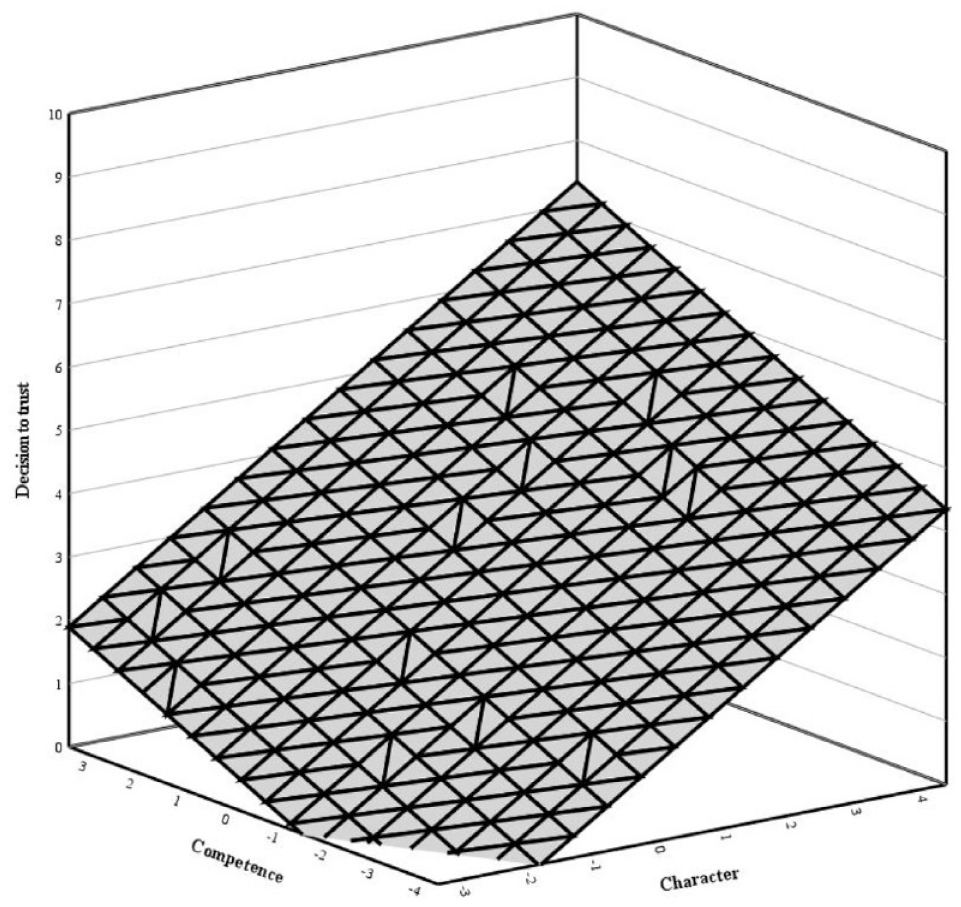
Marginal Effect Plot of Perceived Competence (Mean Centered) and Character (Mean Centered) on the Participant’s Decision in Study 2.
Hypothetical Decision
500 participants passed at least one ticket to the receiver for the competency task, which allowed these participants to review the receiver’s performance and decision of return in the current trial. The receiver’s character, F(1, 496) = 152.32, p < .001, ηp2 = 0.235, competence, F(1, 496) = 81.27, p < .001, ηp2 = 0.141, and the interaction, F(1, 496) = 57.92, p < .001, ηp2 = 0.105, all had a significant effect on the participant’s potential choice in future. High character positively affected the hypothetical decision regardless of the receiver’s high (Meanhigh-character = 5.92, SD = 2.54 vs. Meanlow-character = 1.74, SD = 2.35; p < .001, 95% CI: [3.60, 4.77]) or low (Meanhigh-character = 2.44, SD = 2.22 vs. Meanlow-character = 1.44, SD = 2.19; p < .001, 95% CI: [0.41, 1.57]) competence. However, high competence only affected the participant’s future decision when the receiver demonstrated high (p < .001, 95% CI: [2.93, 4.04]) rather than low (p = .342, 95% CI: [−0.31, 0.90]; see Figure 4) character.
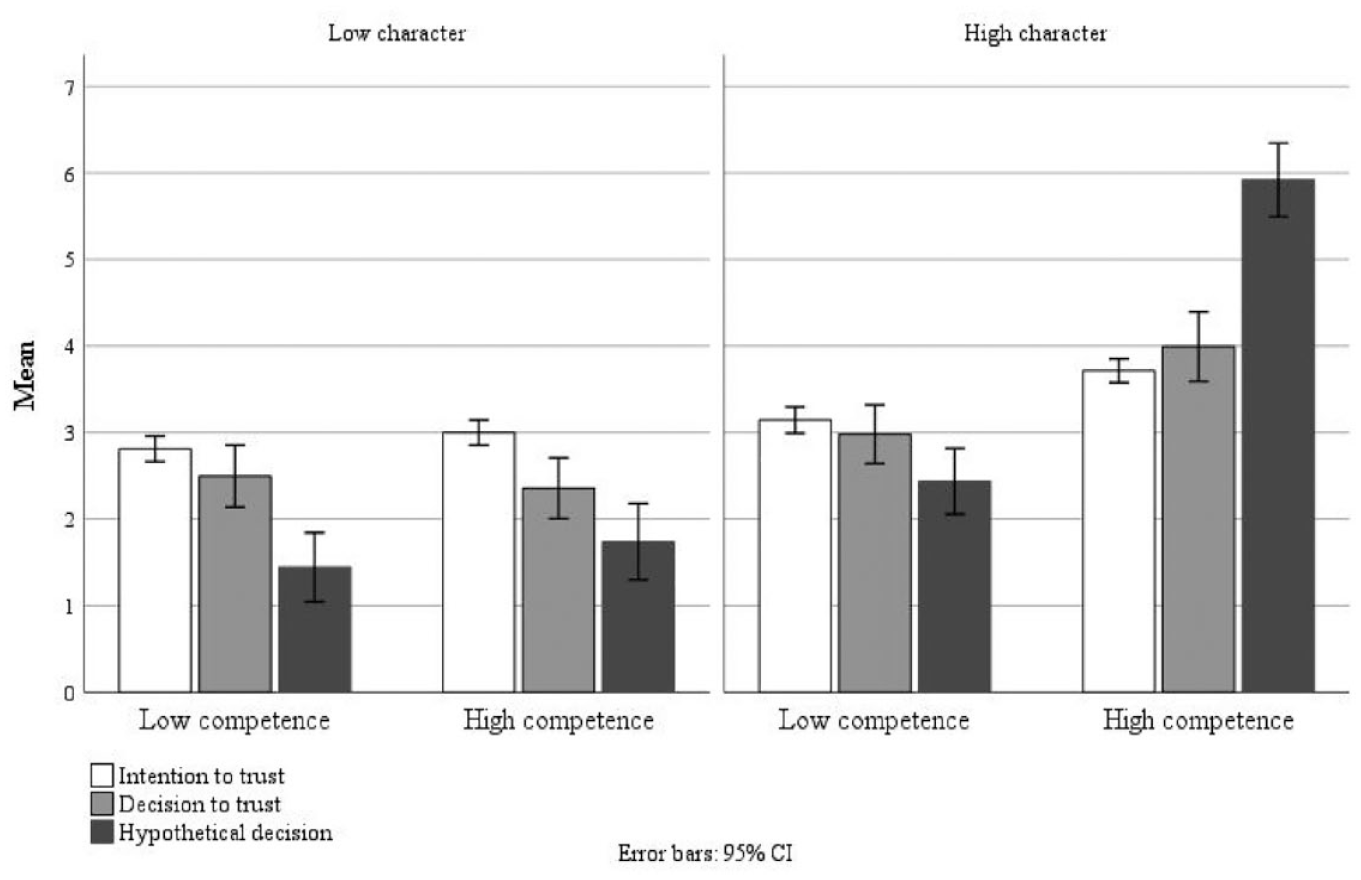
Participant’s Intention and Decision to Trust the Receiver in Study 2.
Discussion
Both the attitudinal and behavioral measures in Study 2 indicate that the reassessment of the trustee’s competence is the cause of the moderation relationship. Whereas high competence alone can be insignificant to the trustor’s decision, its effect on trust can be multiplied by high character.
In addition, the results of the hypothetical decision reveal, in relation to developing or continuing trust, reinforcing the positive feature of one attribute (character or competence) does not compensate for the decreasing positivity in the other. This finding highlights the importance of both the high character and competence to high trust.
Finally, although there is a drastic rise of the trust decision after directly experiencing high character and competence, we cannot rule out its cause to be the participant’s low-risk gambling given the hypothetical nature of this choice. Study 3 proceeds to examine the longer term implication of the moderation.
Study 3
Study 3 contains two trials. In the first trial, the participants observe the previous action of the receiver. However, different from Studies 1 and 2 which both highlight the consistency of the receiver’s competence, Study 3 only provide the receiver’s task performance (and decision of return) from one prior trial. The participants who choose to continue the relationship after the first trial will then experience the outcome of the receiver’s action and report their intention and decision to trust in the second trial.
Methods
Participants
We recruited 1,000 (N = 250, 250, 250, 250) participants (563 female, 425 male, 12 unspecified; mean age = 34; 767 White, 14 Hispanic or Latino, 38 Black, 77 East or Southeast Asian, 52 South Asian, 37 other, 15 unspecified; 187 finished High School; 247 College, 387 University; 138 Masters, 20 PhD, 15 other, six unspecified) from Prolific. Each participant was paid £0.63 to play this game. They had a chance to win two £15 lottery prizes upon the completion of the game.
Procedure
Study 3 has a similar procedure as Study 2. Except that each sender had a chance to play this game twice and was given 10 lottery tickets for each of the two trials. In the first trial, which we call the observation trial, the senders are presented with the receiver’s task performance and decision of return in a prior trial. The receiver then makes their decision of return and tackles the competency task upon receiving any tickets from the sender. The receiver’s actual decision and task performance are the same as in their prior trial. The senders who choose to pass at least one ticket to the receiver then repeat the game with the same receiver in the second trial, which we call the experience trial. We summarize the sender’s expected payoff (in parentheses) and the number of tickets passed to the receiver in each trial in Table 4.
Payoff for Every Ticket to the Receiver (in Parentheses) and Number of Tickets Passed to the Receiver in Study 3.

Measure
The participants reported their perception of the receiver’s competence (aobservation = 0.93; aexperience = 0.98), character (aobservation = 0.91; aexperience = 0.96), and their intention to trust the receiver (aobservation = 0.63; aexperience = 0.73) before making their ticket decision in each trial (Mayer & Davis, 1999).
Results
Observation Trial
We present the means, standard deviation and the correlation matrix in Table 5. The participants reported a higher perception of the receiver’s competence when the receiver succeeded at the prior task, Meanhigh-competence = 5.15, SD = 0.81 vs. Meanlow-competence = 3.43, SD = 1.03; t(947) = 29.18; p < .001, 95% CI [1.60, 1.83], d = 1.85, and character when the receiver chose to split the profit in the prior game, Meanhigh-character = 3.91, SD = 1.11 vs. Meanlow-character = 2.94, SD = 1.21; t(990) = 13.09; p < .001, 95% CI [0.82, 1.11], d = 0.83.
Descriptive Statistics and Correlations for Measures in Study 3.
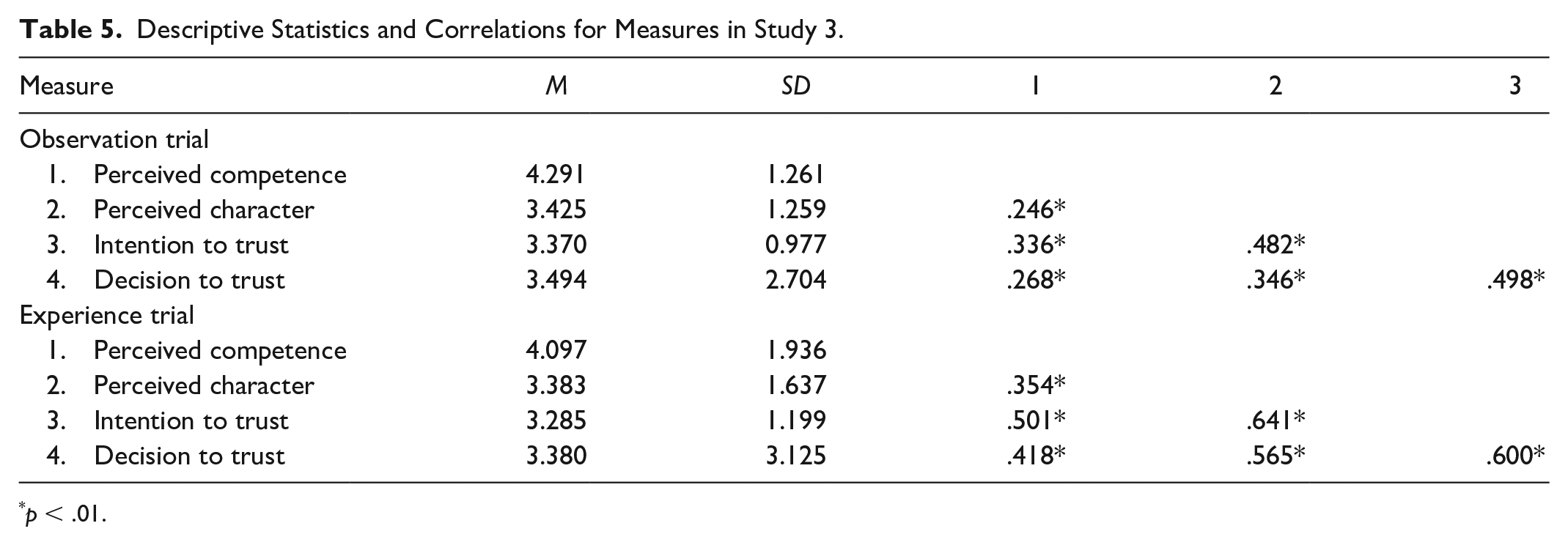
p < .01.
MANOVA revealed a significant effect of the receiver’s character, F(2, 995) = 48.59, p < .001, ηp2 = 0.089, competence, F(2, 995) = 11.22, p < .001, ηp2 = 0.022, and the interaction, F(2, 995) = 6.99, p < .001, ηp2 = 0.014.
Intention to Trust
We found a significant effect of the receiver’s character, F(1, 996) = 70.02, p < .001, ηp2 = 0.066, competence, F(1, 996) = 20.64, p < .001, ηp2 = 0.02, and the interaction, F(1, 996) = 4.88, p = .027, ηp2 = 0.005, on the participants’ intention to trust their receiver. High character consistently increased the participant’s intention to trust the receiver despite high (Meanhigh-character = 3.82, SD = 0.91 vs. Meanlow-character = 3.19, SD = 0.90; p < .001, 95% CI [0.46, 0.79]) or low (Meanhigh character = 3.42, SD = 0.91 vs. Meanlow-character = 3.05, SD = 1.02; p < .001, 95% CI [0.20, 0.53]) competence. However, high competence only increased trust when the receiver had high (p < .001, 95% CI: [0.24, 0.56]) rather than low (p = .099, 95% CI [−0.03, 0.30]) character.
Decision to Trust
We also found a significant effect of the receiver’s character, F(1, 996) = 71.16, p < .001, ηp2 = 0.067, competence, F(1, 996) = 10.58, p = .001, ηp2 = 0.011, and the interaction, F(1, 996) = 13.63, p < .001, ηp2 = 0.014, on the participant’s decision. Corresponding to their intention, the participants passed more tickets to the receiver with high character despite the receiver’s high (Meanhigh-character = 4.75, SD = 2.60 vs. Meanlow-character = 2.77, SD = 2.49; p < .001, 95% CI [1.53, 2.44]) or low (Meanlow-character = 3.62, SD = 2.64 vs. Meanlow-character = 2.84, SD = 2.62; p = .001, 95% CI [0.32, 1.23]) competence. High competence only increased trust in the receiver with high (p < .001, 95% CI [0.68, 1.59]) but not low (p = .756, 95% CI [−0.53, 0.38]) character.
Experience Trial
A total of 793 participants proceeded to the experience trial. They reported a more positive perception of the receiver’s competence after experiencing a success at the competency task, Meanhigh-competence = 5.72, SD = 0.87 vs. Meanlow-competence = 2.37, SD = 1.05; t(747) = 48.74; p < .001, 95% CI [3.22, 3.49], d = 3.48, and a more positive perception of character after their receiver chose to split the profit, Meanhigh-character = 4.31, SD = 1.31 vs. Meanlow-character = 2.25, SD = 1.23; t(791) = 22.62; p < .001, 95% CI [1.88, 2.24], d = 1.62.
MANOVA revealed a significant effect of the receivers’ character, F(2, 788) = 133.82, p < .001, ηp2 = 0.254, competence, F(2, 788) = 77.57, p < .001, ηp2 = 0.164, and the interaction, F(2, 788) = 36.78, p < .001, ηp2 = 0.085.
Intention to Trust
We found a significant effect of the receivers’ character, F(1, 789) = 199.16, p < .001, ηp2 = 0.202, competence, F(1, 789) = 128.58, p < .001, ηp2 = 0.14, and the interaction, F(1, 789) = 29.86, p < .001, ηp2 = 0.036. The participants expressed greater intention to trust the receiver with high character despite their high (Meanhigh-character = 4.30, SD = 0.96 vs. Meanlow-character = 2.93, SD = 0.95; p < .001, 95% CI [1.18, 1.57]) or low (Meanhigh-character = 3.12, SD = 1.00 vs. Meanlow-character = 2.51, SD = 1.03; p < .001, 95% CI [0.41, 0.81]) competence. The participants also expressed greater trust in the receiver with high competence despite their high (p < .001, 95% CI [1.00, 1.37]) or low (p < .001, 95% CI [0.21, 0.62]) character.
Decision to Trust
We found a significant effect of the receiver’s character, F(1, 789) = 179.54, p < .001, ηp2 = 0.185, competence, F(1, 789) = 88.48, p < .001, ηp2 = 0.101, and the interaction, F(1, 789) = 68.68, p < .001, ηp2 = 0.08, on the participant’s decision. The participants passed more tickets to the receiver with high character despite their high (Meanhigh-character = 6.06, SD = 2.64 vs. Meanlow-character = 2.06, SD = 2.52; p < .001, 95% CI [3.50, 4.51]) or low (Meanhigh-character = 2.80, SD = 2.48 vs. Meanlow-character = 1.86, SD = 2.67; p < .001, 95% CI [0.43, 1.46]) competence. However, high competence only increased ticket when the receiver had high (p < .001, 95% CI [2.78, 3.75]) but not low (p = .45, 95% CI [−0.33, 0.74]; see Figure 5) character.
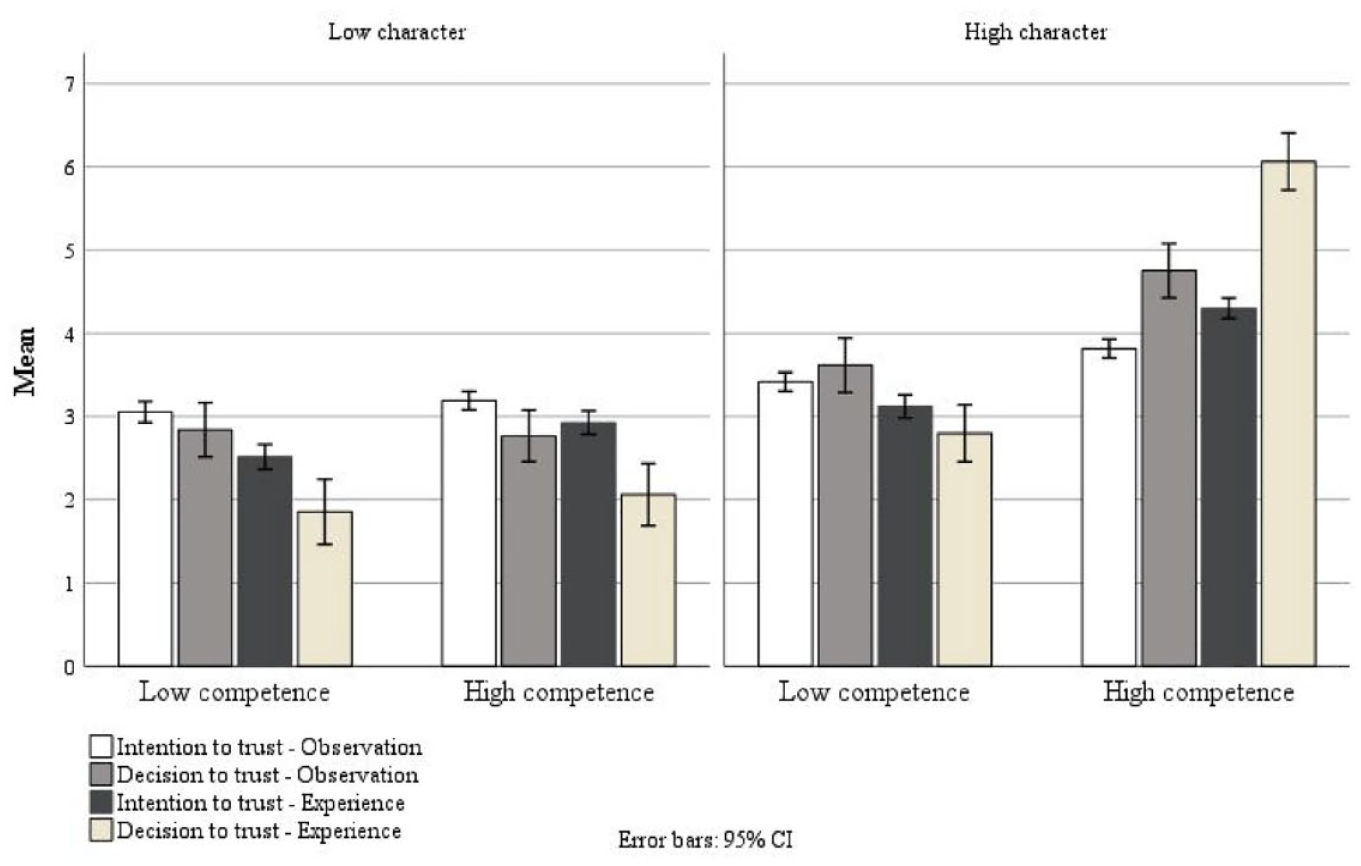
Participant’s Intention and Decision to Trust the Receiver in Study 3.
Moderated Mediation
With the same method as in Study 2, we found a significant effect of competence (b = 0.21, SE = 0.02, p < .001, 95% CI [0.17, 0.24]), character (b = 0.37, SE = 0.02, p < .001, 95% CI [0.33, 0.41]), and the interaction (b = 0.04, SE = 0.01, p < .001, 95% CI [0.02, 0.06]) on the participant’s intention to trust the receiver. We also found a significant effect of competence (b = 0.28, SE = 0.05, p < .001, 95% CI [0.19, 0.38]), character (b = 0.54, SE = 0.07, p < .001, 95% CI [0.41, 0.67]), the intention to trust (b = 0.80, SE = 0.10, p < .001, 95% CI [0.60, 0.99]), and the interaction between character and competence (b = 0.12, SE = 0.02, p < .001, 95% CI: [0.07, 0.17]) on the participant’s decision. The bootstrapped 95% CI [0.02, 0.05] for the index of moderated mediation (index = 0.03, SE = 0.01) indicates that indirect effect of competence on the decision is conditioned on character. Johnson–Neyman procedure (Johnson & Neyman, 1936) revealed only when the character was greater than −1.47 below its mean, competence started to significantly affect the decision (b = 0.11, SE = 0.06, p = .05, 95% CI [0.00, 0.22]). We visualize the interaction in Figure 6.
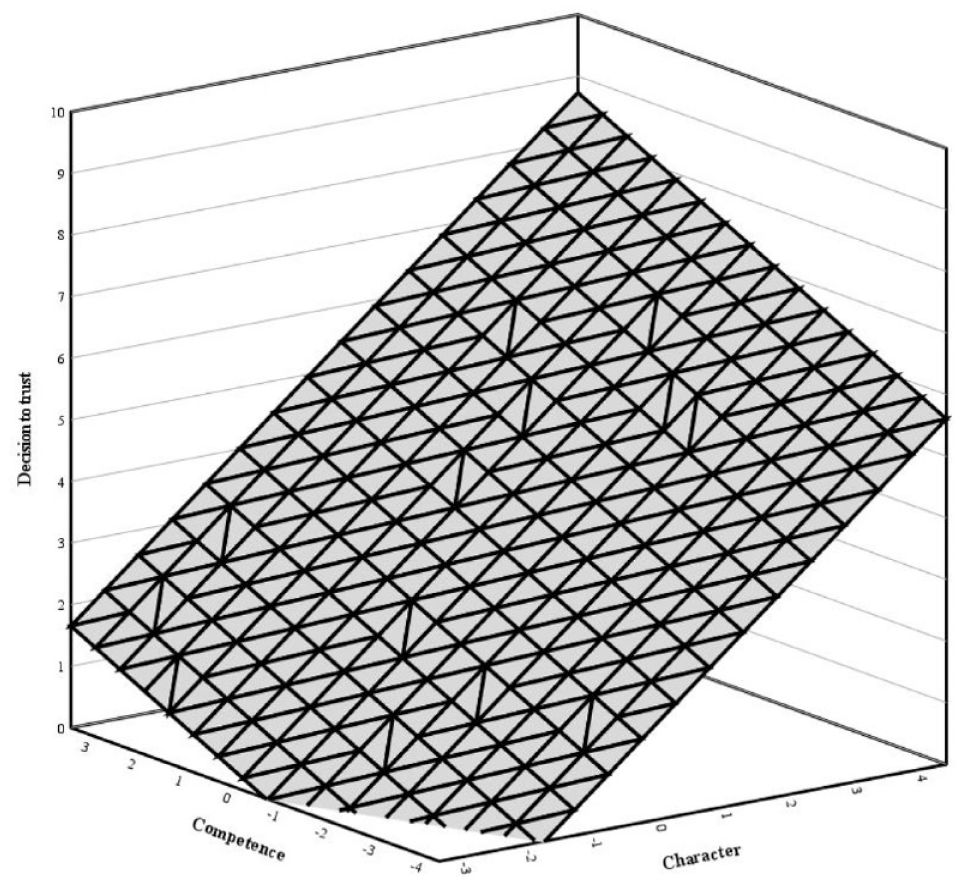
Marginal Effect Plot of the Perceived Competence (Mean Centered) and Character (Mean Centered) on the Participant’s Final Decision in Study 3.
Discussion
Study 3 confirms that the moderation between character and competence underlies not just the development but also the continuation of trust after the initial contact with the trustee. Altogether, three studies find consistent evidence to support Hypothesis 1. We proceed to examine whether situational assurance can substitute for the role of high character in Study 4.
Study 4
Study 4 includes a control mechanism that reduces the participant’s loss from the receiver’s low character. The receivers choose between sharing half and a quarter of their profit with the participants in Study 4. Hence, the participants only lose their gift to the receiver upon the receiver failing the competency task.
Methods
Participants
We recruited 500 (N = 118, 134, 122, 126) participants (225 female, 271 male, four unspecified; mean age = 41; 342 White, 21 Hispanic or Latino, 52 Black, 48 East or Southeast Asian, 21 South Asian, 10 other, six unspecified; 81 finished High School; 85 College, 211 University; 107 Masters, 10 PhD, four other, two unspecified) from Prolific. The participants were paid the same as in Study 3.
Procedure
Same as in Study 3, the senders first observe and then experience the receiver’s task performance and decision of return in two separate trials. In Study 4, the receiver’s decision of return is confined to sharing half (1/2) or a quarter (1/4) of the profit. The implication of the receiver’s task performance remains the same. Therefore, only low competence cancels the payoff of the sender. We summarize the participant’s expected payoff (in parentheses) and the number of tickets passed in Table 6.
Payoff for Every Ticket to the Receiver (in Parentheses) and Actual Number of Tickets Passed to the Receiver in Study 4.

Measure
The participant reported their perception of the receiver’s competence (aobservation = 0.96; aexperience = 0.98), character (aobservation = 0.91; aexperience = 0.93), and their intention to trust the receiver (aobservation = 0.72; aexperience = 0.78) before making the ticket decision in each trial (Mayer & Davis, 1999).
Results
Observation Trial
We present the means, standard deviation and the correlation matrix in Table 7. The participants reported a higher perception of the receiver’s competence when the receiver succeeded at the prior competency task, Meanhigh-competence = 5.45, SD = 0.84 vs. Meanlow-competence = 3.65, SD = 1.36, t(418) = 17.91; p < .001, 95% CI [1.61, 2.00], d = 1.60. The participant’s perception of receiver’s character remained similar in both conditions, Meanhigh-character = 4.18, SD = 1.28 vs. Meanlow-character = 4.02, SD = 1.42, t(498) = 1.35, p = .178, 95% CI [−0.07, 0.40], d = 0.12. In the observation trial, the supposedly higher character of the receiver did affect the participant’s perception if low character caused no loss.
Descriptive Statistics and Correlations for Measures in Study 4.
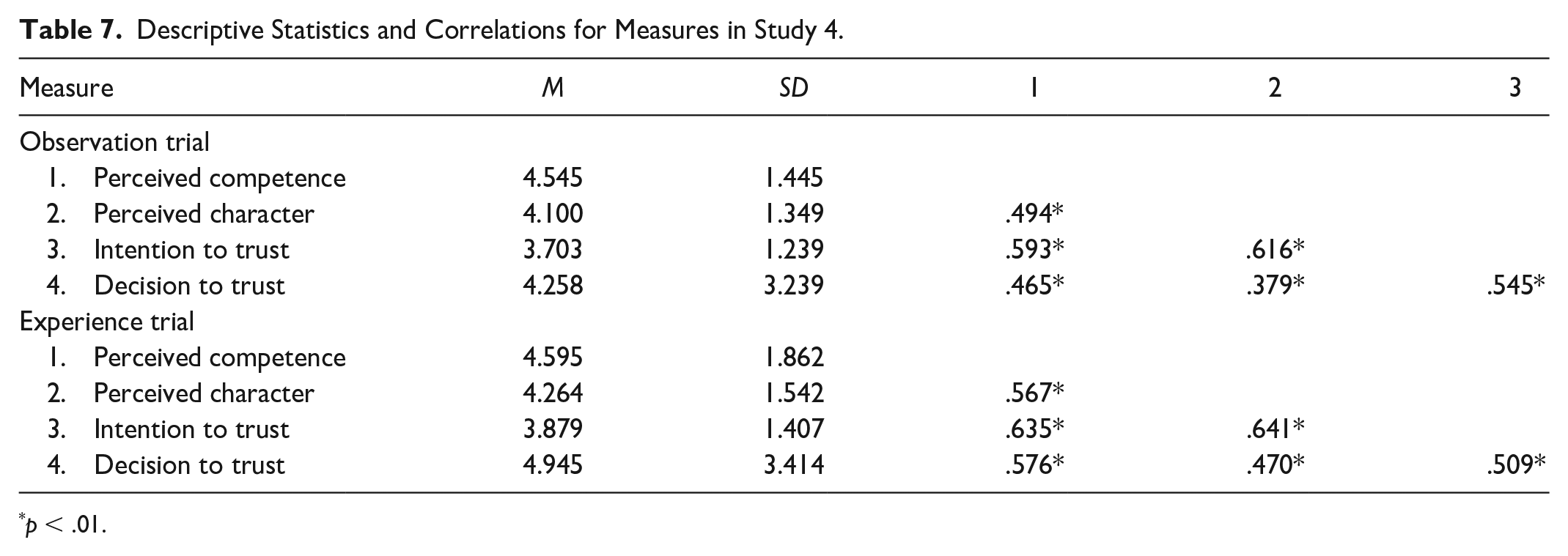
p < .01.
MANOVA revealed a significant effect of the receiver’s competence, F(2, 495) = 24.44, p < .001, ηp2 = 0.09, but not character, F(2, 495) = 2.17, p = .116, ηp2 = 0.009, or the interaction, F(2, 495) = 0.062, p = .94, ηp2 < 0.001.
Intention to Trust
We found a significant effect of the receiver’s competence, F(1, 496) = 45.59, p < .001, ηp2 = 0.084 and character, F(1, 496) = 3.99, p = .046, ηp2 = 0.008, but not the interaction, F(1, 496) = 0.008, p = .927, ηp2 < 0.001, on the participant’s intention to trust the receiver. High character had no effect on the participant’s intention despite the receiver’s high (Meanhigh-character = 4.17, SD = 1.14 vs. Meanlow-character = 3.95, SD = 1.20; p = .141, 95% CI [−0.07, 0.52]) or low (Meanhigh-character = 3.44, SD = 1.16 vs. Meanlow-character = 3.24, SD = 1.24; p = .177, 95% CI [−0.09, 0.50]) competence. By contrast, high competence consistently increased trust despite high (p < .001, 95% CI [0.44, 1.02]) or low (p < .001, 95% CI [0.41, 1.01]) character.
Decision to Trust
We found a significant effect of competence, F(1, 496) = 25.47, p = .001, ηp2 = 0.049, but not character, F(1, 496) = 2.34, p = .127, ηp2 = 0.005, or the interaction, F(1, 496) = 0.06, p = .806, ηp2 < 0.001, on the participant’s decision. High character had no effect despite high (Meanhigh-character = 5.15, SD = 3.09 vs. Meanlow-character = 4.79, SD = 3.22; p = .365, 95% CI [−0.43, 1.15]) or low (Meanhigh-character = 3.79, SD = 3.13 vs. Meanlow-character = 3.29, SD = 3.21; p = .208, 95% CI [−0.28, 1.29]) competence. However, high competence consistently increased the tickets despite high (p < .001, 95% CI [0.59, 2.13]) or low (p < .001, 95% CI [0.70, 2.30]) character.
Experience Trial
A total of 403 participants entered the second stage of the game. The participants reported a more positive perception of the receiver’s competence after experiencing a success at the competency task, Meanhigh-competence = 5.92, SD = 0.81 vs. Meanlow-competence = 3.07, SD = 1.54; t(272) = 22.79, p < .001, 95% CI [2.60, 3.10], d = 2.37. Different form the observation trial, they also differentiated between the two character conditions by reporting a higher perception of the receivers’ character when the receivers shared half of the profit, Meanhigh-character = 4.45, SD = 1.51 vs. Meanlow-character = 4.05, SD = 1.55; t(401) = 2.58, p = .01, 95% CI [0.09, 0.70], d = 0.26.
MANOVA revealed a significant effect of competence, F(2, 398) = 67.34, p < .001, ηp2 = 0.253, and character, F(2, 398) = 6.23, p = .002, ηp2 = 0.03, but not the interaction, F(2, 398) = 0.04, p = .964, ηp2 < 0.001.
Intention to Trust
We found a significant effect of competence, F(1, 399) = 93.08, p < .001, ηp2 = 0.189, and character, F(1, 399) = 8.33, p = .004, ηp2 = 0.02, but not the interaction, F(1, 399) = 0.002, p = .963, ηp2 < 0.001. The receiver’s high character had a significant effect alongside high competence (Meanhigh-character = 4.62, SD = 1.28 vs. Meanlow-character = 4.25, SD = 1.17; p = .032, 95% CI [0.03, 0.71]) and a weak effect alongside low (Meanhigh-character = 3.39, SD = 1.40 vs. Meanlow-character = 3.03, SD = 1.16; p = .054, 95% CI [−0.006, 0.72]) competence. High competence also increased trust despite high (p < .001, 95% CI [0.89, 1.56]) or low (p < .001, 95% CI [0.85, 1.58]) character.
Decision to Trust
We found a significant effect of competence, F(1, 399) = 93.85, p < .001, ηp2 = 0.19, and character, F(1, 399) = 8.95, p = .003, ηp2 = 0.022, but not the interaction, F(1, 399) = 0.052, p = .819, ηp2 < 0.001, on the participant’s decision. High character increased the number of tickets to the competent (Meanhigh-character = 6.71, SD = 2.90 vs. Meanhigh-character = 5.86, SD = 2.83; p = .043, 95% CI [0.03, 1.67]) and incompetent receiver (Meanhigh-character = 3.81, SD = 3.32 vs. Meanlow-character = 2.82, SD = 3.21; p = .029, 95% CI [0.10, 1.87]). The receiver’s high competence had a similar positive effect despite high (p < .001, 95% CI [2.09, 3.72]) or low (p < .001, 95% CI [2.15, 3.93]; see Figure 7) character.
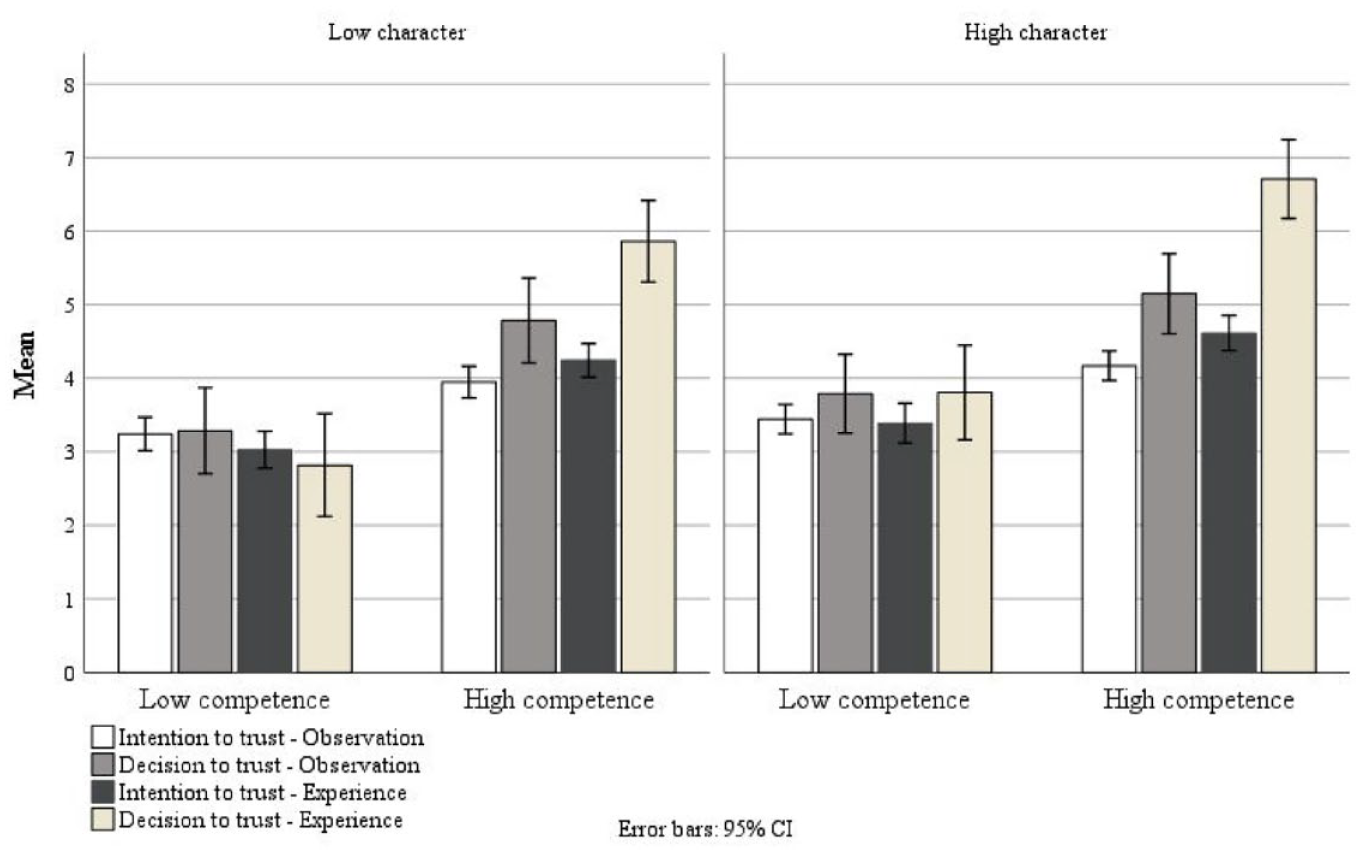
Participants’ Intention and Decision to Trust the Receiver in Study 4.
Discussion
Through clarifying the goal orientation of the trustee, either via character or the situational cues, competence can function as an independent and additive source of trust. The results of Study 4 highlight the relevance of the external intervention mechanisms, such as monitoring or insurance, as a substitute for the personal attributes, to trust.
General Discussion
Carrier and colleagues (2019) reveal that, if the target person is expected to cooperate with the perceiver, the target’s high competence can further inflate the perception of character. That is, the equivalent character of a competent partner is considered more positive than that of an incompetent counterpart. Because cooperation is essential to the trustor’s relationship with the trustee, the combination of the latter’s high competence and low character is meant to be seen as equally, if not more, trustworthy than that of low competence and high character in an additive relationship. Considering the above finding, our opposite findings are particularly rigorous and relevant. Despite an additive framework being widely accepted in trust research (Mayer et al., 1995; McKnight et al., 1998), we hypothesize and find a moderation relationship between the key antecedents of trust. Our results suggest that the moderating effect of character is more prominent than the spill-over from high competence in the overall perceptions and decisions. Without clarifying the goal orientation of the trustee, the trustee’s greater competence could have a reduced value to the trustor.
However, by advocating the moderating role of character, we are not claiming that character is always more important and dismissing the role of competence. High competence is crucial for building high trust. As our studies show, the positive effect of competence can be magnified by the trustee’s high character. For people seeking trustworthy individuals, an over-emphasis on character may lead to ignoring the actual competence needed for the task. For instance, the recent resurgence of measles in some of the most developed economies provides a warning that misplacing trust in the inept source can jeopardize the campaign against the deadliest yet preventable issues facing the humanity (Roberts, 2019).
Besides the systematic bias toward an additive transformation, the potential theory-ladenness of the survey responses and its following scientific process offers another explanation of the prior additive results in the trust research (Brewer & Lambert, 2001; Estany, 2001). Survey respondents are often unable to differentiate between the distinct aspects of the attitudinal measures and rate them independent of each other. For instance, those who trust in one attribute may pursue more reasons to trust the person further. Even in our studies that orthogonally configure these attributes, the aggregated measures remain positively correlated. Hence, although we encourage a better conceptual integration of the trustee’s character and competence, we also emphasize the necessary distinction between the two variables for the research subjects and in the subsequent empirical testing process.
Furthermore, the current research also reveals the situations when the effects of the personal attributes can be additive and independent of each other (Landy et al., 2016). If the control mechanism serves to protect the perceiver’s interests, high competence may compensate for low character. Given the popularity of the situational cues and the danger of misattributing the compliant behavior to the personal cause (Schweitzer et al., 2018), differentiating between the effect of situational and personal cues should be a key consideration in the future research.
Methodologically, our modification of the trust game provides an opportunity to manipulate and measure the various trust-related variables such as competence and risk level, in addition to character as in the classic trust game. As our studies demonstrate, high character is a crucial but not exclusive source of trust. One may modify or replace the competency task and its associated rewarding mechanism to suit the purposes of one’s research. For instance, a memory related task may be useful for further differentiating between the effect of experience and cognitive ability that are currently discussed under the same label of competence.
Limitations and Future Directions
The current research finds no evidence that demonstrating competence may harm trust. However, based on the stalled effect of high competence alongside low character, we may reasonably infer that a negative character (instead of low character) can render the greater competence of the trustee harmful. According to the social cognition research, negative information is not just more potent than the equivalent positive information, the combination of negative and positive information is also perceived as more negative than when they are judged separately (Morewedge, 2009; Rozin & Royzman, 2001). Therefore, distrust may grow disproportionately out of the combination of high competence and negative intention.
Second, although Study 3 suggests that the moderation effect of character is not confined to the development of initial trust, we focus primarily on the early stage of the relationship. Future research may study whether and how long the moderating effect of character persists. For instance, the prior research on the reinforcement learning reveals a gradually changing preference of the wealthier counterparts, who are more capable of delivering the rewards, over the more generous counterparts who are less capable but more willingness to do so (Hackel & Zaki, 2018). Understanding the dynamic interplay between the trustee’s key attributes over time is an important next step.
Third, we call for the research on the interaction between more specific aspects of the trustee’s character and competence. For instance, although the longitudinal data find that integrity, a subset of character, is unrelated to the early trust building process (van der Werff & Buckley, 2017), the contradiction between the integrity and benevolence related concerns, such as fairness and disloyalty, may have implications on the trustor’s decision. Similarly, the future studies may test whether the moderated effect of competence on trust remains when the various competence-related features (e.g., expertise vs. intelligence) contradict each other.
Finally, in the current work, we limit our discussion to the cognitive inference of trust. In addition to the cognitive foundation, trust may arise from the emotional and affective bases (Lewis & Weigert, 1985). Given the close link between the character judgment and affective response (Casciaro & Lobo, 2008; McAllister, 1995; Trafimow et al., 2005), it is possible that a strong affective bond between the trustor and trustee eases the character concern, resulting in a prioritization of the competence cues. These hunches can be tested in the future research.
Footnotes
Appendix
Perceived competence measure (1. Strongly disagree to 7. Strongly agree)
Trusteea is very capable of performing his/er task.b
Trustee has the knowledge about the task that needs done.
I feel very confident about trustee’s skills.
Trustee is known to be successful at the task s/he tries to do.
Trustee has specialized capabilities that can increase our performance in this task.
Trustee is well qualified for the task.
Perceived character measure (1. Strongly disagree to 7. Strongly agree)
My needs and desires in this task are important to trustee.
Trustee would not knowingly do things to disadvantage me.
Trustee looks out for what is beneficial to me in this task.
Trustee goes out of his/er way to help me in this task.
Trustee is concerned about my welfare in this task.
Intention to trust measure (1. Strongly disagree to 7. Strongly agree)
I wouldn’t let trustee has any influence over the choices that are important to me in this task.c
I would be willing to let trustee has complete control over my interest in this task.
I would be comfortable giving trustee a task or problem which was critical to me in this task, even if I could not monitor his/er actions.
I would keep an eye on trustee in this task.c
a Appellation of the trustee.
b Name of the task.
c Reverse coded.
Declaration of Conflicting Interests
The author(s) declared no potential conflicts of interest with respect to the research, authorship, and/or publication of this article.
Funding
The author(s) disclosed receipt of the following financial support for the research, authorship, and/or publication of this article: This research was supported by the seed fund from DCU Business School.
