




Abstract
We propose that deviancy aversion—people’s domain-general discomfort toward the distortion of patterns (repeated forms or models)—contributes to the strength and prevalence of social norms in society. Five studies (N = 2,390) supported this hypothesis. In Study 1, individuals’ deviancy aversion, for instance, their aversion toward broken patterns of simple geometric shapes, predicted negative affect toward norm violations (affect), greater self-reported norm following (behavior), and judging norms as more valuable (belief). Supporting generalizability, deviancy aversion additionally predicted greater conformity on accuracy-orientated estimation tasks (Study 2), adherence to physical distancing norms during COVID-19 (Study 3), and increased following of fairness norms (Study 4). Finally, experimentally heightening deviancy aversion increased participants’ negative affect toward norm violations and self-reported norm behavior, but did not convincingly heighten belief-based norm judgments (Study 5). We conclude that a human sensitivity to pattern distortion functions as a low-level affective process that promotes and maintains social norms in society
Social norms—shared standards of how people should and do behave (e.g., Bicchieri, 2005; Fehr & Fischbacher, 2004b; Sherif, 1936)—are a foundation of human society. Reciprocity, loyalty, and honesty norms all support large-scale cooperation which is essential for societal functioning (e.g., Bicchieri, 2005). Perhaps unsurprisingly then, psychological research has focused heavily on understanding social norms; “social scientists . . . invoke no other concept more frequently than that of ‘norms’” (Fehr & Fischbacher, 2004b, p. 63; Sills, 1968).
Yet, despite the importance and in-depth study of social norms, the affective and cognitive processes enabling a species to develop and enforce social norms remain largely unknown (e.g., Buckholtz & Marois, 2012; Coleman, 1990; Elster, 1989; Fehr & Fischbacher, 2004a, 2004b). Research has instead focused on the underpinnings of social norms in terms of motivational or social factors. For instance, effective action and functionality (e.g., reward, avoiding punishment; e.g., Fehr & Fischbacher, 2004b), social binding (e.g., social ties, in-group pressures; e.g., Christensen et al., 2004), and self-concepts (e.g., maintaining a positive self-view; e.g., Schwartz & Howard, 1984) have all been documented as driving social norms (see Cialdini & Trost, 1998). In contrast, little work has focused on how low-level affective and cognitive processes—defined here as simple, early-emerging, and domain-general processes that often occur outside of awareness—contribute to the existence of social norms (e.g., unreflective imitation of social behaviors, Chartrand & Bargh, 1999; basic reinforcement learning processes, Buckholtz & Marois, 2012). Identifying such foundational processes or “basic” ingredients of social norms can help researchers look under the hood and better understand how social norms develop, change, and are enforced.
Here, we propose a low-level affective ingredient of humans’ tendency to develop and enforce social norms in society: deviancy aversion—experiencing negative affect in response to pattern distortion. Patterns can be understood in terms of the perceptual principle of redundancy—the repetition of identical or similar forms or models (nondifferentiating stimuli), which Garner (1970) argues is the major perceptual feature underlying a pattern (see also Posner, 1973). Pattern distortion, then, involves breaking the principle of redundancy in some way. As such, examples of deviancy aversion include negative affect toward a collection of homogeneous objects except for one deviating object (Figure 1), and more generally, negative affect toward deviations from perceived repetitions. Put another way, deviancy aversion entails the activation of negative affect in response to a perceived pattern being broken, disrupted, or distorted (i.e., breaking the principle of redundancy; Gollwitzer, 2021; Gollwitzer, Marshall, & Bargh, 2020).
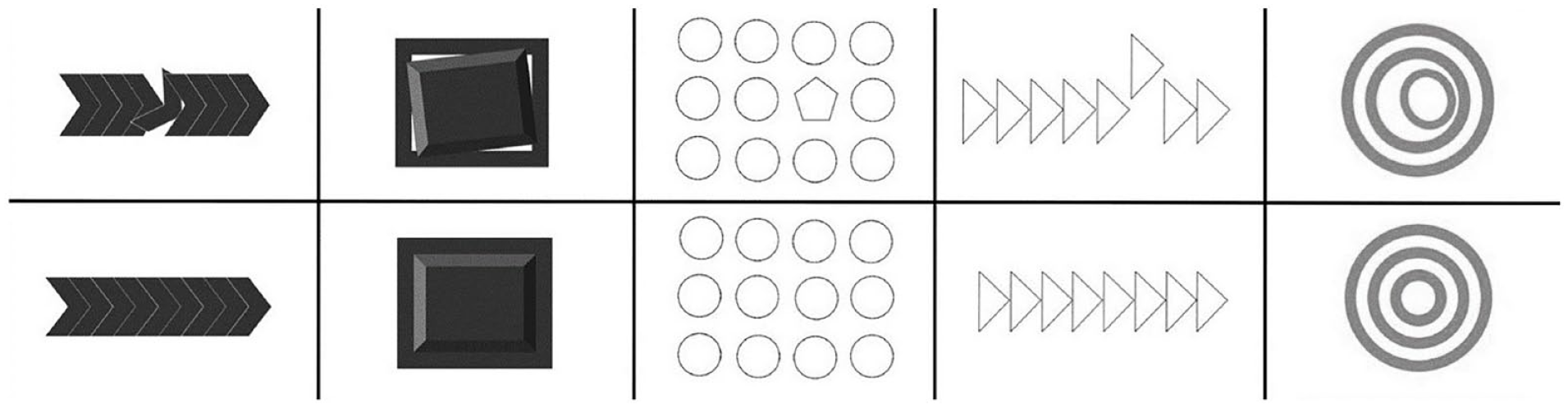
Examples of the stimuli used to assess deviancy aversion in Gollwitzer et al. (2017).
Research has demonstrated that most people—all else being equal—exhibit deviancy aversion (e.g., Evers et al., 2014; Gollwitzer et al., 2017; Heintzelman et al., 2013; Winkielman et al., 2006). For example, people tend to experience negative affect in response to pattern distortion, for instance, toward patterns of geometric shapes that have been distorted in some way (e.g., a row of triangles with one triangle out of line; Figure 1; Gollwitzer et al., 2017). People also dislike collections of objects that cannot be described by simple rules (e.g., Garner, 1970), exhibit aversive arousal in response to prediction errors (e.g., Proulx et al., 2012), respond negatively to surprising events (at least initially; Noordewier et al., 2016), prefer prototypical stimuli (e.g., paintings, dogs, faces; Palmer et al., 2013), and avoid the absence of patterns (e.g., Shermer, 2008). But why would our default response to pattern distortion be one of aversion? From an evolutionary standpoint, deviancy aversion may aid survival. Deviations from regularities and patterns may signal danger, for instance, an unstable changing environment or an intruder or spy (e.g., Foster & Kokko, 2009; Shermer, 2008).
Past research also suggests that deviancy aversion is a “low-level” affective factor, as it exists cross-culturally, is early-emerging, and appears to be domain-general. For example, people across cultures (the United States and China) and even 3-year-olds tend to evaluate broken patterns of simple geometric shapes negatively (Figure 1; Gollwitzer et al., 2017). 1 And, negative affect toward such geometric pattern distortion predicts negative affect toward pattern distortion in nonsocial domains, for instance, toward individuals who break social patterns (e.g., someone extremely rich or poor, racial minorities; Gollwitzer et al., 2017) and toward moral violations (e.g., purity and harm violations; Gollwitzer, Martel, Bargh, & Chang, 2020).
One intuitive way to understand deviancy aversion is in terms of the order and symmetry component of obsessive-compulsive disorder (OCD). Much like subclinical manifestations of other conditions (e.g., autism-spectrum, subclinical paranoia; e.g., Constantino & Todd, 2003; Freeman, 2007), individuals’ degree of deviancy aversion may reflect a nonclinical spectrum of people’s sensitivity toward disorder, that is, a nonclinical degree of their OCD. Illustrating the commonness of this sensitivity, a popular subreddit called Mildly Infuriating (https://www.reddit.com/r/mildyinfuriating/) has more than 100,000 members and posts often depict examples of pattern distortion with users expressing their discomfort.
Relatedly, deviancy aversion can be understood through people’s tendency to follow routines, rituals, and patternicity—seeing meaningful patterns in meaningless noise (e.g., seeing Jesus in the toast; e.g., Shermer, 2008). These behaviors are all hypothesized to reduce anxiety (and OCD is often classified as an anxiety disorder; e.g., Dulaney & Fiske, 1994), suggesting that experiencing deviations from regularities is an anxiety-inducing experience. Indeed, past work has linked anxious attachment to deviancy aversion and found that priming social security and safety reduces people’s sensitivity to pattern distortion (Gollwitzer & Clark, 2019).
In line with deviancy aversion representing an anxiety-laden experience, seeing patterns (vs. pattern distortion), even in terms of nonsocial content such as linguistic triads, increases feelings of meaning in life (Heintzelman et al., 2013). And, people are more likely to perceive illusory patterns after a loss of control (Whitson & Galinsky, 2008). Collectively, these results suggest that an aversion to pattern distortion may be at the root of humans’ “primary and fundamental motivating force” to maintain order, control, and reduce anxiety (Whitson & Galinsky, 2008, p. 1).
While we have described what deviancy aversion is, we have not considered what it is not. Deviancy aversion differs from disliking uncertainty and ambiguity (e.g., need for closure, Webster & Kruglanski, 1994; intolerance for ambiguity, Budner, 1962). Simply put, pattern distortion is not uncertain or ambiguous; it entails an evident irregularity rather than the potential of an irregularity occurring. Indeed, deviancy aversion correlates only weakly to moderately with such variables and links between deviancy aversion and social phenomena (e.g., prejudice against minorities) appear to occur independently of such variables (Gollwitzer et al., 2017).
Relatedly, deviancy aversion is not an aversion to novelty. Consider strolling down a road and encountering a stranger. While the stranger may be novel, the stranger is hardly deviant given that we encounter strangers all the time. In line with this example, deviancy aversion only correlates moderately with an aversion toward novel stimuli and relates to social phenomena (e.g., anxious attachment, prejudice, moral judgment) independently of such novelty aversion (Gollwitzer & Clark, 2019; Gollwitzer, Marshall, & Bargh, 2020; Gollwitzer, Martel, Bargh, & Chang, 2020).
Hypothesis
We propose that deviancy aversion—people’s negative affect in response to pattern distortion—contributes to the powerful role that social norms play in society. Theoretically supporting this idea, social norms entail descriptive regularities and empirical expectations (Bicchieri, 2005); they are statistically regular behaviors that are perceived as such by the majority of a group (Bicchieri, 2005; Sherif, 1936). Put another way, norms are patterns of how people should and do behave in a society, and norm violations are distortions of these perceived patterns of behavior. Indeed, several researchers have explicitly referred to norms as patterns or regularities of behavior (e.g., Muldoon et al., 2014). Despite these claims, however, research has yet to integrate the idea of social norms as patterns with past work on the cognitive principles of pattern distortion (e.g., Garner, 1970; Posner, 1973) and people’s tendency to experience aversion toward pattern distortion (e.g., Gollwitzer et al., 2017). It is thus unclear whether sensitivity to pattern distortion functions as a low-level affective process underlying social norms. Indeed, it remains plausible that social norms exist solely for alternate reasons, for instance, due to social pressures, such as punishment (e.g., Fehr & Fischbacher, 2004b).
Empirical findings support our hypothesis. For instance, collectivistic cultures exhibit greater deviancy aversion than individualistic ones (Gollwitzer et al., 2017; Kim & Markus, 1999; Kim & Sherman, 2008), and collectivistic cultures also have tighter social norms (Gelfand et al., 2011). And in more direct support, Gollwitzer and colleagues (2017, Study 3) found that deviancy aversion, assessed via aversion toward broken geometric patterns (Figure 1), predicts negatively evaluating a fictional norm breaker. Deviancy aversion predicted greater dislike of a “Flurp” living in a house the color of which broke the norm in Flurp society. However, this finding is solely correlational, the Flurp scenario is artificial, and the Flurps may have been perceived as “objects” rather than as sentient agents.
Current Research
Here, we present the first comprehensive test of whether deviancy aversion underlies social norms. In doing so, we significantly extend Gollwitzer et al. (2017) in several ways:
We assess social norms in numerous ways, including measures of effect, attitude, behavior, belief, and motivation. For instance, we examine whether deviancy aversion predicts self-reported and objective norm following (Behavior), judging norms as important (Beliefs; Bizer et al., 2014), and desiring stricter norms in society (Motivation; Gelfand et al., 2011). In doing so, we capture the real-life breadth of social norms rather than studying norms in a fictional vacuum.
We test whether deviancy aversion has a causal impact on social norms. In doing so, the present work provides one of the first tests of whether deviancy aversion (e.g., inducing positive vs. negative affect toward nonsocial pattern distortion) has a causal influence on social responding.
The present work examines whether deviancy aversion predicts conformity—matching one’s judgments or behaviors to the surrounding norm—by examining conformity on accuracy-orientated estimation tasks. In doing so, we may uncover a low-level affective process that predicts conformity, a major topic in psychology with substantial consequences across interpersonal, organizational, and cultural domains (Sunstein, 2019).
The current work examines real-world impact and generalizability. For instance, we test whether deviancy aversion predicts higher conformity, decreased cheating behaviors, and increased normative health behaviors that impact health and mortality (i.e., physical distancing during COVID-19; e.g., Hsiang et al., 2020).
In addition to the extensions noted above, the current article also provides a single, broader contribution. We provide a novel affective perspective on social norms by examining whether deviancy aversion—a cross-cultural, early-emerging, and domain-general affective factor—underlies social norms. Doing so answers call to illuminate the low-level cognitive and affective factors necessary for a species to establish and enforce social norms (e.g., Coleman, 1990; Elster, 1989; Fehr & Fischbacher, 2004a). Ultimately, deviancy aversion may function as a basic and efficient affective process that pushes individuals to follow and enforce social norms in their environments.
Study 1: Linking Deviancy Aversion to Social Norms
Study 1 examined whether deviancy aversion predicts a selection of different social norm indicators. Deviancy aversion was assessed using nonsocial stimuli, for instance, via participants’ aversion toward broken patterns of geometric shapes (Figure 1). Social norms were assessed via participants’ negative affect toward social norm violations (Affect), self-reported social norm behavior (Self-Reported Behavior), and beliefs of social norms as important in society (Beliefs).
Method
Participants
A power analysis based on Gollwitzer et al. (2017; r = .33) revealed that 159 participants would provide 99% power. We aimed to recruit 250 participants on Mechanical Turk (MTurk) to account for exclusion. We ended with 252 participants (129 female; Mage = 38.33, SDage = 13.08). Eight responses were excluded for attention failures; one for completing the study twice. The final sample size (N = 243) provided 90% power to observe a minimum effect of r ~ .21. Unlike Studies 2 to 5, the study was not preregistered. We report how we determined our sample size, all data exclusions, all manipulations, and all measures assessed in each of the reported studies. All verbatim materials, data, and data analysis files can be found at: https://osf.io/tzqwy/?view_only=6503ff2c468e4bb691fd4ef184feb531.
Deviancy aversion
Three measures assessed deviancy aversion. The first, validated by Gollwitzer et al. (2017), entailed images of broken patterns of geometric shapes (Figure 1). For each image: “How much do you dislike the above image?” 1 = Not at all to 7 = A lot. Static geometric shapes were used to reduce social connotations and prior associations (Gollwitzer et al., 2017).
The second measure was a 3-item explicit descriptive measure: “. . . Things that break a pattern, are out of line, and are disordered make me feel . . .” “Anxious,” “Annoyed,” “Uncomfortable.” 1 = Not at all agree to 7 = Strongly agree.
The third measure was a 3-item mental imagery measure: “Imagine a collection of objects where all the objects are very similar to one-another . . . if an object that is very different from the other objects is added to the collection that would make me feel . . .” “Anxious,” “Annoyed,” “Uncomfortable.” 1 = Not at all agree to 7 = Strongly agree.
Social norms
We assessed social norms via negative affect toward social norm violations, self-reported social norm behavior, and beliefs of social norms as important.
Negative affect: Fictional social norm violations
As in Gollwitzer et al. (2017), 3-item measures assessed negative affect toward a fictional character (a Flurp) breaking versus following the Flurp norm of living in a blue house (randomized): “This Flurp makes me feel . . .” “Uncomfortable,” “Annoyed,” “Anxious.” 1 = Not at all agree to 7 = Strongly agree.
Negative affect: Nonfictional social norm violations
We included a 5-item norm violation measure adapted from the social norm subset of the Moral Foundations Vignettes (Clifford et al., 2015; e.g., “Seeing a man east a bowl of cereal in the morning with water instead of milk makes me feel . . . Negative”). 1 = Strongly Disagree to 7 = Strongly Agree.
Negative affect: Littering
A 3-item measure assessed participants’ irritation in response to a 12-second video of someone breaking an injunctive social norm (littering; “At the moment, this person’s actions make me feel. . . “Annoyed,” “Irritated,” and “Angry”). 1 = Strongly Disagree to 7 = Strongly Agree.
Self-reported social norm following
Participants were referred back to the Flurp fictional society, and asked whether, if they were a Flurp, they would follow the norm of living in a Blue house: “I would want to live in a Blue house,” and “I would NOT want to live in a Green house.” 1 = Not at all agree to 7 = Strongly agree.
Self-reported social norm-breaking
Participants were asked if they would break the norm of living in a Blue house: “I would want to live in a Green house,” and “I would NOT want to live in a Blue house.” 1 = Not at all agree to 7 = Strongly agree.
Social norm espousal
We assessed beliefs of social norms as important via an adapted 14-item scale (Bizer et al., 2014; e.g., “If more people followed society’s rules, the world would be a better place”). 1 = Not at all agree to 7 = Strongly agree.
Control variables
We assessed aversion toward unbroken patterns via the broken geometric patterns measure, except participants rated the unbroken counterparts of the broken pattern images. We controlled for third variables associated with deviancy aversion or social norms, including the need for closure (e.g., Webster & Kruglanski, 1994), disgust (e.g., Haidt et al., 1997), political orientation (Janoff-Bulman, 2009), and social desirability (Bizer et al., 2014).
Attention check
One item assessed attention (see Supplements).
Procedure
Participants completed the three deviancy aversion measures (randomized, clustered together, including the unbroken pattern control measure) and the five social norm measures (randomized, clustered together) in random order. Participants then completed the control measures (randomized), attention checks, and demographics.
Results
We averaged across the three deviancy aversion measures (after averaging across their sub-items) because they strongly loaded together (eigenvalue: 2.35; principal axis factor analysis) and exhibited high inter-measure reliability, ω = .86, M = 3.53, SD = 1.51.
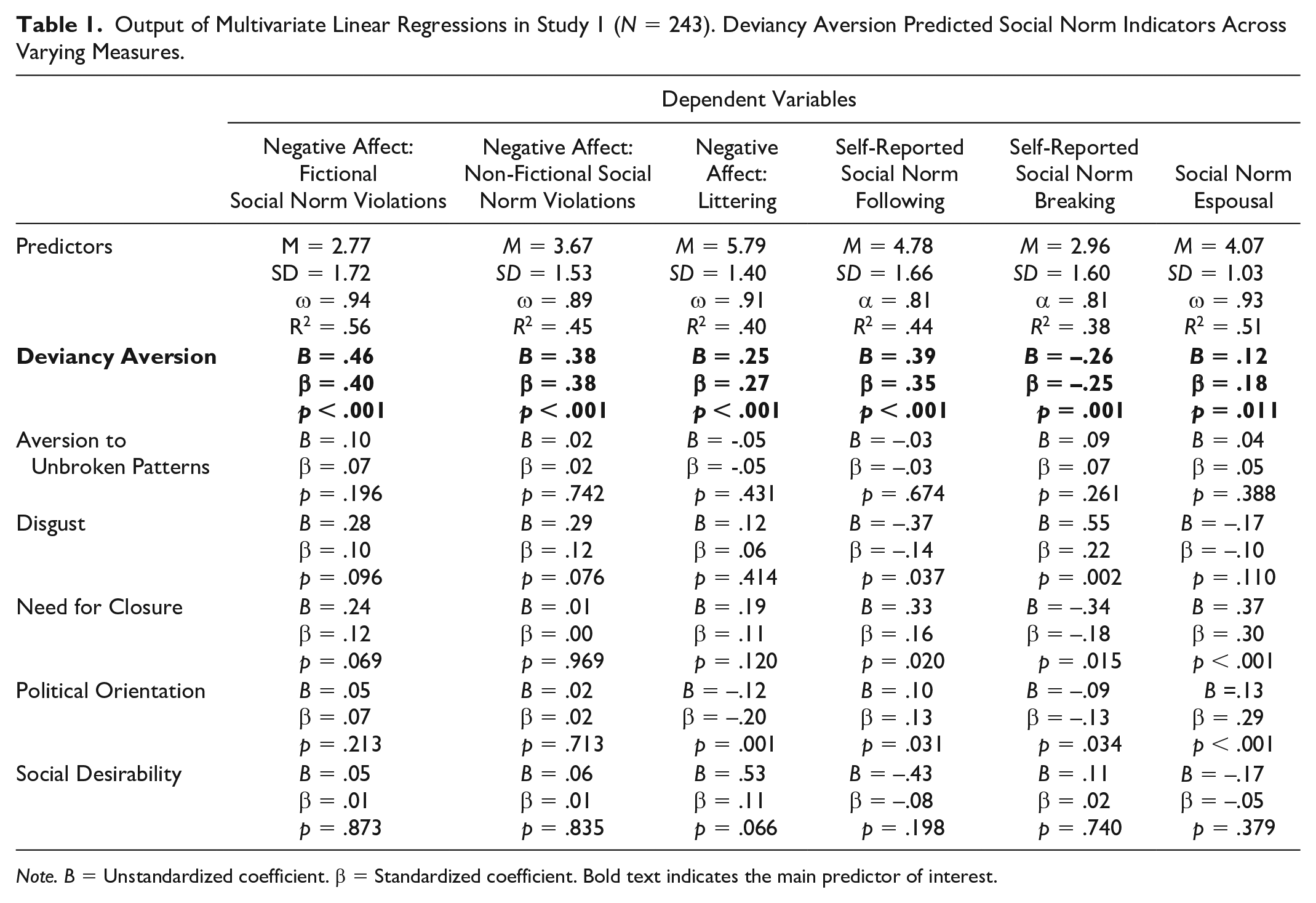
Six multivariate linear regressions were conducted, each predicting a different social norm measure (Table 1). Deviancy aversion, aversion toward unbroken patterns, disgust, need for closure, political orientation, and social desirability were predictors.
Output of Multivariate Linear Regressions in Study 1 (N = 243). Deviancy Aversion Predicted Social Norm Indicators Across Varying Measures.
Note. B = Unstandardized coefficient. β = Standardized coefficient. Bold text indicates the main predictor of interest.
Participants’ deviancy aversion predicted greater negative affect in response to fictional norm violations, nonfictional norm violations, and to an injunctive norm violation (littering), ps < .001 (Table 1; Figure 2). Deviancy aversion also predicted higher self-reported norm following, p < .001, and lower norm breaking, p = .001, in an imagined scenario. Finally, deviancy aversion predicted greater social norm espousal, p = .011 (Figure 2).2,3 Of the included predictors, only deviancy aversion significantly predicted all the social norm measures (Table 1).
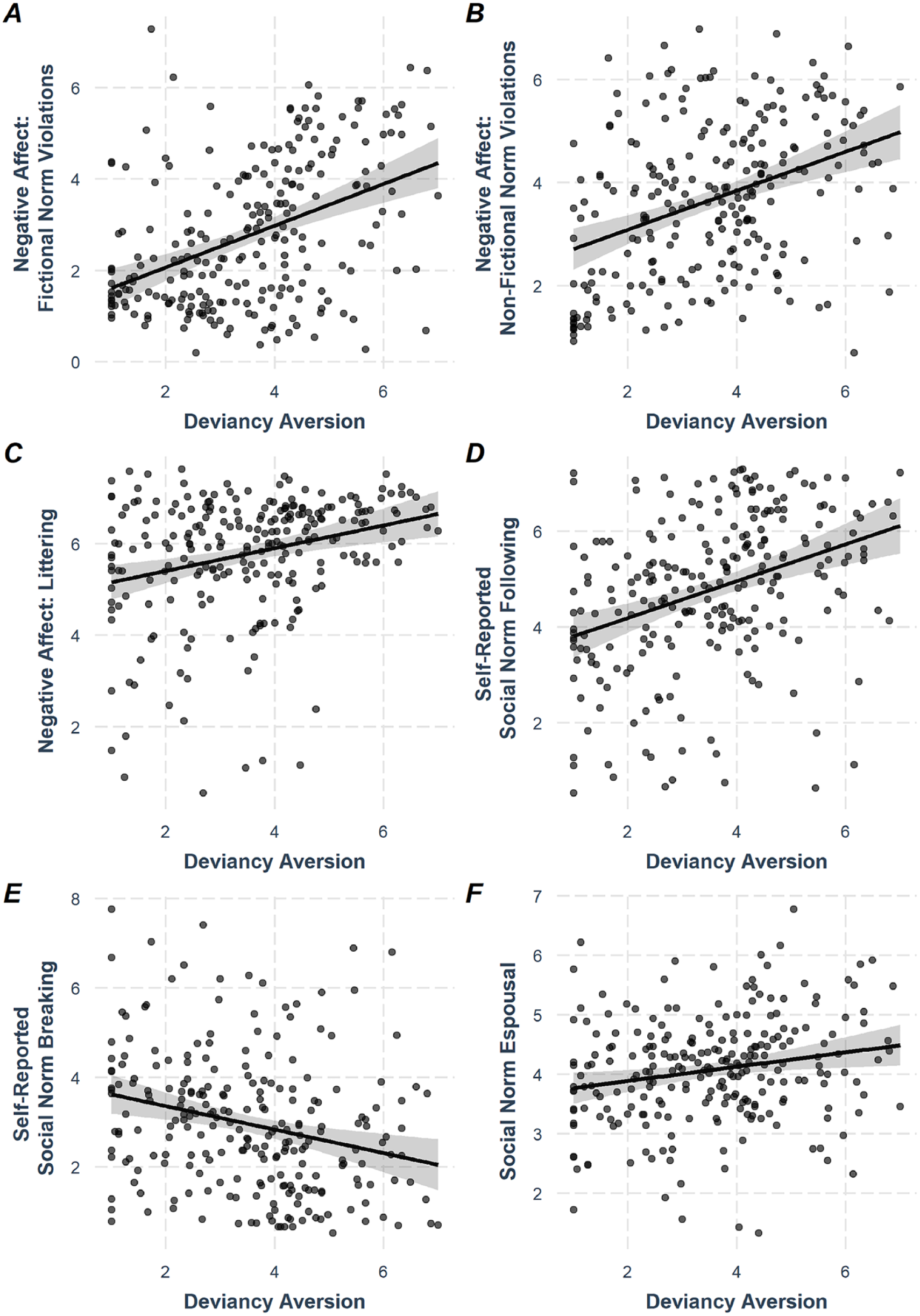
Study 1: partial residual effect plots. Deviancy aversion predicted greater negative affect in response to fictional and nonfictional norm violations (A, B), as well as toward an injunctive norm—littering (C). Deviancy aversion predicted greater self-reported social norm following and reduced self-reported social norm breaking (D, E). Deviancy aversion predicted greater social norm espousal—judging social norms as important and valuable (F). Error bands: confidence intervals (using geom_ribbon in R).
Discounting demand or response bias, none of these relationships were moderated by social desirability, ps > .253. In addition, deviancy aversion predicted lower self-reported norm-breaking behavior, which was reverse-scaled. Finally, participants’ aversion toward unbroken geometric patterns, which was measured using the identical scale end-points as their aversion toward broken geometric patterns, failed to predict any social norm measures, ps > .196 (Table 1).
Study 2: Deviancy Aversion and Conformity
Study 2 examined whether the link between deviancy aversion and endorsing social norms extends from self-report measures to actual conformity, defined as “the act of changing one’s behavior to match the responses of others” (Sunstein, 2019). Although researchers have identified numerous social factors driving conformity (e.g., others’ approval), it is less clear whether low-level affective factors, such as a sensitivity to pattern distortion, play a role in conformity. Study 2 tested whether deviancy aversion predicts conformity on accuracy-oriented estimation tasks. Doing so heightens the generalizability of our findings, and extends our results to belief-updating and knowledge-feedback contexts (e.g., Hoffrage et al., 2000).
Method
Participants
A power analysis based on the smallest effect size of Study 1 (r ~ .20) indicated that we should collect 258 participants (90% power). We aimed to recruit 300 participants on Prolific to account for exclusion. We collected a representative sample (the U.S. population: gender, age, and ethnicity). A total of 310 participants were recruited (154 female; Mage = 44.71, SDage = 16.12). 4 Two responses were excluded for attention failures; two for completing the study twice. The final sample size (N = 306) provided 90% power to observe an effect size of r ~ .18. Preregistration—https://aspredicted.org/98X_XXF. Verbatim Materials—https://osf.io/tzqwy/?view_only=6503ff2c468e4bb691fd4ef184feb531.
Deviancy aversion
We added positive response items (reverse-coded) to the deviancy aversion measures to account for response bias. Geometric shapes measure: “How much do you like the above image?” 1 = Not at all to 7 = A lot. Explicit descriptive measure: “Calm,” “Comfortable,” “Happy.” 1 = Not at all agree to 7 = Strongly agree. Given the added length of these measures, we did not assess the mental imagery measure. The geometric shapes measure was also shortened to two geometric patterns.
Conformity
Conformity was assessed via three accuracy-oriented estimation tasks (height of the Eiffel tower in feet, weight of a cow in pounds, number of marbles in a pictured jar; randomized; Hoffrage et al., 2000). For each estimation, participants: (a) reported their guess, (b) received feedback on what five other participants had apparently guessed (these five estimations were fairly similar to one another and were either all higher or lower than the ground truth; randomized), and (c) reported a revised estimation.
Conformity was quantified as the extent to which participants revised their estimate toward the average of the five other participants (calculated as a percent change). The formulization of the conformity score was: If Est1 < EstAvgO then ((Est2 − Est1)/(ABS(EstAvgO − Est1)) × 100. Alternately, if Est1 > EstAvgO then ((Est1 − Est2)/(ABS(EstAvgO − Est1)) × 100, where ABS is the absolute value, EST1 is the estimation before feedback, EST2 is the estimation after feedback, and ESTAvgO is the average of the five others’ estimations.
Given this formula, scores of 0 indicate no change after feedback (nonconformity), negative scores indicate moving away from others’ estimations (anticonformity), and positive scores indicate moving toward others’ estimations (conformity). This formula was applied for interpretability: 0 = nonconformity, 100 = perfect conformity, and a value X between 0% and 100% = X% conformity. For instance, if a participant estimating the Eiffel Tower’s Height in the high other estimation condition (average of others’ estimation: 1,730.6 feet) estimated 500 before and 1,500 after feedback, the formula would be: (1,500 − 500)/(ABS(1,730.6 − 500)) × 100 = 81.26% conformity.
Control variables
We added reverse-coded items to the aversion toward unbroken patterns measure (to match it to the broken patterns measure of Study 2). Novelty aversion was also assessed. The 6-item measure was identical to the explicit deviancy measure (to control for method variance) except participants read: “People feel differently about things that that are new, novel, and original. . .Things that are new, novel, and original make me feel . . .”
Attention check
The attention check was as in Study 1.
Procedure
Participants completed the measures in random order (deviancy aversion measures clustered together; estimation items clustered together). Participants then completed the attention check and demographics. 5
Results
We averaged across the deviancy aversion measures because they moderately-to-strongly correlated, r = .52, and the items loaded together (eigenvalue: 4.94), M = 4.80, SD = 1.17. We excluded four extreme outliers whose conformity scores (averaged across the three estimations) were ±2 SD from the mean; these participants heavily skewed the sample via absurd responding (e.g., Eiffel Tower is “60000000” feet).
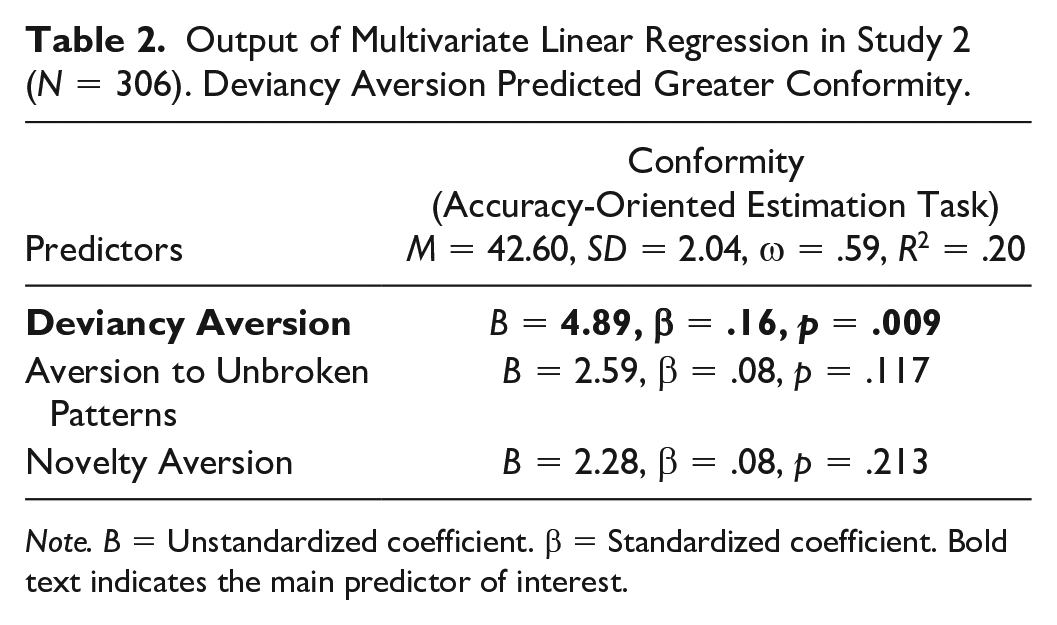
As preregistered, we conducted a multivariate linear regression predicting conformity (Table 2). Deviancy aversion, aversion toward unbroken patterns, and novelty aversion were predictors.6,7 As hypothesized, deviancy aversion predicted greater conformity, p = .009 (Table 2; Figure 3); participants high in deviancy aversion (+1 SD) conformed approximately 47.49%, while those low in deviancy aversion (−1 SD) conformed 37.71%. Neither aversion to unbroken patterns nor novelty aversion predicted conformity, ps > .116.
Output of Multivariate Linear Regression in Study 2 (N = 306). Deviancy Aversion Predicted Greater Conformity.
Note. B = Unstandardized coefficient. β = Standardized coefficient. Bold text indicates the main predictor of interest.
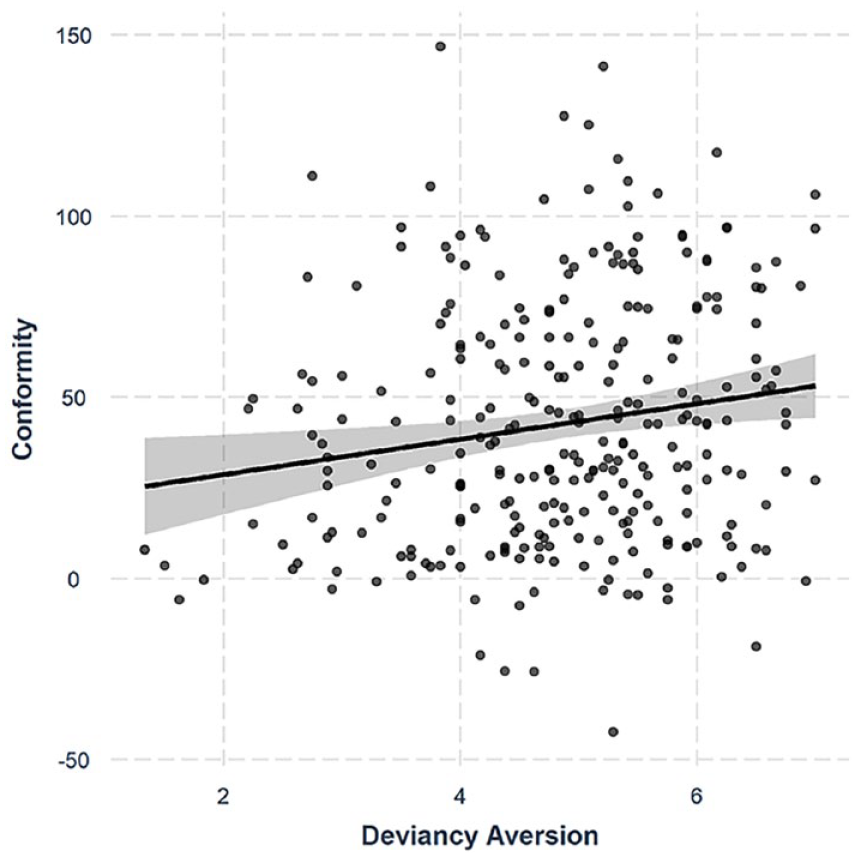
Study 2: partial residual effect plot. Deviancy aversion predicted greater accuracy-oriented conformity. Conformity: y-axis is the percent change toward others’ responses; 100 indicates perfect conformity, 0 indicates no conformity, negative values indicate anti-conformity. Error bands: 95% confidence intervals (using geom_ribbon in R).
Robustness
First, because conformity scores above 100 are possible (if participants overcorrected past others’ estimations), and it is unclear whether such scores count as overconformity or nonconformity, we inverted all values above 100 (e.g., 125 becomes 75). Deviancy aversion still predicted conformity, β = .186, p = .003. Second, if participants’ initial estimations were closer to the average of the feedback they received, there was less space for them to conform. The results remained when controlling for such “accurate” initial estimations, β = .163, p = .009. Third, whether participants received higher or lower feedback (others’ estimations being higher or lower than the ground truth) did not moderate the link between deviancy aversion and conformity, p = .989 (see Supplements).
Study 3: Deviancy Aversion and Physical Distancing Norms During the COVID-19 Pandemic
Study 3 examined whether our findings extend to social norm behaviors that are linked to real-world survival. We tested whether deviancy aversion predicted greater self-reported following of physical distancing norms at the start of the COVID-19 pandemic. Studies have highlighted the importance of physical distancing during COVID-19 (and other viral pandemics) in stopping individual and community infection (e.g., Hsiang et al., 2020).
Method
Participants
The power analysis of Study 2 was applied. We recruited 301 participants across the United States on April 8, 2020—when COVID-19 first started spreading rapidly in the United States and lockdowns had begun (MTurk; 130 female; Mage = 40.13, SDage = 12.15). Thirteen responses were excluded for attention failures; four for completing the study twice. The final sample size (N = 284) provided 90% power to observe an effect size of r = .17. Preregistration—https://aspredicted.org/CLV_5WP. Verbatim Materials—https://osf.io/tzqwy/?view_only=6503ff2c468e4bb691fd4ef184feb531.
Deviancy aversion
The measures were as in Study 1, except, to support conceptual replicability, we added positive scale-points and changed the response scale to 3 items and a 9-point scale (1 = Happy to 9 = Unhappy, 1 = Comfortable to 9 = Uncomfortable, 1= Content to 9 = Discontent; see Verbatim Materials). 8
Adherence to physical distancing norms
We included a 12-item measure (Gollwitzer, Martel, Brady, et al., 2020). The measure included general (e.g., “I try to follow Covid-19 norms and guidelines as closely as possible”) and specific items (e.g., “I try to avoid public places when I can”). 1 = Not at all true to 9 = Very true. Supporting external validity, this measure is linked to objective distancing behaviors at the individual and group level (Gollwitzer, Martel, Brady, et al., 2020).
Control variables
We assessed aversion toward unbroken patterns, novelty aversion, intolerance of ambiguity (Budner, 1962), and political orientation. See Verbatim Materials.
Demand bias: Participants’ predictions
At the end of the study, we assessed participants’ predictions about the study results: “In this study, we had participants report their discomfort towards things that break the pattern . . . We also had participants report whether they have been engaging in actions that may prevent the spread of Covid-19 . . . On average, how do you think these two measures relate?” Participants chose between three options: “People who experience more discomfort towards things that break the pattern, are out of line, and are disordered are (“less” vs. “neither more nor less” vs. “more”) likely to engage in actions that may prevent the spread of Covid-19 . . .” (randomized).
Attention check
The attention check was as in Study 1.
Procedure
Participants completed the measures in random order (deviancy aversion measures clustered together) and then the attention check and demographics.
Results
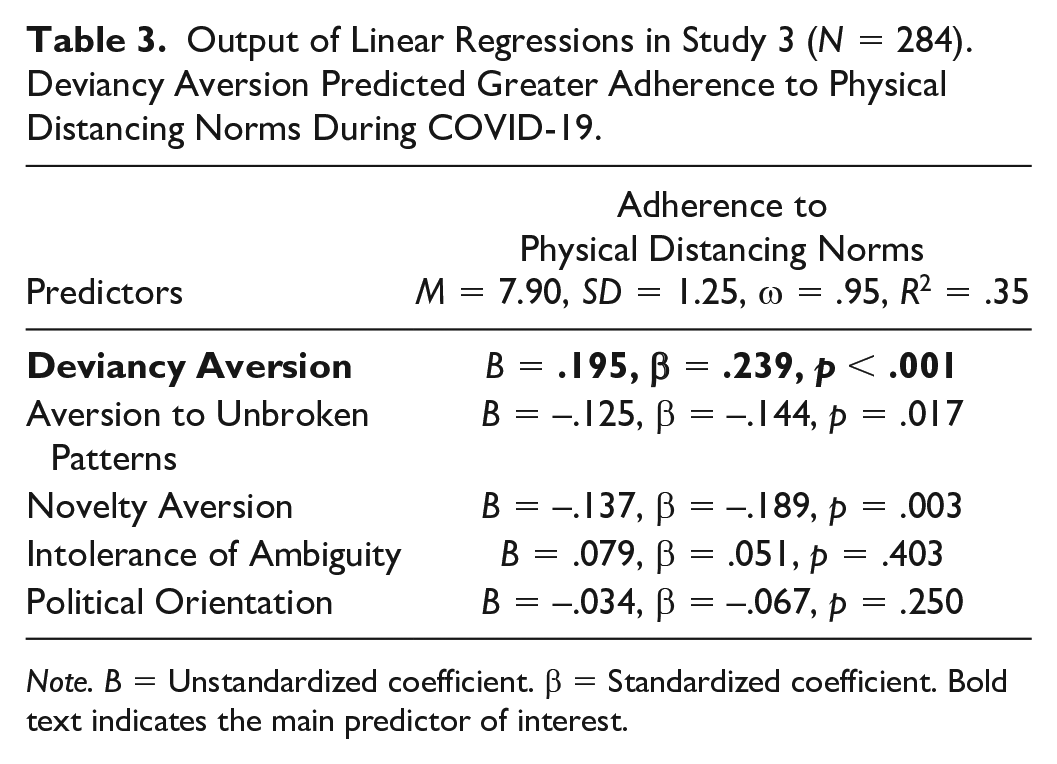
We averaged across the deviancy aversion measures (eigenvalue: 2.05; ω = .77, M = 5.76, SD = 1.53). Indicating that physical distancing was the norm during data collection, participants reported high levels of distancing, ω = .95, M = 7.90, SD = 1.25.
As preregistered, we conducted a multivariate linear regression predicting self-reported physical distancing, with deviancy aversion, aversion toward unbroken patterns, novelty aversion, intolerance for ambiguity, and political orientation as predictors. Of the included predictors, only deviancy aversion positively predicted physical distancing, p < .001 (Table 3; Figure 4). Discounting demand effects, aversion to unbroken patterns, and novelty aversion—which were measured using nearly identical measures as deviancy aversion—predicted decreased rather than increased physical distancing, ps < .018. Intolerance of ambiguity and political orientation did not predict distancing, ps > .250 (Table 3).
Output of Linear Regressions in Study 3 (N = 284). Deviancy Aversion Predicted Greater Adherence to Physical Distancing Norms During COVID-19.
Note. B = Unstandardized coefficient. β = Standardized coefficient. Bold text indicates the main predictor of interest.
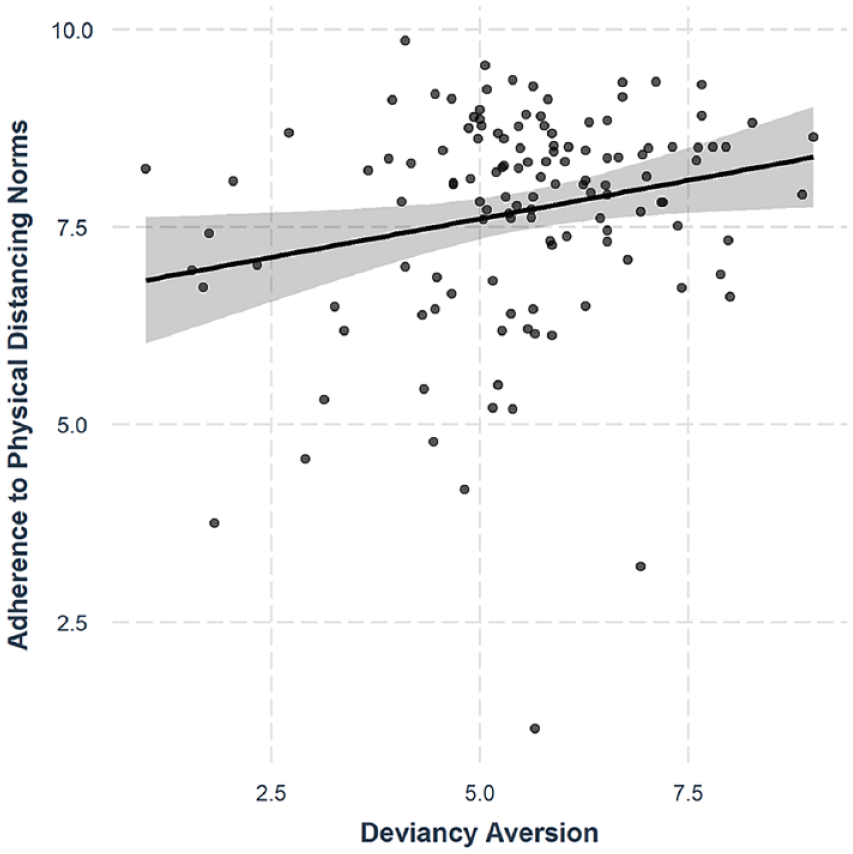
Study 3: partial residual effect plot. Deviancy aversion predicted greater adherence to physical distancing norms at the start of COVID-19. Error bands: 95% confidence intervals (using geom_ribbon in R).
We examined participants’ predictions about the study results. Of the total participants, 55.3% predicted that deviancy aversion links to greater distancing, 22.2% to lower distancing, and 22.5% predicted a null relationship. Although more than 50% of participants guessed our hypothesis, our findings were not moderated by whether participants had successfully guessed our hypothesis or not, p = .750. Moreover, our findings remained when excluding participants who had guessed our hypothesis. Remaining sample: n = 126, B = 0.195, β = .204, p = .024 (change from original model: β = .239 to β = .204, a nonsignificant change: z = −.34, p = .367). These results strongly discount demand effects and suggest that the observed links may occur outside of awareness.
Study 4: Deviancy Aversion and Fairness Norms
Study 4 examined whether our findings extend to objective behaviors. We invited participants to complete an online study but informed them that taking the study multiple times violates fairness norms. Importantly, participants were also told that we could not tell if they cheated and retook the study for additional payment (though in reality we could). We predicted that deviancy aversion would be linked to a greater following of fairness norms, that is, less non-normative cheating in terms of retaking the study for additional payment. Such results would indicate that deviancy aversion predicts real-world following of fairness norms—norms that are a core tenant of our psychology and are essential for social cooperation (e.g., Bicchieri, 2005).
Method
Participants
We aimed to recruit 1,500 participants on MTurk to observe a small effect size. The final sample size (N = 1,503; 739 female; Mage = 49.20, SDage = 11.98), provided 90% power to observe an odds ratio of 1.48 (a small effect size). Preregistration—https://aspredicted.org/6MP_G9Y. Verbatim Materials—https://osf.io/tzqwy/?view_only=6503ff2c468e4bb691fd4ef184feb531.
Norm prompt
To establish the fairness norm and give participants the impression that they could cheat on the study without being caught, participants first read: “Please do not take this survey twice. Though we cannot technically tell if you complete the survey more than once, doing so violates norms of courtesy and transparency.”
Deviancy aversion
Because longer studies would be less likely to be “cheated” on, we shortened the measures. The measures were as in Study 3, except, as in Study 2, we did not include the mental imagery measure. In addition, the geometric shapes measure was shortened to a single image (the broken triangles image), and participants responded to this measure and the explicit descriptive measures on a single item. To discount response bias, participants either responded to the single-item scale, 1 = Positively to 9 = Negatively, or the single-item scale, 1 = Negatively to 9 = Positively (randomized; see Verbatim Materials). The latter scale was reverse-coded.
Control variables
We assessed aversion toward unbroken patterns, novelty aversion, and negativity aversion (aversion toward an image of poor weather) using the same 1 to 9 scale applied above (including the reverse-coded version). In doing so, the control measures were as similar as possible to the deviancy aversion measure.
Procedure
Participants completed all measures in random order and then demographics.
Results
Of the total 1,503 responses, 451 responses were repeated submissions (determined via IP addresses as preregistered—https://aspredicted.org/6MP_G9Y; see Supplements). These 451 responses were completed by 66 individuals (~6% of the total participants), with some repeating the study once and others completing the study multiple times (max: 33 times). As preregistered, we created a single data row (response) for each of the cheating participants as not doing so artificially inflates sample size due to repeat responders. We did so in two ways. First, we averaged across each cheating participants’ responses on the included measures (average). Second, we selected the first responses (quantified via timestamp) of each cheating participant (first response).
The two deviancy aversion measures correlated in each of the two analyses, average: r = .53, p < .001, first response: r = .54, p < .001, and were averaged for each participant, M = 5.57, SD = 1.74, and M = 5.54, SD = 1.80, respectively. As preregistered, we conducted multivariate logistic regressions predicting whether participants had cheated (repeated the study; cheating coded as 1 and not cheating as 0) and multivariate linear regressions predicting the number of times they had cheated (the number of responses they submitted; noncheaters = 0). Deviancy aversion, aversion toward unbroken patterns, negativity aversion, novelty aversion, age, and gender (0 = male, 1 = female) functioned as predictors.
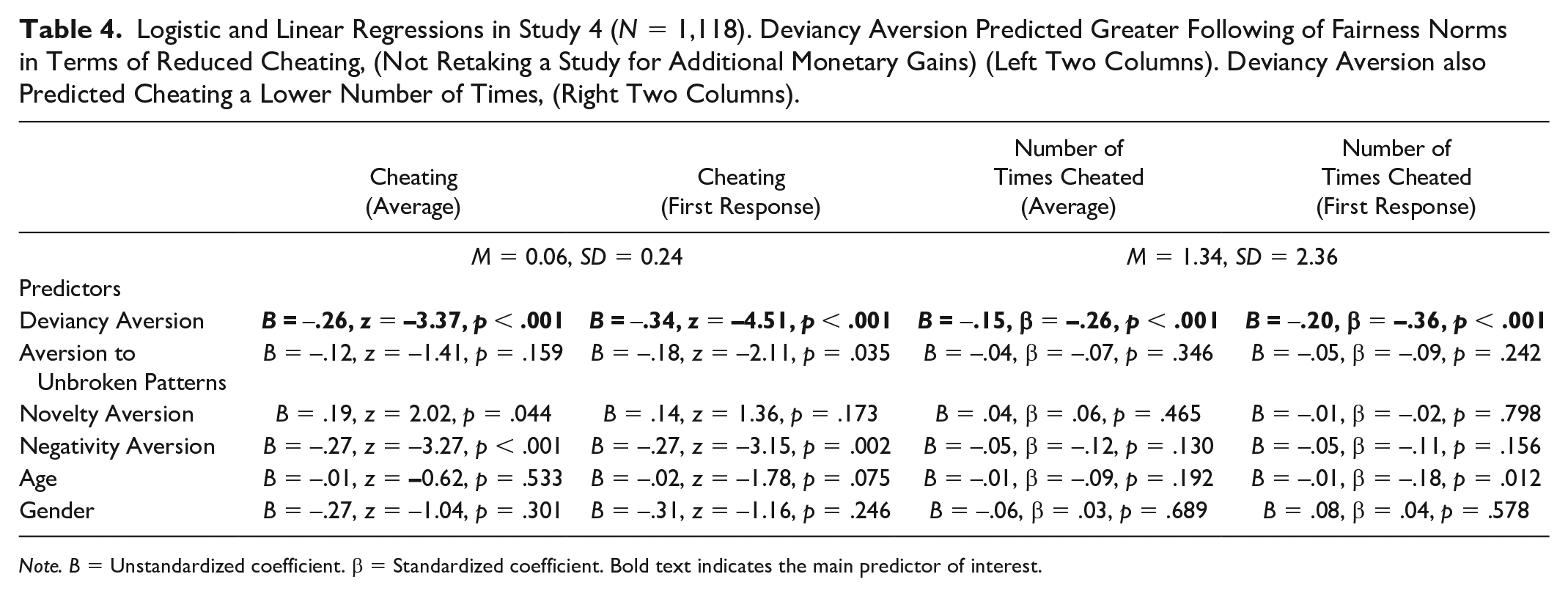
The logistic regressions revealed that deviancy aversion predicted lower levels of cheating for both analysis types: average: B = −0.26, p < .001, and first response: B = −0.34, p < .001. These logit odds translate to approximately a ~23% (average) and a ~29% (first response) decrease in the odds of cheating for every unit increase of one in deviancy aversion (or in terms of probability, a 6.4% and 8.5% lower probability of cheating for each unit increase, respectively). In addition, deviancy aversion predicted a lower number of times participants cheated, that is, the number of times they retook the study: average: B = −0.15, p < .001, and first response: B = −0.20, p < .001 (Table 4). Despite being measured via the identical scale (except for age and gender), none of the other predictors consistently predicted reduced cheating across the four conducted models (see Table 4). 9
Logistic and Linear Regressions in Study 4 (N = 1,118). Deviancy Aversion Predicted Greater Following of Fairness Norms in Terms of Reduced Cheating, (Not Retaking a Study for Additional Monetary Gains) (Left Two Columns). Deviancy Aversion also Predicted Cheating a Lower Number of Times, (Right Two Columns).
Note. B = Unstandardized coefficient. β = Standardized coefficient. Bold text indicates the main predictor of interest.
Study 5: Deviancy Aversion Causally Impacts Social Norms
Study 5 examined whether deviancy aversion causally influences social norms. Participants played a monetary reward game in which they tried to come up with either: (1) negative words describing nonsocial pattern distortion and positive words describing nonsocial patternicity, or (2) positive words describing nonsocial pattern distortion and negative words describing nonsocial patternicity (to counter-balance the valence of the task). Importantly, while these goals were active—before goal-attainment had occurred—participants completed several social norm measures. This design was based on the motivational principle that goals remain active and intrude on current tasks (often outside of awareness) until goal attainment occurs (e.g., Ferguson & Porter, 2009).
Participants
A power analysis based on a small-to-medium effect size (f = .175) revealed we needed 427 participants for 95% power. We aimed to recruit 500 participants, and ended with 510 participants (Prolific; 240 female; Mage = 35.18, SDage = 12.62). Sixty-two responses were excluded for attention failures; eight for completing the survey twice. Our final sample (N = 430), provided 90% power to observe an effect-size of f = .16. Preregistration—https://aspredicted.org/DF6_CVP. Verbatim Materials—https://osf.io/tzqwy/?view_only=6503ff2c468e4bb691fd4ef184feb531.
Deviancy Aversion
To manipulate deviancy aversion, we applied a motivational deviancy aversion paradigm validated by Gollwitzer, Marshall, and Bargh (2020). In line with active goals intruding on attitudes and judgment (e.g., Ferguson & Porter, 2009), participants were induced with the goal to evaluate nonsocial pattern distortion as negative (vs. positive) and nonsocial patterns as positive (vs. negative) for a $20 reward. Importantly, while this goal was active—before goal completion was reached—participants completed several social norm measures. We also assessed participants’ self-reported motivation to perform well on the task. See Supplements and Verbatim Materials.
Social Norms
We included the five social norm measures of Study 1, adapted to include some reverse-coded items (see Verbatim Materials). In addition, to extend our findings to the group level, we included a measure of participants’ desire for the United States to be a tight society—a society with pervasive and rigid norms (e.g., “It is important that the people of the United States closely comply with social norms”; Gelfand et al., 2011). Likert-type scale: 1 = Strongly Disagree to 6 = Strongly Agree.
Novelty Aversion
Novelty aversion was assessed as in Study 3.
Anthropomorphism
To discount the possibility that participants perceived nonsocial pattern distortion and nonsocial patterns as social or agentic, we included a measure of anthropomorphism. We assessed anthropomorphism via a validated 10-item scale (e.g., “I sometimes wonder if my computer deliberately runs more slowly after I have shouted at it”; Neave et al., 2015). Likert-type scale: 1 = Not at all, 7 = Very much so.
Manipulation Check
Participants’ responses toward two broken and two unbroken patterns of geometric shapes functioned as the manipulation check: “How ‘positive’ is the above image?” and “How ‘negative’ is the above image?” 1 = Not at all to 7 = Very. Positive item reverse-coded.
Attention Checks
Participants completed an attention check regarding the manipulation, a face-valid attention check, and the attention check of Study 1 (see Verbatim Materials).
Procedure
After the manipulation, participants completed the social norm measures (randomized), then the novelty aversion and anthropomorphism measures (randomized), and then the manipulation check. Finally, participants completed attention checks and demographics.
Results
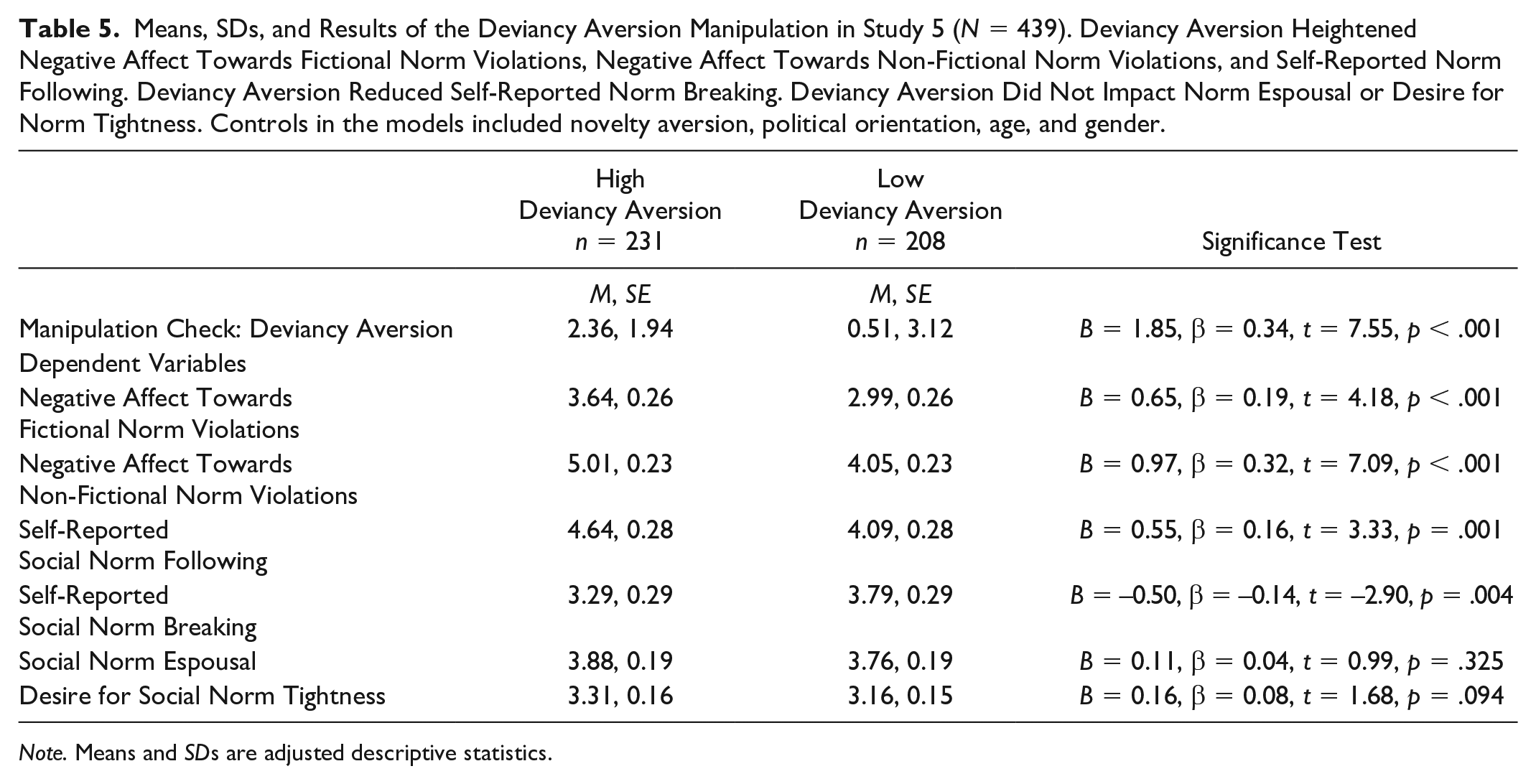
The manipulation was successful. A GLM indicated that deviancy aversion (high vs. low) heightened participants’ deviancy aversion, ω = .93, p < .001, ηp 2 = .115 (Table 5).
Means, SDs, and Results of the Deviancy Aversion Manipulation in Study 5 (N = 439). Deviancy Aversion Heightened Negative Affect Towards Fictional Norm Violations, Negative Affect Towards Non-Fictional Norm Violations, and Self-Reported Norm Following. Deviancy Aversion Reduced Self-Reported Norm Breaking. Deviancy Aversion Did Not Impact Norm Espousal or Desire for Norm Tightness. Controls in the models included novelty aversion, political orientation, age, and gender.
Note. Means and SDs are adjusted descriptive statistics.
We conducted six multivariate linear regressions with deviancy aversion, novelty aversion, age, gender, and political orientation as predictors. The six social norm indicators functioned as the outcome variables, respectively. Deviancy aversion causally heightened participants’ negative affect in response to fictional norm violations, ω = .86, p < .001, and nonfictional norm violations, ω = .95, p < .001 (Figure 5; Table 5). Deviancy aversion also increased participants’ self-reported norm following, ω = .72, p = .001, and decreased their self-reported norm-breaking, ω = .78, p = .004 (Table 5).
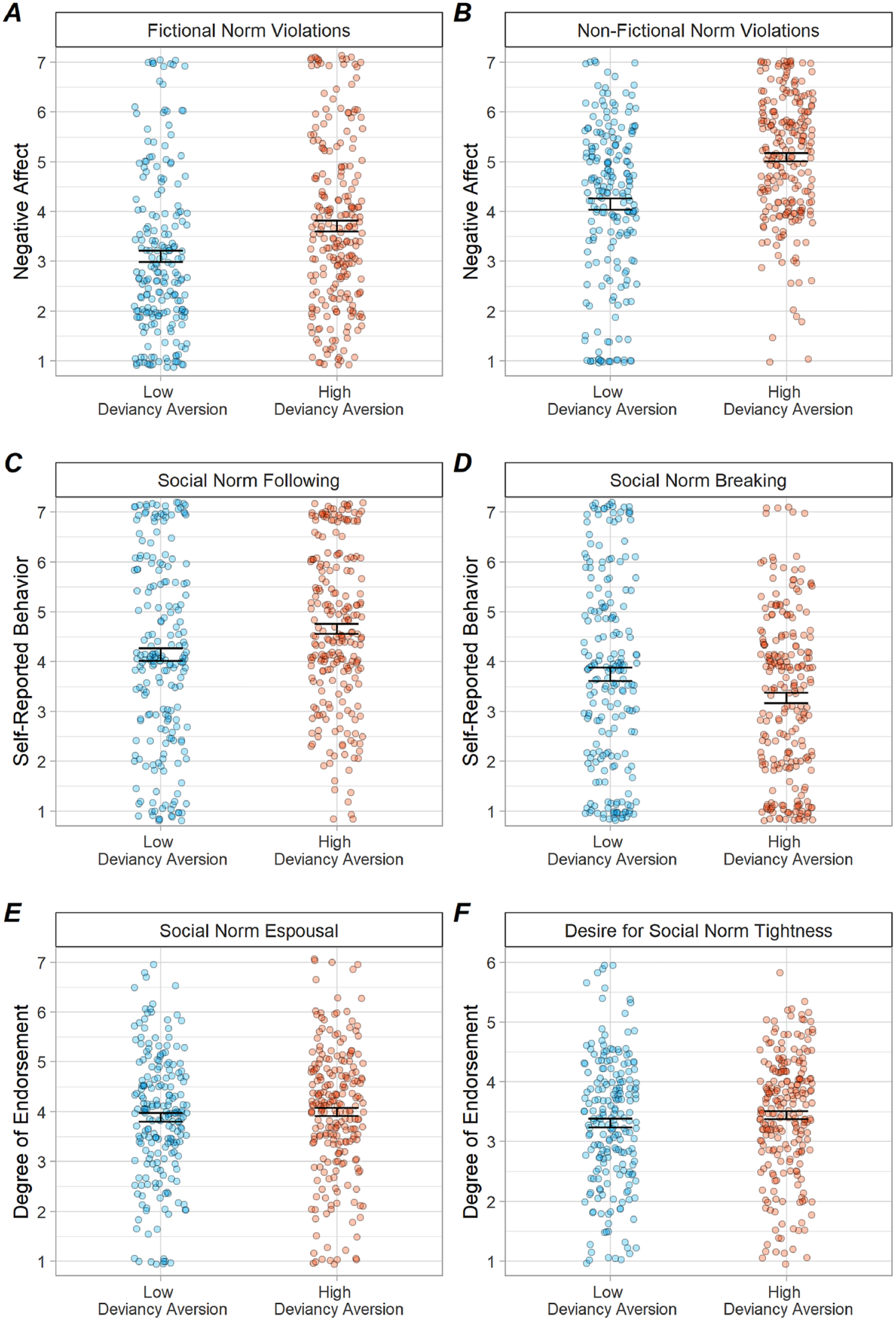
Study 5: the effect of deviancy aversion on (A) negative affect toward fictional norm violations, (B) negative affect toward nonfictional norm violations, (C) self-reported norm following, (D) self-reported norm breaking, (E) norm espousal, and (F) desire for norm tightness in society. Error bars: ±1 SE.
We next considered the more general, belief-based social norm measures—the norm espousal and tightness measures. In our preregistration, we noted that deviancy aversion may fail to impact such norm measures given their more stable, trait-like, and cognitive nature; indeed, deviancy aversion neither causally impacted norm espousal, ω = .88, p = .325 nor desire for norm tightness, α = .84, p = .094 (though the means were in the predicted direction; Table 5; Figure 5). These results may be driven by the norm espousal and tightness measures assessing more cognitive, belief-based attitudes toward social norms, whereas the other norm indicators (e.g., deciding whether to follow a specific norm) are determined by more affective factors—which deviancy aversion qualifies as. Indeed, past research suggests that deviancy aversion impacts social judgment via affective and not reflective pathways (e.g., Gollwitzer, Martel, Bargh, & Chang, 2020).
Several robustness tests supported our results (see Supplements: Study 5 for detailed analyses). First, none of the observed effects were not moderated by participants’ degree of anthropomorphism, ps > .058. In addition, in a Supplemental Study (Study S1) that tested a slightly different manipulation (and found hypothesis-conform results), only a small percent of participants spontaneously generated social content or attributed agency to the broken patterns of geometric shapes (~11.6%), and doing so did not moderate our results (see Supplements). Second, though participants’ self-reported motivation on the deviancy work task moderated the observed effects (for three of the six norm measures; ps < .043), the main effects of deviancy aversion on social norms remained when accounting for these moderations, ps < .005. These results suggest that a significant portion of the influence of deviancy aversion on social norms occurs outside of deliberate intentions or motivation. Third, mediation analyses revealed that, as expected, that the observed effects occurred via heightened levels of deviancy aversion, βs > .12, 95% CI = [.05 < β < .35] and not novelty aversion, βs < .01, 95% CI = [−.02 < β < .04]. Finally, although we failed to observe any direct effects of deviancy aversion on norm espousal and norm tightness, significant indirect effects via the deviancy aversion manipulation check were found, B = 0.23, 95% CI = [.12, .35], and B = 0.18, 95% CI = [.10, .27], respectively.
General Discussion
We find that something as simple as deviancy aversion—people’s sensitivity to the distortion of patterns—contributes to the prevalence and strength of social norms in society. In Study 1, participants’ aversion toward nonsocial pattern distortion (e.g., broken patterns of geometric shapes) predicted negative affect toward social norm violations (Affect), self-reported social norm following (Behavior), and judging social norms as important (Belief). Supporting generalizability, deviancy aversion also predicted greater conformity on accuracy-oriented estimation tasks (Study 2), greater following of physical distancing norms during COVID-19 (Study 3), and greater following of fairness norms in terms of not repeating a survey for additional payment (Study 4). Finally, deviancy aversion causally heightened social norm indicators, including negative affect toward social norm violations and self-reported social norm following, but did not impact more cognitive, belief-based norm measures, such as judging norms as important and desiring tighter social norms in society (Study 5).
Our findings suggest that a low-level affective factor—deviancy aversion—plays a meaningful role in the power of social norms in society. People’s discomfort in response to pattern distortion appeared to lead them to experience norm violations as affectively aversive, in turn motivating norm adherence and conformity. Given the important role of social norms in cooperation and group functioning (e.g., Fehr & Fischbacher, 2004a; Sherif, 1936), deviancy aversion may be a low-level affective factor that contributes to social functioning in human societies.
Robustness
Our findings are robust. First, controlling for third variables, including need for closure, intolerance for ambiguity, disgust, political orientation, aversion toward unbroken patterns, novelty aversion, negativity aversion, and social desirability did not change our results (Studies 1–5). Moreover, none of these potential confounds predicted social norms as consistently as deviancy aversion did (and some failed to predict it at all; Tables 1–5).
Second, our findings are unlikely to have been driven by anthropomorphism or by participants imbuing our stimuli with agency or social content (e.g., Heider & Simmel, 1944). Past research has not found anthropomorphism to moderate links between deviancy aversion and social constructs, and in Study 5, anthropomorphism did not moderate our findings either. In addition, in Study S1, which like Study 5 examined the causal impact of deviancy aversion on social norms, only 10% to 20% of participants spontaneously generated social content or attributed agency to the broken patterns of geometric shapes (and such content did not moderate our findings; see Study S1).
Third, demand or response bias is unlikely to account for our results. Socially desirable responding did not moderate any of our results. In addition, our results remained when excluding participants who had predicted our hypothesis in Study 3, and when controlling for participants’ self-reported motivation to perform well on the deviancy word-task in Study 5. Moreover, regarding response bias, our findings remained when reverse-scaling numerous measures and when accounting for closely matched control measures, for instance, participants’ aversion toward unbroken patterns.
Theoretical Contribution
The present findings theoretically advance our understanding of social norms. Researchers have explicitly noted that affective or cognitive processes underpinning social norms are largely undiscovered despite being theoretically founded (e.g., Fehr & Fischbacher, 2004b). While researchers have shown that low-level affective processes play a large role in other domains (e.g., moral judgment; Gollwitzer, Martel, Bargh, & Chang, 2020; Haidt, 2001), such processes are still on the periphery when it comes to explaining social norms. Addressing this research gap, we find that a simple aversion to pattern distortion may be one simple affective pathway via which social norms and conformity are encouraged. Moreover, combined with past research indicating that deviancy aversion activates “intuitionist” (affective) pathways to moral judgment (Gollwitzer, Martel, Bargh, & Chang, 2020), deviancy aversion may qualify as an emotional response that is activated at the very start of the process of norm responding (e.g., when deciding whether to follow a norm or responding to norm violations). Deviancy aversion may thus qualify as an efficient affective heuristic that predisposes individuals to follow norms and denigrate norm violators (one that can only be overridden by self-regulation or deliberation; see Gollwitzer, Martel, Bargh, & Chang, 2020).
Deviancy aversion may also help explain why people so flexibly conform to norms around them. For example, on the 1962 TV Show, Candid Camera, individual people entered an elevator of occupants all facing backward. Many of these individual people conformed and joined the rather unusual behavior of staring at an elevator wall (Kent, n.d.). Outside of this staged example, norms differ depending on culture and context, and people often adapt to new norms unintentionally (see Chartrand & Bargh, 1999). Similarly to how social norms are situational, what is “patterned” or regular is also situational. Deviancy aversion may thus be a key ingredient of why people can so flexibly follow social norms. By experiencing aversion toward the violation of behavioral patterns in a specific context, people can quickly adapt to that specific environment. Indeed, this theorizing aligns with past work showing that deviancy aversion predicts context-dependent social responding in a different social domain—prejudice (prejudice against Black individuals when the majority is White, prejudice against White individuals when the majority is Black; Gollwitzer, Marshall, & Bargh, 2020). Future work should test whether deviancy aversion underlies humans’ suprising ability to flexibly and automatically adapt to the regularities and social norms in a given context.
Our findings may also inform social norms at the cultural level. Gelfand and colleagues (2011) identified nations as varying in the prevalence and rigidity of social norms—loose versus more tight societies. Although we did not find deviancy aversion to causally impact a desire for looseness vs. tightness (Study 5), past work has found higher levels of deviancy aversion in tighter cultures (China) than in looser ones (United States; Gollwitzer et al., 2017). Future research should seek to explain these contradictory findings, and more carefully examine whether loose vs. tight cultures overlap with lower vs. higher levels of deviancy aversion. If so, tight vs. loose cultures may extend beyond social norms to other domains as well; for instance, tight societies may have more rigid and patterned architecture than more loose societies.
Our findings also shed light on more specific questions. For instance, deviancy aversion may help explain why people engage in normative behaviors even when these behaviors are not clearly motivated; for example, cooperative norms that are harmful for one’s own personal gain (e.g., cooperating in a one-shot prisoner’s dilemma; Cooper et al., 1996), or descriptive norms that are not motivated by social or extrinsic factors (e.g., random trends; e.g., Muldoon et al., 2014; Schwartz & Howard, 1984). In addition, deviancy aversion may help explain why extremely positive norm-violations—such as donating one’s kidney to a stranger—are often denigrated by others (e.g., Herrmann et al., 2008; MacFarquhar, 2015). Indeed, past work has not only linked deviancy aversion to prejudice against stigmatized social outliers, but also “positive” social outliers (e.g., very smart individuals; Gollwitzer et al., 2017). Finally, deviancy aversion may help explain why even infants correct nonconforming others (Schmidt et al., 2019) and expect group-based social norms (Powell & Spelke, 2013). Given that such responses are unlikely to be driven by more conscious factors (e.g., punishment, reasoning), and that deviancy aversion has been found even in 3-year-olds, an affective discomfort toward pattern distortion may motivate such infant norm-based responding.
Our findings also directly extend research on deviancy aversion. For instance, we find deviancy aversion to impact a social construct aside from prejudice (Gollwitzer et al., 2017; Gollwitzer, Marshall, & Bargh, 2020) and moral judgment (Gollwitzer, Martel, Bargh, & Chang, 2020). In addition, we find deviancy aversion to not only relate to social norms but also have a causal impact on heightening social norm indicators (Study 5). Moreover, deviancy aversion predicted self-reported and objective behaviors that have substantial consequences, for instance, conforming to others’ judgments (Study 2), engaging in greater physical distancing norms during COVID-19 (Study 3), and reduced cheating when doing so violates fairness norms (Study 4). In doing so, we extend the potential outcomes of deviancy aversion to health (Study 2), conformity (Study 3), and fairness (Study 4) domains. Finally, we found that deviancy aversion links to social judgments even for participants who do not predict these links (Study 3), impacts social responding outside of awareness (Study 5), and fails to influence individuals’ more cognitive, belief-based judgments (Study 5). Taken together, these findings provide a new theoretical framework of deviancy aversion as an unintentional affective heuristic that influences social responding across domains by inducing negative affect toward social irregularities outside of people’s awareness.
Finally, past work finds that approximately 15% of people exhibit a stable preference for pattern distortion instead of an aversion (Gollwitzer, 2021). This 15% aligns fairly well with the percent of participants in conformity studies who refuse to conform (e.g., ~25% in Asch, 1951). Potentially, this minority group of deviancy preferers, also referred to as “rebels,” “rule-breakers,” or “trend-setters,” functions evolutionarily to motivate social norm change as well as promote opposition against social norms that are harmful (e.g., normative prejudice against minority groups, authoritarian rules).
Limitations and Caveats
First, and perhaps most importantly, though deviancy aversion positively correlated with judging social norms as valuable (Study 1), it did not causally heighten this type of more belief-based norm judgment (Study 5). Several explanations exist. In line with deviancy aversion impacting individuals’ affective responses toward norms and norm violations, these results may be driven by the norm espousal and tightness measures in Study 5 assessing more cognitive, belief-based attitudes toward social norms. This explanation aligns with the link between deviancy aversion and norm espousal being quite small in Study 1 (β = .176), and additionally, with past research indicating that deviancy aversion appears to impact social judgment via affective pathways (e.g., Gollwitzer, Martel, Bargh, & Chang, 2020).
Second, Study 5 did not include a no-treatment condition. It is thus unclear whether deviancy aversion or pattern ‘positivity’ heightens social norm indicators (or both). Supporting the former, participants’ responses to unbroken patterns did not consistently predict social norm indicators (Studies 1–4) and, in a supplemental study, deviancy aversion heightened social norms compared to a negativity aversion control condition (see Study S2). Third, the Flurp social norm measures are limited as participants may perceive the Flurps as “objects” rather than social agents. Fourth, deviancy aversion is not the only factor underlying social norms (e.g., avoiding punishment), and likely interacts with other factors to predict social norms. Fifth, the generalizability of our findings is limited. It remains unclear whether deviancy aversion predicts social norm indicators cross-culturally, predicts social norms in noisier field contexts, and predicts conformity if conformity opposes a known answer (akin to Asch’s line studies; Asch, 1951). Finally, deviancy aversion may also influence perceptions of simple statistical regularities that are not necessarily social norms (Bicchieri, 2005). This would not discount the observed effects, however. Instead, these results would align with the proposed mechanism—that social norms are regular, patterned behaviors.
Conclusion
We find converging evidence that people’s deviancy aversion—their aversion toward distortions of repeated forms or models (patterns)—underlies the power of social norms in society. In doing so, deviancy aversion joins a number of external (e.g., sanctions) and internal forces (e.g., positive self-concept) that appear to underlie social norms. Unlike these previously observed social and motivational factors, however, deviancy aversion may be unique in terms of being a simple affective heuristic that contributes to the ubiquity of social norms in society.
Supplemental Material
sj-docx-1-psp-10.1177_01461672221131378 – Supplemental material for Deviancy Aversion and Social Norms
Supplemental material, sj-docx-1-psp-10.1177_01461672221131378 for Deviancy Aversion and Social Norms by Anton Gollwitzer, Cameron Martel, Anna Heinecke and John A. Bargh in Personality and Social Psychology Bulletin
Footnotes
Declaration of Conflicting Interests
The author(s) declared no potential conflicts of interest with respect to the research, authorship, and/or publication of this article.
Funding
The author(s) received no financial support for the research, authorship, and/or publication of this article.

Supplemental Material
Supplemental material is available online with this article.
Notes
References
Supplementary Material
Please find the following supplemental material available below.
For Open Access articles published under a Creative Commons License, all supplemental material carries the same license as the article it is associated with.
For non-Open Access articles published, all supplemental material carries a non-exclusive license, and permission requests for re-use of supplemental material or any part of supplemental material shall be sent directly to the copyright owner as specified in the copyright notice associated with the article.
