




Abstract
Individuals’ subjective well-being (SWB) is an important marker of development and social progress. As psychological health issues often begin during adolescence, understanding the factors that enhance SWB among adolescents is critical to devising preventive interventions. However, little is known about how institutional contexts contribute to adolescent SWB. Using Programme for International Student Assessment (PISA) 2015 and 2018 data from 78 countries (N = 941,475), we find that gender gaps in adolescents’ SWB (life satisfaction, positive and negative affect) are larger in more gender-equal countries. Results paradoxically indicated that gender equality enhances boys’ but not girls’ SWB, suggesting that greater gender equality may facilitate social comparisons across genders. This may lead to an increased awareness of discrimination against females and consequently lower girls’ SWB, diluting the overall benefits of gender equality. These findings underscore the need for researchers and policy-makers to better understand macro-level factors, beyond objective gender equality, that support girls’ SWB.
Half of all psychological health issues in adulthood have their onset during adolescence (Blakemore, 2019), and the global prevalence rate of psychological health issues among children and adolescents has been estimated to be 13.4%, with little international variation (Polanczyk et al., 2015). As some have noted, these facts render adolescent psychological health a global public health priority (Kern et al., 2020; Patel et al., 2018). Individuals’ subjective well-being (SWB, i.e., their life satisfaction and positive affect and the absence of negative affect) is a major component of psychological health (Diener et al., 2018) and is becoming an important marker of development and social progress (Diener & Seligman, 2004). Countries such as Bhutan (Beaglehole & Bonita, 2015) and New Zealand (M.Anderson & Mossialos, 2019) are supplementing traditional measures of economic progress (e.g., gross domestic product; GDP) with measures of individual SWB.
Individual SWB is influenced by a broad range of individual, sociocultural, and contextual factors (Oishi & Diener, 2014; Oishi et al., 2011). From a sociocultural perspective, the effects of individual social-group memberships, such as gender, have received increasing attention in the literature (Batz-Barbarich et al., 2018). Globally, there has been enormous progress toward gender parity in individual outcomes across different life domains (e.g., education, economics, and health; World Economic Forum, 2018). As individual SWB is closely related to contextual factors, such as one’s objective conditions, it is critical to examine whether this progress in “objective equality” translates into increasing gender equality in SWB. Identifying the contextual factors that impact adolescent SWB can help devise preventive interventions that improve population well-being and reduce the burden on psychological health services.
Furthermore, given that adolescence is the key developmental phase when gender differences in psychological health issues begin to emerge (Blakemore, 2019, see next section for more discussion), there is a substantial interest in gender differences in adolescent SWB. However, the pattern of results in gender differences in adolescent SWB is inconsistent. For example, some studies show that adolescent girls tend to report higher SWB than adolescent boys (Cavallo et al., 2015; de Looze et al., 2018; Inchley & Currie, 2016; Torsheim et al., 2006), whereas others reveal no gender differences (Chen et al., 2020). Thus, there is a need to resolve the inconsistent findings described above, which—as we argue below—can be accomplished by analyzing nationally representative data from a more diverse sample of countries than in earlier studies.
The Importance of Adolescent SWB
Adolescence is a distinct period of biological, psychological, and social development and a time of change: changes to hormones and the body, changes to the brain and the mind, changes in the social environment, and changes to individual identity (including sexual and gender identity; Blakemore, 2019). During this life-course stage, there is evidence of increased risk-taking and fluctuating emotions, exploration of the environment, and changes in social behavior (Dierckens et al., 2020; Viner et al., 2015).
Adolescence is also accompanied by elevated rates of diagnoses with psychological health issues (e.g., Kern et al., 2020; Patel et al., 2018; Polanczyk et al., 2015), and the key developmental phase when gender differences in psychological health issues begin to emerge (Blakemore, 2019). For example, before puberty, girls and boys suffer depression at around the same low rate; however, after puberty, the incidence of depression rises dramatically for girls, with adolescent girls being nearly twice as likely to experience it as boys (Blakemore, 2019). Adolescent SWB, in particular, has been linked to a variety of psychological health issues (Bartels et al., 2013; Diener et al., 2018). Although these findings demonstrate the importance of studying gender differences in adolescent SWB, the available research evidence does not yet paint a comprehensive picture of the nature of these differences.
Gender Differences in SWB
The existing research on gender differences in SWB primarily focuses on life satisfaction, with meta-analyses of studies based on the general population revealing an inconsistent pattern of results (Batz-Barbarich et al., 2018; Haring et al., 1984; Wood et al., 1989). For example, Haring et al. (1984) reported that, overall, men had higher life satisfaction than women (Cohen’s d = .06), whereas Wood et al. (1989) concluded that men had lower life satisfaction than women (Cohen’s d = −.03). In contrast, a more recent meta-analysis by Batz-Barbarich et al. (2018) revealed no gender differences in life satisfaction (Cohen’s d = −.004). Nevertheless, it should be noted that although the pattern of gender differences in life satisfaction based on the general population lacks consistency in terms of the direction and statistical significance, the effect sizes are small. Importantly, Batz-Barbarich and colleagues (2018) demonstrated that the magnitude of the gender differences in life satisfaction did not vary as a function of age, indicating no gender difference in adolescent SWB. A meta-analysis focusing on just children and adolescent samples (under 21 years ago) also revealed no gender differences in SWB (Chen et al., 2020)
However, a major limitation of these meta-analyses is that they rely heavily on studies conducted in Western, educated, industrialized, rich, and democratic (WEIRD) countries, such as those in Europe and North America. For instance, Batz-Barbarich et al. (2018) pointed out that 83.0% of the past studies included in their review were from nations with high levels of gender equality. They concluded that “a restricted range of gender inequality values from the study samples may have also attenuated the estimated gender difference in subjective well-being” (Batz-Barbarich et al., 2018, p. 1501). This underscores the importance of expanding the evidence base on a more diverse set of countries. Cross-national studies on adolescent SWB based on survey data suffer from similar issues of sample bias. Gender differences in SWB favoring boys were found in a few such studies (e.g., Cavallo et al., 2015; de Looze et al., 2018; Inchley & Currie, 2016; Torsheim et al., 2006). However, these studies largely focused on WEIRD countries.
Hence, the evidence generated by the available body of work constitutes only a weak test of the cross-national universality and variability of results (Nielsen et al., 2017). Furthermore, reliance on samples from WEIRD countries—with very similar levels of gender (in)equality—impedes the examination of how the gender gap in adolescent SWB varies by the level of gender (in)equality in a country. As we elaborate below, this is an essential gap in knowledge.
Country-Level Gender Inequality and Gender Differences in Adolescent SWB
There are widespread gender inequalities across countries, as reflected by measures such as the Gender Gap Index (GGI; World Economic Forum, 2018). These significant differences in gender inequality across samples need to be considered when evaluating gender differences in SWB (Batz-Barbarich et al., 2018). Despite evidence indicating that individuals living in countries with greater levels of gender equality report overall higher levels of SWB (Audette et al., 2019; de Looze et al., 2018; Inglehart et al., 2008), few studies have examined whether gender differences in SWB could be explained by variability in country-level gender inequality.
The handful of studies examining cultural and group differences in SWB have often conceptualized these relationships from the prism of need-fulfillment theory (Batz-Barbarich et al., 2018; Tay & Diener, 2011). Need-fulfillment theory rests on the assumption that individuals’ levels of SWB depend on the extent to which their basic physical and psychological needs are met (Tay & Diener, 2011). Different societal systems and conditions can increase or decrease the extent to which these basic physical and psychological needs are met (Veenhoven & Ehrhardt, 1995). In more gender-equal countries, boys and girls have more equitable access to opportunity structures and resources (e.g., education, health) than in less gender-egalitarian countries (United Nations Development Programme [UNDP], 2019; World Economic Forum, 2018). As such, compared with girls in gender-unequal countries, girls in gender-equal countries are more able to have their needs met and realize their human potential (Diener & Tay, 2015; Ryan & Deci, 2002; Tay & Diener, 2011). Therefore, one would expect that girls report higher SWB than their counterparts in more gender-equal countries, thereby closing the gap in SWB between boys and girls.
However, past research using adult samples has provided weak and inconsistent support for the perspective of need-fulfillment theory. Tesch-Römer and colleagues (2008) found that greater levels of societal gender equality were associated with smaller gaps in SWB favoring men, but only in countries that endorsed gender-egalitarian attitudes. In contrast, Meisenberg and Woodley (2015) revealed that lower rates of women’s involvement in gainful employment were associated with higher female-versus-male SWB, whereas other indicators of gender equality and women’s socioeconomic standing (e.g., female/male income ratio) were not significantly related to gender gaps in adult SWB. In Batz-Barbarich and colleague’s (2018) meta-analysis, the authors concluded that there was close to a zero relationship between country-level gender inequality and life satisfaction in the general population. Batz-Barbarich et al. (2018) suggest that there may be other psychological processes at play given the subjectivity feature of SWB. For example, when people estimate their SWB, there is subjectivity in the referent group they choose. When women compare themselves to other women rather than males, for instance, predicted gender differences in SWB may be reduced (Batz-Barbarich et al., 2018, also see Costa et al., 2001).
Research on the association between country-level gender equality and gender differences in SWB among adolescents is, however, relatively rare. A notable exception is a study by de Looze and colleagues (2018), who showed that adolescents living in countries with high levels of gender equality reported higher life satisfaction than adolescents living in countries with lower levels of gender equality. Importantly, the study found that the relationship between country-level gender equality and life satisfaction was equally strong for boys and girls.
Gaps in the Existing Literature and Contributions of the Present Study
The de Looze et al. (2018) study and the overall evidence are limited in four key ways. First, de Looze et al. (2018) were only able to draw on data from 32 European and North American countries, all of which are comparatively progressive in terms of gender equality in the global context (UNDP, 2019; World Economic Forum, 2018). A small number of countries with limited sampling variability (due to the similarity of countries considered) could not only lessen the observed gender differences in SWB but also reduce the likelihood of detecting a significant association between country-level gender equality and gender differences in adolescent SWB (see Batz-Barbarich et al., 2018 for similar arguments).
Second, the de Looze et al. (2018) study, along with other studies on adult samples (e.g., Meisenberg & Woodley, 2015; Tesch-Römer et al., 2008), only focused on how between-country differences in gender equality were associated with gender differences in SWB. A stronger test requires examining the relationship between gender equality and gender differences in SWB from a within-country perspective. For instance, if a specific country increases its level of gender equality, are gender differences in SWB in that country likely to increase or decrease? From a statistical standpoint, within-country tests are more robust than between-country tests. This is because within-country tests control for country differences in unobserved background variables that may act as confounds (e.g., cultural characteristics; Guimond et al., 2007). Failure to account for these background variables may thus result in a biased assessment of the true relationship between country-level gender equality and gender differences in adolescent SWB.
Third, the measures of SWB and country-level gender equality considered in previous cross-cultural studies were relatively narrow. As mentioned before, many of these studies considered only life satisfaction as an indicator of SWB. However, SWB is broader than people’s cognitive appraisals and evaluations of their own lives (i.e., their life satisfaction), and also encompasses their emotional responses within their day-to-day lives. The latter includes both positive and pleasant emotions (positive affect) and unpleasant and negative emotions (negative affect). Indeed, happiness (i.e., a domain of positive affect) has been considered as an outcome other than life satisfaction in some cross-national studies of adult SWB, but measures of positive affect and especially negative affect have rarely been included in cross-national studies of adolescent samples (Diener et al., 2018). Consideration of life satisfaction and both positive affect and negative affect can offer a better picture of overall SWB, as these constructs are empirically correlated but retain a large degree of independence (e.g., Diener & Emmons, 1984).
Fourth, previous studies have typically relied on a single measure of country-level gender equality to examine its association with country-level gender differences in SWB based on adolescent (de Looze et al., 2018) and general (Batz-Barbarich et al., 2018) samples. It casts doubts on the replicability of their results when using alternative (and arguably more appropriate) measures. For example, de Looze et al. (2018) used the Gender Empowerment Measure (GEM) as the only indicator of country-level gender equality. However, the GEM is designed to measure “whether women and men are able to actively participate in economic and political life and take part in decision-making” (UNDP, 1995, p. 73). As such, the GEM has been criticized for focusing mainly on the higher echelons of society and gauging inequality solely among the most educated and economically advantaged women (Cueva Beteta, 2006). More recent composite gender equality measures, such as the GGI and Gender Inequality Index (GII; UNDP, 2019), have been shown to be better measures of gender equality than the GEM (Klasen & Schüler, 2011). Furthermore, Marsh et al. (2020) argued that, when studying gender differences, composite measures of gender equality should be complemented with domain-specific relative measures (e.g., the female-to-male ratio in labor force participation). This is because each type of measures may lead to different patterns of associations with country-level gender differences (see also Richardson et al., 2020).
The present study constitutes a novel attempt to examine the relationships between country-level gender equality and gender differences in adolescent SWB. In doing so, it resolves the four limitations of the existing literature noted above, providing more robust and encompassing evidence. First, compared with previous studies, we conduct our analyses on data from a larger and more varied set of countries (n = 78, including both developing and developed countries) with greater variability in their levels of gender equality. This enhances the cross-national generalizability of the results and enables a more appropriate test of the role of country-level gender inequality on adolescent SWB. Second, our study examines not only between-country associations between gender inequality and gender differences in adolescent SWB but also how within-country changes in gender inequality are associated with within-country changes in gender differences in adolescent SWB between 2015 and 2018. This allows us to establish whether existing findings are robust to adjusting for country-level unobserved characteristics, and to provide more accurate estimates of the true relationships between country-level gender inequality and gender gaps in adolescent SWB. Third, we compare and contrast the results across life satisfaction, five positive emotion facets (i.e., happy, joyful, cheerful, lively, proud), and four negative emotion facets (i.e., afraid, sad, miserable, scared). Because of this, we are able to offer a more encompassing picture of how country-level gender inequality affects adolescent SWB. Finally, we replicate our analyses using six different indicators of country-level gender inequality. This offers reassurance that the findings that we report are not driven by the properties of any specific indicator, further underscoring the robustness of our results.
Method
Sample
A robust empirical test of the relationship between gender gaps in adolescents’ SWB and country-level gender equality requires data with three critical features: (a) high-quality measures of SWB; (b) a cross-national design with global coverage and sufficient cultural variation; and (c) representative samples of adolescent populations within each country. The Programme for International Student Assessment (PISA) data meets all three criteria. The present study used data from the PISA 2015 and 2018, which assessed 15-year-old students’ academic and life outcomes. All students were from secondary schools. The sampling design used for the PISA assessment was a two-stage sampling procedure, indicating the data have a complex structure with students nested within schools and schools nested within countries. This ensures that the samples were representative of secondary school students within both schools and countries (OECD, 2019). PISA evaluates various aspects of students’ school life, including their academic performance, achievement motivation, learning experience, the value of school, and well-being, along with personal demographics and family background. These data provide an unprecedented opportunity to examine whether gender gaps in SWB vary as a function of country-level gender equality from both between- and within-country perspectives.
All individual-level measures used in this study were obtained through the PISA databases. We considered 78 countries whose data on students’ life satisfaction were available in the PISA 2015 and PISA 2018 databases (n = 911,165, see Figure 1). For positive affect and negative affect, the data were only available in PISA 2018 (n = 563,971, 72 countries). Some countries, such as Canada and Denmark, only included survey questions about positive and negative affect but not life satisfaction in PISA 2018. Accounting for substantial overlap in the samples that responded to the two sets of questions, a total of 941,475 students across 78 countries from the PISA 2015 and PISA 2018 databases were involved in the main analyses for at least one outcome. All country-level measures of gender equality (e.g., GGI and associated domain-specific measures of gender equality [www.weforum.org/reports], GEM [hdr.undp.org], and GII [hdr.undp.org]), as well as country-level control variables (GDP [www.imf.org/en/Data], Gini Index [data.worldbank.org], HDI [hdr.undp.org]) were retrieved from external sources. The PISA data and its codebook are freely available via https://www.oecd.org/pisa/data/, and the data analytic methods and code and the national-level data that are available from https://osf.io/srz2v. This study was not preregistered.
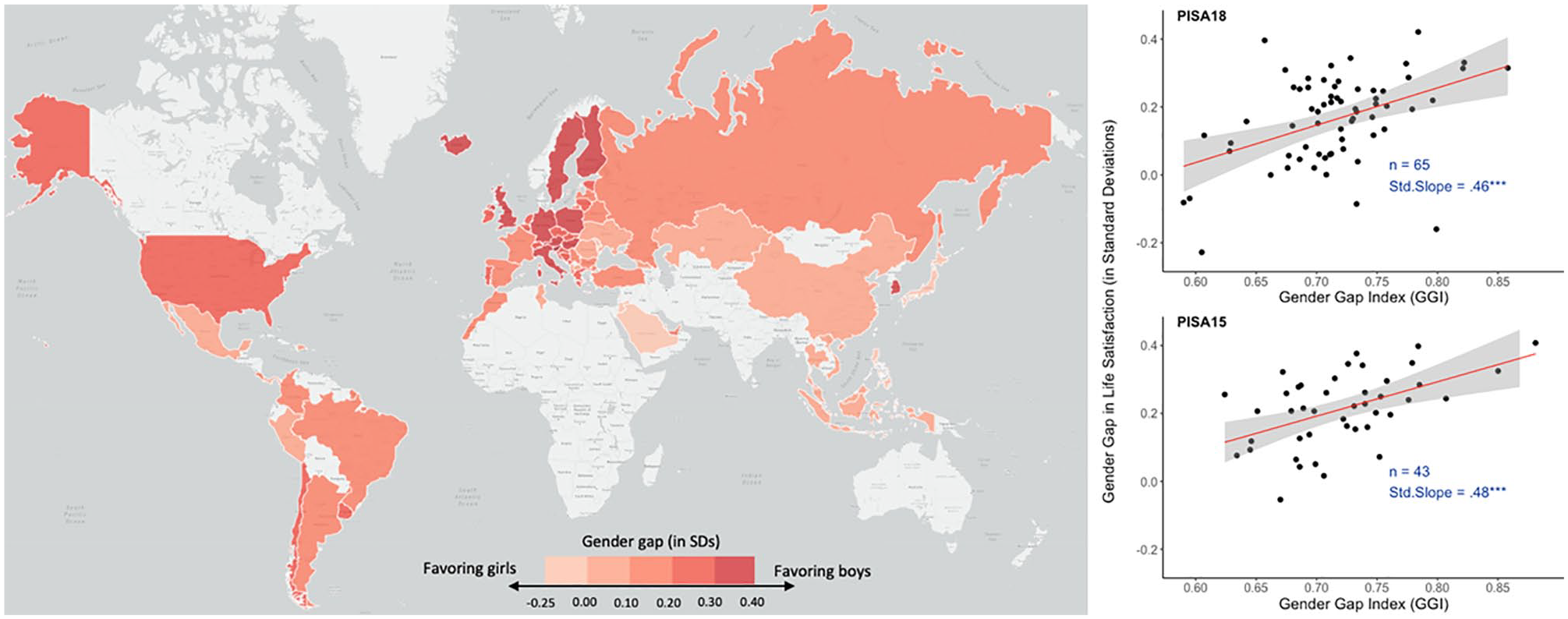
Mean country-level gender difference in life satisfaction using PISA 2015-2018 data.
Individual-Level Measures
Indices of adolescent SWB
Life satisfaction
Adolescents’ life satisfaction was assessed by a single item (“Overall, how satisfied are you with your life as a whole these days.”) with a 10-point scale ranging from 0 (not at all satisfied) to 10 (completely satisfied). Within well-being research, life satisfaction is one of the most widely used indicators of an individuals’ SWB (Diener, 2000; Diener et al., 2018). This single-item measure of life satisfaction has been widely used in large-scale cross-cultural studies (e.g., the World Values Survey, Eurobarometer, the European Quality of Life Survey, the European Values Study), and in a wide spectrum of well-being research (e.g., Marsh et al., 2020; Meisenberg & Woodley, 2015), including among adolescents (De Looze et al., 2018).
Affect
Positive and negative affect are also widely used indices of SWB and are included in a range of well-established multicomponent well-being measures (e.g., Diener, 2000; Diener et al., 2010; Gross & John, 2003), including among adolescents (Bluth & Blanton, 2015). There is evidence that when individuals are functioning well (e.g., are engaged in healthy relationships, are living with a sense of autonomy and purpose, and are resilient), this is accompanied by the regular experience positive affect and a relative lack of negative affect (Watson et al., 1988). Measures of both positive and negative affect are, therefore, highly valuable (and parsimonious) indicators of a person’s SWB (Diener et al., 2010). In the present study, affect was assessed by asking how adolescents normally felt in relation to five positive emotion facets (i.e., happy, joyful, cheerful, lively, proud) and four negative emotion facets (i.e., afraid, sad, miserable, scared) based on Watson et al. (1988)’s Positive and Negative Affect Schedule. Response options were in a 4-point Likert-type scale format, ranging from 1 (never) to 4 (always). These nine emotion facets were analyzed independently and also combined into two composite indices of positive and negative affects. In doing so, following Falk and Hermle (2018)’s suggestion, we first performed a principal component analysis of five positive facets. The first main component then served as the composite index of positive affect. The same procedure was utilized to create the negative affect index. The reliability scores for the composite measures of positive affect and negative affect were above the acceptable threshold of .7 (Cronbach’s alpha α = .80 and .75, Omega coefficient ω = .83 and .77, respectively). There was only a small amount of missing data on the SWB measures (i.e., 13% for life satisfaction, 11% for positive affect, and 11% for negative affect), which was handled by multiple imputation (Enders, 2010, see below).
Individual-level covariates (controls)
Students’ average PISA performance across three subject domains (reading, mathematics, and science), year grades, and family socioeconomic status (SES) were included as covariates in the models that generate the country-level gender differences in SWB (Guo et al., 2019, 2022 see Data Analyses section below for further details). Correlations among all SWB measures and covariates are presented in Table S1 in Supplemental Materials.
Country-Level Measures of Gender Equality
Primary measure
The GGI was used as a primary measure of country-level gender equality in this study, as it is a widely used measure of gender equality. It is based on a number of indicators, including level of education, health, as well as economic and political participation (World Economic Forum, 2018). Education attainment is established by calculating the ratios of women to men in primary, secondary, and tertiary levels of education as well as the ratio of female-to-male literacy rates. Health factors include sex ratios at birth and life expectancy (Buvinic et al., 2014). The economic indicators include the difference between men and women in labor force participation rates, the ratio of estimated female-to-male earned income, the ratio of women to men among senior officials and managers, and the ratio of women to men among technical and professional workers. Finally, political empowerment is calculated from the ratio of females to males with seats in parliament, at the ministerial level, and years with a female head of state of government in the last 50 years (Buvinic et al., 2014). Greater values of the GGI indicate higher levels of gender equality for a given country.
Gender equality measures used in sensitivity analyses
Other measures of gender equality were included in the sensitivity analyses. One such measure is the GEM developed by the United Nations Development Programme (UNDP), which measures female empowerment regarding economic and political power (Dijkstra, 2002). Another measure used in additional analyses is the UNDP’s GII, a composite index assessing the loss of achievement in specific countries because of gender inequality, constructed out of indicators of reproductive health, empowerment, education, and the labor market (Buvinic et al., 2014). The GII is coded opposite to the other measures, such that higher scores denote higher inequality within a country.
It has been recently shown that domain-specific relative measures are important for understanding the relationship between gender equality and academic well-being (Marsh et al., 2020). Hence, we also considered within-country relative measures of gender differences in specific life domains. Three within-country relative measures were included: the female-to-male ratio in gross income per capita, the female-to-male ratio in labor force participation, and the female share of parliamentary seats.
Other country-level measures used in sensitivity analyses
The GINI index measures the extent to which the distribution of income among individuals or households within an economy deviates from a perfectly equal distribution. Annual GDP per capita was obtained from the International Monetary Fund. The Human Development Index (HDI) is widely used as an indicator of national socioeconomic development level, and is calculated by aggregating a series of measures of the quality of national living conditions, including life expectancy, education, health, and financial status.
Data extraction of country-level measures
To maximize the number of observations and power in the subsequent data analyses, for each observation in country (c) in PISA data, we retrieved the following country-level measures in country (c) for the closest year (t) available starting from t−1, then t+1, then t−2, then t+2 (see Breda et al., 2018). Given that the data collection of PISA2018 for each country had to be conducted during a 56-day period between March 1, 2018 and August 31, 2018 (OECD, 2019; the same approach was applied to PISA2015 in 2015), we first matched PISA 2018 data with gender equality indexes for 2018. If there were missing data on the indexes for a specific country, we searched for the same indexes in 2017, followed by 2019, and so forth. But it should be noted that most of the gender equality measures were available for each year time point; only those domain-specific measures (e.g., the female-to-male ratios in gross income per capita and in labor force participation) would have missing data in certain time points.
Data Analyses
This section describes the statistical analyses undertaken. We describe the construction of measures of country-level gender differences in SWB and country-level overall SWB. Then, we provide details on the statistical methods used in the present study. All statistical analyses were conducted with R programming (R Core Team, 2020). Please see the OSF link for the data analytic methods and code.
Computation of country-level gender differences in SWB
First, we standardized scores (M = 0, SD = 1) for all individual-level variables across the entire sample, to facilitate interpretations in relation to a standardized effect-size metric. Second, for each SWB measure, the following individual-level ordinary least squares (OLS) regressions were performed separately for each country c:
Without controls:

With controls:
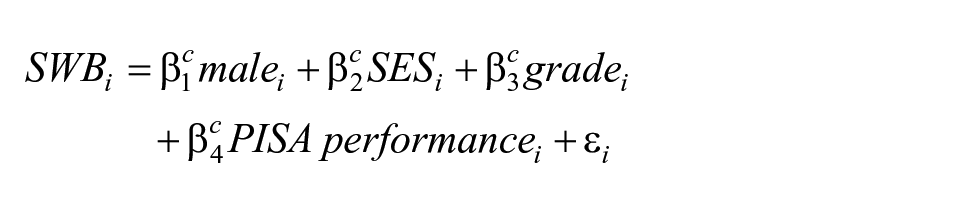
The obtained coefficient
Computation of country-level overall SWB
First, we standardized scores (M = 0, SD = 1) for all student-level SWB variables across the entire sample, to facilitate interpretations in relation to a standardized effect-size metric. Second, we computed the mean of each SWB measure for each country. We employed the same weighting procedure as mentioned above to obtain mean and its standard error, which were saved for the meta-analytic analysis regarding country-level overall SWB.
Meta-analytic approach
In this study, we employed a meta-analytic regression approach instead of simple correlation/regression approaches to calculating global gender differences in SWB and its relationship with country-level gender equality. In the cross-cultural large-scale studies on gender differences, the traditional approach is to aggregate gender differences for each country and conduct single-level regression analysis at the country level, ignoring the reliability of country-level estimates (e.g., Falk & Herlme, 2018; Stoet & Geary, 2018). A meta-analytic approach has been considered a more sophisticated way to study cross-cultural gender differences, as it enables taking between-country heterogeneity into account (e.g., Else-Quest et al., 2010; Keller et al., 2020). This approach is particularly useful because it evaluates the magnitude, consistency, and variability of findings, while also allowing for the examination of moderators that might influence the presence or absence of gender differences (Hyde, 2014).
The meta-analytic regression approach allows us to address aggregation bias and incorporate uncertainty in country-level gender differences in SWB (i.e.,
Multilevel approach
The main analysis was conducted at the country level using the meta-regression approach. As a robustness check, we also deployed a three-level multilevel approach (students [
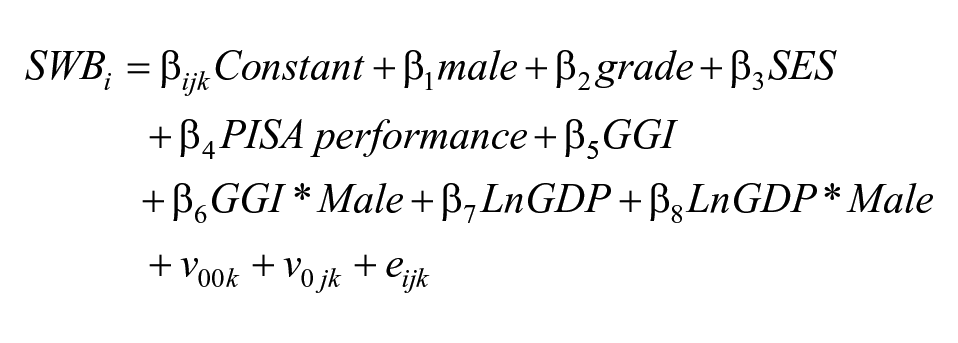
Of note, a random intercept for the school level was also included to take into account the stratified, two-stage sample design for selection of schools and students within schools. The analysis was conducted by using the R packages lme4 (Bates et al., 2015) and lmerTest (Kuznetsova et al., 2017).
In the present study, we handled the small amount of missing data using multiple imputations. Multiple imputations can provide adequate results even for high rates of missing data (Enders, 2010). The variables pertaining to demographic background (index of economic, social and cultural status, year grades) and all aspects of SWB (i.e., life satisfaction, positive affect, and negative affect) were all included to better model the missing data mechanism in the multiple imputation process. Ten imputed data sets were created using a bootstrapped expectation–maximization (EM) procedure (Enders, 2010). All data analyses were run separately, and the results were aggregated appropriately to obtain unbiased estimates across 10 multiple imputations, using the Amelia II package (Honaker et al., 2011) in R.
Results
Overall Gender Differences in Adolescent SWB
First, we examined global gender differences in adolescent life satisfaction and positive and negative affect. To enhance the interpretation of gender differences, we converted the estimated coefficients to Cohen’s d. For example, a Cohen’s d of .20 indicates the two groups differ by .20 standard deviations (SD). In the context of psychological research, d of .20, .41, and .63 can be broadly interpreted as small, medium, and large effects, respectively (Funder & Ozer, 2019). We identified statistically significant gender differences in life satisfaction and all facets of negative affect (Table 1). Boys were on average more satisfied with their lives than girls, and felt negative emotions less frequently. These differences were small-to-medium in magnitude: d = .20 for life satisfaction and −.46 for overall negative affect (d = −.46 for sad, −.39 for scared, −.35 for afraid, and −.19 for miserable; all p < .001). Gender differences in positive affect were only statistically significant in two of five domains: boys felt prouder (d = .14) but less joyful (d = −.05) than girls (p < .001). The gender difference in overall positive affect was not statistically significant (d = .02, p = .292). The sizes of overall gender differences in adolescent SWB remained highly similar after controlling for individual-level covariates (i.e., socioeconomic background, grade level, and academic performance). However, there was a substantial degree of cross-country heterogeneity in the magnitude of the gender differences across domains of SWB (I2 > 93%, see Table 1), which sets the stage for our subsequent analyses.
Gender Differences in Subjective Well-Being Across Countries.
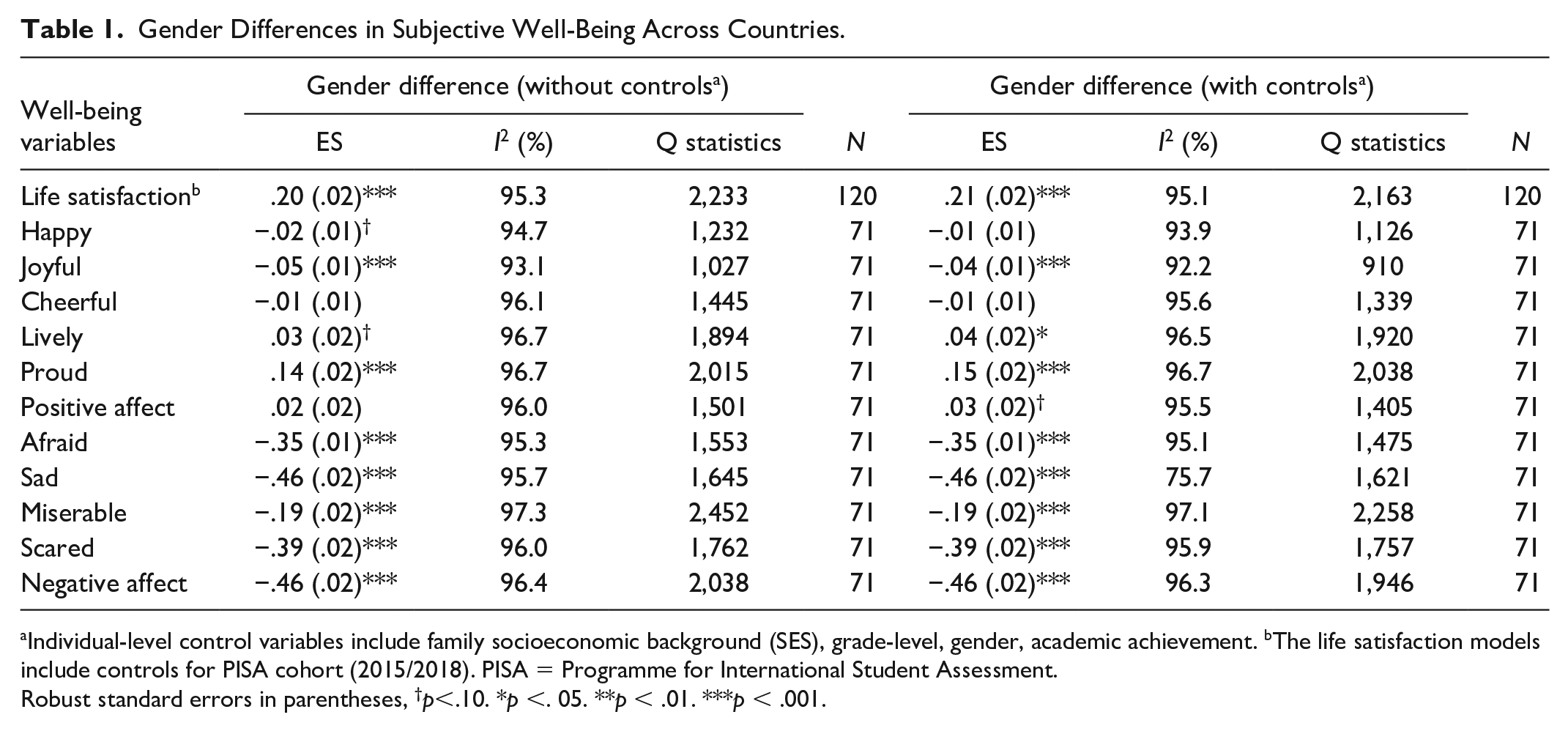
Individual-level control variables include family socioeconomic background (SES), grade-level, gender, academic achievement. bThe life satisfaction models include controls for PISA cohort (2015/2018). PISA = Programme for International Student Assessment.
Robust standard errors in parentheses, †p<.10. *p <. 05. **p < .01. ***p < .001.
Gender Differences in Adolescent SWB as a Function of Country-Level Gender Equality
The meta-regression results revealed that adolescent life satisfaction increased with country-level gender equality (standardized β = .24, p = .008; Supplemental Table S2). Positive and negative affect were, however, not significantly associated with gender equality. Results from the focal models assessing country-level gender differences in SWB across levels of the GGI are presented in Figures 2 and 3 and Table 2. Country-level gender equality moderated the magnitude of the gender gap in life satisfaction (standardized β = .46) and overall positive affect (β = .50) and negative affect (β = −.49; all ps < .001). Similar results emerged for each of the positive affect facets (proud: β = .59; happy: β = .54; joyful: β = .49; cheerful: β = .44; lively: β = .24) and three of four negative affect facets (sad: β = −.59; afraid: β = −.42; miserable: β = −.42). These results indicate that as country-level gender equality increases, so do the gender gaps in life satisfaction, positive affect, and negative affect, favoring boys.
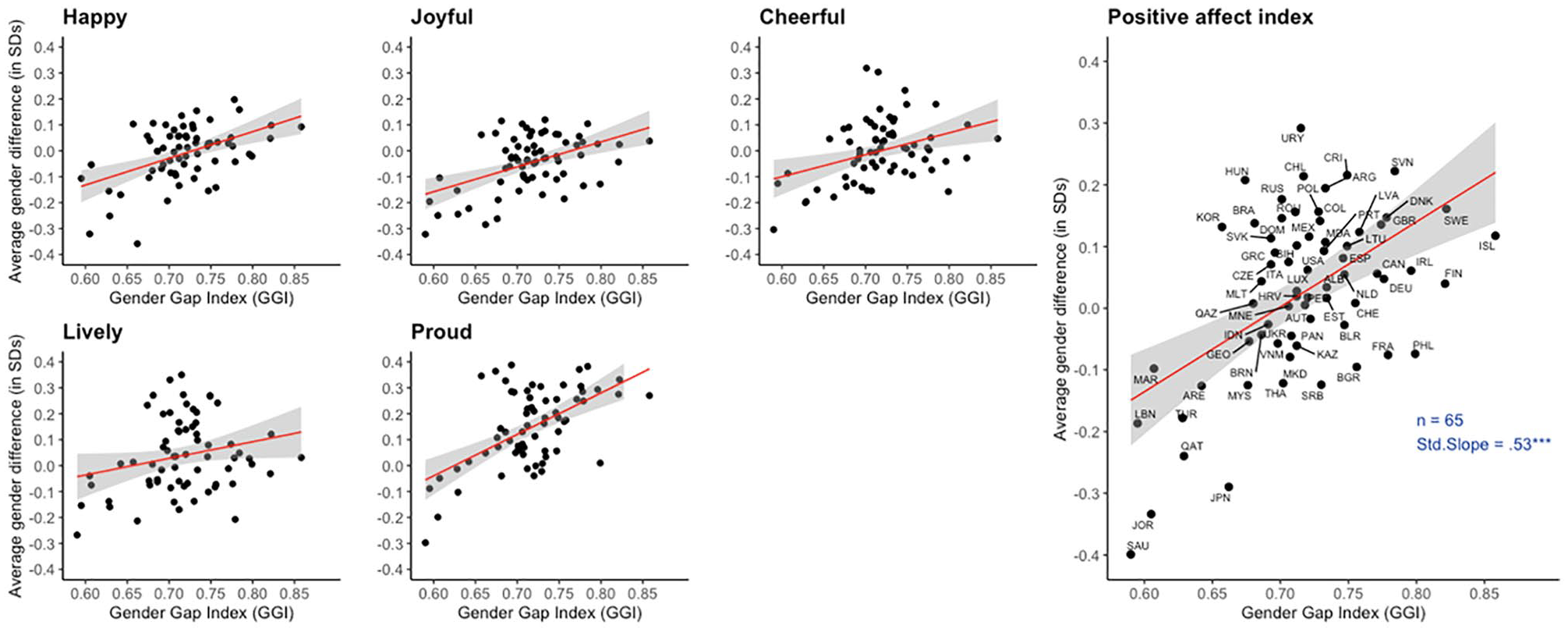
Average country-level gender differences in positive affect by country-level gender equality using PISA 2018 data.
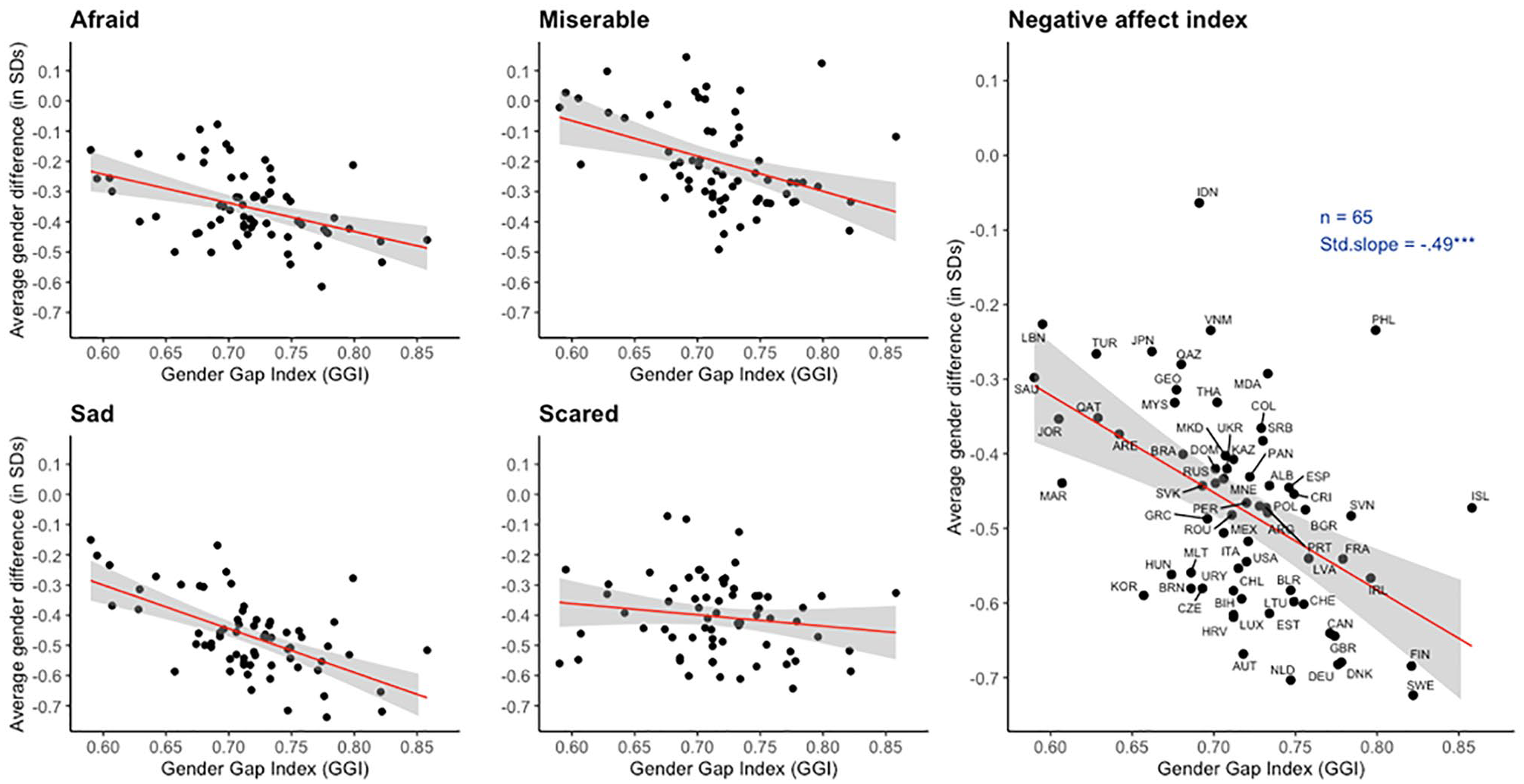
Average country-level gender differences in negative affect by country-level gender equality using PISA 2018 data.
Meta-regression Analysis of Gender Differences in Subjective Well-Being in Relation to Gender Equality at the Country-Level.
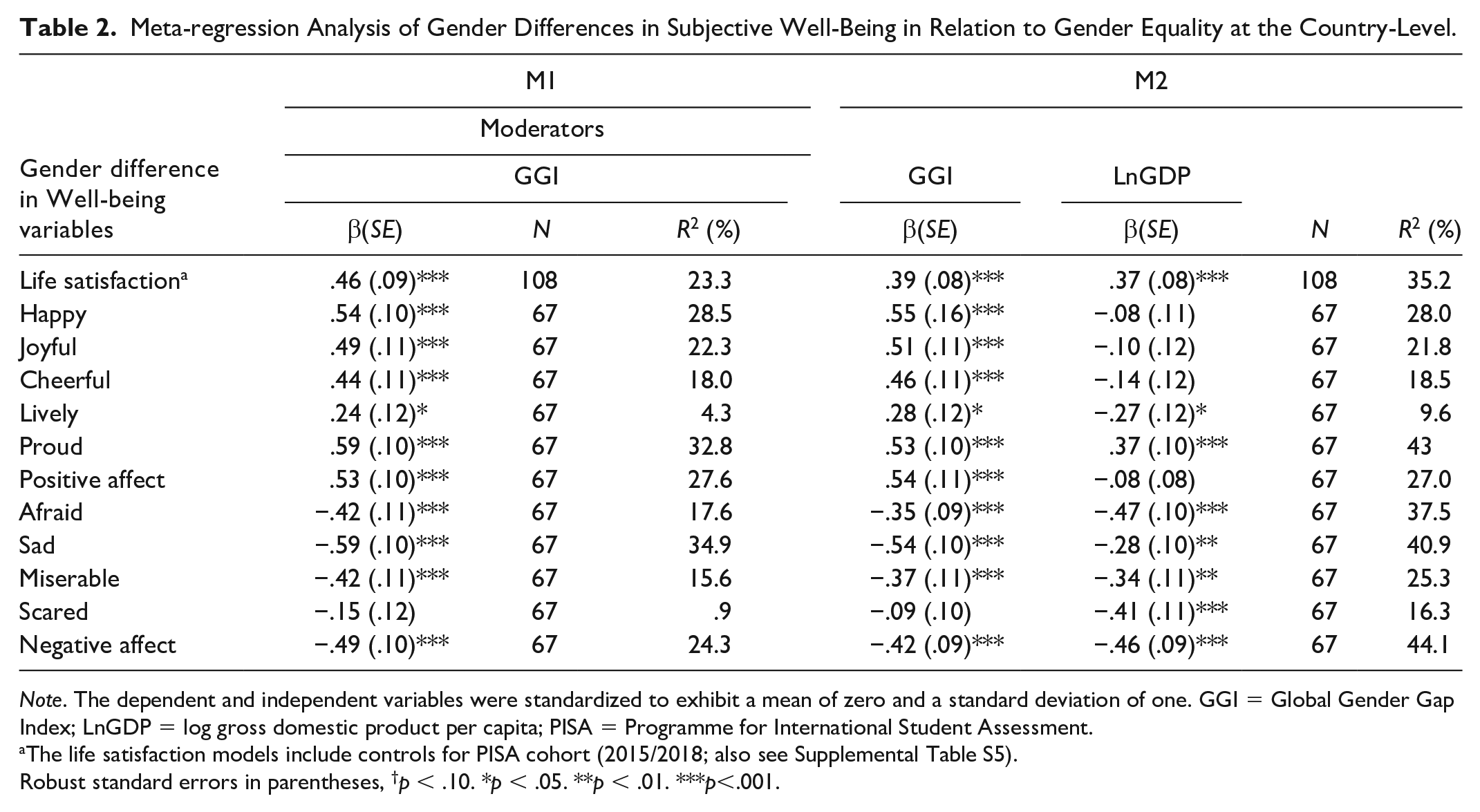
Note. The dependent and independent variables were standardized to exhibit a mean of zero and a standard deviation of one. GGI = Global Gender Gap Index; LnGDP = log gross domestic product per capita; PISA = Programme for International Student Assessment.
The life satisfaction models include controls for PISA cohort (2015/2018; also see Supplemental Table S5).
Robust standard errors in parentheses, †p < .10. *p < .05. **p < .01. ***p<.001.
Sensitivity Analyses
The meta-regression model findings were highly robust to a series of sensitivity analyses. We successfully replicated the pattern of results by: (a) controlling for individual-level covariates—socioeconomic background, grade level, and academic performance—in the regression used to derive country-level gender differences in SWB (Supplemental Table S3); (b) calculating country-level gender differences after standardizing each measure of individual SWB at the country level (i.e., within each country) rather than at the global level (i.e., across all countries; Supplemental Table S4); (c) controlling for country GDP in the models examining the association between gender equality and the gender gaps in SWB (Table 2 and Supplemental Table S3); (d) measuring gender equality through multiple other indices (e.g., the GEM) and domain-specific measures of gender parity in structural characteristics (e.g., labor market participation, gross national income; Supplemental Tables S5–S7); (e) controlling for nongender-specific social inequality (GINI Index, Human Development Index, HDI; Supplemental Table S8); (f) controlling for country OECD status (i.e., OECD/non-OECD) and OECD status × GGI interactions (Supplemental Table S9).
Changes in Gender Gaps in Adolescent SWB as a Function of Changes in Country Levels of Gender Equality: Within-Country Analyses
To validate the above findings from between-country analyses, we also estimated within-country change-score models of country-level gender equality and life satisfaction between 2015 and 2018. The annual reports of World Economic Forum (2018) show that the progress in gender equality at the country level, such as GGI, is not fixed and can be changed from year to year (see OSF link for country-level data). The change in gender quality was calculated by subtracting GGI2015 from GGI2018 for each country. Then the within-country change scores in the GGI were used to correlate to those in life satisfaction. The results revealed a statistically significant positive correlation (r = .34, p = .013, n = 41 countries). It indicates that a 1 SD within-country increase in gender equality was associated with a .34 SD within-country increase in the gender gap in adolescent life satisfaction favoring boys.
Changes in Boys’ and Girls’ SWB as a Function of Country-Level Gender Equality: Multilevel Analyses
The significant association between gender gaps in SWB and country-level gender equality revealed in our meta-regression models was well replicated in multilevel regression models. In these models, the key parameter was a cross-level interaction between respondent’s gender (female as a reference category) and country-level GGI. All these cross-level interactions were statistically significant and positive for life satisfaction (β = 1.00, SE = .06 for PISA2018; β = .98, SE = .07 for PISA2018) and positive affect (β = 1.12, SE = .06) but negative for negative affect (β = −1.13, SE = .06) with ps < .001 (see Tables 3 and 4). The pattern of results remained similar while controlling for individual-level covariates and country-level GDP. Again, this indicates that the gender gaps in SWB are larger in more gender-equal countries. To shed further light on these associations, we examined whether the larger gender gaps in more gender-equal countries emerged due to increases in boys’ SWB, decreases in girls’ SWB, or a combination of these. The multilevel simple slope tests showed that the associations of gender equality with life satisfaction were statistically significant positive and large for boys (β = 1.32, SE = .53, p < .05 for PISA2018; β = 1.89, SE = .49, p < .001 for PISA2015) but relatively small and not significantly different from zero for girls (β = .32, SE = .53, p = .532 for PISA2018; β = .91, SE = .49, p = .071 for PISA2015, see Figure 4 and Table 3). This indicates that the larger gender gaps in life satisfaction in more gender-equal countries are largely due to increases in boys’ but not girls’ life satisfaction. Similarly, the associations of gender equality with positive affect were statistically significant positive and large for boys (β = 1.32, SE = .54, p < .05) but very small and not statistically significant for girls (β = .11, SE = .54, p = .837, see Table 4). Although the associations of gender equality with negative affect were not statistically significant for boys (β = −.67, SE = .58, p = .245) and for girls (β = .63, SE = .58, p = .275), the direction of the estimated coefficient was consistent (i.e., girls’ negative affect did not decrease when being in a more gender-equal country). In general, the results of these additional models suggest that being in more gender-egalitarian countries largely benefits boys’ but not girls’ SWB, and this contributes to widening the gender gap in adolescent SWB.
Multilevel Regression Analysis of Gender Differences in Life Satisfaction in Relation Gender Equality.
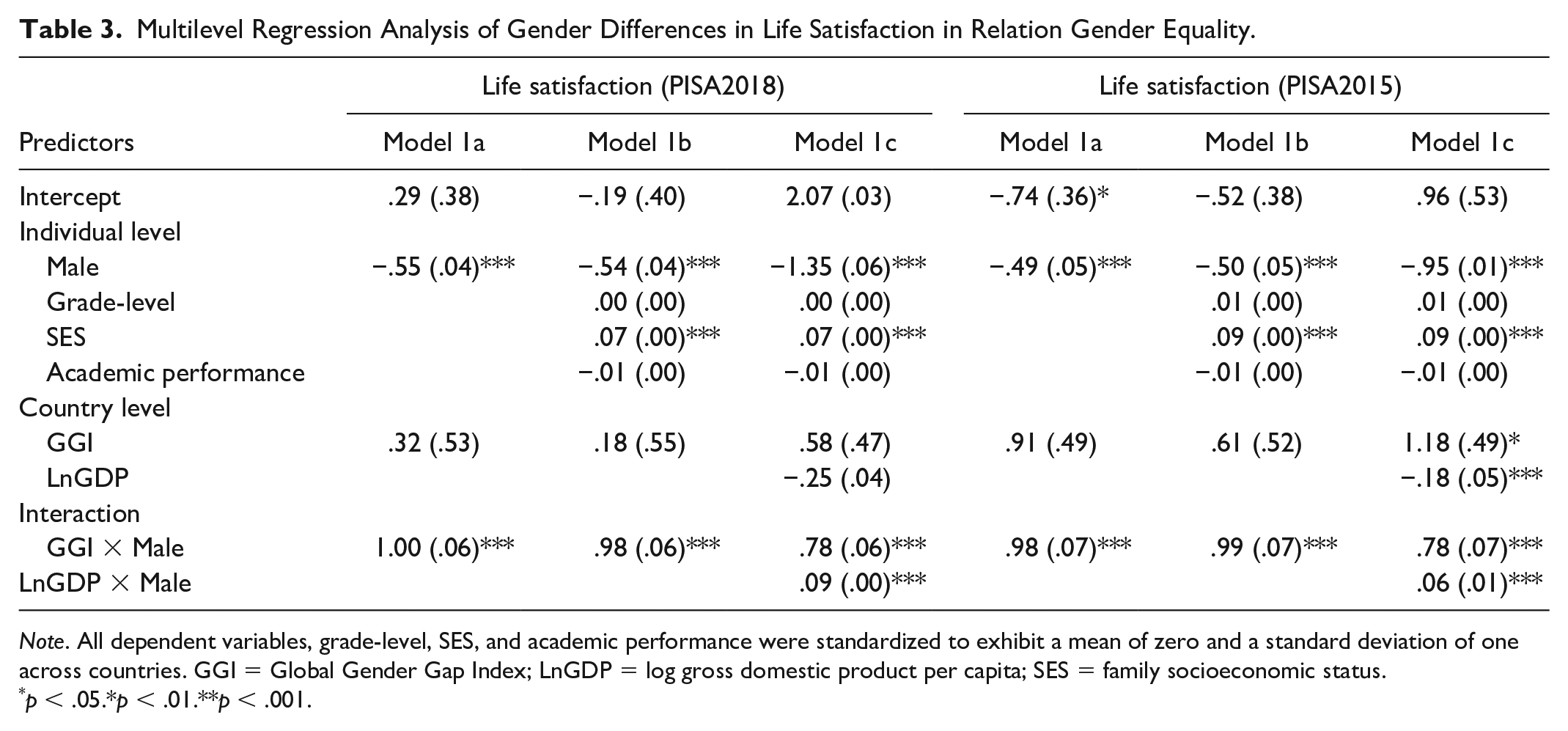
Note. All dependent variables, grade-level, SES, and academic performance were standardized to exhibit a mean of zero and a standard deviation of one across countries. GGI = Global Gender Gap Index; LnGDP = log gross domestic product per capita; SES = family socioeconomic status.
p < .05.*p < .01.**p < .001.
Multilevel Regression Analysis of Gender Differences in Positive and Negative Affect in Relation Gender Equality.
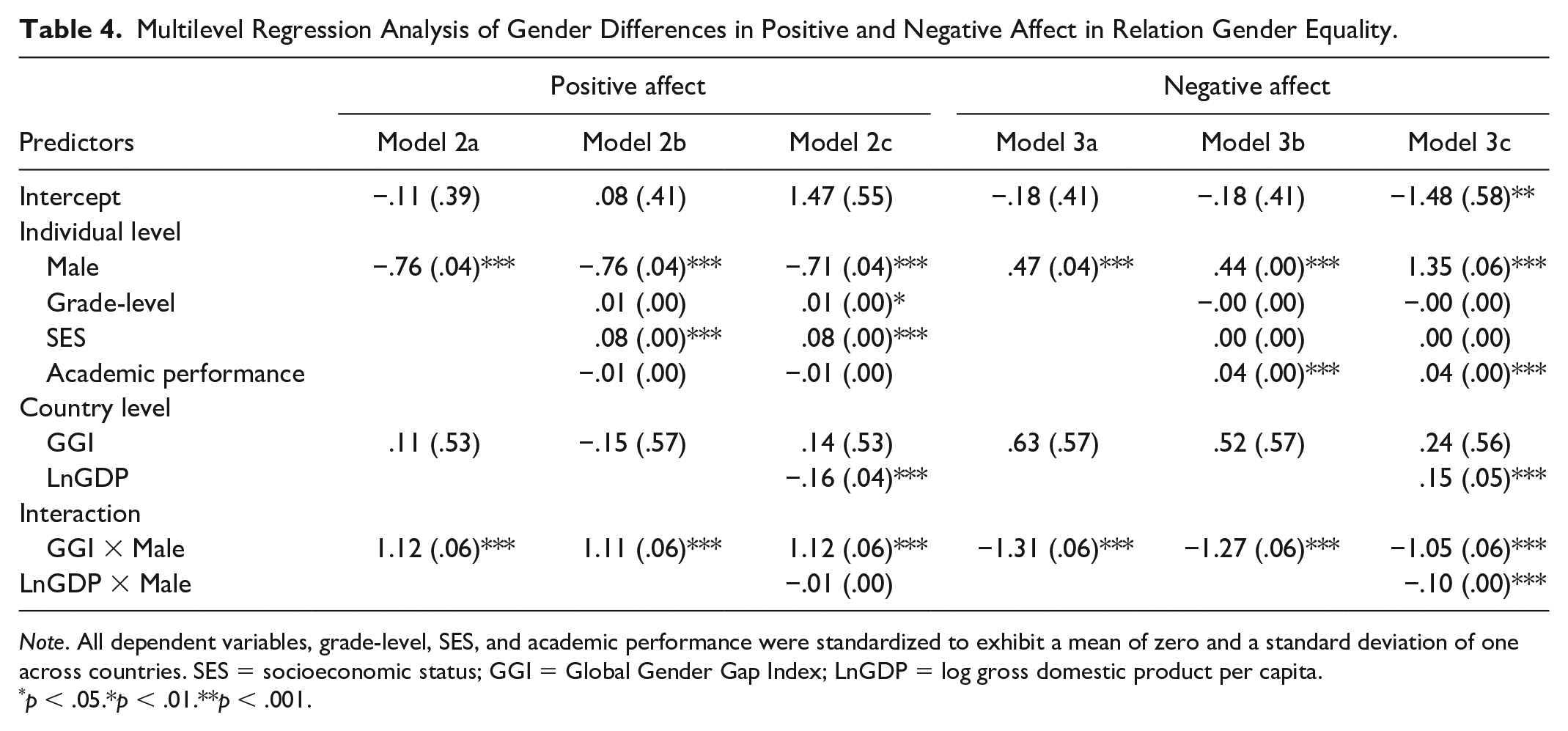
Note. All dependent variables, grade-level, SES, and academic performance were standardized to exhibit a mean of zero and a standard deviation of one across countries. SES = socioeconomic status; GGI = Global Gender Gap Index; LnGDP = log gross domestic product per capita.
p < .05.*p < .01.**p < .001.
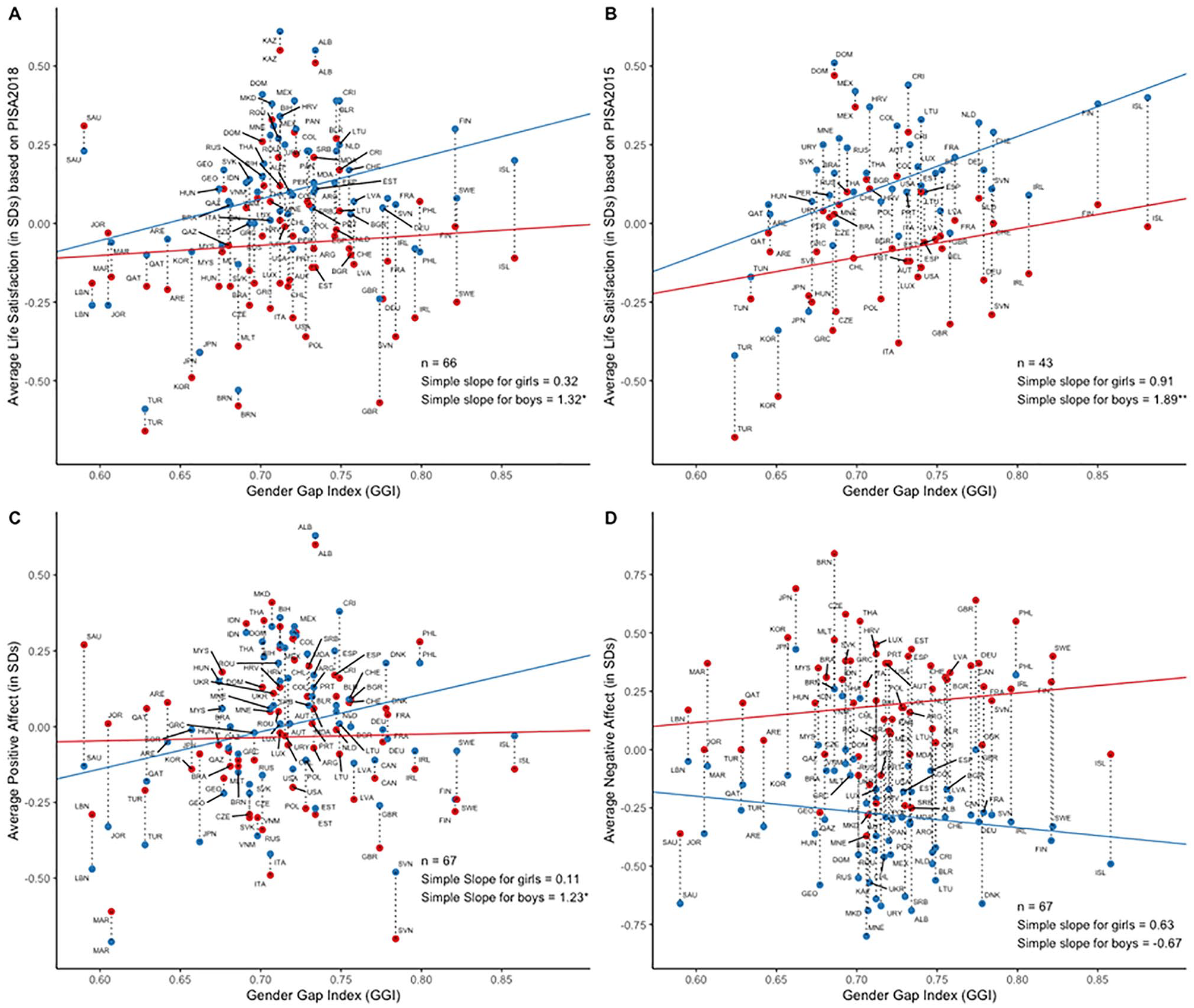
Relationship between subjective well-being components and country-level gender equality for boys and girls using PISA 2015-2018 data.
Replication of the de Looze et al. Study
The de Looze et al. (2018) study was the first study to examine the relationship between county-level gender equality and gender differences in adolescent SWB, from European and North American countries involved in the 2009/10 Health Behaviour in School-aged Children (HBSC) study. In total, 32 European and North American countries that provided both individual-level and country-level data were included in the de Looze et al. (2018) study (N = 158,365, an average n = 4,949 for each country). It is pivotal to replicate and compare their findings using a different and more recent dataset (e.g., PISA). In doing so, we restricted our sample to the HBSC participating countries (28 countries, four countries were missing in PISA; N = 194,516, an average n = 6,947 for each country) and used a similar set of individual-level control variables, such as family affluence (i.e., socioeconomic status) and social support (i.e., parental emotional support, school belonging, and peer classroom support) as well as country-level control variables (i.e., GDP and Gini index). de Looze et al. (2018) concluded that “the interaction was not significant (β = −.196, SE = .141), indicating that the association between societal gender equality and life satisfaction is equally strong for boys and girls” (p. 1081). We found that, based on our sample (limited to the HBSC countries), the cross-level interaction between GEM and gender (male is the reference category to make it comparable) was statistically significant (β = −.166, SE = .036, p < .001, See Supplemental Table S10). This significant interaction indicates that the effect of gender equality was stronger for boys than for girls. Although our findings revealed a similar estimated coefficient to that in de Looze et al.’s study (β = −.166 vs. β = −.196), the standard error was much smaller in our study (SE = .036 vs. SE = .141). To address the apparent conflict in our results, we utilized a meta-analytic approach and calculated the pooled effect size from the two studies. Results showed a highly statistically significant pooled effect size (β = −.168, SE = .035, p < .001), confirming the significant pattern we found. Furthermore, there was nonsignificant heterogeneity (Q[df = 1] = .0425, p = .837), indicating that there was no statistical difference in the sizes of the interaction effects between de Looze et al.’s and our studies. The major difference in studies was in the standard error, which might be caused by differences in sample ages (students of only age 15 in our study vs. students of ages 11, 13, and 15 in the de Looze study) and differences in control variables (e.g., parental emotional support vs. parental communication).
Given that the GEM has been criticized (Klasen & Schüler, 2011), we also tested the interaction effect between the composite country-level gender equality index (i.e., GGI) and gender on life satisfaction based on the limited sample. Results showed that the interaction between GGI and gender was statistically significant (β = −.59, SE = .10, p < .001, See Supplemental Table S10), confirming that the effect of gender equality was stronger for boys than for girls. Our findings underscore the importance of replicability in research in social psychology.
Discussion
The results from this study provide the most conclusive evidence to date of a strong positive association between societal levels of gender equality and gender differences in adolescent SWB. Specifically, we found larger gender gaps in adolescent SWB favoring boys in countries featuring greater levels of gender equality, compared with countries featuring lower levels of gender equality. Although boys’ SWB was higher in countries with greater levels of gender equality, girls’ SWB was not affected by country-level gender equality.
These results are inconsistent with need-fulfillment theory and may be viewed as a paradox: The enhanced opportunities and social resources available to girls in more gender-egalitarian countries do not seem to translate into improved life satisfaction or affect. These findings suggest that individuals’ levels of SWB may depend not only on objective conditions but also on other psychological processes at play given its subjectivity (Batz-Barbarich et al., 2018; Oishi et al., 1999).
Indeed, increasing research has focused on the effect of choosing a reference group for self-comparison on gender differences in SWB (Batz-Barbarich et al., 2018; Guimond et al., 2006, 2007; Zuckerman et al., 2016). Social comparison theory posits that individuals assess their own well-being by comparing their personal circumstances to those of others (Festinger, 1954; Suls et al., 2002). Compared with countries where gender equality is low, males and females in more gender-egalitarian countries are more likely to compare themselves to members of the opposite gender—in addition to their own gender—when making judgments about their SWB (Zuckerman et al., 2016). Indeed, Guimond et al. (2006, 2007) provided both correlational and experimental evidence demonstrating that individuals from Western countries (which typically have higher levels of gender equality) are more likely to engage in between-gender social comparisons (also see Hagerty, 2000). Costa et al. (2001) articulated that people in countries with high levels of gender equality tend to have more progressive gender role ideologies, endorsing such items as “A women should have exactly the same freedom of action as a man” (p. 329). Thus, men and women in these countries tend to use between-gender norms and compare themselves with others regardless of gender. In contrast, in less gender-equal countries, gender roles are more distinct, rigid, and prescriptive. In these countries, self-descriptions of roles are based on comparisons of the self with others of the same gender (Costa et al., 2001; Guimond et al., 2006, 2007).
On one hand, given that men’s higher socioeconomic position and relative standing in society extends even to the most gender-equal countries, changes of frame-of-reference from same-gender to both-gender comparisons can create an awareness of discrimination, undermining females’ SWB reports (Zuckerman et al., 2016). On the other hand, given men’s privileged position in the socioeconomic fabric of society, including women in their comparison group could in fact enhance men’s SWB. That is, women in more gender-equal countries may have lower levels of SWB because they are more likely to compare themselves to men who still tend to have a higher relative standing in society despite objective advances in equality. In contrast, men in more gender-equal countries may report higher levels of SWB because they are more likely to compare themselves to women, who still tend to have a lower relative standing in society. Therefore, greater gender equality may facilitate social comparisons between boys and girls, which in turn may result in an expansion of the gender gap in adolescent SWB in more gender-egalitarian countries.
It should be noted that, however, the social comparison perspective does not necessarily challenge the notion that individuals’ levels of SWB depend on objective conditions (i.e., the need-fulfillment perspective). Undoubtedly, greater levels of gender equality improve girls’ objective living conditions and objective gender equality is important in and of itself (UNDP, 2019; see also de Looze et al., 2018). Nevertheless, the beneficial effects of being in a gender-equal country for girls, stemming from need-fulfillment, may be attenuated or canceled out by between-gender social comparison with boys (e.g., Batz-Barbarich, 2018; Costa et al., 2001; Hagerty, 2000). However, in gender-egalitarian societies, boys’ SWB is likely to benefit from between-gender social comparisons with girls. As a consequence, the progress of gender equality results in an asymmetric pattern: being in more gender-egalitarian countries increases boys,’ but not girls’ SWB, and this contributes to widening the gender gap in adolescent SWB.
Other perspectives that emphasize the subjective nature of individuals’ assessments of their SWB also accord well with our findings. For example, individuals’ levels of SWB may also depend on the gap between what is expected and what is experienced. This aligns with core tenets of the capability theory of well-being, which stresses that SWB is partially driven by individuals’ subjective perceptions of their conditions ( E.Anderson, 2010; Robeyns, 2017). Furthermore, the promise of equality in gender-egalitarian countries may have raised young women’s expectations of equality faster than their actual experiences of equality. For instance, young women in gender-egalitarian countries may have experienced some improvements in education. However, they still face discriminatory practices and barriers to accessing opportunity structures, resources, and power systems (UNDP, 2019). In other words, the incongruence between expected and experienced gender equality tends to be larger in more gender-equal countries, which may attenuate or cancel out the beneficial effects of being in a gender-equal country among young women. Consistent with this theory, Frey and Stutzer (2010) document that women’s SWB in western countries has declined for decades, despite improvements in women’s objective circumstances and greater levels of gender equality (also see Stevenson & Wolfers, 2009). They argue that this process resulted from gender emancipation leading to women developing enhanced expectations, coupled with insufficient resources for these expectations to be fulfilled. This is, therefore, a potential explanation for why the gender gap in adolescent SWB is greater in more gender-equal countries, where the mismatch between females’ expected “horizons of perceived possibilities” and experienced gender equality in relation to the options these horizons entail, is most prominent. To empirically test this proposition, future studies could measure the gap between women’s expectations of gender equality and their actual experiences of equality, and examine its associations with country-level gender equality and country-level gender differences in SWB.
These seemingly paradoxical findings—gender equality intensifying male advantages in adolescent SWB—make significant contributions not only to well-being research but also to the field of gender differences. First, although several large-scale studies have shown gender inequality paradoxes in relation to personality traits (Costa et al., 2001), emotions (Niedenthal et al., 2006), and other psychological constructs (e.g., self-construal, Guimond et al., 2007; values, Schwartz & Rubel, 2005), these studies largely drew on adult samples, and have neglected to examine effects among adolescents. Leveraging a younger cohort sample allows to preclude other sociocultural factors in relation to adulthood that could drive the paradox, such as entering the labor market, marriage, and child-caring duties (Montgomery, 2022). Future empirical work is needed to apply adolescence-related factors and test the mechanisms underlying the paradoxical association between greater gender equality and larger gender differences in adolescent SWB.
Second, cross-cultural and social psychology research has suffered from the crisis of replication and reproducibility usually due to widespread statistically underpowered studies that combined a small number of participants within each cultural group with a limited number of cultural groups (i.e., only a certain number of countries in the world; see Milfont & Klein, 2018). Our study used internationally representative samples and demonstrated the reliability of the findings in many ways to produce trustworthy cultural knowledge. Specifically, we replicated the relationship between country-level gender equality and gender differences in SWB across PISA2015 and PISA2018 data (a) three SWB domains and nine subfacets; (b) six indicators of country-level gender inequality; (c) with and without individual-level (e.g., SES, academic performance) and country-level covariates (e.g., GDP, Gini index, GINI index, HDI); (d) different methodologies including modeling (meta-regression modeling vs. multilevel modeling) and standardization (within- vs. between-country standardization).
Third, previous cross-cultural research has relied heavily on a single cross-section of individuals. This approach ignores the possibility that country-level characteristics other than gender equality could contribute to gender differences in well-being outcomes. The present study addressed this issue by using multiple cohorts of the PISA data and examining the association between within-country change in gender equality and within-country change in gender differences. Similar findings were generated from both with- and between-country analyses.
Fourth, we tried to replicate the findings from the only adolescent cross-cultural study (de Looze et al., 2018) on country-level gender equality and gender differences in life satisfaction, using the same research design (e.g., limiting to adolescent samples in European and North American countries) and methodology. Our replication—though with a different sample—showed that the effect of gender equality on life satisfaction was stronger for boys than for girls. The pooled effect sizes from de Looze et al.’s and our studies also showed a similar pattern to that we found. More research is needed to confirm the results of our study with different nationally representative adolescent samples with the same sets of control variables. Taken together, our findings emphasize the importance of robust analysis and replication in helping psychological research improve its ability to shape policy and practice.
Fifth, previous research has largely focused on identifying cultural differences in the magnitude of gender gaps in SWB and other psychological constructs. However, exploration of the reasons behind such differences is lacking—for example, whether they emerge due to increases in male outcomes, decreases in female outcomes, or a combination of these (Meisenberg & Woodley, 2015; Tesch-Römer et al., 2008). Our simple slope analysis provides a more nuanced understanding of how gender equality paradoxes in SWB are formed. Specifically, the findings suggest that the gender well-being paradox results from the enhancement of boys,’ but not girls’ SWB, in more gender-equal countries.
Limitations
Some limitations should be considered when interpreting our results, pointing to avenues for further research. First, because PISA features repeated cross-sectional data rather than panel data, we were unable to test whether the country-level gender equality causes gender gaps in adolescent SWB. Our findings did, however, reveal that the within-country increase in gender equality was associated with the within-country increase in the gender gap in adolescent life satisfaction favoring boys. Our findings could be further strengthened by cross-national studies based on panel datasets that follow the same individuals over time.
Second, we tested (via sensitivity analyses) several demographic mechanisms that may underlie the effects identified in this study, including country-level wealth, socioeconomic development (HDI), and nongender-specific social inequality (GINI Index) (e.g., Falk & Hermle, 2018; Marsh et al., 2020) but did not find evidence for these candidate mechanisms. We were unable to empirically test social comparison mechanisms, however. Although our findings suggest that multiple psychological processes may play an important role in shaping gender differences in SWB, whether and how social comparisons are involved in the observed patterns should be ascertained by further research.
Third, combining two waves of PISA data affords us coverage of a much wider range of countries than previous cross-cultural research on adolescent SWB (De Looze et al., 2018). Despite this, low-income countries (particularly in Africa) were underrepresented in our sample, and such countries have been shown to have lower levels of gender equality (UNDP, 2019). Consideration of these countries in future empirical studies may reveal different patterns of associations and additional insights into the role of gender equality in shaping gender differences in adolescent SWB.
Fourth, while the present study drew from nationally representative students aged 15, this sample could be potentially biased given that it only considered boys and girls who are enrolled in secondary schools. To address this issue, we ran a new set of analyses by controlling for the sample coverage (i.e., the proportion of 15-year-olds in each country who were covered by the PISA sample. see p. 51, OECD, 2019). Results showed that the relationship between country-level gender equality and gender gaps in SWB remained highly similar (see Supplemental Table S11). Furthermore, the ratio of girls to boys in secondary levels of education is a form of gender equality and is included as a component of gender equality indices (e.g., GGI). Girls are less likely to access secondary schooling in less gender-equal countries, which may lead to a selection bias of PISA data. That said, this sampling issue exists in many other cross-national adolescent surveys (e.g., HBSC study, de Looze et al., 2018). Thus, a more diverse adolescent sample, including a nonschooling population, should be considered in future research, particularly when studying gender differences.
Implication
Adolescence is a key developmental phase where gender differences in psychological health issues begin to emerge, with girls being more vulnerable (Blakemore, 2019, see earlier discussion). These psychological health issues are highly related to SWB. Our study showed that gender equality improved boys’ but not girls’ SWB. This implies that “genuine” equality between girls and boys is still far from being achieved even in gender-equal countries (Inchley & Currie, 2016). While progressing toward objective gender equality, governments should develop a holistic approach to assessing gender equality by including adolescent subjective experience. SWB should be a key measure of societal progress beyond traditional indicators of gender equality. Furthermore, given the focus on high-school adolescents, our results underscore the importance of identifying factors supporting girls’ SWB within more proximal environments, such as schools. Although girls are more likely to access schooling in more gender-equal countries, being able to access education does not necessarily mean that young people of different genders are provided education of equal quality. For example, male-dominant curricular materials are still prevalent (Lindsey, 2020). These sorts of “hidden” gender biases in curricula, together with gender-role during puberty, lead to inequitable educational experiences for girls and boys. By providing even more female-friendly social environments and support networks, and designing preventive interventions (Viner et al., 2012), schools may be able to reduce girls’ psychological health problems during developmentally sensitive periods such as adolescence. Future research, along with policy recommendations and evaluations, is required to examine factors that can help reduce the inequalities in SWB of adolescents.
Supplemental Material
sj-docx-1-psp-10.1177_01461672221125619 – Supplemental material for The Equality Paradox: Gender Equality Intensifies Male Advantages in Adolescent Subjective Well-Being
Supplemental material, sj-docx-1-psp-10.1177_01461672221125619 for The Equality Paradox: Gender Equality Intensifies Male Advantages in Adolescent Subjective Well-Being by Jiesi Guo, Geetanjali Basarkod, Francisco Perales, Philip D. Parker, Herbert W. Marsh, James Donald, Theresa Dicke, Baljinder K. Sahdra, Joseph Ciarrochi, Xiang Hu, Chris Lonsdale, Taren Sanders and Borja del Pozo Cruz in Personality and Social Psychology Bulletin
Footnotes
Declaration of Conflicting Interests
The author(s) declared no potential conflicts of interest with respect to the research, authorship, and/or publication of this article.
Funding
The author(s) received no financial support for the research, authorship, and/or publication of this article.

Supplemental Material
Supplemental material is available online with this article.
References
Supplementary Material
Please find the following supplemental material available below.
For Open Access articles published under a Creative Commons License, all supplemental material carries the same license as the article it is associated with.
For non-Open Access articles published, all supplemental material carries a non-exclusive license, and permission requests for re-use of supplemental material or any part of supplemental material shall be sent directly to the copyright owner as specified in the copyright notice associated with the article.
