




Abstract
Comparison processes are critical to social judgments, yet little is known about how individuals compare people other than themselves in daily life (social-judgment comparisons). The present research employed a 7-day experience-sampling design (Nparticipants = 93; Nsurveys = 3,960) with end-of-week and 6-month follow-ups, to examine how individuals make social-judgment comparisons in daily life as well as the cumulative impact of these comparisons over time. Participants compared close (vs. distant) contacts more frequently and made more downward than upward comparisons. Furthermore, downward, relative to upward, comparisons predicted more positive perceptions of the contact, greater closeness to the contact, and greater relationship satisfaction. More frequent downward comparisons involving a particular contact also predicted greater closeness 1 week and 6 months later. When participants made upward comparisons, they were motivated to protect close, but not distant, contacts by downplaying domain importance, and engaging in this protective strategy predicted greater closeness to the contact 1 week later.
Keywords
In the 1988 United States vice-presidential debate, Senator Dan Quayle attempted to make a comparison between himself and President John F. Kennedy, arguing that he had as much experience as Kennedy did when he sought the presidency. His opponent, Democratic candidate Lloyd Bentsen, seized on Quayle’s comment with devastating effect, declaring, “Senator, I served with Jack Kennedy. I knew Jack Kennedy. Jack Kennedy was a friend of mine. Senator, you’re no Jack Kennedy” (Bentsen, 1988). Whereas Quayle was attempting to draw a lateral social comparison to highlight a similarity between himself and Kennedy, Bentsen was making an upward comparison highlighting the inferiority of his debate rival’s talents relative to those of the revered former senator and president. Numerous studies have examined social comparisons like Quayle’s (those that take place between the self and another person). Less is known about social-judgment comparisons like Bentsen’s, those that individuals make between one of their social contacts and another person but that do not directly involve the self. The present research provides an in-depth investigation of how individuals make and respond to social-judgment comparisons involving their daily contacts.
A large body of research highlights the importance of comparison processes in individuals’ judgments about other people (Higgins & Lurie, 1983; Higgins & Stangor, 1988). In considering whether a judge is lenient or harsh, for example, individuals will be influenced by the presence of other judges who appear lenient or harsh (Higgins & Lurie, 1983). In organizational settings, supervisors often rate how well one employee performs relative to others (Goffin & Olson, 2011). In families, parents compare how well their child is doing relative to siblings (Jensen et al., 2018). Although research has documented the importance of such comparative processes in evaluating others (Damisch et al., 2006; Dunning, 2000; Mussweiler & Damisch, 2008; Mussweiler & Rüter, 2003), little research has examined how and when these comparisons influence perceptions of and relationships with the people with whom one interacts in daily life.
The goals of the present research were fourfold. First, we sought to determine the frequency and characteristics of social-judgment comparisons 1 (i.e., of one person to another) in daily life, showing that individuals compare a range of their regular contacts to other people. Second, we examined whether the degree of closeness to a contact would determine the extent to which individuals engaged in motivated processing when comparing their contacts to other people; that is, we assessed whether individuals would be motivated to engage in comparison processes that would enhance their perceptions of close others. Third, we tested whether social-judgment comparisons have implications for individuals’ relationships with the contacts they compare; specifically, learning that a contact is superior or inferior to another person may have implications for one’s closeness to that contact and satisfaction with that relationship. Fourth, we examined whether social-judgment comparisons have cumulative, long-term outcomes; comparing daily contacts to other people may have aggregate effects that shape one’s closeness to these contacts, extending months into the future.
Our research on social-judgment comparisons was guided by theories regarding comparisons of the self to others. Researchers have noted that the cognitive underpinnings of more general comparison processes can be applied to social comparisons, in which individuals use information about other people to evaluate their own opinions and abilities (Damisch et al., 2006; Kruglanski & Mayseless, 1990; Mussweiler, 2003; Mussweiler & Damisch, 2008). For example, if another person, a comparison standard, is taller than the self, one may view the self to be relatively short. Social comparisons involving the self occur daily (Midgley et al., 2021; Wheeler & Miyake, 1992), and have significant implications for individuals’ self-perceptions. Comparing with a superior other can threaten self-views, whereas comparing with an inferior other can boost self-views (Gerber et al., 2018). The selection and interpretation of information about the self relative to these standards may also be influenced by motivational concerns (Collins, 1996; Wills, 1981; Wood, 1989). According to the selective accessibility model, for example, individuals may be motivated to test whether they are similar or dissimilar to another person in service to their goals (Mussweiler, 2003). That is, individuals seeking to preserve their positive self-views may be motivated to engage in initial dissimilarity testing to an inferior other to maintain their positive self-regard (Corcoran et al., 2011). One’s goals to view the self positively may also determine one’s reactions to comparisons; for example, one may deflect the potential threat of an upward comparison by reducing closeness to the superior other, thus avoiding further comparisons, or by downplaying the importance of the dimension on which one is inferior, thus mitigating the sting of the comparison (Tesser, 1988).
Although a considerable body of research has identified the frequency, outcomes, and motivational processes involved in social comparison, research to date has not examined whether social-judgment comparisons, those that do not involve the self directly, may function similarly in everyday contexts. Whereas social comparisons always involve the self, the outcomes of social-judgment comparisons may vary depending on which contact is being compared, with individuals responding differently when comparing close rather than distant contacts. Thus, it is not clear whether social judgment comparisons will follow the same patterns as social comparisons. Moreover, social-judgment comparisons may have implications beyond those observed for social comparisons, in that they may influence not only perceptions of, but also the relationships that one has with the contact being compared, both in the short term and over time. Further, although a handful of studies have provided initial evidence that, as with social comparisons, motivation may influence the outcome of comparisons involving close others (Thai et al., 2019; Thai & Lockwood, 2015), key questions remain regarding when and how motivation will be involved in social-judgment comparisons. In sum, research on social judgment has not to date has not examined (a) the contacts (e.g., friends, family members, and co-workers) who are most often compared, or the frequency, domain, and direction of these comparisons; (b) the circumstances under which these comparisons will elicit motivation to protect or enhance perceptions of comparison contacts; (c) the impact of these comparisons on relationships with contacts; or (d) the cumulative and long-term effects of these comparisons. The present study thus has novel and important theoretical implications for the understanding of comparative processes in everyday social judgments.
First, although past research has provided evidence that individuals do indeed use comparisons in evaluating other people (Dunning, 2000; Goffin & Olson, 2011), it is unclear how frequently individuals compare one person to another more generally in their daily lives, how often such comparisons occur with specific daily contacts, and how often these comparisons are upward or downward. Past research suggests that social comparisons typically occur at least once a day (Wheeler & Miyake, 1992), and likely more often (Midgley et al., 2021). Given that comparison processes play an important role in social judgments (Dunning, 2000), we expected that individuals would make social-judgment comparisons at least as frequently as social comparisons, that is, on a daily basis. In addition, because individuals likely have more frequent interactions with close (e.g., romantic partner) than distant (e.g., acquaintance) contacts, social-judgment comparisons should be especially frequent with closer contacts. Moreover, given that individuals most likely engage in social-judgment comparisons to evaluate others (Dunning, 2000) and upward comparisons are perceived to be more useful for evaluation than downward comparisons (Taylor et al., 1996), we expected that upward social-judgment comparisons would, like social comparisons, be more common than downward social-judgment comparisons (Gerber et al., 2018; Midgley et al., 2021).
Although social-judgment comparisons with superior others may be more frequent overall, the preference for upward relative to downward comparisons may be attenuated when individuals are comparing contacts who are especially close. Specifically, individuals may be motivated to make downward comparisons that enhance their perceptions of close others, just as they would seek to enhance self-perceptions. Indeed, past research suggests that individuals are motivated to see their close others (e.g., close friends and romantic partner; Boucher, 2014; Gagné & Lydon, 2001) as superior to others, just as they are motivated to see themselves as superior (Zell et al., 2020). Thus, individuals may be especially likely to make downward comparisons when comparing close rather than distant contacts. Consistent with this possibility, when individuals spontaneously recalled comparisons involving their child or parent and another person, greater closeness predicted a greater likelihood of making a downward than upward comparison (Thai et al., 2019). In sum, although individuals may on balance make more upward than downward social-judgment comparisons, just as they do with social comparisons, their social-judgment comparisons involving close contacts are more likely to be downward than those involving more distant contacts.
Second, it is unclear when social-judgment comparisons will elicit responses aimed at protecting the contact. A considerable body of research has focused on when and how individuals will protect the self following an upward social comparison (Mussweiler et al., 2000; Parks-Stamm et al., 2008; Tesser, 1988). It is unclear when similar motivational processes will be involved when comparing a person other than the self. A handful of studies have shown that when individuals include another person in their expanded self-concept (Aron & Aron, 1986), they will respond to comparisons with that individual as they would respond to comparisons with the self (Thai et al., 2019; Thai & Lockwood, 2015; Vogels & Perunovic, 2020); for example, when their child is outperformed by another person, individuals downplay the importance of the comparison domain to protect perceptions of their child, and when their child outperforms another person, they elevate the importance of the domain to boost their positive perceptions of their child. It is less clear whether this motivation extends to any regular contacts, such as roommates or co-workers. Given that individuals are most likely to include partners, children, other immediate family members (e.g., mothers), and close friends in their self-concepts (Thai et al., 2019), it seems reasonable to expect that upward social-judgment comparisons involving these contacts would be associated with protective mechanisms, whereas comparisons involving acquaintances, casual friends, or co-workers would not.
Third, it is unclear whether social-judgment comparisons will have implications not only for one’s perceptions of a contact but also one’s relationship with that individual. The extent to which a contact is better or worse than another person may signal rewards or costs associated with a relationship, leading to changes in one’s closeness to the contact. Research on social comparisons between the self and others suggests that individuals will enhance closeness to a superior other if they can benefit from “basking in the reflected glory” of the other (Cialdini et al., 1976; Tesser, 1988), but will reduce closeness to an inferior other if they fear being dragged down by an association with an inferior other (Lockwood & Pinkus, 2014). Similarly, if a social-judgment comparison indicates that a contact is superior, individuals may experience enhanced self-perceptions due to reflection, and may increase their closeness to the contact to maximize the degree to which they can benefit from their association with the successful other; if the contact is inferior, however, individuals may distance themselves to reduce the threat posed by their connection to the poorly performing contact (Lockwood & Pinkus, 2014). Further, these effects on closeness may be most apparent when comparisons involve contacts who are already at least somewhat close because one’s associations with these contacts are more likely to be clear and publicly recognized, and so to yield benefits (or costs) through association.
Social-judgment comparisons may highlight costs and rewards that affect not only closeness but also relationship satisfaction. For example, realizing that a friend has better social skills than another person signals that one’s interactions with the friend are more pleasurable and thus more rewarding. In contrast, learning that one’s child is not as good at math as a friend’s child indicates that one needs to spend more time helping one’s child with math homework instead of doing more enjoyable activities together. These perceptions of costs and rewards can decrease or increase relationship satisfaction (Thibault & Kelley, 1959). Consequently, upward social-judgment comparisons may reduce relationship satisfaction relative to downward social-judgment comparisons. Given the interdependent nature of relationships with close others, these costs and rewards should be most evident following social-judgment comparisons involving close contacts; thus, we would expect social-judgment comparisons to be more likely to impact relationship satisfaction with close rather than distant contacts.
Finally, past research has not examined the impact of social-judgment comparisons over time. Cumulative and long-term comparison effects have been largely neglected in the social comparison literature more generally. In one recent study, individuals who made more upward comparisons of their relationship to other relationships over 1 week reported lower relationship satisfaction at the end of the week and 6 months later (Thai et al., 2021). For the most part, however, past research has examined either the impact of single comparisons (Gerber et al., 2018) or individuals’ retrospective perceptions of how they have been affected by past comparisons in their aggregate (Buckingham et al., 2019; Buunk et al., 1990) rather than assessing the cumulative effects of specific comparisons over time. Moreover, little is known about the cumulative effects of comparisons involving individuals other than the self.
Given that a single downward social-judgment comparison of a close other is associated with more positive perceptions of the other (Thai et al., 2019; Thai & Lockwood, 2015), we would expect the cumulative effect of multiple downward comparisons on the relationship will most likely also be positive. Specifically, as individuals accrue instances in which they observe that a contact is better than another person, they may want to increase their closeness to that other. For upward comparisons, however, the cumulative effects may depend on individuals’ success in protecting perceptions of the close other following each comparison; that is, individuals who protect a contact by downplaying the importance of the comparison dimension following an upward comparison will, over time, maintain positive perceptions of the contact. Indeed, one study found that individuals who successfully protected their partner perceptions following a threatening upward comparison maintained more positive global perceptions of their partner (Thai & Lockwood, 2015). In contrast, if individuals do not engage this protective strategy, the cumulative effects of comparisons involving this other will be negative; if individuals repeatedly observe that a contact is inferior to other people, and fail to engage protective strategies, they may over time distance themselves from the contact.
In the present research, we used experience sampling to examine the frequency, characteristics (including who one is comparing with whom, as well as the direction, domains, and context of the comparison), and the outcomes (immediate and longer-term) of social-judgment comparisons in daily life. Participants first engaged in an intake session in which they reported on their typical weekly contacts and their closeness to each; this provided us with a baseline measure of closeness to each likely contact. Next, in a 1-week experience sampling study, participants recorded their social-judgment comparisons and reported on the comparison domain, the importance of that domain, the context, the impact of that comparison on their perceptions of the contact, their closeness to that contact, and their satisfaction with their relationship to the comparison contact. At the end of the week and 6 months later, participants completed follow-up surveys in which they reported on their closeness to each of the contacts they had compared during the experience sampling period. For both the 1-week and 6-month follow-up questionnaires, we chose to focus on closeness rather than satisfaction or perceptions of the contact; past research on social comparison has demonstrated that closeness can be affected by both upward (Pleban & Tesser, 1981) and downward (Thai et al., 2016) comparisons, thus we were interested in assessing whether we would observe parallel effects in social-judgment comparisons. 2
We predicted that individuals would make daily social-judgment comparisons, but more frequently for their close contacts. We also predicted that although individuals would overall make more upward comparisons, downward comparisons should be more frequent for closer than distant contacts. 3 In addition, because participants completed multiple comparison questionnaires over the week, we were able to examine within-participant differences in their responses to close, relative to distant, contacts. Although we predicted that individuals would view their contacts less positively after upward than downward social-judgment comparisons, we also predicted that this effect would be attenuated for individuals comparing close others. Specifically, individuals would be more likely to downplay the importance of comparison domains when making upward comparisons and elevate the importance of comparison domains when making downward comparisons involving close rather than distant contacts, which in turn would be associated with more positive perceptions of these close contacts. Further, we predicted that these protective effects would have implications for individuals’ relationships with their contacts, not only in the short term but also in the longer term, assessed 6 months after the initial experience sampling phase. That is, individuals who made frequent upward comparisons involving a less close contact would come to distance themselves from the contact; in contrast, individuals would downplay the importance of the domain of each upward comparison with close contacts, and so maintain closeness over time. Conversely, we predicted that individuals who made frequent downward comparisons involving a contact would over time become closer to that contact; this effect, moreover, should be most pronounced for close contacts.
Method
Participants
We recruited 96 participants using local commuter newspaper ads and online classified ads. 4 On average, participants completed 41.25 surveys (SD = 11.71 surveys, Mdnresponse rate = 100%), for a total of 3,960 completed experience-sampling surveys. Of the original 96 participants, 93 returned for the exit session (29 men, 62 women, 2 unidentified; Mage = 35.01, SD = 12.00): 8 with children and single, 50 currently in a relationship with no children, 35 in a relationship with children. 5 Participants received up to CAD$50 for completing the study. Six months after the exit session, 75 participants completed a follow-up survey in exchange for a CAD$10 gift card of their choice (20 men, 53 women, 2 unidentified, Mage = 34.29, SD = 12.16): 5 with children and single, 41 in a relationship with no children, 29 in a relationship with children. 6
Sensitivity analyses using Monte Carlo simulations revealed that we had at least 80% power to detect effect sizes for each set of analyses: R2 = .005 (experience sampling), R2 = .04 (exit session), and R2 = .05 (longitudinal follow-up).
Procedure
During the in-lab intake session, participants completed a social network survey in which they named various people (e.g., family members and colleagues) they thought they would be likely to interact with over the next week, and rated how close they felt to each person using the inclusion-of-other-in-the-self scale (Aron et al., 1992), a self-other overlap measure (Thai & Lockwood, 2015; 1 = Strongly disagree, 7 = Strongly agree), and a single item assessing closeness (“How close do you feel to [contact’s name]?”; 1 = Not at all, 7 = Extremely close) on 7-point scales. We created a composite measure by first calculating a self-other overlap score using our self-overlap measure, ωwithin = .89, CI95% = [.86, .91], 7 and then averaging it with the inclusion-of-other scale and our single closeness item. Because all items were rated on a 7-point scale, with higher scores indicating greater closeness, we did not standardize the items before combining them, ωwithin = .92, CI95% = [.90, .94]. We attempted to collect baseline closeness data for all potential contacts that participants might encounter and compare in the following week; however, it was not possible to obtain this information for all the contacts that individuals compared. When possible, we used these baseline assessments as covariates in our over time analyses so that our statistical models reflected changes in closeness after making comparisons.
The intake session included a brief tutorial regarding social-judgment comparisons; participants received written examples and were advised that comparisons are not inherently “good” or “bad.” Participants provided an example of a social-judgment comparison and completed a quiz so that the research assistant could confirm that participants were able to accurately identify such comparisons. In addition, the research assistant went through the experience-sampling questionnaire with participants and gave them a handout to help them during the experience-sampling period. Finally, the research assistant helped participants to install the ExperienceSampler app (Thai & Page-Gould, 2018) onto their devices, and trained participants on how to use it.
The 7-day experience-sampling portion started the following day. We used a signal-contingent design in which participants were randomly signaled throughout the day to determine the prevalence of social-judgment comparisons (Reis et al., 2014). Participants received six signals a day, spaced at 1.75 to 2.25 hours intervals. We customized signals to each participant’s schedule. That is, participants received their first signal about 1 hour after their typical waking time and their last signal about 1.5 to 2 hours after their typical dinner time.
In the experience-sampling questionnaire, participants first indicated whether they had compared someone they knew with another person (other than themselves). Given that individuals have countless opportunities to compare people other than themselves, we focused on comparisons involving people they knew because such comparisons would be more likely to have interpersonal consequences; thus, we instructed participants to ignore comparisons involving two strangers. This strategy also reduced the chances that we would overburden our participants during the experience-sampling period. If participants reported a comparison, we presented them with the comparison questionnaire. If they did not, we presented them with a social-interaction questionnaire. 8 In the comparison questionnaire, participants indicated whom they compared (the name or initial was then piped into the subsequent questions), their relationship with the person they compared (hereafter, “contact”), to whom they compared the contact, the comparison domain (selected from a list provided in the survey, as indicated in Table 1; e.g., career success and attractiveness), how important they viewed that domain to be (0 = Not at all important; 6 = Extremely important), and the comparison direction (−3 = [contact] was much worse-off; +3 = [contact] was much better-off). Participants made a downward comparison if the contact was better than another person (above the scale midpoint), an upward comparison if the contact was worse than another person (below the scale midpoint), and a lateral comparison if the contact was similar to another person (at the scale midpoint, indicating neither better nor worse). Participants then reported how close they felt to the contact (0 = not at all close; 6 = extremely close), their perceptions of the contact (“How did the comparison make you feel about [contact]?”) on a 7-point scale (−3 = Much worse than usual; +3 = Much better than usual), and how satisfied they felt about their relationship with the contact (“How did this comparison make you feel about your relationship with [contact]?”) on a 7-point scale (−3 = Much less satisfied than usual; +3 = Much more satisfied than usual). 9
Comparison Domains.
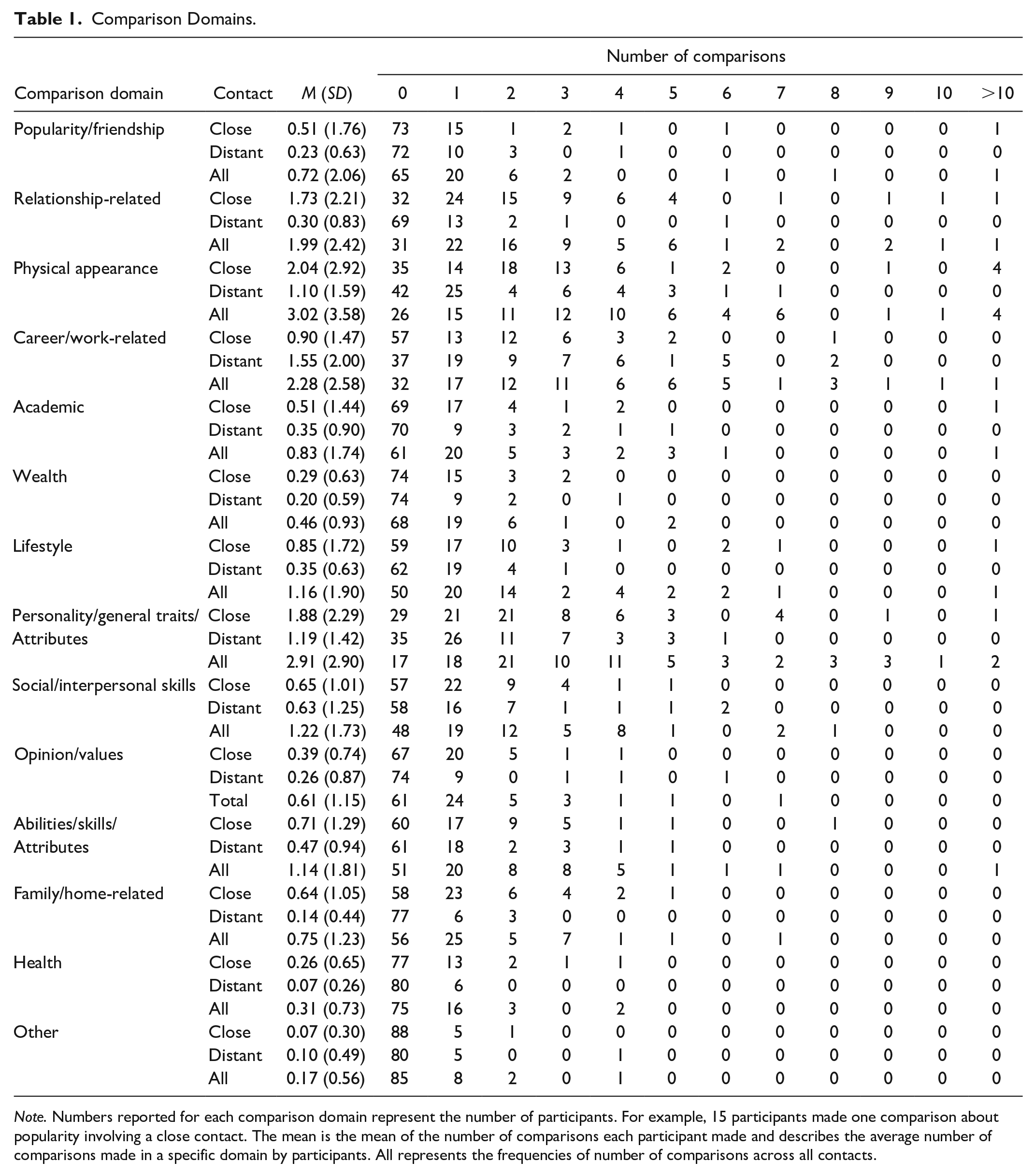
Note. Numbers reported for each comparison domain represent the number of participants. For example, 15 participants made one comparison about popularity involving a close contact. The mean is the mean of the number of comparisons each participant made and describes the average number of comparisons made in a specific domain by participants. All represents the frequencies of number of comparisons across all contacts.
Participants returned to the lab to complete an exit questionnaire. In the exit questionnaire, we provided participants with a list of the contacts they compared during that week, identified by the name or initials participants used in the experience-sampling questionnaire as well as their relationship (e.g., partner, co-worker). Participants rated how close they felt to each of these contacts using the same items completed during the intake session 10 (self-other overlap measure, ωwithin = .95, CI95% = [.95, .96]; closeness composite, ωwithin = .95, CI95% = [.94, .95]). Next, we asked participants if we could contact them in 6 months to complete a follow-up questionnaire. After 6 months, those who agreed to the follow-up were emailed the same closeness questionnaire they completed during the exit session for each of the contacts they compared during the experience-sampling period (self-other overlap measure ωwithin = .96, CI95% = [.95, .97]; closeness composite α = ωwithin = .95, CI95% = [.94, .96]). Our materials have been posted on OSF (https://osf.io/9pd5b/).
Results
We first conducted analyses at the comparison level, examining the frequency of comparisons for each contact type, as well as the direction, context, domains, targets (i.e., who they compared the contact to), and impact of individual comparisons. Next, we assessed the cumulative impact of social-judgment comparisons by examining responses to our follow-up questionnaires administered at the end of the week and 6 months later.
Individual Comparisons
Comparison contact closeness
During the intake session, we had attempted to have participants report their closeness to all contacts they would be likely to encounter and potentially compare in the upcoming week. This would have provided us with a baseline measure to use as a moderator in our analyses. Perhaps not surprisingly, participants did not correctly anticipate all the contacts they would compare, and thus we did not have pretest closeness measures for all from the intake session. In the absence of this more sensitive measure, we operationalized closeness based on participants’ relationships with the various contacts they compared. To determine which contacts would be considered close and distant, we calculated means for each comparison contact category using the baseline closeness data collected during the intake questionnaire (Table 3). For all contact categories, except romantic partner, participants listed multiple people who fell into that specific category (e.g., multiple friends or co-workers). Thus, to account for the nested nature of the data, we used intercept-only multilevel models to estimate the mean, which is represented by the intercept. All participants who were in a relationship listed one partner. Accordingly, for romantic partner, we conducted a linear regression without any predictors to estimate the mean (i.e., the intercept) and standard error. We calculated a baseline closeness mean across contact categories (M = 3.32, SD = 1.33), which was our cutoff to determine whether contacts were considered closer or more distant. Based on these baseline closeness means, we categorized romantic partner, children, siblings, partners, other family members, and close friends as close contacts and all other contacts (e.g., boss, co-worker, casual friend, acquaintance) as distant. Although the mean is only a rough guide as to whether contacts are distant or close, our categorization strategy is supported by research suggesting that the relationships we included in the close category (i.e., family members and close friends) form the heart of most adults’ social networks (Antonucci et al., 2014).
Comparison characteristics
On average, participants made 2.39 (SD = 2.30) social-judgment comparisons each day and 17.92 comparisons in a week (SD = 12.57).11,12 Social-judgment comparisons occurred in a wide variety of domains (Table 1). Consistent with past research examining social comparisons in daily life, the top three domains of comparisons were physical appearance, personality/general traits/attributes, and career/work-related (Midgley et al., 2021; Wheeler & Miyake, 1992). Further, some domains were more relevant for close than distant contacts: At least 80% of the comparisons that occurred in the domains of relationships, family/home, and health involved close contacts. Indeed, a random-intercept logistic multilevel model confirmed that people were more likely to compare a close than distant contact in the domain of relationships, b = 0.76, CI95% [0.55, 1.00], SE = 0.12, z = 6.57, p < .001, OR = 2.14:1; family/home, b = 0.60, CI95% [0.29, 0.98], SE = 0.17, z = 3.55, p < .001, OR = 1.82:1; and health, b = 0.57, CI95% [0.11, 1.23], SE = 0.25, z = 2.25, p = .024, OR = 1.77:1. 13 However, career/work-related comparisons were more prevalent in comparisons involving distant than close contacts, b = −0.61, CI95% [−0.80, −0.43], SE = 0.09, z = −6.96, p < .001, OR = 0.54:1.
On average, participants compared 12 different contacts during the week (M = 12.67, SD = 8.05, range = 1–44 contacts). 14 Of these contacts, participants reported comparing, on average, 6 distinct close contacts (M = 6.14, SD = 4.29). An intercept-only logistic multilevel model revealed that individuals primarily compared those closest to them, b = 0.76, CI95% [0.52, 1.01], SE = 0.12, z = 6.14, p < .001, OR = 2.14:1 (Tables 2 and 3): For any given comparison, there was a 68.11% chance that the comparison involved a close contact and a 31.89% chance they compared a distant contact.
Comparison Contacts and Total Comparisons.
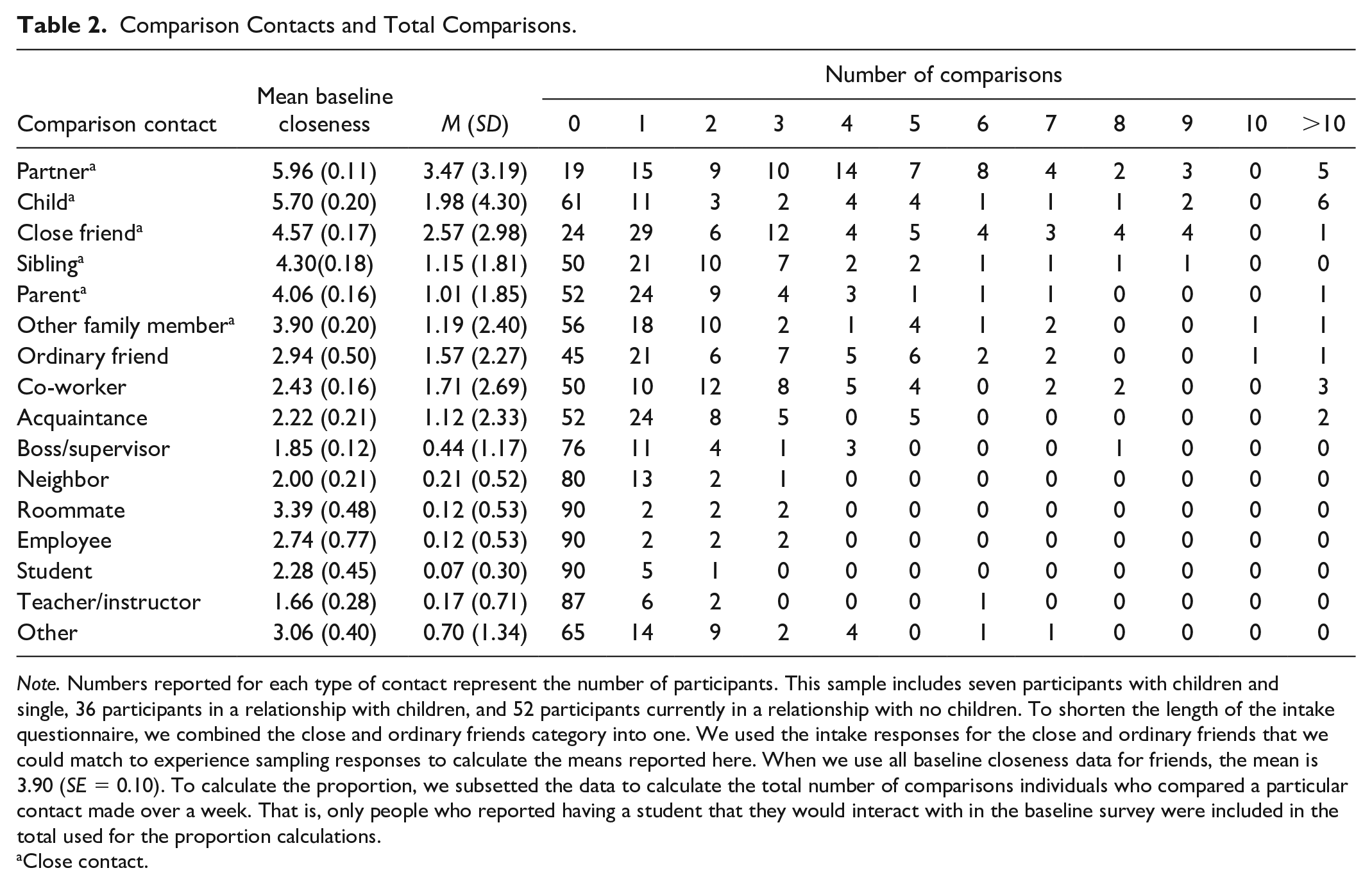
Note. Numbers reported for each type of contact represent the number of participants. This sample includes seven participants with children and single, 36 participants in a relationship with children, and 52 participants currently in a relationship with no children. To shorten the length of the intake questionnaire, we combined the close and ordinary friends category into one. We used the intake responses for the close and ordinary friends that we could match to experience sampling responses to calculate the means reported here. When we use all baseline closeness data for friends, the mean is 3.90 (SE = 0.10). To calculate the proportion, we subsetted the data to calculate the total number of comparisons individuals who compared a particular contact made over a week. That is, only people who reported having a student that they would interact with in the baseline survey were included in the total used for the proportion calculations.
Close contact.
Comparison Contacts and Directions.
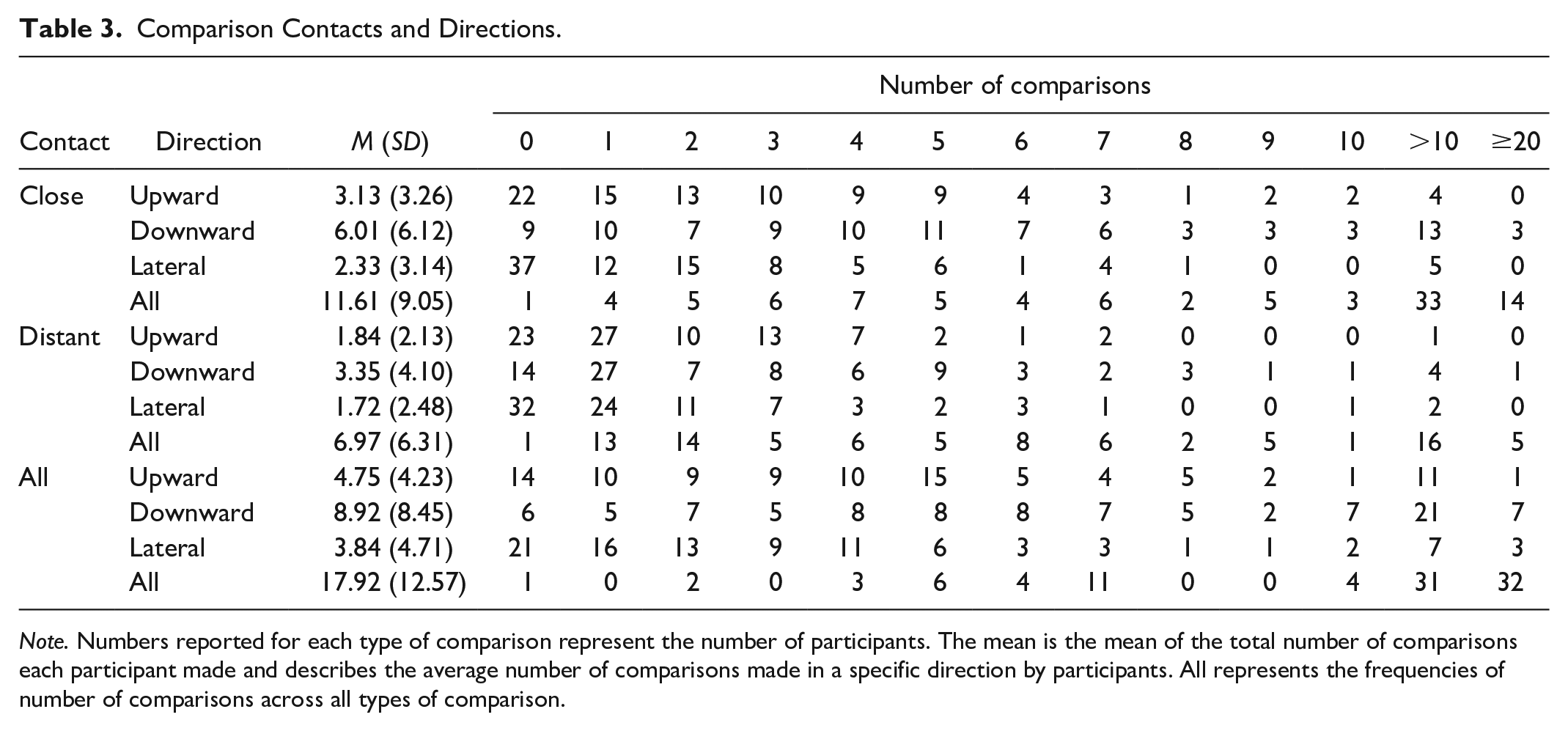
Note. Numbers reported for each type of comparison represent the number of participants. The mean is the mean of the total number of comparisons each participant made and describes the average number of comparisons made in a specific direction by participants. All represents the frequencies of number of comparisons across all types of comparison.
In general, participants indicated that they did not actively seek out these comparisons (M = 2.40, SD = 1.91), regardless of whether these comparisons involved close or distant contacts, b = 0.04, CI95% [−0.04, 0.12], SE = 0.04, t(1541.84) = 0.95, p = .345. The majority of comparisons were made in-person after seeing another person or through imagined comparisons. Social media comparisons were also relatively common (Table 4).
Comparison Contexts.
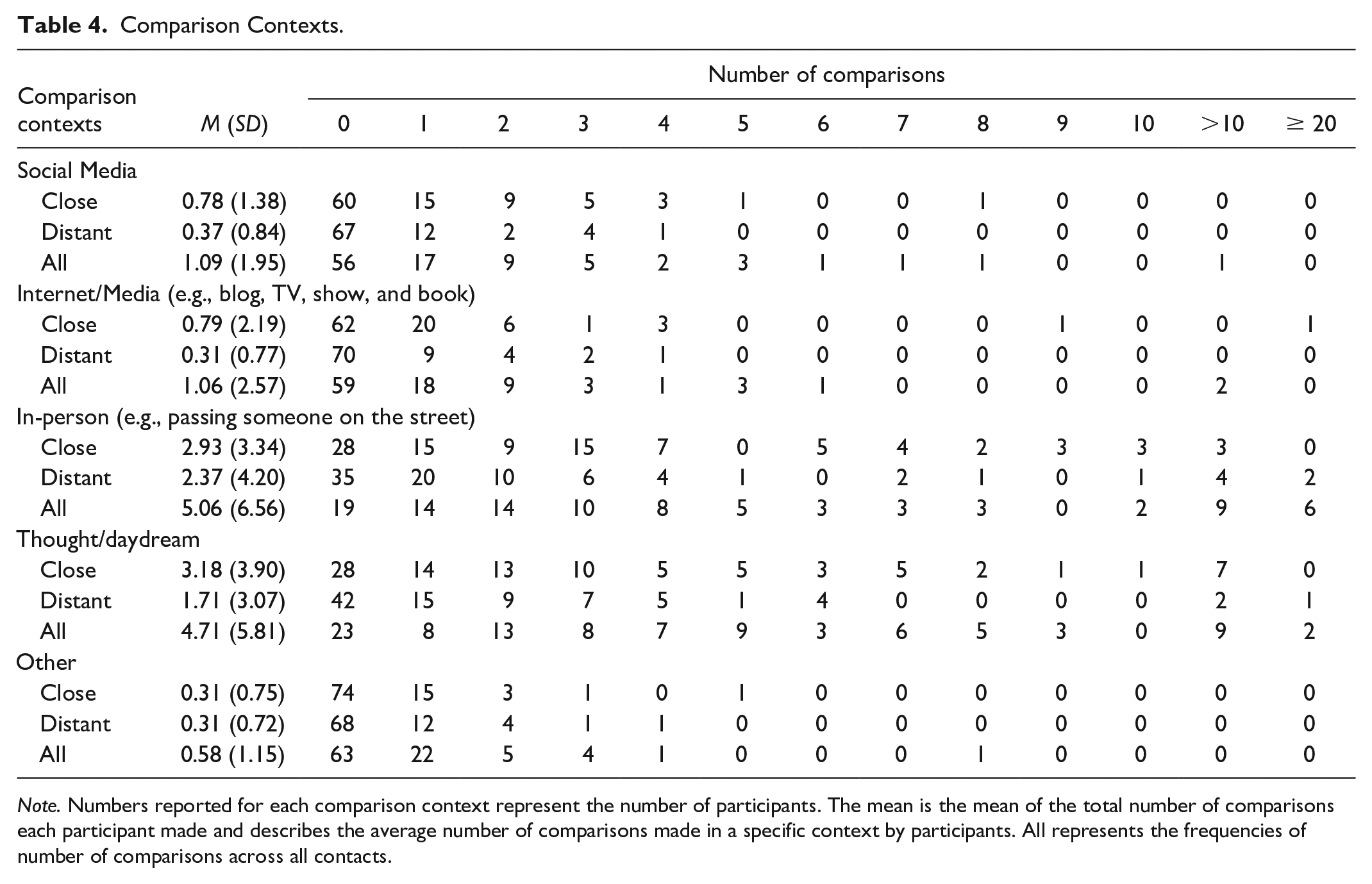
Note. Numbers reported for each comparison context represent the number of participants. The mean is the mean of the total number of comparisons each participant made and describes the average number of comparisons made in a specific context by participants. All represents the frequencies of number of comparisons across all contacts.
When making these comparisons, participants often compared their contacts with other close contacts, with friends being the most frequent comparison target. However, participants also frequently compared their close contacts with strangers. In contrast, they often compared distant contacts to their colleagues or co-workers (Table 5).
Comparison Others (With Whom Were Contacts Compared).
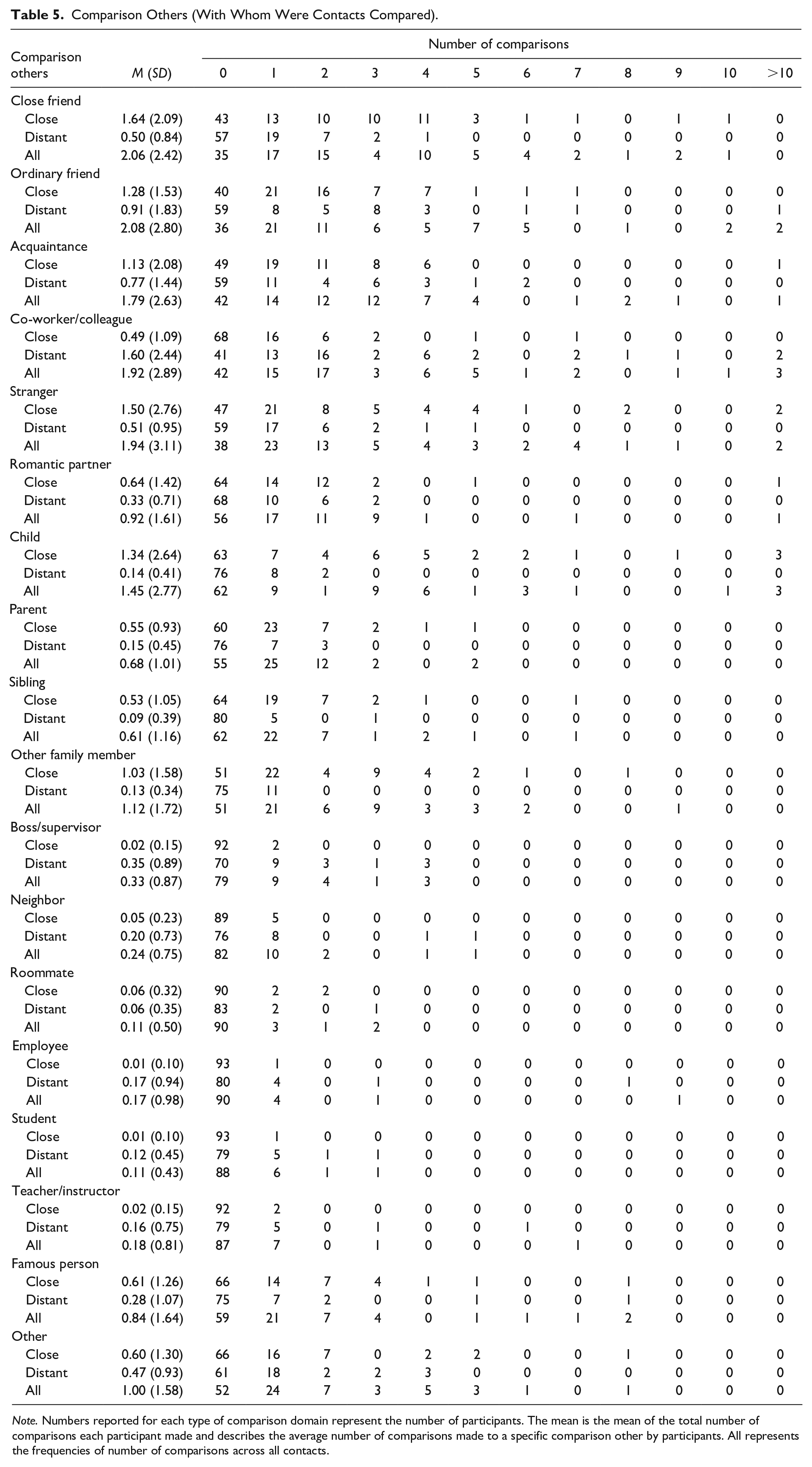
Note. Numbers reported for each type of comparison domain represent the number of participants. The mean is the mean of the total number of comparisons each participant made and describes the average number of comparisons made to a specific comparison other by participants. All represents the frequencies of number of comparisons across all contacts.
Comparison direction
Overall, participants reported 456 upward comparisons, 856 downward comparisons, and 369 lateral comparisons (close contacts: 294 upward comparisons, 565 downward comparisons, and 219 lateral comparisons; distant contacts: 158 upward comparisons, 288 downward comparisons, and 148 lateral comparisons). On average, each participant made 4.75 (SD = 4.23) upward, 8.92 (SD = 8.45) downward, and 3.84 (SD = 4.71) lateral comparisons during the week. Most participants made multiple comparisons over the course of the week, with only two reporting fewer than four comparisons. Participants made comparisons that were, on average, downward in direction (M = 0.56, SD = 1.72). Furthermore, an intercept-only multilevel model revealed that this was significantly greater than the scale midpoint of 0, which corresponds to a lateral comparison, b = 0.50, CI95% = [0.35, 0.65], SE = 0.08, t(84.65) = 6.41, p < .001. Thus, unlike social comparisons, in which upward comparisons are made more or as often as downward comparisons (Gerber et al., 2018), and contrary to our hypotheses, individuals were more likely to make downward social-judgment comparisons.
Next, we examined whether closeness predicted the likelihood of making upward, downward, and lateral comparisons using logistic multilevel models with random intercepts. Closeness did not predict the likelihood of making upward, b = −0.08, CI95% [−0.21, 0.05], SE = 0.07, z = −1.09, p = .274, or lateral comparisons, b = −0.12, CI95% [−0.27, 0.03], SE = 0.07, z = −1.68, p = .093. Closeness did predict greater likelihood of making downward comparisons, b = 0.14, CI95% [0.02, 0.27], SE = 0.06, z = 2.32, p = .020, OR = 1.15:1. When participants compared a close contact, there was a 52.90% chance that they would make a downward comparison, relative to 46.80% for distant contacts. Thus, downward comparisons were more frequent than upward, particularly for close contacts.
Reactions to individual comparisons
Analytic strategy
We analyzed our data using multilevel models because surveys were nested within individuals. 15 We used two-level models with a random intercept for each participant, allowing the average amounts of each outcome to vary between individuals. Although there were no apparent time trends, we also included a centered version of survey number as a fixed effect and a random slope to allow for different trajectories (Bolger & Laurenceau, 2013).
Because we were interested in whether individuals reacted differently to comparing close versus distant contacts, we examined within-person effects only. 16 Thus, we person-centered our comparison direction variable, which was continuous, by centering each person’s responses on their mean. This variable represents whether individuals have made a comparison that is more downward (or upward) than they usually do for all contacts they compared. For example, if an individual, on average, makes slightly downward comparisons across all contacts (e.g., person mean of 0.5), a positive value for a given comparison would indicate a more extreme downward comparison than they usually make, and a negative value would indicate a comparison that is more upward in direction than they usually make.
To examine whether responses to social-judgment comparisons involving close and distant contacts differed, we effects coded comparison contacts (+1 = close; −1 = distant). We then person-centered this variable using the strategy described above and tested whether closeness moderated the effect of comparison direction. This closeness variable captures whether the individuals felt closer to a particular contact relative to other contacts. For example, individuals should have a higher within-person closeness score for their romantic partner or child than for their boss. For simple effects, we examined the effects of comparison direction at one standard deviation above and below our within-person closeness variable (Aiken & West, 1991). Effect sizes were estimated using semi-partial R2 (Edwards et al., 2008).
Domain importance
Individuals rated domains to be less important when they made a more upward comparison than usual, and rated domains to be more important if the comparison involved a close contact relative to a more distant other (Table 6). These effects, however, were qualified by a significant direction-by-closeness interaction (see Figure 1): When individuals compared a close other, they reported lower domain importance when they made a more extreme upward comparison than they usually make. In contrast, when individuals compared a distant other, comparison direction did not predict domain importance.
Multilevel Models Testing the Within-Person Associations Between Comparison Direction and Closeness on Outcomes Measured in the Moment.
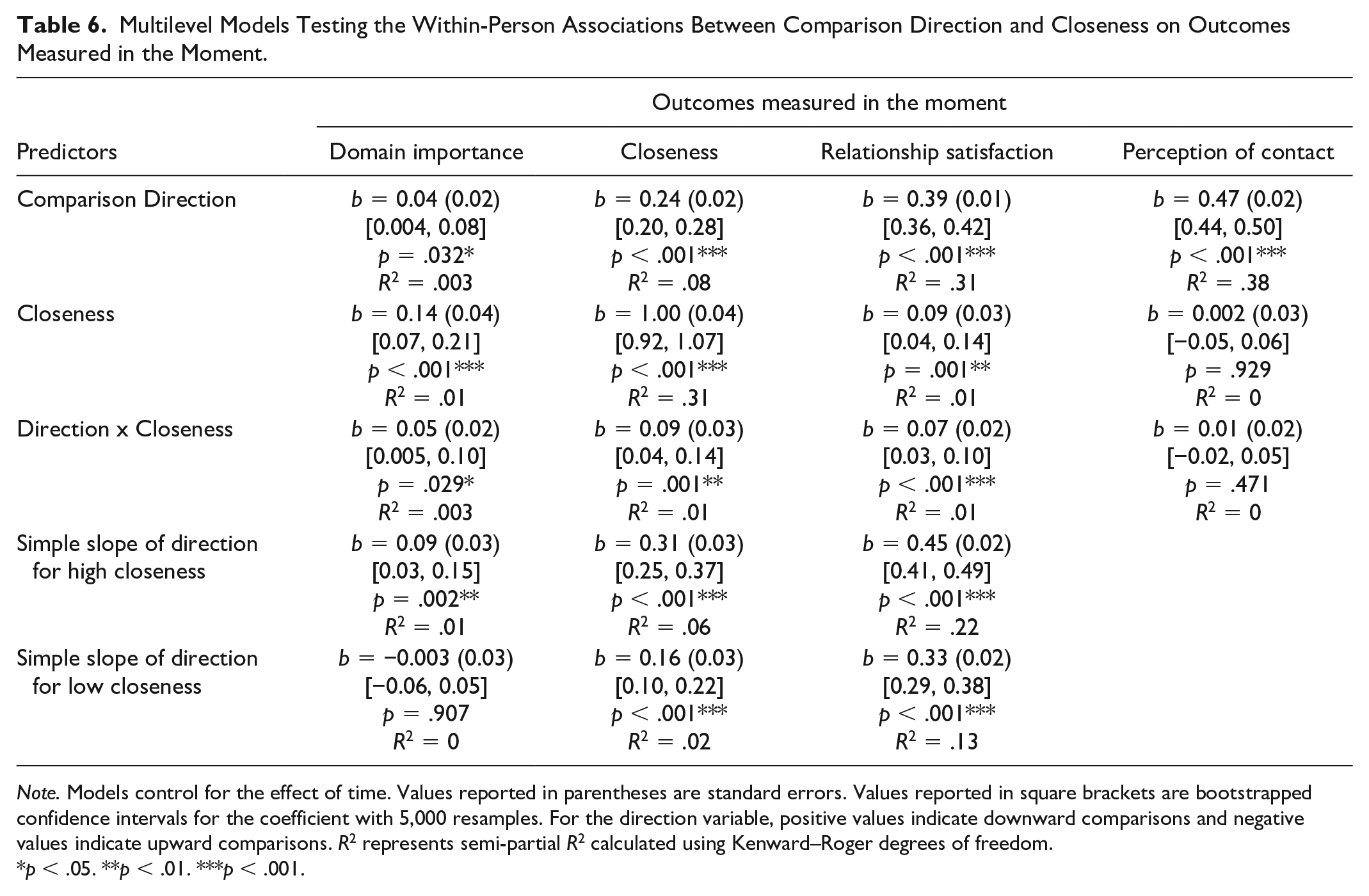
Note. Models control for the effect of time. Values reported in parentheses are standard errors. Values reported in square brackets are bootstrapped confidence intervals for the coefficient with 5,000 resamples. For the direction variable, positive values indicate downward comparisons and negative values indicate upward comparisons. R2 represents semi-partial R2 calculated using Kenward–Roger degrees of freedom.
p < .05. **p < .01. ***p < .001.
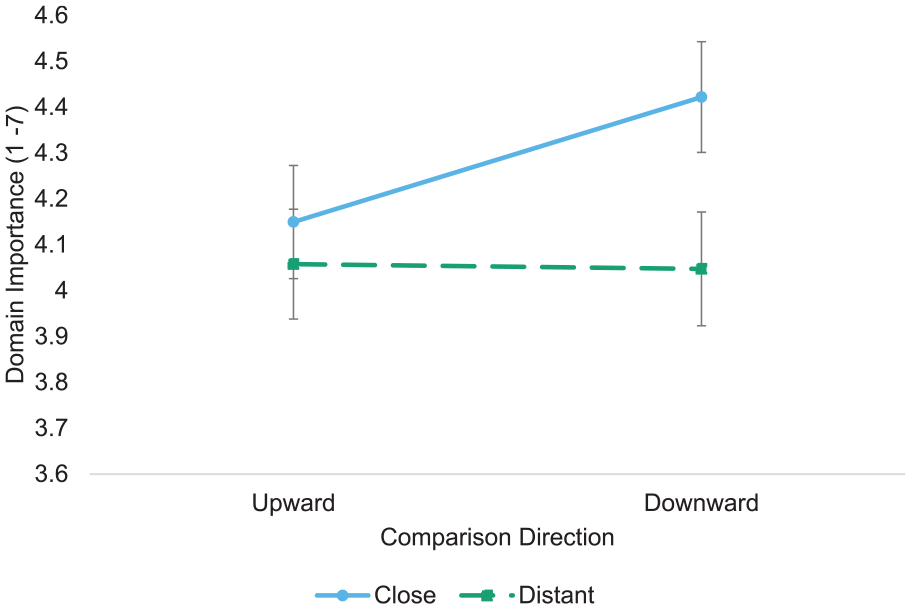
Simple effects depicting the relationship between comparison direction and domain importance ratings for close and distant contacts.
Post-comparison closeness
Individuals felt closer to a contact when they made a more downward comparison than usual across all contacts (Table 6) and when they compared close others rather than more distant others. These effects, however, were qualified by a significant direction-by-closeness interaction (Figure 2). When individuals compared a close other, they reported greater closeness following a more extreme downward comparison. This effect was also true for distant contacts but was larger for close than distant contacts. 17
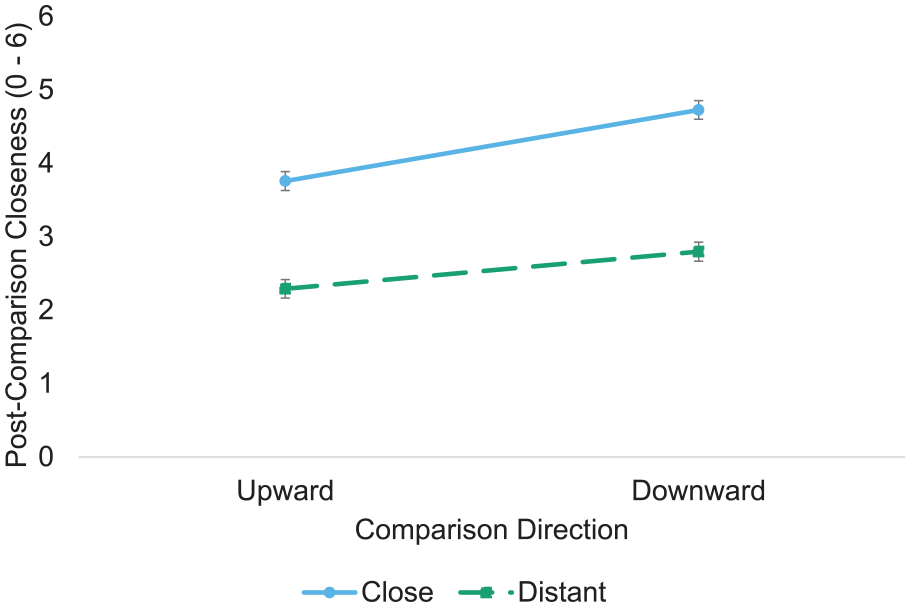
Simple effects depicting the relationship between comparison direction and closeness ratings for close and distant contacts.
Relationship satisfaction
When individuals made a more extreme downward comparison than usual, they felt more satisfied with their relationship with the contact (Table 6). Individuals also reported feeling more satisfied in their relationships with close than distant others. These effects, however, were qualified by a significant direction-by-closeness interaction (Figure 3): Individuals reported greater relationship satisfaction when they made a more extreme downward comparison than usual across all contacts with both close and distant others; however, this effect was larger for close others.
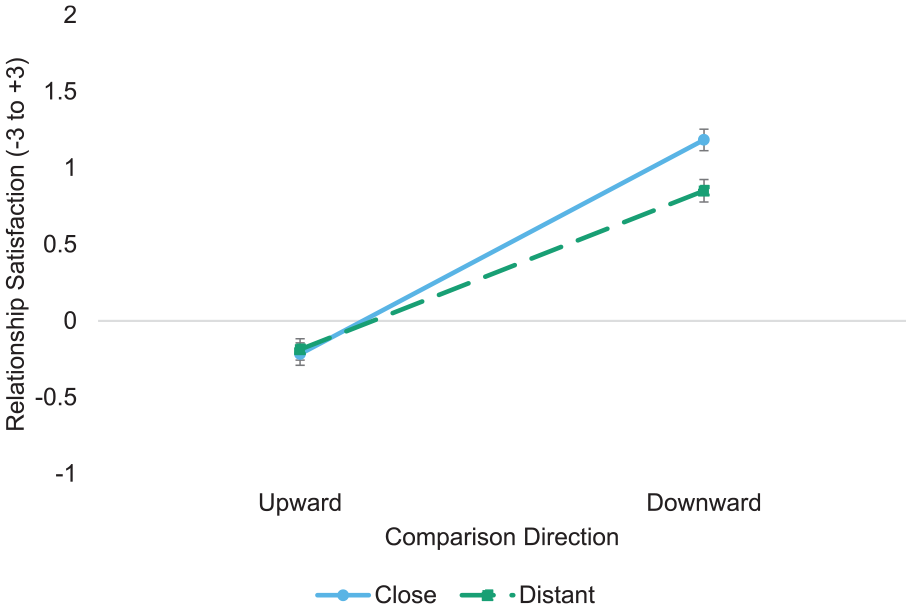
Simple effects depicting the relationship between comparison direction and relationship satisfaction ratings for close and distant contacts.
Perception of contact
When individuals made comparisons that were more downward than usual, they felt better about the contact (Table 6). No other effects were significant.
We also restructured our data so that comparisons were nested within contacts and contacts were nested within participants; this enabled us to examine the effect of comparison direction and closeness for each contact. When individuals made comparisons that were more downward than usual involving a particular contact, they felt better about that specific contact, b = 0.46, CI95% [0.43, 0.49], SE = 0.02, t(1537.41) = 29.59, p < .001, semi-partial R2 = .63. No other effects were significant, ts < 0.42, ps > .677.
Alternative causal direction
We also considered the alternative possibility that closeness precedes comparison direction. For example, it may be that individuals who are closer to the contact they are comparing are more likely to compare that contact to an inferior other. To test this possibility, we used baseline closeness, as a person-centered variable, to predict comparison direction while controlling for time using a subset of data (nparticipants = 87, nobservations = 702). This analysis revealed that baseline closeness did not predict comparison direction, b = 0.10, CI95% [−0.02, 0.21], SE = 0.06, t(610.19) = 1.59, p = .113, R2 = .004. Nevertheless, given that this analysis employed a smaller sample (i.e., only those contacts for whom we had baseline closeness measures), we cannot rule this possibility out completely.
Summary of individual comparison effects
When participants made comparisons in which the contact was superior to another person, they reported more positive perceptions of the contact, greater closeness with the contact, and greater satisfaction with their relationship with this contact. Moreover, these associations of comparison direction to relationship satisfaction and postcomparison closeness were larger for closer contacts than for more distant contacts. Thus, individuals were especially likely to feel better about the contact, as well as closer and happier with their relationship, when the superior contact was a close other. In addition, individuals downplayed domain importance following threatening upward comparisons for close, but not distant, contacts.
Over time effects
Closeness and multiple comparisons
We tested whether baseline closeness predicted the number of upward and number of downward comparisons individuals made involving a specific contact using Poisson multilevel models. Greater baseline closeness predicted making more upward, b = 0.44, CI95% [0.26, 0.65], SE = 0.10, z = 4.54, p < .001, and downward, b = 0.37, CI95% [0.23, 0.52], SE = 0.08, z = 4.85, p < .001, comparisons during the experience-sampling period.
Analytic strategy
To test whether the number of upward and downward comparisons participants made over 1 week had a cumulative effect on closeness, we analyzed our data using two-level multilevel models with random intercepts because contacts were nested within individuals. Because our experience-sampling analyses included lateral comparisons due to the continuous nature of the direction variable, we controlled for lateral comparisons to determine the unique cumulative effects of both upward and downward comparisons. We report results with and without controlling for baseline closeness. Because we were unable to collect baseline closeness for all contacts compared, we first examined the cumulative effect of different types of comparisons on closeness over time to maximize sample size. We then included baseline closeness in our model to examine changes in closeness after making comparisons, over and above baseline measures.
Because we were interested in within-person effects only, we person-centered the number of upward, downward, and lateral comparisons using the same strategy described above. The within-person variable of the number of upward comparisons represents whether individuals made more upward comparisons involving a specific contact relative to all the other contacts they compared during the week. For example, one individual may have made more upward comparisons involving their child than upward comparisons involving other contacts during the week. Similar interpretations apply for downward comparisons. We used this analytic strategy when examining closeness measured 1 week and 6 months later.
Exit session: End-of-week effects
When we used the full sample of contacts available (Table 7), the upward and downward comparison effects were significant: When participants made more upward or downward comparisons involving a particular contact relative to all their other contacts, they felt closer to that contact 1 week later. When we controlled for baseline closeness, however, only the effect of downward comparisons remained marginally significant. 18 Thus, although the cumulative effects of upward comparisons were positive, it appears that this effect may have been driven by the fact that individuals made more upward comparisons involving their closer contacts; not surprisingly, they were closer to these contacts than to distant contacts after one week. Once we accounted for their initial closeness, it does not appear that upward comparisons have a cumulative effect on closeness. The cumulative effect of downward comparisons was in the predicted direction even after controlling for initial closeness, but because this effect was only marginally significant, this finding must be interpreted with caution.
Multilevel Models Testing the Within-Person Associations Between the Number of Comparisons for Close Contacts on Closeness Measured 1 Week and 6 Months Later With and Without Baseline Closeness.
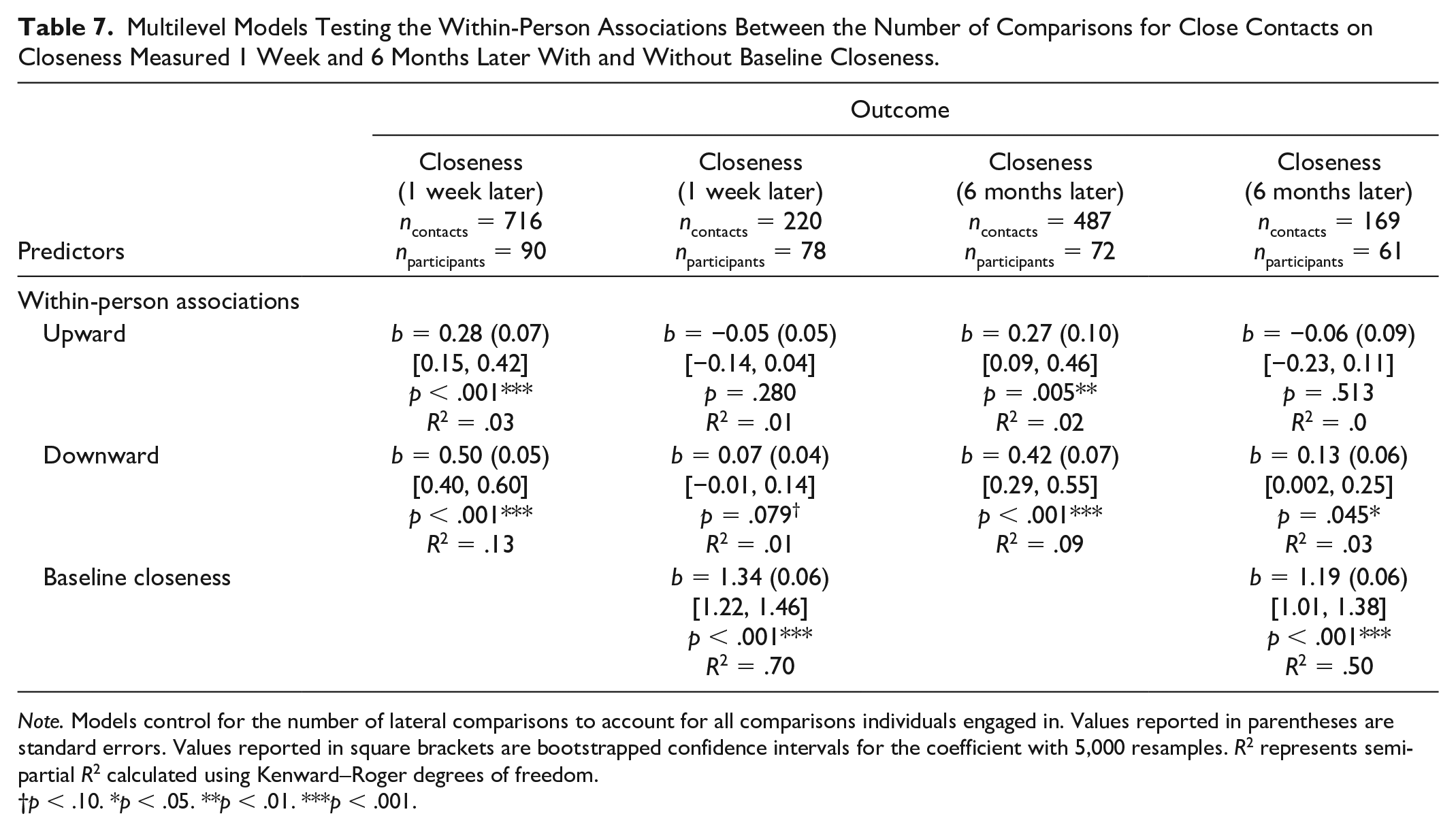
Note. Models control for the number of lateral comparisons to account for all comparisons individuals engaged in. Values reported in parentheses are standard errors. Values reported in square brackets are bootstrapped confidence intervals for the coefficient with 5,000 resamples. R2 represents semi-partial R2 calculated using Kenward–Roger degrees of freedom.
p < .10.
p < .05. **p < .01. ***p < .001.
Six months follow-up: Longitudinal effects
When we used the full sample of contacts available (Table 7), the upward and downward comparison effects were significant: When participants made more upward and downward comparisons involving a particular contact relative to all their other contacts, they felt closer to that contact 6 months later. When we controlled for baseline closeness, the downward comparison effect remained significant, and the upward comparison effect became nonsignificant. Thus, as with the 1-week follow-up, once initial closeness is accounted for, downward comparisons have a positive cumulative effect on closeness, but upward comparisons do not.
Mediation models
Next, we tested whether individuals reported greater closeness to close contacts, relative to more distant ones, 1 week and 6 months later, because they downplayed domain importance following upward comparisons and elevated domain importance following downward comparisons (Figure 4). That is, we examined whether engaging in this protective strategy at the level of each individual comparison helped individuals to minimize the long-term negative effects of upward comparisons and maximize the benefits of downward comparisons when social-judgment comparisons involved close contacts.
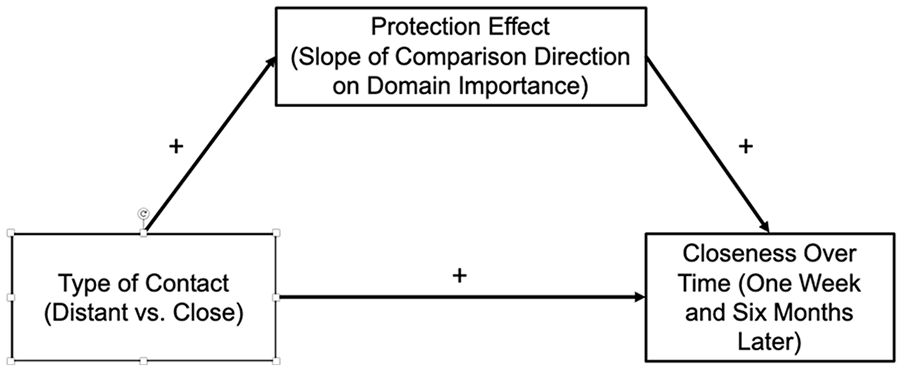
The within-person mediation model tested both 1 week and 6 months later.
To capture the degree to which individuals engaged in the protective strategy, we calculated a random slope for domain importance on comparison direction for each contact. These random slopes capture the strength of the association between comparison direction and domain importance, which is larger for close than distant contacts as reported above. For example, if individuals do not rate domains differently depending on direction for a contact, the random slope for this contact will be close to 0; however, if individuals rate domains to be less important following upward comparisons and more important after downward comparisons, the random slope for this contact will be positive. Because direction was a continuous variable, these random slopes capture both downplaying domains after upward comparisons and elevating domains after downward comparisons. That is, these slopes indicate the degree to which individuals protected or enhanced a contact following a social-judgment comparison. We saved these random slopes and used them as our mediator. We then conducted a 1-1-1 multilevel mediation model because all the variables varied at the level of the contact, and contacts were nested within individuals. Given our interest in within-person effects, we report the results from the within-person models only. We tested our mediational models using a variant of the bootstrap procedure (Preacher & Hayes, 2008) using the indirect function in R (Page-Gould & Sharples, 2016) with 5,000 bootstrapped samples.
The within-person mediation effect was significant: When individuals compared close, relative to distant, contacts, they engaged in this protective strategy to a greater degree, which in turn predicted greater closeness to that specific contact 1 week (Table 8). Although the effect of contact closeness was significant, the direct effect was reduced when the indirect path through protection was included. These results suggest that engaging in this protective strategy when comparisons involve close contacts does buffer against the negative effects of individual upward comparisons and enhance the positive effects of individual downward comparisons, leading to greater closeness over time. We found a similar pattern of results for our mediation model examining closeness 6 months later; however, the indirect effect was nonsignificant. Our longitudinal mediation analysis may have been underpowered due to attrition; our exit mediation dataset had 217 more observations than our longitudinal mediation dataset.
Summary of Multilevel Mediation Analyses Testing the Between-Person and Within-Person Mediations Whereby the Closeness of the Contact Predicts the Degree to Which Individuals Engage in a Protective Strategy, Which in Turn Statistically Accounts for Closeness Reported One Week and Six Months Later.
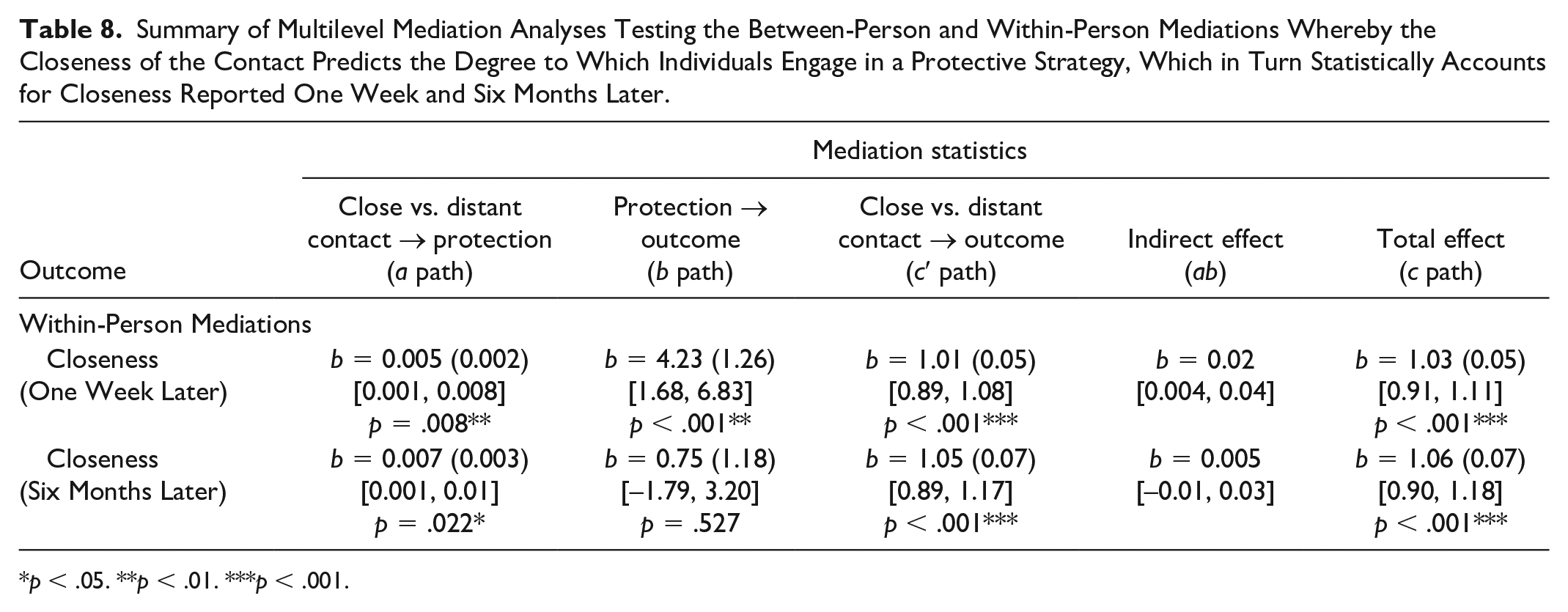
p < .05. **p < .01. ***p < .001.
Summary of over time effects
When individuals made more comparisons in which a specific contact was superior to other people, they felt closer to that person 1 week later and 6 months later, even after controlling for their baseline closeness. When they made more comparisons in which a specific contact was inferior, they also reported greater closeness after 1 week and 6 months; however, this effect was wiped out when we controlled for baseline closeness suggesting that making more upward comparisons involving a particular contact does not increase closeness over time. In addition, our cumulative upward effect was likely driven by individuals’ tendencies to compare closer contacts with superior others more often than distant contacts. Further, the mediation models indicate that individuals may be using a strategy of changing their perceptions about the importance of comparison domains as a means of preserving their closeness to close contacts.
Discussion
The present research provides a comprehensive study of the frequency, characteristics, and impact of social-judgment comparisons in daily life. Past research has examined how individuals evaluate the self through comparisons with others (Gerber et al., 2018; Tesser, 1988; Wood, 1989), how they use the self to evaluate others (Dunning, 2000), or how they compare one person to another in specific contexts, such as work (Goffin & Olson, 2011) or family life (Jensen et al., 2018); studies have not to date examined how individuals use social-judgment comparisons to evaluate their regular social contacts. We found that individuals made such comparisons daily. They made more downward than upward comparisons, and this difference was amplified when they compared close rather than distant others. Individuals made comparisons in a wide range of domains, with comparisons being more common in relationships, family/home, and health for close others. Comparing a contact to an inferior other was associated with a positive impact on perceptions of the contact, relationship satisfaction, and closeness. Indeed, for any given contact, a comparison that was more downward than usual for that specific contact was associated with seeing the contact more positively, suggesting that social-judgment comparisons may account for day-to-day shifts in how individuals view the people in their social circle. Comparing a contact to a superior other was associated with a negative impact on perceptions of the contact, relationship satisfaction, and closeness; however, individuals making such upward comparisons with close others downplayed the importance of the comparison domain, thus mitigating the extent to which these comparisons were associated with negative outcomes. Further, their ability to engage in this protective strategy predicted their long-term closeness to the other: Individuals who devalued domains to a greater degree following individual upward comparisons involving a close contact showed a cumulative effect of these comparisons such that they did not experience any declines in closeness 1 week later. Individuals making more downward comparisons also felt closer 1 week and 6 months later. In sum, the present research shows that social-judgment comparisons play a crucial role in individuals’ evaluations of and relationships with their daily contacts; furthermore, these comparisons have an aggregate impact on individuals’ long-term closeness to these contacts, with more downward comparisons leading to greater closeness over time.
Our findings highlight important differences between social-judgment comparisons and social comparisons that directly involve the self. For example, we found that, unlike social comparisons, downward rather than upward social-judgment comparisons were more prevalent when individuals compare people other themselves. Comparisons involving the self and another person are often used to fulfill three broad motives: self-evaluation, self-improvement, and self-enhancement (Wood, 1989). Although we did not directly ask participants to indicate their motives for making these comparisons, the greater number of downward comparisons suggests that individuals may often make social-judgment comparisons to enhance their perceptions of members of their social network. Thus, social-judgment comparisons may be a crucial component in determining how individuals maintain positive perceptions of their key contacts.
This study makes a valuable contribution to the literature on interpersonal relationships. The comparisons that individuals make between a close contact and other people are associated not only with how they see the contact but also with how they perceive that relationship. Past research indicates that individuals typically view their romantic partner, for example, as superior to others (Gagné & Lydon, 2001); the present study underscores how the daily social-judgment comparisons that one makes may be a key mechanism supporting this perceived superiority. Individuals want to see their close others in a positive light; comparisons can help to reinforce these positive perceptions and, in consequence, may boost closeness and satisfaction. Thus, social-judgment comparisons may play a key role in protecting and enhancing interpersonal relationships.
This research also has important implications for research on the expanded self. To date, research on the expanded self has primarily focused on romantic relationships (Aron et al., 2013) and to a lesser degree on friendships (Mashek et al., 2003). Less is known about who else may be included in the self and how expansive the self is. In the present study, we demonstrate that both immediate and extended family members are also included in the self, and half of our sample included four or more people in their self-concept. Further, this research provides a novel demonstration of the cognitive consequences of including others in the self in daily life. Past research examining the cognitive effects of inclusion of the other in the self has been done primarily in the lab, focusing on one close other at a time (Aron et al., 1991; Aron & Fraley, 1999). In the present study, we show how these overlapping cognitive structures influence social cognitive processes in daily life for several close contacts, demonstrating that individuals can activate different aspects of the expanded self throughout the day in response to comparisons they make.
Although the experience-sampling methodology allowed us to evaluate comparisons as they occurred in a naturalistic setting, this approach is not without its limitations. In the present study, for example, it is possible that individuals made more comparisons than they otherwise would because the prompts themselves encouraged participants to think in more comparative terms. Alternatively, individuals may have made many more social-judgment comparisons than were captured in the study; social comparisons occur relatively automatically (Gilbert et al., 1995), and the same may also be true for comparisons not involving the self. In future research, it will be useful to examine social-judgment comparisons in experimental studies that rely less heavily on self-reports.
Furthermore, given the correlational nature of our design, alternative causal pathways are possible. For example, momentary fluctuations in mood and affect may cause individuals to make comparisons in specific directions. We note that our proposed causal direction, that comparison direction leads to specific reactions, is supported by experimental studies demonstrating that comparison direction causes individuals to adjust their domain importance ratings for close contacts and perceive the contacts they compare more or less positively (Thai et al., 2019; Thai & Lockwood, 2015; Vogels & Perunovic, 2020). Furthermore, we would expect that social-judgment comparisons, like social comparisons, will often be forced rather than chosen. Indeed, most participants indicated that they did not actively seek out these comparisons regardless of whether the contact was close or distant; when individuals notice that one person is clearly superior to another, they may not have the luxury of making comparisons that align with their mood. Nevertheless, we do expect that there will be an interplay such that comparisons will affect the individual, but individuals’ circumstances—mood, self-esteem, or other individual difference variables—will at times influence the comparisons that individuals make or their outcomes.
In addition, we note that our methodology allowed us to examine a broad range of comparisons rather than those occurring in specific settings. It may be that some contexts are more prone to elicit social-judgment comparisons than others. For example, individuals may be especially likely to compare one person with another in evaluative or competitive environments such as school or during sport-related activities. Further, individuals may be more likely to compare some contacts than others; new parents, for example, are often encouraged to assess their infant’s developmental progress by making comparisons to similar-aged peers. Indeed, we found that comparisons involving family members are more prevalent among parents than individuals without children (Supplementary Materials). Additional research will be necessary to better understand the contexts and relationship types that will result in more frequent or impactful social-judgment comparisons.
The present study was also limited to an examination of social-judgment comparisons involving one contact at a time. We note, however, that when individuals compared a close contact with another person, that person was in some instances also a close contact, as when participants compared one friend with another. Thus, in making an upward comparison involving one friend, they were simultaneously making a downward comparison involving another friend. Protecting the inferior friend by downplaying the importance of the comparison domain may happen at the expense of enhancing perceptions of the superior friend. Our study was not designed to tease apart such potentially competing motivations or examine the effects of these comparisons on more than one relationship. The complexities of such processes will be an important future direction for studies of social-judgment comparisons.
This research provides an in-depth examination of how individuals compare people other than themselves in daily life. Consequently, we limited the scope of our investigation to focus primarily on how these comparisons affected a subset of the people individuals compare: their daily contacts. This work, however, lays the foundation for future research examining social-judgment comparisons in other ways. Although we examined comparisons involving both close and distant contacts, we were primarily interested in how perceptions of and relationships with close others might be impacted. It is also possible that social judgment comparisons serve a valuable function when navigating interactions with more distant others. For example, such comparisons may guide interactions with new contacts during the process of relationship initiation: When considering whom to approach in the context of a new job, one may choose a colleague who seems more helpful and competent than another colleague. Further, although we did not differentiate among different types of more distant contacts, such as parasocial relationship targets or contacts known only through social media, we note that individuals may use social-judgment comparisons differently depending on the nature of these more distant contacts; for example, they may be especially likely to use social-judgment comparisons when evaluating parasocial contacts, given that they have no direct personal knowledge on which to form impressions of such contacts. Social-judgment comparisons may also play a key role in intergroup relations: Because ingroup members are psychologically close to the self (Tesser, 1988), individuals may be more likely to make social-judgment comparisons that portray ingroup members positively at the expense of outgroup members, which may reinforce negative perceptions and beliefs about outgroup members.
Future work should also examine lateral comparisons more extensively. In the present research, our predictions were focused primarily on upward and downward comparisons. Past research investigating lateral comparisons involving the self suggests that these comparisons have the potential to fulfill affiliation needs (Taylor et al., 1996). It is possible that lateral social-judgment comparisons may also perform similar functions. For example, if a mother notices that her nephew is struggling with math, like her son, she may turn to her sibling to ask for advice and support. Lateral comparisons may also provide reassurance that the performance of a close other is acceptable. For example, parents may seek evidence from lateral comparisons that their infant’s motor or language skills are on par with other infants of the same age.
In the present research, we examined closeness to comparison targets as a moderator of our predicted effects. We note that there may be other individual differences that determine the frequency and impact of such comparisons in daily life. For example, people may differ in their comparison “styles,” with some individuals making comparisons primarily involving close contacts, and others more focused on distant targets or strangers. Our initial examination of different comparison styles (e.g., compare close contacts only, make downward comparisons only; Supplementary Materials) suggests that, at least in this sample, individuals tended to make a wide variety of comparisons involving both close and distant contacts; only a handful of individuals had distinct styles. Nevertheless, it is possible that certain traits may lead to specific comparison approaches. For example, avoidantly attached individuals may be especially likely to make upward social-judgment comparisons involving their relationship partners, given that they prefer to be with an inferior rather than a superior partner (Thai et al., 2016).
Social cognition research has illustrated the importance of comparative processes in social judgments (Dunning, 2000; Kruglanski & Mayseless, 1990; Mussweiler, 2003): Individuals understand their social world, in part, by comparing one person to another. The present research provides new evidence regarding the prevalence, characteristics, and outcomes of such comparisons, as well as the degree to which individuals’ motivations may affect these outcomes. Furthermore, our study highlights the potential long-term, cumulative impact of social-judgment comparisons. One’s relationship with an individual is to some extent determined by the past comparisons one has made between that individual and other people. Given the frequency with which such comparisons occur, and their potential to affect how individuals view those with whom they interact daily, both in the short and long term, it is crucial to continue to better understand how these comparative processes shape individuals’ relationships with others as they navigate their daily lives.
Supplemental Material
sj-docx-1-psp-10.1177_01461672221115558 – Supplemental material for Social-Judgment Comparisons in Daily Life
Supplemental material, sj-docx-1-psp-10.1177_01461672221115558 for Social-Judgment Comparisons in Daily Life by Sabrina Thai and Penelope Lockwood in Personality and Social Psychology Bulletin
Supplemental Material
sj-docx-2-psp-10.1177_01461672221115558 – Supplemental material for Social-Judgment Comparisons in Daily Life
Supplemental material, sj-docx-2-psp-10.1177_01461672221115558 for Social-Judgment Comparisons in Daily Life by Sabrina Thai and Penelope Lockwood in Personality and Social Psychology Bulletin
Footnotes
Acknowledgements
We are grateful to Chanel Meyers and Emilie Auger for their comments on an earlier draft of this paper. We thank Sylvia Wang and Aliya Aneja for their assistance with data collection. We would also like to thank an anonymous reviewer for their helpful suggestions.
Authors’ Note
Partial report of this data was presented at the 2022 Meeting of the Society for Personality and Social Psychology in San Francisco, California, USA, and the 2019 Meeting of the Society for Personality and Social Psychology in Portland, Oregon, USA.
Declaration of Conflicting Interests
The author(s) declared no potential conflicts of interest with respect to the research, authorship, and/or publication of this article.
Funding
The author(s) disclosed receipt of the following financial support for the research, authorship, and/or publication of this article: This research was supported by grants from the Social Sciences and Humanities Research Council (SSHRC) of Canada awarded to Penelope Lockwood. Sabrina Thai was supported by a Joseph Armand Bombardier CGS Doctoral Scholarship and a Postdoctoral Fellowship from SSHRC.
Data Availability
Data are available upon request by contacting the first author. Syntax (https://osf.io/cmxgj/) and materials ( ) are available online.
Supplemental Material
Supplemental material is available online with this article.
Notes
References
Supplementary Material
Please find the following supplemental material available below.
For Open Access articles published under a Creative Commons License, all supplemental material carries the same license as the article it is associated with.
For non-Open Access articles published, all supplemental material carries a non-exclusive license, and permission requests for re-use of supplemental material or any part of supplemental material shall be sent directly to the copyright owner as specified in the copyright notice associated with the article.
