




Abstract
Attitude position and function often are discussed as though they are distinct aspects of attitudes, but scholars have become increasingly interested in how they may interface. We extend existing work showing that people view their positive attitudes as more self-defining than their negative attitudes (i.e., the positivity effect). All datasets support that the positivity effect emerged most strongly among high self-esteem individuals and was attenuated, eliminated, or even reversed among low self-esteem individuals. Furthermore, Study 4 uses a broad array of individual difference measures to triangulate that the higher self-enhancement motivation associated with high self-esteem, rather than merely the positive self-worth of high self-esteem people, is responsible for moderating the positivity effect. In sum, the present work establishes boundary conditions for an important phenomenon in the attitudes literature, develops understanding of the far-ranging implications of trait self-esteem, and illuminates the psychological motivations that connect attitude position and function.
Attitudes, representing people’s evaluations of objects as good and/or bad, are often characterized as having several distinct dimensions worthy of study. Whereas attitude position concerns the valence and extremity (i.e., the extent to which people view an object as good or bad), attitude functions concern the goals and needs that are fulfilled by having and using an attitude (i.e., whether attitudes are used to optimize use of objects, maintain social impressions, express values, etc.), and attitude structure captures whether opinions are unidimensional, bidimensional, and so on (Maio & Haddock, 2009). 1 Although these aspects (i.e., attitude position, function, structure) are classically viewed as distinct parts of the broader attitude construct, scholars are increasingly interested in how they interface (Ennis & Zanna, 2000; Maio & Haddock, 2009; Pillaud et al., 2013; Zunick et al., 2017). For example, Pillaud and colleagues (2013) observed that people are more likely to report ambivalent attitudes (attitude structure) insofar as social-adjustive motivations (attitude function) motivate such ambivalence. Zunick and colleagues (2017) found that people judge objects as being more self-defining (attitude function) insofar as attitudes are positive and extreme (attitude position). In short, these aspects of attitudes (position, function, structure) may be interrelated in meaningful ways. The present work explores how individual differences may moderate connections between attitude position and attitude function, explaining why these aspects of attitudes interrelate. We focus here on how self-esteem and self-enhancement motivation (SEM) may galvanize some of these effects.
Attitude Position and Function
Intuitively, it might seem that attitude position should be independent from attitude function because the position of one’s attitude as positive or negative should not necessarily dictate the function that the attitude serves. Suppose that one’s attitude function toward an object is primarily social-adjustive. Intuitively, it seems that one should be able to fulfill this need with negative, positive, or moderate attitude positions. That is, one can connect with close others through one’s dislikes, likes, or neutrality about attitude objects, depending on how they evaluate those objects. Indeed, Herek’s (1987) study of attitudes toward gay people found that people with positive attitudes toward gay people often felt that their positive views fulfilled their social-adjustive needs, but people with negative attitudes also felt that their views fulfilled their social-adjustive needs. This seems logical: holding either a positive or negative attitude could be more social-adjustive depending on the attitude position held by one’s important social groups or family members (and see Priester & Petty, 2001). Similarly, both positive and negative attitudes were value-expressive for distinct groups of people.
In short, it seems clear that positive, neutral, and negative attitudes should logically be able to fulfill functional needs. However, this does not mean that any attitude valence is equally likely to facilitate the attitude functions. Do certain attitude positions generally foster greater fulfillment of specific functions? That is, might positive attitudes more reliably fulfill people’s social needs, or extreme (i.e., very positive or very negative) attitudes better fulfill value-expressive needs? Most research on attitude functions ignores their association with typical attitude positions, instead focusing on attitude function as a component in attitude change (Petty & Wegener, 1998; Shavitt, 1990; Shavitt & Nelson, 2002; Watt et al., 2008) or as a moderator of attitude consequences (Maio & Olson, 1994). Little research documents overlap between attitude position and function.
One interesting exception was demonstrated by Zunick and colleagues (2017), who found that two elements of attitude position mapped onto a novel attitude function they labeled “self-defining” (i.e., the degree to which an object helps one to express one’s personal identity). Zunick et al. suggested that self-defining attitudes fulfill an important function: helping people to answer, “Who am I?” (p. 1136), which is a theme common to some classic attitude functions (e.g., social-adjustive, value-expressive). These researchers noted several patterns between attitude position and people’s judgment of how self-defining those attitudes were. First, there was a positivity effect: positive attitudes were more often considered self-defining compared with negative attitudes. Second, they found an extremity effect: very positive and very negative attitudes were more self-defining than were moderate attitudes. Combining the positivity and extremity effects thus produced a “check-mark”-shaped, curvilinear association between attitude valence and the self-defining function. We aim to explore the psychological meaningfulness of the positivity effect by testing the moderating effect of trait self-esteem. 2 Rather than operating universally, we propose that the positivity effect will depend on the personality of the attitude-holders. Such findings probe how the positivity effect connecting attitude position and function (the positivity effect) reflects an underlying psychological drive.
Moderating the Positivity Effect: The Role of Self-Esteem
We propose that the positivity effect (i.e., systematically evaluating positive objects as more important to defining oneself) may operate in one (or both) of two directions. One possibility is that the self-relevance of attitude objects may cause people to see those objects as good or bad. For instance, people prefer the first letters of their own name (i.e., a self-relevant object) over other letters (Gebauer et al., 2008; Pelham et al., 2002). In this case, the self-relevance of the object obviously came first chronologically (name-letters being assigned at birth), causing the favorable evaluation of the object. This tendency is often conceptualized as an implicit measure of self-esteem; that is, people presumably only prefer their name-letters to the extent that they like themselves.
In other instances, the reverse causal order also may make sense: the positivity/negativity of objects may lead people to conclude that the objects are self-defining (vs. not). That is, people might be quite reluctant to judge very negative things (e.g., genocide, torture) as being central to their identity—even to define themselves as hating those things. This might primarily be true among people who like themselves, that is, who have high self-esteem. At least two psychological forces may drive such an effect. First, people tend to form balanced associations between the valence of related cognitive elements (Crandall et al., 2007; Festinger, 1957; Heider, 1958; Zanna & Cooper, 1974), including the self (e.g., in balanced identity theory, Cvencek et al., 2012; Greenwald et al., 2002). The more closely two objects are associated, the more people tend to evaluate them similarly. Therefore, if one likes oneself, and likes (dislikes) an object, one should be inclined (disinclined) to associate that object with oneself, since such a close association between these objects would maximize cognitive consonance (dissonance). This would predict that the positivity effect (i.e., seeing positive objects as more self-defining than negative objects) would be stronger for people with high self-esteem, simply because the attitude valence held toward oneself by high self-esteem people is more favorable: positive self-worth (PSW). This dynamic should be attenuated or even reversed for low self-esteem people, because for these individuals more dissonance should be aroused when linking good things with their (less favorable) self-evaluation.
Relatedly, people sometimes trivialize the importance of dissonant information (Martinie & Fointiat, 2006; Simon et al., 1995). Since the higher one’s self-esteem, the more an object’s negativity is dissonant in relation to self, high self-esteem might motivate the trivialization of negative objects. Viewing the object as self-irrelevant would presumably make it seem less subjectively important (Eaton & Visser, 2008), facilitating this trivialization (and thus dissonance reduction). Pelham (1991) noted that high self-esteem people were more likely than low self-esteem people to attribute higher importance to their best attributes and less importance to their worst attributes. Although this research was specific to personal traits (rather than attitude objects broadly), it suggests that high self-esteem people tend to consider good things important over bad things. In sum, we propose that high self-esteem people might actively identify with good objects to help maintain their PSW.
However, a second reason why self-esteem would moderate the positivity effect is that high self-esteem people often have increased SEM. This conceptualization could suggest that people are motivated to associate good versus bad things with themselves as part of a general self-enhancement strategy (Alicke & Sedikides, 2009; Sedikides & Strube, 1997). Indeed, past research suggests that associating favorable objects with oneself facilitates self-enhancement (Cialdini et al., 1976; Vaughan-Johnston et al., 2021). Individuals with high self-esteem are more likely to be self-enhancement motivated (e.g., Kobayashi & Brown, 2003). For example, individuals higher in trait self-esteem are more reactive against losses of self-esteem, and they are more motivated to self-enhance than are people with low self-esteem (Baumeister et al., 1993, 1996; Brown et al., 2001; Kobayashi & Brown, 2003). Thus, high self-esteem people may show a greater positivity effect (i.e., inflating the self/identity importance of good over bad objects) because they have more motivation to extract the self-enhancing benefits of such associations.
Despite these two main reasons for thinking that high self-esteem will maximize the positivity effect (one based on balance with PSW; the other based on motivation stimulated by SEM), our hypothesis is not necessarily obvious. First, one might instead counter-argue that high self-esteem should moderate the pattern in the reverse direction. For example, high self-esteem people might be more willing to associate negative objects with their selves, because high self-esteem is linked with a more secure identity (Campbell & Lavallee, 1993), leading people to feel less concerned about associating the self with specific negative objects. Past work suggests that high self-esteem people may thrive to a greater degree under socially risky conditions (Cameron & Granger, 2019; Murray et al., 2006). By this line of thinking, high self-esteem people might be less threatened by the possible identity implications of negative objects and thus show a weaker positivity effect.
A second pushback to our theorizing is that the positivity effect might be driven by some other psychological dynamic that is irrelevant to the self-esteem of the attitude-holder. Consider that evaluating an attitude object as particularly self-central is a key attitude strength antecedent (Krosnick & Petty, 1995) which makes it more likely that people would spontaneously access that attitude on exposure to an object (Fazio et al., 1983). But people prefer to experience positive rather than negative evaluations (Snyder & Tormala, 2017). Thus, people may be more inclined to appraise positive objects as being self-central, so that they can experience plenty of (enjoyable) positive attitude activations, and disinclined to appraise negative objects as self-central to avoid experiencing (aversive) negative attitude activations. In short, people may avoid connecting bad things with themselves because doing so would make these objects self-central, and therefore powerfully lead people to experience the negative feelings associated with these bad things.
The Present Research
To examine these questions, we followed a procedure comparable with Zunick et al. (2017), but substituted a range of classic attitude functions rather than the broader “self-defining” function. Although numerous taxonomical systems of attitude functions have been outlined, these systems are beyond the scope of the present work. We employed a four-factor approach that examines ego-defensive, social-adjustive, value-expressive, and utilitarian attitude functions (inspired by Herek, 1986, 1987; Katz, 1960; Maio & Haddock, 2009; Maio & Olson, 1994; Olson & Maio, 2003; Smith et al., 1956). Like Zunick et al., we propose that three of these attitude functions (ego-defensive, social-adjustive, value-expressive) may serve diverse aspects of a person’s identity or self-definition. We also included the utilitarian function specifically because it did not appear to be self-defining, but clearly could be construed as a component of attitude importance.
First, the ego-defensive function has been defined in several ways, such as the management of internal conflict (Katz, 1960; Sarnoff & Katz, 1954), or as a “means of protecting one’s self-concept . . . [from] unexpected or disconfirming information” (Lapinski & Boster, 2001, p. 315). Despite a heterogeneity of characterizations, most definitions suggest that maintaining certain attitudes can bolster feelings of psychological safety and PSW. For example, Olson and Maio (2003) state that an ego-defensive attitude “protects self-esteem” (p. 306), and Lapinski and Boster’s definition ultimately underscores the protection of self-esteem from threat. Ego-defensive attitudes are thus relevant to maintaining a favorable identity. Second, social-adjustive attitudes refer to people’s desire to maintain a positive social image through holding and expressing attitudes endorsed by other people. Implicit in social-adjustive motivations is an intention to maintain a positive social identity (Shrauger & Schoeneman, 1979; Tice, 1992) by aligning one’s beliefs with beliefs held by others in one’s close circle or community (Priester & Petty, 2001). Third, value-expressive attitudes are reflective of one’s core sense of self (Hitlin, 2003). Indeed, expressing one’s personal values (e.g., in writing) is a common self-affirmation strategy because of its direct relevance to reinforcing one’s fundamental sense of identity and life purpose (Schmeichel & Martens, 2005). 3
Finally, attitudes are utilitarian insofar as they are used to optimally work with (or avoid) an object. That is, people may hold attitudes to maximize their extraction of benefits from the object and minimize the possible losses that may be attributable to the object. For example, a person’s attitude may be utilitarian when they seek to buy a cost-effective vehicle or when avoiding a co-worker known for their inefficiency. Although such consequentiality is likely to make an object seem quite important, it does not have clear implications for one’s self-definition per se, and we separate it conceptually from the above three functions for this reason.
In Study 1, we tested if trait self-esteem moderated the positivity effect for the three self-defining attitude functions. Studies 2 and 3 then replicated Study 1, with Study 3 doing so in a preregistered format. Finally, Study 4 probed whether a more particular aspect of high self-esteem led to the enhancement of the positivity effect. To examine this question, we collected a wide array of individual differences, attempting to triangulate which specific aspect(s) of self-esteem was/were responsible for moderating the positivity effect.
Study 1
Our first goal was to detect positivity and/or extremity effects for each function, conceptually replicating Zunick and colleagues (2017) but using more specific measurement of a range of self-defining attitude functions (ego-defensive, social-adjustive, value-expressive, i.e., rather than using a single “self-defining” measure), and utilitarian functions as a source of comparison. In other words, we wanted to determine whether attitude valence positively correlated with each attitude function (positivity effect), and whether a quadratic attitude valence term positively correlated with each attitude function (extremity effect). However, our main goal of Study 1 was attempting to use an individual differences approach to test whether self-esteem would moderate the positivity effect.
For each study in this article, we had participants generate attitude ratings of a wide variety of objects including political topics (e.g., affirmative action), commonplace objects (e.g., make-up, coffee), and symbolically significant objects (e.g., wedding rings). Objects were selected with a goal of generating a diverse array of attitude functions (see Shavitt, 1990). Participants then rated attitude functions and the importance of each object and filled out personality questionnaires. We then analyzed the associations between the object-ratings, assessing personality variables as moderators of these associations.
An ancillary goal of Study 1 was validating our attitude function measures. We measured participants’ judgments of a series of attitude objects on all four classic attitude functions, so we could check if the functions had independent validity. Because the attitude functions each should represent, unique, important psychological goals/needs by which people are motivated when forming attitudes, we also checked if the functions showed incremental criterion validity when predicting objects’ perceived importance. Theoretical arguments about attitude importance suggest that objects should be seen as more important when they connect with people’s ego-defensive, social-adjustive, value-expressive, and utilitarian needs (Eaton & Visser, 2008; also see Boninger et al., 1995a).
Method
For this and all studies, data and syntax are available at https://osf.io/u9w6b/. We report all manipulations, measures, and exclusions in these studies.
Participants
For all studies, we used time-based stopping rules in which we recruited students via emails to register for a study with a set launch date (i.e., a single recruitment wave). For Study 1, we thus collected data from 186 Canadian university students (90% women, 10% men; 68% European/White, 18% East Asian, 4% South Asian, 3% African, 2% other, 6% mixed; 24% Agnostic, 21% Atheist, 16% Christian, 11% Catholic, 7% Jewish, 21% None/Other). 4 Although our goal was to simply collect as many participants as possible in that window, 186 is more than triple the sample size of Zunick et al. (2017; Study 1; n = 59), which we reasoned would allow us to replicate and then examine moderation. 5 Working online, participants evaluated k = 20 different attitude objects, which were picked for three reasons. First, they spanned a wide range of possible functions (e.g., “your own appearance” for ego-defensive, a local sports team for social-adjustive, “wedding ring” for value-expressive, and “the flu” for utilitarian). We successfully created a range of objects that were diverse with respect to their perceived relevance to the attitude functions (see Supplementary Online Materials, SOM-1). Second, we took numerous objects from Zunick et al.’s (2017) set to foster a plausible conceptual replication, but localized these (e.g., Zunick used “Ohio State Buckeyes” for a sample from The Ohio State University; we used our university’s sports team). Third, we deliberately picked some objects that would likely be evaluated favorably (e.g., air conditioners) and negatively (e.g., final exams). Study 1 somewhat oversampled positive objects, so Studies 2 to 4 added more negative objects (e.g., adding “vomit” and “broken microwave”). Due to missing data, degrees of freedom vary slightly by test, but we did not exclude any participants in this or any studies.
Measures
Trait self-esteem
We used Rosenberg’s (1965; RSE) 10-item measure of self-esteem (sample item: “I take a positive attitude toward myself”) rated from 1 (strongly disagree) to 4 (strongly agree) with higher scores indicating higher trait self-esteem. The RSE has high internal reliability (αs = .88–.90; Robins et al., 2001).
Attitude valence
Like Zunick et al. (2017), we employed single-item attitude questions where participants scored their opinion from 1 (extremely negative) to 9 (extremely positive).
Attitude functions
For ego-defensive, we asked if participants’ attitudes were “based on my self-esteem: how confident I feel about myself.” For social-adjustive, we asked if participants’ attitudes were “based on other people’s opinions.” For value-expressive, we asked if participants’ attitudes were “based on my personal values.” Finally, for utilitarian, we asked if participants’ attitudes were “based on practical benefits and drawbacks of the object.” Each item was rated from 1 (not at all true for me) to 9 (extremely true for me). These items were novel but are validated in each study.
Attitude importance
With a single item per object, participants addressed “how important each of the following [objects] are to you,” on a scale from 1 (not at all important to me) to 9 (extremely important to me). Similar single-item scales often show validity in past research (Bizer & Krosnick, 2001; Krosnick, 1989).
Results
All statistics were calculated using R (R Core Team, 2018).
Validating the attitude functions measures
Associations between the attitude functions varied by attitude object but generally were modest in magnitude. Associations between the self-defining functions, analyzed separately across the 20 objects, were as follows: Ego-defensive/Social-adjustive, rmedian = .40 (rrange = .24–.52); Ego-defensive/Value-expressive, rmedian = .31 (.17–.43); and Social-adjustive/Value-expressive, rmedian = .38 (.22–.59). Associations with the utilitarian function also were modest, Ego-defensive/Utilitarian, rmedian = .26 (.00–.57); Social-adjustive/Utilitarian, rmedian = .30 (.10–.54); Value-expressive/Utilitarian, rmedian = .34 (.13–.50). These modest-to-moderate correlations suggest that the various attitude functions were probably not redundant with one another, capturing somewhat distinguishable parts of attitude judgments.
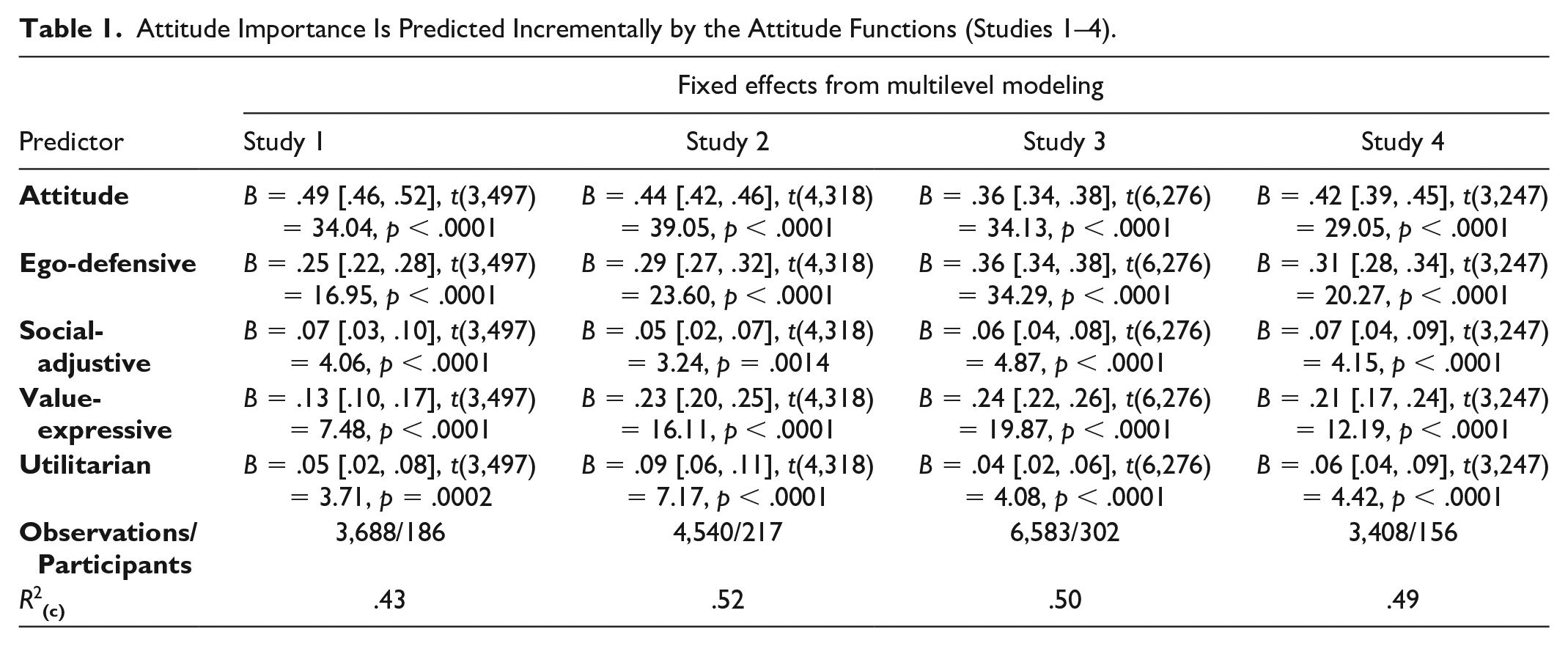
We used multilevel modeling (nlme package; Pinheiro et al., 2021) to regress attitude importance on attitude valence and all attitude functions with random intercepts for each participant across all 20 objects (see Table 1 for results across all four datasets). More positive attitudes were rated as more important in each study. In addition, attitudes higher on each given attitude function were rated as more important, controlling for attitudes and all other functions, in every dataset. This pattern strongly supported our claim that the attitude functions would emerge as accounting for unique variance in attitude importance. Interestingly, objects seen as fulfilling ego-defensive functions were particularly strongly related to importance, significantly more strongly than were the social-adjustive, χ2(2) = 1,301.4, p < .001; value-expressive, χ2(2) = 1,368.4, p < .001; or utilitarian functions, χ2(2) = 1,791.7, p < .001. In other words, the best predictor of objects being judged as important was their relevance to self-esteem.
Attitude Importance Is Predicted Incrementally by the Attitude Functions (Studies 1–4).
Attitude structure and function
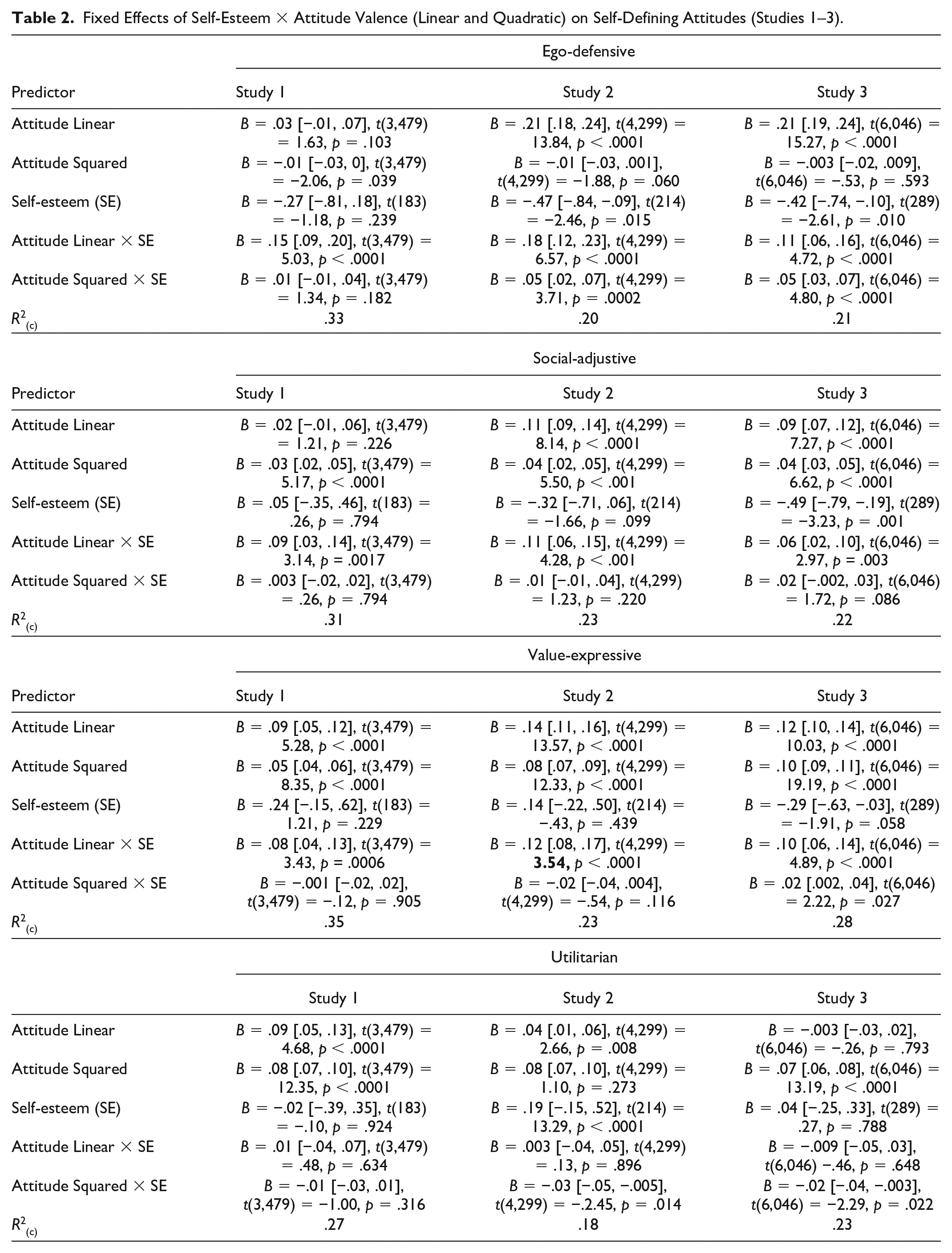
Table 2 shows the relationship between centered attitude scores (to capture positivity effects), squared attitude scores (to capture extremity effects), and centered trait self-esteem. We discuss the positivity and extremity effects in turn.
Fixed Effects of Self-Esteem × Attitude Valence (Linear and Quadratic) on Self-Defining Attitudes (Studies 1–3).
Positivity effects
We began by analyzing the ego-defensive attitude function (left data column of Table 2, under the ego-defensive heading). Although people showed no simple positivity effect for ego-defensive attitudes, an interaction with self-esteem suggested that a positivity effect may have emerged depending on the rater’s self-esteem. Consistent with our hypothesis, people with high (+1 SD) trait self-esteem showed a positivity effect (simple slopes for all studies are tracked in Table 3). In contrast, people with low self-esteem (−1 SD) rated the ego-defensive attitude function lower for positive attitudes, in what might be termed a negativity effect (i.e., rating ego-defensive relatively higher for negative attitudes). The pattern is captured in Figure 1 (Panel A), where the black/solid line reflecting high self-esteem respondents shows a positive slope (of attitude valence predicting judgments of ego-defensive relevance), whereas low self-esteem respondents (reflected by the grey/dashed line) show a negative slope. 6 This pattern strongly supports our hypothesis that positivity effects depend on people having high self-esteem and suggests a reversal for low self-esteem people.
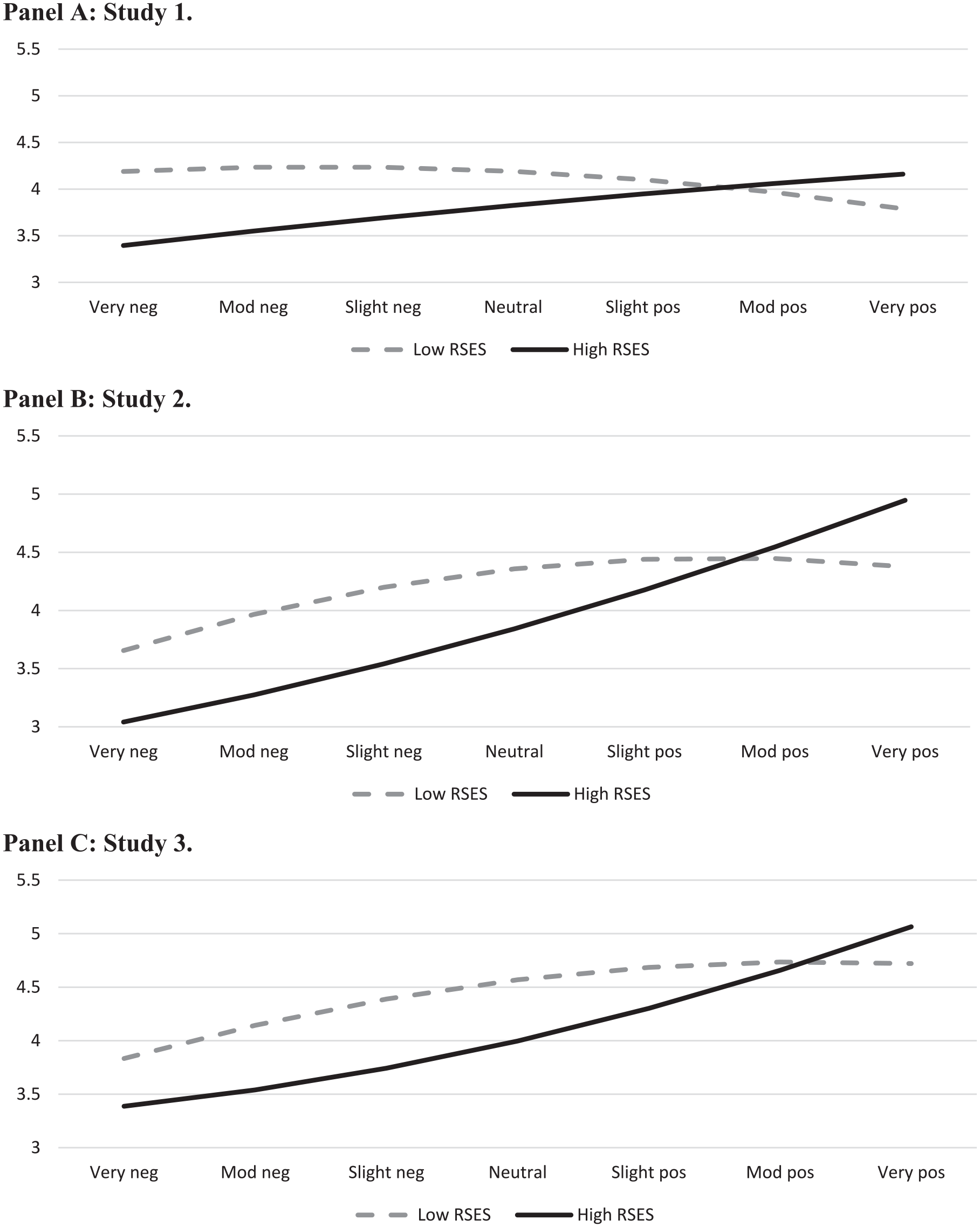
Self-esteem moderates the positivity effects of attitude position on ego-defensive attitude function. Panel A: Study 1, Panel B: Study 2, Panel C: Study 3.
Interactions of Attitude Valence (Linear) × Self-Esteem (Self-Enhancement Motivation in Study 4) Decomposed: Simple Slopes at Lower and Higher Levels of the Individual Difference Variable.
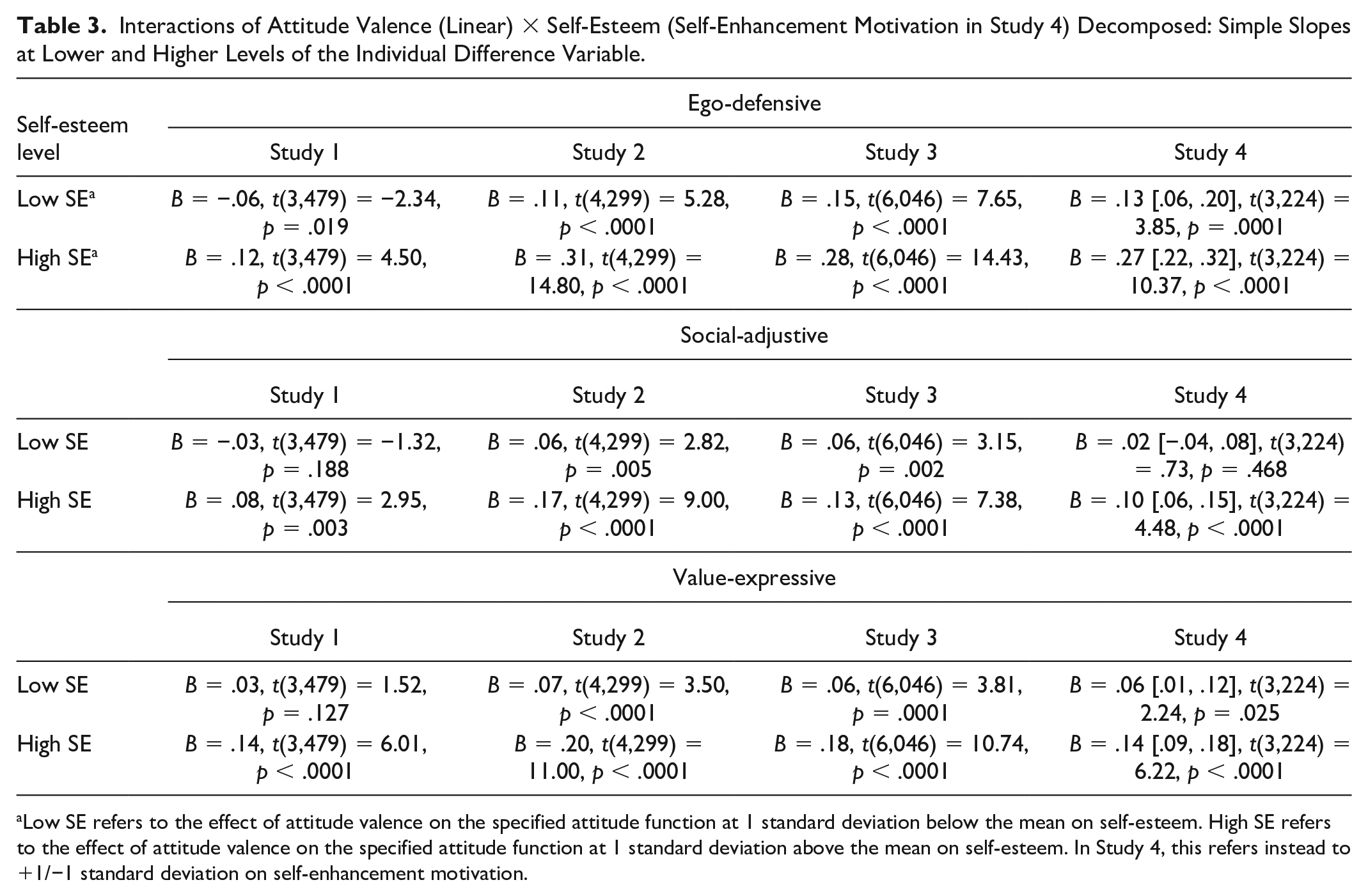
Low SE refers to the effect of attitude valence on the specified attitude function at 1 standard deviation below the mean on self-esteem. High SE refers to the effect of attitude valence on the specified attitude function at 1 standard deviation above the mean on self-esteem. In Study 4, this refers instead to +1/−1 standard deviation on self-enhancement motivation.
Similarly, the social-adjustive positivity effect was influenced by raters’ self-esteem. Once again, a robust positivity effect was detected among high self-esteem people. This effect was completely eliminated for low self-esteem people. The pattern is captured in Figure 2 (Panel A), where the black/solid line reflecting high self-esteem respondents show a positive slope (of attitude valence predicting judgments of social-adjustive relevance), whereas low self-esteem respondents show a negative slope.
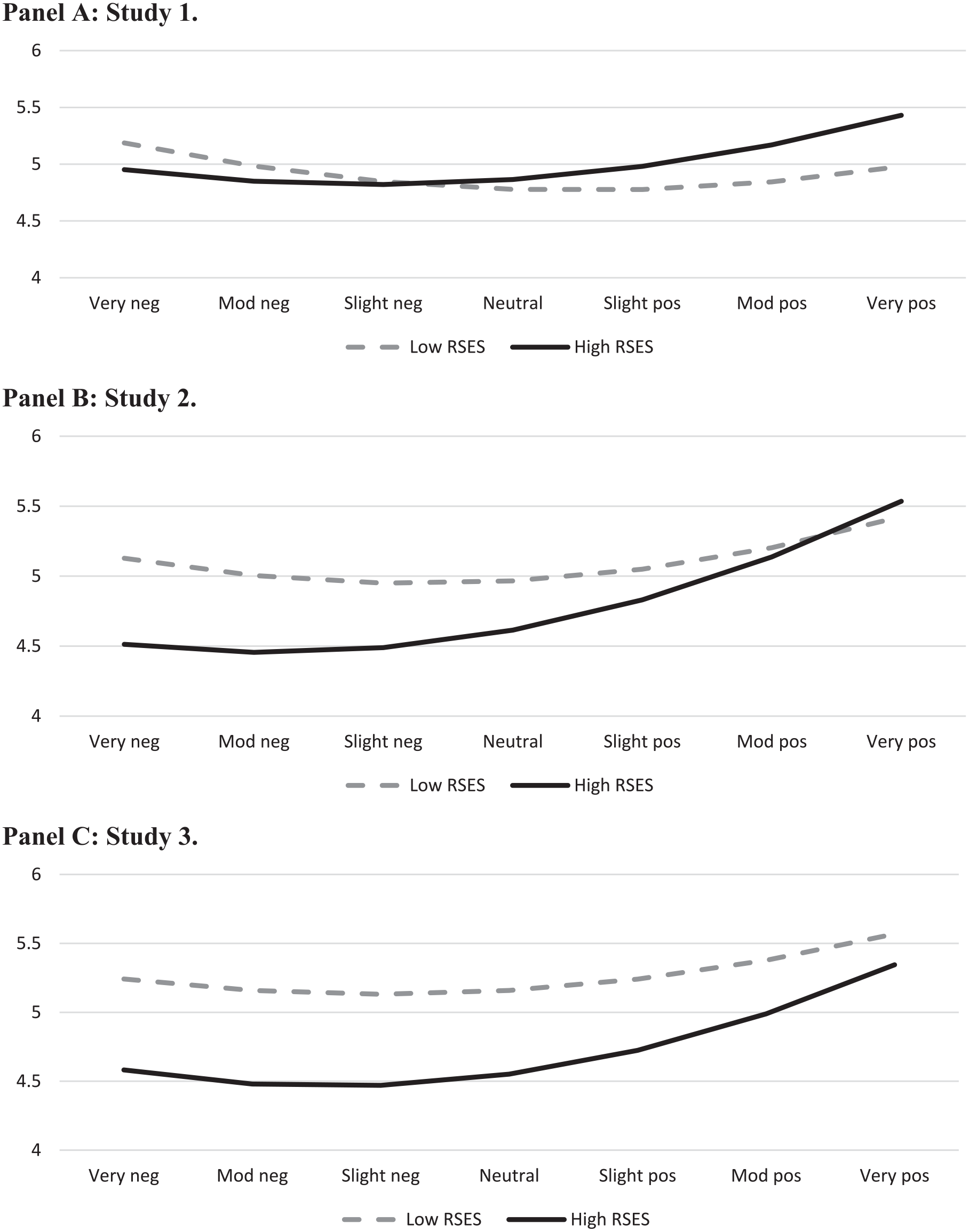
Self-esteem moderates the positivity effects of attitude position on social-adjustive attitude function. Panel A: Study 1, Panel B: Study 2, Panel C: Study 3.
The value-expressive function’s positivity effect was once again moderated by trait self-esteem. Again, a large positivity effect was detected for high self-esteem people, which was once again not significant among low self-esteem respondents. The pattern is captured in Figure 3 (Panel A), where the black/solid line reflecting high self-esteem respondents show a positive slope (of attitude valence predicting judgments of value-expressive relevance), whereas low self-esteem respondents show a negative slope. In sum, we found that trait self-esteem moderated positivity effects for all three attitude functions that we suggested could be considered as self-defining.
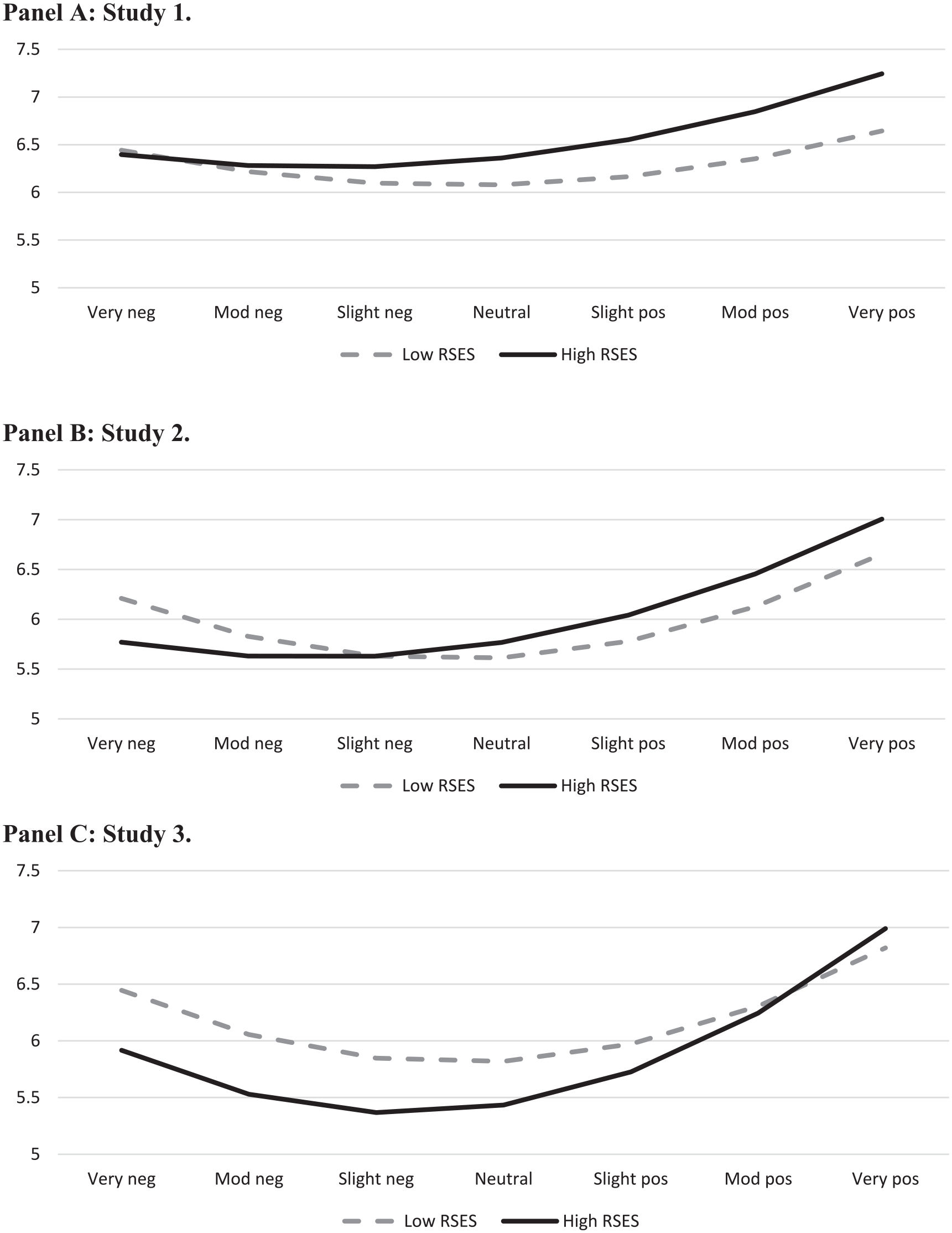
Self-esteem moderates the positivity effects of attitude position on value-expressive attitude function. Panel A: Study 1, Panel B: Study 2, Panel C: Study 3.
In contrast, we detected no Linear Attitude × Self-Esteem interaction for the utilitarian function (p = .634). Thus, interestingly, the only attitude function that theoretically would be considered as not “self-defining” was the only attitude function that was unaffected by self-esteem. Instead, we identified only a simple main effect of attitude valence: specifically, a positivity effect for judgments of utilitarian importance regardless of raters’ self-esteem levels. Although we do not want to overinterpret a null effect, we do observe that our data were sufficiently powered to find this interaction for the three identity-relevant attitude functions, but it did not emerge for utilitarian attitudes. These results are consistent with the view that the positivity effect emerged for the identity-relevant functions (ego-defensive, value-expressive, and social-adjustive), but more weakly or not at all for the utilitarian function.
Extremity effects
We found a positive quadratic (extremity) effect for social-adjustive, value-expressive, and utilitarian attitudes, conceptually replicating and extending Zunick and colleagues by revealing this connection between attitude position and function for three identity-relevant attitude functions. Because our focus in this work is on moderation by individual differences, we placed relevant figures in the Supplementary Online Materials (SOM-2). Unexpectedly, we found a negative quadratic effect (weak “upside-down U”) for ego-defensive attitudes; objects were viewed as less ego-defensively important at attitudinal extremes.
Discussion
First, these results contribute to the attitudes literature in several respects. Most importantly, we identified several positivity and extremity effects across a range of classic attitude functions, resembling Zunick et al.’s (2017) effects for self-defining attitudes. These data suggest that Zunick and colleagues’ findings may be more generalizable than their work revealed, and that positivity/extremity effects may emerge for any attitude functions that have identity-related implications. However, the positivity effect did not emerge for the utilitarian attitude function. We propose that this null effect is because utilitarian functions are not seen as having important identity implications, even though people recognize the practical importance of objects that fulfill utilitarian needs.
Furthermore, positivity (but not extremity) effects were moderated by people’s trait self-esteem. This result suggests a psychological basis for positivity effects: high self-esteem people may be more motivated to associate positive objects with their personal identity (i.e., deeming good but not bad objects to be important to their ego defense, social networks, and core values). However, low self-esteem people do not share this motivation. This contrast is theoretically innovative in two ways: First, it reveals a boundary condition for the sort of positivity effect originally documented by Zunick and colleagues, revealing that these connections of attitude position and function depend on the individual differences of the attitude-holders. Second, these findings help us to understand the psychological mechanism of the positivity effect by suggesting that only people with high self-esteem (i.e., who are more motivated to maintain high self-esteem; Brown et al., 2001; Kobayashi & Brown, 2003) show the pattern.
In addition, the importance analysis reveals that above and beyond the effect of mere attitude valence, each attitude function is uniquely related to attitude importance. In other words, an attitude object will be seen as important (worthy of care and attention) insofar as it fulfills social functions, core values, practical gains/losses, and self-esteem maintenance goals. This finding expands previous conceptualizations of attitude importance (e.g., Boninger et al., 1995a, 1995b) in that previous theorizing often does not consider directly esteem-related motivations as driving attitude importance, despite some empirical hints that it could be relevant (Eaton & Visser, 2008). This result is particularly key given our finding that the ego-defensive function showed a quite large association with attitude importance, despite its marginal consideration among the antecedents of attitude importance.
Studies 2 and 3
Due to the theoretical novelty of the moderation effects that we noted in Study 1, we wanted to replicate these effects. Thus, we ran several replication studies, including a higher-powered and preregistered study (Study 3), to confirm our findings (preregistered at https://osf.io/9gt53). 7 These studies also changed some of the attitude objects captured in Study 1 to generalize our findings across a wider range of stimuli (explained in SOM-1).
Method
Participants
For Study 2, we collected N = 217 Canadian university students who participated online for partial course credit (86% women, 13% men, 1% nonbinary, 1% prefer not to answer; 77% European/White, 11% East Asian, 5% South Asian, 1% African, 5% Mixed; 28% Atheist, 20% Agnostic, 15% Catholic, 14% Christian, 7% Jewish, 15% None/Other). In Study 3, we followed a preregistered stopping rule to perform data collection until we exceeded N = 300. We thus collected N = 304 Canadian university students (88% women, 12% men; 75% European/White, 8% East Asian, 8% South Asian, 3% African, 1% Other, 6% Mixed; 27% Agnostic, 26% Atheist, 14% Catholic, 12% Christian, 4% Jewish, 18% None/Other). Like Study 1, the logic of these rules was simply to obtain large samples that were at least triple the size of Zunick et al. (2017; Study 1).
Procedural changes
Whereas Study 2 participants evaluated k = 21 objects, Study 3 participants evaluated k = 22 different objects.
Results
Validating the attitude functions measures
In Studies 2 to 4, we do not repeat discussion of the incremental validity of each attitude function predicting attitude importance at length, but Table 1 clearly shows a consistent pattern whereby each attitude function accounts for incremental variance in attitudinal importance. Furthermore, in all cases the relation of ego-defensiveness to importance was stronger than any other attitude function’s link with importance, all ps < .001.
Attitude structure and function
Once again, Tables 2 to 4 show the relationship between attitude scores, squared attitude scores, and trait self-esteem on the self-defining attitude functions. Note that for Studies 2 and 3, readers should refer to the second/third data columns, respectively.
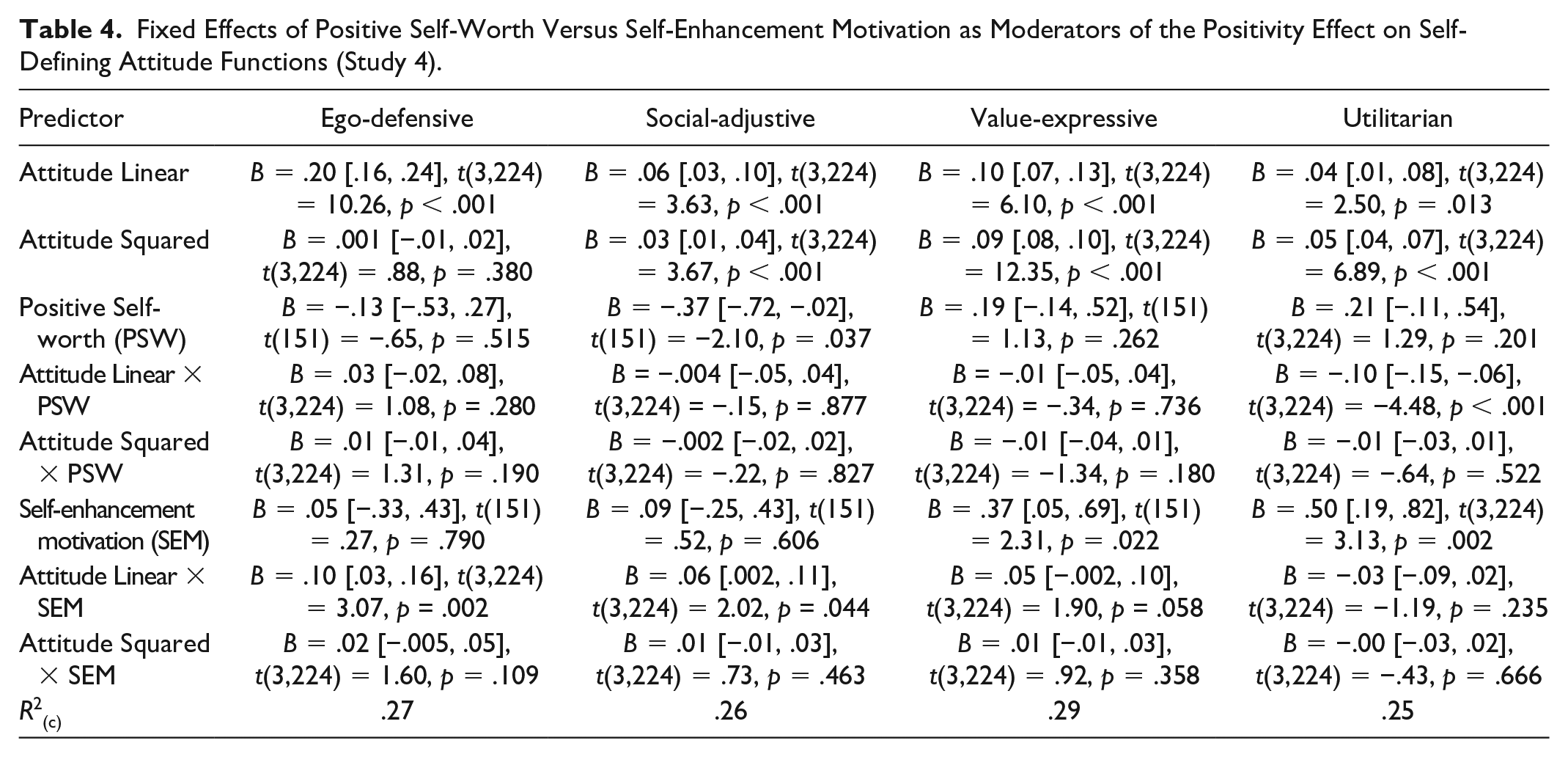
Fixed Effects of Positive Self-Worth Versus Self-Enhancement Motivation as Moderators of the Positivity Effect on Self-Defining Attitude Functions (Study 4).
Positivity effects
In Studies 2 and 3, positivity effects emerged as simple effects for ego-defensive, social-adjustive, and value-expressive attitude functions (all ps < .0001), supporting the generalizability of the positivity effect. Positivity effects emerged for the utilitarian function in Study 2 but not Study 3. (Note that because the utilitarian function is not self-defining, we did not predict such a positivity effect, so its inconsistent manifestation is not critical.)
More central to our hypotheses, we found several moderation effects whereby high self-esteem people showed larger positivity effects than did low self-esteem people, indicated by positive interaction terms. Starting with ego-defensive attitudes (Figure 1, Panel B/C), a significant interaction of Attitude × Self-Esteem appeared in both Studies 2 and 3. In Study 2, a positivity effect was detected for ego-defensive judgments for high self-esteem people, which was significantly weaker for low self-esteem people. Similarly, in Study 3, a positivity effect for ego-defensive ratings was found for high self-esteem people, but significantly less so for low self-esteem people. These patterns supported our key hypothesis—that positivity effects primarily emerge for people with high self-esteem.
Turning to social-adjustive attitudes (Figure 2, Panel B/C), the breakdown of slopes in Study 2 revealed a strong positivity effect for high self-esteem people, but less so for low self-esteem people. This pattern was replicated in Study 3, wherein high self-esteem people showed a larger positivity effect, compared with low self-esteem people.
Finally, for value-expressive attitudes (Figure 3, Panel B/C), a significant interaction in Study 2 revealed a positivity effect for high self-esteem respondents, but less so for low self-esteem people. Similarly, the positivity effect for the value-expressive attitude function in Study 3 was pronounced for high self-esteem people, but weaker for low self-esteem people. In sum, these data strongly support the idea that positivity effects for identity-relevant attitude functions are relevant to raters’ self-esteem. Specifically, people tend to associate favorable objects with their identities only insofar as people view themselves in a positive light.
Study 4
Although the prior three datasets provided very consistent evidence for our claims about the role of self-esteem moderating the relationships between attitude position and function, one important consideration remained unclear. Throughout the article, we have generally suggested that self-esteem moderates the positivity effects because high self-esteem individuals have more SEM as compared with low self-esteem individuals (Brown et al., 2001; Kobayashi & Brown, 2003). However, it is unclear if the results of Studies 1 to 3 were driven by high self-esteem people simply liking themselves more (i.e., having PSW) or were driven by high self-esteem people having more motivation to pursue/maintain self-esteem (i.e., having more SEM). To improve the clarity of our argument, we pit these explanations against one another empirically in Study 4 by employing a wider range of measures designed to capture PSW and self-enhancement distinctly.
Method
Participants
For Study 4, we determined a stopping rule where we would terminate collection after a single online recruitment wave. We thus collected N = 157 Canadian university students who participated online for partial course credit (76% women, 23% men, 1% prefer not to answer; 77% European/White, 10% East Asian, 5% Indigenous, 2% Latinx, 2% African, 9% Other; Mage = 18.9, SDage = 2.4). 8 This provided a sample size much larger than the original Zunick et al. (2017) study we were replicating (n = 59) to continue probing for moderation.
Materials
Due to the substantial number of individual difference measures included, we explain the conceptual categories here but provide full details and a zero-order correlation table in SOM-3. Several scales were included to capture self-esteem broadly (DeMarree & Rios, 2014; Heatherton & Polivy, 1991; Matthews, 2021; Rosenberg, 1965; Tafarodi & Swann, 2001). We also assessed self-concept clarity (Campbell et al., 1996). To directly assess SEM, we measured ideal and ought self-esteem (DeMarree & Rios, 2014), narcissism (Raskin & Hall, 1979), and self-esteem importance beliefs (Vaughan-Johnston & Jacobson, 2021a). Finally, we assessed emotions using the four-dimensional measure designed by Huelsman et al. (1998), to check if emotional positivity could explain our effects. This resulted in four conceptual measurement categories: positivity of self-worth, SEM, positive emotions, and negative emotions. Otherwise, our procedure matched earlier studies, and employed k = 22 objects.
Results
Factor analysis
Using the scale means for each individual difference measure noted above, we conducted a factor analysis to identify latent variables (i.e., positivity of self-worth, self-enhancement desires, and emotion valence). We concluded that four factors emerged: PSW (trait self-esteem, self-liking and competence, state self-esteem, narcissism, adaptive disengagement, self-concept clarity, core worth, and [low] neuroticism; rave = .47); SEM (ideal self-esteem, ought self-esteem, and self-esteem importance beliefs; rave = .30); negative emotions (high and low arousal negative emotions; rave = .59); and positive emotions (high and low arousal positive emotions; rave = .57). The scale means for each measure loading on a factor were averaged to create composite variables. See SOM-4 for details on the factor analysis. The negative/positive emotion factors were not systematically related to positivity or extremity effects and are not discussed further.
Attitude structure and function
Once again, the attitude functions were all related to attitude importance (Table 1).
Positivity effect
We conducted analyses such as Studies 1 to 3, but this time tested the moderating effects of our general factors (PSW and SEM) within our multilevel models (as a pair of Level 2–1 interaction terms). This allowed us to consider whether the unique influence of simply seeing oneself as good (PSW) versus desiring more PSW (SEM) was responsible for the positivity effects. Results are shown in Table 4, such that each column represents one of the self-defining attitude functions. Rows capture the fixed effects not only of linear and curvilinear attitudes, but of each individual difference composite interacting with linear and curvilinear attitudes.
First, positivity effects emerged as simple effects for ego-defensive, social-adjustive, and value-expressive attitude functions (all ps < .0001). This again replicates our conceptual replication of Zunick et al., continuing to reveal the breadth of connection between attitude position and attitude function.
Second, consistent with our hypotheses, we found that the self-enhancement composite moderated the positivity effect for all self-defining attitude functions, but the self-worth composite did not. The interaction effects are presented in Figure 4. For ego-defensive attitudes, consistent with our hypotheses that SEM is the primary driving feature of the high self-esteem positivity effect, we found that self-enhancement moderated the positivity effect as indicated by a Significant Attitude × Self-Enhancement interaction. That is, those high in SEM (+1 SD) showed a larger positivity effect, whereas those low in SEM (−1 SD) showed a smaller positivity effect. PSW did not produce a significant interaction. Thus, when we distinguished between the SEM versus the self-worth of high self-esteem people, only the former drove the positivity effect for ego-defensiveness.
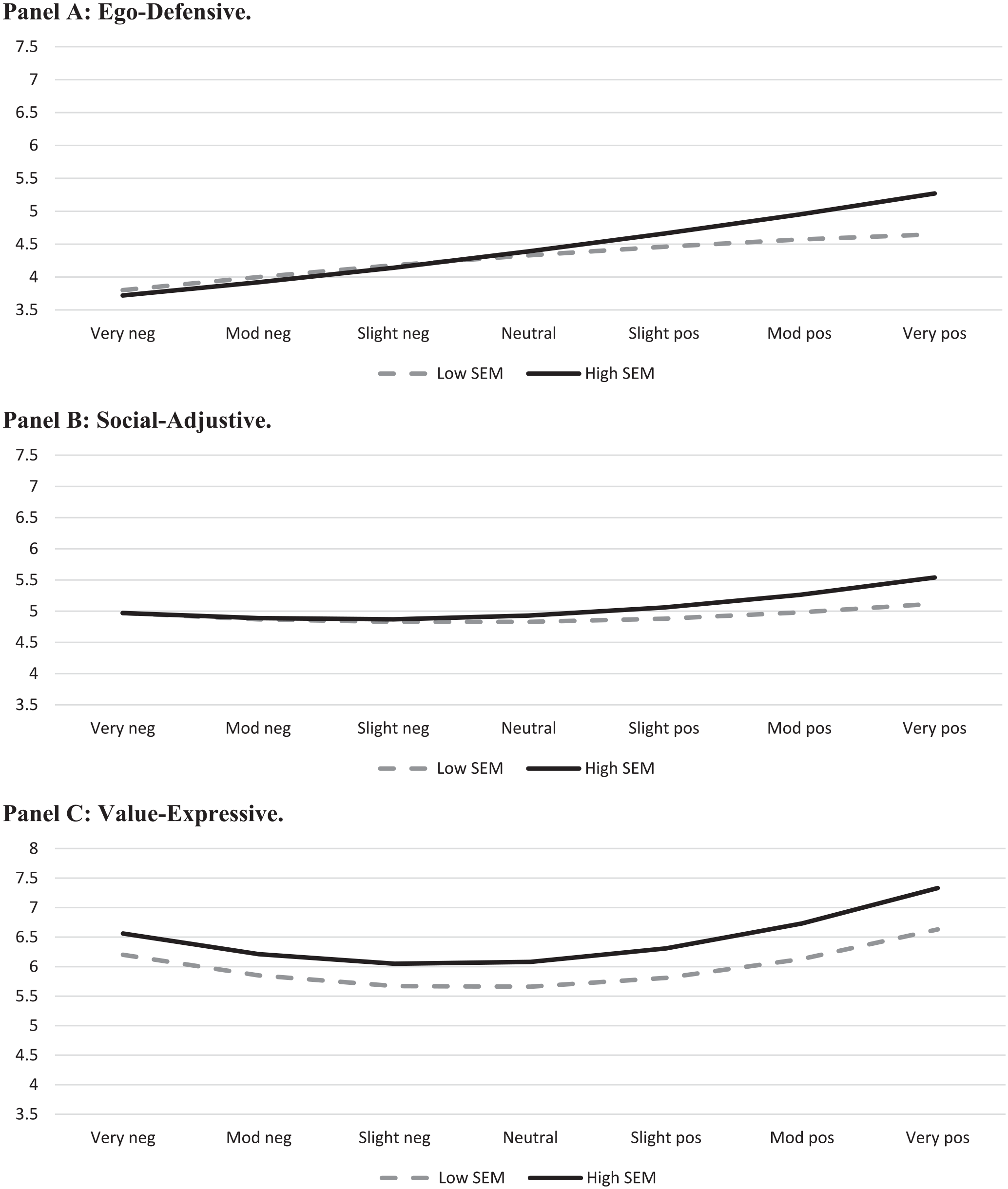
The self-enhancement composite moderates the positivity effects of attitude position on the self-defining attitude functions (Study 4). Panel A: Ego-defensive, Panel B: Social-adjustive, Panel C: Value-expressive.
Second, for social-adjustive attitudes, we again observed a significant Attitude × Self-Enhancement interaction, and once again no Self-Worth × Attitude interaction. Those high in SEM (+1 SD) showed a robust positivity effect, whereas among people low in SEM (−1 SD) the positivity effect was completely eliminated.
Third, a similar finding emerged for value-expressive attitudes. Again, self-enhancement moderated the positivity effect (marginally, this time; p = .058), whereas self-worth did not. That is, those high in SEM (+1 SD) showed a robust positivity effect, whereas those low in SEM (−1 SD) showed an attenuated positivity effect.
Discussion
We have suggested throughout that self-esteem moderates the observed positivity and extremity effects on attitude functions because it serves an SEM (Baumeister et al., 1993, 1996; Brown et al., 2001; Kobayashi & Brown, 2003). However, Study 4 was essential in clarifying whether this SEM (rather than merely PSW itself) was responsible for the moderation effect. Thus, we employed a wide range of measures to triangulate these distinct psychological dimensions. We consistently demonstrated that self-enhancement, and not self-worth, moderated the positivity effects on all three self-defining attitude functions (ego-defensive, value-expressive, social-adjustive).
General Discussion
Across four datasets, we examined the intriguing possibility that attitude structure and function interface, replicating prior findings outlined by Zunick and colleagues (2017). Zunick et al. demonstrated a positivity effect whereby positive attitudes are more often considered self-defining, and an extremity effect whereby more extreme (i.e., very positive and very negative) attitudes were more often experienced as self-defining. Across four studies, we replicated the positivity and extremity effects for three attitude functions that we suggested were self-defining: the ego-defensive, value-expressive, and social-adjustive functions (as expected, effects were much less consistent for the non-self-defining utilitarian function).
Moreover, we proposed that the positivity effect for all three self-defining functions should be moderated by self-esteem, such that they would emerge most strongly for high self-esteem people. 9 This conjecture was based on past research suggesting that high self-esteem individuals self-enhance more than their low self-esteem counterparts, and our reasoning that SEM should lead to greater perceived self-relevance only of objects evaluated favorably. In Studies 1 to 3, we demonstrated that the positivity effect was moderated by self-esteem. Thus, positivity effects emerged primarily for high self-esteem individuals, and weakened, eliminated, or even reversed for low self-esteem people. In Study 4, we sought to better understand what aspect of self-esteem was responsible for the moderation of the positivity effect. Our results demonstrate that it was the higher SEM that tends to be linked with self-esteem, rather than PSW itself, that was the key feature underlying this effect.
Theoretical Insights
Our research first sheds some additional light on the conditions wherein attitude position (i.e., whether one’s attitude position is negative, positive, etc.) and attitude function (i.e., the psychological needs fulfilled by one’s attitudes) are interrelated. That is, rather than treating connections between these aspects of attitudes as invariant phenomena, our results show that individual differences shape these patterns. We argue that our findings help to refocus this burgeoning research area on conditions (“for whom?”; “in what contexts?”) under which these distinct aspects of the attitude construct will interface, rather than treating them as universal phenomena. The case of self-esteem moderating positivity effects is particularly intriguing in that low self-esteem people (who are generally less motivated by self-enhancement) showed attenuated, eliminated, and sometimes even reversed patterns compared with high self-esteem people (who are more motivated by self-enhancement). Thus, for some individuals, negatively valenced objects were more likely to be viewed as self-defining/important. As Study 4 revealed, this had more to do with low self-esteem people’s relative absence of SEM than their negative self-views per se, revealing that these connections are motivated by psychological needs (i.e., the need for self-esteem; Sedikides & Gregg, 2008; Sedikides & Strube, 1997). The more people desire self-esteem and see it as consequential (elements of our self-enhancement factor), the more they link only positive things with their selves.
Our findings also clarify understanding around attitude functions. Most work on attitude functions manipulates rather than measures the functions. Not only did we measure each attitude function, but we showed that in all four datasets the functions were related to a criterion variable: importance. That is, attitude objects that were evaluated based on fundamental human needs for self-esteem, social connection, value-expression, and satisfaction of utilitarian drives were also seen as more worthy of personal care. This helpfully reveals that the attitude functions may be easily measured such that each function has incremental validity (i.e., seeing objects as fulfilling various functional needs connects with seeing the objects as being important), even when measured with just a single item apiece. However, we think that the study of attitude functions might be best advanced with proper scale development research, which might help to address disagreements about the number of dimensions of attitude functions (e.g., see Herek, 1987), and perhaps stimulate renewed interest in the attitude functions.
This same, very robust association between attitude functions and attitude importance also contributes to scholarship concerning attitude importance, which often highlights personal outcomes (utilitarian), main interpersonal connections (social-adjustive), and core moral beliefs (value-expressive) as bases of perceived attitude importance (Boninger et al., 1995a, 1995b). We expand on this past scholarship by showing that when people think that objects play a crucial role in influencing their feelings of self-worth, they also view such objects as important (also see Eaton & Visser, 2008). This expands extant conceptualization of why people revere some attitude objects as more important than others—which in turn has downstream consequences because attitude importance directs information-processing and attitude change processes (Holbrook et al., 2005; Starzyk et al., 2009). Thus, understanding the relatively direct role of self-esteem maintenance in forming attitude importance may be worthy of further study.
Finally, this work helps us to better understand self-esteem, by showing the benefits of distinguishing between PSW “versus” the SEM that often accompanies it (e.g., Brown et al., 2001; Kobayashi & Brown, 2003; Robins et al., 2001). Implicit in most research analyzing effects of self-esteem is the reality that one or both of these psychological forces may drive patterns of results. For instance, if SEM increases the use of self-esteem maintenance strategies that are effective (which they often are; Aspinwall & Taylor, 1993; Vaughan-Johnston et al., 2021; Vogel et al., 2014), increased SEM should be at least partially responsible for why people have high self-esteem. Thus, when researchers measure trait self-esteem, they may sometimes capture both the positive self-evaluation itself as well as the underlying enhancement motivation that led the person to like themselves. By Sedikides and Gregg’s (2008) “gastronomic analogy” in which self-enhancement is compared with appetite, it is unclear whether measuring high self-esteem (a “chronically well-fed” person) may also sometimes capture dispositional SEM (the “desire that sustains eating,” p. 103). By harnessing common variance among numerous measurements, we were able to distinguish between PSW and SEM, showing that the latter drove our moderation effect. We would suggest that self-esteem research may often benefit from using this or similar design strategies to determine whether PSW—or the self-enhancement drive sometimes implicitly connected with high self-esteem—is responsible for its broad range of effects.
We earlier discussed why people’s self-enhancement strivings would produce positivity effects connecting attitude valence to perceived self-relevance of objects. We suggested that people striving to see themselves positively may not wish to associate themselves with “bad” things by connecting such negative objects to their self-concept (whether by viewing them as important to their ego, beloved social groups, or core values). Similar effects have been captured through phenomena such as BIRGing, wherein people prefer to associate themselves with social groups insofar as those groups are successful (i.e., positive; Cialdini et al., 1976). Recent work has empirically shown that BIRGing facilitates increased self-esteem (i.e., is an effective self-enhancement technique; Vaughan-Johnston et al., 2021). Similarly, under some conditions people may associate themselves with upward social comparison targets, fueling self-esteem growth (Collins, 1996). Thus, prior evidence shows that people tend to link themselves with favorable over unfavorable objects, facilitating self-enhancement.
This viewpoint also might be explained by way of analogy. According to the hedonic contingency perspective (Wegener & Petty, 1994), when people feel positive emotions, they seek to maintain that positivity, for example by paying less attention to attitude objects that may disrupt their positive mood (compared with people in more negative moods, who are less motivated to maintain their current mood). By analogy, consider that high self-esteem people have more to lose by jeopardizing their present self-view, and might not wish to consider how negative information may connect to fundamental elements of their own identity. Although negative information could conceivably bolster one’s self-esteem (i.e., if one contrasts one’s “good” self with the bad object), people might be more likely to feel intuitively that assimilation is more likely (Wegener & Petty, 1995), thus viewing negative information as potentially harmful to self-esteem. In contrast, a low self-esteem person may be willing to connect objects—good and bad—to their selves, as they have less self-esteem to jeopardize. Future research should examine this intriguing possibility.
Limitations and Future Possibilities
First, the present work is limited by the cross-sectional/correlational nature of these data. We cannot rule out, for instance, that self-esteem is the outcome rather than the “cause” of the positivity effects. Indeed, it makes intuitive sense that people who systematically associate good things with themselves (via their core social groups, moral values, etc.) could lead people to like themselves. However, note that it was SEM—rather than merely having PSW—that moderated the positivity effects in Study 4. It is unclear why systematically associating good things with the self would increase people’s desire for more self-esteem, and we see it as more theoretically plausible that the positivity effects are an outcome. But systematic research could examine this by altering people’s current self-enhancement needs (e.g., by convincing people that self-esteem is desirable or consequential; DeMarree & Rios, 2014, Study 3; Vaughan-Johnston & Jacobson, 2021b), and then testing if people motivated to increase their self-esteem show increased positivity effects. This would help to cement the causal directionality of the present findings. Nonetheless, the present studies qualify a provocative finding in the attitudes literature with very robust evidence, advancing our understanding of how research on self-esteem and attitude functions intersect.
Second, we deployed only explicit measures of self-esteem (ESE) in the present work. Past theorizing about the differences between ESE and implicit self-esteem measures (ISE) suggests that expanding measurement here would be a fruitful pursuit. Past scholarship has sometimes indicated that ISE measures may interact with ESE in intriguing ways. For example, the combination of high ESE and low ISE (sometimes labeled defensive self-esteem) may relate to a vulnerability to self-esteem threats (Haddock & Gebauer, 2011; McGregor et al., 2005; Schmeichel et al., 2009) that might galvanize our present pattern. Such “defensive” self-esteem individuals seem to have stronger SEM, which according to our Study 4 would lead to a larger positivity effect. This would also help to solidify the distinctiveness of ISE and ESE measurement (also see Cvencek et al., 2012).
Finally, we used a similar paradigm in four studies to build substantial support for a single way of examining our proposed phenomenon. However, future research should consider other methodological approaches to this topic. For instance, attitudes that are highly accessible (i.e., that are more easily retrieved from memory) have a variety of important effects, such as driving more of the attitude-holders’ attention when processing stimuli (Roskos-Ewoldsen & Fazio, 1992). If high self-esteem people perceive positive (vs. negative) objects as more central to their identity (i.e., their self-esteem, social groups, and core values), might their positive (versus negative) attitudes also be more accessible? This would have a variety of important implications, such as suggesting that high self-esteem people’s attitude-behavior correspondence might be heightened for positive objects (whereas low self-esteem people might show stronger attitude-behavior correspondence for negative objects; Fazio et al., 1989). Future research like this could help to define how robust our captured effects are to such conceptual variations, potentially revealing exciting new developments in the association of the self and attitudes literatures.
Supplemental Material
sj-docx-1-psp-10.1177_01461672221100866 – Supplemental material for Connecting Attitude Position and Function: The Role of Self-Esteem
Supplemental material, sj-docx-1-psp-10.1177_01461672221100866 for Connecting Attitude Position and Function: The Role of Self-Esteem by Thomas I. Vaughan-Johnston, Devin I. Fowlie and Jill A. Jacobson in Personality and Social Psychology Bulletin
Footnotes
Declaration of Conflicting Interests
The author(s) declared no potential conflicts of interest with respect to the research, authorship, and/or publication of this article.
Funding
The author(s) received no financial support for the research, authorship, and/or publication of this article.

Supplemental Material
Supplemental material is available online with this article.
Notes
References
Supplementary Material
Please find the following supplemental material available below.
For Open Access articles published under a Creative Commons License, all supplemental material carries the same license as the article it is associated with.
For non-Open Access articles published, all supplemental material carries a non-exclusive license, and permission requests for re-use of supplemental material or any part of supplemental material shall be sent directly to the copyright owner as specified in the copyright notice associated with the article.
