




Abstract
Research has shown that processes of social comparison as well as persuasive argumentation are involved in group polarization. We propose a processing effort account according to which the role of these processes in determining group polarization is contingent on ability and motivation. The impact of information regarding others’ positions on group polarization should be higher given low (vs. high) ability or motivation. In contrast, the impact of persuasive argumentation should be higher given high (vs. low) ability and motivation. Results in line with these assumptions were obtained in two experiments in which individuals’ ability (Experiment 1) or motivation (Experiment 2), information regarding group average position, and argument persuasiveness were manipulated. Furthermore, consistent findings were also obtained in a third experiment testing the role of motivation in real group discussions. A processing effort account provides a novel perspective for investigating the development of group extremity.
Keywords
Group polarization refers to a change in individual preferences from pregroup discussion to postgroup discussion in the direction that is favored according to individuals’ average prediscussion preferences (Myers & Lamm, 1976). Three major approaches have been proposed to account for group polarization, stressing the role of social comparison processes (Sanders & Baron, 1977), persuasive argumentation (Burnstein & Vinokur, 1977), and social identity concerns (Mackie, 1986). Focusing on the first two approaches, we aim to identify conditions under which group polarization is mainly determined by social comparison processes versus persuasive argumentation (Isenberg, 1986). Based on a processing effort account, we show that individuals’ processing ability and motivation may determine the extent to which either process predominates in group polarization.
Social Comparison Theory (SCT)
SCT (Sanders & Baron, 1977) stresses normative processes (Deutsch & Gerard, 1955) for group polarization. SCT assumes that people are motivated to appraise their abilities and opinions and, therefore, to make comparisons with other persons (Festinger, 1954). Furthermore, individuals are presumed to wish being seen in a virtuous, socially desirable way and also to uphold a positive self-view. In a group discussion, some group members may recognize that other members hold more extreme socially desired opinions than they had initially presumed them to do, thereby eliciting a competition to hold opinions differing from the average in the desired direction. As a consequence, whereas no need to adapt their opinion is presumed to exist for extreme members, less extreme members adapt their positions accordingly and, thus, become more extreme.
Indeed, experiments show that mere exposure to others’ positions (i.e., without any group discussion) leads to polarization (Clark & Willems, 1969), especially when others’ positions reflect the socially appreciated direction (Baron & Roper, 1976). For instance, it has been found that presenting information about the distribution of others’ attitudes or simply their average attitude produces shifts of similar magnitude (Myers, Wojcicki, & Aardema, 1977). Furthermore, it has been shown that the level of the group’s central tendency may be manipulated experimentally. More specifically, Blascovich and Ginsburg (1974) had each of their participants play blackjack along with two confederates. Based on the average betting level of individuals in a pretest, confederates’ betting levels were either higher or lower. Indeed, the results showed a risky shift in participants’ choices only given high (vs. low) bettings.
Persuasive Arguments Theory (PAT)
PAT (Burnstein & Vinokur, 1977; Vinokur & Burnstein, 1974) emphasizes the role of informational processes for group polarization (Deutsch & Gerard, 1955). According to PAT, for any given discussion topic, there is a culturally determined pool of relevant arguments. The prediscussion position held by an individual is assumed to reflect the pro and con arguments that he or she can retrieve from memory. In addition, it is presumed that the pool of arguments is only partially shared among group members. During group discussion, arguments are being stated, some of which are persuasive to individual group members. According to Vinokur and Burnstein (1978), the persuasiveness of arguments is determined by the degree to which they are perceived to imply new and valid aspects regarding the issue at hand. Given an existing positive or negative prediscussion tendency within a certain group, more arguments favoring the already dominant direction are likely to be mentioned and processed. Hence, the ratio of pro and con arguments will become more extreme for individuals, leading to a polarization of opinions among group members.
Indeed, research has established the role of the ratio of pro to con arguments. Both in content analyses of real group discussions (Bishop & Myers, 1974) and with experimental manipulations employing prepared tapes (Ebbesen & Bowers, 1974; Vinokur & Burnstein, 1974), the ratio was associated with the direction and magnitude of observed shifts. Furthermore, Hinsz and Davis (1984) investigated the role of argument persuasiveness, showing that highly (vs. lowly) persuasive arguments lead to stronger group polarization.
Social Comparison Processes Versus Persuasive Argumentation
Studies aimed to determine whether one of these two processes was both necessary and sufficient to explain group polarization (Burnstein & Vinokur, 1977; Burnstein, Vinokur, & Trope, 1973; Sanders & Baron, 1977) left the exclusiveness question unanswered. Such efforts came to an end with Isenberg’s (1986) meta-analysis, which established mean effect sizes of r = .44 for mere exposure and r = .75 for persuasive arguments. In terms of Cohen’s d, the effect size for mere exposure (d = 0.98) ranges between large and very large (Cohen, 1988) and the effect size for persuasive arguments (d = 2.27) is huge (Sawilowsky, 2009). Thus, although persuasive argumentation may elicit larger effects than social comparison processes, strong empirical evidence exists for the impact of both processes.
Against the background of this state of affairs, the present research aims to show that either persuasive argumentation or information relevant for social comparison processes may predominate under specific circumstances. Essentially, this objective takes up the first of four integrative questions posed by Isenberg (1986): “Under what conditions will group processes be more affected by either rational argumentation or social comparison?” (p. 1149).
Processing Determinants as Moderators of the Impact of Information on Social Judgments
Process models of persuasion (Chaiken, Liberman, & Eagly, 1989; Kruglanski & Thompson, 1999; Petty & Cacioppo, 1986) have in common that they differentiate between different processing mechanisms that may underlie attitude change. One mechanism involves rather simple cognitive operations. In terms of the unimodel (UM; Kruglanski & Thompson, 1999), judgments may be influenced by easy-to-process information, which often means brief and early presented information. In comparison, a second mechanism involves rather effortful cognitive operations. In terms of the UM, judgments may also be influenced by difficult-to-process information, which often means long and complex and later presented information. Furthermore, all process models have in common that an individual’s processing ability and motivation are assumed to moderate which mechanism dominates attitude change. When individuals’ processing resources and/or motivation are reduced, attitude change should be determined by rather simple cognitive operations. On the contrary, when individuals have both sufficient processing resources and motivation, more effortful cognitive operations should determine attitude change.
According to the UM, individuals acquire new knowledge structures by testing hypotheses and drawing inferences on the basis of evidence, that is, information relevant to draw a conclusion. Information is relevant when it serves as a minor premise that combines with a major premise to afford a conclusion. Different types of information, that is, “cues” versus “arguments” (Chaiken et al., 1989; Petty & Cacioppo, 1986), are seen as functionally equivalent. Thus, rather than serving different functions (i.e., information serving as a cue in heuristic processing vs. information serving as an argument in systematic processing), the judgmental impact of any piece of information is assumed to depend on a number of judgmental parameters that are independent of information type. First, any information may be more or less relevant for a certain judgment. Furthermore, judgmental parameters such as the length, complexity, and order of presentation of information may make it more or less difficult to realize the relevance potential of any piece of information for the judgment at hand. In this regard, both processing motivation and ability are presumed to be necessary preconditions for the processing of later presented, lengthy, and complex information. Hence, to the extent that such information is relevant, it should affect judgments more strongly given high (vs. low) processing ability and motivation. Given low processing ability or motivation, in comparison, judgments may be influenced mainly by early presented, short, and simple information, irrespective of its relevance.
Indeed, numerous persuasion studies have found that the effect of early presented, short, and simple information on attitudes given low processing ability or motivation disappears when processing ability and motivation are high (Petty & Wegener, 1998). For instance, Petty, Cacioppo, and Goldman (1981) first presented their participants with short and simple information regarding source expertise (high vs. low expertise), followed by a lengthy and complex persuasive message (consisting of strong vs. weak arguments). Their results showed that source expertise affected attitudes given low processing motivation but ceased to affect attitudes given high processing motivation. In contrast, argument persuasiveness affected attitudes given high processing motivation but did not affect attitudes given low processing motivation. Relatedly, Pierro, Mannetti, Erb, Spiegel, and Kruglanski (2005; see also Kruglanski & Thompson, 1999) showed that brief information only affected attitudes when recipients’ processing motivation was low (vs. high). Lengthy information, in contrast, only affected attitudes when recipients’ processing motivation was high (vs. low). As Pierro, Mannetti, Kruglanski, and Sleeth-Keppler (2004) have shown, such findings are due to a relevance override mechanism. More specifically, their research showed that under low processing motivation, participants’ attitudes were influenced by early presented information, irrespective of whether it was more or less relevant. Given high processing motivation, on the contrary, early presented information ceased to affect attitudes when later presented information was of higher relevance than early information. In other words, the findings given high processing motivation were consistent with a relevance override perspective, according to which the influence of earlier presented information of lesser judgmental relevance is overridden by later presented information of higher judgmental relevance. When, however, earlier presented information is more relevant than later presented information, later information does have no effect, irrespective of whether processing motivation is high or low (Pierro et al., 2004).
A Processing Effort Account
We propose that information about others’ positions, as it has been operationalized in mere exposure experiments on polarization (e.g., average information; Myers et al., 1977), usually represents information that is rather brief and easy to process (cf. Isenberg, 1986). By contrast, persuasive argumentation exchanged during group discussion often represents rather long and complex information that is more difficult to process. Hence, processing of arguments should demand more processing ability and motivation than processing of information regarding others’ positions. Furthermore, the effect sizes reported by Isenberg (1986) suggest that persuasive argumentation may often be of higher judgmental relevance than information on others’ positions.
This line of reasoning suggests that group polarization may be a function of either information regarding others’ positions or of persuasive argumentation. In particular, when either individuals’ processing ability or their motivation is reduced, group polarization may be determined by information that is easy to process. Specifically, information presumed by SCT to determine group polarization via social comparison processes refers to others’ positions (Sanders & Baron, 1977). When such information is brief and simple, or presented early to individuals, group polarization may be determined mainly by whether others hold more or less favorable positions. In contrast, when individuals have sufficient processing resources available given high processing ability, and when they invest sufficient processing resources given high processing motivation, they may also consider information that is more difficult to process. Specifically, information presumed by PAT to determine group polarization via informational processes refers to others’ arguments (Burnstein & Vinokur, 1977). When such information is lengthy and complex, or presented later, group polarization may be determined mainly by whether argument persuasiveness is high or low.
Taken together, this suggests that processing ability and motivation may allow disentangling when information serving as input for processes emphasized in extant accounts of group polarization affects group polarization more or less strongly. Persuasive argumentation should affect group polarization more given high processing ability and motivation than given low processing ability or motivation. In contrast, social comparison processes should affect group polarization more given low processing ability or motivation than given high processing ability and motivation. Thus, we hold that social comparison processes and persuasive argumentation do not have additive effects given high processing ability and motivation. Rather, we argue that the influence of information of lower judgmental relevance on polarization is overridden by the influence of information of higher judgmental relevance (cf. Pierro et al., 2004). Hence, to the extent that others’ persuasive argumentation represents more relevant information than their attitudinal positions (cf. Isenberg, 1986), normative information regarding others’ attitudes should cease to affect polarization when group members are sufficiently able and motivated to process the arguments exchanged in a group discussion.
Some previous studies have reported suggestive findings. For instance, content analyses of group discussions revealed more informational than normative statements given an intellective issue, but more normative than informational statements given a judgmental issue (Kaplan & Miller, 1987). However, significant group polarization was found only given a judgmental issue under a unanimity rule. Similarly, response scale ambiguity (high vs. low) has been found to affect the impact of mere exposure and group discussion (Hale & Boster, 1988) and of group response and item type (Boster & Hale, 1989). Unfortunately, however, persuasive argumentation was not manipulated in any of these studies. Finally, Flint, Hernandez-Marrero, and Wielemaker (2006; Experiment 1) found that persuasive argumentation elicited polarization given a low (but not a high) procedural justice scenario. In a second experiment, in comparison, polarization was found to be affected by information about others’ average rating in the case of high (but not low) procedural justice. Overall, these existing studies are suggestive in that either process may predominate under certain circumstances. Conclusive evidence, however, is lacking.
Overview of the Current Research
We conducted three experiments to test the idea that individuals’ processing ability and motivation moderate the impact of information regarding others’ average attitude and others’ argumentation on group polarization. In Experiment 1, we manipulated individuals’ level of cognitive capacity (high vs. low); in Experiments 2 and 3, individuals’ level of processing motivation (high vs. low) was manipulated.
In the first two experiments, we employed prepared group information, allowing us to independently manipulate information about others’ positions as well as persuasive argumentation of an ingroup (Blascovich & Ginsburg, 1974; Burnstein et al., 1973; Hinsz & Davis, 1984; Mackie, Worth, & Asuncion, 1990). More specifically, similar to Blascovich and Ginsburg (1974), we manipulated the group norm by presenting participants with either an average group attitude highly in favor of the dominant position or with an average group attitude only slightly in favor of the dominant position. Furthermore, similar to Hinsz and Davis (1984), we manipulated argument persuasiveness by presenting participants either with strong arguments in favor of the dominant position or with weak arguments in favor of the dominant position.
Thus, similar to previous research investigating the role of different processes for group polarization (e.g., Burnstein et al., 1973; Ebbesen & Bowers, 1974; Mackie, 1986), the experimental paradigm involved individuals who did not actively participate in a group discussion. Rather, to test our assumptions regarding the role of cognitive capacity and motivation for the impact of social comparison processes and persuasive argumentation on polarization, we exposed individuals to a group discussion as listening recipients. Indeed, then, the first two experiments were concerned with attitude polarization, in general, rather than with group polarization, in particular. Hence, to test whether the proposed explanations also hold regarding group polarization, we conducted a third experiment, in which we investigated real group discussions and performed content analyses of the information exchanged by group members (e.g., Bishop & Myers, 1974).
In all three experiments, we analyzed whether the impact of information regarding positions and persuasive argumentation on polarization was contingent on the manipulated processing determinant (i.e., ability or motivation).
Experiment 1
In Experiment 1, we tested the assumption that the impact of information regarding others’ average attitude and others’ argumentation on polarization is moderated by individuals’ cognitive capacity. For this purpose, participants’ cognitive capacity was either taxed by a second task or not (cf. Petty, Wells, & Brock, 1976). We hypothesized that early presented brief information about others’ average attitude is easy to process and, hence, determines the extent of polarization when participants’ cognitive capacity is restrained (vs. unrestrained) due to a second task. Thus, an average group attitude highly (vs. slightly) in favor of the dominant position should lead to more polarization given low capacity. By contrast, later presented, lengthy, and complex argumentation should be more difficult to process and, hence, determines the extent of polarization given unrestrained (vs. restrained) cognitive capacity. Thus, whereas strong arguments should lead to more polarization than weak arguments given high capacity, argument persuasiveness should not affect polarization given low capacity. Furthermore, based on our assumption that persuasive argumentation represents information of higher judgmental relevance than others’ attitudinal positions, we expected the effect of group average attitude given low capacity to be overridden by the effect of argument persuasiveness given high capacity (Pierro et al., 2004). Note that we did not vary the order of information regarding group average attitude and persuasive argumentation. Rather, we deliberately held the sequence constant, with information about group average attitude preceding persuasive argumentation. This order was guided by our objective to ensure adequate conditions for showing that the role of normative and informational processes for polarization can be disentangled. In other words, our methodological decision was motivated by providing an answer to the question posed by Isenberg (1986): When is polarization affected more by persuasive argumentation, and when is it affected more by social comparison? Finally, to shed further light on information processing, we also collected individuals’ thoughts (cf. Krizan & Baron, 2007), expecting that thought valence reflects argument persuasiveness more strongly given unrestrained (vs. restrained) processing ability.
Calculation of required sample size to achieve adequate power was done with G*Power (Faul, Erdfelder, Lang, & Buchner, 2007), and based on the effect size for mere exposure reported in Isenberg’s (1986) meta-analysis (in terms of Cohen’s f: f = 0.49). Although this is a large effect in absolute terms (Cohen, 1988), it is smaller than the huge effect of persuasive argumentation (Sawilowsky, 2009), thus leading to higher required sample size to achieve a certain level of power. According to our hypothesis, we expected an interaction of cognitive capacity with group average attitude information, showing the full effect of social comparison processes given low capacity (f = 0.49) to be completely eliminated given high capacity (f = 0.00). Hence, calculating required sample size with G*Power based on the two-way interaction effect size of f = 0.245 gives total sample size n = 152 to achieve power of 1 – ß = 0.85. Note that this sample size gives power of 1 – ß > 0.99 for the predicted mirror-imaged two-way interaction of cognitive capacity with persuasive arguments, showing that the full (huge) persuasive argumentation effect given high capacity (f = 1.14) is completely eliminated given low capacity (f = 0.00). 1
Method
Participants and design
We collected data from 152 students (72 male; age: M = 23.61 years, SD = 3.66 years) at the University of Tuebingen. With each day participating between 20 and 30 students, data collection was stopped after 6 days. In return for participation, students received a reward worth about 1.20 euros (a nonalcoholic beverage). Participants were randomly assigned to one of the experimental conditions in the 2 (high vs. low cognitive capacity) × 2 (high vs. low group average) × 2 (high vs. low argument persuasiveness) between-subjects factorial design. Data of five participants were not included in the analysis: Three did not follow experimental procedures; two expressed suspicion regarding the cover story. Thus, the final sample consisted of 147 students (70 male).
Procedure and independent variables
A research assistant approached students in the university cafeteria building and asked them whether they would like to take part in an opinion poll on different topics. In a quiet area of the building, four tables were prepared, each equipped with a laptop and a headphone. Participants received the information that they would partake in two independent studies (cf. Mackie et al., 1990). The alleged first study served to measure prediscussion attitudes. We used a fictitious attitude issue for our study, the construction of a new tunnel underneath the harbor of Kiel, connecting the east and west part of the city. Selection of this attitude topic was based on a pretest. 2 In the main experiment, prediscussion attitudes were collected by telling participants that we were interested in individuals’ spontaneous reactions toward different issues. After this first study was finished, participants had to wait a few seconds for the second study to load on the computer system.
To assure sufficient motivation across conditions, the second study was introduced as part of a scientific project on the way people deal with information from a group discussion and the extent to which they deem it useful. Hence, participants would get information from a project conducted with students of the University of Tuebingen dealing with one of the topics from the alleged first study (cf. Ebbesen & Bowers, 1974). They were further informed that, in their case, the topic was the construction of the tunnel in Kiel. Specifically, they would get information from a discussion group comprised of six students. By emphasizing that the group members were students of the same university as participants, we assured that the group would be seen as consisting of comparable ingroup members (cf. Burnstein et al., 1973). According to the stated first names of these students, three were male and three were female. Allegedly, these students had dealt with some facts about the tunnel project and discussed their arguments in the group. Furthermore, we told participants that they would be first presented with the group’s opinion mean regarding the tunnel construction and would then get to listen to an audiofile of the group discussion. To this end, participants were asked to don headphones.
Participants in conditions with low cognitive capacity read that the project aimed at investigating the impact of handling a second task while dealing with a group discussion. Therefore, they would be presented with letter strings at regular time intervals. Their task was to decide, for each letter string, whether it represented a German word. Each letter string (e.g., “BAUM,” “RIPAT”) was displayed for 1 s, and participants had three more seconds left to click on one of two reaction buttons labeled “yes” and “no,” respectively. Altogether, 48 letter strings were presented (cf. Petty et al., 1976). In high-capacity conditions, no mention was made of this task and no letter strings appeared on the screen.
Next, information regarding the group members’ average attitude was presented to participants. Similar to Myers et al. (1977), we presented average information indicating either a very positive average evaluation (high group average conditions) or a slightly positive average evaluation (low group average conditions) of the tunnel construction project (cf. Blascovich & Ginsburg, 1974). To this end, in the upper part of the screen, participants were presented with a horizontal line marked with negative (−15) and positive (15) at the left and right end, respectively. In the case of a high (low) group average, an average evaluation of M = 11.51 (M = 2.51) appeared above the line with an arrow pointing at the corresponding position on the line. This average information remained visible for 10 s. In low (but not high) capacity conditions, in addition, in the lower part of the screen, the first letter string and the pertaining response buttons appeared after 5 s.
Immediately after the display of the average attitude was ended, an audiofile started automatically. Participants heard a group discussion containing six arguments in favor of building the tunnel and one argument (third place) against the tunnel construction. According to a pretest, the counterargument was of moderate persuasiveness. The six arguments in favor of building the tunnel, in comparison, were all either highly persuasive (high persuasiveness conditions) or hardly persuasive (low persuasiveness conditions). Each speaker uttered one proargument; order of speakers was identical in both persuasiveness conditions. The first argument in high persuasiveness conditions was the following: I have just read the results of some medical studies which argue for building the tunnel. That is, there is a linkage between air pollution and allergic respiratory diseases. The thing is that these diseases keep increasing in the concerned districts of Kiel. That’s why from my point of view a quick solution to the problem is important. By building the tunnel, air pollution can be reduced by 60%.
The other highly persuasive arguments referred to (a) a better transport connection of the container terminal to the railway network, (b) a reduction of transit traffic by 50%, (c) facilitation of land rehabilitation projects, (d) a reduction of traffic noise by 10%, and (e) the possibility of building playgrounds for children in renaturated areas. In low persuasiveness conditions, the first argument was the following: I’ve just read that the new filter elements already employed in modern heating power stations that are supposed to be built into the tunnel function like a catalytic converter. This way the stale air in the tunnel will be purified so that the volume of exhaust fumes will be reduced by 2%.
The other hardly persuasive arguments referred to (a) a small reduction in the number of unemployed laborers in the local building trade, (b) a construction period 12 months shorter than the once-discussed alternative of building a bridge, (c) reaching destinations 3 min earlier, (d) a 5% subsidy from a European Community fund for the advancement of European infrastructure, and (e) a 5% higher value of property in relieved districts.
Subsequently, the dependent measures, demographic questions, and an open-ended suspicion probe followed. Finally, participants contacted the experimenter, selected their reward, were thanked and dismissed.
Dependent measures
Unless noted otherwise, ratings were made on scales ranging from 1 to 11.
Pre- and postdiscussion attitudes
The prediscussion attitude was measured on a 31-point scale to the item “I think it is a good idea to build the tunnel” (fully agree to do not agree at all). To measure postdiscussion attitudes, participants first indicated their agreement with the same item but on a reversed attitude scale. Furthermore, they rated the tunnel construction on a 31-point semantic differential scale (pointless to meaningful).
Manipulation checks
Processing difficulty was measured with “I found it easy to listen to the statements of the group members” (do not agree at all to fully agree). Furthermore, we recorded the answers to the letter strings presented in low capacity conditions. Regarding group members’ average position, participants were asked, “How did the group members evaluate the tunnel construction on average?” (clearly opposed to clearly in favor).
Cognitive responses
Participants were also asked to write down the thoughts they had while dealing with the group discussion material. Up to eight textboxes were provided; participants were asked to spend 3 min on this task and to use a new textbox for each thought. Thoughts were coded by two independent raters blind to the condition whether they were related to the arguments of the group discussion, and further coded as favorable, unfavorable, or neutral with respect to the tunnel project. Rater agreement was good (83%); disagreements were resolved by discussion.
Results
Unless noted otherwise, three-factorial cognitive capacity × group average × argument persuasiveness ANOVAs were conducted.
Polarization
A preliminary analysis showed, as expected based on our attitude issue pretest, that prediscussion attitudes were moderately positive (M = 5.24, SD = 7.25) and did not differ across conditions. Responses to the two postdiscussion attitude measures were averaged (r = .76, p < .01). A polarization score was computed by subtracting prediscussion attitudes from postdiscussion attitudes, so that positive scores indicate greater polarization (i.e., attitude change in direction of building the tunnel). The ANOVA on polarization scores (see Table 1) yielded the two predicted two-way interactions. First, the cognitive capacity × group average interaction, F(1, 139) = 4.43, p < .04 (see Figure 1, top panel), revealed that high group average led to larger polarization (M = 3.51, SD = 8.04) than low group average (M = 0.06, SD = 8.16) given low capacity, F(1, 139) = 3.96, p < .05, d = 0.43, confidence interval (CI) = [0.04, 0.81]. There was no corresponding effect given high cognitive capacity, F < 1 (M = 2.19 and SD = 7.08 vs. M = 4.10 and SD = 7.41).
Polarization and Thought Valence as a Function of Cognitive Capacity, Group Average Evaluation, and Argument Persuasiveness (Study 1).
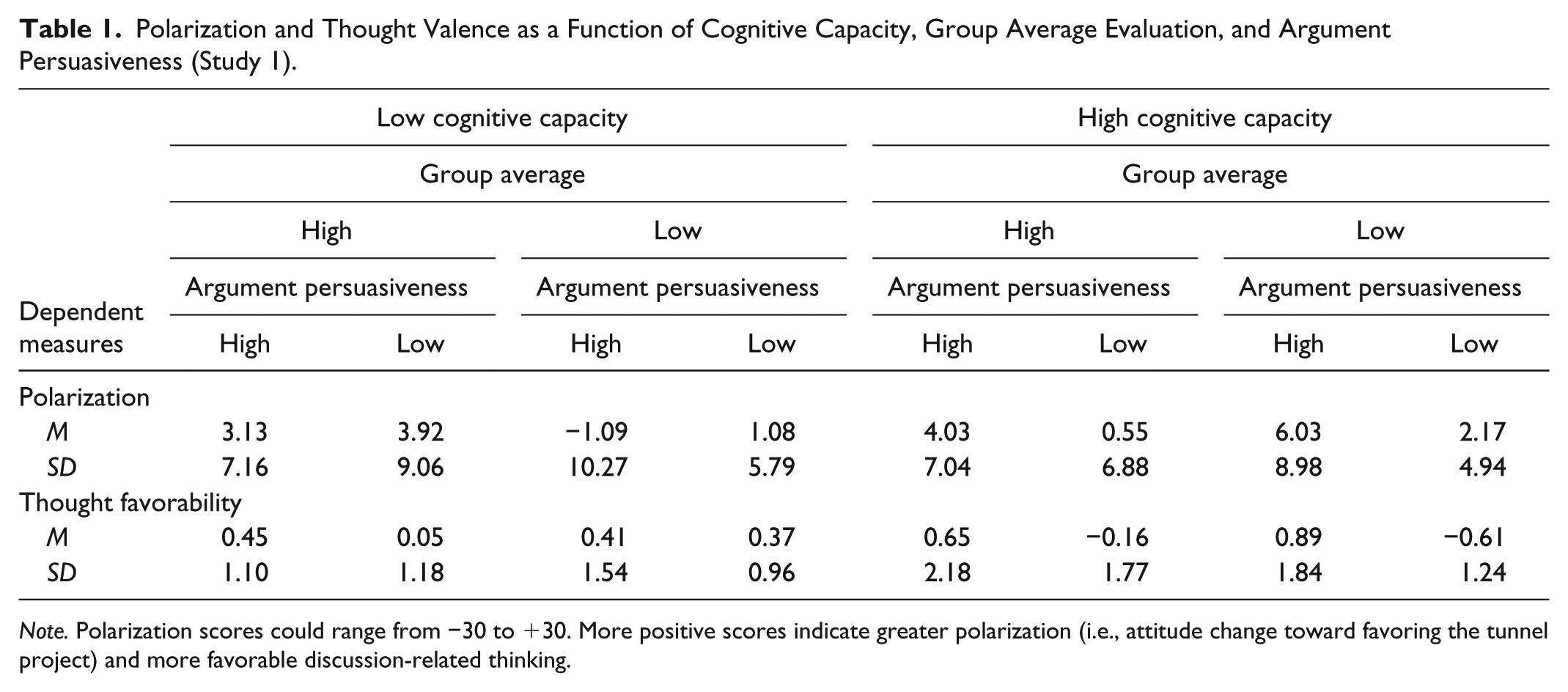
Note. Polarization scores could range from −30 to +30. More positive scores indicate greater polarization (i.e., attitude change toward favoring the tunnel project) and more favorable discussion-related thinking.
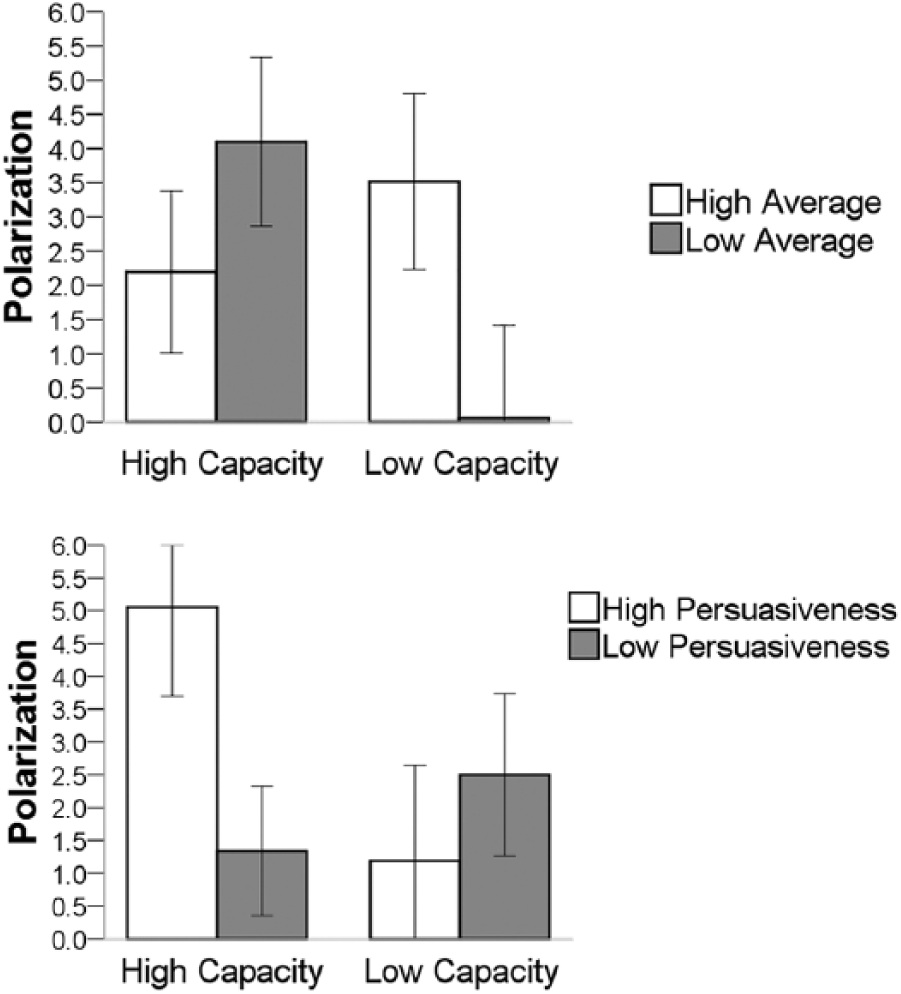
Polarization as a function of cognitive capacity and group average information (top panel) and as a function of cognitive capacity and argument persuasiveness (bottom panel).
Also as hypothesized, the second significant interaction of cognitive capacity and argument persuasiveness, F(1, 139) = 4.41, p < .05 (see Figure 1, bottom panel), showed that high persuasiveness led to larger polarization (M = 5.06, SD = 8.04) than low persuasiveness (M = 1.34, SD = 5.99) given high capacity, F(1, 139) = 4.12, p < .05, d = 0.52, CI = [0.13, 0.92]. Given low capacity, argument persuasiveness made no difference, F < 1 (M = 1.19 and SD = 8.85 vs. M = 2.50 and SD = 7.64).
Cognitive responses
We calculated a cognitive response index by subtracting the number of unfavorable thoughts from the number of favorable thoughts. The ANOVA on this index (see Table 1) revealed a main effect for argument persuasiveness, F(1, 139) = 7.53, p < .008, d = 0.92. High persuasiveness elicited more favorable thoughts (M = 0.60, SD = 1.67) than low persuasiveness (M = −0.08, SD = 1.34). The predicted cognitive capacity × argument persuasiveness interaction, however, did not reach conventional levels of significance, F(1, 139) = 3.47, p = .065. Nonetheless, consistent with our assumptions, thought valence was affected by argument persuasiveness only in high cognitive capacity conditions. Highly persuasive arguments led to more positive thoughts (M = 0.77, SD = 1.98) than hardly persuasive arguments (M = −0.38, SD = 1.53), F(1, 139) = 10.41, p < .003, d = 0.65. In low cognitive capacity conditions, in comparison, thought valence was not affected by argument persuasiveness, F < 1 (M = 0.43 and SD = 1.30 vs. M = 0.21 and SD = 1.07).
Manipulation checks
Results on the cognitive capacity manipulation showed lower perceived processing difficulty in high capacity (M = 5.48, SD = 2.18) than low capacity conditions (M = 4.63, SD = 2.78), F(1, 139) = 4.30, p < .05, d = 0.34. Furthermore, unexpectedly, a group average effect, F(1, 139) = 4.05, p < .05, d = 0.34 (all other ps > .22), revealed lower perceived difficulty given low group average (M = 5.49, SD = 2.28) than high group average (M = 4.65, SD=2.68). Regarding perceived group evaluation of the tunnel project, high group average led to higher ratings (M = 9.32, SD = 1.84) than low group average (M = 6.65, SD = 2.43), F(1, 139) = 58.70, p < .001, d = 1.24 (all other ps > .11).
Discussion
The results of Experiment 1 were consistent with the hypothesis that an individual’s cognitive capacity moderates the impact of information regarding others’ average attitude and argumentation on polarization. When participants’ processing ability was low, polarization was larger in the case of high as compared with low group average, regardless of argument persuasiveness. Furthermore, thought valence was unaffected by argument persuasiveness given low ability. In contrast, when processing ability was high, polarization was larger in the case of arguments of high (vs. low) persuasiveness, irrespective of group average information. Moreover, given high ability, thought valence reflected argument persuasiveness. With respect to the conditions conducive for either persuasive argumentation or social comparison to affect polarization (Isenberg, 1986), these results show that early presented, short, and simple information about others’ attitudes affects polarization when individuals’ cognitive capacity is restrained. Later presented, lengthy, and complex persuasive argumentation, on the contrary, affects polarization when individuals’ cognitive capacity is unrestrained.
Experiment 2
According to our processing effort account, sufficient processing ability as well as sufficient processing motivation are necessary for processing of information that is more complex and presented late in an information sequence, as compared with processing of information that is brief and simple and presented early. Hence, Experiment 2 was conducted to test the assumption that an individual’s processing motivation moderates the impact of information regarding others’ average attitude and others’ argumentation on polarization in a similar way as Experiment 1 has shown with respect to processing ability (Kruglanski et al., 2012). Given low processing motivation, we expected that polarization is determined by early presented, brief, and easy-to-process information about others’ average attitude. On the contrary, given high processing motivation, we expected that polarization is a function of later presented, complex, and difficult-to-process arguments.
Calculation of required sample size to achieve adequate power was identical to Experiment 1, except for motivation rather than cognitive capacity as the tested moderator variable. The full effect of social comparison processes given low motivation should be completely eliminated given high motivation, hence, again leading to the required sample size of total n = 152 to achieve a power of 1 – ß = 0.85 for testing the interaction of motivation with group average information.
Method
Participants and design
One hundred seventy-six students (88 male; age: M = 23.14 years, SD = 2.94 years) at the University of Tuebingen participated in return for a reward worth about 1.20 euros (a nonalcoholic beverage). With each day participating between 20 and 30 students, data collection was stopped after 7 days. Participants were randomly assigned to one of the experimental conditions in the 2 (high vs. low motivation) × 2 (high vs. low group average) × 2 (high vs. low argument persuasiveness) between-subjects factorial design. We excluded data of 13 participants who did not comply with experimental procedures. Thus, the final sample consisted of 163 students (82 male).
Procedure and independent variables
The procedure and the operationalizations of group members’ average attitude and argument persuasiveness were similar to high capacity conditions of Experiment 1. To manipulate motivation, participants in high motivation conditions were informed that the second study was part of a scientific project on the way people deal with information from a group discussion and the extent to which they deem it useful, and that the start of construction of the tunnel would be in about 1 year. In low motivation conditions, in contrast, participants were told that they would take part in a preliminary study (cf. Axsom, Yates, & Chaiken, 1987), and that our concern simply was to gather some first impressions. Furthermore, they were informed that the start of construction of the tunnel, if at all, would be in 10 years at the earliest. Finally, they read that their ratings and the ratings of many other participants would be collected and considered in summarized form (Pierro et al., 2004).
Dependent measures
All ratings were made on scales ranging from 1 to 11.
Pre- and postdiscussion attitudes
Prediscussion and postdiscussion attitudes were gathered in a similar manner as in Experiment 1.
Manipulation checks
The item “I believe that my judgments for this study are very important” (do not agree at all to fully agree) served to assess processing motivation.
Cognitive responses
Thoughts were coded by two independent raters blind to condition whether they were related to the arguments of the group discussion, and further as favorable, unfavorable, or neutral with respect to the tunnel project. Agreement of raters was satisfactory (77%); disagreements were resolved by discussion.
Results
Unless noted otherwise, three-factorial motivation × group average × argument persuasiveness ANOVAs were conducted.
Polarization
Prediscussion attitudes were moderately positive (M = 7.41, SD = 2.38) and did not differ across conditions. Postdiscussion attitude measures were averaged (r = .86, p < .001), and a polarization score was computed similar to Experiment 1. The ANOVA on polarization scores (see Table 2) yielded three main effects and the two predicted two-way interactions (all other ps > .25). The motivation effect showed larger polarization in high motivation conditions (M = 1.70, SD = 2.56) than in low motivation conditions (M = 0.84, SD = 1.99), F(1, 155) = 5.32, p < .03, d = 0.38. The group average effect revealed that high group average was associated with larger polarization (M = 1.71, SD = 2.20) than low group average (M = 0.81, SD = 2.37), F(1, 155) = 6.42, p < .02, d = 0.39. More important, the predicted motivation × group average interaction, F(1, 155) = 4.35, p < .04 (see Figure 2, top panel), indicated that high group average led to larger polarization (M = 1.62, SD = 1.90) than low group average (M = 0.04, SD = 1.77) in low motivation conditions, F(1, 155) = 10.91, p < .01, d = 0.86, CI = [0.48, 1.24], but not in high motivation conditions, F < 1 (M = 1.80 and SD = 2.50 vs. M = 1.60 and SD = 2.65).
Polarization and Thought Valence as a Function of Motivation, Group Average Evaluation, and Argument Persuasiveness (Study 2).
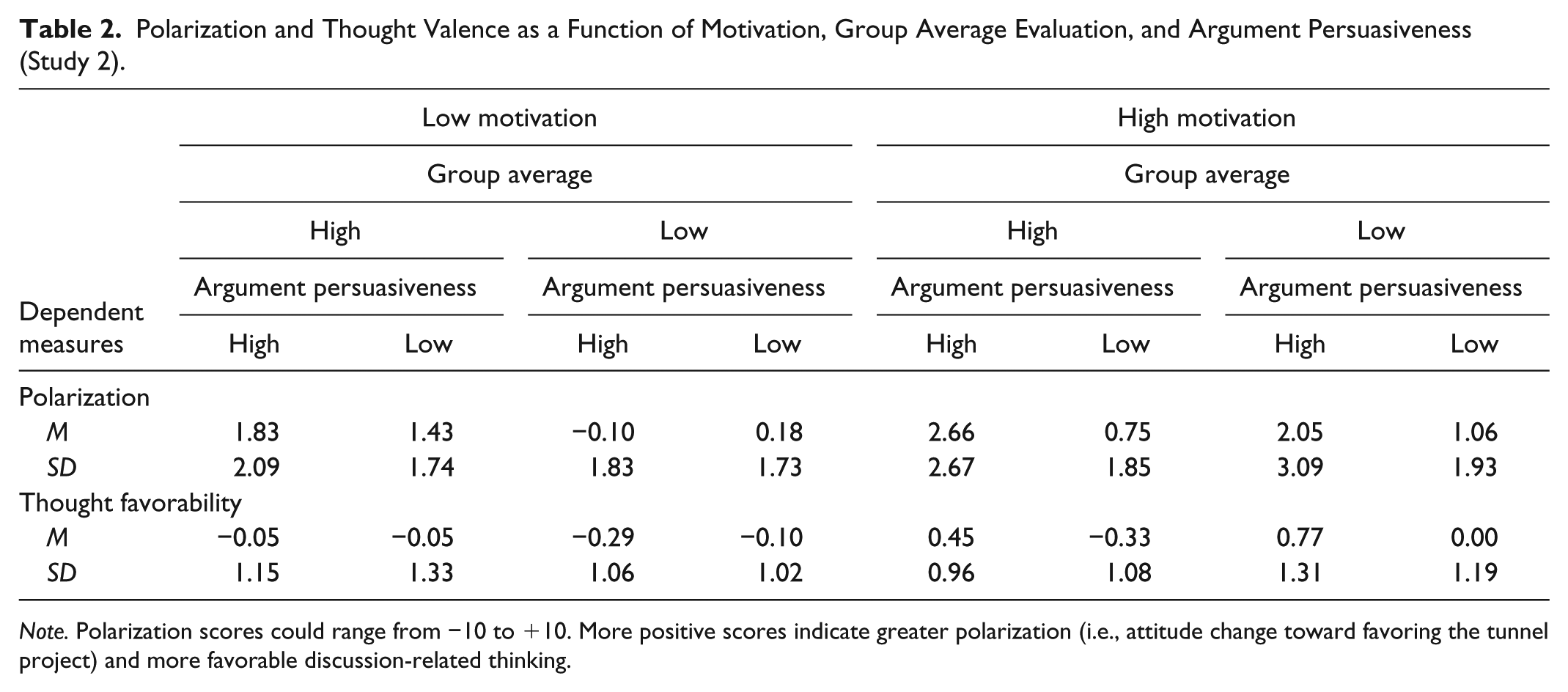
Note. Polarization scores could range from −10 to +10. More positive scores indicate greater polarization (i.e., attitude change toward favoring the tunnel project) and more favorable discussion-related thinking.
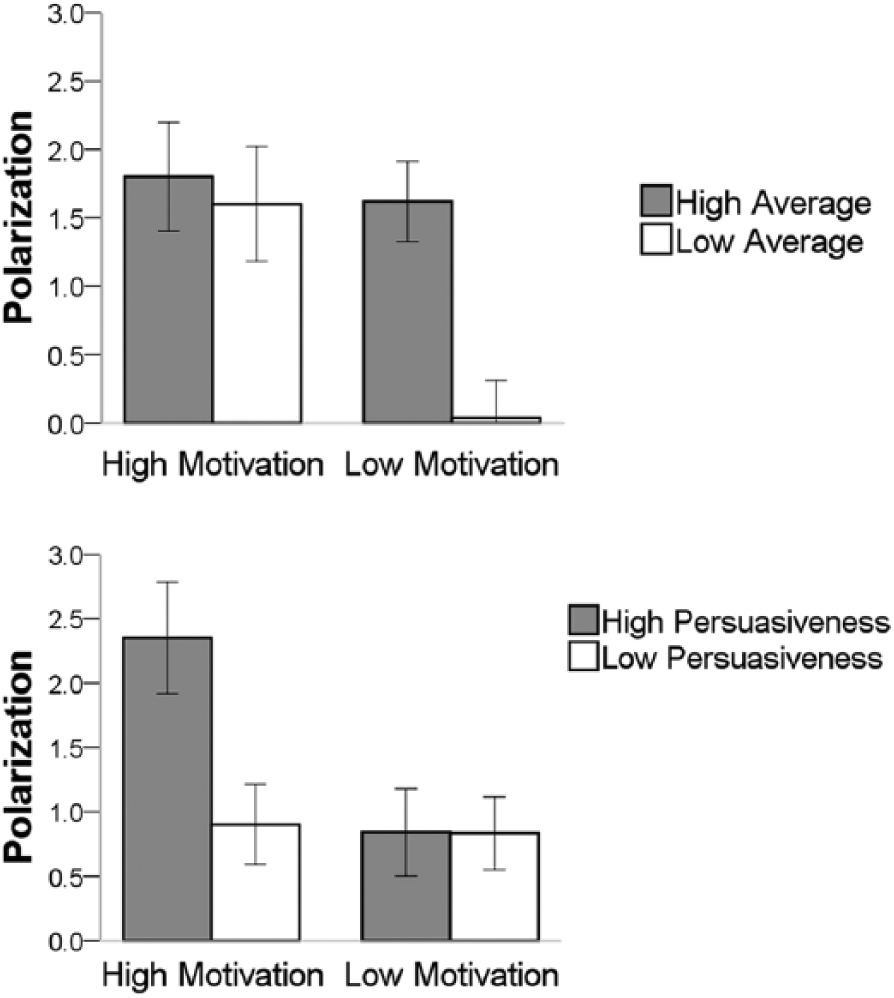
Polarization as a function of motivation and group average information (top panel) and as a function of motivation and argument persuasiveness (bottom panel).
The argument persuasiveness effect showed that high persuasiveness led to larger polarization scores (M = 1.62, SD = 2.65) than low persuasiveness (M = 0.87, SD = 1.84), F(1, 155) = 4.35, p < .04, d = 0.33. However, as predicted, the interaction of motivation and argument persuasiveness, F(1, 155) = 4.07, p < .05 (see Figure 2, bottom panel), revealed that high persuasiveness led to larger polarization (M = 2.35, SD = 2.87) than low persuasiveness (M = 0.90, SD = 1.87) only given high motivation, F(1, 155) = 8.69, p < .01, d = 0.59, CI = [0.21, 0.96], but not given low motivation, F < 1 (M = 0.84 and SD = 2.17 vs. M = 0.83 and SD = 1.83).
Cognitive responses
A cognitive response index was calculated similar to Experiment 1 (see Table 2). Descriptively, thought valence was more positive in high motivation conditions (M = 0.26, SD = 1.20) than in low motivation conditions (M = −0.12, SD = 1.13), and highly persuasive arguments elicited more positive thoughts (M = 0.24, SD = 1.18) than hardly persuasive arguments (M = −0.12, SD = 1.15). According to an ANOVA on this index, however, neither the effect of motivation, F(1, 155) = 3.65, p < .06, d = 0.32, nor the effect of argument persuasiveness, F(1, 155) = 3.62, p < .06, d = 0.31, reached conventional levels of significance. More important, however, the motivation × argument persuasiveness interaction was found significant, F(1, 155) = 5.92, p < .02 (all other ps > .19). Simple effects tests showed that thought valence was affected by argument persuasiveness in high motivation conditions only, with highly persuasive arguments leading to more positive thoughts (M = 0.61, SD = 1.15) than hardly persuasive arguments (M = −0.17, SD = 1.13), F(1, 155) = 9.19, p < .004, d = 0.68. In low motivation conditions, thought valence was not affected by argument persuasiveness, F < 1 (M = −0.17 and SD = 1.09 vs. M = −0.07, SD = 1.18).
Manipulation checks
Perceived group evaluation of the tunnel was higher in high group average conditions (M = 9.46, SD = 1.41) than in low group average conditions (M = 7.04, SD = 2.09), F(1, 155) = 73.95, p < .001, d = 1.24 (all other ps > .11). An ANOVA on participants’ motivation ratings did not reveal any significant effects. The interaction between motivation and argument persuasiveness, F(1, 155) = 3.42, p < .07 (all other ps > .15), suggested that participants in high motivation conditions considered their judgments to be more important (M = 4.98, SD = 3.02) than participants in low motivation conditions (M = 4.19, SD = 2.71) given high argument persuasiveness, F(1, 155) = 3.89, p = .05. In low argument persuasiveness conditions, ratings did not differ between high and low motivation conditions (M = 4.22 and SD = 1.99 vs. M = 4.64, SD = 3.07, F < 1). 3
Discussion
The results of Experiment 2 showed that individuals’ level of processing motivation moderates the influence of information about others’ average attitude and argumentation on polarization in a highly similar way as individuals’ level of cognitive capacity (Experiment 1). In low motivation conditions, polarization was only affected by group average information. Irrespective of argument persuasiveness, polarization was larger given high (vs. low) group average. Moreover, argument persuasiveness did not affect thought valence. In high motivation conditions, in contrast, polarization was only affected by argument persuasiveness. Irrespective of the group average, polarization was larger given highly as compared with hardly persuasive argumentation, and thought valence reflected argument persuasiveness. Together, then, results of the first two experiments were consistent with our processing effort account, according to which persuasive argumentation is more difficult to process and of higher judgmental relevance than information about others’ average attitude, and, hence, affects polarization only given sufficient processing ability (Experiment 1) and sufficient processing motivation (Experiment 2). When individuals lack either sufficient processing ability or sufficient processing motivation, polarization is affected by social comparison processes.
Experiment 3
We conducted a third experiment to test the generalizability of our assumptions to real group discussions. As already outlined, in the first two experiments, information regarding others’ average position was presented before their argumentation. However, to the extent that information about others’ positions is easy to process, whereas persuasive argumentation during group discussion is difficult to process, individuals’ motivation should have a similar effect regarding the role of argumentation and social comparison for polarization when the sequence of information about others’ positions and their arguments is not fixed.
By manipulating individuals’ processing motivation in a real group discussion, we investigated differences in discussion content and the role of discussion content for group polarization. Research has revealed that highly (vs. lowly) motivated recipients mention more and more elaborated cognitions in response to a persuasive message (e.g., Axsom et al., 1987). Hence, we hypothesized that highly motivated discussants should bring up more arguments during group discussion than lowly motivated discussants.
Moreover, we assumed that discussion content should be differentially related to group polarization in high versus low motivation conditions. Specifically, content analyses in some former studies investigating group polarization in real group discussions have shown a relationship of the ratio of exchanged pro and con arguments with the magnitude of group polarization (Bishop & Myers, 1974; Ebbesen & Bowers, 1974). Furthermore, as assumed by PAT (Vinokur & Burnstein, 1974), an individual’s prediscussion attitude reflects the pro and con arguments he or she can retrieve from memory. Hence, the ratio of pro and con arguments of an individual with a more extreme prediscussion attitude should already be high, making it less likely for him or her to encounter new persuasive arguments for the favored direction during group discussion (Vinokur & Burnstein, 1974). Given high motivation, then, the ratio of the pro-to-con arguments brought up by other group members during group discussion should affect polarization stronger the less a group member already holds an extreme prediscussion attitude. Given low motivation, in comparison, we reasoned that group polarization should not be affected by other group members’ arguments, irrespective of whether a group member holds a more or less extreme prediscussion attitude. In particular, a less extreme individual should not show more polarization the higher the ratio of pro-to-con arguments uttered by other group members during group discussion because of insufficient processing of their persuasive arguments given low motivation. As a consequence, individuals may not realize whether and to what extent there are more persuasive pro than con arguments uttered by other group members given little processing motivation. Instead, in line with assumptions of SCT (Sanders & Baron, 1977), we hypothesized that when motivation is low, the magnitude of polarization should be higher the more a group member’s prediscussion attitude differs from the average position of other group members.
To calculate the required sample size for achieving adequate power, we focused on the interaction hypothesis of a three-way interaction of motivation, the difference of a group member’s prediscussion attitude to the average attitude uttered by other group members, and the ratio of pro-to-con arguments regarding group polarization. Subsuming any lower order effects, the three-way interaction should show that the ratio of pro-to-con arguments of other group members affects group polarization only given high motivation when a group member’s prediscussion attitude clearly differs from the average attitude uttered by other group members. Thus, the full effect of argument persuasiveness (ratio of pro and con arguments) should be found given high motivation when the prediscussion attitude is much lower than other group members’ average attitude (d = 2.27). In contrast, this effect should be eliminated given high motivation when the prediscussion attitude is not different from other group members’ average attitude as well as given low motivation (irrespective of how different the prediscussion attitude is from other group members’ average attitude). Hence, based on the three-way interaction effect size (d = 0.57 or f2 = 0.08), calculation with G*Power (Faul, Erdfelder, Buchner, & Lang, 2009) gives total n = 115 to achieve power of 1 – ß = 0.85.
Given that the third experiment involved real group discussions, it could not be conducted in the university cafeteria building (cf. Experiments 1 and 2), but rather was conducted in laboratory spaces available in the psychology department building (see below for details). Because of this mandatory change of the location for conducting the experiment, we also opted to have psychology students in their first semester as participants. Thus, the pool of participants was restricted to a maximum of 100 students who had begun their psychology studies in the year the experiment was conducted. Given this maximum possible, we decided to strive for running 20 four-person groups, total n = 80. In effect, then, the third experiment had a power of 1− ß = 0.70 for testing the predicted three-way interaction.
Method
Participants and design
Participants were 80 students (71 female; age: M = 20.89 years, SD = 3.88 years) at the University of Tuebingen receiving extra credits. They were randomly assigned to one of the two experimental conditions (high vs. low motivation).
Procedure and independent variable
The experiment took place in five laboratory spaces of the Department of Psychology at the University of Tuebingen. Participants were led to one of four individual rooms. We employed another topic than in the first two experiments. At the time, the introduction of a government-supported period in which grandparents cared for their grandchildren to relieve pressure on the parents was debated politically (hereafter referred to as “grandparental leave”). As shown by a pretest, the mean attitude toward this issue was moderately positive. In the first part of the experiment, participants individually dealt with an initial questionnaire. They should spontaneously react toward seven issues including the topic of interest. Afterward, they were instructed for group discussion. In the high motivation condition, the study was introduced as part of a scientific project on the way people share information in group discussion and the extent to which they deem it useful. Participants in the low motivation condition, in contrast, were told that they took part in a preliminary study (cf. Axsom et al., 1987) and that its concern simply was to check technical equipment and to test experimental procedures. In both conditions, participants were then informed that they would have 15 min for discussion, at the end of which they should reach a consensus. Group discussion took place in a group room. Group discussions were audiotaped by using headsets, so that the contents could be matched to individual group members. When the group had given its consensual rating, participants were led back to their individual rooms and asked to fill out another questionnaire containing the dependent measures, demographic questions, and an open-ended suspicion probe. On completion, they were thanked and dismissed.
Dependent measures
Unless noted otherwise, ratings were made on 31-point scales ranging from −15 to 15.
Pre- and postdiscussion attitudes
Prediscussion and postdiscussion attitudes were measured with the item “I think the introduction of a grandparental leave is a good idea” (fully agree to do not agree at all).
Manipulation check
The item, “I was motivated to intensively deal with the topic ‘introduction of a grandparental leave’” (do not agree at all to fully agree), served to assess processing motivation.
Contents of group discussion
Two independent raters coded the contents of group discussions, distinguishing arguments from position utterances. Arguments were further coded as pro or con (correspondence 84.7%) or neutral statements (correspondence 83.9%). Regarding positions (correspondence 91.9%), raters also coded whether they were expressed in a quantitative way (i.e., on the scale ranging from −15 to 15) or in a qualitative way (rater scale ranging from complete disapproval to complete approval, coded from −2 to 2). The correlation between raters was r = .99, p < .001 (quantitative positions), and r = .91, p < .001 (qualitative positions).
Raters’ scores for each content category were averaged. With respect to arguments, we also computed for each group member the ratio of other group members’ pro and con arguments by dividing the number of their pro arguments by the number of all their pro and con arguments (Ebbesen & Bowers, 1974; Vinokur & Burnstein, 1974). Thus, higher values indicate a higher number of pro arguments included in the whole set of arguments of other group members’ utterances (M = 0.58, SD = 0.20). Quantitative and qualitative positions (both z standardized) were averaged to one position index. The difference to others’ uttered position was computed by subtracting each group member’s own prediscussion attitude (also z standardized) from the mean coded position of the three other group members (M = 0.00, SD = 1.30; Mackie, 1986).
Results
Analytic strategy
Given that each participant was part of a four-member group, individual reactions were nonindependent. Hence, we conducted mixed model analyses with participants’ individual responses at Level 1, motivation condition at Level 2, and random intercepts.
Group discussion content
Descriptively, high motivation led to more arguments being discussed than low motivation (pro: M = 6.25, SD = 4.73 vs. M = 3.34, SD = 2.91; neutral: M = 5.86, SD = 3.96 vs. M = 4.84, SD = 3.16; con: M = 3.95, SD = 2.88 vs. M = 2.95, SD = 3.77). In fact, a mixed model analysis with motivation condition (between-subjects factor: high vs. low), argument valence (within-subjects factor: pro, neutral, con), and their interaction revealed main effects of motivation, F(1, 234) = 12.35, p < .001, and argument valence, F(1, 234) = 5.80, p < .01 (for the interaction: F(1, 234) = 1.83, p = .16). The motivation effect showed, as predicted, that more arguments (averaged across argument valence) were mentioned given high motivation (M = 5.35, SD = 4.03) rather than low motivation (M = 3.71, SD = 3.37). The argument valence effect showed differences between the number of pro arguments (M = 4.79, SD = 4.17), neutral statements (M = 5.35, SD = 3.60), and con arguments (M = 3.45, SD = 3.37). As expected based on the topic pretest and prediscussion attitudes (see below), participants voiced more pro arguments than con arguments, t(18) = 2.30, p < .04.
Notably, the ratio of pro and con arguments uttered by other group members did not differ between motivation conditions (high: M = 0.60, SD = 0.16; low: M = 0.55, SD = 0.22, F < 1). Also, no difference was found regarding the average position voiced in high and low motivation conditions (M = 0.01, SD = 0.48 vs. M = 0.01, SD = 0.39, F < 1). Finally, discussants in high and low motivation groups also did not differ in the frequency of mentioning their positions (M = 1.50, SD = 1.18 vs. M = 2.08, SD = 1.24, F(1, 18) = 2.32, p > .14).
Polarization
Similar to our attitude issue pretest, a preliminary mixed model analysis showed that the mean prediscussion attitude was moderately positive (M = 3.78, SD = 6.07) and did not differ between high (M = 3.90, SD = 5.81) and low (M = 3.65, SD = 6.40) motivation conditions, F < 1. A polarization score was computed by subtracting prediscussion attitudes from postdiscussion attitudes. We conducted a mixed model analysis on polarization scores with motivation condition (Level 2; high motivation: 1, low motivation: −1), the centered difference to other group members’ average position (Level 1), the centered ratio of pro and con arguments brought up by other group members (Level 1), and all possible two-way-products and the three-way product as predictors. We expected to find a significant three-way interaction, subsuming any lower order effects.
Results are shown in Table 3. The main effect of the difference to others’ average position indicated more polarization the lower a group member’s prediscussion attitude was. However, as indicated by a two-way interaction between the difference to others’ average position and motivation, the difference to others’ average position affected polarization more given low (vs. high) motivation. Furthermore, results revealed an argument ratio by motivation interaction, showing more polarization given a higher ratio in high motivation than in low motivation conditions. The two-way interaction between the ratio of pro and con arguments and the difference to others’ average position showed that the argument ratio influenced polarization more (more polarization the higher the ratio) when the difference to others’ average position was high (vs. low). However, all these effects need to be seen in light of the predicted three-way interaction.
Results of a Multilevel Analysis Predicting Polarization Scores by Motivation, Difference to Others’ Average Position (Difference), Ratio of Pro and Con Arguments Brought Up by Other Group Members (Ratio), and Their Interactions (Study 3).
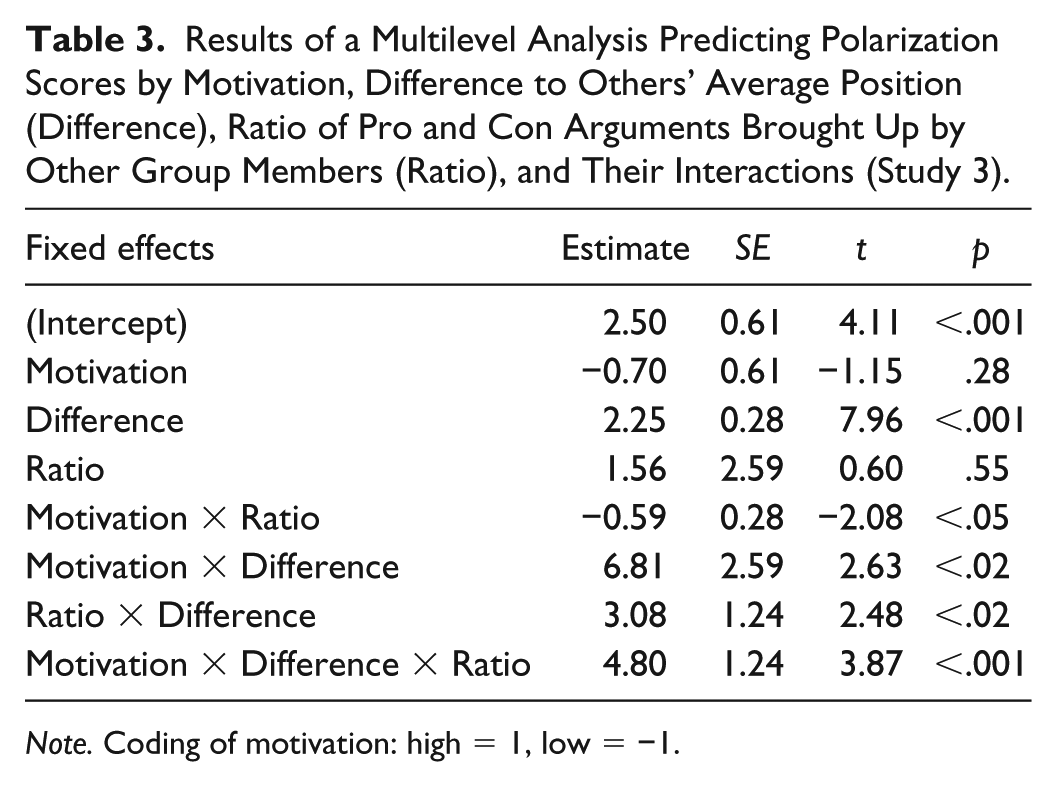
Note. Coding of motivation: high = 1, low = −1.
To further explore the three-way interaction, we conducted the same mixed model analysis using dummy coding for motivation. In low motivation groups, only the simple effect of the difference to others’ position was significant (ß = 2.84, SE = 0.41, p < .001; ratio: p > .09; interaction: p > .29), as expected. As can be seen in Figure 3 (top panel), polarization occurred only when the difference was high (+1SD). When the difference was low (-1SD), no polarization was found.
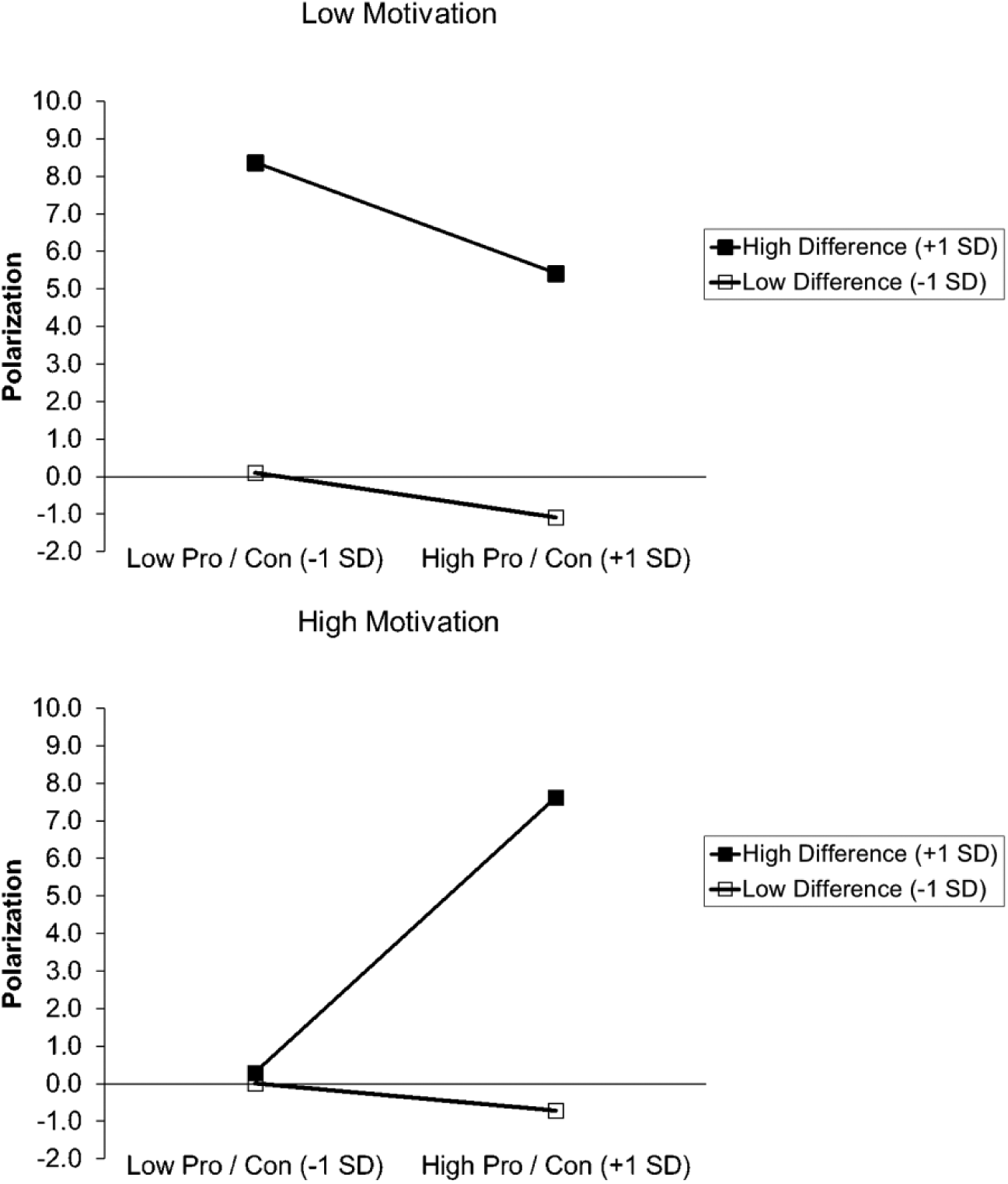
Polarization as a function of motivation, ratio of others’ pro and con arguments (pro/con) and difference of individuals’ own prediscussion attitude to the average uttered position of other group members (difference) for low motivation (top panel) and high motivation (bottom panel).
In high motivation groups, in comparison, simple effects of argument ratio (ß = 8.37, SE = 4.16, p < .05) and of position difference (ß = 1.66, SE = 0.39, p < .001) were found. More important, the predicted two-way interaction was also significant (ß = 7.88, SE = 1.89, p < .001). The ratio by difference interaction showed that the effect of the argument ratio was significant given a high difference to others’ average position (+1SD; ß = 18.62, SE = 4.96, p < .001), but not significant given a low difference to others’ average position (−1SD; ß = −1.88, SE = 4.70, p > .69). In fact, as shown by Figure 3 (bottom panel), polarization occurred only when the argument ratio was high (+1SD) and a group member’s prediscussion attitude was much lower than the other three group members’ average position (+1SD). A high difference (+1SD) did not lead to polarization when the argument ratio was more balanced (−1SD). When the difference was low (−1SD), no polarization occurred, no matter whether the argument ratio was high or low.
Manipulation check
Results suggested more motivation to intensively deal with the topic in high motivation groups (M = 8.53, SD = 1.40) than in low motivation groups (M = 7.98, SD = 2.03), though the difference did not reach statistical significance, F(1, 78) = 1.99, p = .081, one sided; see Note 3.
Discussion
In Experiment 3, participants took part in real group discussions. The results showed hypotheses-consistent differences regarding both the content of group discussions and the processes underlying group polarization in high versus low motivation groups.
With respect to the content of group discussion, discussants brought up more arguments in the discussion given high (vs. low) motivation. Moreover, we found that motivation moderated the influence of information about others’ position and others’ argumentation on group polarization. Given low motivation, polarization was affected by the difference of a group member’s prediscussion attitude to the average position of the other group members. Others’ argumentation had no impact on polarization. Thus, irrespective of whether the ratio of pro and con arguments brought up by other group members was more or less high, individuals evinced more polarization, the more their prediscussion attitude differed from the other group members’ average attitude. Clearly, then, low motivation led group members to adjust their attitude based on information about others’ positions, but not based on others’ argumentation.
Given high motivation, on the contrary, the ratio of pro and con arguments brought up by other group members predicted group polarization. The higher the ratio was, the more polarization occurred. However, this only held true for group members with a high difference to the average position of the other group members. For group members with a low difference to the average position of other group members, no polarization was found. Thus, to the extent that a discussant did not already hold a socially desirable attitude prior to group discussion, other group members’ argumentation was crucial with regard to a discussant adjusting his or her attitude.
General Discussion
We found information regarding other group members’ positions to determine group polarization under conditions of low cognitive capacity (Experiment 1) or low processing motivation (Experiments 2 and 3). On the contrary, under conditions of high cognitive capacity (Experiment 1) and high processing motivation (Experiments 2 and 3), group members’ argumentation turned out to determine group polarization. The moderating impact of group members’ motivation held true both in the case of prepared group discussion (Experiment 2) and given real group discussions (Experiment 3).
SCT and PAT
Whereas SCT (Sanders & Baron, 1977) can explain our findings in low cognitive capacity and low motivation conditions, PAT cannot explain results in these conditions. Confronted with high group average information (Experiments 1 and 2), or given a high difference to others’ average position (Experiment 3), participants adopted a more extreme attitude. On the contrary, recognizing that the group average was rather low (Experiments 1 and 2) or that the difference to others’ positions was low (Experiment 3) led to less polarization. Argument persuasiveness (Experiments 1 and 2) and the pro-to-con ratio of others’ arguments (Experiment 3), in contrast, did not affect polarization. As the results of Experiments 1 and 2 suggest, in Experiment 3, the pro-to-con ratio of others’ arguments did not affect polarization because individuals did not sufficiently process the arguments brought up in the group discussion and, thus, did not realize whether and to what extent the other group members uttered more persuasive pro than con arguments.
Conversely, whereas PAT (Vinokur & Burnstein, 1974) can account for the present findings in high processing ability and high motivation conditions, SCT cannot explain findings in these conditions. Participants processed the arguments thoroughly and realized whether they were high or low in persuasiveness (Experiments 1 and 2). Hence, polarization was larger when arguments were highly persuasive than when arguments turned out to be hardly persuasive (cf. Hinsz & Davis, 1984). Group position average had no influence on polarization. In Experiment 3, the pro-to-con ratio of others’ arguments predicted group polarization for highly motivated discussants when their prediscussion attitude was much less positive than others’ average position. No polarization was found given more extreme prediscussion attitudes. According to PAT, group members with more extreme prediscussion attitudes should already have more pro arguments in mind and were, therefore, less likely to encounter new persuasive pro arguments.
A Processing Effort Account
The current findings are highly consistent with our assumptions regarding the role of cognitive resources and motivation for extensive information processing. As suggested by the presented processing effort account, we found that early presented, rather brief and simple group average information had a considerable impact on polarization in the case of diminished processing ability or motivation. On the contrary, we expected that later presented, lengthy, and complex persuasive argumentation affects attitude polarization given high processing ability and motivation. Consistent with assumptions, in high cognitive capacity and high motivation conditions, argument persuasiveness affected the extent of polarization as well as the valence of thoughts related to the presented arguments.
Furthermore, in real group discussions, the brief and easy-to-process information about others’ positions predicted group polarization in low motivation groups. On the contrary, the complex and difficult-to-process information about others’ pro and con arguments predicted group polarization in highly motivated individuals with moderate prediscussion attitudes.
Notably, the results of our experiments suggest that information about others’ argumentation was of higher judgmental relevance than information about others’ positions (cf. Isenberg, 1986). Specifically, no polarization was found in Experiments 1 and 2 in the case of high capacity and motivation when arguments were low in persuasiveness, despite high group average information. In Experiment 3, similarly, no polarization occurred when highly motivated group members were confronted with a low ratio of others’ arguments even when the difference toward others’ average position was high. Hence, when individuals realize the relevance of different evidence under conditions of high motivation and ability, highly relevant information (others’ arguments) has a stronger impact on polarization than less relevant (normative) information (cf. Pierro et al., 2004).
Future Directions
We manipulated cognitive capacity via a second task so as to tax the cognitive resources available to individuals (cf. Petty et al., 1976). Future research may investigate how other factors impeding cognitive processing, such as time pressure (e.g., Kruglanski & Freund, 1983), affect the impact of others’ positions and arguments on group polarization.
Future research may also investigate the role of judgmental parameters such as the length, complexity, and order of presentation of information. For instance, lengthier and more complex information about others’ positions (e.g., detailed descriptions of other group members’ positions) or later presented information about others’ positions might affect group polarization more strongly given high (vs. low) processing ability and motivation. In contrast, rather brief or early presented arguments might affect group polarization more strongly given low (vs. high) ability and motivation.
Moreover, the judgmental relevance of persuasive argumentation and information about others’ positions may depend on the issue. In particular, normative information may be more relevant than arguments in what Isenberg (1986) referred to as argument-poor tasks. When playing blackjack, for instance, others’ higher or lower wagers may be more relevant than arguments for higher or lower wagers (Blascovich & Ginsburg, 1974). Similarly, in polarization research employing the autokinetic phenomenon (Baron & Roper, 1976), other group members’ arguments for higher or lower estimates may be less relevant than normative information suggesting higher or lower estimates.
Considering potential relevance differences may also shed light on existing findings. For instance, the relevance of persuasive argumentation and normative information may depend on whether the issue is of an intellective or of a judgmental nature (Kaplan & Miller, 1987), the extent of procedural justice involved in a scenario (Flint et al., 2006), or response scale ambiguity (Hale & Boster, 1988). With respect to ambiguity (Boster & Hale, 1989; Hale & Boster, 1988), research may also investigate the extent to which information regarding others’ positions may affect the interpretation of ambiguous persuasive argumentation (e.g., Ziegler & Diehl, 2003).
Conclusion
The present research suggests that group polarization research may be reinvigorated by taking into account insights that have emerged from process models of persuasion (Chaiken et al., 1989; Kruglanski & Thompson, 1999; Petty & Cacioppo, 1986). Thus, as also addressed in one of Isenberg’s (1986) integrative questions, group polarization phenomena indeed can be related to attitude change processes and attitude polarization more generally. Furthermore, the present findings provide an answer to the question regarding conditions conducive for the influence of either argumentation or social comparison that has been posed by group polarization research quite some time ago (Isenberg, 1986). Hence, we hope this work provides an impetus for a new wave of research on group polarization.
Supplemental Material
Ziegler_OnlineAppendix1 – Supplemental material for Group Polarization Revisited: A Processing Effort Account
Supplemental material, Ziegler_OnlineAppendix1 for Group Polarization Revisited: A Processing Effort Account by Janusch Sieber and Rene Ziegler in Personality and Social Psychology Bulletin
Supplemental Material
Ziegler_OnlineAppendix2 – Supplemental material for Group Polarization Revisited: A Processing Effort Account
Supplemental material, Ziegler_OnlineAppendix2 for Group Polarization Revisited: A Processing Effort Account by Janusch Sieber and Rene Ziegler in Personality and Social Psychology Bulletin
Supplemental Material
Ziegler_OnlineAppendix3 – Supplemental material for Group Polarization Revisited: A Processing Effort Account
Supplemental material, Ziegler_OnlineAppendix3 for Group Polarization Revisited: A Processing Effort Account by Janusch Sieber and Rene Ziegler in Personality and Social Psychology Bulletin
Footnotes
Acknowledgements
We thank Andrea Bauer, Petra Bugl, Henning Daus, Reiner Heide, and Martin Losert for their help in conducting this research, and Fabian Ache for his advice regarding mixed model analyses.
Authors’ Note
This research is based on the first author’s doctoral dissertation which was supervised by the second author.
Declaration of Conflicting Interests
The author(s) declared no potential conflicts of interest with respect to the research, authorship, and/or publication of this article.
Funding
The author(s) received no financial support for the research, authorship, and/or publication of this article.
Notes
Supplemental Material
Supplemental material is available online with this article.
References
Supplementary Material
Please find the following supplemental material available below.
For Open Access articles published under a Creative Commons License, all supplemental material carries the same license as the article it is associated with.
For non-Open Access articles published, all supplemental material carries a non-exclusive license, and permission requests for re-use of supplemental material or any part of supplemental material shall be sent directly to the copyright owner as specified in the copyright notice associated with the article.
