




Abstract
This study seeks to explore, how Luke presents the narrative portrayal of Philip in Acts utilizing Social Network Analysis (SNA) and presents an interdisciplinary study combining methods from Theology, Social Sciences, and Computer Science. First, we provide a detailed methodological discussion that highlights the overlap between narrative criticism and SNA. Combining both, we present results in a mathematical computational social networks using exegetical methods. SNA presents different perspectives on one of those minor actors, which Luke presents in more detail, and his relation to the nascent Christian movement in Acts. This study shows that it is in the relational aspects and the crossing of social, cultural, and religious distances that are key to understanding Luke’s story of Philip’s ministry. In particular, he presents Philip as a dynamic pioneering missionary. These results also raise new questions for further research, and show new perspective on biblical texts
Both Philip and Barnabas play an interesting role in the narrative of Acts. They are not major actors like Paul and Peter, but among the minor actors, they both play a central role and Luke provides more information about them, than about any other actor. However, the list of literature on these actors is very short, as Spencer (1992, 13) observed several decades ago: “One major reason why there are plenty of matters to deal with is that Philip has been virtually ignored in New Testament scholarship. Current monographs devoted to the study of Philip are in very short supply.” Schnabel (2002, 658) also complains that only very little research is carried out focusing on Philip. Spencer’s work is particularly important because he focuses on a narrative analysis of relations: The relationships between Philip and the converted individuals, groups, or persons such as Peter and Paul.
In addition, there is a more recent work by von Dobbeler (2000, 13), who also sees Philip as the poor cousin of NT research. Yet, like Stephen, Philip belonged to the “Circle of Seven,” which soon became the “Circle of Stephen” in research. But Spencer (1992, 14) correctly states, “Philip also is associated on some level with all three Lukan heroes […]: Stephen (Acts 6:5), Peter (8:5-25) and Paul (21:8); if a man is judged by the company he keeps, then Philip seems to deserve more respect.” However, there are other accounts of him, one concerning his itinerant mission to Samaria, the coastal plain in Ac 8:4–40, and his ministry and family circumstances in Caesarea. Spencer (1992) notes three main aspects in the portrayal of Philip: that of the pioneering missionary, the dynamic prophet, and the cooperative servant. Thus, he acknowledges the multiple ministries through his diagonal, kerygmatic, missionary, and community work. Apart from this, he discusses the relational level and social contacts. Further, he observes the multiple relationships with other characters in Acts – but there is no in-depth analysis of these relationships as provided in our work (cf. Spencer 1992, 275). According to Kollmann (2000, 310),
erscheint Philippus durchweg als pneumatisch begabter und char-ismatisch wirkender, führender Vertreter eines sich wesentlich an prophetischen Traditionen orientierenden Christentums, für das die praktische Diakonie nicht nur als Ausdruck, wahrer Prophetie‘ zentrale Bedeutung hatte, sondern als Legitimationsgrundlage schlechthin.
Thus, his consideration of the relational level falls short of the work of Spencer (1992). The source material on Philip is thin, and here one can only rely on Acts. For “Luke’s presentation remains both the earliest and fullest account of Philip available to us,” as Spencer (1992, 16) correctly states. The identification of various persons with the name Philippus is the subject of controversies (cf. Zugmann 2009). Thus, trying to present new results on Philip in Acts, we need a novel approach to query the text. This research focuses on social network analysis (SNA) and how SNA may contribute to our understanding of the narrative portrayal of Philip in Acts. For this, we apply methods from Computer Science leading to a computable social network representation. The two main research questions are as follows:
Can SNA give hints to identify several charactrsistics of Philip?
How does SNA help to understand th role of Philip in Acts, in particular his role as worker and co-worker within the network described in Acts?
However, we will also provide a detailed overview on SNA on biblical texts and discuss the broad methodological overview between SNA and narrative approaches.
First, we present and discuss the data and methods in the first section. The second section discussed the role of Philip in Acts, where a narrative exegesis is supported by the results of SNA. We draw our conclusions and present an outlook in the last section. All relevant data is available in the appendix.
Data and Methods
Social network analysis (SNA) aims at an analytic representation of human interactions. In the social sciences, this was a paradigm shift. A comprehensive historical analysis of network research in the field of social sciences can be found in Stegbauer and Häußling (2010) or in Rollinger (2014, 345ff). The development began in the 1940s as so-called “sociometry” and had its breakthrough in the US in the 1970s. According to Stegbauer and Häußling (2010, 21) SNA can be defined in various ways. First, it can describe an analysis of social relations between different actors as part of the social order. Second, it can describe the systematic evaluation of empirical data. Third, it can describe the graphical presentation of the data and fourth, it can describe mathematical models describing the data (cf. Stegbauer and Häußling 2010, 21). Thus, it is a highly interdisciplinary approach, and part of the so-called field of digital humanities or digital theology.
All data is provided in the appendix and is available at Dörpinghaus (2022). For technical details we refer to Dörpinghaus and Stenschke (2021). As discussed in Dörpinghaus (2020) and according to our following discussion, we will provide values for Acts 1-12 and Acts 1-28 to distinguish between two time points.
Social, Hisotrical, and Religious Network Analysis
Network approaches have been used in historical studies for some decades. Here, they are often called historical network analysis (HNA). Reitmayer and Marx (2010) note that many methods are used and no common formal structure exists. They show that Anglo-American historians started to work with network analysis much earlier, whereas European scholars started using the method much later. Since only selected methods of network analysis are used, a full network analysis as it is conducted within the social sciences would not be carried out, and usually no methods or computational analysis are applied. As a special application of HNA that often uses text sources, we need to mention archaeology. Network approaches are also used in archaeology to evaluate social structures. This involves settlement structures, social hierarchies and also the analysis of documents. The most obvious problem here is the source problem and limited data for antiquity, as Reitmayer & Marx summarize (cf. Reitmayer and Marx 2010, 869). See also the works of Collar (2013, 6).
Important works for the study of social networks in the ancient Mediterranean area are found in Malkin et al. (2013), who deals with the Roman imperial house and the spread of Christianity. Rutherford (2007) examines the networks of Greek city-states. He concludes that network theory “seems to provide a way of describing theoretic networks, and a number of valuable insights into their structure and functioning” (Rutherford 2007, 32). Nevertheless, he also points to the problem of finding reliable source.
Although SNA and HNA are emerging topics, most works show that the described data and source problem are the greatest hurdle (cf. Leidwanger et al. 2014; Rollinger 2014; Ganter 2015).
To sum up, sources need to be interpreted, because they do not contain direct statements about the quality of the relationships or their temporal duration. While network analysis can show additional aspects, working with sources is crucial.
Having discussed the methodology of HNA, we also need to introduce religious network analysis (RNA) as another field. RNA is often combined with HNA, thus it is often unclear, which methods are applied. Vásquez (2008) presents the theoretical background for the analysis of contemporary religious networks. Further approaches can be found in Malkin et al. (2013), where the spreading of religious ideas in the ancient Mediterranean area is examined on the basis of the cult of Demeter Eleusinia. Woolf (2016) also examines the application of network approaches to religious change in the Roman Empire. In doing so, he uses both the model of conversion as a form of contagion and as a spread of ideas.
Networks in early Christianity have not yet been fully investigated. Duling (2013, 136) summarizes the situation: “interest in SNA by Biblical scholars has been sporadic, but steady, and is apparently growing”. First approaches can be found in Thompson (1998), who examines the communication of information in the network of early Christians between the years A.D.30 and 70, Further attempts to explore these questions with the help of social network analysis were carried out in the work of Duling (1999) and Duling (2000) which are entitled “The Jesus Movement and Social Network Analysis”. Here, older approaches of Malina (1979) were used to generate a network. However, this only includes the direct network (so called ‘ego-network’) around Jesus. In general, Dulling’s work remains unfinished. He concludes one
then needs to work out the many persons and relationships in the intimate, effective, and extended social networks, and graph the nodes and lines throughout the network. The above illustration is only a beginning (Duling 2000, 11).
Another scholar working with SNA is McClure. She analyzed a harmonized version of all gospels and was first working on support, conflict, and compassion (see McClure 2016). After that, she investigated subgroups and balance (see McClure 2018). While the methodological approach remains somehow unclear (for example the data is changed which makes the studies incomparable), she carries no detailed discussion on her choice of methods. However, she draws her final observations in McClure (2020):
The results provide a unique window into the relational dynamics portrayed by the Gospels, producing a variety of insights, some which may not surprise biblical scholars but others which hopefully will inspire further consideration. (McClure 2020, 35)
Centrality Measures to analyze Actors in Social Networks
Once a social network is built, we can start the analysis. We can ask questions like “How many friends does actor X have?” or “How many groups does actor Y belong to?”. The mathematical formulation of these questions would be “What is the degree of node X?” and “How many communities Ci can be found so that Y ⊂ Ci?”. Thus, the challenge of this sections is to communicate interdisciplinarily between mathematics and computer science (discrete mathematics, graph theory), social sciences and the natural perspective on networks or the world describing the networks. The mathematical foundations in this section are based on the works of Diestel (2012) and Matoušek et al. (2007), unless otherwise noted.
In general, we define a Graph G = (V, E) with a set of edges or vertices V – these are actors, locations or any other nodes in the network – and edges E, which describe the relations between nodes. The number of nodes |V | is usually denoted with n. Given two nodes s =Simon and j =Jerusalem we may add an edge or relation (s, j) between both, describing, for example, that Simon is or was in Jerusalem. Then we say s and j are connected or they are neighbors. The neighborhood of a vertice v is denoted with N (v) and describes all nodes connected to v. If we are interested in the size of this neighborhood we calculate the node degree given by deg(v) = |N(v)|. Compare with the example given in Figure 1.
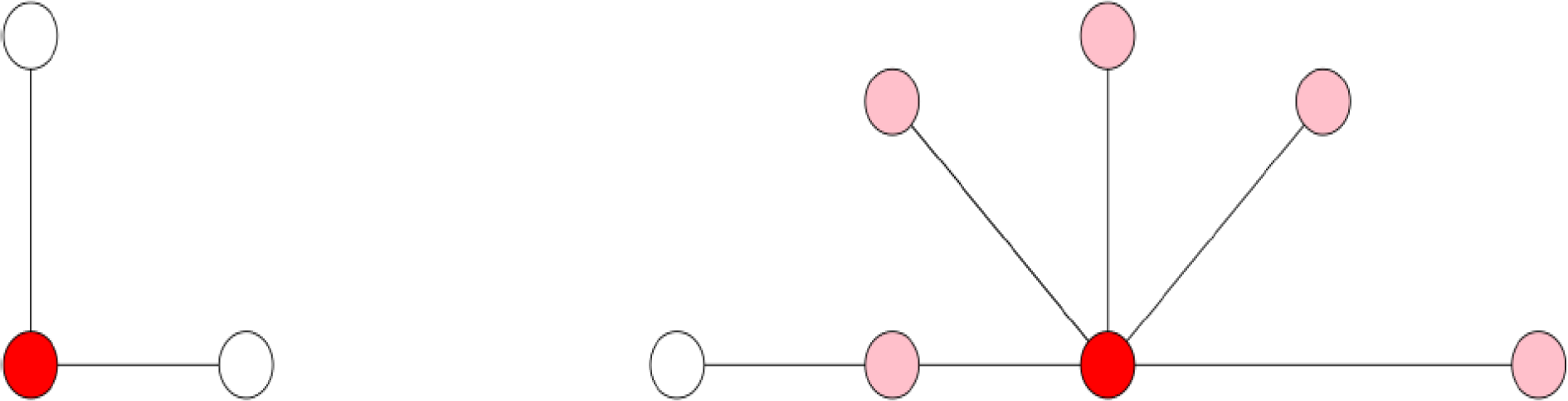
Two examples for node degrees and neighborhoods. In the left network, the red node has two neighbors and thus a degree of two. In the right example the red node is connected to five pink nodes which form the neighborhood and thus his node degree is five.
The neighborhood thus gives information about the connectedness of an actor in the network. This can be useful to illustrate the direct influence of an actor within the complete network, especially for actors with a high node degree. But it is obvious that the amount of relations we maintain does not provide any indication to their quality or usefulness. The node degree is often used as a measure to create random graphs, but it is, in general, not a good approach to analyze particular actors in networks, see Jackson (2010, 8-13).
Nevertheless, the degree centrality for a node v ∈ V is given by
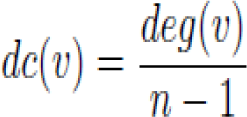
The output value ranges between 0 and 1 and gives a reference to the direct connections. As discussed, it omits all indirect relations and in particular the node’s position in the network. We will now discuss more properties to evaluate actors and their position in the networks. These properties can be used to calculate statistical parameters, so-called centrality measures (cf. Freeman 1978; Carrington et al. 2005). They answer the question “Which nodes in this network are particularly significant or important?”.
Betweenness analyzes critical connections between nodes and thus gives an indication of individuals that can change the flow of information in a network. This measure is based on the number of paths in a network:
Much of the interest in networked relationships comes from the fact that individual nodes benefit (or suffer) from indirect relationships. Friends might provide access to favors from their friends, and information might spread through the links of a network. (Jackson 2010, 39)
A path p in a graph G = (V, E) is a set of pairwise connected vertices v1, …, vn, for example written as

where (vi, vi+1) ∈ E for i ∈ {1, …, n − 1}. The length |p| of the path p is the total number of edges – not nodes. Thus |p| = n − 1. The path p links the starting node v1 and an ending node vn. In a path, no crossings are allowed, thus vi /= vj for all i, j ∈ {1, …n}. If the beginning and the end are the same (v1 = vn) we consider this path to be a circle.
Betweenness centrality (BC) was first introduced by Freeman (1977), initially for symmetric relations – undirected graphs – it was extended to asymetric relations – directed graphs – by White and Borgatti (1994). BC considers other indirect connections, see Schweizer (1996). Given a node v, it calculates all shortest paths in a network Pv(k, j) for all beginning and ending nodes k, j ∈ V. If P (k, j) denotes the total number of paths between k and j, the importance of v is given by the ratio of both values. Thus, the betweenness centrality according to Jackson (2010) is given by

where n denotes the number of the vertices in the graph. This parameter allows an analysis of the critical links and how often a node lies on such a path. This centrality measure thus answers the questions whether a node can change the flow of information in a network or whether it is a bridge between other nodes, see Schweizer (1996).
While betweenness assumes network flows to be like packages flowing from a start to destination, other measures consider multiple paths. For example, the so-called eigenvector centrality (EC) – introduced by Bonacich (1972)–measures the location of direct neighboring nodes in the network. It “counts walks, which assume that trajectories can not only be circuitous, but also revisit nodes and lines multiple times along the way.” (Borgatti 2005, 56) This measures not only the direct possibility to influence neighbors, but also the indirect possibility to influence the whole network. For a detailed mathematical background we refer to Jackson (2010, 49ff).
A Closure describes closed groups, meaning clusters or communities, see Jackson (2010, 39). The nodes within such a structure are nodes that can potentially establish trust within a cluster. The Closeness is determined by the number of shortest paths starting from a node. Thus, it indicates the potential possibility of a node to establish new connections. In contrast to betweenness, only selected paths and possibilities are considered here.
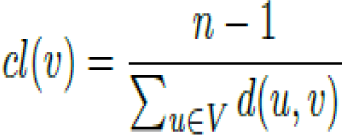
This leads to other occasionally used measures like closeness centrality (CC) and harmonic closeness centrality (HCC). Given a node i ∈ V we can compute the average distance between the first and other nodes j ∈ V with −j /= id(i, j) where d(i, j) denotes the length of a shortest path between i and j. Then, according to Jackson (2010, 39), we can compute closeness-centrality as follows:
But making a small adjustment in this formula leads to the harmonic closeness-centrality:
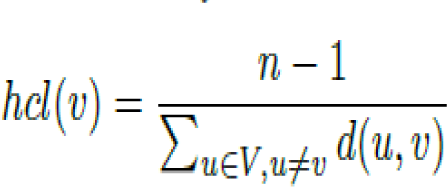
The change is small but leads to significant other results, especially for large networks:
Harmonic centrality is strongly correlated to closeness centrality in simple networks, but naturally also accounts for nodes y that cannot reach x. Thus, it can be fruitfully applied to graphs that are not strongly connected (Vigna and Boldi 2014, 230).
Having introduced the most important centrality measures, it still remains unclear for which particular question they provide an answer. We refer to the extensive study of Das et al. (2018) who not only present the historical development of centrality measures but also discuss their application. They conclude: “Centrality measures are very useful for network analysis. But their proper information, selection and application are also needful.” (Das et al. 2018, 13) and indeed, we will work on a narrative-based social network. When computing centrality measures, we first need to understand what they describe within that network and then in a next step transfer this knowledge back to the world of the author.
We will use the following approaches:
Degree distribution: To get a first overview about the network structure.
Betweenness centrality: To identify actors which control information flows between other actors in the network.
Eigenvector centrality: To identify actors who have a great influence on the whole network and who are important for emergent trends.
Closeness centrality and harmonic closeness centrality: To identify actors that can potentially establish trust within a cluster, build new relations and spread information within a cluster.
Since there is often no consent about the proper interpretation of these structures, we propose this as a further research question for this study: How can we interpret these values within the given framework of New Testament Studies? Our study nevertheless may provide some first hints on this question. We will continue with a more detailed discussion on early Christian networks according to theological research, an in particular, translocal links and mission. These aspects are important because they build a basis for the discussion and construction of the network.
Early Christian Networks, Translocal Links, and Mission
Current research often tries to find an answer to the questions regarding what early Christianity looked like. There is some interdisciplinary research in this field, mostly combining history or archaeology, although some research even focuses on quantitative methods, see Schor (2009). One major challenge is the missing sources. Apart from Acts, there are basically no sources available. Carson and Moo summarize: “Acts is the New Testament book that most nearly resembles historical narration, and it is the only source for most of what is narrated.” (Carson and Moo 2009, 312) However, Keener (2012, 197) describes this problem with all consequences:
Those who reconstruct early Christian history on the basis of a very selective reading of Acts, such as the Tübingen School, are likely to read it in light of their own biases (in that case, Hegelian dialectic); those who exclude Acts altogether may be forced to reconstruct Christian origins almost by arguing from the silence after they have eliminated the clearest concrete sources.
The early work of Robertson (1920) and Marshall (1988) should be mentioned here. Marshall examines the concept of historicity, but also criticizes its opposition to theology. He argues that Luke, just because he was a theologian, could also be a historian: “His view of theology led him to write history” (Marshall 1988, 52).
With this question introduced by Marshall, the actual concept of historicity must be taken into account. Bock (2008, 3) observes that “[it] has become popular in our postmodern age to define history itself as a construct and a type of fictive act.” The question of Luke’s own claim, the external perception in antiquity, and the reception of Acts in the present cannot be answered without a detailed consideration of the environment and an exact study of the Greco-Roman and Jewish sources. Schnelle also points out the influence of the Greco-Roman world (cf. Schnelle 2017, 340).
A detailed discussion of Luke’s claim to write a historical report can be found in Müller (2009). It is striking that Luke uses the term διήγησις in Lk 1:1–4, which was quite common for a historical work. However, since his work can certainly also be placed in the category of ancient biographical narrative, an interesting overall picture can be supported by all critical inquiries: “Die Glaubwürdigkeit des Erzählten wird durch die Nutzung etablierter literarischer Formen aus dem Bereich historiographischer und biographischer Literatur massiv unterstützt” (Müller 2009, 124).
Besides the discussion about world views that influence the arguments, the view of Padilla (2016) is also worth mentioning. He sees Acts as a work of history that “encourages the reader to view the events narrated as actually having occurred; however, it does not guarantee accuracy.” (Padilla 2016, 72) An important point is therefore the embedding of Acts in ancient historiography:
Luke is situated precisely at the meeting point of Jewish and Greek historiographical currents. His narrative devices are heavily indebted to the cultural standard in the Roman Empire, that is, history as the Greeks wrote it. (Marguerat 2002, 25)
Thus, we can assume that the description is incomplete, but historically useful while talking about ancient historiography. This view is currently the consensus in research, especially in the English-speaking world. But also in the German-speaking world, reservations are – albeit cautiously – being dropped, see for example Schnelle (2017, 333).
To understand the New Testament writings in this context, approaches from the historical and social sciences have also been used in recent times – and this is a further research focus – in this context. Here, the research on Acts naturally strongly overlaps with the research on early Christianity. Especially the ancient notions of memory are a much-noticed topic. Stock et al. (2016), for example, discussed the neuropsychological perspective of memory and the question if memory was important when Jerusalem was no longer the centre of early Christianity. Alan Kreider is primarily working on the history of early Christianity; he assumes sociologically that it was “[p]atience […] as centrally important to the early Christians” (Kreider 2016, 5) that led to the rise of Christianity.
In addition, the study of migration also contributed to the understanding of Acts (cf. Samuel 2019, 29ff). On the subject of migration and diversity in Acts 1-15, see the work Stenschke (2018). In research, however, there are also many questionable parallels. Not only may patience and perseverance have become a symbol of early Christianity, but migration as such may also have become a condition of mission: “As in the Scripture God ministers to and through the diaspora communities to fulfil his sovereign plan and purpose” (Moses 2019, 29). A new problem occurs when current terms are used without transferring them to the historical environment. This is the weak point of many methodological approaches: Historical questions must not be ignored. Otherwise, when viewed in isolation, for example, even with a view to Acts in extreme cases early Christianity may be classified as a “new religious movement”, see Regev (2016, 504).
However, although valuable research has been carried out in this area, we will focus on a different perspective, reading Acts as narrative. First, this helps to define a precise methodological background. Second, it helps to understand the narrative as it with a clear definition of the overlap between historical, critical, and narrative research.
Exegetical Approach: Luke-Acts as Narrative
The exegetical approach which is most suitable for the questions to be answered for SNA – and which wants to examine the social networks represented in biblical literature – is a literary approach and narrative criticism. Oeming (2007) describes some confusion about this approach and its naming. In general, we find this method as “New (Literary) Criticism, Literary Approach/Criticism, Holistic Approach, Rhetorical Criticism, Close Reading, Synchronical Approach, Narratology und Narrative Criticism”(Oeming 2007, 70). This approach tries to determine how biblical texts can be interpreted as literature (cf Resseguie 2005; Petersen 1978, 18).
The problem with applying narrative criticism is its variety. The approaches differ slightly, not only due to the different original languages between OT and NT, but also between different literary approaches and schools in different countries. Additionally, we may even consider different generations of research. While all these differences might create the impression that the approach suffers from a certain arbitrariness, this diversity actually benefits narrative criticism by broadening its range of observations. Before continuing, we will try to give a short overview about methods and approaches and a selection of scholarly work to position our own methodological horizon. After that, we will present the most important narratological elements, locations and space, people, actors, interaction, and discuss the unresolved problem of time.
The interest in narrative and ‘story’ began with Richard Niebuhr in 1941, see Niebuhr and Ottati (2006). After that, it was introduced in the 1970s (cf. Ritschl and Jones 1976; Wacker 1977). While some scholars focused on ‘text-oriented approaches’, ‘reader-oriented approaches’ were also widely used. What they all have in common, however, is the focus on biblical texts as a literary work and the usage of methods of criticism studies for the interpretation of narrative texts. In Table 1 we present a short overview about most common trends in literary approaches.
Overview about most common trends in literary approaches, following Cornils (2006b).
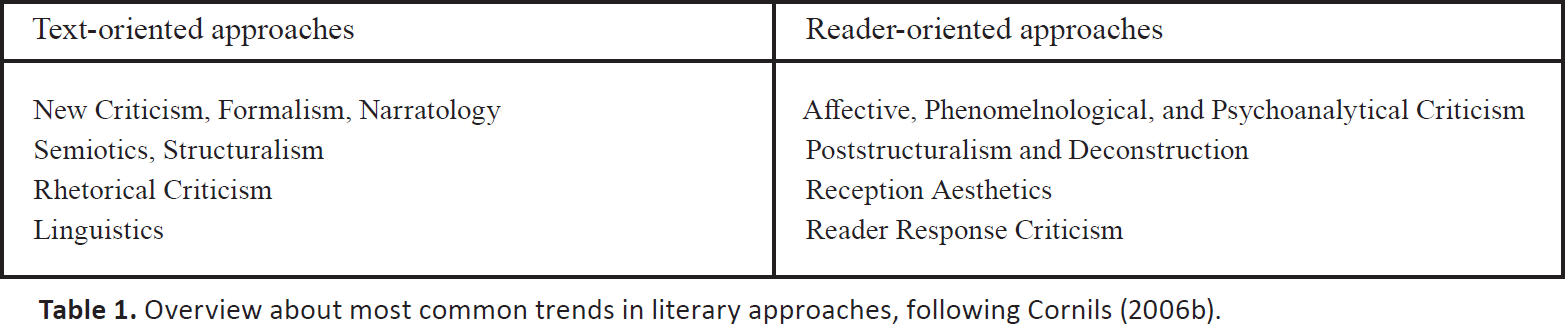
Different schools exists which are not only committed to different literary theories, but are also connected to different geographical areas, see Oeming (2007, 70-71) and in particular Cornils (2006b, 30-32). Even though Gunkel (1910) displays a literary sensitivity in Old Testament texts as early as 1910 in his commentary on Genesis, this method initially received little attention. His approaches were further developed till the 1920s by Buber (1917) and Franz Rosenzweig, and later by Niebuhr (1934), Metz (1962), and Harald (1964), as well as Weiss (1967) in the 1960s. At that time, narratology (“Erzählforschung” Cornils 2006a, 38) was primarily a marginal topic only investigated by individual researchers. Weiss increasingly examined narrative texts of the Old Testament with literary narrative form analysis (cf. Bar-Efrat 2006; Alter 2011, 12). Bar-Efrat was one of his students and created a standard work on narratological exegesis with his work ‘Narrative Art in the Bible’. This was an important contribution to the dissemination of this method. But the roots are hard to trace and there are different sub-approaches or related methods. They all use a synchronic method and are related to one or more approaches from literary studies.
Narrative approaches are more popular in OT research (cf. Dörpinghaus 2022). While Bar-Efrat mainly considers formal structures and language art, other researchers like Berlin (1994, 13) are more interested in the whole structure of the OT: “Narrative is the predominant mode of expression in the Hebrew Bible.” Here, we present a small selection of various narrative approaches outside biblical studies with reference to Table 1. It is a selection of scholars which may, in one way or another, help to establish a good foundation for the research questions. (Literary) semiotics, for example, are widely associated with Genette (1966) and Uspenskij (1975) who examine literature as structure and formalism. Some elements will be examined later, and it should be noted that the readers decides for themselves, so to speak, which structural elements of literature they wish to take up. This approach is rarely used in biblical studies – at least outside the Francophone world (cf. Cornils 2006a) – an exception is the work of Chabrol (1973). Fisher (1987), on the other hand – who was concerned with rhetoric and communication – put forward the thesis in his little received work that narratives are the essence of human communication. Narrative ratio, he argues, is the inverse logic of all human communication (Fisher 1987, 194). The works of Jauss (1982) and his late work Jauss (1994) should also be mentioned. He describes aesthetic experience and literary hermeneutics (1982): Not the social-historical interpretation and reception, but the specific experience of literature leads to an interpretation. However, this is not really a paradigm shift, since the impact of literature (and art) has been known since antiquity. If Fisher is to be commended for elaborating the importance of narrative in and for human communication, Jauss’s work succeeds in elaborating the importance of the reader for the interpretation of narratives.
In Germany, literary approaches relied on German literary studies (cf Cornils 2006b, 23). On the other hand, they had to find their position next to the omnipresent historical-critical approaches. In the last 30 years, concepts from semiotic and narratology have been adopted and often combined with a diachronic or historical-critical perspective.
Many studies have also been published on New Testament exegesis. Resseguie (2005), for example, provides a broad methodological overview with focus on rhetoric, setting, character, point of view, and plot. This explains why SNA and narrative criticism can be combined: Both focus on characters, settings and the plot with a literary point of view. Another overview work can be found in Powell (1990). He especially focuses on the continuity of this approach: “Narrative criticism is a new approach to the Bible, but it is based on ideas that have been used in the study of other literature for some time.” (Powell 1990, 1) Other work has been carried out by Finnern (2010), who analyzed Mt 28. Together with Jan Rüggemeier he published one of the most recent workbooks on narrative criticism, see Finnern and Rüggemeier (2016). A narrative exegesis of the Gospel of Luke can be found in Resseguie (2004), Knight and Knight (1998) and in particular in Green (2020).
In narrative exegesis, the first step is to apply methods of text analysis: “The ‘what’ of a text (its content) and the ‘how’ of a text (its rhetoric and structure) are analyzed as a complete tapestry, an organic whole.” (Resseguie 2005, 19) For this purpose, the text is examined in terms of its content layer and effect layer to find out which structure, order, and content the text wants to convey. To refine the exegesis, different elements of the text are examined: time, locations, characters, perspective, plot or plot line, narrator, listeners, and readers, keywords, repetitions, and other structural elements and stylistic devices.
Narrative approaches can be applied to any narrative texts – both the Gospels and Acts are widely considered to be suitable (cf. Bailey and Vander Broek 1992, 91). Finnern and Rüggemeier (2016, 259ff) offer a wider perspective which comprises historical, thematic, and critical approaches. Since we are primarily interested in the world of story and only secondarily in how the historical information could help to understand the narrative (for example within the world of text production), we will focus on the text and provide critical references whenever necessary. This is inspired by Kuhn’s approach: First, he introduces Luke and his world, followed by a narrative interpretation (cf. Kuhn 2015). This approach can – as shown above – be applied to Acts.
In general, we will apply exegetical methods from narrative criticism following Finnern and Rüggemeier (2016) and Resseguie (2005). For a detailed analysis, we need to analyze specific objects within the narrative. While Finnern and Rüggemeier (2016, 176) mention space (Raum), plot (Handlung), characters (Figuren), and perspective (Perspektive), Resseguie (2005) names rhetoric, setting, character, point of view, and plot. We will focus on the following two entities: characters and spaces. We will also consider the entity of time, but since this is not easy to integrate either into the SNA or into the narrative analysis, we will mainly consider the critique of temporal analysis.
As we can see, these aspects interact with all other issues found in narrative criticism. But for performing SNA we will focus on characters and spaces and do as much analysis in the other fields as necessary to understand these two. Since narrative criticism tries to understand the text as literaturee in its final form, we will only focus on these introductory questions which are necessary to understand the texts. We will not address the historical reliability of texts but focus on the literary description of social networks.
In principle, social network analysis can be used in various contexts of application. The most common ones – in the social sciences, historical and religious network analysis – have already been discussed in the previous section. The application of SNA in narratological studies is usually not considered. Some studies have been presented, for Alice in Wonderland (cf. Agarwal et al. 2012), Les Misérables (cf. Newman and Girvan 2004), or in the context of ancient Greek tragedies (cf. Rydberg-Cox 2011). Some researchers, such as Elson et al. (2010a), additionally use methods of computational linguistics, for example, to automatically analyze corpora of 19th-century British literature and extract social networks. The connections between SNA and the narratological exegesis of biblical texts have so far only been discussed in passing. For instance, Dörpinghaus (2021, 69) concludes, with reference to persons, time, and space, that the close relationship between the SNA and narratological exegesis is still widely omitted.
People, Actors, Interaction: The Social Network within the Narrative
SNA always includes people. These may well be fictitious or the information about them can be worked out by exegetical steps from historical sources, which Rollinger (2020) did for the epoch of antiquity. Thus, the social network paradigm can technically be applied to narrative texts without any problem. As an example for a first systematization of these relations, the so-called figure configuration which Cornils (2006a, 75) uses for Acts may serve: This is a pure listing of characters appearing simultaneously in a narrative. Thus, the computer-based evaluation of this data already used in the literary analysis is merely another logical step.
The character is the main (or minor) actor described in the text. This is equivalent to the actor in SNA. Narrative criticism provides a more detailed view: “Characters reveal themselves in their speech (what they say and how they say it), in their actions (what they do), by their clothing (what they wear), in their gestures and posture (how they present themselves).” (Resseguie 2005, 121) Resseguie also points out a social perspective by mentioning their position within society. Thus, it is also important to think about the constellation of characters, which means their position in a network – this equivalent to Figurenkonstellation found in Finnern and Rüggemeier (2016, 204) – and their relation to the plot.
The character analysis can be separated into quantitative and qualitative questions: When is a character present (in drama: “stage presence”) and with whom does he interact? Qualitatively, one can also ask about content (the “character speech”) or about characterizations. The first is answered by the “figure configuration” and its “configurational structure”: In the first, the person, and their interactions are inferred; in the second, they are juxtaposed. While the extraction of characters as word entities is not very difficult, the accurate analysis of interactions is challenging. Therefore, current studies focus on “co-presence”. Rarely are models explored to precisely describe these interactions, see Elson et al. (2010b) or Wiedmer et al. (2020). In New Testament studies, figure constellations have been generated manually so far, see Cornils (2006a, 75) and Dörpinghaus (2020).
Pfister states that this opens up the possibility to apply methods of sociometry or social network analysis to the analysis of the structure of drama characters (cf. Pfister 1988, 233). And indeed, methods of social network analysis (whose precursors were called sociometry) can be applied, which again makes new computer-based analysis procedures possible, see Dörpinghaus (2021) and Trilcke (2013).
A possible limit of this approach lies, however, clearly in the significance: The network is a reproduction or a representation of the literary findings. The information it provides must always be interpreted within the framework of this narrative horizon. Thus, the evaluation does not position itself historically, since it can interpret the narrative in its immanent framework. However, it contributes to the understanding of narratives and opens new perspectives for interpretation and for interdisciplinary models.
Locations and Space in Narrative
Locations and Space, or more generic spatiality, of a narrative offer a detailed framework for interpretation, since they are necessary to understand the story and characters and their relation to the plot.
The method of narrative criticism offers another approach to tackle the understanding of different world views on the basis of the implicitly presupposed and explicitly addressed framework conditions (cf. Finnern and Rüggemeier 2016, 232). And indeed, there are multiple dimensions of locations and space in narrative texts: Not only “place, presence and person/story” (Habel 2016, 481) but also what is called ‘environmental hermeneutics’. Here, aspects of logic coherence, compatibility, together with ethnic, linguistic, geographic, political and religious aspects are key. We should also mention the works of Uspenskij and Živov (2017) and Uspenski˘ı et al. (1973) who are working on the field of typology in different points of view.
To understand the concept of space, we should also mention Critical Spatiality (see Flanagan et al. 2003). In the past decades, there has been a growing understanding of the concept of space as a construct on the one hand, and an interest in different concepts of space on the other hand (see also Becking et al. 2017). Basically, back in the 1960s there was a critique of the modern concept of spatiality and a demarcation from the meaning of “time”, leading to a “recognizable spatial turn in literary and cultural studies” (Tally Jr 2012, 11). This goes back to various philosophers, some of them Marxist, such as Lefebvre and Soja, and discusses “spatiality” as a social theory. Lefebvre was noticed outside the French-speaking scientific community in the early 1990s (cf. Charnock 2014, 313). He claims that urbanization was the impact of industrialization Marx did not foresee, see Lefebvre (1976), in particular he claims that “dominance of the urban centers had to be maintained in town planning projects without even an adequate analysis of its impact” (Lefebvre and Enders 1976, 34). In summary, his perception of space is: “(Social) space is a (social) product.” (Lefebvre and Nicholson-Smith 1991, 26). Soja (1985, 94) follows here: “the materialist interpretation of spatiality is the recognition that spatiality is socially”. They divide space trialectically into three parts, see Soja (1996). The firstspace includes physical space, the secondspace mental space, and the thirdspace social space. While the first space can be studied quantitatively, i.e. simply measured, the second reflects the human idea of space as such, the third involves the practice of living in relation to other people. However, the concept of space can also be interpreted by non-Western ideas, by other cultures, or even through a feminist lense. The theory of Critical Spatiality is primarily applied to the Old Testament in theology. Boda et al. (2007, 45), for example, examined the book of Daniel and the concept of the temple. In particular, it addresses chronology and place as more than just a physical entity. “The historical-critical study of the Bible in modern period has tended to focus on time and chronology, not on the spatial and geographical dimension of the literature.” (Dozeman 2008, 87). This implies, then, the use of geographical terms, of places, as a tactical, theoretical level in the background. Let us distinguish between religious geography and the geography of religion. The religious geography is understood as more ‘fantastic’ literature and must be reproduced critically as geography of religion. Dozeman (2008) argues primarily from the Old Testament and must also face whether his attempt to reproduce the geography of religion is not culturally influenced. An attempt to apply this method to the New Testament is found in Schreiner (2016).
Thus, Critical Spatiality as a theory seeks to penetrate and socio-historically reconstruct living space as a whole. Or in other words, as Becking et al. (2017, 22) summarizes, Critical Spatiality offers a “range of ways for holding our critical feet more systematically on the fire on how we understand this fundamental, but often taken for granted, aspect of human existence.” Thus, it calls for a constant shifting reflection and rethinking of spatiality.
A methodological issue in the application of SNA is that it can’t be associated with all three spatial terms: Real distances cannot be mapped and are instead replaced by distances in social space. As shown by Dörpinghaus (2020), this problem cannot be addressed within the scope of SNA, but important connections in the social network can be analyzed for their distance in firstspace, secondspace and thirdspace, which requires an exegetical analysis of the text.
Thus, this work follows an approach similar to that portrayed by Robbins (2010, 200f) and Dörpinghaus (2020) to socio-rhetorical interpretation. Critical spatiality – as being aware of the trialectic spatial view – is used as an additional tool to examine the social and spatial structure of New Testament writings.
Firstspace, i.e. the physical space, can be extrapolated easily from the text, provided appropriate information is given. Secondspace, the mental space, on the other hand, is much more difficult to reconstruct. Here the question is how people perceive and interpret space. This requires the examination of social positions as well as positions, education, empathy, and antipathy. Can we draw possible conclusions about the inner perception of persons? This finally leads to a description of the thirdspace, i.e. the experienced space and the description of how people live and use the space. Thus, a spatial description of the social network is obtained.
The Unresolved Problem of Time
A narrative always represents a progression of time in which the actions occur (narrated time). At the same time, time passes while the narrative is being told (narrative time), where Genette (2014, 75) points out the universality: “est un trait caractéristique non seulement du récit cinémmatographique, mais aussi du récit oral, à tous ses niveaux d’éleboration esthétique”. Narrative time is automatically created through the shaping of the narrative utilizing sentences, rhythm, paragraphs, lengths, etc. Narrated time is rarely linear, but adapts to circumstances and thus includes leaps, expansions, or even breaks.
The temporal component can also be interpreted as a limitation of the method: The complex narrative flow cannot be mapped to a computational model; only a static, final network can be analyzed. But time is of great importance for biblical narrative, and thus we will use predefined ‘breakpoints’ for our analysis. Here, the ‘motion’ is stopped, and we may analyze a particular time-point in the story or compare them to other timepoints. This is the reason, why we split our analysis in Acts 1-12 and Acts 13-28, including the narrative elements mentioned earlier. The narrative shift at the beginning of the Pauline mission is a reasonable and widely considered turning point in Acts. We will now present detailed results on Philip and in particular discuss those aspects which are closely connected to SNA. A detailed exegesis will not be presented.
Phillip in Acts: A social network perspective
Philip in Jerusalem
Philip is introduced in Ac 6:5 as a member of the “circle of seven.” Ac 21:8 records Paul and his traveling companions coming ε¹̓ς τòν ο κον Φιλίππου τοũ εu̓αγγελιστοũ,
  ντος ἐκ τω̃ν ἑπτά and staying there. There, too, it seems important to note that he was not only an evangelist, but is clearly identified with the Philip of the Circle of Seven. Early on, confusion came up identifying different persons with the same name: “Polykrates von Ephesus identifiziert ihn im ausgehenden 2. Jhdt. n. Chr. mit Philippus dem Apostel, dem gleichnamigen Mitglied des Zwölferkreises (Mk 3,18)” (Kollmann 2000, 552). Since the confusion of names does not cease, especially with Ac 8:4–40, the question of the exact identification has to be asked. To this end, however, von Dobbeler (2000, 29) concludes that this seems to be nearly impossible.
Philip is thus to be assigned to the Hellenists. As shown in 2, we can see that Philip was well-connected in the community. In the text, this importance is hard to see, as Kollmann’s assessment show (cf. Kollmann 2000, 553).
Mission in Samaria and the coastal plain
Philip is mentioned apart from Ac 6 by Luke as a central figure in Ac 8. Thus, he plays a more prominent role than the majority of the apostles. He is mentioned as a missionary to Samaria and probably as a pioneer of the mission to the Gentiles (cf. Kollmann 2000, 306). It became clear that Philip, with the help of God, crossed various cultural, social and religious boundaries. Thus, he has not only manifold, partly unique missionary connections in the network of the original Christian community, cf. Figure 2, but is also overcoming cultural and social distances. The scope of these events is pointed out by Kollmann (2000, 306):
Die Überlieferungen legen dabei den Schluß nahe, daß sich der missionarische Schritt über die Grenzen Israels hinaus nicht etwa historischer Zufälligkeit oder persönlicher Willkür verdankt, sondern einem Konzept entspricht, daß in Anknüpfung an Is 56:3ff in der Einbeziehung der, Fremden‘und der, Verschnittenen‘die Erfüllung prophetischer Verheißungen sah und damit den heilsgeschichtlichen Rahmen markierte, in dem die Samaritanerund Heidenmission des Philippus verstanden werden konnten.
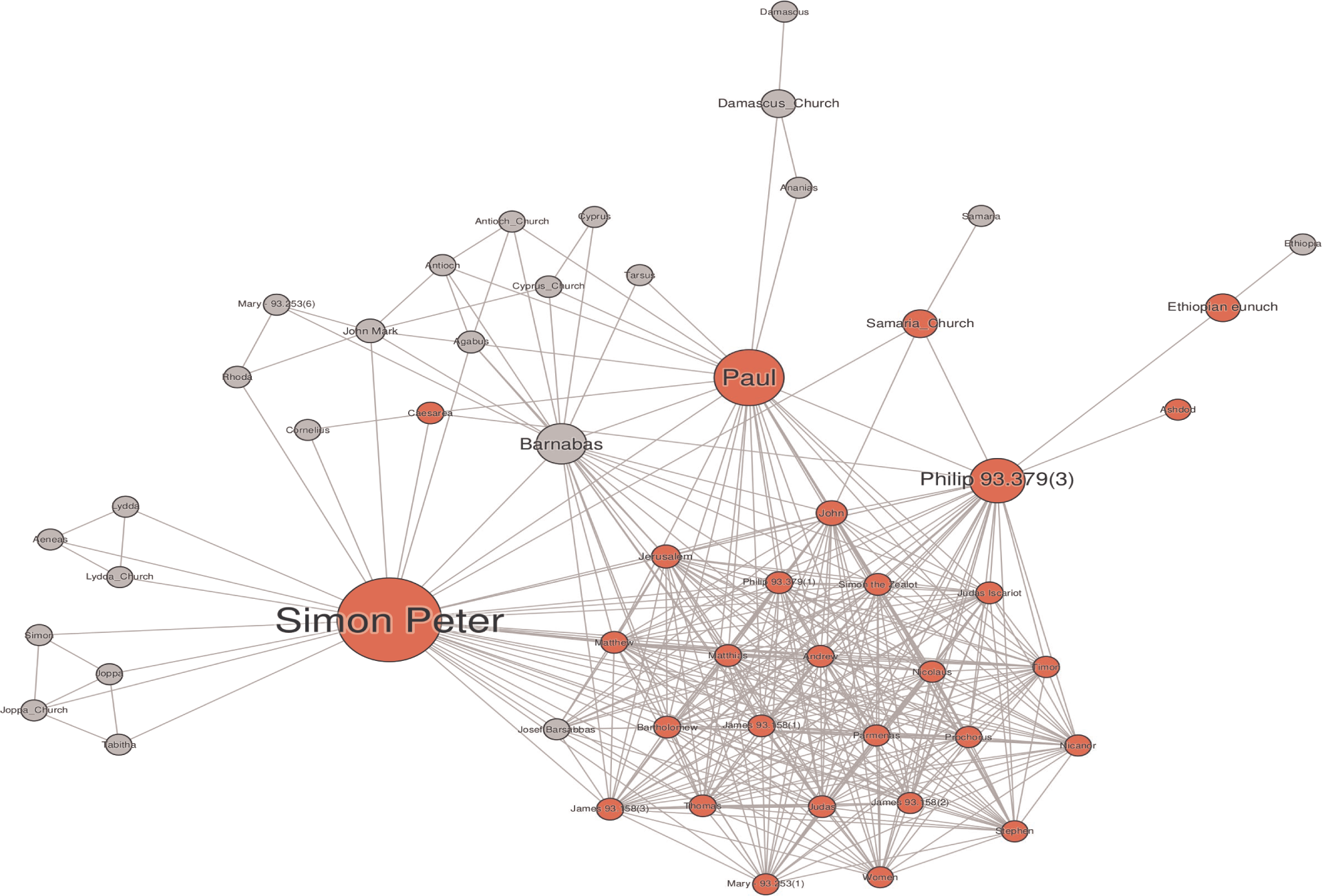
Philip in the social network of Acts 1-12. Nodes in the neighborhood of Philip are colored in red.
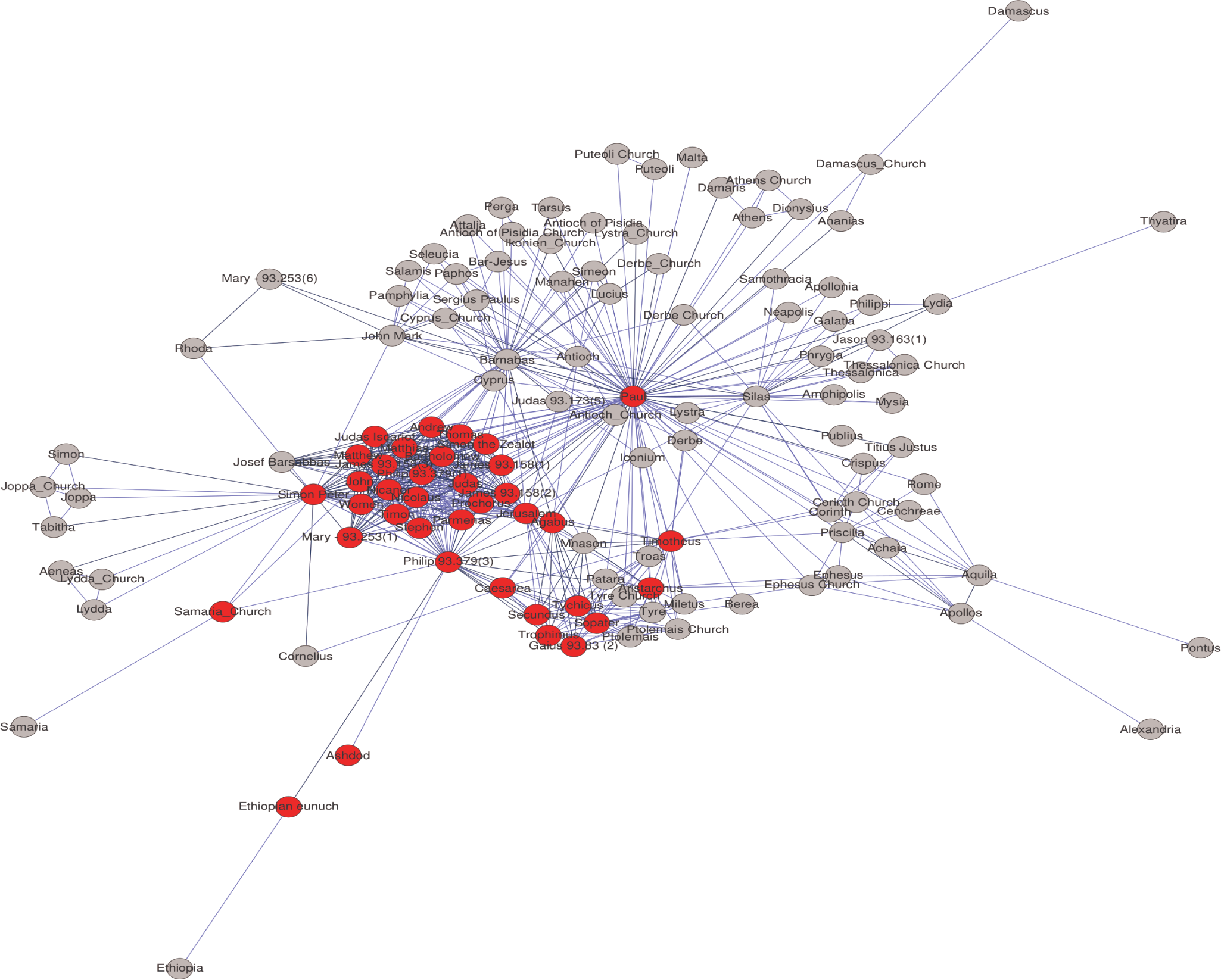
Philip in the social network of Acts 1-28. Nodes in the neighborhood of Philip are colored in red.
Philip is a classic pioneer who is able to use new social connections with God’s help. However, no general conclusions can be drawn from this as to how exactly he uses these connections. The thesis of Kollmann (2000, 307) that in “Unterschied zu Petrus, dessen Begegnung mit Simon auf Ausgrenzung hinausläuft, [] Philippus ein auf Integration abzielendes Verhalten zeigt” is not only difficult to justify exegetically, but also does not show up in either the aspects that can be worked out for Peter and Philip. According to SNA Peter seems to have a mediating nature. Thus, it is much more likely that Simon excluded himself. Philip, on the other hand, leaves further pastoral ministry to the apostles.
In Acts 1-12 Philip has a betweenness centrality of 177.29, see Table 2 on page 14. Only Peter and Paul have a higher value, which makes Philip significant. For comparison, Barnabas has a value of 146.52, Peter 475, most of the network about a value in part far below 8. This value is thus the third highest in Acts 1-12 after Peter and Paul. This highlights, how important Philip is within the narrative, driving the story. His importance not only corresponds to the apostles, Stephen, Barnabas, and Paul, but he is also essential to the progress of the narrative itself.
Philip’s eigen centrality is 0.93. This value is not significant, but higher than, for example, Barnabas and comparable to most members of the Jerusalem church. We can deduce from this that Philip was not integrated into the central network of the Jerusalem church to an above-average degree. This also shows the character of a classic pioneer who is rather concerned about new social connections. His strength, however, consisted primarily in holding together various parts of the early Christian network that extended beyond Jerusalem. Here, Philip is an enormously important person. This also becomes clear through the analysis in terms of critical spatiality, since Philip constantly overcomes social and cultural distances, and in the illustration in Figure 2.
Philip in the second half of Acts
We meet Philip once again in Caesarea (Ac 21:8): They ‘entered the house of Philip the evangelist, who was one of the seven’. In v. Ac 21:9 we learn that he had four unmarried daughters, who prophesied. While other actors like Barnabas do not reappear in the narrative, Luke pays special attention to Philip. He is not only clearly identified as ‘one of the seven’, but also as εu̓αγγελιστής. “Philip evidently settled in Caesarea, the seat of the Roman governor, bought a house, and preached the gospel before Jews and, presumably, Gentiles in Caesarea and the surrounding areas.” (Schnabel 2012, 856) While the latter is not provable, it is interesting that Luke again portrays hospitality which has a clear link to the social network. Keener observes: “Paul and his former nemesis Philip will have stories to tell; news spread whenever people from different cities came together […], and guests carried news.” (Keener 2014, 3089) If we consider Table 3 on page 15, we see that Philip has a very high BC value (591.9) in Acts 1-28, only Barnabas, Peter, and Paul have larger values. This implies, despite the fact that Luke does not provide further information about him, he is still one of those actors pushing the narrative and indeed are well-connected. EC indicates that his connections have a ‘better’ quality than, for example, Barnabas. Our analysis of the neighborhood in Table 6 proofs this assumption. This is very likely since Philip belonged to ‘the seven’ and is deeply rooted in the community in Jerusalem.
What we also learn is the fact, that besides Peter, Philip is also a married missionary. There is an ongoing discussion about his daughters:
The reference to Philip’s four unmarried daughters reinforces the community setting of the incident, which has been indicated by the theme of hospitality (the house of Philip) and the description of Philip as an evangelist. There is no good reason why Luke mentions the fact that Philip’s daughters were unmarried (παραθένοι, ‘virgins’) unless he wants to indicate that they were of marriageable age. (Schnabel 2012, 856)
However, Luke does not pay special attention to them. What is more interesting is the question, why Luke provides further information about Philip. To Keener, this is a clear situation:
That we find Philip here in Caesarea is not surprising. Just as Luke’s narrative leaves Saul in Tarsus and revisits him there (9:30; 11:25), and probably the narrator himself in Philippi (16:10; 20:6), so it returns to Philip in Caesarea, where an earlier evangelistic itinerary left him (8:40). (Keener 2014, 3087-8)
In contrast, Pesch (2012, 215) sees Luke’s primary interest in narrating Philip’s lower status (cf. Pesch 2012, 215). But this is rather unlikely, since Paul seems to know him and in particular chooses Philip’s house as accommodation. The SNA also does not support the view that Philip was assigned some sort of lower status. Philip seems to be an independent actor, and in particular an independent missionary.
There are also some possible links between Luke and Philip in the second half of Acts, as Redditt (1992, 312) summarizes:
Luke may have received information about persons and events of the early years of Christianity in Judea from the daughters of Philip. Papias received: information about Joseph Barsabbas (Acts 1:23) from the daughters of Philip (he confuses him with Philip the Apostle) (Eus. Hist. Eccl. 3,39.9-10). Polycrates, bishop of Ephesus, mentions that Philip, one of the twelve apostles, and two virgin daughters who grew quite old were. buried in a tomb at Hierapolis (Eus. Hist. Eccl. 3.31.2-3). Eusebius understands this reference to, be to Philip the Evangelist, for he goes on to quote Proclus from the Dialogue of Gaius that the four daughters of Philip were prophetesses who worked and were buried in Hierapolis along with their father Philip. In support, Eusebius cites Acts 21:8 as the biblical reference to the family (Eus. Hist. Eccl. 3.31.4—5).
These references are out of scope of this work. However, they are a good argument for further research on the social network role of Luke himself as possible author or narrator of Luke-Acts.
Philip and the network of Acts
Philip is presented as a pioneering missionary, overcoming social, cultural and religious distances while not being inasmuch integrated in the early Christian network. In Table 7 we summarize significant centrality values for selected actors and their neighborhood in the network of Luke-Acts. This highlights, however, that Luke describes actors not only as singular characters but also their style of mission. Thus, we can assume that Luke was in particular aiming at this portrayal of his figures.
While the analysis so far brought up important information about particular actors and the network structure, we now need to go one step further. In Table 6 we provide the average centrality of a particular node’s neighborhood. This means for a particular actor v and an arbitrary centrality measure c we calculated:
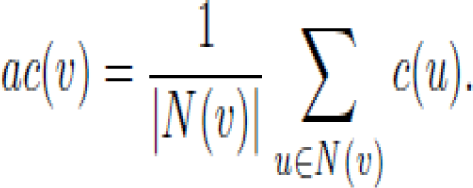
With this, we can evaluate how good these measures are for all actors related to v.
We observe that the BC of Peter’s neighborhood is the highest (185.8) whereas Paul’s is the lowest (87.0). This shows two things: (a) Peter is connected to different actors pushing the narrative and is well-connected in the network of Acts. (b) Paul is himself pushing the narrative, but while having more than twice as many neighbors than Peter, these actors are generally not that important for Luke’s narrative. However, we recognize that Philip is not as good connected as any other actor in Acts, but he is – similar to Peter – embedded in a network of ‘important’ actors. Some high values are not surprising: Philip is the only connection to Ethiopia – at least in the network, which Luke presents. These values nevertheless also highlight the importance of Paul as bridge between himself and Simon Peter, Philip, and other subnetworks. Nevertheless, he is not covering structural holes, as we discussed earlier: For example, we find an important tie between Barnabas and Simon Peter.
It is thus not solely the collaboration with co-workers, not solely leadership, but in particular the concrete setting of coworkers and local churches, mobility (extensive traveling) and being in one place for a longer time, e.g. in Corinth (Ac 18:1–17) but also the cultural environment and being embedded in a dense, inclusive, and reliable network of nascent Christianity which forms the environment for the narrative social network for Philip as actor in Acts.
Conclusion
In current research we find three main aspects on the portrayal of Philip: that of the pioneering missionary, the dynamic prophet, and the cooperative servant. Our study makes it clear that it is in the relational aspects and the crossing of social, cultural, and religious distances that are key to understanding Luke’s story of Philip’s ministry. Further attention to these aspects would be necessary for further discussion.
For example, eigen centrality offers reason to re-examine his role in Jerusalem. Unlike Barnabas, he is better, or more networked with the “more important” people. At the same time, he has the greater betweenness centrality value after Peter and Paul. This wider, presumably Jewish network, has been neglected in previous research. The results of the investigation also show that Philip’s missionary sphere is independent of other missionary activity (cf. Figure 2). Thus, a more detailed study of this mission could also lead to a better understanding of Philip’s activity. Our analysis provided a new perspective on Philip’s portrayal in Acts, raising new questions for exegetical research and in particular supporting the narrative understanding of Acts. Unlike other digital methods, SNA contributes to exegesis. Our study is just a beginning.
In this work, on the one hand, we have presented results in a mathematical computational social networks using exegetical methods. On the other hand, these results have also raised new questions and shown new perspective on biblical texts. Previous work has been limited to only one of these goals.
However, our analysis was limited to Philip. Other actors can be studied as well. In addition, more research on other methods like community-detection could also lead to more insights.
Footnotes
Appendix
Significant centrality values for selected actors and their neighborhood in the network of Luke-Acts. XX refers to very significant, X to significant, - to not significant.
