




Abstract
Rudolf Otto remains one of the most influential theologians of the early 20th century. One area where he made a sizable impact was on the “fear of God” discussion. From Otto’s influence emerged the theory of Numinous Fear as a means of explaining the “fear of the gods” in the ancient world. However, there are misunderstandings regarding Numinous Fear and Otto’s role in its conception. To this end, this article investigates the extent of Otto’s influence regarding Numinous Fear and the consequential effects to the “fear of God” discussion.
Imagine a lush valley teeming with vegetation and life. Then a meteorite irrupts through the atmosphere smashing into the hillside. The resultant impact scars the geography, devastates the area, and changes the landscape forever. Rudolf Otto was such a force (for his contribution to theological and biblical studies, see Twiss & Conser 1992: 77–85; for how he influenced theology in the 20th century, see Schüz 2016: esp. 363–408). Regarding the landscape of biblical scholarship, there is a discernable before and after effect regarding the impact of Otto’s works and ideas. His influence is so far reaching that he altered the nature of discussion for topics that he was not directly invested. The clearest example of this is how he altered the underlying conception of fearing God to Numinous Fear in western thought (for how he influenced the theology of “fear of God,” see Engleman 2009: 41–54; for his influence on the Hebrew behind “fear of God,” see Lasater 2019: 26–29; for an appraisal of his influence on “fear of God” in wisdom studies, see Ellis 2014). With this in mind, this article investigates the extent of Otto’s influence regarding Numinous Fear. It explores this in four areas: 1) identifying Otto’s specific contribution; 2) explaining how scholars developed Numinous Fear based on Otto’s ideas; 3) exploring how “fear of God” was interpreted before and after Otto’s impact; and, 4) delving into the critical reception of Otto and Numinous Fear.
Rudolf Otto’s Contribution to the “Fear of God” Discussion
As a philosopher-theologian, Otto researched the applications of phenomenology on world religions. His most prominent work—which greatly (re)shaped the scholarly terrain—is Das Heilige originally published in 1917 (Eng. The Idea of the Holy, 1950). The work essentially triangulated the theological, philosophical, and psychological reflections (which had been developing over the last few centuries) regarding fear and its relationship with religion. As such, Otto interacts with the works of Fries, Kant (mostly in agreement), and Schleiermacher (mostly in disagreement). Of particular importance are Fries’ Wissen, Glaube und Ahndung, Kant’s Kritik der Urteilskraft (Eng. Critique of Judgment) and Kritik der reinen Vernunft (Eng. Critique of Pure Reason) as well as Schleiermacher’s Sendschreiben über seine Glaubenslehre an Lücke (Eng. On the Glaubenslehre) and Über die Religion (Eng. On Religion) (for a discussion on Schleiermacher’s influence on “fear of God” [esp. in the theological domain], see Lamm 2020). A major reason why Otto is so significant for the “fear of God” discussion is that he was one of the first modern theologians to introduce philosophical and scientific advancements into his discussion on the concept of fear of the divine (see Schüz 2016: 22–23). The result was a new systematic approach to the conception of God’s holiness and man’s interaction with it. This marks the turning point for modern scholarship regarding the “fear of God.”
In order to convey his theories, Otto pioneered language that remains common throughout theological discourse as well as standard for “fear of God” discussions today.
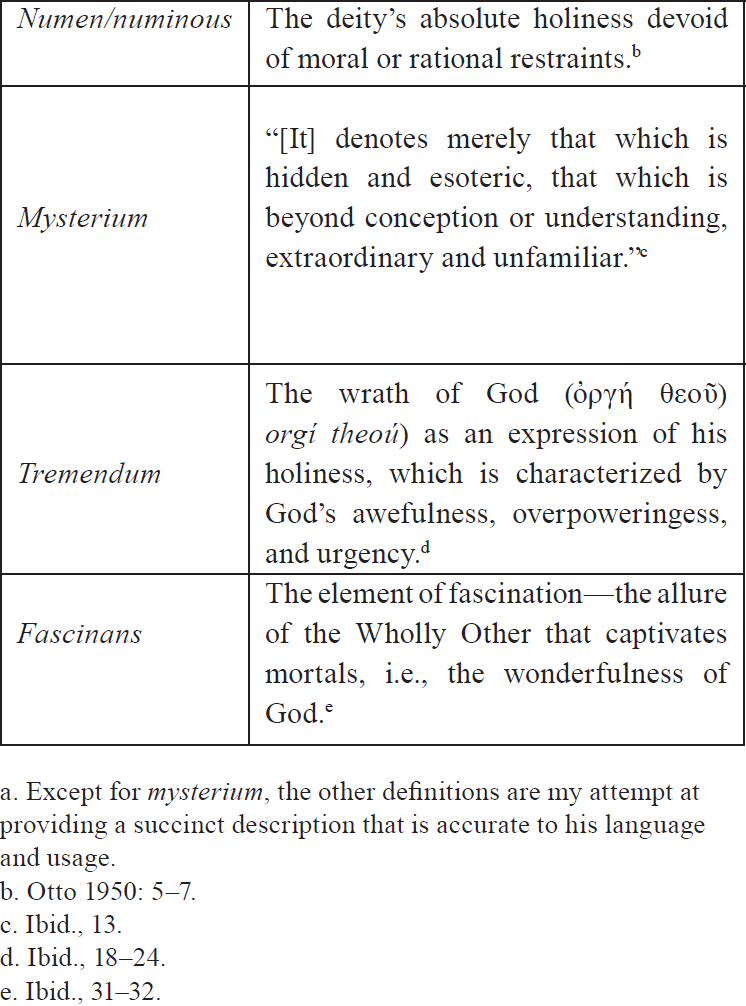
Except for mysterium, the other definitions are my attempt at providing a succinct description that is accurate to his language and usage.
Otto 1950: 5–7.
Ibid., 13.
Ibid., 18–24.
Ibid., 31–32.
Otto employs these terms for his system regarding man encountering the numen. He based much of his conceptualization of “holy,” “numen,” and “numinous” on his understanding of mysticism (both eastern and western). He further explored this in West-östliche Mystik (Eng. Mysticism East and West) in which he provided background for his thinking on the numen while also building upon it. For a thorough discussion, the reader is encouraged to consult Schüz 2016 (esp. pt. 2, ch. 3: 244–98). To summarize, when a man comes before the mysterium of the wholly other—which is by definition incomprehensible—he does not fully encounter the divine. The divine entity radiates out power, majesty, and awefulness which overwhelms the mortal. The majesty that radiates outward and the overwhelming sensation experienced by the mortal is the numen. Through this encounter with the numen the individual experiences what Otto dubbed numinous Scheu (dread) (1950: 16–18; cf. Schüz 2016: 277–80). The moment of the numinous is an a priori experience that simultaneously incites the (mysterium) tremendum and the fascinans which is a concurrent repulsion/attraction to the divine (numinous) presence. As Otto summarizes, “The daemonic-divine object may appear to the mind an object of horror and dread, but at the same time it is no less something that allures with a potent charm, and the creature, who trembles before it, utterly cowed and cast down, has always at the same time the impulse to turn to it, nay even to make it somehow his own” (1950, 31). While it is common to find discussions attributing this idea of tension before the divine presence to early 20th century scholarship, these sorts of ideas were already expressed as early as the mid-19th century. For example, H. Wheeler Robinson (1946: 52–53) draws attention to St. John Newman’s poem The Dream of Gerontius:
And these two pains, so counter and so keen,—
The longing for Him, when thou seest Him not;
The shame of self at thought of seeing Him,—
Will be thy verist, sharpest purgatory [1903: 58, ln. 744–47].
The problem as Otto saw it is that we attribute “holiness” with absolute moral goodness. So, when we refer to God as “holy,” we are imposing a qualifier onto something that cannot be qualified or quantified. We are saying: He is the epitome of goodness, righteousness, love, etc. As Otto further explains,
We generally take ‘holy’ as meaning “completely good;” it is the absolute moral attribute, denoting the consummation of moral goodness. In this sense Kant calls the will which remains unwaveringly obedient to the moral law from the motive of duty a “holy” will; here clearly we have simply the perfectly moral will. In the same way we may speak of the holiness or sanctity of Duty or Law, meaning merely that they are imperative upon conduct and universally obligatory. But this common usage of the term is inaccurate. It is true that all this moral significance is contained in the word “holy,” but it includes in addition—as even we cannot but feel—a clear overplus of meaning, and this it is now our task to isolate [1950, 5–6].
When we talk about God, we talk about him by attributing rational (quantifiable) and non-rational (unquantifiable) attributes. This gives the impression that God is either a non-rational or supra-rational subject (see his first chapter “The Rational and the Non-Rational”). In order to address this, he coined his own term which is both morally neutral and non-rational: numen/numinous.
Otto’s intent was to uncover the essence of religion (see Schüz 2018: 57–63). He therefore described man’s encounter with the divine in natural language. As profane beings, we lack adequate means of grasping “holiness.” So, the only means for us to encounter the divine is when it breaks through into our plane of existence. Only, it is not the divine being but rather its numen which we interpret as and through religious experience. Thus, our encounter with the non-rational being becomes a type of rational experience. It is important to note: this is a naturalistic way of explaining the phenomenon of man encountering the divine. As Otto illuminates, these factors (magic, worship of the dead, spirits, power [mana], natural forces [e.g., sun, moon, volcanoes, etc.], myths) serve as “the vestibule at the threshold of the real religious feeling, an earliest stirring of the numinous consciousness…” (1950: 126; cf. 121–26). He goes on to explain that religion developed as humans began to attribute these forces to personalized entities: i.e., daemons. The numen is just as much an aspect attributed to the deity’s power as it is a sensation that the supplicant interprets then internalizes.
The Legacy of Otto’s Mysterium tremendum et fascinen
Typically, when scholars discuss Otto’s systematic presentation of “fear of God,” they use the phrase numinosen Furcht (Numinous Fear). However, Otto (seemingly intentionally) opted for the expression numinosen Scheu (numinous dread) to describe man’s initial reaction upon the advent of the numen (for Otto’s conception and use of “Scheu,” see Schüz 2014: 134–37). His primary interest was in the holiness of God as a real phenomenon that man can experience and interpret. With this in mind, Otto only broadly applied his theory to the biblical concept of “fear of God” and never directly to the OT’s yirat YHWH ( ) “fear of the Lord” (comp. Lasater who points out that Otto never delved into the specific meaning or nuances of yr’ (
 ). [2019: 26–27]). Instead, he compared it to ’ēmat YHWH (
 ), deima panikon (δεĩμα πανικόν), and sabastos (σαβαστός) (Otto 1950: 14–15). However, none of these terms even occur in the OT (MT or LXX respectively).
It was later scholars who developed the theory of Numinous Fear in a way that equates Otto’s numinous dread with the ancient world’s “fear of the gods” concept. As Roland Murphy admits, “Although Rudolph Otto did not set out to investigate exclusively the biblical experience of the numinous, his study of the Holy does provide us with concepts that help to explicate the biblical fear of the Lord” (Murphy 1992: 175). Overtime, Otto’s “fear of God” theory became enmeshed with the biblical concept “fear of the Lord/God.” Siegfried Plath provides us the earliest account of the philosophical/theological development of the “fear of God” in the early 20th century. His list of contributors include Johannes Hempel, Johannes Hänel, Gerardus van der Leeuw, and Ludwig Kohler (he admits that he neglected the “Dutch” works of [Barend] J. Engelbrecht and B. J. Oosterhoff) (1963: 9, fn. 1). This article focuses on the first three.
Hempel’s Gott und Mensch im Alten Testament (1st ed. 1926; 2nd ed. 1936)
Johannes Hempel was among the first to apply his own “fear of God” theory, which closely resembles Otto’s numinous dread, to ANE religion. He describes this in chapter 1: “Die Furcht vor Jahve.” As he explains, “The simplest motive, as far as man’s relationship with God is concerned, is fear, and the one which best correlates divine action with human [response] is the belief in retribution” (1936: 276 [author’s translation]). He initially characterizes “fear of God” as a recognition of the distance between man and deity (1936: 4–8). This distance applies to every sphere of comparison; God is in heaven/we are on earth, he is big/we are small, he is strong/we are weak, he is holy/we are unworthy. Secondly, he emphasizes that the deity is an ever-present danger. Both—the distance and danger—hold true for all ANE religions. This refers to those occasions when God interacts with humanity which is often characterized by judgement and terror (1936: 8–21). However, Israelite religion is unique in that fear became a motivation for their religious ethic. He explains, “As much as the terminology of the ‘fear of Yahweh’ essentially represents the overall religious development, it differs greatly at individual times in terms of intensity, motive and emotional quality” (1936: 32 [author’s translation]). Israelite “fear of God” developed into a state of ambivalence. The individual becomes caught between the polarities of desiring to maintain distance all the while longing to be close to Yahweh: analogous to fear and love (1936: 21–24). He elaborates, “It is—I repeat: in various shades!—not pure fear, but it is also not a limitless longing to become one [with God], it is a feeling of distance and solidarity in one” (1936: 29–30 [author’s translation]). He further clarifies, “The analysis of ‘fear’ shows as its end result that both the feeling of distance from Yahweh and the feeling of connectedness are conditioned by its characteristics. The distance of man from Yahweh is powerlessness and unworthiness. Yahweh’s power and holiness, however, have both typical and highly individual traits that have to be considered” (1936: 32 [author’s translation]). There is an undeniable similarity between Hempel’s distance/longing and Otto’s repulsion/attraction. Hempel even employs some of Otto’s terminology (e.g., numen/numinous) and grants Otto a passing nod, confirming his influence (1936: 50).
Hänel’s Die Religion der Heiligkeit (1931)
Johannes Hänel’s work describes Israelite religion as a “Religion of Holiness” (1931: 1). This is founded upon a recognition of the distance between man and God often described as “fear.” At this point, religion was reduced to a “fear of the holy” (Otto) which was then explained as an ambivalent tension between being close to God and maintaining distance (Hempel). As Hänel explains:
But that this fact is not determined as the basic phenomenon of all pious impulses—whether of fear or of trust—, not as the basic phenomenon of all ideas about God—whether that of his anger or his love, his power or his wisdom—, but that it sinks to the mere experience of fear—be it the natural fear of the dangerous nearness of God, be it the ethical fear of the judging God—, indicates a limitation that must be broken. This constriction occurs where the feeling of distance is explained by the ‘fear of the holy,’ accordingly also for prophetic religiosity holiness is determined as the divine power ‘which punishes all sin;’ and therefore, from the feeling of distance [derives] the feeling of closeness, by holiness love is distinguished as the opposite pole [to fear]. But with the requirements that have been made, this is not balanced and it cannot be balanced…the too rigid connection with fearfulness limits the actual breadth of the holiness-testimony” [1931: 2–3 (author’s translation)].
However, Hänel felt that this was too simplistic. He develops his argument regarding the nature of the “fear of God” in chapter 2, §9: “Die Ehrfurcht vor Gott.” As he describes, the “fear of God” is a fear of God’s wrath, whereas, “awe for God” is a recognition of God’s holiness (1931: 106–07). Across the ancient world, religion was based on the fear of the gods, but what began as fear (Furcht) developed into awe/reverence (Ehrfurcht) (1931: 110 [unfortunately, we lose the wordplay in English]). He goes on to suggest that while it appears to be true that systems of piety developed within the various cultures, these systems were largely based on their “fear of the gods.” Even within Israel, behavior would be dictated by “fear.” However, Israel was supposed to base its piety on its “awe for God” (1931: 110). He then spends the majority of this section explaining how the Israelite religion evolved its conception of piety from a fear-based system to an awe-based one. It was this belief in God’s holiness that was to be their center for religion. While he does not consistently mention or cite Otto, this whole discussion is reminiscent of Otto’s writings.
Van der Leeuw’s Phänomenologie der Religion (1933; Eng. 1986)
Gerardus van der Leeuw further developed these ideas in his work, especially part 3, §68: “Gottesmei-dung” (Eng. The Avoidance of God). Here he incorporates into the discussion the works and ideas of Kierkegaard (Begrebet Angest [Eng. The Concept of Anxiety]) and Heidegger (Sein und Zeit [Eng. Being and Time]) (for Kierkegaard’s influence on “fear of God” esp. in the theological domain, see O’Regan 2020). He begins by explaining that “[awe appears] ambivalent, as involving the fascinans just as it does the tremendum. Thus man fears the sacred, but loves it also: he attempts to elude it, yet seeks for it too. In fear therefore, which we are now about to examine, we shall discover not avoidance alone, but within and about this always a simultaneous attraction…” (1986: 463). He then distinguishes between primary fear (the irrational fear of the unknown [similar to Kierkegaard’s “dread concept”]) and secondary fear (the rational fear of danger). An illustration he provides is a boy who wanders into a forest. At first, the boy is filled with dread because he does not know what is lurking in the forest (primary fear). As the boy becomes acquainted with the forest, his knowledge allows him to discern what is dangerous and what is safe (secondary fear) (1986: 463–64).
For van der Leeuw, this primary fear—mankind’s instinctual excitement/anxiety towards the unknown—is the origin of religion. This applies to the OT as he explains, “There always persists in [the fear of God] something of that instinctive and irrational fear which is occasionally manifested without any concealment in the Old Testament itself, to whatever degree the Old Testament idea, in the course of time, may have accumulated ethical content…” (1986: 464). He further elaborates: “…in fear there is always an element of love, however feeble this may be, and in love an element of terror, however refined it may have become; and there are no religious ideas from which awe, as corresponding to the primeval experience of dread, is wholly absent. Only thus, in fact, can we understand that to fear God, to love and to serve Him, appear as related concepts…” (1986: 465–66). Here we can clearly see his reliance on Kierkegaard’s description of “anxiety” (fear) as both a “sympathetic antipathy and an antipathetic sympathy” (see Kierkegaard 1980: 42).
Additional Contributions
In addition to these, other significant works helped promote and advance the growing discussion surrounding “fear of God” with an assumed connection to Numinous Fear. These works include: Johannes Pedersen (1920–1934; Eng. 1926–1940), especially vol. 2, part 3 “Sacred and Profane” which thoroughly covers the nature of holiness in Israelite culture; Adolph Büchler (1922); Paul Volz (1924); Albrecht Alt (1929; Eng. 1966); George Foot Moore (1927–1930), especially vol. 2, pt. V. “Morals;” Johannes Fichtner (1933), especially pt. 1, C “Weisheit als Frömmigkeit;” Reinhold Sander (1935); and finally Walther Eichrodt (1933–1939; Eng. 1961–1967), especially part 3 “God and Man.” In particular, Eichrodt has an excellent summation on the “fear of God” discussion. He presents the matter from the theological side while engaging Otto, Hempel, and van der Leeuw (Eichrodt 1961–1967, see esp. 2:268–77). It may not be a stretch to suggest that he (more than any other singular figure) helped standardized the “fear of God” discussion around the Numinous Fear theory for the general populace during the mid-20th century.
How Numinous Fear Marked a Shift in the “Fear of God” Discussion
The discussion around “fear of God” underwent a profound change across Europe around the beginning of the 20th century. It may be an exaggeration to attribute all credit to Rudolf Otto. However, it is undeniable that he was at the epicenter of this revolutionary shift. This transition can only be appreciated if you understand how “fear of God” was discussed before Otto then compare that to the discussion after Otto.
“Fear of God” Before Otto
From the time of the church fathers up to the modern period, Christian theologians wrestled with the tension between fear and love. This tension is based on passages in the NT that seem to be in conflict. For example, Paul instructs Christians to “work out your own salvation with fear and trembling” (Phil 2:12–13), but also that “God did not give us a spirit of fear, but rather a spirit of power, love, and of self-control (1 Tim 1:7). Perhaps most importantly, John writes, “perfect love casts out fear” (1 John 4:18). Recognizing the “paradox” this presented for Christian theologians, Andreas Bähr discusses how the fear-love dichotomy developed in Christian thought (beginning with Augustine, then Aquinas, and through the Reformation) (2013: 79–95). For the purpose of this article, we will examine a few key examples.
John Donne expresses this tension eloquently in his sermon on Psalm 34:11, “Come ye children, hearken unto me, I will teach you the fear of the Lord”:
So the fear and love of God will be one; for jealousy is but a fear of losing. Brevissima differentia Testamentorum, timor et amor; this distinguishes the two Testaments, the Old is a Testament of fear, the New of love; yet in this they grow all one, that we determine the Old Testament, in the New, and that we prove the New Testament by the Old…. For, this fear is inchoative love, and this love is consummative fear; the love of God begins in fear, and the fear of God ends in love; and that love can never end, for God is love [1839, 288–89].
Herein Donne references St. Augustine who wrote, “For this is the most concise and apparent difference between the two Testaments, fear and love: the former refers to the old man, the latter belongs to the new man; nevertheless, one of God’s most merciful dispensations brought forth both of them and linked [them together]” (Adim. 17.2 [author’s translation]). For Donne (and Augustine) fear is akin to an imperfect virtue, one that is necessary and eventually blossoms into love.
Throughout his classic piece, A Treatise of the Fear of God, John Bunyan reflects on the relationship between fear and love (1981: e.g., 57, 59, 74, 75–76, 89–90, 107–08, 20, 28–29). For Bunyan, fear is a type of grace alongside faith, hope, and love (1981: 51–56, 107–108). He defends this by distinguishing between godly and ungodly fear (1981: 22–34). This bifurcation of fear goes back as early as the 2nd century AD. For example, Clement of Alexandria distinguished between rational (logikos) and irrational (alogos) fear (phobos). He labeled “rational fear” eulabeia which he understood to be the appropriate interpretation for “fear” in the OT’s “fear of the Lord” (Strom. 2.7). However, the bifurcation was popularized by St. Augustine’s categories of timor servilis and timor castus (Tract. Ev. Jo. 43.5–7; see also Tract. Ev. Jo. 85.3; Tract. ep. Jo. 9.5–8; and Enarrat. Ps. 18[Eng. 19].10). The aptly designated timor servilis is a restraining phenomenon where the individual is enslaved to his dread of punishment, whereas timor castus is a motivation to retain something so it is not lost. According to this rationale, for Bunyan (and Augustine again), there are two types of fear: bad fear and good fear. The labels and definitions vary, but the basic logic is consistent. We approach God through our bad fear, but over time it evolves into good fear.
A final example is found in Catherine Cavadini’s article (2020) where she discusses Bernard of Clairvaux and Thomas of Perseigne. The article is fascinating because it examines two 12th-century Cistercian monks, who both wrote commentaries on the Song of Songs, and both discuss the fear of God. However, they reconcile the underlying tensions differently. For Bernard, fear is something that will ultimately be replaced by love. As he writes, “When the soul ascends to the mystical and ecstatic ‘kiss of the mouth,’ fear is cast out, and all things, for the bride, then consist of love” (2020: 111). However, for Thomas, fear is not inherently bad but needs perfection. “As the bride kisses the feet with fear, she is in turn kissed with forgiveness; as she kisses the hands, she is in turn kissed with the gift of virtue; as she kisses the mouth, she is in turn kissed with a contemplative revelation of secrets” (2020: 114). We see in Bernard and Thomas both approaches which emerged from Medieval thought: fear replaced by love, and fear perfected through love resulting in a new kind of fear.
“Fear of God” After Otto
Otto and Numinous Fear’s influence can be felt in almost every aspect of “fear of God” discussions from the 20th century to today. For the purpose of this article, we will briefly examine three: lexical studies about yr’ ( ), general depictions of “fear of God,” and the “fear of the Lord in wisdom scholarship.
Regarding yr’ studies, we find Otto’s influence as early as the late 1940’s. Hendrik Brongers writes, “In the Old Testament, religious fear corresponds to the notion of holiness… Attention has been drawn to the fact that religious fear, the thrill of the numen, has two faces, namely tremendum and fascinans” (1948: 152–53 [author’s translation]; see also 157–58). As Brongers argues, the OT’s yirat YHWH “fear of the Lord” may have conveyed Otto’s numinous concept in the past, but over the course of time this quality fades into something more practical (1948: 164–65). The subsequent lexical studies by Siegfried Plath (1963: 127), Joachim Becker (1965: 57–59), and Louis Derousseaux (1970: 18–21) all discuss the numinous aspect of fear as part of the semantic development of yr’ (comp. Fuhs TDOT: 6:300–03). However, recent studies such as those by David Clines (2003: 62–64) and Philip Lasater (2019: 26–34) also include discussions regarding the numinous quality of yr’, but they tend to be more skeptical.
In broader “fear of God” discussions, we find Otto’s influence everywhere. For example, James Muilenburg’s article on “Holiness” in the Interpreter’s Dictionary of the Bible (1962) is heavily influenced by Otto. In the OT section, his 4th heading is “Holiness and fear” (2:616–618) where he redirects the reader to Samuel Terrien’s “fear” article. There, Terrien writes,
It would be a grave error, however, to soften the meaning of the expression [“the fear of the Lord” (Yirat YHWH)] and to ignore its central element of mysterium tremendum. Although many commentators and historians have fallen into this error during the past hundred years, the fear of the Lord is not merely to be equated with reverence, piety, or religion because it is impossible today to revaluate and again charge these terms with their ancient—but now largely lost—connotation of awesomeness [2:258].
Just by these two articles, we can see how Otto’s conception of holiness and fear are influencing each other on an academic level. “Fear of God” articles constantly reference Otto, his ideas, and Numinous Fear (see e.g., Balz 1969: 637; Cate 1987: 45; Murphy 1992: 175–77; Loader 2001: 268–69; Castelo 2008: 151–52, see fn 11; and Astell 2020: 3). Even in popular literature we see the strong connection fear maintains with holiness. For example, the third chapter in R. C. Sproul’s book, The Holiness of God, discusses “fear of God” in relation to Otto (1998: 35–45).
Otto’s contribution to wisdom studies has already been the focus of publications. For example, Ettienne Ellis’ articles (2014 and her follow up article 2015) are examinations of Otto’s impact on biblical scholarship with an emphasis on wisdom. While her articles are informative, they are not comprehensive. She overlooks how later scholars (e.g., Hempel, Hänel, and van der Leeuw) helped develop Otto’s ideas. She also focuses too much on the acceptance of Otto and ignores criticism. However, she is correct that within wisdom studies Otto is regularly discussed (see e.g., Blocher 1977: 7; Barré 1981: 42). The best available synopsis is Bruce Waltke’s article (1992). Here he defends the integration of “Otto’s” Numinous Fear with wisdom’s yirat YHWH. The article is expertly written. However, he fails to address the development of Otto’s ideas or the philosophy behind them. Furthermore, he also ignores any criticism of Otto’s theories.
To summarize, prior to the 20th century, fear was understood as resembling a virtue, but in contradistinction to love. The debate for most of this time was over how to reconcile the tension between fear and love with multiple approaches proposed. After Otto, “fear of God” is understood as man’s reaction to the numen. While it can be described as man’s ambivalent response to the (mysterium) tremendum et fascinen, it is widely discussed in relation to God’s holiness (i.e., the numen).
Critical Reception of Otto’s Numinous Fear
So much literature has adopted Otto—in one form or another—that it can easily convey the misconception of consensus. Furthermore, most of the reviews of his work shy away from negative critiques. However, Otto has received criticism from the areas of philosophy (e.g., Todd Gooch points out that some philosophers are dismissive of Otto because he was motivated by “theological interest” [2000: 25–27]; David Bastow criticizes Otto’s integration of philosophy with phenomenology [1976: 175–76]; Thomas Ryba is critical of Otto’s use of Kant’s a priori category [1991: 38]), psychology (e.g., see Dawson 1989: 307–08), and philology (e.g., see Lasater 2019: 26–34). For the purpose of this article and in the interest of biblical research, we will focus on the reactions from three demographics: Dutch, German, and American biblical scholarship.
The Dutch Resistance
Berend J. Oosterhoff is an unfortunate figure in the history of “fear of God” research. His monograph (1949) is possibly the oldest dissertation on the “fear of God” topic. Plath was even aware of Oosterhoff’s work but for whatever reason did not consult it for his own dissertation (1963: 9, see the last paragraph of fn 1). It is intriguing to consider how Oosterhoff might have altered the course of the conversation had he made a bigger splash in the 1950’s. Essentially, he attempted to shift the discussion from the philosophical/theological to the theological/exegetical without jettisoning the former. He covered this in chapter 10: “Het Karakter van de Vreze des Heren,” where he synthesized the ideas of Otto, Hempel, and van der Leeuw. Overall, he agreed with what had already been discussed concerning religious fear (1949: 123–24). The question that he took up was: Does this innately hold true for the OT’s yirat YHWH, fear of the Lord? As he explains, “Although it is true of all religious fear that there is a sense of distance and connection, nevertheless, the [yirat YHWH] in the Old Testament religion takes on its own character, distinguishing it from any other religious fear” (1949: 125 [author’s translation]). He elaborated that this is initially due to the fact that Yahweh is the sole source of religious dread for the OT religion which creates a unique dynamic (1949: 125–26). Second, since Yahweh is both holy and moral, when man comes before him the distance generates fear and guilt. This guilt leads to a longing to please God and not simply appease him. Here we see the moral quality (zedelijk karakter) of fear explicitly introduced (1949: 126–29). As he summarizes, “Thus, in the Old Testament religion the feeling of distance and dependence acquires a character of its own, as in no other religion…” (1949: 126 [author’s translation]).
Oosterhoff effectually asked a question that no one up to this point had raised: Is Otto’s Numinous Fear an appropriate way to describe the yirat YHWH in OT wisdom? And his answer is no. This objection was taken up later by Kornelis Miskotte,
Faith is not without experience, which surrounds like an aura the act of entrusting oneself. Or are we to say that they did not really find reconciliation and receive forgiveness? Or is the yir’ath YHWH (‘fear of Yahweh’) nothing but a variant of the mysterium tremendum? Is the Old Testament only a primitive prefiguration of Kierkegaard’s dialectical analysis of dread? Is the fear expressed here completely stripped of love? And what is the basis of this love? Is not the he’emin, the trusting and venturing, an affirmation of the ‘miracle’ (des Entrückten), a response to the revelation of this God, who as God becomes man in all the acts of his progress over the earth? Is not certainty an accompanying experience, an outflow of their experience of the steadfastness of the berith, the Covenant? [1967: 263; comp. his remarks in 2016: 165, 91; cf. Vreekamp 1982, 6–8).
Karl Barth and the Neo-Orthodox Response
Otto’s harshest criticism came from the Neo-Orthodox. For example, Barth was adamant, “The holy God of Scripture is certainly not ‘the holy’ of Otto, that numinous element which, in its aspect as tremendum, is in itself and as such the divine” (CD, 2:1, 360–361; for a summary of how Barth’s view of fear and religion differed from Otto’s, see Schüz 2016: 75–78). He elaborated on this in “The Homecoming of the Son of Man:”
The numinous is not by a long way the holy. It is certainly quite inadequate as our present reference to the Holy Spirit because in practice it is a reference to the unknown, and the unknown may actually be, in part or in whole, the demonic. Even at best it is only a title or concept for what has to be said formally in elucidation of the process of revelation and the corresponding process of knowledge, and what is perhaps better said without this concept and title if in any case they do not lead us any nearer to that which is elucidated [CD, 4:2, 127–129].
He further stressed the difference between Otto’s numen and his view concerning the revelation of the Word of God. “Whatever ‘the holy’ of Otto may be, it certainly cannot be understood as the Word of God, for it is the numinous, and the numinous is the irrational, and the irrational can no longer be differentiated from an absolutised natural force. But everything depends on this differentiation if we are to understand the concept of the Word of God” (CD, 1:1, 135; for further discussion, see 3:3, 266–267; 4:2, 310–311; 4:3:3, 513–514; 4:4, 180–181). Robert Davidson summarizes the contention between Barth and Otto as a theocentric (Barth) vs. anthropocentric (Otto) view on the nature of religion (1946: 73). Barth understood religion as God revealing himself to man, whereas Otto emphasized man’s reaction to the divine.
Now it is true that Barth was criticizing Otto’s depiction of God’s holiness (numen) and not the Numinous Fear theory directly or broadly. Yet, to criticize Otto’s ideas regarding the numen is to critique the foundation of Numinous Fear as we currently understand it. Similar critiques were raised by Paul Tillich (2009: 170–71; cf. Schüz 2016: 158; 74–78) and Rudolf Bultmann (1969: 130–39; cf. Lattke 1985: 355–60; Schüz 2016: 157–59).
Objections by American Scholars
Like Barth, Walter Kaiser raises concerns over Otto’s understanding of the numen (2007: 145–46). As he describes, in Deuteronomy “fear [of God] was not a worked-up feeling of some numinous awe, but it was the result of hearing, learning, and responding to God’s word” (2008: 135). He then suggests that this carries throughout the wisdom books as well (2007: 134–36). Most telling is his detailed discussion on “fear of the Lord” where he never engages Otto or his ideas (1978: 137–45). Another scholar who is openly critical of associating Otto’s theories with the OT concept of yirat YHWH is Leo Perdue who writes:
Fear of the Lord, which provides the major inclusio for the entire book of Proverbs (1:7 = 31:30), is not terror of divine power or what Rudolf Otto calls the religious experience of awe occasioned by standing in the presence of the Holy (mysterium tremendum). Rather, it is a religious piety characterized by faith in God as the creator and sustainer of life (see 9:10; 15:33; 31:30; Job 28:28; Ps. 111:10) [1994: 79].
Perdue further writes in his Proverbs commentary, “[It] is neither the terror occasioned by the supposition of a powerful yet unknown, even capricious deity, about which Qoheleth later speaks, nor the awe evoked in the presence of the holy God who is wholly other. For Proverbs, the ‘fear of Yahweh’ is the stance of the believer who confesses God is the creator and sustainer of life and the source and provider of all wisdom” (2000: 74). Here Perdue sounds closely aligned with Oosterhoff and Miskotte.
Final Remarks
The purpose of this article is not to undermine Otto’s contribution to 20th century scholarship, but to recognize legitimate concerns regarding some of his theories. In particular, how his theory of the numen has informed and dictated the “fear of God” discussion ever since. Does the “fear” of God (for lack of a better word) describe the deity’s irruption into our plane of existence or merely man’s emotional response? Or could it be something in between? Or something altogether different? Is religion the byproduct of fear or man’s answer to fear? Finally, should the fear of God (as expressed in the Bible) be understood as the mechanism that drives the progression of religion or is it something different entirely? These are valid questions that biblical scholars should be asking both in light of Otto and in response to him. While his ideas may help explain the natural evolution of religion, there are concerns for applying them to the divine as a real experience such as the Bible describes and assumes (e.g., see Derousseaux’s critique of Otto’s Numinous Fear (crainte sacrée) (1970: 16–21). This is why we should take care—when engaging Otto—to recognize potential problems, appreciate how later theologians filtered and developed his ideas, and not embrace them uncritically.
References
?”yārē’.”