




Abstract
The psalmist describes betrayal by a close companion in Psalms 41 and 55. His response aligns with Betrayal Trauma Theory, but his strong relationship with God prevents a negative impact on his “self.” The structure of these Hebrew lament-poems reveals how the psalmist coped with emotional distress. Laments offer a way for burdened individuals to express pain, frustration, anger, fear, and disillusionment to God, seeking eventual relief. In Pss 41 and 55, this approach brings solace. However, in Pss 44 and 88, where YHWH appears as the “betrayer,” the psalmist’s hope remains unfulfilled, yet he relies on the covenant for eventual resolution.
This paper began when I was working with some women in a very depressed township in Cape Town. We were going through Psalm 55 to see which of the many “traumas” mentioned in that text provoked a strong resonance for the women. Although they live in a context of violence, poverty, drugs, gangs, and abuse, the verse in Ps 55 with which the women most identified was the one speaking of the pain of being betrayed by a good friend. Of all the difficulties they had to endure, betrayal was the most intolerable. Unfortunately, the Covid pandemic prevented the women being able to participate further in the study of psalms touching on betrayal. However, the initial impact suggested that a further study (even if only theoretical) of the emotions linked to betrayal could be enlightening, particularly in relation to how the psalmist dealt with those emotions.
First, I will consider some of the major negative emotions, with a focus on betrayal and shame. Then, the use of “shame” as a tactic by the psalmist to motivate YHWH to act is discussed. This relies on his covenant relationship with YHWH. The influence of the patron-client relationship (typical in many situations in the ANE) is also considered, as is Attachment Theory (Ainsworth and Bowlby 1991). The latter could be relevant in cases when YHWH seems to be the betrayer, in terms of the attachment supposedly being broken and the dependent party no longer feeling “cared for” by the “parent-figure”.
Then, the emotions in four lament psalms are considered, with a focus on the laments that stand in the focus-point (the center of a chiasm) in Pss 41 and 55. From these psalms, principles are drawn out as to how biblical lament can help the psalmist deal with negative emotions, particularly that of betrayal. His reactions to the betrayal are assessed in the light of Betrayal Trauma Theory. By comparing his responses in two other psalms (44 and 88) in which the psalmist feels betrayed by YHWH, it becomes clear that the covenant relationship is critical in helping (or hindering) the psalmist coming to a place of resolution, after being betrayed by a significant other.
Fear, shame, guilt, and anger
The principal emotions associated with trauma are fear, anger, guilt, and shame. As Taylor (2015) points out, major attention in trauma-healing is usually given to fear, but dealing with anger, guilt and shame are now recognized to play significant roles. Indeed, the American Psychiatric Association (2013) includes “persistent negative emotional states of fear, horror, anger, guilt, or shame” as symptoms of PTSD (post-traumatic stress disorder).
Shame
Shame is a frequent sequel to trauma, but it is often poorly recognized (Taylor 2015). It has been defined in various ways:
Psychological definition of shame
According to psychology, shame arises from the perception of a discrepancy between “the ideal self” and “the actual self”. In this direction, Stiebert (2007: 23) argues, “Shame is a self-conscious emotion … a negative self-evaluation.”
Sociological definition of shame
The sociological view is that shame is a social emotion, reaffirming the emotional inter-dependency of persons (Lynd 1958). Shame is seen to arise from a social interaction in which a person senses that another is judging him/her negatively. For example, Cooley (1922: 184) proposes that shame arises from self-monitoring, which he views as having three steps: 1) How do I appear to the other person? 2) How does the other person judge me? 3) How does that make me feel? Scheff (2000: 96-97) follows a similar definition, claiming that the sources of shame (but not fear and anger) are always social. His view is that people are constantly aware of the ways others evaluate them. As Goffman (1967) notes, a person is very sensitive to the amount of deference he is granted, and even a slight discrepancy from what he expects may generate shame or embarrassment.
As a result of its social basis, shame has been perceived as one of the moral emotions that motivate prosocial behavior (e.g., Emde and Oppenheim 1995). Moral emotions are emotions that are linked to the interests of other people (Haidt 2003). Such emotions “serve as commitment devices” (Frank 2004: 5). For example, people usually avoid anti-social behavior in order to avoid the threat of being “shamed” and excluded from a social relationship. However, even if one cannot avoid being shamed, the social dynamics of the emotion offer an opportunity for a stronger relationship, if one shares one’s shame with another (Lynd 1958: 66).
The social root of shame is observed in the work of Robertson et al (2018). They find that shame is triggered when a person attributes a negative outcome to their self, rather than to a particular act or circumstance. The person’s sense of shame is linked to being devalued by others and socially excluded (p.2). They note that even the prospect of being devalued by others can bring about shame (p.20). This is in line with the Information Threat Theory of shame (e.g. Sznycer et al 2017) which states that a person will experience shame when others learn (or might learn) negative information about him/her. Further, even when a person is innocent, they can be made to feel shame by being excluded by others (pp.12, 19). Thus, Robertson et al (2018: 22) conclude that the trigger of shame appears to be “negative perceptions of the self by others, not by the self”. I would add a caveat to this statement: it is the victim’s evaluations of others’ negative perceptions that leads to shame. As Taylor (2015) notes, “Shame occurs as a result of the meaning the individual places on the traumatic experience and on subsequent interpersonal and environmental events” (my emphasis). Thus, if the victim does not view that the negative evaluation was justified (i.e. being excluded was not as a result of his/her having done anything wrong), the response might be one of anger and aggression rather than shame (Leary et al 2006; Sell et al. 2017).
Betrayal
When interpersonal trauma is perpetrated by a close other (i.e. when a person is betrayed by someone close to them), victims can experience many different forms of psychological distress: shame (or humiliation or disgrace), alienation (being excluded, as a result of being judged “unworthy” in some capacity), anxiety (for not knowing the cause of the break in the relationship), self-blame (assuming that one is the cause of the relationship break-up), feeling taken advantage of by people (a sense of injustice), and disruptions to one’s sense of “self” (Gagnon et al 2017: 373). Since the 1990s, Betrayal Trauma Theory has been proposed to explain various behaviors observed in those who have been betrayed by a close other.
Betrayal Trauma Theory (BTT)
This theory proposes that betrayal traumas vary in their degree of betrayal. Further, the degree of betrayal is related to how the traumatic event is processed and remembered, and consequently, how the trauma affects psychological well-being. That is, the impact of the betrayal depends significantly on the survivor’s “meaning making” (or “appraisal”) of the events (Gagnon et al 2017: 375). This, in turn, depends on whether the survivor is in a dependency relationship with the betrayer or not.
“High trauma” resulting from betrayal is often revealed by a strong sense of “shame” (or feelings of disappointment, confusion, or alienation) as well as dissociation (Platt and Freyd 2015). Dissociation is “a disintegration of thoughts, emotions, physiological sensations, and behaviors that are normally integrated” (Moskowitz et al 2009). It also includes depersonalization and identity confusion (Kruger and Mace 2002). Dissociation is a common response to psychological trauma (Carlson et al 2012), and has been hypothesized to protect against the shame that often co-occurs with trauma (Kaufman 1989; Nathanson 1992). Dissociation is more likely to occur following abuse by someone close to the victim (Freyd 1996).
The way in which the victim processes the betrayal by a close other depends on her other relationships. If she is in a dependent relationship with the abuser, it seems that she feels (unconsciously) pressured to adapt to the abuse in ways that preserve the relationship (Gagnon et al 2017: 374). Freyd (1994: 312-313) proposes that this “betrayal blindness” is an adaptive mechanism that arises in order to resolve the conflicting need to respond to social betrayal (“cheater-detecting”) and to maintain necessary (or apparently necessary) relationships. This is often the case with children in situations of “care”. As they cannot manage without the relationship with the abuser, they re-interpret the abuse to absolve the perpetrator. In other situations, e.g. a woman dependent on her partner who constantly betrays her, the victim may even expect abuse to be a normal part of relationships (Lee et al 2015). Victims may not even label the “betrayal” as such, but may instead blame themselves (Gagnon et al 2017, 375).
Shame in the Psalms
In the ANE, being shamed was a social catastrophe (Maré 2014: 1). The shaming of others, or the averting of shame by the psalmists (warranting a plea for divine assistance) are major issues addressed in the Psalms. Tucker (2007: 467-468) claims that Psalms employ 18 different words and phrases to express shame. Stiebert (2007: 807-808) asserts that 23 of the 150 psalms allude to shame. However, she excludes both Ps 41 and Ps 55 (examined in this study), thereby indicating that she does not consider the sense of being betrayed as provoking a feeling of shame. Similarly, Siegenthaler (2014: 4) notes that some psalms which mention shame (or humiliation) seem to focus on other emotions, such as anger or confusion.
The reality of an emotion of “shame” following a shaming experience is disputed by Clines (2013). He argues that in the Psalms, shame is an ‘objective’, external reality. He concedes that a shaming experience may provoke emotions (e.g. fear, grief, anger, confusion) but denies that in the ANE, “shame” was a feeling. Indeed, the verb most often translated ‘shame’ in English, viz. bosheth, has more the sense of ‘disappointment’ (Avrahimi 2010: 297) or ‘embarrassment, confusion, disillusionment, humiliation, and brokenness’ (Oswalt in TWOT 1980: 98). Perhaps “shame” and “humiliate” are verbs, enacted upon a victim, who then feels “shamed” and “humiliated” with the accompanying feelings of pain (described above), in various forms.
In support of Clines’ notion, Hobbs (1997) and Tucker (2007: 465-480) draw upon the patron-client relationship as the context for much of the shame language in the Psalms. Olyan (1996) considers that the shame construct is better situated within the context of covenantal relations. The two models are not inherently mutually exclusive (Tucker 2007, 473), with both being valid methods of understanding honor and shame within the Book of Psalms (Maré 2014: 4). Indeed, some psalms (e.g. Ps 74) include aspects of both types of relationship. A further model that is important is that of the Carer-dependent relationship, as defined by Attachment Theory. These theories are discussed in the examples that follow.
Covenant relationship
The fact that Israel is in covenant with YHWH means that when other nations challenge God’s honor by attacking God’s covenant partner (Israel), God’s hand is forced. Indeed, God must intervene on behalf of Israel in order to maintain and restore God’s own honor.
Several times, the psalmist mentions “shame” as a motivation to get Israel’s covenant partner to intercede. Stiebert (2007) notes that “shame” language is used differently in Lamentations and Psalms. Whereas in the former, the writer is attempting to “rouse divine pity”, the psalmist is seeking to “procure divine punishments for adversaries”. The psalmist does this by linking YHWH’s honor (or shame) to that of Israel’s honor (or shame). For example, in Ps 74:20, the psalmist appeals to the covenant relationship to issue a strong plea, implying that God has not “had regard” for the obligations of his covenant (Tate 1990: 252).
Siegenthaler (2014: 19-20) argues that although major setback (e.g. a severe illness, a loss in battle, or a loss of status) causes ‘disappointment’ for the psalmist (not being how he expects his covenant partner to treat him), it only becomes “shame” when he experiences the mocking of enemies. Implied or explicit in their mockery is that his faith is senseless and his God is worthless. Some psalmists rise above such derision but others find it totally humiliating. The pain felt by the psalmist from these enemies is not primarily social humiliation, but the denial of the true relationship between YHWH and Israel. Thus, the psalmist is delivered from his “shame” when his honor is restored, and even more so, when his relationship with YHWH is vindicated.
Patronage relationship
Patron-client relations are based on inequality (Eisenstadt and Roniger 1984: 49). The psalmist, as the “client”, often appeals to his “patron” (YHWH) to remember his obligations and act in a manner that exhibits both solidarity and reciprocity. The psalmist usually appeals to a point of interest between God and himself (e.g. God’s honor) to call forth “God’s sympathy and a demonstration of solidarity” (Greenberg 1983: 11). Indeed, the people of Israel expected YHWH to intervene on their behalf and to restore their honor (and that of YHWH) by shaming their enemies (Botha 2002).
The ideas of reciprocity and solidarity are foundational in patronage. When the personal relationships of reciprocity fail to produce the needed resources for the client, the patron’s reputation suffers the loss of honor and the accumulation of shame (Tucker 2007: 474). In the communal laments (especially Psalms 44, 74, and 79), the psalmists recount YHWH’s failure as a patron to act in a way that reflects the reciprocal nature of the relationship, and to engender solidarity (Tucker 2007: 475). Consequently, the “client” (the community of Israel) is shamed, and further, the “patron” (YHWH) is shamed. The latter outcome is meant to provoke YHWH to act to restore YHWH’s honor (and thereby also the community’s honor).
For example, in Ps 74, the psalmist begins by asserting that the aspect of unconditionality (expected in patron-client relations) is absent (Eisenstadt and Roniger 1984: 48). He then briefly recounts their relationship, in an attempt to engender solidarity and trust. In particular (v.2), he calls upon YHWH to remember two objects which represent their relationship: “your congregation” and “Mount Zion”. The verb ‘remember’ (zakar) is a call for YHWH to act (TWOT: 241; Aejmelaeus 1986: 42), in terms of the patron-client relationship. Verses 3-8 describes the shame (or humiliation) felt by the psalmist, and in vv.10, 18, and 22, the shame extends to YHWH. The psalmist reaffirms a picture of cosmic and social order (vv.12-17), thereby confirming his belief in the constancy of the patron-client relationship between YHWH and Israel (Tucker 2007: 477-478; cf. Eisenstadt and Roniger 1984: 206).
YHWH may also be called upon to act when the safety of the righteous is threatened (Maré 2014, 4). Should the upright be defeated by the unrighteous, God’s honor would be at stake; the unrighteous would use this as proof of God’s weakness or non-existence (e.g. Ps. 42:10). As Miller (1994: 120) notes, “What happens to those servants of the LORD who cry out in affliction and oppression … is a call to God’s reputation.” By restoring the honor of Israel, God would also ensure God’s honor was retained.
Carer-dependent relationship
Attachment Theory (Ainsworth and Bowlby 1951) motivates the concept of an attachment figure providing a secure base from which an infant can explore the world. This suggests that a trusted relationship between YHWH and the psalmist would enable the latter to explore new experiences, even those of moderate trauma, with a measure of security. However, if the dependent person experiences a loss of the security entailed in the attachment relationship, three responses may result from this feeling of separation, viz. protest, despair/depression, and denial (Robertson and Bowlby 1952). Bowlby (1951, 57) claims that “intense depression [is] a result of hating the person they most dearly love and need.” During adult life, these responses to separation are expressed by four phases of grief, viz. numbness, yearning and protest, disorganization and despair, and reorganization (Bowlby and Parkes 1970). Yearning (for a better relationship with YHWH) and protest (against seemingly unfair treatment by YHWH) are often clear in psalms of lament. However, as components of grief, they are part of the process toward attaining a new identity (Bretherton 1992, 764). This is often apparent in biblical lament - the psalmist’s protests against YHWH do enable a new relationship between them to emerge, and the psalmist establishes a new identity.
What is the underlying emotion experienced by the psalmist in situations of betrayal? Shame or disappointment/confusion?
It was noted earlier that if the victim of betrayal considers the negative behavior to be unjustified / unde-served, then his response might not be one of shame but some other emotion (Sell et al 2017). This seems to be the case in the account of Job: despite feeling strongly that he had been betrayed by God, he does not seem to manifest an attitude of shame. Perhaps his response is more one of bewilderment and lack of understanding. Four psalms will next be considered to address this matter further, and to clarify if the psalmist’s general response to betrayal is one of confusion rather than shame.
Emotions in four lament psalms (Pss 41, 55, 44, and 88)
Psalms 41 and 55 both refer to betrayal by a “close other”, and thus will be studied to consider what emotions are included in the poems, and to ascertain how the psalmist deals with the negative emotions. Psalms 44 and 88 are also briefly reviewed to provide a contrast with the other two psalms. They differ in that the psalm-ist accuses YHWH of being the betrayer (not an enemy as in Pss 41 and 55).
The table below shows the emotions in the two psalms which mention “(human) betrayal”. It is interesting that the sensed feelings in both poems include “being humiliated” followed by “being betrayed” (and its assumed emotions of disappointment or alienation or confusion). However, both psalms end on a note of confidence.
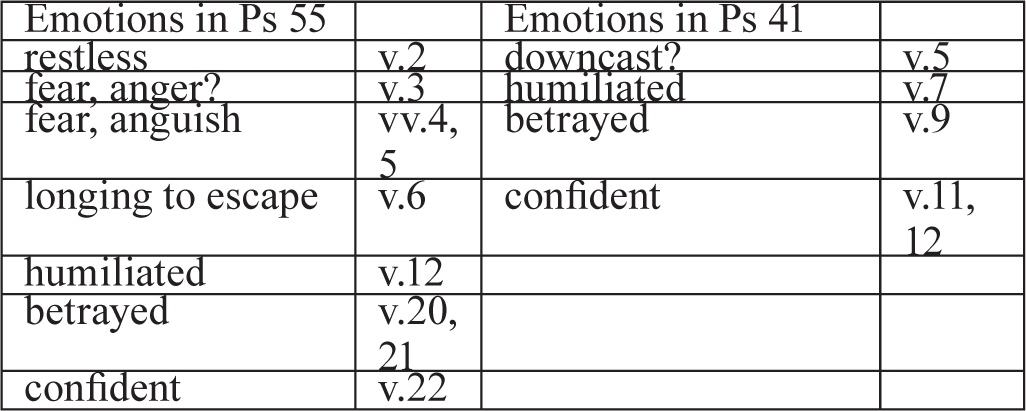
The emotions in Pss 44 and 88 show no confidence but do include indications that the psalmist is relying on his covenant relationship with YHWH, and from that, there is a modicum of hope. The four psalms will now briefly addressed in turn.
Psalm 41
Various words in the text of Ps 41 indicate that negative emotions might have been experienced by the psalmist. In v.5, the enemy speaks “in malice”. The way this impacts the psalmist is revealed in that he then gives a direct quote of the enemies’ disparaging words. Direct quotations indicate how deeply the words of the enemies have cut into the psyche of the psalmist, that he can even remember them exactly.
Then in vv.6-7, the psalmist relates how his enemies speak badly about him “abroad”, “whispering together about [him]” and “imagining the worst for [him]”. Another direct quote in v.8 continues to build the rhetoric to a climax in v.9 with the astonishing joining of two opposing ideas, viz. “my close friend” and “lifted his heel against me”. “Lifted his heel against me” (going back to Gen 3:15) implies ‘an insult’ or ‘contempt’ (UBS Study Notes) and expresses the “greatest sense of betrayal” (Word Biblical Commentary Vol 19).
The ideas of reciprocity and solidarity are foundational in patronage. When the personal relationships of reciprocity fail to produce the needed resources for the client, the patron’s reputation suffers the loss of honor and the accumulation of shame…
In contrast to the double-faced “friend”, the psalm-ist refers to his own “integrity” (v.11) and six times reminds YHWH of his covenant relationship with YHWH by using the covenant name (vv.1, 2, 3, 4, 10, 13). The psalmist recognizes the need for justice, but he does not ask God for this. Instead, he asks for delivery from his problem, so that he himself can execute justice (v.10b).
Tidball (49-50) notes that the section pf Ps 41 that dwells on the sense of betrayal by the psalmist is in the middle of a chiastic structure, thereby indicating its prominence. The suffering (vv.5-9) emanates from two sources, viz. enemies (vv. 5-8) and his “close friend” (v. 9), someone “who shared my bread”, a sign of intimacy, trust, and genuine friendship.
Psalm 55
Although there are no direct quotes of the enemies’ words in Ps 55 (unlike in Ps 41), the choice of words used by the psalmist indicates the negative behavior of his former friend. Botha (nd: 19) notes that Ps 55 could refer to David’s betrayal by, and flight from, King Saul. But whatever the context, the psalmist mentions that the betrayer “taunts” and “deals insolently” (v.12) and has “war in his heart” (v.21). Clearly, the major problem the psalmist experiences comes from the (angry and deceitful) words of the enemy. He refers to “the voice of the enemy” (v.3a) and “his mouth [being] smooth as butter” (v.21a). Smooth (ḥālaq) speech refers to someone who flatters or deceives. Many times in the Psalter, “a deceptive tongue” is likened to “a sharp instrument” (Botha nd: 17), as here in Ps 55. Thus, the psalmist requests God to “split [the enemy’s] tongue” (v.9a). He also mentions the “anger” of his opponent (v.3c) as well as his “deceit” (v.11b) and “treachery” (v.23b).
His collocation of “not an enemy” with “reproaches me” in v.12 reveals the psalmist’s pain and confusion. The verb “reproach” (or ‘scorn’, ‘taunt’, ‘mock’, ‘scoff’) is used 30 times in the Psalter and refers to the mocking aspect of the experience of shame. Sometimes (as in this psalm), the scorn comes from inside the covenant community (as evidenced in vv.12, 14). The focus of mockery in this case is probably social humiliation, casting disdain on the psalmist’s trust in God. In recompense, the psalmist affirms that his covenant partner, YHWH, will “humiliate them” (v.19a) because this betrayer “violated his covenant” (v.20b). By attesting to the punishment of the betrayer, the psalmist rises above a feeling of personal shame or humiliation.
Of interest is the fact that the psalmist only uses the covenant name YHWH twice in this poem (vv.16, 22) but the title “Lord” seven times. Perhaps the patron-client relationship is in focus, rather than that of the covenant. He acknowledges his dependence on his patron (v.23c) and looks to him to bring about justice (in contrast to Ps 41 where he planned to execute justice himself). Also, as Lynd (1958: 66) notes, “If one can find ways of sharing and communicating [the negative emotions one feels], this can bring about particular closeness with others.” We see the psalmist sharing his pain and vulnerability in vv.2b, 4, and 5, thereby building a closer relationship with YHWH, his patron and his carer (on whom he is dependent).
Psalm 44
Ps 44 is a lament psalm without resolution. The psalmist experiences shame (e.g. v.9) as a result of Israel’s covenant partner, YHWH, not living up to the obligations of the covenant (vv.9-22). God is accused of betraying God’s people; indeed, YHWH’s actions threaten their relationship. The people “feel that God has forsaken and betrayed them, that everything they believed in and trusted in has been shattered … [they] experience God as their enemy” (Maré 2014: 10). However, the psalm ends (v.26) with a cry of hope, requesting God to remember his covenant loyalty (hesed).
Psalm 88
Ps 88 is known as “the darkest psalm” with no obvious ray of light to disperse the bleakness. For that very reason, the psalm has served to “give expression” to those in dire pain or with deep theological struggles with the question of suffering (Dickie 2022, section 5). The psalmist feels “betrayed” by YHWH, though he does not use that word. He accuses YHWH of abandoning him and not responding as expected of a covenant partner (vv.6-8, 14-18). The covenant is hinted at in the first verse (with the use of the covenant name, YHWH) and again when YHWH’s character is mentioned (the covenant term hesed along with ‘faithfulness’, ‘wonders’, and ‘righteousness’ in vv.11-12). But the psalmist does not feel relieved of his feelings of alienation and depression, but exhibits “ultimate despair” (Wallace 2011: 11).
DePrince et al (2011) note that alienation (and its consequence, depression) may arise from “harm caused in the context of a close victim-perpetrator relationship”. The psalmist’s relationship with YHWH is certainly in focus in Ps 88 (the whole psalm oscillating between “I” and “you”). No enemies are mentioned. God alone is at the root of his enormous pain. The fact that God is “a close other” (his “carer” or “patron” or “covenant partner”) exacerbates the pain he feels in being betrayed. Indeed, the closer the established relationship between the victim and the betrayer, the greater the sense of betrayal (Platt and Freyd 2015).
Scheff (2001: 212) notes that lack of community is also a major factor in depression, and the psalmist is certainly suffering from “lack of friends” (vv.8, 18). However, if he is depressed, it is an aggressive, angry depression, unlike that which is “a blankness, [resulting] from the suppression of feeling” (Scheff 2001: 216). Rather, he talks about his sadness (v.9) and fear (v.15b-16). But there is also a lack of physical strength to fight the emotional pain (vv.4b, 7b, 16b).
To understand the different ways the psalmist approaches betrayal by a close other, it is helpful to consider where these psalms are positioned in the Psalter. They are all lament psalms, three of them (Pss 41, 44, 55) being within Books 1 and 2 which are considered to focus on “lament” (Wallace 2011: 5-6; Ho 2016: 148). The other, Ps 88, is the second last psalm in Book 3, in which “the psalmists understand the relationship with YHWH as closer than patron-client … Indeed, a paternal relationship is emphasized to stress the inviolability of the covenant” (Brown 2002, 192). Wallace (2011: 14), also argues that throughout Book 3, there is still the patron-client expectation that the Davidic covenant will be honored. However, it becomes clear, with each flash of hope countered by a following lament, that the ancient way is no longer capable of providing security (McCann 2005: 91). The glimmer of hope in Ps 44 (v.26) has been almost snuffed out in Ps 88 (v.18). But the fact that the psalmist calls YHWH “[his] salvation” (v.1) and makes reference to the covenant (vv.1, 11-12) means that there could yet be life. And Books 4 and 5 explore that truth, with YHWH replacing David as the reigning king.
Role of biblical lament in dealing with negative emotions
Biblical lament is God’s provision for humanity to deal with strong negative emotions and to be released from them in a safe and healthy way. In the psalms of lament, the psalmists display various emotions, from fear to anger to confusion to despair, and many others too. Essentially lament is an expression of faith (O’Connor 2002: 9) holding God to his covenantal promises (Cilliers 2007: 397).
Both Ps 41 and Ps 55 show a chiastic structure, with the lament about being betrayed in the center of the chiasm, the position of prominence. Ps 41 is a simple chiasm. Ps 55 is a slightly more-developed chiasm with three parallel structures; again, the lament about betrayal is in the center (D).
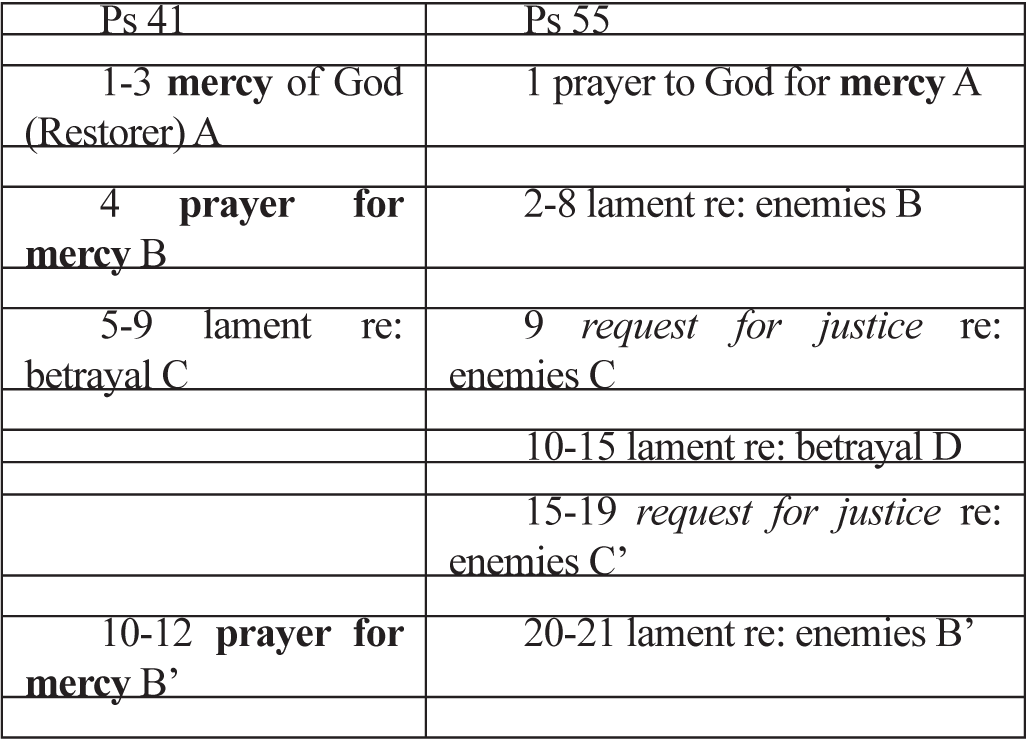
The fact that both Ps 41 and Ps 55 have the lament about being betrayed in the center of their chiastic structures indicates that this pain, that of betrayal, is the most-emotionally loaded element in the psalm. Despite the clear symmetry in the chiasm, there is also a development in the lament sections in Ps 55. The first lament (vv.2-8) is a simple complaint about the enemies in very general terms. The second lament (vv.10-15) is more specific and identifies the “enemy”. The third lament (vv.20-21) gives further details about this person, what he actually did that was so distressing to the psalmist. Thus, within the circular design of the poem, there is also a linear movement, with growing intensity.
Psalms 44 and 88 do not have a human as the betrayer, but YHWH is accused of betraying the covenant. In Ps 44, the complaint against God extends from v.9 to v.25 (with a final request in v.26). In Ps 88, complaint against God permeates almost every verse.
In those psalms in which the betrayer is perceived to be a person (not YHWH), the psalmist takes comfort in his relationship with YHWH. However, when YHWH is understood to be the cause of his pain, the psalmist shows great confusion. He is still aware of the covenant relationship he has with YHWH, but the latter does not seem to be playing his part, which provokes bewilderment for the psalmist. In neither situation does the psalmist show any element of shame.
Conclusion
Betrayal by a close friend clearly is a very distressing situation, and for many people, could be devastating. In the face of betrayal by a human friend, the psalmist was able to hold on to his strong relationship with YHWH (as in Pss 41 and 55). His confidence in his patron, covenant-partner, and caregiver enabled him to weather the storm. He does not seem to have a “shattered self” as suggested by Betrayal Trauma Theory. He was also able to hand over his need for justice to God, and so be able to rest confidently that “the enemy” would be punished.
In contrast, when the psalmist feels betrayed by YHWH (as in Ps 44 and particularly Ps 88), he has no resources to fight against this ultimate betrayal. There is no “other” on whom he can depend, and consequently his soul experiences confusion. All he can do is to cry out, reminding God of the covenant, and hoping that this would stir God to act on his behalf.
This study of the psalmist’s emotions following a traumatic betrayal indicates that having YHWH as one’s partner can significantly mitigate the negative effects predicted by BTT. The psalmist’s key is faith, and his hanging on (in the midst of the darkness) to his covenant God.
References
 in the Psalms—Shame or Disappointment?”