




Abstract

Introduction
“Often a bridesmaid, never a bride” read the caption of a 1930s advertisement for mouthwash, declaring that halitosis, once an obscure medical diagnosis was in fact a medical scourge, responsible for damaging relationships and for failure in the business world. Closer examination shows that the medicalization of bad breath was driven by 1 of the 20th century’s most aggressive and successful advertising campaigns. 1
The story begins with Dr. Joseph Lister, an English surgeon and pioneer of surgical antisepsis, who showed in 1865 that surgical dressings soaked in carbolic acid significantly reduced rates of postoperative infection. Taking inspiration from Lister, American physician Dr. Joseph Lawrence created his own antiseptic formula in 1879, and with Lister’s permission, named the product Listerine. This novel formula was initially sold as a medical cleaning solution with a wide range of applications including use as an aftershave, a nasal douche, a “cure” for gonorrhea, and even a treatment for dandruff and balding. Soon after creating Listerine, Lawrence formed a partnership with St. Louis pharmacist Jordan Lambert. Lawrence would eventually sell his stake in the partnership to Lambert, and Listerine would come to be owned by the Lambert Pharmaceutical Company. 2
In 1895, Listerine was marketed to the dental profession and in 1914, the product became available over the counter. Listerine didn’t become a household name until the 1920s when Gerald Lambert, an heir to Lambert Pharmaceuticals, launched a campaign with a Chicago advertising team. (Figures 1, 2). It focused on “halitosis,” its ill effects and potential cure. Lambert poured money into advertising, increasing the cash spent on magazine ads in proportion to sales. The advertisements extolled the virtues of Listerine in killing germs, curing halitosis and reducing the risk of sore throats and the common cold.(Figure 3) Lambert’s revenue rose from $115,000 in 1922 to over $8 million by 1929 (equivalent of about $152 million today).
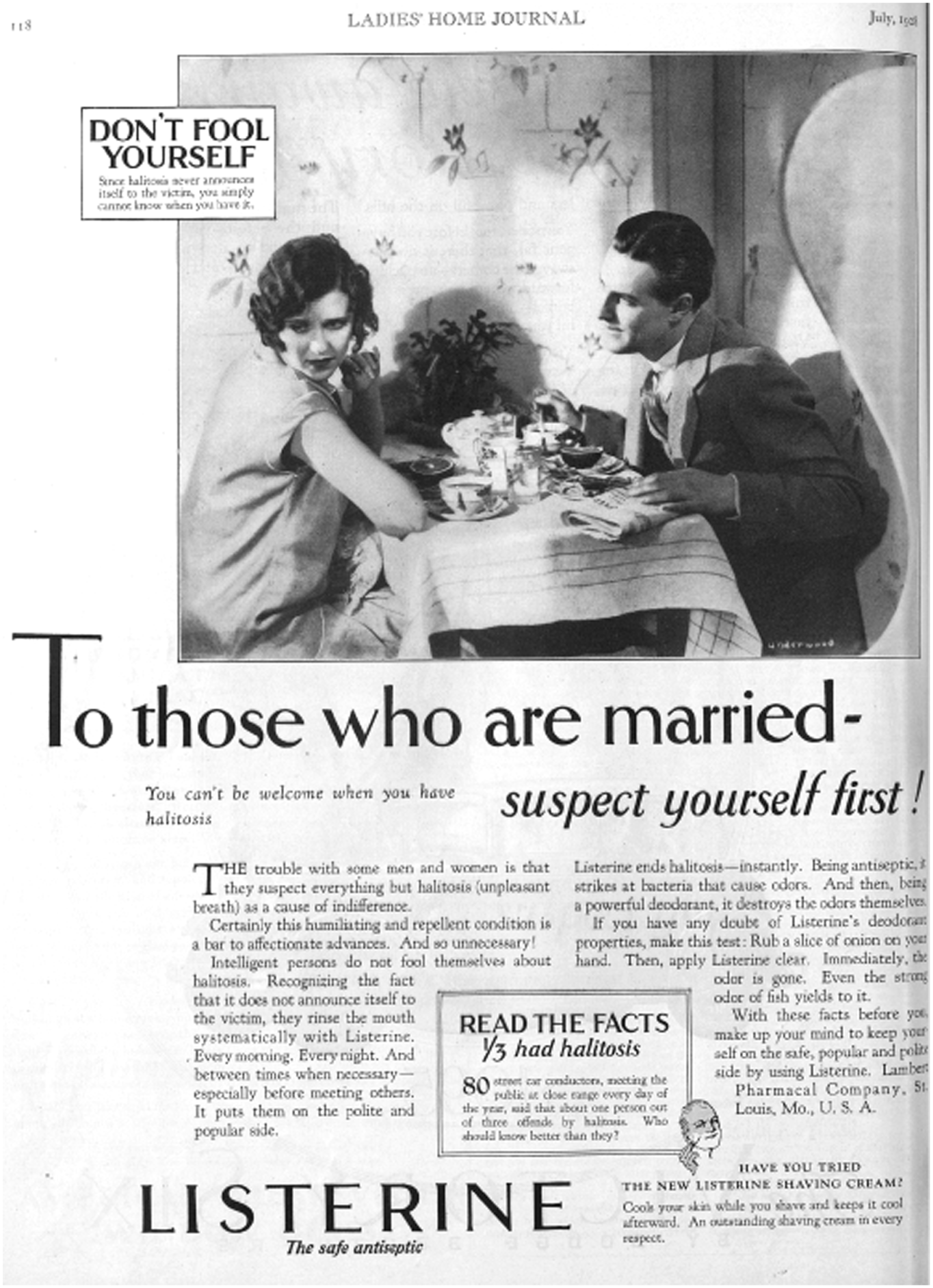
To those who are married. 1928 Listerine advertisement warns halitosis can lead to marital indifference (Ladies’ Home Journal; 45, 7; (Jul 1928) p. 118).
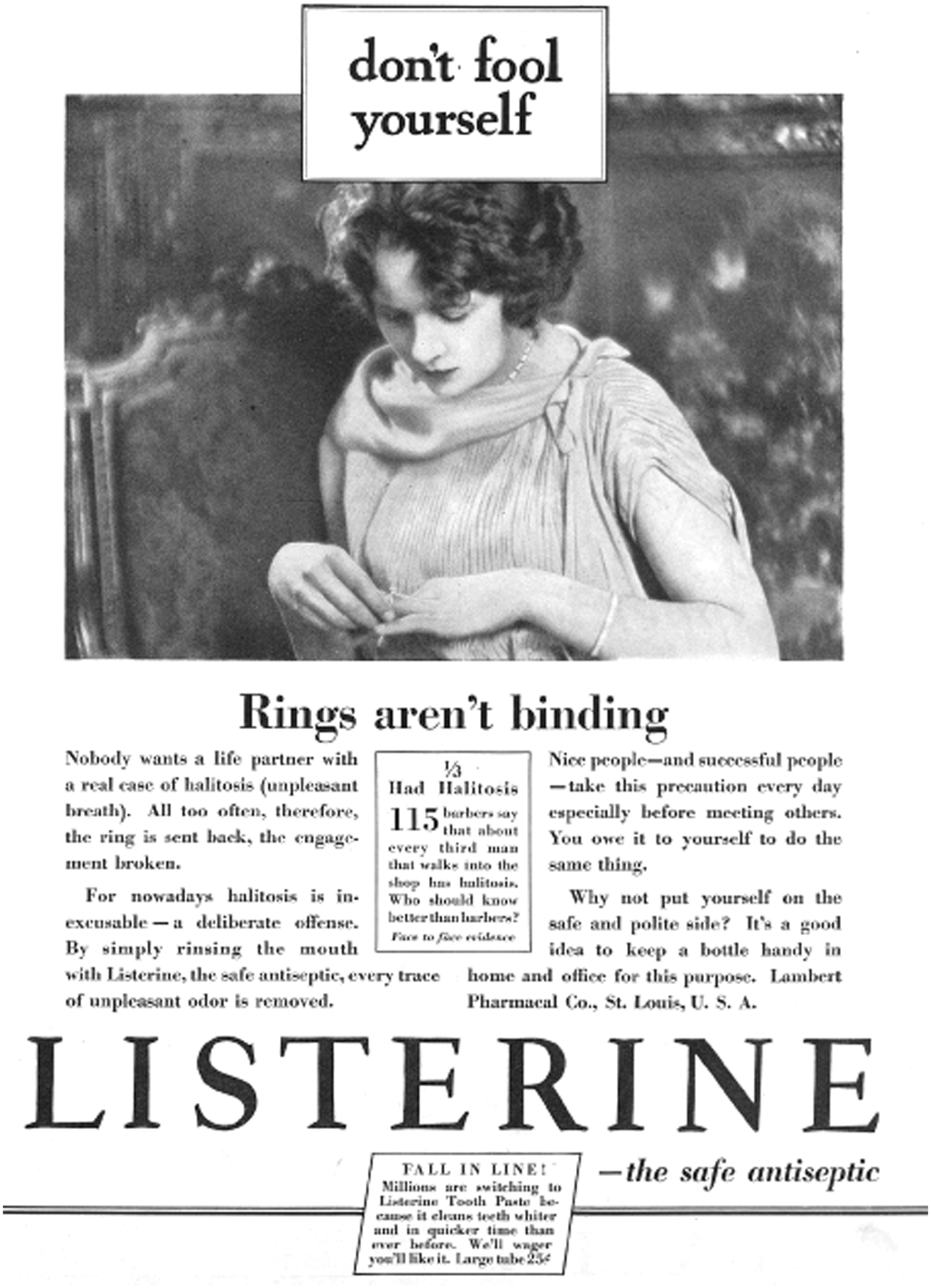
Rings aren’t binding. 1927 Listerine advertisement warns halitosis may end an engagement (Ladies’ Home Journal; 44, 9; (Sep 1927) p. 55.).
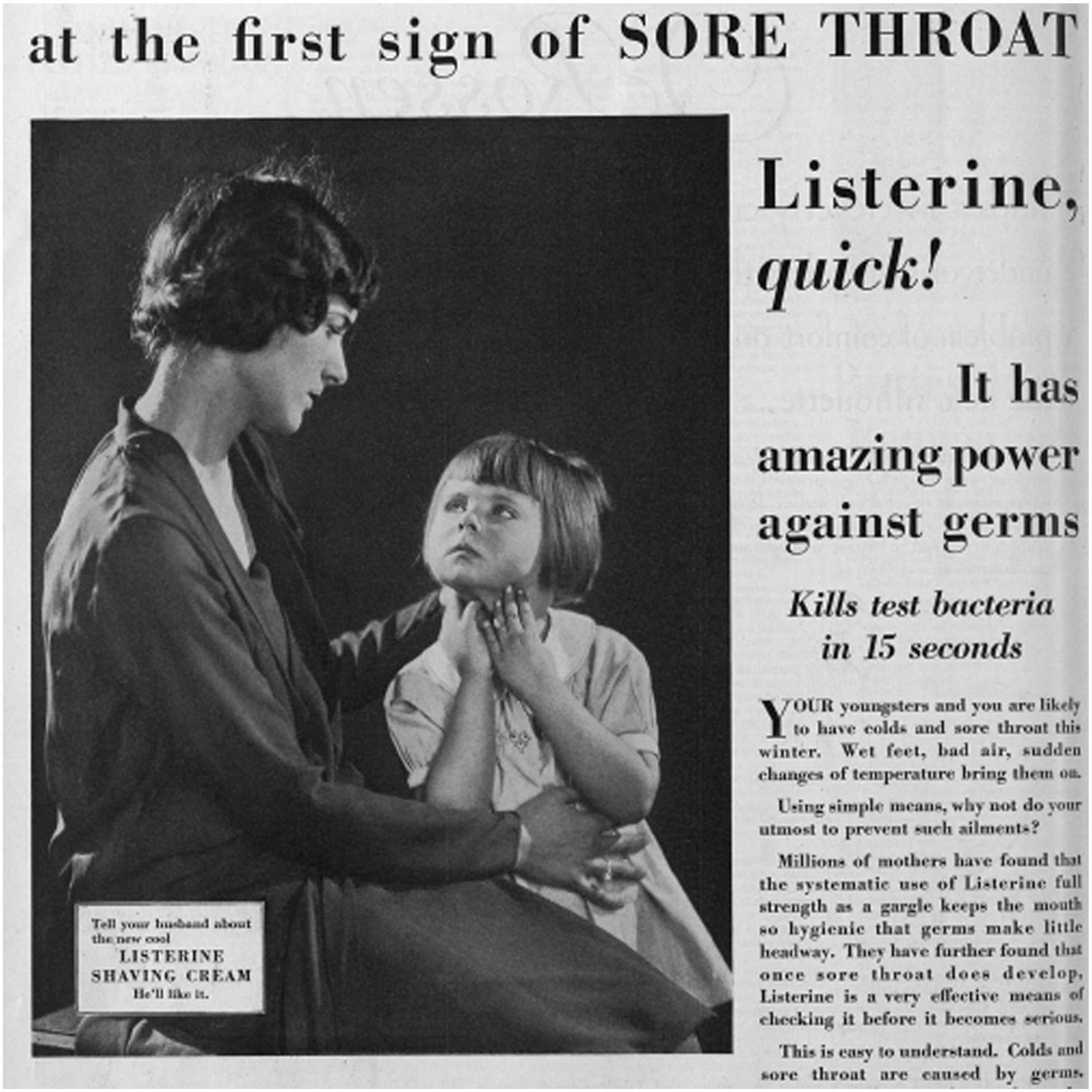
At the first sign of sore throat. 1928 advertisement implies Listerine can prevent sore throat – A claim later disproved (Ladies’ Home Journal. 45, 11; (Nov 1928): p. 186).
Despite the ubiquity of these advertisements promising broad medical benefits, research conducted during this time examining Listerine’s advertising was narrowly focused on the effects of the company’s toothpaste and was solely written for a scientific audience. 3 This lack of public scrutiny and clear pushback from the scientific community allowed Lambert’s advertisements to drive sales unabated. It was not until the 1970s and 1980s that dental research supported Listerine mouthwash’s modest effect in controlling plaque and gingivitis. Its purported ability to prevent viral upper respiratory infections and pharyngitis were never substantiated.
In 1972, the Federal Trade Commission issued a complaint against Listerine’s producer, the Warner-Lambert Co. The complaint alleged that, contrary to its advertisements, “Listerine does not cure or prevent colds or sore throats or cause them to be less severe than they otherwise would be.” The complaint was upheld in court, although the demand for a corrective advertising, “until Warner-Lambert had spent a sum equal to the average annual Listerine advertising budget for the period of April 1962 to March 1972” was overturned on appeal. 4
In the 1980s, after over 60 years of widespread use, dental researchers and otolaryngologists began investigating whether alcohol-containing mouthwashes such as Listerine could be a risk factor for developing oral cancer. 5 Listerine mouthwash contains eucalyptol, menthol, methyl salicylate, and thymol, but much of its antibacterial activity comes from its alcohol content (Listerine Original Antiseptic is 26.9% ethanol). It was well established by that time that heavy consumption of alcohol potentiated the carcinogenic effects of smoked and chewed tobacco. Results of these mouthwash studies varied, depending on methodology and industry sponsorship. While short, daily exposure to mouthwashes appears to be safe, some studies suggested a small, but statistically significant effect of frequent exposure. 6
The promotion of halitosis as a social stigma led to mouthwash’s meteoric rise and to the acceptance of fresh breath as a societal norm. The success of this decades-long mouthwash campaign demonstrates the power of advertising to create and exploit fear of social isolation.
Footnotes
Author Note
Portions of this article were presented at the Combined Sectional Meeting of the Triological Society, Orlando, FL, January 24, 2026.

Ethical Considerations
The study was conducted in accordance with the Declaration of Helsinki.
Funding
The authors received no financial support for the research, authorship, and/or publication of this article.
Declaration of Conflicting Interests
The authors declared no potential conflicts of interest with respect to the research, authorship, and/or publication of this article.
Data Availability Statement
Data from this study are available for review by interested researchers. The authors would be pleased to assist via the corresponding author’s email.*