



Abstract

Significance Statement
Septic arthritis of the temporomandibular joint (SATMJ) is a rare condition that arises due to hematogenous seeding, contiguous spread of infection, or direct inoculation. Early recognition of SATMJ is important because its nonspecific clinical presentation, including trismus, jaw pain, and preauricular swelling, for which imaging such as computed tomography (CT) or magnetic resonance imaging (MRI) serves a critical role.1,2 Delayed diagnosis and treatment increase the risk of complications such as osteomyelitis, intracranial abscesses, and sepsis. 3
Case Description
We present a case of a 58-year-old man who presented with intermittent fever, left-sided otalgia, and trismus unrelieved with antibiotic treatment. Physical examination revealed left temporomandibular joint (TMJ) tenderness on palpation as well as facial numbness in the region of the left auriculotemporal nerve.
Contrast-enhanced CT of the temporal bones demonstrated a rim-enhancing fluid collection about the left mandibular condyle with associated asymmetric fullness and hyperemia of the left TMJ, extending to the surrounding soft tissues (Figure 1). Findings were compatible with left TMJ septic arthritis and abscess.
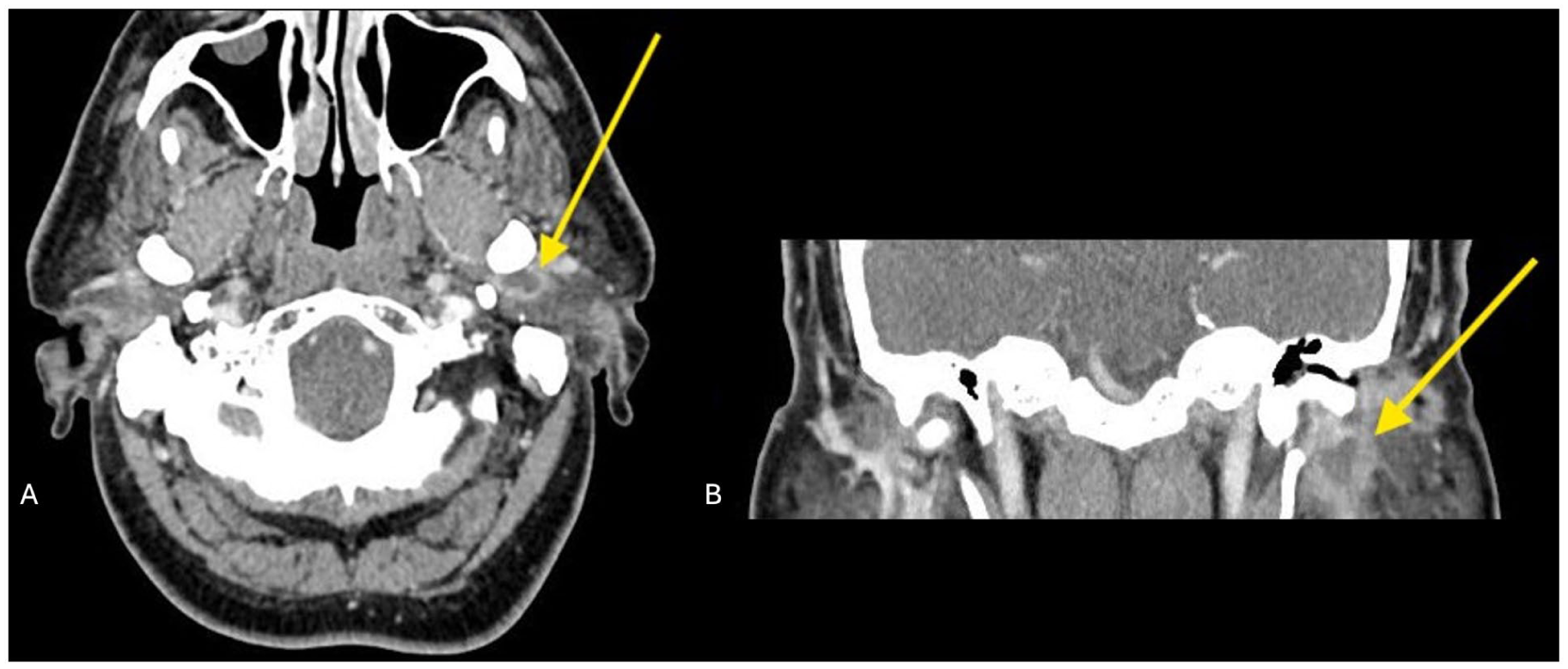
Contrast-enhanced CT of the mastoids with axial (A) and coronal (B) views demonstrates a rim-enhancing, centrally-hypoattenuating collection which measures 9 × 10 × 12 mm (AP × TV × CC) posterolateral to the left mandibular condyle. Yellow arrows demonstrate rim-enhancing fluid collection compatible with TMJ septic arthritis and abscess formation. AP, Anteroposterior; CC, Craniocaudal; CT, computed tomography; TV, Transverse.
The patient was subsequently transferred to an outside facility for further evaluation by the oral maxillofacial surgery service and was lost to follow-up.
Discussion
The TMJ is a bicondylar articulation consisting of right and left synovial joints that are involved in important functions such as mastication and speech. 4 It is a unique joint that has articular surfaces covered by fibrocartilage, rather than hyaline cartilage, which provides hinging and gliding actions between its connection to the temporal bone and the mandible. 4 Septic arthritis of the TMJ is a rare condition with few cases reported in the literature, but one that is important to recognize and treat early to prevent life-threatening complications. SATMJ is most frequently associated with Staphylococcus aureus, but other microorganisms such as Neisseria gonorrhoeae and Pseudomonas species have also been identified.5,6 Clinical features that raise concern for SATMJ include trismus, jaw pain, and preauricular swelling. The majority of SATMJ cases affect older, immunosuppressed individuals with chronic illnesses. Approximately half of all reported cases of SATMJ were due to hematogenous seeding from a distant site of infection, likely due to the joint’s highly vascular synovium and lack of a basement membrane to protect against pathogens.1,5 Diagnosis of SATMJ can be challenging due to its nonspecific clinical presentation. Clinical features that should raise concern for SATMJ include trismus, jaw pain, and preauricular swelling; however, some cases may present without these findings, which makes imaging such as radiographs, CT, and MRI critical for diagnosis.1,3 While synovial fluid is essential to confirm the diagnosis of SATMJ, arthrocentesis and cultures may not be sufficient for definitive diagnosis, as many cases have negative culture results. 7
Due to its rarity, SATMJ lacks standardized treatment protocols, which can delay diagnosis and treatment and increase the risk of complications such as osteomyelitis, TMJ ankylosis, intracranial abscess, and sepsis.1,3 Spreading infection may lead to sepsis, which has mortality rates ranging from 25% to 30% in severe cases and up to 40% of cases with septic shock. Individuals over 65 years of age are 13 times more likely to develop sepsis, with increasing risk in those who are immunosuppressed and have chronic illness. This stresses the importance of initiating early antibiotic therapy to improve outcomes. 8
Footnotes

Ethical Considerations
Our institution does not require ethical approval for reporting individual cases or case series.
Consent for Publication
Written informed consent was obtained from the patient for their anonymized information to be published in this article.
Author Contributions
Jagan D. Gupta conceived the case topic and designed the paper methodology. Abdul Khan and Frank Rizzuto conducted the data collection and performed the investigation and analysis. Abdul Khan, Frank Rizzuto, Jagan D. Gupta, Neel D. Gupta, and Triet M. Do interpreted the results and contributed to the manuscript writing. All authors reviewed and approved the final manuscript, ensuring accuracy and integrity in the reported findings.
Funding
The authors received no financial support for the research, authorship, and/or publication of this article.
Declaration of Conflicting Interests
The authors declared no potential conflicts of interest with respect to the research, authorship, and/or publication of this article.
Data Availability Statement
Data sharing is not applicable to this article as no datasets were generated or analyzed during the current study.