




Abstract

Keywords
True to what the noted anatomist and physician William Harvey once said—“All we know is still infinitely less than all that still remains unknown”—the journey of the medical authors is from unknown to known—or, more aptly, from greater unknown to lesser unknown. This realization gives their work a transcendental value, where there is no absolute end for the “knowable,” and consequently, no fear of missing out on something from the realm of knowledge that, anyway, promises to be never-ending. Such authors, therefore, peacefully concentrate on picking up whatever morsels of scientific truth their conscious lifetimes allow, accept the inexorable flow of the ever-changing medical science, and gain precious wisdom that they transfer to their successors before retiring. Their sense of humility toward Nature extracts genuine works of unconditional passion.
The other way round is what explains how authors are born out of compulsion (Figure 1). They ostensibly seek the “lesser unknown,” but knowingly or unknowingly, they imbibe the “publish or perish” culture. Deliberately or out of ignorance, their research and writings become vehicles for their ego-driven professional identity. Science to them is no longer a luxury of thoughtful escapade to the infinite world of truth and possibilities, but a limited, utilitarian medium to accomplish their ulterior motive of career advancement. Enviable author metrics, peer-driven competitive environment in outnumbering projects and papers, slavery to the system-imposed deadlines—overall, a compulsive infatuation rather than a true inner arousal—are the factors that drive them forth. Unfortunately, the medical education system and the hospital governance in many nations foster an environment conducive for this “pressure to perform” situation, where the inherent passion for spontaneous scientific inquiry gives way to condition-bound compulsion. 1 Hectic and tiring hospital duty schedule, disproportionate human resources, un-adjusted work pressure, demanding infrastructure, professional insecurity, and the need for good pay often frustrate a young medico and threaten their peace, personal life, and the work–life balance. In such complex situations, a system-generated competitive demand for research output often drives them into compulsion. To make ends meet, the authors make themselves vulnerable to get lured and entrapped into the intricate web of authorship malpractices. They may not even realize that they have deviated from the accepted norms and have to suffer from the possible consequences that would follow. Genuine ignorance of publication ethics due to inadequate research exposure and lack of proper mentorship further complicate the situation. A significant proportion of such authors, who may or may not be ignorant of the rules, feel greedy and sense the scope of ego-inflation from this crisis!
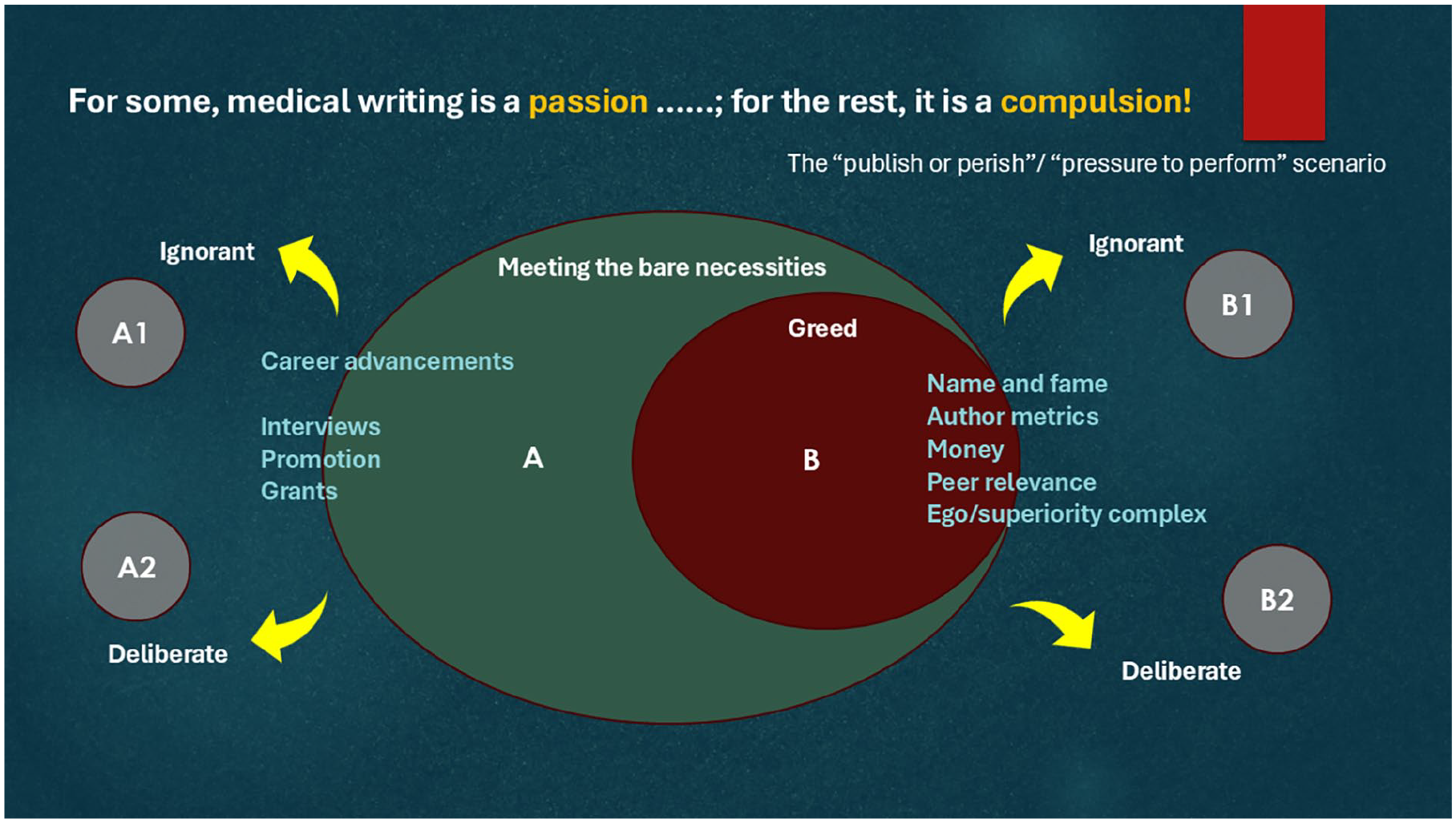
This schema depicts the possible reasons why an author writes out of compulsion, and the human behavior associated with it. The “publish or perish” situation compels the authors to write to meet the bare necessities required for career advancement (green; group A). As they climb up the ladder of metrics and recognition, greed sets in, which defines a subset within group A (red; group B). Authors in group B are guided by their inflated ego, misdirected self-identity, and peer-driven interpersonal competition in the workplace and professional life. Both these groups can get lured to the web of authorship malpractices, either out of ignorance (A1, B1) or deliberately (A2, B2). The yellow arrows indicate their tendency for malpractices. Groups A1 and B1 are potentially modifiable with mentorship programs and workshops. A conducive workplace and appropriate medical education and service policies may also be beneficial, especially for group A2, who may commit such malpractice out of desperation. Group B1 additionally needs counseling to make them realize the ill effects of authorship malpractices and the untoward translational effects they would have on human society. It is group B2 that imposes concern because they produce bad science out of the resistant downward trait of human nature.
The problem is therefore both at the personal level, as well as with the governance, stakeholders, and policymakers that guide a nation’s medical education and practice. This significant deviation from the utopian world of transcendentalism represents the hard problem of the authors’ attitude born out of compulsion. The web of authorship malpractices is intertwined, with one form subtly linked with the other. Subtly, because the interconnections are difficult to appreciate unless the authors are made educated on the malpractices. For example, a salami slicing submission may assume a redundant one, or appear a duplicate submission; paper mill productions are intimately associated with conflict-of-interest issues, violation of authorship criteria, data fabrication, citation manipulation, monetary heist, and salami slicing; plagiarism almost always leads to copyright infringement, and is often associated with duplicate submissions, methodologic inaccuracies, and, again, salami slicing.2-4 These interconnections are like tight junctions—the list can be endless, the tendency infectious, and the fallout catastrophic.
The ubiquitous and injudicious use of artificial intelligence (AI) and large language models has only complicated the problem. The authors take a passive role as they witness the extra-human superpower taking over them, producing unoriginal, apathetic, mechanical scriptures and pseudo-analyses, devoid of the human interface and emotional intelligence that true science deserves. The thinktank of the scientific world at the present date, including the major publishing houses, is confused on the optimum applicability of AI in day-to-day medical science. Opinions are divided on AI’s potential in judiciously guiding the authors toward transparent medical research and in preparing honest scriptures. The authors born out of compulsion, if unaware and not oriented, may feel uninhibited to utilize this technical loophole in an unacceptable manner.
It is uncertain whether the authors are always aware of the serious consequences such malpractices invite. Those who are, they dare to execute it out of greed, hoping to get away with impunity. And those who aren’t can’t plead innocence citing genuine ignorance as an excuse. The publishing industry and scientific bodies concerned with protecting and upholding publication ethics are in constant lookout for such malpractices. They continue to develop new technologies to filter tainted manuscripts and works out of ethics. There are detectives at the personal level, and at the editorial management systems. 5 The screening of submissions by editorial offices prior to peer-review includes checks for duplicate submissions, plagiarism, authorship criteria, conflict-of-interest and copyright issues, ethics committee approval/exemption, availability/submission of data in a repository, and financial disclosures. The purpose is to sieve out falsified and fabricated manuscripts. This process nowadays has gained edge with AI tools that make it more productive, accurate, and effortless. There are exclusive learning modules for the peer reviewers and editors prepared by the publication houses that train them to identify potential malpractices. Moreover, dedicated, highly experienced reviewers and editors develop a sixth sense to detect that something is wrong with a paper, in ethics or otherwise. This cannot be replaced with an AI tool, as it concerns a higher functioning of the neocortex—an exclusive human trait which gratifies a reviewer/editor’s academic satiety. Post-review/publication, once the manuscript is included in archival databases, it is open to scrutiny by professional colleagues and by the technical experts who can verify the results. So, escaping the policing eyes of the journal houses and peers is not easy. However, in contrast, getting hold of a research misconduct is also not easy, as techniques to bypass the screening methods are continuously evolving. There are funded agencies (like paper mills) for this that need to run a business for their survival, utilizing the authors’ inadequacies and limitations.3,4
This is an eternal chase of sleuths after the criminals in the world of academic publishing for the purpose of upholding the truth in medical science, and thereby to protect the suffering human beings. . . . . . So, what is the way out? Since ignorance is one significant contributor to publication malpractice that is modifiable and preventable, preparations to combat it should target medical students and residents at their early career stages. The importance of having motivated, responsible mentors who would introduce them to good research and writing practices, and a scholarly environment, is undeniable. Teaching them the importance of research and publication ethics will appeal to their collective conscience and will prime them to look toward medical science “as it is,” without the need for manipulation and distortion for their career gains. In a journey from the greater to the lesser unknown, loving the nuances of medical science and generating self-respect through introspection will bring them greater productivity with peer-acceptance and recognition than being involved in a competition with their peers.
Otherwise, the authors’ authenticity and credibility will be put to serious questions. If a publication misconduct is proved and its gravity measured, there are several penalties imposed on the authors, like blacklisting them, preventing them from submitting manuscripts to the particular journal/publisher, reporting to the authors’ institutions, and even handing over a retraction notice. Any of these bears serious consequences to an author’s career as it questions his/her integrity, and puts a permanent blot of distrust on their professional life. 6 Let these measures be reserved for those who pursue such misconduct out of compulsion driven by greed. But the medical education system and mentorship should be deemed a failure if these punishments are rendered on someone who, being a product of compulsion, is ignorant of the dynamics of malpractice and its consequences. To help them, there are the author guidelines and protocols to go through on the journal webpages, dedicated platforms like the Committee on Publication Ethics (COPE; https://publicationethics.org/) that provide valuable guidance, resources, and case-studies on publication ethics, and whitepapers published by malpractice-detection services (like the iThenticate for plagiarism; https://www.ithenticate.com/). These should be supplemented by institution-based workshops and dedicated Continuous Medical Education programs on Good Clinical Practice and research methodologies that should form the foundation for generating awareness and churning out authors driven by passion.
None of us is a true transcendentalist. We are limited by our senses and wants. But we all love each other and share the responsibility toward the betterment of humankind at large. Unethical research and authorship misconduct promote wrong medical science, which is bound to affect the human race, will not prevent or cure diseases, and will not alleviate human suffering. For medical professionals, the best way to ensure that these do not happen is to be ethical in one’s quest from the greater unknown to the lesser, thereby transforming oneself from an author born out of compulsion to passion, focusing on our inner true self.
Footnotes
Author Note
This manuscript is the excerpt of a lecture delivered by the author on June 14, 2025, as a part of Faculty Development Program organized by the Medical Education Unit, All India Institute of Medical Sciences, Kalyani, India.

Ethical Considerations
No patient information has been incorporated in this manuscript. Its content follows the ethical standards of relevant national and institutional guidelines on human experimentation and understanding, as laid down in the Declaration of Helsinki, 1975, as revised in 2013, at Fortaleza, Brazil.
Grant Number
Not applicable.
Funding
The author received no financial support for the research, authorship, and/or publication of this article.
Declaration of Conflicting Interests
The author declared no potential conflicts of interest with respect to the research, authorship, and/or publication of this article.
Data Availability Statement
The data and information stated in this article are available with the author and can be reproduced on request.