




Abstract
Sidney Yankauer was one of the fathers of American broncho-esophagology. He was a founding member of the American Bronchoscopic Society and was among the first to remove an obstructing peanut from a child’s bronchus using rigid bronchoscopy. 1 Still, he is best remembered for his inventions—a series of wonderful instruments and mechanical devices.
Born to German Jewish parents who immigrated to New York in the early 1800s, Yankauer grew up more privileged than his Eastern European peers. He was studying at the City College of New York while young Julius Lempert was selling apples on the streets of Lower Manhattan. Yankauer attended the prestigious College of Physicians and Surgeons. After completing an internship at Mount Sinai Hospital in 1893, he joined the staff there, spending the rest of his 38-year professional career at Mount Sinai. 2
This was a formative period in otolaryngology and Yankauer applied his many talents to the challenges of the new field. He devised operations to curette and seal the eustachian tube through the middle ear 3 and to irrigate the maxillary sinuses of children. 4 He described a new approach to submucous resection of the nasal septum and advanced intranasal spheno-ethmoidectomy. His treatise on tonsillectomy described the technique of total tonsillectomy and argued for its superiority to guillotine tonsillotomy when treating chronic infection. 5
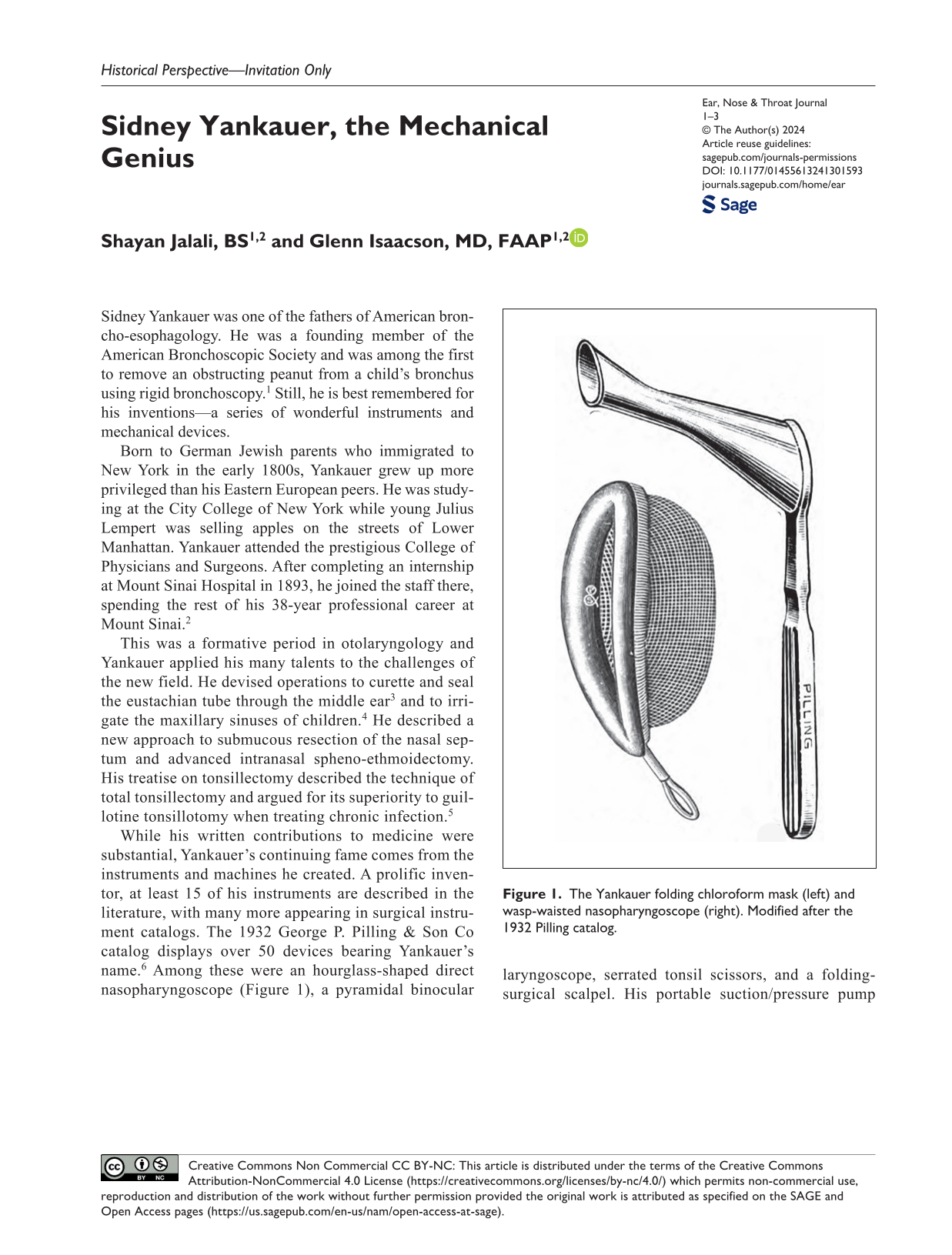
While his written contributions to medicine were substantial, Yankauer’s continuing fame comes from the instruments and machines he created. A prolific inventor, at least 15 of his instruments are described in the literature, with many more appearing in surgical instrument catalogs. The 1932 George P. Pilling & Son Co catalog displays over 50 devices bearing Yankauer’s name. 6 Among these were an hourglass-shaped direct nasopharyngoscope (Figure 1), a pyramidal binocular laryngoscope, serrated tonsil scissors, and a folding-surgical scalpel. His portable suction/pressure pump became a fixture in every otolaryngology office and proved valuable for anesthesia administration as well (Figure 2).
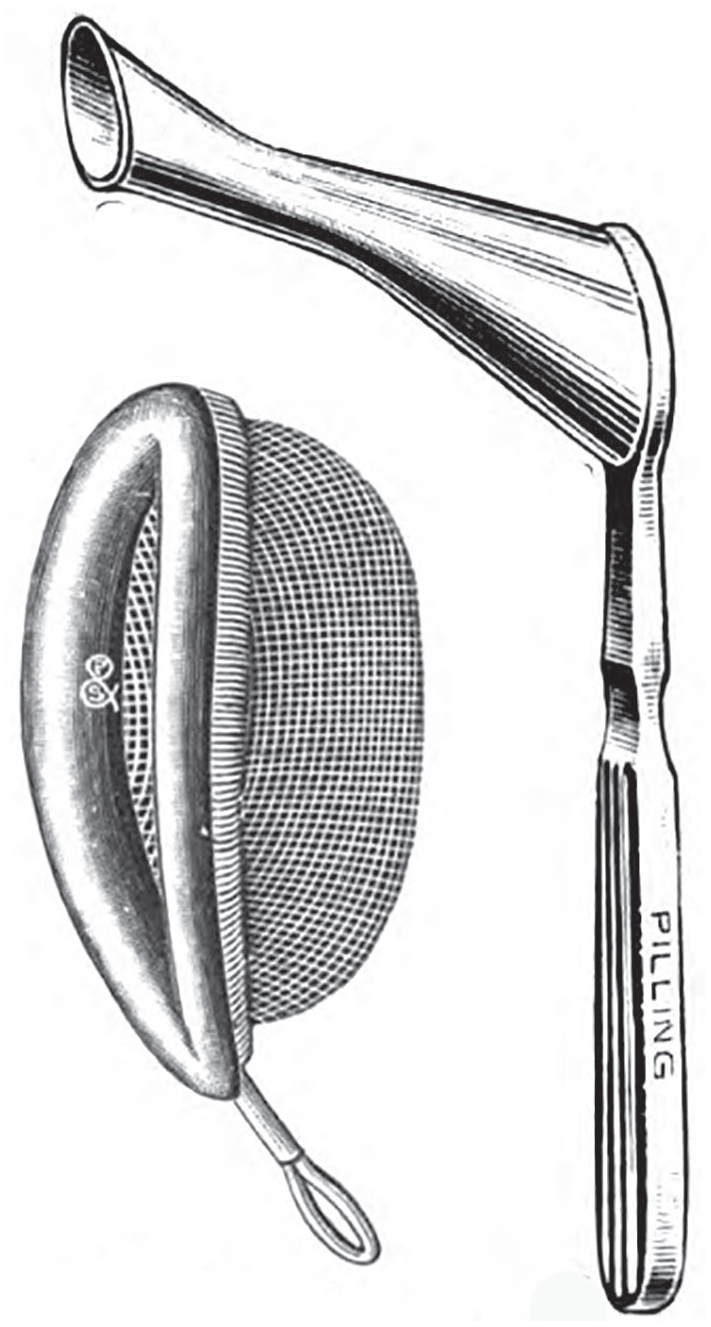
The Yankauer folding chloroform mask (left) and wasp-waisted nasopharyngoscope (right). Modified after the 1932 Pilling catalog.
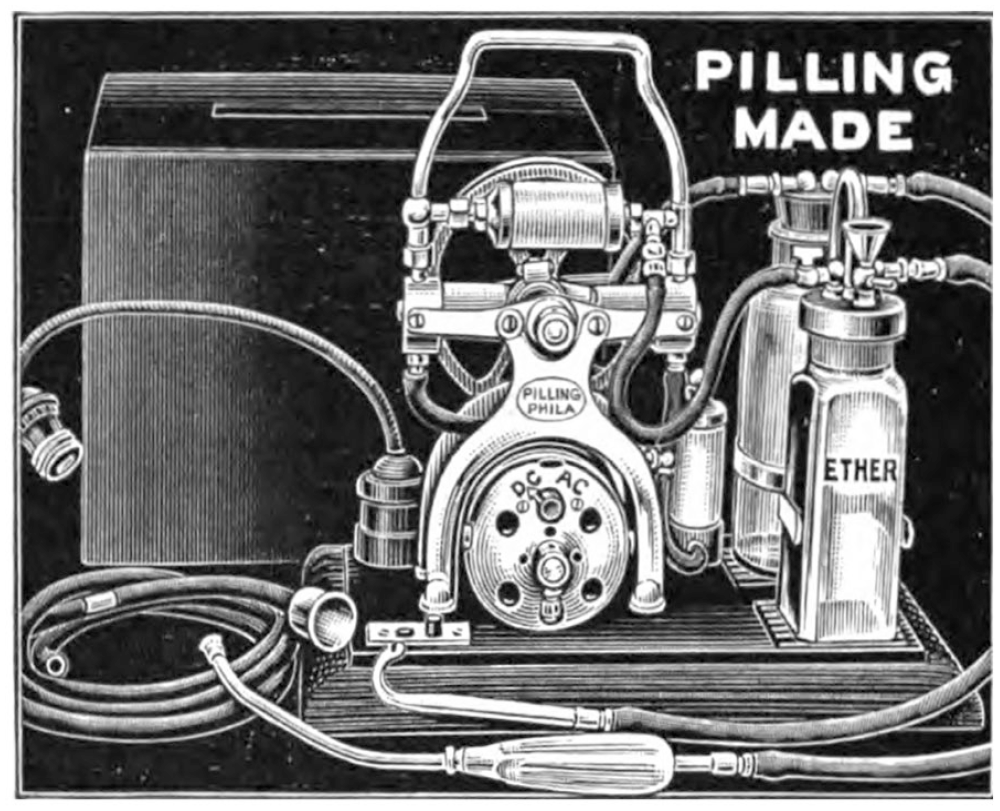
Yankauer portable suction apparatus, with Yankauer suction aspirator and ether hook attached. Modified after the 1932 Pilling catalog.
The most famous of Yankauer’s creations is his suction tube aspirator (Figure 2). This double-curved steel suction with a bulbous detachable tip remains the most frequently used surgical suction in the world. While Yankauer designed the tool for tonsillectomy, it is chosen by anesthesiologists to clear oral secretion, by emergency medicine personnel to aspirate blood from the airway, and by general surgeons working in the abdomen and pelvis. Its angulation allows a clear view while retracting soft tissues and its atraumatic tip avoids injury to the pharynx. Remarkably, the suction itself has no patent, no description in the early literature, and is not referenced in Yankauer’s detailed description of the tonsillectomy technique.
While Yankauer was reluctant to patent medical devices, he did claim commercial rights to his non-medical inventions. His electric pipe lighter (Figure 3) became the model for the cigarette lighters found in the dashboard of cars for decades to come. 7
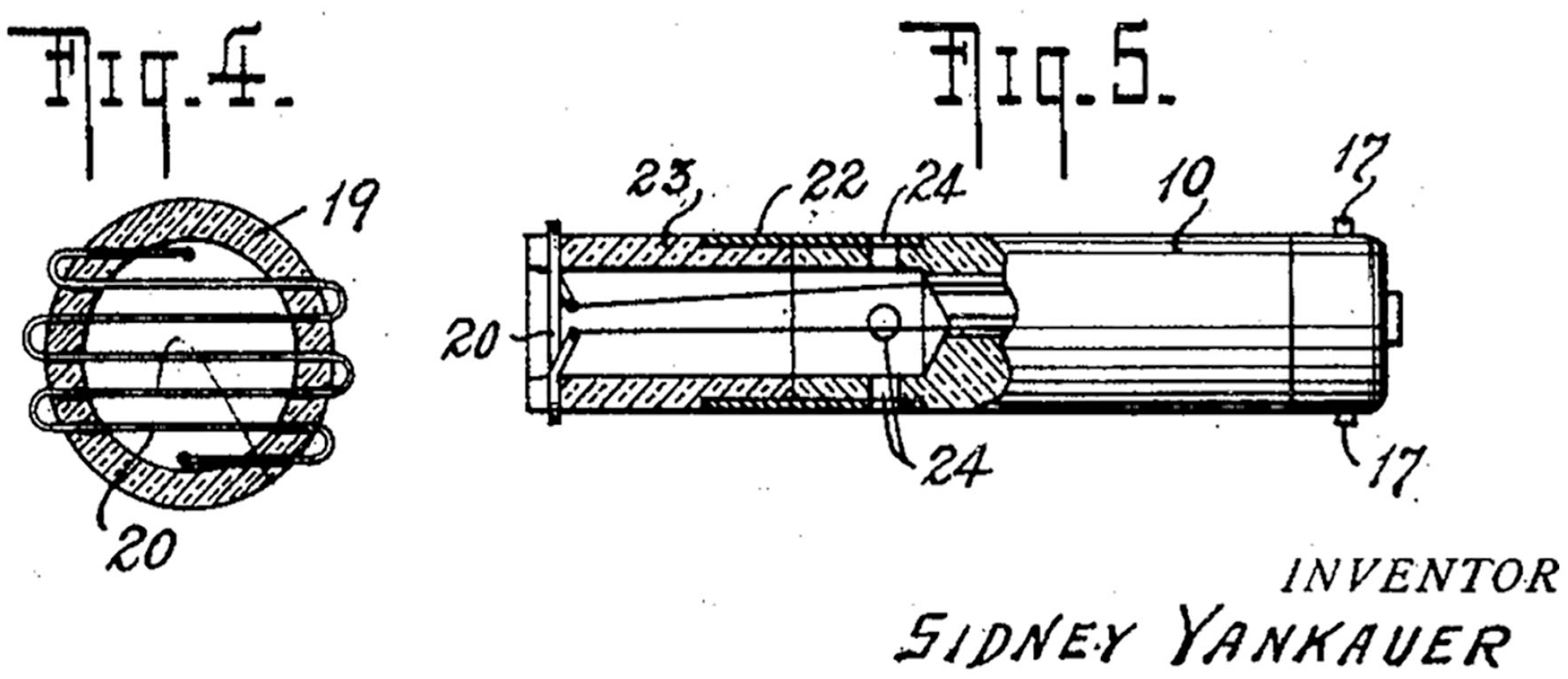
U.S. Patent No. 1,834,756—The Yankauer electric pipe (and cigarette) lighter.
Yankauer’s obituary lists his society memberships and lengthy bibliography. The greater compliment however is a quote from Chevalier Jackson, who called Yankauer a mechanical genius. One inventor recognizing the other.
Footnotes
Declaration of Conflicting Interests
The author(s) declared no potential conflicts of interest with respect to the research, authorship, and/or publication of this article.
Funding
The author(s) received no financial support for the research, authorship, and/or publication of this article.
Level of Evidence
5—Expert opinion.
