




Abstract
The excessive length of the superior cornu of the thyroid cartilage is extremely rare, and the etiology is unknown. Few reports of this condition exist in the literature. The objective of the present study was to present a rare case of unilateral excessive length of the superior cornu of the thyroid cartilage.
Keywords
Introduction
The excessive length of the superior cornu of the thyroid cartilage is extremely rare, and the etiology is unknown. Few reports of this condition exist in the literature. We recently diagnosed 1 patient with a different variant than previously reported in the literature. Thus, the objective of the present study was to present a rare case of unilateral excessive length of the superior cornu of the thyroid cartilage.
Case Report
A 56-year-old man presented to our outpatient clinic with a 10 year history of recurrent left pharyngeal discomfort. The patient complained of a foreign body sensation on the left side of the pharynx without obvious triggers, with a sore throat, mainly at the beginning of eating and when his head was turned to the left. He denied a history of trauma and surgery. On examination, we could see an oval-shaped, hard object palpable at 1 cm below the left angle of the mandible, with a clear boundary and no mobility. Laryngoscopy (Figure 1) revealed no abnormalities in the the mucosa of the pharynx. Neck CT (Figure 2) showed excessive length of the left superior cornu of the thyroid cartilage. The left superior cornu of the thyroid cartilage was resected by externally under general anesthesia. The patient was followed for 6 months after the operation, and the symptoms disappeared.
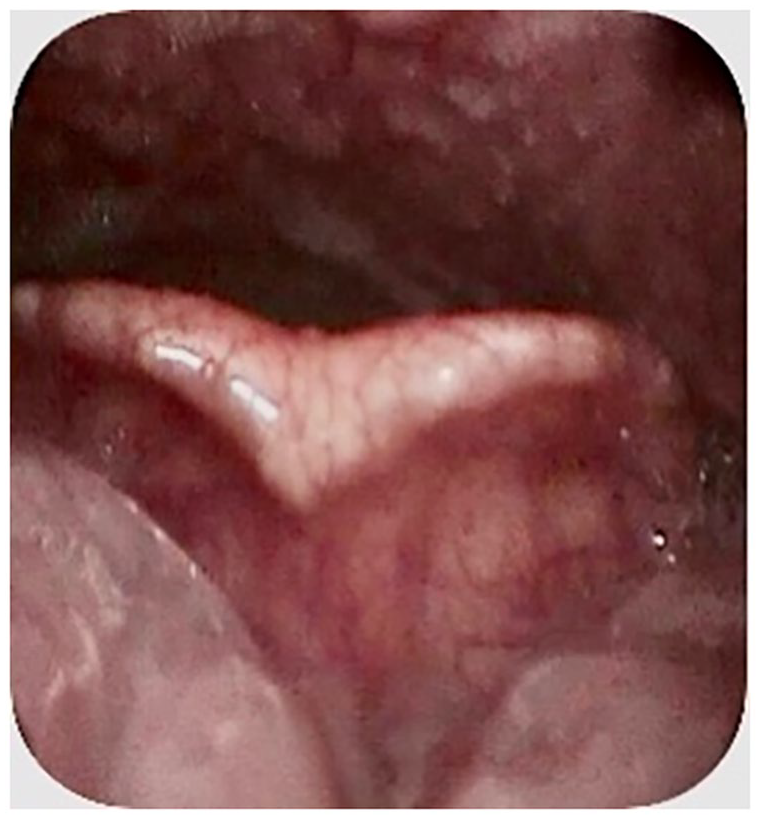
Laryngoscopy imaging.
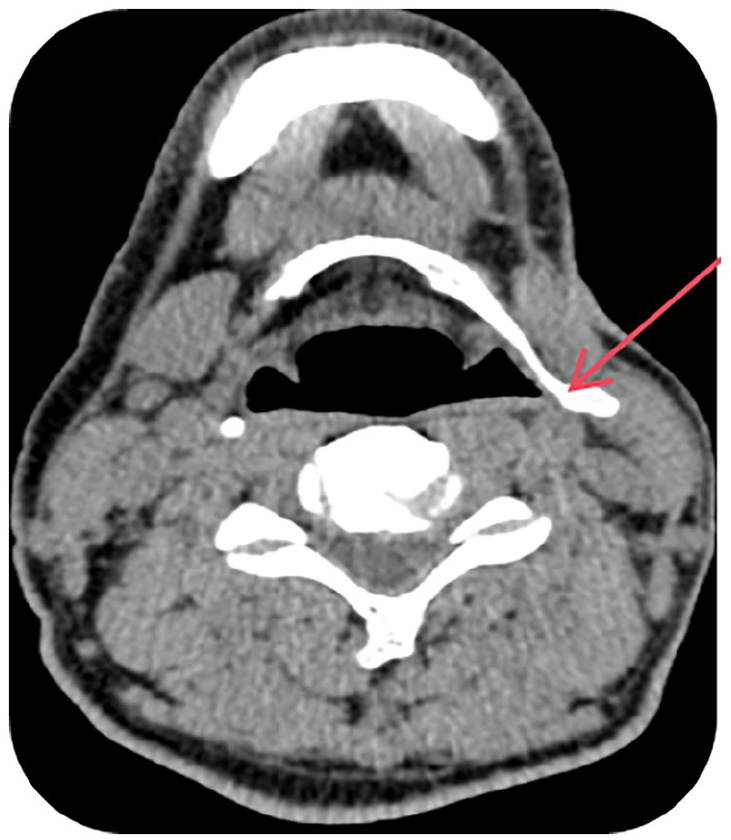
Excessive length of superior cornu thyroid cartilage with red arrow.
Discusion
Hirano et al 1 found that age-related changes in the human body caused changes in the superior cornu of the thyroid cartilage, such as calcification or hyperplasia, but did not seem to affect function. The medial deviation of the superior cornu of the thyroid cartilage was first reported by Browning and Whittet. 2 The superior cornu of the thyroid cartilage protruding into the laryngeal region and pharynx could be seen on laryngoscopy, and this report was the first to describe anatomical variation of the superior cornu of the thyroid cartilage. Later, Smith et al 3 reported on 11 patients who presented with pharyngeal discomfort associated with a sound of “clicking,” and found that the superior cornu of the thyroid cartilage protruded posteriorly and medially in most cases. Surgical excision of a portion of the superior cornu of the thyroid cartilage eliminated the symptoms in all patients. Interestingly, unlike Browning et al, the case we reported showed significant growth of the superior cornu of the left thyroid cartilage, but there was no abnormal alteration of the pharynx by laryngoscopy, which differs from case previously reported in the literature. Yang et al 4 found that anatomical variations of the superior cornu of thyroid cartilage may stimulate the carotid artery, the upper segment of the carotid sympathetic trunk, and the greater cornu of the hyoid bone, which may cause associated, nonspecific symptoms such as a foreign body sensation in the throat, unilateral pharyngolaryngeal pain aggravated by eating; and pain in the affected portion of the neck. However, there is no specific clinical manifestation of this condition, which is easy to misdiagnose and mistreat. We must consider the diagnosis in patients with long-term recurrent pharyngeal discomfort, especially unilateral pharyngeal discomfort, localized pain in the neck and palpation of the bony structures and superior cornu of the thyroid cartilage should be included in the examination, along with laryngoscopy and neck CT imaging. Surgical resection of the overgrown is often required to eliminate symptoms. For patients with a protruding superior cornu of thyroid cartilage toward the medial pharynx, low-temperature plasma radiofrequency ablation under transoral laryngoscopy can be chosen for resection: For patients with protrusion in the lateral neck, surgical resection through a lateral cervical approach may be used. In this case, we found no obvious protrusion of the mucosa in the pharynx and that the abnormity was palpable in the left neck. So, we chose the left cervical approach.
Conclusions
Unilateral thyroid cartilage’s excessive length is extremely rare. We report a case of unilateral excessive length of the superior cornu that was treated surgically with good results.
Supplemental Material
sj-docx-1-ear-10.1177_01455613241298069 – Supplemental material for The Unilateral Excessive Length of Superior Cornu of Thyroid Cartilage: A Case Report
Supplemental material, sj-docx-1-ear-10.1177_01455613241298069 for The Unilateral Excessive Length of Superior Cornu of Thyroid Cartilage: A Case Report by Wei Wei Li and Zhengcai Lou in Ear, Nose & Throat Journal
Footnotes
Acknowledgements
Thanks to all the authors of this article.
Author Contributions
The collection of medical records, the follow-up of the patients, and the writing of the article were carried out by W.W.L. L.Z. is responsible for the revision and polishing of this article.
Data availability statement
The data are reliable.
Declaration of Conflicting Interests
The author(s) declared no potential conflicts of interest with respect to the research, authorship, and/or publication of this article.
Funding
The author(s) received no financial support for the research, authorship, and/or publication of this article.
Ethics Statement
Ethics statement is in a separate file upload.
Grant number
None.
Informed consent/Patient consent
We have obtained written informed consent from the patient for publication in the Ear, Nose & Throat Journal.
Trial registration number/date
None.

Supplemental Material
Supplemental material for this article is available online.
References
Supplementary Material
Please find the following supplemental material available below.
For Open Access articles published under a Creative Commons License, all supplemental material carries the same license as the article it is associated with.
For non-Open Access articles published, all supplemental material carries a non-exclusive license, and permission requests for re-use of supplemental material or any part of supplemental material shall be sent directly to the copyright owner as specified in the copyright notice associated with the article.
