




Abstract
Significance statement
This clinic describes a rare congenital anomaly, a supernumerary nostril in a 5-year-old boy. It is also known as an accessory nostril, with or without communication with the cavity of the nose. Surgical correction performed at an early age avoids any impact on the nasal cartilages due to the fistula, deformation of the adjacent structures, as well as psychosocial implications.
Clinic
A 5-year-old boy presented to the Otorhinolaryngology clinic with a supernumerary nostril on the right side (Figure 1). Bilateral nasal cavities were well developed. Computed tomography of the face (Figure 2) revealed an accessory nostril overlying the right ala with the presence of alar cartilage with an external opening measuring 4 mm and an internal opening measuring 2.3 mm with communication with the right anterior ethmoid sinus. The right maxillary antrum was hypoplastic. There was no other associated congenital anomaly.
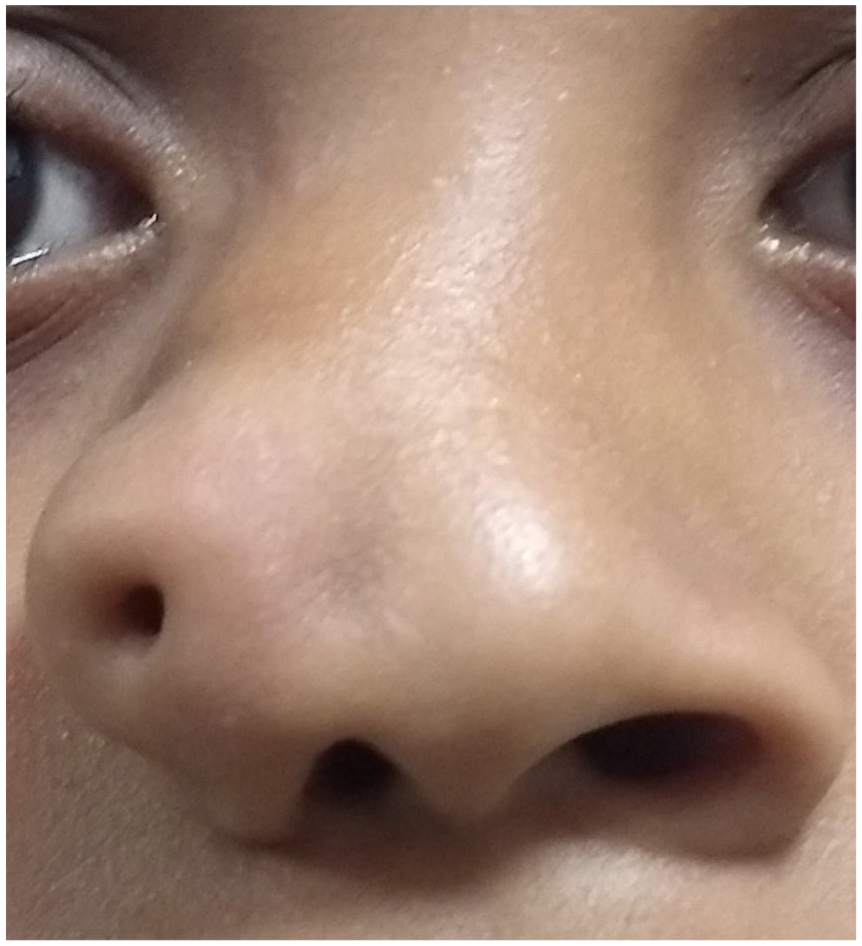
Five-year-old boy with the right supernumerary nostril.
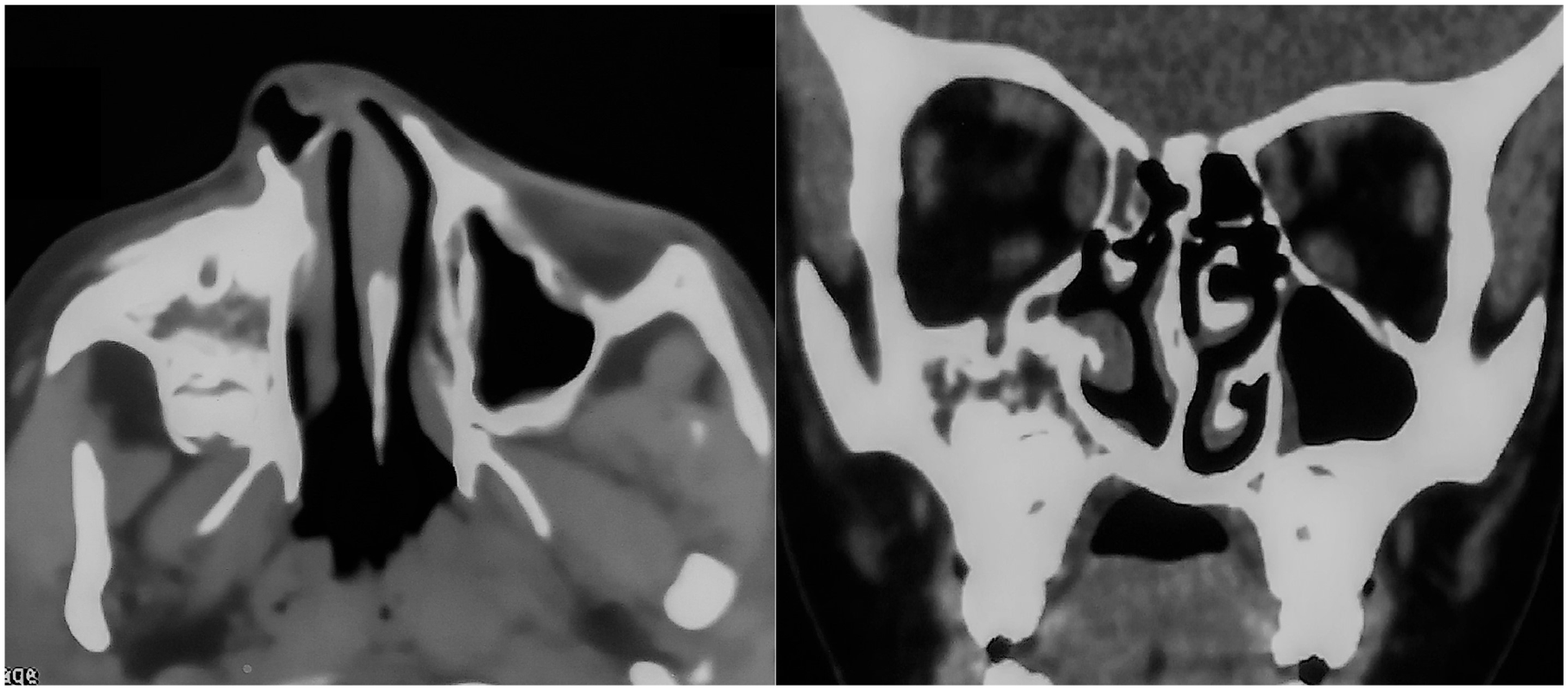
Computed tomography of the face shows an accessory nostril overlying the right ala with the presence of alar cartilage with an external opening measuring 4 mm and an internal opening measuring 2.3 mm with communication with the right anterior ethmoid sinus.
Supernumerary nostril is a rare congenital nasal deformity, the etiology of which is still undetermined. 1 It is defined as an accessory nostril with or without an accessory cartilage, with or without direct communication with the nasal cavity. It is usually unilateral, and more common on the left side. It may present as an isolated malformation or may be associated with other congenital malformations in 45% of the cases. 2 The reported malformations associated with the supernumerary nostril are complete unilateral cleft lip, congenital cataract, esophageal atresia, imperforate anus and patent ductus arteriosus, bilateral congenital choanal atresia, osteoma of ethmoid sinus, congenital adrenal hyperplasia, and ear hypoplasia. The treatment of the supernumerary nostril involves surgical removal of the entire accessory nasal tract and preservation of the normal nostril. Early diagnosis and surgical excision improve the outcome and reduce the psychosocial implications in such patients.3,4 Excision performed at an early age avoids the impact on the nasal cartilage due to the fistula and avoids deformation of the adjacent structures.
Footnotes
Author Contributions
A.J.: conceptualization, drafting the manuscript, and patient management. J.K.: drafting the manuscript and patient management.
Declaration of Conflicting Interests
The author(s) declared no potential conflicts of interest with respect to the research, authorship, and/or publication of this article.
Funding
The author(s) received no financial support for the research, authorship, and/or publication of this article.
Informed Consent
Written informed consent was taken from the parents (legally authorized representative).
