




Abstract
Plain Language Summary
This study attempted to investigate why ENT patients do not attend their follow-up appointments and the frequency of patients who do follow-up visits. The researcher identified transportation problems, professional engagement, family issues, and financial constraints as major barriers leading to non-attendance at follow-up appointments in ENT clinics. Lower-middle-class and middle-class individuals are particularly affected, with transportation and financial problems significantly hindering their ability to attend follow-up appointments. Based on the findings of the study, practical solutions are needed to reduce missed appointments such as concession on second follow-up fees, telephonic consultations (excluding severe cases), and the implementation of an automated reminder system to enhance patient adherence in otolaryngology clinics.
Introduction
Missed appointments by outpatients refer to the nonappearance of patients at formerly scheduled clinic appointments without cancellation beforehand. Missed appointments have been an enduring national concern and induce a considerable burden on the system of healthcare. The nonappearance of outpatients at scheduled appointments can result in an adverse examination of patients, inadequate utilization of staff, and extended waiting time. 1 However, missed appointments not only adversely affect health outcomes but also limit the educational opportunities for medical and residency students.
Dashtban and Li 1 also mentioned that missed follow-up and cancellation of appointments comprised 31.1% (around 45,000 patients per annum) of total scheduled appointments, which cost 3% to 14% of loss in annual revenue. Therefore, it has an indirect impact on the efficiency of healthcare and its resource utilization. The study by Prescher et al 2 identified factors related to nonattendance for follow-up at an urban trauma center. They found 28% of patients did not feel any need, 20% of patients had transportation issues, and 19% of patients had conflicts in scheduling. Therefore, this study highlighted that clinic follow-up in trauma centers is significantly affected by socioeconomic factors, with nonattendance linked to lack of insurance, out-of-network status, and transportation issues. Further, Mukhtar 3 employed a quantitative approach to understand the factors of nonattendance trait of patients at the Physiotherapy Department of Columbia Asia Hospital and his study found that work engagement was the prime factor that makes the patient miss their sessions of physiotherapy since they mostly from the working-age group. Previous research has advocated that the rates of missed follow-up appointments depend on the type and the locality of the healthcare setting for instance, the rate of missed follow-up appointments was 15% in general clinics and 30% in urban community centers, whereas the educational clinics for otolaryngology has approximately 8.3% of missed follow-up rate. 4 However, Fiorillo et al 5 highlighted the factors that were associated with the nonattendance of ENT patients such as the type of insurance, young age, new visits, and satellite clinics; these rates of missed appointments vary across subspecialties.
There have been several studies that discussed and analyzed the factors that contribute to the nonattendance of patients at scheduled appointments.4,6 The most frequent factors that are associated with missed appointments are those patients who are engaged with some professional work, type of clinic visits, ethnic background of patients, low socioeconomic status, insurance status, waiting time between actual and scheduled appointments, language barriers, and distance of healthcare system. Moreover, psychological problems and the younger age of patients are also factors for nonattendance.
Tripathi et al 7 conducted a study in elective head and neck surgery in the Department of ENT-Head and Neck Surgery, aiming to identify the reasons for missed appointments. The results depicted that the majority of the patients did not visit hospitals as surgery had already been done, and patients did not want surgery or wanted to postpone surgery due to improvement in symptoms. In the wake of the pandemic COVID-19, Ahmadi et al 8 showed that the factors determinants of nonattendance of the patients were sex, socioeconomic status, ethnicity, and age. Khan et al 9 assessed the attendance rate at a tertiary adult audiological service in South Africa and studied the factors responsible for attendance and nonattendance. The results showed that the reasons behind the patients’ attendance were their realization of the need for follow-up appointments, the positive attitude of staff, and the reminders of the appointments. Whereas the reasons for nonattendance included scheduling of multiple appointments, work commitments, the lack of transportation facilities, forgetting appointments, and hearing impairments. Another study investigated the factors associated with attendance of hearing aid review appointments. 10 The study concluded that factors such as government subsidies or funds, superior funding aid outcomes, and the realization of the importance of appointments were responsible for the patients’ attendance. For missed Otolaryngology appointments at an Urban Safety-Net Hospital, Wilson et al 11 unveiled that appointments were often missed by females, individuals with lower educational levels, disabled, unemployed, and having language barriers. Nonattendance was more frequent during the spring and fall. In light of the results of multivariate regression, it was revealed among the social determinants of health, nonattendance of the patients was predicted by race, insurance status, employment, education, gender, Spanish-speaking individuals, students, and disabled patients missing their appointments was no longer statistically significant.
Previous studies have significantly demonstrated the demographic factors of missed follow-up appointments; however, these studies have not sufficiently explored the patient-specific reasons for nonattendance. This study is a pioneer endeavor in bridging this gap by comprehensively analyzing the specific reasons why patients fail to appear at scheduled appointments. Therefore, the study investigates and examines the factors of missed appointments specific to patients and why they delay their follow-up appointments.
Material and Methods
Study Design and Setting
This study was an ambidirectional cohort study that included both prospective and retrospective cross-sectional study design. This audit-based methodology was employed to improve patients’ access to healthcare services. Further, this method leads to providing target evidence regarding nonattendance issues. A cohort ENT clinic-based study was conducted for 3 consecutive months from the December 1, 2023 to the February 29, 2024. To reduce selection bias, participants were initially informed that the survey was about factors affecting ENT patients’ follow-up visits; however, they were informed later that the actual purpose was to identify reasons for not attending follow-up visits to ENT clinics. We had obtained verbal consent to proceed.
Inclusion Criteria and Population
The study included a total of 104 patients who had missed their follow-up appointments at the ENT outpatient clinic. Furthermore, the inclusion criteria of this study are as follows: patients between the ages of 16 to 55 were included, patients who were proficient in conversational English to communicate with the interviewer, had valid telephonic contact, and those who were able to provide informed consent.
Study Tool and Data Collection
The telephonic surveys were conducted through a vigilantly designed questionnaire, comprising demographic information of patients (gender, age, and socioeconomic status) and a range of different factors that possibly influence patients’ ability to miss their scheduled appointments. A questionnaire was designed on the factors and data categories extracted from relevant literature reviews. 3 The questionnaire was based on 10 questions to identify the patient-specific factors that contributed to patients missing their scheduled appointments. Each question was formatted on a 5-point Likert scale (Strongly agree, Agree, Neutral, Disagree, and Strongly disagree), allowing for a range of responses. To achieve the aim of the study, data is collected through telephonic surveys of these patients who have missed their follow-up visits during the specified period and the study included 104 patients, randomly selected from all those who had missed follow-up appointments, so each patient has an equal chance of selection.
Ethical Approval
The study was conducted after getting IRB approval from Imperial College NHS and registration ID ENT-059. All applicants were educated about the study’s purpose, objectives, and voluntary participation nature. Confidentiality and anonymity were ensured by assigning unique codes to each participant and keeping their personal information secure. Informed verbal consent was attained from all participants and the study did not involve any physical or psychological risks or harm to the participants.
Statistical Analysis
Patient responses were diligently recorded and organized using Microsoft Excel to ensure accurate data management. Furthermore, SPSS version 27, was used to perform the descriptive statistics and cross-tabulation. Chi-square tests were conducted to analyze the relationships between socioeconomic status and the factors preventing patients from attending follow-up appointments, with a P-value cut-off of .05 used to determine statistical significance.
Results
The baseline characteristics and the socioeconomic status of ENT patients (n = 104) are demonstrated in Table 1. It is observed in the mentioned table that 51.9% of patients were men while 48.1% were female patients. Most of the patients (36.5%) had an age bracket of 26 to 35 years and had socioeconomic status of Middle Class (36.5%) and Middle-Upper Class (32.7%). It is worth noting that the respondents were evaluated on their socioeconomic status after dividing them into 5 categories (Lower Class, Lower-Middle Class, Middle Class, Upper-Middle Class, and Upper Class across) based on their income.
Descriptive Statistics on Demographics of Patients.

The patient-specific factors that contributed to the missed follow-up visits of patients were presented in Table 2 and these factors were analyzed on a 5-point Likert scale ranging from strongly agree to strongly disagree. It is observed that transportation was a matter of issue for most of the participants as 44.2% of patients agreed that they missed their follow-up visits due to this reason, while only 28% of patients disagreed on transportation having any contribution in them missing their scheduled appointment. In addition, work commitment was also highlighted as a factor in missing scheduled appointments since 46% of patients agreed whereas, only 34.6% of patients disagreed. Furthermore, family problems for the participants were another barrier to missing their follow-up appointments as most of the patients (43.2%) agreed while 38% of patients disagreed with this factor. Feeling sick was not the reason highlighted by the patients as most of the patients (73.1%) neither agreed nor disagreed. Similarly, forgetfulness was not a factor for most of the respondents as 48.1% of patients disagreed that they forgot about their appointments while 26.9% agreed that they forgot about their follow-up appointment. Furthermore, complete recovery did not make patients miss their follow-up appointments as 76.9% of patients disagreed with this factor and only 1.9% of patients agreed that due to complete recovery, they missed their follow-up appointments. Patients were fully aware of the significance of keeping a follow-up visit as 100% of patients agreed. However, patients did not have the awareness that their absence can cause lost opportunities to other patients as 96.2% of patients disagreed with this and only 3.8% of patients neither agreed nor disagreed. The results of the present study demonstrated that almost all the patients had awareness regarding the importance of keeping an appointment but they were not aware that not doing so would negatively affect another patient in need of medical treatment, thereby reducing the availability of healthcare services for that particular consultation.
Patient-Specific Factors Affecting Follow-Up Appointments.

Table 3 explored the relationship between the socioeconomic status of the patients and the factors behind missed appointments in ENT clinics. Notably, transportation problems emerged as a significant barrier, particularly affecting the “Lower Middle and Middle Class” individuals, with unanimous agreement. In addition, professional engagement was also a significant barrier for Lower-Middle and Middle-Class groups. Similarly, working commitments and financial problems significantly impact appointment attendance, predominantly affecting the “Lower-Middle Class” and “Middle Class,” respectively. Family problems exhibit a significant association with socioeconomic status, particularly affecting the “Lower-Middle Class,” “Middle Class,” and “Middle-Upper Class.” Feeling sick and being fully recovered were not the dominant factors for missed appointments across socioeconomic status. It is surprising to note that forgetting scheduled appointments did not appear as a significant factor for nonattendance across the socioeconomic status of the respondents except for the Lower-Middle Class group. Interestingly, while awareness of the importance of keeping appointments does not significantly vary across socioeconomic classes almost all respondents across different socioeconomic groups agreed with this factor. Furthermore, awareness of the potential impact of no-shows on other patients is significantly associated with socioeconomic status. Lastly, there is a notable inclination across all socioeconomic classes toward a preference for an automated reminder system.
Relation of Socioeconomic Status With Frequency of Follow-Up Patients in ENT Clinic.
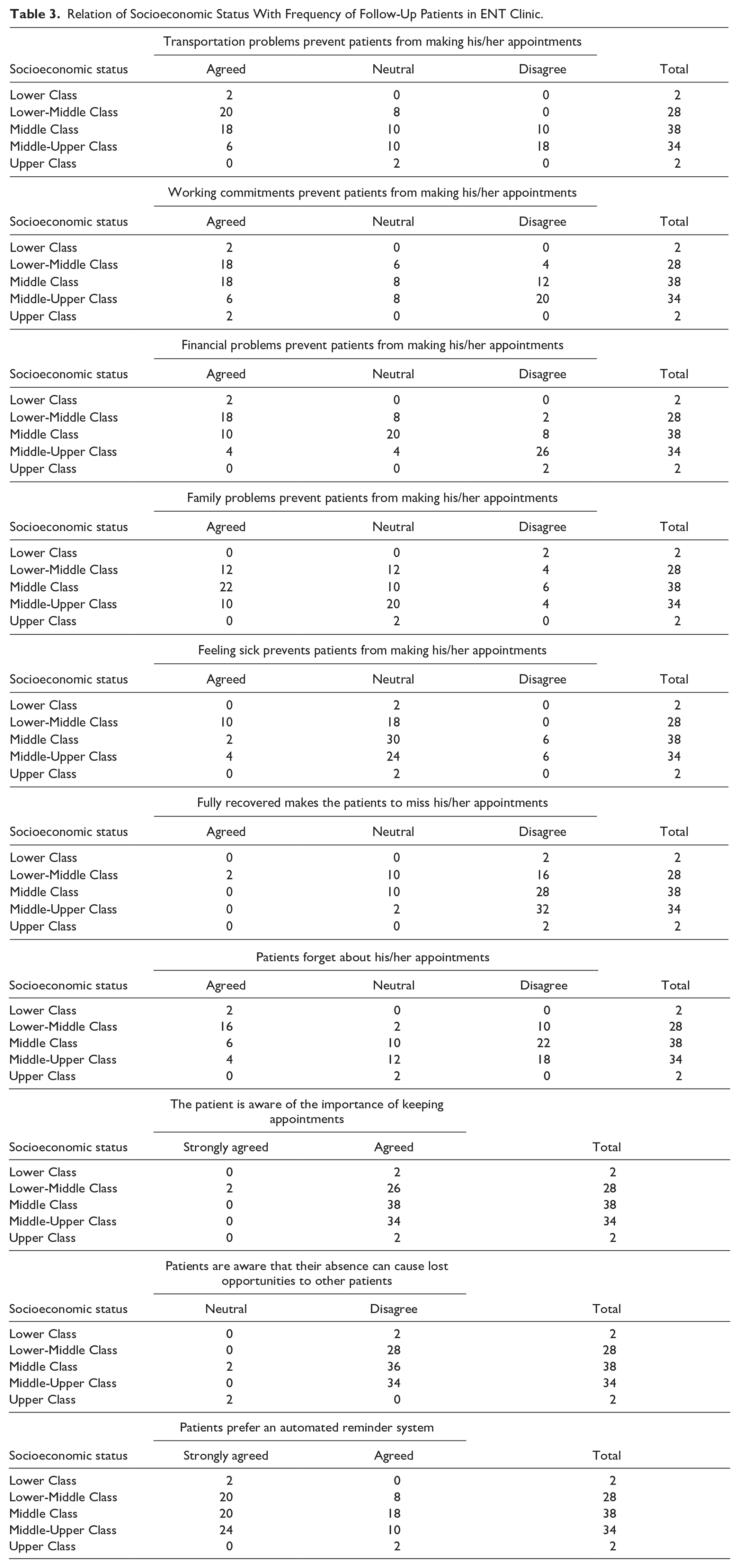
Table 4 explores the relationship between socioeconomic status and the frequency of follow-up patients in an ENT clinic, focusing on various factors influencing appointment adherence. Notably, transportation problems emerge as a significant barrier, particularly affecting the “Lower middle and Middle Class” individuals, in an overwhelming majority and a highly significant P = .00. Similarly, working commitments and financial problems significantly impact appointment attendance, predominantly affecting the “Middle-Upper Class” (P < .004) and “Middle Class” (P = .00).
Association Between Socio-Economic Status and Reasons for No ENT Follow-Up.
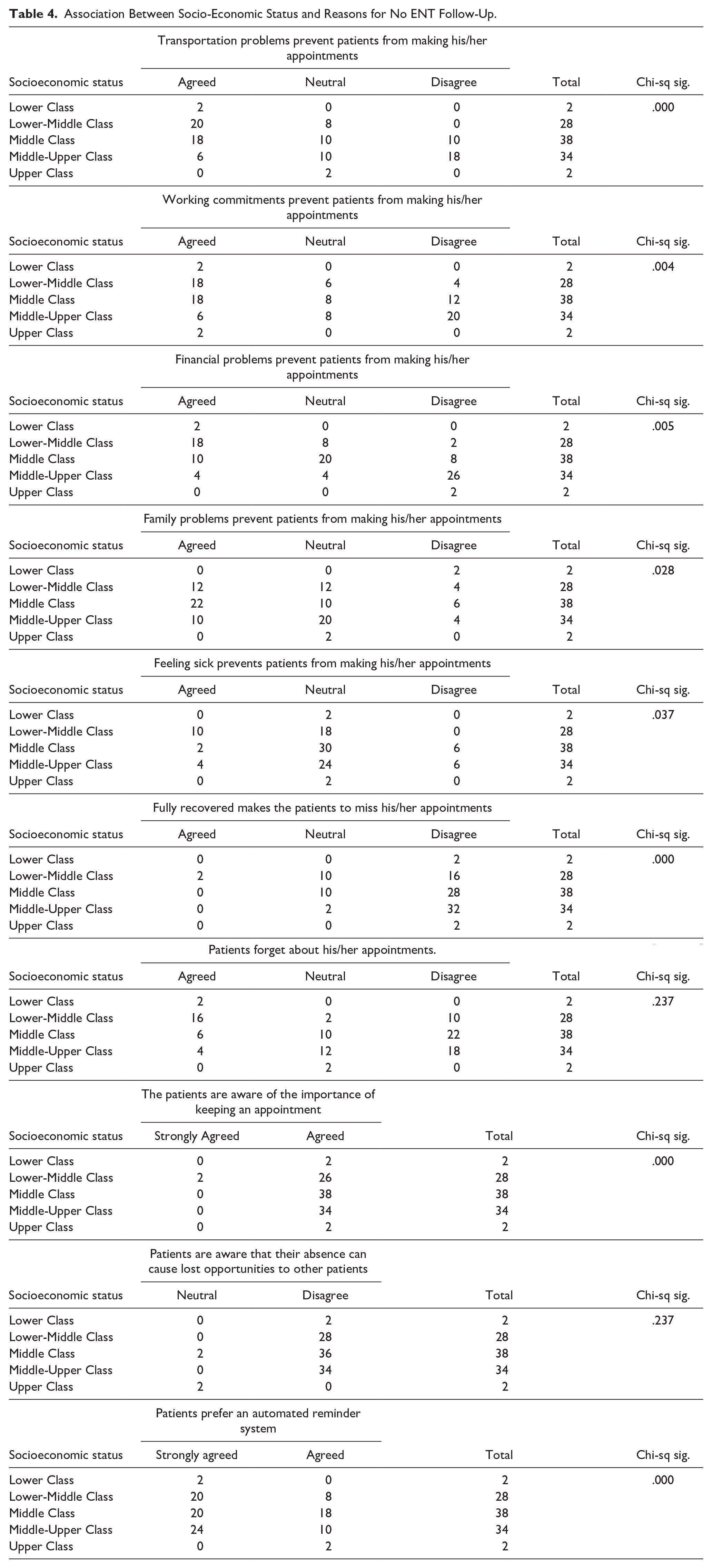
Family problems exhibit a significant association with socioeconomic status (P < .005), particularly affecting the “Lower Class” and “Middle Class.” Feeling sick, being fully recovered, and forgetting appointments also show significant socio-economic associations with P-values of .028, .037, and .00, respectively. Interestingly, while awareness of the importance of keeping appointments does not significantly vary across socioeconomic classes (P = .2737), awareness of the potential impact of absence on other patients is significantly associated with socioeconomic status (P = .00; Table 4). Lastly, although not statistically significant (P = .08), there is a notable inclination across all socioeconomic classes toward a preference for an automated reminder system.
Discussion
The existing literature demonstrated that to examine the factors associated with the nonattendance of patients at follow-up appointments, previous scholars extensively employed qualitative and quantitative approaches. Moreover, the research in these fields observed that factors related to nonattendance were not limited to any specific specialty. Several factors were analyzed for the patient’s attendance in urology units for pediatrics, 12 psychiatric units, 13 primary care units, 13 and pulmonary rehabilitation centers. 14 However, there is a deficiency of literature on clinical audit, particularly follow-up appointments at ENT clinics which is important for comprehensively examining the factors of nonattendance concerning care of the ear, nose, and throat. Thus, this study analyzed the barriers to showing up at follow-up visits that are specifically associated with the patients at the ENT clinic. It was highlighted that the underlying reasons were patients’ transportation problems, professional engagement, family, and financial problems. However, patients did not identify forgetfulness about the appointment, complete recovery, and health-related issues on the day of the appointment as the barrier to missing their scheduled appointment. These results are in contrast with the findings of Samuels et al. 15 They examined the factors in association with missed follow-up appointments specifically in pediatrics. They found that patients admitted to the reasons for non-attendance as forgetfulness, experiencing difficulty in transportation, and professional engagement. Additionally, the study of Wong et al 16 determined the reason for missed follow-up appointments in outpatients of ophthalmic clinics. They found busy scheduling, forgetfulness about the appointment, and health-associated issues incurring on the day of the scheduled appointment as the factors for patients’ nonattendance. This study revealed that the frequency of missed follow-up appointments of outpatients in tertiary-level eye care has extensively prevailed. On the other hand, some past studies also surveyed and interviewed professionals and patients to compare and explore the reasons for not attending scheduled appointments.17-19 They have reported results similar to the present study and found that physical location, transportation, cultural, and language differences issues were the primary factors.17-19
The results of this present study demonstrated that ENT patients experienced transportation problems, work engagement, financial problems, and family problems as the most highlighted patient-specific factors in nonattendance for their follow-up appointments. It stated that forgetfulness about appointments was not a considerable patient-specific factor as most of the patients disagreed on missing their appointments due to this factor.
It was observed that the socioeconomic status of the patients had an impact on the attendance of patients at their scheduled follow-up visits. Therefore, transportation challenges disproportionately affect the “Lower Middle Class,” while the “Middle class” grapples with issues related to working commitments and financial constraints. Working commitments were also the leading factor for missed appointments across socioeconomic groups. However, forgetfulness was also a significant factor but only for Lower-Middle Class patients. Nevertheless, missed follow-up appointments not only have an adverse effect on the health of the patients themselves but also burden the healthcare system in addition to causing another well-deserving patient to lose their opportunity.
In their study, Parente et al 20 also endorsed that missed appointments had adversely impacted the system of healthcare and also had an influence on the effectiveness of clinics. Thus, it is also important to create awareness that no-shows not only cause financial loss to the healthcare systems which invest time and money to persuade patients into attending their appointments but also adversely impact the quality of care being provided. Furthermore, healthcare systems with automated reminder systems must work on an automated survey to generate large volumes of data on patients who failed to attend their follow-up appointments.
Recommendations and Limitations
Notably, 100% of respondents thought that automated reminders would be a good idea. The reason behind this discrepancy might be because of mostly patients remember their scheduled appointments but an automated reminder system can be helpful by recalling them about their follow-up appointments so that they can manage and organize their work and other activities. There is a need to make people aware of the importance of keeping an appointment but also the realization that missed appointments can reduce the availability of medical services for other patients because follow-up appointments are a preoccupied slot. It is also suggested that to decrease missed appointments of patients, doctors can provide concessions on second follow-up visits and can provide consultation through a telephonic medium (in case of emergency and severity of disease patient should appear physically at the clinic). Additionally, a collective awareness of the impact of one’s absence on other patients is evident, emphasizing the need for tailored solutions to enhance healthcare access and engagement across diverse socioeconomic groups in the ENT clinic.
However, this study has some limitations as the sample size was small and specifically focused on the audits of ENT clinics. In the future, scholars can highlight the factors and reasons for missed appointments with large sample sizes and different branches of practice. Another limitation is that this study focused on qualitative analysis. Research scholars can employ a mixed methodological approach to identify comprehensive reasons behind missed appointments.
Conclusion
This study identified and examined the barriers to appointment attendance and analyzed the patient-specific factors contributing to noncompliance with scheduled appointments at the ENT clinic. This study highlighted different patient-specific factors that contribute to a barrier to missing already scheduled appointments. The most important factors were transportation problems, family problems, financial problems, and professional engagement. However, this study did not identify health-related issues on appointment day, and complete recovery from the disease as contributing factors in missed appointments. It is also noticed that most of the respondents agreed that forgetfulness was not a significant factor for nonattendance but on the socioeconomic status of the patients (Lower-Middle Class) it had a significant impact. Missed appointment is a national concern and not only affect the health of the patients but also burden the healthcare system.
Supplemental Material
sj-docx-1-ear-10.1177_01455613241283798 – Supplemental material for Analyzing Factors and Reasons Behind NonAttendance of ENT Patients: Clinical Audit
Supplemental material, sj-docx-1-ear-10.1177_01455613241283798 for Analyzing Factors and Reasons Behind NonAttendance of ENT Patients: Clinical Audit by Faris Ahmed Bahammam, Neil Tolley, Romana Kuchai, Elliot Benjamin and Matthew Rollin in Ear, Nose & Throat Journal
Footnotes
Clinical Trial Registration
Not applicable.
Data Availability Statement
The data will be available for review from the corresponding author on request.
Declaration of Conflicting Interests
The author(s) declared no potential conflicts of interest with respect to the research, authorship, and/or publication of this article.
Funding
The author(s) received no financial support for the research, authorship, and/or publication of this article.
Ethics Approval Statement
The study was conducted according to the guidelines of the Declaration of Helsinki.
Patient Consent Statement
Verbal consent was taken from all the study participants.
Permission to Reproduce Material from Other Sources
Not applicable.

Supplemental Material
Supplemental material for this article is available online.
References
Supplementary Material
Please find the following supplemental material available below.
For Open Access articles published under a Creative Commons License, all supplemental material carries the same license as the article it is associated with.
For non-Open Access articles published, all supplemental material carries a non-exclusive license, and permission requests for re-use of supplemental material or any part of supplemental material shall be sent directly to the copyright owner as specified in the copyright notice associated with the article.
